Saturday, June 13, 2020

Bishop Basil Meeking (1929-2020): Requiescat in Pace

NLM has learned of the death of the Most Rev. Basil Meeking, Emeritus Bishop of Christchurch, New Zealand, who was for many years a staunch supporter of the usus antiquior, which he celebrated frequently. Although nowadays pontifical ceremonies are becoming (relatively) common, Bishop Meeking was well ahead of the curve in that regard. For example, he did pontifical Holy Week ceremonies in Melbourne for many, many years (the photo to the left is from 2010).

He actively supported the Sons of the Most Holy Redeemer (Transalpine Redemptorists), the Priestly Fraternity of St. Peter, and the Institute of Christ the King Sovereign Priest, among others. The traditional movement in New Zealand stands greatly in his debt.

On one occasion, Bishop Meeking wrote a kind note to me about an NLM article; his comments indicated that this was a blog he read with some regularity, which is gratifying to know. It edified me that the particular article he wanted to have as a Word document was the Examination of Conscience based on the Rule of St. Benedict (here). He also expressed his agreement with the content of “Cantate Domino Canticum Novum: A Statement on the Current Situation of Sacred Music,” published in nine languages in 2017.

Meeking was ordained a priest in 1953. From 1963 to 1966, he studied at the Pontifical University of Saint Thomas Aquinas in Rome, following which he was appointed to the Pontifical Council for Promoting Christian Unity in Rome, where he served for eighteen years. He was appointed as Bishop of Christchurch by Pope John Paul II on 30 March 1987 and resigned the see on 15 December 1995. Meeking died in Christchurch on 11 June 2020, aged 90, after what was reported as a recent period of ill-health. (Information culled from Wikipedia; to read more and see a number of photographs, visit the diocesan archives.)

It is heartening to read that, in addition to the usual funeral Mass on Wednesday 17 June at 11am at St Mary’s Pro-Cathedral, 373 Manchester Street, the diocese is also announcing on its website a 7:00pm “Vigil Requiem Mass in the Extraordinary Form” on Tuesday 16 June at the same cathedral.

Given his great devotion to the Holy Sacrifice of the Mass, it is highly fitting that His Excellency passed to his eternal reward on the feast of Corpus Christi. The Church needs many more humble and generous servants like Bishop Meeking. May it please Our Lord to grant him eternal rest, and to raise up more shepherds with a heart for Catholic tradition.
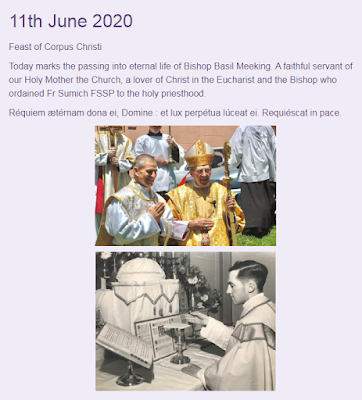
From FSSP New Zealand
From diocesan archives
At a priestly ordination for the Transalpine Redemptorists
Receiving the first blessing of the priest

Monday, November 02, 2015

Romano Guardini on Evening, Death, and Eternal Life

On this day, the Commemoration of All the Souls of the Faithful Departed, we pray the Lord, in His abundant mercy, may deign to raise up the faithful departed to the vision of His supernal glory. Requiem aeternam, dona eis, Domine, et lux perpetua luceat eis.

Reflections on death, judgment, heaven, and hell were abundant in Catholic preaching and literature of the past, but one is saddened to see that these topics have suffered an enormous eclipse since the Second Vatican Council, an eclipse that has barely abated. Death has been, in a sense, forbidden as a theological topic or pastoral theme, "papered over"; we spend our efforts (at least in affluent Western societies) putting off the day of human reckoning as long as possible, and when it finally comes, nobody knows what to say, think, or do, as evidenced by a widespread lack of profound rituals of mourning and suitably somber liturgical ceremonies focused on praying for the salvation of the departed. As for divine judgment, the pendulum has swung from a supposedly exaggerated fear of the Pantocrator in olden times to our modern non-judgmental God of Elysian fields who holds out crowns for every man, woman, and child, like free tickets to a public event. No matter how one looks at it, there is a serious need for a serious return to traditional meditation and preaching on the Four Last Things.

I have always been struck by a particular meditation offered by Romano Guardini in his marvelous little book, Sacred Signs. Many will already know of this book, because it is one of the best introductions to liturgical symbolism ever written. I remember first finding out about it through a lecture by Fr. Cassian Folsom, O.S.B., Prior of Norcia, in which he took various points from Guardini and used them as a way of explaining how we can pray liturgically with greater understanding of what we are doing and why we are doing it, and with a greater integration of body and soul.

Here is Fr. Guardini's reflection on the meaning of the day's ending, each day's ending:

EVENING
         Evening also has its mystery. The mystery of evening is death. The day draws to a close and we make ready to enter the silence of sleep. The vigor which came with the morning has by evening run down, and what we seek then is rest. The secret note of death is sounded; and though our imaginations may be too crowded with the day’s doings or too intent on tomorrow’s plans for us to hear it distinctly, some perception of it, however remote, does reach us. And there are evenings when we have very much the feeling that life is drawing on to the long night “wherein no man can work.”
         What matters is to have a right understanding of what death means. Dying is more than the end of life. Death is the last summons that life serves on us. Dying is the final, the all-decisive act. With individuals as with nations the events that precede extinction in themselves conclude and settle nothing. After the thing has happened, it remains to be determined, by nations as by individuals, what is to be made of it, how it is to be regarded. The past event is neither good nor evil; in itself it is nothing. It is the face we put upon it, our way of viewing it, that makes it what it is. A great calamity, let us say, has overtaken a nation. The event has happened, but it is not over with. The nation may give way to despair. It may also think the matter through again, rejudge it, and make a fresh start. Not until we have decided how to take it is the event, long past though it may be, completed. The deep significance of death is that it is the final sentence a man passes on his whole life. It is the definite character he stamps upon it. When he comes to die a man must decide whether he will or will not once more take his whole life in hand, be sorry for all he has done amiss, and plunge and recast it in the burning heat of repentance, give God humble thanks for what was well done, (to him be the honor!) and cast the whole upon God in entire abandonment. Or he may give way to despondency and weakly and ignobly let life slip from him. In this case life comes to no conclusion; it merely, without shape or character, ceases to be.
         The high “art of dying” is to accept the life that is leaving us, and by a single act of affirmation put it into God’s hands.
         Each evening we should practice this high art of giving life an effectual conclusion by reshaping the past and impressing it with a final validity and an eternal character. The evening hour is the hour of completion. We stand then before God with a premonition of the day on which we shall stand before him face to face and give in our final reckoning. We have a sense of the past being past, with its good and evil, its losses and waste. We place ourselves before God to whom all time, past or future, is the living present, before God who is able to restore to the penitent even what is lost. We think back over the day gone by. What was not well done contrition seizes upon and thinks anew. For what was well done we give God humble thanks, sincerely taking no credit to ourselves. What we are uncertain about, or failed to accomplish, the whole sorry remnant, we sink in entire abandonment into God’s all-powerful love.


SOURCE

Sacred Signs. First published 1911. Trans. Grace Branham (St. Louis: Pio Decimo Press, 1956). [Last year, I took the public domain text and re-typeset it completely so that my students could have a nice edition. Then I decided to make it available to the public: see here.]

Other excerpts from this book — the sections on kneeling and incense — may be found here.

More recent articles:

For more articles, see the NLM archives:




