Friday, November 28, 2025

A Very Useful New Piece of Liturgical Scholarship from Sharon Kabel

One of our most frequently seen and linked posts in NLM’s history is a guest article shared with us by archival researcher extraordinaire Sharon Kabel in 2020, about the mythical indult which supposedly granted a general dispensation from the traditional rule of abstinence from meat, in the United States, on the Friday after Thanksgiving, (i.e. today). Mrs Kabel has recently completely another very interesting project on the history of the wedding Mass, which she was able to do via the incredibly useful Usuarium database, a vast, searchable repository of medieval liturgical books. Surprisingly, it turns out that the wedding Mass in the Missal of St Pius V (known from its Introit as Deus Israel) is actually a new creation which did not previously exist. Sharon’s research reveals that there was a variety of different wedding Masses, and the most common was simply a votive Mass of the Holy Trinity.

The wedding Mass, with the Gregorian propers from the votive Mass of the Most Holy Trinity, in a Missal according to the Use of Arrhas in France, printed in 1508. BNF Paris, B-27899
Her project examines all the different parts of the wedding Mass (Gregorian propers, including the sequences, Scriptural readings etc.) and tabulates which ones were used most commonly in which regions, organized into charts which show the frequency of their use, and maps out the geographical regions where each was most common. You can the whole thing on her website:
https://sharonkabel.com/survey_wedding_masses_983-1617/

or download it as a pdf:
This project is not just a worthy and interesting piece of research in its own right, but a model for similar projects to explore other aspects of our liturgical patrimony. We congratulate Mrs Kabel on her excellent and diligent work - feliciter! 

Thursday, September 07, 2023

The Fivefold Nuptial Blessing: A Millennium-Long Mystery Solved by Sharon Kabel

The indefatigable Sharon Kabel, whose superb research work we have shared several times, has taken a lot of interest in wedding rituals. She has very kindly shared with us the results of her investigation of a nuptial blessing which appears in the 1954 American Collectio Rituum. The Latin translation below is by Isaac Smith Schendel, the German translation is edited by William Kabel and Isaac Smith Schendel.

In my ongoing quest for minutiae about Catholic nuptial texts, I have written elsewhere about an oddly worded blessing in the Roman Catholic Rite of Marriage. The blessing’s themes are fivefold: love, children, friends, work, eternal life. They appeared in the 1954 American Collectio Rituum [1] and 1964 Roman Ritual. [2] At the time, I attributed the blessing to Reverend Philip T. Weller because of his translation of the Rituale Romanum. He was also the likely author (or at least codifier) of our current Rite of Betrothal.
Even in a nuptial setting, I found the blessing overly sentimental, and was glad to see that they disappeared from the Rite of Marriage after 1964.
Imagine my excitement when I discovered a 1950 German Collectio Rituum with that same blessing (obviously in German)! [3] It seemed unlikely that Fr. Weller composed them - so who did? To my great surprise, I found an essay from an author of the 1950 German Collectio, claiming that this nuptial blessing was actually a restoration of an old text:
From my own diocese of Trier, the oldest in Germany, was taken the fivefold blessing which the priest pronounces, extending his hands over the newly-married couple at the end of the wedding ceremony. You are perhaps familiar with this much and rightly admired blessing (which originated in the West Gothic Liturgy of Spain) from the American Ritual, which took it over. [emphasis added] [4]
So, this fivefold nuptial blessing was not written by the Americans in the 1960’s, nor by the Germans in the 1950’s, but… by the Spanish in the 600’s?
The history of any nuptial text or tradition is murky and complex. It is possible that a blessing did indeed make its way from 7th century Spain to twentieth century Germany and America. But… one wonders. The twentieth century liturgical reformers had a bad habit of justifying their reforms with spurious antiquarianism.
The burning question is: what does this 7th century Mozarabic ritual say? Does this nuptial blessing really have a 1300-year old pedigree? The Mozarabic ritual is scanned online, but it’s a reprint of the original manuscript. I hoped to find the most original text possible. I owe the success of my quest to Christina Linklater, at the Isham Memorial Library and Houghton Music Cataloger at Harvard Library. Out of hundreds of oddly-assembled pages in several languages, she found not only the wedding ceremonies, but the fivefold blessing itself.
I’ve created a comparison chart of the blessings as they appear in the Mozarabic Liber Ordinum (Latin and translated), the German Collectio (German and translated), and the American Collectio.
While the broad themes of love, children, and friends are present in all versions, it’s clear that the twentieth century blessings embellished on those themes. For example, the Mozarabic Liber’s blessing “gaudeatis perenniter cum amicis” has become “May the peace of Christ dwell always in your hearts and in your home; may you have true friends to stand by you, both in joy and in sorrow. May you be ready with help and consolation for all those who come to you in need; and may the blessings promised to the compassionate descend in abundance on your home” in the 1954 American Collectio.
There have been numerous changes in liturgical and sacramental texts in the twentieth century. The current iteration of this blessing is more a question of taste, rather than nefarious doctrinal changes. So why waste ink on something so small?
This fivefold blessing is one small piece in a cascade of changes to the marriage rituals. The 1970 Rite of Marriage is almost completely changed from the 1962 Rite of Marriage (which is identical to the 1615 Tridentine Rituale). The ancient and majestic Nuptial Blessing, with its own rubrics and graces, has been revised dramatically, with many particular blessings removed. Marriage itself has suffered on a catechetical level, with, for example, a decrease in emphasis on the dangers of mixed marriages. It is worthwhile, therefore, to take note even of small reforms in our holy sacraments, because they can lead to bigger changes.
More importantly, the justification for reforms is critical. Weddings in particular have been (and will continue to be) variable. The modern reformers could have picked any number of nuptial blessings from the hundreds of extant, geographically proximate, early to late medieval liturgical manuscripts. They could have justified the fivefold blessing by saying that they took an old blessing, and adapted it for the unique needs of modern man. They did not do either of these things.
The editor of the German Collectio claimed that the blessing “originated in the West Gothic Liturgy of Spain.” This is a tricky statement. The word “originated” provides just enough plausible deniability: it’s stronger than “inspired by”, but much weaker than “is identical to”. It is true, in a way, that the blessing originated in Spain, but the twentieth century version of the blessing has clearly taken on a life of its own. We have seen this archaeologism before with more important issues, such as “the early Church received on the hand, and stood rather than kneeling, and so should we.” Why a text is changed is arguably just as important to us as what was changed, and if the reasoning for the change is weak, it should give us pause.
For as much as the modern reformers embellished the fivefold blessing - the latest iteration is nearly five times as long as the Mozarabic original - it is worth considering what themes were not mentioned. Catholic wedding blessings over the centuries have asked God for the blessings of children, of health, and of long life. However, it was not uncommon for nuptial blessings to ask for angelic protection against demons, simultaneously a sobering and comforting thought. By way of a closing thought, here are a few examples of medieval nuptial blessings [5]:
  • Bobbio Missal (8th cent.): Pour out your blessing through Raphael, your angel of peace, that health and honor might be theirs.
  • Benedictional of Robert of Jumièges (early 11th cent.): May he who sent the archangel Raphael to prepare the marriage of Tobias and Sarah send his holy angel from his heavenly throne to comfort you in his holy service, show you the path of righteousness and protect you forever from all evil.
  • Canterbury Benedictional (1025-50): May the angel of God be with them as an unfailing guard; may the power of the devil be utterly expelled from them; may their days be multiplied in peace and enriched with children…
  • Sacramentary of Vich (1038): Grant them, Lord, to be of one mind in the fear of your Name and to show their love in the goodness of their mutual behavior… May they render to one another the debt of marriage in such a way as to never cause offense to you… Let them so negotiate all temporal business that they will continue faithfully to long for eternal things.
  • Missal of Bury St. Edmunds (12th cent.): Look down, O Lord, from your holy heaven upon this marriage and send Raphael, your angel of peace, that they might be healthy and worthy and peaceable, and pour out your blessing upon them.
  • Sarum Manual, blessing of the marriage bed (16th cent.): O God, who neither sleep nor slumber, bless this bedchamber, you who watch over Israel, watch over your servants as they sleep in this bed, protecting them from all demonic dreams…
  • Ritual of Coutances, blessing of the bedchamber (18th cent.): Visit, we beseech you, O Lord, this dwelling and drive far from it all the snares of the enemy. Let your holy angels dwell herein who may keep these newlyweds in peace…
Click to enlarge
Notes:
[1] Collectio Rituum Ad Instar Appendicis Ritualis Romani Pro Diœcesibus Statuum Fœderatorum Americæ Septentrionalis. Cum Licentia Sacrae Congregationis Rituum. Milwauchiæ: Ex typographia Bruce, 1954
[2] The Roman Ritual Complete ed. Milwaukee: Bruce Pub. 1964
[3] Collectio Rituum Ad Instar Appendicis Ritualis Romani Pro Omnibus Germaniae Diocesibus. (1950).
[4] Fischer, Balthazar, “Impressions of the German Ritual” The Furrow 8, no. 10 (1957): 659-74. http://www.jstor.org/stable/27657252
[5] All translations from: Searle, Mark and Kenneth W Stevenson, 1992. Documents of the Marriage Liturgy. Collegeville: Liturgical Press: A Pueblo Book. Searle & Stevenson have a chapter on the Mozarabic Liber, along with their own translation of the fivefold blessings: “May the Lord bless you by the word of our mouth, and may he join your hearts in the everlasting bond of sincere love. May you flourish with an abundance of this world’s goods; May you be fittingly blessed with your children; May you always rejoice in your friends. May the Lord grant you the goods that last, to your parents a happy old age, and to all everlasting happiness.”

Saturday, July 22, 2023

Historical Images of Notre-Dame de Paris: A Collection by Sharon Kabel (Part 2)

Here is the second part of Sharon Kabel’s collection of images of the interior of Notre-Dame de Paris, which she gracious agreed to share with us: the first part was published on Wednesday. This covers the period from the Revolution to modern times, during which the church was severely damaged in more than one way. The motto of the city of Paris is “Fluctuat, nec mergitur – it is tossed by the waves, but not sunk”, and this applies to its cathedral as well, as these images beautifully show.

1790 A Te Deum sung at Notre-Dame on February 14, 1790, commemorating the session of Parliament of Feb. 4, for which the king was present. (This was an attempted reconciliation between King Louis XVI and the revolutionaries, which would soon fail.) Imprimerie des Revolutions: Paris.
https://gallica.bnf.fr/ark:/12148/btv1b6948087c?rk=42918;4#

1793 An idolatrous festival celebrated in the cathedral, dyring which the Jacobins had an actress sit on the high altar, dressed as the goddess Reason. 1793, J. M. Will: Augsburg. https://gallica.bnf.fr/ark:/12148/btv1b52509803t?rk=1373397;2

1800s Charles Percier. The choir of Notre-Dame before the restoration by M. Viollet-le-Duc. Bibliothèque nationale de France. https://gallica.bnf.fr/ark:/12148/btv1b103033087?rk=879832;4
1800s A drawing of the sanctuary, 1163-c.1250, as conceived in the 19th cent. Paris: Notre-Dame Cathedral Ref.: drawings sanctuary. https://library-artstor-org.ezaccess.libraries.psu.edu/asset/ARTSTOR_103_41822003354576

1802 Aubert, M. (1920). Notre-Dame de Paris: sa place dans l’histoire de l’architecture du XIIe au XIVe siècle. [Paris]: Librarie Renouard.

Wednesday, July 19, 2023

Historical Images of Notre-Dame de Paris: A Collection by Sharon Kabel (Part 1)

Once again, we are profoundly grateful to Mrs Sharon Kabel for sharing one of her wonderful research projects with NLM. This time, she has made a collection of historical images of the high altar and choir of the cathedral of Notre-Dame in Paris, enough that we can make two posts of them. In its long history, as she rightly notes, “The high altar and the choir of Notre Dame have gone through several drastic changes, all of which drew strong and mixed reactions when they happened, and in ensuing decades.” I am sure that a good number of our readers will agree with me that the new arrangement installed by King Louis XIV (1699-1714) would have been worthy in and of itself for a new church of its era, but that in Notre-Dame, was not an improvement over the medieval arrangement. But I am equally sure that any of the arrangements we see here would be an improvement over the truly awful new liturgical furnishings which the archdiocese of Paris recently revealed, so hopefully, these images will also provide inspiration for a future dewreckovation.

This first part covers images up to the beginning of the Revolution; the second will cover the period from 1790 to April, 2019.

The altar in the 1200s, from Viollet-le-Duc, E. (1875). Dictionnaire raisonné de l'architecture française du XIe au XVIe siècle. Paris: A. Morel. https://catalog.hathitrust.org/Record/000776217/Home
The choir in the same period. (Viollet-le-Duc, Eugène-Emmanuel, 1814-79, and Edgar Quinet. Les églises De Paris: Le Panthéon Par E. Quinet. Paris: C. Marpon et E. Flammarion, 1883. https://catalog.hathitrust.org/Record/100345704)
The main altars of Notre-Dame de Paris (fig. 1) and the cathedral of Arras (fig. 2), both with altar curtains (tetravela). Illustration in Franz Bock's 1871 Geschichte der liturgischen Gewänder des Mittelalters.
https://commons.wikimedia.org/wiki/File:Bock1871bd3_0259.jpg
Fortuné Louis Méaulle. [Notre-Dame de Paris, Livre troisième.] Le Grand-Autel. 1877. Maison de Victor Hugo - Hauteville House. Numéro d’inventaire: 2017.0.1322.3.
https://www.parismuseescollections.paris.fr/fr/maison-de-victor-hugo/oeuvres/notre-dame-de-paris-livre-troisieme-le-grand-autel-1#infos-principales
The choir in 1669. (Choeur de N-D de Paris lors du Te Deum donné en 1669, gravure de Jean Marot (1619-79), musée Notre-Dame.)
https://commons.wikimedia.org/wiki/File:Choeur_de_ND_de_Paris_1669.jpg
This coin minted in 1699 shows the plans for the renovation of the sanctuary in the style of the era, planned by Louis XIV in fulfillment of a vow made by his father. (Jerome Roussel. Voeu de Louis XIII. 1699. Petit Palais, musée des Beaux-arts de la Ville de Paris. https://www.parismuseescollections.paris.fr/fr/petit-palais/oeuvres/voeu-de-louis-xiii-0#infos-principales)

Saturday, June 10, 2023

Historical Images of Corpus Christi Processions, from Sharon Kabel (Part 2)

Our thanks once again to the tireless Sharon Kabel for sharing with NLM the results of her research. This is the second part of her series of historical images of Corpus Christi celebrations from around the world, and includes a whole section of processions on boats in Austria and Germany. Part one was published on the feast day.

North America
The San Francisco Call, Volume 86, Number 5, June 5, 1899. https://cdnc.ucr.edu/?a=d&d=SFC18990605

New York Tribune. April 07, 1912. Chronicling America: Historic American Newspapers. Lib. of Congress. https://chroniclingamerica.loc.gov/lccn/sn83030214/1912-04-07/ed-1/seq-47/

Oceania
Manly, Australia (Yes, that really is the name of a coastal suburb of Sidney.) – “The feast of the Corpus Christi, Manly, Sunday, June 1, 1902.” The Sydney Mail and New South Wales Advertiser. June 7, 1902. https://trove.nla.gov.au/newspaper/article/163815139

New Zealand – Roman Catholic religious ceremony. Evening Star, issue 22800, 8 November 1937, page 7. https://paperspast.natlib.govt.nz/newspapers/ESD19371108.2.49.2br

Papua, New Guinea, The Church in Papua. The Advocate (Melbourne, Vic.). August 24, 1912. https://trove.nla.gov.au/newspaper/article/170953115

Thursday, June 08, 2023

Historical Images of Corpus Christi Processions, from Sharon Kabel (Part 1)

For the feast of Corpus Christ, we are grateful once again to the generosity of researcher extraordinaire Sharon Kabel, who has put together this splendid collection of historical images of Corpus Christ processions from a huge range of sources. 

In Africa
Crowd watches Corpus Christi procession in Ouagadougou, Burkina Faso (at the time, the French colony known as Upper Volta), ca.1900-1930.
(International Mission Photography Archive, ca.1860 - ca.1960 (collection), Mission Photographs: Yale Divinity School Library (subcollection), YDS/RG101/007/0000/0036 (file). https://doi.org/10.25549/impa-m12896)
  
Lubumbashi, Congo, ca.1920-40. (IMP/YDS/RG101/045/0000/0098 (file); Ibid. https://doi.org/10.25549/impa-c123-84381

Corpus Christi procession in Fianarantsoa, Madagascar, ca.1900-1930. (Ibid. YDS/RG101/005/0000/0073 (file). https://doi.org/10.25549/impa-m12520
In Asia
Corpus Christi at Hiroshima, Japan; Southern Cross, July 11, 1947. https://trove.nla.gov.au/newspaper/article/167715926

Tokyo, Japan, ca. 1920-40
(IMP/YDS/RG101/043/0000/0082 (file), International Mission Photography Archive, ca.1860-ca.1960 (collection), Mission Photographs: Yale Divinity School Library (subcollection). https://doi.org/10.25549/impa-c123-84069

Hanoi, Vietnam
“Hanoi prays as Reds approach city.” (The Catholic times. [volume] (Columbus, Ohio), 16 July 1954. Chronicling America: Historic American Newspapers. Lib. of Congress. https://chroniclingamerica.loc.gov/lccn/sn83007243/1954-07-16/ed-1/seq-8/)

Saturday, May 27, 2023

Historical Images of the Chartres Pilgrimage, from Sharon Kabel

Since today is the first day of the Chartres pilgrimage, we are very pleased to share with our readers some more of the fascinating research work of Mrs Sharon Kabel, who has put together this wonderful collection of historical documentations of past pilgrimages, going back nearly 100 years. (I am sure our readers have already heard that this year, for the first time ever, the number of people enrolled was so high that the organizers had to close registrations.) Félicitations à tous les pélérins!

From Sharon: To start off, here’s a photo from the 1948 pilgrimage. (from The Catholic World in Pictures, 18 June 1948: https://thecatholicnewsarchive.org/?a=d&d=cwp19480618-01.2.14&srpos=2)
We can thank the poet Charles Peguy for reviving the pilgrimage in the 1910s (not in 1935, as the clipping says... Peguy was long dead by then.) The 1955 pilgrimage allegedly had 14,000 pilgrims and two Masses at the end! (from The Catholic Standard and Times, Volume 60, Number 35, 27 May 1955, https://thecatholicnewsarchive.org/?a=d&d=cst19550527-01.2.128&srpos=1)
1933 - over 5,000 pilgrims. (Catholic News Service - Newsfeeds, 15 May 1933, https://thecatholicnewsarchive.org/?a=d&d=cns19330515-01.1.47&srpos=2)
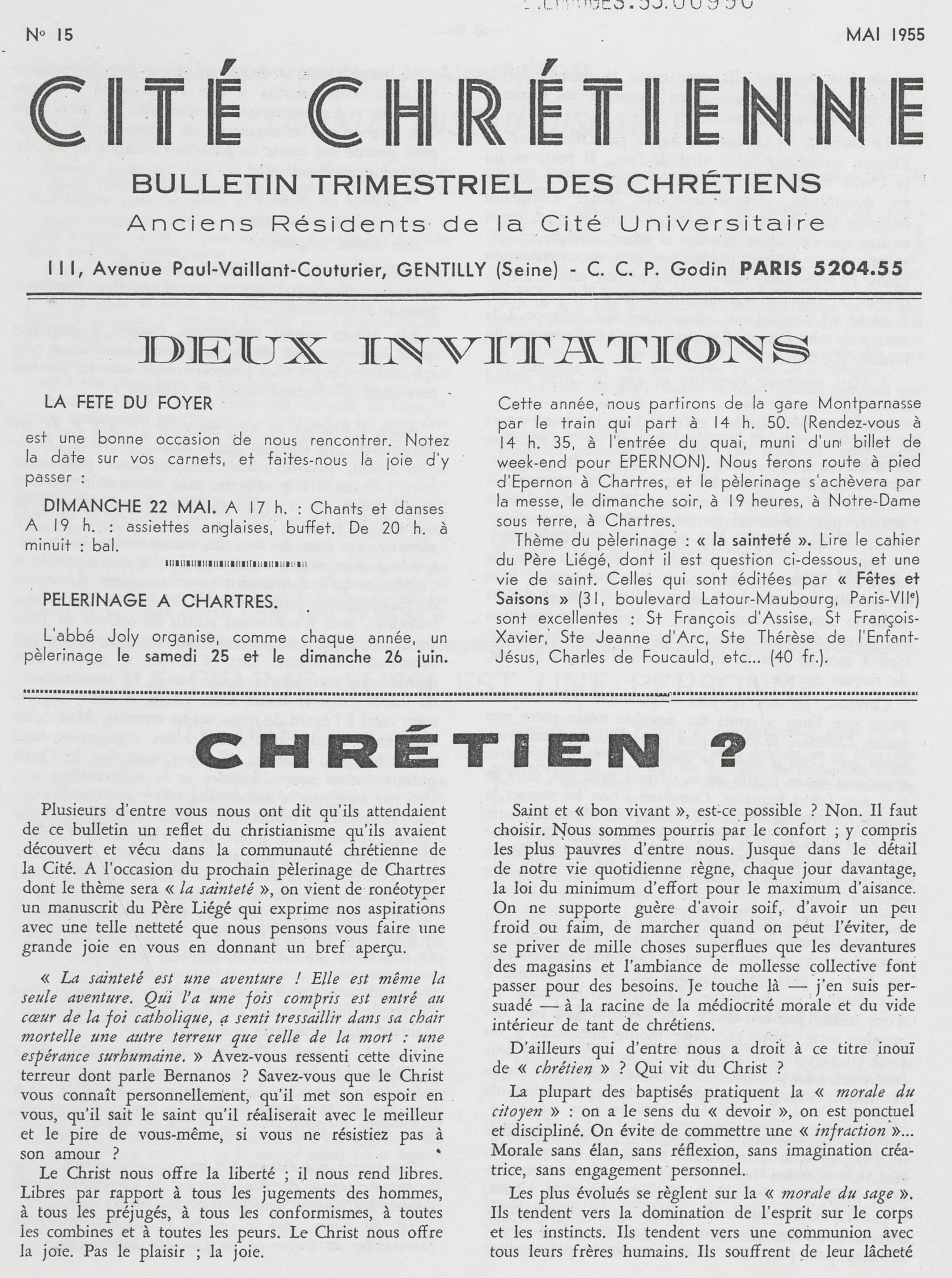
I leave American newspapers behind, and turn to the website of the Bibliothèque Nationale de France. Here’s an announcement for the 1955 pilgrimage in the publication Cité chrétienne. (Cité chrétienne: bulletin trimestriel des chrétiens: anciens résidents de la Cité Universitaire. 1955-05-01. https://gallica.bnf.fr/ark:/12148/bpt6k9783528f)

Wednesday, January 25, 2023

The Periti of Vatican II: A New Research Project by Sharon Kabel

The indefatigable Sharon Kabel, whose superb research work we have shared several times, has just announced an important new project, documenting the careers of the theological experts, or “periti”, as they were generally known, who advised the bishops at Vatican II: https://sharonkabel.com/periti-of-vatican-ii/ A spreadsheet with all the information she has gathered so far, with more than thirty datapoints, is available from her website here:
https://docs.google.com/spreadsheets/d/1H4_HUtAuLCoIyo7pOnmTLSg5bv4K_adLuo98Yx-yW3A/edit#gid=0
Please note that this is an open-source project, and people are encouraged to contribute any further information they may have via this submission form: https://sharonkabel.com/#contact. We are very glad to share Mrs Kabel’s summary and introduction to the project, and to congratulate her for her extraordinarily diligent and useful work - feliciter!

We know (or at least debate) a great deal about the Second Vatican Council, but how much do we really know about who was there? Apart from the Council Fathers, the press, and the observers were the conciliar periti, priests who had expertise in a particular area, appointed to assist the Council and its commissions. These men ran the gamut of theological, pastoral, academic, political, and media experience and influence. During the Council, they assisted and advised, but they also edited, debated, and in some cases, were the leading authors of the Council documents. Some would even become bishops during the Council, and at the stroke of a pen becoming voting members of the Council they had just advised.

After (even during) the Council, the periti gave themselves the weighty responsibility of explaining, interpreting, and implementing the Council to the press, to the Church, to the world, to their home dioceses, even to other periti and Council Fathers. Many became bishops and cardinals after the Council; one became pope.

And yet they remain largely unknown. While the names of some will sound familiar, such as Joseph Ratzinger, Edward Schillebeeckx, OP, or Hans Kung, there is no complete open access list of periti. There have been some studies on the national, such as the Americans and the Belgians, but nothing systematic. These men of influence, learning, and (one hopes) holiness are, as a group, a mystery to us.
The Periti of Vatican II is a new project cataloging information about them; for the first time, you can browse a list not only of 479 Conciliar periti, but of several dozen private periti.
As an example of how unexpectedly time-consuming it was simply to retype the Vatican’s list and to check the first names, here are three:
Jose Moss Tapajos’ name order is wrong, Placid Podipara’s religious and non-Western name has been transmuted (the Latinized abbreviation of his religious order causing even more mayhem), and John Courtney Murray is missing a Ioannes entirely.
I have added over 30 data points to each name, to both verify their identities, and to make this sheet a robust research tool. I also have a Zotero library with references about the periti, and by the periti - including articles, books, and archival finding aids. The list is here, my reference library is here, and you can read more about the project here. The spreadsheet and reference library are freely available to download.
Since I started the project in summer 2022, three periti have passed away: Bill Hunt (left priesthood, married), Donald Dietz, OMI, and of course, Pope Benedict XVI. To my knowledge, the only living conciliar peritus is Archbishop John Stephens Cummins.
Overwhelmingly, the periti occupied roles related to media and education/formation: radio stations, newspapers, journals, magazines, publishing houses, books, television shows, universities, schools, seminaries, etc. The infamous and hugely popular press panel at Vatican II was run largely by periti. Many wrote columns about their experiences and opinions while the Council was still going on. These men, then, were involved not only in the inception, writing, and revising of the Council documents; they also made themselves the emissaries of the Council to the world, interpreting everything to other Council members, to the press, and to ordinary Catholics back home. We need look no further than Father Edward Schillebeeckx’s relationship with the media to see how incredibly messy all of this could get.
After the Council, many became bishops and Cardinals. One wonders if their influence at all stages of the Council, and their relationship with media, is one answer to the perpetual debate and frustration in trying to figure out what the Council really, or “really”, said, did, and meant.
There are so many interesting research rabbit holes to pursue, such as:
● Piero Marini, perhaps the youngest (private) peritus at 20, ordained a priest only a few months before the Council closed.
● John L. Swain, SJ, who has the interesting distinction of being the only person to go from Council Father (session III) to peritus (session IV)
● Thomas F. Devine, who has a golf tournament named after him
● Fabian Flynn, known around the world and confessor to Nuremberg Nazis
● Manuel Bonet y Muixi, survivor of the Spanish Civil War, now forgotten, but once a colleague of Annibale Bugnini and key drafter of Sacrosanctum Concilium
● Basil Frison, CMF, amateur composer whose cassette tapes were found and digitized in the early aughts and sent to WFMU’s 365 Days music project, and you can hear the tapes here and here.
● Georges Marie Martin Cottier, OP, anti-Lefebvre; theologian of the papal household
● Placid (Max) Jordan, OSB, radio pioneer, later-in-life convert, and columnist on the Council
● Reginald Garrigou-Lagrange, OP, and his influence (positive and negative) on fellow periti Fenton and Chenu
● Herman Mizzi, OCD, the Maltese with the most interesting obituary, but no other records…
There are some conciliar periti whose identity I could not verify, and I am sure there are more private periti out there. I hope that other readers and researchers will be able to help me solve some of those mysteries!

Wednesday, April 21, 2021

Sharon Kabel on a Supposed Saying of Pope Pius XII

Our friend Sharon Kabel has just posted another one of her useful and interesting research pieces, this time on a saying ascribed to Pope Pius XII: “The day the Church abandons her universal tongue [Latin] is the day before she returns to the catacombs.” I had read this once before, and was recently going to use it in an article. When I went to look for it in what I thought was the source, the encyclical Mediator Dei, I discovered that it was not there, and in fact, could not trace it to any of the Pope’s published writings or discourses, so I asked Sharon if she could verify it. She posted the full results of her research on her own blog two days ago, and kindly gave us permission to reproduce them. She gives a bit more than I include here, but the sum of it is that while these words are consonant with Pius XII’s thoughts as expressed elsewhere, the exact quote cannot be verifiably ascribed to him.
Public domain image from Wikimedia Commons
“(The) encyclical Mediator Dei is the source that is most commonly given for this quotation, but one will search in vain for the quotation in that document. Pius did, of course, discuss Latin in Mediator Dei with the famous quotation: ‘The use of the Latin language, customary in a considerable portion of the Church, is a manifest and beautiful sign of unity, as well as an effective antidote for any corruption of doctrinal truth.’ (parag. 60) So the sentiment of the original quotation about catacombs is not implausible; it’s simply not confirmed. It’s not in Mediator Dei, and checking something said ‘days before his death’ is above my pay grade and time-traveling abilities.
In the course of checking my usual sources and databases for any relevant keywords, I found several unrelated but interesting uses of the phrase ‘returns to the catacombs’... (but) I can’t confirm that Pope Pius XII ever said, “The day the Church abandons her universal tongue [Latin] is the day before she returns to the catacombs.” There is no evidence he said it, but it is not completely unlikely.
What I did find is a related quotation that has not made its way into any mainstream outlet, as far as I can see. Pope Pius XII, in an Apostolic Letter, said Latin is not a dead language and must be ‘preserved in its force and in its clarity.’ He stressed that the fact that Latin is ‘covered by the dust of centuries’ does not justify calling it a dead language. The Pontiff said it especially deserved to be preserved because it is an instrument which serves to provide understanding of the wisdom of the teachings of the Catholic Church.
... I also checked the Acta Apostolicae Sedis. The closest match that I found was from a letter in May 1958, ‘De Latina Lingua Rite Excolenda.’ (On the cultivation of the Latin language.) ‘Ex omnis aetatis igitur viris litteratis exemplum simul et incitamentum capiant discipuli, qui hac ratione certis innixam argumentis hanc detegent veritatem: linguam Latinam non esse mortuum quiddam vel exsangue saeculorum pulvere contectum** ideoque ad vitae disciplinam prorsus inutile, sed instrumentum atque sapientiae humanitatisque vehiculum, quibus, Ecclesia duce et magistra, noster civilis cultus effictus et conformatus est: eam igitur iure meritoque firmam etiam hodie servare vim et efficacitatem.’ (Let students therefore take from the literary men of every age both example and encouragement, and by this consideration, they will discover this truth which depends on certain arguments: that the Latin language is not something dead, or bloodless, covered over with the dust of the ages, and therefore wholly useless for the study of life, but rather an instrument and vehicle of wisdom and good education, by which, under the leadership and authority of the Church, our civil society was formed and strengthened, and therefore rightly and worthily preserves even today its vigor and efficacy.)
I asked a classicist friend to focus on phrases that I thought used “dust” and “clarity”. He translated two relevant phrases as, “that Latin is certainly not dead or buried in the lifeless dust of ages”, and “therefore rightfully and deservedly to keep this force and power enduring even today.” Given the nearly identical keywords and the date of this letter, it seems reasonable to think that this May 1958 letter from Pius (as yet untranslated in full) ... perhaps may have inspired the alleged catacombs quotation.”

Monday, February 22, 2021

Follow-Up on the Thanksgiving Indult, by Sharon Kabel

Our thanks once again to Sharon Kabel for sharing her research with NLM, this time following up on her November article on the day-after-Thanksgiving indult for eating meat.

In November of last year, I shared a provocative hypothesis: thanks to the discovery of new evidence, it was possible for the first time to confirm that the long-rumored American “Turkey Indult” directly from the Pope did in fact occur, although not quite the way we thought.
Participants in the “Turkey Indult” conversation generally fall into three camps:
● No, the Turkey Indult did not happen; it has been conflated with diocesan permissions for indults.
● Yes, Pope Pius XII did issue a Turkey Indult in 1958 that remained applicable beyond 1958.
● You’re still talking about this?
My position was a fourth way: The papally-issued Turkey Indult happened in 1958 only, and was likely issued by Pope St. John XXIII, not Pius XII. And yes, we are still talking about it, thank you. (For brevity’s sake, I will refer to the event in question as the Turkey Indult throughout the article.)
In this follow-up post, I will briefly respond to the objections raised after my initial article, before revealing additional new discoveries which further confirm my original hypothesis. I would also like to share several new discoveries that paint a picture of growing laxity regarding fasting and abstinence, even before the Second Vatican Council.
Considering the murky origins of this story, and the strident and conflicting opinions held on the matter, it is increasingly obvious that the Turkey Indult Mythos has come to symbolize a preconciliar flash point. The Turkey Indult - its existence and its historiography - is a drama in miniature of rapid relaxation of traditional practices, and of the difficulty of reconstructing mid-twentieth century reforms with any surety.
Origins and Objections
One of the first substantial Internet discussions of the Turkey Indult appeared on Rorate Caeli in 2010 (archived article). Articles with mostly similar wording appeared in 2012, 2013, 2014, 2016, and 2017. The story lacked definitive sourcing, but provided a clear frame for the discussion. The Turkey Indult, the story went, was not merely a privilege granted by the Pope to American bishops (who could use or ignore it diocese by diocese), but instead a direct papal indult from Pius XII to Americans.
In subsequent years, several writers challenged this story because of the lack of evidence. My article, suggesting that the Turkey Indult happened but not quite the way we think, produced a wide range of responses.
Followers of the Turkey Indult have cited three main sources to argue that a papal dispensation did not occur. I will now examine these sources to provide an honest look at the critiques I received.
Source 1: Homiletic and Pastoral Review
Three websites referenced the Homiletic and Pastoral Review (HPR) to argue that the Turkey Indult never happened (Louis Tofari, Romanitas Press; Matthew Plese, Fatima.org (article); Matthew Plese, A Catholic Life). The specific HPR articles cited are:
• Aidan M. Carr, O.F.M.Conv., “Questions Answered: Friday’s Turkey,” Homiletic and Pastoral Review (December 1962; Vol. LXIII, No. 3).
• Aidan M. Carr, O.F.M.Conv., “Questions Answered: Friday’s Turkey Rehashed,” Homiletic and Pastoral Review (February 1963; Vol. LXIII, No. 5): “If my original questioner meant - as he most probably did - that the bishop had dispensed the whole diocese from the law of abstinence on Friday after Thanksgiving, then I should have stated that his subjects could not, in that case, avail themselves of the favor when outside the territory of their ordinary.”
These HPR articles confirm that Rome granted US bishops permission to dispense the faithful from abstinence on holidays or days surrounding holidays. However, as these clippings are concerned with diocesan dispensations in 1962-63, rather than a papal indult in 1958, they do not have bearing on the question of the Turkey Indult.
Source 2: Fr. Bouscaren’s Canon Law Digest
Two writers called upon a weighty source to similarly argue that the Turkey Indult likely did not happen (Matthew Plese, A Catholic Life; Dale Price, Dyspeptic Mutterings). The specific source cited is:
● Father T. Lincoln Bouscaren, Canon Law Digest, vol. 5 (1963, Bruce Publishing Company), pp. 557-8, 565: “In a letter of 13 January 1962 His Eminence, the Cardinal Prefect of the Sacred Congregation of the Council, has graciously informed me that the faculty of the Most Reverend Ordinaries of the United States to dispense from the laws of fast and/or abstinence on civil holidays has been renewed for another period of five years...Note: To avoid misunderstanding, it should be remembered that it does not necessarily follow from the above document that all Ordinaries make full use of their faculties. [...] Dispensation Faculty Available for the Friday After Thanksgiving Day: The U. S. Apostolic Delegate can delegate to local Ordinaries who request it, the faculty to dispense from abstinent on the Friday after Thanksgiving Day. The faculty, when granted, is valid for five years.” [emphases added]
Interestingly, it is worthwhile to note that while Thanksgiving itself is obviously a civic holiday, the Friday after Thanksgiving is not. The fact that the Friday after Thanksgiving was addressed separately a few pages later supports the idea that indults for civic holidays did not automatically include the Friday after Thanksgiving.
Despite this, Fr. Bouscaren’s Digest did not address a 1958 papal Turkey Indult. The writers citing this source merely suggested that the 1958 Turkey Indult was in reality a diocesan dispensation that fell under the existing permissions.
Source 3: The Arkansas Catholic newspaper
One reader shared the following newspaper article:
● Arkansas Catholic, March 1, 1963, “Regulations on Fast and Abstinence: Diocese of Little Rock, 1963“: “By reason of special faculties, His Excellency, the Most Reverend Bishop, grants herewith the following dispensations:...from the Law of Abstinence on Friday, November 29, (day after Thanksgiving)...”
This article described diocesan indults in force for 1962-3 for the Friday after Thanksgiving (and several other days). This newspaper article did not address a 1958 papal Turkey Indult.
New Discoveries
In preparation for this second installment, I redoubled my efforts to find additional confirmation of the Turkey Indult described by Fr. Daniel Brennan in The Pittsburgh Catholic newspaper. As I mentioned at the end of my first article, the phrasing of Fr. Brennan’s response and the date of John XXIII’s election to the papacy make it highly suggestive that the Turkey Indult was granted by John XXIII and not Pius XII.
In the course of research, I sadly could find no additional sources besides the already-linked Pittsburgh Catholic article. I did, however, discover three additional dramatic papal indults granted by John XXIII within the first 10 months of his papacy.
Friday, December 26, 1958 (not a feast, vigil, or civic holiday)
Pope Okays Meat Friday Dec. 26,” The Herald-Press, Saint Joseph, Michigan (16 Dec 1958)
Friday, May 1, 1959 (a new feast)
Pope John Says Catholics Can Eat Meat Today,” Star Tribune, Minneapolis, Minnesota (01 May 1959)
Friday, August 14, 1959 (a vigil)
Catholics Can Eat Meat Friday, Pope Declares,” Galesburg Register-Mail, Galesburg, Illinois (11 Aug 1959)
These newspaper articles demonstrate that these papal dispensations were not routine or familiar and caused confusion amongst the bishops and the faithful.

Thursday, December 17, 2020

Paul VI Was Once In Favor of Sacrosanctum Concilium

It is perhaps difficult to believe, especially for those who were born after Vatican II, but there was really was a time when people within the Church, even at the uppermost levels of the hierarchy, thought that the reforms and changes that would be introduced after the Council would actually have something to do with what the Council itself said. Of course, were one to read any of its documents, and then look at the reality of the Church as it is now, one would reasonably be skeptical of such a claim, and many people have been skeptical of it. However, the indefatigable Sharon Kabel has unearthed yet another very interesting piece of history, one which proves that the claim is in fact true.
On April 6, 1964, the Catholic Transcript, an official publication of the Archdiocese of Hartford, Connecticut, printed an article titled “Gregorian Chant Not In Any Danger, Pope Tells French.” It is brief enough to quote in full.

“Pope Paul VI has sought to assuage the fears of those who see the ecumenical council’s Constitution on the Liturgy as possibly spelling a new eclipse for Gregorian chant. Speaking to a pilgrimage of French teachers of plain chant, the Pope said, ‘Are any of you perhaps alarmed at the future applications of the Constitution on the Sacred Liturgy which was adopted by the council Fathers and promulgated by us last Dec. 4? Let them read that admirable text’s passage concerning liturgical chant, and particularly the following: “The treasure of sacred music is to be preserved and fostered with great care… ” (Liturgy Constitution, Paragraph 1141).

Pope Paul went on to say that some ‘effort of adaptation’ will be necessary, but added he is confident ‘that you are generously disposed and prepared to do so.’ Stating that Gregorian chant assures great beauty to the rites of the Church, the Pope declared: ‘As our predecessors often pointed out, this chant has all the qualities required in religious music.’ ”

Note this carefully: the Pope takes it for granted that the Church’s treasure of sacred music will in fact be preserved and fostered with great care, because the Council has said that that it is to be preserved and fostered with great care, and this is sufficent to assuage the fears of those who worry that chant faces a new eclipse. Furthermore, he even appeals to his predecessors’ praise of Gregorian chant, also within the context of assuaging such fears, which strongly suggests (without explicitly stating so) that he intends to follow their example. But the stated intention is absolutely clear; the Council will be obeyed.

It hardly needs to be said that honesty played far too small a role in the execution of the post-Conciliar reform, and currently plays far too small a role in the ongoing assessment of it. But I feel that honesty requires us to recognize not only that the Council was not obeyed, but also that responsibility for that disobedience lies first and foremost with Paul VI himself. Only five and a half years later, at the final general audience before the imposition of the Novus Ordo (Nov. 26, 1969), he admitted that the arrival of the new liturgy would indeed bring about the very eclipse that he had previously declared would not take place. “We (i.e. the Church) will lose a great part of that stupendous and incomparable artistic and spiritual thing, the Gregorian chant.” There is no reason why the post-Conciliar liturgy cannot and should not be sung with Gregorian chant and sacred polyphony, but this baleful prediction did, sadly, prove to be true. Honesty likewise requires us to recognize that this happened in no small part because the Pope did nothing to safeguard the dignity and beauty of the liturgy, to “preserve and foster” the “treasure of sacred music” as the Council had asked, or to exclude inappropriate music from our churches. 
At the very same audience, Paul VI also declared that the first motive for the “grave changes” which were taking place in the liturgy was “obedience to the Council.” As a very witty man once said about Teilhard de Chardin, he “can be excused of dishonesty only on the grounds that before deceiving others he has taken great pains to deceive himself.” Fifty-five years have passed since the official closure of Vatican II; it is well past time for us to take similarly great pains to undeceive ourselves about the failure of the subsequent reforms.

Thursday, November 19, 2020

On the Mythical Pius XII Thanksgiving Indult: Guest Article by Sharon Kabel

We are grateful once again to Sharon Kabel for sharing her research with us, this time on the so-called Thanksgiving indult ascribed to Pope Pius XII.

Every year around Thanksgiving, a flurry of social media posts make the rounds in traditional Catholic circles, concerning a mysterious “Turkey Indult” from the 1950s. They all follow the same essential pattern: an assertion that it is widely known that Pius XII granted an indult to Catholics in the United States to dispense them from the obligation to abstain from meat on the Friday after Thanksgiving. An example social media post is below, but this claim has been made by many different websites and blogs (including Rorate Caeli, the Society of St Pius X, and OnePeterFive).

A Curious Lack of Sources
Every year, upon reading those posts, I always wondered why no concrete source or proof had yet surfaced to support this claim. Papal indults are official acts with paper trails, so something like this should be fairly easy to substantiate. I have seen comments on various sites by enterprising souls with serious scholarly chops who claim to have perused the entire AAS of Pius XII and found no record of such an indult - but it is an open question whether such an indult would have appeared in the official record of the pope’s decrees. So this year, just for fun, I decided to try and solve this mystery.
Brief Aside On Current Penance Rules
This seems to be a fitting moment to mention that the existence or non-existence of this legendary Turkey Indult does not have any impact on the current obligations in place for Catholics in the United States. The current 1983 Code of Canon Law clearly states that for the universal Church “[a]bstinence from meat, or from some other food as determined by the Episcopal Conference, is to be observed on all Fridays, unless a solemnity should fall on a Friday”.
However, the current Code also allows the national episcopal conferences to “substitute other forms of penance, especially works of charity and exercises of piety, in whole or in part, for abstinence and fast.” [2] In the United States, the episcopal conference issued a document in 1966 stating:
“Friday should be in each week something of what Lent is in the entire year. For this reason we urge all to prepare for that weekly Easter that comes with each Sunday by freely making of every Friday a day of self-denial and mortification in prayerful remembrance of the passion of Jesus Christ.
Among the works of voluntary self-denial and personal penance which we especially commend to our people for the future observance of Friday, even though we hereby terminate the traditional law of abstinence binding under pain of sin, as the sole prescribed means of observing Friday [except during Lent], we give first place to abstinence from flesh meat. We do so in the hope that the Catholic community will ordinarily continue to abstain from meat by free choice as formerly we did in obedience to Church law.” [3]
Therefore it is clear that while all Catholics should offer a fitting sacrifice each week on Friday, and should view abstinence from meat as the ancient, fitting, and primary way to offer this sacrifice, it is no longer an obligation in the United States that binds under pain of sin.
(As an interesting aside: while most countries in the 1960s did indeed jettison this obligation to abstinence from meat, there is a clear trend of Catholics around the world desiring to return to the traditional practice. In 2011, the Catholic bishops of England and Wales restored the traditional obligation to Friday abstinence under pain of sin.)
Proof finally discovered!
After exploring a variety of databases and sources, I found only one concrete reference to the elusive Pius XII Turkey Indult. The proof comes in a slightly oblique fashion; rather than a papal document, or even an announcement of the indult from official sources (more on this later), the only piece of evidence I was able to find was from a question and answer column on page 8 of the Pittsburgh Catholic, the official publication of the Diocese of Pittsburgh, from Thursday, December 3, 1959.
In the “Question Box” with Fr. Daniel H Brennan, a reader asks, “I am wondering why a dispensation was not given for the Friday after Thanksgiving this year [1959]. Or why one was given last year [1958].” Fr Brennan answers, in part, “If you would insist that there is good cause for such dispensation because the Holy Father granted it in 1958, I would remind you that the Pope does not need a justifying reason to dispense from mere Church law, and in granting the relaxation of the abstinence on the Friday after Thanksgiving in 1958 he set no precedent but granted a particular favor for a particular year.” This would seem to be the first documentary proof that the pope granted a “Turkey Indult” to the Catholics of the United States in 1958, which he did not extend in 1959.
The full excerpt from the paper:
After I discovered this article, it seemed to be a simple matter to hunt just a little more and find the official announcement of the indult in a Catholic newspaper in 1958. However, to add further mystery, I was not able to find anything during 1958 that mentions it. I searched the entire Catholic News Archive for relevant terms and their derivatives in proximity, like thanksgiving, indult, meat, dispensation, abstinence, and Friday.
Interestingly, there are plenty of other mentions of dispensations from abstinence during that same year! Here are just a few quick examples from 1958:
● All Connecticut dioceses were dispensed from abstinence on Memorial Day, and July 4
● The diocese of Pittsburgh was dispensed from abstinence on Memorial Day and July 4
● The Bishop of Sacramento dispensed all Catholic visitors to the California State Fair on the Fridays of August 29 and September 5
● Pope John XXIII granted a dispensation from abstinence on December 26
Regarding the existence of the specific indult for American Catholics made by the pope in 1958, there is not a single corroborating reference - not even in the paper on the very day of Thanksgiving in 1958.
This was a twist to the Turkey Indult mystery I certainly did not expect.
The Trend of Holiday Indults
Catholic Transcript, 13 June 1935
An unexpected result of my research into this matter was the discovery of a broader trend of dispensations from abstinence on American holidays. A few non-Thanksgiving examples include:
● 1932: a dispensation for February 12, Lincoln’s birthday
● 1935: a dispensation for February 22, Washington’s birthday
● 1951: a dispensation for five civic holidays, including October 12, Columbus Day
● 1953: a papal dispensation for May 1, Labor Day in many countries
● 1960: a dispensation for November 11, Veterans Day
I found no mention of dispensations granted for abstinence on the Friday after Thanksgiving until 1958.
Catholic Transcript, 5 November 1931
Then, following the 1958 indult, in 1959 (as referenced by the Q&A column above) there were no papal or diocesan dispensations granted for the Friday after Thanksgiving. This tells us that the “Turkey Indult” of 1958 was an outlier.
However, a trend started in 1960 of dioceses around the nation granting indults for the Friday after Thanksgiving. Here are just a few examples (by no means comprehensive) to illustrate the point:
● Diocese of Pittsburgh issued Friday after Thanksgiving dispensations in 1960, 1961, 1962, and 1964
● Dioceses of Connecticut issued Friday after Thanksgiving dispensations in 1962 and 1963
● Diocese of Santa Rosa issued Friday after Thanksgiving dispensations in 1963
● Diocese of Stockton issued a Friday after Thanksgiving dispensation in 1962
● Archdiocese of San Francisco issued Friday after Thanksgiving dispensations in 1962 and 1963
The Monitor, 29 November 1963
Alongside these specific examples, there are also even larger developments like the Canadian Bishops Conference completely abolishing all ember day and Lenten fasting and abstinence (with a few exceptions) in 1960!
Summary & A Final Wrinkle
Based on the 1959 Q&A exchange the Pittsburgh Catholic, it seems reasonable to think that the Turkey Indult was granted by the pope for Americans in 1958. However, it was just once, in 1958; it was not repeated on a papal level, and it is still bewildering that no official record has yet been found during the year of 1958 itself. And, although the papal indult was not repeated, we can see the 1958 Turkey Indult appears to be a tipping point, after which a trend of frequent and repeated dispensations are granted both for Thanksgiving and for many other civic holidays across America, right up to 1966 when the American bishops removed the obligation altogether. Can it be any wonder there have been decades of confusion and rumors about abstinence and dispensations on the Friday after Thanksgiving?
One final note of interest: You may have noticed the article from 1959 did not mention the name of the pope who granted the indult in 1958. He is merely referred to as “the Holy Father.” Pope Pius XII died on October 9, 1958, Pope John XXIII took the throne less than 20 days later on October 28, 1958, and Thanksgiving that year fell on November 28. Until a future researcher finds conclusive proof of the announcement itself in 1958, can we really even truly assume it was, in fact, Pius XII who granted the long rumored papal Turkey Indult after all? Or could there be one more final wrinkle waiting in this mysterious saga?
[2] Ibid, Canon 1253.

More recent articles:

For more articles, see the NLM archives: