
Friday, February 27, 2026

The Penitential Psalms in the Liturgy of Lent

In his Life of St Augustine, St Possidius of Calama writes that in his final illness, the great doctor “had ordered the Psalms of David, those very few which concern penance, be written out; and lying on his bed … read the four of them (from the pages) attached to the wall, and wept copiously and continuously.” (chapter 31) He does not say which four these were, but we may safely assume that Psalm 50, often known by its first word in Latin, “Miserere”, was included among them, long recognized as the penitential psalm par excellence.

The Funeral of St Augustine, by Benozzo Gozzoli, 1465, in the church of St Augustine in San Geminiano, Italy.
In the following century, Cassiodorus (ca 485-585), in his massive Exposition of the Psalms, refers in many places to the Penitential Psalms as a group, and when commenting on the first of them, Psalm 6, lists the others, according to the traditional numbering of the Septuagint: 31, 37, 50, 101, 129 and 142. (The list is given twice more, in the comments on Psalms 50 and 142.) At the conclusion of this section, he states that these seven are especially worthy of attention, since they “are given to the human race as an appropriate medicine, from which we receive a most salutary cleansing of our souls, revive from our sins, and by mourning, come to eternal joy.” As he explains each one individually, he often relates it in some way to one or more of the other six, as for example Psalm 142, which is placed last in the group “because these psalms begin from afflictions, and end in joys, lest anyone despair of that forgiveness which he knows has been set forth in these prayers.”

Cassiodorus takes it for granted that his reader know this tradition, and therefore we may safely assume it was already part of the Church’s prayer by his time; his influence was very strong in the Middle Ages, and we may also assume that his writing did much to solidify its place in the liturgy. They were added to a variety of rites, such as the dedication of a Church according to the Roman Pontifical; in the traditional ordination rite, the bishop enjoins those who receive tonsure and the minor orders “to say one time the seven Penitential Psalms, with the Litany (of the Saints) and the versicles and prayers (that follow).”

One of the oldest manuscripts of Cassiodorus’ Exposition of the Psalms, from the library of the Swiss monastery of San Gallen. (Cod. Sang. 200, 950-75 A.D.)
Of course, they are particularly prominent in the liturgy of Lent. The customary of the Papal court known as the Ordinal of Innocent III (1198-1216) prescribes that they be said after Lauds every ferial day of Lent, together with the Litany of the Saints. To these were added the fifteen Gradual Psalms (119-133) before Matins, and the Office of the Dead, a burden which unquestionably increased the temptation to add more Saints to the calendar, since these supplementary Offices were routinely omitted on feast days. The Breviary of St Pius V distributed them over the days of the week, so that the Office of the Dead would be said on the first ferial day of each week of Lent, the Gradual Psalms on Wednesdays and the Penitentials on Fridays, if the Office was of the feria. This remained in force until the reform of St Pius X, in which all mandatory recitation of them in the Office was abolished; the Gradual and Penitential Psalms are not included as specific groups in the post-Conciliar Liturgy of the Hours.

The Use of Rome, with characteristic simplicity, simply recites the Psalms as a group with a single antiphon, based on the words of Tobias 3, 3-4: “Ne reminiscaris Domine delicta nostra, vel parentum nostrorum: neque vindictam sumas de peccatis nostris. – Remember not, Lord, our offenses, nor those of our forefathers, nor take Thou vengeance upon our sins.” In other Uses, the antiphon was followed by a series of versicles like those sung with the Litany of the Saints, and various prayers; this custom was highly developed in German-speaking lands, less so elsewhere. At Augsburg, for example, each day of the week had a different collect to conclude the recitation of the Penitential Psalms; the prayer for Monday was as follows.

“Deus, qui confitentium tibi corda purificas, et accusantes se ab omni vinculo iniquitatis absolvis: da indulgentiam reis, et medicinam tribue vulneratis; ut percepta remissione omnium peccatorum, in sacramentis tuis sincera deinceps devotione permaneamus, et nullum redemptionis æternæ sustineamus detrimentum.
O God, who purify the hearts of those that confess to Thee, and release from every bond those that accuse themselves, grant forgiveness to the guilty, and bring healing to the wounded, so that, having received the remission of all sins, we may henceforth abide in Thy sacraments with true devotion, and suffer no detriment to eternal salvation.”

The beginning of the Penitential Psalms in the Book of Hours of Louis de Roncherolles, end of the 5th or beginning of the 16th century. (Bibliothèque de l'Arsenal, Ms-1191 réserve, Bibliothèque nationale de France)
At Salzburg, the intentions for reciting the Penitential Psalms were summed up in the following prayer, attested in a few other breviaries and books of hours.

“Suscipere digneris, omnipotens Deus, hos septem psalmos consecratos, quos ego indignus et peccator decantavi in honore nominis tui, et beatissimæ Genitricis tuæ Virginis Mariæ, in honore sanctorum Angelorum, Prophetarum, Patriarcharum, in honore sanctorum Apostolorum, in honore sanctorum Martyrum, Confessorum, Virginum et Viduarum, et sanctorum Innocentum, in honore omnium Sanctorum, pro me misero famulo tuo N., pro cunctis consanguineis meis, pro omnibus amicis et inimicis meis, pro omnibus his qui mihi bona et mala fecerunt, vivis et defunctis: concede, Domine Jesu Christe, ut hi psalmi proficiant nobis ad salutem et veram pænitentiam agendam, et vitam æternam consequendam.
Deign thou to receive, almighty God, these seven holy psalms, which I, though unworthy and a sinner, have sung unto the honor of Thy name, and of Thy most blessed Mother the Virgin Mary, to the honor of the holy Angels, Prophets and Patriarchs, to the honor of the holy Apostles, to the honor of the holy Martyrs, Confessors, Virgins and Widows, and the Holy Innocents, to the honor of all the Saints, for myself Thy wretched servant, for all my relatives, for all my friends and enemies, for all those who have done me good and ill, both living and dead; grant, o Lord Jesus Christ, that these Psalms may profit us unto salvation and the doing of true penance, the obtaining of eternal life.”

The Penitential Psalms were also generally used at the beginning of Lent, at the ceremony by which the public penitents were symbolically expelled from the church, and again on Holy Thursday, when they were brought back in. These ceremonies were particularly elaborate in the Use of Sarum, but similar rites were observed in a great many other places. After Sext of Ash Wednesday, a sermon was given; a priest in red cope, accompanied by deacon, subdeacon and the usual minor ministers, then prostrated before the altar, while the choir said the seven penitential psalms. At the end of these were said a series of versicles and prayers, most of which refer directly to the public penitents.

“Dómine Deus noster, qui offensióne nostra non vínceris, sed satisfactione placaris: réspice, quæsumus, super hos fámulos tuos, qui se tibi gráviter peccasse confitémur: tuum est enim absolutiónem críminum dare, et veniam præstáre peccántibus, qui dixisti pænitentiam te malle peccatóris quam mortem. Concéde ergo, Dómine, his fámulis tuis, ut tibi pænitentiæ excubias celebrant; et correctis áctibus suis, conferri sibi a te sempiterna gaudia gratulentur.
Lord our God, who are not overcome by our offense, but appeased by satisfaction; look we beseech Thee, upon these Thy servants, who confess that they have gravely sinned against Thee; for it is Thine to give absolution of crimes, and grant forgiveness to those who sin, even Thou who said that Thou wishest the repentance of sinners, rather than their death. Grant therefore, o Lord, to these Thy servants, that they may keep the watches of penance, and by correcting their deeds, rejoice that eternal joys are given them of Thee.”

The ashes were then blessed, followed by a procession, which, as I noted in an article last week, was a normal part of the Ash Wednesday ceremonies in the Middle Ages. The Sarum Processional specifies that a cross was not used, but an “ash-colored banner” was carried instead at the head of the procession. At the door, the penitents were taken by the hand, and led out of the church, while the following responsory was sung, reprising an ancient theme of meditation on the Fall of Man in the readings of Genesis in Septuagesima.

An illustration from a Sarum Processional of the Ash Wednesday procession; the captions reads “The station on the day of ashes, when the bishop expels the penitents.” The ash-colored banner is seen up top. Reproduced in a modern edition by WG Henderson, 1882. (This would seem to be one of the inspirations for Fr Fortescue’s famous little illustrations in the Ceremonies of the Roman Rite.)
R. Behold, Adam is become like one of us, knowing good and evil; see ye lest he take of the tree of life, and live forever. V. The Cherubim, and the flaming, turning sword, to guard the way to the tree of life. See ye…

On Holy Thursday, when the penitents were brought back into the church, usually referred to as their “reconciliation”, the process was reversed, again by a priest in a red cope, accompanied by the various grades of ministers and the ash-colored banner. This ceremony deserves its own post, which I shall do on Holy Thursday; suffice it therefore to note here that the penitential Psalms are said again before the final absolution is imparted.

Friday, February 20, 2026

A Prayer from Ash Wednesday

The Torment of St. Anthony, Michelangelo
Lost in Translation #161

I cannot resist the temptation to take a brief hiatus from our examination of the Ordinary of the Mass to mull upon a remarkable prayer from the Blessing of Ashes. After all have received their ashes on Ash Wendesay, the priest prays:

Concéde nobis, Dómine, praesidia militiae christiánae sanctis inchoáre jejuniis: ut contra spiritáles nequitias pugnatúri continentiae muniámur auxiliis. Per Christum Dóminum nostrum.
Which I translate as:
Grant to us, O Lord, to take up our positions in Christian warfare with holy fasts: that, as we do battle with spiritual evils, we may be protected by the help of self-denial. Through Christ our Lord.
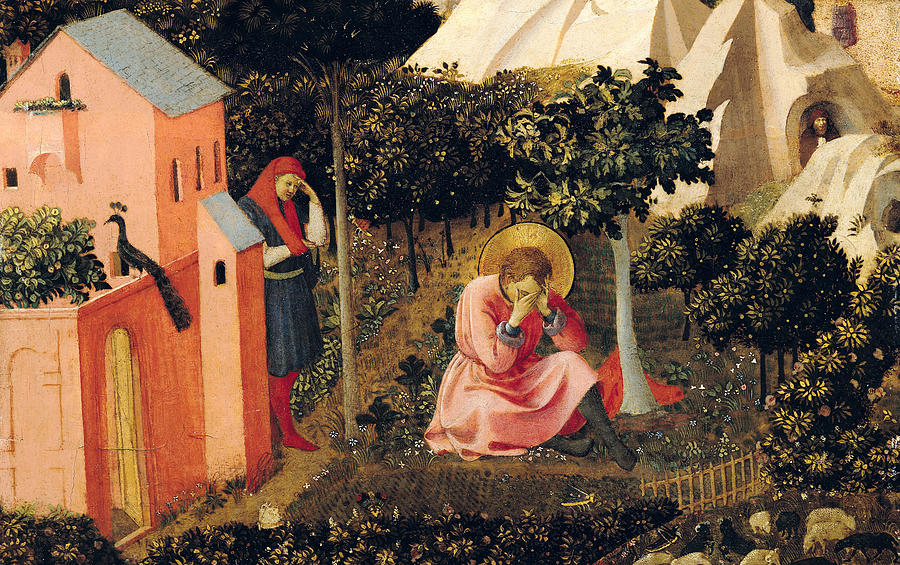
Although this prayer is also in the 1970 Missal, spiritual combat is not a favorite theme among more progressive Catholics, who disdain this imagery as too aggressive or bellicose. And yet, spiritual combat is no mere metaphor: it is a reality sown into the DNA of Christian life. It is an essential part of St. Paul’s theology, (see Eph. 6, 11; 12) and it features prominently in the writings of the Church Fathers and medieval Doctors, such as St. Augustine and St. Hildegard of Bingen (and yes, women are called to be spiritual “shield-maidens,” as Tolkien might say, as well).
The Conversion of St. Augustine, Fra Angelico
It is curious that the 1970 Missal retains a reference to our “holy fasts,” since the mandatory Fast was eliminated in 1966, and since the Novus Ordo makes no reference to fasting in its other orations during Lent. The 1962 Missal, on the other hand, prays for a holy fast almost every day of the week in its prayers.
The Collect asks that we may be protected from spiritual evils by the help of continentia, which is usually translated as “self-denial.” Continentia entails self-denial, but it is more. On the verge of his conversion, St. Augustine prayed for “chastity and continence, but not yet,” afraid of giving up the dirty little pleasures with which he had grown so comfortably accustomed. (Conf. 8.7.17) Continence is a regaining of mastery over self, an ability to be self-contained (with God’s grace, of course) over the tug of the appetites; it is more self-control than self-denial. The 2011 ICEL translation comes admirably close when it translates continentia as “self-restraint.”
Finally, according to the economy of the prayer, continence becomes a defensive weapon against demonic assault, a shield or an armor. We enter into the Great Fast, as the Preface of Lent declares, to “curb our vices, elevate our minds, and bestow virtue and reward.” And in the words of the Secret for the First Sunday of Lent, we solemnly offer God “the sacrifice of the beginning of Lent, beseeching [Him], that by refraining from flesh at our meals, we may refrain from harmful pleasures.” In other words, we refrain from licit pleasures (regardless of what PETA tells you, there is nothing wrong with consuming the flesh of a warm-blooded animal) in order to take charge over pleasures that lean into the illicit (gluttonous habits, etc.). Such is the power of continence for which we pray as we enter into the annual Boot Camp of spiritual combat.

Wednesday, February 18, 2026

Liturgical Notes on Ash Wednesday

It is a universal custom of all historical Christian rites not to fast on the day of the Lord’s Resurrection, even in Lent and Holy Week. The original Roman Lent of six weeks therefore comprised forty-two days, but only thirty-six days of fasting, which St Gregory the Great describes as “the tithe of the year.” (Hom. XVI in Evang.) The Roman Missal preserves a reminder of this in the Secret for the Mass of the first Sunday of Lent, which speaks of the “sacrifice of the beginning of Lent.”

Not long afterwards, however, perhaps by Gregory himself, the four days preceding the first Sunday were added to the fast to bring the number of days to exactly forty, the length of the fast kept by the Lord Himself, as well as by the prophets Moses and Elijah. This extension of Lent back to Ash Wednesday, which was once commonly known as “in capite jejunii – at the beginning of the fast”, is a proper custom of the Roman Rite, attested in the earliest Roman liturgical books of the century after St Gregory. It was copied by the Mozarabic liturgy, but never by the Ambrosian, and indeed, the Milanese traditionally make a point of eating meat on this day. In the Eastern rites, Great Lent begins on the Monday of the First Week, two days before the Roman Ash Wednesday.

A Greek icon of the Transfiguration from the second half of the 15th century. The Gospel of the Transfiguration, Matthew 17, 1-9, is read on the Ember Saturday of Lent in reference to the forty-day fast of Christ, which is mentioned on the previous Sunday (Matthew 4, 1-11) and of the two Prophets who appeared alongside Him at the Transfiguration, Moses and Elijah, both of whom appear in the readings of Ember Wednesday.(Public domain image from Wikimedia Commons.)
The Breviary of St Pius V and its medieval predecessors also preserve a memory of the fact that Ash Wednesday is a later addition. Although the fast begins on that day, the proper features of the Lenten Office (the hymns, chapters, versicles etc.) only begin to be sung at Vespers of Saturday before the First Sunday. This is also reflected in the traditional nomenclature of the three days after “Ash Wednesday (Feria IV Cinerum)”, which are called “post cineres – after the ashes,” rather than the first Thursday, Friday and Saturday of Lent. In the titles printed in liturgical books, and in the prayers of the Mass, the use of the Latin word for Lent, “Quadragesima,” only begins on the first Sunday. (An apparent exception is the Secret of the Friday “post cineres”, which contains the words “observantiae quadragesimalis”, but this is a revision of the Tridentine editors; the original reading was “observantiae paschalis.”)

The blessing and imposition of ashes was originally a rite for those who were assigned to do penance publicly during Lent for grave or notorious sins, an extremely ancient discipline and practice of the Church. The extension of this custom to all the faithful began in the later part of the 10th century, and was solidified by the end of the 11th, when Pope Urban II prescribed it at the Council of Benevento in 1091. The rite of “expelling” the public penitents from the church on Ash Wednesday, and receiving them back on Maundy Thursday, remained in the Pontifical for centuries after it had faded from use; another trace is the prayer “for the penitents” among the Preces said at Lauds and Vespers in penitential seasons. Many medieval uses also added a special commemoration of the public penitents to the suffrages of the Saints; in the Sarum Use, it was said as follows at Lauds:

Aña Convertímini ad me in toto corde vestro, in jejunio et fletu, et in planctu, dicit Dóminus.
V. Peccávimus cum pátribus nostris. R. Injuste égimus, iniquitátem fécimus.
Oratio Exaudi, quaesumus, Dómine, súpplicum preces, et confitentium tibi parce peccátis: ut páriter nobis indulgentiam tríbuas benignus, et pacem.

Aña Be ye turned to me with all your heart, in fasting, and in weeping, and in mourning, sayeth the Lord.
V. We have sinned with our fathers. R. We have acted unjustly, we have wrought iniquity.
Prayer Graciously hear, we beseech Thee, O Lord, the prayers of Thy supplicants, and pardon the sins of those who confess to Thee: that Thou may kindly grant us both pardon and peace.

The expulsion of the public penitents, in an illustration from a 1595 edition of the Roman Pontifical. (Reproduced by permission of the Pitts Theological Library, Candler School of Theology at Emory University)
In the Missal of St Pius V, the blessing of the ashes is introduced by a chant which is called an antiphon in the rubrics, but is structured like an introit. The blessing itself consists of four prayers, the sprinkling of the ashes with holy water, and their incensation, after which they are imposed on all present, while two antiphons and a responsory are sung. The rite concludes with a brief prayer, and then the Mass begins.

In the Middle Ages, the Ash Wednesday ceremony generally included a procession as well. Historically, processions are regarded as penitential acts by nature; this is the reason why even those of Candlemas and the Rogations were traditionally done in penitential violet, although the Mass of the former and the season of the latter require white vestments. (See note below.)

In the year 1143, a canon of St Peter’s named Benedict wrote the following brief description of the Ash Wednesday ceremony in his treatise on the rituals of Rome and the Papal court, now known as the Ordo Romanus XI. “The ‘Collect’ (i.e. gathering is held) at St Anastasia, where the Pope comes with the whole curia; and there is he dressed, and all the other orders go up to the altar. There the Pope gives the ashes, and the primicerius sings with the schola the Antiphon Exaudi nos, Domine. When the (ritual at the Collect church) is finished, the Pope and all the others go bare-footed in a procession to Santa Sabina, followed by the primicerius with the schola, as they sing (the antiphon) Immutemur habitu. When they reach the church, the subdeacon lays aside the (processional) cross, and goes to the altar during the litany (of the Saints)… the Pope sings the Mass without the Kyrie, because of the Litany”, (i.e., it has already been sung at the end of the Litany.)

Later descriptions of this ceremony, such as the various recensions of the Ordinal of Innocent III (1198-1216), mention that the ashes were made at the church of St Anastasia by burning the palms left over from the previous year’s Palm Sunday, a common custom to this very day. During the Papal residence in Avignon, however, many long-standing traditions of the Papal court dropped out of use and were never revived; thus, the procession is not included in the pre-Tridentine Missal of the Roman Curia, the antecedent of the Missal of St Pius V.

A penitential procession led by St Gregory the Great, from the Très Riches Heures du Duc du Berry, by the Limbourg brothers, 1412-16.
Note: The ancient processions of the Roman Rite, all of which were once regarded as obligatory at major churches, were those of Candlemas, Ash Wednesday, Palm Sunday and the Rogation Days. Corpus Christi was added last, as the culmination of the liturgical year; the white vestments used at the procession indicate its purely celebratory character, wholly appropriate to the nature of the feast. However, it should be noted that the procession is not even mentioned in the Missal, nor is any particular music prescribed for it; of course, the Litany of the Saints, the penitential prayer par excellence, is not sung, and the procession is done after the Mass, rather than before it.

Wednesday, March 05, 2025

Ash Wednesday 2025

Dómine, non secundum peccáta nostra, quae fécimus nos: neque secundum iniquitátes nostras retríbuas nobis. V. Dómine, ne memíneris iniquitátum nostrárum antiquárum: cito antícipent nos misericórdiae tuae, quia páuperes facti sumus nimis. Hic genuflectitur V. Adjuva nos, Deus, salutáris noster: et propter gloriam nóminis tui, Dómine, líbera nos: et propitius esto peccátis nostris, propter nomen tuum.

Tract O Lord, not according to the sins which we have committed, nor according to our iniquities do Thou repay us. V. Lord, remember not our former iniquities: let thy mercies speedily come before us, for we are become exceeding poor. All kneel. V. Help us, O God, our Savior: and for the glory of Thy name, O Lord, deliver us: and be merciful to our sins for Thy name’s sake.

This beautiful tract is sung every Monday, Wednesday and Friday of Lent until Holy Monday, with the exception of Ember Wednesday. Here is a polyphonic version by the Spanish composer Juan de Anchieta (1462-1523.)

Wednesday, February 14, 2024

Durandus on the Liturgical Customs of Lent

The following selections are taken from book 6, chapter 28 of William Durandus’ Rationale Divinorum Officiorum, which treats specifically of Ash Wednesday, but also of Lent in general. Some of the elisions here are made for the sake of a more succinct presentation of his thought; several others are made in places where he directs the reader to matters he has discussed elsewhere in the work. The translation is my own.

After Quinquagesima follows Quadragesima, (“fortieth”, the Latin word for Lent), which is the spiritual number of penance, in which the Church fasts, and repents of its sins; for by the penance which is accomplished in Lent, we arrive at the fifty days (of Easter), which is to say, the jubilee year, which symbolizes the forgiveness of sins. Lent (Quadragesima) begins on the following Sunday, on which (the Introit) Invocavit me is sung, but the fast begins on Wednesday, as will be mentioned below.

In medieval liturgical books, the days of Lent are often noted by the Sunday Introits; the first Sunday of Lent is “Dominica Invocavit”, the first Monday “feria secunda post Invocavit”, etc. Here we see a folio from the 1502 Missal of Liège, in which today’s Mass is desgnated in the header as “Feria vj ante Invocavit - Friday before the Introit Invocavit.”
The Blessed Peter first instituted the fast of Lent before Easter. Nor is the fact that we are in abstinence for 46 days from the beginning of the fast to Easter without symbolic meaning. For after the Babylonian captivity, the temple of the Lord was built in 46 years; whence we also after the captivity of Babylon, that is, of the confusion caused by the vices, for 46 days build ourselves as a temple to God through abstinence and good works. … (“Babylon” is the Greek form of the Hebrew word “Babel”, which means “confusion”, the site of the confusion of tongues in Genesis 11. Durandus refers the forty-six years of the building of the temple, as stated in John 2, 20, to the post-exilic rebuilding in the days of Ezra and Nehemiah at the end of the 6th century B.C.; historically, the Jews speaking to Christ in the Gospel were referring to the reconstruction under Herod the Great in the first century B.C.)

Again, the fasts were instituted, because in the Old Law, it was commanded to render tithes and first-fruits from all goods to God; wherefore, we must also do the same in regard to ourselves, that is, from our body, our mind and our time. … For indeed, we offer tithes and first-fruits to God when we do good. In Lent a tithe of days is paid, according to Gregory (the Great, hom. 16 in evang., cited by Gratian de consecr. dist. 5, 16). From the first Sunday of Lent until Easter six weeks are numbered, which make 42 days; from these, the six Sundays are removed from the fast, and there remain 36 days of abstinence, which are almost a tenth of the year. Therefore, in order that the number of forty day in which Christ fasted may be fulfilled, four days are recovered in the previous week… To the thirty-six days which are the tithe, four are added … the first of which is a day of sanctification and cleansing, for then do we purify the soul and body by sprinkling ashes on our heads. …

But we in Provence (Durandus was bishop of Mende in the Occitan region of France) begin the Lenten fast on the Monday of the preceding week (i.e. the day after Quinquagesima), and thus we fast two days more than the other nations. This is not only for honesty’s sake, that is, so that being thus purified in these two days, we may begin the holy fast on Wednesday, but also because Lent ends on the great Thursday of the (Lord’s) Supper… Therefore, on the last two days (i.e. Good Friday and Holy Saturday), we fast, not because it is Lent, but because … of the holiness of those days. …

The Cathedral of St Privatus in Mende. (Image from Wikimedia Commons by Myrabella; CC BY-SA 3.0)
But since in Lent we are invited (to go) through Christ’s fast … and He began His fast immediately after the Baptism, which is (commemorated on) Epiphany, the question arises as to why we begin the fast at this time, and not at the same time in which He fasted, especially since His deeds should be our instruction. There are four reasons for this. The first is that in Lent we represent the people of Israel, who were in the desert for forty years, and immediately after celebrated the Passover.

The second is that in the spring, men are naturally moved to desire (libido), and fasting was instituted in this period to restrain it.

The third is that the Resurrection is joined with Christ’s Passion; therefore, it was reasonable that our affliction should be joined with the Passion of the Savior. For since He suffered for us, we must suffer along with Him, so that we may finally reign with Him; and after the Passion, the Resurrection follows immediately, according to the Apostle’s word, “If we suffer, we shall also reign with him.” (2 Tim. 2, 12) Likewise, a sick man is more afflicted (by his illness) when he is getting healthier.

An icon of the type known as “Christ the Bridegroom” (ὁ Νύμφιος, Женихъ), placed on the site of Golgotha within the Church of the Holy Sepulchre in Jerusalem. This icon is placed in the church during the first three days of Holy Week, and the Matins of those days are known as Bridegroom Matins. (Image from Wikimedia Commons by Adriatikus; CC BY-SA 3.0)
The fourth reason is that just as the children of Israel afflicted themselves before they ate the lamb, and ate wild, that is, bitter lettuce, (Exodus 12, 8, from the Epistle of the Mass of the Presanctified on Good Friday) so also we, through the bitterness of penance, must first be afflicted, so that immediately after we may worthily eat the Lamb of life, that is, the body of Christ, and so mystically receive the Paschal sacraments.

Now in the Lenten Masses, “Bow your heads to God (Humiliate capita vestra Deo)” is often said, since in that period the devil attacks us even more; for which reason, we must humbly pray God, and humble ourselves before him, …

The prayer over the people (at the end of the Lenten ferial Masses) is also said after “Bow (your) heads”, because of the holiness of the season, and to indicate that in this life, prayer must be offered for us, that in the future we may merit to hear, “Come, ye blessed of my Father etc. (Matthew 25, 34, from the Gospel of the first Monday of Lent.) This prayer takes the place of Holy Communion. For once upon a time, all communicated and the deacon would invite those who were to receive communion to kneel; but now, because many receive the Lord’s body unworthily, in place of Communion we use a prayer, and the deacon fulfills his office as before, saying “Bow your heads to God”, because whosoever humbleth himself shall be exalted (Matthew 23, 12, from the Gospel of the second Tuesday of Lent), and whoever is blessed by good deeds in this life, will be deputed to eternal blessing afterwards. In this prayer, therefore, the priest commends the soldiers of Christ to the fight, to combat the ancient enemy and snares of the enemies, and so he first arms them through his minister (the deacon) with the weapons of humility, saying “Bow your heads to God”. And thus at last, when they have bowed their heads, he pours the protection of his blessing upon them, strengthening them, as it were …

(In many medieval Uses, “Oremus. Flectamus genua. Levate” were said before the Collect of every ferial Mass in Lent, not just on the Ember Days as in the Roman Use. This custom is still kept by the Dominicans, who say it in addition to, not in place of, “Dominus vobiscum etc.” In the image above from the Missal of Liège, they are noted in the 7th line from the bottom of the right column.) At the first Collect we kneel in accord with the struggle of the present life, representing the affliction of labor and continence; but at the last prayer, which is for thanksgiving, we bow the head, by which is designated humility of the mind, because in the life eternal, every labor will be excluded, but humility will always remain. …

Now in these days the Church, being set in the great struggle of Lent, frequently repeats the Psalm He that dwelleth, because this psalm tells those who are in a struggle to place their hope in the Lord, and seek all their help from him. (This is Psalm 90, from which are taken all the propers of the Mass of the First Sunday, and the versicles and short responsories of the Office.) …

The Temptation of Christ, from Les très riches heures du Duc de Berry, a Book of Hours illuminated by the Limbourg Brothers, 1416. During this episode, the Gospel of the First Sunday of Lent (Matthew 4, 1-11), the devil quotes Psalm 90 to the Lord: “If thou be the Son of God, cast thyself down, for it is written, ‘That he hath given his angels charge over thee, and in their hands shall they bear thee up, lest perhaps thou dash thy foot against a stone.’ ” From this comes the famous line in Shakespeare’s The Merchant of Venice, “The devil can cite Scripture for his purpose.”
Also, from Ash Wednesday until Palm Sunday the preface of the fast is said every day, and in some places, even on Sunday. But on Palm Sunday and the following days is said the Preface of the Passion. But it seems to be incongruous that the preface of the fast should be sung on Sundays, since one does not fast on those days, and therefore some people say the daily preface on those Sundays. But even though they are not counted as fast days, they are kept as a fast in the kind of food that is eaten, which is like that of the other days.

(Concerning the anticipation of Vespers on ferial days) … it must be noted that the season of Lent is a time of mourning and penance; but while the penitents are converted to Christ, they pass from darkness to light. Now the evening, because of the failing of the light and the (ensuing) darkness, signifies imperfection. Therefore, because the penitents are pressing forward, not towards imperfection and failure, but rather towards perfection and the light of truth, in regard to Vespers the aforementioned time of light is appropriately anticipated, according to a decree of the Council of Chalon. (Cited by Gratian, de consecr., dist. 1, 50) Vespers are thus said immediately after Mass, though they are otherwise wont to be said close to the night-time.

Friday, March 03, 2023

The Penitential Psalms in the Liturgy of Lent

In his Life of St Augustine, St Possidius of Calama writes that in his final illness, the great doctor “had ordered the Psalms of David, those very few which concern penance, be written out; and lying on his bed … read the four of them (from the pages) attached to the wall, and wept copiously and continuously.” (chapter 31) He does not say which four these were, but we may safely assume that Psalm 50, often known by its first word in Latin, “Miserere”, was included among them, long recognized as the penitential psalm par excellence.

The Funeral of St Augustine, by Benozzo Gozzoli, 1465, in the church of St Augustine in San Geminiano, Italy.
In the following century, Cassiodorus (ca 485-585), in his massive Exposition of the Psalms, refers in many places to the Penitential Psalms as a group, and when commenting on the first of them, Psalm 6, lists the others, according to the traditional numbering of the Septuagint: 31, 37, 50, 101, 129 and 142. (The list is given twice more, in the comments on Psalms 50 and 142.) At the conclusion of this section, he states that these seven are especially worthy of attention, since they “are given to the human race as an appropriate medicine, from which we receive a most salutary cleansing of our souls, revive from our sins, and by mourning, come to eternal joy.” As he explains each one individually, he often relates it in some way to one or more of the other six, as for example Psalm 142, which is placed last in the group “because these psalms begin from afflictions, and end in joys, lest anyone despair of that forgiveness which he knows has been set forth in these prayers.”

Cassiodorus takes it for granted that his reader know this tradition, and therefore we may safely assume it was already part of the Church’s prayer by his time; his influence was very strong in the Middle Ages, and we may also assume that his writing did much to solidify its place in the liturgy. They were added to a variety of rites, such as the dedication of a Church according to the Roman Pontifical; in the traditional ordination rite, the bishop enjoins those who receive tonsure and the minor orders “to say one time the seven Penitential Psalms, with the Litany (of the Saints) and the versicles and prayers (that follow).”

One of the oldest manuscripts of Cassiodorus’ Exposition of the Psalms, from the library of the Swiss monastery of San Gallen. (Cod. Sang. 200, 950-75 A.D.)
Of course, they are particularly prominent in the liturgy of Lent. The customary of the Papal court known as the Ordinal of Innocent III (1198-1216) prescribes that they be said after Lauds every ferial day of Lent, together with the Litany of the Saints. To these were added the fifteen Gradual Psalms (119-133) before Matins, and the Office of the Dead, a burden which unquestionably increased the temptation to add more Saints to the calendar, since these supplementary Offices were routinely omitted on feast days. The Breviary of St Pius V distributed them over the days of the week, so that the Office of the Dead would be said on the first ferial day of each week of Lent, the Gradual Psalms on Wednesdays and the Penitentials on Fridays, if the Office was of the feria. This remained in force until the reform of St Pius X, in which all mandatory recitation of them in the Office was abolished; the Gradual and Penitential Psalms are not included as specific groups in the post-Conciliar Liturgy of the Hours.

The Use of Rome, with characteristic simplicity, simply recites the Psalms as a group with a single antiphon, based on the words of Tobias 3, 3-4: “Ne reminiscaris Domine delicta nostra, vel parentum nostrorum: neque vindictam sumas de peccatis nostris. – Remember not, Lord, our offenses, nor those of our forefathers, nor take Thou vengeance upon our sins.” In other Uses, the antiphon was followed by a series of versicles like those sung with the Litany of the Saints, and various prayers; this custom was highly developed in German-speaking lands, less so elsewhere. At Augsburg, for example, each day of the week had a different collect to conclude the recitation of the Penitential Psalms; the prayer for Monday was as follows.

“Deus, qui confitentium tibi corda purificas, et accusantes se ab omni vinculo iniquitatis absolvis: da indulgentiam reis, et medicinam tribue vulneratis; ut percepta remissione omnium peccatorum, in sacramentis tuis sincera deinceps devotione permaneamus, et nullum redemptionis æternæ sustineamus detrimentum.
O God, who purify the hearts of those that confess to Thee, and release from every bond those that accuse themselves, grant forgiveness to the guilty, and bring healing to the wounded, so that, having received the remission of all sins, we may henceforth abide in Thy sacraments with true devotion, and suffer no detriment to eternal salvation.”

The beginning of the Penitential Psalms in the Book of Hours of Louis de Roncherolles, end of the 5th or beginning of the 16th century. (Bibliothèque de l'Arsenal, Ms-1191 réserve, Bibliothèque nationale de France)
At Salzburg, the intentions for reciting the Penitential Psalms were summed up in the following prayer, attested in a few other breviaries and books of hours.

“Suscipere digneris, omnipotens Deus, hos septem psalmos consecratos, quos ego indignus et peccator decantavi in honore nominis tui, et beatissimæ Genitricis tuæ Virginis Mariæ, in honore sanctorum Angelorum, Prophetarum, Patriarcharum, in honore sanctorum Apostolorum, in honore sanctorum Martyrum, Confessorum, Virginum et Viduarum, et sanctorum Innocentum, in honore omnium Sanctorum, pro me misero famulo tuo N., pro cunctis consanguineis meis, pro omnibus amicis et inimicis meis, pro omnibus his qui mihi bona et mala fecerunt, vivis et defunctis: concede, Domine Jesu Christe, ut hi psalmi proficiant nobis ad salutem et veram pænitentiam agendam, et vitam æternam consequendam.
Deign thou to receive, almighty God, these seven holy psalms, which I, though unworthy and a sinner, have sung unto the honor of Thy name, and of Thy most blessed Mother the Virgin Mary, to the honor of the holy Angels, Prophets and Patriarchs, to the honor of the holy Apostles, to the honor of the holy Martyrs, Confessors, Virgins and Widows, and the Holy Innocents, to the honor of all the Saints, for myself Thy wretched servant, for all my relatives, for all my friends and enemies, for all those who have done me good and ill, both living and dead; grant, o Lord Jesus Christ, that these Psalms may profit us unto salvation and the doing of true penance, the obtaining of eternal life.”

The Penitential Psalms were also generally used at the beginning of Lent, at the ceremony by which the public penitents were symbolically expelled from the church, and again on Holy Thursday, when they were brought back in. These ceremonies were particularly elaborate in the Use of Sarum, but similar rites were observed in a great many other places. After Sext of Ash Wednesday, a sermon was given; a priest in red cope, accompanied by deacon, subdeacon and the usual minor ministers, then prostrated before the altar, while the choir said the seven penitential psalms. At the end of these were said a series of versicles and prayers, most of which refer directly to the public penitents.

“Dómine Deus noster, qui offensióne nostra non vínceris, sed satisfactione placaris: réspice, quæsumus, super hos fámulos tuos, qui se tibi gráviter peccasse confitémur: tuum est enim absolutiónem críminum dare, et veniam præstáre peccántibus, qui dixisti pænitentiam te malle peccatóris quam mortem. Concéde ergo, Dómine, his fámulis tuis, ut tibi pænitentiæ excubias celebrant; et correctis áctibus suis, conferri sibi a te sempiterna gaudia gratulentur.
Lord our God, who are not overcome by our offense, but appeased by satisfaction; look we beseech Thee, upon these Thy servants, who confess that they have gravely sinned against Thee; for it is Thine to give absolution of crimes, and grant forgiveness to those who sin, even Thou who said that Thou wishest the repentance of sinners, rather than their death. Grant therefore, o Lord, to these Thy servants, that they may keep the watches of penance, and by correcting their deeds, rejoice that eternal joys are given them of Thee.”

The ashes were then blessed, followed by a procession, which, as I noted in an article last week, was a normal part of the Ash Wednesday ceremonies in the Middle Ages. The Sarum Processional specifies that a cross was not used, but an “ash-colored banner” was carried instead at the head of the procession. At the door, the penitents were taken by the hand, and led out of the church, while the following responsory was sung, reprising an ancient theme of meditation on the Fall of Man in the readings of Genesis in Septuagesima.

An illustration from a Sarum Processional of the Ash Wednesday procession; the captions reads “The station on the day of ashes, when the bishop expels the penitents.” The ash-colored banner is seen up top. Reproduced in a modern edition by WG Henderson, 1882. (This would seem to be one of the inspirations for Fr Fortescue’s famous little illustrations in the Ceremonies of the Roman Rite.)
R. Behold, Adam is become like one of us, knowing good and evil; see ye lest he take of the tree of life, and live forever. V. The Cherubim, and the flaming, turning sword, to guard the way to the tree of life. See ye…

On Holy Thursday, when the penitents were brought back into the church, usually referred to as their “reconciliation”, the process was reversed, again by a priest in a red cope, accompanied by the various grades of ministers and the ash-colored banner. This ceremony deserves its own post, which I shall do on Holy Thursday; suffice it therefore to note here that the penitential Psalms are said again before the final absolution is imparted.

Wednesday, February 22, 2023

Liturgical Notes on Ash Wednesday

It is a universal custom of all historical Christian rites not to fast on the day of the Lord’s Resurrection, even in Lent and Holy Week. The original Roman Lent of six weeks therefore comprised forty-two days, but only thirty-six days of fasting, which St Gregory the Great describes as “the tithe of the year.” (Hom. XVI in Evang.) The Roman Missal preserves a reminder of this in the Secret for the Mass of the first Sunday of Lent, which speaks of the “sacrifice of the beginning of Lent.”

Not long afterwards, however, perhaps by Gregory himself, the four days preceding the first Sunday were added to the fast to bring the number of days to exactly forty, the length of the fast kept by the Lord Himself, as well as by the prophets Moses and Elijah. This extension of Lent back to Ash Wednesday, which was once commonly known as “in capite jejunii – at the beginning of the fast”, is a proper custom of the Roman Rite, attested in the earliest Roman liturgical books of the century after St Gregory. It was copied by the Mozarabic liturgy, but never by the Ambrosian, and indeed, the Milanese traditionally make a point of eating meat on this day. In the Eastern rites, Great Lent begins on the Monday of the First Week, two days before the Roman Ash Wednesday.

The Gospel of the Transfiguration, Matthew 17, 1-9, is read on the Ember Saturday of Lent in reference to the forty-day fast of Christ, which is mentioned on the previous Sunday (Matthew 4, 1-11) and of the two Prophets who appeared alongside Him at the Transfiguration, Moses and Elijah, both of whom appear in the readings of Ember Wednesday. (Icon by Theophanes the Greek, early 15th century, now in the Tretyakov Gallery in Moscow.)
The Breviary of St Pius V and its medieval predecessors also preserve a memory of the fact that Ash Wednesday is a later addition. Although the fast begins on that day, the proper features of the Lenten Office (the hymns, chapters, versicles etc.) only begin to be sung at Vespers of Saturday before the First Sunday. This is also reflected in the traditional nomenclature of the three days after “Ash Wednesday (Feria IV Cinerum)”, which are called “post cineres – after the ashes,” rather than the first Thursday, Friday and Saturday of Lent. In the titles printed in liturgical books, and in the prayers of the Mass, the use of the Latin word for Lent, “Quadragesima,” only begins on the first Sunday. (An apparent exception is the Secret of the Friday “post cineres”, which contains the words “observantiae quadragesimalis”, but this is a revision of the Tridentine editors; the original reading was “observantiae paschalis.”)

The blessing and imposition of ashes was originally a rite for those who were assigned to do penance publicly during Lent for grave or notorious sins, an extremely ancient discipline and practice of the Church. The extension of this custom to all the faithful began in the later part of the 10th century, and was solidified by the end of the 11th, when Pope Urban II prescribed it at the Council of Benevento in 1091. The rite of “expelling” the public penitents from the church on Ash Wednesday, and receiving them back on Maundy Thursday, remained in the Pontifical for centuries after it had faded from use; another trace is the prayer “for the penitents” among the Preces said at Lauds and Vespers in penitential seasons. Many medieval uses also added a special commemoration of the public penitents to the suffrages of the Saints; in the Sarum Use, it was said as follows at Lauds:

Aña Convertímini ad me in toto corde vestro, in jejunio et fletu, et in planctu, dicit Dóminus.
V. Peccávimus cum pátribus nostris. R. Injuste égimus, iniquitátem fécimus.
Oratio Exaudi, quaesumus, Dómine, súpplicum preces, et confitentium tibi parce peccátis: ut páriter nobis indulgentiam tríbuas benignus, et pacem.

Aña Be ye turned to me with all your heart, in fasting, and in weeping, and in mourning, sayeth the Lord.
V. We have sinned with our fathers. R. We have acted unjustly, we have wrought iniquity.
Prayer Graciously hear, we beseech Thee, O Lord, the prayers of Thy supplicants, and pardon the sins of those who confess to Thee: that Thou may kindly grant us both pardon and peace.

The expulsion of the public penitents, in an illustration from a 1595 edition of the Roman Pontifical. (Reproduced by permission of the Pitts Theological Library, Candler School of Theology at Emory University)
In the Missal of St Pius V, the blessing of the ashes is introduced by a chant which is called an antiphon in the rubrics, but is structured like an introit. The blessing itself consists of four prayers, the sprinkling of the ashes with holy water, and their incensation, after which they are imposed on all present, while two antiphons and a responsory are sung. The rite concludes with a brief prayer, and then the Mass begins.

In the Middle Ages, the Ash Wednesday ceremony generally included a procession as well. Historically, processions are regarded as penitential acts by nature; this is the reason why even those of Candlemas and the Rogations were traditionally done in penitential violet, although the Mass of the former and the season of the latter require white vestments. (See note below.)

In the year 1143, a canon of St Peter’s named Benedict wrote the following brief description of the Ash Wednesday ceremony in his treatise on the rituals of Rome and the Papal court, now known as the Ordo Romanus XI. “The ‘Collect’ (i.e. gathering is held) at St Anastasia, where the Pope comes with the whole curia; and there is he dressed, and all the other orders go up to the altar. There the Pope gives the ashes, and the primicerius sings with the schola the Antiphon Exaudi nos, Domine. When the (ritual at the Collect church) is finished, the Pope and all the others go bare-footed in a procession to Santa Sabina, followed by the primicerius with the schola, as they sing (the antiphon) Immutemur habitu. When they reach the church, the subdeacon lays aside the (processional) cross, and goes to the altar during the litany (of the Saints)… the Pope sings the Mass without the Kyrie, because of the Litany”, (i.e., it has already been sung at the end of the Litany.)

Later descriptions of this ceremony, such as the various recensions of the Ordinal of Innocent III (1198-1216), mention that the ashes were made at the church of St Anastasia by burning the palms left over from the previous year’s Palm Sunday, a common custom to this very day. During the Papal residence in Avignon, however, many long-standing traditions of the Papal court dropped out of use and were never revived; thus, the procession is not included in the pre-Tridentine Missal of the Roman Curia, the antecedent of the Missal of St Pius V.

A penitential procession led by St Gregory the Great, from the Très Riches Heures du Duc du Berry, by the Limbourg brothers, 1412-16.
Note: The ancient processions of the Roman Rite, all of which were once regarded as obligatory at major churches, were those of Candlemas, Ash Wednesday, Palm Sunday and the Rogation Days. Corpus Christi was added last, as the culmination of the liturgical year; the white vestments used at the procession indicate its purely celebratory character, wholly appropriate to the nature of the feast. However, it should be noted that the procession is not even mentioned in the Missal, nor is any particular music prescribed for it; of course, the Litany of the Saints, the penitential prayer par excellence, is not sung, and the procession is done after the Mass, rather than before it.

Wednesday, March 02, 2022

Ash Wednesday 2022

Dómine, non secundum peccáta nostra, quae fécimus nos: neque secundum iniquitátes nostras retríbuas nobis. V. Dómine, ne memíneris iniquitátum nostrárum antiquárum: cito antícipent nos misericórdiae tuae, quia páuperes facti sumus nimis. Hic genuflectitur V. Adjuva nos, Deus, salutáris noster: et propter gloriam nóminis tui, Dómine, líbera nos: et propitius esto peccátis nostris, propter nomen tuum.

Tract O Lord, not according to the sins which we have committed, nor according to our iniquities do Thou repay us. V. Lord, remember not our former iniquities: let thy mercies speedily come before us, for we are become exceeding poor. All kneel. V. Help us, O God, our Savior: and for the glory of Thy name, O Lord, deliver us: and be merciful to our sins for Thy name’s sake.

This beautiful tract is sung every Monday, Wednesday and Friday of Lent until Holy Monday, with the exception of Ember Wednesday. Here is a polyphonic version by the Spanish composer Juan de Anchieta (1462-1523.)


Tuesday, March 01, 2022

The Mortifying Orations of Ash Wednesday

Gustav Dore, Jonah Preaches to the Ninevites, 1866
Lost in Translation #71

Ash Wednesday, which inaugurates the sacred season of Lent, is one of the most memorable days of the liturgical year. The four traditional blessings of the ashes along with the antiphons emphasize the need for our repentance and God’s infinite mercy. Blessed by God through the mediation of one of His angels, the ashes become not only a token of our lowliness and mortality but a wholesome and forgiving remedy to all those who are truly contrite and who call upon the name of the Lord. One of the prayers reminds us of the example of the Ninevites, who were told by the prophet Jonah that they would be punished by God for their sins. The heathen Ninevites, it should be recalled, repented in sackcloth and ash and were spared. There is hope for us all.

(A polyphonic setting of the responsory Emendemus in melius by William Byrd.)
The prayers and readings of the Mass likewise stress the importance of fasting and other ascetical practices so long as they are done in the right spirit. Mourn and weep, we are told, but do not be sad; that is, do not make an empty show of external observances but use them as a means of effecting an interior transformation. Lent is traditionally inseparable from the forty-day fast that begins today, and this fast should be kept in order to aid us in our conversion or ‘rending of heart’ (Lesson). The Lenten Preface explains how. By mortifying our appetites, bodily fasting helps curb our vices; by curbing our vices, fasting helps elevate our minds, liberating them from the mire of our disordered desires; and by elevating our minds, fasting helps confer virtue and reward, reinstituting righteous habits and restoring a capacity to do and enjoy the good.
The traditional Missal mentions, explains, and prays for the practice of fasting on every day of Lent prior to Holy Week: the traditional rite’s Preface for Lent, which is used daily from Ash Wednesday until Passiontide, is supplemented almost daily with additional references to fasting in the proper prayers. While the 1969 Missal retains several references to fasting on Ash Wednesday (still a mandatory fast day), there are only two required references to the fasts of the faithful for the rest of the season.[1] Consequently, with the exception of Ash Wednesday, the new Missal offers very little guidance on fasting and almost no prayers for its success.[2] “The practice of penance,” Vatican II's Sacrosanctum Concilium states, “should be fostered” (5.110). But if one wants regular instruction on the nature and meaning of fasting, and if, moreover, one wants priests and congregations daily praying and offering up the Holy Sacrifice for the efficacy of one’s fasts, one is better off turning to the Missal used during Vatican II rather than the one mandated by it. Let us turn, then, to the old rite:
The Collect for Ash Wednesday is:
Praesta, Dómine, fidélibus tuis: ut jejuniórum veneranda solemnia, et cóngrua pietáte suscipiant, et secúra devotióne percurrant. Per Dóminum.
Which I translate as:
Grant, O Lord, to Thy faithful ones that they may take up with fitting piety the solemnities of fasting which should be venerated, and race after them with steadfast devotion. Through our Lord.
Fasting is not a cure-all: to be spiritually efficacious, it requires “fitting piety,” the right spirit. Fasting is not private, even though it involves a regulation of one’s private body. It is part of the solemnia, the solemn observances of the Church. And these solemnities “should be venerated,” held in reverence, not as an onerous duty but as a part of one’s office as a priest of the baptized. And we pray to “race after” them with a secure devotion. Curro means to run, and per-curro means to run thoroughly, to travel quickly from to end. Our goal is not to slow down during Lent but to speed up. We are in training!
The Secret is:
Fac nos, quáesumus Dómine, his munéribus offerendis convenienter aptári: quibus ipsíus venerábilis sacramenti celebrámus exordium. Per Dóminum.
Which I translate as:
Make us, we beseech Thee, O Lord, to be fittingly adapted to these gifts which are to be offered, by which we celebrate the beginning of this venerable Mystery. Through our Lord.
Liturgical fasting is not about forty days to becoming a thinner, sexier You: it is about becoming adapted, molded, configured, to the Messiah, who emptied Himself to become a slave like us. At the beginning of Lent, we pray to have the right disposition to our fasts, and we do so in the name of the offerings by which we celebrate the beginning of this venerable mystery. “Mystery” is a loaded term: it means both “mystery” and “sacrament.” When we begin the season of the Passion of the Christ, we enter into the Paschal Mystery, which is also the sacrament of our redemption.
The Postcommunion is:
Percepta nobis, Dómine, práebeant sacramenta subsidium: ut tibi grata sint nostra jejunia, et nobis proficiant ad medélam. Per Dóminum.
Which I translate as:
May the Sacraments that we have received, O Lord, provide us help: that our fasts may be acceptable to Thee and profitable unto us for healing. Through our Lord.
Fasting, dieting, etc., are nothing without God. They only become an aid to healing when they are fed (ironically enough) by the Sacraments of the Body and Blood of the Eucharist. We mortify the flesh to heal the spirit, and we heal the spirit only through the Food that is Christ Himself. If we thin ourselves during Lent (and we should), it is only to become fat with the help of the nourishing flesh of the Lamb.
Notes
[1] The Collect for the Third Sunday of Lent and the Prayer over Offerings for Saturday in the Fifth Week of Lent. I say “required” because the traditional Preface for Lent was retained in the new Missal as Preface IV but made optional. I also stipulate fasts of the faithful because the new Mass’ First Sunday of Lent refers to Christ’s fast in the desert, but there is no reference to, let alone prayer for, our imitating His action.
[2] See Lauren Pristas, “The Post-Vatican II Revision of the Lenten Collects,” in Ever Directed towards the Lord, ed. Uwe Michael Lang (T&T Clark, 2007), 62 –89; see also Lauren Pristas, The Collects of the Roman Missals (Bloomsbury, 2013), 113-158.

Wednesday, February 17, 2021

Durandus on the Liturgical Customs of Lent

The following selections are taken from book 6, chapter 28 of William Durandus’ Rationale Divinorum Officiorum, which treats specifically of Ash Wednesday, but also of Lent in general. Some of the elisions here are made for the sake of a more succinct presentation of his thought; several others are made in places where he directs the reader to matters he has discussed elsewhere in the work. The translation is my own.

After Quinquagesima follows Quadragesima, (“fortieth”, the Latin word for Lent), which is the spiritual number of penance, in which the Church fasts, and repents of its sins; for by the penance which is accomplished in Lent, we arrive at the fifty days (of Easter), which is to say, the jubilee year, which symbolizes the forgiveness of sins. Lent (Quadragesima) begins on the following Sunday, on which (the Introit) Invocavit me is sung, but the fast begins on Wednesday, as will be mentioned below.

In medieval liturgical books, the days of Lent are often noted by the Sunday Introits; the first Sunday of Lent is “Dominica Invocavit”, the first Monday “feria secunda post Invocavit”, etc. Here we see a folio from the 1502 Missal of Liège, in which today’s Mass is desgnated in the header as “Feria vj ante Invocavit - Friday before the Introit Invocavit.”
The Blessed Peter first instituted the fast of Lent before Easter. Nor is the fact that we are in abstinence for 46 days from the beginning of the fast to Easter without symbolic meaning. For after the Babylonian captivity, the temple of the Lord was built in 46 years; whence we also after the captivity of Babylon, that is, of the confusion caused by the vices, for 46 days build ourselves as a temple to God through abstinence and good works. … (“Babylon” is the Greek form of the Hebrew word “Babel”, which means “confusion”, the site of the confusion of tongues in Genesis 11. Durandus refers the forty-six years of the building of the temple, as stated in John 2, 20, to the post-exilic rebuilding in the days of Ezra and Nehemiah at the end of the 6th century B.C.; historically, the Jews speaking to Christ in the Gospel were referring to the reconstruction under Herod the Great in the first century B.C.)

Again, the fasts were instituted, because in the Old Law, it was commanded to render tithes and first-fruits from all goods to God; wherefore, we must also do the same in regard to ourselves, that is, from our body, our mind and our time. … For indeed, we offer tithes and first-fruits to God when we do good. In Lent a tithe of days is paid, according to Gregory (the Great, hom. 16 in evang., cited by Gratian de consecr. dist. 5, 16). From the first Sunday of Lent until Easter six weeks are numbered, which make 42 days; from these, the six Sundays are removed from the fast, and there remain 36 days of abstinence, which are almost a tenth of the year. Therefore, in order that the number of forty day in which Christ fasted may be fulfilled, four days are recovered in the previous week… To the thirty-six days which are the tithe, four are added … the first of which is a day of sanctification and cleansing, for then do we purify the soul and body by sprinkling ashes on our heads. …

But we in Provence (Durandus was bishop of Mende in the Occitan region of France) begin the Lenten fast on the Monday of the preceding week (i.e. the day after Quinquagesima), and thus we fast two days more than the other nations. This is not only for honesty’s sake, that is, so that being thus purified in these two days, we may begin the holy fast on Wednesday, but also because Lent ends on the great Thursday of the (Lord’s) Supper… Therefore, on the last two days (i.e. Good Friday and Holy Saturday), we fast, not because it is Lent, but because … of the holiness of those days. …

The Cathedral of St Privatus in Mende. (Image from Wikimedia Commons by Myrabella; CC BY-SA 3.0)
But since in Lent we are invited (to go) through Christ’s fast … and He began His fast immediately after the Baptism, which is (commemorated on) Epiphany, the question arises as to why we begin the fast at this time, and not at the same time in which He fasted, especially since His deeds should be our instruction. There are four reasons for this. The first is that in Lent we represent the people of Israel, who were in the desert for forty years, and immediately after celebrated the Passover.

The second is that in the spring, men are naturally moved to desire (libido), and fasting was instituted in this period to restrain it.

The third is that the Resurrection is joined with Christ’s Passion; therefore, it was reasonable that our affliction should be joined with the Passion of the Savior. For since He suffered for us, we must suffer along with Him, so that we may finally reign with Him; and after the Passion, the Resurrection follows immediately, according to the Apostle’s word, “If we suffer, we shall also reign with him.” (2 Tim. 2, 12) Likewise, a sick man is more afflicted (by his illness) when he is getting healthier.

An icon of the type known as “Christ the Bridegroom” (ὁ Νύμφιος, Женихъ), placed on the site of Golgotha within the Church of the Holy Sepulchre in Jerusalem. This icon is placed in the church during the first three days of Holy Week, and the Matins of those days are known as Bridegroom Matins. (Image from Wikimedia Commons by Adriatikus; CC BY-SA 3.0)
The fourth reason is that just as the children of Israel afflicted themselves before they ate the lamb, and ate wild, that is, bitter lettuce, (Exodus 12, 8, from the Epistle of the Mass of the Presanctified on Good Friday) so also we, through the bitterness of penance, must first be afflicted, so that immediately after we may worthily eat the Lamb of life, that is, the body of Christ, and so mystically receive the Paschal sacraments.

Now in the Lenten Masses, “Bow your heads to God (Humiliate capita vestra Deo)” is often said, since in that period the devil attacks us even more; for which reason, we must humbly pray God, and humble ourselves before him, …

The prayer over the people (at the end of the Lenten ferial Masses) is also said after “Bow (your) heads”, because of the holiness of the season, and to indicate that in this life, prayer must be offered for us, that in the future we may merit to hear, “Come, ye blessed of my Father etc. (Matthew 25, 34, from the Gospel of the first Monday of Lent.) This prayer takes the place of Holy Communion. For once upon a time, all communicated and the deacon would invite those who were to receive communion to kneel; but now, because many receive the Lord’s body unworthily, in place of Communion we use a prayer, and the deacon fulfills his office as before, saying “Bow your heads to God”, because whosoever humbleth himself shall be exalted (Matthew 23, 12, from the Gospel of the second Tuesday of Lent), and whoever is blessed by good deeds in this life, will be deputed to eternal blessing afterwards. In this prayer, therefore, the priest commends the soldiers of Christ to the fight, to combat the ancient enemy and snares of the enemies, and so he first arms them through his minister (the deacon) with the weapons of humility, saying “Bow your heads to God”. And thus at last, when they have bowed their heads, he pours the protection of his blessing upon them, strengthening them, as it were …

(In many medieval Uses, “Oremus. Flectamus genua. Levate” were said before the Collect of every ferial Mass in Lent, not just on the Ember Days as in the Roman Use. This custom is still kept by the Dominicans, who say it in addition to, not in place of, “Dominus vobiscum etc.” In the image above from the Missal of Liège, they are noted in the 7th line from the bottom of the right column.) At the first Collect we kneel in accord with the struggle of the present life, representing the affliction of labor and continence; but at the last prayer, which is for thanksgiving, we bow the head, by which is designated humility of the mind, because in the life eternal, every labor will be excluded, but humility will always remain. …

Now in these days the Church, being set in the great struggle of Lent, frequently repeats the Psalm He that dwelleth, because this psalm tells those who are in a struggle to place their hope in the Lord, and seek all their help from him. (This is Psalm 90, from which are taken all the propers of the Mass of the First Sunday, and the versicles and short responsories of the Office.) …

The Temptation of Christ, from Les très riches heures du Duc de Berry, a Book of Hours illuminated by the Limbourg Brothers, 1416. During this episode, the Gospel of the First Sunday of Lent (Matthew 4, 1-11), the devil quotes Psalm 90 to the Lord: “If thou be the Son of God, cast thyself down, for it is written, ‘That he hath given his angels charge over thee, and in their hands shall they bear thee up, lest perhaps thou dash thy foot against a stone.’ ” From this comes the famous line in Shakespeare’s The Merchant of Venice, “The devil can cite Scripture for his purpose.”
Also, from Ash Wednesday until Palm Sunday the preface of the fast is said every day, and in some places, even on Sunday. But on Palm Sunday and the following days is said the Preface of the Passion. But it seems to be incongruous that the preface of the fast should be sung on Sundays, since one does not fast on those days, and therefore some people say the daily preface on those Sundays. But even though they are not counted as fast days, they are kept as a fast in the kind of food that is eaten, which is like that of the other days.

(Concerning the anticipation of Vespers on ferial days) … it must be noted that the season of Lent is a time of mourning and penance; but while the penitents are converted to Christ, they pass from darkness to light. Now the evening, because of the failing of the light and the (ensuing) darkness, signifies imperfection. Therefore, because the penitents are pressing forward, not towards imperfection and failure, but rather towards perfection and the light of truth, in regard to Vespers the aforementioned time of light is appropriately anticipated, according to a decree of the Council of Chalon. (Cited by Gratian, de consecr., dist. 1, 50) Vespers are thus said immediately after Mass, though they are otherwise wont to be said close to the night-time.

Friday, March 06, 2020

The Penitential Psalms in the Liturgy of Lent

In his Life of St Augustine, St Possidius of Calama writes that in his final illness, the great doctor “had ordered the Psalms of David, those very few which concern penance, be written out; and lying on his bed … read the four of them (from the pages) attached to the wall, and wept copiously and continuously.” (chapter 31) He does not say which four these were, but we may safely assume that Psalm 50, often known by its first word in Latin, “Miserere”, was included among them, long recognized as the penitential psalm par excellence.

The Funeral of St Augustine, by Benozzo Gozzoli, 1465, in the church of St Augustine in San Geminiano, Italy.
In the following century, Cassiodorus (ca 485-585), in his massive Exposition of the Psalms, refers in many places to the Penitential Psalms as a group, and when commenting on the first of them, Psalm 6, lists the others, according to the traditional numbering of the Septuagint: 31, 37, 50, 101, 129 and 142. (The list is given twice more, in the comments on Psalms 50 and 142.) At the conclusion of this section, he states that these seven are especially worthy of attention, since they “are given to the human race as an appropriate medicine, from which we receive a most salutary cleansing of our souls, revive from our sins, and by mourning, come to eternal joy.” As he explains each one individually, he often relates it in some way to one or more of the other six, as for example Psalm 142, which is placed last in the group “because these psalms begin from afflictions, and end in joys, lest anyone despair of that forgiveness which he knows has been set forth in these prayers.”

Cassiodorus takes it for granted that his reader know this tradition, and therefore we may safely assume it was already part of the Church’s prayer by his time; his influence was very strong in the Middle Ages, and we may also assume that his writing did much to solidify its place in the liturgy. They were added to a variety of rites, such as the dedication of a Church according to the Roman Pontifical; in the traditional ordination rite, the bishop enjoins those who receive tonsure and the minor orders “to say one time the seven Penitential Psalms, with the Litany (of the Saints) and the versicles and prayers (that follow).”

One of the oldest manuscripts of Cassiodorus’ Exposition of the Psalms, from the library of the Swiss monastery of San Gallen. (Cod. Sang. 200, 950-75 A.D.)
Of course, they are particularly prominent in the liturgy of Lent. The customary of the Papal court known as the Ordinal of Innocent III (1198-1216) prescribes that they be said after Lauds every ferial day of Lent, together with the Litany of the Saints. To these were added the fifteen Gradual Psalms (119-133) before Matins, and the Office of the Dead, a burden which unquestionably increased the temptation to add more Saints to the calendar, since these supplementary Offices were routinely omitted on feast days. The Breviary of St Pius V distributed them over the days of the week, so that the Office of the Dead would be said on the first ferial day of each week of Lent, the Gradual Psalms on Wednesdays and the Penitentials on Fridays, if the Office was of the feria. This remained in force until the reform of St Pius X, in which all mandatory recitation of them in the Office was abolished; the Gradual and Penitential Psalms are not included as specific groups in the post-Conciliar Liturgy of the Hours.

The Use of Rome, with characteristic simplicity, simply recites the Psalms as a group with a single antiphon, based on the words of Tobias 3, 3-4: “Ne reminiscaris Domine delicta nostra, vel parentum nostrorum: neque vindictam sumas de peccatis nostris. – Remember not, Lord, our offenses, nor those of our forefathers, nor take Thou vengeance upon our sins.” In other Uses, the antiphon was followed by a series of versicles like those sung with the Litany of the Saints, and various prayers; this custom was highly developed in German-speaking lands, less so elsewhere. At Augsburg, for example, each day of the week had a different collect to conclude the recitation of the Penitential Psalms; the prayer for Monday was as follows.

“Deus, qui confitentium tibi corda purificas, et accusantes se ab omni vinculo iniquitatis absolvis: da indulgentiam reis, et medicinam tribue vulneratis; ut percepta remissione omnium peccatorum, in sacramentis tuis sincera deinceps devotione permaneamus, et nullum redemptionis æternæ sustineamus detrimentum.
O God, who purify the hearts of those that confess to Thee, and release from every bond those that accuse themselves, grant forgiveness to the guilty, and bring healing to the wounded, so that, having received the remission of all sins, we may henceforth abide in Thy sacraments with true devotion, and suffer no detriment to eternal salvation.”

The beginning of the Penitential Psalms in the Book of Hours of Louis de Roncherolles, end of the 5th or beginning of the 16th century. (Bibliothèque de l'Arsenal, Ms-1191 réserve, Bibliothèque nationale de France)
At Salzburg, the intentions for reciting the Penitential Psalms were summed up in the following prayer, attested in a few other breviaries and books of hours.

“Suscipere digneris, omnipotens Deus, hos septem psalmos consecratos, quos ego indignus et peccator decantavi in honore nominis tui, et beatissimæ Genitricis tuæ Virginis Mariæ, in honore sanctorum Angelorum, Prophetarum, Patriarcharum, in honore sanctorum Apostolorum, in honore sanctorum Martyrum, Confessorum, Virginum et Viduarum, et sanctorum Innocentum, in honore omnium Sanctorum, pro me misero famulo tuo N., pro cunctis consanguineis meis, pro omnibus amicis et inimicis meis, pro omnibus his qui mihi bona et mala fecerunt, vivis et defunctis: concede, Domine Jesu Christe, ut hi psalmi proficiant nobis ad salutem et veram pænitentiam agendam, et vitam æternam consequendam.
Deign thou to receive, almighty God, these seven holy psalms, which I, though unworthy and a sinner, have sung unto the honor of Thy name, and of Thy most blessed Mother the Virgin Mary, to the honor of the holy Angels, Prophets and Patriarchs, to the honor of the holy Apostles, to the honor of the holy Martyrs, Confessors, Virgins and Widows, and the Holy Innocents, to the honor of all the Saints, for myself Thy wretched servant, for all my relatives, for all my friends and enemies, for all those who have done me good and ill, both living and dead; grant, o Lord Jesus Christ, that these Psalms may profit us unto salvation and the doing of true penance, the obtaining of eternal life.”

The Penitential Psalms were also generally used at the beginning of Lent, at the ceremony by which the public penitents were symbolically expelled from the church, and again on Holy Thursday, when they were brought back in. These ceremonies were particularly elaborate in the Use of Sarum, but similar rites were observed in a great many other places. After Sext of Ash Wednesday, a sermon was given; a priest in red cope, accompanied by deacon, subdeacon and the usual minor ministers, then prostrated before the altar, while the choir said the seven penitential psalms. At the end of these were said a series of versicles and prayers, most of which refer directly to the public penitents.

“Dómine Deus noster, qui offensióne nostra non vínceris, sed satisfactione placaris: réspice, quæsumus, super hos fámulos tuos, qui se tibi gráviter peccasse confitémur: tuum est enim absolutiónem críminum dare, et veniam præstáre peccántibus, qui dixisti pænitentiam te malle peccatóris quam mortem. Concéde ergo, Dómine, his fámulis tuis, ut tibi pænitentiæ excubias celebrant; et correctis áctibus suis, conferri sibi a te sempiterna gaudia gratulentur.
Lord our God, who are not overcome by our offense, but appeased by satisfaction; look we beseech Thee, upon these Thy servants, who confess that they have gravely sinned against Thee; for it is Thine to give absolution of crimes, and grant forgiveness to those who sin, even Thou who said that Thou wishest the repentance of sinners, rather than their death. Grant therefore, o Lord, to these Thy servants, that they may keep the watches of penance, and by correcting their deeds, rejoice that eternal joys are given them of Thee.”

The ashes were then blessed, followed by a procession, which, as I noted in an article last week, was a normal part of the Ash Wednesday ceremonies in the Middle Ages. The Sarum Processional specifies that a cross was not used, but an “ash-colored banner” was carried instead at the head of the procession. At the door, the penitents were taken by the hand, and led out of the church, while the following responsory was sung, reprising an ancient theme of meditation on the Fall of Man in the readings of Genesis in Septuagesima.

An illustration from a Sarum Processional of the Ash Wednesday procession; the captions reads “The station on the day of ashes, when the bishop expels the penitents.” The ash-colored banner is seen up top.  Reproduced in a modern edition by WG Henderson, 1882. (This would seem to be one of the inspirations for Fr Fortescue’s famous little illustrations in the Ceremonies of the Roman Rite.)
R. Behold, Adam is become like one of us, knowing good and evil; see ye lest he take of the tree of life, and live forever. V. The Cherubim, and the flaming, turning sword, to guard the way to the tree of life. See ye…

On Holy Thursday, when the penitents were brought back into the church, usually referred to as their “reconciliation”, the process was reversed, again by a priest in a red cope, accompanied by the various grades of ministers and the ash-colored banner. This ceremony deserves its own post, which I shall do on Holy Thursday; suffice it therefore to note here that the penitential Psalms are said again before the final absolution is imparted.

More recent articles:

For more articles, see the NLM archives:



