Monday, May 23, 2022

Cathedrals of Mordor and Zen-like Meditation Rooms: Some Churches That Fail as Churches

Saint Ignatius, Tokyo, Japan (Sakakura Associates, 1999)
Last week, we looked at a High Church Anglican theologian's reflections on what makes a church building worthy of being called a church, that is, a spatial representation and habitation of what the church is in its mystical essence (my words, not his).

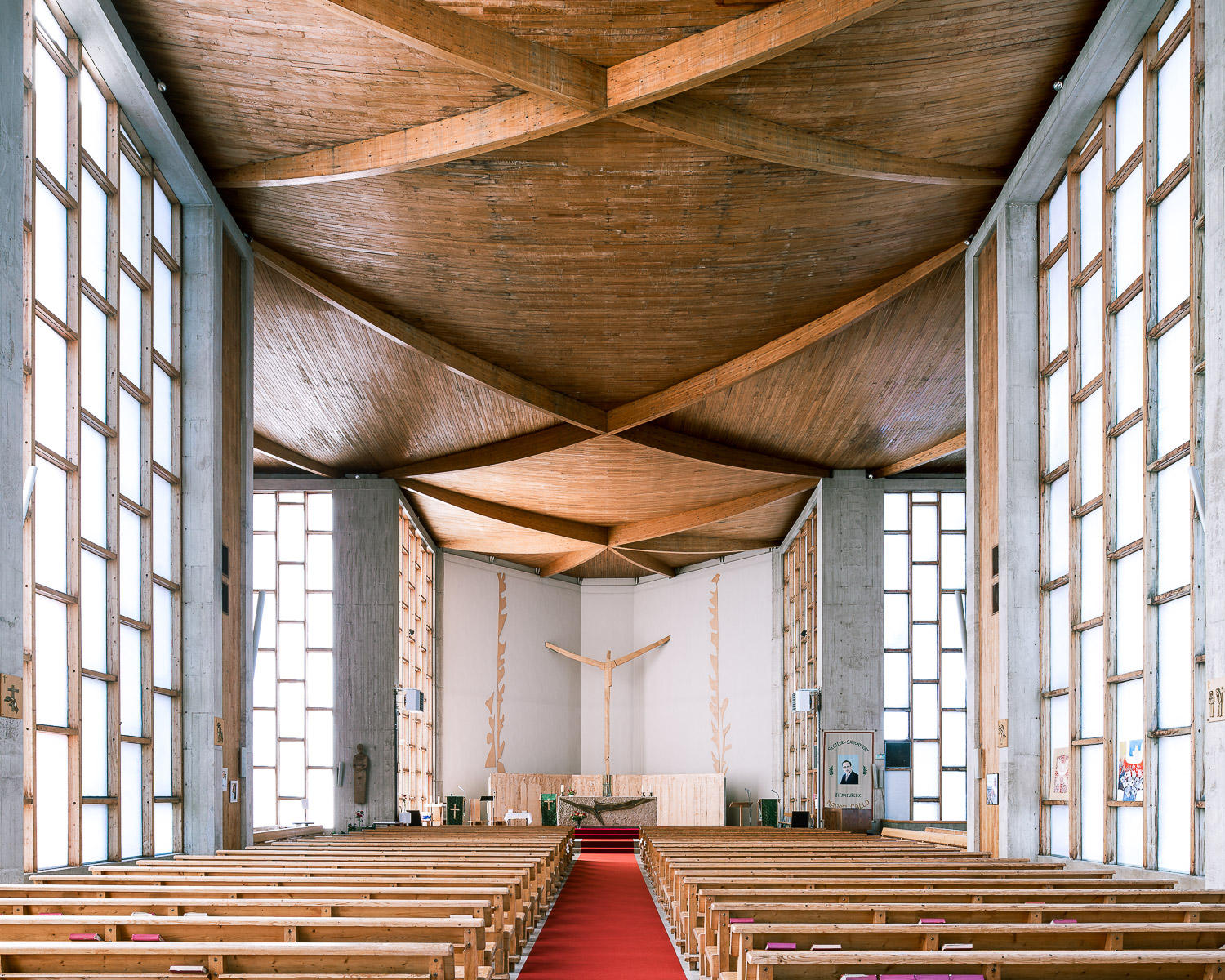
Since we're on the subject of architecture, which is endlessly fascinating and has not been featured as much as NLM as it used to be, I thought I would take this opportunity to share a remarkable gallery of photos by the French photograph Thibaud Poirier of ultra-modernist churches.

Most of them are impressive for their sheer size, but nearly all of them transmit either a cold, oppressive, sinister feel (as if they were chapels for the religion of Sauron in Mordor) or, on the contrary, a religiously vague, mildly comforting, functionally neutral spaciousness that is artistically far superior to “the Shed” (the name of the space in which the Mars Hill Bible Church meets, which we featured last week) yet lacking for the most part in the qualities that make for a recognizable, inhabitable, incarnational dwelling.

I was particularly struck by how many of these churches were built in the 1950s, well before Vatican II, or at any rate during Vatican II, before the Novus Ordo. It prompted me to wonder if such trends in architecture were a small part of the psychological reason behind simplifying, abbreviating, and modernizing the liturgy, for the simple reason that it's very hard to imagine a solemn Mass in such spaces. It would seem awkward to say the least, and bizarrely out of place. Of course it can be done (and surely was done for a short period of time in these buildings), but I can only think of the tensions involved in, say, a super-minimalist production of Shakespeare on a barren stage with actors all in black, where the Elizabethan language clashes with the plain constumery and the vacuous setting.

Here are a few examples of the sinister ones featured in the gallery, with location, architect, and year of completion: 

Saint Mary's Cathedral, Tokyo, Japan (Kenzo Tange, 1964)

Saint-Rémy de Baccarat, Baccarat, France (Nicolas Kazis, 1957)

Sainte-Thérèse-de-l'Enfant-Jésus, Metz, France (Roger-Henri Expert, 1959)

Saint Joseph, Le Havre, France (Auguste Perret, 1956)

Notre Dame du Royan, Royan, France (Guillaume Gillet, 1958)

Saint Anselm's Meguro, Tokyo, Japan (Antonin Raymond, 1954)

Again, note the dates of these: 1964, 1957, 1959, 1956, 1958, 1954.


And now for a few examples of the more comforting but deistic-agnostic designs:
 
Église du Saint Esprit, Viry-Châtillon (Anton Korady, 1964)

Kruiskerk, Amsterdam (Marius Duintjer, 1956)

Notre dame du Chêne, Viroflay, France (Louis, Luc and Thierry Sainsaulieu, 1966)

Obviously these structures, unlike Mars Hill, have a permanence, massiveness, and artfulness (in a certain sense) that marks them as important public buildings with religious overtones, but still they seem to thwart their purpose; indeed, the very modernism draws too much attention to itself, and becomes like a Pharisee standing in front and saying: “I thank you, Lord, that I am not like other churches…” Whereas the traditional church design kneels in the back and says: “Lord, be merciful to me, a sinner like everyone else.”

The photography is brilliant. Some of the churches Poirier photographs are quite inspiring (I have not included here the semi-traditional designs); others, intriguing; still others send chills down the spine. It is clear that no cost was spared in building these edifices, and that they represent something other than mere utility. They are built on a grand scale. Unfortunately, some of them hardly transmit anything of the Christian message and could just as well be United Nations meditation rooms. At their worst, they are cold and terrifying, and would certainly not draw ordinary people in, except those who are curious about feats of modern architecture. One cannot envision Mary sitting at the feet of Jesus there; not even a cozy nook exists to escape into.

Speaking of United Nations, I shared on Facebook not too long ago the following two pictures. The first is of the main hall of the UN; the second is of the Cathedral of Light in Oakland. Family resemblance? What is the message of either building? What is the message of their analogy?


It does no good to pretend that a building is not a silent language and a philosophy embodied.

Wednesday, May 18, 2022

Of Liturgical Interest: Three New Books on the Papacy, Tradition, Authority, and Obedience

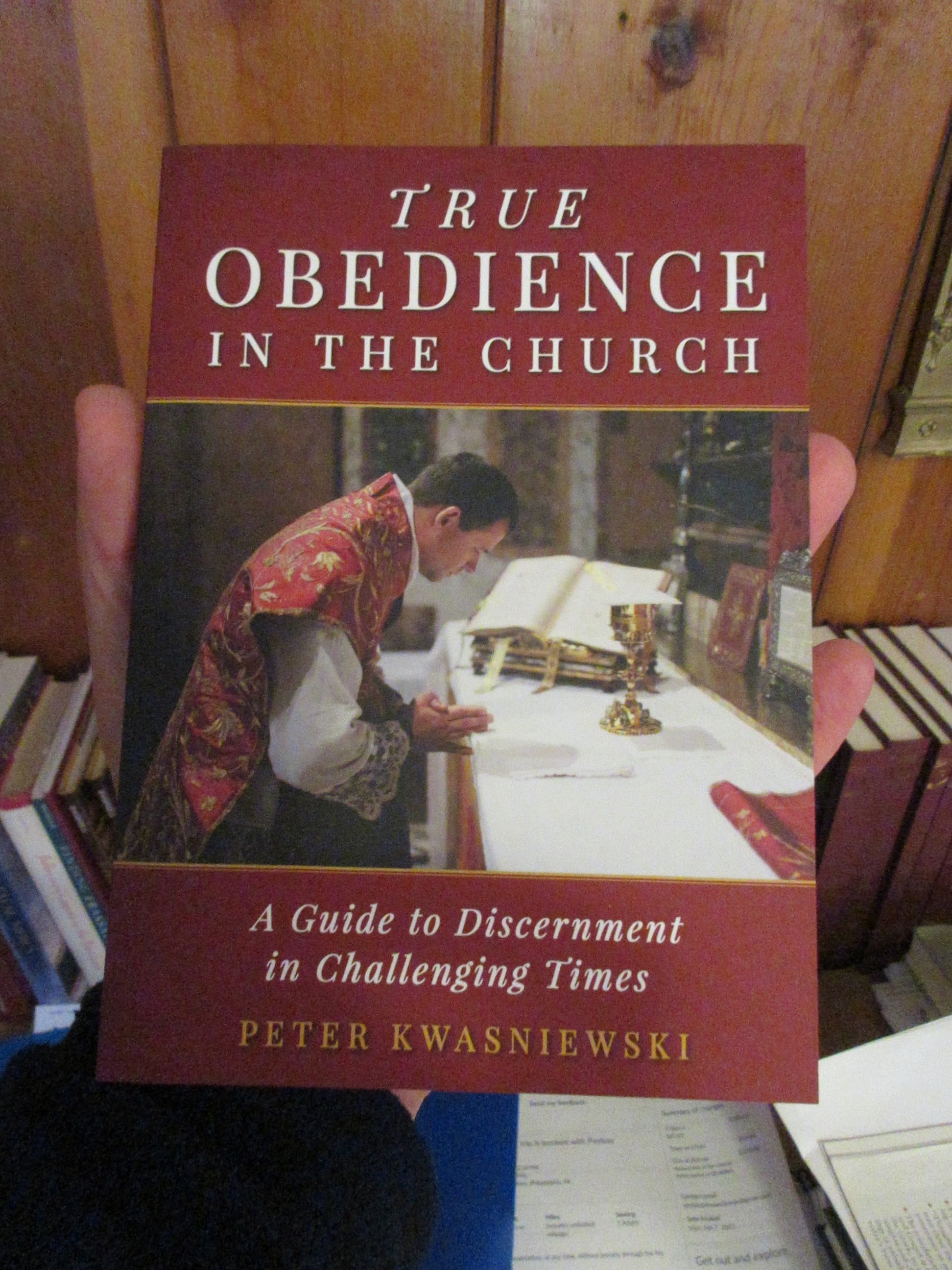
A few months ago, a “tract for the times” (so to speak) appeared from Sophia Institute Press, called True Obedience in the Church: A Guide for Discernment in Challenging Times. This small book has been the topic of many online interviews, a list of which can be found at the link above. The most recent took place with Timothy Flanders, editor of OnePeterFive, on May 16 (here). True Obedience has also been translated into Spanish and German, with Italian, French, Portuguese, and Polish on the way.

The reason it has struck a nerve is not hard to see. Traditionis Custodes presented us with a fundamentally untenable situation. As many authors have explained, it canceled out the pax Benedictina which insisted on some kind of continuity between old and new such that there was room for both in the Church (and, more importantly, such that the old should be seen as in some sense normative for the new, and as positively beneficial in the life of the Church), and replaced it with a rather blunt assertion of the cancellation of the traditional lex orandi by a modern lex orandi because the lex credendi had changed. We were faced with a more outrageous contradiction between popes than has been witnessed in a long time, or perhaps ever, because (to repeat for the hundredth time) it does not concern merely disciplinary matters.

As a result, a crisis of theology, of conscience, and of priesthood immediately follow. How are we to think about this situation, and navigate it practically? What are the principles by which we can distinguish between the obedience that must be given to legitimate authorities, and an “indiscreet obedience” (as St. Thomas Aquinas calls it) that is excessive, based on falsehood, harmful to the good of the Church or to one’s own soul? When canon law is wielded as a cudgel to dissuade or dismay tradition-loving Catholics, what recourse do we have? Do canonical penalties always take effect? What if they are based on falsehoods, both theoretical and practical? Can a falsehood generate a just law or an efficacious application of law?

These are the sorts of questions into which True Obedience delves. Thanks to a generous donor, free copies may be requested by priests, deacons, and seminarians using this link. A dedicated website has been set up, TrueObedience.com, where relevant articles, reviews, and videos may be found.

Naturally, raising such questions prompts still others that go straight back to the foundations of the Catholic religion, especially in the realm of ecclesiology:

• On what basis can we ever question the teachings, commands, or prohibitions of Church authorities?
• Does the papal office have any limits to its power? If so, what are they and how do we know what they are and when they have been overstepped?
• How is a pope’s freedom of action and teaching limited by tradition and by the actions and teachings of his predecessors?
• Did the First Vatican Council officially turn the pope into a supreme monarch whose will is law?
• Why are appeals to “living tradition” and “living magisterium” equivocal and misleading?
• What are we supposed to learn from alternating dark and bright periods of papal history?
• If a pope goes astray in teaching, have the “gates of hell” prevailed?
• Are traditional Catholics guilty of “Protestant private judgment”?
• Why are Sedevacantism and Orthodoxy dead ends rather than ways out of the crisis?
• Is there a common thread connecting the many deviations of the Bergoglio papacy?
• How can we maintain spiritual tranquility in the midst of an ecclesiastical meltdown?
 
The need to engage questions like these, plentiful in the reign of Pope Francis and its renewal of the 1970s attack against liturgical tradition, has led me to think and write frequently about the papacy and about this pontificate. I believed the time had come, in the “end of reign” mood that has taken hold, to gather the best fruit of that work and make it available in a more convenient and definitive format. Arouca Press has just released the resulting two-volume set, entitled The Road from Hyperpapalism to Catholicism: Rethinking the Papacy in a Time of Ecclesial Disintegration.

Volume 1, Theological Reflections on the Rock of the Church, takes up broader theological and spiritual themes, presenting a realistic ecclesiology in which the papacy is indeed a capital part of the Mystical Body of Christ on earth, but still only a part, with definite duties and responsibilities toward the whole; moreover, a pope’s fidelity in meeting these can be assessed by objective, knowable standards.

Volume 2, Chronological Responses to an Unfolding Pontificate, analyzes the major moments of Francis’ pontificate, illustrating and corroborating the points laid out in volume 1. Includes extensive discussions of Amoris Laetitia, the change to the Catechism ono the death penalty, the Abu Dhabi declaration, the Pachamama debacle, and various synods, especially the ones on marriage and family, on youth, and on the Amazon, concluding with analyses of the dismissal of Bishop Daniel Fernández Torres, the reconfiguration of the Roman Curia under Praedicate Evangelium, and an overview of Modernism from Pius X to Francis.

Although it’s a matching set, and obviously the topics interrelate, the volumes are designed to be self-contained and to stand alone; either one can be taken up first. In both, readers will find a searching investigation into some of the major issues facing Catholics at this time in the history of the Church and of the West.

It is only fitting for a post at NLM to draw attention to the liturgical aspects of these books.

Volume 1 argues for the inseparable triad of doctrine, morals, and liturgy: this is what the orthodox Faith necessarily involves. It is not just a matter of “true doctrine” or even “true doctrine and sound morals,” next to which liturgy is a sort of nice leisure activity to keep the faithful busy, to create opportunities for taking up collections, and to share announcements and homespun wisdom from the pulpit. Liturgy is the first and most basic work of the Church, the home of doctrine and the school of morals. More specifically, the 9th chapter of vol. 1 speaks about Pius VI’s Auctorem Fidei and similar documents, and explains why they do not furnish security to the Novus Ordo but, on the contrary, rule out the liturgical reform ahead of time.

Volume 2 contains a number of chapters directly on liturgical matters: ch. 1, an early and still optimistic piece on Pope Francis’ positive remarks about the Byzantine Divine Liturgy; ch. 2 on environmentalist ethics applied to liturgy; ch. 9 on Francis’ sociological reading of 1 Cor. 11, 27-29 in order to sidestep restrictions on Eucharistic communion; ch. 12 on the modernization of liturgy as a key psychological moment in the dismantling of the Ten Commandments; ch. 30 on the routine profanation of church buildings by secular events; ch. 35 on the traditional Martyrology’s witness to martyrs under Islam; ch. 44 on the bizarre invention of the “Sunday of the Word of God” and the refusal of the post-reform Church to acknowledge how the modern liturgy itself withholds the reverence traditionally given to Scripture; ch. 45 on the irony of replacing the feast of the Divine Maternity with the feast of John XXIII; ch. 48 on idolatry, inculturation, celibacy, and deaconesses; ch. 58 on the shattering of liturgical unity by excessive vernacularization; ch. 59 on the unbelievability of papal protestations over liturgical abuses, which “must stop” even if nothing is ever going to be done to stop them. There are, needless to say, many other references to liturgy in these pages, but the foregoing are the extended discussions.

Arouca Press is offering a 15% discount on the set at this link. Otherwise, it may be found at all Amazon outlets.

Monday, May 16, 2022

Worship Spaces vs. Liturgical Dwellings: Church Architecture’s Subtle Language

Last week ago I spoke about William Daniel’s treatment in his book Christ the Liturgy of the meaning of leitorugia as “work of the One for the many” (instead of its mistranslation as “work of the people”). Today I wish to look at some of his insights about church architecture, which are mainly found in chapter 3 — a searching (and often entertaining) inquiry which argues convincingly for traditional ecclesial design from the vantage of modern philosophy and psychology intersecting with biblical and patristic verities.

Daniel is uncompromising about what is at stake in how we build our churches:

The spatial structures we inhabit and the practices by which we inhabit them, as well as those with whom we relate in our environments, are modalities of contingency that incline us to perceive, and thereby understand, what it means to be (alive). (88)

He rejects the idea that architecture could ever be a neutral space, a mere “placeholder.” Even the most empty warehouse already communicates a purpose and a spirit that affects what takes place within it and the people who go there.

Researchers have only recently begun to explore the impact of architecture on the human psyche. What is interesting, however, is that without digging too far beneath the surface to understand the long-term effects of space on human cognition, we know that people’s behavior changes in relation to the space they inhabit. For instance, Jan Gehl has observed that people walk more quickly in front of buildings with blank facades. James Danckert and Colleen Merrifield have found in their work on cognitive neuroscience that people who visually take in a “boring” environment, for instance the plain frontage of a Wal-Mart store or the shadowy glass exterior of a Whole Foods, develop increased levels of cortisol, the stress hormone related to heart disease and diabetes. 8 Not only this, but Canadian psychologist Donald Hebb has discovered that rats living in enriched environments are markedly more intelligent than those that live in more “Spartan” environs…. [H]ow does the space “work on” the worshipper, even, or especially, under the radar of human awareness? (91-92)

He gives many examples, based on research, of how even something as simple as the material and design of chairs and desks affect the mood and productivity of workers. Natural materials such as wood, and the presence of live plants, play a role in maintaining better spirits than obviously artificial materials and a solely man-made environment. In a way this seems obvious when stated, but that which “goes without saying” is very often nowadays simply ignored or denied.

While our individual personalities and habits may work with or fight against such spatial configurations, it is inevitable that the places we inhabit will over time affect our patterns of life, thereby conditioning us to perceive the world and others in relation to their warmth or coldness. (98)

Moving into the ecclesiastical realm, Daniel describes a High Church Anglican chapel, St. Mary the Virgin of Nashotah House Theological Seminary, where he studied for the ministry, and which he obviously found a “warm” space:

Those who inhabit the space as the dwelling place of God, where a person can see, hear, touch, taste, and smell God, experience the connective tissue of the wood, incense, bread, wine, water, chanting, stained glass and much more as a space of freedom, where scales fall from the eyes, burdens fall from the shoulders, and peace is made manifest, not as restrictive but restorative, transformative, extending one’s very body beyond itself as worshippers stand amidst the great cloud of witnesses whose prayers are still savored today.
          Not every liturgical space provides access to this divine, connective tissue. And while I in no way intend to limit the kyriake oikia to the physical structure itself, which too would betray the making involved in the Lord’s house, I seek to wonder here for a moment whether the empty space of the warehouse or strip mall church can be said to be a dwelling place for God, in the sense of ligare noted by David Jones. That is, is cylinder block or drywall conducive to liturgy? Does the warehouse afford the worshipper an attachment to the space of liturgy beyond the scheduled act of worship? If a person walked into the room would it be clear what the space is for, or are such spaces an inadvertent cutting of the ligament that binds the human physically to the celestial, giving way to a kind of spiritual atrophy? (103-4) 

St Mary the Virgin at Nashotah House
 
Mars Hill Bible Church

A rhetorically effective contrast is developed between St. Mary the Virgin and the “Mars Hill Bible Church” in Grand Rapids — a typical multi-purpose Protestant set-up with a stage platform and movie-theatre-like chairs, whose frequenters even nicknamed it “the Shed.”

The minimalist design of the space communicates to the worshipper that while worship does occur inside it remains detached from the building itself. In other words, the space is not a space meant to be inhabited; it is not a place of dwelling. If a person were to walk into the Shed at any other time, there would be no visible markers or signs that allow one to recognize it as a place where worship occurs...
          The contrast between the Chapel of St. Mary the Virgin and the Shed are profound. The former is a space designed to be inhabited by both worshipper and worship, a building that is itself involved in the liturgical action. The latter is transitory by design, which houses a temporary action separable from the space and, perhaps, the worshipper herself. The difference is between inhabiting a space and enacting something within a space. What is missing from the warehouse church is a deep connection with what the Christian worshipper believes and thinks — the tangibility of faith. The visceral sense of the space is impermanent. Its homogenous character neither requires anything from nor offers anything to its occupants. (105) 

Interestingly, the author pivots to a well-known sociological phenomenon — namely, that most people in the Western world, even agnostics and cultural Christians, seek “traditional”-looking churches for weddings — and offers an explanation for it:

It is telling that many who worship in these [“Bible church”] spaces refuse to be married in them. When couples desire a “church wedding,” more often than not they inquire at another local church that “looks like a church,” or they have their wedding outdoors. Why? Because marriage, something intended for a lifetime, needs a permanent space for vows to feel permanent. The temporary space of the abandoned store signals to young couples that their marriage may not last. The expressed desires are “good wedding pictures,” “memories in a holy place,” and “for it to feel like a church wedding.” The message hidden from a couples’ immediate awareness is the need to feel like God is present for their wedding and that their covenant will last. To be and to dwell, as Heidegger notes, are inseparable. (ibid.) 

Returning to the contrast between the Anglican chapel and the Shed, Daniel draws out further implications.

The major difference between the two spaces of worship noted above is that one, the Chapel at Nashotah, is incorporated daily in the making of Holy Eucharist, while I cannot say if this ever occurs at Mars Hill. The irony is that the name Mars Hill invokes a somewhat sacred site, where the Apostle Paul preaches before an altar dedicated to “the Unknown God.” One might speculate that Mars Hill in Grand Rapids bears the marks of an Unknown God, given its lack of symbolism or anything that might disclose the space as Christian. Perhaps the name is deliberate to invoke Paul’s mission to speak amidst the false god of consumer capitalism, witnessed by the abandoned storefront. Nevertheless, the Eucharist — the sacramental action whereby God creates the church — is that which makes any space a space of dwelling. For this reason it is easy to recognize a space that has been designed by and for Eucharistic action. These are not temporary structures separable from the liturgy, even if they lend themselves to more than just prayer and the breaking of bread. Rather, these are eternal structures created by and for an eternal action, an action that remains present even when the building is empty of its people, because it is separable neither from the people who worship there, nor the God whose action the building and people inhabit. (106) 

Then he asks the provocative question: “If worship occurs in a space that conveys temporariness, is the worshipper inclined by the space to treat the liturgical action as temporary?... A utilitarian space breeds a utilitarian liturgy” (107).
 

After a fascinating analysis of tools, economics, and alienation from the process of production (it would no doubt be too Marxist for some, but it seemed to me spot-on, in the vein of William Cavanaugh), Daniel returns to his main theme, this time weaving in a metaphor from viticulture:

Terroir in French has to do specifically with wine making, yet in a deeply cultural sense of the taste of a place, gout de terroir. For this reason, it is actually illegal to label a wine with the name Burgundy if it is not from Burgundy, France. Burgundy is at once the wine and the place; the two are inseparable. The gout de terroir draws the deep connection that the soil and the hands that work it are inseparable from the taste of the wine. In other words, the wine — its fullness of taste and heightening of the senses — cannot be separated from any of the environmental circumstances within which it is produced.
          In like manner, Christian liturgy is inseparable from the space and people intervolved in the action, all of which are intervolved in what we might call the grammar of God. We might even go so far as to call it the gout de Dieu, as it is in, by, and through the Eucharistic space that the worshipper learns what it means to taste and see that the Lord is good. The taste of the place, the smell, the touch, the sights and sounds of the kyriake oikia are all a language that conditions perception in the worshipper as she is spoken into being through them and called to attention by them, as the unspoken language demands not words but, perhaps, silence. (118-19) 

We must continue to develop such tools of analysis for explaining why our traditional church designs are objectively superior and necessary, and cannot be written off as habitual and sentimental models to which we are lazily attached and for which we ought to find (or be content with) “modern” substitutes. If Christ the Liturgy is correct in its argumentation, there can be serious negative psychological and spiritual effects of bad church architecture — and this is before we even broach more properly theological and liturgical questions.

Monday, December 20, 2021

Notre Dame 2.0 and Missale Romanum 2.0

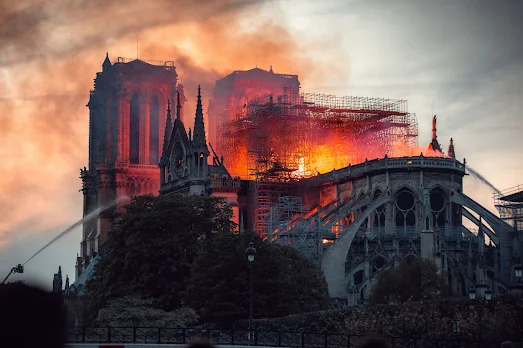
Notre Dame Cathedral has once again been in the news quite a bit. (I promise my readers that this article will come around to the subject on all of our minds, namely, the attack on the Roman Rite that was intensified by the CDW document released this past Saturday.) On the side of good news, Sharon Kabel at OnePeterFive takes us through the wondrous things happening in the course of Notre Dame’s painstaking structural restoration, in the categories of wood, acoustics, metal, glass, stone, structure, digital, and emotion. What a building and what a project! The artisans, art historians, and craftsmen obviously love the medieval masterpiece that they are privileged to study and repair. On the side of bad news, Auguste Meyrat at Crisis tells us that (surprise, surprise) Catholic churchmen are in cahoots with liturgical and artistic modernists to produce an interior of hair-raising horror. Jeanne Smits, the Paris correspondent of LifeSiteNews, furnishes details about the plan, which apparently has received preliminary approval, in spite of the impassioned protest of over a hundred major French cultural figures. One can only hope and pray that better counsels will prevail, as they did for the replacement of the spire and the outside renovation.

In an interesting article published last April at PrayTell, James Hadley made a brilliant case for architectural traditionalism and against artistic modernism. He quotes Jorge Otero-Pailos, Director and Professor of Historic Preservation at Columbia University Graduate School of Architecture, Planning and Preservation, who said that “heritage is a social process of making and remaking culture by interacting in and with sites and objects inherited with previous generations.” Hadley comments:

While this in part is true, it also wrongly gives the impression that both heritage and culture are things we create based upon what we value or dis-value at any given moment. It implies that heritage has no inherent force or stability by which we “should” value it. As a result, contemporary society is left unfettered to destroy or remake past monuments as we see fit. We are simply playing at making new transient meanings and values based upon our shifting priorities and allegiances at the moment.
He then turns to the Vatican’s Pontificia Commissione per i Beni Culturali della Chiesa for guidance. The commission’s body of directives on how old ecclesiastical buildings should be treated
understands ecclesiastical heritage not firstly as high artistic achievement, but as material witness to Christian belief. The object itself (be it a sculpture or building) expresses Christian belief, but more importantly, it records and projects the faith of the community which created it – it is the witness of the witnesses. Christian heritage is theologically rooted therefore in those who have seen and confessed Christ as Lord, and is theologically oriented to continuing that witness in the present. In this way, the pertinent question for church heritage is not how may we act upon it to our own ends, but how may we become present to its inner world of meaning, what in Italian is known as valorizzazione. In this paradigm there is a very real sense of communio with and between the present church, the object, and the Christian community of the past. To tamper with the material object, is to change the record of witness. A communion suggests respect, listening, and investigation. Not hubris, hegemony, and alteration. Oddly, no one would contend that in order to understand the past and make it relevant one should enter an archive and rewrite, erase or destroy documents. But this is exactly what we continuously do in the built environment (our church buildings bearing the brunt), and in so doing we falsify and destroy the underlying witness. In this process of alteration we ultimately erase ourselves since we are constantly born out of our pasts.
Hadley notes that most of the proponents of super-modern renovations to Notre Dame (thankfully all rejected) believe that moderns are inescapably stuck in modernity and cannot relate any more to past styles as if they were present languages. Citing Catholics who believe that the right approach is to “innovate for God,” to show that the community has something “new” to say, he remarks:
In a post-Christian West the necessary reflection called for by the Notre-Dame tragedy is not a question of “innovation” but of reclamation and witness. Reclaiming and fortifying our witness by understanding our past. When the fire broke out at the cathedral, the nearby monastic Fraternité de Jérusalem began signing the Litany of Saints in their church invoking the aid of French Christians of old whose faith had built Notre-Dame. They continued the litany until the flames were extinguished…. What I see at stake now is the preservation of the very possibility of religious imagination. It seems to me that what Christianity should be proposing at this time is not “innovation” but deep engagement with our past, by calling upon the people, faith, and wisdom, that created that which we postmodernists are now playing at. After all, the term innovate in its earlier Latin form meant more to “renew” than to “change.” One is hard pressed to innovate with empty hands. We need our architectural and artistic past and we need to relearn it urgently.
The end of Hadley’s article is an eloquent appeal to abandon modern hubris and to sit at the feet of our ancestors in the Faith, who have something to teach us, who have indeed much to tell us that we have forgotten, to our impoverishment. Perhaps most of all, we need to be broken out of our temporal snobbery and the hidden heresy of perpetual progress. Every age is an age of progress, regress, and stasis, in different respects; and yet the most important truths, the truths by which we live and die, remain the same.
It now must be said again explicitly; Our ancestors, histories, material cultures, and built environments, have the right to be what they are. To not be re-interpreted, or reinvented. To exist today in their integrity without our pushy or hubristic updates, additions, and re-contextualization meant to sooth, temporarily mesmerize, or aggrandize ourselves… What this demands of us is humility, recognition that we are not inherently progressive in any positive way, that modernity is not innately better, that the junk we flood the earth with today, is not more enduring and meaningful than the artistry and faith of our past. We like the Russian Orthodox reformer of the 19th century, Ivan Kireevsky, cannot insist that the way forward is to change a past because we have forgotten it (Kireevsky, Fragments, 248-43). We must instead go to that place our ancestors built and learn to see it as they did, and thus bear testimony to it as eyewitnesses. And such is the case of Notre-Dame in Paris. Its restoration lies not in our changes to it, but in our submission to its form, wisdom, and witness.


Could anyone read this impassioned plea for preserving the architectural integrity of Notre Dame cathedral and not think immediately of the even greater claim made on us by the greatest work of art known to the Western world—the Roman Rite of the Mass, and its panoply of attendant rites—whose integrity was so violently assaulted after the Second Vatican Council? Just go back and re-read the quotations from Hadley, but having in mind the liturgy instead of Notre Dame. There is a nearly one-for-one equivalency of concept and praxis.

This, in turn, reminds me of one of the most splendid passages in the writings of John Senior:

Whatever we do in the political or social order, the indispensable foundation is prayer, the heart of which is the Holy Sacrifice of the Mass, the perfect prayer of Christ Himself, Priest and Victim, recreating in an unbloody manner the bloody, selfsame Sacrifice of Calvary. What is Christian culture? It is essentially the Mass.
       That is not my or anyone’s opinion or theory or wish but the central fact of 2,000 years of history. Christendom, what secularists call Western Civilization, is the Mass and the paraphernalia which protect and facilitate it. All architecture, art, political and social forms, economics, the way people live and feel and think, music, literature―all these things, when they are right, are ways of fostering and protecting the Holy Sacrifice of the Mass.
       To enact a sacrifice, there must be an altar, an altar has to have a roof over it in case it rains; to reserve the Blessed Sacrament, we build a little House of Gold and over it a Tower of Ivory with a bell and a garden round it with the roses and lilies of purity, emblems of the Virgin Mary ―Rosa Mystica, Turris Davidica, Turris Eburnea, Domus Aurea, who carried His Body and His Blood in her womb, Body of her body, Blood of her blood.
       And around the church and garden, where we bury the faithful dead, the caretakers live, the priests and religious whose work is prayer, who keep the Mystery of Faith in its tabernacle of music and words in the Office of the Church; and around them, the faithful who gather to worship and divide the other work that must be done in order to make the perpetuation of the Sacrifice possible—to raise the food and make the clothes and build and keep the peace so that generations to come may live for Him, so that the Sacrifice goes on even until the consummation of the world.
The raging flames that burned up the spire and roof of the great medieval masterpiece of Notre-Dame in Paris, the fire that gutted its harmonious additions and renovations, provided us with a palpable image of what was done to that even greater masterpiece of medieval art (so to speak), the traditional Roman Rite, in the decade from about 1963 to 1973. The cathedral, after all, was created to house the Host and to provide a worthy space for the sacred liturgy. There would be no Notre Dame, no Chartres, not a single one of the great cathedrals, without the usus antiquior, as Marcel Proust recognized (see his important 1904 essay Death Comes for the Cathedrals, recently published by Wiseblood Books with commentary by John Pepino and me, tying it in to the traditionalist movement today).

It is therefore the very same instinct to wish to see Notre Dame restored to her glory and to wish to see the Roman liturgy restored to its glory; the same intuition that tells us there is something radically wrong with deconstructing and reconstructing our central act of prayer according to modernist or post-modernist proclivities.

Monday, June 22, 2020

Can Modernity Bring Anything to the Liturgy?

Photo by Lucas Carl on Unsplash
Today’s revival of traditional approaches in the fine arts and particularly of traditional liturgical practices has been greeted by many with skepticism and disapproval. “Surely, it is not possible to ‘go back’ to an earlier age, whose ideals are so different from ours? Have we not made significant progress in doing what none could do before? As for anything we might need, it will not be what former generations needed.”

The history of the arts and of reform/renewal movements tells a different tale. All great artists began by apprenticing themselves to a tradition and copying its masterpieces. In like manner, all great movements of reform in Church history looked back for inspiration to what worked in the past in order to fix what was broken in the present. The noble cultural ideals of Western civilization — largely imparted to it by the vigorous activity of the Catholic Church — are possessed of a perennial vitality and creative fecundity against which the self-consciously “modern,” with its fading faddishness, cannot successfully compete.

The reinveintion of the liturgy after the Council was merely the last and most tragic of a long series of unnatural dislocations and distortions of human forms in the 20th century. This was a century that prided itself on taking everything apart, breaking it down, and gutting it out: first painting and poetry, then dance and music, social customs, politics, education. It was only a matter of time before the liturgy, the cumulative and culminating art form, the king in his court, was also deposed. Once all the subsidiary arts, both material and spiritual, that made liturgy possible were reviled and denied, how could liturgy itself stand? If all of culture was declining throughout the modern period, how could liturgy — that supreme expression and concentration of culture — be left unaffected? Would there not be a terrible risk that men without chests and without taste would eventually hold the reins of power and change it to reflect their simplistic rationality? And so it happened.

In the aftermath of this sad story, is it inopportune and premature to ask whether or not there might be something, anything, that modernity can bring to Catholic ritual in a positive sense? Let me explain the basis for the question.

Each era seems to have added — one might say, grafted — something distinctive onto the tradition. The Christians of the Middle Ages were masters of symbol, Scripture, and allegory, and gave us rites and commentaries in that spirit. The medieval liturgy in its tropes, ritual elaboration, architectural framework, and commentary tradition, is an exquisite glorification of the sacrifice on which salvation history centers. The Baroque brings something startlingly new: the unveiled sanctuary, the focus on ecstatic vision and overwhelming sensual experience, even a surprising penchant for the dramatic (i.e., stages, machines, flying angels for the Forty Hours’ devotion). In one way, it is a departure from tradition, even in some way a narrowing, as the Neo-Classical and humanist mind shied away from the dense layers of Scripture and mystery in medieval liturgy and tended toward an “open” sanctuary, emphasizing in ritual the adoration of Christ in His Real Presence rather than placing weight on the many symbolic words and gestures of the rites. Nevertheless, all of this seemed well-suited to the times, fruitful in sanctity, and eventually absorbed into our heritage.

It is a sign of vitality and true mastery of the tradition to be able to enrich it with the gifts of one’s own time. Every vigorous age has produced its own liturgical spirit and forms. Could modernity, too, add to the tradition, enriching it? Has it any legitimate aspirations? Can the excruciating pains and confusion expressed in modernist literature and architecture be given some liturgical answer, spoken in the same dialect? We might look to the composer Arvo Pärt as an example: his music is distinctly modern, but also grounded in tradition. Is there a liturgical analogy to Pärt? What might it look like?

Would that a positive answer were easier to give. “Modernity” is, or at least has been characterized by, waves of disorder: the progressive dismantling, doubting, destabilizing, and distorting of elements that were deemed inopportune, inefficient, oppressive, clericalist, etc. It is defined by its rebellion against classical and Christian order. This is unmistakably seen in the fine arts. Atonal music is defined with an alpha privative. Abstract art is not representational, not recognizable, not indwelling in this world, but flying off to some uninhabitable world where man cannot dwell, a cold planet hung in empty space, lacking water or life. Moreover, since modernity is not one positive spiritual-cultural force, the way that (say) English Gothic and French Baroque were, it is hard to see how it could exercise causality per se. Privation does not act.

Leaving it at this point would, however, be too pessimistic. Human nature and God’s grace reassert themselves. Past culture never completely dies out but is passed along in the “genes” of a society or a civilization. “Modernity,” whatever it means, includes within it that which is not rebellious, not unnatural, not privative, but rather in a loose continuity with the preceding cultural matrix, with some openness to the transcendent, like poor soil still capable of nourishing a plant, awaiting the sower and the seed. This, it seems to me, explains why young people can encounter the traditional liturgy, which is so very unmodern, and immediately resonate with it. In a corner of modern man’s soul is found a desire, vague and tentative though it may be, to escape from the prison that recent generations have built.

Perhaps this, then, is a special grace of modernity: it has placed people into a hunger and thirst for expressions of the sacred and the divine that lift them out of the horizontal immanent void and confront them with the mysterium tremendum et fascinans, the overpowering and the alluring. Would we not be in a better position than any earlier generation to be struck by such a thing — what Benedict XVI called “the shock of the beautiful” — since we no longer live familiarly with it, take it for granted, or even expect to have it around us?

Now, of course, I’m not one to say that men of today are essentially different from their predecessors, such that they would need something radically different in their Catholicism from the ample treasury already at hand in our tradition. The tradition as it is can save him, whether in its more monastic-medieval or more Baroque instantiation. Love of the Church’s tradition is always totally contemporary and totally ageless. Modern man needs what every man needs — or even more of it! — and that is sacredness, solemnity, beauty, and a deep sense of connection with the human race, the Church, and his fellows. Only the use of the same fundamental forms of life, worship, and art, however varied in presentation, can accomplish this diachronic and synchronic unity.

My answer, then, to the question posed in the title would be this. Modernity left the Church a long time ago; it partly fled in rebellion, and was partly driven forth as a demon. It can therefore contribute nothing to the restoration of the sacred. All it can do is bring moderns to the Church’s threshold, and leave them there, like orphans abandoned on the doorstep of a convent. The traditional sacred liturgy will take them up in its arms and provide for their healing and elevation. It is our job to let ourselves be cared for (yes, that will take swallowing some pride), and if the Lord deigns to raise up a new Christendom over many centuries, He will give us the light and strength right now to play our small part in paving the way for its emergence.

Visit Dr. Kwasniewski’s website, SoundCloud page, and YouTube channel.

This stained glass window, to me, speaks volumes...

Monday, October 21, 2019

St. John Henry Newman, the Traditionalist — Part 2: Quotations

Newman wearing a saturno and a winter cappa
Last week I spoke about Newman’s anti-liberal, anti-progressive, anti-modernist side, against those of his fairweather friends and misguided enemies who paint him as a proto-Congar or a proto-De Lubac, as one who practically sketched out the Second Vatican Council and left his notes to Papa Roncalli. The truly Catholic Newman was faithfully expounded in seven books written by Fr Stanley Jaki and still in print, albeit nearly ignored, as they do not flatter modern readers. In a timely manner, Bishop Edward O’Dwyer’s 1908 essay Cardinal Newman and the Encyclical ‘Pascendi Dominici Gregis’ has also just been republished.

Today I would like to make good on my claim that Newman would oppose just about every trend in the Church today, except for the active role taken on by laity — I mean, by conservative and traditional laity who pass on and defend the Catholic and Apostolic Faith in spite of the resistance or indifference of their shepherds, a situation that echoes the fidelity of the laity during the Arian crisis, as Newman carefully documented. I shall quote particularly sparkling passages from his writings. Some of these will be found in the book that I announced on Monday, Newman on Worship, Reverence, and Ritual: A Selection of Texts (US | UK), but most are from other places in his writings. I am not putting these in any particular order, nor am I attempting to canvas his entire career or cherrypick the “best.” Like most great authors, Newman wrote an astonishing amount, and wherever one dips in, one is apt to find treasure.

Ancient Israel as a Model and Warning

In my opinion, one of Newman’s greatest strengths as a biblical exegete is his keen sense, indebted to the Church Fathers, that the Old Testament is not just a record of a particular ancient people or nation, but a mirror we hold up to our faces to see our own image. The virtues of Israel are the virtues of Christians, and their vices our vices.

A splendid example of his approach is the following passage, in which he explains that it would make no difference to have miracles, if we have not faith and love, illustrating the more general (and uncomfortable) truth that Christianity does not somehow automatically make us better than the ancient Israelites. It gives us more access to truth and grace — that is all. We can still imitate their disbelief, even as the best of them foreshadowed our saints and indeed are counted among our saints.
What is the real reason why we do not seek God with all our hearts, and devote ourselves to His service, if the absence of miracles be not the reason, as most assuredly it is not?
       What was it that made the Israelites disobedient, who had miracles? St. Paul informs us, and exhorts us in consequence. “Harden not your hearts, as in the provocation, in the day of temptation in the wilderness ... take heed ... lest there be in any of you” (as there was among the Jews) “an evil heart of unbelief in departing from the Living God.” Moses had been commissioned to say the same thing at the very time; “Oh that there were such a heart in them, that they would fear Me, and keep My Commandments always!”
       We cannot serve God, because we want the will and the heart to serve Him. We like any thing better than religion, as the Jews before us. The Jews liked this world; they liked mirth and feasting. “The people sat down to eat and to drink, and rose up to play;” so do we. They liked glitter and show, and the world’s fashions. “Give us a king like the nations,” they said to Samuel; so do we. They wished to be let alone; they liked ease; they liked their own way; they disliked to make war against the natural impulses and leanings of their own minds; they disliked to attend to the state of their souls, to have to treat themselves as spiritually sick and infirm, to watch, and rule, and chasten, and refrain, and change themselves; and so do we. They disliked to think of God, and to observe and attend His ordinances, and to reverence Him; they called it a weariness to frequent His courts; and they found this or that false worship more pleasant, satisfactory, congenial to their feelings, than the service of the Judge of quick and dead; and so do we: and therefore we disobey God as they did, — not that we have not miracles; for they actually had them, and it made no difference.
       We act as they did, though they had miracles, and we have not; because there is one cause of it common both to them and us — heartlessness in religious matters, an evil heart of unbelief; both they and we disobey and disbelieve, because we do not love.  (Parochial and Plain Sermons, vol. 8, sermon 6, Miracles no Remedy for Unbelief)
In a similar vein, Newman speaks of how even the incarnate Christ remains the “hidden Savior” of Israel, one whose presence calls for reverential fear and faith in things unseen. We can quarrel and commit blasphemy towards Christ just as the Jews of His day did:
If He is still on earth, yet is not visible (which cannot be denied), it is plain that He keeps Himself still in the condition which He chose in the days of His flesh. I mean, He is a hidden Saviour, and may be approached (unless we are careful) without due reverence and fear. I say, wherever He is (for that is a further question), still He is here, and again He is secret; and whatever be the tokens of His Presence, still they must be of a nature to admit of persons doubting where it is; and if they will argue, and be sharpwitted and subtle, they may perplex themselves and others, as the Jews did even in the days of His flesh, till He seems to them nowhere present on earth now. And when they come to think him far away, of course they feel it to be impossible so to insult Him as the Jews did of old; and if nevertheless He is here, they are perchance approaching and insulting Him, though they so feel. And this was just the case of the Jews, for they too were ignorant what they were doing. It is probable, then, that we can now commit at least as great blasphemy towards Him as the Jews did first, because we are under the dispensation of that Holy Spirit, against whom even more heinous sins can be committed; next, because His presence now as little witnesses of itself, or is impressive to the many, as His bodily presence formerly.”  (Parochial and Plain Sermons, vol. 4, sermon 16, Christ Hidden from the World)
One of very few pictures we have of Newman in liturgical garb

Church Services Too Long and In Need of Modification?

Newman sees the liturgical services (or “ordinances”) of the Church as an opportunity to test our actual resolve to be holy, to attend in faith and love to God’s presence. If we cannot bring ourselves to go to church at a set time to meet the Lord and to concentrate our minds on Him when the means are provided to us, why should we presume that we will succeed in putting our minds on Him elsewhere, when no consistent means are given? Back in Newman’s day, proposals were afoot for shortening and simplifying the Church’s public worship, and he opposed them staunchly. As we know, one of the principal goals of twentieth-century liturgical reform in the Catholic Church was to abbreviate all the ceremonies, because they were considered too long for Modern Man.Ô This tendency was at work in Pius XII’s Holy Week deformation before the epitome of exiguity was achieved in the hieratic haiku of the rites of Paul VI. Newman has something helpful to say to this self-sabotaging reformism:
If any one alleges the length of the Church prayers as a reason for his not keeping his mind fixed upon them, I would beg him to ask his conscience whether he sincerely believes this to be at bottom the real cause of his inattention? Does he think he should attend better if the prayers were shorter? This is the question he has to consider. If he answers that he believes he should attend more closely in that case, then I go on to ask, whether he attends more closely (as it is) to the first part of the service than to the last; whether his mind is his own, regularly fixed on what he is engaged in, for any time in any part of the service? Now, if he is obliged to own that this is not the case, that his thoughts are wandering in all parts of the service, and that even during the Confession, or the Lord’s Prayer, which come first, they are not his own, it is quite clear that it is not the length of the service which is the real cause of his inattention, but his being deficient in the habit of being attentive. If, on the other hand, he answers that he can fix his thoughts for a time, and during the early part of the service, I would have him reflect that even this degree of attention was not always his own, that it has been the work of time and practice; and, if by trying he has got so far, by trying he may go on and learn to attend for a still longer time, till at length he is able to keep up his attention through the whole service.  (Parochial and Plain Sermons, vol. 1, sermon 11, Profession without Hypocrisy)
Newman makes mention of the Lord’s Prayer, which for him exemplifies the value of simple, clear, unemotional, formal prayer — as long as it remains true to its type:
Christ gave us a prayer to guide us in praying to the Father; and upon this model our own Liturgy is strictly formed. You will look in vain in the Prayer Book for long or vehement Prayers; for it is only upon occasions that agitation of mind is right, but there is ever a call upon us for seriousness, gravity, simplicity, deliberate trust, deep-seated humility. Many persons, doubtless, think the Church prayers, for this very reason, cold and formal. They do not discern their high perfection, and they think they could easily write better prayers. When such opinions are advanced, it is quite sufficient to turn our thoughts to our Saviour’s precept and example. It cannot be denied that those who thus speak, ought to consider our Lord’s prayer defective; and sometimes they are profane enough to think so, and to confess they think so.  (Parochial and Plain Sermons, vol. 1, sermon Sermon 14, Religious Emotion)
One wonders what Newman would have said about a pope twisting the last line of the Lord’s Prayer to say something that the Greek New Testament doesn’t say, and then to enforce his “new and improved” version on segments of the Church. We know what he would say about a pope abandoning the Latin language for Catholic worship:
The Mass must not be said without a Missal under the priest’s eye; nor in any language but that in which it has come down to us from the early hierarchs of the Western Church. (Idea of a University, Part II, ch. 6: “University Preaching,” 1855) 
Along similar lines, Newman preached on the quality of zeal that befits the confessor of Christ, and complained quite movingly of coreligionists who dared to suggest purging verses from the Psalter because they were no longer fitting to recite. We pick up the thread where he is telling us how much we are supposed to keep learning from the Old Testament. Watch where he goes with the Psalter:
A certain fire of zeal, showing itself, not by force and blood, but as really and certainly as if it did — cutting through natural feelings, neglecting self, preferring God’s glory to all things, firmly resisting sin, protesting against sinners, and steadily contemplating their punishment, is a duty belonging to all creatures of God, a duty of Christians, in the midst of all that excellent overflowing charity which is the highest Gospel grace, and the fulfilling of the second table of the Law.
       And such, in fact, has ever been the temper of the Christian Church; in evidence of which I need but appeal to the impressive fact that the Jewish Psalter has been the standard book of Christian devotion from the first down to this day. I wish we thought more of this circumstance. Can any one doubt that, supposing that blessed manual of faith and love had never been in use among us, great numbers of the present generation would have clamoured against it as unsuitable to express Christian feelings, as deficient in charity and kindness?
       Nay, do we not know, though I dare say it may surprise many a sober Christian to hear that it is so, that there are men at this moment who (I hardly like to mention it) wish parts of the Psalms left out of the Service as ungentle and harsh? Alas! that men of this day should rashly put their own judgment in competition with that of all the Saints of every age hitherto since Christ came — should virtually say, “Either they have been wrong or we are,” thus forcing us to decide between the two. Alas! that they should dare to criticise the words of inspiration! Alas! that they should follow the steps of the backsliding Israelites, and shrink from siding with the Truth in its struggle with the world, instead of saying with Deborah, “So let all Thine enemies perish, O Lord!”  (Parochial and Plain Sermons, vol. 3, sermon 13. Jewish Zeal, a Pattern for Christians)
Yet Paul VI did exactly what Newman railed against: he had “parts of the Psalms left out of the Service” (that is, the Liturgy of the Hours of 1970), following the steps of the backsliding Israelites. See this link for a full listing of the omitted verses.

I would go further and say that Newman, of all modern theologians, is the one whose thought stands most opposed, as a matter of principle, to the postconciliar liturgical reform.
There never was a time since the apostles’ day when the Church was not; and there never was a time but men were to be found who preferred some other way of worship to the Church’s way. These two kinds of professed Christians ever have been — Church Christians and Christians not of the Church; and it is remarkable, I say, that while, on the one hand, reverence for sacred things has been a characteristic of Church Christians on the whole, so, want of reverence has been the characteristic on the whole of Christians not of the Church.  (Parochial and Plain Sermons, vol. 8, sermon 1, Reverence in Worship)
Did those who radically altered the inherited liturgy, with its profound spirit of reverence exhibited and inculcated in a thousand turns of phrase, bows of the head, kisses of the altar, bending of the knees — did they “prefer some other way of worship” to what had been, for so many centuries, “the Church’s way”? Did they show “reverence for sacred things” or rather an appalling “want [lack] of reverence”? As if continuing his train of thought, Newman says in a different sermon:
It is scarcely too much to say that awe and fear are at the present day all but discarded from religion. Whole societies called Christian make it almost a first principle to disown the duty of reverence; and we ourselves, to whom as children of the Church reverence is as a special inheritance, have very little of it, and do not feel the want of it.  (Parochial and Plain Sermons, vol. 5, sermon 2, Reverence, a Belief in God’s Presence)

A Church is Like Heaven — or Should Be

Newman’s vision of what heaven will be like is all the more challenging to read in the postconciliar period, when his comparison of it to services in church seems to apply to nearly no Catholic parish except those that have resolutely returned to tradition:
Heaven then is not like this world; I will say what it is much more like, — a church. For in a place of public worship no language of this world is heard; there are no schemes brought forward for temporal objects, great or small; no information how to strengthen our worldly interests, extend our influence, or establish our credit. These things indeed may be right in their way, so that we do not set our hearts upon them; still (I repeat), it is certain that we hear nothing of them in a church. Here we hear solely and entirely of God. We praise Him, worship Him, sing to Him, thank Him, confess to Him, give ourselves up to Him, and ask His blessing. And therefore, a church is like heaven; viz. because both in the one and the other, there is one single sovereign subject — religion — brought before us.  (Parochial and Plain Sermons, vol. 1, sermon 1. Holiness Necessary for Future Blessedness)
Such views about the afterlife and the way in which a church service should emulate the state of beatitude would probably be written off today by many as “romantic” or “romanticized,” as much as would be Guéranger’s reconstruction of medieval monasticism, Mocquereau’s reinterpretation of plainchant, or Pugin’s and Viollet-le-Duc’s reclamation of Gothic architecture. Yet what all of these 19th-century geniuses had in common is their strong artistic intuition and lively religious imagination. In short, they were not rationalists and historicists, but believers and emulators.

Newman was concerned about the worldliness that ever threatened to creep into the Church, as he complains about “the American Church,” i.e., the Episcopalians.
If this view of things is allowed a footing, a sleek gentlemanlike religion will grow up within the sacred pale, with well-warmed chapels, softly cushioned pews, and eloquent preachers. The poor and needy, the jewels of the Church, will dwindle away; the clergy will sink in honour, and rich laymen will culminate. Already, Mr. Caswall informs us, “there are churches which rather resemble splendid drawing-rooms than houses of worship, and in which the poor man could hardly feel himself at home. Handsome carpets cover every part of the floor,” and “the pews are luxuriously cushioned in a manner calculated to invite repose.” (Essays Critical & Historical, Volume 1, VIII. The Anglo-American Church)
We are not far here from the utterly non-transcendent comfortable religion that Bishop Barron years ago, before he busied himself with the more urgent business of evacuating hell, memorably dubbed “beige Catholicism.” Not heaven on earth, but a second-rate country club.

Carpeted and cushioned churches: Newman is not amused

Refraining From or Approaching Holy Communion

The question of who may or may not, who should or should not approach to receive the true Body of Christ in the most holy sacrament of the altar has always been and will always be a pressing one in the Church, as it is a matter of spiritual life or death: those who receive worthily grow in God’s friendship, while those who receive unworthily, that is, in a sinful condition offensive to God, heap damnation on themselves, until and unless they repent. When Newman speaks about the receiption of communion, even in the Anglican context, he is dreadfully serious about what he believes is at stake for souls (and indeed, as any Thomist would say, if an Anglican believes his Eucharist is truly Christ, he would commit a further grave sin by receiving it with grave sin on his conscience):
The true reason why people will not come to this Holy Communion is this, — they do not wish to lead religious lives; they do not like to promise to lead religious lives; and they think that that blessed Sacrament does bind them to do so, bind them to live very much more strictly and thoughtfully than they do at present. Allow as much as we will for proper distrust of themselves, reasonable awe, the burden of past sin, imperfect knowledge, and other causes, still after all there is in most cases a reluctance to bear, or at least to pledge themselves to bear, Christ’s yoke; a reluctance to give up the service of sin once for all; a lingering love of their own ease, of their own will, of indolence, of carnal habits, of the good opinion of men whom they do not respect; a distrust of their perseverance in holy resolves, grounded on a misgiving about their present sincerity. This is why men will not come to Christ for life; they know that He will not impart Himself to them, unless they consent to devote themselves to Him.  (Parochial and Plain Sermons, vol. 7, sermon 11. Attendance on Holy Communion)
Would that we had a mere fraction of this sense of self-awareness among us today, when the vast majority of those present at any Mass walk up to receive, without heeding St. Paul’s instruction to examine their consciences for impediments! If one had to choose between this pervasive laxity and the bad old days when few received, the latter situation was far better, as simply being more honest. Christian love builds on truth, not on free lollipops for all comers. Mortal sinners used to refrain from committing an act of sacrilege. Today, they get what has been called the “Sin-nod.”

Newman understood sacramental logic better than all the bishops at the various modern synods that have wasted the time, money, and patrimony of the Catholic Church:
If the dead bodies of Christians are honourable, so doubtless are the living; because they have had their blessedness when living, therefore have they in their sleep. He who does not honour his own body as something holy unto the Lord, may indeed revere the dead, but it is then a mere superstition, not an act of piety. To reverence holy places (right as it is) will not profit a man unless he reverences himself. Consider what it is to be partaker of the Body and Blood of Christ. We pray God, in our Church’s language, that “our sinful bodies may become clean through His body;” and we are promised in Scripture, that our bodies shall be temples of the Holy Ghost. How should we study, then, to cleanse them from all sin, that they may be true members of Christ! We are told that the peril of disease and death attends the unworthy partaking of the Lord’s Supper. Is this wonderful, considering the strange sin of receiving it into a body disgraced by wilful disobedience? All that defiles it, intemperance or other vice, all that is unbecoming, all that is disrespectful to Him who has bought our bodies with a price, must be put aside.  (Parochial and Plain Sermons, vol. 1, sermon 21, The Resurrection of the Body)
I take it as a peculiar virtue in Newman that he uncompromisingly sizes up sin for the gross disorder it is, and sees the entire work of the Church to consist in freeing man from sin so that the divine life may take root in him. In a famous passage, our author articulates a view that is not just worlds apart from the currently reigning moral theology, but, one might say, its direct and categorical opposite.
“The Catholic Church holds it better for the sun and moon to drop from heaven, for the earth to fail, and for all the many millions on it to die of starvation in extremest agony, as far as temporal affliction goes, than that one soul, I will not say, should be lost, but should commit one single venial sin, should tell one wilful untruth, or should steal one poor farthing without excuse.” I think the principle here enunciated to be the mere preamble in the formal credentials of the Catholic Church, as an Act of Parliament might begin with a “Whereas.” It is because of the intensity of the evil which has possession of mankind, that a suitable antagonist has been provided against it; and the initial act of that divinely-commissioned power is of course to deliver her challenge and to defy the enemy. Such a preamble then gives a meaning to her position in the world, and an interpretation to her whole course of teaching and action.  (Apologia Pro Vita Sua, ch. 5, quoting internally from Certain Difficulties Felt by Anglicans in Catholic Teaching, Volume 1, Lecture 8)
It cannot be denied that “the Catholic Church” about which Newman spoke so majestically and with such certitude in the preceding passage is in mortal danger today, fifty years after the last Council, languishing in a sickness that, from all appearances, is unto death, and will require a divine Physician to heal. From time to time, Newman could wax apocalyptic, as in this Anglican sermon where he is reflecting on the internal schisms of his own community, in words that tragically apply today to the Catholic Church he recognized by her notes and praised for her unity:
Alas! I cannot deny that the outward notes of the Church are partly gone from us, and partly going; and a most fearful judgment it is. “Behold ... the stars of heaven and the constellations thereof shall not give their light; the sun shall be darkened in his going forth, and the moon shall not cause her light to shine.” “I will cause the sun to go down at noon, and I will darken the earth in the clear day. And I will turn your feasts into mourning, and all your songs into lamentation.” “All the bright lights of heaven will I make dark over them, and set darkness upon thy land, saith the Lord God.” This in good measure has fallen upon us. The Church of God is under eclipse among us. Where is our unity, for which Christ prayed? where our charity, which He enjoined? where the faith once delivered, when each has his own doctrine? where our visibility, which was to be a light to the world? where that awful worship, which struck fear into every soul? And what is the consequence? “We grope for the wall like the blind, and we grope as if we had no eyes; we stumble at noonday as in the night; we are in desolate places as dead men.”  (Sermons on Subjects of the Day, Sermon 22. Outward and Inward Notes of the Church, citing Isa. xiii. 10; Amos viii. 9, 10; Ezek. xxxii. 8; Isa. lix. 10)
Yes, these passages are stern and sobering. They are not the happy-clappy stuff of BunnyLuv liturgy. Newman could see the developing secularism of England, Europe, America, the deepening shadow of infidelity that threatened to suffocate the entire West. He knew that there was only one answer: absolute faithfulness to Jesus Christ and His revelation, without compromise, without shame, without cowardice, and with the joy that comes from resting in the truth of God’s love, which is too intense to leave us, Grand Inquisitor-style, in our self-absorbed mediocrity. For Newman there is not, nor could there be, a “new paradigm” for Christianity; there is the one and only paradigm, already given, given once and for ever. Our work is to conform to it, not to transform it; to apply it, not to subvert it.

A Lighter Interlude

There is plenty of humor, especially of a satirical kind, in Newman’s work. I shall offer just one example, especially pertinent to readers of NLM. How often do we bump into people who insist on repeating their liturgical mistakes, because “that’s the way we’ve always done it (or: the way it’s always been done)”?
It is related by the learned Dr. Bentley . . . [that] his opponent happened to spell wrongly the name of a Greek town; and when he was set right, he made answer that it was the custom of our English writers so to spell it, and he proceeded to quote as many as five of them in proof of his assertion. On this Bentley observes, “An admirable reason, and worthy to be his own; as if the most palpable error, that shall happen to obtain and meet with reception, must therefore never be mended.” After this, the slashing critic goes on to allude to the instance of an unlearned English priest, truly or not I know not, “who for thirty years together” (perhaps it was on taking the first ablution in the Mass) “had always said, ‘Quod ore mumpsimus,’ instead of ‘Quod ore sumpsimus,’ and when, says Bentley, “a learned man told him of his blunder, ‘I’ll not change,’ says he, ‘my old Mumpsimus for your new Sumpsimus.’”  (Present Position of Catholics in England, Lecture 3, Fable the Basis of the Protestant View)
A contemporary parallel: “I’ll not change my old Missa murmurata for your new Missa lecta,” or, “I’ll not change my rubricae personales for your rubricae generales.”

Conclusion

I would like to close with a well-known meditation in which Newman reminds us that God has made us and placed us here, right now, for a reason, whether we grasp it or not, and that each of us has our role in the great scheme of things — in the working out of His plan for the salvation of men and the triumph of the Cross:
God has created me to do Him some definite service; He has committed some work to me which He has not committed to another. I have my mission — I never may know it in this life, but I shall be told it in the next. Somehow I am necessary for His purposes, as necessary in my place as an Archangel in his — if, indeed, I fail, He can raise another, as He could make the stones children of Abraham. Yet I have a part in this great work; I am a link in a chain, a bond of connexion between persons. He has not created me for naught. I shall do good, I shall do His work; I shall be an angel of peace, a preacher of truth in my own place, while not intending it, if I do but keep His commandments and serve Him in my calling.
       Therefore I will trust Him. Whatever, wherever I am, I can never be thrown away. If I am in sickness, my sickness may serve Him; in perplexity, my perplexity may serve Him; if I am in sorrow, my sorrow may serve Him. My sickness, or perplexity, or sorrow may be necessary causes of some great end, which is quite beyond us. He does nothing in vain; He may prolong my life, He may shorten it; He knows what He is about. He may take away my friends, He may throw me among strangers, He may make me feel desolate, make my spirits sink, hide the future from me — still He knows what He is about.
       O Adonai, O Ruler of Israel, Thou that guidest Joseph like a flock, O Emmanuel, O Sapientia, I give myself to Thee. I trust Thee wholly. Thou art wiser than I — more loving to me than I myself. Deign to fulfil Thy high purposes in me whatever they be — work in and through me. I am born to serve Thee, to be Thine, to be Thy instrument. Let me be Thy blind instrument. I ask not to see — I ask not to know — I ask simply to be used.  (Meditations and Devotions, Part III, I. Hope in God — Creator, n. 2)
How moving is this meditation, when we think of Newman’s own heroic fidelity, often under very trying circumstances, to the “definite service and mission” God entrusted to him! And how moving for us today, when so many Catholics feel themselves to be “in sickness, in perplexity, in sorrow,” at the spirit of worldliness that has swept through and conquered the human side of the Church!

What a marvel to behold the sublime realism, the integrity and honesty, the unbending trust in Providence disclosed in this meditation and prayer. Christ will conquer. Truth and righteousness will have the final word. We are not likely to see it or know it in this life, but we still beg the Lord to use us for His glory, to work in and through us during our pilgrimage of faith. “I do not ask to see / The distant scene — one step enough for me.”

St. John Henry Newman, pray for us.
Newman's private chapel, where he offered the Tridentine Mass
(photo courtesy of Liturgical Arts Journal)
Visit www.peterkwasniewski.com for articles, sacred music, and classics reprinted by Os Justi Press (e.g., Benson, Scheeben, Parsch, Guardini, Chaignon, Leen).

More recent articles:

For more articles, see the NLM archives: