Wednesday, June 08, 2022

A Recent Armenian Liturgy in California

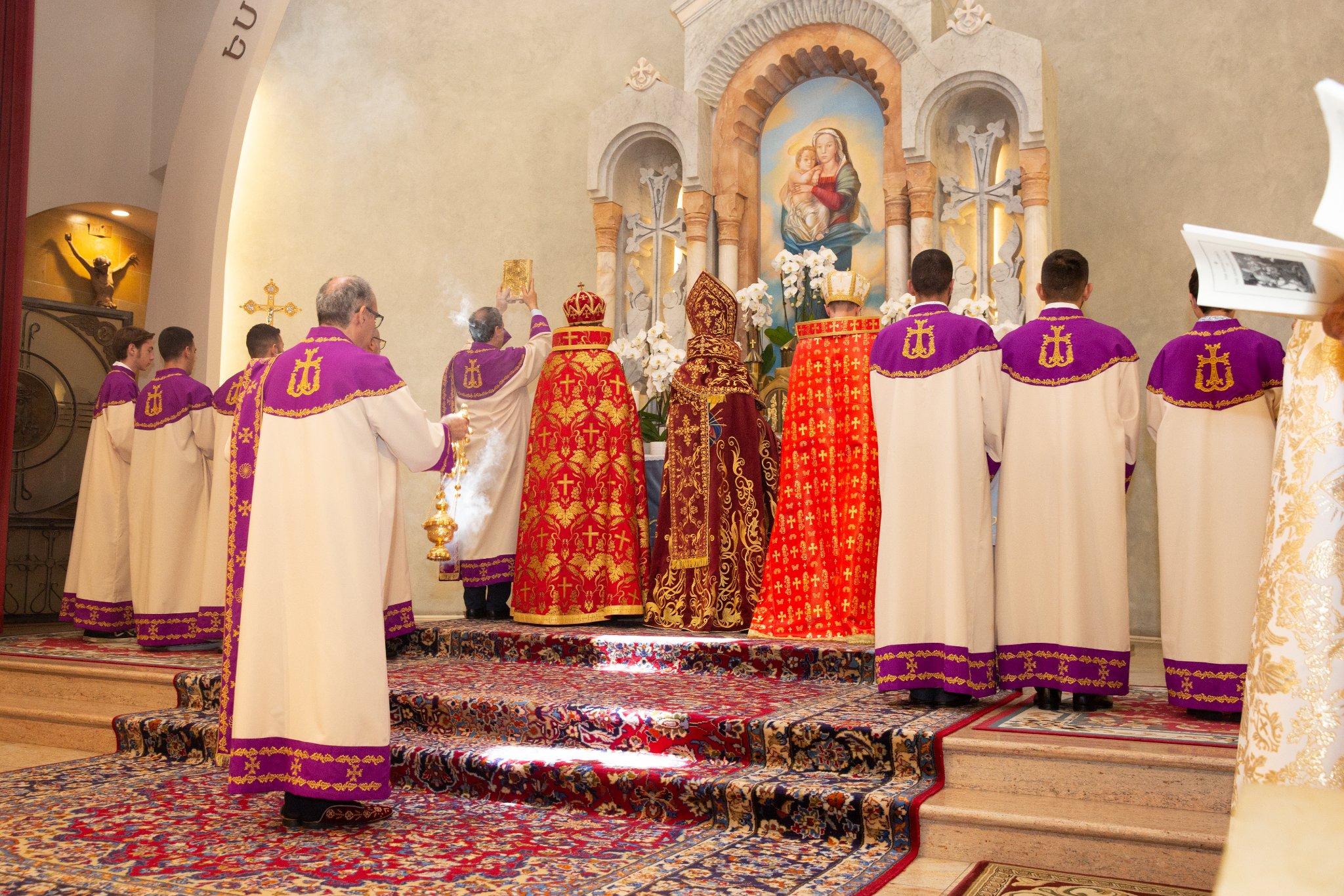
Our readers may remember Fr John Henry Hanson, O. Praem., of St Michael’s Abbey in Silverado, California, who contributed the articles “Encountering the Sacred Mysteries East of Byzantium: The Armenian Liturgy as a Home away from Rome” (link) and “Some Ritual Features of the Armenian Catholic Liturgy” (link) and whose own celebration of the Armenian liturgy has been shared in a colorful gallery (link). In this latest photo essay, Fr John Henry provides a gallery of photos from a Divine Liturgy celebrated on May 29 by His Beatitude Raphael Bedros XXI at the Armenian Catholic Cathedral of St Gregory the Illuminator in Glendale, California, during his recent pastoral visit to the area. Fr John Henry is shown in white mitre, assisting at the right of His Beatitude.

The procession into the church begins outside in the cathedral courtyard.
The procession as it nears the sanctuary. The Patriarch is flanked by Fr John Henry and Fr Andon. Armenian bishops and Patriarchs wear a Latin-style mitre, whereas simple priests wear a crown (saghavard).

Patriarch with assisting priests and subdeacons line the sanctuary steps as they recite the prayers at the foot of the altar, which include Psalm 42.
Patriarch and assistants gradually ascend the sanctuary as they recite Psalm 42.
They arrive at the altar platform.
Incensations carried out by the Patriarch after the Preparation of the Oblation, a kind of “minor offertory” carried out behind the drawn sanctuary curtain.
Reading of the Gospel.
As the creed is recited, a subdeacon holds aloft the Gospel book.
Blessing given before the invitation to exchange a sign of peace, which is always given prior to the anaphora.
During the anaphora: all priests at the altar, including the Patriarch, remove their marks of office before beginning the anaphora. The Patriarch removes his mitre, ring, pectoral icon, and omophorion; priests remove their crown.
Final blessing

Monday, October 05, 2020

Photos and Descriptions of a Recent Armenian Liturgy in California

In this time of pandemic when many churches are required to hold religious services outdoors, it is edifying to see how much effort some parishes are making to cultivate a sacred environment for their outdoor Masses. In the following photos we are given a look at the efforts of the Armenian Catholic Cathedral of St. Gregory the Illuminator in Glendale, California, to provide both dignified worship and a sacred space for the divine liturgy. The location of the liturgy is a courtyard in between the cathedral church and parish hall. All photos were taken by Viken Abassian, a seminarian for the Armenian Catholic Eparchy. The celebrant pictured is Fr. John Henry Hanson, O. Praem., whose articles on the Armenian Liturgy have been featured on NLM in recent years. Each photo (click to enlarge) will be accompanied by an explanation of what is taking place in the liturgy.

After prayers at the foot of the altar, the celebrant ascends altar steps and approaches the altar reciting this prayer: “Bowing down in this Holy abode of praise, which for the Angels is a dwelling temple and for men a place for expiation, in the Holy presence of this glorious Cross and Holy Altar, we worship Your triumphant Resurrection...”

There immediately follows the “Preparation of the Oblation” or minor offertory, during which the celebrant fills the chalice with wine alone, i.e. unmixed with water, according to ancient Armenian usage.

During the Preparation of the Oblation, the celebrant places the paten on top of the filled chalice and says the Prayer of St John Chrysostom: “O Lord our God, who sent the heavenly Bread, our Lord Jesus Christ, to nourish the whole world, sanctify us.  And now we implore You, O Lord, bless these oblations and accept them on Your Holy Altar....”

A server reads the Epistle, facing the congregation, as the celebrant remains at the altar.

Thursday, March 14, 2019

Guest Article: “Some Ritual Features of the Armenian Catholic Liturgy”

Following up on a recent article for NLM, “Encountering the Sacred Mysteries East of Byzantium: The Armenian Liturgy as a Home away from Rome,” Fr. John Henry Hanson, O.Praem., offers today a more detailed look at the particular rituals of the Soorp Badarak (the “Holy Sacrifice”) that comprise the Divine Liturgy of the Armenian Catholic Church.

As noted in the previous article, the traditional Latin Mass and the Armenian liturgy share much common ground, largely owing to lengthy periods of reunion, not to mention the missionary efforts of Dominican friars in the fourteenth century, who translated the Mass of the Latin rite entirely into Armenian so as to reach more effectively those separated from Catholic communion.

The order of the Divine Liturgy follows the familiar structure of Christian liturgy: prayers of preparation, the Mass of the catechumens (or liturgy of the word), and Mass of the faithful (or liturgy of the Eucharist).

Prayers of Preparation

Upon beginning the liturgy, the celebrant and a numerous contingent of deacons and subdeacons flanking him alternately recite and chant the preparatory prayers at the foot of the altar, actually beginning in the nave. As Psalm 42 progresses, the celebrant begins to ascend the altar one step at a time, each step corresponding to a verse of the psalm. Word and ritual go together.


After several other prayers, the large sanctuary curtain is drawn, and behind it begins what could be called a minor offertory—known more properly as the Preparation of the Oblation. The chalice is unveiled and the host is both blessed and offered up “in remembrance of our Lord and Savior, Jesus Christ.” Proceeding to the epistle side of the altar, the celebrant then prepares the chalice. After blessing the wine, he pours it crosswise into the chalice, without (according to ancient usage) mixing water.

Mass of the Catechumens: Liturgy of the Word

This is followed by the recitation of the day’s introit, a Byzantine-style litany, and then the Gospel Procession. All Armenian churches are built with an east-facing high altar within an apse, leaving space between the altar and the sanctuary wall for the deacon, a thurifer, and two torch bearers to pass in procession. The procession is always accompanied by the chanting of the Trisagion, which the Latin rite normally reserves to Good Friday. This unique procession symbolizes the Gospel going out from Jerusalem and around the world, enacted ritually by the circumambulation of the altar.


From a Biblical point of view, this is very poignant. Both altars and earth are described by the prophets as having four corners, thus linking earth with the table of worship. The implication of the earth as the venue for the worship of God, for glorifying God, is thus displayed. As St Paul says, quoting Psalm 24 (23), “the earth is the Lord’s, and everything in it” (1 Cor. 10, 26).

The Gospel procession normally concludes at the edge of the sanctuary where those lay faithful come forward for whose intentions the Mass is celebrated, and venerate the Gospel book with a kiss and touch of the forehead.


After the Gospel procession, the Gospel Book itself is enthroned on the left side of the altar. This placement explains why in the Divine Liturgy the missal is always placed to the right of the corporal: no other book should have prominence on the side of the altar dedicated to the word of God.

The epistle is then read facing the congregation, after which the Gospel is read by the priest celebrant (or deacon), standing directly before the altar. He first blesses the congregation with the book, then chants the Gospel while the book is held by two servers, who in turn are flanked by two torch bearers, with (normally) two thurifers stationed at opposite ends of the sanctuary, swinging their thuribles outward at the end of each sentence of the Gospel: an impressive punctuation to “every word that proceeds from the mouth of God” (Matt. 4, 4)


The use of dual thuribles is actually a feature throughout the liturgy, as are the keshotz, liturgical bell fans comparable to the Byzantine ripidion. The use of these bells is often intended not only to alert the congregation to particularly important moments in the liturgy, but also to signify the movement of angelic wings. This is especially poignant as the fans are shaken in greater earnest at the moment the priest chants the words of consecration, reflecting the exultation of the angelic spirits before the Lord’s arrival under the forms of bread and wine.

Before the Eucharistic liturgy proper, the Nicene Creed is always chanted—at every Mass, high or low, and the sign of peace is given. Armenians retain the practice of receiving the peace from the altar, in this order: two deacons kiss the altar, then the priest’s dual maniples, then proceed into the nave where they personally extend the peace to each row. Armenians greet each other with this formula: Christ is revealed in our midst. Blessed is the revelation of Christ.

Mass of the Faithful: Liturgy of the Eucharist

Then follows the canon. Known as the Anaphora of St Athanasius, it is used in every Mass and recited sotto voce as the priest extends his arms in cruciform manner. As he prays the canon, the sublime Armenian Sanctus or Soorp, Soorp (“Holy, Holy”) is sung.


The elevations of the consecrated elements do not take place immediately after their consecration. Rather, quite later in the liturgy, each species is lifted up for a prolonged elevation, accompanied by words deriving from the ancient Liturgy of St James. As he raises the Host, the priest says or sings “The Holy Gifts are due to the saints!”, after which the people, in words referenced by St Cyril of Jerusalem in his Baptismal Catecheses, acclaim, “There is One who is Holy, One who is Lord, Jesus Christ!”

A final poignant ritual just prior to Holy Communion is a blessing with the Eucharistic species. Turning from the altar, the priest elevates the host over the chalice, making the sign of the cross over the congregation, saying, “Let us taste in holiness, the most holy and precious Body and Blood of our Lord and Savior Jesus Christ, who descended from heaven and is now distributed among us. This is life, hope, resurrection, expiation and forgiveness of sins. Sing psalms to the Lord our God, sing psalms to our heavenly and immortal king, who sits upon the chariots of the Cherubim.”


Communion is always given standing, the respectful posture of Eastern worship, but on the tongue after intinction of the Host. As the celebrant reposes the Blessed Sacrament, he again blesses the people with the ciborium, quoting Psalm 28 (27), “Save, O Lord, your people, and bless your inheritance.” After the ablutions, the concluding rites are relatively brief. A blessing with the hand-cross is given accompanied by the words, “May you be blessed through the graces of the Holy Spirit. Go in peace, and may the Lord be with you all!”

A word about vestments may be added. As a rule, Armenian vestments are bright, colorful, and richly textured—while not necessarily carrying a chromatic meaning reflecting the feast of the day. While black is customary for requiem services, wearing blue or violet on Pentecost, for instance, is totally fine. One reason for this lack of uniformity is to emphasize that all of the mysteries are celebrated in each liturgy. The function of the vestments is to draw attention to the dignity and beauty of the liturgy itself.

The church seen in these photos (as in the ones for the previous article) is St Gregory the Illuminator Armenian Catholic Cathedral in Glendale, Caliofornia, which was built in the early 2000’s.

Thursday, February 28, 2019

Guest Article: “The Armenian Liturgy as a Home away from Rome”

Fr John Henry offering the Armenian Divine Liturgy
Editor's Note: NLM is always interested in showcasing all rites of East and West. We are therefore very pleased to present to our readers today a guest article by Fr John Henry Hanson, O. Praem., who on Sundays celebrates the Armenian Divine Liturgy at the Armenian Catholic Cathedral in Los Angeles. We publish it in connection with the February 27th feastday of the latest Doctor of the Church, the Armenian St Gregory of Narek.

Of all the Eastern rites, the Armenian is the one whose shape mirrors most closely that of the traditional Latin Mass. During extended periods of reunion, the Armenians were very receptive to Latin influence. For example, there are extended prayers at the foot of the altar, with Psalm 42. On the other hand, there are things peculiar to the Armenian rite, such as not mixing water with wine during the preparation of the chalice: the Armenians just use pure, unmixed wine.

The Armenian rite is a great example of a traditional rite that tranquilly maintains its traditions within the context of the modern world. Like other “smaller” rites within the Church, it was preserved from great damage after Vatican II because it was so “off the beaten track” that fashionable liturgists scarcely paid attention to it. Also, the spirit of ecumenism worked to the advantage of the East and always to the disadvantage of the West. The Armenians were told after Vatican II (especially under Pope St John Paul II) to restore whatever needed restoring in their rite. All the same, the Armenian liturgy needed little repair. In any case, the idea of root-and-branch change is unthinkable to Armenians, due in large part to the ancient culture their liturgy preserves, and which has given the people such a strong sense of identity over so long a time.
  

Encountering the Sacred Mysteries East of Byzantium:

The Armenian Liturgy as a Home away from Rome 

Fr John Henry Hanson, O. Praem.


Being only partially Armenian in ancestry (a quarter, to be exact), it’s not surprising that I was not raised in the rite of my ancestors. It was only after ten years of ordination as a priest of the Norbertine Order that the opportunity of exploring the Divine Liturgy of the Armenian Rite was unexpectedly given me, when my assistance on Sundays was requested by the Armenian Catholic Cathedral in Glendale, California.

Before beginning public celebrations of the Armenian Soorp Badarak (“Holy Sacrifice”), I was tutored in its rituals by His Grace, Mikael Mouradian, Eparch of the Armenian Church in North America. And although it differed much from the Roman rite, I found enough of the liturgical terrain familiar territory. If the surface of the altar may be likened to the “compact” holy city of Psalm 122, then the monuments, edifices, and lanes looked a lot like home.

Over and again I found myself registering the similarities between the traditional Latin Mass and the Armenian, while also noting those ways in which the mystery of Christ is celebrated in a uniquely Armenian way. These likenesses are no coincidence, but rather the fruit of lengthy periods of reunion between Rome and the Armenian Church, most notably from 1198-1375, when much Latin influence was assimilated. Today, the division between Catholic and Orthodox Armenians prevails, although their liturgy is substantially the same.

The rare opportunity of seeing one’s native rite from the outside — from the inside of another rite — has afforded me a wholesome compare-and-contrast, increasing my appreciation for both. For westerners, in fact, the special beauty of Eastern Christian liturgies is primarily one of fresh perspective: experiencing the mysteries of Christ through a new lens. Each rite preserving its own proper character gives a special glory to God by revealing an aspect of Christ not fully revealed by another rite.

Pope Benedict XVI alluded to this quality of the sacred liturgy in the letter accompanying Summorum Pontificum. Explaining the attraction felt by many young people to the traditional liturgy of the Latin rite, he regarded their attraction as rooted in “a form of encounter with the Mystery of the Most Holy Eucharist, particularly suited to them.” While the Mystery remains the same, the form of encounter differs, and should be held in reverence by those drawn to a different form of worship.

The idea of liturgy as the venue of encounter with Christ in the Eucharistic mystery is key to understanding not only the genius of one’s own rite, but of other rites as well. As one Byzantine abbot put it in a homily I heard several years ago, the eastern rites should not function merely as a “side show” for western Catholics. If the end of the sacred liturgy is worship pleasing to God, coupled with its inseparable purpose of uniting man to God, then it behooves Christians of any rite to explore the ways in which their brethren worship and how their liturgies do the work of bringing them into communion with the Lord.

In a particular way, the Popes of modern times (from Leo XIII on) have insisted on the equality, the shared dignity, of all Catholic rites. Pope Pius XI, perhaps more than any pre-conciliar pope, vigorously defended the legitimate diversity of rites while encouraging deeper familiarity with them, especially on the part of Latin clergy. Appreciation for their cultural antiquity and unique expression of the Christian mysteries can provide, as Pius XI said, “a more adequate knowledge of Catholic theology … while conceiving a more ardent love for the true Bride of Christ, whose enchanting comeliness, and unity in the diversity of the various rites, will shine forth more clearly in their [i.e. the clergy’s] eyes.”

This balanced and appreciative Magisterial thinking is a welcome antidote against the often superficial and uninformed polemics launched from various sides of ongoing liturgical debates (discussions which also exist, in their own way, in the oriental churches). Easterners tend to do better at respecting the sacred liturgy as a sacred inheritance, a family heirloom, and this is a wholesome corrective against liturgical fads, the pressure to reinvent, or reduce the liturgy to its bare essentials (whose ironic side-effect is a quasi-demystification of the mysteries). Mysteries need to be presented with an air of mystery, of the transcendent, or else we fallen creatures will never rise from the mud of daily life.

This is not to say that our liturgy is a kind of museum piece, to be admired from afar, and curated (not to say comprehended) only by a select few. Nor is it frozen in time. The liturgy is alive and, like all living things, grows and develops organically — which is why Benedict XVI asserted: “In the history of the liturgy there is growth and progress, but no rupture.”

Put simply: In liturgy, there needs to be a part we get and a part we don’t get. The “food” part of the Eucharist we get, the God part we don’t. It is the nature of a sacrament to present incomprehensible realities under the form of comprehensible signs. But to treat those signs with great dignity and solemnity better points us to the invisible workings of grace than using common and ordinary things which can’t effectively point beyond themselves.

Easterners have a deeper sense of the cultural and apostolic lifelines preserved in their liturgy than do Latin Catholics. What Benedict XVI said in Summorum Pontificum itself is very applicable to the eastern rites: “What earlier generations held as sacred, remains sacred and great for us too…. It behooves all of us to preserve the riches which have developed in the Church’s faith and prayer, and to give them their proper place.” Whereas the Latin rite emerged from Greco-Roman culture, with its unique modes of verbal expression and ritual, the contemporary Catholic in the pew is not likely to perceive a connection between the liturgy of their mainstream parish and that of their ancient ancestors — a sad result of inauthentic application of the Council’s intentions for the liturgy.

Where the Latin rite is often characterized by a kind of austerity and sobriety of expression — a holy restraint reflecting our inability to express the ineffability of the mysteries we celebrate — the Eastern rites tend to express themselves in superlative fashion. Mining human language for its richest expressions, utilizing poetry where prose falls short, and employing ritual gesture that engages the outer man as much as the inner, are some of the most conspicuous marks of eastern liturgies.

This has not prevented at least one eminent Armenian Orthodox scholar and prelate from describing the divine liturgy as somewhat “dysfunctional,” in that modern Armenian-Americans bring along their inevitably modern mentality to church and fail to find meaning in the ancient rituals, language, and chants of their native rite. Even if the dysfunctional culture in which the people are immersed is the more likely culprit, the problem is a real one: ritual relevance. The solution of many in the western Church has been to introduce novelties that might engage some for a time, but in the end lack the weight of tradition to sustain them.

Armenians manifest a healthy balance between preservation and adaptation. The lectionary is more or less invariable like that of the Tridentine missal, and valuably preserves closer than any other rite the primitive Jerusalem lectionary. And although the liturgical language is classical Armenian, modern Armenian is often employed in the proclamation of the Scriptures — often, as in the extraordinary form, read in addition to reading in the classical language.

Individual eparchies are also free to employ the vernacular for other parts of the Mass at the discretion of the Eparch. Hence, you will find Armenian Catholic parishes celebrating good portions of the liturgy in, for example, Arabic, French, and English. But although modern languages are utilized, the ritual remains the same. What the priest and ministers do at the altar admits of no variation, but reflects the Armenian mode of worship. The altar is always eastward in orientation, priests and sacred ministers wear liturgical slippers during the liturgy, duel thuribles are almost continually in use, along with metal liturgical fans, and the laity (in general) are not given access to the sanctuary.

Armenian worship is unique in the family tree of Christian rites, standing independent of the other eastern liturgical offshoots. Armenians have uniquely assimilated Syrian, Byzantine, and Latin influences — so much so that Catholics who regularly attend the extraordinary form will find in the Armenian rite much to remind them of home: Prayers at the foot of the altar, including Psalm 42, unleavened communion bread (given on the tongue after intinction), normally a rectangular stone altar instead of the square Byzantine style, a single canon recited silently (although accompanied by the chanting of the hauntingly beautiful Armenian Sanctus), the Last Gospel (chanted rather than recited), and an open sanctuary not permanently covered by the iconostasis. At those several moments in the liturgy requiring a veiling of the sanctuary, a large curtain is drawn instead.

The liturgy is generally traced back to that of St Basil, although the Greek liturgies of St James and of St John Chrysostom are clearly in evidence. Combine this with generous Latin influence, and you have a rite all its own. One may argue that it has absorbed the best features of both eastern and western rites, forming a kind of ecumenical liturgical bridge between east and west.


More recent articles:

For more articles, see the NLM archives: