Here are a couple of recent articles which will certainly be of interest to our readers, and which I think it profitable to read together, as I will explain below. The first is a lengthy piece in First Things by Martin Mosebach, called “The Return to Form”, subtitled “A Call for the Restoration of the Roman Rite.” It is fairly long, but certainly worth reading in its entirety; I was especially struck by his take on the nature of what Pope Benedict did for the liturgy as a whole when he promulgated Summorum Pontificum.
“When Pope Benedict had the greatness of soul to issue Summorum Pontificum, he not only reintroduced the Roman Rite into the liturgy of the Church but declared that it had never been forbidden, because it could never be forbidden. No pope and no council possess the authority to invalidate, abolish, or forbid a rite that is so deeply rooted in the history of the Church.
Not only the liberal and Protestant enemies of the Roman Rite but also its defenders, who in a decades-long struggle had begun to give up hope, could barely contain their astonishment. Everyone still had the strict prohibitions of countless bishops echoing in their ears, threats of excommunication and subtle accusations. And one hardly dared draw the conclusion that, in view of Pope Benedict’s correcting of the wrongful suppression of the Roman Rite, Blessed Pope Paul VI had apparently been in error when he expressed his strong conviction that the rite long entrusted to the Church should never again be celebrated anywhere in the world.
Benedict XVI did even more: He explained that there was only a single Roman Rite which possesses two forms, one ‘ordinary’ and the other ‘extraordinary’— the latter term referring to the traditional rite. In this way, the traditional form was made the standard for the newly revised form. The pope expressed the wish that the two forms should mutually fructify and enrich each other. It is therefore natural to assume that the new rite, with its great flexibility and many possible forms of celebration, must draw near to the older, steady, and fixed form of the Roman Rite, which provides no latitude whatsoever for encroachments or modifications of any kind.
.... Whenever Pope Benedict spoke of a mutual influence and enrichment between the two forms of the rite, he surely did so with an ulterior motive. He believed in organic development in the area of liturgy. He condemned the revolution in the liturgy that coincided with the revolutionary year 1968, and he saw the connection between the liturgical revolution and the cultural one in world-historical terms, for both contradict the ideal of organic evolution and development. He regarded it as a serious offense against the spirit of the Church that the peremptory order of a pope should be taken as warrant to encroach upon the collective heritage of all preceding generations. After decades of use throughout the world, Benedict not only considered it a practical impossibility simply to prohibit the new rite with its serious flaws, but in all likelihood he also perceived that such an act, even if it had been feasible, would have continued along the erroneous path taken by his predecessor, one of reform by fiat. The correct path would be found, so he hoped, in a gradual growing together of the old and new forms, a process to be encouraged and gently fostered by the pope.”
And also this passage on this Reform of the Reform.
“It is with downright incredulity that one reads (the prescriptions of Sacrosanctum Concilium), for their plain sense was given exactly the opposite meaning by the enthusiastic defenders of post-conciliar ‘development.’ One cannot say that Ratzinger’s call for a reform of the reform intended in any way to go back ‘behind the council,’ as the antagonists of Pope Benedict have maintained. As any fair-minded reading of Sacrosanctum Concilium makes clear, the reform of the reform has no goal other than realizing the agenda of the council.”
The website of the Society of St Hugh of Cluny has an article by Stuart Chessman about a “first encounter” with the traditional liturgy which took place over 200 years ago, when a German law student from solidly Protestant Berlin visited the Catholic city of Bamberg, then still “a world of processions, relics and devotions, of overflowing public and popular piety, of splendid masses accompanied by orchestras, gunfire salutes and trumpet blasts!” The student, one Wilhelm Heinrich Wackenroder, writes as follows of his experiences of the ceremonies which he witnessed, all still untouched by any of the horrors of revolution or enthusiasms of modern reformers.
“As I entered the venerable church I found it already almost full. I pushed forward up to the main altar and waited now for the solemn scene. Oh! – truly I had not expected very much. Everything was new for me. The ceremonies, which every minute always changed, made an ever stronger and wonderful impression on me the more they were mysterious and unintelligible. I was standing among nothing but Catholics: men, women and children. Some were constantly reading prayer books; others prayed the rosary while standing, yet others reverently knelt right next to me.
Here I found proved so clearly what Nicolai relates: that fixed raising of the gaze in prayer, which suddenly blazes up to heaven without resting on earthly objects; the making of the sign of the cross in holy zeal; the heartfelt firm striking of the breast which, with expressive glances towards heaven and with deeply felt sighs, shows such special depth of feeling. …One is totally initiated into the Catholic faith here and almost driven to participate in all the ceremonies.”
Wackenroder would become one of the founders of German Romanticism, and Chessman gives a long quote from one of his books, the title of which almost summarizes the entire movement: “Outpourings from the Heart of an Art-Loving Monk” In it, his experience of Bamberg is transformed into a fictionalized account of a solemn Mass in the Pantheon in Rome, which ends with a conversion experience. “I could not leave the temple after the end of the celebration, I fell down in a corner and wept, and then passed with a contrite heart all the saints, all the paintings – it seemed that only now could I really contemplate and revere them. I could not resist the force within me – dear Sebastian, I have now crossed over to your faith, and my heart feels happy and light. It was art that had all-powerfully drawn me over, and I can say that only now can I understand and grasp art. ”
In the first article, Mosebach writes, “In a period such as the present, unable to respond to images and forms, incessantly misled by a noisy art market, all experimentation that tampers with the Roman Rite as it has developed through the centuries could only be perilous and potentially fatal. In any case, this tampering is unnecessary. ... The peasant woman who said the rosary during Mass, knowing that she was in the presence of Christ’s sacrifice, understood the rite better than our contemporaries who comprehend every word but fail to engage with such knowledge because the present form of the Mass, drastically altered, no longer allows for its full expression.” Likewise, Chessman concludes his article with the observation that in Wachenroder’s case, “... this Mass, so foreign to him, and that he could not ‘understand,’ had clearly communicated to him the most profound sense of worship and of the Divine. Such is the transformative power, both in 1793 and today, of this Mass – the Mass of Tradition!”
“When Pope Benedict had the greatness of soul to issue Summorum Pontificum, he not only reintroduced the Roman Rite into the liturgy of the Church but declared that it had never been forbidden, because it could never be forbidden. No pope and no council possess the authority to invalidate, abolish, or forbid a rite that is so deeply rooted in the history of the Church.
Not only the liberal and Protestant enemies of the Roman Rite but also its defenders, who in a decades-long struggle had begun to give up hope, could barely contain their astonishment. Everyone still had the strict prohibitions of countless bishops echoing in their ears, threats of excommunication and subtle accusations. And one hardly dared draw the conclusion that, in view of Pope Benedict’s correcting of the wrongful suppression of the Roman Rite, Blessed Pope Paul VI had apparently been in error when he expressed his strong conviction that the rite long entrusted to the Church should never again be celebrated anywhere in the world.
Benedict XVI did even more: He explained that there was only a single Roman Rite which possesses two forms, one ‘ordinary’ and the other ‘extraordinary’— the latter term referring to the traditional rite. In this way, the traditional form was made the standard for the newly revised form. The pope expressed the wish that the two forms should mutually fructify and enrich each other. It is therefore natural to assume that the new rite, with its great flexibility and many possible forms of celebration, must draw near to the older, steady, and fixed form of the Roman Rite, which provides no latitude whatsoever for encroachments or modifications of any kind.
.... Whenever Pope Benedict spoke of a mutual influence and enrichment between the two forms of the rite, he surely did so with an ulterior motive. He believed in organic development in the area of liturgy. He condemned the revolution in the liturgy that coincided with the revolutionary year 1968, and he saw the connection between the liturgical revolution and the cultural one in world-historical terms, for both contradict the ideal of organic evolution and development. He regarded it as a serious offense against the spirit of the Church that the peremptory order of a pope should be taken as warrant to encroach upon the collective heritage of all preceding generations. After decades of use throughout the world, Benedict not only considered it a practical impossibility simply to prohibit the new rite with its serious flaws, but in all likelihood he also perceived that such an act, even if it had been feasible, would have continued along the erroneous path taken by his predecessor, one of reform by fiat. The correct path would be found, so he hoped, in a gradual growing together of the old and new forms, a process to be encouraged and gently fostered by the pope.”
And also this passage on this Reform of the Reform.
“It is with downright incredulity that one reads (the prescriptions of Sacrosanctum Concilium), for their plain sense was given exactly the opposite meaning by the enthusiastic defenders of post-conciliar ‘development.’ One cannot say that Ratzinger’s call for a reform of the reform intended in any way to go back ‘behind the council,’ as the antagonists of Pope Benedict have maintained. As any fair-minded reading of Sacrosanctum Concilium makes clear, the reform of the reform has no goal other than realizing the agenda of the council.”
 |
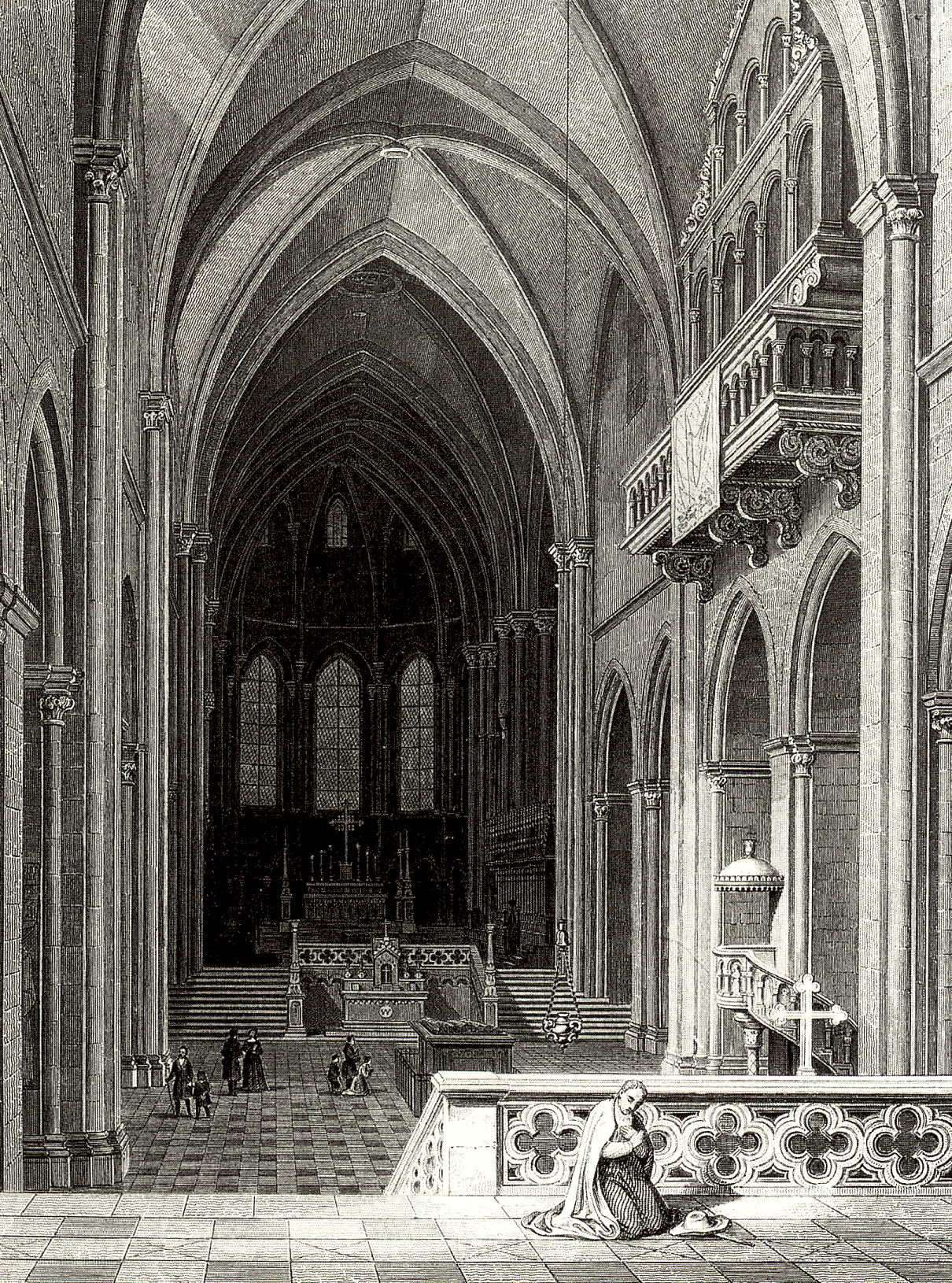
| The west choir of Bamberg Cathedral, which is still quite splendid despite being vandalized by the King of Bavaria in the 1830s, and again after Vatican II. From an article published in 2009 by Gregor Kollmorgen. |
“As I entered the venerable church I found it already almost full. I pushed forward up to the main altar and waited now for the solemn scene. Oh! – truly I had not expected very much. Everything was new for me. The ceremonies, which every minute always changed, made an ever stronger and wonderful impression on me the more they were mysterious and unintelligible. I was standing among nothing but Catholics: men, women and children. Some were constantly reading prayer books; others prayed the rosary while standing, yet others reverently knelt right next to me.
Here I found proved so clearly what Nicolai relates: that fixed raising of the gaze in prayer, which suddenly blazes up to heaven without resting on earthly objects; the making of the sign of the cross in holy zeal; the heartfelt firm striking of the breast which, with expressive glances towards heaven and with deeply felt sighs, shows such special depth of feeling. …One is totally initiated into the Catholic faith here and almost driven to participate in all the ceremonies.”
Wackenroder would become one of the founders of German Romanticism, and Chessman gives a long quote from one of his books, the title of which almost summarizes the entire movement: “Outpourings from the Heart of an Art-Loving Monk” In it, his experience of Bamberg is transformed into a fictionalized account of a solemn Mass in the Pantheon in Rome, which ends with a conversion experience. “I could not leave the temple after the end of the celebration, I fell down in a corner and wept, and then passed with a contrite heart all the saints, all the paintings – it seemed that only now could I really contemplate and revere them. I could not resist the force within me – dear Sebastian, I have now crossed over to your faith, and my heart feels happy and light. It was art that had all-powerfully drawn me over, and I can say that only now can I understand and grasp art. ”
In the first article, Mosebach writes, “In a period such as the present, unable to respond to images and forms, incessantly misled by a noisy art market, all experimentation that tampers with the Roman Rite as it has developed through the centuries could only be perilous and potentially fatal. In any case, this tampering is unnecessary. ... The peasant woman who said the rosary during Mass, knowing that she was in the presence of Christ’s sacrifice, understood the rite better than our contemporaries who comprehend every word but fail to engage with such knowledge because the present form of the Mass, drastically altered, no longer allows for its full expression.” Likewise, Chessman concludes his article with the observation that in Wachenroder’s case, “... this Mass, so foreign to him, and that he could not ‘understand,’ had clearly communicated to him the most profound sense of worship and of the Divine. Such is the transformative power, both in 1793 and today, of this Mass – the Mass of Tradition!”