
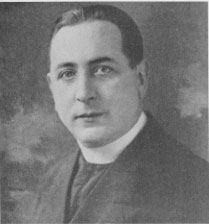
Francis X. Weiser, S.J. (1901-86) is better known today among homeschooling Catholic families than liturgical scholars, but his works on the Church calendar were once held in high regard for their erudition and clarity. Weiser’s popular books on Christian festivities and customs played a role in the American Liturgical Movement of the 1950s, and they still serve as a model for balancing scholarly rigor and pastoral sensitivity. In this article, we examine Father Weiser’s life and writings: in the next, his liturgiology.
Early Life
Franz Xavier Weiser was born in Vienna, Austria on March 21, 1901 to Franz S. Weiser and Maria (née Schipp) Weiser. At the time, Vienna was still, as Weiser would later describe it, “the gay capital of a famous empire” and “the great metropolis of music and song.” The pre-war culture of the Imperial City would have a significant impact on Weiser and his authorial ambitions:
You might say that we grew up to the tunes of Haydn, Beethoven, Mozart, Schubert, and Strauss. I have a vague feeling that this atmosphere of culture, music, and art, had much to do with my desire to write. At the age of eight or nine, while still a little boy in grammar school, I used to ask God daily in my evening prayer to “let me write books.”
Another formative influence on Weiser was domestic devotional practices. Joseph Ratzinger, who lived only a few miles from the Austrian border in a similar Catholic milieu, writes in his autobiography: “The Church year gave the time its rhythm, and I experienced that with great gratitude and joy already as a child, indeed, above all as a child.” As a boy Ratzinger was particularly fond of the liturgies and Bavarian customs of the Christmas and Easter seasons. “Every new step into the liturgy was a great event for me,” he recalls. “It was a riveting adventure.”
Weiser’s earliest recollections were of a similar kind. One of his first memories was that of his mother Maria making the sign of the cross on his forehead and wishing him good night. “This simple action,” he writes, “taught me more than any words the great truth that parents are God’s representatives.” He learned the same lesson from “an old and very wholesome practice [that] demanded that children, before going to Confession, should ask forgiveness from their parents for offenses and faults committed in the home.”
Weiser’s mother was also adept at explaining the meaning of Christian practices to her son. He recalls:
It was the general custom among Catholics to greet priests on the street and in public in order to profess the Faith and show reverence for the holy priesthood. When I was a little boy, my mother told me, “You must always joyfully greet a priest, whether you know him or not. Your Guardian Angel, too, greets the priests with great love and reverence.” These simple words of my mother made a deep impression on me; I never forgot them.
Other memories of Weiser were tied to the liturgical year, such as his family’s observance of name days, the feast day of the saint after whom one is named. Weiser writes:
I remember how from early childhood I went to church with my father every year on the feast of St. Francis Xavier, attending the Holy Sacrifice and later receiving Communion, too. Returning home, I found the table cheerfully decorated with flowers and little presents. Mother, Father, brothers and sisters offered their congratulations. Then we sat down to a joyful breakfast, my proud little self sitting in the place of honor. And all this because centuries ago a wonderful young man in Spain loved God so much that he became a Saint. I cannot express the powerful conviction that filled me every year on this occasion, how great and important it is to become holy. This was one of the eloquent lessons which our religious customs taught me without words, but with an effect greater than many words could achieve. Judging from this aspect, we may truly say that such Catholic customs in the home educate the children more efficiently than the best Catholic teachers could ever do in school.
But perhaps his most important devotional memory is that of the annual visit of St. Nicholas:
I still vividly remember the annual visit of this friendly and saintly figure on the evening of December 5. With joy and happy excitement we awaited his coming. We were convinced, as little children easily are, that he really was our great Patron Saint who came from Heaven on his feast day to visit us children whom he loved so much. With utter sincerity we promised him to overcome our faults, to obey our parents and to prepare our hearts for Christmas. Gratefully we accepted his gifts and kissed the ring on his holy hand. Never again in all my life have I experienced the unspeakable thrill of a physical nearness to Heaven as I did on those evenings of my childhood when “St. Nicholas” came to us. When I later found out that it was not really the Saint but a man representing him, this caused me no shock or harm. The thrill I had felt remained in my memory and has remained to this day with all its beauty.

Both Ratzinger and Weiser’s childhood memories would presage their later interest in liturgical studies.
Early Writings
Weiser received the standard gymnasium education of his day: Latin at the age of eleven, Greek at fourteen, three years of Italian, and instruction in religion, literature, history, geography, mathematics, physics, chemistry, biology, drawing, music, art appreciation, and singing, all “topped by a two-year course in fundamental philosophy.” But instead of going on to university, he entered the Jesuit novitiate at the age of nineteen. In 1924, he began a seven-year period of matriculation at the University of Innsbruck, ending with doctorates in philosophy, theology, and education/psychology. Among his teachers at Innsbruck was a fellow Austrian Jesuit, the liturgical scholar Josef A. Jungmann. In a brief autobiographical essay Weiser calls these degrees the recorded “fruits” of his studies but adds: “The unrecorded fruit (which is more important), is supposed to have become a part of my personality, and is known only to God.”
Weiser was ordained a priest on July 26, 1930 at Holy Trinity Church in Innsbruck. The next year he began his tertianship, the third stage of probation and a special year of spiritual training for Jesuits before they take their final vows, at the novitiate of St. Andrew-on-Hudson in Hyde Park, New York. During his time in the United States, he took courses at nearby Marist College in Poughkeepsie and visited St. Louis University and the Missouri countryside.
Weiser’s superiors encouraged him to pursue his childhood interest in writing, and soon he was an accomplished author. He published eight books between 1927 and 1931: three biographies (of Jesuit missionaries Johann Grueber and Blessed Charles Spinola and the Jesuit martyr Miguel Pro), four novels, and a history of a German Catholic student association in Prague called Nordgau.
His novels from this period include Der Sohn des weißen Häuptlings (The Son of the White Chief), Alfreds Geheimnis (Alfred’s Secret), Walter Klingers Weltfahrt (Walter Klinger’s World Tour), and Das Licht der Berge: Aus dem Leben eines jungen Menschen (The Light on the Mountains: From the Life of a Young Person). Das Licht remains Weiser’s most popular book: it went through thirty-eight editions in German between 1931 and 1998, sold over one million copies, and has been translated into thirty languages. The International Companion Encyclopedia of Children’s Literature (2004) designates the book as a Bildungsroman in which
Hein Moll, a boy from Tirol, is confronted in the capital Vienna with a number of fundamental issues. By trial and error he finds the strength to remain faithful to his Christian ideals. In this type of traditional novel a priest often acts as an adviser. In more recent juvenile fiction religion no longer forms the familiar setting in which the young characters grow up.

Vienna, 1932-38
In 1932 Weiser returned to Vienna, where he served as the national moderator of Austria’s Marian Congregations (a student sodality run by the Society of Jesus) and the editor of their monthly magazine Unsere Fahne (Our Flag). The two positions dovetailed nicely with his already-apparent interest in youth formation through juvenile fiction and inspirational biography. By the time he left Vienna in 1938, he had written another sixteen books: biographies, novels, plays, travelogues, and a scholarly monograph on a German dialect that is still being cited in linguistic studies.
Several of Weiser’s works during this time owe their inspiration to his stay in America. His 1933 Im Lande des Sternenbanners (In the Land of the Star-Spangled Banner) is a travelogue while his 1936 Amerikanisches Tagebuch (American Diary) draws from his trip to Missouri in order to reminisce “on the exploits of pioneer Jesuit missionaries such as Father De Smet and Father Franz Xaver Weninger.” Weiser also published separate biographies on DeSmet and Weninger along with a biography of Jesuit Father James Bouchard (a Delaware Indian originally named Watomika) and the Jesuit martyr Jean de Brebeuf.
The Anschluss, the War, and Its Aftermath
Most likely it was Weiser’s prior experience with and fondness of America that influenced his decision of where to go when Nazi Germany annexed his homeland on March 12, 1938. Although some members of the Austrian episcopate welcomed the “union of Greater Germany,” it was clear to Weiser that “Catholic youth work” would be “made well-nigh impossible” by Nazi occupation. By year’s end he moved to America. Drawing from an uncited source, the German-language edition of Wikipedia states that “Francis Weiser was sent by his order to the United States in 1938 to study the history of the Jesuit mission in North America” while the Jesuit Archives asserts that he “fled to the United States.” Weiser himself simply writes: “I ‘returned’ to the United States that same year and have remained here ever since.”
In 1938, Weiser was appointed associate pastor of St. Ann Church in Buffalo, New York. The following year, he was transferred to Boston to become the associate pastor of Holy Trinity Church, a parish of 490 families and two schools with 400 students that primarily served German Americans. When the pastor’s health began to decline in 1943, Weiser was made his successor and remained pastor of Holy Trinity until 1950.
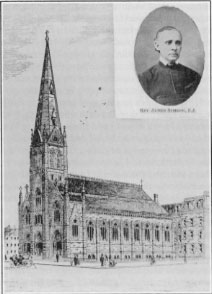
Weiser thus had the unenviable position of shepherding a German parish in the United States during World War II, a time when anti-German sentiment ran high. But he made the best of these “bittersweet years.” A history of Holy Trinity published in 1994 describes him as “an intellectual of the first rank” who “was an extremely active pastor.” In 1944, the parish’s week-long celebration of their centennial included several Missae cantatae and a Solemn High Mass, visits from local dignitaries such as the mayor of Boston and archdiocesan administrator Richard J. Cushing (later cardinal), and a special concert featuring some personal friends of Weiser who had likewise fled the Anschluss and emigrated to New England: the Von Trapp Family Singers. (I have also heard from former Holy Trinity parishioners that the Trapps, who lived in Stowe, Vermont, would serve in the choir for a High Mass anytime Fr. Weiser needed them for a special occasion).
The centennial would prompt Weiser to write his only book during the war, a history of Holy Trinity. In the preface he evinces, as he did in his autobiography, an appreciation of external accomplishments coupled with an awareness of the primacy of “unrecorded fruits” in the interior life:
The history of the parish possesses an (sic) unique interest. Naturally, its first and foremost achievement as a Catholic parish will always remain hidden within the sphere of personal religious life, but its external activities exhibit features which will engage the attention not only of its own parishioners but of all Catholics.

The Von Trapps
In this brief monograph Weiser also took advantage of his friendship with the von Trapps; the illustrations were drawn by their daughter Agathe. And after Captain Georg von Trapp passed away in 1947, Weiser dedicated his Christmas Book to him.
In addition to his regular pastoral duties, Weiser helped found the Massachusetts branch of the National Catholic Women’s Union and soon became their National Spiritual Director (a position he would hold for twenty years) and the National Youth Director of both the National Catholic Women’s Union and the National Catholic Central Union of America. he also served as auxiliary chaplain to German POWs at Fort Devens from 1943 until 1945.
But it was after the war that his activities reached a new level. Stories began to reach the U.S. of nuns starving to death and of Soviet troops raping and plundering in Austria and Germany; Weiser’s beloved Vienna was designated by a United Press International report as the hungriest capital in Europe. Under Weiser’s leadership, Holy Trinity became the premier parish in the United States for European war relief. In May 1946, the archbishop of Boston, recognizing his efforts, named him the official representative of the archdiocese for relief work for the national Catholic Welfare Conference in Germany and Austria. Between 1946 and 1949, the Holy Trinity rectory was stacked high with packages of food and clothing to be shipped to Europe as Weiser answered 25,200 letters from Europe begging for assistance. During this period, Holy Trinity raised $85,000 ($1,126,075 in today’s money) for the purchase of food and medicine and shipped almost 500,000 pounds of clothing and shoes and almost 18,000 cans of food. In recognition of his relief work and his impact on German youth in the 1920s and 30s, Weiser was awarded the Order of Merit First Class by the Federal Republic of Germany in 1957.

Return to Academia
Weiser returned to juvenile fiction with his 1949 Rothäute und Bleichgesichter (Redskins and Palefaces). Over the next thirteen years he would produce a steady stream of publications similar in kind to his prewar output: biographies of Jesuit missionaries, Bildungsromane, etc. All of them were still in German, although one of them, his travelogue to the Holy Land, later appeared in English. During this same period Weiser also had a minor influence on film. His 1936 Het lied van de Donau (The Song of the Danube) was the inspiration for the 1947 Dutch movie Jeugdstorm (Youth Storm), and his children’s classic The Light of the Mountains was made into a German film in 1955 titled Het licht der bergen. According to the Internet Movie Database, Weiser is credited as a writer on a total of three movies. The final entry in his filmography, in which he is listed as the screenplay’s sole author, is a 1965 Yugoslavian television movie Sasvim Malo Skretanje (Quite a Little Turn).
Weiser continued his work in charitable services, administering the funds of the St. Joseph’s Mission Fund from 1950 to 1968.
The 1950s would mark two major developments in his life. In 1950 he earned a second doctorate in theology from the Gregorian University in Rome. Upon his return to the U.S. (by now an American citizen), he held academic instead of parochial positions. From 1950 to 1961 he was a professor of Philosophy and German at Emmanuel College (a women’s college in Boston founded by the Sisters of Notre Dame de Namur), and around the same time he also taught at Weston College, a Jesuit institution in Weston, Massachusetts. After Weston was integrated into Boston College in 1959, Weiser became a Spiritual Counselor in the Boston College School of Education (which had an all-female student body) from 1961-70. At Boston College he also taught courses in ethics, philosophy, and theology. By 1957, he was referring to himself as “a college professor by duty and habit.”
Boston College Emeritus Professor Mary T. Kinnane describes Weiser as “somewhat larger than life” and an “excellent colleague and a good friend.” She adds:
He was a distinguished international scholar in Linguistic Philosophy with a doctoral degree from the University of Innsbruck, Austria, and the Gregorian in Rome. He had a diverse background in counseling as a Church pastor for eleven years and was a college professor for thirteen years. He had been Chaplain to the Von Trapp family, both in Austria and the United States.Father Weiser was a proud man, with a marvelous humility in speech and mien. His books, The Christmas Book and Easter Book, are popular purchases at the Holy Seasons since they are especially rich in explaining the symbols of the seasons, their origins, and their spiritual importance. His account of the Holy Land is also impressive. As the speaker at School of Education Christmas Assemblies in Campion Hall, he explained the origins of the Christmas tree and its lighted decoration (“O Tannenbaum!”), and the angelic symbol of the pretzel! One short anecdote should be recalled since it represented Father’s attention to detail in the area of housekeeping. Twice a week, Father would suggest we have a simple lunch of soup and sandwich in his office, usually to discuss our programs for students, students with special needs, or our policy on student life and whatever agenda were pertinent. An early arrival to his office would find Father with large pieces of felt-like material attached to his shoes as he moved around rhythmically to polish his ever-shiny floor. How fortunate we all were and are to have been able to share the life of such fine and distinctive, marvelous Jesuits. How enriching for students and all!
Weiser influenced other students in the area as well. New Testament scholar Pheme Perkins (current Joseph Professor of Catholic Spirituality at Boston College) met him when she was just “a high school kid”:
He would come to give a talk at my best friend’s grandmother’s house in Wayland [Massachusetts] one evening a month to a group of conservative lay Catholics. We would get out of school to go out there, so we could ride her horses, go to the talk, spend the night, and get returned to the prep school the next day. Neither of us were Catholic.After I became a Catholic my freshman year in college when I was seventeen, Fr. Weiser was my spiritual director, also aiding my German reading with a combination of the pious young adult novels he wrote (don’t remember a thing about them now) and his copies of Orientierung. He had been in the Jesuits with Hugo Rahner, so discussions of Karl Rahner were often filtered through Hugo who could actually write much better German! When I started a New Testament doctoral program after college, I was treated [by Fr. Weiser] to a slew of anti-Bultmann articles.
The Liturgical Turn
Kinnane’s allusion to The Christmas Book and The Easter Book brings us to the second major development in Weiser’s life at this time, his turn to heortology. He himself defines the field as “the historical science that explains the origin and meaning of feasts. The word ‘heortology’ is derived from the Greek heorte (feast) and logos (discourse).” And for him at least, that discourse includes not only “the origin, history, development, and observance” of Christian feasts but “their celebration in folklore” as well.
It was Weiser’s experience of America that generated his interest in the topic. He writes:
I was deeply impressed by many aspects of American life. Among them was the charming sight of the popular Christmas celebration. This tradition had been molded into one unit out of the best national Christmas lore of various immigrant groups. It was only during the second half of the last century that our American Christmas observance came to be established.Soon I discovered that most people have no clear notion of the origin, background, and true meaning of these customs which they observe in their homes. Since the great majority of our Christmas, Easter, Thanksgiving, and other observances actually go back to the inspiration of liturgical thought and symbolism, I judged it a worthwhile subject to explain. Also a priestly subject; for, given the fact that our popular customs contain the radiation of the liturgy, the understanding of this radiation would make the celebration of our Christian feasts within the family warmer, holier, and more truly joyful. At the same time, a better grasp of the religious meaning and message of our family customs would give parents valuable help for the religious training of their little ones.
Weiser used his spare time to research, and very often he felt like abandoning the project because of the difficulty in finding reliable source material. It took him six years, but in the end he had published five books: The Christmas Book in 1952, The Easter Book in 1954, The Holyday Book and Religious Customs in the Family in 1956, and The Handbook of Christian Feasts and Customs: The Year of the Lord in Liturgy and Folklore (a compendium of the first three).

Next week, we will examine the characteristics of Fr. Weiser’s liturgical theology.
A version of this article (with full annotation) appeared as “The Domestic Heortologist: An Introduction to Francis X. Weiser, S.J.” in Antiphon: A Journal of Liturgical Renewal 29:2 (2025), pp. 144-171. Many thanks to its editors for allowing its publication here.



