Tuesday, March 24, 2026

Bel and the Dragon in the Liturgy of Lent

On the Tuesday of Passion week, the Epistle of the Mass is the episode of the book of Daniel known as “Bel and the Dragon”, the fourteenth and final chapter in the Vulgate. This is one of the deuterocanonical parts of the book, along with the story of Susanna (chapter 13), which is read earlier in Lent, and the long section of chapter 3 known as “the Prayer of Azariah and the Song of the Three Children.” Of the latter two, a portion of the Prayer is read as the Epistle on Thursday of this week; the Song is one of the most commonly used canticles in all historical Christian liturgies, known from its opening word in Latin as the Benedicite.

This episode is the second time Daniel is thrown into a den of lions, the first being in the protocanonical sixth chapter. In the Patrologia Latina, more citations of chapter 6 are listed than of chapter 14, but in point of fact, the two stories are very similar, and many of the citations are vague enough that they could really refer to either one. The first verses in the Missal paraphrase the Biblical text, and summarize that the Babylonians rose up against Daniel because he destroyed two of their idols: a statue called Bel, which he unmasked as a fraud that didn’t really eat the food laid out for it every night, and a “dragon” (or “serpent”) which he killed by stuffing a lump of pitch, fat and hair down its throat. (“Bel” derives from the name “Baal”, a very nasty character who is often mentioned in the books of Kings) They therefore force King Cyrus to throw Daniel to the lions, which (as in the earlier episode) have been deliberately starved, but nevertheless do not touch the prophet; after a week he is discovered safe and sound, and his persecutors are themselves then thrown into the pit and devoured. I suspect that the version from chapter 14 was the one chosen for liturgical use because of the picturesque episode of the angel (verses 32-38), who carries the prophet Habakkuk by his hair over 500 miles from Judaea to Babylon, in order to bring food to Daniel.

Habakkuk and the Angel, by Gian Lorenso Bernini. ca. 1656-61; in the Chigi Chapel, Santa Maria del Popolo, Rome (Photo from Wikimedia Commons by Bede735)
In ancient Christian frescoes and sarcophagi, Daniel is often shown in the lions’ den nude. His emergence from the den or “pit” represents the Resurrection of Christ, which is the general theme behind so many early Christian artworks; his nudity therefore demonstrates the reality of the human nature and human body in which Christ rose, against the many early heretics who denied them. (The prophet Jonah, who represents Christ’s body in his own, according to the Lord’s own explanation, is also frequently shown nude for the same reason.) However, this theme does not appear in early Christian writings.

Daniel in the Lions’ Den; fresco of the 3rd century in the Catacomb of Ss Peter and Marcellinus
As is so often the case, the Church Fathers’ interpretation of the episode indicates why it was chosen to be read in Lent. Already in the third century, St Cyprian of Carthage explains that “Daniel, when he was compelled to adore the idol Bel that the people and king then worshipped, to assert the honor of his God with full faith and liberty, cried out, saying, ‘I worship nothing but the Lord my God, who made heaven and earth.’ ” (Epistle 61, known as “The Exhortation to Martyrdom”, PL IV 354A) These words, so similar to the opening of the baptismal Creed, reminded the ancient catechumens not only of the Faith which they wished to profess, but also that they might very well have been called to bear witness to it as martyrs, as indeed Cyprian himself did. In his commentary on the Lord’s Prayer (the first such commentary among the works of the Fathers), the story is read as an exhortation to trust in God. “To those who seek the kingdom and the justice of God, He promises that all things will be added; for, since all things belong to God, nothing can be lacking to him that has God, if he himself is not lacking to God. Thus a meal was arranged divinely for Daniel, when he was closed in the lions’ den by the king’s order; and among the hungry beasts, who did yet spare him, the man of God was fed.” (PL 4, 534A)

Once the era of persecution had passed, Daniel was frequently represented by the Fathers as a moral model. For St Zeno of Verona, a contemporary of St Ambrose, Daniel shows us the power of fasting as a spiritual discipline, an important theme for Lent. “Daniel, unarmed, killed a dragon that was terrible to the peoples, and being thrown to the lions, ate in the middle of his danger, he who was wont to fast (Dan. 9, 3) when he was out of danger. (Tractatus 2.8.3 de Timore, PL XI 324A) For Ambrose himself, this also makes him a model of the virtue of courage. “Daniel … was so wise that, in the midst of lions irritated by hunger, he was not weakened (or ‘disheartened’) by any dread of the beasts’ savagery; so courageous, that he could eat without fear of provoking them by his example to eat him.” (De Officiis, 2.4.11, PL XVI 106C)

In his treatise “On God’s Promises and Predictions” St Quodvultdeus, bishop of Carthage in the mid-5th century, sums up these various traditions. Daniel by his actions “teaches and shows that only the one true God is to be worshipped, abandoning vain superstitions, by which the prophet saw that not only the Babylonians, but indeed the whole world was held captive under the power of demons. (God) also showed to his herald that in the future it would be freed from their dominion by the grace of Christ the Lord. But because, as someone once said ‘Truth begets hatred’ (the Roman playwright Terence, in Andria, 1.1.68) … the Babylonians put him into the lions’ den to be devoured. … Therefore, when Daniel was brought out … his enemies were given to the lions as food, that they might perish. These things were done as a symbol of Daniel’s Lord, who prayed for His own, saying ‘Hand not over to the beasts the soul that confesseth Thee (Psalm 73, 19).’ For that roaring lion, the devil, who wandereth about seeking whom he may devour, (1 Peter 5, 8), consumes the enemies of our prophet, Christ the Lord, when he finds them, having received power over them.”

Daniel in the Lion’s Den; sculpted capital in the Abbey of Sant’Antimo in Montalcino, Italy, by the anonymous Romanesque sculptor known as the Master of Cabestany, active in the second half of the 12th century. (Photo from Wikimedia Commons by Sailko.) Daniel in the center, surrounded by lions, raises his hands in a gesture very similar to that of the priest at Mass during the Our Father; the angel, immediately to the right, is the deacon, and Habakkuk holds his basket of food under a veil, as the subdeacon holds the paten. – The Master of Cabestany is named for a small town near Perpignan, France, where he did a particularly beautiful sculpted tympanum over the door of one of the churches. Well over 100 pieces have been attributed to him and his workshop, in a wide range of places throughout southern France and northern Spain. The presence of three of his pieces in Tuscany suggests that he may have traveled as a pilgrim to Rome, and financed the trip by doing sculptures at various stops along the way. In his time, Sant’Antimo was a very rich and important territorial abbey which governed a large tract of Tuscany, fully able to pay him a good price for his work, as well as a popular stop for pilgrims on the via Francigena.

Saturday, March 14, 2026

The Woman Caught in Adultery in the Liturgy of Lent

In the Roman Rite, the Gospel of the woman caught in adultery, John 8, 1-11, is joined at today’s Mass with the story of Susanna, who is rescued from an accusation of adultery by the prophet Daniel. Whether by coincidence or design, these two stories are united not just by a textual theme, but also by a text-critical one; both stories were known in antiquity to be later additions to their respective books, but nevertheless accepted as authentic and canonical by the Church.

Christ and the Adulteress, 1620s, by the French painter Valentin de Boulogne (1591-1632), an unabashed plagiarist of Caravaggio. Public domain image from Wikimedia Commons
Susanna is one of two Greek additions to the book of the prophet Daniel, the other being the episode known as Bel and the Dragon. In the Septuagint, it is placed at the beginning of the book, since it describes Daniel as a youth, and Bel and the Dragon at the end. St Jerome placed them both at the end of his Latin translation of Daniel, and they therefore appear in the Vulgate as chapters 13 and 14 respectively. Since the time of the Protestant reformation, they have been included in many non-Catholic English Bibles with the group of books improperly known as the Apocrypha.
But as with the other so-called Apocrypha, the early Church had no serious doubts about the canonicity of either episode. The earliest Patristic commentary on Daniel, written by Hippolytus of Rome in the first half of the 3rd century, accepts Susanna as a part of the book without distinction, and the hugely influential Biblical scholar Origen, his contemporary, explicitly defended its canonicity. It was frequently depicted in art in the Roman catacombs, and both episodes form part of the Roman Mass lectionary.
Susanna as a lamb between two wolves, from the Arcosolium of Celerina in the Catacomb of Praetextatus, mid-4th century.
The pericope of the adulteress, on the other hand, was a bit slower to find acceptance. It is missing completely from a considerable number of Greek manuscripts of the New Testament, including several of the earliest and most important ones, such as the Codexes Sinaiticus, Vaticanus, and Alexandrinus. Other early manuscripts have it marked in such a way that indicates doubt as to its authenticity, and a few place it at the end of Luke 21, which is why it is sometimes known as “the wandering pericope.” It is not mentioned in some important early commentaries on the Gospel of John, such as those by Ss John Chrysostom and Cyril of Alexandria. To this day, the Byzantine Rite’s Gospel for the Divine Liturgy of Pentecost goes from the last verse of John 7 directly to verse 8, 12, and the passage is not included in the semi-continuous reading of St John that runs from Easter to Pentecost. (It is included in the lectionary for the feasts of female penitents.)
In the West, the question of its authority was settled by its acceptance on the part of three of the first four Doctors of the Church. St Jerome included it in the correction of the Latin text of the Gospels which he made at the behest of Pope St Damasus I. St Ambrose refers to it as part of the liturgy in his Second Apology for David, and it is still used to this day in the Ambrosian Rite in the same place in which he attests it. St Augustine includes it in his commentary on the Gospel of John, which is by far the most important and widely read such commentary in the West. In his book “On Adulterous Marriages”, he also gives the following explanation of the passage’s absence from some manuscripts, words which have become, alas, all too relevant to our own age.
“But now, after Christ said to the adulteress, ‘Neither shall I condemn thee; go, sin no more henceforth,’ who could not understand that the husband must forgive since he sees that the Lord of them both has forgiven (her)? Nor should she any longer call herself an adulteress, whose crime was wiped away by God’s mercy when she repented.
But clearly the sense of the faithless abhors this, such that some of little faith, or rather enemies of the true faith, I believe, fearing that free license to sin was being given to their wives, took out of their copies (of the Gospel) that which the Lord did regarding the forgiveness of the adulteress, as if He granted permission to sin when He said, ‘Now sin no longer …’ (De conjugiis adulterinis II, 7.)
The Four Doctors of the Church, by Pier Francesco Sacchi, ca. 1516.
For Hippolytus, Susanna is a figure of the Church beset by her persecutors, but vindicated and saved by the just judgment of God in the person of the prophet Daniel, whose name means “God is my judge.” For St Ambrose, the adulteress is also a figure of the Church, in the broader sense of God’s people, in both the Old and New Testaments, that seeks the Word of God in many places until she finds it in Christ, and is absolved and purified by Him. “And therefore she was waiting about, and everywhere sought the Word of God, because she was wounded, because she was naked, because she was an adulteress in all things, although without blemish in Christ, as she sought a redeemer in her wretched body. Christ joined her to Himself, in order to make her immaculate; He united Himself to her, in order to take away her adultery.” Where Susanna is the symbol of the Church in her fidelity to Christ, and the adulteress is the Church redeemed by Christ when she has been unfaithful to him.
Roughly nine centuries later, William Durandus neatly sums up this union of the two readings as follows: “On Saturday (of the third week of Lent) it is shown that the Lord saves by justice and mercy, whence the Epistle speaks of Susanna, who was saved by justice. The Gospel is that of the woman caught in adultery, whom the Lord delivered through mercy. Therefore, because (she) is saved through mercy, the Church, seeing the weakness of her children, asks to be delivered through mercy in the Introit, saying, ‘Give ear, O Lord, to my words, understand my cry. Hearken to the voice of my prayer, (my king and my God.)’ ” (Rat. Div. Off. 7, 52, 1)
Three further things we may note about this Introit. Psalm 5, from which it is taken, is titled in Greek and Latin “for her that obtaineth the inheritance”, which the Church Fathers naturally took as a reference to the Church. A 4th-century commentary on the Psalms called “Breviarium in Psalmos”, which was long mistakenly attributed to St Jerome, says, “This Psalm is written about the Church, which at the end of the world will obtain the inheritance in all the nations that believe in Christ.” (PL XXVI, 828D-829A)
Secondly, the same commentary explains the words “my king and my God” as follows. “He truly dared to say ‘my king and my God’, even he over whom sin does not reign in his mortal body. ‘My king and my God’, because Thou reignest in me, and sin reigneth not, wherefore Thou art my God. Thou art my God, because my belly is not my God (Phil. 3, 19), because money is not my God, because lust is not my God.” This represents the condition of the Church as symbolized by the adulteress, whose adultery is taken away, and thus lust is no longer her god.
Third, the verse of the Introit continues in the fourth verse of the Psalm, “For to thee will I pray, o Lord; in the morning thou shalt hear my voice.” The story of the adulteress begins when “early in the morning (Jesus) came again into the temple.” This is also a symbol of the adulteress’ conversion, as the Breviarium says: “As long as I am in the darkness of error, He does not hear me, but when the sun of justice (i.e. Christ) shall come into my heart, then He heareth me.”
The Gradual of this Mass is taken from Psalm 22: “If I shall walk in the midst of the shadow of death, I will fear no evils; since Thou art with me, o Lord.” This refers to the fact that both Susanna and the adulteress faced the possibility of being killed, but were saved by the Lord. In many medieval Uses of the Roman Rite, this same gradual was used at the Requiem Mass.
The Offertory is from Psalm 118, verse 133: “Direct my steps according to thy word, that no injustice may have dominion over me, o Lord.” Of this, the Breviarium says simply “and not according to bodily desires, because I am given over to Thy service.” St Hilary of Poitiers comments in a similar vein, “…not according to the ways of the world, not according to the glory of men, not according to the pleasures of the body.” (Tractatus super Psalmos; PL IX, 617D-618A) Thus the Church, freed from the dominion of sin like the adulteress, is able to proceed to the offering of the Holy Sacrifice. And since this Psalm was sung daily for centuries at the hours from Prime to None, those who heard and sang this Offertory would certainly have thought of the first part of the following verse, “Redeem me from the calumnies of men” as a reference to the calumnies made against Susanna, and the second part, “that I may keep thy commandments,” as a reference to the Lord’s command to the adulteress, “Go and sin no more.”
On the ferias of Lent, the Communion antiphons are taken each one from a different Psalm in sequential order, starting on Ash Wednesday with Psalm 1. The days which were formerly aliturgical do not form part of this series, namely, the six Thursdays, and also the first and last Saturday; the ferias of Holy Week are also not included. (See the table below; click for larger view.)

The series is also interrupted on six days when particularly important passages of the Gospels are read, and the Communion is taken from them instead. Here is a magnificent polyphonic setting of the one for today, by the Portuguese composer Frei Manuel Cardoso (1566-1650), a Carmelite friar who worked principally at his order’s house in Lisbon.

Friday, March 13, 2026

The Samaritan Woman in the Liturgy of Lent

In the lectionaries of the various Latin rites, one of the most prominent Gospels of the Lenten season is that of the Samaritan woman who spoke to Christ at the well of Jacob (St John 4, 5-42). Although the Roman, Ambrosian and Byzantine Rites each read this Gospel on a different day, it appears in all three as a lesson of particular importance for the preparation of those who will be baptized at Easter or Pentecost.

In the Roman Rite, it is read on the Friday of the third week, joined with one of the most important epistles of Lent, Numbers 20, 1-13, in which Moses makes water run from the rock in the desert. This story was understood by the early Christians as a prefiguration of the sacrament of baptism, starting with St Paul himself, who tells us that “our fathers were all under the cloud, and all passed through the sea. And all in Moses were baptized, in the cloud, and in the sea: and did all eat the same spiritual food, and all drank the same spiritual drink; and they drank of the spiritual rock that followed them, and the rock was Christ.” (1 Cor. 10, 1-4) Moses striking the rock to make the water run from it is one of the most frequently depicted Biblical scenes in early Christian art; just in the paintings of the Roman catacombs, it appears over 70 times, along with numerous other representations on ancient sarcophagi.

Moses making the water run from the rock in a fourth-century fresco in the Catacomb of St Callixtus.
On the previous Sunday, the Lenten station is kept at the church of St Lawrence Outside-the-Walls, where anciently the catechumens underwent a formal examination of their Christian faith, the ritual known as the scrutiny. The Gelasian Sacramentary contains a beautiful prayer for them to be said on that day, “that they may worthily and wisely come to the confession of Thy praise; so that through Thy glory they may be reformed to the former dignity which they had lost in the original transgression.” At the same Mass, the Memento of the living has an interpolation to pray for their future godparents, and during the Hanc igitur, the names of the catechumens were read out loud. On the following Friday, the station is kept at another church of Rome’s most venerated martyr, St Lawrence ‘in Lucina’, nicknamed, like so many sacred places in the city, for the woman upon whose property it was originally built. Here, they would hear Christ speaking to the Samaritan woman of the “living water … springing up unto life everlasting”, and understand His words as a clear reference to baptism.

A piece of the gridiron of St Lawrence’s martyrdom, preserved in a reliquary in a side-altar of San Lorenzo in Lucina. Photo courtesy of Orbis Catholicus.
In his treatise on the Gospel of St John (Tract 15, 10), St Augustine explains the woman as a type of the Church, “not yet justified, but waiting to be justified”, like the catechumens themselves. He also reminds us that the Samaritans were not part of the Jewish people; indeed, the Bible itself says that they were a mixed nation of Jews and pagans, observing the customs of both. (4 Kings 17, 24-41) So too, the early Church was a mixture of Jews and pagans, now united in Christ in whom “there is neither Jew nor Greek … for you are all one in Christ Jesus.” (Galatians 3, 28) Augustine continues by saying, “Therefore, in her, let us hear ourselves (spoken of), and in her, let us recognize ourselves, and in her, let us give thanks to God for ourselves.” (i.e. for what He has done for us.)

The dedicatory inscription on the counter-façade of Santa Sabina in Rome, the only part of the church’s original mosaic decoration which survives, ca. 425 A.D. The two figures on the sides are “the church from the circumcision” on the left, and “the church from the gentiles” on the right. Photo courtesy of Fr. Lawrence Lew, O.P.
In the Ambrosian Rite, the first Sunday of Lent is called “in capite jejunii – at the beginning of the fast”, a title also used for Ash Wednesday in medieval liturgical books of the Roman Rite. The remaining Sundays are named for their Gospels, all taken from St John, the second Sunday being that of the Samaritan woman, the third ‘of Abraham’ (chap. 8, 31-59), the fourth ‘of the man born blind,’ (9, 1-38), the fifth of Lazarus (11, 1-45) and the sixth ‘of the Palms’ (11, 55 – 12, 11). On the second Sunday, the following antiphon is sung after the Gospel, while the deacon spreads the corporal on the altar in preparation for the Offertory. (As in the Roman Rite, most of the Mass propers use the Old Latin version of the Scriptures.)
For I will take you from among the gentiles, and I will pour upon you clean water; you shall be cleansed from all your iniquities. I will give you a new heart, and renew a righteous spirit within you. (Ezechiel 36, 24, 25 and 26.)
In the Roman Rite, the same prophecy of Ezechiel (though not exactly the same words) provides both the introit and the first epistle of the Mass of the Wednesday of the fourth week of Lent, on which day the catechumens were exorcized and blessed at the tomb of St Paul, the great Apostle of the gentiles.

The Ambrosian Missal contains proper prefaces for nearly every Mass of the temporal cycle, generally rather longer than those of the Roman Rite. The Lenten prefaces of the Sundays are each based on the Gospel of the day, and that of the Samaritan woman reads as follows:
Truly it is worthy and just…through Christ our Lord. Who, to instill (in us) the mystery of His humility, being tired, sat at the well, and * asked of the Samaritan woman that a drink of water be given Him, even He that had created the gift of faith in her; and so He deigned to thirst for her faith, so that, as He asked water of her, He might enkindle in her the fire of divine love. * We therefore beseech Thy boundless compassion, that defying the dark depths of vice, and leaving behind the vessel of harmful desires, we may ever thirst for Thee, that art the fountain of life, and source of all goodness, and may please Thee by the observance of our fast. Through the same etc.
The words here noted between the stars form the basis of a Preface used in the post-Conciliar Rite in the first year of the three-year lectionary cycle, when the story of the Samaritan woman is read on the third Sunday of Lent. Since this crucial passage is not included among the readings of the second and third years, a rubric provides that it may be read on Sunday in place of the Gospels assigned to those years, or it may displace one of the ferial Gospels; a similar provision is made for the blind man and Lazarus.

The Orthodox church of Jacob’s Well, also known as St Photini’s, in the city of Nablus on the West Bank. The current church is the fifth structure to stand over the site, which has been venerated by Christians as the Well of Jacob since the fourth century.
In the Byzantine tradition, the story of the Samaritan woman is read in Eastertide rather than Lent, as is that of the man born blind; however, the association of it with the sacrament of baptism is just as clear as in the Latin rites. On the fifth Sunday of Easter, the following three exapostilaria are sung at the end of Matins; the first is that of the Easter season, the second relates to the Gospel of the day’s Divine Liturgy, and the third to the feast of Mid-Pentecost.
Exapostilarion of Easter  Having fallen asleep in the flesh as a mortal, O King and Lord, You rose again on the third day, raising up Adam from corruption, and abolishing death. O Pascha of incorruption, O salvation of the world!
of the Samaritan Woman  You reached Samaria, and talking with a woman, sought water to drink, my all-powerful Savior, who poured out water for the Hebrews from a sharp rock, and led her to belief in you: and now she enjoys life eternally in heaven.
of Mid-Pentecost  At the mid-point of the feast, Lover of mankind, you came to the temple and said: You who are full of thirst, come to me and draw living water welling up, through which you will all revel in delight and grace and immortal life.
Note how the exapostilarion of the Samaritan woman makes the same association between the Lord’s revelations to her and the episode of the water running from the rock that is made in the Roman Rite by the readings of the Mass. This reference to the waters of baptism continues in the third text, which quotes Christ’s second reference to the “living waters” in the Gospel of John, when He speaks in the temple during the feast of Tabernacles. (chapter 7, 37-39.)

The text of this second Gospel of the “living waters” is deferred by the Byzantine Rite to Pentecost itself, a custom which it shares with the Ambrosian and Roman Rites in different ways. The church of Milan preserves to this very day an ancient custom of celebrating two Masses on both Easter and Pentecost, the traditional days for the administration of baptism; one is the Mass “of the solemnity” itself, and another “for the (newly) baptized.” On Easter Sunday, the Gospel at the Mass for the baptized is John 7, 37-39, with the second part of the last verse omitted.
On great day of the festivity, the Lord Jesus stood and cried, saying: If any man thirst, let him come to me, and drink. He that believeth in me, as the scripture saith, Out of his belly shall flow rivers of living water. Now this he said of the Spirit which they should receive, who believed in him.
At the Mass for the baptized on Pentecost, this Gospel is repeated, adding the final words of verse 39 which are not said on Easter, “for as yet the Spirit was not given, because Jesus was not yet glorified.” In the Roman Rite, the same text provides the Communion antiphon for the Mass of the vigil of Pentecost, although the Gospel itself is read on the Monday of Passion Week.

The Byzantine Rite has traditionally honored the Samaritan woman as a Saint, and she was often called both an Apostle and Evangelist. Her legend states that she, her five sisters and two sons were among those baptized by St Peter and the other Apostles on the first Pentecost, and afterwards traveled to preach in many places; after evangelizing Carthage, they came to Rome, where they were martyred under Nero. Her given name is Photeine (or “Photini” in the modern pronunciation), the Greek word for “bright”; the cognate “photistes – illuminator” is used in the Byzantine tradition as a title for the saint who first evangelizes a people, the best-known example of this being perhaps St Gregory the Illuminator of Armenia. With the latinized form of her name, Photina, she was added to the Tridentine edition of the Roman Martyrology by Cardinal Baronius, along with her family members, on March 20th, the day of her feast in the Byzantine Rite. Her troparion makes the same association between the waters of baptism and the coming of the Holy Spirit on Pentecost indicated by the placement of her Gospel on the Sunday after Mid-Pentecost.
Wholly illuminated by the divine Spirit, and sated of your thirst by the springs, you drank deeply of the water of salvation from Christ the Savior, all praiseworthy one, and shared it abundantly with them that thirst; o Great Martyr and Equal to the Apostles, Photini, entreat Christ our God to save our souls.

Wednesday, March 11, 2026

Byzantine Hymns for Mid-Lent

The Fast that bringeth good things hath now reached its middle point, having pleased God well in the days gone past, and bringing help in the days to come; for the increase of good things maketh greater the good work. Wherefore let us cry to Christ, the Giver of all good things, pleasing Him well, “O Thou who for our sake did fast and endure the Cross, deem us worthy to partake also of Thy divine Pasch uncondemned, living our lives in peace, and rightly glorifying Thee with the Father and the Spirit.

Since the Byzantine liturgical week runs from Monday to Sunday [note], Lent starts two days before the Roman Ash Wednesday; therefore, today is Wednesday of the Fourth Week of Lent in the Byzantine Rite, but “Wednesday of the Third Week” in the Roman. This day is sometimes referred to informally as Mid-Lent, although this is an approximation, where the analogous half-way point of the Paschal season, a special feast called “Mid-Pentecost”, is exactly half-way (25 days) between Easter and Pentecost. The sticheron given above is one of several placed between the verses of a group of four Psalms which are sung at Vespers every day (140, 141, 129 and 116), while the deacon incenses the altar and sanctuary, the iconostasis, the church, the clergy and the faithful. The first of these Psalms is chosen for the words “Let my prayer raise before Thee like incense, the lifting up of my hands as an evening sacrifice,” which are prominent in most historical Christian rites. (A sticheron is technically referred to as kind of “hymn”, but in construction is really more analogous to the antiphons of the Roman Rite; the number of them varies from day to day.)

The last of a group of stichera is almost always a Theotokion, a hymn to the Virgin Mary, and that of Mid-Lent is particularly beautiful. The references to the Crucifixion look back to the preceding Sunday, that of the Veneration of the Holy and Life-Giving Cross, and forward to Good Friday and the end of Lent.

“Today, He that is by nature unapproachable becometh approachable to me, and undergoeth His sufferings to deliver me from sufferings; He that giveth light to the blind is spit upon by impious lips, and giveth His cheek unto blows, for the sake of those held captive. The holy Virgin and Mother, seeing Him upon the Cross, cried out, ‘Alas, my Child! What is this Thou hast done? Beautiful beyond the sons of men, dost Thou appear without life or spirit, having no beauty or comeliness? Alas, my Light! I cannot look upon Thee sleeping, I am wounded to the core, and a terrible sword passeth through my heart. I sing of Thy sufferings, I adore Thy compassion; long-suffering Lord, glory to Thee!’ ” (In the video below, the Church Slavonic version.)

A 16th-century icon of the Holy Mandylion, the cloth with Christ’s face impressed upon it, and below, the Lamentation over the Dead Christ.
[note] As with most things Byzantine, this is a case where a little bit of inaccuracy saves a ton of explanation. In the liturgical book called the Triodion, which contains the Office propers of Fore-Lent, Lent and Holy Week, the liturgical week begins on Monday, so the First Monday of Lent is followed by the First Tuesday, Wednesday etc., then the First Sunday. The next day after that is “the Second Monday of Lent”, then Tuesday, Wednesday etc., and then the Second Sunday, the Third Monday, and so on. The same system is used in the lectionary for the period after Pentecost. However, in the Pentecostarion, which covers the Easter season, the weeks are arranged from Sunday to Saturday; there are also features of the Divine Office which run on a weekly cycle that begins with Vespers on Saturday evening.

Tuesday, March 10, 2026

Elisha and the Widow are Christ and the Church

William Durandus’ commentary on today’s Mass, Rationale Divinorum Officiorum VI, 48

The Mass of this day speaks of prayer and of mercy, through which also does the Lord save us. The epistle (4 Kings, 4, 1-7) is about a widow, whose sons a creditor is seeking to take as slaves, so Elisha fills her vessels with oil, telling her to pay the debt which she owes from selling part of the oil, and that she and her sons should live from the rest.

A Dutch engraving of Elisha and the widow, 1616-36.
This widow is the Church, whose spouse Christ is not present bodily or visibly. The creditors are the demons, for which reason, the devil is called a tax-collector (exactor), because he demands money from us, meaning, uncleanness, with interest. This is why Isaiah says (14, 4), “How hath the tax-collector ceased, and the tribute gone silent?”
But Christ has delievered us from this sort of tax-collector through the works of mercy, the liberation which is asked for in the Gradual.
Graduale, Ps 18 Ab occultis meis munda me, Dómine: et ab aliénis parce servo tuo. ℣. Si mei non fúerint domináti, tunc immaculátus ero: et emundábor a delicto máximo. (From my hidden sins cleanse me, o and from those of others spare Thy servant. ℣. If they rule not over me, then shall I be blameless, and cleanse of a very great sin.)
But the Gospel from St Matthew (18, 15-22) is about mercy, to wit, “If thy brother sin against thee, go and reprove him.” If he ignores you, teach him; if he repents, forgive him, “not, I say, as many as seven times, but unto seventy times seventy”, that is, as often as he sins, forgive him.
Again, the widow as she prays to Elisha for her sons says in the introit, “I have cried out”, and in the gradual, “From my hidden sins cleanse me.”
Introitus, Ps. 16 Ego clamávi, quoniam exaudisti me, Deus: inclína aurem tuam, et exaudi verba mea: custódi me, Dómine, ut pupillam óculi: sub umbra alárum tuárum prótege me. Ps. Exaudi, Dómine, justitiam meam: intende deprecatiónem meam. Glória Patri... Ego clamávi.. (I cried out, because Thou didst hear me, o God; incline Thine ear, and hear my words; keep, o Lord, as the apple of Thine eye, beneath the shadow of Thy wings protect me. Ps. Hear, o Lord, my just cause, intende unto my supplication.)
At last, when she has been heard in her prayers, she gives thanks in the offertory, “The right hand of the Lord,” and in the communio, she teaches us how those who want the oil of mercy should present themselves, which is to say, let those who wish to rest upon the mountain go walk without blemish, and work justice.
Communio, Ps. 14 Dómine, quis habitábit in tabernáculo tuo? aut quis requiescet in monte sancto tuo? Qui ingréditur sine mácula, et operátur justitiam. (Lord, who shall dwell Thy tent? Or who shall rest upon Thy holy mountain? He who walks without blameless, and doeth justice.)

Sunday, March 08, 2026

A Hymn for Lent, Lost and Restored

The Roman tradition has always been very conservative about the use of hymns in the Divine Office. In most liturgical seasons, there are three proper hymns, one each for Matins, Lauds and Vespers, but many feasts, including some of the greatest solemnities (Christmas, Epiphany, Ascension etc.), have only two. In the Ordinal of Pope Innocent III (1198-1216), the ancestor text of the breviary of St Pius V, Lent is an exception, since it has four hymns, one each for Matins and Lauds, but two for Vespers. Audi, benigne Conditor is said from Monday to Saturday, but Sunday Vespers has its own hymn, Aures ad nostras, an anonymous work first attested in a 10th century manuscript from the abbey of St Benedict on Monte Cassino.
The hymn Aures ad nostras in a breviary according to the Use of Esztergom, the primatial see of Hungary, 1523-24. (Bibliothèque nationale de France, Département des Manuscrits, Latin 8879)
St Pius V’s reform of the Roman breviary made very few alterations to the established repertoire of musical propers for the Office in all their genres (antiphons, responsories etc.) This hymn was therefore left in its place, with a small correction of the awkwardly arranged opening words (“Ad preces nostras Deitatis aures”), but otherwise unchanged.
In early 1588, Pope Sixtus V established the Sacred Congregation for Rites, and appointed as its first prefect Alfonso Gesualdo, archbishop of Conza in southern Campania, and uncle of the famous composer Carlo Gesualdo. As part of the preparatory work for new editions of the breviary and missal of St Pius, the cardinal wrote to various nuncios in Europe, asking them to canvas the learned men of their respective nations for suggestions as to what might be due for revision. The reports of two different nuncios (Prague and Madrid) contained the suggestion that Aures ad nostras be removed from the Office completely; another (Venice) suggested it be corrected, since its numerous metrical flaws made the Catholic Church look foolish to the Protestant heretics. [1]
This information comes from an article by a chant scholar and canon of the cathedral of Chartres, Fr Yves Delaporte, published in 1907. In the second part, he gives the following information from the notes of the commission that prepared the revised breviary which Pope Clement VIII promulgated in 1602. “The hymn Ad preces nostras... has been removed; it seemed inept in both its choice of words and phrasing, was put together with no account of (metrical) feet or syllables, and further, was superfluous, since in all offices, the same hymn is said at both Vespers, and no other solemn observance... has more then three hymns.” [2]
In the post-Conciliar Rite, however, it has been restored to use, but not in Lent. The first three stanzas serve as the hymn for the Office of Readings on Tuesday of weeks 2 and 4 of the Psalter, and the fifth, sixth and eighth on Wednesday; on both days, it concludes with the same, original doxology. In accordance with the usual censorship of any negative thoughts that might disturb the complacency of Modern Man™ in his splendor, the fourth stanza, which says that “we are submerged beneath the wave of sin” is suppressed, as is the seventh, which refers to the newly unfashionable practice of fasting, and the “thousand vices of the flesh.” Both of these stanzas also contain significant blemishes in their Latinity. Surprisingly, the reference to Satan in the eighth stanza remains in place, and only a few other alterations were made.
This first recording, from the always wonderful Schola Hungarica, begins with the antiphon Media vita, which was commonly sung with the Nunc dimittis at Compline in Lent. The first stanza of the hymn begins at 2:20, in a Gregorian melody, followed by a polyphonic version of the second, and only these two are sung.
The first stanza of the hymn in a musical collection of the 15th century. (Bibliothèque nationale de France, département Musique, RES-1750)
This English translation is from the collection Pange Lingua by Alan G. McDougall (Burns and Oates, London, 1916.) [3]
Ad preces nostras Deitátis aures, [4]
Deus, inclína pietáte sola:
Súpplicum vota súscipe, precámur
   Fámuli tui.
God, of thy pity,
   unto us thy children
Bend down thine ear in
   thine own loving kindness,
And all thy people’s
   prayers and vows ascending
Hear, we beseech thee.
Réspice clemens solio de sancto,
Vultu seréno lámpades illustra:
Lúmine tuo ténebras depelle
   Péctore nostro.
Look down in mercy
   from thy seat of glory.
Pour on our souls the
   radiance of thy presence,
Drive from our weary
   hearts the shades of darkness,
Lightening our footsteps.
Crímina laxa pietáte multa,
Ablue sordes, víncula disrumpe:
Parce peccátis, réleva jacentes
   Déxtera tua.
Free us from sin by
   might of thy great loving,
Cleanse thou the sordid,
   loose the fettered spirit,
Spare every sinner,
   raise with thine own right hand
All who have fallen.
Te sine tetro mérgimur profundo:
Lábimur alta scéleris sub unda:
Brachio tuo tráhimur ad clara
   Sídera caeli.
Reft of thy guiding
   we are lost in darkness,
Drowned in the great wide
   sea of sin we perish,
But we are led by
   thy strong hand to climb the
Ascents of Heaven
Christe, lux vera, bónitas et vita,
Gaudium mundi, píetas immensa,
Qui nos a morte róseo salvasti
   Sánguine tuo:
Christ, very light and
   goodness, life of all things,
Joy of the whole world,
   infinite in kindness,
Who by the crimson
   flowing of thy life-blood
From death hast saved us,
Insere tuum, pétimus, amórem
Méntibus nostris, fídei refunde
Lumen aeternum, charitátis auge
   Dilectiónem.
Plant, sweetest Jesu,
   at our supplication
Deep in our hearts thy
   charity: upon us
Faith’s everlasting
   light be poured, and increase
Grant us of loving.
Tu nobis dona fontem lacrimárum,
Jejuniórum fortia ministra;
Vitia carnis millia retunde
   Frámea tua.
Grant to our souls a
   holy fount of weeping,
Grant to us strength to
   aid us in our fasting,
And all the thousand
   hosts of evil banish
Far from thy people.
Procul a nobis pérfidus absistat
Satan, a tuis víribus confractus:
Sanctus assistat Spíritus, a tua
   Sede demissus
Bruised by thine heel may
   Satan and his legions
Far from our minds be
   driven, that are guided
By the indwelling
   of the Holy Spirit
Sent from Heaven
Gloria Deo sit aeterno Patri:
Sit tibi semper, Genitóris Nate,
Cum quo aequális Spíritus
      per cuncta,
   Sáecula regnat. Amen.
Glory to God the
   Father everlasting,
Glory for ever
   to the Sole-begotten,
With whom the Holy
   Spirit through the ages
Reigneth coequal.
This splendid polyphonic version by the Flemish composer Adrian Willaert (1490 ca. - 1562) has only the odd-numbered stanzas, since it was written to be sung in alternation with the Gregorian melody. (Willaert spent the last 35 years of his life as the Master of the Chapel at the basilica of St Mark in Venice, and is regarded as the founder of the Venetian school of polyphony, which makes great use of multiple choirs.)
[1] Of the hymn’s thirty-six lines, twenty-eight contain mistakes according to the rules of classical Latin prosody.
[2] Les Hymnes du Bréviaire Romain de Pie V à Urbain VIII, 1568-1632; Rassegna Gregoriana, Nov.-Dec. 1907, col. 495-512; cited by Dom Anselmo Lentini OSB in Te decet hymnus, p. 49, with incorrect citation of the first column number (489 instead of 495). Second part, May-June 1908, col. 231-250. (My thanks to Fr Brian Austin, FSSP, for providing me with a copy of the second part.)
[3] This meter is known as the Sapphic stanza, after its inventor, the Greek poetess Sappho (ca. 630-570 B.C.) Each stanza has three lines that run as follows, ⎼⏑⎼⏒⎼⏑⏑⎼⏑⎼⏒, and then one shorter line, ⎼⏑⏑⎼⏒, with the primary accents on the long syllables (⎼) at the beginning of each foot. English, however, lends itself more naturally to meters that place the primary accent at the end of a foot, such as the iambic pentameter (⏑⎼ x5); this accounts for the awkwardness of McDougall’s translation in many places, since he retained the meter of the Latin version.

[4] The original wording, “Aures ad nostras Deitatis preces, / Deus, inclina”, abuses the flexibility of Latin word order, and sounds at first blush like it means “O God, incline the prayers of the Divinity to our ears”; hence, the correction to the much clearer (and theologically sounder) “Ad preces nostras Deitatis aures, / Deus, inclina. – O God, incline the ears of the Divinity to our prayers.”

The Third Sunday of Lent 2026

Oculi mei semper ad Dóminum, quia ipse evellet de láqueo pedes meos: réspice in me, et miserére mei, quoniam únicus et pauper sum ego. Ps 24 Ad te, Dómine, levávi ánimam meam: Deus meus, in te confído, non erubescam. Gloria Patri... Oculi mei... (The Introit of the Third Sunday of Lent.)
Introit My eyes are ever toward the Lord, for He shall pluck my feet out of the snare; look Thou upon me, and have mercy on me, for I am alone and poor. Ps 24 To Thee, o Lord, have I lifted up my soul; my God, in Thee do I trust; let me not be put to shame. Glory be... My eyes...
“The third Sunday (of Lent) belongs to confession... which a man must have in two senses, the confession of sin and of praise. For it is by the humility of confession that a man awaits all that he awaits from God, to wit, liberation, and the gift of grace, and all good things, whence the Introit ‘My eyes are ever towards the Lord.’ And it is in the seventh tone, because by the sevenfold grace of the Holy Spirit, a man shall be plucked from the snare of the devil. For through confession, evil deeds are examined, and for this reason, the station is at the church of St Lawrence (in Lucina), who was delivered through confession. ...
the Apostle shows how confession ought to be in the Epistle (Ephesians 5, 1-9) For it must first be in humility, that is, so that we may humble ourselves before God, and thus walk in newness of life. Second, in perseverance, so that a man may not return to his own vomit (2 Peter 2, 22), and that the infamy of sin may be removed, whence it says ‘But let fornication, and all uncleanness not so much as be named among you.’ This happens through perseverance in a good life.” (Durandus, Rat. Div. Off. 6, 47)

Friday, March 06, 2026

The Ambrosian Lenten Litanies

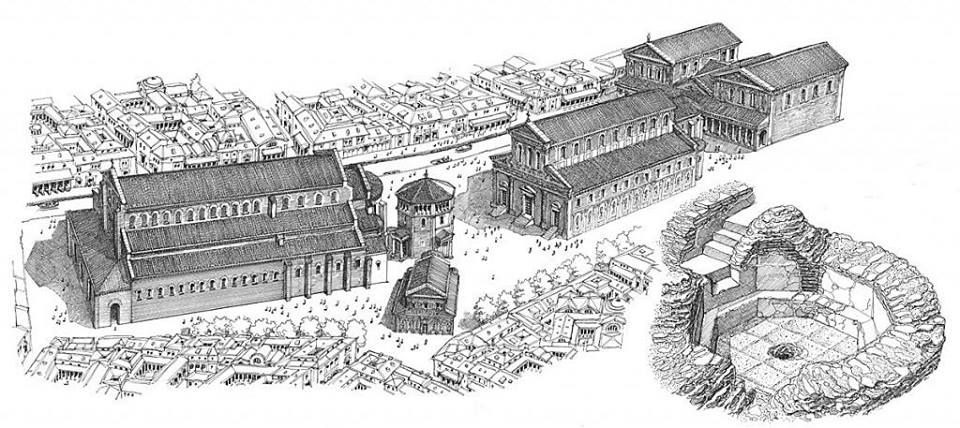
The duomo of Milan as it stands today is the result of a project which began in 1386, to replace the two cathedrals which had hitherto served the see of St Ambrose. The “winter church”, as it is still called in Ambrosian liturgical books, was the smaller of the two, dedicated to the Virgin Mary, and used from the Third Sunday of October, the feast of its Dedication, until Holy Saturday; it stood where the modern cathedral stands, but was nowhere near as large. The larger “summer church”, which was demolished in 1543, stood on the opposite end of the modern Piazza del Duomo, and was dedicated to St. Thecla, for which reason her name is included in the Canon of the Ambrosian Mass.

A reconstruction of the cathedral complex of Milan, with the summer church of St Thecla on the left, and the winter church of the Virgin Mary at the right. The octagonal structure in front of St Thecla is the baptistery of St John; the smaller structure beneath it is the baptistery of St Stephen. At the lower right is a partial reconstruction of the interior of the baptistery of St John.
The Ambrosian Rite has several customs which were designed around this arrangement, one of which is a special set of litanies said after Terce on Wednesdays and Fridays of Lent. These litanies have the same structure as those of the Greater and Lesser Rogations: an opening collect; a series of processional antiphons; a litany of the Saints; another collect; another set of antiphons; and then the same concluding formula. On these Lenten ferias, the first set of antiphons was sung as the clergy processed from the winter church over to the summer one, where the litany of the Saints was said as they knelt before the altar; the second set was sung as they returned to the winter church. The proper texts of these litanies vary from day to day, as do the number of antiphons within each set; here are the texts for today, the Friday of the Second Week of Lent. Until 1913, the Ambrosian clergy were required to say these as part of their Office, just as Roman clergy are required to say the Litany of the Saints on the Rogation days, so they are printed in the breviary. This picture is taken from the first post-Tridentine edition of the Ambrosian breviary, printed by authorization of St Charles in 1582. (Click to enlarge and read the Latin text.)

The opening collect: Be present, Lord, to our supplications, and with Thy heavenly aid, through the intercession of all Thy Saints, kindly protect those who hope in Thy mercy. Through our Lord...

Antiphon I In Thee, o Lord, do we hope, let us not be confounded forever; in Thy justice deliver us, and rescue us, that we may not perish.
Antiphon II Lord, for the multitude of our sins, we are not worthy to look upon the height of heaven: destroy us not unto the end with our sins.
Antiphon III Lord, if Thou shalt be wroth against us, what helper shall we find, or who will have mercy upon our infirmities? Thou didst call the woman of Chanaan and the Publican to repentance, and receive Peter as he wept; receive also our repentance, o Merciful One, and save us, o Savior of the world.
Antiphon IV With Thy unassailable wall surround us, o Lord; and with the arms of Thy might protect us always; deliver, o God, of Israel, those who cry out to Thee.
Antiphon V Hear, o Lord, the voices of Thy servants that cry to Thee, and say, ‘Lord, have mercy on us!’, and with the arms of Thy might protect us always; deliver, o God, of Israel, those who cry out to Thee.
Each version of the litany of the Saints is introduced by three Kyrie, eleisons, three repetitions of “Domine, miserere – Lord, have mercy”, three of “Christe, libera nos - Christ, deliver us”, and three of “Salvator, libera nos – o Savior, deliver us.” The names of the Saints are then sung by the cantors, to which all others answer, repeating the names and adding “intercede pro nobis.” (“Sancta Maria. – Sancta Maria, intercede pro nobis.”) In the Roman Rite, the list of the Saints is always the same, although local Saints may be added by immemorial custom; in the Ambrosian Rite, the Saints named in the litany change from one occasion to another.
St Ambrose, 1465-70, by the Sienese painter Giovanni di Paolo (1403 ca - 1482) 
On this day, after the Virgin Mary, the three Archangels are named, followed by St John the Baptist as the last prophet, and St Joseph as the last patriarch; the Apostles Peter, Paul, Andrew, Thomas and Barnabas, who is traditionally said to be the founder of the see of Milan and its first bishop; the protomartyr Stephen, followed by the local martyrs Nazarius and Celsus, Protasius and Gervasius, Victor, Nabor and Felix, then two Easterners, George and Theodore (both soldiers, as were the three named before them); Faustinus and Jovita, the patrons of nearby Brescia, and Aquilinus; the virgin martyrs Thecla, Agnes and Pelegia; then Galdinus, Charles Borromeo, and Ambrose, who always conclude the litanies in the Ambrosian Rite. The litany ends with three repetitions of “Exaudi, Christe. R. Voces nostras. Exaudi, Deus. R. Et miserere nobis.”, (Hear, o Christ, our voices. Hear o God, and have mercy on us.), and three Kyrie eleisons.
The second collect: O God, who causest all things to benefit those who love Thee; grant to our hearts a disposition of inviolable charity; that desires conceived from Thine inspiration may not be able to be changed by any temptation. Through our Lord...
The processional antiphons for the return to the winter church.
Antiphon I We have sinned, o Lord, we have sinned: spare our sins and save us. Thou who governed Noah upon the waves of the flood, save us, and Thou who called Jonah back from the depth with a word, deliver us. Thou who stretched for Thy hand to Peter as he sank, come to our aid, o Christ, son of God.
Antiphon II Let Thy right hand lift us up straight, whom the weight of sins boweth down, et because we have fallen to the earth, may we be lifted up o Lord, by Thy mercy.
Antiphon III Lord, incline Thine ear and hear us; look down from heaven, and hear out groaning, and deliver us, o Lord, from the hand of death.
The litany concludes with the following formula each day:

Kyrie, eleison (six times)
V. Agnus Dei, qui tollis peccata mundi, miserere nobis.
R. Gloria Patri. Sicut erat.
V. Agnus Dei, qui tollis peccata mundi, miserere nobis.
R. Sucipe deprecationem nostram, qui sedes ad dexteram Patris.
V. Agnus Dei, qui tollis peccata mundi, miserere nobis.
R. Kyrie, eleison. Kyrie, eleison. Kyrie, eleison.
R. Benedicamus Domino. R. Fidelium animae.

“Let My Prayer Rise as Incense” by Dmitry Bortniansky - Byzantine Music for Lent

In the Byzantine Rite, the Divine Liturgy is not celebrated on the weekdays of Lent, but only on Saturdays and Sundays; an exception is made for the feast of the Annunciation. Therefore, at the Divine Liturgy on Sundays, extra loaves of bread are consecrated, and reserved for the rest of the week. On Wednesdays and Fridays, a service known as the Liturgy of the Presanctified Gifts is held, in which Vespers is mixed with a Communion Rite. (It is also held on the first three days of Holy Week, and may be done on other occasions, but twice a week is the standard practice.)

The first part of this ceremony follows the regular order of Vespers fairly closely, and the second part imitates the Great Entrance and the Communion rite of the Divine Liturgy. After the opening Psalm (103) and the Litany of Peace, the Gradual Psalms are chanted by a reader in three blocks, while a portion of the Presanctified Gifts is removed from the tabernacle, incensed, and carried from the altar to the table of the preparation. This is followed by a general incensation of the church, as the hymns of the day are sung with the daily Psalms of Vespers (140, 141, 129 and 116), the entrance procession with the thurible, and the hymn Phos Hilaron. Two readings are given from the Old Testament (Genesis and Proverbs in Lent, Exodus and Job in Holy Week), after which, the priest stands in front of the altar and incenses it continually, while the choir sings verses of Psalm 140, with the refrain “Let my prayer rise before Thee like incense, the lifting up of my hands as an evening sacrifice.” (The first part of this refrain is also NLM’s motto.)


This particular setting is by one of the greatest Slav composers of music for the Byzantine Liturgy, Dmitry Bortniansky, who was born in 1751 in the city of Hlukhiv in modern Ukraine. At the age of seven, he went to St Petersburg to sing with the Imperial Court Chapel, whose Italian master, Baldassare Galuppi, was so impressed with his talents that he brought him back to Italy in 1769. After ten years of training and work as a composer, Bortniansky returned to St Petersburg, and eventually became himself master of the same choir. His enormous oeuvre includes operas, instrumental compositions, songs in a variety of languages, 45 sacred concertos, and of course a very large number of liturgical compositions in Church Slavonic, like the one given above.

Monday, March 02, 2026

The Penitential Psalms in Books of Hours

The seven Penitential Psalms are a standard part of the liturgical material incorporated into Books of Hours, along with the Little Office of the Virgin Mary, the Office of the Dead, and the Litany of the Saints. Of course, many Books of Hours are filled with beautiful illustrations, and as a follow-up to a recent post about the Penitential Psalms in the liturgy of Lent, here is a selection of some of the images commonly chosen to go with them.

From the Maastricht Hours, 14th century (Stowe ms. 17, British Library): Mary Magdalene, the penitent Saint par excellence, meets the risen Christ in the Garden; a woman kneels before her confessor, as the hand of God absolves her from above. The bishop on the right is probably meant to signify that the priest can absolve sins only on the bishop’s authority.

The Maastricht Hours are famous for their repertoire of strange and whimsical marginal images, most of which have no relationship to the text and are not religious in character. Here is an exception, a black bird accompanying the words of Psalm 101, “I am like a night raven in the house.”

Book of Hours according to the Use of Ghent, 14th century. (Bibliothèque de l’Arsenal, 565, Bibliothèque nationale de France.) Christ in Judgment at the end of the world, with the dead rising from the earth, and a figure representing the mouth of Hell.

Book of Hours according to the Use of Paris, late 14th - early 15th century. (Bibliothèque nationale de France, Département des Manuscrits, Latin 18014.) The Trinity in Majesty, with the symbols of the Four Evangelists. Below, David, the author of the Psalms, in combat with Goliath, a popular subject with the Penitential Psalms.

The Hours of Brière de Surgy, 14th century. (Bibliotheque Municipale de la Ville de Laon, ms. 243q.) King David as an elderly man in prayer.

Sunday, March 01, 2026

Some Ambrosian Chants For Lent

Here is a very nice recording of four pieces of Ambrosian chant, two of which are particular to the Lenten season, and used on this day, the Second Sunday of Lent, but not only on this day.

The first is an Ingressa, the Ambrosian Rite’s equivalent of the Introit, which is sung, however, without a psalm verse, doxology, or repetition; it is the first in a series of nine which are sung in rotation through the Sundays after Pentecost.

Incline, o Lord, thy ear, and hear me. Save thy servant, O my God, that hopeth in thee. Have mercy on me, for I have cried to thee all the day, hallelujah. (Psalm 85)

The second piece is also an Ingressa, that of the Second Sunday of Lent, which in the Ambrosian tradition is called the Sunday of the Samaritan Woman.

O God, come to my assistance; O Lord, make haste to help me. Let my enemies be confounded and ashamed that seek my soul. (Psalm 69)

The third piece is one of two litanies which are sung in place of the Gloria on the Sundays of Lent, except Palm Sunday. (It should be noted that the Ambrosian Rite does not have an equivalent of the Roman Kyrie, but does add three Kyrie eleisons to the end of a great number of things, including this litany.) The recording gives the second of these two, known from its first words as Dicamus omnes, which is sung on the Second and Fourth Sundays; the other one is the famous Divinae Pacis, of which we have written several times, which is sung on the First, Third and Fifth Sundays. This recording omits the invocations from V to VIII; click the link above for the translation. Both of these are included in various editions of Cantus selecti, and might very well be used as bidding prayers in the modern Roman Rite.

The 4th piece is a Psalmellus, the equivalent of a Gradual; Oculi mei is the fourth in a series of nine, which are likewise sung in rotation through the Sundays after Pentecost.
My eyes are ever towards the Lord: for he shall pluck my feet out of the snare. Look thou upon me, and have mercy on me; for I am alone and poor. (Psalm 24)

Saturday, February 28, 2026

The Ember Saturday of Lent at Sarum and St Peter’s

In the Roman Missal, the fifth prophecy is the same on all four of the Saturday Ember Days, Daniel 3, 47-51, with a few of the verses re-ordered. The words that follow in the Biblical text (verses 52-57) are sung as a canticle, according to a very beautiful melody; the text is from the so-called Old Latin translation of the Bible which was used before St Jerome’s version, and contains several more verses than are found in the Vulgate. In the Roman Use, the canticle is sung on the Ember Saturdays of Advent, Lent and September, but supplanted by a very short Alleluja on the Ember Saturday of Pentecost week.

The Sarum Use arranges both the reading and the canticle that follows differently on each of the four Ember Days. In Advent, it is basically the same as the Roman, with a few small variants. In Lent, on the other hand, the words of the Roman canticle are sung as part of the Lesson; the canticle of Sunday Lauds, the Benedicite (Daniel 3, 57-88) is then sung in a special arrangement, alternating between two cantors who sing the verses, and the choir singing the response.
The fifth lesson and canticle of the Ember Saturday of Lent in Sarum Missal printed at London in 1500. The lesson begins in the lower part of the second column.
The Lesson
The Angel of the Lord went down with Azariah and his companions into the furnace, and he drove the flame of the fire out of the furnace, and made the midst of the furnace like the blowing of a wind bringing dew. And the flame mounted up above the furnace nine and forty cubits, and burnt such of the Chaldeans as it found near the furnace, the ministers of the king who kindled the fire. And the fire touched them not at all, nor troubled them, nor did them any harm. Then these three as with one mouth praised, and glorified, and blessed God in the furnace, saying: (Here Sarum continues to read as part of the Lesson the words which are sung as the Canticle in the Roman Use.) Blessed art thou, O Lord the God of our fathers: and worthy to be praised, and glorified, and exalted above all for ever: and blessed is the name of thy glory, which is holy: and worthy to be praised, and exalted above all in all ages. Blessed art thou in the holy temple of thy glory: and exceedingly to be praised, and exceeding glorious for ever. Blessed art thou on the throne of thy kingdom, and exceedingly to be praised, and exalted above all for ever. (Here 3 verses are added from the old Latin text.) Blessed art thou upon the scepter of thy divinity: and exceedingly to be praised, and exceeding glorious for ever. Blessed art thou, that beholdest the depths, and sittest upon the cherubims: and worthy to be praised and exalted above all for ever. Blessed art thou, who walkest upon the wings of the winds, and upon the waves of the sea: and worthy to be praised and exalted above all for ever.
Here the canticle begins, alternating between two cantors and the choir.
V. Blessed art thou in the firmament of heaven, and praiseworthy and glorious forever. R. Blessed art thou in the firmament of heaven, and praiseworthy and glorious forever.
V. All ye works of the Lord, bless the Lord. O ye heavens, bless the Lord. O ye angels of the Lord, bless the Lord. R. Sing ye a hymn, and exalt him above all for ever. (This response is repeated by the choir after each verse.)
V. O all ye waters that are above the heavens, bless the Lord. O all ye powers of the Lord, bless the Lord. O ye sun and moon, bless the Lord. R. Sing ye...
V. O all ye waters that are above the heavens, bless the Lord. O all ye powers of the Lord, bless the Lord. O ye sun and moon, bless the Lord. R. Sing ye...
V. O ye stars of heaven, bless the Lord. O every shower and dew, bless ye the Lord. O all ye spirits of God, bless the Lord. R. Sing ye...
V. O ye fire and heat, bless the Lord. O ye nights and days, bless the Lord. O ye darkness and light, bless the Lord. R. Sing ye...
V. O ye cold and heat, bless the Lord. O ye frost and snows, bless the Lord. O ye lightnings and clouds, bless the Lord. R. Sing ye...
V. O let the earth bless the Lord. O all ye mountains and hills, bless the Lord. O ye that are born of the earth, bless the Lord. R. Sing ye...
V. O all ye seas and rivers, bless the Lord. O ye fountains, bless the Lord. O ye whales, and all that move in the waters, bless the Lord. R. Sing ye...
V. O all ye fowls of the air, bless the Lord. O ye beasts and cattle, bless the Lord. O ye sons of men, bless the Lord. R. Sing ye...
V. O let Israel bless the Lord. O ye priests of the Lord, bless the Lord. O servants of the Lord, bless the Lord. R. Sing ye...
V. O spirits and souls of the just, bless the Lord. O ye holy and humble of heart, bless the Lord. R. Sing ye.
V. O Ananiah, Azariah, Misael, bless the Lord. R. Sing ye...
The Cantors repeat the beginning: Blessed art thou in the firmament of heaven. and the choir finishes: And praiseworthy and glorious forever.

O ye holy and humble of heart, bless the Lord!
When the Lenten station is held at St Peter’s Basilica, on Ember Saturday and Passion Sunday, the Papal altar is decorated with relics according to a particular arrangement. The relics of martyrs are placed closer to the edge of the mensa, and those of other Saints further in; the four corners are decorated with reliquaries shaped like obelisks, with long bones (tibias and such) in them. On each of the two short sides of the altar is set a rectangular panel containing relics of 35 Popes, between them, all of the Sainted Popes except the most recent.
On the long side facing the apse, a bust reliquary of Pope St Damasus I (366-84, feast on December 11), containing the relics of his skull, is placed in the middle. This is a particularly appropriate choice, since Damasus was a great promoter of devotion to the saints and the cult of the relics, particularly those of the Roman martyrs. Within many catacombs, he rearranged the spaces around the tombs of the martyrs to make it easier for pilgrims to find and visit them, decorating the tombs themselves with elaborately carved inscriptions written by himself in classical poetic meter. For this reason, he is honored as the patron Saint of archeologists.

More recent articles:

For more articles, see the NLM archives: