
Monday, June 20, 2022

Communion under the Species of Wine for Health Reasons and the Traditional Latin Mass

During this octave of Corpus Christi, and just before the feast of the Most Precious Blood on July 1st, it seems appropriate to publish the following letter, which I wrote in response to an inquiry from a person burdened with an extreme wheat allergy, whereby any exposure to wheat, even gluten-free, causes strong adverse reactions. Since this question comes up more and more often nowadays, it is well that it be dealt with in a principled and practical way. I am aware, of course, that opinions vary a lot, and I would be particularly interested in hearing from clergy in the comments. Let me clarify at the outset that I am not at all in favor, in the Latin rite, of a blanket policy of “communion under both kinds” for the laity (see here for a good explanation of the traditional viewpoint) and that I see the use of the chalice, as described in the letter, as a reasonable concession to be made only for those who cannot communicate with low-gluten hosts, which already have the Church's approval.

June 15, 2022

Dear N.,

It was good to meet you recently at the Washington, DC premiere of Episode 2 of Mass of the Ages. Thank you for sharing a little of your story with me, including your struggles with severe wheat and gluten allergies. The question of the laity receiving from the chalice in case of grave necessity can be considered an open question; it is surely one that requires amicable and serious discussion.

My attention was first drawn to the problem of celiac Catholics close to home, since my wife was diagnosed years ago with celiac and we had to address how best to handle sacramental Communion. The phenomenon of allergies to gluten and/or to wheat is a reality. [1] There are a number of theories as to why we are seeing more of it at this time in history. Some think it has to do with hybridizations and genetic modifications of crops, others that it has to do with food quality and modern life strains. Whatever the exact etiology, the condition is real and far from imaginary or exaggerated. People can get very sick from foods or drinks contaminated with allergens; I’ve seen it firsthand.

As we know, the miracle of transubstantiation changes the substance of the bread and the wine into the substance of the Body and Blood of Christ, but it leaves intact the accidents, the quantity and qualities, of the substances that were once present. The remaining accidents affect the body as if they were still present in a natural substance.

For this reason, the Church has deemed it just and reasonable that celiacs should be accommodated, as long as the divinely instituted matter of the sacrament is respected. [2] It is easy enough to see how this may be done in the traditional Roman Rite with those who can tolerate a low-gluten host, for it is easy to ensure that some such hosts are consecrated and available. The difficulty arises rather with those whose sensitivity is such that they can receive only under the form of wine.

The rubrics of the old missal do not prohibit the giving of the chalice to the laity for the simple reason that they do not envision it at all; it is not even mentioned. It is entirely ignored, since it long ago ceased to be the custom to share the chalice with the faithful on any occasion, with the rather peculiar exception of Catholic emperors and monarchs. However, there is no inherent reason why the Precious Blood could not be shared with a member of the faithful in a case of true necessity, as long as all due precautions were taken into account.

The fact that the rubrics of the old rite do not anticipate or envision such a thing is not logically or canonically tantamount to the exclusion or forbiddance of such a thing in a case of true necessity. Necessity is, after all, the mother of invention, and it could be assumed that in a healthy situation in which the Congregation for Divine Worship was properly functioning to support the organic development of tradition rather than acting as a policeman to suppress it, a solution would have been worked out sooner or later, as adumbrated in note 1. Unfortunately, now is not the time to be submitting new dubia to the CDW or any other Vatican dicastery! It is rather the time to use common sense, historical precedents, and sound sacramental principles to arrive at a reverent practical solution consistent with the nature of the Roman Rite.

Historically, there are two relevant precedents for communicating the laity with the Precious Blood: first, the fistula or liturgical metal straw, which was mentioned as recently as the Latin edition of the 1969 General Instruction of the Roman Missal, but which is not, perhaps, very practical anymore, and in any case difficult to obtain; second, the spoon, as used in the Byzantine tradition, which is readily available. [3]

The procedure would be as follows. The priest consecrates, in addition to the large chalice, a small chalice with a little wine in it, which has been placed on the corporal as would a ciborium. [4] At communion time, after everyone else has received the host, the communicant in need of the chalice approaches and kneels. The priest brings down the small chalice from the altar, with the spoon, and gently places a few drops of the Precious Blood into the mouth of the communicant, who holds a purifactor under her mouth as a precaution. The priest then takes the purificator and returns to the altar to perform the usual ablutions, in the course of which the small chalice and spoon are rinsed as well, and dried with the purificator. [5]
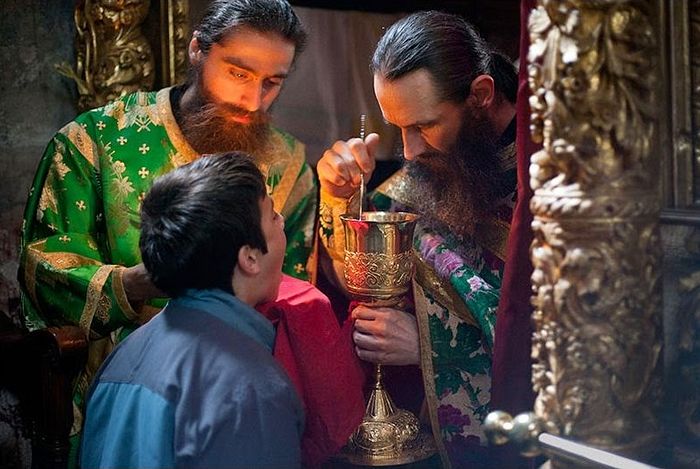
Alternatively, the spoon could be skipped, and the priest tilts the chalice gently to the communicant’s lips, himself holding a purificator under the rim of the chalice. I have seen this done and it presents no difficulties. Any spillage is prevented by the purificator being present.

A last alternative — though the least desirable, because it moves into a practice stemming from and associated with the Novus Ordo — is that the communicant take the small chalice from the priest, drink its content, and return it to him. If this were to be done, the communicant should wear a pair of gloves, as is the normal respectful way for the non-ordained to handle sacred vessels.

Once accustomed to the procedure, the adding of a little wine to a small chalice, the bringing of that chalice to the person who needs it, and the cleansing of it afterward along with the other vessels should not add more than one minute to the duration of Mass. Again, I have seen all this done with my own eyes, otherwise I would not be able to speak about it with confidence. In one case, it was a diocesan priest who brought the small chalice and tilted it to the communicant’s mouth; in two other cases I have seen it done by members of the Priestly Fraternity of St. Peter. As note 2 indicates, I recently learned of an SSPX priest who uses the spoon method. Suffice it to say that this accommodation can be made and is being made.

Some may question whether it is ever necessary for a member of the faithful to receive Communion. Surely this question should answer itself. Our Lord urged His disciples to eat and drink His Flesh and Blood, and said that we would have no life within us if we failed to do so; Scripture and Tradition alike teach that baptism orders the baptized to sacramental participation in the Eucharist. This is the revealed basis for the canonical requirement that the faithful receive at least once a year, having duly cleansed their souls in Confession. Due to concomitance (Our Lord being fully present under either species), this requirement is fulfilled by receiving either the host or the chalice. If there were an extremely rare case of a person who was simply unable to receive under either species, he would have no choice, sadly, but to resign himself to the inscrutable decrees of Providence and to make fervent spiritual communions. It seems unnecessarily harsh, however, to deprive a member of the faithful of sacramental Communion simply on account of an allergy to wheat, when there is an alternative at hand.

Communion may not be denied to a properly-disposed member of the faithful, as canon 843 (CIC 1983) §1 states: “Sacred ministers cannot deny the sacraments to those who seek them at appropriate times, are properly disposed, and are not prohibited by law from receiving them.” It would seem unreasonable and unkind to say to a celiac who can commune only under the species of wine: “You are not allowed to do that at the Latin Mass, you must go instead to the Novus Ordo Mass.” This would be setting up a strange conflict or competition between forms of the Mass, when in reality the faithful should be able to satisfy their obligations and receive sacramental nourishment at either one.

Yours in Christ,

Peter Kwasniewski

ADDENDUM (6/27/22)

I should have said in the above letter that it is important to be considerate about making the request to a priest to accommodate a special need, since doing so does involve a certain inconvenience and adds a bit of time, which affects everyone present at Mass. It's not enough, in other words, to speculate that, since one is feeling unwell and can't find another cause, it must be or could be this particular food allergy. Rather, someone must be medically certain that he has this problem before bothering a priest about it; a scientific test result would seem to be appropriate in this case, for the ease of everyone's conscience.

NOTES

[1] Some priests seem to be unaware that a wheat allergy is distinct from a gluten allergy, even if they often go together. Someone who suffers from the former cannot receive even a low-gluten host without negative consequences.

[2] See “Circular Letter to all Presidents of the Episcopal Conferences concerning the use of low-gluten altar breads and mustum as matter for the celebration of the Eucharist,” sent by Joseph Cardinal Ratzinger as Prefect of the Congregation for the Doctrine of the Faith on 24 July 2003 (text here), B1: “A layperson affected by celiac disease, who is not able to receive Communion under the species of bread, including low-gluten hosts, may receive Communion under the species of wine only.”

[3] It seems that the Vatican was already thinking along these lines in a 1959 ruling from the Holy Office (Canon Law Digest on Canon 852): “The Holy Office has received the petition of Anne T., who desires to receive Holy Communion but finds it difficult to so because she suffers from a severe allergy to wheat in all its forms. After careful consideration of all the circumstances of the case, this Supreme Sacred Tribunal has decreed: ‘Favor granted whereby the petitioner may receive Holy Communion in the Oriental rite under the species of wine only; opportune safeguards are to be used to avoid wonderment on the part of the faithful.’” It seems to me that if things had evolved naturally over the next decade instead of the upheaval of the 1960s, this question would eventually have been dealt with and the same logic applied to the Roman Rite. After all, Sacrosanctum Concilium proposed a modest increase in the number and circumstances of those who could receive under both kinds, which logically includes receiving under either kind. The fact that this practice was subsequently extended indiscriminately, contrary to the Council’s provisions, does not rule out a reasonable use of it.

[4] It would be appropriate that a drop of water be added to this chalice, and that it be covered with a (small) pall.

[5] A world-famous expert on usus antiquior rubrics, Louis Tofari of Romanitas Press, wrote the following to me when I asked him for his thoughts on this matter: “Yes, I am familiar with this situation, and in fact, we had a similar one several years ago with a gentleman who also suffered from an adverse reaction from low-gluten hosts, despite several trials. So the pastor ended up doing this instead: he would consecrate a small portion of Precious Blood in another chalice and then communicate It with an Eastern Rite golden spoon and using a purificator held by the gentleman as a safeguard — thus imitating the Byzantine practice; this was also done after everyone else had received normally. This being said, the gentleman was not a daily Mass-goer, so this was done only on Sundays usually, and with advance notice from him (and not every Sunday at that, either). So this is certainly an extraordinary option for an extraordinary situation and to my mind, perfectly legitimate. Note also, Fr. N. is an older priest and a former district superior, thus had quite a great deal of pastoral experience.”

Tuesday, February 15, 2022

Three Historic Chalices Form a United Testimony of Faith

Here is another guest article by my friend, Andrew Marlborough, a 6th-year seminarian studying at Allen Hall in London, and who worked in the art gallery business for 10 years before joining seminary in England. 

“Three historic chalices that appeared at auction in the UK recently deserve special mention. Although quite different, they stand as a united witness to the survival of Catholic faith under persecution. This witness is sorely needed today in the current troubled times for the Church and the world. And it is amplified all the more by the fact that these remarkable vessels have contained the Precious Blood of the Son of God Himself, our High Priest and Victim, whose sacrificial love is the very bedrock of our faith.
The oldest example was an exceptionally rare late 15th-century Irish silver-gilt chalice, sold by Duke’s in Dorset on 1st July 2021 for £48,000.
Although made just before the Reformation, its survival through the period is remarkable, given the widespread destruction of Catholic culture at the time. Its plain conical-form bowl, ornate knop, and overall appearance reflect a clear late-medieval style. The chalice belongs to a small group of related pre-Reformation vessels, such as the Matheus Macraith chalice at Clonfert Cathedral in Galway, and the De Burgo O’Malley and Kirwan chalices in the National Museum of Ireland. The auctioneer’s description noted that the Museum of Ireland suggested it may have been made in the Cork area. This handsome and rare chalice was bought by an Irish foundation which will loan it for public exhibition, starting this March with the exhibition, ‘Thirst for the Divine’ at Villanova University in the US. It is also a joy to report that he hopes it will be used occasionally in the Holy Sacrifice of the Mass. This is surely a great example for other collectors to follow. 
The second was an historic silver chalice sold by Sotheby’s London on 3rd August 2020 for £20,000.
It was another Irish provincial example, but this time from the mid-17th century recusant period, and of documentary importance. Its elegant profile results from the characteristically tall hexagonal spreading foot found on other surviving chalices from this period, and from the Baroque style tulip-form bowl. The foot bears an engraved Crucifix, surrounded by instruments of the Passion, and a memento mori motif. The great historical significance of the chalice derives from an inscription on the base reading:
This chalice was made for Terlagh O Briene and Ellinorie Briene of Comoragh the 26th of October 1643. 
This places it right at the start of the Irish Confederate Wars between Catholic landowners and the English administration under Charles I. Not too much is known about Terlagh and his wife Ellinorie but their son Derby O’Brien was taken prisoner and died in captivity in 1656, and four of his sons were later hanged by Cromwell’s men for defending their estate. This important chalice, a tangible expression of Catholic endurance under persecution, was bought by the Australian Catholic University for display in its art collection. 
Finally, a very fine and rare Polish mid-17th century Baroque style silver-gilt chalice was sold by Tenants Auctioneers in Yorkshire on 13th November last year for £6,500.
Although dated 1652 and from almost the same date as the Terlagh O’Briene example above, it was of finer craftsmanship and more ornately decorated, revealing the different cultural context in which it was made. This quality, combined with the rarity of surviving Polish chalices from the period make it good value. So much Polish Church plate was destroyed or looted over the years of the country’s traumatic history. The ornate base is mounted with garnets, but the most interesting and beautiful part of the chalice is the central knop cast with three angels. The auctioneer’s description noted that the vessel had been used at St Anne’s Orthodox Monastery in York. It would be fascinating to know the story of how it survived the centuries and ended up there.

Tuesday, May 04, 2021

How to Find Catholic Works of Art at Auction Houses, and How to Bid

After last week’s article about the quality of Catholic art and artifacts that may be found at an auction house, I asked the writer, Andrew Marlborough, to provide some guidance on how to find such pieces and on how to bid and buy. He kindly provided the following. One thing that I would add to his excellent advice is that in regard to fulfilling the purpose of such objects as sacred vessels or sacred art, the authenticity of their provenance has little bearing on their usefulness in context of the liturgy. In deciding on whether to buy, I would judge them first on their suitability for the liturgical context, and secondly, by comparing their prices with the market for sacred art, contemporary or antique, rather than their value as antiques alone.

Andrew wrote: “Buying things at auction has become a lot easier in recent years as auction houses are selling more things to private customers, as well as trade buyers. The top end of the market is dominated by the ‘big three’ companies - Christie’s, Sotheby’s, and Bonham’s. For those with deep pockets, you can go directly to their websites. Below that there are many smaller metropolitan and provincial salerooms, which frequently sell items of Catholic interest. The best way to find things is by searching one of several online databases which between them process most of the catalogs from these companies. You can simply go to the website and use search terms such as “Jesus”, “chalice”, “St Joseph”, etc. These databases also provide a subscription search service so they will actively look for things coming up which match your criteria. They also enable you to bid online via their sites, as well as having lots of useful advice for buyers. These are the two main dealers who buy up sacred art and architectural furnishings in Europe and America:
The following might also be helpful, depending on where you live:
www.the-saleroom.com
When it comes to bidding there are a few things to keep in mind:
First, always be sure to ask the auctioneers for a condition report and provenance before you buy something.
Second, set yourself a limit for bidding as it’s easy to get carried away, but be aware that often smaller auction houses often undervalue things.
Third, remember that you will have to pay a fee to the auctioneer, possibly a small fee for bidding through one of the internet portals mentioned above, and whatever shipping costs are involved, which may include import tax if you are buying from another country.
Finally, remember the wise old saying often applied to auctions - caveat emptor (buyer beware!).
Another place to find things is the online auction sites like eBay and Catawiki. These are more risky but they can also be good places to find things. Watch out for fakes though, especially relics. Only bid if you are confident about authenticity: www.ebay.com, www.catawiki.com
Andrew Marlborough is a 5th-year seminarian for Plymouth Diocese in the UK, studying at Allen Hall in London. Before entering seminary he worked for 10 years in the auction and art gallery business.
St Joseph holding the baby Jesus in the style of Franz Ittenbach (1813-1879). Bought in Leicestershire, England in December 2020 by a devout young Catholic, and just in time for the Year of St Joseph, for £1,300.
Postscript: Fr Augustine Thompson asked me to add this to the post. He remarks: ‘One can often get remarkable buys on eBay. I got the chalice seen below, with paten, scruple spoon, and box for $150. Appraised by a silversmith at $5000. Not a bad deal!’

I‘ ’m thinking that you have the expertise to develop a nice little sideline, Father, if you ever need it!

Tuesday, September 10, 2019

Guest Article on Post-Communion Ablutions for the Laity

Our thanks to Mr Archie MacGregor, a PhD student in Religious Studies at Marquette Univeristy, for sharing with us this brief article about ablutions for the faithful at Mass. Readers may also find interesting a recent article at Corpus Christi Watershed on the same topic.

I was reading Pope Benedict XIV’s De Sacrosancto Missæ Sacrificio (1748), a primer, designed for seminarians, on the history of the ceremonies of the Mass, and of certain related theological controversies. Among other things, he makes reference to a now-abandoned practice; after the laity had received Communion, they were given a cup of ordinary wine, in order to ensure than all particles of the Host had been swallowed. The cup was handed to the laity by a server instead of the priest, in order to distinguish it from the Chalice. [1] The wine was consumed standing, using a fistula, or straw. [2]

As noted in the article on CCW linked above, a rubric which refers to the post-Communion ablution offered to the laity, although long obsolete, remained in the Roman Missal until the new rubrics of 1960 were promulgated. “The server, holding in his right hand a vessel with wine and water, and in his left a napkin, (standing) a little behind the Priest offers them [the purification, and the napkin to wipe their mouths.” It is seen here in the Ritus servandus of an edition printed by Desclée in 1913.
Benedict’s explanation of the ritual is insightful, even if his arguments are disputed by later liturgical scholars such as Jungmann. By the 1740s there was already debate as to the origins of the ablution. The Pope rejects the suggestion that the custom is a holdover from the period when the laity received under both species. Aware of contemporary polemics in favour of utraquism, he seeks to emphasize its ancient precedents. Citing an unspecified Latin translation of Chrysostom, he argues that the ablution is the successor of the custom attested by the Saint of communicants purifying their mouths by eating bread and drinking water after the liturgy, as is still done to this day in the Byzantine Rite. While the idea that the drinking of unconsecrated wine after Communion is a direct descendant of this practice is tendentious in the extreme, it does show the long history of reverence for the Real Presence even in particles of the Host. [3]

Jungmann acknowledges the custom mentioned by Chrysostom, but holds that the origin of the practice of ablution wine can be found in High Middle Ages. There are scattered references to it in the ninth century, but it does not seem to have been widespread. In order to minimize the risk of spilling the Precious Blood, it was often added to a cup, or cups, of ordinary wine. This wine was considered to be sanctified, and still in some sense the Blood of Christ. [4] A modern analogy might be the addition of ordinary water to Holy Water to make one’s supplies of the latter last longer, but in this case, the greater proportion of the cup’s contents were unconsecrated. [5] Jungmann seems to believe partly because of the retention of the fistula that the ablution wine was an extension, and perhaps a dilution (no pun intended) of this custom. More substantial is the evidence that infants were given a little of the ablution wine to drink after Baptism, whereas in the Middle Ages they had received the Precious Blood. Giving ablution win to the newly baptised continued until at least 1783 when the Austrian Emperor, Joseph II, decried it. [6]

The custom spread with the growing reverence for the Blessed Sacrament, and seemed first to spread through monastic communities such as the Cistercians. Jungmann believes that the laity did not know that they were receiving an ablution, and not Communion, since during the Reformation provincial synods began to demand that clear signs be given that the two were different. [7] Pope Benedict cites two of these in his book, but he interprets them as showing that the Church had always known the difference. In 1584, the Synod of Bourges declared in Canon 12 on the Eucharist, “In exhibenda laicis sacra Communione paratum sit vas, quod formam Calicis non prae se ferat, ex quo sumatur ablutio post Communionem Eucharistiae.” (When giving Holy Communion to the laity, a vessel should be prepared which does not have the appearance of a Chalice, from which the ablution may be received after the Eucharistic Communion). [8]

Likewise, the Synod of Aachen, where both the ablution and utraquism had been practiced in living memory, demanded a year later that, “Clericus, qui Confessionem recitavit, accepto vase purificationis, quod tamen non sit Calix ad Consecrationem paratus, sed cyathus, et mappa purgata alia manu teneat aliud vas, in quo vinum sit pro purificatione communicantium.” (The cleric who recited the Confiteor, after having taken the vessel of purification, which should not be the Chalice used for the Consecration, and a clean towel, should hold this other vessel in his other hand, which contains the wine for the purification of the communicants.) [9] Since the Chalice for the laity, the mixture of wine and the Precious Blood, was given after the cup of purification, and the latter was a different vessel, it seems unlikely that this injunction was really concerned with the fact that the laity did not understand the difference between communion and ablution. By the 1580s, it was already a well-known fact that Catholics did not receive under both kinds. More likely the Church simply wanted to emphasise further its already apparent differences with Protestantism in the age of Confessionalization.

Evidently, the practice was still common in the Papal States when Benedict wrote his tract, as he takes it for granted. Jungmann says it persisted until ‘the last centuries’, but gives no account of its decline, or why it might have ceased to exist. The only remnant of it that remains is in the rite of priestly Ordination according to the traditional Pontificale Romanum, in which the newly ordained are given wine after Communion. It would be fascinating to find out if there are nineteenth century documents attesting to this practice.

A newly ordained priest of the FSSP consumes the ablution of unconsecrated wine during the ordinations held in Auxerre cathedral in 2016. (Photo courtesy of the FSSP).
[1] Benedict XIV, De Sacrosancto Missae Sacrificio, Libri Tres (Prati: 1843), p126.
[2] Josef. A. Jungmann, The Mass of the Roman Rite: Its Origins and Development (Missarum Solemnia), Volume 2 (New York: Benziger, 1951-1955), pp. 382-384.
[3] Benedict XIV, op. cit., p. 126.
[4] Jungmann, op. cit., p.383.
[5] Ibid.
[6] Ibid. p. 414.
[7] Ibid. pp. 385-386.
[8] Benedict XIV, op. cit., p. 126.
[9] Ibid.

Monday, April 23, 2018

Why the Double Ablutions?

A priest and regular NLM reader, responding to the series on canonical or liturgical digits (see here), sent this note to me:
I was wondering if, in your study, you have come across any authors who explain the double ablution that takes place in the traditional liturgy: first with wine, then with water and wine.
          The basic nut I am trying to crack is: I feel like a single ablution is not enough whenever I purify the sacred vessels—whether it is done with water only, or in the more traditional way, with both water & wine. It seems right that there be two ablutions before any further cleaning of the chalice (such as with soap & water, as is common in most hygiene-minded sacristies dominated by busy lay sacristans today) be done. I’m hoping to find some older commentaries on the purification that might (or might not) lend an argument to my feelings and impressions.
I have not seen an explanation in the sense of a moral or theological explanation, but of course the rubrical authors speak extensively about how it is to be done, and the basic reason why. For example, O’Connell’s The Celebration of the Mass says (p. 286):
The proper quantity of wine to be taken [at the first ablution] is about the same as had been taken at the Offertory, so that all the surface of the chalice that had been touched by the Precious Blood will be covered by the wine. When the celebrant has received sufficient wine he raises the chalice slightly as an indication to the server. The celebrant may then rotate the chalice carefully once or twice in order that the wine will pass over the surface that had been touched by the Precious Blood. He drinks the Contents of the chalice at the same point on the edge at which he had received the Precious Blood. ... Next the celebrant takes the chalice with the second, third, and fourth fingers of each hand around the cup, and the joined index fingers and thumbs within it. .. The amount of wine and water (together) to be taken will again be about the quantity of the Precious Blood. Rubricians direct that at the second ablution a little wine and a good deal of water be taken: (a) to make sure that when the second ablution has been drunk none of the Sacred Species will remain to be wiped up by the purificator; (b) because water is more cleansing than wine (especially than sweet wine, which is sticky); (c) to avoid staining the purificator.
This passage seems to confirm the reader’s intuition that a thorough cleansing is only possible with “two goes at it.” It seems to me that this was a matter of common sense developed over centuries of experience, and that it should be adopted today even in the context of the Ordinary Form, in accordance with the principle that we ought to exercise epikeia or good judgment with respect to laws to be followed, and always seek the common good—which begins with the proper treatment of the sacra mysteria, for, as St. Thomas Aquinas teaches us, “the common spiritual good of the entire Church is contained substantially in the sacrament itself of the Eucharist” (Summa theologiae III, q. 65, a. 3, arg. 1).

It is interesting to note, in terms of development (if it can be called such), that in the traditional Roman Rite the purificator does not ordinarily come in contact with the consecrated species, and therefore the Rituale provides no special blessing just for purificators. However, since corporals and palls do come into contact, there is a special blessing for them that is also “reserved”; an ordinary priest had to be delegated to bless a corporal/pall. Nowadays, the opposite obtains: purificators are often soaked with the Precious Blood by extraordinary ministers and clerics, while corporals more or less do not come into contact with the host due to the continuous use of the paten (although I have been told that some priests are sloppy in how they fracture the host). Besides, the modern Book of Blessings does not actually intend to bless the Mass linens as such.

What the foregoing shows is the beautifully consistent logic in the traditional practices: every detail makes sense. What is supposed to come into contact with the consecrated species is duly and properly blessed by the proper hierarchical authority; what is not supposed to come into contact is not so blessed; and the rubrics themselves govern the disposition and use of all items so that the sacred species will be treated with utmost care and reverence. One suspects that this is why the entire set of customs “had” to be dismantled by the modernists: they could see that it was a total system and had come to despise its rigor, impersonalism, objectivity, and sacrality. As Alice von Hildebrand once remarked, you either have to patiently accept it all and submit to it as the sweet yoke of Christ, or you will chafe at the bonds like a restive horse.


More recent articles:

For more articles, see the NLM archives:



