Friday, December 29, 2023

The Sacristy of the Cathedral of Toledo

Our series on the cathedral of Toledo concludes with pictures of the sacristy, which is full of artworks and magnificent liturgical furnishings, including several paintings by El Greco, as well as Goya, Titian, Raphael, Velasquez, Caravaggio and Van Dijk among others. The first part of this series showed the cathedral itself, and the second part covered the cloister and chapter house.   

The sacristy was built in the later 17th century, and decorated by the Neapolitan artist Luca Giordano (1634-1705), who worked for ten years (1692-1702) as chief painter of the Spanish court. The enormous fresco on the ceiling depicts the clothing of St Ildephonsus with a chasuble which, according to an ancient legend, was given to him by the Virgin Mary as a reward for writing a treatise in defense of her perpetual virginity.

The altarpiece of the sacristy altar, the Despoliation of Christ, is one of a series of paintings made for the cathedral by El Greco (1541-1614), which also includes portraits of the Twelve Apostles, and an image of Our Lord as Pantocrator.

St Peter
St Paul

Wednesday, December 20, 2023

The Cathedral of Toledo, Spain (Part 2): The Cloister and Chapter House

We continue with pictures taken by a friend at the cathedral of Toledo in Spain, today covering the cloister and chapter house (properly, chapter room, since it is not a separate detached building.) The first set, pictures of the cathedral itself, was published last Friday. At the beginning of the month, I used some of his pictures of the Mozarabic chapel in an article about that rite.   

The bell-tower seen from within the cloister.
The walls of the cloister are decorated with 18th century frescos of episodes of the lives of important local Saints, such as Eugenius, archbishop of Toledo from 636 to 646, Leocadia, a virgin martyr of the persecution of Diocletian (ca. 304), and Casilda (950-1050), a Moorish princess who converted to Christianity, went to northern Spain, and lived to a great old age as a solitary.

Friday, December 15, 2023

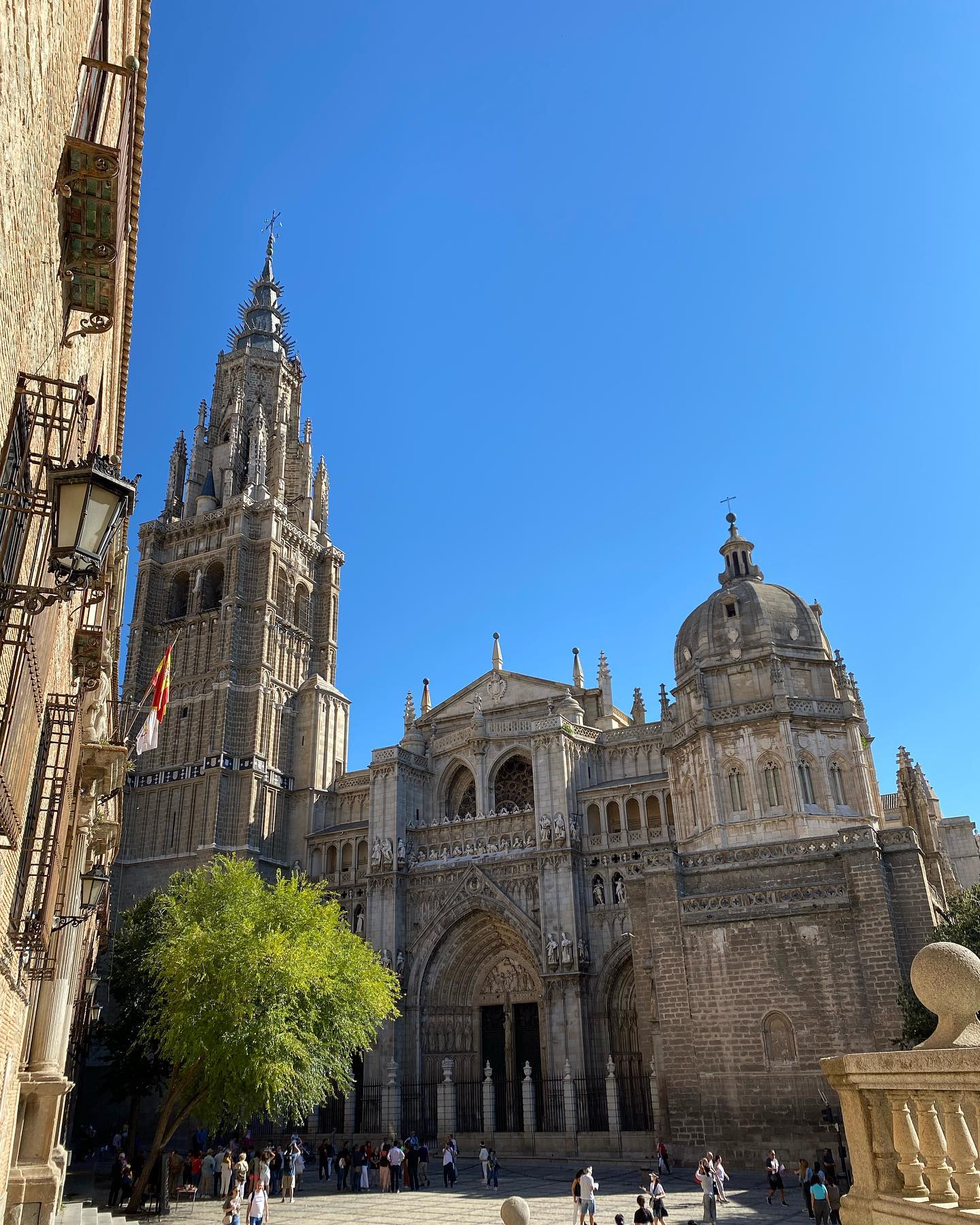
The Cathedral of Toledo, Spain (Part 1)

For the octave of Our Lady’s Immaculate Conception, here are some pictures of one of the most impressive churches in the world dedicated to Her, the cathedral of Toledo, courtesy of a friend. (I recently included a few of his pictures in a post about the Mozarabic liturgy, which is still celebrated daily in a chapel built within the cathedral in the early 16th century to save it from extinction.) There will be two follow-ups, one of the cloister and chapter house, and another of the sacristy, but I think it would require something like ten posts to do full justice to this magnificent church.

The cathedral was built on the site which the principal mosque of Toledo had stood during the Islamic occupation, which itself had replaced a much earlier Visigothic structure. The current building was begun in 1226, and completed in 1493. The façade is part of the original design, begun in 1418, but  restorations done in the later 18th century, necessitated by deterioration of the stonework, altered its appearance considerably. The belltower is contemporary to it; on the right is the Mozarabic chapel, officially “the chapel of Corpus Christ”, built in the 1500. 
The entrance to the Mozarabic chapel.
The main choir seen from towards the back of the main nave. In many Spanish cathedrals, including Toledo, the choir is set within part of the columns of the main nave, but the main sanctuary is separate from it, and the space between them is left open.   
Unlike Italy, Spain did not reject the inheritance of the Gothic period during the 15th century, since Gothic was the style which prevailed during the glorious period of the Reconquista, then drawing to its final success. The Spanish did not use the pejorative term “Gothic”, taken from the Germanic tribe that had once sacked Rome, and seen by the Italians as its destroyers; what we call Gothic art and architecture, they called “estilo moderno”, and what we call the style of Renaissance, they called “estilo romano.” This is why we find this huge (about 50 feet high) and fantastically complex Gothic altarpiece over the main altar commissioned so late as 1497, when the Italian Renaissance was much closer to its end than its beginning; it was completed in 1504, the work of a large crew of builders, painters and sculptors. The major panels depict 20 scenes from the life of Christ and the Virgin, surrounded by countless other figures.

Wednesday, February 11, 2015

Music from the Golden Age of Spain

San Lorenzo de El Escorial
As a chorister at Westminster Cathedral during the 1980s, I was fortunate enough to be involved in a number of recordings of some of the most wonderful liturgical music in the repertoire. A particular highlight was Treasures of the Spanish Renaissance, released by Hyperion in 1985, which included a number of stunning masterpieces from the golden age of Spanish polyphony by three of its greatest masters: Francisco Guerrero, Alonso Lobo and Sebastián de Vivanco. Amongst the choristers, a particular favourite on that recording was Versa est in luctum by Lobo. It is an absolutely remarkable piece of polyphony, a setting of a responsory from the Office of the Dead: ‘My harp is turned to mourning and my music to the voice of those who weep. Spare me, Lord, for my days are as nothing.’ It was a text which seems to have had particular significance to Iberian composers at the time, and indeed the greatest of them all, Tomás Luis de Victoria, included a beautiful setting in his Requiem music for the Dowager Empress Maria who he served as Chaplain at the Monastery of Las Descalzas Reales in Madrid. Lobo’s setting was written for the funeral of her brother, Philip II, and there is a definite sense that the composer saved something extra for this commission, attaining new heights of the greatest beauty, achieving something truly worthy of one of the greatest Catholic monarchs.

The Reredos at Toledo Cathedral
This Friday I will be travelling to Spain with my choir, the Schola Cantorum of the London Oratory School, and amongst the Masses and recitals planned, it will be especially wonderful to direct the boys in performances of the Lobo at two places of great significance: the first will be the magnificent Basilica at the Monastery of San Lorenzo at El Escorial. Philip II, for whose funeral it was written, lies in the Royal Mausoleum under the High Altar at El Escorial. He built the magnificent foundation, incorporating a monastery, basilica and palace, in thanksgiving for the Spanish victory at St Quentin in 1557. The battle took place on the Feast Day of St Laurence, 10 August, which is why El Escorial was built in a gridiron layout, in honour of St Laurence’s mode of martyrdom. The king had his own chambers carefully positioned so that he could see the Holy Sacrifice of the Mass from his bed to which he was confined towards the end of his life, through an internal window to the right of the altar. The second performance will be at the magnificent Cathedral in Toledo where Lobo served as Maestro de Capilla. The cathedral's stupendous reredos must be one of the finest in Christendom and simply has to be experienced.

The boys will also be singing music by the Spanish composers Esquivel, Vivanco, Guerrero and Victoria, as well as music by English and Italian composers. You can read more details here, and you can follow their progress through Escorial, Madrid, Segovia, Toledo and Salamanca on Facebook and Twitter. Wish us luck and keep us in your prayers.

More recent articles:

For more articles, see the NLM archives: