The ancient corpus of Matins responsories that accompanies the readings from the book of Tobias, Judith and Esther in the last weeks of September includes one that is actually not Biblical at all, although the verse with which it is sung comes from the book of Judith. (It is repeated on some of the weekdays, including today.)
R. Tribulationes civitatum audivimus quas passae sunt, et defecimus; timor et hebetudo mentis cecidit super nos et super liberos nostros: ipsi montes nolunt recipere fugam nostram; * Domine, miserere. V. Peccavimus cum patribus nostris, injuste egimus, iniquitatem fecimus. Domine, miserere.
R. We have heard of the tribulations of the cities which they have suffered, and we have grown faint; fear and dullness of mind have fallen upon us and upon our children; the very mountains will not receive our flight; o Lord, have mercy. V. We have sinned with our fathers we have done unjustly, we have committed iniquity; o Lord, have mercy.
Folio 98v of the Antiphonary of Compiègne, also known as the antiphonary of Charles the Bald, 860-77 AD, with the texts of three antiphons from the book of Job, six responsories and three antiphons from the book of the Tobias, and the first two from the book of Judith, the second of which is Tribulationes civitatum; all of these are used in the month of September. (Bibliothèque nationale de France, Département des Manuscrits, Latin 17436) – The original corpus for Tobias included only these six responsories, which cover the first two nocturns of Sunday Matins; responsories for the third nocturn, including Tribulationes civitatum, were usually supplied from those assigned to other books.
This was beautifully set as a motet by the composer William Byrd, but with modifications to the text, which is no longer structured as a responsory. The words “Domine, ad te sunt oculi nostri, ne pereamus” are inserted from one of the responsories of the following month which accompany the books of the Maccabees, and the last part is completely changed, also borrowed in part from one of the Maccabee responsories. Tribulationes civitatum audivimus quas passae sunt, et defecimus; Domine, ad te sunt oculi nostri, ne pereamus; timor et hebetudo mentis cecidit super nos et super liberos nostros: ipsi montes nolunt recipere fugam nostram; Domine, miserere. Nos enim pro peccatis nostris haec patimur; aperi oculos tuos, Domine, et vide afflictionem nostram. (We have heard of the tribulations of the cities which they have suffered, and we have grown faint; o Lord, to Thee do we look, lest we perish; fear and dullness of mind have fallen upon us and upon our children; the very mountains will not receive our flight; o Lord, have mercy; for we suffer these things for our sins, open Thy eyes, o Lord, and see our affliction.)
This is one of three works known collectively as ‘the Jerusalem motets’, written by the Catholic Byrd in response to the intensification of anti-Catholic persecution in England under Queen Elizabeth I. The “city” in each case is the Catholic Church, and the pleas to the Lord for mercy are made collectively, in the plural, which it to say, on behalf of all the persecuted. The second motet is purely Biblical, taken from Isaiah 64, 9-10.
Ne irascaris, Domine, satis, et ne ultra memineris iniquitatis nostrae; ecce, respice, populus tuus omnes nos. Civitas Sancti tui facta est deserta, Sion deserta facta est, Jerusalem desolata est. – Be not very angry, O Lord, and remember no longer our iniquity: behold, see, we are all thy people. The city of thy sanctuary is become a desert, Sion is made a desert, Jerusalem is desolate.
The third, Vide, Domine, has only a few words taken directly from a liturgical text, “veni, Domine, et noli tardare”, from one of the responsories of Advent.
Vide, Domine, afflictionem nostram, et in tempore maligno ne derelinquas nos. Plusquam Hierusalem facta est deserta civitas electa; gaudium cordis nostri conversum est in luctum, et jocunditas nostra in amaritudinem conversa est; sed veni, Domine, et noli tardare, et revoca dispersos in civitatem tuam. Da nobis, Domine, pacem tuam diu desideratam, pax sanctissima, et miserere populi tui gementis et flentis, Domine. Deus noster. – See our affliction, o Lord, and do not forsake us in the evil time. More than Jerusalem, the chosen city hath become desert; the joy of our heart is turned to mourning, and our delight to bitterness; but come, o Lord, and tarry not, and recall the scattered ones into thy city. Grant us, O Lord, thy peace, long desired, (o most holy peace), and have mercy on thy mourning, weeping people, o Lord our God.
Byrd’s collaborator Thomas Tallis was a generation older; having grown up in the Catholic Church before the many woes inflicted upon it by the impiety and avarice of the English monarchs, he remained a Catholic all his life. From the liturgical texts of the same period, he drew the words of one of the most famous motets of all time, very much on the same theme, the Spem in alium for forty voices. In the Office, it is sung as a responsory with the book of Esther in the last week of September, but it is another ecclesiastical composition, not an exact citation of any Biblical text.
Spem in alium nunquam habui praeter in te, Deus Israel, qui irasceris et propitius eris, et omnia peccata hominum in tribulatione dimittis. Domine Deus, creator caeli et terrae, respice humilitatem nostram. – I have never had hope in any other but in Thee, o God of Israel, who grow wroth, and art merciful, and forgivest all the sins of men in (their) tribulation. O Lord God, creator of heaven and earth, look upon our lowliness.
Today is the 400th anniversary of the death of the English composer William Byrd. Peter’s son Julian, who is himself a musician, and very knowledgeable about sacred music, has an excellent article about him over at Catholic World Report, which I heartily recommend to our readers. He gives a good summary of Byrd’s life and career, and explains some of the features of his works in various genres: Masses, motets, his settings of various hymns and antiphons etc.
I make bold to add just one point about Byrd which is pertinent to our own times. Although the precise date of his birth is unknown, unlike his friend and collaborator Thomas Tallis (1505 ca. - 85), he was certainly born too late (ca. 1540) to have known the Catholic Church as it had been in England before the destruction visited on it by the greed and impiety of the English monarchs. In the long reign of Elizabeth I (1558-1603), he was often heavily fined for “recusancy”, non-attendance at the services of the new religion; some of his works are veiled responses to her intensification of the persecution of Catholics. Among his acquaintances was a priest of the Jesuit mission named Henry Garnet, who was sentenced in 1606 to be hung, drawn and quartered. In the same year that he died, the English crown prince, soon to become King Charles I, went to Spain to arrange a marriage with one of the royal infantas; this project foundered in part because Charles knew that he could not get Parliament to agree to toleration for Catholics, or to repeal England’s anti-Catholic penal laws, conditions demanded by the Spanish.
In other words, Byrd lived in very dark times for the Church indeed. This did not stop him from doing what he could for Her, placing his talents at the service of God, and creating a lasting monument that still proclaims His glory to this day. And although Catholicism in England is, of course, not free of the problems that vex the Church everywhere in our own time, it has now been free for many decades; in our still-ongoing Corpus Christi photopost series, we have seen particularly beautiful public processions in both York and London. As a Latin proverb says “Succisa virescit - being cut down, it flourishes.” Let us strive to do as Byrd did, knowing that better days are coming, later, perhaps, than we wish for, but sooner than we hope.
Here are just a few examples of Byrd’s work, selected out of his vast oeuvre with the current liturgical season in mind.
The Mass for Five Voices
The Salve Regina
Veni, Sancte Spiritus, the Sequence of Pentecost
Cibavit Eos, the Introit of Corpus Christi
Hodie Simon Petrus, the Magnificat antiphon of Second Vespers of Ss Peter and Paul.
The ancient corpus of Matins responsories that accompanies the readings from the book of Tobias this week includes one that is actually not Biblical at all, although the verse with which it is sung comes from the book of Judith. (It is repeated on some of the weekdays, including today.)
R. Tribulationes civitatum audivimus quas passae sunt, et defecimus; timor et hebetudo mentis cecidit super nos et super liberos nostros: ipsi montes nolunt recipere fugam nostram; * Domine, miserere. V. Peccavimus cum patribus nostris, injuste egimus, iniquitatem fecimus. Domine, miserere.
R. We have heard of the tribulations of the cities which they have suffered, and we have grown faint; fear and dullness of mind have fallen upon us and upon our children; the very mountains will not receive our flight; o Lord, have mercy. V. We have sinned with our fathers we have done unjustly, we have committed iniquity; o Lord, have mercy.
Folio 98v of the Antiphonary of Compiègne, also known as the antiphonary of Charles the Bald, 860-77 AD, with the texts of three antiphons from the book of Job, six responsories and three antiphons from the book of the Tobias, and the first two from the book of Judith, the second of which is Tribulationes civitatum; all of these are used in the month of September. (Bibliothèque nationale de France, Département des Manuscrits, Latin 17436) – The original corpus for Tobias included only these six responsories, which cover the first two nocturns of Sunday Matins; responsories for the third nocturn, including Tribulationes civitatum, were usually supplied from those assigned to other books.
This was beautifully set as a motet by the composer William Byrd, but with modifications to the text, which is no longer structured as a responsory. The words “Domine, ad te sunt oculi nostri, ne pereamus” are inserted from one of the responsories of the following month which accompany the books of the Maccabees, and the last part is completely changed, also borrowed in part from one of the Maccabee responsories. Tribulationes civitatum audivimus quas passae sunt, et defecimus; Domine, ad te sunt oculi nostri, ne pereamus; timor et hebetudo mentis cecidit super nos et super liberos nostros: ipsi montes nolunt recipere fugam nostram; Domine, miserere. Nos enim pro peccatis nostris haec patimur; aperi oculos tuos, Domine, et vide afflictionem nostram. (We have heard of the tribulations of the cities which they have suffered, and we have grown faint; o Lord, to Thee do we look, lest we perish; fear and dullness of mind have fallen upon us and upon our children; the very mountains will not receive our flight; o Lord, have mercy; for we suffer these things for our sins, open Thy eyes, o Lord, and see our affliction.)
This is one of three works known collectively as ‘the Jerusalem motets’, written by the Catholic Byrd in response to the intensification of anti-Catholic persecution in England under Queen Elizabeth I. The “city” in each case is the Catholic Church, and the pleas to the Lord for mercy are made collectively, in the plural, which it to say, on behalf of all the persecuted. The second motet is purely Biblical, taken from Isaiah 64, 9-10.
Ne irascaris, Domine, satis, et ne ultra memineris iniquitatis nostrae; ecce, respice, populus tuus omnes nos. Civitas Sancti tui facta est deserta, Sion deserta facta est, Jerusalem desolata est. – Be not very angry, O Lord, and remember no longer our iniquity: behold, see, we are all thy people. The city of thy sanctuary is become a desert, Sion is made a desert, Jerusalem is desolate.
The third, Vide, Domine, has only a few words taken directly from a liturgical text, “veni, Domine, et noli tardare”, from one of the responsories of Advent.
Vide, Domine, afflictionem nostram, et in tempore maligno ne derelinquas nos. Plusquam Hierusalem facta est deserta civitas electa; gaudium cordis nostri conversum est in luctum, et jocunditas nostra in amaritudinem conversa est; sed veni, Domine, et noli tardare, et revoca dispersos in civitatem tuam. Da nobis, Domine, pacem tuam diu desideratam, pax sanctissima, et miserere populi tui gementis et flentis, Domine. Deus noster. – See our affliction, o Lord, and do not forsake us in the evil time. More than Jerusalem, the chosen city hath become desert; the joy of our heart is turned to mourning, and our delight to bitterness; but come, o Lord, and tarry not, and recall the scattered ones into thy city. Grant us, O Lord, thy peace, long desired, (o most holy peace), and have mercy on thy mourning, weeping people, o Lord our God.
Byrd’s collaborator Thomas Tallis was a generation older; having grown up in the Catholic Church before the many woes inflicted upon it by the impiety and avarice of the English monarchs, he remained a Catholic all his life. From the liturgical texts of the same period, he drew the words of one of the most famous motets of all time, very much on the same theme, the Spem in alium for forty voices. In the Office, it is sung as a responsory with the book of Esther in the last week of September, but it is another ecclesiastical composition, not an exact citation of any Biblical text.
Spem in alium nunquam habui praeter in te, Deus Israel, qui irasceris et propitius eris, et omnia peccata hominum in tribulatione dimittis. Domine Deus, creator caeli et terrae, respice humilitatem nostram. – I have never had hope in any other but in Thee, o God of Israel, who grow wroth, and art merciful, and forgivest all the sins of men in (their) tribulation. O Lord God, creator of heaven and earth, look upon our lowliness.
Here’s an interesting thing I stumbled across via a friend’s Facebook page: an English vocal ensemble called The Marian Consort has recently posted some videos on their YouTube channel under the rubric (so to speak) “Inside the music”, in which the founding director, Rory McCleery, gives historical and musical details about specific composers and pieces of their repertoire. Here is his take on William Byrd’s Mass for Three Voices:
another about a particularly beautiful motet by the Netherlandish composer Jacob Clemens, which also explains a bit about the odd nickname by which he is usually known, “Clemens non Papa”:and this one about a composer I had never heard of before, a nun from the Italian city of Ferrara named Rafaella Aleotti, who lived from 1575 to 1640.
We’ve settled into a more regular posting regimen at Square Notes: The Sacred Music Podcast, releasing a new episode each Sunday evening. Here are the latest!
In episode 11, we discuss life as a Catholic under the reigns of Henry VIII and Elizabeth I, and look at what makes Tudor era polyphony tick, as well as how Byrd’s music evolved throughout his life. Our guest is the renowned expert on these topics, Dr. Kerry McCarthy.
In episode 12, we look at the process of producing an illuminated chant manuscript, and the role this process played in the lives of monastics, as well as what the modern person can take away from the medium. Mrs. Elizabeth Lemme of Pelican Printery House shared with us a little bit about her own growth in faith through this artistic medium, as well as her expertise in all its details.
You can catch us on our website, YouTube, iTunes, Stitcher, or your favorite podcast app. Please note that we have discontinued publishing on SoundCloud.
Today we interview a composer from Australia, Ronan Reilly, whom NLM readers may recall is also the President of the Latin Mass Society of Australia. It was in that administrative capacity that I first got to know him, on my trip Down Under in April 2019. But then I quickly discovered what a gifted musician and composer he is, and have looked forward ever since to sharing his work.
Reilly, on the left, with friends who recorded his music
Tell us about your musical background: when and how you began singing or playing instruments, your most influential teacher, how your interest in composing sacred music was enkindled.
I started out my musical journey as a 10-year-old chorister at St Mary’s Cathedral, Sydney in 2002. Over the course of 8 years I was exposed to the beautiful treasury of Sacred Music, everything from Gregorian chant through to contemporary compositions in the vein of classical polyphony. Each Chorister was expected to learn an instrument to complement their singing tuition – I chose the cello. Throughout my time in the Cathedral Choir I developed an interest for the ‘mechanics of polyphony’ and had a fascination for the art of renaissance composition.
“Behold A Simple Tender Babe”
Is there a sacred music composer whose work you find most captivating, either as a source of delight, or as direct inspirations and models for your own work?
I have always had a particular love for the English School of Polyphony and most especially for William Byrd. I find Byrd has a depth of expression in his compositions that is hard to match due to his experience of persecution and repression – he is unapologetically Catholic and his music attests to this (cf. Et Unum Sanctam Catholicam Mass for Five Voices). Byrd also has a profound ability to express melancholy (cf. Civitas Sancti Tui) – he intimately understood and lived through the Elizabethan Catholic persecution and did not shy away from comparing it to the desolation and devastation of the Israelites of old. I think it is safe to say that what Byrd experienced and what we are living through have many parallels – a change in liturgical praxis, a change in the language of prayer, a change in the attitude of secular authorities towards Catholics, etc.
“Regina Caeli”
If you were given an unlimited budget for musicians for a solemn pontifical Mass, what works would you put on the program?
If I were allowed to specify the feast day, I would certainly opt for November 2nd, the feast of All Souls. There is a vast treasury of compositions for the Mass and Office of the Dead, especially from the Spanish School. It is a uniquely Catholic reality to pray for the repose of the souls of loved ones who are, God willing, being cleansed of their sins, transgressions and negligence’s in Purgatory. It is a dream of mine to sing Victoria’s Requiem for 6 voices; a feat of musical and theological genius. Ideally the Mass would be preceded by Matins for the Dead, using the Morales Invitatory.
“For With God”
The language of sacred music, as of Catholic worship in general, remains a controversial subject. What are your thoughts about the place of Latin in vernacular liturgy and the place of the vernacular in Latin liturgy?
I am a firm believer in the sacral and expressive beauty of Latin, a vehicle for tradition and stability. Latin instantly brings to mind the antiquity of the Church and the universal character of the Bride of Christ, somewhat like the expanse and glory of the Roman Empire which She inherited. The language of prayer ought to elevate the soul and transcend national boundaries – a foretaste of Heaven. There can be no doubt that the patrimony of Catholic thought and prayer is directly bound to Latin. The melodies of both Gregorian chant and polyphony are married to the Latin texts which they clothe and bring to life: one cannot sacrifice the use of Latin without sacrificing the history, inheritance and tradition of the Church.
What are some strengths and weaknesses you see in the “traditionalist” movement, particularly from a musical point of view?
Having attended the Usus Antiquior exclusively for almost 10 years, I can attest, from a musical perspective, that it is a safe haven from the ‘sacro-pop’ wars, a place wherein the integrity of Catholic music can flourish and thus nourish everyone. First and foremost, the Mass in use is that for which the majority of great sacred music was written: it fits hand in glove.
That is not to say that all traditional communities have a standard or expectation of sacred music that befits the liturgy – this is certainly not the case. In a purely theoretical framework, a traditional community has everything at its disposal to build and sustain a great sacred music tradition. And so this should be taken as a duty, not an option.
What are you doing now in the realm of sacred music?
I currently teach music at a small traditional Catholic School in Brisbane, Australia. We have a budding sacred music program with an abundance of talent and enthusiasm; our High School Polyphonic Choir will perform Allegri’s Miserere at the end of the year and our Liturgical Schola will sing the Byrd Mass for Three Voices at the final School Mass. It is a wonderful gift and opportunity to be able to impart the indispensable beauty of sacred music to young minds and to see them fall in love with the many facets and fascinations of sacred music and all that it entails.
As the Publicity Officer for the Australian Sacred Music Association (www.sacredmusic.org), I frequently travel around Australia conducting workshops in Sacred Music, mainly in schools and parishes that are keen to learn about their musical heritage.
Our thanks once again to one of our frequent guest contributors, Roseanne Sullivan, for sharing with us this article on one of the great English Catholic composers, William Byrd. It was originally published in the Christmas 2019 edition of The Latin Mass Magazine, and is reproduced here with their kind permission, in a slightly edited form.
In honor of the season, this article takes a comparative look at the circumstances in which two of composer William Byrd’s works for Christmastide were created. The first piece is an English carol from a songbook that Byrd dedicated to Queen Elizabeth I’s chancellor. The second is his polyphonic setting of a Christmas day Mass from a collection that he published late in his life, which he dedicated to a baron who secretly held prohibited Catholic Masses in his home.
A medallion portrait traditionally said to be of William Byrd by Gerard Vandergucht, ca. 1750, based on an original by Nicola Francesco Haym. No authentic contemporary likeness of the composer exists. (Public domainimage from Wikimedia Commons.)
William Byrd (1543-1623), as you know, was a brilliant English Catholic composer, whose music is still treasured and often performed today during traditional Latin Masses—and also in Ordinary Form Masses that in some places are reverently celebrated in Latin. For example, the Saint Ann Choir of Palo Alto, California, directed by Stanford Musicology Professor and New Liturgical Movement publisher, William P. Mahrt, often sings Byrd Masses on feast days, and motets composed by him on Sundays throughout the year at Ordinary Form Latin Masses. Saint Mary’s Church in Norwalk, Connecticut, sings Byrd Masses at their regularly scheduled Mass in both the Ordinary Form and Extraordinary Form Masses. Even the volunteer choir at the Immaculate Heart of Mary Oratory that I attend in San José, which is dedicated to the Extraordinary Form, sings Byrd’s “Mass for Three Voices” at traditional Latin High Masses on special occasions, and frequently sings his Ave Verum Corpus and other motets by him at Sunday Masses.
Byrd led a paradoxical life, to say the least. He was a Catholic who worked for Protestant Queen Elizabeth as a court composer and musician, and was prominent among Elizabeth’s Protestant courtiers. But he also composed music that he and his harried Catholic co-religionists would sing at Masses, which they were forced to celebrate covertly in fear of a knock at the door, imprisonment, steep fines, and even death. It’s almost miraculous that he kept his job and his life.
As Dr Kerry McCarthy, a scholar and singer of Gregorian chant and Renaissance polyphony, noted in her highly readable 2013 biography titled Byrd, he was born at “an unusually volatile moment in English history.” (All quotations in this article are from this work.) The year of his birth, 1540, was the year that King Henry VIII “finished dismantling the monasteries and convents.” Monastic libraries were looted and their books used for scrap paper and even as toilet paper, so totally despised were the ancient liturgies and music of the Catholic Church. “1540 was the year the workshop of Hans Holbein produced the iconic ‘Rome portrait’ of the forty-nine-year-old Henry VIII, glowering at the viewer with fists clenched, the massive canvas (94 by 53 inches) barely able to contain his bulk.”
The ruins of Fountains Abbey near Aldfield in North Yorkshire, one of the largest and most important Cistercian abbeys in England until the dissolution of the monasteries in 1539. This view shows the abbey church from within the ruins of the former infirmary. (Image from Wikimedia Commons by DrMoschi, CC BY-SA 4.0)
It is hard to deny the obvious similarity between the attitude of destruction of traditional Catholic liturgy and music that was in progress when Byrd was born and the widespread disdain and neglect on the part of many since the Second Vatican Council for the beautiful Gregorian chant and polyphonic music that had evolved as an intrinsic part of the Mass and the Divine Office over the centuries.
“[Byrd] was as well known in his day as any court poet or playwright, and just as close to the centers of power. A monumental painting made in 1604, illustrates the point nicely.” Although he is not pictured, Byrd had close ties to many portrayed in this painting. “At a distance of more than four hundred years, the atmosphere of luxury, gravity, and political tension is still palpable in this painting. That was the world in which Byrd’s music was created and performed.”
During his youth, the traditional Latin Mass was banned outright, replaced with a stripped down English service. “What had taken place daily at every pre-Reformation altar, from the humblest parish church to the greatest cathedral, was now a rare and dangerous luxury.”
As court composer, William Byrd published a wide variety of music. Protestants at that time allowed polyphonic settings of Psalm texts, so most of the religious works he published were motets that set Psalm texts in Latin or English. He also published religious songs in English.
Byrd not-so-subtly thumbed his nose at the Protestant majority by his choice of texts, many of which were about throwing off oppressors and pleading for God to rescue (an allegorical) Jerusalem. Some were ‘gallows texts’—Psalm verses that were well known among Catholics as the last words of priests martyred during the persecution of the Church in England during the Reformation.
“Lullaby,” a Christmas Carol
In 1588, Byrd published an elegant songbook, Psalms, Sonnets and Songs; according to McCarthy, this may have been part of an attempt to reestablish his reputation at court. “He spent most of the decade under constant suspicion of illegal Catholic activities.” The title page reads in part “Songs very rare and newly composed are here published for the recreation of all such as delight in music, by William Byrd, one of the gentlemen of the Queen’s Majesty’s honorable Chapel. With the privilege of the royal majesty.”
Fortunately for Byrd’s reputation, the songbook was a great success, and his English Christmas carol from that songbook, “Lullaby, My Sweet Little Baby,” became an enduring favorite. The Earl of Worcester wrote fourteen years later, in 1602, that “we are frolic [joyful] here in court ... Irish tunes are at the time more pleasing, but in winter Lullaby, an old song of Mr. Byrd’s, will be more in request, as I think.”
Remembering Byrd’s earlier thinly-disguised protests in the texts of his Psalm settings, it is tempting to see a similar vein in the “Lullaby,” with this line, “O woe and woeful heavy day when wretches have their will!”, and a prediction that even though the wicked king sought to kill the King (Jesus), the Son of God would reign, “whom tyrants none can kill.”
Lullaby, My Sweet Little Baby: Lyrics
1. My sweet little Baby, what meanest Thou to cry?
Be still, my blessed Babe, though cause Thou hast to mourn,
Whose blood most innocent to shed the cruel king has sworn;
And lo, alas! behold what slaughter he doth make,
Shedding the blood of infants all, sweet Saviour, for Thy sake.
A King, a King is born, they say, which King this king would kill.
Refrain: O woe and woeful heavy day when wretches have their will! Lulla, la-lulla, lulla, lullaby.
2. Three kings this King of kings to see are come from far,
To each unknown, with offerings great, by guiding of a star;
And shepherds heard the song which angels bright did sing.
Giving all glory unto God for coming of this King,
Which must be made away — King Herod would Him kill. Refrain.
3. Lo, lo, my little Babe, be still, lament no more:
From fury Thou shalt step aside, help have we still in store;
We heavenly warning have some other soil to seek;
From death must fly the Lord of life, as lamb both mild and meek;
Thus must my Babe obey the king that would Him kill. Refrain.
4. But thou shalt live and reign, as sibyls hath foresaid,
As all the prophets prophesy, whose mother, yet a maid
And perfect virgin pure, with her breasts shall upbread
Both God and man that all hath made, the Son of heavenly seed,
Whom caitiffs none can ‘tray, whom tyrants none can kill. Refrain.
Third Mass of Christmas Day, Puer Natus Est
In 1607, nineteen years after “Lullaby,” and about a decade after he published his still-famous settings for the Ordinary of the Mass, Byrd published his polyphonic setting of the Latin propers for the Third Mass of Christmas Day, Puer Natus Est. This was included along with various Christmas motets in the second volume of Gradualia, a large collection of his settings of the Propers for major feasts, published in two volumes in 1605 and 1607.
McCarthy noted that Byrd’s version of the Introit Puer Natus Est was unique among his compositions for the following reasons. In Gregorian chant, multiple singers sing the same melody together at exactly the same pitch. When polyphonic music developed with multiple voice lines, Gregorian chant was used as a single cantus firmus (a “fixed song”) around which multi-voiced improvisation were developed. Byrd departed from that cantus firmus tradition in most of his polyphonic compositions, using melodies from sources other than chant, with one exception, the Puer Natus Est Mass.
The Introit begins by quoting the Gregorian chant for the day (Puer natus est nobis/A child is born for us) in three of the four voices. “This gesture seems to have been a brief nod to the old tradition of chant-based polyphonic Mass Propers, something that Byrd never took up again in quite the same way.”
The following bit of history gives a vivid glimpse into the risks Byrd and his fellow Catholics were taking. In 1605, after publication of the first part of the Gradualia, a French traveler named Charles de Ligny wrote home that he had attended a musical evening during which Byrd played the organ and other musical instruments, together with the Jesuit Henry Garnett, some other Jesuits, and English gentlemen. De Ligny was arrested and briefly thrown into Newgate prison “on account of certain papistical books written by William Byrd” that he carried, the partbooks of the first Gradualia. In spite of being the composer of those papistical books, Byrd narrowly avoided imprisonment through the indulgence of Queen Elizabeth, and continued to live free until he died in 1623.
Byrd had retired from the court to live in Essex by the time he published Gradualia, and he worshipped with, played for, and composed sacred music for a gathering of Catholics in the nearby home of Baron John Petre. In the dedication of his second Gradualia to Petre, he wrote that the music had “proceeded from his house, most generous to me and mine.”
Byrd somehow managed to get the necessary approvals for printing the Gradualia from no less a Protestant personage than Richard Bancroft, the Anglican Bishop of London. According to McCarthy, the bishop who approved the printing apparently did so because he thought the Propers would contribute to dissension among Catholics.
Perhaps partly due to the danger of discovery that he envisioned for singers of his Propers, Byrd kept the individual pieces short. “His elegant little offertories and communions—some of them are barely a minute long—could hardly be further removed from the leisurely Latin motets.”
“When he described his settings of the Mass Proper in his 1605 preface, he called them ‘notes as a garland to adorn certain holy and delightful phrases of the Christian rite.’”
Catholic to the End
In spite of all the associated risks, Byrd increasingly used his talents to serve the Catholic liturgy over the same years when almost the entire English population was abandoning the ancient Faith. Almost certainly, he had his own end in mind. In the will he signed in 1622, the year before he died, Byrd wrote this prayer, “that I may live and die a true and perfect member” of the “holy Catholic Church, without which I believe there is no salvation for me.”
The ancient corpus of Matins responsories that accompanies the readings from the book of Tobias this week includes one that is actually not Biblical at all, although the verse with which it is sung comes from the book of Judith. (It is repeated on some of the weekdays, including today.)
R. Tribulationes civitatum audivimus quas passae sunt, et defecimus; timor et hebetudo mentis cecidit super nos et super liberos nostros: ipsi montes nolunt recipere fugam nostram; * Domine, miserere. V. Peccavimus cum patribus nostris, injuste egimus, iniquitatem fecimus. Domine, miserere.
R. We have heard of the tribulations of the cities which they have suffered, and we have grown faint; fear and dullness of mind have fallen upon us and upon our children; the very mountains will not receive our flight; o Lord, have mercy. V. We have sinned with our fathers we have done unjustly, we have committed iniquity; o Lord, have mercy.
Folio 98v of the Antiphonary of Compiègne, also known as the antiphonary of Charles the Bald, 860-77 AD, with the texts of three antiphons from the book of Job, six responsories and three antiphons from the book of the Tobias, and the first two from the book of Judith, the second of which is Tribulationes civitatum; all of these are used in the month of September. (Bibliothèque nationale de France, Département des Manuscrits, Latin 17436) – The original corpus for Tobias included only these six responsories, which cover the first two nocturns of Sunday Matins; responsories for the third nocturn, including Tribulationes civitatum, were usually supplied from those assigned to other books.
This was beautifully set as a motet by the composer William Byrd, but with modifications to the text, which is no longer structured as a responsory. The words “Domine, ad te sunt oculi nostri, ne pereamus” are inserted from one of the responsories of the following month which accompany the books of the Maccabees, and the last part is completely changed, also borrowed in part from one of the Maccabee responsories. Tribulationes civitatum audivimus quas passae sunt, et defecimus; Domine, ad te sunt oculi nostri, ne pereamus; timor et hebetudo mentis cecidit super nos et super liberos nostros: ipsi montes nolunt recipere fugam nostram; Domine, miserere. Nos enim pro peccatis nostris haec patimur; aperi oculos tuos, Domine, et vide afflictionem nostram. (We have heard of the tribulations of the cities which they have suffered, and we have grown faint; o Lord, to Thee do we look, lest we perish; fear and dullness of mind have fallen upon us and upon our children; the very mountains will not receive our flight; o Lord, have mercy; for we suffer these things for our sins, open Thy eyes, o Lord, and see our affliction.)
This is one of three works known collectively as ‘the Jerusalem motets’, written by the Catholic Byrd in response to the intensification of anti-Catholic persecution in England under Queen Elizabeth I. The “city” in each case is the Catholic Church, and the pleas to the Lord for mercy are made collectively, in the plural, which it to say, on behalf of all the persecuted. The second motet is purely Biblical, taken from Isaiah 64, 9-10.
Ne irascaris, Domine, satis, et ne ultra memineris iniquitatis nostrae; ecce, respice, populus tuus omnes nos. Civitas Sancti tui facta est deserta, Sion deserta facta est, Jerusalem desolata est. – Be not very angry, O Lord, and remember no longer our iniquity: behold, see, we are all thy people. The city of thy sanctuary is become a desert, Sion is made a desert, Jerusalem is desolate.
The third, Vide, Domine, has only a few words taken directly from a liturgical text, “veni, Domine, et noli tardare”, from one of the responsories of Advent.
Vide, Domine, afflictionem nostram, et in tempore maligno ne derelinquas nos. Plusquam Hierusalem facta est deserta civitas electa; gaudium cordis nostri conversum est in luctum, et jocunditas nostra in amaritudinem conversa est; sed veni, Domine, et noli tardare, et revoca dispersos in civitatem tuam. Da nobis, Domine, pacem tuam diu desideratam, pax sanctissima, et miserere populi tui gementis et flentis, Domine. Deus noster. – See our affliction, o Lord, and do not forsake us in the evil time. More than Jerusalem, the chosen city hath become desert; the joy of our heart is turned to mourning, and our delight to bitterness; but come, o Lord, and tarry not, and recall the scattered ones into thy city. Grant us, O Lord, thy peace, long desired, (o most holy peace), and have mercy on thy mourning, weeping people, o Lord our God.
Byrd’s collaborator Thomas Tallis was a generation older; having grown up in the Catholic Church before the many woes inflicted upon it by the impiety and avarice of the English monarchs, he remained a Catholic all his life. From the liturgical texts of the same period, he drew the words of one of the most famous motets of all time, very much on the same theme, the Spem in alium for forty voices. In the Office, it is sung as a responsory with the book of Esther in the last week of September, but it is another ecclesiastical composition, not an exact citation of any Biblical text.
Spem in alium nunquam habui praeter in te, Deus Israel, qui irasceris et propitius eris, et omnia peccata hominum in tribulatione dimittis. Domine Deus, creator caeli et terrae, respice humilitatem nostram. – I have never had hope in any other but in Thee, o God of Israel, who grow wroth, and art merciful, and forgivest all the sins of men in (their) tribulation. O Lord God, creator of heaven and earth, look upon our lowliness.
The Cathedral of St. John Berchmans in Shreveport, Louisiana, located at 939 Jordan Street, will have Masses with the music of William Byrd and Franz Schubert inter alios (the latter with an orchestra) for the Feast of Pentecost on May 15. Details in the poster below.
A new recording is released next month by Westminster Cathedral Choir of all three of William Byrd’s settings of the Mass. The recording of the Masses for three, four and five voices also includes the famous Ave verum corpus from Byrd’s Gradualia.
In the sleeve notes, the eminent scholar John Milsom reminds us that the revival of the Byrd Masses came about at Downside Abbey, the London Oratory and at Westminster Cathedral, so it is appropriate that the famed Cathedral Choir should make this recording. He also reminds us that these exquisite Mass settings would have originally been conceived as chamber works, to be sung on a small scale in secret, behind closed doors, for fear of retribution during the Reformation.
It was perhaps partly in deference to these original performances in Tudor times that Martin Baker, the Master of Music, decided to make quite a radical change to the way the choir was recorded. Most of the Cathedral Choir’s recordings are made in the Apse, the usual liturgical singing position of the choir, however for this recording, the choir stood on the Sanctuary in a large square facing inwards towards Martin Baker, who stood at the centre. The effect is very different, both intimate and powerful, with a noticeable change in the acoustics. There is a heightened sense of dynamic range, with diminuendi of extraordinary control which taper into nothingness. And although this music will be very familiar to anyone in regular proximity to a traditional Catholic choir, there is a real sense of a new experience when listening to this recording.
The recording of the 'Mass for three voices' puts the choir’s boy altos to good use on the top line. Something of rarity, the alto line is almost always sung by countertenors alone in the English Cathedral tradition, rather than combining them with boys as is the case at Westminster. The Cathedral Choir sang the 'Mass for five voices' on the occasion Pope Benedict XVI celebrated Mass at Westminster Cathedral. But even on that occasion, we didn’t get to hear the magnificent setting of the Credo. One of the most thrilling moments on this recording comes in the 4-part setting of the Creed at the words ‘et resurrexit’. Listening to it left me with a real desire to hear some of the great Credo settings in a liturgical context.
‘The Three Masses’ by William Byrd, sung by Westminster Cathedral Choir directed by Martin Baker, is available from September 1 from Amazon, iTunes and directly from Hyperion.
Our schola is now working on its second of the Byrd propers, these glorious jewels of the English renaissance that have been sadly neglected. There is the problem that sung propers in general somehow have gotten short shrift. Even preconciliar, they became Psalm tones for most parishes. Postconciliar, they were replaced by idle musicians who far preferred to consider their favorite hymn "another appropriate song" and so tossed the propers out completely.
It was so bad that the USCCB issued a now-defunct document called Music in Catholic Worship that evidence no awareness of propers at all. (Why, by the way, is it still up on the USCCB site with no notification of when it was written, how it came to be, or that it no longer has standing?) (ADDED NOTE: The link came down after this post, so Music in Catholic Worship survives only on the Wayback Machine.)
Adding to the neglect is the tendency to think of sung propers as chant-only musical moments. Singing them in polyphonic settings just hasn't been the thing. Other factors contributing to the neglect: English music has been generally bypassed in favor of the Continent, and also these polyphonic propers are too difficult for beginning choirs.
We've been working on two pieces from Byrd's Gradualia, to sing not as propers but as seasonal motets (we are a regular schola after all). So far we have tackled Confirma Hoc and Optimam Partem. This is a post of personal reflections on what seems to make Byrd's music different.
First, the music is indeed difficult and is only suitable for intermediate level scholas. We are doing three weeks of rehearsal to prepare one motet, which is a rather serious investment of time. The intervals are tricky and not always intuitive. Byrd has preserved the modal character of the chant so you have to have a real fix on the mechanics of the pitches. Entrances require a great deal of confidence. The ranges and voicings are demanding. To make it all seem natural and normal, much less effortless, requires special ability and time.
Second, the part writing is more voice dependent than music you get from Victoria or Palestrina or others. I've noticed that it is extremely difficult to rehearse this music in sections, for example. The cues for entrances and pitches come from other sections, and without those sections, the music makes little sense. No part is extraneous. Every note from every singer is part of the mechanical operation here, an essential gear. We might say that the music is vertically composed. So if not everyone is at rehearsal, there is probably not much reason to even pull the music out. This is different from other music of the period.
Third, this music is unusually stout in the sense that it holds up to vigorous singing. It's like an erector set made of hardened steel. You can sing with great forcefulness; indeed, the music nearly demands it. One might say that the music can be "man handled" in a way and otherwise sung with a fiery intensity. This is different from polyphony from the same period from others such as Palestrina and Guerrero, which sometimes seems brittle and easy broken when the fire is turned up on it or the sections become imbalanced.
Overall, I must say that I've been blown away by the symphonic genius of these pieces. There is a very high musical payoff that comes with learning them and singing them. We sang Confirma a few weeks back, and a number of people mentioned it afterward as a notable moment in the Mass. This is certainly not mood music. It makes a strong and lasting impression. Byrd believed in the propers, it is clear, and he thought they should stand out as text and as art. He has left us many masterpieces to make this possible.
Scholas: even if the time is not yet there, know that these jewels await.
Renaissance England’s most brilliant Catholic composer, William Byrd, also happened to be Renaissance England’s most brilliant Anglican composer. The most excellent example of the latter is the Great Service, an apt name for this large-scale work but not the name it had when it was composed. It was simply a set of service music most likely composed for Queen Elizabeth in her court, performed in 1598 and probably completed certainly by 1604.
The ironies are intense. The war on the Roman religion was in full swing. Even as Byrd’s Great Service was being sung, people were being arrested for being caught with this composer’s own setting of polyphonic propers for Mass. It has to strike anyone looking at this period as completely bizarre that this Catholic musician would have a royal appointment under Elizabeth, but his talent unlocks the mystery. This service—the pieces of it that I’ve heard in addition to motets such a "Sing Joyfully"—pretty much explain why he was kept around.
Richard Turbet, writing in A Byrd Celebration, calls this piece “the jewel in the crown of Anglican music.” He further compares it to Bach’s St. Matthew’s Passion, Beethoven’s 9th, and Mahler’s 8th. He points out that it can’t have been lost on Elizabeth that Byrd’s music would assist in securing the cultural legacy of her reign. I would like add that while this motive in protecting Byrd might not have been praiseworthy, it has more going for it than modern political ambitions. Better polyphonic services than destructive foreign wars!
At the Byrd Festival, we attended Choral Evensong at the Trinity Episcopal Cathedral. This service included the Magnificat, Nunc Dimittis, and Preces and Responses from the Great Service. It was conducted by Richard Marlow, who conducted Evensong for many years at Trinity College.
I heard these first in rehearsal and found myself completely astonished, as in “I can’t believe what I’m hearing.” They are scored for two choirs in 10 parts, a very large scale setting but never does the music become too rich or thick for comprehension. Byrd manages to add voices and complexity in a way that adds not decadence but rather increases the sense of decorum and majesty.
It was right that these pieces were sung at the Byrd Festival in a liturgical setting rather than as pure concert pieces. And this was real liturgy, not just some historical recreation. People in Oregon attended not just to listen but to pray. Some accommodation, then, had to be made for the time and place, and thus was “O Lord, Save the Queen” in the Responses changed to “O Lord, Save the State”—an interesting illustration of limits of changing venues.
I can easily see why composing for this setting would have been very difficult for Byrd as a Catholic in those times of upheaval. In our own times, it should be easier for Catholics to draw from this well-developed and legitimate tradition. It should be, but is it? It is an enduring mystery why Catholics, in the postconciliar years, at the time when English was introduced into the liturgy, did not turn to the religious tradition that had been doing it—and perfecting it—for nearly 500 years.
It seems that they turned to anything and everything but that tradition. In trying to reinvent the wheel, Catholics managed to put together some pretty awful contraptions. The Church permitted the vernacular, and then the English translation committees, their friendly publishers, and their affiliated composers socked it to us good and hard.
Ancient feuds die hard, and the animosity that the Catholic ethos has for the Anglican liturgy remains evident. In Catholic cathedrals and parishes, it is sometimes the case that when high-quality English-language music is presented, you hear muttering about how this is Anglican and not Catholic music such as “One Bread, One Body.”
So I was very pleased for this rare chance to attend the Evensong with Byrd’s astonishing music. It helped me realize how much that Catholics, so long as we insist on using the vernacular in our hymns, psalms, and dialogues, have to learn from the Anglican tradition—and if, as a Catholic worshiping in the ordinary form, you bristle at that comment, you illustrate the point. A bit more deference to those with more experience would help us all.
In the movie series “National Treasure” there is always a last scene in which the treasure hunters break into the hidden cave to find a world-historic stash of rare and beautiful things of priceless value. In terms of Catholic music, I feel as if I’ve walked into that hidden cave.
I’m in Portland, Oregon, at the Byrd Festival, which is several weeks of concerts and lectures and services, including Masses, that use and celebrate the music of William Byrd. The point of my being here is to distribute A Byrd Celebration but what I’ve found here just amazes me.
For starters, I’ve heard Cantores in Ecclesia, a singing group that surely ranks among the best polyphony choirs attached to any parish in the English speaking world. It was founded by Dean Applegate and sustained all these years by his total dedication to the cause. He very wisely maintained a children’s choir too, so now Cantores is populated by the grown members of his children’s choir. The average age of these 35 singers is probably 32 years old—just my estimate.
Last night, they were being rehearsed by choirmaster Richard Marlow, now retired from Trinity College, London. The rehearsal lasted 3 hours. Sometimes rehearsals can be as interesting as concerts, and this is the case here. I’ve heard so much music that I’ve never heard before. I know Byrd’s Masses and a few common motets but there is a whole world out there that has just been opened to me. During that time, they sang from Byrd the following and much more:
Viderunt Omnes (Communion, Gradualia) Viderunt Omnes (Gradual, Gradualia) Tui Sunt Coeli (Gradualia) Dies Sanctificatus (Gradualia) Puer Natus Est Nobis (Gradualia) Non von Relinquam (Gradualia) Hodie Christus Natus Est (Gradualia) Confirma Hoc, Deus (Gradualia) Veni, Sancte Spiritus (Gradualia) Proper Veritatem (Gradualia) O Sacrum Convivium (Gradualia) Deus miseratur (Psalm) Factus est Repente (Gradualia) Emitte Sprituum Tuum (Gradulia) Magnificat (English, The Great Service) Nunc Dimitis (English, The Great Service) Teach Me, O Lord (English)
It seems unbelievable doesn’t it? It was. And though most choir members would deny it, each one of these could have been recorded on the spot and distributed. The balance, the confidence, the tone, the phrasing, the pitch – everything was in place as it should be. I’ve never heard a choir that makes all this music seem so easy and effortless.
I was able to follow along with the scores as they sang. It suddenly struck me that Byrd has been terribly neglected in the polyphonic revival. We (I guess I mean I here) tend to be so focused on the Italian tradition of Palestrina and the Spanish tradition of Victoria that we don’t look to England like we should. This was true half a century ago as well. Byrd’s Gradualia, an incredibly rich source of polyphony based on proper texts and the Gregorian melodies, have just not been part of the apparatus of Catholic music as they should.
Most of this music is free on CPDL.org. Most of it is in four or five parts. It is fresh, energetic, creative, and magnificent in every way, satisfying to both singer and listening alike. Most of it is short—and that is for a reason. It had to be short because it was largely used in secret Masses in which singers and the congregation had to be in and out in a hurry. There could be no long languishing on huge motets. But this constraint ends up being fantastic for modern choirs, simply because there is less to learn. Each of these pieces—and there are many dozens more—are suitable for parish choirs, right now. If you are not in a position to sing Gregorian propers right now, these make a great substitute. Ideally of course you would sing the plainsong followed by the motet.
But I don’t want to get off track here. My point in writing is just to say that Cantores in Ecclesia is a national treasure. Why some entrepreneurial recording company has not seized on them is beyond me. They could make a dozen CDs right now that would be splendid contributions. For that matter, OCP itself is right here in town. Cantores has recorded one CD of chant for this publisher and it remains their bestseller. This project should be dramatically expanded and immediately. If OCP doesn’t jump on this opportunity, someone should.
If you think that the Catholic Church in America doesn’t have much to offer in the way of professional musicianship, come to Portland. Hear this choir. See what they are doing. Observe the professionalism and love at work.
We also need to appreciate the vision behind both Cantores and The Byrd Festival. There is nothing in the structure of the universe that demands that these exist. They are product of crazy dreams, impossible goals, relentless determination -- and then the reality exists and it changes the way with think and live and worship. Tremendous credit goes out to all those who have worked so hard to make this happen.
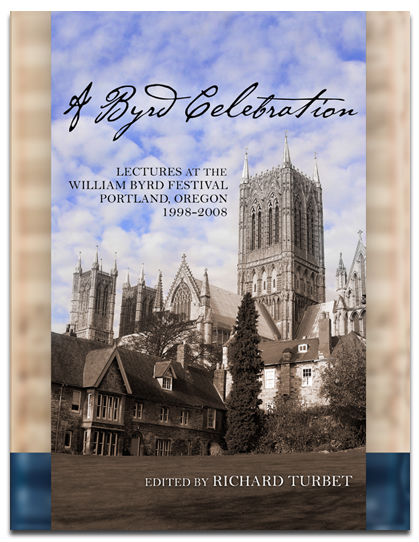
I'm very pleased to offer a free download of the complete book A Byrd Celebration, edited by Richard Turbet. Herein are original essays on the life and work of this great master of polyphony written by Byrd experts, and for a volume to be distributed at the Byrd Festival in Portland, which begins August 10.
Every chapter has interesting material but I'm particularly intrigued at the stories of how this devout Catholic managed his life in Elizabethan England as a composer for the English church. Essentially he lived a double life. His Catholic music, such as his Masses, were written for private and secret use in estates far away from the state's prying eyes, even as his English music was being performed in Cathedrals.
There is even more to his double life: he was involved in smuggling and money laundering activities for Jesuit priests, activities which endangered his life.
Read this passage from Joseph Kerman:
Byrd attends a Jesuit retreat for priests who had been smuggled into the country—and I don’t think he was there simply to do the music at their undercover services; I think he was there also because he’d been involved with the smuggling operation. A servant who had been with Byrd since his Lincoln days was caught with an incriminating letter and died in prison.
Yet Byrd had powerful friends, as I’ve already indicated—including the queen herself, as we’ve already seen. Elizabeth was a devoted musician, as you probably know. She was always praised for her playing on the virginals, and the best keyboard music around for her to play was by the star of her Chapel Royal, William Byrd—the best by far, as she must have known as well as we musicologists do, five hundred years later.
Well: this is speculation, but it is a fact that Elizabeth granted Byrd some sort of liability from prosecution for recusancy. And Byrd kept his nose clean, just about, and what’s more Byrd had paid his dues, and he continued to do so. Though he evidently tacked too close to the wind in connection with the Throckmorton Plot against Elizabeth in 1583, by the time the Spanish Armada was blown away in 1588, when the queen wrote an anthem of thanks she chose Byrd to set it set to music. In these same years, we think, Byrd also produced the greatest piece of music ever written for the Anglican Rite, doubtless for Queen Elizabeth’s Chapel Royal—the Great Service, for a double five-part choir.
Byrd was living a double life. And not a few other Elizabethans were walking the same sort of tightrope. And some, like Byrd, were courting trouble by exposing their feelings in books and poems. Byrd found a way of doing this in music.
The CMAA is so very pleased to be named as the publisher of the first-ever conference volume for the Byrd Festival this year. It is called A Byrd Celebration, and it features essays by the world top Byrd experts, writing about all aspects of his life and work. The volume will be available for those attending, but for those who are not going to be there, you can still order it in softcover and hardcover versions.
Most notable to my mind is that these essays are not what you would find in musicological journals. They are essays based on lectures given to real-life, flesh-and-blood attendees of The Byrd Festival over ten years. What's important here is that these are the writings of world-class scholars who are speaking to laypeople who are attending simply for the reason that they find Byrd's music beautiful, fascinating, and important. So each essay is designed to reach people with a story that illuminates the life and work of this most fascinating composer of music in Renaissance England.
The contributor list is truly a who's who of Renaissance music scholarship: Richard Marlow (Trinity College, Cambridge), Kerry McCarthy (Duke University), Philip Brett (1937-2002; King's College, Cambridge), Joseph Kerman (University of California, Berkeley), William Peter Mahrt (Stanford University), David Trendell (King's College London), Richard Turbet (University of Aberdeen), and Mark Williams (London).
They frankly deal with the liturgical and music issues of Byrd's life, not merely treating him as some sort of artistic genius but regarding him as inspired with a higher mission than art for art's sake. This, to me, is what makes the volume especially important. Further, all the writers are very much aware of the roots of Byrd's musical spirituality in the Roman Rite and its chant.
I'm rather in awe of the editor Turbet for managing to put all this together. It took years of work, and it was only completed this summer, when the last of the papers finally came in. When he first called the CMAA as the publisher, we all thought he meant for distribution in 2009. No problem. Then Dean Applegate revealed that he wanted it available for this year's festival! Umm, that is rather unrealistic.
Rethinking began. After some serious thought, we decided that it was completely crazy, that it could not happen that a book could be copyedited, indexed, etc. etc. with all the apparatus, plus a beautiful cover, plus printed, in a matter of two months. So we decided not to go ahead and that was that. Everyone felt relief.
After a day's rest, a sense of regret developed. Perhaps the impossible is possible after all. So we decided, with no plan whatsoever, to give it a go. It was back on and there was much celebration all around. It was quite the emotionally ride there. Well, you can imagine the number of hours that were spent in preparing this in this short a time. I still can't quite believe that it is done.
I'm certain that this makes an enormous contribution both to the understanding of Byrd and to making his timeless music come to life in our own times. I think you will love this book too.
Here is a nice recording of some of his English music.
The William Byrd Festival is surely one of the most spectacular events in the choral arts in the United States, and, for lovers of early music, this event is just essential. This is its tenth anniversary. It occurs August 10-24, 2008, Portland Oregon. As always, it features the best concerts, lectures, liturgies all with the music of William Byrd, "Renaissance England's Greatest Composer."
Actually, the whole idea seems implausible, even impossible, and perhaps for that reason it has really worked. The numbers that attend lectures and services approach the 1000 mark, if you can believe it. It seems that many people are willing to travel long distances and stay a very long time in order to experience excellence in music.
This is due to the dedication of the organizing force Dean Applegate, along with conductor Richard Marlow, as well as Byrd scholars such as Kerry McCarthy, William Mahrt, Richard Turbet, David Trendell, and others. Organists contribute as well. I've personally never attended but the music and fun is legendary. Among all the serious Church musicians I know, the Byrd Festival is the time of the year in which everything else must stop. In other words, it is a real institution and it has made a big difference.
The Latin Church music is covered of course, but also the English music, sacred and secular. In some ways, it makes sense that Byrd would become the subject of so much attention. His music is breathtakingly wonderful and holds up to centuries of examination and study. It has the depth of Mahler, the clarity of Bach, and the complexity of Beethoven (or feel free to random mix those traits among all those names). Also, he lived a fascinating life, carefully surviving and thriving as a composer during the most intense period of religious upheaval in England. During a long period, he lived double life: public loyalty to the Queen while privately composing Masses for private estates and even assisting in the hiding of priests.
It makes for wonderful romance and storytelling -- an inspiring life to go along with his eternally inspiring music.
Peter Phillips writes that "Last week Byrd’s Mass for Four Voices was heard in concert — I assume for the first time — in Lusaka, Zambia." The group is Vox Zambezi, which sings many styles but Phillips was particularly drawn to its performance of Byrd, partly because it shatters the pervasive tendency to regard this polyphony as somehow bound up with European experience only.
Browsing around I found this short clip of the group singing some piece of polyphony, and I bet one of the readers could name it immediately. I don't recognize it, and I'm sure I'll shortly be embarrassed to admit it.