In the Roman Breviary, the Matins lessons for the dedication feasts of the Lateran and Vatican basilicas state that Pope St Sylvester I (314-35) consecrated them on November 9th and 18th respectively. However, there is no contemporary or early historical source that attests to this. The Liber Pontificalis, which dedicates a considerable amount of space to Sylvester’s career, says nothing of it; neither do his contemporary Eusebius of Caesarea, the famous Church historian, or the acts of Sylvester mentioned in the Gelasian Decree (ca. 500 A.D.) as one of the reliable lives of the Saints to be read in the liturgy. The tradition of these dates seems to have been popularized by a much later sermon which was commonly read at Matins of a church dedication. [1]
The Consecration of the Lateran Basilica by Pope St Sylvester I; fresco in the transept of that basilica, by Giovan Battista Ricci (1597-1601). The decorations in this part of the church were commissioned by Clement VIII (1592-1605), the same Pope who issued the Roman Pontifical, the liturgical book which contains the rite of a church consecration. (Image from Wikimedia Commons by Sailko, CC BY 3.0)
The earliest liturgical books of the Roman Rite do not have these feasts, nor indeed, any annual commemoration of a church’s dedication at all. Such feasts are one of the enrichments introduced into the liturgy in the Carolingian period, and these particular two examples are indisputably post-Carolingian. As I noted in an article last week, in the Middle Ages they were kept only in Rome itself, and did not begin to be celebrated by other churches until after the Tridentine reform, when those churches adopted the Breviary and Missal of St Pius V, and their calendar with them.
This means that they also post-date the institution of the feast of All Saints, and I here make bold to offer an explanation of why this may be relevant. It is impossible to say, and I certainly do not pretend to say, whether this was a deliberate choice of the unknown persons who instituted them, or another happy example of the mysterious providence by which God refines the liturgy towards ever great beauty and intricacy.
On October 31st, the Church militant upon the earth prepares itself for the great solemnity of All Saints with a day of fasting, as it does for all the greatest feasts. On November 1st, it celebrates all the Saints in the Church triumphant in heaven, and the following day, prays for all those in the Church suffering in Purgatory. Thus, the three liturgical days are dedicated to the three parts of Christ’s mystical body, on earth, in purgatory, and in heaven.
Speaking only of those feasts which are attested on calendars of the Roman Rite from the earliest times [2], November continues with at least one feast of each of the traditional classes of Saint: the Apostle Andrew on the 30th; a martyred bishop, Pope St Clement I, on the 23rd; a martyr, St Chrysogonus, on the 24th (plus the Eastern martyrs Theodore and Menna); a group of several martyrs, the Four Crowned Martyrs, on the 8th; a confessor, St Martin, on the 11th; a virgin and martyr, Cecilia, on the 22nd, and a matron, St Felicity, also on the 23rd. Thus the month itself becomes, so to speak, an icon of all the Saints.
The calendar page for November in a Gregorian sacramentary produced in the second half of the 9th century at the abbey of St-Amand-les-Eaux, about 130 miles north north-east of Paris. (Bibliothèque nationale de France. Département des Manuscrits. Latin 2290). All of the Saints named above are included except for the Egyptian martyr Menna, whose feast coincides with that of St Martin, kept in Gaul as a solemnity of the highest degree, and therefore without commemoration.
With the exception of Martin, each of these Saints is also very Roman. St Andrew is the Apostle Peter’s brother, and has been the subject of great devotion in the Eternal City from earliest times. The rest are either Roman themselves or have important Roman connections. Clement, Chrysogonus, Cecilia and the Crowned Martyrs all have large and prominent basilicas in the city; Felicity had one near the catacomb where she was buried, and the feast of her seven sons on July 10th is in all Roman liturgical books, going back to the so-called Leonine Sacramentary.
Looking back to the earliest calendars, there is no other month which has such a variety of different kinds of Saints, and almost all of them Roman. Perhaps this was the inspiration for placing the annual commemoration of the dedication of Rome’s cathedral in November as well, once such a commemoration had been instituted as a regular feature of the liturgy. And when this was done, the logical thing would be to also add the commemoration of the dedications of the basilicas of Ss Peter and Paul, the Roman church’s two apostolic founders and principal patrons. This complex month-long celebration of the church of Rome and its Saints would then serve as the link between All Saints and the beginning of the new liturgical year in Advent, the season which draws our mind both to the first coming of Christ in the Incarnation, and His second coming in glory at the end of the world, when all the Saints shall be perfected in the fullness of His Redemption.
The placement of the two dedication feasts between All Saints and Advent thus also reminds us of the mediating role which the Church itself plays in bringing us to our own place in heaven among the angels and the saints. And perhaps it is not too extravagant to posit that there is some intentional symbolism in placing them at intervals of nine days, the number of the choirs of angels in heaven: the dedication of the Lateran is on the 9th, of Ss Peter and Paul on the 18th, and the earliest possible beginning of Advent on the 27th.
The interior of the dome of St Peter’s basilica, with Christ, the Virgin, the Baptist and the Twelve Apostles, and above them, the choirs of angels, with God the Father in the mosaic inside the lantern. (Image from Wikimedia Commons by Gary Ullah, CC BY 2.0)
[1] The first part of this sermon, which opens with the words “Consecrationes altarium”, was read as the lessons of the first nocturn of a church dedication in the pre-Tridentine Roman breviary, and the Office of many other liturgical Uses. In the breviary of St Pius V, it is rewritten according to the general literary criteria of that reform, and read in part in the second nocturn of November 9, and in part on the 18th, with various other material added to it. The lessons for these two days were considerably expanded in later additions, in order to give more of the history of the three churches as they were rebuilt and renovated in the 17th, 18th and 19th centuries.
[2] All of these are in their places by the time the first version of the Gregorian Sacramentary was created towards the end of the 8th century.
For many centuries before the feast of the Visitation was instituted, July 2nd was kept as the feast of the martyrs Ss Processus and Martinian, who remain as a commemoration. According to a legend current since the sixth century, they were the jailers in charge of keeping Ss Peter and Paul in the Mamertine prison in Rome during the reign of the Emperor Nero, and having been converted by the Apostles, allowed them to escape. For this, they were put to death after a long series of torments, through which they simply said over and over again, “Blessed be the name of our Lord, Jesus Christ, whom his blessed Apostles have preached!” Originally buried in a cemetery off the via Aurelia, their remains were transferred to the ancient basilica of St Peter by Pope Paschal I in the early ninth century. The north transept of the new basilica is named for them, where their relics are kept under the middle of the three altars.
The north transept of St Peter’s Basilica
The central altar is where this painting of their martyrdom, by the French painter Valentin de Boulogne (1629) was originally displayed; it is now replaced by a mosaic copy.
Since the windows of St Peter’s Basilica are so high up, the marble walls are never exposed to direct sunlight for any great length of time, and generally remain cooler than the air. In the summertime, when Italy is often very hot and humid, a great deal of moisture comes into the building and condenses on the cooler marble. In the middle of the 18th century, it was realized that the paintings over the altars were being destroyed because they had a slick of condensation over them for several months of the year; there were therefore all taken down and replaced by mosaics. The original is now in the Painting Gallery of the Vatican Museums.
Valentin was an unabashed plagiarist of Caravaggio, in terms of both style and subject. One of the latter’s more prestigious commissions was a series of three paintings of the life of St Matthew in the Contarelli Chapel of the church of San Luigi dei Francesi. The angel whom Valentin shows here bringing the palm of victory to the martyrs is essentially a cross between the two angels painted by Caravaggio, one inspiring St Matthew in the writing of the Gospel, and the other bringing him the palm of martyrdom.
Long before either the Visitation or the Queenship of the Virgin Mary were celebrated on this day, and before those, St Angela Merici, the founder of the Ursulines, May 31st was the feast day of St Petronilla. Although she is missing from the oldest Roman liturgical books, she is seen in a painting of the mid-4th century in the catacomb of Domitilla, where she was buried, and her name appears on lists of the venerated tombs of martyrs in the sixth and seventh centuries. In the reign of Pope St Paul I (757-67), an ancient sarcophagus containing her remains was translated from the catacomb to the basilica of St Peter, the treasury of which still preserves a large metal reliquary with her skull inside it.
Fresco of the mid-4th century, with the martyr Petronilla on the right, leading a young woman named Veneranda into the garden of Paradise. (Image source.)
The true history of her life and martyrdom has long since been lost, but she was for many centuries believed to be the daughter of St Peter. This idea seems to have come partly from her name and the location of her relics, partly from a Gnostic “Acts of St Peter”, which speaks of a daughter of St Peter, without giving her a name. (In the Middle Ages, this apocryphal document would not have been understood as a work of heretical origin.)
The first edition of the Breviary of St Pius V carried over from its late medieval predecessors two brief Matins lessons of her life, which state that she was miraculously healed of paralysis by her father, relapsed, and while she was recovering again, a “count” named Flaccus conceived a wish to marry her sight unseen. Petronilla, “understanding that the human race’s most bitter enemy was readying an assault on her virginity, which she had dedicated to Jesus Christ”, prayed and fasted for three days, and then, after receiving the Eucharist, died. When St Robert Bellarmine and Cardinal Cesare Baronio revised the Saints’ lives for a new edition of the Breviary, published in 1602, these lessons were replaced with a generic one from the common of Virgins, a clear sign that the traditional story was considered wholly unreliable.
A reconstruction and partial cross-section view of old St Peter’s Basilica, with the mausoleum mentioned below on the far left. This structure was round on the outside, but octagonal on the inside. A narthex was later constructed between the left transept of the basilica and the rotunda, and doors opened up to form a passage from the church into the mausoleum. Another passage connected the mausoleum with its twin next door, also demolished by Vignola in the 1570s.
In the middle of the 5th century, a large mausoleum was built next to the left transept of the Constantinian basilica of St Peter. Six of its eight internal niches later became chapels, with that opposite the door being dedicated to St Petronilla; for a long time, this chapel was under the patronage of the kings of France. In 1498, Cardinal Jean Bilhères de Lagraulas, the French ambassador to the Papal court, commissioned his own funerary monument to be added to the chapel, from a 23-year-old Florentine sculptor named Michelangelo Buonarroti. This is, of course, one of the most loved and admired sculptures in the entire world, the Pietà.
Michelangelo did not know, of course, that only 7 years after the sculpture’s completion and the Cardinal’s death, both in 1499, Pope Julius II and the architect Donatello Bramante would begin (though just barely) the process of replacing the ancient basilica, then in a pitiable state. Much less did he know that, after decades of delays, he himself would take the project in hand in 1545, at the age of 70, and spend the last 19 years of his life working on the monumental church which we have today. Although he lived to an extraordinary age for that era, dying 2 weeks before his 89th birthday, he did know full well that he would not live to see the project finished. It fell to his successor as chief architect of St Peter’s, Giacomo Vignola, to demolish the mausoleum where the Pietà originally stood, in order to make way for the left transept of the vastly larger new basilica.
The Pietà now stands in its own chapel at the back of St Peter’s, and most of the thousands of people who come to see it every day never visit the chapel dedicated to St Petronilla on the opposite end of the building. (The new church is so much larger than the old one that this chapel in the northwest corner stands entirely outside the former footprint of the Constantinian structure.) Around the year 1623, the painter Francesco Barbieri (1591-1666), known by the nickname “Guercino” (“squinty” in the dialect of his native region, the Emilia Romagna), was commissioned to do a painting of the Burial of St Petronilla for this chapel.
Guercino was especially admired for a remarkably vivid blue paint of his own invention, which he uses for two figures in this painting, as well as the sky in the background. In the upper part, it clothes Christ as He receives St Petronilla into heaven. Although the historical St Petronilla was certainly honored as a martyr, as the legendary daughter of St Peter, she is honored as a virgin, but not as a martyr, and here she is shown receiving the crown of virginity, but not the palm of martyrdom.
Below, notice the intense realism of the scene of her burial; we see the hands of a man standing in her grave, but only his hands, reaching up to help lower her body into it. The fellow dressed in blue on the left is the painter’s tribute to Michelangelo, whose most famous sculpture formerly graced the chapel of the same Saint for whom Guercino himself made this painting. The face of this man is taken from a bust of Michelangelo carved by the latter’s disciple Daniele da Volterra, and his massive forearm is very much that of a sculptor. (Even as a very elderly man, Michelangelo never ceased to work in his favorite medium, sculpture in white marble, a labor-intensive and muscle-building activity.) Surely by design and not coincidence, the chapel immediately next to that of St Petronilla in the modern basilica is dedicated to Michelangelo’s name-saint, the Archangel Michael.
The YouTube channel of EWTN recently published a video about the exposition of the Holy Lance at St Peter’s basilica on the first Saturday of Lent. This was formerly done on the Ember Friday, which was long kept as the feast of the Holy Lance and Nails, but since this feast is no longer observed, the exposition of the relic has been transferred to the following day, when the station is at St Peter’s. Each of the four massive pillars which hold up the church’s dome is dedicated to one of its major relics (apart from those of the Apostle himself, of course): the True Cross, a piece of which is kept there; the Holy Lance; the skull of St Andrew; and the veil of Veronica. The last of these is shown to the faithful on Passion Sunday, when the station is also at St Peter’s. Our good friend Jacob Stein from Crux Stationalis is interviewed, and talks about the importance of the station and the relic, the veneration of which starts Lent off by looking forward to the Passion on Good Friday.
Here is Jacob’s own video about the station of that day: as a reminder, his YouTube channel has new videos about the stations and other Roman customs several times a week at least.
In the Roman Breviary, the life of St Andrew the Apostle ends with the statement that “When Pius II was Pope, his head was brought to Rome, and placed in the basilica of St Peter.” This statement gives no idea of what an extraordinary event the translation of this relic was in the life of the Church at the time.
St Andrew is traditionally said to have died in the city of Patras on the northwestern coast of the Peloponnese, which was usually called “the Morea” in the Middle Ages. In 357, under the Emperor Constantius, his relics were brought to Constantinople, and remained there until the city was sacked during the Fourth Crusade, when they were brought to the Italian city of Amalphi; his head, however, had remained at Patras.
(Each year, for the feast of St Andrew, the reliquary kept in the crypt of the Duomo of Amalphi is taken out for a long procession though the city, and then returned to the church in a rather remarkable fashion, as seen in this video.)
In the later years of the Byzantine Empire, the Peloponnese was made into its own principality within the Empire, ruled by relatives of the Emperor, and called the “Despotate of the Morea.” (“Despotes” in Greek simply means “prince.”) The last two princes, Demetrius and Thomas, were the brothers of Constantine XI, under whom the Great City fell to the Turks in 1453. The Morea, however, was not immediately invaded, and the despotate continued to exist for seven years afterwards. Partly as a gesture to gain the Latin Church’s support for a new Crusade to drive the Turks out of Greece and the Balkans, partly to prevent the relic of the Apostle’s head from being destroyed in the by-then inevitable invasion, the despot Thomas decided to consign it to Pope Pius II.
Aeneas Silvius Piccolomini was known as one of the great men of letters of the Italian Renaissance, although much of his writing as a layman, and most of his personal life, would hardly suggest a man fit for the clerical state, much less the Papacy. However, after years of involvement with important matters of both Church and State, he underwent a profound moral conversion; after receiving the subdiaconate in 1446, he was made a bishop about a year later, a cardinal by 1456, and elected Pope in 1458. His papal name “Pius” was chosen as partly in reference to his secular name “Aeneas”, since Virgil constantly calls the hero of his Aeneid “pius Aeneas.”
Pope Pius II Canonizes St Catherine of Siena, from the famous Piccolomini library in the cathedral of Siena, by Pinturicchio, 1502-8. Pius was born in a small town within the territory controlled by Siena, where his family became especially important upon his election to the Papacy, and he was particularly proud of the fact that he was able to canonize a great “home-town hero” among the Saints. The proper Office of St Catherine still used to this day in the traditional Dominican Breviary was composed by him.
We may be tempted to dismiss this as no more than a clever literary reference from an age very much enamored with clever literary references, but this would be unjust. The Latin word “pius” means “one who fulfils his duty”, duty to God, to one’s country, and to one’s family, and therefore, among its many meanings are “pious, devout, conscientious, affectionate, tender, kind, good, grateful, respectful, loyal, patriotic.” Under the heading of the last of these, Pope Pius died while attempting to rally the Christian princes to the defense of Europe, as the Turks prepared to press further into the Balkans, and cross the Adriatic into Italy.
Under the heading of the first two meanings, “pious and devout”, Pope Pius devoted several pages of his autobiography to the events surrounding the reception of St Andrew’s head. After the despot Thomas had rescued the head from Patras, he brought it to Ancona, a major Italian port on the Adriatic, protected by its presence from severe storms during the crossing. Pius’ legate was sent to examine it, and declared it authentic, after which it was brought to the city of Narni, and left there for a time on account of political and military disturbances then flaring up in Italy. When these had died down, preparation was made for it come to Rome; the Pope had thought to go meet it by bringing with him the heads of Ss Peter and Paul which were kept in the Lateran, but gave up on this idea because the reliquary in which they were enclosed was too heavy to conveniently move.
The high altar of St John in the Lateran; in the enclosed area above may be seen the reliquary containing the skulls of Ss Peter and Paul. (These are not the reliquaries which Pope Pius II found too heavy to move, which were likely destroyed during the sack of Rome in 1527, but later replacements. Image from Wikipedia.)
On Holy Monday, the Pope and his court, along with an enormous crowd of Romans, went forth from the Flaminian gate to meet the three cardinals charged with bringing the relic from Narni, close to the Milvian bridge, the site of Constantine’s famous victory so many centuries before. A large platform was erected in the middle of a field, so that all could witness the event, with two staircases on either side, and an altar in the middle. As Pius II describes the event, “as the Pope ascended the one side, weeping with joy and devotion, followed by the college (of cardinals) and the clergy, (Card.) Bessarion with the two others ascended from the other side, bearing the small arc in which the sacred head was contained, and set it on the altar… the arc was then opened, and Bessarion, taking the sacred head of the Apostle, weeping, handed it to the weeping Pope.” Pius then gives his address before the crowd.
“Thou hast finally come, most sacred and adored head of the Apostle! The furor of the Turks has driven thee from thy place; thou hast fled as an exile to thy brother. … This is kindly Rome, which thou seest nearby, dedicated by thy brother’s precious blood; the blessed Apostle Peter, thy most holy brother, and with him the vessel of election, St Paul, begot unto Christ the Lord this people which stands here. Thy nephews, all the Romans, venerate, honor and respect thee as their uncle and father, and doubt not of thy patronage in the sight of God. O most blessed Apostle Andrew, preacher of the truth, and outstanding asserter of the Trinity! With what joy dost thou fill us today, as we see before us thy sacred and venerable head, that was worthy to have the Holy Paraclete descend upon it visibly under the appearance of fire on the day of Pentecost! … These were the eyes that often saw the Lord in the flesh, this the mouth that often spoke to Christ! …
We are glad, we rejoice, we exult at thy coming, o most divine Apostle Andrew! … Enter the holy city, and be merciful to the Roman people! May thy coming bring salvation to all Christians, may thy entrance be peaceable, thy stay among us happy and favorable! Be thou our advocate in heaven, and together with the blessed Apostles Peter and Paul, preserve this city, and in thy devotion take care for all the Christian people, that by thy prayers, the mercy of God may come upon us.”
The Pope then lifted up the head for all to see, and the entire crowd knelt, most of them already moved to tears by the Pope’s oration. The relic was brought to the church of Santa Maria del Popolo, just inside the gates of Rome; from there, it was carried on Holy Wednesday under a golden processional canopy through the streets of the Eternal City to St Peter’s Basilica, accompanied by thousands of Romans and pilgrims.
Less than 50 years later, Pope Julius II would begin the process of tearing down the ancient basilica of the Vatican, which was then close to twelve centuries old, and in several places on the point of collapsing under the weight of its own ceiling. The new basilica, not the work of Pope Julius’ original architect, but of the genius of Michelangelo, is centered upon a massive elevated dome, directly over St Peter’s tomb. The base is pierced with enormous windows to show us that St Peter is God’s privileged instrument, who opens for us the doors of Heaven with the keys which Christ gave him, and that it is through Peter that God brings us up to Himself. The four enormous pillars which support the dome are each dedicated to one of the church’s major relics, among them the head of St Andrew, which was kept in a room behind the balcony seen here above François Duquesnoy’s statue of the Apostle. (In 1966, this relic was returned to the custody of the Orthodox Church in the city of Patras.)
In preparation for the upcoming Jubilee, a lot of work is being done inside St Peter’s basilica in the Vatican to clean up and restore some of its major features. One of these is the great sculpture in the apse by Gian Lorenzo Bernini, which is simply known as the Cathedra. I took this photograph of it decorated for the feast of St Peter’s Chair more than 13½ years ago.
It is often forgotten that this feast is not only the commemoration of St Peter’s ministry as chief of the Apostles, but also the feast of a relic long reputed to be his actual throne. Although it never attained to the popularity of the Veil of St. Veronica, the Vatican Basilica’s relic par excellence in the High Middle Ages, it was regularly seen and venerated by the faithful, being first explicitly named “the Chair of St. Peter” in 1237. Before the long period of the Popes’ residence in Avignon (during which many medieval customs of the Papal liturgy disappeared), the Pope was enthroned on the relic for part of his coronation ceremony, and used it as his liturgical throne in the basilica on the feast of February 22. Since 1666, it has been kept within Bernini’s Cathedra, and very rarely brought out. The magnificence of the sculpture, and its presence as the visual culmination of the church, has overwhelmed its purpose as a reliquary; all the more so since the relic itself cannot be seen within it, and has so rarely been removed from it for viewing. It was last exposed in 1867, at the behest of Blessed Pope Pius IX, during the celebrations of the eighteenth centennial of the martyrdoms of Ss. Peter and Paul. A copy is displayed in the treasury of St. Peter’s, but with little to indicate the prominence which the original formerly held.
This week, however, as the cleaning up of the Cathedra comes to a close, the relic has once again, for the first time since 1867, been put on display for the faithful to venerate, and a friend was kind enough to share his pictures of it with us. It should be pointed out that, as scholars have long acknowledged, the chair was actually made in the time of the Emperor Charles the Bald as a gift for Pope John VIII, who crowned him as the Holy Roman Emperor in the old basilica in 875. However, the ivory panels on the front of it are much older, dating from sometime in the 2nd century B.C. They originally belonged to some other object, possibly also a chair, and showed the twelve signs of the zodiac, and the twelve labors of Hercules: nine of each survive.
The great baldachin over the high altar and the tomb of St Peter has also just been unveiled after a good cleaning.
On the right side of the central aisle sits this bronze statue of St Peter made by Arnolfo di Cambio to be displayed in the old basilica for the Jubilee of 1300. The extended right foot of St Peter has been worn away by pilgrims rubbing and kissing it for well over 700 years.
On this day in the year 1878, Blessed Pius IX died, ending the longest documented papal reign in history. (I will explain below why I qualify with “documented”.)
He was born Giovanni Maria Mastai-Ferretti in 1792 in Senigallia, a town on the Adriatic coast of the northern Italian region of the Marches, then part of the Papal State. After receiving his education in Volterra and Rome, he entered the company of the Pope’s palace guards known as the Guardia Nobile, but was released from service because of a seizure disorder from which he suffered. (The precise nature of this illness has apparently never been determined.) This would normally have prevented him from entering the clergy as well, but with the patronage of Pope Pius VII, he was able to begin his theological studies, and was ordained a priest in 1819. In 1824, he traveled to Chile on a diplomatic mission, the first future Pope to visit the New World. In 1827, Pope Leo XII appointed him bishop of Spoleto; Gregory XVI, who was elected in 1831, moved him to Imola 5½ years later, and in 1839, made him a cardinal.
A portrait of Bl Pius IX painted in 1847 by Giovanni Orsi.
On Gregory’s death in 1846, Cardinal Mastai-Ferretti was elected to the Papacy, and took the name “Pius” in honor of the Pope who had made it possible for him to enter the service of the Church. He was crowned on June 21, five days after his election.
Prior to his reign, nine among the successors of St Peter (numbering 254 at that point) had reigned for more than 20 years, but none had ever reached the 25 years traditionally ascribed to Peter himself. For many centuries, therefore, it had been part of the papal coronation ritual that as soon as the cardinal archbishop of Ostia placed the crown on the new Pope’s head, he would say to him, “Numquam videbis annos Petri. – Thou shalt never see the years of Peter”: a way of reminding him, amid the glories of the Church’s highest office, that like all Popes, he is the steward of Another.
But Pius IX did in fact live to see the years of Peter, surpassing the 25-year mark in 1871, and living for more than 6½ years beyond that. This custom was then removed from the coronation rite, and his successor, Leo XIII, reigned for exactly 25 years and 4 months. (St John Paul II, who beatified Pius IX in 2003, also surpassed it, reigning for a bit less than 26½ years.)
I began this by saying that Pius IX’s is the longest documented papal reign, because there is no ancient document which tells us precisely how long St Peter reigned. Some traditions say that he was Pope for 25 years, others for 32. The second number makes better sense of the traditional dates of the last year of the Lord’s earthly life, ca. AD 33, after which Peter assumed the leadership of the Church, and of Peter’s death at the hands of Nero, ca. AD 64. There is also a very ancient tradition that Peter was bishop of Antioch before he came to Rome, and one way of reconciling these different stories, an explanation which strikes me as the most plausible, is that Peter was Pope for 32 years, but bishop of Antioch for 7, and of Rome for 25. Pius IX would therefore have surpassed his years in the latter role, but not the former.
The photograph below shows a statue of St Peter in the nave of the Vatican basilica, made by Arnolfo di Cambio at the very end of the 13th century. On the wall above it is a mosaic portrait of Pius IX, with the inscription, “For Pope Pius IX, who alone equaled the years of Peter in the Roman Pontificate, the clergy of the Vatican decorated the holy throne. June 16, 1871”, this date being the 25th anniversary of his election.
When there were two feasts of St Peter’s Chair, that of Rome celebrated today, and that of Antioch on February 22, the following sermon of Pope St Leo the Great was read at Matins of the former in the Breviary of St Pius V.
When the twelve Apostles, having received through the Holy Spirit the power to speak every tongue, undertook to teach the Gospel to the world, and divided the regions of the earth amongst themselves, the most blessed Peter, chief of the apostolic order, was chosen for the capital city of the Roman Empire, so that the light of truth, which was revealed for the salvation of the nations, might be shed the more powerfully through the whole body from the world from its own head. From what nation were there no men at that time in that city? Or what did the nations not know, once Rome had learned it? Here were the opinions of philosophy to be trod down, here the vanities of earthly wisdom to be abolished, here the worship of demons to be suppressed, here the impiety of every sacrilege to be destroyed, where everything that had been established by vain error over the whole world was kept, gathered most diligently by superstition.
St Peter Walks Upon the Water (Matthew 14, 22-33, the Gospel of the Octave of Ss Peter and Paul.) The original mosaic was made by Giotto on a wall of the courtyard of the old St Peter’s Basilica in 1298, opposite the church’s façade. Only a few fragments were saved from the destruction of the old basilica; this copy is an oil painting made in 1628 from drawings of the original. In 1675, a new mosaic on the same design was mounted in the portico of the new basilica, facing the main door, as a reminder to pilgrims as they leave the church to pray for the Holy Father. (Public domainimage from Wikimedia.)
To this city, then, most blessed Apostle Peter, thou didst not shrink to come, and since thy comrade in glory, the Apostle Paul, was still occupied in the founding of other churches, thou didst enter that forest of roaring beasts, that most deep and stormy ocean, more firmly than when thou did upon the sea. Already hadst thou taught them that had believed from among the circumcision, thou hadst founded the Church of Antioch, where first arose the noble name of Christian; by thy preaching thou hadst filled with the law of the Gospel Pontus, Galatia, Cappadocia, Asia, and Bithynia; and with no doubt of the advancement of thy work, nor uncertain of the span of thy life, thou didst bring the trophy of the cross of Christ into the fortresses of Rome, where the honor of their authority and the glory of thy passion went before thee by the providence of God.
Today, the Church marked the four-hundredth anniversary of the martyrdom of St Josaphat, who was killed for his ardent championship of union with Rome among the Byzantine-rite Christians of the Polish-Lithuanian Commonwealth. A member of the Basilian Order, Josaphat, né John Kuntsevych, was made bishop of Vitebsk in 1617, at the age of only 37, and archbishop of Polotsk the following year. (Both cities are now in Belarus.) In a period of great tension between Catholics and Orthodox, he went to preach at Vitebsk; on the steps of his co-cathedral he was struck in the head with an ax, and then shot by fanatical opponents of the union with Rome, on the sixth anniversary of his episcopal consecration. They then tore off his clothes, and for a moment thought they had killed the wrong man, since he was wearing a hairshirt underneath; the body was thrown into the river, but recovered three days later. The Roman Breviary states that the first beneficiaries of his martyrdom were his own assassins, who were all reconciled to Rome, as was his principal opponent among the Orthodox clergy, Bishop Meleti Smotrytsky. Beatified only 20 years after his death, he was canonized by Blessed Pope Pius IX in 1867; originally assigned to November 14th in the Roman Rite, his feast was moved to the day of his death in the calendar revision of 1969.
A few weeks ago, the Gregorian University in Rome inaugurated a special exposition to mark this anniversary; we are grateful to Fr Joseph Koczera SJ for sharing these pictures of it with us.
An eighteenth-century Baroque portrait of the Saint attributed to the Italian artist Sebastiano Conca (1680-1764).
The official portrait used at his canonization ceremony in 1867.
A 1934 painting of a teenaged St Josaphat and the Sacred Heart of Jesus, by the Italian artist Mario Barberis (1893-1960): created for the chapel of the Pontifical College in Rome named for the Saint, but removed in the 1960s, when the very Latinized style of the work had fallen out of fashion in an era of re-Byzantinization.
A 1946 painting of St Josaphat by Mykola Azovskyj (1903-47), an important 20th-century Ukrainian artist, who offered a modern depiction of the saint that nevertheless stands in continuity with both Byzantine and Latin iconography.
An icon of St. Josaphat by Juvenalij Mockryckj (1911-2002), with the Pochaiv Lavra, one of the most important monasteries in the western part of Ukraine, depicted at the bottom of the image. (The church at the far right was designed in the early 1900s by a Russian architect named Alexei Shchusev (1873-1949), who ironically went on to design Lenin’s mausoleum.)
A prayer card distributed at the event, featuring a reproduction of the earliest-known image of St. Josaphat.
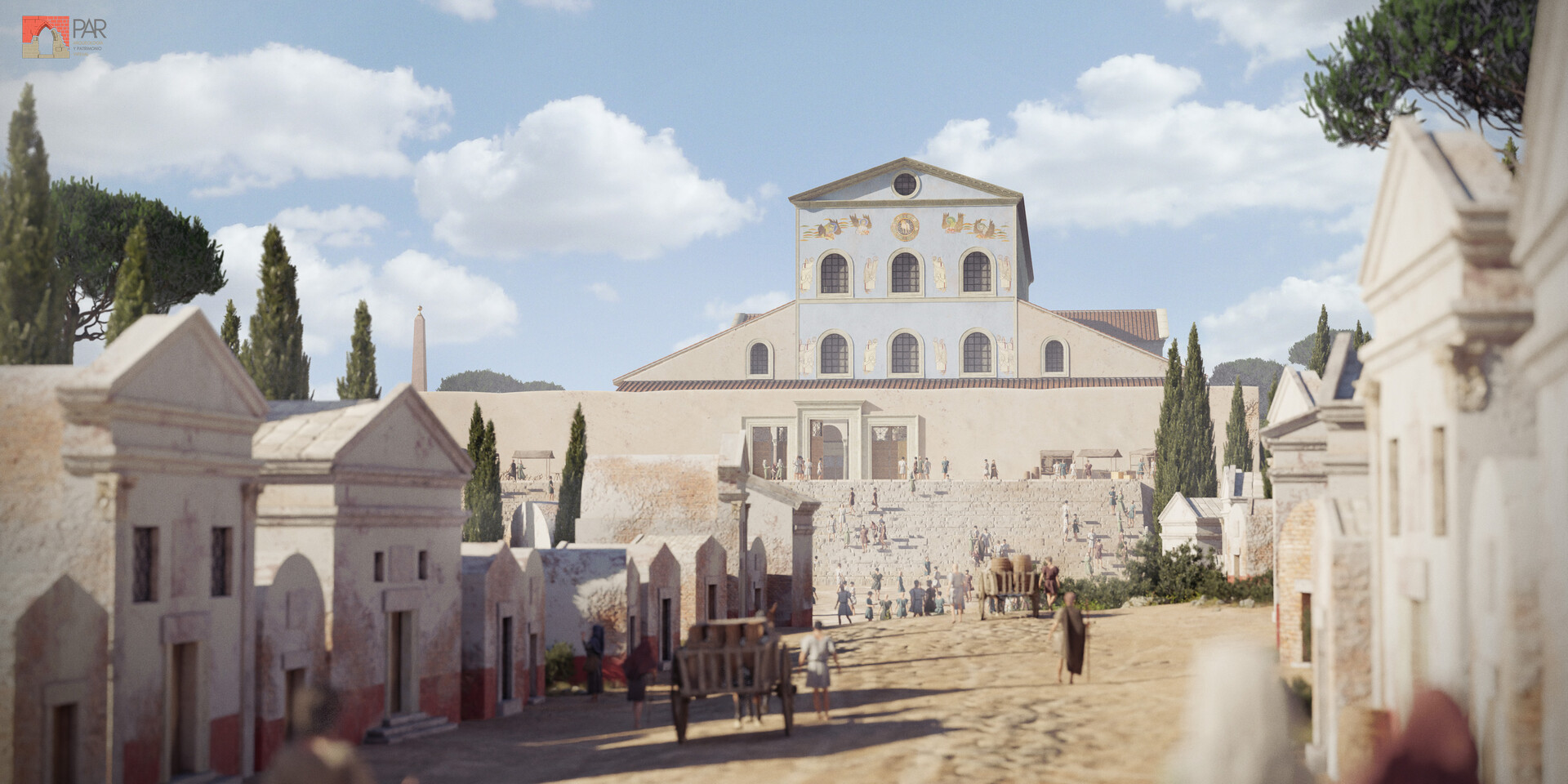
We are very grateful to Prof. Pablo Aparicio Resco for his kind permission to reproduce these images of a very interesting project he has been working on, a virtual reconstruction of the ancient basilica of St Peter. (Video and images from PAR – Arqueología y Patrimonio Virtual and 3D Stoa – Patrimonio y Tecnología.)
As I am sure our readers already know, the original building was constructed by the Emperor Constantine in the earliest days of the Peace of the Church; the traditional date of its consecration is November 18, 326. By the mid-15th century, it was over 11 centuries old, and in very poor condition, as was much of Rome after the neglect entailed by the long papal residence in Avignon (1309-76), and the events of the Great Schism (1378-1417). In the 1440s, the Florentine scholar León Battista Alberti (1404-72) was serving as architectural advisor to Pope Nicholas V (1447-55), and pointed out to him that a stretch of the north wall (on the right as one looks at the façade) totaling about half its length was sagging well over three feet off the perpendicular. After various rather half-hearted attempts to restore it, the building was deemed unsalvageable, and in the beginning of the 16th century, the project of replacing it was begun by Pope Julius II (1503-13). Julius’ project, however, stalled repeatedly, and would not really begin in earnest until many years later, when it was assigned to Michelangelo by Pope Paul III in 1545.
The Constantinian basilica was placed so that the apse would enshrine the grave of St Peter, which, however, was in the middle of a very large necropolis on the Vatican Hill. This required not only that a good many burials be disturbed, but also that a massive part of the hill itself be moved, amounting to about a million cubic feet of dirt. As a very good guide once pointed out on a tour of the modern excavations under the new basilica, this alone makes for a very strong argument in favor of the authenticity of the gravesite as that of St Peter. Next to the site was a ready-made flat space formerly occupied by the so-called Circus of Nero (more properly, of Caligula), where the church could have been built more easily. Constantine would be unlikely to expend so much time and energy flattening the hill, unless he needed to do so to include the grave.
This view, therefore, shows us how one would originally have approached the church, walking through the part of the Vatican necropolis that remained undisturbed, (the modern Via della Conciliazione.)
Here, we see the basilica from the south side. The obelisk was originally mounted on the wall that ran down the middle of the circus, which the Romans called “spina - the spine ”, and around which the chariots turned during races. By Constantine’s time, the circus was gone, but the obelisk, an 84 foot-tall block of solid granite weighing about 330 tons, remained in its place until 1588, when it was transported roughly a quarter of a mile away, to stand in front of the new basilica.
The façade seen from inside the great courtyard in front of the basilica.
Two cross section views: the first shows the transept and apse, with the site of the grave...
In the Roman Missal, the fifth prophecy is the same on all four of the Saturday Ember Days, Daniel 3, 47-51, with a few of the verses re-ordered. The words that follow in the Biblical text (verses 52-57) are sung as a canticle, according to a very beautiful melody. This canticle is one of the oldest pieces in the repertoire of Gregorian chant; the text follows the so-called Old Latin translation of the Bible which was used before St Jerome’s Vulgate, and contains several more verses than are found in the Vulgate version. In the Roman Use, the canticle is sung on the Ember Saturdays of Advent, Lent and September, but supplanted by a very short Alleluja on the Ember Saturday of Pentecost week.
The Sarum Use arranges both the reading and the canticle that follows differently on each of the four Ember Days. In Advent, it is basically the same as the Roman, with a few small variants. In Lent, on the other hand, the words of the Roman canticle are sung as part of the Lesson; the canticle of Sunday Lauds, the Benedicite (Daniel 3, 57-88) is then sung in a special arrangement, alternating between two cantors who sing the verses, and the choir singing the response.
The Lesson
The Angel of the Lord went down with Azariah and his companions into the furnace, and he drove the flame of the fire out of the furnace, and made the midst of the furnace like the blowing of a wind bringing dew. And the flame mounted up above the furnace nine and forty cubits, and burnt such of the Chaldeans as it found near the furnace, the ministers of the king who kindled the fire. And the fire touched them not at all, nor troubled them, nor did them any harm. Then these three as with one mouth praised, and glorified, and blessed God in the furnace, saying: (Here Sarum continues to read as part of the Lesson the words which are sung as the Canticle in the Roman Use.) Blessed art thou, O Lord the God of our fathers: and worthy to be praised, and glorified, and exalted above all for ever: and blessed is the name of thy glory, which is holy: and worthy to be praised, and exalted above all in all ages. Blessed art thou in the holy temple of thy glory: and exceedingly to be praised, and exceeding glorious for ever. Blessed art thou on the throne of thy kingdom, and exceedingly to be praised, and exalted above all for ever. (Here 3 verses are added from the old Latin text.) Blessed art thou upon the scepter of thy divinity: and exceedingly to be praised, and exceeding glorious for ever. Blessed art thou, that beholdest the depths, and sittest upon the cherubims: and worthy to be praised and exalted above all for ever. Blessed art thou, who walkest upon the wings of the winds, and upon the waves of the sea: and worthy to be praised and exalted above all for ever.
Here the canticle begins, alternating between two cantors and the choir.
V. Blessed art thou in the firmament of heaven, and praiseworthy and glorious forever. R. Blessed art thou in the firmament of heaven, and praiseworthy and glorious forever. V. All ye works of the Lord, bless the Lord. O ye heavens, bless the Lord. O ye angels of the Lord, bless the Lord. R. Sing ye a hymn, and exalt him above all for ever. (This response is repeated by the choir after each verse.) V. O all ye waters that are above the heavens, bless the Lord. O all ye powers of the Lord, bless the Lord. O ye sun and moon, bless the Lord. R. Sing ye... V. O all ye waters that are above the heavens, bless the Lord. O all ye powers of the Lord, bless the Lord. O ye sun and moon, bless the Lord. R. Sing ye... V. O ye stars of heaven, bless the Lord. O every shower and dew, bless ye the Lord. O all ye spirits of God, bless the Lord. R. Sing ye... V. O ye fire and heat, bless the Lord. O ye nights and days, bless the Lord. O ye darkness and light, bless the Lord. R. Sing ye... V. O ye cold and heat, bless the Lord. O ye frost and snows, bless the Lord. O ye lightnings and clouds, bless the Lord. R. Sing ye... V. O let the earth bless the Lord. O all ye mountains and hills, bless the Lord. O ye that are born of the earth, bless the Lord. R. Sing ye... V. O all ye seas and rivers, bless the Lord. O ye fountains, bless the Lord. O ye whales, and all that move in the waters, bless the Lord. R. Sing ye... V. O all ye fowls of the air, bless the Lord. O ye beasts and cattle, bless the Lord. O ye sons of men, bless the Lord. R. Sing ye... V. O let Israel bless the Lord. O ye priests of the Lord, bless the Lord. O servants of the Lord, bless the Lord. R. Sing ye... V. O spirits and souls of the just, bless the Lord. O ye holy and humble of heart, bless the Lord. R. Sing ye. V. O Ananiah, Azariah, Misael, bless the Lord. R. Sing ye...
The Cantors repeat the beginning: Blessed art thou in the firmament of heaven. and the choir finishes: And praiseworthy and glorious forever.
O ye holy and humble of heart, bless the Lord!
When the Lenten station is held at St Peter’s Basilica, on Ember Saturday and Passion Sunday, the Papal altar is decorated with relics according to a particular arrangement. The relics of martyrs are placed closer to the edge of the mensa, and those of other Saints further in; the four corners are decorated with reliquaries shaped like obelisks, with long bones (tibias and such) in them. On each of the two short sides of the altar is set a rectangular panel containing relics of 35 Popes, between them, all of the Sainted Popes except the most recent.
On the long side facing the apse, a bust reliquary of Pope St Damasus I (366-84, feast on December 11), containing the relics of his skull, is placed in the middle. This is a particularly appropriate choice, since Damasus was a great promoter of devotion to the saints and the cult of the relics, particularly those of the Roman martyrs. Within many catacombs, he rearranged the spaces around the tombs of the martyrs to make it easier for pilgrims to find and visit them, decorating the tombs themselves with elaborately carved inscriptions written by himself in classical poetic meter. For this reason, he is honored as the patron Saint of archeologists.
From a sermon of Pope St Leo the Great (440-61) on the Ember days of December, read today in the Divine Office. Note that the fasting of the Ember days and the station of Ember Saturday are already well-established customs, well over a century before the time of St Gregory the Great, and our oldest copies of the associated liturgical texts.
We preach to you, most beloved, that which both the order of the season, and the custom of our devotion urges upon us, to wit, that the fast of the tenth month is to be celebrated, by which, in thanks for all the fruits received over the year, an offering of continence is made most worthily to God, their Giver. For what can be more effective than fasting? by the observation of which we come close to God, and by resisting the devil, overcome the allure of the vices. For fasting hath ever been the food of virtue, from abstinence proceed pure thoughts, reasonable desires, and healthier counsels, and by voluntary mortifications the flesh dieth to its lusts, and the spirit is renewed in might.
The interior of the ancient basilica of St Peter, where St Leo would have preached this sermon, used as a setting for the proclamation of the edict of Milan in a fresco by the students of Raphael. This painting represent in the building in much better condition than the badly dilapidated state it actually was in at the time, the early 1520s. (Public domainimage from Wikimedia Commons, cropped.)
But since fasting is not the only means whereby is acquired health for our souls, let us add our fasting to the mercies shown to the poor. Let us spend in good deeds what we take away from indulgence. Let the abstinence of him that fasteth become the refreshment of the poor. Let us be intent upon the defense of the widow, the service of the orphan, the consolation of the mourning, and the peace of those at variance. Let the stranger be taken in, the oppressed helped, the naked clothed, the sick fostered; so that whoever among us from these just labors offer to God, the author of all good things, a sacrifice of such duty, may merit to receive from Him the reward of the heavenly kingdom. Therefore let us fast on Wednesday and Friday, and likewise on Saturday, let us keep the vigil with blessed Peter, and by the help of his merits, may we be able to obtain what we ask, through our Lord Jesus Christ, Who with the Father and the Holy Ghost, liveth and reigneth unto all ages. Amen.
Our friend Jacob has just published his video about today’s station at St Peter’s basilica on his YouTube channel, Crux Stationalis.
In the Roman Breviary, the Matins lessons for the dedication feasts of the Lateran and Vatican basilicas state that Pope St Sylvester I (314-35) consecrated them on November 9th and 18th respectively. However, there is no contemporary or early historical source that attests to this. The Liber Pontificalis, which dedicates a considerable amount of space to Sylvester’s career, says nothing of it; neither do his contemporary Eusebius of Caesarea, the famous Church historian, or the acts of Sylvester mentioned in the Gelasian Decree (ca. 500 A.D.) as one of the reliable lives of the Saints to be read in the liturgy. The tradition of these dates seems to have been popularized by a much later sermon which was commonly read at Matins of a church dedication. [1]
The Consecration of the Lateran Basilica by Pope St Sylvester I; fresco in the transept of that basilica, by Giovan Battista Ricci (1597-1601). The decorations in this part of the church were commissioned by Clement VIII (1592-1605), the same Pope who issued the Roman Pontifical, the liturgical book which contains the rite of a church consecration. (Image from Wikimedia Commons by Sailko, CC BY 3.0)
The earliest liturgical books of the Roman Rite do not have these feasts, nor indeed, any annual commemoration of a church’s dedication at all. Such feasts are one of the enrichments introduced into the liturgy in the Carolingian period, and these particular two examples are indisputably post-Carolingian. As I noted in an article last week, in the Middle Ages they were kept only in Rome itself, and did not begin to be celebrated by other churches until after the Tridentine reform, when those churches adopted the Breviary and Missal of St Pius V, and their calendar with them.
This means that they also post-date the institution of the feast of All Saints, and I here make bold to offer an explanation of why this may be relevant. It is impossible to say, and I certainly do not pretend to say, whether this was a deliberate choice of the unknown persons who instituted them, or another happy example of the mysterious providence by which God refines the liturgy towards ever great beauty and intricacy.
On October 31st, the Church militant upon the earth prepares itself for the great solemnity of All Saints with a day of fasting, as it does for all the greatest feasts. On November 1st, it celebrates all the Saints in the Church triumphant in heaven, and the following day, prays for all those in the Church suffering in Purgatory. Thus, the three liturgical days are dedicated to the three parts of Christ’s mystical body, on earth, in purgatory, and in heaven.
Speaking only of those feasts which are attested on calendars of the Roman Rite from the earliest times [2], November continues with at least one feast of each of the traditional classes of Saint: the Apostle Andrew on the 30th; a martyred bishop, Pope St Clement I, on the 23rd; a martyr, St Chrysogonus, on the 24th (plus the Eastern martyrs Theodore and Menna); a group of several martyrs, the Four Crowned Martyrs, on the 8th; a confessor, St Martin, on the 11th; a virgin and martyr, Cecilia, on the 22nd, and a matron, St Felicity, also on the 23rd. Thus the month itself becomes, so to speak, an icon of all the Saints.
The calendar page for November in a Gregorian sacramentary produced in the second half of the 9th century at the abbey of St-Amand-les-Eaux, about 130 miles north north-east of Paris. (Bibliothèque nationale de France. Département des Manuscrits. Latin 2290). All of the Saints named above are included except for the Egyptian martyr Menna, whose feast coincides with that of St Martin, kept in Gaul as a solemnity of the highest degree, and therefore without commemoration.
With the exception of Martin, each of these Saints is also very Roman. St Andrew is the Apostle Peter’s brother, and has been the subject of great devotion in the Eternal City from earliest times. The rest are either Roman themselves or have important Roman connections. Clement, Chrysogonus, Cecilia and the Crowned Martyrs all have large and prominent basilicas in the city; Felicity had one near the catacomb where she was buried, and the feast of her seven sons on July 10th is in all Roman liturgical books, going back to the so-called Leonine Sacramentary.
Looking back to the earliest calendars, there is no other month which has such a variety of different kinds of Saints, and almost all of them Roman. Perhaps this was the inspiration for placing the annual commemoration of the dedication of Rome’s cathedral in November as well, once such a commemoration had been instituted as a regular feature of the liturgy. And when this was done, the logical thing would be to also add the commemoration of the dedications of the basilicas of Ss Peter and Paul, the Roman church’s two apostolic founders and principal patrons. This complex month-long celebration of the church of Rome and its Saints would then serve as the link between All Saints and the beginning of the new liturgical year in Advent, the season which draws our mind both to the first coming of Christ in the Incarnation, and His second coming in glory at the end of the world, when all the Saints shall be perfected in the fullness of His Redemption.
The placement of the two dedication feasts between All Saints and Advent thus also reminds us of the mediating role which the Church itself plays in bringing us to our own place in heaven among the angels and the saints. And perhaps it is not too extravagant to posit that there is some intentional symbolism in placing them at intervals of nine days, the number of the choirs of angels in heaven: the dedication of the Lateran is on the 9th, of Ss Peter and Paul on the 18th, and the earliest possible beginning of Advent on the 27th.
The interior of the dome of St Peter’s basilica, with Christ, the Virgin, the Baptist and the Twelve Apostles, and above them, the choirs of angels, with God the Father in the mosaic inside the lantern. (Image from Wikimedia Commons by Gary Ullah, CC BY 2.0)
[1] The first part of this sermon, which opens with the words “Consecrationes altarium”, was read as the lessons of the first nocturn of a church dedication in the pre-Tridentine Roman breviary, and the Office of many other liturgical Uses. In the breviary of St Pius V, it is rewritten according to the general literary criteria of that reform, and read in part in the second nocturn of November 9, and in part on the 18th, with various other material added to it. The lessons for these two days were considerably expanded in later additions, in order to give more of the history of the three churches as they were rebuilt and renovated in the 17th, 18th and 19th centuries.
[2] All of these are in their places by the time the first version of the Gregorian Sacramentary was created towards the end of the 8th century.