Friday, April 24, 2026

Francis X. Weiser, SJ, the Domestic Heortologist, Part One: Biography

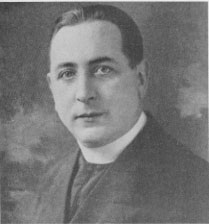
Francis X. Weiser, S.J. (1901-86) is better known today among homeschooling Catholic families than liturgical scholars, but his works on the Church calendar were once held in high regard for their erudition and clarity. Weiser’s popular books on Christian festivities and customs played a role in the American Liturgical Movement of the 1950s, and they still serve as a model for balancing scholarly rigor and pastoral sensitivity. In this article, we examine Father Weiser’s life and writings: in the next, his liturgiology.

Early Life
Franz Xavier Weiser was born in Vienna, Austria on March 21, 1901 to Franz S. Weiser and Maria (née Schipp) Weiser. At the time, Vienna was still, as Weiser would later describe it, “the gay capital of a famous empire” and “the great metropolis of music and song.” The pre-war culture of the Imperial City would have a significant impact on Weiser and his authorial ambitions:
You might say that we grew up to the tunes of Haydn, Beethoven, Mozart, Schubert, and Strauss. I have a vague feeling that this atmosphere of culture, music, and art, had much to do with my desire to write. At the age of eight or nine, while still a little boy in grammar school, I used to ask God daily in my evening prayer to “let me write books.”
Another formative influence on Weiser was domestic devotional practices. Joseph Ratzinger, who lived only a few miles from the Austrian border in a similar Catholic milieu, writes in his autobiography: “The Church year gave the time its rhythm, and I experienced that with great gratitude and joy already as a child, indeed, above all as a child.” As a boy Ratzinger was particularly fond of the liturgies and Bavarian customs of the Christmas and Easter seasons. “Every new step into the liturgy was a great event for me,” he recalls. “It was a riveting adventure.”
Weiser’s earliest recollections were of a similar kind. One of his first memories was that of his mother Maria making the sign of the cross on his forehead and wishing him good night. “This simple action,” he writes, “taught me more than any words the great truth that parents are God’s representatives.” He learned the same lesson from “an old and very wholesome practice [that] demanded that children, before going to Confession, should ask forgiveness from their parents for offenses and faults committed in the home.” Weiser’s mother was also adept at explaining the meaning of Christian practices to her son. He recalls:
It was the general custom among Catholics to greet priests on the street and in public in order to profess the Faith and show reverence for the holy priesthood. When I was a little boy, my mother told me, “You must always joyfully greet a priest, whether you know him or not. Your Guardian Angel, too, greets the priests with great love and reverence.” These simple words of my mother made a deep impression on me; I never forgot them.
Other memories of Weiser were tied to the liturgical year, such as his family’s observance of name days, the feast day of the saint after whom one is named. Weiser writes:
I remember how from early childhood I went to church with my father every year on the feast of St. Francis Xavier, attending the Holy Sacrifice and later receiving Communion, too. Returning home, I found the table cheerfully decorated with flowers and little presents. Mother, Father, brothers and sisters offered their congratulations. Then we sat down to a joyful breakfast, my proud little self sitting in the place of honor. And all this because centuries ago a wonderful young man in Spain loved God so much that he became a Saint. I cannot express the powerful conviction that filled me every year on this occasion, how great and important it is to become holy. This was one of the eloquent lessons which our religious customs taught me without words, but with an effect greater than many words could achieve. Judging from this aspect, we may truly say that such Catholic customs in the home educate the children more efficiently than the best Catholic teachers could ever do in school.
But perhaps his most important devotional memory is that of the annual visit of St. Nicholas:
I still vividly remember the annual visit of this friendly and saintly figure on the evening of December 5. With joy and happy excitement we awaited his coming. We were convinced, as little children easily are, that he really was our great Patron Saint who came from Heaven on his feast day to visit us children whom he loved so much. With utter sincerity we promised him to overcome our faults, to obey our parents and to prepare our hearts for Christmas. Gratefully we accepted his gifts and kissed the ring on his holy hand. Never again in all my life have I experienced the unspeakable thrill of a physical nearness to Heaven as I did on those evenings of my childhood when “St. Nicholas” came to us. When I later found out that it was not really the Saint but a man representing him, this caused me no shock or harm. The thrill I had felt remained in my memory and has remained to this day with all its beauty.
Both Ratzinger and Weiser’s childhood memories would presage their later interest in liturgical studies.
Early Writings
Weiser received the standard gymnasium education of his day: Latin at the age of eleven, Greek at fourteen, three years of Italian, and instruction in religion, literature, history, geography, mathematics, physics, chemistry, biology, drawing, music, art appreciation, and singing, all “topped by a two-year course in fundamental philosophy.” But instead of going on to university, he entered the Jesuit novitiate at the age of nineteen. In 1924, he began a seven-year period of matriculation at the University of Innsbruck, ending with doctorates in philosophy, theology, and education/psychology. Among his teachers at Innsbruck was a fellow Austrian Jesuit, the liturgical scholar Josef A. Jungmann. In a brief autobiographical essay Weiser calls these degrees the recorded “fruits” of his studies but adds: “The unrecorded fruit (which is more important), is supposed to have become a part of my personality, and is known only to God.”
Weiser was ordained a priest on July 26, 1930 at Holy Trinity Church in Innsbruck. The next year he began his tertianship, the third stage of probation and a special year of spiritual training for Jesuits before they take their final vows, at the novitiate of St. Andrew-on-Hudson in Hyde Park, New York. During his time in the United States, he took courses at nearby Marist College in Poughkeepsie and visited St. Louis University and the Missouri countryside.
Weiser’s superiors encouraged him to pursue his childhood interest in writing, and soon he was an accomplished author. He published eight books between 1927 and 1931: three biographies (of Jesuit missionaries Johann Grueber and Blessed Charles Spinola and the Jesuit martyr Miguel Pro), four novels, and a history of a German Catholic student association in Prague called Nordgau. His novels from this period include Der Sohn des weißen Häuptlings (The Son of the White Chief), Alfreds Geheimnis (Alfred’s Secret), Walter Klingers Weltfahrt (Walter Klinger’s World Tour), and Das Licht der Berge: Aus dem Leben eines jungen Menschen (The Light on the Mountains: From the Life of a Young Person). Das Licht remains Weiser’s most popular book: it went through thirty-eight editions in German between 1931 and 1998, sold over one million copies, and has been translated into thirty languages. The International Companion Encyclopedia of Children’s Literature (2004) designates the book as a Bildungsroman in which
Hein Moll, a boy from Tirol, is confronted in the capital Vienna with a number of fundamental issues. By trial and error he finds the strength to remain faithful to his Christian ideals. In this type of traditional novel a priest often acts as an adviser. In more recent juvenile fiction religion no longer forms the familiar setting in which the young characters grow up.
Vienna, 1932-38
In 1932 Weiser returned to Vienna, where he served as the national moderator of Austria’s Marian Congregations (a student sodality run by the Society of Jesus) and the editor of their monthly magazine Unsere Fahne (Our Flag). The two positions dovetailed nicely with his already-apparent interest in youth formation through juvenile fiction and inspirational biography. By the time he left Vienna in 1938, he had written another sixteen books: biographies, novels, plays, travelogues, and a scholarly monograph on a German dialect that is still being cited in linguistic studies.
Several of Weiser’s works during this time owe their inspiration to his stay in America. His 1933 Im Lande des Sternenbanners (In the Land of the Star-Spangled Banner) is a travelogue while his 1936 Amerikanisches Tagebuch (American Diary) draws from his trip to Missouri in order to reminisce “on the exploits of pioneer Jesuit missionaries such as Father De Smet and Father Franz Xaver Weninger.” Weiser also published separate biographies on DeSmet and Weninger along with a biography of Jesuit Father James Bouchard (a Delaware Indian originally named Watomika) and the Jesuit martyr Jean de Brebeuf.
The Anschluss, the War, and Its Aftermath
Most likely it was Weiser’s prior experience with and fondness of America that influenced his decision of where to go when Nazi Germany annexed his homeland on March 12, 1938. Although some members of the Austrian episcopate welcomed the “union of Greater Germany,” it was clear to Weiser that “Catholic youth work” would be “made well-nigh impossible” by Nazi occupation. By year’s end he moved to America. Drawing from an uncited source, the German-language edition of Wikipedia states that “Francis Weiser was sent by his order to the United States in 1938 to study the history of the Jesuit mission in North America” while the Jesuit Archives asserts that he “fled to the United States.” Weiser himself simply writes: “I ‘returned’ to the United States that same year and have remained here ever since.”
In 1938, Weiser was appointed associate pastor of St. Ann Church in Buffalo, New York. The following year, he was transferred to Boston to become the associate pastor of Holy Trinity Church, a parish of 490 families and two schools with 400 students that primarily served German Americans. When the pastor’s health began to decline in 1943, Weiser was made his successor and remained pastor of Holy Trinity until 1950.
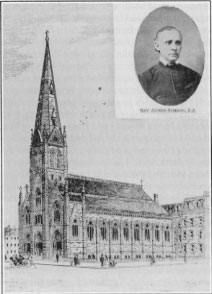
Weiser thus had the unenviable position of shepherding a German parish in the United States during World War II, a time when anti-German sentiment ran high. But he made the best of these “bittersweet years.” A history of Holy Trinity published in 1994 describes him as “an intellectual of the first rank” who “was an extremely active pastor.” In 1944, the parish’s week-long celebration of their centennial included several Missae cantatae and a Solemn High Mass, visits from local dignitaries such as the mayor of Boston and archdiocesan administrator Richard J. Cushing (later cardinal), and a special concert featuring some personal friends of Weiser who had likewise fled the Anschluss and emigrated to New England: the Von Trapp Family Singers. (I have also heard from former Holy Trinity parishioners that the Trapps, who lived in Stowe, Vermont, would serve in the choir for a High Mass anytime Fr. Weiser needed them for a special occasion).
The centennial would prompt Weiser to write his only book during the war, a history of Holy Trinity. In the preface he evinces, as he did in his autobiography, an appreciation of external accomplishments coupled with an awareness of the primacy of “unrecorded fruits” in the interior life:
The history of the parish possesses an (sic) unique interest. Naturally, its first and foremost achievement as a Catholic parish will always remain hidden within the sphere of personal religious life, but its external activities exhibit features which will engage the attention not only of its own parishioners but of all Catholics.
The Von Trapps
In this brief monograph Weiser also took advantage of his friendship with the von Trapps; the illustrations were drawn by their daughter Agathe. And after Captain Georg von Trapp passed away in 1947, Weiser dedicated his Christmas Book to him. In addition to his regular pastoral duties, Weiser helped found the Massachusetts branch of the National Catholic Women’s Union and soon became their National Spiritual Director (a position he would hold for twenty years) and the National Youth Director of both the National Catholic Women’s Union and the National Catholic Central Union of America. he also served as auxiliary chaplain to German POWs at Fort Devens from 1943 until 1945.
But it was after the war that his activities reached a new level. Stories began to reach the U.S. of nuns starving to death and of Soviet troops raping and plundering in Austria and Germany; Weiser’s beloved Vienna was designated by a United Press International report as the hungriest capital in Europe. Under Weiser’s leadership, Holy Trinity became the premier parish in the United States for European war relief. In May 1946, the archbishop of Boston, recognizing his efforts, named him the official representative of the archdiocese for relief work for the national Catholic Welfare Conference in Germany and Austria. Between 1946 and 1949, the Holy Trinity rectory was stacked high with packages of food and clothing to be shipped to Europe as Weiser answered 25,200 letters from Europe begging for assistance. During this period, Holy Trinity raised $85,000 ($1,126,075 in today’s money) for the purchase of food and medicine and shipped almost 500,000 pounds of clothing and shoes and almost 18,000 cans of food. In recognition of his relief work and his impact on German youth in the 1920s and 30s, Weiser was awarded the Order of Merit First Class by the Federal Republic of Germany in 1957.
Return to Academia
Weiser returned to juvenile fiction with his 1949 Rothäute und Bleichgesichter (Redskins and Palefaces). Over the next thirteen years he would produce a steady stream of publications similar in kind to his prewar output: biographies of Jesuit missionaries, Bildungsromane, etc. All of them were still in German, although one of them, his travelogue to the Holy Land, later appeared in English. During this same period Weiser also had a minor influence on film. His 1936 Het lied van de Donau (The Song of the Danube) was the inspiration for the 1947 Dutch movie Jeugdstorm (Youth Storm), and his children’s classic The Light of the Mountains was made into a German film in 1955 titled Het licht der bergen. According to the Internet Movie Database, Weiser is credited as a writer on a total of three movies. The final entry in his filmography, in which he is listed as the screenplay’s sole author, is a 1965 Yugoslavian television movie Sasvim Malo Skretanje (Quite a Little Turn).
Weiser continued his work in charitable services, administering the funds of the St. Joseph’s Mission Fund from 1950 to 1968. The 1950s would mark two major developments in his life. In 1950 he earned a second doctorate in theology from the Gregorian University in Rome. Upon his return to the U.S. (by now an American citizen), he held academic instead of parochial positions. From 1950 to 1961 he was a professor of Philosophy and German at Emmanuel College (a women’s college in Boston founded by the Sisters of Notre Dame de Namur), and around the same time he also taught at Weston College, a Jesuit institution in Weston, Massachusetts. After Weston was integrated into Boston College in 1959, Weiser became a Spiritual Counselor in the Boston College School of Education (which had an all-female student body) from 1961-70. At Boston College he also taught courses in ethics, philosophy, and theology. By 1957, he was referring to himself as “a college professor by duty and habit.”
Boston College Emeritus Professor Mary T. Kinnane describes Weiser as “somewhat larger than life” and an “excellent colleague and a good friend.” She adds:
He was a distinguished international scholar in Linguistic Philosophy with a doctoral degree from the University of Innsbruck, Austria, and the Gregorian in Rome. He had a diverse background in counseling as a Church pastor for eleven years and was a college professor for thirteen years. He had been Chaplain to the Von Trapp family, both in Austria and the United States.
Father Weiser was a proud man, with a marvelous humility in speech and mien. His books, The Christmas Book and Easter Book, are popular purchases at the Holy Seasons since they are especially rich in explaining the symbols of the seasons, their origins, and their spiritual importance. His account of the Holy Land is also impressive. As the speaker at School of Education Christmas Assemblies in Campion Hall, he explained the origins of the Christmas tree and its lighted decoration (“O Tannenbaum!”), and the angelic symbol of the pretzel! One short anecdote should be recalled since it represented Father’s attention to detail in the area of housekeeping. Twice a week, Father would suggest we have a simple lunch of soup and sandwich in his office, usually to discuss our programs for students, students with special needs, or our policy on student life and whatever agenda were pertinent. An early arrival to his office would find Father with large pieces of felt-like material attached to his shoes as he moved around rhythmically to polish his ever-shiny floor. How fortunate we all were and are to have been able to share the life of such fine and distinctive, marvelous Jesuits. How enriching for students and all!
Weiser influenced other students in the area as well. New Testament scholar Pheme Perkins (current Joseph Professor of Catholic Spirituality at Boston College) met him when she was just “a high school kid”:
He would come to give a talk at my best friend’s grandmother’s house in Wayland [Massachusetts] one evening a month to a group of conservative lay Catholics. We would get out of school to go out there, so we could ride her horses, go to the talk, spend the night, and get returned to the prep school the next day. Neither of us were Catholic.
After I became a Catholic my freshman year in college when I was seventeen, Fr. Weiser was my spiritual director, also aiding my German reading with a combination of the pious young adult novels he wrote (don’t remember a thing about them now) and his copies of Orientierung. He had been in the Jesuits with Hugo Rahner, so discussions of Karl Rahner were often filtered through Hugo who could actually write much better German! When I started a New Testament doctoral program after college, I was treated [by Fr. Weiser] to a slew of anti-Bultmann articles.
The Liturgical Turn
Kinnane’s allusion to The Christmas Book and The Easter Book brings us to the second major development in Weiser’s life at this time, his turn to heortology. He himself defines the field as “the historical science that explains the origin and meaning of feasts. The word ‘heortology’ is derived from the Greek heorte (feast) and logos (discourse).” And for him at least, that discourse includes not only “the origin, history, development, and observance” of Christian feasts but “their celebration in folklore” as well. It was Weiser’s experience of America that generated his interest in the topic. He writes:
I was deeply impressed by many aspects of American life. Among them was the charming sight of the popular Christmas celebration. This tradition had been molded into one unit out of the best national Christmas lore of various immigrant groups. It was only during the second half of the last century that our American Christmas observance came to be established.
Soon I discovered that most people have no clear notion of the origin, background, and true meaning of these customs which they observe in their homes. Since the great majority of our Christmas, Easter, Thanksgiving, and other observances actually go back to the inspiration of liturgical thought and symbolism, I judged it a worthwhile subject to explain. Also a priestly subject; for, given the fact that our popular customs contain the radiation of the liturgy, the understanding of this radiation would make the celebration of our Christian feasts within the family warmer, holier, and more truly joyful. At the same time, a better grasp of the religious meaning and message of our family customs would give parents valuable help for the religious training of their little ones.
Weiser used his spare time to research, and very often he felt like abandoning the project because of the difficulty in finding reliable source material. It took him six years, but in the end he had published five books: The Christmas Book in 1952, The Easter Book in 1954, The Holyday Book and Religious Customs in the Family in 1956, and The Handbook of Christian Feasts and Customs: The Year of the Lord in Liturgy and Folklore (a compendium of the first three).
Next week, we will examine the characteristics of Fr. Weiser’s liturgical theology.
A version of this article (with full annotation) appeared as “The Domestic Heortologist: An Introduction to Francis X. Weiser, S.J.” in Antiphon: A Journal of Liturgical Renewal 29:2 (2025), pp. 144-171. Many thanks to its editors for allowing its publication here.

Tuesday, December 16, 2025

Did St Pius V Mandate That All Masses Be Celebrated in the Morning?

The short answer is, No, he did not.

A friend recently sent me a question about an old article of mine (the best way to flatter an author’s vanity!), titled “Vespers in the Morning?”, in which among other things, I explained the very ancient custom by which Mass was traditionally celebrated after either Terce, Sext or None, according to the quality of the liturgical day: after Terce on Sundays and greater feasts, after Sext on ferias and lesser feasts, and after None on vigils and fast days.

Folio 1v of the Gellone Sacramentary, ca 780 AD., with the rubric before the Mass of Christmas Eve, “On the vigil of the birth of the Lord, at the ninth hour, (station) at St Mary (Major.)” In the ancient liturgical books of the Roman Rite, the year begins with Christmas Eve, and ends with Advent. (Bibliothèque nationale de France. Département des Manuscrits. Latin 12048)
I should add first that this is now a strictly historical question, since this discipline no longer obtains in any form in the Roman Rite. Furthermore, what is said here applies to conventual and solemn Masses, but not to private Masses. Regarding the latter, the rubric in the Roman Missal “on the hour of celebrating Mass” stated they had to be celebrated after the recitation of Matins and Lauds, anytime from one hour before dawn until noon. (Noon was the latest permitted starting time, so ending by about 1 p.m. at the latest.)
My friend’s question was, Why did St Pius V impose noon as the latest starting time for the Easter Vigil? to which I replied that I was not aware that he had made any such imposition. He then directed me to some articles which made this claim, citing the bull Sanctissimus, issued on March 29, 1566. (Cherubini, Magnum Bullarium Romanum, vol. 2, p. 178; Lyon, 1682.) But it is a misinterpretation to assert that this bull mandates that all Masses be celebrated before noon. It does not. What it does is revoke a privilege by which some Masses were celebrated in the evening, which is not the same thing.
It must be borne in mind that curial documents of all sorts, not just bulls, were written by canon lawyers trained to be very precise in their language, and they must therefore be read very precisely. If something is not mentioned by a document, then that document is not relevant to it. One cannot treat the admission as accidental, or extrapolate from the text beyond the strict bounds of its letter to apply it to something to which it does not expressly refer.
Portrait of St Pius V, by the Venetian painter Iacopo Negretti, generally known Palma il Giovane (1548/50-1628).
That being said, Sanctissimus begins by explaining that some rectors and superiors of various kinds of churches have obtained permissions to celebrate the midnight and dawn Masses of Christmas, the Mass of Easter morning, “and perhaps (the Masses) of other festivities… late (de sero), perhaps also around sunset of the vigils of these same feasts.”
Note that the only Masses which are specifically mentioned here are those of feasts, specifically, those of Christmas and Easter, “perhaps” some others. In the first place, therefore, this bull is relevant only to the hour at which feasts are celebrated. It has nothing to do with those of ferias, vigils and fast days, including Holy Saturday, the occasion for my friend’s question.
Secondly, the bull declares that all such permissions are permanently revoked, and must no longer be used as a pretext to celebrate Masses “vespertino tempore – in the evening.” But the sixth hour, after which the Masses of lesser feasts and ferias are celebrated, is not in the evening; it is at noon. Likewise, the ninth hour, after which the Masses of vigils and fast days are celebrated, is also not in the evening; it is in the mid-afternoon. So even if the restriction were applied to such Masses other than those of major feasts, it would not prohibit their celebration after noon or around 3 p.m.
Third, that is the end of what the bull orders; the rest is a standard legal “anything to the contrary notwithstanding” formula, and the decree for promulgation. The bull makes no mention of a positive mandate to say all Masses in the morning hours, contrary to the letter of the pertinent rubric in the Missal itself (which, by the way, was promulgated after the bull, by the very same authority.) Therefore, as I stated in the article linked above, a religious community of any sort was always free to observe the ancient discipline on Holy Saturday and other fast days, that is, to say None, Mass and Vespers at the appropriate time in the afternoon.
The papal chancery in Rome, in an engraving by the Italian artist Giuseppe Vasi (1710-82); in St Pius V’s time, official documents of the Holy See were often formally promulgated by affixing a copy of them to the doors of this and various other buildings.
In passing, I note that less than five months later, in the bull Providentia, St Pius V also permanently (“perpetuo”) revoked all faculties for clerics of the Roman Rite to celebrate the Byzantine Rite, and vice versa, using very similar language. (A good portion of this bull is copied word-for-word from Sanctissimus.) It would obviously be rash to claim on the basis of this one document that no such faculties were or could ever be granted again. One should always be very careful and precise in treating all such documents.

Friday, December 16, 2022

Announcing a Comprehensive Canonical Critique of “Traditionis Custodes”

As readers of NLM are too well aware, Pope Francis's apostolic letter Traditionis Custodes aimed at a drastic reduction of the use of the traditional Roman liturgy. In a letter to the bishops published on the same day, the pope explained at length the reasons for his decision. The harsh measures, in tandem with the violent and accusatory tone of the accompanying letter, have aroused consternation among the faithful who are attached to the usus antiquior. The Responsa ad Dubia issued in December of 2021 by the Congregation for Divine Worship and the Discipline of the Sacraments, so far from clarifying matters, only intensified the growing dismay and debate.

The inaccuracies, difficulties of interpretation, and problems of concrete application of Traditionis Custodes have meanwhile raised many questions among canonists, pastors, and institutes whose proper law binds them to the liturgical forms of the Latin tradition.

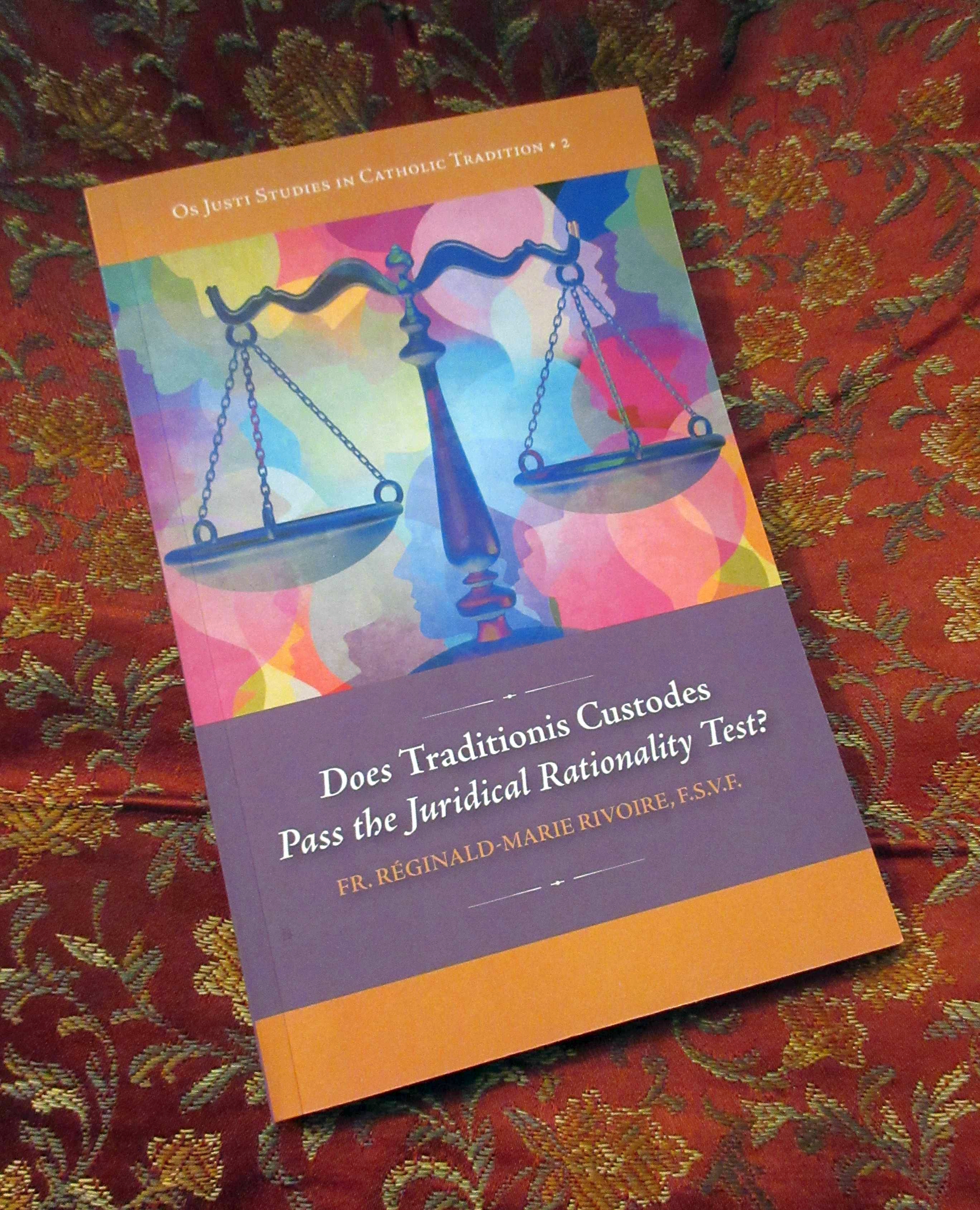
It was time for a competent canonist to write a full critique of the letter. This was done by canon lawyer Fr. Réginald-Marie Rivoire, F.S.V.F., who in a lengthy French article undertook a careful canonical reading of these documents, chiefly from the point of view of their "juridical rationality." It is well known that rationality is one of the essential characteristics of a legal norm, such that strictly speaking, an irrational norm is not a norm and does not bind.

I am happy to share at NLM that an authorized English translation of this tract has now been published as part of the "Os Justi Studies in Catholic Tradition" series launched by my publishing house, Os Justi Press. The work is entitled (simply enough): "Does Traditionis Custodes Pass the Juridical Rationality Test?" 

First, Fr. Rivoire considers the legal status of the documents; then, the affirmation at the heart of this whole legal apparatus and its raison d’être, namely, that the liturgical books promulgated by Paul VI and John Paul II are the sole expression of the lex orandi of the Roman Rite; and finally, the way in which numerous fundamental principles and precepts of canon law are undermined by the new norms. Nearly every point I have seen made piecemeal elsewhere by canonists is found here, integrated within a total structure. It's just under 100 pages.

The book is available in paperback or electronically, either from the publisher directly (here) or from Amazon.com (here) and its affiliates around the world. I see other online sites carrying it as well.

This tract would make a good gift for a sympathetic priest, a friendly bishop, a canon lawyer, a local Una Voce chapter, etc. The Table of Content and the Introduction may be found as a PDF here.

ABOUT THE AUTHOR: Fr. Réginald-Marie Rivoire of the Fraternity of St. Vincent Ferrer is a graduate of the Institut d’Etudes Politiques of Paris and holds a doctorate in canon law from the Pontifical University of the Holy Cross in Rome. He is the Master of Novices at the Friary of St. Thomas Aquinas in Chémeré-le-Roi and Defender of the Bond and Promoter of Justice at the ecclesiastical Tribunal of Rennes. He teaches canon law in various religious institutes.

Os Justi Press also publishes works like:

and others of liturgical, dogmatic, and literary interest. Please take a moment to visit the new website. All Os Justi titles are also available via Amazon.

Friday, July 09, 2021

The Legal Achievement of Summorum Pontificum : Reprint from 2017

In recent days, with the rumors of a possible suppression or rollback of Summorum Pontificum, there has been a great deal of discussion about its status and meaning. I therefore thought it might be useful to reprint this consideration of the matter, originally published on the tenth anniversary. The short version is that the motu proprio is not a document about the history of the liturgy, but a legal provision, and should be read and understood as such.

UPDATE: I also happened to remember today this statement on the subject by a French Dominican, Fr Thierry-Dominique Humbrecht, which is very well worth considering. “The liturgical pluralism of the two states of the Roman Rite is perhaps harmful, but it is the consequence of a savage rupture in the liturgy, which is even more damaging, and the official light which has been put on it is still too timid.” (Le pluralisme liturgique des deux états du rite romain est peut-être dommageable, mais il est la conséquence d’un éclatement liturgique sauvage, plus dommageable encore, sur lequel la lumière officielle est encore trop timidement faite.)”

I propose here to consider what Pope Benedict XVI meant, and what he achieved, by categorizing the traditional Roman Mass and the post-conciliar reform of it as two Forms of the same Rite, the one Extraordinary and the other Ordinary. Before doing that, I believe it is necessary to establish a distinction between the terms which have historically been used to describe variations within a liturgy or liturgical family, namely, Rite and Use.

To the best of my knowledge, the distinction between Rite and Use has not been officially laid out anywhere in law by the Church; this is therefore purely my take on the matter.

For clarity’s sake, the variants of the same Rite should properly be called Uses, like the Sarum Use or Carmelite Use; this is what they were most commonly called before the Tridentine reform. For example, the frontispiece of the Sarum Missal says “Missale ad usum insignis ecclesiae Sarisburiensis – the Missal according to the Use of the famous church of Salisbury.”
The frontispiece of a Sarum Missal printed at Paris in 1555.
It is true that even before Trent, there was some confusion between these terms, and Rite was occasionally said instead of Use; after Trent, the term Use became rare. The terminology was certainly never uniform, and many liturgical books do not use either term, and have just an adjective modifying the words Missale, Breviarium etc. The Dominicans said either “according to the Sacred Order of Preachers,” or “according to the Rite of the Sacred Order of Preachers.”

On the left, the beginning of the pre-Tridentine Missal “according to the Use of the renowned church of Liège.” On the right, the frontispiece of a post-Tridentine edition of the “Breviarium Leodiense - Breviary of Liège”; “Leodiensis” is the adjectival form of the city’s name in Latin, Leodium. In French, this could be translated more literally as “Bréviaire Liégeois.” 
However, if we wish to establish a distinction between different liturgies on the one hand, and variants within a given liturgy on the other, while still keeping to some kind of historical terminology, it seems obvious that Rite is the more appropriate for the former, and Use for the latter. It would be absurd to describe the liturgies of the Eastern churches as “the Byzantine Use, the Coptic Use etc.,” when comparing them to “the Roman Use”; they are clearly and entirely different Rites. “Use”, on the other hand, was the predominant term for variants of the Roman Rite when there were many such variants celebrated throughout Western Europe.

All of the essential characteristics of the Roman Rite, such as the Ordo Missae and the structure of the Office, are the same from one Use to the other. They are not the same in other Rites. This applies not just to the Canon, but the whole structure of the Mass: Introit, Kyrie, Gloria, Collect(s), Epistle, Gradual, Alleluia etc. With minor variations, which are more variations of order than of wording, the bulk of the liturgical texts is the same as well. Searching through every missal or antiphonary of every Use of the Roman Rite, one will find the Introit Ad te levavi on the First Sunday of Advent, Populus Sion on the Second, etc. It is true that some of the later features of the Rite, mostly notably the Offertory prayers and the Sequences, differ considerably from one Use to another. These variations are nevertheless confined within certain clearly recognizable limits, have much in common with one another, and can therefore be grouped into families.

Furthermore, any proper Mass or Office written for one Use can be transposed into any of the others with no difficulty at all. (The same is true for any set of Offertory prayers or any Sequence.) For example, St Thomas Aquinas was a Dominican, and wrote the Office and Mass of Corpus Christi according to the medieval French Use followed by his order. (The Office had nine responsories at Matins, rather than eight as in the Roman Use, a versicle between Matins and Lauds, etc.) Almost nothing needed to be done to adjust these texts for the Missal and Breviary according to the “Use of the Roman Curia”, which in the Tridentine reform became the Missal and Breviary of St Pius V.

However, when the Mass of Corpus Christi was added to the Ambrosian Rite, all kinds of adjustments had to be made: the addition of a first reading, the antiphon after the Gospel, the Oratio super sindonem, and the Transitorium, none of which exist in the Roman Rite, and the removal of the Sequence, which has never existed in the Ambrosian Rite. Vice versa, if one wanted to take the Ambrosian Mass of St Ambrose, for example, and transpose it into the Roman Rite, one would need to change it very considerably, adding a psalm verse and Gloria to the Ingressa to make an Introit, and removing the first reading, the antiphon after the Gospel, the Oratio super sindonem, and the Transitorium.

If we accept these definitions of Rite and Use, it seems to me very clear that neither of them is appropriate to describe the relationship between what we now call the two Forms of the Roman Rite. On the very basic level of what we usually see and hear in a Mass of the Ordinary Form and a Mass of the Extraordinary Form, they immediately appear to be two different Rites. The liturgist Fr Joseph Gelineau SJ famously declared à propos of the reformed Mass, “This needs to be said without ambiguity: the Roman Rite as we knew it no longer exists. It has been destroyed.” A statement of this sort cannot be glossed over as just the opinion of a single man; Fr Gelineau was a prominent figure in the liturgical reform, and highly esteemed by its most famous architect, Archbishop Annibale Bugnini. Similar statements, pro and con, have been made by many others. I cannot imagine any serious liturgical scholar applying similar language to any previous change within the Roman Rite.

On the basis of my transposition argument given above, (texts can easily be moved from one Use to another, but can be moved from one Rite to another much less easily, or not at all), it can be said that the EF and OF do share a certain identity. Most of any given block of Mass texts can be moved from one to the other fairly easily, or at least, much more easily than they could be moved between the Byzantine and Ambrosian Rites. However, considering that the post-conciliar reform was a far greater displacement of liturgical texts than had ever taken place before in the Roman Rite, and the significant ritual differences, it is much harder to argue that the EF and OF share an identity. Historically, this is an absolutely anomalous situation; there has never been a case of two Rites or Uses which shared so much and yet were so radically different.

Because of this, the identity of the two Forms of a single Rite as established by Summorum Pontificum has sometimes been described as a “legal fiction.” I submit that this is a wholly appropriate way of describing the situation, that the identity of the two Forms as a single Rite IS a legal fiction, and that this is a good thing.

A legal fiction is not the same thing as a lie. Adoption, for example, is a legal fiction, which states that in terms of law, this person is the child of that person. This is most emphatically not a false statement, even though the adopted child is not the natural offspring of the parent. The law’s recognition of the bond between a parent and child is perhaps the least significant thing about it, precisely because it does not create such a bond and cannot dissolve it. In this sense, adoption simply declares that the absence of a genetic relationship between two specific people is legally irrelevant, and that a parent-child relationship exists between them.

In a similar way, Pope Benedict’s action in creating two “Forms” was not intended to speak to the relationship between the EF and OF as a matter of liturgical or historical scholarship, but solely as a description of the relationship between them in law. It simply declares that the tenuous relationship between the two Forms is legally irrelevant.

As a matter of law, a priest of one Rite needs special faculties to celebrate Mass in another. This is a useful and perfectly sensible legal provision for a variety of reasons, and a long-standing one, but hardly a moral necessity per se; where deemed pastorally useful, the Church has been fairly flexible in granting such faculties. However, the whole point of Summorum Pontificum was to establish that a priest of the Roman Rite does not need any special faculty or permission to say the Mass according to the traditional Missal, as was the case under the indult Ecclesia Dei. I believe that Pope Benedict acted very wisely and conscientiously in adopting a completely different category from any other previously used, Form instead of Use or Rite, to get around an important legal problem, namely, that by any other solution, he would have made the vast majority of Catholic priests “bi-ritual.” That would have been a legal abomination without precedent.

Thursday, December 20, 2018

Divini Cultus, Pope Pius XI’s Apostolic Constitution on Sacred Music

Today marks the 90th anniverary of the publication of Divini Cultus, an Apostolic Constutition issued by Pope Pius XI to commemorate the 25th anniversary of St Pius X’s motu proprio Tra le sollecitudini. Although the post-Conciliar reform was effected with almost total disregard for earlier legislation and magisterial pronouncements on the liturgy, as an Apostolic Constitution, this remains part of the law of the Church to this day, no less than the motu proprio which inspired it. It is very much to be hoped that when the time comes to reform the liturgy properly (which it most surely will, though we know not the day nor the hour), the Church will take the wisdom of this document into serious consideration, particularly in regard to the importance it lays on the training of the clergy in the field of sacred music, and the importance of the public celebration of the Divine Office. We here present some excerpts from an English translation published on the website of the Adoremus Bulletin, where you can read the complete text; the Latin original is available on the Vatican website. (h/t Nicola.)

Public domain image from Wikipedia
“... No wonder, then, that the Roman Pontiffs have been so solicitous to safeguard and protect the Liturgy. They have used the same care in making laws for the regulation of the Liturgy, in preserving it from adulteration, as they have in giving accurate expression to the dogmas of the faith. This is the reason why the Fathers made both spoken and written commentary upon the Liturgy or “the law of worship”; for this reason the Council of Trent ordained that the Liturgy should be expounded and explained to the faithful.

In our times too, the chief object of Pope Pius X, in the Motu Proprio Tra Le Sollecitudini which he issued twenty-five years ago, making certain prescriptions concerning Gregorian Chant and sacred music, was to arouse and foster a Christian spirit in the faithful, by wisely excluding all that might ill befit the sacredness and majesty of our churches. The faithful come to church in order to derive piety from its chief source, by taking an active part in the venerated mysteries and the public solemn prayers of the Church. It is of the utmost importance, therefore, that anything that is used to adorn the Liturgy should be controlled by the Church, so that the arts may take their proper place as most noble ministers in sacred worship.

Far from resulting in a loss to art, such an arrangement will certainly make for the greater splendor and dignity of the arts that are used in the Church. This has been especially true of sacred music. Wherever the regulations on this subject have been carefully observed, a new life has been given to this delightful art, and the spirit of religion has prospered; the faithful have gained a deeper understanding of the sacred Liturgy, and have taken part with greater zest in the ceremonies of the Mass, in the singing of the psalms and the public prayers. ...

It is, however, to be deplored that these most wise laws in some places have not been fully observed, and therefore their intended results not obtained. We know that some have declared that these laws, though so solemnly promulgated, were not binding upon their obedience. Others obeyed them at first, but have since come gradually to give countenance to a type of music which should be altogether banned from our churches. ...

In order to urge the clergy and faithful to a more scrupulous observance of these laws and directions which are to be carefully obeyed by the whole Church, We think it opportune to set down here something of the fruits of Our experience during the last twenty-five years. ...

We wish, then, to make certain recommendations to the bishops and ordinaries, whose duty it is, since they are the custodians of the Liturgy, to promote ecclesiastical art. ...

Holy Thursday in the Sistine Chapel in the reign of Pope Pius XI
All those who aspire to the priesthood, whether in seminaries or in religious houses, from their earliest years are to be taught Gregorian Chant and sacred music. At that age they are able more easily to learn to sing, and to modify, if not entirely to overcome, any defects in their voices, which in later years would be quite incurable. Instruction in music and singing must be begun in the elementary, and continued in the higher classes. In this way, those who are about to receive sacred orders, having become gradually experienced in chant, will be able during their theological course quite easily to undertake the higher and “aesthetic” study of plainsong and sacred music, of polyphony and the organ, concerning which the clergy certainly ought to have a thorough knowledge.

In seminaries, and in other houses of study for the formation of the clergy both secular and regular there should be a frequent and almost daily lecture or practice — however short — in Gregorian Chant and sacred music. ... Thus a more complete education of both branches of the clergy in liturgical music will result in the restoration to its former dignity and splendor of the choral Office, a most important part of divine worship; moreover, the scholae and choirs will be invested again with their ancient glory.

Those who are responsible for, and engaged in divine worship in basilicas and cathedrals, in collegiate and conventual churches of religious, should use all their endeavors to see that the choral Office is carried out duly — i.e. in accordance with the prescriptions of the Church. And this, not only as regards the precept of reciting the divine Office “worthily, attentive and devoutly”, but also as regards the chant. ...

... it should be observed that, according to the ancient discipline of the Church and the constitutions of chapters still in force, all those at least who are bound to office in choir, are obliged to be familiar with Gregorian Chant. ...

We wish here to recommend, to those whom it may concern, the formation of choirs. These in the course of time came to replace the ancient scholae and were established in the basilicas and greater churches especially for the singing of polyphonic music. Sacred polyphony, We may here remark, is rightly held second only to Gregorian Chant. We are desirous, therefore, that such choirs, as they flourished from the fourteenth to the sixteenth century, should now also be created anew and prosper especially in churches where the scale on which the Liturgy is carried out demands a greater number and a more careful selection of singers.

Choir-schools for boys should be established not only for the greater churches and cathedrals, but also for smaller parish churches. The boys should be taught by the choirmaster to sing properly, so that, in accordance with the ancient custom of the Church, they may sing in the choir with the men, especially as in polyphonic music the highest part, the ..., ought to be sung by boys. Choir-boys, especially in the sixteenth century, have given us masters of polyphony: first and foremost among them, the great Palestrina. ...

The traditionally appropriate musical instrument of the Church is the organ, which, by reason of its extraordinary grandeur and majesty, has been considered a worthy adjunct to the Liturgy, ... We wish, within the limits prescribed by the Liturgy, to encourage the development of all that concerns the organ; but We cannot but lament the fact that, as in the case of certain types of music which the Church has rightly forbidden in the past, so now attempts are being made to introduce a profane spirit into the Church by modern forms of music; which forms, if they begin to enter in, the Church would likewise be bound to condemn. Let our churches resound with organ-music that gives expression to the majesty of the edifice and breathes the sacredness of the religious rites; in this way will the art both of those who build the organs and of those who play them flourish afresh and render effective service to the sacred liturgy.
A Mass coram Summo Pontifice at the Dominican church of Santa Maria sopra Minerva in Rome, celebrated on the occasion of Pope Pius XII’s proclamation of Ss Catherine of Siena and Francis of Assisi as the Patron Saints of Italy. (Courtesy of the Liturgical Arts Journal, via their Facebook page.)
In order that the faithful may more actively participate in divine worship, let them be made once more to sing the Gregorian Chant, so far as it belongs to them to take part in it. It is most important that when the faithful assist at the sacred ceremonies, or when pious sodalities take part with the clergy in a procession, they should not be merely detached and silent spectators, but, filled with a deep sense of the beauty of the Liturgy, they should sing alternately with the clergy or the choir, as it is prescribed. If this is done, then it will no longer happen that the people either make no answer at all to the public prayers — whether in the language of the Liturgy or in the vernacular — or at best utter the responses in a low and subdued manner.

Let the clergy, both secular and regular, under the lead of their bishops and ordinaries devote their energies either directly, or through other trained teachers, to instructing the people in the Liturgy and in music, as being matters closely associated with Christian doctrine. This will be best effected by teaching liturgical chant in schools, pious confraternities and similar associations. Religious communities of men and women should devote particular attention to the achievement of this purpose in the various educational institutions committed to their care....

We are well aware that the fulfillment of these injunctions will entail great trouble and labor. But do we not all know how many artistic works our forefathers, undaunted by difficulties, have handed down to posterity, imbued as they were with pious zeal and with the spirit of the Liturgy? Nor is this to be wondered at; for anything that is the fruit of the interior life of the Church surpasses even the most perfect works of this world. Let the difficulties of this sacred task, far from deterring, rather stimulate and encourage the bishops of the Church, who, by their universal and unfailing obedience to Our behests, will render to the Sovereign Bishop a service most worthy of their episcopal office.”

Monday, June 11, 2018

Traditional Clergy: Please Stop Making “Pastoral Adaptations”

The Gospel being read in French, versus populum, at the Solemn Pontifical Mass
Over the past twenty-five years, I have assisted at traditional Latin Masses in many states and countries. What I have seen has largely been edifying: clergy who love the liturgy, offering it in accord with its Roman spirit and the appropriate rubrics, and faithful who are grateful to have access to this powerhouse of sanctity.

But there are some shadows as well.

A friend shared with me the video of the traditional Pontifical Mass celebrated by Robert Cardinal Sarah in Chartres cathedral. It was going along magnificently, as one would have every reason to expect from this crown jewel of the Latin liturgy — until we reach the Lesson and the Gospel (the Epistle may be found at the 1:08:50 mark, the Gospel at 1:17:40, of the above video). At this point, the subdeacon faced the people rather than the East, chanted only the title of the reading in Latin, and proceeded to speak aloud a French translation. The Latin reading was never chanted ad orientem in its ancient and thrilling tone. Then along came the deacon, and instead of chanting the Gospel in Latin facing northwards, he again faced the people, and after singing the title, proceeding to read the Gospel in French.

This practice is contrary both to the spirit of the ancient Roman liturgy and to the rubrics that govern its celebration. Most recently, in 2011, the Instruction Universae Ecclesiae of the Pontifical Commission Ecclesia Dei states:
26. As foreseen by article 6 of the Motu Proprio Summorum Pontificum, the readings of the Holy Mass of the Missal of 1962 can be proclaimed either solely in the Latin language, or in Latin followed by the vernacular or, in Low Masses, solely in the vernacular.
Only in a Low Mass, therefore, is it permitted to substitute vernacular readings for Latin — and note, it is permitted, not required or recommended. In fact, it is always better practice to read the lessons in Latin first, and then read them in the vernacular from the pulpit if it is judged pastorally wise. But at a High Mass, a fortiori a Solemn High Mass, a fortiori a Pontifical Mass, the readings are always to be sung in Latin, with the correct ceremonial and orientation. What we saw in the Chartres Mass is a liturgical abuse, no different in kind from the host of abuses with which the Novus Ordo is plagued.

This violation of rubrics was no doubt intended as a “pastoral adaptation” or “accommodation.” Nevertheless, it is an example of exactly what we must be careful not to do. Many of the worst aberrations and deviations in the 1960s, when the old Mass was already being subjected to torture and dismemberment, and subsequently the ruinous missal of Paul VI, arose exactly from such supposedly “pastoral considerations.” Fr. Louis Bouyer, who worked at the Bugninian abattoir before regretting his complicity, already caught the whiff of a weird pastoralism in the 1950s. For Bouyer, liturgy is first of all
a given, a traditional given. From a material point of view it is a precisely circumscribed object: the whole of the rites and ceremonies, of readings and prayers that are written down in the books called the Missal, the Breviary, and the Ritual. It is something we can desire to enrich, as every living Christian generation enriches Christian spirituality, Christian morals, even dogma; but it is something that has first to be received, received from the Church.[1]
A major difference between the theology of the classical Roman Rite and that of Paul VI’s modern rite is the difference in how lections are understood. The lections at Mass are not merely instructional or didactic. They are an integral part of the seamless act of worship offered to God in the Holy Sacrifice. The clergy chant the divine words in the presence of their Author as part of the logike latreia, the rational worship, we owe to our Creator and Redeemer. These words are a making-present of the covenant with God, an enactment of their meaning in the sacramental context for which they were intended, a grateful and humble recitation in the sight of God of the truths He has spoken and the good things He has promised (in keeping with Scripture’s manner of praying to God: “Remember, Lord, the promises you have spoken!”), and a form of verbal incense by which we raise our hands to His commandments, as the great Offertory chant has it: “Meditabor in mandatis tuis, quae dilexi valde: et levabo manus meas ad mandata tua, quae dilexi.”

The chanted Latin lection is an expression of adoring love directed to God before it is a communication of knowledge to the people, and the form in which it is done should reflect this primacy. In the ancient liturgy, always and everywhere God enjoys primacy. Nothing is done “simply” for the people. Holy Communion, which is clearly for the benefit of the people, is treated with adoration, reverence, care, and attentive love, being distributed exclusively by the anointed hands of the ordained, on the tongues of the kneeling faithful, with a paten held underneath, and, perhaps, a houseling cloth. All eyes are thus fixed on the Eucharistic Lord, giving Him the primacy that is His due. It should be no different with the utterance of the divine words, in which we find a symbolic incarnation of the Word of God which nourishes our souls in preparation for the divine banquet of the Most Holy Sacrament.[2]

Vernacularization and recitation of the lessons at High Mass betrays the rationalism and utilitarianism of the Synod of Pistoia. The chanting of the Word of God is not just for instruction but also a quasi-sacramental action in and of itself (as Martin Mosebach argues with regard to the use of incense, candles, and the prayer “Per evangelica dicta, deleantur nostra delicta”).[3] It is part of the activity of worship, and like the other prayers of the Mass, it should be set apart by words of a sacral register, hallowed by tradition. No one will complain if this formal liturgical chant, which takes only a few minutes in any case, is followed up with a recitation of the vernacular texts before the homily. But the latter should never be substituted for the former.

I have learned about priests in France and Germany who, in keeping with this cavalier pastoral attitude, also change the “Ecce Agnus Dei” and “Domine non sum dignus” into the vernacular. Seriously: has it ever really caused difficulty for the faithful to understand what is meant by these phrases, which are repeated at every Holy Mass? Additionally, some clergy in Germany, who have apparently learned nothing from the past fifty years, persist in recycling the old saccharine Schubert Masses and other German paraphrases, which they fob off on the people instead of sharing with them the riches of Gregorian chant, as every Pope has urged from 1903 to 2013.[4]

Then there are practical concerns, those stubborn little things known as facts. Congregations who attend the usus antiquior today are often made up of faithful of diverse linguistic backgrounds, because in many locales only a single Latin Mass is available, and all the people of the surrounding territory gather for it. I was recently visiting St. Clement’s in Ottawa, in which about 40% of the faithful are Francophone and 60% are Anglophone. Latin is the common liturgical language that unites them. In the United States, when Hispanic Catholics attend a Latin Mass, the Latin is closer to their native tongue than English. In another city parish of which I am aware, there are families who speak English, Romanian, Polish, Russian, Czech, Italian, and Spanish. Quite apart from fidelity to the rubrics, such situations present a genuine “pastoral” reason for the consistent use of Latin!

In this respect, the Chartres Mass afforded us a spectacular lack of pastoral common sense. This is an international pilgrimage of people for whom French is certainly not a common language. To read the lessons only in French reveals a nationalist, regionalist, and culturally imperialist attitude. As Pope John XXIII noted in Veterum Sapientia, only the use of the venerable and universal Latin tongue is exempt from such problems.

It would be opportune for the Pontifical Commission Ecclesia Dei, as well as religious congregations and societies of apostolic life that utilize the usus antiquior, to monitor such liturgical abuses and correct them before they spread. How can clergy expect the faithful to show due obedience to their fathers in Christ, if these same fathers are not faithful to the inherited liturgy? Is it too much to ask that priests follow the spirit and the letter of the Roman Rite as it has been passed down to us, without introducing the deviations and creative adaptations of the Liturgical Movement? We have seen where those ended up: the Novus Ordo.

The faithful deserve and have a right to a traditional Mass offered in accordance with the wise slogan “Say the Black, Do the Red.” After decades of confusion, the Church is being given an unparalleled opportunity to restart the celebration of the liturgy with a correct attitude and praxis. If we mess it up this time with short-sighted pastoral adaptations, we will have no one to blame but ourselves when we slide into a second liturgical reform, from which Divine Providence may not rescue us.

[1] “Après les journées de Vanves. Quelques mises au point sur le sens et le rôle de la Liturgie,” in Études de pastorale (Paris: Cerf, 1944 and Lyon: Abeille, 1944), 383, cited in John Pepino, “Cassandra’s Curse: Louis Bouyer, the Liturgical Movement, and the Post-Conciliar Reform of the Mass,” Antiphon 18.3 (2014): 254–300, on 270.

[2] For a more extensive treatment of the topic, see my article “In Defense of Preserving Readings in Latin.”

[3] Another confirmation of this thesis is found in the traditional rite for the ordination of deacons, as a commenter at Fr. Zuhlsdorf noted (and here I quote):
After the bishop vests the new deacon in the stole and dalmatic, he presents the Gospel book and says: “Accipe potestatem legendi Evangelium in Ecclesia Dei, tam pro vivis, quam pro defunctis. In nomine Domini.” “Receive the power of reading the Gospel in the Church of God, both for the living and for the dead. In the name of the Lord.” The part about reading the Gospel for the dead would be nonsense if the reading were merely a practical instruction for those members of the Church Militant who happen to be present at a particular Mass. (The rite for subdeacons has a similar formula withe the Book of Epistles, with reference to power to read them both for the living and the dead.)
[4] I would not necessarily object to vernacular hymns being sung at a High Mass, provided that the Gregorian Ordinary and Propers were sung first, and the hymn functioned as a kind of popular motet. But to supplant what is liturgical with what is non-liturgical is Protestant, not Catholic or Orthodox.

Saturday, September 09, 2017

New Motu Proprio on Translations

The complete text of the new motu proprio on liturgical translations issued today, Magnum principium, is now available on the Vatican Bolletino in a variety of languages: Latin, English, Italian, and Spanish. A commentary from the CDW on the changes instituted thereby accompanies it.

From the very first post on NLM, August 1, 2005, a report by Stratford Caldecott on a liturgical conference held in June of that year in Oxford.

“Don’t fear anarchy ... Anarchy is what we have already. The law of the Church has been so widely disregarded that it is now in disrepute: if respect for law is to return there must be an end to the pretense that everything is under control.”

Wednesday, July 05, 2017

The Legal Achievement of Summorum Pontificum

I propose here to consider what Pope Benedict XVI meant, and what he achieved, by categorizing the traditional Roman Mass and the post-conciliar reform of it as two Forms of the same Rite, the one Extraordinary and the other Ordinary. Before doing that, I believe it is necessary to establish a distinction between the terms which have historically been used to describe variations within a liturgy or liturgical family, namely, Rite and Use.

To the best of my knowledge, the distinction between Rite and Use has not been officially laid out anywhere in law by the Church; this is therefore purely my take on the matter.

For clarity’s sake, the variants of the same Rite should properly be called Uses, like the Sarum Use or Carmelite Use; this is what they were most commonly called before the Tridentine reform. For example, the frontispiece of the Sarum Missal says “Missale ad usum insignis ecclesiae Sarisburiensis – the Missal according to the Use of the famous church of Salisbury.”
The frontispiece of a Sarum Missal printed at Paris in 1555.
It is true that even before Trent, there was some confusion between these terms, and Rite was occasionally said instead of Use; after Trent, the term Use became rare. The terminology was certainly never uniform, and many liturgical books do not use either term, and have just an adjective modifying the words Missale, Breviarium etc. The Dominicans said either “according to the Sacred Order of Preachers,” or “according to the Rite of the Sacred Order of Preachers.”

On the left, the beginning of the pre-Tridentine Missal “according to the Use of the renowned church of Liège.” On the right, the frontispiece of a post-Tridentine edition of the “Breviarium Leodiense - Breviary of Liège”; “Leodiensis” is the adjectival form of the city’s name in Latin, Leodium. In French, this could be translated more literally as “Bréviaire Liégeois.” 
However, if we wish to establish a distinction between different liturgies on the one hand, and variants within a given liturgy on the other, while still keeping to some kind of historical terminology, it seems obvious that Rite is the more appropriate for the former, and Use for the latter. It would be absurd to describe the liturgies of the Eastern churches as “the Byzantine Use, the Coptic Use etc.,” when comparing them to “the Roman Use”; they are clearly and entirely different Rites. “Use”, on the other hand, was the predominant term for variants of the Roman Rite when there were many such variants celebrated throughout Western Europe.

All of the essential characteristics of the Roman Rite, such as the Ordo Missae and the structure of the Office, are the same from one Use to the other. They are not the same in other Rites. This applies not just to the Canon, but the whole structure of the Mass: Introit, Kyrie, Gloria, Collect(s), Epistle, Gradual, Alleluia etc. With minor variations, which are more variations of order than of wording, the bulk of the liturgical texts is the same as well. Searching through every missal or antiphonary of every Use of the Roman Rite, one will find the Introit Ad te levavi on the First Sunday of Advent, Populus Sion on the Second, etc. It is true that some of the later features of the Rite, mostly notably the Offertory prayers and the Sequences, differ considerably from one Use to another. These variations are nevertheless confined within certain clearly recognizable limits, have much in common with one another, and can therefore be grouped into families.

Furthermore, any proper Mass or Office written for one Use can be transposed into any of the others with no difficulty at all. (The same is true for any set of Offertory prayers or any Sequence.) For example, St Thomas Aquinas was a Dominican, and wrote the Office and Mass of Corpus Christi according to the medieval French Use followed by his order. (The Office had nine responsories at Matins, rather than eight as in the Roman Use, a versicle between Matins and Lauds, etc.) Almost nothing needed to be done to adjust these texts for the Missal and Breviary according to the “Use of the Roman Curia”, which in the Tridentine reform became the Missal and Breviary of St Pius V.

However, when the Mass of Corpus Christi was added to the Ambrosian Rite, all kinds of adjustments had to be made: the addition of a first reading, the antiphon after the Gospel, the Oratio super sindonem, and the Transitorium, none of which exist in the Roman Rite, and the removal of the Sequence, which has never existed in the Ambrosian Rite. Vice versa, if one wanted to take the Ambrosian Mass of St Ambrose, for example, and transpose it into the Roman Rite, one would need to change it very considerably, adding a psalm verse and Gloria to the Ingressa to make an Introit, and removing the first reading, the antiphon after the Gospel, the Oratio super sindonem, and the Transitorium.

If we accept these definitions of Rite and Use, it seems to me very clear that neither of them is appropriate to describe the relationship between what we now call the two Forms of the Roman Rite. On the very basic level of what we usually see and hear in a Mass of the Ordinary Form and a Mass of the Extraordinary Form, they immediately appear to be two different Rites. The liturgist Fr Joseph Gelineau SJ famously declared à propos of the reformed Mass, “This needs to be said without ambiguity: the Roman Rite as we knew it no longer exists. It has been destroyed.” A statement of this sort cannot be glossed over as just the opinion of a single man; Fr Gelineau was a prominent figure in the liturgical reform, and highly esteemed by its most famous architect, Archbishop Annibale Bugnini. Similar statements, pro and con, have been made by many others. I cannot imagine any serious liturgical scholar applying similar language to any previous change within the Roman Rite.

On the basis of my transposition argument given above, (texts can easily be moved from one Use to another, but can be moved from one Rite to another much less easily, or not at all), it can be said that the EF and OF do share a certain identity. Most of any given block of Mass texts can be moved from one to the other fairly easily, or at least, much more easily than they could be moved between the Byzantine and Ambrosian Rites. However, considering that the post-conciliar reform was a far greater displacement of liturgical texts than had ever taken place before in the Roman Rite, and the significant ritual differences, it is much harder to argue that the EF and OF share an identity. Historically, this is an absolutely anomalous situation; there has never been a case of two Rites or Uses which shared so much and yet were so radically different.

Because of this, the identity of the two Forms of a single Rite as established by Summorum Pontificum has sometimes been described as a “legal fiction.” I submit that this is a wholly appropriate way of describing the situation, that the identity of the two Forms as a single Rite IS a legal fiction, and that this is a good thing.

A legal fiction is not the same thing as a lie. Adoption, for example, is a legal fiction, which states that in terms of law, this person is the child of that person. This is most emphatically not a false statement, even though the adopted child is not the natural offspring of the parent. The law’s recognition of the bond between a parent and child is perhaps the least significant thing about it, precisely because it does not create such a bond and cannot dissolve it. In this sense, adoption simply declares that the absence of a genetic relationship between two specific people is legally irrelevant, and that a parent-child relationship exists between them.

In a similar way, Pope Benedict’s action in creating two “Forms” was not intended to speak to the relationship between the EF and OF as a matter of liturgical or historical scholarship, but solely as a description of the relationship between them in law. It simply declares that the tenuous relationship between the two Forms is legally irrelevant.

As a matter of law, a priest of one Rite needs special faculties to celebrate Mass in another. This is a useful and perfectly sensible legal provision for a variety of reasons, and a long-standing one, but hardly a moral necessity per se; where deemed pastorally useful, the Church has been fairly flexible in granting such faculties. However, the whole point of Summorum Pontificum was to establish that a priest of the Roman Rite does not need any special faculty or permission to say the Mass according to the traditional Missal, as was the case under the indult Ecclesia Dei. I believe that Pope Benedict acted very wisely and conscientiously in adopting a completely different category from any other previously used, Form instead of Use or Rite, to get around an important legal problem, namely, that by any other solution, he would have made the vast majority of Catholic priests “bi-ritual.” That would have been a legal abomination without precedent.

More recent articles:

For more articles, see the NLM archives: