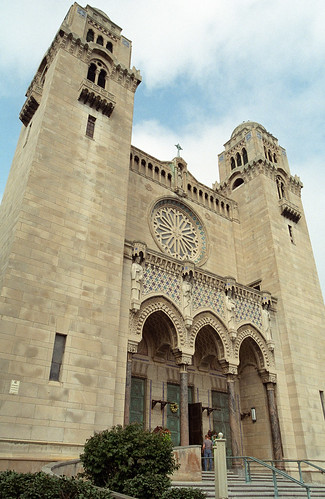
I received some correspondence some months back about a number of potential parish closings--as many as fifty-two--in the diocese of Cleveland. The most potentially tragic of these cases was the stunning St. Ignatius of Antioch parish
(above), an opulent and eclectic structure in the Romanesque style with a number of elements that are faintly Mozarabic. (Incidentally, the Mozarabs' Italian cousins, so to speak, pop up later on in this story). Its
slender campanile looms strikingly over the surrounding neighborhood. Fortunately it, and the turn-of-the-century neo-Baroque St. Colman's were recently saved from being shuttered, and the parishes will remain open. This was a great relief as I had not been able to turn my attention to this problem until this week. Unfortunately, the other parishes are still going to be merged and there is no answer yet on what will happen to the structures.
Palermo Comes to OhioThis is particularly disconcerting with regards to the truly amazing and unique church of St. James in Lakewood
(below), a gilded jewel-box done in the Sicilian Gothic style, strongly reminiscent of the cathedral in Monreale and the Palatine chapel in Palermo. (Some of our readers may recall the significant role the church architecture of this remarkable little island has played in the work of several prominent Gothic revival architects, most notably the English Sir Ninian Comper. To see it pop up unexpectedly in the American Midwest is nothing short of a wonder.) As far as I know, it is the only example of this unusual style in the United States, or at the least, one of the very few, and one of the very best. This story here is somewhat out-of-date, as it mentions St. Ignatius and St. Colman, but it does include photos of some of the other forty-nine churches, including the astonishing St. James, which deserves to be preserved, if only for its exceptional singularity and opulence. And one never knows when a neighborhood may turn around.
Lost OpportunitiesMeanwhile, the diocese is breaking ground on a $3 million, 450-seat church in the exurb of Grafton,
Our Lady Queen of Peace (below), done in a dismal retro style. As I have said before, this is an aesthetic that even most thorough-going neo-modernistic contemporary architects have moved away from. In some ways, I appreciate the fact the diocese is still building churches where churches are needed to be built. Some parish closings may be an inevitable fact of life given the way the populace in the last four or so decades in many cities. It is important for people to remember that Catholics are, in terms of per-capita income, one of the richest denominations in the country. Yet we are parsimonious givers when it comes to the collection basket. Parish closings like this are an opportunity to rectify this image, and take responsibility once again.
That being said, there are also historical and aesthetic issues that are often simply ignored in these cases. Beautiful landmarks like St. James deserved to be preserved, if only for their historic merit; they spring from a staggering flowering of American imagination that came, almost out of nowhere, at the turn of the last century, a period only now just beginning to be understood, reappraised, and treasured for the renaissance it was.
Some creativity is called for. Parishes cannot be turned around overnight, and I recognize that empty churches have to be put to use somehow. Dioceses have to run on a shoestring budget these days. Organizations like the Canons Regular of St. John Cantius and the Institute of Christ the King, like the Anglican "slum ritualists" of the nineteenth century, have shown beauty can flower again in the most unlikely places. And even where that is impossible--there are only so many priests like that to go round at this point in time--there is the remarkable, and I would believe, very doable notion of simply picking the church up and dropping it down somewhere else where it will get a proper home.
Less than a century ago, an entire monastery in Spain was taken to bits and mailed to California, where it ended up in one of William Randolph Hearst's warehouses. (He had planned to turn the chapel into a gigantic cruciform swimming pool, but the plan came to nought). I believe an order of monks is currently trying to put the whole thing back together like a gigantic jigsaw puzzle. We have also reported on
the financially reasonable proposal to take the beautiful and historic St. Gerald's Church in rather moribund Buffalo to bits and reassemble it in Norcross, Georgia, where new parishes are growing at a remarkable rate, at considerably less than the cost of building a new traditional church. Interestingly enough, this odyssey was estimated at only $3 million, exactly the cost of the new church of Our Lady of Peace. One assumes moving, say, St. James out of downtown to a Cleveland exurb would presumably require even less effort.
As to that new parish church, I am glad it is comparatively small--only 450 seats--given the monstrous, unwieldy megachurch size of most suburban parishes, and I am quite pleased to hear that it has received a fairly reasonable budget. $3 million may sound lavish, but it is, given the cost of building, just right, or even a bit on the tight side. What disappoints me is that it is being designed in an unremarkable and rather outmodeled modern style, when one could easily get a fairly austere but handsome traditional-style church for the same budget.