Saturday, August 23, 2025

The Life of St Philip Benizi in Art

Today is the feast of St Philip Benizi, a 13th century Florentine who stands to the Servite Order in the same position that St Bernard of Clairvaux does to the Cistercians. He was not the order’s founder, but he was its most effective early propagator, and his lifetime of work and reputation for holiness did a great deal to consolidate its position in the Church. He entered as a lay brother in 1254; four years later, he was ordained a priest, and rapidly rose to prominence. In a general chapter held in 1267, he was elected superior general, despite the fact that three of the original seven founders were still alive, and held that office for the rest of his life. During the papal conclave of 1268-71 (at 33 months, the longest in history), he was seriously proposed as a candidate, and had to go into hiding to avoid being elected. (The pope elected by this conclave and his successor are both Blesseds, but not Saints, so it seems Philip really did choose the better part.) He was born on the feast of the Assumption in 1233, and died on its octave, August 22nd, 1285; his feast was therefore assigned to the 23rd when he was canonized in 1671.

St Philip Benizi Refusing the Papal Tiara, medallion by Antonio Raggi (1621-89) on the façade of the church of San Marcello al Corso in Rome. (Image from Wikimedia Commons by Torvindus, CC BY-SA 3.0)
In the mid-15th century, a new portico, now known as the “chiostrino dei voti – the little cloister of the vows”, was added to the front of the Servite church in Florence, which is dedicated to the Annunciation. A project was begun to decorate it with frescoes depicting episodes from the life of the Virgin Mary and of St Philip, which, however, went forth very slowly. In 1509, the painter Andrea del Sarto was hired to complete it, and the majority of the paintings are his work. In 1513, a native son of Florence, Cardinal Giovanni de’ Medici, was elected Pope with the name Leo X; the decoration of the portico was hastily finished with the hiring of new painters to prepare for his first official papal visit to the city. By the early decades of the 16th century, the Renaissance had effectively run its course, and the paintings are in the early Mannerist style, which is very much more interested in artifice than in realism, and is probably to the modern eye more interesting than attractive.
The Calling and Profession of St Philip, by Cosimo Rosselli, 1476 (one of only two parts of the fresco series to be completed at the time of its original proposal.) - On the right, St Philip has a vision of the Virgin Mary while he prays in his room; on the left, he receives the habit of the order. The depiction of the Saint in his underwear as he is about to receive the habit will perhaps strike the modern viewer as rather inappropriate. Florence was a city that made its fortune in the cloth market, and less than half a mile away, walking in an almost perfectly straight line from the door of this portico, stands the famous and very richly decorated city baptistery, which was paid for by the cloth merchants’ guild. The depiction of the Saint in this fashion therefore serves to emphasize the poverty which he embraced by entering the mendicant Servite order.
(The remaining paintings of the life of St Philip are all by Andrea del Sarto, done from 1509-14.)
St Philip Heals a Leper - In the scenes in the background, the leper, having been healed, is able to come close to the Saint, who then embraces and clothes him. The Roman Breviary states that it was because of this miracle specifically that the cardinals in Rome thought to make him Pope in the midst of the long-deadlocked conclave.

The Punishment of a Group of Blasphemers, who are struck by an arrow from heaven. The art historian Giorgio Vasari singled out the startled horse in the background as a particularly praiseworthy aspect of del Sarto’s work.

St Philip Heals a Possessed Woman by making the sign of the Cross over her. Note how the figure of the woman, the beneficiary of the miracle, is highlighted by the luminosity of her dress, while the rest of the figures, including the Saint himself, are less bright.

The Death of St Philip - a newly deceased child is brought to the place where his body is laid out, and raised to life upon touching the bier. As is typical with Mannerists, who generally preferred to imitate art rather than life, this painting was done as a deliberate imitation of Ghirlandaio’s Funeral of Santa Fina in the collegiate church of San Gimignano.

Wednesday, July 16, 2025

Why the Church’s Religious Should Return to the Traditional Liturgy

A Trappist offering the old rite of Mass

I once received a letter from a religious superior who explained that his community had been quietly integrating the traditional Latin Mass into its life, with several younger members learning the Mass and beginning to delve into the breviary. They all felt they had so much to learn. He asked me for advice and reading recommendations. He also noted that while some prelates had encouraged them to learn the TLM, others had strongly discouraged them, and asked me why I thought there was such a sharp division among prelates over this issue. Here’s what I replied.

Dear Father,

Thank you for your very kind and encouraging letter.

The questions you are raising are enormous ones, and very delicate, too. The problem is, to speak quite frankly, when one starts to enter into the great liturgical tradition, one can’t help noticing all kinds of ways in which it is obviously superior, from the point of view of offering worthy adoration and praise to God, cultivating the right interior and exterior dispositions, and edifying all who participate in it. The old liturgy was slowly built up as a great hymn of glory to the omnipotent God, to the humanity of the Savior, and to the invisible working of the Holy Spirit. It is supple, generous, meditative, profound, and poetic. (I speak now of both the Mass and the Office, and indeed of all the sacramental rites and the blessings.)

As one discovers these things, one also feels pained by the loss of so much beauty and reverence in the reformed rites, which will increasingly look and feel like committee-made rational constructions—which, of course, they are, even if there is no heresy or intentional sacrilege in them as such. The reformers exhibited an almost pathological aversion to symbolism, ceremonial, repetition, silence, chant, and the self-surrender of a fixed order of worship with detailed rubrics.

When Catholics, whether lay or clerical, rediscover the old rites today, they are often struck, on the contrary, by how utterly appropriate all these things are to a mysterious action in which God is the primacy agent and we are His collaborators and cultivators, privileged to step for a moment into the celestial worship of the Eternal High Priest.

Moreover, it cannot be accidental that religious communities around the world began to crumble apart and bleed their members as the liturgical axis around which their entire lives had once revolved collapsed into a shameful chaos. The Second Vatican Council taught in Perfectae Caritatis that “the religious life bears witness to the fruitfulness of the sacraments.” If that is true, what does the catastrophic decline of religious life tell us about the Church’s “updated” sacramental regime?

For these reasons (and others that I go into in this article), I am convinced that the long-term health and even viability of the religious life and of the priesthood will depend on reintegrating—and, for some communities, simply being completely dedicated to—the traditional rites of the Latin Church (and here I include Roman, Dominican, Norbertine, Carthusian, Ambrosian, and other such rites and uses), which have been powerhouses of holiness and touchstones of theology for so many centuries.

Moreover, as we briefly discussed in person, it is remarkable how well the laity respond to traditional expressions of the Faith. Wherever the old Mass has taken root, the congregation suddenly “juventates,” if I may coin an expression: young families pop out of the woodwork, while older folk feel comforted by the calmness and prayerfulness of the rite.

Here is where a difficulty begins to arise. Once a person gets a really good taste, a deep draught, of these rites, he wants to use them more. Eventually, he may want to use them exclusively, because he can so easily rest in their stability, flow along with their naturalness and rightness. Basically, the old liturgy is “built for praying.” No one feels this more viscerally than priests and religious do. As with a taste of freshly baked bread or the finest wine, so in matters liturgical: sensitive souls hesitate to go back to that which is less satisfying to the spiritual palate.

After a time, one who has entered deeply into the old Mass notices that the old Office is perfectly coordinated with it: there is a continual back-and-forth between the lections at Mass and the chapters in the Office, and the calendar, of course, is richer and more coherent. So the Mass leads to the Office, and soon it becomes challenging, if not frustrating, to be switching back and forth between the new calendar and the old, or the new Liturgy of the Hours and the old Mass, etc. Put simply, the two worlds are different, very different, and they do not readily lend themselves to coexistence.
 
Benedictines chanting Tenebrae in Australia

Now, I will qualify that last statement this way. In a community like the Oratorians, where there are many priests and where congregations of the faithful show up on a regular basis for worship, one can have a fairly dense schedule of Masses, confessions, and devotions, with priests taking turns doing various things, and most of the time praying their office privately; so they get to choose whether to use the 1960 Roman breviary or the 1970 Liturgy of the Hours (and most will choose the former). So you get a sort of rough-and-ready coexistence that works well enough on a pastoral level.

In a religious house, on the other hand, the ideal is a daily conventual Mass and at least some common recitation or chanting of the Office. This, therefore, requires a certain uniformity of practice so that everyone can be at peace and not feel “jerked around” by a shifting schedule or by the shifting expectations of different liturgical forms. It isn’t so easy in this environment to “punt” on liturgical questions, as they affect communal exercises.

If religious priests learn the TLM, they will have the freedom to offer their “private” morning Masses in the usus antiquior—regardless of whether or not the conventual Mass is the TLM. Since the daily Mass is so formative of priestly spirituality, this step will already be a great enrichment that does not directly impinge on the communal horarium. It goes without saying that no priest ever needs permission to offer the old rite.

I am happy that you asked me for reading recommendations. I know that time is limited, so I’ll recommend just a few works that I think will be particularly helpful: Joseph Ratzinger’s The Spirit of the Liturgy, if you haven’t already read it (this can be an excellent community read for ongoing intellectual formation); two of mine, Noble Beauty, Transcendent Holiness: Why the Modern Age Needs the Mass of Ages and The Once and Future Roman Rite: Returning to the Traditional Latin Liturgy after Seventy Years of Exile; Martin Mosebach’s The Heresy of Formlessness: The Roman Liturgy and Its Enemy. That being said, frequent experience of the rite will be more beneficial, for most, than reading and arguments—at least for a while. The intellectual component is important but can follow subsequently.

The old liturgy carries the force of conviction in its very practice. Explanations can and will be helpful, but there is a point at which liturgists might seem to be simply flinging opposite opinions at each other: “he says... she says...” Whereas when a Christian, especially a priest, experiences that he can more fervently adore, supplicate, and immolate himself, or that meditation on and assimilation of the Word of God is deepened in the traditional rite, no argument can contradict it, even as no argument can substitute for it.

Along these lines, a genre of reading that I find especially moving and effective in melting resistance or misconceptions is that of priests writing about their own journey. Some fine examples may be found here, here, and here, but many more exist.
 
Card. Burke celebrating Pontifical Mass for the Franciscans of the Immaculate, ca. 2010

As for why some prelates would be opposed to the recovery of liturgical tradition, there is much that can be said, but this much is clear: there was a mighty epidemic of identity confusion and tradition-bashing that took place overtly between 1965 and 1975, but which had roots in the 1940s, and of course, going back to the late 19th century with the Modernist controversy to which Pope Pius X responded. Once Catholics begin to study these matters in depth, they usually realize they’ve been “had,” to a greater or lesser extent. They have been lied to; their birthright has been stolen from them. Older generations do not take kindly to criticism of the novel and enthusiasm for the traditional. (I wrote about this in an article, “Can We Explain the Anti-Tridentine Phobia or Rage?”)

Some anti-traditionalists say that having the old rite in the Church “causes division.” How can they ignore the fact that the Novus Ordo has produced more division than has ever been seen in the history of Western liturgy? Don’t be put off the right path by those who discourage you from pursuing what is clearly your right and indeed your birthright. [1] It seems to me that most of the opponents of the old rite have never celebrated the usus antiquior themselves. In my experience, this is the “Rubicon”: when you know in your heart and your bones that this rite was “made to be prayed”—that it is Christ’s holocaust of love, offered in and through His alter Christus—it becomes impossible to walk away from it, much less to suppress it, without sinning against the light.

I am aware of many communities—most of them obscure, but including various Carmels, and fairly new Oratories in the process of starting up—that are experiencing a mighty tension between the “reform of the reform” and a return to the traditional rite. Their members know that the traditional liturgy is a vessel “full of grace and truth,” like the Incarnate Word who inspired its development in the Church over the millennia; but they are no less acutely aware of the ecclesiastical politics that make a simple switchover, or even a significant accommodation, difficult to achieve.

Every step taken should be gradual, gentle, and understood by all ahead of time, so that all may walk arm-in-arm. However we look at it, the incorporation of the TLM and the breviary and other sacramental rites is an immense enrichment. How could we think otherwise about a liturgy celebrated by countless saints and endorsed by centuries of Roman Pontiffs? It is truly a kind of schizophrenia when people get tied up in knots about it. As Ratzinger asked, what does this say about how we view our own tradition, our own history? When a well-meaning person says “Yes, tradition is good, but don’t get carried away…,” that is the voice of worldly prudence, not the passion of divine love that seeks to give the best and greatest to Our Lord.

Dear Father, the elephant in the room is this: many Catholics are ignorant of or malformed in theology, ignorant of or malformed in liturgy; they are not deeply rooted in the history and tradition of Catholicism. It sounds harsh to say it, but it’s clearly true. Vatican II was like a nuclear bomb. Millions of books (including liturgical books) were thrown into dumpsters in the 1960s and 1970s. The self-styled reformers attempted to make a clean break with the past. Of course, they could never have succeeded completely, and a reaction was inevitable; but the extreme makeover has succeeded well enough to leave us a vast swath of Catholics unacquainted with basic monuments and elements of the Faith, such as the liturgy prayed by the Church from well before St. Gregory the Great down to Pope John XXIII, or the decrees and canons of the Council of Trent.

After the imposition of the Novus Ordo, it was believed that the use of the old Roman rite would gradually vanish. Its endurance was written off as a fetish, a fashion, a niche interest, a bit of nostalgia. Today, decades later, we can see very clearly that it is a magnet for young people, for families, for vocations.
 
Padre Pio celebrating a Solemn High Mass

The question then becomes: How do we integrate our new knowledge of old tradition, with all its truth, beauty, and goodness, into our lives as Catholics, as religious, as priests? It is no easy task, since we are very much still living in the age of rupture, discontinuity, confusion, ignorance, and, I’m afraid to say, bad will.

This much is clear: there is no “stuffing” of the old back into a box; once it comes out, it is too powerful to push down. The priests in your community need to learn the old rite and to offer it, since it is the most perfect, most fruitful, and most formative exercise of the ministerial priesthood, the key to a richer interior life. It should be a standard feature that is accepted as a normal part of day-to-day life, and not fussed over.

Whatever else one may say, it is a time for being “wise as serpents, innocent as doves” (Matt 10, 16).

Yours in Christ our Lord,

Dr. Kwasniewski

[1] Traditionis Custodes changes none of this because it claims to revoke a faculty that was never granted. Benedict XVI did not grant a faculty in Summorum Pontificum, but precisely the contrary: he acknowledged that the old rite had never been abrogated and was always in principle available to priests, and simply proclaimed their freedom to use the older form of the Roman rite, basing his decision ultimately on a dogmatic fact that what was sacred remains sacred and great for us today.

Visit Dr. Kwasniewski’s Substack “Tradition & Sanity”; personal site; composer site; publishing house Os Justi Press and YouTube, SoundCloud, and Spotify pages.

Saturday, November 25, 2023

St Catherine of Alexandria in the Counter-Reformation

The acts of St Catherine of Alexandria tell us that she was a noblewoman of immense learning in all the sciences, who at the age of eighteen went to the emperor Maximin Daia (305-312) to reprove him for his persecution of the Church, denouncing the worship of the false gods of the pagans. Unable to respond to her himself, Maximin had her imprisoned, and then brought a group of fifty philosophers to explain to her the folly of Christianity; all of these she converted to the Faith, for which they were put to death. Catherine was returned to prison, where she was visited by the empress and a captain of the emperor’s troops named Porphyry, both of whom were also converted, and soon after martyred. Catherine was then condemned to die by the famous spiked wheel which has long been known as her emblem, but which broke apart on touching her; like so many Saints whom Nature itself and the persecutors’ devices refused to harm, she was then beheaded. As the traditional Collect of her feast states, her body was carried by Angels to Mount Sinai, where first a church, and later the famous monastery were built in her honor.

An icon of the Presentation of Mary, with St Catherine on the far left. (Greek, 18th century). In the Byzantine Rite, the Entrance of the Virgin in the Temple is one of the twelve Great Feasts, most of which are kept with both a Forefeast and Afterfeast, broadly the equivalent of a vigil and octave in the traditional Roman Rite. Afterfeasts vary in length, and those of the Virgin’s Presentation and Nativity are the shortest, only four days, the final day being known as the Leave-taking; the Leavetaking of the Presentation therefore coincides with St Catherine’s feast day. (Photo from Wikimedia Commons by shakko.) 
She became one of the most popular Saints of the High Middle Ages beginning in the 11th century, when some of her relics were brought to the French city of Rouen. Innumerable churches and chapels were dedicated to her, she appears in an extraordinary number of paintings and statues, and her feast day was kept in many places as a holy day of obligation. She has long been honored as a Patron Saint of philosophers and theologians, orators and preachers, (and hence especially by the Dominicans, who kept her feast with an octave until the early 20th century,) but also of women in religious life, students of every sort, millers and wheelwrights. In France, her prestige was very much enhanced by the fact that she was one of the Saints who spoke to St Joan of Arc. She is honored in the Byzantine Rite with the title “Great Martyr”, and named in the preparation rite of the Divine Liturgy; in the Ambrosian Rite, her name was even added to the Canon of the Mass in the later 15th century.

It is painful to relate that no aspect of the life of St Catherine as given in her acts can be considered historically trustworthy. Just to give one of many possible examples, she is named as the “daughter of a king named Costus”, even though Egypt in the early fourth century was a province of the Roman Empire, and had had no king for over three-hundred years. There is no mention of her in the wealth of Egyptian Christian literature for several centuries after her death, or in the various accounts of pilgrims to the monastery on Mt Sinai, which was not originally named for her.

By the time the Roman Breviary was revised after the Council of Trent, scholars had long known that many of the well-known and loved stories of the Saints were not historically reliable. Thus we find several of the Virgin Martyrs who were very popular in the Middle Ages, such as Ss Barbara, Margaret of Antioch and Ss Ursula and Companions, reduced from full offices of nine readings in the Roman Breviary of 1529 to a mere commemoration in the Breviary of St Pius V. Even Ss Cecilia and Agatha, who are named in the Canon of the Mass, were originally kept at the second of three grades; only Ss Agnes, the Roman martyr par excellence among women, Lucy (a rather random choice), and Catherine of Alexandria were kept at the highest grade.

Virgo inter Virgines (The Virgin Mary among the other holy virgins) by the anonymous Netherlandish painter known as the Master of the St Lucy Legend, ca. 1490. The holy Virgins are Ss Apollonia, Ursula, Lucy, Dorothy, Catherine (receiving a ring from the baby Jesus; her red cloak is covered with her symbol, the wheel), Mary Magdalene, Barbara, Agnes, Margaret, Agatha and Cunera, patron of the Rhenen area near Utrecht, said be one of the 11,000 companions of St Ursula. (Click image to enlarge; click here for a complete explanation of the icongraphy.)
The Breviary of St Pius V, first published in 1568, was revised in the last decade of the same century, and a new edition published in 1602. Pope Clement VIII had entrusted the task of correcting the Saints’ lives to the great Cardinal Cesare Baronius, also the principal editor of the first Tridentine edition of the Martyrology. Among Baronius’ collaborators was St Robert Bellarmine, one of the most learned men of his age, who is supposed to have said in regard to St Catherine, “I wish I could believe that she existed.” In his History of the Roman Breviary, Mons. Pierre Batiffol notes (p. 216) that Baronius often refused, against St Robert’s advice, to alter some of the popular legends, despite the historical problems associated with them; and that he noted of St Catherine specifically, “Her history contains many things which are repugnant to the truth.” Nevertheless, her Office was left unaltered, and remained in the same form until the Breviary revision of 1960.

It was certainly a goal of the Tridentine reform of the Breviary to remove from the Church’s public prayer anything that might offer the Protestants a pretext for attack or ridicule. (Baronius was well aware of this problem, and also produced a massive history of the Church, covering the first 12 centuries, in response to Protestant controversialists.) The question therefore arises as to why a Saint whose life was subject to serious doubts, even on the part of the very revisers of the Breviary, was not merely included in it, but celebrated in one of its most prominent feasts.

In part, we may simply say that scholars must at times take their lesson from the devotion of the people, and accept what they may perhaps not understand. (It is interesting to note in this regard that St Catherine was abolished in the Novus Ordo, but restored to the general calendar by Pope St John Paul II.) But there are three aspects of the story of St Catherine that are particularly significant to the Counter-Reformation, which certainly contributed to the preservation of devotion to her.

The first is her role as the Patron Saint of philosophers, which comes, of course, from the story told above of her converting the fifty men sent to dissuade her of her Christian faith.

The second is her role as patron of women in religious life. This arises from the story that Maximin offered to take her on as a second wife or mistress, and even honor her as a goddess, if she would renounce the Faith. To this Catherine replied, “It is a crime even to think of such things. Christ has taken me to Himself as a bride; I have joined myself to Him as a bride in an indissoluble bond.” Other virgin martyrs like Ss Agnes and Agatha also speak of themselves in similar terms, but for whatever reason, it was seen as especially important in Catherine’s case. Therefore, she is very often represented, both before and after the Counter-Reformation, receiving a wedding ring from the infant Christ as He is held by His Mother, joined to him in a mystical marriage, although this is not specifically said in the text of her acts commonly read in medieval breviaries, nor in the Golden Legend.

The Mystical Marriage of St Catherine, by Guercino, 1620
The third reason has to do with her place among the Fourteen Holy Helpers. In the 1499 Missal of Bamberg, the Collect of a Votive Mass in their honor reads as follows:
Almighty and merciful God, who didst adorn Thy Saints George, Blase, Erasmus, Pantaleon, Vitus, Christopher, Denis, Cyriacus, Acacius, Eustace, Giles, Margaret, Barbara and Catherine with special privileges above all others, so that all who in their necessities implore their help, according to the grace of Thy promise, may attain the salutary effect of their pleading: grant us, we beseech Thee, forgiveness of our sins, and with their merits interceding, deliver us from all adversities, and kindly hear our prayers.
The words “according to the grace of Thy promise” refer to the tradition that during their passion, each of these Saints received a promise from God that their intercession would be exceptionally effective on behalf of those who honored them. Thus, the third antiphon of Lauds in the proper office of St Catherine reads “I await the sword for Thee, o Jesus, good king; set Thou my spirit in Paradise, and show mercy to those who keep my memory.” To this Christ answers in the fourth antiphon: “A voice sounded from heaven: ‘Come, my chosen one, come, enter the chamber of Thy spouse; thou hast obtained what thou asked; those that praise thee shall be saved.” And the fifth concludes, “Because we keep the memory of thee, o virgin, with devout praises, pray for us, we ask, o blessed Catherine.”

In these three roles, as Patron Saint of philosophers, as a bride of Christ, and as a Holy Helper, St Catherine stands out as a perfect response to the novelties of the Protestant reformers.

After serving for many centuries as the “handmaid of theology,” from the Fathers to Boethius to St Thomas, and particularly after the great scholastic conquest of Aristotle, philosophy, and indeed reason itself, were cast out by Martin Luther as “the Devil’s greatest whore… who ought to be trodden under foot and destroyed, she and her wisdom…” And likewise, “Aristotle is the godless bulwark of the papists. He is to theology what darkness is to light. His ethics is the worst enemy of grace. He is a rank philosopher, … the most artful corrupter of minds. If he had not lived in flesh and bones, I should not scruple to take him for a devil.” As for St. Thomas, “he never understood a chapter of the Gospel or Aristotle … In short, it is impossible to reform the Church if Scholastic theology and philosophy are not torn out by the roots with Canon Law.” St Catherine therefore serves as an example of the Church’s true tradition, one who successfully used philosophy in the preaching and teaching of the Faith.

St Catherine and the Philosophers, from the Castiglione chapel in the Basilica of St Clement in Rome, by Masolino da Panicale, 1425-31. Note how she calmly counts off her reasons for believing the Christian faith, as the philosophers look in confusion in different directions. “We firmly confess this to thee, o emperor, that unless thou shall show us a more likely sect than these which we have followed hitherto; behold, we all convert to Christ, because we confess Him to be true God and the son of God.” (from the Sarum Breviary). At this the emperor orders them to be burnt alive, as seen on the right.
The Protestants also completely rejected any kind of monastic or canonical religious life, leaving no formal place at all for women in the institutional life of the Church. (Luther himself, like so many disaffected religious, married a former nun, whose name, ironically, was Catherine.) The tradition of Christ accepting her in a mystical marriage would therefore validate the institution of consecrated life in general, but particularly for women.

Finally, as a Saint renowned for her powerful intercession on behalf of many classes of people, St Catherine stands with countless others in the “cloud of witnesses” against the early Protestant rejection of devotion to the Saints, and their power to intercede for us in this world.

Even within Luther’s lifetime, it was hardly possible to get two Protestant reformers together to agree on any point; hence, the famous dispute at which he carved “EST – it is” into the table, in reply to Zwingli, who was quite certain that the Lord was only kidding when He said “This IS my body.” Broadly speaking, however, they generally accepted that things had really gone wrong in the Church with the coming of the mendicants, (especially the Franciscans), and the flourishing of their teachings in the universities. Although the life of St Catherine may no longer be regarded as historical, it still bears witness to the Church’s historical belief, before the emergence of the mendicants, in the goodness of reason and philosophy, in the value of consecrated life, and the intercession of the Saints on our behalf.

Tuesday, August 23, 2022

The Life of St Philip Benizi in Art

Today is the feast of St Philip Benizi, a 13th century Florentine who stands to the Servite Order in the same position that St Bernard of Clairvaux does to the Cistercians. He was not the order’s founder, but he was its most effective early propagator, and his lifetime of work and reputation for holiness did a great deal to consolidate its position in the Church. He entered as a lay brother in 1254; four years later, he was ordained a priest, and rapidly rose to prominence. In a general chapter held in 1267, he was elected superior general, despite the fact that three of the original seven founders were still alive, and held that office for the rest of his life. During the papal conclave of 1268-71 (at 33 months, the longest in history), he was seriously proposed as a candidate, and had to go into hiding to avoid being elected. (The pope elected by this conclave and his successor are both Blesseds, but not Saints, so it seems Philip really did choose the better part.) He was born on the feast of the Assumption in 1233, and died on its octave, August 22nd, 1285; his feast was therefore assigned to the 23rd when he was canonized in 1671.

St Philip Benizi Refusing the Papal Tiara, medallion by Antonio Raggi (1621-89) on the façade of the church of San Marcello al Corso in Rome. (Image from Wikimedia Commons by Torvindus, CC BY-SA 3.0)
In the mid-15th century, a new portico, now known as the “chiostrino dei voti – the little cloister of the vows”, was added to the front of the Servite church in Florence, which is dedicated to the Annunciation. A project was begun to decorate it with frescoes depicting episodes from the life of the Virgin Mary and of St Philip, which, however, went forth very slowly. In 1509, the painter Andrea del Sarto was hired to complete it, and the majority of the paintings are his work. In 1513, a native son of Florence, Cardinal Giovanni de’ Medici, was elected Pope with the name Leo X; the decoration of the portico was hastily finished with the hiring of new painters to prepare for his first official papal visit to the city. By the early decades of the 16th century, the Renaissance had effectively run its course, and the paintings are in the early Mannerist style, which is very much more interested in artifice than in realism, and is probably to the modern eye more interesting than attractive.
The Calling and Profession of St Philip, by Cosimo Rosselli, 1476 (one of only two parts of the fresco series to be completed at the time of its original proposal.) - On the right, St Philip has a vision of the Virgin Mary while he prays in his room; on the left, he receives the habit of the order. The depiction of the Saint in his underwear as he is about to receive the habit will perhaps strike the modern viewer as rather inappropriate. Florence was a city that made its fortune in the cloth market, and less than half a mile away, walking in an almost perfectly straight line from the door of this portico, stands the famous and very richly decorated city baptistery, which was paid for by the cloth merchants’ guild. The depiction of the Saint in this fashion therefore serves to emphasize the poverty which he embraced by entering the mendicant Servite order.
(The remaining paintings of the life of St Philip are all by Andrea del Sarto, done from 1509-14.)
St Philip Heals a Leper - In the scenes in the background, the leper, having been healed, is able to come close to the Saint, who then embraces and clothes him. The Roman Breviary states that it was because of this miracle specifically that the cardinals in Rome thought to make him Pope in the midst of the long-deadlocked conclave.

The Punishment of a Group of Blasphemers, who are struck by an arrow from heaven. The art historian Giorgio Vasari singled out the startled horse in the background as a particularly praiseworthy aspect of del Sarto’s work.

St Philip Heals a Possessed Woman by making the sign of the Cross over her. Note how the figure of the woman, the beneficiary of the miracle, is highlighted by the luminosity of her dress, while the rest of the figures, including the Saint himself, are less bright.

The Death of St Philip - a newly deceased child is brought to the place where his body is laid out, and raised to life upon touching the bier. As is typical with Mannerists, who generally preferred to imitate art rather than life, this painting was done as a deliberate imitation of Ghirlandaio’s Funeral of Santa Fina in the collegiate church of San Gimignano.

Monday, July 11, 2022

The Feasts of St. Benedict and Their Proper Texts in Benedictine Churches

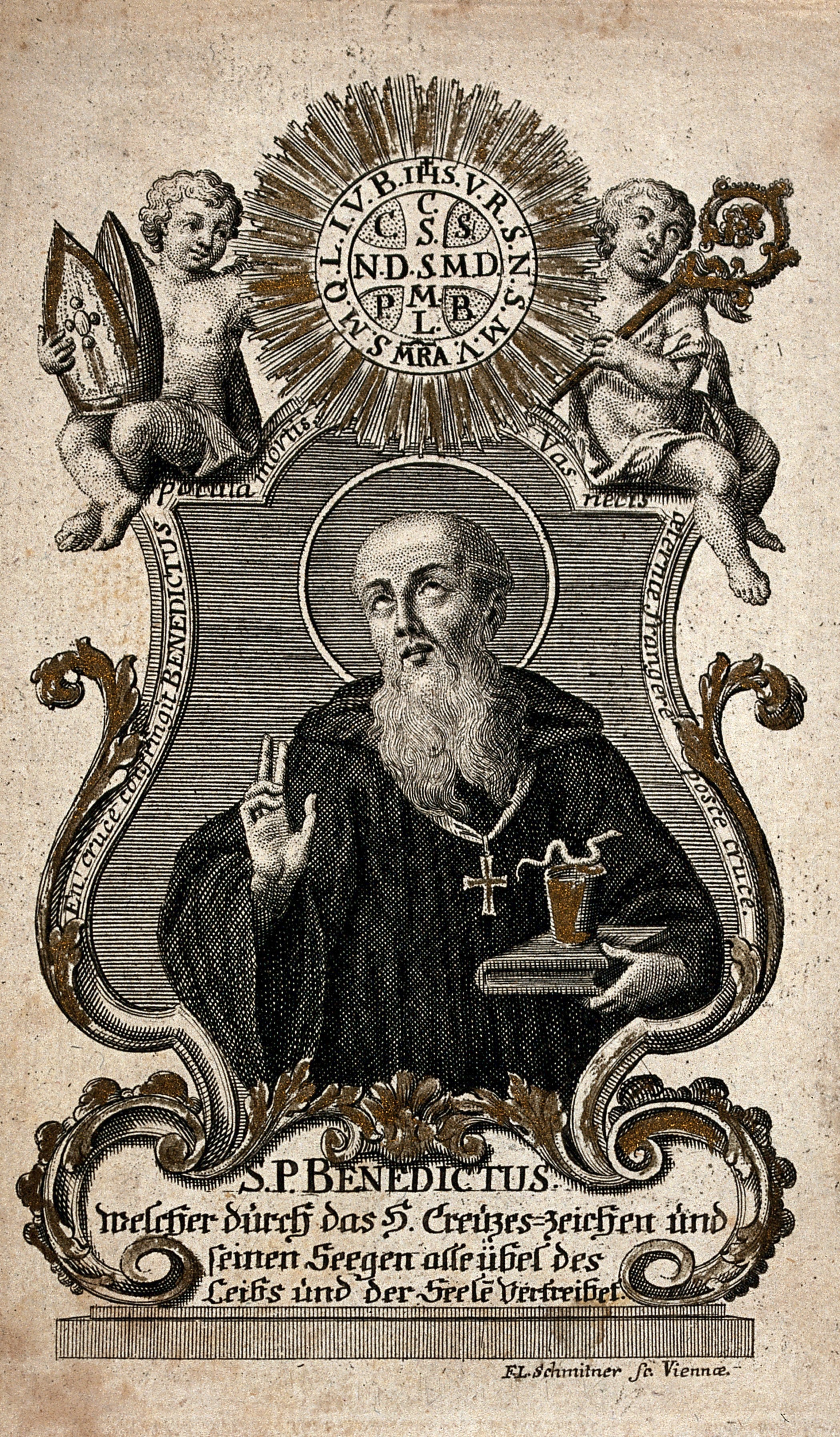
Catholics attentive to the sanctoral cycle will have noticed two feasts of St. Benedict that appear in the calendar (depending on your location and the form of the Mass): the dies natalis of March 21, which almost always falls during Lent, and the summer feast on July 11, which historically originated as a feast of the translation of relics but has been simply accepted by most Benedictines as an opportune time to celebrate their holy father. Traditionally March 21 has no octave due to Lenten austerity but July 11 has a jubilant octave. In the Tridentine calendar, March 21 is the only feast of the saint, and sadly since John XXIII the day is rarely given over to the great patriarch of Western monasticism. Even if the feast is observed, it would be observed with the “Os Justi” Common.

However, Benedictines who keep their own traditions rejoice in three proper Masses for their holy founder: one on March 21; another on July 11; and a third on July 18 for the octave. I thought it would interest NLM readers to see the proper texts for all three, which are conveniently found in an appendix to the St. Andrew Daily Missal (reprint of the 1945 edition). I do not know if any other founder of a religious “order” (taking that term in the broadest possible sense) enjoys such a profusion of proper Masses! The texts are extraordinarily rich and well-suited to the saint, a luminous exemplar of how the usus antiquior coalesces its changing texts around the figure of a saint as an icon of Christ, as a figure that fulfills in his life the message of Sacred Scripture.

I would draw the reader's attention particularly to the Sequence and the proper Preface.

We should bear in mind thatt the July 11th feast as the translation of St Benedict’s relics, while very old, was not universally celebrated by the OSB before the 19th century, and the recasting of it as the “solemnity of St Benedict” with an octave is rather recent. E.g., it is not in this edition of the breviary from 1831.

UPDATE (7/12/22): I have been informed by several people that there is yet another feast of St. Benedict observed in some monasteries, namely, a December 11th "In Veneratione et Repositione Sacrae Reliquiae Capitis SS. Patriarchae Nostri Benedicti." I have not been able to get hold of the Propers but here's a screenshot that was shared with me:
 

March 21


The March 21st propers are conveniently available as a PDF online, from which the following images have been extracted.

Monday, January 31, 2022

The Power of Catholic Customs: A Candlemas Procession in the Life of Dom Hubert van Zeller

In his extremely entertaining and somewhat melancholy autobiography One Foot in the Cradle, well-known spiritual writer Dom Hubert van Zeller (1905–1984) describes a particularly memorable February 2nd in his life as a Benedictine novice at Downside Abbey, in the school of which he had been enrolled for a decade as a student. (Since there appear to be no archival photos of any Candlemas at Downside, I found a photo that perhaps suggests a similar spirit: Candlemas at Westminster Cathedral in 1938, with plenty of schoolboys in attendance.)

Dom Hubert had entered religion one year after graduation, in 1924, and so still had friends among the older boys. At this point in his life he is struggling with his vocation — whether to remain in the monastery, or to go back to the world, to which he was drawn by many affections. The account deserves to be shared on this eve of Candlemas. Afterwards I will share four points of reflection.

*       *       *

“It was a little later, when the school reassembled after the Christmas holidays, that the proximity of the boys and of all that went with them began to trouble me. Up till now I had been so busy learning what to do as a novice, and finding satisfaction in the fulfilment of what had been so long awaited, that I had not found the presence of the school within hailing distance any great distraction. But now the whole question of my place in Benedictine education became more acute. The immediacy was brought home to me on February 2, the feast of the Purification.

“At Downside the Candlemas procession, everyone holding a lighted candle, moves round the cloisters. Following the cross and acolytes come first of all the boys, then the monks, then the celebrant and ministers. So it was that together with my fellow junior novice (Brother Maurice, Reggie) I came close upon the heels of the two most senior boys in the school. These were Maurice Turnbull and Robert Arbuthnot — Robert as well as Maurice being a very particular friend of mine. By stretching out my candle I could have singed the hair of either of them. I was as close as I had been to the Field Marshal’s ears in Egypt.

“While the Purification antiphons were going on and we wound our way from one cloister to another I was conscious of a dualism at work inside me which so boiled up as to make me wonder for a moment which part of the procession I was in. I felt that there was a significant difference between belonging to those who walked in front of me and belonging to those who walked behind me. I was caught in the middle between two environments. Spiritually I was in one, emotionally in another. It was like a bad dream, because I could not tell where the one ended and the other began. I knew only that for me there were two quite separate worlds, and that one or other must win in the end. Must, indeed, be winning now. I knew in which world I willed to be — namely among the monks who were just behind me in the procession — but was the will strong enough to override the pull of the emotions which drew me towards those in front?

“This Candlemas procession came to be, during the months which followed, something of a symbol to me. It was one which carried particular urgency as the time for taking vows drew near: I must know in good time where I was in the procession, and where it was leading me.

“Things were not made any easier by such glimpses and echoes of school life as inevitably came my way. The roar of laughter from a classroom well beyond novitiate bounds, light music played on gramophones in rooms whose doors had been open to me eighteen months ago, the sound of a band-practice, the cheering at a rugger match, the sight of teams on their way up to the field, the crowding in to Mass and Benediction, the group of rather cheeky boys whom I had known as fags [i.e., boys who acted as servants to older schoolmates] who would bump into me on purpose in the church and then laugh and look away: all this made for matter of further self-searching.

“It is commonplace to observe that the human mind can want two opposite things at once. I wanted very much to be under the rule which forbad novices to speak to anyone not in the novitiate, and at the same time wanted to talk to people. Everything all round me told me that the school was an essential part of the life, that it was an extension of the community, that the boys belonged to the procession as much as the monks did. It was not even a question of one world impinging on another: they coincided. But until I could myself feel this, and not merely see it as an identification which others could feel, I knew I would never be at peace. Without the experience of such a harmony, I would always be a misfit.

“While in America not long ago I was saying Mass at a convent where the community runs a large high-school for girls. Some few of the students are boarders, but the majority are day-girls. These, the ‘day-hops,’ arrive noisily in cars and school buses just in time for the first class of the day which begins at a quarter to nine. I had said Mass at eight and was about to leave at a quarter to nine when I noticed a young nun rinsing out the cruets at the sacristy sink. Cars were still racing through the campus and skidding to a gritty stop at the school entrance. I could hear the car doors being closed with a rich plunk, the loud cries and shrill laughter, the hurrying of feet and the dropping of books. The young nun was hearing it too, and I watched her face as she looked out of the window. She was too preoccupied to know that I was there, that the tap was running, that the cruet needed no more drying. My guess was that she had been in the school a year or two before. I felt like telling her to keep her wits about her at the next Candlemas procession.” (One Foot in the Cradle: An Autobiography [New York: Holt, Rinehart, and Winston, 1966], 134–36.)
 
Downside boys ice-skating in the 1930s

Several things about this account are striking to me.

First, it was precisely by having such a Candlemas procession that the young novice was able to have a sort of “peg” on which to hang his thoughts, a palpable “axis” around which he could arrange his thoughts of discernment. It’s a brilliant example of how the so-called “externals” of Catholicism in fact constitute something like a spiritual gravitational field that gathers our scattered selves into coherent entities. The procession became a symbol of the new monk’s life, and helped him to sort out where he belonged. If we diminish or abolish such symbols — as the postconciliar liturgical reform did, both on paper and especially in its iconoclastic implementation — we are eliminating solid walls, ceilings, windows, and doors for the interior castle in which we are capable of living. We take away the centripetal power of rituals and leave the field open to the centrifugal force of fallen mindlessness and worldly distraction. As conservatives never seem to realize, it is not enough, most of the time, to “desire to be a good Catholic”; the desire has to be suggested, shaped, nourished, solidly built up by the structures of ecclesial life.

Second, only traditional Catholic communities today could actually understand and relate to the liturgical experience van Zeller is describing, since they alone (with a tiny number of exceptions) have retained the candle procession with the Latin Gregorian antiphons Dom Hubert is talking about. Such communities are continuing to do nearly the same thing he was doing (with perhaps some unfortunate modifications from the 1960 code of rubrics).

Third, monastic life at this time was exuberantly flourishing. As van Zeller describes it in the book, every religious community in England was pretty well packed with vocations. This is the kind of record that gives the lie to the myth — propagandistically repeated so often that it is now practically assumed as self-evident — that the Church before the Second Vatican Council was in desperate straits and needed radical reform. In fact, it was precisely the sudden explosion of radical ideas in the 1960s that precipitated the crisis of faith that undermined the consensus and common life of Catholics, leading to a decline from which the Church in the Western world has never recovered (except, incipiently, in those traditional communities against which Pope Francis and his nostalgic advisers have aligned themselves). As Martin Mosebach says somewhere, it was inevitable that there would be some crashing challenges to the Church in the post-War era, but the very best thing churchmen could have done is to meet those shocks with an adamant refusal to budge, rather than with a slippery willingness to move wherever the world moved.

Fourth, the genres of autobiography and detailed historical accounts of individuals and particular places are extremely valuable in achieving an accurate Catholic sense of the past and of what a Catholic culture looks like. Monasteries that still practice refectory reading have long shown a preference for these genres, and one can understand why: a robust awareness of belonging to a tradition is best achieved by learning about those who belonged to it before, and how they faced and either surmounted or failed to surmount the anti-traditional forces that opposed their way of life. General history, fiction, and theology obviously have their honorable places, but let’s not forget about books like One Foot in the Cradle, which have a lot to teach us.

The Dedication of the Downside Abbey Church in 1935

Wednesday, November 25, 2020

St Catherine of Alexandria in the Counter-Reformation

The acts of St Catherine of Alexandria tell us that she was a noblewoman of immense learning in all the sciences, who at the age of eighteen went to the emperor Maximin Daia (305-312) to reprove him for his persecution of the Church, denouncing the worship of the false gods of the pagans. Unable to respond to her himself, Maximin had her imprisoned, and then brought a group of fifty philosophers to explain to her the folly of Christianity; all of these she converted to the Faith, for which they were put to death. Catherine was returned to prison, where she was visited by the empress and a captain of the emperor’s troops named Porphyry, both of whom were also converted, and soon after martyred. Catherine was then condemned to die by the famous spiked wheel which has long been known as her emblem, but which broke apart on touching her; like so many Saints whom Nature itself and the persecutors’ devices refused to harm, she was then beheaded. As the traditional Collect of her feast states, her body was carried by Angels to Mount Sinai, where first a church, and later the famous monastery were built in her honor.

An icon of the Presentation of Mary, with St Catherine on the far left. (Greek, 18th century). In the Byzantine Rite, the Entrance of the Virgin in the Temple is one of the twelve Great Feasts, most of which are kept with both a Forefeast and Afterfeast, broadly the equivalent of a vigil and octave in the traditional Roman Rite. Afterfeasts vary in length, and those of the Virgin’s Presentation and Nativity are the shortest, only four days, the final day being known as the Leave-taking; the Leavetaking of the Presentation therefore coincides with St Catherine’s feast day. (Photo from Wikimedia Commons by shakko.) 
She became one of the most popular Saints of the High Middle Ages beginning in the 11th century, when some of her relics were brought to the French city of Rouen. Innumerable churches and chapels were dedicated to her, she appears in an extraordinary number of paintings and statues, and her feast day was kept in many places as a holy day of obligation. She has long been honored as a Patron Saint of philosophers and theologians, orators and preachers, (and hence especially by the Dominicans, who kept her feast with an octave until the early 20th century,) but also of women in religious life, students of every sort, millers and wheelwrights. In France, her prestige was very much enhanced by the fact that she was one of the Saints who spoke to St Joan of Arc. She is honored in the Byzantine Rite with the title “Great Martyr”, and named in the preparation rite of the Divine Liturgy; in the Ambrosian Rite, her name was even added to the Canon of the Mass in the later 15th century.

It is painful to relate that no aspect of the life of St Catherine as given in her acts can be considered historically trustworthy. Just to give one of many possible examples, she is named as the “daughter of a king named Costus”, even though Egypt in the early fourth century was a province of the Roman Empire, and had had no king for over three-hundred years. There is no mention of her in the wealth of Egyptian Christian literature for several centuries after her death, or in the various accounts of pilgrims to the monastery on Mt Sinai, which was not originally named for her.

By the time the Roman Breviary was revised after the Council of Trent, scholars had long known that many of the well-known and loved stories of the Saints were not historically reliable. Thus we find several of the Virgin Martyrs who were very popular in the Middle Ages, such as Ss Barbara, Margaret of Antioch and Ss Ursula and Companions, reduced from full offices of nine readings in the Roman Breviary of 1529 to a mere commemoration in the Breviary of St Pius V. Even Ss Cecilia and Agatha, who are named in the Canon of the Mass, were originally kept at the second of three grades; only Ss Agnes, the Roman martyr par excellence among women, Lucy (a rather random choice), and Catherine of Alexandria were kept at the highest grade.

Virgo inter Virgines (The Virgin Mary among the other holy virgins) by the anonymous Netherlandish painter known as the Master of the St Lucy Legend, ca. 1490. The holy Virgins are Ss Apollonia, Ursula, Lucy, Dorothy, Catherine (receiving a ring from the baby Jesus; her red cloak is covered with her symbol, the wheel), Mary Magdalene, Barbara, Agnes, Margaret, Agatha and Cunera, patron of the Rhenen area near Utrecht, said be one of the 11,000 companions of St Ursula. (Click image to enlarge; click here for a complete explanation of the icongraphy.)
The Breviary of St Pius V, first published in 1568, was revised in the last decade of the same century, and a new edition published in 1602. Pope Clement VIII had entrusted the task of correcting the Saints’ lives to the great Cardinal Cesare Baronius, also the principal editor of the first Tridentine edition of the Martyrology. Among Baronius’ collaborators was St Robert Bellarmine, one of the most learned men of his age, who is supposed to have said in regard to St Catherine, “I wish I could believe that she existed.” In his History of the Roman Breviary, Mons. Pierre Batiffol notes (p. 216) that Baronius often refused, against St Robert’s advice, to alter some of the popular legends, despite the historical problems associated with them; and that he noted of St Catherine specifically, “Her history contains many things which are repugnant to the truth.” Nevertheless, her Office was left unaltered, and remained in the same form until the Breviary revision of 1960.

It was certainly a goal of the Tridentine reform of the Breviary to remove from the Church’s public prayer anything that might offer the Protestants a pretext for attack or ridicule. (Baronius was well aware of this problem, and also produced a massive history of the Church, covering the first 12 centuries, in response to Protestant controversialists.) The question therefore arises as to why a Saint whose life was subject to serious doubts, even on the part of the very revisers of the Breviary, was not merely included in it, but celebrated in one of its most prominent feasts.

In part, we may simply say that scholars must at times take their lesson from the devotion of the people, and accept what they may perhaps not understand. (It is interesting to note in this regard that St Catherine was abolished in the Novus Ordo, but restored to the general calendar by Pope St John Paul II.) But there are three aspects of the story of St Catherine that are particularly significant to the Counter-Reformation, which certainly contributed to the preservation of devotion to her.

The first is her role as the Patron Saint of philosophers, which comes, of course, from the story told above of her converting the fifty men sent to dissuade her of her Christian faith.

The second is her role as patron of women in religious life. This arises from the story that Maximin offered to take her on as a second wife or mistress, and even honor her as a goddess, if she would renounce the Faith. To this Catherine replied, “It is a crime even to think of such things. Christ has taken me to Himself as a bride; I have joined myself to Him as a bride in an indissoluble bond.” Other virgin martyrs like Ss Agnes and Agatha also speak of themselves in similar terms, but for whatever reason, it was seen as especially important in Catherine’s case. Therefore, she is very often represented, both before and after the Counter-Reformation, receiving a wedding ring from the infant Christ as He is held by His Mother, joined to him in a mystical marriage, although this is not specifically said in the text of her acts commonly read in medieval breviaries, nor in the Golden Legend.

The Mystical Marriage of St Catherine, by Guercino, 1620
The third reason has to do with her place among the Fourteen Holy Helpers. In the 1499 Missal of Bamberg, the Collect of a Votive Mass in their honor reads as follows:
Almighty and merciful God, who didst adorn Thy Saints George, Blase, Erasmus, Pantaleon, Vitus, Christopher, Denis, Cyriacus, Acacius, Eustace, Giles, Margaret, Barbara and Catherine with special privileges above all others, so that all who in their necessities implore their help, according to the grace of Thy promise, may attain the salutary effect of their pleading: grant us, we beseech Thee, forgiveness of our sins, and with their merits interceding, deliver us from all adversities, and kindly hear our prayers.
The words “according to the grace of Thy promise” refer to the tradition that during their passion, each of these Saints received a promise from God that their intercession would be exceptionally effective on behalf of those who honored them. Thus, the third antiphon of Lauds in the proper office of St Catherine reads “I await the sword for Thee, o Jesus, good king; set Thou my spirit in Paradise, and show mercy to those who keep my memory.” To this Christ answers in the fourth antiphon: “A voice sounded from heaven: ‘Come, my chosen one, come, enter the chamber of Thy spouse; thou hast obtained what thou asked; those that praise thee shall be saved.” And the fifth concludes, “Because we keep the memory of thee, o virgin, with devout praises, pray for us, we ask, o blessed Catherine.”

In these three roles, as Patron Saint of philosophers, as a bride of Christ, and as a Holy Helper, St Catherine stands out as a perfect response to the novelties of the Protestant reformers.

After serving for many centuries as the “handmaid of theology,” from the Fathers to Boethius to St Thomas, and particularly after the great scholastic conquest of Aristotle, philosophy, and indeed reason itself, were cast out by Martin Luther as “the Devil’s greatest whore… who ought to be trodden under foot and destroyed, she and her wisdom…” And likewise, “Aristotle is the godless bulwark of the papists. He is to theology what darkness is to light. His ethics is the worst enemy of grace. He is a rank philosopher, … the most artful corrupter of minds. If he had not lived in flesh and bones, I should not scruple to take him for a devil.” As for St. Thomas, “he never understood a chapter of the Gospel or Aristotle … In short, it is impossible to reform the Church if Scholastic theology and philosophy are not torn out by the roots with Canon Law.” St Catherine therefore serves as an example of the Church’s true tradition, one who successfully used philosophy in the preaching and teaching of the Faith.

St Catherine and the Philosophers, from the Castiglione chapel in the Basilica of St Clement in Rome, by Masolino da Panicale, 1425-31. Note how she calmly counts off her reasons for believing the Christian faith, as the philosophers look in confusion in different directions. “We firmly confess this to thee, o emperor, that unless thou shall show us a more likely sect than these which we have followed hitherto; behold, we all convert to Christ, because we confess Him to be true God and the son of God.” (from the Sarum Breviary). At this the emperor orders them to be burnt alive, as seen on the right.
The Protestants also completely rejected any kind of monastic or canonical religious life, leaving no formal place at all for women in the institutional life of the Church. (Luther himself, like so many disaffected religious, married a former nun, whose name, ironically, was Catherine.) The tradition of Christ accepting her in a mystical marriage would therefore validate the institution of consecrated life in general, but particularly for women.

Finally, as a Saint renowned for her powerful intercession on behalf of many classes of people, St Catherine stands with countless others in the “cloud of witnesses” against the early Protestant rejection of devotion to the Saints, and their power to intercede for us in this world.

Even within Luther’s lifetime, it was hardly possible to get two Protestant reformers together to agree on any point; hence, the famous dispute at which he carved “EST – it is” into the table, in reply to Zwingli, who was quite certain that the Lord was only kidding when He said “This IS my body.” Broadly speaking, however, they generally accepted that things had really gone wrong in the Church with the coming of the mendicants, (especially the Franciscans), and the flourishing of their teachings in the universities. Although the life of St Catherine may no longer be regarded as historical, it still bears witness to the Church’s historical belief, before the emergence of the mendicants, in the goodness of reason and philosophy, in the value of consecrated life, and the intercession of the Saints on our behalf.

Friday, November 29, 2019

Christmas Cards and Other Items from Silverstream Priory

Many readers will know of Silverstream Priory, the only traditional Benedictine monastery in Ireland. It is an oasis of liturgical prayer and a frequently-visited location for retreats. The monks are currently endeavoring to raise funds for the construction of a desperately-needed monastic chapel, which will be built on to the side of their existing guesthouse. (Their current chapel, a renovated living room in a large mansion, is bursting at the seams with monks, candidates, and visitors.) The monastery’s website has a helpful page that tells of the ways you can come to their aid, especially in this end-of-year giftgiving season.

Meanwhile, I notice that the good monks have updated their online shop and, in particular, have made available two new Christmas card designs, one of which includes an original watercolor image of the Child Jesus:


These cards are not, however, the only items of interest for those looking for unusual Christmas gifts or stocking stuffers. They have a series of transparent decals in different colors: the medal of St. Benedict, a Marian motif, a Lamb, St. Benedict with the raven, a Celtic cross design, a medieval chalice and host, and “Keep Calm and Ora et Labora.”

There is a page devoted to liturgical prayers: a beautiful set of altar cards (which was announced here some time ago), thick cards for the prayers at the foot of the altar, the priest’s vesting prayers, declaration of intention before celebrating Mass, and a Way of the Cross with meditations for priests:

Prayer cards specific to Silverstream are available: Novena to Mother Mectilde, Institutress of the Benedictine Nuns of Perpetual Adoration; Act of Adoration for Priests; Novena to Fr. Paul of Moll; Novena to St. Therese of Lisieux; A Prayer of Forgiveness and Reparation; Supplica to St. Dymphna:

And lastly, three prints of pencil drawings by one of the monks:
All of the above products are designed by the monks. Take a moment to check out the Silverstream shop.

More recent articles:

For more articles, see the NLM archives: