
Tuesday, March 31, 2026

Art, Beauty, Creativity and Inspiration – Part 1: What is Art?

Towards A Christian Understanding

This is the first in a four-part series in which I explore what art is, what makes it beautiful, and why beauty matters – not merely aesthetically, but also theologically and even economically.

Over these four posts, I hope to lay out a coherent Christian philosophy of art and beauty, drawing on classical thought, the insights of St Thomas Aquinas, and the living tradition of the Church. This week, I begin at the beginning: with the question of what art actually is. It sounds almost too simple to ask, and yet we live in an age that has quietly abandoned any agreed answer – with consequences that surround us on every side. I will also consider what distinguishes good art from bad, and what makes art distinctively Christian, arguing that a work need not carry an explicitly religious subject matter to be genuinely Christian in spirit.
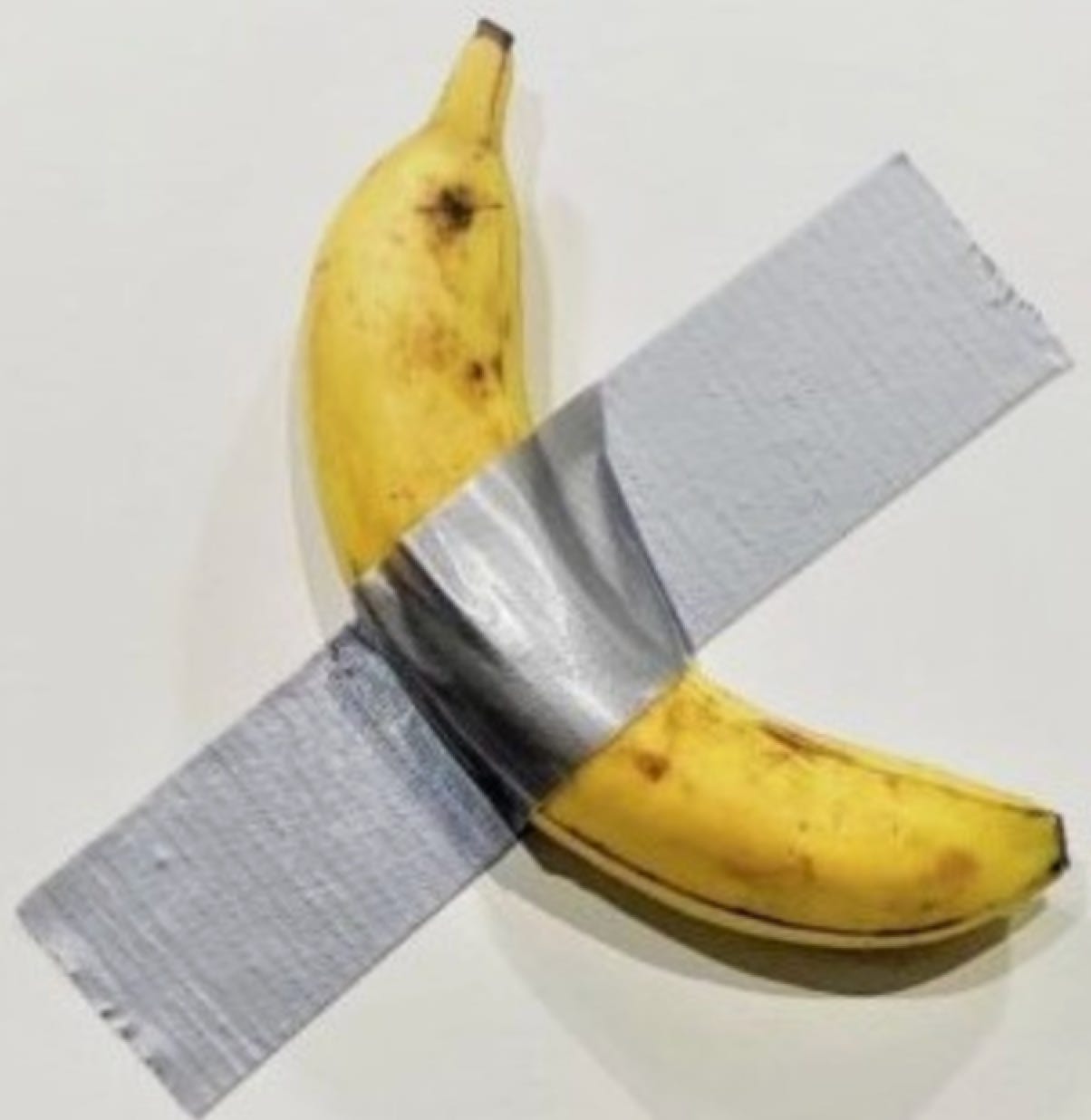
The Million Dollar Banana, conceptual art, by Maurizio Cattelan, Italian, 2024
We live in an age that has largely lost confidence in its own artistic tradition – an age that fills galleries with objects whose claim to be “art” rests not on beauty, skill, or purpose, but on the artist’s assertion alone. To recover a culture of beauty, we must begin at the beginning: with a clear understanding of what art actually is, what makes it good, and what makes it distinctively Christian. This long article sets out to do precisely that. Drawing on the ancient traditions of both Greece and Rome, on the philosophical insights of St. Thomas Aquinas, and on the living wisdom preserved in the Church’s artistic heritage, we will explore art not as an arbitrary exercise in self-expression, but as a purposeful act of making – one rooted in skill, ordered toward beauty, and capable, at its highest reaches, of drawing the human soul toward God. Along the way, we will consider how beauty is known and judged, why tradition is a more reliable guide to it than individual taste or critical fashion, and why the creation of beautiful things is not a luxury to be weighed against other needs, but a form of participation in God’s own creative work that pays for itself.

What is Art?

The word ‘art’ can have a variety of meanings today, and it might be impossible to come up with a definition that all will accept, but here we will focus on ideas of art that are likely to appeal to the traditionally minded Christian and for which we might find a consensus amongst non-Christians also.

Looking to traditional understandings in Western culture, we find that the ancient Greek techne and Latin ars both denoted “skill,” “craft,” or “technique” – a learned proficiency in creating or producing, encompassing all practical trades, such as carpentry, as well as what today we might call the fine arts, such as poetry or painting. An “artefact” is the product of techne in action, and the artisan is the one who creates an artifact. When we speak of an “artist” today, we typically have in mind someone who creates works of fine art.

But how precisely would we define fine art today? How does the mainstream art world define it? We want to answer this question, if only to be sure that when we discuss art with others, we at least know what they believe it to be.

One might think that the major art galleries would provide a definition, given that their whole raison d’être is the exhibition of art. However, a review of the websites of major art galleries such as MoMA, Tate, and the National Galleries of England and America doesn’t provide much help. In fact, I couldn’t find any definitions. Perhaps they assume we all know what art is and that a definition is unnecessary; or perhaps they hesitate to put anything in words because they struggle to find a definition that applies to all the artifacts they show in their galleries.

The British Museum, which is more traditional in its outlook, provides (albeit buried in a training program newsletter) a good working definition of what we would call fine art, closer to the ancient idea of art as the product of techne, as described above. This can be a good working definition for us. It says:

“The definition of art can vary depending on the context and the cultural, social, and historical background in which it is created. However, art in general can be defined as a creative expression of human skill and imagination that aims to communicate an idea, emotion, or message to an audience. This can include a wide range of media, including painting, sculpture, music, literature, film, and other forms of artistic expression.” 1

Good Art and Christian Art

For Christians, adopting this working definition from the British Museum and building on it, we might then ask: what constitutes good art? And, what constitutes Christian art?

In response, I would say that good art is art (as defined above – “a creative expression of human skill and imagination”) that fulfills a good purpose well. We define a good purpose as one consistent with a Christian worldview. This means that art can be Christian even if it does not explicitly express a religious theme or message. For example, a beautiful landscape that communicates the beauty of Creation is a work of Christian art, even if the artist had no explicitly religious intention in painting it and was not a Christian himself.

We would further say that all art is a manifestation of an idea (which might also be an emotion or a message) or an image that first exists in the artist’s imagination before being fashioned into material form. This picture in the artist’s imagination is, in traditional Christian anthropology, taken directly or assembled as a composite from information gained through sensual experience.

The creation of art, from the Christian perspective, is bound up with the creation of something beautiful. Art requires beauty to fulfill its purpose – if a work is not beautiful, it is not good; this might seem a strange proposition given that there is a place for the representation of ugliness, evil, and suffering in art. However, if the art is to portray a Christian understanding of these things, it must also communicate the purpose of these evils within the economy of grace. God must permit evil in the world for good reason, and it is the responsibility of the Christian artist to communicate that message, too. Otherwise, he is not communicating the full truth

For the Christian, even in the face of evil, suffering, and ugliness, there is hope. When infused with hope, the portrayal of these otherwise ugly realities becomes beautiful. This is exemplified by depictions of the Crucifixion. A well-executed Crucifixion is a beautiful work of art. This beauty is created through the artist's treatment of the image – through skillful choices in line, tone, contrast, and composition, for example. In this way, a good artist presents the greatest crime ever committed without diminishing the profound evil it signifies, but rather by infusing the work with Christian hope – a hope that surpasses all the evil and suffering depicted.
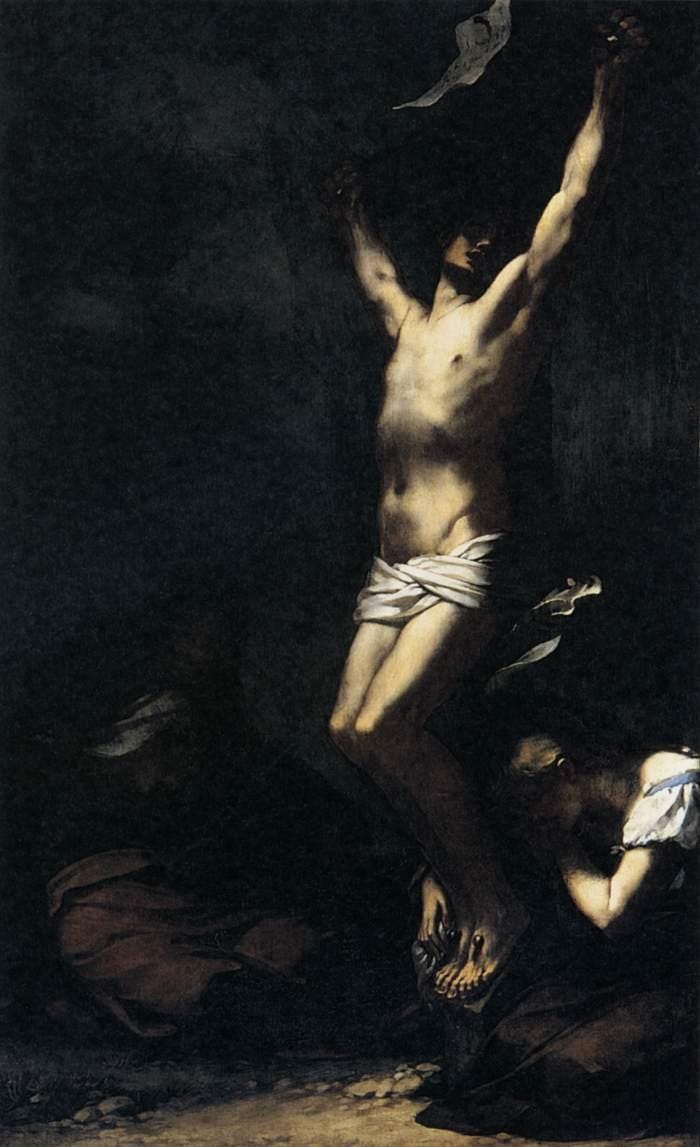

Crucifixion, Pierre-Paul Prud’hon, French, 19th century. Using the baroque style, the artist intentionally contrasts the light on Christ with darkness to symbolize the Light overcoming evil and suffering. This stylistic choice is meant to communicate a sense of hope.
To depict suffering or evil without simultaneously offering hope is, for a Christian, not the full truth. It presents an incomplete picture that can lead to despair. It is through beauty that Christ’s hope is communicated to us, for beauty naturally speaks of God's love (more on beauty later).
Sacred art is the highest form of art, characterized by an explicitly sacred or religious purpose. Liturgical art—created to help us worship God – is the noblest form of sacred art, since worship of God is the highest expression of love for Him and the greatest human activity.
For Christians, the creation of art is intertwined with the pursuit of beauty and divine inspiration. When we recognize the goodness of a work of art, we call it beautiful. As such, good art serves as a sign of the divine – beauty in good art is a visible sign of the work of the unseen God, either as Creator, as seen in the beauty of the universe, or as the God who inspired its creation, through human effort. Therefore, beauty tends to awaken in us a desire for something greater than what we see – the source of that beauty, who is God Himself.

Tuesday, July 15, 2025

The Pear as a Symbol of the Fruit of the Tree of Life in a Painting by Albrecht Dürer

Madonna and Child with Half-Eaten Pear, by Albrecht Dürer

This painting, dated 1512, is influenced by the style of the Italian Renaissance, but was painted by the German artist Albrecht Dürer. It shows Mary and Christ, each regarding the other with a touchingly loving gaze, and Christ holding a half-eaten pear. Because of its sweetness, in Western iconography the pear is often associated with the fruit of the Tree of Life. This fruit, which our first parents, Adam and Eve, never ate, contains the promise of eternal life. Church Fathers such as Ephraim the Syrian speculated that Adam and Eve were expelled from the garden to protect them from the temptation of doing so, so that they could not live forever in a fallen state.

The pear can be contrasted with the apple, which is traditionally used to represent the fruit of the Tree of Knowledge of Good and Evil. The apple is not mentioned in Scripture, but it became associated with the Fall because, in Latin, the word for apple is malum, which is phonetically close to malus, meaning “evil.” Here is a 16th-century German painting of the Temptation of Adam and Eve:
This works beautifully, in my opinion, when paired with the Dürer. It is dark and sombre in mood, lacking in color, and the forms are difficult to distinguish in the tenebrous haze of the effects of sin. Even the garden is uniformly brown and shadowy, stripped of any hint of divine glory. 

The Dürer painting, on the other hand, is brightly colored and clear, with the figures shining with light. The contrast between light and dark is visually heightened by the rich black background, an effect achieved through multiple glazes of thin paint.

As Christians, we are now given the privilege denied to our first parents until Christ retrieved them from Hades after the Crucifixion. We are now all offered the choice to enter an Eden that is raised in glory to a level greater than that of the prelapsarian paradise. And we can choose to eat the fruit that promises eternal life, which is Christ himself, present in the Eucharist.

Hymns from Orthros (morning prayer), in the Byzantine liturgy (Canons for Tone VI on Sunday), express these same sentiments, and connect Mary, the Theotokos, to the economy of redemption directly:

Canon of the Resurrection:

Deceived in Eden into eating of the tree, our progenitor fell into corruption, disobeying Thy commandment, O all-good Lord; yet, obedient to the Father, O Savior, by the Cross Thou didst restore him again to his original beauty.

To the Theotokos:

Through thee, O most holy one, hath grace blossomed forth and the law ceased its effect; for thou, O pure Ever-virgin, gavest birth to the Lord Who granteth us remission.

Tasting of the tree showed me forth as mortal, but the Tree of Life, Who revealed Himself through thee, O all-pure one, raised up the dead and hath made me an heir to the sweetness of paradise.


In depictions of the Tree of Jesse, we see that Christ is connected to Adam through Jesse, and, crucially, in the line of King David. The genealogy from Abraham to Christ is described in three sets of 14 generations in the Gospel of Matthew (1, 1-17) to establish this connection. The number 14 is associated with King David due to the numerical value of his name in Hebrew ‘gematria’, a numerological system in which Hebrew letters are assigned numerical values, and words or phrases with equal totals are considered to have a mystical or interpretive connection. In this 12th-century English illumination of the Tree of Jesse by an anonymous artist, we see the line from Jesse, David’s father, to Christ, represented by a single figure, Mary, who in this context can also be considered the figure from which springs the Tree of Life. Christ is, according to the hymn above, the fruit - the ‘sweet pear’ - present to us in the Eucharist.


As an aside, in old Cockney rhyming slang used in England, the phrase “apples and pears” is a synonym for “stairs”. When I was a boy, my Dad used to tell me to go to bed by directing me to go, “up the apples and pears”. I was reminded of this as I wrote this article. I’m not aware of any connection with the fruit of Eden for this saying, although many aspects of traditional culture do have roots in the old religion, so you never know. Perhaps he was wishing me a peaceful night and the sleep of the redeemed, although I was unaware of it at the time!

More recent articles:

For more articles, see the NLM archives:



