
Do not be afraid, Zachary, thy prayer hath been heard, and Elizabeth thy wife shall bear thee a son, and thou shalt call his name John; and he shall be great before the Lord, and shall be filled with the Holy Spirit even from his mother’s womb; and many will rejoice at his birth. V. O Lord, in Thy strength the king shall be glad; and in Thy salvation shall he rejoice exceedingly. Glory be. Do not be afraid (The introit for the vigil of the Nativity of St John the Baptist.)
Introitus Ne tímeas, Zacharía, exaudíta est oratio tua: et Elísabeth uxor tua pariet tibi filium, et vocábis nomen ejus Joannem: et erit magnus coram Dómino: et Spíritu Sancto replébitur adhuc ex útero matris suae: et multi in nativitáte eius gaudébunt. V. Dómine, in virtúte tua laetábitur rex: et super salutáre tuum exsultábit vehementer. Gloria Patri. Ne tímeas.Tuesday, June 23, 2026
Wednesday, May 13, 2026
Durandus on the Vigil of the Ascension
The following text is most of section 103 of book six of William Durandus’ Rationale Divinorum Officiorum; a few obscure passages have been omitted. The vigil of the Ascension is one of the relatively few features of the temporal cycle in which there was a lot of variation between different Uses of the Roman Rite in the Middle Ages, and some of the texts which he refers to here differ from those in the Roman Missal. The second part explains the baptismal significance of the Introits of the time after Easter, an appropriate subject for the last day of the Easter season properly so-called, and the beginning of the approach to Pentecost, the other major baptismal feast.
Since fasting, of which we have previously spoken (in the preceding section on the Rogation Days), is not sufficient without the works of mercy, therefore on the vigil of the Ascension, which is the third day of the Rogations, the Church exhorts us to the works of mercy, saying in the introit which is sung in some churches, “The mercy of the Lord etc.” (Repeated from Good Shepherd Sunday in the Use followed by Durandus.) For Gregory (the Great) says “If you want your prayer to fly up to heaven, make two wings for it, namely, fasting and alms.” (This saying is incorrectly attributed.) For with good desires we fly to heaven, whence it is said of the Lord, “Lifting up his hands, he was born unto heaven.” …
But the epistle which is read in some churches, (Acts 4, 32-37) seems not to fit, but rather, to set things in the wrong order, since it happened after the Lord’s Ascension that “the heart and mind of the multitude of the believers were one.” But this is done for two reasons. The first is so that the epistle may fit with the gospel (John 17, 1-11a), in which the Lord says “Father, glorify, (that is, manifest) Thy son”, and afterwards prays, saying “I ask that they may be (one) as we are,” and this unity is shown in the epistle. The other reason is that when alms are given from a true heart, all things are held to belong to all, as the Apostle says about the manna, that he who gathered more did not abound more, and who gathered less did not have less (2 Corinthians 8, 15, citing Exodus 16, 18): for he who is rich, should not for this reason eat more, but share it with others, and this is said in the epistle, “And they had all things in common.”
Now for this reason the aforementioned gospel is read today, because He that prayed when He was about to suffer, became known to men when He ascended (to heaven); or else because at the end it says “I come to Thee.” And in this (gospel) He prays for those whom the Father gave Him, that they may be one in the Father, since all things are one in faith and charity, that is, united to one another in harmony … St Hilary (of Poitiers) explains these words as follows. “I ask that just as I and Thou are one, that is, not only in will, but also in nature; so also may they be one, that is, in unity of spirit, and the grace of the Holy Spirit.” (De Trinitate VIII, 9)
But in other churches, the Epistle is (Ephesians 4, 7-13). …
Therefore, because this Mass is about alms and the works of mercy, in some places, in order that they may acquire for themselves the wings mentioned above, people busy themselves with almsgiving, but they defer this to the feast of the Ascension, as if then to fly unto heaven after Christ…
Now some people fittingly refer the Masses of Easter week to those who are reborn in baptism, according to the seven gifts of the Holy Spirit. And so, the one who is reborn, inspired by the spirit of wisdom, says “I have risen.” (The Introit of Easter Sunday) The gospel declares through what he is risen, namely, through the Resurrection of the Lord, and the spirit of understanding instructs him as to what he has gained thereby, saying, “He hath brought us into the Land” (The Introit of Easter Monday), that is, the Church; and the spirit of counsel adds, “With the water of wisdom He gave them to drink.” (Tuesday) The spirit of fortitude indicates what else he ought to gain thereby, saying “Come, ye blessed of my Father.” (Wednesday) The spirit of knowledge teaches him that for these benefits granted to him, he must praise God, saying “Together they praised Thy conquering hand, o Lord.” (Thursday) The spirit of piety indicates what the Resurrection has brought to the reborn, saying “The Lord hath led them out in hope” (Friday), and the spirit of fear adds to this, saying, “The Lord has led out his people.” (Saturday)
For all these benefits conferred in baptism, the angels congratulate men, men confess God, and exhort one another to the praises of Christ; they give thanks, they rejoice, they remember these benefits and the causes thereof, and they confidently aspire to greater things. The other parts of the Masses of Easter are concerned with this … Notice also that in the Introits of this week, Alleluia is said four times in four of them (on Easter Sunday, Tuesday, Wednesday and Friday), and three times in three of them, because praise is given to Holy Trinity from the four parts of the world for the resurrection of Christ, and the redemption of man. In the first Sunday, that is “Quasi modo geniti”, the baptized are urged by their mother (i.e. the Church) to live innocently like infants, and to desire the milk of the Holy Scripture, so that by their mores and life they may hold to the Paschal sacrament which they have received through Christ’s resurrection, overcome the world, triumph with him, and obtain rejoicing in body and soul together. Because of this rejoicing, the Alleluja (before the Gospel) is doubled, because they have escaped from death, and merited to have the hope of life; or as a symbol of action and contemplation; or as a symbol of the joy of the preachers and of those whom they convert.
(The Introit of Good Shepherd Sunday: “The earth is full of the mercy of the Lord, alleluia, and by the word of the Lord the heavens were established, alleluia, alleluia.” Psalm 32)
But on the second Sunday, the baptized, being already instructed, sound forth the mercy of Christ, and preach the Trinity; for in the word “mercy”, they announce the Spirit, in “the word” the Son, and in “God” (i.e. the Lord) the Father. First they mention the Spirit, through whom they are sanctified; then the Son, through whom they are redeemed, then the Father, to whom they are reconciled: and because they sing of the Trinity, they sing Alleluia three times.
(The Introit of the Third Sunday after Easter: “Shout with joy to God, all the earth, alleluia, sing a psalm to his name, alleluia; give glory to his praise, alleluia, alleluia, alleluia.” Psalm 65)
On the third Sunday, the baptized invite the whole world to the praise of God, and sound forth the Trinity, … and since through the two precepts of charity they are strengthened in the faith of the Trinity, therefore, first they sing alleluia twice, then three times.
(The Introit of the Fourth Sunday: “Sing to the Lord a new song, alleluia: because the Lord hath done wonderful things, alleluia. In the sight of the nations He hath revealed his justice, alleluia, alleluia, alleluia.” Psalm 97)
On the fourth Sunday, again the baptized invite the converted nations to the praise of God, and commemorate the Trinity, when in “the Lord” understand the Father, through “wonders” the Son, and in “justice” the Holy Spirit. And because the nations received the faith of the Trinity from the four parts of the world, therefore they sing of the Trinity with a fourth alleluia.
(The Introit of the Fifth Sunday: “Announce the voice of rejoicing, and let it be heard, alleluia: and proclaim even to the ends of the earth, the Lord hath redeemed his people, alleluia, alleluia.” Isaiah 48)
On the fifth Sunday, again the baptized announce their liberator to their nations, because they sing of the Trinity with a threefold Alleluia.
 |
| The Mass of the Vigil of the Ascension in a 15th century Missal according to the Use of Paris, with the Epistle Acts 4, 32-37, instead of the Roman Epistle, Ephesians 4, 7-13. |
Now for this reason the aforementioned gospel is read today, because He that prayed when He was about to suffer, became known to men when He ascended (to heaven); or else because at the end it says “I come to Thee.” And in this (gospel) He prays for those whom the Father gave Him, that they may be one in the Father, since all things are one in faith and charity, that is, united to one another in harmony … St Hilary (of Poitiers) explains these words as follows. “I ask that just as I and Thou are one, that is, not only in will, but also in nature; so also may they be one, that is, in unity of spirit, and the grace of the Holy Spirit.” (De Trinitate VIII, 9)
But in other churches, the Epistle is (Ephesians 4, 7-13). …
Therefore, because this Mass is about alms and the works of mercy, in some places, in order that they may acquire for themselves the wings mentioned above, people busy themselves with almsgiving, but they defer this to the feast of the Ascension, as if then to fly unto heaven after Christ…
Now some people fittingly refer the Masses of Easter week to those who are reborn in baptism, according to the seven gifts of the Holy Spirit. And so, the one who is reborn, inspired by the spirit of wisdom, says “I have risen.” (The Introit of Easter Sunday) The gospel declares through what he is risen, namely, through the Resurrection of the Lord, and the spirit of understanding instructs him as to what he has gained thereby, saying, “He hath brought us into the Land” (The Introit of Easter Monday), that is, the Church; and the spirit of counsel adds, “With the water of wisdom He gave them to drink.” (Tuesday) The spirit of fortitude indicates what else he ought to gain thereby, saying “Come, ye blessed of my Father.” (Wednesday) The spirit of knowledge teaches him that for these benefits granted to him, he must praise God, saying “Together they praised Thy conquering hand, o Lord.” (Thursday) The spirit of piety indicates what the Resurrection has brought to the reborn, saying “The Lord hath led them out in hope” (Friday), and the spirit of fear adds to this, saying, “The Lord has led out his people.” (Saturday)
For all these benefits conferred in baptism, the angels congratulate men, men confess God, and exhort one another to the praises of Christ; they give thanks, they rejoice, they remember these benefits and the causes thereof, and they confidently aspire to greater things. The other parts of the Masses of Easter are concerned with this … Notice also that in the Introits of this week, Alleluia is said four times in four of them (on Easter Sunday, Tuesday, Wednesday and Friday), and three times in three of them, because praise is given to Holy Trinity from the four parts of the world for the resurrection of Christ, and the redemption of man. In the first Sunday, that is “Quasi modo geniti”, the baptized are urged by their mother (i.e. the Church) to live innocently like infants, and to desire the milk of the Holy Scripture, so that by their mores and life they may hold to the Paschal sacrament which they have received through Christ’s resurrection, overcome the world, triumph with him, and obtain rejoicing in body and soul together. Because of this rejoicing, the Alleluja (before the Gospel) is doubled, because they have escaped from death, and merited to have the hope of life; or as a symbol of action and contemplation; or as a symbol of the joy of the preachers and of those whom they convert.
(The Introit of Good Shepherd Sunday: “The earth is full of the mercy of the Lord, alleluia, and by the word of the Lord the heavens were established, alleluia, alleluia.” Psalm 32)
(The Introit of the Third Sunday after Easter: “Shout with joy to God, all the earth, alleluia, sing a psalm to his name, alleluia; give glory to his praise, alleluia, alleluia, alleluia.” Psalm 65)
On the third Sunday, the baptized invite the whole world to the praise of God, and sound forth the Trinity, … and since through the two precepts of charity they are strengthened in the faith of the Trinity, therefore, first they sing alleluia twice, then three times.
(The Introit of the Fourth Sunday: “Sing to the Lord a new song, alleluia: because the Lord hath done wonderful things, alleluia. In the sight of the nations He hath revealed his justice, alleluia, alleluia, alleluia.” Psalm 97)
On the fourth Sunday, again the baptized invite the converted nations to the praise of God, and commemorate the Trinity, when in “the Lord” understand the Father, through “wonders” the Son, and in “justice” the Holy Spirit. And because the nations received the faith of the Trinity from the four parts of the world, therefore they sing of the Trinity with a fourth alleluia.
(The Introit of the Fifth Sunday: “Announce the voice of rejoicing, and let it be heard, alleluia: and proclaim even to the ends of the earth, the Lord hath redeemed his people, alleluia, alleluia.” Isaiah 48)
On the fifth Sunday, again the baptized announce their liberator to their nations, because they sing of the Trinity with a threefold Alleluia.
Friday, October 31, 2025
The Vigil of All Saints
In the Roman Rite, the term “vigilia – vigil” traditionally means a penitential day of preparation for one of the more important feasts. The Mass of a Saint’s vigil is celebrated after None, as are the Masses of the ferias of Lent or the Ember Days, and in violet vestments; however, the deacon and subdeacon do not wear folded chasubles, as they do in Lent, but the dalmatic and tunicle. The Mass has neither the Gloria nor the Creed, the Alleluja is omitted before the Gospel, and not replaced with a Tract, and Benedicamus Domino is said at the end in place of Ite, missa est.
The feast of All Saints was not definitively established as a major solemnity of the Roman Rite until the mid- to late 9th century, but in every book in which it is attested, it is accompanied by such a vigil. It seems reasonable to assume, therefore, that they were instituted at the same time. Because of the preeminent position of the martyrs in Christian devotion as the first and most widely venerated Saints after those who appear in the New Testament, the liturgical texts of All Saints are often borrowed or imitated from those of the feasts of martyrs, and the same is true of its vigil.
The Introit of the vigil is taken from the third chapter of the book of Wisdom, the source of many liturgical texts of all kinds for the feasts of martyrs. “Júdicant Sancti gentes et dominantur pópulis: et regnábit Dóminus, Deus illórum, in perpétuum. Ps. 32 Exsultáte, justi, in Dómino: rectos decet collaudatio. Gloria Patri. Judicant. – The Saints judge nations, and rule over peoples, and the Lord their God shall reign for ever. Ps. Rejoice in the Lord, O ye just: praise becometh the righteous. Glory be. The Saints.”
The Epistle is taken from the Apocalypse, chapter 5, 6-12; this part of the book, St John’s vision of God on His throne with the heavenly court and the Saints standing before Him, has long been a favorite source for artistic depictions of Heaven. This specific passage contains the first mention of Christ as “the Lamb that was slain”, and the book’s first occurrence of the word “Saints”.
“In those days, behold I, John, saw in the midst of the throne and of the four living creatures, and in the midst of the elders, a Lamb standing as it were slain, having seven horns and seven eyes: which are the seven Spirits of God, sent forth into all the earth. And he came and took the book out of the right hand of him that sat on the throne. And when he had opened the book, the four living creatures, and the four and twenty ancients fell down before the Lamb, having every one of them harps, and golden vials full of odours, which are the prayers of saints: And they sung a new canticle, saying: Thou art worthy, O Lord, to take the book, and to open the seals thereof; because thou wast slain, and hast redeemed us to God, in thy blood, out of every tribe, and tongue, and people, and nation. And hast made us to our God a kingdom and priests, and we shall reign on the earth. And I beheld, and I heard the voice of many angels round about the throne, and the living creatures, and the ancients; and the number of them was thousands of thousands, saying with a loud voice, ‘The Lamb that was slain is worthy to receive power, and divinity, and wisdom, and strength, and honour, and glory, and benediction.’ ”
As I described in an article eight years ago, the feast of All Saints was instituted in part as a response to the iconoclast heresy which the Byzantine Emperors invented, and enforced with a brutal persecution. Roughly a generation before iconoclasm began in 726, the Emperor Justinian II had called a synod now known as either “the Synod in Trullo” or “the Quinisext Council”, which among other things forbade any representation of Christ as an animal. In response, Pope St Sergius I (687-701) added the Agnus Dei to the Mass, and the church of Rome began regularly depicting Christ as a lamb in art. This Epistle, in which the Bible itself calls Him a lamb, was most likely chosen in reference to this; likewise the Epistle of the feast itself, chapter 7, 2-12, in which John sees “a great multitude, which no man could number, of all nations, and tribes, and peoples, and tongues, standing before the throne, and in sight of the Lamb, clothed with white robes, and palms in their hands. And they cried with a loud voice, saying, ‘Salvation to our God, who sitteth upon the throne, and to the Lamb.’ ” In the same vein, the Magnificat antiphon for Second Vespers of the feast says “O how glorious is the kingdom where all the Saints rejoice with Christ; clothed in white robes, they follow the Lamb wheresoever he goeth!”
The Gradual is taken from Psalm 149, “Exsultabunt sancti in gloria; laetabuntur in cubilibus suis. V. Cantate Domino canticum novum; laus ejus in ecclesia sanctorum. – The Saints shall rejoice in glory: they shall be joyful in their resting places. V. Sing ye to the Lord a new canticle: let his praise be in the church of the Saints.” The first part of this is frequently said in the Office of Several Martyrs, and was chosen in reference to the fact that the original focus of devotion to the Saints was always at the place of their burial. (There is no recording of it available on YouTube, but it is very similar to the Gradual Tecum principium of the First Mass of Christmas.)
The Gospel, Luke 6, 17-23, is taken from the beginning of the Sermon on the Plain; this is St Luke’s shorter version of the Beatitudes with which St Matthew’s Sermon on the Mount begins (chap. 5, 1-12), the latter being the Gospel of the feast. As St Ambrose explains in the breviary sermon on this Gospel, “Saint Luke sets out only four of the Lord’s Beatitudes, while Saint Matthew gives eight; but in those eight are contained these four, and in these four those eight. For the former in these four embraced the cardinal virtues, and the letter in those eight set forth a number full of mystery. … For as the eighth beatitude names the perfection of what we hope for (i.e., the kingdom of Heaven), so it is also the sum of the virtues.”
The Offertory is taken from the same Psalm as the Gradual, and includes a small variant from the Old Latin version, rather than the Vulgate version of St Jerome. “Exsultabunt sancti in gloria; lætabuntur in cubilibus suis. Exaltationes Dei in faucibus (“gutture” in the Vulgate) eorum. – The Saints shall rejoice in glory: they shall be joyful in their resting places. The high praises of God shall be in their mouth.”
Finally, the Communion also comes from Wisdom 3, and in fact has the same text as the Offertory of the feast, without the Alleluja at the end; the music, however, is completely different.
“Justórum ánimae in manu Dei sunt, et non tanget illos tormentum malitiae: visi sunt óculis insipientium mori: illi autem sunt in pace. – The souls of the just are in the hand of God, and the torment of malice shall not touch them. In the sight of the unwise they seemed to die: but they are in peace.”
In the Middle Ages, October 31 was also celebrated in England, France and the Low Countries as the feast of St Quintinus (“Quentin” in English), a Roman who came to Gaul, preached in the area of Amiens, and was martyred at a town which is now named for him. In many parts of Germany, it was the feast of St Wolfgang, bishop of Regensburg in Bavaria. Where one of these or some other feast was kept, two Masses would be celebrated on the day, one of the Saint after Terce, and the other of the vigil after None, with First Vespers of the feast normally following immediately after the second Mass. The vigil of All Saints receives little attention from medieval liturgical commentators such as Sicard of Cremona or William Durandus, but they do note that it was supposed to be kept with a fast, which was not to be broken until after None and Mass, and was not to be dispensed with because of the occurring feast.
 |
A folio of the Echternach Sacramentary, 895 AD, with the Mass of the vigil of All Saints, and the collect of the feast. (Bibliothèque nationale de France, Département des manuscrits, Latin 9433)
|
Before the Tridentine reform, the vigil of a Saint consisted solely of the Mass, and had no presence in either the Roman version of the Divine Office, or in that of most other Uses. A minority custom, which seems to have been predominantly German, gave an Office to the vigils of Saints, which consisted of a homily at Matins, and the use of the collect of the vigil as the principal collect of the day; the rest of the Office was that of the feria. The Breviary of St Pius V adopted this latter custom for the vigils of Saints, a rare example of change in an otherwise extremely conservative reform; but even for the Roman Rite, this was not an absolute novelty. Historically, the vigils of the major feasts of the Lord (Christmas, Epiphany etc.) did include the Office, and the change in 1568 simply extended the scope of a well-established custom.
The feast of All Saints was not definitively established as a major solemnity of the Roman Rite until the mid- to late 9th century, but in every book in which it is attested, it is accompanied by such a vigil. It seems reasonable to assume, therefore, that they were instituted at the same time. Because of the preeminent position of the martyrs in Christian devotion as the first and most widely venerated Saints after those who appear in the New Testament, the liturgical texts of All Saints are often borrowed or imitated from those of the feasts of martyrs, and the same is true of its vigil.
The Introit of the vigil is taken from the third chapter of the book of Wisdom, the source of many liturgical texts of all kinds for the feasts of martyrs. “Júdicant Sancti gentes et dominantur pópulis: et regnábit Dóminus, Deus illórum, in perpétuum. Ps. 32 Exsultáte, justi, in Dómino: rectos decet collaudatio. Gloria Patri. Judicant. – The Saints judge nations, and rule over peoples, and the Lord their God shall reign for ever. Ps. Rejoice in the Lord, O ye just: praise becometh the righteous. Glory be. The Saints.”
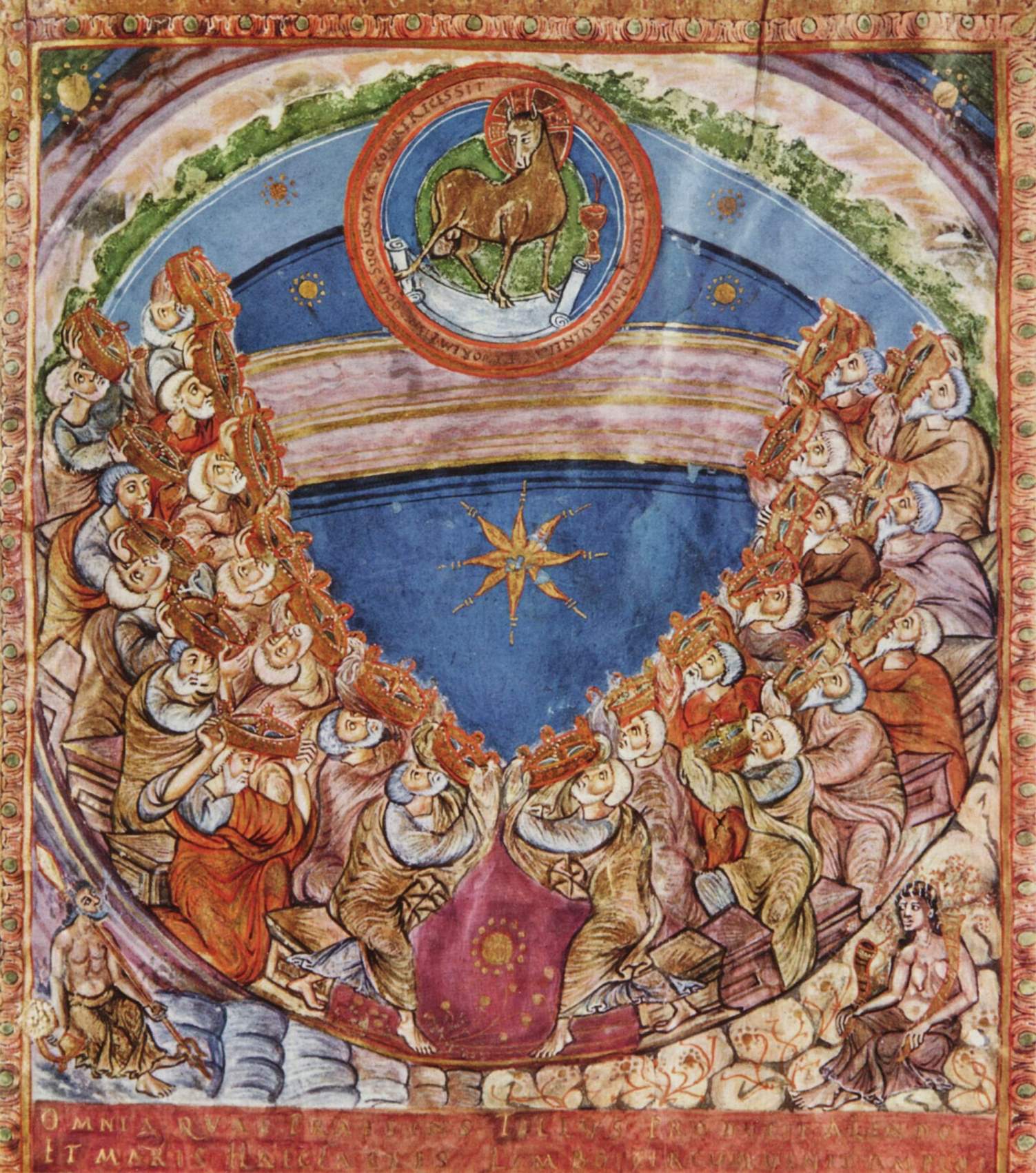 |
| The Adoration of the Lamb, from the Gospel book known as the Codex Aureus of St Emmeram, 870. |
“In those days, behold I, John, saw in the midst of the throne and of the four living creatures, and in the midst of the elders, a Lamb standing as it were slain, having seven horns and seven eyes: which are the seven Spirits of God, sent forth into all the earth. And he came and took the book out of the right hand of him that sat on the throne. And when he had opened the book, the four living creatures, and the four and twenty ancients fell down before the Lamb, having every one of them harps, and golden vials full of odours, which are the prayers of saints: And they sung a new canticle, saying: Thou art worthy, O Lord, to take the book, and to open the seals thereof; because thou wast slain, and hast redeemed us to God, in thy blood, out of every tribe, and tongue, and people, and nation. And hast made us to our God a kingdom and priests, and we shall reign on the earth. And I beheld, and I heard the voice of many angels round about the throne, and the living creatures, and the ancients; and the number of them was thousands of thousands, saying with a loud voice, ‘The Lamb that was slain is worthy to receive power, and divinity, and wisdom, and strength, and honour, and glory, and benediction.’ ”
 |
| In the church of Ss Cosmas and Damian in Rome, Pope Sergius added the gold-background mosaic on the proscenium arch, filled with images from the book of the Apocalypse, including the Lamb of God on His throne. (Photo by Fr Lawrence Lew.) |
The Gospel, Luke 6, 17-23, is taken from the beginning of the Sermon on the Plain; this is St Luke’s shorter version of the Beatitudes with which St Matthew’s Sermon on the Mount begins (chap. 5, 1-12), the latter being the Gospel of the feast. As St Ambrose explains in the breviary sermon on this Gospel, “Saint Luke sets out only four of the Lord’s Beatitudes, while Saint Matthew gives eight; but in those eight are contained these four, and in these four those eight. For the former in these four embraced the cardinal virtues, and the letter in those eight set forth a number full of mystery. … For as the eighth beatitude names the perfection of what we hope for (i.e., the kingdom of Heaven), so it is also the sum of the virtues.”
The Offertory is taken from the same Psalm as the Gradual, and includes a small variant from the Old Latin version, rather than the Vulgate version of St Jerome. “Exsultabunt sancti in gloria; lætabuntur in cubilibus suis. Exaltationes Dei in faucibus (“gutture” in the Vulgate) eorum. – The Saints shall rejoice in glory: they shall be joyful in their resting places. The high praises of God shall be in their mouth.”
Finally, the Communion also comes from Wisdom 3, and in fact has the same text as the Offertory of the feast, without the Alleluja at the end; the music, however, is completely different.
“Justórum ánimae in manu Dei sunt, et non tanget illos tormentum malitiae: visi sunt óculis insipientium mori: illi autem sunt in pace. – The souls of the just are in the hand of God, and the torment of malice shall not touch them. In the sight of the unwise they seemed to die: but they are in peace.”
In the Middle Ages, October 31 was also celebrated in England, France and the Low Countries as the feast of St Quintinus (“Quentin” in English), a Roman who came to Gaul, preached in the area of Amiens, and was martyred at a town which is now named for him. In many parts of Germany, it was the feast of St Wolfgang, bishop of Regensburg in Bavaria. Where one of these or some other feast was kept, two Masses would be celebrated on the day, one of the Saint after Terce, and the other of the vigil after None, with First Vespers of the feast normally following immediately after the second Mass. The vigil of All Saints receives little attention from medieval liturgical commentators such as Sicard of Cremona or William Durandus, but they do note that it was supposed to be kept with a fast, which was not to be broken until after None and Mass, and was not to be dispensed with because of the occurring feast.
 |
The south façade of the basilica of St Quentin. (Photo from Wikimedia Commons by René Hourdry; CC BY-SA 4.0)
|
Saturday, August 09, 2025
The Vigil of St Lawrence
In the Roman Rite, the term “vigilia – vigil” traditionally means a penitential day of preparation for a major feast. The Mass of a Saint’s vigil is celebrated after None, as are the Masses of the ferias of Lent or the Ember Days, and in violet vestments; however, the deacon and subdeacon do not wear folded chasubles, as they do in Lent, but the dalmatic and tunicle. The Mass has neither the Gloria nor the Creed, the Alleluja is simply omitted before the Gospel, not replaced with a Tract, and Benedicamus Domino is said at the end in place of Ite, missa est.
Before the Tridentine reform, the vigil of a Saint consisted solely of the Mass, and had no presence in either the Roman version of the Divine Office, or in that of most other Uses. A minority custom, which seems to have been predominantly German, gave an Office to the vigils of Saints, which consisted of a homily at Matins, and the use of the collect of the vigil as the principal collect of the day; the rest of the Office was that of the feria. The Breviary of St Pius V adopted this latter custom for the vigils of Saints, a rare example of change in an otherwise extremely conservative reform; but even for the Roman Rite, this was not an absolute novelty. Historically, the vigils of the major feasts of the Lord (Christmas, Epiphany etc.) did include the Office, and the change in 1568 simply extended the scope of a well-established custom.
Writing at the end of the 13th century, the liturgical commentator William Durandus notes as one of the special privileges of St Lawrence that he is the only martyr whose feast has a vigil, a custom which he shares with the Virgin Mary and the Apostles. More anciently this was not the case; the Gelasian Sacramentary also included vigils of the martyrs Gervasius and Protasius on June 17th, and of Ss John and Paul on June 25th. However, these had already disappeared from the Gregorian Sacramentary by the mid-9th century, and the fact that St Lawrence’s vigil was retained certainly indicates the universality and importance of devotion to him. The same ancient sacramentaries have vigils for the Assumption, the birth of St John the Baptist, Ss Peter and Paul, and St Andrew; they were later given to the other Apostles whose feasts occur outside Eastertide, and to the feast of All Saints.
The story is well known that during the persecution of the Emperor Valerian in the mid-3rd century, St Lawrence was the deacon in Rome in charge of the Church’s charities. When he was arrested and told to hand the riches of the Church over to the Romans, he distributed all the money to the poor, whom he then brought to the residence of the prefect of Rome, and showing them to him, said, “These are the riches of the Church.” The liturgy refers to this by using Psalm 111, 9, “He hath distributed, he hath given to the poor: his justice remaineth for ever and ever” as both the Introit and Gradual of the vigil of St Lawrence; the same text is cited by St Paul in the Epistle of the feast day, 2 Corinthians 9, 6-10. St Maximus of Turin also cites this verse in a sermon on St Lawrence: “How profound and how heavenly was the counsel of this man of the spirit, that he should take care of the needy; and since the crowd was using up what he had given them, nothing could be found for the persecutor to take; for indeed he followed the saying ‘He hath distributed etc.’ ” (Homilia 74 in natali S. Laurentii; PL LVII 401A)
The Epistle of the vigil, Sirach 51, 1-8 and 12, appears in the Wurzburg lectionary, the very oldest of the Roman Rite, around 650 AD; it was clearly chosen for the reference to St Lawrence’s martyrdom by being roasted alive on a grill. “Thou hast delivered me, according to the multitude of the mercy of thy name, from them that did roar, prepared to devour. Out of the hands of them that sought my life, and from the gates of afflictions, which compassed me about. From the oppression of the flame which surrounded me, and in the midst of the fire I was not burnt. From the depth of the belly of hell, and from an unclean tongue, and from lying words, from an unjust king, and from a slanderous tongue.” The “unjust king” is, of course, the Emperor Valerian, in contrast to whom St Lawrence’s “justice remaineth for ever and ever.”
The Gospel, Matthew 16, 24-27, appears in the same lectionary only on the vigil of St Lawrence, but was later extended to the Common of a Single Martyr. (Commons of the Saints had not yet been created as a feature of Roman liturgical books when the Wurzburg lectionary was written.) The first line, “If any man will come after me, let him deny himself, and take up his cross, and follow me.”, may have been chosen in reference to the story of St Lawrence’s martyrdom, as told by St Ambrose.
When Lawrence saw Pope St Sixtus II being led to martyrdom, he addressed him thus: “Whither goest thou without thy son, father? Whither, holy priest, dost thou hasten without thy deacon? Never wast thou want to offer sacrifice without thy minister. What then hath displeased thee in me, father? Hast thou found me ignoble? Make proof surely whether thou didst choose a worthy minister. Dost thou deny a share in thy blood to one to whom thou didst entrust the consecration of the Lord’s blood, and a share in the celebration of the sacraments?... Abraham offered his son, Peter sent Stephen before him…” To this Sixtus replied, “I do not leave or abandon thee, son, but greater contests await thee. We, as elder men, receive the way of an easier combat; a more glorious triumph against the tyrant awaiteth thee as a younger man. Soon shalt thou come after, cease weeping; after three days shalt thou follow me, as levite followeth priest.” (These words from the 39th chapter of St. Ambrose’s De Officiis form the basis of several antiphons and responsories in the office of St Lawrence.)
The Offertory is beautifully selected from the book of Job, who, like Lawrence, is honored by the Church as one who showed great patience in suffering. “My prayer is pure, and therefore I ask that a place be given in heaven to my voice; for there is my judge, and He that knoweth me is on high; let my plea arise to the Lord.” (from the end of Job 16) The text is loosely cited from the Old Latin version, not the Vulgate of St Jerome, which indicates that it is a piece of great antiquity. One of Durandus’ predecessors in the field of liturgical commentary, the Benedictine abbot Rupert of Deutz (ca. 1075-1130), wrote a book about the terrible fire which destroyed the town of Deutz, in which he refers frequently to both Job and St Lawrence, and cites this offertory. “Thou, o blessed Martyr, … were the Job of thy times, and now, and until the end of the world, Christ and His Church hear thy cry, the great cry of thy passion, … She (the Church) first heard thy cry, and first joined thee in it, and taught us to cry out with Her in these words, which first were the words of Job… but nevertheless are the words of the Holy Church in her afflictions, and are mostly perfectly suitable to Thee, ‘My prayer is pure etc.’ ” (De incendio oppidi Tuitii sua aetate viso liber aureus, cap. 21; P.L. 170 354B)
The Gelasian Sacramentary also contained a Preface for both the vigil and feast of St Lawrence, of which the former reads as follows, a lovely exposition of the reason for celebrating the feasts of the Saints every year.
Truly it is worth and just, meet and profitable to salvation, that we should give Thee thanks always and everywhere, o Lord, holy Father, almighty and everlasting God, by anticipating the blessed struggles of the glorious martyr Lawrence, whose honorable solemnity in its annual recurrence is everlasting and ever new; for precious death of Thy just ones remaineth in the sight of Thy majesty, and the increase of joy is renewed, when we recall the beginning of their eternal happiness. And therefore with the Angels…
The 1960 reform of the Breviary added to the vigil of St Lawrence a completely anomalous feature, something which had never existed before, and does not exist anywhere else; it is the only vigil that has Vespers. [1] A vigil is a separate liturgical observance from its feast, and traditionally, all feasts began with First Vespers, and so a vigil by definition ended once None and the Mass were celebrated. In 1960, however, all the feasts of St Lawrence’s rank lost their first Vespers. [2] His vigil somehow managed to survive the massacres of 1955 and 1960, but as the only vigil attached to a feast with no First Vespers. In order to cover the gap between the vigil and the feast, which now begins with Matins, the vigil was extended to include Vespers; these consist of the regular Office of the feria, but with the Collect of the vigil. For no discernible reason, the series of versicles known as the ferial preces, which are characteristic of penitential days, are omitted from all the vigils in 1960.
[1] The vigil of the Epiphany, which as part of the Christmas season is not a penitential day, is celebrated in a different manner from the vigils of the Saints. It traditionally had First Vespers, on the evening of January 4th, but ended like the other vigils after None. Many medieval Uses extended this custom to the vigil of Christmas as well, but this was not done in the Roman Use.
[2] By 1981, when the Ambrosian Liturgy of the Hours was promulgated, this change was recognized to be a mistake; the modern Ambrosian Office has First Vespers for all feasts, and celebrates Solemnities with Second Vespers.
 |
Folio 100r of the Gellone Sacramentary, a sacramentary of the mixed Gelasian type written in 780-800 AD. The Mass of the vigil of St Lawrence begins with the large A in the middle of the page; the preface cited below begins with the decorated VD second from the bottom. (Bibliothèque nationale de France, Département des Manuscrits, Latin 12048)
|
Writing at the end of the 13th century, the liturgical commentator William Durandus notes as one of the special privileges of St Lawrence that he is the only martyr whose feast has a vigil, a custom which he shares with the Virgin Mary and the Apostles. More anciently this was not the case; the Gelasian Sacramentary also included vigils of the martyrs Gervasius and Protasius on June 17th, and of Ss John and Paul on June 25th. However, these had already disappeared from the Gregorian Sacramentary by the mid-9th century, and the fact that St Lawrence’s vigil was retained certainly indicates the universality and importance of devotion to him. The same ancient sacramentaries have vigils for the Assumption, the birth of St John the Baptist, Ss Peter and Paul, and St Andrew; they were later given to the other Apostles whose feasts occur outside Eastertide, and to the feast of All Saints.
 |
| St Lawrence Distributing Alms to the Poor; fresco by the Blessed Angelico from the Chapel of Pope Nicholas V, 1447-49, now in the Vatican Museums. |
The Epistle of the vigil, Sirach 51, 1-8 and 12, appears in the Wurzburg lectionary, the very oldest of the Roman Rite, around 650 AD; it was clearly chosen for the reference to St Lawrence’s martyrdom by being roasted alive on a grill. “Thou hast delivered me, according to the multitude of the mercy of thy name, from them that did roar, prepared to devour. Out of the hands of them that sought my life, and from the gates of afflictions, which compassed me about. From the oppression of the flame which surrounded me, and in the midst of the fire I was not burnt. From the depth of the belly of hell, and from an unclean tongue, and from lying words, from an unjust king, and from a slanderous tongue.” The “unjust king” is, of course, the Emperor Valerian, in contrast to whom St Lawrence’s “justice remaineth for ever and ever.”
 |
| The Martyrdom of Saint Lawrence, by Titian, 1567, from the Spanish Royal Monastery of the Escorial. |
When Lawrence saw Pope St Sixtus II being led to martyrdom, he addressed him thus: “Whither goest thou without thy son, father? Whither, holy priest, dost thou hasten without thy deacon? Never wast thou want to offer sacrifice without thy minister. What then hath displeased thee in me, father? Hast thou found me ignoble? Make proof surely whether thou didst choose a worthy minister. Dost thou deny a share in thy blood to one to whom thou didst entrust the consecration of the Lord’s blood, and a share in the celebration of the sacraments?... Abraham offered his son, Peter sent Stephen before him…” To this Sixtus replied, “I do not leave or abandon thee, son, but greater contests await thee. We, as elder men, receive the way of an easier combat; a more glorious triumph against the tyrant awaiteth thee as a younger man. Soon shalt thou come after, cease weeping; after three days shalt thou follow me, as levite followeth priest.” (These words from the 39th chapter of St. Ambrose’s De Officiis form the basis of several antiphons and responsories in the office of St Lawrence.)
 |
Ss Benedict, Sixtus II, and the Martyr Proculus by Simone di FIlippo, ca. 1380. (Image from Wikipedia by SilviaZamb, CC BY-SA 3.0)
|
The Gelasian Sacramentary also contained a Preface for both the vigil and feast of St Lawrence, of which the former reads as follows, a lovely exposition of the reason for celebrating the feasts of the Saints every year.
Truly it is worth and just, meet and profitable to salvation, that we should give Thee thanks always and everywhere, o Lord, holy Father, almighty and everlasting God, by anticipating the blessed struggles of the glorious martyr Lawrence, whose honorable solemnity in its annual recurrence is everlasting and ever new; for precious death of Thy just ones remaineth in the sight of Thy majesty, and the increase of joy is renewed, when we recall the beginning of their eternal happiness. And therefore with the Angels…
 |
| Part of the mosaic in the apse of Santa Maria in Trastevere in Rome. St Lawrence, in the middle; on the left, Pope Innocent II (1130-43), who built the church, presents to Christ; on the right, Pope St Callixtus I (ca. 218-22), who was martyred in the neighborhood of this church, and whose relics are kept in it. |
[1] The vigil of the Epiphany, which as part of the Christmas season is not a penitential day, is celebrated in a different manner from the vigils of the Saints. It traditionally had First Vespers, on the evening of January 4th, but ended like the other vigils after None. Many medieval Uses extended this custom to the vigil of Christmas as well, but this was not done in the Roman Use.
[2] By 1981, when the Ambrosian Liturgy of the Hours was promulgated, this change was recognized to be a mistake; the modern Ambrosian Office has First Vespers for all feasts, and celebrates Solemnities with Second Vespers.
Saturday, June 28, 2025
The Vigil of Ss Peter and Paul
In the Roman Rite, the term “vigilia – vigil” traditionally means a penitential day of preparation for a major feast. The Mass of a Saint’s vigil is celebrated after None, as are the Masses of the ferias of Lent or the Ember Days, and in violet vestments; however, the deacon and subdeacon do not wear folded chasubles, as they do in Lent, but the dalmatic and tunicle. The Mass has neither the Gloria nor the Creed, the Alleluja is simply omitted before the Gospel, not replaced with a Tract, and Benedicamus Domino is said at the end in place of Ite, missa est.
 |
| The Mass of the Vigil of Ss Peter and Paul in the Echternach Sacarmentary, (895 A.D.; Bibliothèque nationale de France, Département des manuscrits, Latin 9433) Note that it is preceded by the Mass of Pope St Leo II, as will be explained below; the preface of the Apostles is said, instead of the common preface prescribed by the Missal of St Pius V. |
The vigil of Ss Peter and Paul is one of the oldest observances of the Roman Rite, attested in all pertinent liturgical books as far back as we have them. The Mass chants (except for the Communio) and the two Scriptural readings are the same in the most ancient sources as those in the Missal of St Pius V; the three prayers are the same in the earliest versions of the Gregorian Sacramentary, from the end of the 8th century.
It is one of the Church’s oldest and most universal customs to celebrate Ss Peter and Paul in a joint feast on June 29. However, the Roman liturgy naturally tends to lay greater emphasis on Peter as the one who was a close friend of the Lord in His earthly life, and in whom the primacy was conferred upon the church of Rome. Therefore, just as Peter figures more prominently than Paul in the main feast, so also in the vigil; the Introit, Epistle, and Gospel are all about him, as is the modern Communio taken from the Gospel. This is balanced by the fact that Paul has a special feast of his own on June 30th, while at the vigil, the prayers all refer to “apostles” generically, without naming either one.
Collecta Præsta, quáesumus, omnípotens Deus: ut nullis nos permittas perturbatiónibus cóncuti; quos in apostólicae confessiónis petra solidasti. - Grant, we ask, almighty God, that Thou may not permit us to be shaken by any disturbances, whom Thou hast strengthened on the rock of the apostolic confession. (Here, of course, the “rock” also refers more to Peter.)
Secreta Munus pópuli tui, quáesumus, Dómine, apostólica intercessióne sanctífica: nosque a peccatórum nostrórum máculis emunda. – Sanctify the service of Thy people, we ask, O Lord, by the intercession of the Apostles, and cleanse us from the stains of our sins.
Postcommunio Quos caelesti, Dómine, alimento satiasti: apostólicis intercessiónibus ab omni adversitáte custódi. – O Lord, by the intercession of Thy Apostles, defend from all adversity those whom Thou hast satisfied with heavenly food.
The Introit is taken from the Gospel, as it is some of the other very ancient Roman vigils, such as those of St John the Baptist and the Apostle St Andrew.
Introitus Dicit Dóminus Petro: Cum esses junior, cingébas te et ambulábas ubi volébas: cum autem senúeris, extendes manus tuas, et alius te cinget et ducet, quo tu non vis: hoc autem dixit, signíficans, qua morte clarificatúrus esset Deum. Ps 18 Caeli enarrant gloriam Dei: et ópera mánuum ejus annuntiat firmamentum. Gloria Patri. Dicit Dóminus Petro.
Introit The Lord said to Peter, ‘When thou wert young, thou didst gird thyself and walk where thou would, but when thou shalt be old, thou wilt stretch forth thy hands, and another will gird thee, and lead thee where thou wouldst not. Now this He said to signify by what manner of death he should glorify God. Ps 18 The heavens declare the glory of God, and the firmament proclaims the works of His hands. Glory be. The Lord said to Peter.
The Epistle, Acts 3, 1-10, is chosen in part because it is the first miracle which Peter performs after Pentecost, the healing of the paralytic at the Beautiful Gate. This signifies his role as the head of the Church in the long period from the descent of the Holy Ghost (which is recounted in the previous chapter) to the end of the world, a period symbolized by the season between Pentecost and Advent. This miracle happened when Peter and John had gone up to the temple to pray “at the ninth hour”, which refers to the hour of the vigil’s celebration after None.
The psalm verse with which the Introit is sung is repeated in the Gradual, and was associated with the Apostles from very ancient times. For example, a commentary on the Psalms written in the 4th century, and formerly attributed to a correspondent (and later disputant) of St Jerome, Rufinus of Aquileia, says “the Apostles and Evangelists … are rightly called ‘heavens’, because of the loftiness of their life, and the ‘firmament’ because of the solidity of their faith and charity; they declare the glory of (Christ’s) divinity, and proclaim to the works of (His) humanity.” (PL 21, 712B in fine) The first part of the Gradual, “Their sound hath gone forth into all the earth, and their words unto the ends of the world,” likewise refers to the Apostolic preaching of the Gospel to the whole world. (The exact same verses are also sung in the Byzantine Rite as the Prokimen, the chant before the Epistle, at the Divine Liturgy on June 29.)
Since the Gospel of the feast is Matthew 16, 13-19, the conferral of the primacy of the Church upon Peter, that of the vigil is the prophecy of his death which Christ makes to him at the end of the Gospel of St John.
“Jesus saith to Simon Peter: Simon son of John, lovest thou me more than these? He saith to him: Yea, Lord, thou knowest that I love thee. He saith to him: Feed my lambs. He saith to him again: Simon, son of John, lovest thou me? He saith to him: Yea, Lord, thou knowest that I love thee. He saith to him: Feed my lambs. He said to him the third time: Simon, son of John, lovest thou me? Peter was grieved, because he had said to him the third time: Lovest thou me? And he said to him: Lord, thou knowest all things: thou knowest that I love thee. He said to him: Feed my sheep. Amen, amen I say to thee, when thou wast younger, thou didst gird thyself, and didst walk where thou wouldst. But when thou shalt be old, thou shalt stretch forth thy hands, and another shall gird thee, and lead thee whither thou wouldst not. And this he said, signifying by what death he should glorify God.”
In the brief reading in the breviary in which St Augustine comments on this passage, he explains that Peter here makes a three-fold confession in place of his three-fold denial of Christ during the Passion.
 |
| The Crucifixion of St Peter, depicted in the Papal Chapel known as the Sancta Sanctorum at the Lateran Basilica in Rome, ca. 1280. |
 |
| In this altar in St Peter’s Basilica are kept the relics of three Sainted Popes named Leo, the Second (682-3), the Third (795-816) and the Fourth (847-55). The altar of Pope St Leo I (440-61) is right next to it, and Pope Leo XII (1823-29) is buried in the floor between them. |
In 1921, Pope Benedict XV extended the feast of St Irenaeus of Lyon to the general Calendar on his traditional Lyonese date, June 28, moving Leo II to July 3rd, the next free day on the calendar, and the day of his burial according to the Liber Pontificalis. In the reform of 1960, St Irenaeus was moved to July 3rd, and Leo II suppressed, in order to free June 28th up entirely for the Mass and Office of the vigil of Ss Peter and Paul. This was fundamentally a rather odd thing to do, since so many of the vigils then on the general Calendar (including all those of the other Apostles, and, inexcusably, those of the Epiphany and All Saints), were abolished by the same reform.
Less than a decade later, however, with the promulgation of the Novus Ordo, vigils in the classic Roman sense, penitential days of preparation for the major feasts, were simply abolished altogether, “freeing” June 28th from the one observance which had hitherto been absolutely universal on that date, the vigil of Ss Peter and Paul. Irenaeus was therefore returned to that date.
Thursday, October 31, 2024
The Vigil of All Saints 2024
In those days, behold I, John, saw in the midst of the throne and of the four living creatures, and in the midst of the elders, a Lamb standing as it were slain, having seven horns and seven eyes: which are the seven Spirits of God, sent forth into all the earth. And he came and took the book out of the right hand of him that sat on the throne. And when he had opened the book, the four living creatures, and the four and twenty ancients fell down before the Lamb, having every one of them harps, and golden vials full of odours, which are the prayers of saints.
 |
| The representation of this scene in an illustrated manuscript of the Commentary on the Apocalypse by Beatus of Liébana. The Lamb is represented on a medallion on Christ’s chest and another on top of his staff, although they are barely visible as such. (Public domain image from Wikimedia Commons.) |
And they sung a new canticle, saying: Thou art worthy, O Lord, to take the book, and to open the seals thereof; because thou wast slain, and hast redeemed us to God, in thy blood, out of every tribe, and tongue, and people, and nation. And hast made us to our God a kingdom and priests, and we shall reign on the earth. And I beheld, and I heard the voice of many angels round about the throne, and the living creatures, and the ancients; and the number of them was thousands of thousands, saying with a loud voice, ‘The Lamb that was slain is worthy to receive power, and divinity, and wisdom, and strength, and honour, and glory, and benediction.’ ” (Apocalypse 5, 6-12, the Epistle for the vigil of All Saints.)
Wednesday, August 14, 2024
The Vigil of the Assumption
In the Roman Rite, the term “vigilia – vigil” traditionally means a penitential day of preparation for a major feast. The Mass of a Saint’s vigil is celebrated after None, as are the Masses of the ferias of Lent or the Ember Days, and in violet vestments; however, the deacon and subdeacon do not wear folded chasubles, as they do in Lent, but the dalmatic and tunicle. The Mass has neither the Gloria nor the Creed, the Alleluja is simply omitted before the Gospel, not replaced with a Tract, and Benedicamus Domino is said at the end in place of Ite, missa est.
The vigil of the Assumption is not attested in the most ancient liturgical books of the Roman Rite, most notably, the oldest form of the Gelasian Sacramentary, ca. 750 AD. It is found in the Gellone Sacramentary only 30 years later, and in all copies of the Gregorian Sacramentary. In the Roman Missal, the Gregorian chant parts are all taken from other Masses of the Virgin Mary. The Introit Vultum tuum is also sung on the Annunciation and at the Votive Mass of the Virgin in Christmastide, which indicates that the salvation of the human person in both body and soul, which God begins to effect in the Incarnation, and which He manifests to the world with His birth, is first perfected when His Mother is assumed into heaven body and soul.
The Epistle is taken from the twenty-fourth chapter of Sirach, in which Wisdom, understood in medieval tradition as a figure of the Virgin Mary, “praises her own self, and is honored in God, ... and among the blessed is blessed, etc.” The verses selected for the vigil are 23-31, the first of which may have been chosen in reference to the tradition that after the Assumption, flowers grew out of the stone floor of the tomb in which the Apostles had laid Her body to rest. “As the vine I have brought forth a pleasant odor: and my flowers are the fruit of honor and riches.” And likewise, the last verse, “They that explain me shall have life everlasting”, points to the Virgin as the first-fruits of mankind’s eternal redemption in Her Son.
The feast of the Assumption was adopted into the Roman Rite from the Byzantine towards the end of the 7th century, under Pope St Sergius I (687-701), who was of Syrian origins, but born and raised in Palermo, Sicily, then part of the Byzantine Empire. In the Byzantine Rite, two separate parts of St Luke’s Gospel are taken together as a single reading at the Divine Liturgy, chapter 10, 38-42, in which the Lord tells Martha that her sister Mary “hath chosen the better part”, and chapter 11, 27-28, in which a woman in the crowd says to Him, “Blessed is the womb that bore thee.” In the Wurzburg lectionary, the oldest of the Roman Rite, which is roughly contemporary with Pope Sergius, these readings are both given for the “birth (into heaven) of St Mary”, but as two separate entries; it may be that they were nevertheless read together as in the Greek tradition. However, the Roman Rite makes almost no use of these kinds of composite readings, and in the second oldest lectionary, that of Murbach, from roughly a century later, the second part has disappeared. Its association with the Assumption was then preserved by assigning it to the vigil.
The most interesting aspect of the Mass is the evolution of its prayers. The collect appears in the Gregorian Sacramentary (ca. 800 AD) in the same form it has in the Missal of St Pius V.
“Deus, qui virginálem aulam beátae Maríae, in qua habitáres, elígere dignátus es: da, quaesumus; ut, sua nos defensióne munítos, jucundos facias suae interesse festivitáti. – O God, Who deigned to choose for Thy dwelling the virginal womb (lit. ‘court’) of the blessed Mary, grant, we beseech Thee, that, protected by Her defense, we may with joy take part in her festival.”
In its original form, the Secret is very unusual in that it contains no petition.
“Magna est, Dómine, apud clementiam tuam Dei Genetrícis oratio: quam idcirco de praesenti saeculo transtulisti; ut pro peccátis nostris apud te fiduciáliter intercédat. – Great before Thy clemency, o Lord, is the prayer of the Mother of God, whom Thou didst transport from this present age for this reason, that She might confidently intercede with Thee for our sins.”
Already by the end of the ninth century, this prayer appears in the Echternach Sacramentary with a very slight emendation; the first verb is changed to the subjunctive, which makes it a petition: “Magna sit… – May the prayer of the Mother of God be great… ” This was evidently still deemed too unlike a typical Secret, and was later emended again to the more conventional form it has in the Tridentine Missal, “Munera nostra … commendet oratio - May the prayer of the Mother of God commend our offerings… ”
It is a well-known fact that although the Church has officially defined the fact of the Virgin Mary’s bodily Assumption, it has never formally pronounced on the question of whether She died first or not. However, the weight of tradition, going back to the very earliest Eastern sources, is very much of the opinion that She did die first. This is explicitly stated in many prayers used on the feast of the Assumption in the West, including the Post-Communion of the vigil in its original form.
“Concéde, miséricors Deus, fragilitáti nostrae praesidium: ut, qui sanctae Dei Genetrícis requiem celebrámus; intercessiónis ejus auxilio, a nostris iniquitátibus resurgámus. – Grant, o merciful God, Thy protection for our frailty, that we who celebrate the repose of the holy Mother of God, may rise again from our iniquities with the help of Her intercession.”
In the context of the Roman Rite, in which the liturgy for the dead repeatedly uses the words “Requiem aeternam dona eis, Domine”, this should certainly be read as an allusion to the belief that the Virgin Mary did in fact die before the Assumption. It also looks forward to the traditional Epistle of the feast itself, Sirach 24, 11-20 (minus verse 14), which begins with the words “In all things I sought rest (requiem), and I shall abide in the inheritance of the Lord.” The editors of the Tridentine Missal, however, decided to take a more neutral stance on a point thitherto undefined, and therefore changed “requiem celebrámus” to “festivitátem praevenímus – look forward to Her festivity.”
 |
Folio 102v of the Gellone Sacramentary, 780 AD; the Mass of the vigil of the Assumption begins with the decorative S just under the middle of the page. The prayers given here are different from those of the Gregorian Sacramentary which are described below. Above it is the Mass of St Eusebius, which is still kept as a commemoration on the vigil to this day. (Bibliothèque nationale de France, Département des Manuscrits, Latin 12048)
|
The Epistle is taken from the twenty-fourth chapter of Sirach, in which Wisdom, understood in medieval tradition as a figure of the Virgin Mary, “praises her own self, and is honored in God, ... and among the blessed is blessed, etc.” The verses selected for the vigil are 23-31, the first of which may have been chosen in reference to the tradition that after the Assumption, flowers grew out of the stone floor of the tomb in which the Apostles had laid Her body to rest. “As the vine I have brought forth a pleasant odor: and my flowers are the fruit of honor and riches.” And likewise, the last verse, “They that explain me shall have life everlasting”, points to the Virgin as the first-fruits of mankind’s eternal redemption in Her Son.
The feast of the Assumption was adopted into the Roman Rite from the Byzantine towards the end of the 7th century, under Pope St Sergius I (687-701), who was of Syrian origins, but born and raised in Palermo, Sicily, then part of the Byzantine Empire. In the Byzantine Rite, two separate parts of St Luke’s Gospel are taken together as a single reading at the Divine Liturgy, chapter 10, 38-42, in which the Lord tells Martha that her sister Mary “hath chosen the better part”, and chapter 11, 27-28, in which a woman in the crowd says to Him, “Blessed is the womb that bore thee.” In the Wurzburg lectionary, the oldest of the Roman Rite, which is roughly contemporary with Pope Sergius, these readings are both given for the “birth (into heaven) of St Mary”, but as two separate entries; it may be that they were nevertheless read together as in the Greek tradition. However, the Roman Rite makes almost no use of these kinds of composite readings, and in the second oldest lectionary, that of Murbach, from roughly a century later, the second part has disappeared. Its association with the Assumption was then preserved by assigning it to the vigil.
The most interesting aspect of the Mass is the evolution of its prayers. The collect appears in the Gregorian Sacramentary (ca. 800 AD) in the same form it has in the Missal of St Pius V.
“Deus, qui virginálem aulam beátae Maríae, in qua habitáres, elígere dignátus es: da, quaesumus; ut, sua nos defensióne munítos, jucundos facias suae interesse festivitáti. – O God, Who deigned to choose for Thy dwelling the virginal womb (lit. ‘court’) of the blessed Mary, grant, we beseech Thee, that, protected by Her defense, we may with joy take part in her festival.”
In its original form, the Secret is very unusual in that it contains no petition.
“Magna est, Dómine, apud clementiam tuam Dei Genetrícis oratio: quam idcirco de praesenti saeculo transtulisti; ut pro peccátis nostris apud te fiduciáliter intercédat. – Great before Thy clemency, o Lord, is the prayer of the Mother of God, whom Thou didst transport from this present age for this reason, that She might confidently intercede with Thee for our sins.”
 |
| The first part of Mass of the Vigil of the Assumption in the Echternach Sacramentary, 895 AD, with the alteration of the verb “est” to “sit”, as noted below. Note that another scribe, still perhaps worried that the prayer was still not sufficently petitionary, added the words “pro nobis – for us.” (Bibliothèque nationale de France, Département des manuscrits, Latin 9433) |
It is a well-known fact that although the Church has officially defined the fact of the Virgin Mary’s bodily Assumption, it has never formally pronounced on the question of whether She died first or not. However, the weight of tradition, going back to the very earliest Eastern sources, is very much of the opinion that She did die first. This is explicitly stated in many prayers used on the feast of the Assumption in the West, including the Post-Communion of the vigil in its original form.
“Concéde, miséricors Deus, fragilitáti nostrae praesidium: ut, qui sanctae Dei Genetrícis requiem celebrámus; intercessiónis ejus auxilio, a nostris iniquitátibus resurgámus. – Grant, o merciful God, Thy protection for our frailty, that we who celebrate the repose of the holy Mother of God, may rise again from our iniquities with the help of Her intercession.”
In the context of the Roman Rite, in which the liturgy for the dead repeatedly uses the words “Requiem aeternam dona eis, Domine”, this should certainly be read as an allusion to the belief that the Virgin Mary did in fact die before the Assumption. It also looks forward to the traditional Epistle of the feast itself, Sirach 24, 11-20 (minus verse 14), which begins with the words “In all things I sought rest (requiem), and I shall abide in the inheritance of the Lord.” The editors of the Tridentine Missal, however, decided to take a more neutral stance on a point thitherto undefined, and therefore changed “requiem celebrámus” to “festivitátem praevenímus – look forward to Her festivity.”
 |
| The Assumption of the Virgin, ca. 1665, by Juan Martín Cabezalero (1633-73). |
Saturday, June 22, 2024
The Vigil of the Nativity of St John the Baptist
In the Roman Rite, the term “vigilia – vigil” traditionally means a penitential day of preparation for a major feast. The Mass of a Saint’s vigil is celebrated after None, as are the Masses of the ferias of Lent or the Ember Days, and in violet vestments; however, the deacon and subdeacon do not wear folded chasubles, as they do in Lent, but the dalmatic and tunicle. The Mass has neither the Gloria nor the Creed, the Alleluja is simply omitted before the Gospel, not replaced with a Tract, and Benedicamus Domino is said at the end in place of Ite, missa est.
Because they are penitential days, they are not celebrated on a Sunday, but anticipated to the previous Saturday, which is the case this year for the vigil of the Nativity of St John the Baptist. Before 1908, the feast of St Paulinus of Nola was ranked as a simple feast, and the vigil would have taken precedence over it, but in that year, St Pius X raised it to the rank of a double. The vigil is therefore observed in the Divine Office with the ninth lesson at Matins, and a commemoration at Lauds. Private Masses may be said of either the vigil or the feast, with the commemoration of the other; in major churches, the Mass of the feast is said after Terce, and that of the vigil after None.
The vigil of the Nativity of St John the Baptist is attested in all liturgical books of the Roman Rite until 1969, when vigils in the traditional sense were abolished. The same chants and Scriptural readings which it has in the Missal of St Pius V are already found in the oldest graduals and lectionaries, and the same prayers are all in place in the Gregorian Sacramentary at the beginning of the 9th century. The Baptist’s conception is noted on September 24th in many early Western calendars and martyrologies, but does not seem to have been kept as an actual feast as it is in the Byzantine Rite (one day earlier). This is because the vigil itself serves as the liturgical commemoration of his conception, the announcement of which by the Angel Gabriel to his father Zachariah is read as the Gospel of the day. This custom mirrors that of the Ember Wednesday of Advent, on which the Gospel of the Annunciation is read in preparation for Christmas. |
Folio 89r of the Gellone Sacramentary, 780 AD; the Mass of the vigil of the Nativity of St John, which is here called “jejunium Sancti Johannis Baptistae - the fast of St John the Baptist”, begins with the large decorated P at the bottom of the page. Note the hole where the parchment gave way in the process of preparation; the text is copied out around it on both sides. (Bibliothèque nationale de France, Département des Manuscrits, Latin 12048)
|
The introit of the vigil sums up the Angel’s message, and prepares us for the great feast of the following day, on which “many will rejoice at his birth.”
It has very often been noted that the birth of the Baptist occurs shortly after the summer solstice, when the hours of daylight begin to grow shorter, and the birth of Christ occurs shortly after the winter solstice, when the hours of daylight begin to grow longer. This arrangement is traditionally understood as a reflection of St John’s words about Christ, “He must wax, and I must wane.” (John 3, 30) The Collect of the vigil seems also to refer to this when it speaks not of the upcoming festivity, but rather of John’s role in sending us to Christ.
“Præsta, quáesumus, omnípotens Deus: ut familia tua per viam salútis incédat; et, beáti Joannis Praecursóris hortamenta sectendo, ad eum, quem praedixit, secúra perveniat, Dóminum nostrum Jesum Christum, Fílium tuum etc. – Grant, we beseech Thee, almighty God, that Thy household may walk in the way of salvation and, by following the exhortations of blessed John the Forerunner, safely come to Him whom he foretold, even our Lord Jesus Christ, Thy Son, etc.”
 |
| The Preaching of St John the Baptist, ca. 1665 by Mattia Preti (1613-99); public domain image from Wikimedia Commons. |
The association of this passage with John the Baptist goes back to the very origins of Latin Christianity, already cited in Tertullian’s treatise On the Soul, chapter 26. “Elizabeth exults with joy, (for) John had leaped in her womb; Mary magnifies the Lord, (for) Christ had so impelled Her. The mothers recognize each other’s offspring, being each herself recognized by them, who were of course alive, and not merely souls, but spirits also. So also do you read the word of God (spoken) to Jeremiah, ‘Before I formed thee in the belly, I knew thee.’ … And God made a man, and breathed into him the breath of life, and God would not have known him to be a man in the womb, unless he were whole: ‘and before thou camest out of the womb, I sanctified thee.’ ”
 |
| The Prophet Jeremiah, by Piero della Francesca, 1452-66, in the church of St Francis in Arezzo. |
The Gradual is one of only two in the historical corpus [1] of the Roman Missal whose texts are taken from the Gospels, the other being that of the feast of John the Evangelist. This acknowledges the unique roles that the two Saints John played in Our Lord’s life on this earth, and perhaps also reflects the fact that they share the dedication of the cathedral of Rome with Him. Both graduals are in the fifth mode, but their music is different.
Graduale Fuit homo missus a Deo, cui nomen erat Joannes. V. Hic venit, ut testimonium perhibéret de lúmine, paráre Dómino plebem perfectam. (There was a man sent by God, whose name was John. V. This man came to bear witness concerning the light, to prepare for the Lord a perfect people.)
The Gospel, Luke 1, 5-17, is titled in the Missal “The beginning of the Holy Gospel according to Luke”, since the first four verses, which are not traditionally read in the Roman Rite, are treated as a prologue. This part explains who John’s parents were, and tells us of their childlessness and of the Angel’s words to Zachariah when he appears to him in the temple. However, the second part, verses 18-25, which narrates Zachariah’s doubt and punishment, and the actual conception, is not read. Beginning in the Carolingian era, the Nativity of the Baptist was celebrated with two Masses, one at dawn and one during the day, which are analogous to the second and third Masses of Christmas. Luke 1, 18-25 was historically read as the Gospel of the dawn Mass, but disappeared from the Roman Rite when that Mass fell out of use. In the post-Conciliar lectionary, these verses have been restored to the lectionary, not in connection with the Birth of St John, but in Advent, on December 19th when that day is a feria.
The so-called Leonine Sacramentary contains a special preface for the vigil, a shortened version of which is found in many manuscripts of the Gregorian sacramentary and in the traditional Ambrosian rite; here is the older Leonine form.
VD: exhibentes sollemne jejunium, quo beati Johannis baptistae natalicia praevenimus. Cujus genitor et verbi Dei nuntium dubitans nasciturum vocis est privatus officio, et eodem recepit nascente sermonem; quique Angelo promittente dum non credit obmutuit, magnifici praeconis exortu et loquens factus est et profeta: materque pariter sterilis aevoque confecta non solum puerperio fecunda processit, sed etiam, quo beatae Mariae fructum sedula voce benedictione susciperet, spiritu divinitatis impleta est; ipseque progenitus, utpote viae caelestis adsertor, viam domino monuit praeparari, seraque in suprema parentum aetate concretus et editus, procreandum novissimis temporibus humani generis disseruit redemptorem.
Truly it is worthy… holding the solemn fast, by which we anticipate the birth of blessed John the Baptist. Whose father, when he doubted the message of God’s word that he was to be born, was deprived of the use of his voice, and received it back when he was born; who grew silent when he did not believe the Angel’s promise, but at the birth of the glorious herald, gained his speech and became a prophet. And likewise his mother, being sterile and worn by old age, did not only become fruitful in childbearing, but was also filled with the Holy Spirit, so that she might receive the fruit of the Blessed Mary with a blessing with eager voice. And himself that was begotten, as the one who shows the way to heaven, urged that the way of the Lord be prepared, and being lately conceived and brought forth in the last age of his parents, proclaimed that the Redeemer of the human race would be born in the last times.
[1] The graduals of two very late Masses, both promulgated by Pope Pius XI, also take their text from the Gospels, those of St Thérèse of Lisieux (1925) and the votive Mass of Christ the Eternal High Priest (1935).
Wednesday, November 29, 2023
The Vigil of St Andrew
In the Roman Rite, the term “vigilia – vigil” traditionally means a penitential day of preparation for a major feast. The Mass of a Saint’s vigil is celebrated after None, as are the Masses of the ferias of Lent or the Ember Days, and in violet vestments; however, the deacon and subdeacon do not wear folded chasubles, as they do in Lent, but the dalmatic and tunicle. The Mass has neither the Gloria nor the Creed, the Alleluja is simply omitted before the Gospel, not replaced with a Tract, and Benedicamus Domino is said at the end in place of Ite, missa est.
Before the Tridentine reform, the vigil of a Saint consisted solely of the Mass, and had no presence in either the Roman version of the Divine Office, or in that of most other Uses. A minority custom, which seems to have been predominantly German, gave an Office to the vigils of Saints, which consisted of a homily at Matins, and the use of the collect of the vigil as the principal collect of the day; the rest of the Office was that of the feria. The Breviary of St Pius V adopted this latter custom for the vigils of Saints, a rare example of change in an otherwise extremely conservative reform; but even for the Roman Rite, this was not an absolute novelty. Historically, the vigils of the major feasts of the Lord (Christmas, Epiphany etc.) did include the Office, and the change in 1568 simply extended the scope of a well-established custom.
Writing in the mid-12th century, the liturgical commentator John Beleth states that the feast of St Andrew the Apostle “has no vigil, because it occurs in a time of fasting, (i.e. Advent), wherefore it was not necessary that a vigil be instituted for it.” (Summa de Ecclesiasticis Officiis 164). At the end of the 13th century, William Durandus repeats this statement word for word (Rationale 7,38). It may safely be assumed that this is not said merely in error, and does reflect a custom which they both knew to be in use at the time. [1] Nevertheless, the vigil of St Andrew is a very ancient observance of the Roman Rite, attested in the oldest sacramentaries and lectionaries with its own proper Mass, alongside those of the Assumption, the Birth of St John the Baptist, Ss Peter and Paul, and St Lawrence.
The church of Rome is particularly concerned to honor St Andrew as the brother of its first bishop, whom he brought to Christ, as recounted in the Gospel of the vigil. The Introit of the vigil Mass is therefore taken from the Gospel of the feast, Matthew 4, 18-22. “Dóminus secus mare Galiláeae vidit duos fratres, Petrum et Andréam, et vocávit eos: Veníte post me: faciam vos fíeri piscatóres hóminum. – By the sea of Galilee, the Lord saw two brothers, Peter and Andrew, and called them: “Come ye after me, and I will make you to be fishers of men.”
The epistle is a selection of verses from chapters 44 and 45 of the book of Sirach, with the first verse taken from the book of Proverbs. Several words differ from the version of Sirach found in the Vulgate, an indication of the reading’s extreme antiquity. In the lectionary of Wurzburg, the oldest of the Roman Rite (ca. 650 AD), it is assigned to the feast, but about a century later, in the lectionary of Murbach, it has been moved to the vigil. From this position, it became the common Epistle for vigils of the Apostles, as we find in the Missal of St Pius V. The words “divided him his portion among the twelve tribes” refer to the words spoken by the Lord to St Andrew’s brother, “You, who have followed me, in the regeneration, when the Son of man shall sit on the seat of his majesty, shall also sit on twelve seats, judging the twelve tribes of Israel.” (Matthew 19, 28)
Prov. 10, 6a The blessing of the Lord is upon the head of the just, Sir. 44, 26 therefore he gave him an inheritance, and divided him his portion among the twelve tribes, 27 and he found grace in the sight of all flesh, 45, 2 and magnified him in the fear of his enemies, and with his words he made prodigies to cease. 3 He glorified him in the sight of kings, and gave him commandments before his people, and showed him his glory. 4 He sanctified him in his faith, and meekness, and chose him out of all flesh. 6 And he gave him commandments before his face, and a law of life and instruction, and 7 exalted him. 8 He made an everlasting covenant with him, and he girded him about with a robe of justice, and the Lord put on him a crown of glory.
In the Gospel, John 1, 35-51, St Andrew is named as one of two disciples of St John the Baptist who follow the Lord after John points to Him and says “Behold, the Lamb of God.” Andrew finds and brings to the Lord his brother Simon, who is then first given the name “Cephas”, the Hellenized form of the Aramaic “kepha – the rock.” The passage continues to include the Lord’s meeting with Philip, who was of Bethsaida, the city of Andrew and Peter; Philip then brings to Him Nathanael, whom the other Evangelists call Bartholomew. This passage also provides the Communion antiphon of the Mass, which is unique to it. “Dicit Andréas Simóni fratri suo: Invénimus Messíam, qui dícitur Christus: et adduxit eum ad Jesum. – Andrew sayeth to his brother Simon, ‘We have found the Messiah, who is called Christ’, and brought him to Jesus.”
The Gelasian and Gregorian Sacramentaries each have a proper preface for the vigil of St Andrew. The former speaks of the importance of the ancient discipline of fasting in preparation for a major feast. “VD. Reverentiae tuae dicato jejunio gratulantes, quo apostolica beati Andreae merita desideratis praevenimus officiis, ut ad eadem celebranda solemniter preparemur. – Truly it is worthy and just, meet and profitable to salvation, that we give Thee thanks always and everywhere, o Lord, Holy Father, almighty and everlasting God, rejoicing in the fast dedicated to Thy veneration, by which we anticipate the merits of the blessed Apostle Andrew, our glad duty, that we may be prepared to solemnly celebrate the same. And therefore…”
In the Gregorian Sacramentary, this preface is displaced by that of the feast day, which lays greater emphasize on St Andrew’s role as a member of the Apostolic college. “VD. Qui Ecclesiam tuam in apostolicis tribuisti consistere fundamentis, de quorum collegio beati Andreæ solemnia celebrantes, tua, Domine, preconia non tacemus. Et ideo. – Truly it is worthy… who granted to Thy Church to stand firmly upon the foundation of the Apostles; and among their company, as we celebrate the solemnity of the blessed Andrew, we proclaim also Thy praises, o Lord. And therefore…”
Surprisingly, it is the Ambrosian Preface, not the ancient Roman one, that speaks particularly of St Andrew’s relationship to his brother Peter, and the fact that they both shared the Lord’s death by crucifixion. “VD. Per Christum, Dominum nostrum. Per quem beatus Apostolus Andreas tantum caelesti gratia eminet praecipuus, quantum etiam beati Petri Apostoli germanitate demonstratur esse præclarus: ut, quos una genitrix edidit mundo, una regeneratione per Crucis patibulum collocarentur in caelo. Et ideo… – Truly it is worthy… through Christ, our Lord. Through Whom the blessed Apostle Andrew stands forth as preeminent in heavenly grace, as he is also shown glorious as the brother of the blessed Apostle Peter; so that those whom one mother brought forth unto the world, might be reborn through the gibbet of the Cross, and placed in heaven. And therefore…” The final words “be placed in heaven” refer to a verse of Psalm 112 which is often referred to the Apostles, “That he may place (collocet) him with princes, with the princes of his people.”
In the year 1955, as part of a simplification of the rubrics of both Missal and Breviary (which was in reality anything but a simplification), the vigil of St Andrew was suppressed, although the similarly ancient vigils listed above were not. Since the Gospel passage occurs nowhere else in the Missal, in 1960, it was rescued, along with the Introit, as part of a newly created votive Mass “to ask for ecclesiastical vocations”; the Epistle and the Communion, however, have disappeared. In the post-Conciliar rite, in which vigils in the traditional sense do not exist, both the Introit and Communion from the vigil of St Andrew have been moved to his feast.
[1] According to the rubrics of the Breviary and Missal of St Pius V, if the vigil occurs in Advent, the Office is that of the ferial day of Advent, with no mention of the vigil. However, the Mass of the vigil remains the principle Mass of the day, with commemorations of the feria and the martyr St Saturninus.
 |
Folio 122r of the Gellone Sacramentary, a sacramentary of the Gelasian type written in 780-800 AD. The Mass of the vigil of St Andrew begins with the large Q, decorated with two fish in honor of his calling as a “fisher of men”; the same device is used with the Collect of the feast day towards the bottom of the page. The preface “Reverentiae tuae” cited below begins with the decorated VD about the middle of the page. (Bibliothèque nationale de France, Département des Manuscrits, Latin 12048)
|
Writing in the mid-12th century, the liturgical commentator John Beleth states that the feast of St Andrew the Apostle “has no vigil, because it occurs in a time of fasting, (i.e. Advent), wherefore it was not necessary that a vigil be instituted for it.” (Summa de Ecclesiasticis Officiis 164). At the end of the 13th century, William Durandus repeats this statement word for word (Rationale 7,38). It may safely be assumed that this is not said merely in error, and does reflect a custom which they both knew to be in use at the time. [1] Nevertheless, the vigil of St Andrew is a very ancient observance of the Roman Rite, attested in the oldest sacramentaries and lectionaries with its own proper Mass, alongside those of the Assumption, the Birth of St John the Baptist, Ss Peter and Paul, and St Lawrence.
The church of Rome is particularly concerned to honor St Andrew as the brother of its first bishop, whom he brought to Christ, as recounted in the Gospel of the vigil. The Introit of the vigil Mass is therefore taken from the Gospel of the feast, Matthew 4, 18-22. “Dóminus secus mare Galiláeae vidit duos fratres, Petrum et Andréam, et vocávit eos: Veníte post me: faciam vos fíeri piscatóres hóminum. – By the sea of Galilee, the Lord saw two brothers, Peter and Andrew, and called them: “Come ye after me, and I will make you to be fishers of men.”
The epistle is a selection of verses from chapters 44 and 45 of the book of Sirach, with the first verse taken from the book of Proverbs. Several words differ from the version of Sirach found in the Vulgate, an indication of the reading’s extreme antiquity. In the lectionary of Wurzburg, the oldest of the Roman Rite (ca. 650 AD), it is assigned to the feast, but about a century later, in the lectionary of Murbach, it has been moved to the vigil. From this position, it became the common Epistle for vigils of the Apostles, as we find in the Missal of St Pius V. The words “divided him his portion among the twelve tribes” refer to the words spoken by the Lord to St Andrew’s brother, “You, who have followed me, in the regeneration, when the Son of man shall sit on the seat of his majesty, shall also sit on twelve seats, judging the twelve tribes of Israel.” (Matthew 19, 28)
Prov. 10, 6a The blessing of the Lord is upon the head of the just, Sir. 44, 26 therefore he gave him an inheritance, and divided him his portion among the twelve tribes, 27 and he found grace in the sight of all flesh, 45, 2 and magnified him in the fear of his enemies, and with his words he made prodigies to cease. 3 He glorified him in the sight of kings, and gave him commandments before his people, and showed him his glory. 4 He sanctified him in his faith, and meekness, and chose him out of all flesh. 6 And he gave him commandments before his face, and a law of life and instruction, and 7 exalted him. 8 He made an everlasting covenant with him, and he girded him about with a robe of justice, and the Lord put on him a crown of glory.
In the Gospel, John 1, 35-51, St Andrew is named as one of two disciples of St John the Baptist who follow the Lord after John points to Him and says “Behold, the Lamb of God.” Andrew finds and brings to the Lord his brother Simon, who is then first given the name “Cephas”, the Hellenized form of the Aramaic “kepha – the rock.” The passage continues to include the Lord’s meeting with Philip, who was of Bethsaida, the city of Andrew and Peter; Philip then brings to Him Nathanael, whom the other Evangelists call Bartholomew. This passage also provides the Communion antiphon of the Mass, which is unique to it. “Dicit Andréas Simóni fratri suo: Invénimus Messíam, qui dícitur Christus: et adduxit eum ad Jesum. – Andrew sayeth to his brother Simon, ‘We have found the Messiah, who is called Christ’, and brought him to Jesus.”
The Gelasian and Gregorian Sacramentaries each have a proper preface for the vigil of St Andrew. The former speaks of the importance of the ancient discipline of fasting in preparation for a major feast. “VD. Reverentiae tuae dicato jejunio gratulantes, quo apostolica beati Andreae merita desideratis praevenimus officiis, ut ad eadem celebranda solemniter preparemur. – Truly it is worthy and just, meet and profitable to salvation, that we give Thee thanks always and everywhere, o Lord, Holy Father, almighty and everlasting God, rejoicing in the fast dedicated to Thy veneration, by which we anticipate the merits of the blessed Apostle Andrew, our glad duty, that we may be prepared to solemnly celebrate the same. And therefore…”
In the Gregorian Sacramentary, this preface is displaced by that of the feast day, which lays greater emphasize on St Andrew’s role as a member of the Apostolic college. “VD. Qui Ecclesiam tuam in apostolicis tribuisti consistere fundamentis, de quorum collegio beati Andreæ solemnia celebrantes, tua, Domine, preconia non tacemus. Et ideo. – Truly it is worthy… who granted to Thy Church to stand firmly upon the foundation of the Apostles; and among their company, as we celebrate the solemnity of the blessed Andrew, we proclaim also Thy praises, o Lord. And therefore…”
Surprisingly, it is the Ambrosian Preface, not the ancient Roman one, that speaks particularly of St Andrew’s relationship to his brother Peter, and the fact that they both shared the Lord’s death by crucifixion. “VD. Per Christum, Dominum nostrum. Per quem beatus Apostolus Andreas tantum caelesti gratia eminet praecipuus, quantum etiam beati Petri Apostoli germanitate demonstratur esse præclarus: ut, quos una genitrix edidit mundo, una regeneratione per Crucis patibulum collocarentur in caelo. Et ideo… – Truly it is worthy… through Christ, our Lord. Through Whom the blessed Apostle Andrew stands forth as preeminent in heavenly grace, as he is also shown glorious as the brother of the blessed Apostle Peter; so that those whom one mother brought forth unto the world, might be reborn through the gibbet of the Cross, and placed in heaven. And therefore…” The final words “be placed in heaven” refer to a verse of Psalm 112 which is often referred to the Apostles, “That he may place (collocet) him with princes, with the princes of his people.”
 |
| The Crucifixion of St Andrew, by Mattia Preti, from the choir of the basilica of Sant’Andrea della Valle in Rome. |
[1] According to the rubrics of the Breviary and Missal of St Pius V, if the vigil occurs in Advent, the Office is that of the ferial day of Advent, with no mention of the vigil. However, the Mass of the vigil remains the principle Mass of the day, with commemorations of the feria and the martyr St Saturninus.
Friday, October 27, 2023
The Vigil of Ss Simon and Jude
In the Roman Rite, the term “vigilia – vigil” traditionally means a penitential day of preparation for a major feast. The Mass of a Saint’s vigil is celebrated after None, as are the Masses of the ferias of Lent or the Ember Days, and in violet vestments; however, the deacon and subdeacon do not wear folded chasubles, as they do in Lent, but the dalmatic and tunicle. The Mass has neither the Gloria nor the Creed, the Alleluja is simply omitted before the Gospel, not replaced with a Tract, and Benedicamus Domino is said at the end in place of Ite, missa est.
 |
| Folio 116v of the Gellone Sacramentary, ca. 780 AD, with the Mass of the vigil of Ss Simon and Jude, and the beginning of the Mass of their feast. (Bibliothèque National de France, Département des Manuscrits, Latin 12048) |
In the common Mass for the vigil of an Apostle, all of the proper texts except for the Gospel refer to a single person, as for example the Epistle, which begins with the words “The blessing of the Lord is upon the head of the just man.” The vigil of Ss Simon and Jude therefore has a different Mass, the texts of which all refer to more than one person, in keeping with their joint celebration. The three orations of the Mass in the Missal of St Pius V are the same as those found in the Gellone Sacramentary, and originated with this vigil, but the Gregorian propers and Scriptural readings are all also used in other Masses.
 |
| The altar of the left transept of St Peter's Basilica, in which are kept the relics of Ss Simon and Jude; the altar itself is now also dedicated to St Joseph. |
The Introit, Gradual and Communion all take their text from Psalm 78, which the Church Fathers often associated with those who, like the Apostles, had given their lives for the Faith. An anonymous “Exposition of the Psalms” previously attributed to St Jerome says e.g., in regard to the words which begin the Introit, “Why should I not understand this to be simply said about the martyrs who were shut up in prisons? … And I say that God does truly hear the voice of those prisoners.” (PL 26, 1289B)
“Intret in conspectu tuo, Dómine, gémitus compeditórum: redde vicínis nostris séptuplum in sinu eórum: víndica sánguinem Sanctórum tuórum, qui effúsus est. Ps. 78 Deus, venérunt gentes in hereditátem tuam: polluérunt templum sanctum tuum: posuérunt Jerúsalem in pomórum custodiam. Gloria Patri. Intret. – Let the sighing of the prisoners come in before Thee, O Lord; render to our neighbors sevenfold in their bosom: repay our neighbors sevenfold into their bosoms; revenge the blood of thy servants, which hath been shed. Ps. 78 O God, the heathens are come into thy inheritance, they have defiled thy holy temple: they have made Jerusalem as a place to keep fruit. Glory be… Let the sighing…”
Likewise, in his Exposition of the Psalms, St Augustine says of the psalm verse, “I believe the words ‘as a place to keep fruit’ should be understood to mean the laying-to-waste caused by the devastation of persecution: … And certainly, when the Church seemed to be laid waste because the heathen were persecuting it, the spirits of the martyrs passed to the heavenly banquet, as if they were many of the sweetest fruits from the Lord’s garden.” (Enarratio in Ps. 78)
This choice may also reflect a long-standing hagiographical confusion, by which the Apostle Simon was thought to be the same person as a kinsman of the Lord named Symeon, who became bishop of Jerusalem after the death of St James the Less, and was martyred at the age of 120 in the reign of the Emperor Trajan.
 |
| St Simon the Apostle; statue by Francesco Moratti, 1704-9, in the Lateran Basilica. (Image from Wikimedia Commons by Sailko, CC BY-SA 3.0.) |
The Epistle is taken from the fourth chapter of St Paul’s First Letter to the Corinthians (verses 9-14), in which he describes the duties of an Apostle. “We are made a spectacle to the world, and to angels, and to men.” A commentary on the Epistles of St Paul which was traditionally (but incorrectly) attributed to St Ambrose says about this, “the Apostles became a spectacle, because they were publically mocked, and set to the injury and the death which they suffered. By ‘the world’, he means both angels and men, because there are also evil angels, … (and) the injuries done to the Apostles delighted them.” (PL 17 205A)
This reading first appeared in the Roman Rite in the mid-8th century on the feast of two martyrs named Abdon and Sennen, Persians who were killed at Rome in the 3rd century; they are still commemorated in the Extraordinary Form on July 30th. Their bodies were left to lie “before the image of the sun god,” a colossal statue of the Emperor Nero which stood next to the Colosseum, one of the places where gladiatorial “spectacles” were held and Christians were martyred. It makes for an interesting coincidence, but no more than that, that their native land, Persia, is traditionally said to be the place where St Jude died for the faith.
The Gospel, John 15, 1-7, is one of two traditionally read on the feasts of Martyrs in Eastertide, the other being verses 5-11 of the same chapter. This is the only place where this passage is read outside that season, but the reason for doing so is not readily discernible. The concluding words “you shall ask whatever you will, and it shall be done unto you” may seem to reflect the devotion to St Jude as the patron of lost causes, but this devotion is extremely recent, no earlier than the 19th century, and its origin obscure.
The Offertory is taken from an Old Latin version of Psalm 149, and includes a small variant from the Vulgate version of St Jerome. “Exsultabunt sancti in gloria; lætabuntur in cubilibus suis. Exaltationes Dei in faucibus (“gutture” in the Vulgate) eorum. – The Saints shall rejoice in glory: they shall be joyful in their resting places. The high praises of God shall be in their mouth.”
The first part of this is frequently said in the Office of Several Martyrs, and was chosen in reference to the fact that the original focus of devotion to the Saints was always at the place of their burial. This same chant is sung on the feasts of Ss Processus and Martinian, whose relics are also kept at St Peter’s; in the modern basilica, they are in the main altar of the right transept, directly opposite that of Ss Simon and Jude in the left transept. It is also sung on the octave day of Ss Peter and Paul, and on the feast of the Holy Maccabees, whose relics are in another church dedicated to St Peter, the basilica which houses his chains.
Like most Masses in the ancient sacramentaries, this vigil originally had its own proper preface, which refers to the ancient character of such days as preparation for a major feast.
VD: Quia tu es mirabilis in omnibus sanctis tuis, quos et nominis tui confessione praeclaros, et suscepta pro te fecisti passione gloriosos. Unde, sicut illi ieiunando orandoque certaverunt, ut hanc possent obtinere victoriam, ita nos potius quae exercuere sectantes, convenientius eorum natalicia celebremus. Per Christum. – Truly it is worthy … because Thou are wondrous in all Thy Saints, whom Thou has made honorable by the confession of Thy name, and glorious by the passion which they accepted for Thee. Wherefore, just as they strove by fasting and praying, that they might be able to obtain this victory, so may we also, by follow their practices, more fittingly celebrate their birth into heaven.







