Looking upon our thoughts and offenses, we sacrifice to Thee, o Lord, no bloody victims, but with humble prayers we offer Thee the Body of the eternal Priest. Remember therefore, o Lord, what He underwent for us Who bore our sins, and do Thou put on us the stole of justice, that none may take his place at Thy supper without the wedding garment, and the banquet of the New Covenant may flourish with the joys of heaven. Far from it be the guile whereby the evil disciple was deceived. May all have true faith, certain hope, and pure charity, that our conscience may not be condemned by these spiritual sacraments, but rather, cleaned of all vices through the sweetness of Thy peace and charity, we may call out to Thee from this earth: Our Father... (The introduction to the Lord’s Prayer at the Mozarabic Mass of Holy Thursday.)
A fresco of the Last Supper painted ca. 1245-55 in a chapel of the cathedral of St Mary in La Seu d’Urgell, Catalonia, Spain. Image from Wikimedia Commons by Ángel M. Felicísimo, CC BY 2.0.
Ad Orationem Dominicam Cogitatiónes et delicta nostra cernentes, non cruentas tibi, Dómine, víctimas immolámus, et simplícibus votis tibi sempiterni Sacerdótis corpus offérimus. Memoráre ítaque, Dómine, quid pro nobis pertúlerit, qui peccáta nostra portávit. Indue ergo nos justitiae stola, ut in coena tua sine veste nuptiáli nullus accumbat, gaudiisque caeléstibus novi testamenti convivium flóreat. Procul absit dolus, quo deceptus est malus ille discípulus. Sit ómnibus fides vera, spes certa et cáritas pura, ut spiritálibus sacramentis non damnétur conscientia, sed per pacis caritatisque tuae dulcédinem ab ómnibus emundáti vitiis, ad te proclamémus e terris: Pater noster...
At the end of February, I published an article about the use of the Penitential Psalms in Lent, in which I mentioned that they were generally said at the beginning of the season, at the ceremony by which the public penitents were symbolically expelled from the church, and again on Holy Thursday, when they were brought back in. These ceremonies were particularly elaborate in the Use of Sarum, but similar rites were observed in a great many other places. Here then is the promised description of the rite of the reconciliation of the public penitents, taken from WG Henderson’s 1882 edition of the Sarum Processional.
An illustration from a Sarum Processional of the Ash Wednesday procession; the captions reads “The station on the day of ashes, when the bishop expels the penitents.” The ash-colored banner is seen up top. Reproduced from Henderson’s edition.
After None of Holy Thursday, the bishop or his substitute goes to the west door of the church, wearing a red silk cope, and accompanied by two deacons, led by the same “ash-colored” banner used in the procession of Ash Wednesday. The penitents await them in the narthex. If the bishop himself performs the ritual, the archdeacon, also in silk cope, stands near the penitents and delivers a rather lengthy address to the bishop, of which I give here only the beginning.
“The time is present, venerable bishop, prayed for by the afflicted, meet for the penitent, desired by those in tribulation. Your sons are present, father, whom their true Mother the Church bore unto God with joy; but again, She mourns with new grief every day that at the devil’s suasion, they became corrupt, and wretched, and exiled. For these, all who have happily remained in Her bosom do humbly pray, and who have remained strong in their faith under the protection of divine clemency. Spare them today, father, and with all the force of thy goodness, let that fountain of David be open to us (Zach. 13, 1), and flow forth unto the cleansing of the woman with the issue of blood, reproving none, rejecting none, excluding none. For although no season lacketh the riches of divine mercy, still, now is the forgiveness of sins more abundant through indulgence, and more copious the acceptance of those reborn through grace. …”
The bishop then intones three times the first word of an antiphon, “Venite, Venite, Venite! – Come! Come! Come!”, beckoning to the penitents with his hand as he does, as if to invite them into the church. One of the two deacons, standing near the penitents, says “Let us kneel”; the other, standing near the bishop, says “Rise.” This is all done a second time, then the bishop repeats “Venite” a third time, at which the choir finishes the antiphon “(Come) ye sons, hear ye me, I will teach you the fear of the Lord.” The whole of Psalm 33 from which it is taken is sung, with the antiphon repeated after each verse. In the meanwhile, priests conduct the penitents by hand to the archdeacon, who brings them to the bishop, who then brings them into the church.
An illustration from a 1595 edition of the Roman Pontifical, showing the reception of the public penitents on Holy Thursday. (Courtesy of the Pitts Theological Library, Candler School of Theology at Emory University.)
When all have entered the church, and the clergy have processed into the choir, they kneel, and say the seven Penitential Psalms; these are accompanied as usual by the antiphon Ne reminiscaris, Kyrie eleison, the Lord’s prayer, and a series of versicles, followed by three prayers. Here is the third one.
“O Lord, Holy Father, almighty and eternal God, who deigned to heal our wounds, we Thy lowly servants and priests humbly beseech and ask of Thee, that Thou may deign to incline the ears of Thy compassion to our prayers, and be moved by confession at (this) penance; and forgive all crimes, and remit every sin; and grant these Thy servants, o Lord, forgiveness in accord with their humble prayers, rejoicing in place of grief, life in place of death; so that those who have come to so great a hope of the height of heaven, trusting in Thy mercy, may merit to come to the goods of Thy peaceable promise and the gifts of heaven.”
He then turns to the penitents, and makes the sign of the Cross over them, saying: “We absolve you by the authority of the blessed Peter, prince of the Apostles, to whom was given by the Lord power to bind and loose; and in so far as any accusation falleth to you, and forgiveness thereof to us, may God almighty be unto you life and salvation, and the merciful forgiver of all your sins.” He gives the usual blessing “May almighty God bless you…”, and the Mass of the Lord’s Supper begins.
Thou, o Lord, didst command us to be partakers of Thy Son, sharers of Thy kingdom, dwellers in Paradise, companions of the Angels; ever provided we keep the sacraments of the heavenly host with pure and undefiled faith. And what may we not hope of Thy mercy, we who received so great a gift, that we might merit to offer Thee such a Victim, namely, the Body and Blood of Our Lord, Jesus Christ? Who for the redemption of the world gave Himself up to that holy and venerable Passion; Who instituting the form of the perennial sacrifice of salvation, first offered Himself as the Victim, and first taught that It be offered. (From the Ambrosian Missal; these words are interpolated into the Communicantes at the Mass of the Lord’s Supper. Here is a complete description of the very interesting Vespers and Mass of Holy Thursday in the Ambrosian Rite.)
The Institution of the Holy Eucharist, by Federico Barocci, from the Aldobrandini Chapel of Santa Maria sopra Minerva in Rome; 1603-8.
Tu nos, Domine, participes Filii tui, tu consortes regni tui, tu incolas Paradisi, tu Angelorum comites esse jussisti; si tamen illaesa et intemerata fide caelestis militiae sacramenta servemus. Et quid sperare de misericordia tua non possumus, qui tantum munus accepimus, ut talem tibi hostiam offerre mereamur, Corpus scilicet et Sanguinem Domini nostri Jesu Christi? Qui se pro mundi redemptione piae illi ac venerandae tradidit Passioni; qui formam sacrificii perennis instituens, hostiam se primus obtulit, et primus docuit offerre.
This second Holy Thursday photopost shows us very nicely the beauty of the special ceremonies of that day: the Mass and procession to the altar of repose, the decoration of the latter, the washing of the feet, and the stripping of the altar. Thanks once again to everyone who contributed; next week, we move on to Good Friday. Keep up the good work of evangelizing through beauty!
Nuestra Señora del Pilar – Guadalajara, Mexico (FSSP)
Yes, of course tradition will always be for the young!
We continue with our regular series of photoposts of your liturgies of the Triduum. As is usually the case, it’s a slow process to gather all the albums together, select the photos among the larger albums, size them down, etc., which means there is plenty of time to send more in to photopost@newliturgicalmovement.org, remembering to include the name and location of the church, and any other information you think important. As always, many thanks to the contributors for keeping up the good work of evangelizing through beauty.
Oratory of Ss Gregory and Augustine – St Louis, Missouri
Photos courtesy of Kiera Petrick
Yes, of course tradition will always be for the young.
One of the contributors to our station churches series this year, Fr Joseph Koczera, SJ, has kindly shared with his photographs of a few of the altars of repose in Roman churches; not a large number, because he spent most of the evening of Holy Thursday at the church of the Pontifical Russian College, for the Matins of the Twelve Gospels, one of the longest and most beautiful ceremonies in the Byzantine Rite.
Here we see the church of the Russicum, as it usually called, on one of the first days of Holy Week.
An icon of the Man of Sorrows is set up in the middle of the church, of the type known as the Bridegroom, from the opening words of the troparion of Matins: Behold the Bridegroom cometh in the midst of the night, and blessed is the servant whom He shall find watching; and again, unworthy is he whom He shall find heedless. Take care, therefore, oh my soul, lest thou be borne down with sleep, lest thou be given up to death, and be shut out of the kingdom; but rouse thyself, crying, Holy, Holy, Holy are Thou O God. Through the Mother of God, have mercy on us!
On the evening of Holy Thursday, this large cross is set in the middle of the church, and a Gospel book placed in front of it. At the Matins of Good Friday, which is very often anticipated to this evening, Twelve Gospel accounts of the Passion are added to the usual order of the service.
Although churches of the Byzantine Rite do not make an altar of the repose, the church remains open until midnight, as do the Roman Rite churches.
Compared to other ancient liturgies, the Roman Rite is unusual in treating the Mass of Maundy Thursday as a feast of the Lord, vesting the clergy in white, and saying the Gloria in excelsis and the Creed. It is far more unusual in not reading one of the Synoptic accounts of the Lord’s Supper as the Gospel, but rather John 13, 1-15, the washing of the disciples’ feet. In the Ambrosian Rite, for example, the vestments are red for the whole of Holy Week, including both Holy Thursday and Good Friday, a custom which the church of Milan received from antiquity, when red was a color of mourning; the Gloria and Credo are not said. The Gospel is Matthew 26, 17-75, which goes from the preparations which the Lord orders the disciples to make for the Last Supper until the crowing of the rooster after Peter’s betrayal.
The Washing of the Disciples’ Feet, 1308, by Duccio di Buoninsegna (ca. 1255/60 - 1318/19), part of the great altarpiece of the cathedral of Siena known as the Maestà. (Public domainimage from Wikimedia Commons.)
In the Byzantine Rite’s Divine Liturgy of Holy Thursday, the psalms and antiphons with which the Eucharistic rite normally begins are replaced by the first part of Vespers, but the hymns which are sung are of a decidedly non-festal tone, heavily focused on the betrayal of Judas.
“Judas the transgressor, o Lord, who dipped his hand with Thee in the dish at the supper, lawlessly stretched out his hands to take the silver pieces; and he that reckoned up the price of the myrrh, did not shudder to sell Thee, that art beyond price; he who stretched out his feet to be washed, deceitfully kissed the Master to betray him to the lawless; cast from the choir of Apostles, and having cast away the thirty silver pieces, he did not see Thy Resurrection on the third day; through which have mercy on us.”
The Gospel is also from St Matthew, chapter 26, 1 – 27, 2; the washing of the disciples’ feet, John 13, 3-17, is inserted after verse 20, and three verses of St Luke, from his account of the Agony in the Garden (22, 43-45) are inserted after verse 29. The Mozarabic Rite also reads a longer and more complex composite Gospel of the same episodes, while the Armenian liturgy reads the Last Supper twice, as part of longer readings from the first chapter of the Passions of Matthew (26, 17-30) and Mark (14, 1-26), as well as the washing of the feet. The Syro-Malabar tradition is similar to the Ambrosian.
In other words, by far the dominant tradition in Christian liturgy is to emphasize the Institution of the Eucharist as a part of the whole Paschal mystery, by placing it in the context of the Passion narrative. The same narrative then continues on Good Friday, as e.g. in the Ambrosian Rite, which reads most of Matthew 27 at a synaxis of readings done after Terce, the principal commemoration of the Passion on that day.
A photo of the Good Friday post Tertiam in the Ambrosian Rite, from 2017. At Matthew 27, 50 “And Jesus again crying with a loud voice, yielded up the ghost”, all kneel, and two servers (subdeacons in the solemn rite) strip the altar; all the candles and lights are extinguished. A sign is then given with the bells, which are henceforth “bound” until the Easter vigil; the Passion resumes, but the rest of it is said in a lower voice.
However, it would be very superficial to think that by reading only John 13, 1-15, and that in a Mass of a more festal character, the Roman Rite does not do the exact same thing as the others. For after the Gloria in excelsis is sung, the bells are “bound”, as the Italians say, replaced with the dissonant noise of the crepitaculum, and the organ is silenced, signs that the Church’s joy at receiving the gift of the Eucharist is overshadowed by the impending sufferings of Our Lord. The saying of the Creed emphasizes the fact that at the Institution of the Eucharist and priesthood, Christ established the apostolic college that would go forth to preach and teach the Faith to the world, and as time went on, commission others to do likewise. But it is worth remembering that the Creed itself speaks of the Incarnation, death and Resurrection of Christ, i.e., the Paschal mystery, but does not say anything about the Mass or the Eucharist.
This also explains why the chants of the foremass of Holy Thursday, the introit, gradual and offertory, also make no mention of the Eucharist, but all speak of the Passion and Resurrection. “in whom is our salvation… and resurrection… wherefore God also did exalt Him… I shall not die, but live, and tell of the works of the Lord.” The collect refers to the betrayal of Judas and the confession of the good thief, and also speaks of the Passion and the Resurrection, but not of the Eucharist.
Offertorium Déxtera Dómini fecit virtutem, déxtera Dómini exaltávit me: non moriar, sed vivam, et narrábo ópera Dómini.
Offertory Ps. 117 The right hand of the Lord hath wrought might: the right hand of the Lord hath exalted me; I shall not die, but live, and declare the works of the Lord.
As I noted earlier this week, the Roman Mass of the Lord’s Supper originally had no foremass, but began with the Secret. By the time this custom was changed, in the later decades of the 8th century, the text of the liturgy was regarded as a closed canon, and thus, all of its elements are taken from elsewhere: the introit from Holy Tuesday, the collect from Good Friday, the epistle and gradual from Tenebrae, the Gospel (reduced to the first 15 verses) also from Holy Tuesday, and the offertory from the Sundays after Epiphany. It is the epistle from St Paul’s First Letter to the Corinthians (11, 20-32) that sets the Institution of the Eucharist in the broader context of the Passion which the chant parts and oration speak of.
“(T)he Lord Jesus, the same night in which he was betrayed, took bread, and giving thanks, broke, and said, ‘Take ye, and eat: this is my body, which shall be delivered for you: this do for the commemoration of me.’ In like manner also the chalice, after he had supped, saying, ‘This chalice is the new testament in my blood: this do ye, as often as you shall drink, for the commemoration of me.’ For as often as you shall eat this bread, and drink the chalice, you shall show the death of the Lord, until he come.” (verses 23-26).
The canon of the Mass on Holy Thursday has both a variable Communicantes and Hanc igitur; here again, the Institution of the Eucharist is set in the broader context of the Passion. The former refers to “the most sacred day on which Our Lord Jesus Christ was given over (traditus) for us”, i.e., to His Passion, while the latter refers to it as “the day on which Our Lord handed over (tradidit) to his disciples the mysteries of His Body and Blood to be celebrated.”
One of the most beautiful features of the traditional Ambrosian Rite is its unique manner of celebrating the Mass of Holy Thursday, which includes a special form of the Canon used only on that day. The Mass takes place ‘inter Vesperas – in the midst of Vespers’, although the Vespers in question are very much simplified, relative to the normal form. In fact, the Divine Office of the entire Milanese Holy Week is unusually austere; among other things, the Magnificat is omitted at Vespers, and the Benedictus at Lauds, as a sign of mourning over the death of the Savior.
The rite begins with the regular lucernarium, a responsory originally to be sung during the lighting of candles and lanterns in the church. This is followed by a hymn, and another responsory called the “responsorium in choro”; in the Duomo itself, this chant is to be sung by the archbishop. A reader then sings the entire book of Jonah, a custom which, as Nicola de’ Grandi has noted before, is attested in the writings of St Ambrose himself; this is followed by a psalmellus, the Ambrosian equivalent of a gradual. The Mass then begins without an introductory chant, (the Ambrosian Rite has no Kyrie), starting from the collect, the same that of the Roman Rite; the epistle which follows is of course St Paul’s account of the institution of the Holy Eucharist and the Sacrifice of the Mass from the First Epistle to the Corinthians, 11, 20-34, which is read in the Roman Rite at both Mass and Tenebrae.
There follows a cantus, the Ambrosian equivalent of a tract; its text is taken partly from the reading of the Passion according to St. Matthew which follows, (chapter 26, 17-75), and partly from St. Luke 22, 47-48.
You are come out as it were to a robber with swords to apprehend me. Daily I was with you, teaching in the temple, and you laid not hands on me, and behold you hand me over to be crucified.
V. As He yet spoke, behold a crowd, and he that was called Judas came, and drew near to Jesus to kiss him. And Jesus said to him: Judas, dost thou betray the Son of man with a kiss to be crucified?
All the readings for the principle services of the Triduum are taken from the Gospel of St Matthew; the Passion therefore stops with the cock-crow which reminds St Peter that Christ prophesied his betrayal, and resumes in the morning service after Terce at the beginning of chapter 27. (The other three Passions, of Ss Mark, Luke and John, are read in the second of two nocturns at Matins of Good Friday.)
The Mass continues as normal, with a few modifications similar to those of the traditional Roman Rite. The normal antiphon “after the Gospel” is sung; its text is taken with slight modifications from the Byzantine Rite, which on this same day sings these words in the place of the Cherubic hymn at the Divine Liturgy.
Thou receivest me today, Son of God, as a partaker of Thy wondrous Supper. For I will not reveal this mystery to Thy enemies; I will not I give Thee a kiss as did Judas; but as the thief, confessing to Thee: remember me, O Lord, in Thy kingdom.
In accordance with the very ancient custom that the Kiss of Peace is not given on Holy Thursday, since it was the sign by which Judas betrayed the Lord, the deacon does not sing “Pacem habete” after laying the corporal on the altar, is as usually done in the Ambrosian Rite.
The prayer “over the Offering” is the same as the Roman Secret; the Mass has a proper preface, as do most Masses in the Ambrosian Rite.
Truly it is worthy and just etc. … Through Christ our Lord. Who though He was God in heaven, descended unto the earth to cancel the sins of men; and He that had come to liberate the human race, was sold in an unlawful purchase by His servant, like a debtor and a guilty man, even the Lord; and He that judgeth the Angels, was set in the judgment of man, that He might deliver from death man, whom He Himself had made. And therefore with the Angels etc.
The Canon of the Mass is the normal Ambrosian Canon, which is in most respects fairly similar to the Roman Canon, but today is said with several very long interpolations. The first of these is in the Communicantes:
Communicating, and celebrating the most sacred day, on which Our Lord, Jesus Christ, was betrayed. Thou, o Lord, didst command us to be partakers of Thy Son, sharers of Thy kingdom, dwellers in Paradise, companions of the Angels; ever provided we keep the sacraments of the heavenly army with pure and undefiled faith. And what may we not hope of Thy mercy, we who received so great a gift, that we might merit to offer Thee such a Victim, namely, the Body and Blood of Our Lord, Jesus Christ? Who for the redemption of the world gave himself up to that holy and venerable Passion; Who instituting the form of the perennial sacrifice of salvation, first offered Himself as the Victim, and first taught that It be offered. But also venerating the memory etc.
The words “keep the sacraments of the heavenly army – caelestis militae sacramenta servemus” refer to a common pre-Christian sense of the Latin word “sacramentum – a military oath of allegiance”.
The first part of the Ambrosian Canon of Holy Thursday, in a missal printed in 1548.
The Hanc igitur is not so much interpolated as completely rewritten.
We therefore beseech thee, o Lord, graciously attend to this offering, which we make to Thee because of the day of the Lord’s Supper, on which Our Lord, Jesus Christ, Thy Son, instituted the rite of sacrifice in the New Covenant, when He transformed the bread and wine, which Melchisedech the priest had offered as a prefiguration of the mystery that was to come, into the sacrament of His Body and Blood; and so for the course of many years, in health and safety may we merit to offer our gifts to the Thee, o Lord; and may Thou order our days in Thy peace etc.
The Qui pridie is then interpolated as follows:
Who on the day before He suffered for our salvation and that of all men, that is, on this day, reclining in the midst of His disciples and taking bread etc.
The second part of the same canon.
The rest of the Canon is said as normal; however, after the Nobis quoque, there follows a lengthy addition unique to the Ambrosian Rite.
We do these things, we celebrate these thing, o Lord, keeping Thy commandments: and at this inviolable communion, by the very fact that we receive the Body of the Lord, we also announce his death. But it belongeth to Thee, almighty Father, to send now Thy only begotten Son, whom Thou didst send willingly to them that sought Him not. Who though Thou art infinite and unknowable, didst also beget of Thee God infinite and unknowable; so that Thou may now grant His Body unto our salvation, by whose Passion Thou didst grant redemption to the human race. Through the same.
In the Ambrosian Rite, the fraction of the Host is done before the Our Father, accompanied by an antiphon called the Confractory, which on Holy Thursday reads as follows:
This is the Body, which shall be given up for you: this Chalice of the New Covenant is in My Blood, sayeth the Lord. As often as you shall receive these things, do this in memory of Me.
The Lord’s Prayer is then preceded by a special formula of introduction used only on this day, in place of the usual formula common to the Roman and Milanese rites.
It is His commandment, o Lord, which we follow, in Whose presence we now ask Thee. Give to the sacrifice its Author, that the faith of the matter may be fulfilled in the loftiness of the mystery; so that as we carry out the truth of the heavenly sacrifice, so we may draw in the truth of the Lord’s Body and Blood. Through the same Christ Our Lord, saying: Our Father etc.
The Transitory, the Ambrosian communion antiphon, also refers to the Passion Gospel of Matthew 26.
My soul is sorrowful even unto death: stay you here, and watch with me. Now you shall see the crowd that surroundeth me, and take flight, and I will go to be immolated for ye.
The Post-Communion prayer is different from that of the Roman Rite.
Lord, our God, grant in Thy mercy; that we who have received the Body and Blood of Thy only begotten Son may be set apart from the blindness of the faithless disciple, we who confess and worship Christ our Lord as true God and true man. Who liveth etc.
As in the Roman Rite, the Blessed Sacrament is taken to the Altar of Repose in solemn procession at the end of the Mass; afterwards, the end of vespers is sung. This consists of psalm 69, sung together with the two psalms 133 and 116 added to it, sung with a single doxology, according to a common custom of the Ambrosian Rite on feasts. The rite then concludes with four prayers, the Magnificat being omitted as noted above.
The English word “jeans” derives from “Gênes”, the French name for the Italian city of Genoa. Back when the Republic of Genoa was a major mercantile power, (and long before blue jeans were popularized in America by Mr Strauss), cloth dyed with indigo was one of the city’s major products. Since it was both difficult and expensive to make, it was considered a luxury material. Led by the Catholic instinct that rightly seeks to give the best of everything to God, in 1538, a Genovese abbey commissioned a set of 14 pieces of cloth dyed blue with indigo, and then decorated with images of the Passion painted in white lead. The cloths were designed to be set up over a frame which made a temporary chapel for the repose of the Blessed Sacrament on Holy Thursday; the image are copied from a series of engravings of the Passion made by Albrecht Dürer in 1508-12. These pieces are now on display in the diocesan museum of Genoa, from which we published some other pictures on Wednesday, and according to the museum’s website, are the only known examples of their kind.
Beneath the pictures of the blue jeans chapel are some pictures of some rooms within the museum which were formerly part of the residence of the cathedral canons.
The front of the chapel shows the Crucifixion at top; at the lower left, the Virgin Mother with Mary Magdalene, Mary the wife of Cleophas, St John, Joseph of Arimathea and Nicodemus; at the lower right, the Christ with the cross amid the soldiers.
One of the two sides, with the Agony in the Garden, Judas’ suicide at the left, and the rest of the Apostles at the right.
On the other side, clockwise from the lower left, Christ before Caiaphas, the mocking of the soldiers, and the Ecce Homo.
Judas’ kiss, St Peter attacking one of the soldiers, and the young man fleeing from the scene (traditionally believed to be St Mark, who alone narrates this fact (14, 51-52.)
Once again, I apologize for the slowness with which these posts are coming out. Part of the delay comes from the fact that we receive far more beautiful pictures than we can realistically hope to post, and to do even a modicum of justice to the photographers, I have to go through each album and try to select the best. Thanks as always to all the contributors, and may the Lord continue to bless you all through the Easter season - He is truly risen!
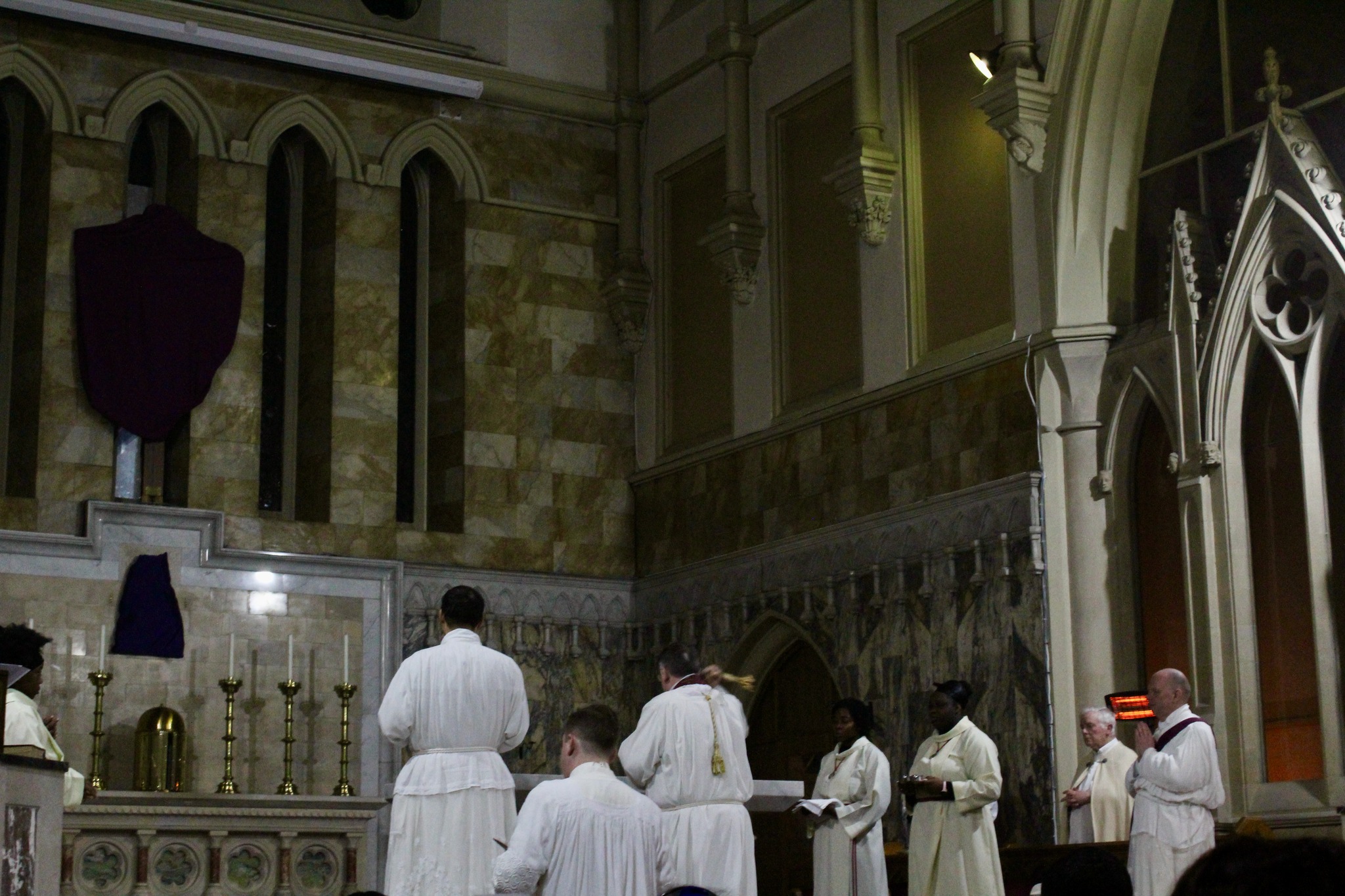
Priory of Our Lady of Sorrow – Peckham, England (Norbertine Fathers)
I especially like how the darker filter on these photos makes for such a strong contrast with the last picture of the altar of repose with all its candles.
We continue our regular series of photoposts of your liturgies of the Triduum. As is usually the case, it’s a slow process to gather all the albums together, select the photos among the larger albums, size them down, etc., but we will get to them all eventually (hopefully before the Ascension!) As always, many thanks to the contributors for keeping up the good work of evangelizing through beauty.
Cathedral Basilica of Our Lady of the Pillar – São João del Rei, Minas Gerais, Brazil
Chrism Mass celebrated by H.E. Bishop José Eudes Campos do Nascimento
Many thanks to Fr Michael Baggot for sharing with us these pictures of some of the Sacrament Altar in various churches in Rome, where the tradition is still very much alive of honoring Our Lord on the night of Passion by decorating them as beautifully as possible.
Just over a month ago, I published an article about the use of the Penitential Psalms in Lent, in which I mentioned that they were generally said at the beginning of the season, at the ceremony by which the public penitents were symbolically expelled from the church, and again on Holy Thursday, when they were brought back in. These ceremonies were particularly elaborate in the Use of Sarum, but similar rites were observed in a great many other places. Here then is the promised description of the rite of the reconciliation of the public penitents, taken from WG Henderson’s 1882 edition of the Sarum Processional.
An illustration from a Sarum Processional of the Ash Wednesday procession; the captions reads “The station on the day of ashes, when the bishop expels the penitents.” The ash-colored banner is seen up top. Reproduced from Henderson’s edition.
After None of Holy Thursday, the bishop or his substitute goes to the west door of the church, wearing a red silk cope, and accompanied by two deacons, led by the same “ash-colored” banner used in the procession of Ash Wednesday. The penitents await them in the narthex. If the bishop himself performs the ritual, the archdeacon, also in silk cope, stands near the penitents and delivers a rather lengthy address to the bishop, of which I give here only the beginning.
“The time is present, venerable bishop, prayed for by the afflicted, meet for the penitent, desired by those in tribulation. Your sons are present, father, whom their true Mother the Church bore unto God with joy; but again, She mourns with new grief every day that at the devil’s suasion, they became corrupt, and wretched, and exiled. For these, all who have happily remained in Her bosom do humbly pray, and who have remained strong in their faith under the protection of divine clemency. Spare them today, father, and with all the force of thy goodness, let that fountain of David be open to us (Zach. 13, 1), and flow forth unto the cleansing of the woman with the issue of blood, reproving none, rejecting none, excluding none. For although no season lacketh the riches of divine mercy, still, now is the forgiveness of sins more abundant through indulgence, and more copious the acceptance of those reborn through grace. …”
The bishop then intones three times the first word of an antiphon, “Venite, Venite, Venite! – Come! Come! Come!”, beckoning to the penitents with his hand as he does, as if to invite them into the church. One of the two deacons, standing near the penitents, says “Let us kneel”; the other, standing near the bishop, says “Rise.” This is all done a second time, then the bishop repeats “Venite” a third time, at which the choir finishes the antiphon “(Come) ye sons, hear ye me, I will teach you the fear of the Lord.” The whole of Psalm 33 from which it is taken is sung, with the antiphon repeated after each verse. In the meanwhile, priests conduct the penitents by hand to the archdeacon, who brings them to the bishop, who then brings them into the church.
An illustration from a 1595 edition of the Roman Pontifical, showing the reception of the public penitents on Holy Thursday. (Courtesy of the Pitts Theological Library, Candler School of Theology at Emory University.)
When all have entered the church, and the clergy have processed into the choir, they kneel, and say the seven Penitential Psalms; these are accompanied as usual by the antiphon Ne reminiscaris, Kyrie eleison, the Lord’s prayer, and a series of versicles, followed by three prayers. Here is the third one.
“O Lord, Holy Father, almighty and eternal God, who deigned to heal our wounds, we Thy lowly servants and priests humbly beseech and ask of Thee, that Thou may deign to incline the ears of Thy compassion to our prayers, and be moved by confession at (this) penance; and forgive all crimes, and remit every sin; and grant these Thy servants, o Lord, forgiveness in accord with their humble prayers, rejoicing in place of grief, life in place of death; so that those who have come to so great a hope of the height of heaven, trusting in Thy mercy, may merit to come to the goods of Thy peaceable promise and the gifts of heaven.”
He then turns to the penitents, and makes the sign of the Cross over them, saying: “We absolve you by the authority of the blessed Peter, prince of the Apostles, to whom was given by the Lord power to bind and loose; and in so far as any accusation falleth to you, and forgiveness thereof to us, may God almighty be unto you life and salvation, and the merciful forgiver of all your sins.” He gives the usual blessing “May almighty God bless you…”, and the Mass of the Lord’s Supper begins.

.jpg)


.jpg)
.jpg)
.jpg)
.jpg)
.jpg)
.jpg)
.jpg)
.jpg)
.jpg)
.jpg)