Thursday, June 19, 2025

Corpus Christi 2025

Qui manducat meam carnem et bibit meum sanguinem, * In me manet, et ego in eo. V. Non est alia natio tam grandis, quæ habeat deos appropinquantes sibi, sicut Deus noster adest nobis. In me manet. (The seventh responsory of Matins of Corpus Christi.)


He that eateth my flesh, and drinketh my blood, in me abideth, and I in him. V. There is no other nation so great, that hath gods that come nigh them, as our God is present to us. In me he abideth.

Today is also the feast of St. Juliana Falconieri (1270-1341), who was the foundress of the female branch of the Servite Order, and the niece of St. Alexius Falconieri, one of the seven founders of the older male branch. The collect of her feast refers to a famous Eucharistic miracle that took place to her benefit.
Deus, qui beatam Julianam Virginem tuam extremo morbo laborantem pretioso Filii tui corpore mirabiliter recreare dignatus es: concede, quaesumus; ut ejus intercedentibus meritis, nos quoque eodem in mortis agone refecti ac roborati, ad caelestem patriam perducamur.
O God, Who, when the blessed Virgin Juliana was laboring in her last illness, deigned in wondrous manner to comfort her with the Precious Body of thy Son; grant by the intercession of her merits, that we also, in the agony of death, may be refreshed and strengthened thereby, and so brought to the heavenly fatherland.
When St Juliana was dying, at the (for that era) very old age of 71, she was unable to retain any solid food, and for this reason, also unable to receive Holy Communion. She therefore asked that the Eucharist might be brought to her in her sickroom, that she might at least adore Christ in the Real Presence. As the priest brought the Host close to her, it disappeared, and Juliana peacefully died. When her body was being prepared for burial, the impression of a circle the size of a Host, with an image of the Crucifixion in it, was discovered over her heart. She is therefore represented in art with a Host over her heart.

A statue of St Juliana Falconieri in St Peter’s Basilica
She was canonized in 1737 by Pope Clement XII, and her feast added to the universal calendar. The Office of her feast includes a proper hymn for Vespers, which also refers to the Eucharistic miracle:
Hinc morte fessam proxima / Non usitato te modo / Solatur, et nutrit Deus, / Dapem supernam porrigens.
Hence when thou wert tired, and death close by, / God consoled and nourished thee, / Not in the usual way / offering the heavenly banquet.
St. Juliana, pray for us!

Monday, July 08, 2024

The Excision of the Institution Narratives from Pius XII’s Holy Week

This past Holy Week I was once again able to assist at the Roman Rite in its ancient-medieval-baroque plenitude, or, to put it more simply, “pre-55.” I have now attended for several years, and the contrast between it and the rite of Eugenio Pacelli is nothing less than astonishing: I would say it is of the same kind of contrast as one finds between the old and new missals in general, if the new be done in the most conservative way possible. Indeed, the ultimate irony is that there are features in the Novus Ordo Triduum that restore what Pacelli had removed—one of the few times in the year when Tridentine and Montinian rub shoulders, so to speak.

Each year I assist at the pre-55 ceremonies, my love and appreciation for them grow. If I had to use a single word, I would say they are sublime. The texts and actions are coherent in a way that those of the Pius XII remix aren’t. These rites move with a majestic, unhurried inevitability, dense with interlocking symbolism. Something about their sheer massiveness, and their utter indifference to pragmatic considerations, makes it easier to lose the sense of time; one surrenders to something so great that it can just as well exist without you, but you are humbly glad to be a part of it. It is not always the case that shortening and simplifying a rite in fact makes it feel easier and shorter. The flow of a rite, and the sacral atmosphere it creates, is far more important for pulling a man out of himself than anything a clock can measure.

The problems with Pius XII’s “restored” Holy Week—which was officially in force from 1955 to 1969, only fourteen years, not long enough to constitute any kind of custom worthy of preservation, as compared with the many centuries of the traditional Holy Week—begin on Palm Sunday and continue throughout nearly every Mass and office till Easter. I provide an overview of some of these points in chapter 12 of The Once and Future Roman Rite, though of course Gregory’s series here at NLM is already a classic, as is Stefano Carusi’s article, and the critique of Pius XII’s master of ceremonies Msgr. Léon Gromier. A simple comparison may be found here.

This year I was more struck than usual by the jarring absence of the Last Supper from the Passion accounts as read in the ’62 missal (the TLM reads all four Passions in Holy Week every year, unlike the NOM which cycles through the Synoptics on Palm Sunday). Everyone who knows about the Roman Tradition (pre-55) vs. Pius XII’s neo-Holy Week talks about this, but I think it has more of an impact if you can see it visually.

Here is what happened to the Passion according to St. Matthew, from Palm Sunday. The images are taken from my 1948 St. Andrew's Daily Missal.

Here is what Pius XII did to the Passion according to St. Mark, read on Tuesday of Holy Week. The ending is intact, but not the beginning: once again, the institution of the Holy Eucharist is completely removed.

Here are the verses chopped out of St. Luke’s Passion on the Wednesday of Pius XII’s Holy Week. 

The upshot of these cuts is that nowhere in the 1962 missal, except for a rarely-used votive Mass, are any of the institution narratives read.

But were the readings too long?

One objection that has been made to the Roman tradition of reading the Passion narratives in their entirety—a practice done for many centuries prior to 1955, and which was to a large extent resumed with the Novus Ordo (!), albeit with a rotation cycle for the Synoptics—is that these accounts are just too long.

Well, yes, they are very long. However, that hardly seems like a serious objection during Holy Week. Do we have anything better to do during Holy Week than read Scripture and pray? If one is going to read the Passion, then one ought to read about the “Sacrament of the Passion” (as St Thomas calls the Eucharist), in order to underline, as Our Lord Himself did at the Last Supper, the intimate connection between the Holy Eucharist, the Sacrifice of Calvary, and the perfect charity of which the former is a sign and the latter is the principal act. It is hard to defend the theological coherence of skipping out on the sign Jesus gave us of His loving atonement and atoning love. As my esteemed colleague Gregory wrote on social media: “The whole aim of the 1955 Holy Week reform is to divorce the Mass from the Passion and the Cross.”

Regarding length of readings, Gregory added:

Objecting to the length of the Roman Passion accounts is just foolish; the Roman arrangement is the simplest and shortest of all the historical liturgies. In the Ambrosian Rite, the narrative of all the principal services from Spy Wednesday to the Easter vigil inclusive is carried entirely by St Matthew, so the Passions of Mark, Luke, and John are all read at one ceremony: the Matins of Good Friday. The Byzantine Rite does something similar with St Matthew, starting at the beginning of chapter 21 at Matins of Palm Sunday, and getting to the end of the Gospel (chapter 28) at Vespers of Holy Saturday. On Good Friday, there are twelve Gospels of the Passion at Matins, the first of which is more than four full chapters of John (!), then large parts of all four Passions are repeated at the Royal Hours. And this, in the midst of a huge number of other readings, endless canons and other kinds of hymns, etc., with almost none of the typical features of the Divine Office omitted.
A deacon commented:
I remember attending the Paschal Divine Liturgy at an Orthodox monastery one year, which begins with the chanting of the entire book of Acts. The liturgy was about four hours, and since there was no electricity at this monastery (and no pews), two of the monks threaded their way through the church replacing peoples’ candles as they burned down. Nobody complained about the length of the service. When it was over, the people went to their cars or tents to get a few hours sleep while two monks took turns tolling the bells all night long. Early in the morning, we were all up again for Divine Liturgy, followed by a meal. Let’s face it: we’ve become sissies. 

The question is forced: What in the world was going on with Pius XII that he allowed such liturgical tomfoolery under his watch?

The first thing we have to rule out—sorry, conspiracy theorists—is that Bugnini was the “author” of the Pacellian Holy Week. He was no such thing. At the time, he was a lowly secretary to the secret committee for proposing liturgical reforms, but the major players, older than he and more influential, steered the entire project. It was other Vatican officials, not Bugnini, who pushed through the new Holy Week. The secretary, for his part, watched open-eyed, learned the tricks of the trade, acquired the insider rolodex, and prepared for his day in the sun under Paul VI.

Here is how historian Yves Chiron puts it in his biography of Bugnini:

On May 28, 1948, Pius XII set up a Pontifical Commission for the Reform of the Liturgy that was eventually to be termed Commissio Piana. It was created within the Congregation of Rites, with Cardinal Micara, the new prefect of the same Congregation, as its president. Its creation was not made public; for a long time it worked in secrecy. Only when the first of the reforms it had prepared was promulgated was its existence revealed to the greater number, including most liturgists. It numbered few members and, unlike the commissions that later pontificates were to establish, it relied on few liturgy experts.
            With Cardinal Micara as president, the Pontifical Commission for the Reform of the Liturgy originally numbered only six members: Archbishop Alfonso Carinci, undersecretary of the Congregation of Rites; Fr Ferdinando Antonelli, OFM, relator general of the historical section of the Congregation of Rites; Fr Josef Löw, CSSR, vice-relator general of the same historical section; Fr Anselmo Albareda, OSB, prefect of the Vatican Library; Fr Augustin Bea, SJ, rector of the Pontifical Biblical Institute; and Fr Bugnini who, in his capacity as director of Ephemerides Liturgicae, was named secretary of this commission.
            Later on Bugnini would exercise the same function of secretary in the conciliar preparatory commission on the liturgy as well as in the postconciliar Consilium for liturgical reform. Yet whereas he played a decisive role in the preparatory commission and in the Consilium, he did not have a leading role on the Commissio Piana. He was an invaluable worker11 and rarely intervened in the discussions. He learned and observed much, probably became aware of certain problems, but never exerted a decisive influence. 

As to what might have been going on with Pius XII, readers may consult two articles of mine:

Quite simply: it is time to let go of the postwar experiments and return, humbly and gratefully, to the Roman tradition embodied in the 1570 missal and its line of continuous successors.
 

Visit Dr. Kwasniewski’s Substack “Tradition & Sanity”; personal site; composer site; publishing house Os Justi Press and YouTube, SoundCloud, and Spotify pages.

Saturday, June 08, 2024

“The Old Leaven” of Catholic Truth, Part 2: Eucharist as Sacrifice in the Language of Medieval England

In the first part of this article, I discussed the relationship between eucharistic belief and eucharistic language, taking modern Catholicism and Reformation England as examples of belief and language deteriorating together. The counterexample I provided was medieval England, where devotion to the Real Presence was robust and had been nourished for centuries not only by the strong, poetic Latin of the liturgy but also by various English expressions that helped the faithful to understand and love the Blessed Sacrament.

As I mentioned in Part One, the term “eucharist” was not a part of English-language vocabulary until the fourteenth century. In the second part of this article, we’ll consider the words and phrases that Englishmen of the early and high Middle Ages used when they were speaking, writing, and thinking about the Holy Eucharist.[1]

The Mass of Saint Gregory, a woodcut by Albrecht Dürer (d. 1528) depicting a eucharistic miracle whose legendary account was popular among English Catholics in the late Middle Ages.

“Unhousel’d, disappointed, unanel’d”

The most standard item of eucharistic vocabulary in Old and Middle English is also one of the most unfamiliar in modern English: housel (pronounced “HOW-zuhl” and also spelled husel, housul, howsell, etc.). This word was used as a noun meaning primarily “the Eucharist” and as a verb meaning “to administer the Eucharist to.”

Actually, countless speakers and students of modern English have seen this word, but they may not have noticed it or understood its meaning. It appears in Hamlet, Act 1, Scene 5, when the ghost of Prince Hamlet’s father describes his murder at the hands of “that adulterate beast” Claudius. The ghost laments that he was

Of life, of crown, of queen at once dispatch’d;
Cut off even in the blossoms of my sin,
Unhousel’d, disappointed, unanel’d;
No reckoning made, but sent to my account
With all my imperfections on my head.
O, horrible! O, horrible! most horrible!

King Hamlet relates, with admirable horror, that the murder deprived him of a good Christian death, since he died “unhousel’d, disappointed, unanel’d,” that is, without receiving the Eucharist, unprepared (without confessing his sins), and unanointed (without receiving extreme unction).

Hamlet (with companions) and the Ghost, by Henry Fuseli (d. 1825).

The deeper psychological and emotional effects of a word are greatly influenced by the word’s etymology and its range of meanings. In the case of “housel,” the term’s origin and multiple meanings convey powerful truths about the nature of the Blessed Sacrament. It is related to Germanic words meaning “sacrifice” or “offering,” and in Old English it was used, though perhaps infrequently, to mean “sacrifice” in a non-eucharistic sense. Over time, “housel” became more closely associated with the Holy Eucharist, but not in a restrictive way: in addition to denoting the sacred species, it referred to receiving Communion and celebrating the eucharistic sacrifice.

Thus, the notion of sacrifice is encoded within the very word “housel,” which binds the Eucharist as spiritual nourishment to religious sacrifice in general and, more specifically, to the sacred liturgical sacrifice through which this nourishment is produced. A term that memorably conveys this association would be beneficial in any age and in our own would perhaps have an especially salutary effect.

The Body of God

There is a striking tendency in medieval English to use “God,” without any qualifying words, as a name for Christ. Here are a few examples:

“The old fiend led them astray with lying wiles, ... so that they crucified God himself” (Cynewulf, Elene; ninth century)

“Therein was closed a nail great / That was driven through God’s feet” (Short English Metrical Chronicle; fourteenth century)

“Here must God take out Adam” (stage direction, referring to Christ, in a cycle play for the Harrowing of Hell; late fourteenth century)

This usage is now officially deemed “obsolete,” and indeed, it clashes quite strongly with the speech patterns of modern English, despite being theologically sound. I find its forceful simplicity refreshing, and one could hardly find a more concise way to affirm the hypostatic union.

Medieval eucharistic terminology displaying this same tendency includes God’s flesh, the flesh and blood of God’s body, and Godes lichama, this last meaning in modern English “God’s body” or, perhaps more accurately, “God’s living body.” These titles are surely due for a revival. I for one would benefit from more frequently contemplating the Blessed Sacrament not only as corpus Christi but as corpus Dei, that is, as the sacrificial flesh of my dear Savior but also as the eternal and glorious Body of God—uncreated Light, infinite Love, and the very Principle of all that exists.

Detail of The Last Supper, by Giorgio Vasari (d. 1574).

Journey Bread

The idea of Holy Communion as preparation for death was far more pronounced in medieval England than it is today:

The reception of communion was not the primary mode of lay encounter with the Host. Everyone received at Easter, and one’s final communion, the viaticum or “journey money” given on the deathbed, was crucially important to medieval people.... For most people, most of the time the Host was something to be seen, not to be consumed.[2]

Infrequent Communion was the norm in this society, even for some religious. The clergy who attended the eleventh-century Council of Aenham expected the laity to receive three times per year, and the Laws of Cnut, issued around the same time and drafted by Archbishop Wulfstan, likewise mentioned thrice-yearly Communion. The thirteenth-century document Ancrene Wisse (i.e., Anchoresses’ Guide) states that anchoresses, like lay brothers, should receive only fifteen times per year, since “me let leasse of þe þing þet me haueð ofte” (“one values less the thing which one has often”).[3]

A page from the law code of King Cnut. Cotton MS Nero A I, f. 16r, courtesy of the British Library. I find this script captivating.

For ordinary Catholics of medieval England, the Eucharist was not consumed as a daily (or weekly, or maybe even monthly) Bread, and it naturally acquired greater prominence as viaticum—sanctifying Bread for that final and supremely important voyage toward the setting sun of earthly life. Thus, one of the Old English titles for the Blessed Sacrament was wegneste, meaning “provision for the journey” or, more literally, “way food.”

Fear, Love, and Adoration

The collection of terms given above is not exhaustive. Indeed, no exhaustive list could be compiled, for Old English manuscripts are few, and the eucharistic devotion of the Anglo-Saxons, a fervent and poetic people, was vast. I’ll conclude with the words of Thomas Bridgett, an English scholar and priest of the nineteenth century who converted to Catholicism after refusing to take the oath of royal supremacy:

For more than a thousand years the races that successively peopled [Great Britain] regarded the celebration of this Sacrament as the central rite of their religion, the principal means of divine worship, the principal channel of divine grace. The Holy Eucharist was the great mystery of faith, the object not only of fear and of love, but also of supreme adoration.[4]


NOTES

1. Much of the information in this article is built upon the doctoral research, completed in 1932, of Sister Mary Joseph Cravens.

2. Eamon Duffy, The Stripping of the Altars: Traditional Religion in England, 1400–1580, p. 95.

3. The author also stipulates the days on which the anchoresses will communicate: “(i) Mid-winter Dei, (ii) Tweofte Dei [Twelfth Day, i.e., Epiphany], (iii) Condelmeasse Dei, (iiii) a Sunnedei mid-weibitweonen [midway between] thet ant Easter, other Ure Leafdi Dei [or Our Lady’s Day, i.e., the Annunciation], yef he is neh the Sunnedei, forthe hehnesse, (v) Easter Dei, (vi) the thridde Sunnedei th’refter [the third Sunday after Easter], (vii) Hali Thursdei, (viii) Witsunne Dei, (ix) Midsumer Dei, (x) Seinte Marie Dei Magdaleine, (xi) the Assumptiun, (xii) the Nativite, (xiii) Seinte Mihales Dei, (xiii) Alle Halhene Dei [All Saints’ Day], (xv), Seint Andrews Dei.” See Ancrene Wisse: Part Eight, edited by Robert Hasenfratz.

4. Thomas Bridgett, History of the Holy Eucharist in Great Britain, Volume 1, p. 1.


For thrice-weekly discussions of art, history, language, literature, Christian spirituality, and traditional Western liturgy, all seen through the lens of medieval culture, you can subscribe (for free!) to my Substack publication: Via Mediaevalis.

Saturday, June 01, 2024

“The Old Leaven” of Catholic Truth, Part 1: Eucharistic Language and Eucharistic Faith in Medieval England

Aristotle believed not only that “words mean something”—an increasingly bold assertion in the twenty-first century—but also that carefully chosen words have a special power to “create knowledge in us.” He singles out metaphor, that central pillar of rhetorical and poetic language, as a mode of communication that “most brings about learning” and “creates understanding” (On Rhetoric, III.10.2). Liturgical, doctrinal, or devotional aggiornamento allows us to see Aristotle’s views in action, as we observe how knowledge and understanding are modified—or simply lost—when language changes from Latin to vernacular, or from poetic to prosaic, or from mystical to mundane.

Detail of Allegory of the Holy Eucharist, by Miguel Cabrera (d. 1768).

Belief in the Holy Eucharist has deteriorated in alarming fashion. If the statistics can be trusted, the situation is dire. The reasons for this are many, but some are of greater import than others, and language is surely among the more urgent factors. Modernized, banalized, and in some cases simply erroneous discourse has for decades obscured the truths of the Eucharist and the eucharistic liturgy. Perhaps the primary effect of all this is simply confusion, but confusion leads to misbelief, and misbelief to irreverence, and irreverence to further degeneration of language. And thus the cycle—a vicious one indeed—continues.

Illumination on parchment, fourteenth century.

The severity of this state of affairs is unprecedented, but the problem itself is not new. It is striking to read, for example, a description of eucharistic malpractice that sounds all too familiar, despite being eight hundred years old: the author of Vices and Virtues, a homiletic prose dialogue written in the Middle English of the early thirteenth century, laments the “misbileaue” (misbelief) and “unwurscipe” (irreverence) of those who received the body of the Lord “al swa unwurðliche swa me nimð ðat bread of ðæ borde — as unworthily as one takes the bread of the table.” The metaphorical reflections in this text show us the strong, evocative, and deeply Catholic language that abounds in the literature of medieval England:

Take what you see, bread and wine in appearance; and in your thoughts believe what you see not: that is, Christ’s flesh and His blood. And know in truth, as truly as bread and wine feed the body, while in this life it dwells, so this holy corpus Domini truly feeds both soul and body unto eternal life. And as truly as the tree of Paradise was called “knowing both good and evil,” so truly bears this same tree the fruit that turns many to life, and also some to death, for [their] misbelief and [their] irreverence.

The term “eucharist,” a borrowing from Greek via Latin and French, does not appear in Vices and Virtues, and in fact, it does not appear as an English-language word in any document from the conversion of the Anglo-Saxons until sometime in the fourteenth century. English Catholics of the early and high Middle Ages had various other titles for the Blessed Sacrament, and these titles give us an opportunity to consider how their eucharistic language formed their eucharistic faith—and a formidable faith it was, despite the unedifying individuals mentioned in Vices and Virtues, who were surely the exception. On the eve of the Reformation, the sacramental body of Christ was still “the focus of all the hopes and aspirations” of the English people:

As kneeling congregations raised their eyes to see the Host held high above the priest’s head at the sacring, they were transported to Calvary itself, and gathered not only into the passion and resurrection of Christ, but into the full sweep of salvation history.[1]

Part of a very long Corpus Christi procession winding through a town in eighteenth-century Bavaria. I can imagine something similar occurring in pre-Reformation England.

Though England’s ruling class succeeded in dismantling the vast and magnificent edifice of English Catholicism, the Anglican Church did not fully repudiate the real presence of Christ in the Holy Eucharist. The Articles of Religion published in 1571, during Queen Elizabeth’s reign, state that “the Bread which we break is a partaking of the Body of Christ, and likewise the Cup of Blessing is a partaking of the Blood of Christ.” However, eucharistic belief and practice were strategically diluted, and transubstantiation was condemned as “repugnant to the plain words of Scripture.” One senses that the elites carried out as much doctrinal vandalism as the common folk would tolerate. Gilbert Burnet, Anglican bishop of Salisbury from 1689 to 1715, admits as much in his Exposition of the Thirty-Nine Articles of the Church of England: an earlier version of the Articles spoke strongly against belief in the “Real and Bodily Presence ... of Christ’s Flesh and Blood in the Sacrament of the Lord’s Supper,” but this version was suppressed, because

the design of the Government was at that time much turned to the drawing over the Body of the Nation to the Reformation, in whom the old Leaven had gone deep; and no part of it deeper than the belief of the Corporeal Presence of Christ in the Sacrament; therefore it was thought not expedient to offend them by so particular a Definition in this matter; in which the very word Real Presence was rejected.

“The old Leaven had gone deep”: Yes indeed, Rev. Burnet! The Old Faith went deep and was still as alive and vigorous as golden, foaming, freshly poured English ale. The people of merrie olde Catholic England didn’t want your watered-down “Sacrament of the Lord’s Supper,” and that’s why your Protestant forebears had to foist it on them with their shifty language and Machiavellian tricks.[2]

At least the bishop was honest enough to acknowledge that, decades after Henry VIII exchanged Christendom for Anne Boleyn, the English people were still seriously committed to “the Corporeal Presence of Christ in the Sacrament”—so committed, in fact, that the lords of the realm deemed it “not expedient to offend them.” What a fine compliment the bishop here offers to the common folk of his once Catholic nation! Their hearty faith and respect for tradition forced the Innovators to preserve at least one crucial aspect of eucharistic Truth. As a result, the Anglican Church became an example of moderation amidst Nonconformists and continental zealots who, in their wanton assault on ancient sacramental belief, found a new way to profess that which is “repugnant to the plain words of Scripture,” wherein we read, “Whoso eateth my flesh, and drinketh my blood, hath eternal life.... For my flesh is meat indeed, and my blood is drink indeed.”

In Part Two of this article, I’ll discuss the eucharistic vocabulary of medieval England and consider how this vocabulary helped English Catholics to know, understand, and love the Blessed Sacrament.


NOTES

1. Eamon Duffy, The Stripping of the Altars: Traditional Religion in England, 1400–1580, p. 91.

2. In fairness to Machiavelli, he surpassed the Reformers in his understanding of tradition: “Princes should learn ... that they begin to lose their state the moment they begin to break the laws and to disregard the ancient traditions and customs under which men have long lived” (Discourses on Livy, III.5).


For thrice-weekly discussions of art, history, language, literature, Christian spirituality, and traditional Western liturgy, all seen through the lens of medieval culture, you can subscribe (for free!) to my Substack publication: Via Mediaevalis.

Friday, May 24, 2024

Bankrupting the Banquet: Reflections on the Distribution of Holy Communion

Among other things, the National Eucharistic Revival launched by the USCCB is an invitation to reflect on our treatment of the Holy Eucharist and the way it may influence our beliefs. Two decades ago the Reverend Massimo Salani made international news by accusing fast food of being Protestant. Characterizing the popular form of eating as the complete oblivion of food’s “sacred nature,” the Italian Patristics scholar went on to opine that fast food “reflects the individualistic relation between man and God introduced by Luther” and is thus “the fruit of a Protestant culture.”[1] While Salani’s theory won praise from the Italian Minister for Agricultural Resources, both the German Lutheran community and the McDonalds Corporation were quick to issue letters of rebuttal, almost as if both were equally insulted by association with the other.

Regardless of where one stands on the value of fast food, the topic raises a question about the relationship between dining and the Catholic sacramental life. Indeed, Fr. Salani could just as easily have asked not whether fast food is Protestant, but whether fast food is now, thanks to the way we currently administer Holy Communion, Catholic.
Specifically, while the rite of communion in the traditional Latin Mass (and in all other historic apostolic rites) takes on the form of a high banquet or feast, communion in the typical Novus Ordo Mass celebrated in the U.S. today generally resembles the experience of eating at a fast-food restaurant. I stress “today,” for it would be simplistic and misleading to lay blame on the 1969 Missal per se.[2] But we can at least suggest the following. Even when the communion rite of the traditional Latin Mass is celebrated poorly by a hasty priest, the form of it remains unmistakably that of a grand banquet. On the other hand, the more negotiable form of the Novus Ordo communion rite, together with the implementations of the USCCB and the guidance of some American liturgists, have clearly made possible a number of practices that more often than not sell our banqueting birthright for a bowl of McPottage.
At the Lamb’s High Feast
In a traditional Latin Mass, everything about the communion rite betokens participation in a great feast. Only the choicest vessels, made out of silver or gold, are used and only the finest linens. The atmosphere, even when there is only a single priest in somewhat of a hurry, is one of solemn leisure. The communicant stops, kneels, and waits. He is honored by the approach of the priest himself, not a lower minister and certainly not a fellow layman, just as diners at a fine restaurant are particularly honored when the chef comes out and visits their table (I apologize for the profane comparisons here and throughout, but they are necessary for the argument).
When the priest arrives, accompanied by his “waiter,” a formally-dressed acolyte, precious dishware (a gold paten) is placed under the communicant’s chin and he is treated to three things: a beautiful invocation directed specifically to him, “May the body of Our Lord Jesus Christ keep thy soul unto eternal life. Amen”; a mini-Benediction (for the priest makes the sign of the cross with the Host in his hand before distributing it); and the sacred Host itself. The prayer is particularly relevant to our discussion. The chef at a fine restaurant is likely to “pray” that his patrons obtain the intended effects of the fare he has served: hence he says something like, “Enjoy your meal.” The purpose of Holy Communion, on the other hand, is not pleasure for the body but bliss for the soul: hence the priest’s precise yet succinct prayer to each and every communicant.
The communicant then usually lingers for a little while in gratitude. In some parishes, kneelers even wait until everyone on their side of the aisle has received before rising and returning to their pews, both to prolong their adoration but also to show good manners in not rising from the table until everyone has finished.
Of particular importance throughout this ritual feasting is the communion rail. Its opponents depict it not only as a barrier between God and man but as an impediment to the Lord’s supper, for it keeps the congregation segregated from the altar, which in the great tradition has been understood as both the locus of sacrifice and a mensa, a table on which a meal is shared. Yet they overlook how the chancel rail, like the Byzantine iconostasis, is not a partition separating but a seam uniting heaven and earth, sacred and profane; and subsequently, it is more of a window than a wall. Moreover, the communion rail is a table, a banquet setting for the communion of God and His children in the congregation. Underscoring this function was the custom in some parishes of placing a fine white linen communion cloth—a tablecloth, if you will—on the chancel rail.
The Happy Meal
The ethos for Holy Communion at the average American Nouvs Ordo is noticeably different. The communion rail now gone and the striking descent of the priest from the high altar now ameliorated by architectural changes to the sanctuary and by the team of Eucharistic ministers diluting his distributive office, the communicants form a single file line from which they never fully escape. As they hasten forward (in my experience, the line usually moves quickly), they are advised to make some gesture of reverence as they approach the Blessed Sacrament as long as it is not the traditional genuflection—presumably because it might impede efficiency.[3] In the traditional communion rite, the line breaks as individual communicants find a place at the rail and then prepare for Holy Communion. In the most common current dispensation, by contrast, there is no local (and possibly no psychological) transition from reaching the head of the line to receiving the Eucharist.
All of this smacks of a fast-food arrangement, with its focus on speed and efficiency. Customers form single file lines either in the restaurant or in the drive thru, and their food is ready for them before they are seated.
Instead of receiving from a priest, chances are that the communicant will be receiving from an “extraordinary minister of Holy Communion,” often located at various points throughout the church (again to aid efficiency). As has been mentioned already, it is an honor to receive one’s fare from the chef himself (the “high priest,” as it were, of the dinner), but in a decent restaurant one can at least expect to be served by a duly-uniformed waiter. What one would not expect is to have diners from the next table suddenly stand up and serve you your food. Yet this is precisely what happens with lay Eucharistic ministers. They are not priests, they are not members of a minor order (acolyte), and they are not even laymen performing the function of a minor order (altar boys).[4] They are fellow diners who may or may not have taken a workshop on how to distribute God.
Instead of a precious vessel made out of gold or silver, the priest or Eucharistic minister may be holding in his or her hand cheap earthenware. From it he/she proffers a Host and says, “The Body of Christ.” This brief declarative statement, no longer than “Have a nice day,” replaces the beautiful prayer addressed to the individual for his eternal salvation as well as the mini-Benediction. Gone too are the gold patens and the communion cloth that add to the festive splendor and that reinforce belief in the Real Presence of every particle of the Host.
Although one is still permitted to receive on the tongue, it is more common for communicants to receive on the hand, a practice that further facilitates a fast-food mentality. Under this arrangement, it is easy to begin the return to one’s pew before the Host is actually in one’s mouth. Such an impatient action, should it occur (and it does), is roughly comparable to the fast-food customer who pops some fries into his mouth as he takes his tray and finds a table. McDonalds refers to the counter area where orders are picked up as the “grab and go” zone. The term is also a fitting description of Holy Communion at the average Novus Ordo parish. And should the communicant try to slow things down by kneeling down and receiving on the tongue, he may be denied Holy Communion. 
It is not difficult to see, incidentally, which of the two dining paradigms we have described better accords with the Eucharistic passages of the Bible. With the exception of the miracle of the fish and loaves (a picnic setting, so to speak, necessitated by the circumstances), scriptural foreshadowings of the Eucharist tend to involve grand or traditional feasts, such as the Wedding of Cana or the Parable of the Prodigal Son. Moreover, the Last Supper itself took place during no mere meal but the Seder, the highest and most solemn banquet of the Hebrew year, with every its dimension steeped in ritual and ceremony. Finally, the earthly liturgy that Christ instituted in the cenacle is itself a participation in His heavenly wedding feast described in the Book of Revelation. Since every Mass not only synthesizes all of the just sacrifices from Abel on but anticipates this great eschatological banquet in Heaven, it is fitting to have this hidden reality reflected in signs and gestures that are suitably august.
Reply to Objections
Two objections can be raised against our thesis, the first being that, despite the “grab and go” temptation, Communion in the hand as well as Communion standing up remain closer in form to that of a banquet. Few people at a feast, after all, are either spoon-fed by another or take their food on their knees. Yet this is precisely where the analogy—as all analogies eventually do—begins to fail. At an earthly banquet, an adult must indeed be somewhat active in taking food to his mouth. At the heavenly banquet, however, we are more like what St. Paul refers to as “little ones”—helpless infants seeking sustenance from our Parent. The gesture that a communicant takes in the traditional Roman rite is one of perfect receptivity (which is not to be confused with passivity).[5] He is like a fledgling chick, head tilted back, mouth open, pleading for Life.
The pelican, a type for the Eucharistic Christ, on a tabernacle door
This image may be mildly insulting to those who think of themselves as all grown up, but it is evocative of the gala logikos, the “rational milk” (or “milk of the Word”) that St. Peter admonishes us to receive as newborn babes (1 Pet. 2:2); and it hearkens to the ancient association of Christus passus with the mythical pelican. According to a Greek legend, a male pelican returned to the nest after a three-day absence to find his young killed by a serpent. To bring them back to life, he tore open his breast and let his blood trickle onto them. Church Fathers like St. Jerome saw in this tale an allegory of the Eucharist, which is why in Eucharistic hymns like St. Thomas Aquinas’ Adoro Te, Devote, Jesus is addressed with the words, Pie Pelicane, and why tabernacle doors sometimes contain the relief of a pelican immolating itself. And if Jesus is the Pelican whose blood is life-giving Logos-milk, then we are certainly His newborn babes, smitten by the old serpent of sin and recumbent before Him.[6]
The pelican’s affinity with Our Lord also puts into perspective the inappropriateness of recent experiments in intinction, where the communicant takes the Host and then dunks it in the Precious Cup. This chips-’n’-dip motion of the layman is far removed from the practice of several Eastern rites, where the communicant receives both species (the Body intincted in the Blood) from the priest in a fledgling manner similar to that of the believer at a Tridentine Mass. And, of course, it gives the rite of communion an additional air of nonchalant informality, at least in cultures affected by the habits of Super Bowl Sunday snacking.
Second, it may be objected that Communion under both kinds is more banquet-like, since obviously banquets involve drink as well as food. As with Communion in the hand, there is an ancient Roman precedent for this practice, though likewise it is debatable that what we are doing today actually restores the tradition. Few proponents of the former, for example, seem to realize that the original practice, in some places at least, required a woman’s hands to be covered by a cloth when she received the Host.
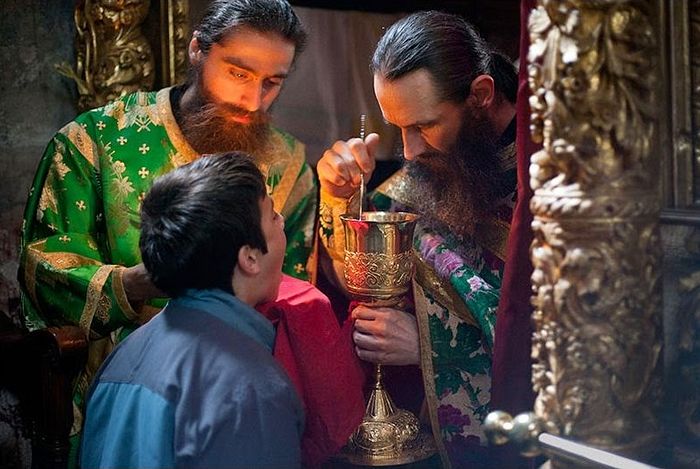
The issue with Communion under both species is not so much that the Precious Blood is shared (which is theologically unproblematic and even in some respects commendable), but how it is shared. The answer to that question today is, again, fast-food-like. The communicant moves to a second station, almost always staffed by a lay Eucharistic minister, as if he were driving up to the second window of a drive thru. There he takes the Chalice in his hands (further undermining his fledgling orientation), imbibes his share, and goes. Having this second station can also undermine respect for the Eucharist, for invariably—in order not to hold up “traffic”—other communicants pass by the Chalice without acknowledging the presence of their Eucharistic Lord. And it hardly resembles the ancient practice, where only the deacon (the sous-chef of the Sacrifice, so to speak) took a golden straw called a fistula, lowered it in the Chalice, and put his finger over one end so that it would hold the Precious Blood. Then, moving to the communicant (not vice versa), he would suspend the fistula over the person’s open mouth and release his finger so that the Blood would empty into it, pelican-like.
two fistulae
Conclusion
Entitling this article “Bankrupting the Banquet” is not intended to be sensationalist or to suggest that when Mass is celebrated in a fast-food manner the Sacrament loses any of its efficacy. Both “bankrupt” and “banquet” come from bancus (the Latin for bench), the former in reference to a banker’s counter, the latter to a dining table. Keeping this etymology in mind sets into relief the content of our critique: by removing the communion rail and all the other elements of grand feasting, we have literally bankrupted the Roman rite, ruptured or broken the banquet bench on which the communion between God and man appropriately takes place.
Consequently, nature abhorring the vacuum that it does, an ethos of efficient consumption comparable to that of the American fast-food industry has crept into our solemn worship. The result is an atmosphere and an etiquette at odds not only with the sacrificial, regal, and divine character of the Eucharistic liturgy but with its festive, leisurely nature. Exorcizing the spirit of Burger King from the banquet of the Heavenly King remains an urgent and pastorally pressing task. If, as National Eucharistic Revival would suggest, the Church is serious about restoring a sense of reverence for the Eucharist, she may wish to reconsider how she distributes It.
An earlier version of this essay appeared in The Latin Mass magazine 16:3 (Summer 2007), pp. 38-41. Many thanks to the editors for allowing its publication here.
Notes
[1] From an interview that appeared in Avvenire, November 8, 2000. English translation from 2000 Religion News Service Star Telegram, Ft. Worth, Texas.
[2] Indeed, many of the features of a contemporary American Mass I am about to describe are not at all mandated by the 1969 Missal. On the other hand, it must be acknowledged that the new Missal and many post-conciliar directives either permit or insufficiently guard against the encroachment of “fast-food” practices in the liturgy.
[3] While the American adaptations to the General Instructions for the Roman Missal discourage kneeling or genuflecting during the reception of Communion (the bishops’ effort to forbid the practice outright was rejected by the Vatican), they do not state why these practices are now so objectionable. One respected liturgical scholar once suggested to me that the motive was purely logistical: kneeling and genuflecting interrupt the flow of the communion line.
[4] Even tonsured clerics were not permitted to distribute Holy Communion: only the major order of priest (for the Body) and the major order of deacon (for the Precious Blood) had such privileges.
[5] The Blessed Virgin Mary, for instance, was utterly receptive to the Angel Gabriel’s announcement, not utterly passive.
[6] The pelican metaphor also underscores the inappropriateness of Eucharistic ministers whose activity alienates the priest—acting in persona Pelicani, as it were—from the Divine Pelican’s blood and brood. For the pelican does not ask some other bird to revive his young after his act of self-sacrifice but carries the act through to its completion himself.

Monday, August 14, 2023

On the Christ-Angel of the Roman Mass

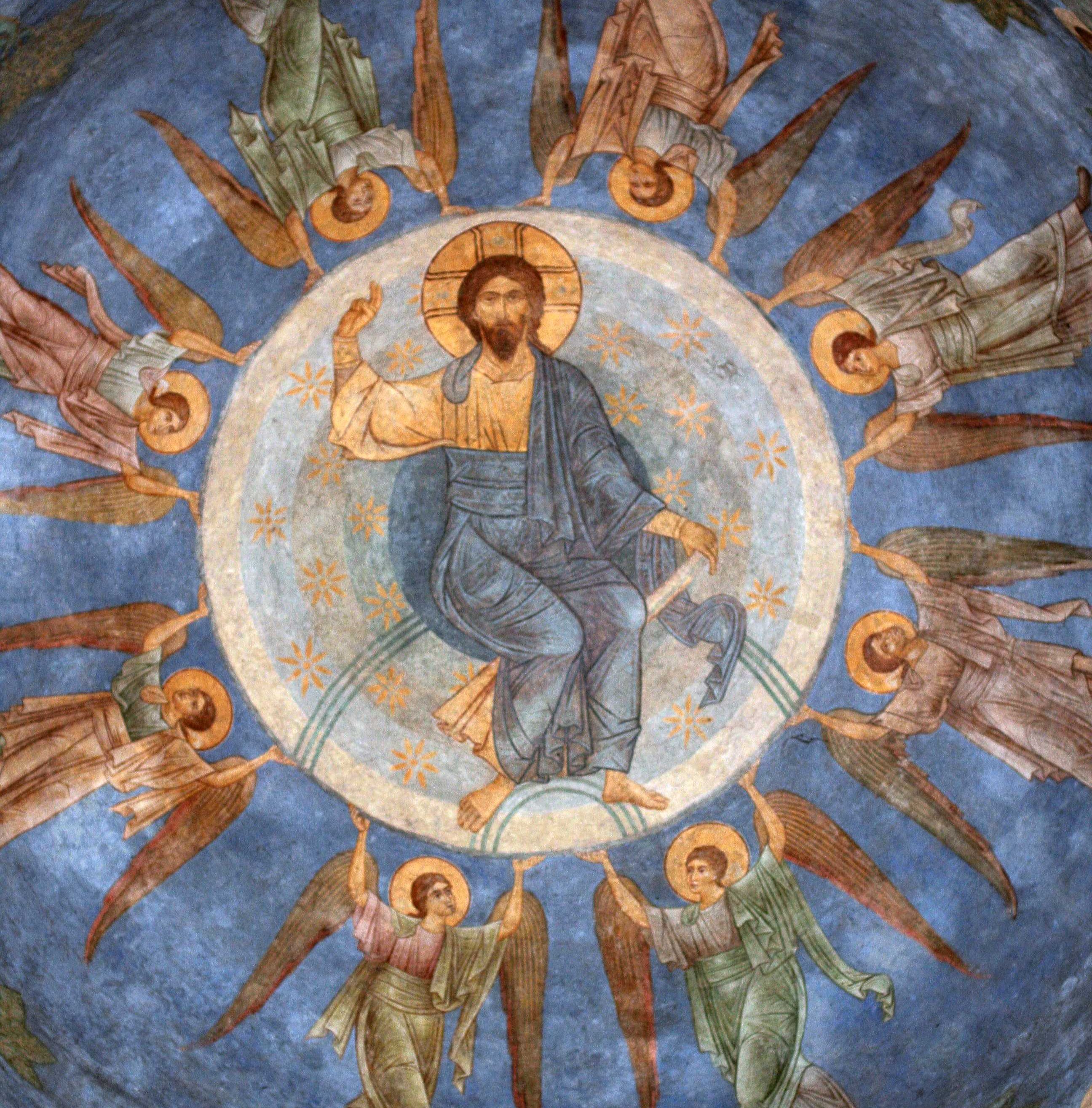
The Ascension of Christ, Mirozhsky Monastery, Pskov
In Fr. Claude Barthe’s remarkable book A Forest of Symbols: The Traditional Mass and Its Meaning (Angelico Press, 2023, reviewed here), we are introduced early on to the allegorical understanding of Christ as an “Angel,” that is, a messenger and mediator, in keeping with the Septuagint’s use of the phrase “Angel of the Great Counsel” in Isaiah 9:6. Speaking of the Asperges, Fr Barthe says:
The aspersion itself, which follows when the ministers have entered the church, is really a combination of blessing and exorcism, almost a domestic rite. It resembles the aspersions seen in monasteries when a tour was made of the cloister, or the individual cells were visited. The final prayer of this ceremony, Exaudi nos, Domine . . . (Hear us, O holy Lord, almighty Father, eternal God: and vouchsafe to send thy holy angel from heaven, to guard, cherish, protect, visit, and defend all that dwell in this house), which is that of the blessing prescribed by the Ritual when the priest blesses a house as he enters it to carry out a ceremony, refers to the habitaculum, the house where one lives, for which one requests a visit from the Angel of God. This is also a first reference to “the Angel of God,” that is, to Christ himself, who is asked to come down to this place… There is a link between this water and the Blood of Christ, since immersion in the waters of baptism represents in reality immersion in the cistern of Christ’s propitiatory Blood. (36)
Later, speaking of the rite of incensation, Fr. Barthe comments:

The humanity of Jesus Christ, consumed (or consummated, as the classical writers used to say) in the sacrifice, lifts his prayer up to the Father, the only prayer that the Father finds acceptable, to which are joined the prayers of the saints, thrown like grains of incense into the burning furnace of love of Christ’s holy soul…. [T]he Angel of the Apocalypse (Rev 8:3–4)…draws near to the altar and offers the incense with the prayers of the saints… This Angel is, of course, Christ himself, and his golden censer (or scoop) is his precious humanity: “Let my prayer be directed as incense in thy sight; the lifting up of my hands, as evening sacrifice” (Ps 140:2). (41)

Concerning the incensation at the offertory, he develops the point further:

Of course, the offering of incense at the altar also symbolizes the Angel who stood beside the altar of the Temple, holding in his hand the censer from which the smoke of the incense rose in the presence of the Lord (Rev 8:3–4). This angel is compared to St Michael, but above all reflects Christ, the Angel of Great Counsel, offering his own immaculate flesh, full of the fire of the Holy Spirit, to the Lord on our behalf on the altar of the Cross, in the odor of sweetness. The smoke of the incense gives material expression, in some way, along with the prayer of Christ, to the prayers of his saints. (91–92)

Then comes the most mysterious angel of all, the one mentioned in the “communion epiklesis” of the Roman Canon, the Supplices te rogamus:

We most humbly beseech thee, almighty God, to command that these things be borne by the hands of thy holy angel to thine altar on high, in the sight of thy divine majesty, that as many of us as, at this altar, shall partake of and receive the most holy Body ✠ and ✠ Blood of thy Son may be filled with every heavenly blessing and grace, through the same Christ our Lord. Amen.

On which Fr. Barthe observes:

There have been many discussions of the identity of the “Angel.” Durandus wrote, “He is the Angel of Great Counsel, the Counsellor on whose advice the Father created and recreated the world,” otherwise known as Christ-Wisdom, the Word incarnate. But he adds that the altar on high in the presence of God is also the crucified Christ sitting in glory at the right hand of the Father. The Angel brings these “sacraments” to this altar, revealing his wounds, and interceding for us who bring the sacraments to fulfilment on earth. Olier and Pierre Lebrun take a similar view. It is worth noting that the De Sacramentis refers to angels in the plural (per manus angelorum tuorum) rather than the singular, which would not contradict the idea of a “communion epiklesis,” but would prevent identification of the angels with Christ. St Thomas Aquinas, who thinks that the Angel can be compared to Christ, derives the following mystical etymology: the Mass, missa, takes its name from the fact that, through the Angel, the priest sends (mittit) his prayers to God, or again because Christ is the approved victim sent (missa) to us. All of which underlines that the meaning of the prayer Supplices te rogamus is at the heart of this oblation of the holy victim, which we know as the Canon, and is therefore also at the heart of the whole celebration. (117–18)

The Christological interpretation is classic and theologically attractive.

However, if we take the other interpretation, namely, that the angel who is tasked with bringing our offering before God is a reference to the created angel depicted in the book of Revelation as bringing the prayers of the saints before God, we can see some neat things about the Canon.

Note, first, how differently the Canon handles angels and saints. We ask to be admitted to the saints’ company, and we offer the Mass to their honor and remembrance, and we ask that they pray for us, but we never explicitly ask them to do the one thing the angel does: offer the Mass to God. In fact, the saints are never described as worshipping God (of course they do worship God—I’m just talking about what the text explicitly says). But the one other time angels are mentioned in the Canon lines up perfectly with the task of this angel of Revelation: the Preface describes the angels—above all, the cherubim and the seraphim—as ceaselessly worshipping God.

All of this suggests to me that, as the angels are by their very nature the mediators between God and men, so are they by their very nature the ones who would mediate even our prayers to God. The saints have joined the angels by grace, to be sure, but grace has not simply abolished the difference in nature between human souls and angelic choirs. The Mass seems to nod to this difference by a selectivity of description: saints do worship God ceaselessly, but that is not the role assigned them in the text of the Canon; angels do pray for us, but that is not the role assigned to them in the Canon. Rather, the angels are the primordial divine attendants; the saints are those who have joined the angels; and we hope to join the saints.

Because we are speaking of the Canon, allow me to mention one last beautiful subtlety: the sudden shift in prayer after the consecration. Up to that point, all prayer is directed to the Father through the Son in the Holy Spirit; but after that point, prayer is consistently directed to the Son directly—and naturally enough, because THERE HE IS. Before the consecration, all prayer is shaped by the mystery of the Trinity; after the consecration, prayer is shaped by the Incarnation. In this way, the form of the prayer reflects the great mystery of God’s inner life piercing into our world of space and time through the Son taking on flesh.

Leaf from a Beatus manuscript: the Opening of the Fifth Seal (1180), Spanish, from the Met collections

Join Dr. Kwasniewski at his Substack "Tradition & Sanity." You can read or listen to more at his personal sitecomposer siteYouTubeSoundCloud, and Spotify, and visit his publishing house Os Justi Press.

Monday, June 20, 2022

Communion under the Species of Wine for Health Reasons and the Traditional Latin Mass

During this octave of Corpus Christi, and just before the feast of the Most Precious Blood on July 1st, it seems appropriate to publish the following letter, which I wrote in response to an inquiry from a person burdened with an extreme wheat allergy, whereby any exposure to wheat, even gluten-free, causes strong adverse reactions. Since this question comes up more and more often nowadays, it is well that it be dealt with in a principled and practical way. I am aware, of course, that opinions vary a lot, and I would be particularly interested in hearing from clergy in the comments. Let me clarify at the outset that I am not at all in favor, in the Latin rite, of a blanket policy of “communion under both kinds” for the laity (see here for a good explanation of the traditional viewpoint) and that I see the use of the chalice, as described in the letter, as a reasonable concession to be made only for those who cannot communicate with low-gluten hosts, which already have the Church's approval.

June 15, 2022

Dear N.,

It was good to meet you recently at the Washington, DC premiere of Episode 2 of Mass of the Ages. Thank you for sharing a little of your story with me, including your struggles with severe wheat and gluten allergies. The question of the laity receiving from the chalice in case of grave necessity can be considered an open question; it is surely one that requires amicable and serious discussion.

My attention was first drawn to the problem of celiac Catholics close to home, since my wife was diagnosed years ago with celiac and we had to address how best to handle sacramental Communion. The phenomenon of allergies to gluten and/or to wheat is a reality. [1] There are a number of theories as to why we are seeing more of it at this time in history. Some think it has to do with hybridizations and genetic modifications of crops, others that it has to do with food quality and modern life strains. Whatever the exact etiology, the condition is real and far from imaginary or exaggerated. People can get very sick from foods or drinks contaminated with allergens; I’ve seen it firsthand.

As we know, the miracle of transubstantiation changes the substance of the bread and the wine into the substance of the Body and Blood of Christ, but it leaves intact the accidents, the quantity and qualities, of the substances that were once present. The remaining accidents affect the body as if they were still present in a natural substance.

For this reason, the Church has deemed it just and reasonable that celiacs should be accommodated, as long as the divinely instituted matter of the sacrament is respected. [2] It is easy enough to see how this may be done in the traditional Roman Rite with those who can tolerate a low-gluten host, for it is easy to ensure that some such hosts are consecrated and available. The difficulty arises rather with those whose sensitivity is such that they can receive only under the form of wine.

The rubrics of the old missal do not prohibit the giving of the chalice to the laity for the simple reason that they do not envision it at all; it is not even mentioned. It is entirely ignored, since it long ago ceased to be the custom to share the chalice with the faithful on any occasion, with the rather peculiar exception of Catholic emperors and monarchs. However, there is no inherent reason why the Precious Blood could not be shared with a member of the faithful in a case of true necessity, as long as all due precautions were taken into account.

The fact that the rubrics of the old rite do not anticipate or envision such a thing is not logically or canonically tantamount to the exclusion or forbiddance of such a thing in a case of true necessity. Necessity is, after all, the mother of invention, and it could be assumed that in a healthy situation in which the Congregation for Divine Worship was properly functioning to support the organic development of tradition rather than acting as a policeman to suppress it, a solution would have been worked out sooner or later, as adumbrated in note 1. Unfortunately, now is not the time to be submitting new dubia to the CDW or any other Vatican dicastery! It is rather the time to use common sense, historical precedents, and sound sacramental principles to arrive at a reverent practical solution consistent with the nature of the Roman Rite.

Historically, there are two relevant precedents for communicating the laity with the Precious Blood: first, the fistula or liturgical metal straw, which was mentioned as recently as the Latin edition of the 1969 General Instruction of the Roman Missal, but which is not, perhaps, very practical anymore, and in any case difficult to obtain; second, the spoon, as used in the Byzantine tradition, which is readily available. [3]

The procedure would be as follows. The priest consecrates, in addition to the large chalice, a small chalice with a little wine in it, which has been placed on the corporal as would a ciborium. [4] At communion time, after everyone else has received the host, the communicant in need of the chalice approaches and kneels. The priest brings down the small chalice from the altar, with the spoon, and gently places a few drops of the Precious Blood into the mouth of the communicant, who holds a purifactor under her mouth as a precaution. The priest then takes the purificator and returns to the altar to perform the usual ablutions, in the course of which the small chalice and spoon are rinsed as well, and dried with the purificator. [5]

Alternatively, the spoon could be skipped, and the priest tilts the chalice gently to the communicant’s lips, himself holding a purificator under the rim of the chalice. I have seen this done and it presents no difficulties. Any spillage is prevented by the purificator being present.

A last alternative — though the least desirable, because it moves into a practice stemming from and associated with the Novus Ordo — is that the communicant take the small chalice from the priest, drink its content, and return it to him. If this were to be done, the communicant should wear a pair of gloves, as is the normal respectful way for the non-ordained to handle sacred vessels.

Once accustomed to the procedure, the adding of a little wine to a small chalice, the bringing of that chalice to the person who needs it, and the cleansing of it afterward along with the other vessels should not add more than one minute to the duration of Mass. Again, I have seen all this done with my own eyes, otherwise I would not be able to speak about it with confidence. In one case, it was a diocesan priest who brought the small chalice and tilted it to the communicant’s mouth; in two other cases I have seen it done by members of the Priestly Fraternity of St. Peter. As note 2 indicates, I recently learned of an SSPX priest who uses the spoon method. Suffice it to say that this accommodation can be made and is being made.

Some may question whether it is ever necessary for a member of the faithful to receive Communion. Surely this question should answer itself. Our Lord urged His disciples to eat and drink His Flesh and Blood, and said that we would have no life within us if we failed to do so; Scripture and Tradition alike teach that baptism orders the baptized to sacramental participation in the Eucharist. This is the revealed basis for the canonical requirement that the faithful receive at least once a year, having duly cleansed their souls in Confession. Due to concomitance (Our Lord being fully present under either species), this requirement is fulfilled by receiving either the host or the chalice. If there were an extremely rare case of a person who was simply unable to receive under either species, he would have no choice, sadly, but to resign himself to the inscrutable decrees of Providence and to make fervent spiritual communions. It seems unnecessarily harsh, however, to deprive a member of the faithful of sacramental Communion simply on account of an allergy to wheat, when there is an alternative at hand.

Communion may not be denied to a properly-disposed member of the faithful, as canon 843 (CIC 1983) §1 states: “Sacred ministers cannot deny the sacraments to those who seek them at appropriate times, are properly disposed, and are not prohibited by law from receiving them.” It would seem unreasonable and unkind to say to a celiac who can commune only under the species of wine: “You are not allowed to do that at the Latin Mass, you must go instead to the Novus Ordo Mass.” This would be setting up a strange conflict or competition between forms of the Mass, when in reality the faithful should be able to satisfy their obligations and receive sacramental nourishment at either one.

Yours in Christ,

Peter Kwasniewski

ADDENDUM (6/27/22)

I should have said in the above letter that it is important to be considerate about making the request to a priest to accommodate a special need, since doing so does involve a certain inconvenience and adds a bit of time, which affects everyone present at Mass. It's not enough, in other words, to speculate that, since one is feeling unwell and can't find another cause, it must be or could be this particular food allergy. Rather, someone must be medically certain that he has this problem before bothering a priest about it; a scientific test result would seem to be appropriate in this case, for the ease of everyone's conscience.

NOTES

[1] Some priests seem to be unaware that a wheat allergy is distinct from a gluten allergy, even if they often go together. Someone who suffers from the former cannot receive even a low-gluten host without negative consequences.

[2] See “Circular Letter to all Presidents of the Episcopal Conferences concerning the use of low-gluten altar breads and mustum as matter for the celebration of the Eucharist,” sent by Joseph Cardinal Ratzinger as Prefect of the Congregation for the Doctrine of the Faith on 24 July 2003 (text here), B1: “A layperson affected by celiac disease, who is not able to receive Communion under the species of bread, including low-gluten hosts, may receive Communion under the species of wine only.”

[3] It seems that the Vatican was already thinking along these lines in a 1959 ruling from the Holy Office (Canon Law Digest on Canon 852): “The Holy Office has received the petition of Anne T., who desires to receive Holy Communion but finds it difficult to so because she suffers from a severe allergy to wheat in all its forms. After careful consideration of all the circumstances of the case, this Supreme Sacred Tribunal has decreed: ‘Favor granted whereby the petitioner may receive Holy Communion in the Oriental rite under the species of wine only; opportune safeguards are to be used to avoid wonderment on the part of the faithful.’” It seems to me that if things had evolved naturally over the next decade instead of the upheaval of the 1960s, this question would eventually have been dealt with and the same logic applied to the Roman Rite. After all, Sacrosanctum Concilium proposed a modest increase in the number and circumstances of those who could receive under both kinds, which logically includes receiving under either kind. The fact that this practice was subsequently extended indiscriminately, contrary to the Council’s provisions, does not rule out a reasonable use of it.

[4] It would be appropriate that a drop of water be added to this chalice, and that it be covered with a (small) pall.

[5] A world-famous expert on usus antiquior rubrics, Louis Tofari of Romanitas Press, wrote the following to me when I asked him for his thoughts on this matter: “Yes, I am familiar with this situation, and in fact, we had a similar one several years ago with a gentleman who also suffered from an adverse reaction from low-gluten hosts, despite several trials. So the pastor ended up doing this instead: he would consecrate a small portion of Precious Blood in another chalice and then communicate It with an Eastern Rite golden spoon and using a purificator held by the gentleman as a safeguard — thus imitating the Byzantine practice; this was also done after everyone else had received normally. This being said, the gentleman was not a daily Mass-goer, so this was done only on Sundays usually, and with advance notice from him (and not every Sunday at that, either). So this is certainly an extraordinary option for an extraordinary situation and to my mind, perfectly legitimate. Note also, Fr. N. is an older priest and a former district superior, thus had quite a great deal of pastoral experience.”

More recent articles:

For more articles, see the NLM archives: