Wednesday, November 18, 2020

UK Bishops Fix the Conclusions of the Mass Prayers

I have just learned from a priest friend that the English and Welsh bishops have decided to fix the conclusion of the English Mass Collects by removing the superfluous word “one” before the word “God.” (I say “superfluous” because it is completely absent from the Latin.) The conclusion will now read “Through our Lord Jesus Christ your Son, who lives and reigns with you in the unity of the Holy Spirit, God, for ever and ever.” The shorter conclusion used when the Son has already been mentioned earlier in the prayer is the same, beginning at the words “who lives”, while the conclusion addressed to the Son says “who live and reign with God the Father in the unity etc.” This was done in accordance with a directive issued in May by Robert Cardinal Sarah, Prefect of the Congregation for Divine Worship, to the presidents of the various Bishops’ Conferences that are members of ICEL. (Click image to enlarge.)

A note accompanying the decree by which this change is promulgated explains why it has been made.

“The addition of ‘one’ could be construed as mistaken or problematic. On the one hand, it could serve to undermine the statement of the unique dignity of the Son within the Trinity which the Latin formulae so strongly convey. On the other hand, it could be interpreted as saying that Jesus is ‘one God.’ Either or both of these interpretations is injurious to the faith of the Church. The ‘one’ risks suggesting that Jesus became a god independent of the Blessed Trinity and is one god among many. Contrary to the Arian heresy, Jesus Christ, who is God, did not become God. He is God from all eternity, and taking human flesh at his Incarnation, became man. According to the ‘lex orandi,’ what we pray needs to express what the Church believes, requiring that, in liturgical formulae, we uphold the doctrine of the Blessed Trinity.

It is clear from the Latin texts that the doxology emphasises the divinity of Our Lord Jesus Christ, the Second Person of the Blessed Trinity, who as the Incarnate Son, intercedes on our behalf to the Father, the prayer being made ‘in the unity of the Holy Spirit.’ Thus, the Son’s role of priestly mediation is made clear. The doxological phrase was coined in Africa during the fourth century as a means to combat the Arian heresy. The reference of ‘Deus’ is intended Christologically.”

The note further observes that the standard translation in the Western European Romance languages and German have no equivalent of this added “one.” It remains for the other English-speaking Bishops’ Conferences to decide how to adjust the translations they use in accordance with this new directive; it seems like the best solution would be to just follow what the English and Welsh bishops have already done. It is also certainly an encouraging sign that the bishops are thinking closely and carefully about how to translate properly express the Church’s lex orandi in the vernacular.

Wednesday, November 06, 2019

New English Hymns for the Liturgy of the Hours

We recently received the following information from the Internantional Commission on English in the Liturgy, regarding some new versions of the hymns for the Liturgy of the Hours.

“In the Liturgia Horarum, hymns are an integral part of the celebration of the Hours, marking the sanctification of time. Each hymn is proper to a liturgical hour, observing the progression of the day and frequently drawing the mind to the creation of the world, the redemption of humanity, the struggle to overcome evil, and the glory that awaits the faithful. Spanning over 1600 years, the 294 hymns represent a recovery of a corpus of poetry of theological intensity that has yet to appear in its entirety in the official liturgical book in English. From Saint Ambrose (4th c.) and Prudentius (5th c.), to the twentieth century, this treasure trove of poetic genius of the Western Church is now being made available to the English-speaking world.

Effort has been made to capture as much of the meaning and theological content of the Latin hymns, while at the same time, respecting both natural English idiom of expression and the meter of the Latin original. In rendering the fullest sense of the Latin text, rhyme has been avoided. This is because inversion of syntax, often necessary to maintain the rhyme, creates a text that is complex. There has also been a consideration of the fact that many who pray the hours alone will be reading rather than singing the hymns.

By following the meter of the Latin hymn, these English translations permit the use of the chant melodies proper to each hymn in its Latin version. The hymns can equally be sung to metrical hymn tunes. In these videos, we present a small selection of the hymns, sung to both chant and metrical melodies, some in unison and others in harmony.”

Since the dedication of the Lateran Basilica will be celebrated at the end of this week, here one sample of the project, an English version of the hymn “Urbs Jerusalem Beata” for the dedication of a church.


The following link goes to a YouTube playlist with 10 of the new hymns: https://www.youtube.com/playlist?list=PLW0AH11wR5Zvav2-vLR1fGnPUVI31_KUO

Tuesday, April 24, 2018

Official English Texts for the Feast of Our Lord Jesus Christ, Eternal High Priest

Readers of NLM, and particularly those in England and Wales, will be interested to learn that the Liturgy Office of the Catholic Bishops’ Conference of England and Wales has recently announced that the official English-language texts for the Feast of Our Lord Jesus Christ, the Eternal High Priest (Thursday after Pentecost) are now available. The full Lectionary, Missal and Office texts for insertion into the Ordinary Form Missal, along with the relevant decrees of promulgation and publication, can be found at this link. The insertion of this Feast into the proper calendar of England and Wales takes effect on Pentecost Sunday this year, so it will be celebrated for the first time on Thursday 24th May, 2018, and on the Thursday after Pentecost in every subsequent year.


It was announced by the CDWDS back in 2012 that the formularies for this feast had been prepared for those episcopal conferences that requested use of them, and the Latin texts were printed in Notitiae 551-552 (2012), pp. 335-368.

In the 2008 Missale Romanum, there is already a Votive Mass of Our Lord Jesus Christ, the Eternal High Priest. However, and perhaps somewhat confusingly, the Latin texts for the Feast and the Votive Mass are different. The Collect, super oblata and Postcommunion for the Feast are actually nearly identical to those found in the 1962 Missale Romanum for the Votive Mass de D. N. Iesu Christo summo et aeterno Sacerdote, with the only minor difference being a brief insertion in the Collect. For those interested in the differences, here is a side-by-side comparison of the two sets of Mass propers:

Collect
Votive Mass of OLJC, Eternal High Priest (2008 MR/2011 RM)
Votive Mass of OLJC, Eternal High Priest (1962 MR); Feast of OLJC, Eternal High Priest (2012 Latin, 2018 English) [phrase in square brackets not in 1962 MR]
Deus, qui ad gloriam tuam et generis humani salutem Christum voluisti, summum aeternumque constituere sacerdotem, praesta, ut populus, quem sanguine suo tibi acquisvit, ex eius memorialis participatione, virtutem crucis ipsius capiat et resurrectionis.
Deus, qui ad maiestatis tuae gloriam et generis humani salutem, Unigenitum tuum Summum atque Aeternum constituísti Sacerdotem, praesta, ut, [Spiritu Sancto largiente,] quos ministros et mysteriorum suorum dispensatores elegit, in accepto ministerio adimplendo fideles inveniantur.
O God, who for your glory and the salvation of the human race willed to establish Christ as the eternal High Priest, grant that the people he has gained for you by his Blood may, through their participation in his memorial, experience the power of his Cross and Resurrection.
O God, who for the glory of your majesty and the salvation of the human race, made your Only Begotten Son the Eternal High Priest, grant that, [through the outpouring of the Holy Spirit,] those whom he has chosen as ministers and stewards of his mysteries may be found faithful in carrying out the ministry they have received.

Super oblata
Votive Mass of OLJC, Eternal High Priest (2008 MR/2011 RM)
Votive Mass of OLJC, Eternal High Priest (1962 MR); Feast of OLJC, Eternal High Priest (2012 Latin, 2018 English)
Concede nobis, quaesumus, Domine, haec digne frequentare mysteria, quia, quoties huius hostiae commemoratio celebratur, opus nostrae redemptionis exercetur.
Haec munera, Domine, Mediator noster Iesus Christus tibi reddat accepta et nos, una secum, hostias tibi gratas exhibeat.
Grant us, O Lord, we pray, that we may participate worthily in these mysteries, for, whenever the memorial of this sacrifice is celebrated, the work of our redemption is accomplished.
Lord, may our Mediator Jesus Christ render these gifts acceptable to you, and may he present us as sacrifices pleasing to you in union with him.

Postcommunion
Votive Mass of OLJC, Eternal High Priest (2008 MR/2011 RM)
Votive Mass of OLJC, Eternal High Priest (1962 MR); Feast of OLJC, Eternal High Priest (2012 Latin, 2018 English)
Quaesumus, Domine, ut, huius participatione sacrificii, quod in sui commemorationem Filius tuus praecepit offerri, nosmetipsos cum illo oblationem facias tibi sempiternam.
Vivificet nos, quaesumus, Domine, divine quam obtulimus et sumpsimus hostia, ut, perpetua tibi caritate coniuncti, fructum, qui semper maneat, afferamus.
We pray, O Lord, that through our partaking in this sacrifice, which your Son commanded to be offered in his memory, you may make us together with him an everlasting oblation to you.
May this divine sacrifice we have offered and received fill us with life, O Lord, we pray, so that, bound to you in lasting charity, we may bear fruit that lasts for ever.

I am sure that readers will have their own, well-considered opinions on the quality of the ICEL translations, which set of Mass propers better expresses the celebration of Our Lord as Eternal High Priest, etc.

Saturday, February 24, 2018

New ICEL Translations in England and Wales for the Chrism Mass

Readers of NLM may be interested to know that the Liturgy Office of England and Wales has just announced that the English and Welsh Bishops' Conference has received the recognitio for use of the 2016 ICEL translation of the Ordo benedicendi oleum catechumenorum et infirmorum et conficiendi chrisma (1971)

This use of this translation, entitled The Order of Blessing the Oil of Catechumens and of the Sick and of Consecrating the Chrism, will be obligatory in England and Wales from 2018 onwards, so will be in use in this year's Chrism Masses. The text is provided on the Liturgy Office website, along with some other related resources.

These are not texts that are used very often, so a good number of people may be unfamiliar with them. For those who are interested, I have drawn up a table where the 1971 Latin editio typica, the 1972 ICEL translation, and the new ICEL translation can be compared:

Comparison of the Order of Blessing the Oil of Catechumens and of the Sick and of Consecrating the Chrism (1971 Latin, 1972 ICEL, 2016 ICEL) [PDF]

(Note: the 2009 translation of the Ordo benedicendi published in the interim Roman Pontifical in 2012 is not part of the comparison here, as to the best of my knowledge it was never in use in England and Wales.)

Pope Benedict XVI breathing on the Chrism before the Prayer of Consecration (2010)
I am sure that NLM readers will enjoy discussing the merits and faults of the new translation in the comments below!

Thursday, October 31, 2013

Guest Article: Remembering the Saints

On this Vigil of All Saints, I am very happy to share with the readers of New Liturgical Movement an article offered to us by the Academic Dean of Wyoming Catholic College, Dr. Jeremy Holmes. It is a most appropriate reflection as we circle around to the annual celebration of the citizens of the Heavenly Jerusalem, the countless host of angels and souls who worship the Lamb in eternal joy.

Remembering the Saints


BY JEREMY HOLMES 
The book that ICEL (almost) forgot...
See if you can answer this Catholic trivia question without reading ahead: What post-Vatican II liturgical book intended for daily use has never been published in English? Even my well-educated Catholic friends, and even those reading and publishing in the area of liturgy, have trouble coming up with an answer. The average Catholic boggles at the very idea.

Answer: the Roman Martyrology. The most recent edition was published in Latin in 2004, but ever since Vatican II—which most American Catholics identify with the movement of liturgy into English—no edition of the post-conciliar revision has been published in translation. It seems that a translation was submitted to Rome five years ago or more, but it has been idling in the Vatican offices all the while. The average Catholic does not know that the Martyrology even exists, and while the liturgically educated usually do know it exists, it is so far off the beaten path that most are unaware of whether it exists in the vernacular or not. It’s an unfortunate situation, because the Martyrology really ought to be more widely known and celebrated.

The Roman Martyrology (2004)
The 2004 Roman Martyrology is a handsome, burgundy hardback with five red ribbons. One ribbon marks the rubrics for praying the Martyrology, either as part of the Liturgy of the Hours or as its own liturgy, and another marks the biblical readings which form an optional part of the celebration. A third ribbon marks the closing prayers, and a fourth the chant tones for the various parts. The fifth ribbon marks the current day, with the name, place, and a brief description of each saint commemorated.

Although devotion to the saints remains strong in many Catholic homes, it often seems an affair separate from liturgical prayer. Unless there are propers in the Mass or the Breviary, Catholics generally think that a saint’s “feast day” means a day when you can have a cake or sing a song at home. They don’t realize that every saint with a feast day is commemorated by a liturgical act. Even well-educated Catholics tend to think that the number of saints celebrated over the course of the liturgical year is limited by the number of days in the year, when in reality a typical day in the Church sees the liturgical remembrance of 20 or more.

Indications for chanting
By the same token, Catholics often think that a Sunday “cancels” the feast of a saint. I have often heard people say that we will “lose” so-and-so’s feast this year because it falls on a Sunday. They don’t realize that, although we do not use the propers of that feast at Mass on a Sunday, the feast of that day is in fact liturgically celebrated via the reading or chanting of the Martyrology. So for example when Pope Francis asked the Church to fast on the eve of the feast of the Birth of Mary, it made sense—even though that feast fell on a Sunday this year.

Ironically, the last edition (1956) of the Martyrology for the preconciliar Extraordinary Form—which most people identify as “the Latin liturgy”—has been available in English since 1962, although the translation by Canon J. B. O’Connell does not carry approval for liturgical use and seems to have been prepared for the sake of private devotion and study. However, John Paul II canonized a lot of saints, and for specific purposes: he wanted people to know about saints of modern times, suffering modern conditions, and from every walk of life. His purposes are lost on most of the world, because without the current Martyrology people remain only vaguely aware of the newly canonized men and women.

Title page of the 1956 Roman Martyrology,
available in English!
Besides having the specific advantage of more modern saints, greater awareness of the current Martyrology could subtly change the way people tend to compare the liturgies of the Ordinary and Extraordinary Forms. For example, one often hears that the Extraordinary Form has more “saints days” than the Ordinary Form. While it is true that in the Ordinary Form there are fewer days in the calendar marked by Masses with propers and readings tied to the sanctoral cycle, it is not true, simply speaking, that the Ordinary Form has fewer liturgical celebrations of saints. In fact, due to a greatly enriched Martyrology, more saints are celebrated in the Ordinary Form than ever before, an impression that grows on one who uses the old version and experiences firsthand the glaring absence of many recently canonized saints—including great devotees of the traditional liturgy such as St. Pio of Pietrelcina and St. Josemaria Escriva. While this expansion of the Martyrology does not directly address the question of how many Masses proper to individual saints the sanctoral cycle should have, it does change the context of the question somewhat.

In a similar vein, it is well known that, in reforming the liturgical calendar after the Council, the Vatican placed great emphasis on historical reliability. Saints that seem to have been merely legendary, or whose existence cannot be proved, were dropped from the general calendar. However, this move toward the historical was not as sweeping as is generally thought. Often, when something about a saint cannot be verified, his life is described in the Martyrology under the clause ut fertur, “as is said.” Most notably, Old Testament figures such as Job and Jonah, whose lives or even whose existences are often considered to be Hebrew literary creations, retain their feasts in the reformed liturgical calendar as officially given in the book of the saints.

December 1st in the 1956 edition
The presence of Old Testament saints in the Martyrology is worth noting in its own right. In the Ordinary Form of the Mass, the only Old Testament saints with propers are the Archangels—two of whom are also mentioned in the New Testament—and it seems to the average Catholic that the Old Testament saints were dropped from the calendar altogether, particularly when the August 1st feast of the Seven Holy Maccabees disappeared. But Abraham is still there, and Moses, and the prophets, and December 24 is the commemoration of “all the holy ancestors of Jesus Christ, son of David, son of Adam.”

With this sweep of names and lives from Abraham to Mother Teresa, the cumulative effect of praying the Martyrology day after day is to make real what the Epistle to the Hebrews says about the “cloud of witnesses” that surrounds us. Every day, anywhere from ten to thirty heroic predecessors in the faith are brought to mind, both their lives and their often difficult ends. Every celebration of the Martyrology concludes with the same sentence: Pretiosa in conspectu Domini mors sanctorum eius, “Precious in the eyes of the Lord is the death of his holy ones.”

As a record of all those whom the Church has declared to be citizens of heaven, the Martyrology resembles that “book of life” mentioned in Scripture, in which God is said to have written the names of all the saved. Just as the printed name is a sign of the saint commemorated, so the book as a whole is a sign of the heavenly Jerusalem, our eternal home. To hold it in one’s hands is to think of life’s end and goal.

So it is truly a shame that the current Roman Martyrology is not more widely known and prayed. For English readers at any rate, this is largely the fault of delays in making available to the public a translation of the 2004 edition. Since the book includes rubrics for celebration by laypersons, the intention seems to have been that the Roman Martyrology would become more widely used, as has occurred with the Liturgy of the Hours. We can hope that someone in the offices of ICEL will take note—and take action.

November 1-2 in the 1956 edition

Friday, October 18, 2013

Photographs of the ICEL 50th Anniversary Mass at St Peter's

Here are some photographs of ICEL's 50th anniversary Mass which took place yesterday at St Peter's, Rome. The Catholic Herald has a report here which includes Archbishop Arthur Roche's homily. Cardinal Arinze and Cardinal Pell were amongst the concelebrants. The Schola was made up of seminarians from the Venerable English College, some of whom can be seen singing a motet during Holy Communion.


Rome Reports has this video of the Holy Father's address to members of the Commission this morning. The full text of the address is here.

Friday, October 15, 2010

Lecture Series at Kenrick-Glennon: The New Translation of the Roman Missal

I was recently directed to the latest installment of the Kenrick-Glennon Seminary lecture and workshop series I participated in earlier this year; the most recent speaker was the witty and articulate Msgr. Wadsworth of ICEL giving an excellent four-lecture cycle on the new missal translation, accompanied with snippets of a DVD produced to help clergy navigate the changes.

You can find the recordings, plus a sermon he gave on the priesthood, here. While I did not see the DVD itself (podcasts can only convey so much), it sounded excellent, and Msgr. Wadsworth himself did a wonderful job as well explaining the concepts in play in the new translation, what we can expect, and how it will be implemented. With a priest like him at the tiller of ICEL, we have much to be thankful for.

Monday, September 14, 2009

From Fr. Kocik: What's wrong with this prayer?

Today, 14 September, in both forms of the Roman Rite, is the Feast of the Exaltation of the Holy Cross. The Post-communion prayer in the ordinary form reads:

Refectione tua sancta enutriti, Domine Iesu Christe, supplices deprecamur, ut, quos per lignum crucis vivificæ redemisti, ad resurrectionis gloriam perducas. Qui vivis et regnas in sæcula sæculorum.
The English translation currently in use renders the prayer as follows:
Lord Jesus Christ, you are the holy bread of life. Bring to the glory of the resurrection the people you have redeemed by the wood of the cross. We ask this through Christ our Lord.
Other than the poor translation of the body of the prayer, what else is wrong? (I expect most readers have already caught it.)

Ordinarily, the prayers of the Sacred Liturgy are addressed to God the Father. This is one of those rare instances when a "presidential prayer" is addressed to the Son. Fine. But one might understandably ask whether the translators (and the Roman officials who approved the translation) were asleep at the switch, especially on this one. I know: mistakes crop up from time to time, despite the unflagging efforts of translators and proofreaders. But concluding a prayer addressed to the Son with the phrase "through Christ our Lord" is just plain asinine. So, why make an issue of it, when a new and improved translation is forthcoming?

Trinitarian attentiveness, that's why. (At least, that's what I like to call it.) The late Jesuit theologian Karl Rahner once observed that Christians, despite their professed faith in God as a Trinity, are "practical unitarians" who do not understand or live trinitarian faith. For most Christians, "God" means God the Father, even if they would never consciously deny the deity of the Son and Holy Spirit. It probably has something to do with that fact that, in the liturgy of the Western Church, it is nearly always the Father who is invoked as Deus (God) or Domine (Lord), with the default conclusion "through [our Lord Jesus] Christ...". Prayers addressed to the Son are few; where they do occur, the conclusion is: "You who live and reign [with the Father in the unity of the Holy Spirit]...".

The fact that the liturgical books vary the conclusion according to which divine Person is invoked is evidence of trinitarian attentiveness. On the other hand, the conclusion of today's Post-communion (the English translation, that is) is a glaring example of editorial oversight (at best) or trinitarian oblivion (at worst).

I cannot help but think that such carelessness was somehow facilitated by the omission, in the Missal of 1970, of one little word. In the extraordinary form, when reference to the Son is made at the beginning or in the body of a prayer, or when mention is made of the Person of the Holy Spirit, the word "same" (eiusdem or eundem) appears in the conclusion, just before the reference to the aforementioned divine Person. Take, for example, the Collect of the Mass of Pentecost Sunday:
Deus, qui hodierna die corda fidelium Sancti Spiritus illustratione docuisti.... Per Dominum nostrum Iesum Christum filium tuum, qui tecum vivit et regnat in unitate eiusdem Spiritus Sancti, Deus, per omnia sæcula sæculorum... (O God, who this day hast taught the hearts of the faithful by the light of the Holy Spirit.... [We ask this] through our Lord Jesus Christ your Son, who lives and reigns with you in the unity of the same Holy Spirit, God, forever and ever.)
The eiusdem recalls the mention of the Paraclete in the body of the prayer. Trinitarian attentiveness is enhanced by that single word. Granted, without the eiusdem it is still obvious that the Spirit mentioned in the prayer and the Spirit mentioned in the conclusion are one and the same Holy Spirit. Nevertheless, the eiusdem implicitly acknowledges that the Spirit has already been referred to. Similarly, in prayers referring to the Son, the eundem in Per eundem D. N. Iesum Christum underscores the fact that Christ has already been mentioned. This, to me, suggests a great deal of attentiveness, not only to Whom we are praying, but also to what we have prayed about.

Maybe I'm making too much of it. Still, I would be interested to know why the postconciliar liturgical reformers thought it expedient to discontinue the use of eiusdem/eundem. And I wonder whether others share my suspicion that this omission has weakened an already weak trinitarian consciousness in the West. (I would welcome a scholarly paper on this subject for possible publication in Antiphon.)

Monday, June 08, 2009

The Church's Ritual Texts Must Be Freed

The growing trend in scholarly publishing, particularly in the natural sciences and health, is to eschew exclusive copyright protection in favor of a model that permits widespread and instantaneous publication. This tend has the main players in the industry very unhappy because their business model depends heavily on owning a monopoly on the texts and dispersing them based on a fee-based system.

The fees that the big players charge are far above any standard pricing formula simply because they are the sole owners of the text from a legal standpoint. This system is at the breaking point for two reasons: authors don't like having their work buried, and the community of researchers needs to have the broadest possible access to the texts. As a result, the younger and more innovative writers and researchers are publishing through different and more innovative forms.

The details of this remarkable upheaval in scholarly publishing can be read in publications such as the Chronicle of Higher Education and many other online resources. It is but one signal of the new consciousness that has dawn on people in publishing and writing in the digital age, when the reality of the infinite reproducibility of text and images has become more clearly in focus.

In times past, it was easy to become confused over what precisely constituted the good in question when it came to a text. Was it the physical book itself or the matter it in that was being purchased? There was no need to ask that question until it became possible for the physical properties of a book to be separated in distribution from its actual content, and until it became possible for nearly everyone to enter into the once-coveted position of being a publisher. Today the contents of any book or journal can be transmitted instantly and reproduced infinitely and it is also possible for any living person to become a publisher with a few clicks of the mouse.

You might ask what this has to do with the ritual texts of the Church. Well, the problem is that the exact same issues confront the Catholic Church today. Its ritual texts continue to be locked in a copyright prison, and I'm not just talking about the layout or the graphics or physical books themselves. The International Commission on English in the Liturgy (ICEL) is charged with preparing new English translations of the Missale Romanum and has every intention of locking the texts themselves behind a copyright wall so that ICEL alone will be in a position to determine who can use the texts and under what conditions, when their use will be free and when they will charge for them.

The same is true of the Revised Grail Psalter that has been approved for use in the Mass. The rights to the texts will be administered by a for-profit company, the GIA, that itself will be the primary publisher/distributor of the Psalms, thus setting up a conflict of interest and the potential for a terrible legal thicket for composers and publishers.

Now compare the movement in scholarly/scientific circles with the situation of Catholic ritual texts. The scientists say that it is preposterous to limit access because lives are at stake. In many ways, the progress of science depends upon community-base efforts. The digital age permits global cooperation in knowledge seeking, and these tools should be employed for the good of humanity, and certainly the interests of a handful of old-line publishers should not be allowed to stand in the way of progress.

If this is true for science, how much more it is true for the ritual texts of the Catholic Church? The English-speaking sector of the Catholic Church is global and the numbers of laypeople, monks and nuns, composers, musicians, priests, and would-be small publishers add up to the many millions. They are all affected when an official text of the Church is made the private and legally-enforced domain of a single institution. The development of the liturgy is artificial constrained by monopolistic privilege for a few. We might say that people are being denied their essential rights as Catholics to freely use the indulgenced texts for our faith for purposes of public prayer. The world has moved on but the ritual texts of the Church are stucked back in some primitive proprietary state as if it were still in the 1920s.

To be sure, there has been some progress. Two things I will mention in particular. ICEL has agreed to permit its texts to be used for free within the context of digital media. This way you can post the Mass text or the Divine Office to your blog and not face legal reprisal from an arm of the Catholic Church. If this doesn't seem like much progress to you, consider that last year at this time, ICEL was still enforcing its old standards, pretending as if it were doing something good for the world by hammering people for daring to say "Lord, Have Mercy" on their Facebook accounts. In this sense, this is progress indeed.

The same is true for the Revised Grail Psalms. GIA has announced that it will permit the Psalms to be posted at no charge provided no more than one full Psalm is available at a single download link, and all rights are overtly named etc. etc. This might also sound rather restrictive but for GIA, a private publisher whose copyrights are its very lifeblood, this is a big step, and we should not fail to recognize it as such.

But can you see what is happening here? The exclusive arrangements are being liberalized provided that the material is given away for free, but the instant you step into the printed media for which money has to change hands in order for the good to be acquired, both ICEL and Grail are demanding some tribute be paid. This remains a serious problem. It says to composers that they are free to post but not free to attempt to sell their works without paying some unspecified royalty to GIA and ICEL. What that amount is in particular remains the sole judgment of the monopolist institution that possesses the state-enforced exclusive to the text.

What are the consequences of this restrictive policy in the digital age? People will continue to circulate compositions and books and publications in secret, fearing lawsuits and crackdown. Another tendency will be to eschew the use of the texts themselves. Here is an example. The monks of Our Lady of Spring Bank in Sparta, Wisconsin, have decided to post and publish the first large update to the Cistercian Psalter since 1948 – a massive job and one that absolutely requires open source texts. The Abbey obviously wants to avoid having to pay some private publisher for the right to print their own Psalter!

So instead of using the GIA's Revised Grail, it will go another path and use the Book of Common Prayer. Here is what a monk explains: "Why, you may ask, are Roman Catholic monks using an Anglican psalter? …[T]hose of you who have followed the discussion around the new Grail Psalter at The New Liturgical Movement and other sites know that there is an issue of copyright. The BCP psalms are in the public domain and can be downloaded, for free, from any number of sites."

So there you have it. The copyrighting and royalty-charging business for ritual texts is backfiring and will continue to do so. Far from protecting the integrity of those texts, it is causing people to turn to untaxed sources and eschew the official texts. This is wholly understandable. At the same time, it is rather heartbreaking for those who have worked so hard for so long—for example, the monks at Conception Abbey—on composing excellent texts only to have them drop down the black hole of intellectual property. That is exactly what is happening.

It is not too late for Grail, and it is certainly not to late for the forthcoming texts from ICEL. They need to be made open access. There is no other solution consistent with justice, sound economics, and, I would argue, even morality. No Church should lock its liturgy behind national laws that grant a special right to profit only to a few well established institutions. Dramatic change is needed, and soon.

If the scientists see a need for change, in the interest of serving humanity, surely the Church can see the need for change in the interest of serving the Owner of all things.

Friday, May 15, 2009

New ICEL music but why the secrecy?

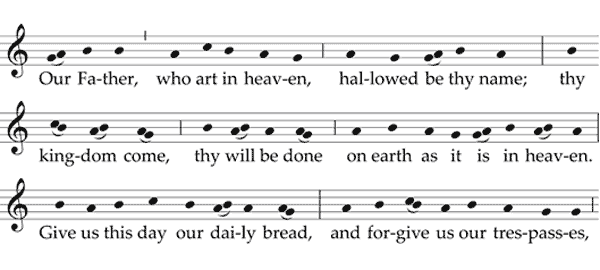
ICEL is giving us a first glimpse of the new music for the new Missal, with some wise changes such as this new framework for the Our Father:


It is all very interesting to read about the method and there is reason for optimism, provided many people are able to make comments and criticism and corrections before the entire package is complete. The world is filled with outstanding liturgical musicians, genuine experts in a huge range of issues, who can assist in putting together what will be the common property of us all.

This is why I'm puzzled by this note from ICEL

Music for the Roman Missal

The International Commission on English in the Liturgy, while working on a new translation of the Roman Missal, assembled a small committee of expert musicians to prepare musical settings of the texts that are set to music in the 2002 Latin edition of the Missal. They were directed to follow as closely as practical the Gregorian melodies given with the Latin text. The Music Committee has worked closely with the translators.

The Commission has now approved settings for those parts of the Order of Mass that received recognitio from the Holy See in June 2008, in accord with Cardinal Arinze’s expressed wish that the publication of these texts ‘facilitate the devising of musical settings’. The Commission is now making these settings available on a secure website, accessible by a password, which has been communicated to the Chairmen of the Liturgy Commissions in each of ICEL’s Member and Associate-member Conferences. They will distribute the password as they see fit.

The Introduction, giving a rationale for the choices made, is accessible to all.

Work continues on music for the remainder of the Missal. This will be made available when the final texts are known.


Then follows a link to an explanation of how the music came to be with a final instruction:

For access to the music discussed in this report, please click here and enter the username and password provided by your national liturgical office.


So you are either in or you are out, based on whether you can log in here. Congratulations if you are on the in crowd. I'm sure not.

Monday, August 11, 2008

JT on: Waiting on an ICEL response

After ICEL sent this note to me, I sent back the following on Friday, August 8:

I gather from this that composers can post settings of the ICEL Mass text, provided that the ICEL copyright notice is posted, that it is distributed through non-commercial means (free download), and it is noted that it has not been approved for liturgical use. Under these conditions, then, ICEL will permit it to be posted and not claim to be owed royalties. Is this correct?


I have not heard back.

Thursday, August 07, 2008

Jeffrey Tucker on: From ICEL comes an answer

Here is a record of the question and below is reprinted the answer. My question was whether composers could now begin posting settings of the Ordinary for free download without paying ICEL. Comments on this letter are welcome.

Dear Mr. Tucker:

Your letter of 5 August requesting permission to post musical settings of the newly-released texts of the Order of Mass online for free download was passed on to me by my assistant Jason McFarland.

As you know, the International Commission on English in the Liturgy was established by the Congregation for Divine Worship and the Discipline of the Sacraments as a Mixed Commission in service to the Conferences of Bishops that use English in the celebration of the Liturgy. As a result, permissions granted by ICEL for use of its texts are contingent on the authorization of the publication in question by the Conference(s) of Bishops in those territories where the publication is to be distributed. Various Conferences have been discussing the important issue of the timeline for catechesis on the implementation of the new Missal translation and the production of materials to aid in the reception of the new translation. It is our understanding that an implementation date for the publication of the Order of Mass texts will need to wait until the translation of the entire Missal has been approved by the Conferences of Bishops and the approval has received the recognitio of the Congregation for Divine Worship and the Discipline of the Sacraments. The schedule for release of musical settings of the Order of Mass, therefore, will be established by each Conference of Bishops. It is possible, however, that some Conferences will decide to allow for publication and release of musical settings of the Order of Mass before the entire Missal has been approved. Should you wish, therefore, to proceed with your plans to make available online settings of the new translation of the Order of Mass, you first need to contact the national liturgy offices of those Conferences where you plan to make these settings available. Along with your request for authorization, you will need to submit a copy of the manuscript to the national liturgy office. In the United States you would need to write the USCCB Secretariat of Divine Worship, 3211 Fourth Street, NE, Washington, DC 20017. Should you wish to proceed at this time, I will be pleased to send you a list of addresses of the various other national liturgy offices.

When you have received authorization from the Conference(s) of Bishops, we will draft a permission granting the rights to publish within those territories in which authorization has been secured. For most non-commercial uses of ICEL material, no fee is usually charged by ICEL.

It may help you to know that ICEL is a non-profit organization, whose assets belong entirely to its member Conferences of Bishops. The Commission in its early days was funded by its member Conferences, each Conference contributing a share of the total sum in proportion to the number of Catholics estimated to reside in its territory. When income began to come in from royalties, surplus funds (which amounted to over two and one half times the original cost of establishing the Commission) were distributed in the early years to the Conferences, divided according to the same ratio as their contributions. In recent years, royalty income has been used to fund the long process of translation of the Missale Romanum. Thanks to this income, it has not been necessary to request any contribution from member Conferences. When income increases, as is to be expected with the publication of a new Missal, the surplus will again be distributed among the Conferences.

The copyright ensures that the integrity of texts is preserved and that the rights of the Conferences to regulate their use are protected. The copyright is, therefore, a means of discouraging the issuance of inaccurate or unfinished or unapproved or unduly altered texts of the Church’s Liturgy.

As you may know, the ecumenical ICET texts (Gloria in excelsis, Nicene and Apostles’ Creeds, Preface Dialogue, Sanctus, Agnus Dei) were not under copyright, which partially explains changes made by individual composers to these texts.

Should you have any questions concerning the ICEL publication policies, you may wish to consult the ICEL Web Site, www.icelweb.org. I will also be pleased to respond, as best I can, to any additional questions you may have.

I thank you for your kind attention in these matters and wish you all the best.

Yours sincerely,

Peter C. Finn

Peter Finn
Associate Executive Director
International Commission on English in the Liturgy
1522 K Street, NW
Washington, DC 20005-1202
Phone: 202-347-0800
FAX: 202-347-1839
PFinn@eliturgy.org

JT on: ICEL Royalty Question Update

Earlier this week, I sent this question to ICEL, asking whether composers need to pay ICEL to set the new Mass texts to music and post the music for free download.

ICEL wrote me as follows:

We will be glad to respond to your request for copyright permission. First, could you tell us on which website or websites the musical settings would be posted and provide us with an estimate as to how much internet traffic this website (or these websites) receive?


I've written them back as follows:

It is hard to say because this depends on human volition. It could be anywhere between 2,000 and 250,000 visitors per month, not all of whom would be downloading music. But outside links can cause one-day traffic to soar. If the music is not appreciated by users, that traffic could fall again. Also they might be posted on blogs and forums of varying sizes, and, in any case, Google makes the precise venue somewhat less relevant.

The point is that many people want to set Gregorian melodies and Psalm tones to English texts, mainly for the ordinary of the Mass, so their approval is not really a question. My question concerns royalty payments to ICEL. If they have to pay, they will not likely post.

I'm asking not just for myself but on behalf of all musicians. My specific question is whether any royalties are due for freely downloaded music that sets the new Mass texts.


I await an answer.

Tuesday, August 05, 2008

JT on: My Short Note to ICEL

Here is what I've sent to permission@eliturgy.org:

I know of 10 composers who have already worked on new settings of the new Mass text. In doing this, they are responding to Cardinal Arinze's hope that having the texts available will "facilitate the devising of musical settings for the parts of the Mass."

They would like to post these compositions online for free download for everyone. Your copyright notice does not seem to specify whether they are permitted to do this without paying ICEL. Can you please provide me a public and clear answer to this question?


I will post the entire answer when I obtain one.

Jeffery Tucker on: ICEL, copyright, and the core of the problem

The letter from Cardinal Arinze posted here presents the framework for the new Mass texts. It specifies that the purpose is, in part, to "facilitate the devising of musical settings for the parts of the Mass." It further specifies that the text is under copyright and so it is subject to "all pertinent copyright legislation in civil law" in accordance with the statutes of ICEL.

Many composers might at first feel a sense of excitement here that the Church is asking for their creative contributions. But then they look at the ICEL rules that Cardinal Arinze rightly says are enforced by the state. It turns out that ICEL demands a tax--this is the right word since the payments rely on coercion--be paid for any settings that are posted for more than one-time use. The taxes go higher if the music finds a market.

There are only a few publishers prepared to pay this tax, understand the accounting rules, and can bear the costs associated with compliance. We need to appreciate just how afraid of these rules that most musicians really are. They will compose and let these pieces sit on their harddrives rather than post them. That leaves only the established music publishers in a position to distribute appropriate musical settings.

So we see here that Cardinal Arinze's two principles are at odds with each other: it is not possible to facilitate widespread and faithful musical settings of these texts under ICEL's current copyright/"royality" rules. There is a simple workaround: make these texts open source. They can use Creative Commons or even conventional copyright while eliminating the tax on publishing with broad permissions granted de facto. This is how the ordo of service for every other denomination handles matters, so far as I know. Changes are essential if the monopolistic forces currently impeding progress are not addressed. The status quo is not suitable.

Right now, ICEL's rules say nothing about digital publication or online distribution, almost as if they are made to apply to a world that disappeared ten years ago. There is an opportunity right now for ICEL to issue a clarification. If that clarification does not assist in permitting widespread creation and distribution of new musical settings, there is a case for some sort of intervention.

Monday, August 04, 2008

JT on: ICEL vs. the Book of Common Prayer

In a comment thread on a previous post, someone mentioned that the Book of Common Prayer, even the most recent edition, is in public domain to encourage the widest possible use, at no charge. That makes sense. We are, after all, talking about a religious text the words of which are the common property of the whole world. If someone wants to claim ownership over a particular edition with new material, that's another matter, of course.

Living in the Catholic world in which tribute, a liturgy tax, must be paid to International Commission on English in the Liturgy (ICEL) for printing the text of the Mass, even for simple musical settings for distribution outside a single event (and I'm going to stop laying out all the technicalities here, else I would have to reprint ICEL's own textual minefield in full), this news about the BCP is rather interesting.

Sure enough, the commentator is right: here, here, here, here, and probably a thousand other places. Many people are able to sell it in different formats, and even profitably. No disaster has befallen the liturgy as a result. Compare those links to this one.

In the same way, of course, the text of the 1962 Missal is free for all, as are most supporting materials.

That leaves the ordinary form of the Roman Rite as the exception, and it is a very serious one, given that new texts are are going to be issued that will require musical settings. Catholics will not be free to compose music and post it for free download or for sale without first and last paying ICEL. That gives a huge market boost to the established music publishers that are currently the big players in the market. What we have here is a monopolistic barrier to entry to the market that affects every parish and every Catholic.

Why the ICEL tax? They say they need the money, more than the rest of us I suppose. But if a Church can't pay for the production of its own liturgical texts, I'm not sure what there is to say about that.

Something needs to change, dramatically and quickly, about ICEL's copyright and royalty policies.

Friday, August 01, 2008

Jeffrey Tucker on: ICEL, Copyright, and a Creative Commons Future

Most of the focus on the translated Mass texts of the future has concerned language issues. But regardless of what is finally chosen and printed, a very serious issue has not been part of public discussion: namely, the rights of people to print and distributed these texts online and in new musical settings.

To the naïve among us, this probably doesn’t sound like an issue at all. These are the texts of the Mass that belong to all. Part of the Church’s evangelistic mission is to promote and distribute the theological import of them, and to inspire creativity in their liturgical presentation. It’s one thing to claim exclusive rights over presentation, art work, or commentary. But the required texts themselves? Surely they are the property of all.

The International Commission on English in the Liturgy doesn’t see it this way. Here is its copyright policy. In part this is an unintended fallout from vernacularization. The Latin texts are age old and gift to the entire world. But by authorizing vernacular translations, the texts of Mass themselves become bound up with national copyright laws in which the state collaborates with private producers to create and protect publishing monopolies.

By way of background, these kinds of copyright didn’t formally exist in the English speaking world until Elizabeth used them for purposes of securing political and religious loyalty toward the Crown and against those musicians or clergy or publishers who might have loyalties to the Vatican. These actions set a new precedent in the intermingling of church and state. Producers awarded such exclusive privileges appreciated the system but those who were not merely found themselves ensnared with the law. The copyright system, when used in this way, became an intrusion on the freedom of conscience and speech as well as religious liberty in general.

Nowadays, few know of this background. But everyone in Catholic liturgical publishing is aware of ICEL’s policies, which can be summarized in the following statement. “Any publication produced for sale which contains ICEL translations is subject to a royalty or flat fee.” Now, the fees may not seem to be high but small margins of this sort of publishing tax can make the difference in whether or not to go ahead with publishing. This is especially true with today’s astonishingly tight financial margins.

Now, there are conditions under which ICEL does not charge. This is for what is called a “one time use” by an institution or congregation. Examples would be “convention program booklets, jubilee Masses, ordinations, baptisms, first communions, confirmations, funerals, weddings, etc.” One time use means, presumably, in some way that the program cannot be reused, to use a literal rendering. But what if you post it online for, for example, the parish to see and download? Is that one-time use or more? It is hard to say.

The incredible fact is that ICEL does not anywhere in its policies explicitly account for digital posting or rendering of its texts. But we do know that last year, a British blog called “Hermeneutic of Continuity” posted the proposed translation. Here is the message he was sent by ICEL:

It has come to our attention that the proposed translation (Gray Book) of the Order of Mass circulated in January 2006 by the International Commission on English in the Liturgy has been included on your blogspot (the-hermeneutic-of continuity.blogspot.com). This translation has been produced without the Commission's permission and in violation of the ICEL copyright. We ask therefore that the text be removed immediately from the site.

This case set a precedent and scared the wits out of bloggers the world over, who were terrified even to quote the new texts for fear of getting in trouble. Now, most Catholics who would otherwise publish these texts have good hearts. They want to get the word out and discuss them. But ICEL has said no.

What about when the texts are finalized? The presumption is that the policy will hold. The copyright policy will be the same, and the ambiguity concerning online posting will continue. This is a serious issue and a major problem that needs to be addressed, and soon.

By the way, the ambiguity is an issue not only for those who would give away their music, for example. What if someone wants a bound version of this music? These days it is as easy as provided a click through to permit people to purchase a bound volume printed on demand. Are we supposed to believe that only this action would cause ICEL to sit up and take notice, slapping around the individual or institution and fining them for royalties? It is not clear, but you can see how a resolution of the problem of non-commercial distribution is not enough. No clean line exists any longer between commercial and non-commercial.

The blogger who was harassed complied with ICEL’s demand but wrote: “I know that many good priests and lay people share my concern that the enforcement of copyright by ICEL over the past decades has not served the Church well. The restriction of publishing rights to one or two publishers has given rise to a monopoly with the result that only poorly produced books are available for priests to use in their parishes. …There are many Catholics who would be willing to finance the production of good quality, beautifully produced Missals were it only possible to do so without falling foul of copyright restrictions.”

[Someone else attempted to provide a substitute link to the texts, and here is the thanks he received. And yet, the crackdown hasn't worked.]

The blogger above is speaking of the English case but it is also true in the United States. Only a few firms seem to be able to afford to become liturgical publishers. And those that can are the source of many of the problems that the new translations are designed to overcome, namely liturgical deviations from the history and practice of the Roman Rite. In other words, if only these publishers are able to overcome the barriers to entry in the market, we are going to get new texts in the same old musical package that has proven to be much of a change. The attempt to bring about change will be foiled and solely because of a copyright policy.

Online digital publishing and printing has led to fantastic innovations in copyright policy as well, simply because the old models no longer work in a digital world. Creative Commons offers many opportunities for retaining a proprietary relationship with texts (attribution) while still permitting a generous use, even when it involves a commercial relationship, as the blog Cantemus Domino points out. The Catholic faithful have a very strong interest in making sure that ICEL adopts some new policy in this regard.

Will this mean less money for ICEL? Certainly. I’m sorry about that. But right now, its “royalties” are coming from poor parishes that cannot afford them—for it is they (their parishioners) who ultimately pay the price for them. There has been speculation that ICEL will shut down after this task is completed. That is all the more reason to stop the flow of money from the pockets of average Catholics into the coffers of these extra-ecclesiastical outfits and permit fair and open rivalry among all those who want to contribute to the Church’s liturgical life. For the good of the Church and the faith, something must change and now, before it is too late.

Actually, it seems to me that if ICEL does not voluntarily give up its temporal power, the Vatican has an interest in acting here to insist that the text of the Mass not be subject to a tax.

Friday, March 02, 2007

Worth Sharing

Father Richard John Neuhaus, editor-in-chief of First Things, weighs in on the ongoing battle over liturgical translation in the current issue of that fine journal of religion and culture. He writes:

Thanks to a working group called Vox Clara, headed by George Cardinal Pell of Australia, and to the hard work of a reformed ICEL (International Commission on English in the Liturgy), it seems that Catholics will soon have a new sacramentary with an actual translation of the Latin texts of the Mass rather than the loose and clunky paraphrases that were hastily contrived in the 1960s. The old guard of the liturgical establishment that was responsible for the dumbed-down paraphrase is not happy. Bishop Donald Trautman, who will be chairman of the U.S. bishops conference's committee on liturgy for a little while longer, gave the keynote address at the January meeting in Toronto of the North American Academy of Liturgy. Criticizing the work of Vox Clara and ICEL, he said liturgists must be "prophetic" in defending a liturgy that is "accessible and pastorally aware." I don't know how liturgy can be aware, but Catholics who are aware may be somewhat amused by the warnings of Trautman and others that changes in the rite might alienate some of the faithful. After forty years of eat-your-spinach diktats from the liturgical guild, it seems a little late to be worrying about alienating the faithful. By now everybody is familiar with the quip about the difference between liturgists and terrorists: You can sometimes negotiate with terrorists. Thanks to Vox Clara and ICEL, it seems that at least one war on terrorism is being won.

-- "While We're At It," First Things 171 (March 2007): 61

More recent articles:

For more articles, see the NLM archives: