Here is another big win for the YouTube suggestion algorithm, a motet by Palestrina which has the first two verses of the epistle of Corpus Christi (1 Corinthians 11, 23-29) as its text. For simplicity’s sake, I have titled this post “for Corpus Christi”. But our friend Thomas Neal, who is an expert on Palestrina, tells me that the exact occasion for which it was composed is unknown; it may have been written for Holy Thursday instead.
“Brethren: I indeed have received of the Lord that which also I delivered unto you, that the Lord Jesus, the same night in which he was betrayed, took bread, and giving thanks, broke it, and said, ‘Take ye, and eat: this is my body, which shall be delivered for you: this do for the commemoration of me.’”Sunday, June 07, 2026
A Motet and Mass by Palestrina for Corpus Christi
Gregory DiPippoTuesday, August 05, 2025
Music by Palestrina in Honor of the Virgin Mary
Gregory DiPippoAs we have already mentioned a number of times, this year the Church is celebrating the fifth centenary of the birth of Giovanni Pierluigi di Palestrina (1525-94), one of the greatest composers of sacred music for the Roman liturgy. Palestrina is actually the name of the town where he was born, about 24 miles to the east of Rome, but he spent the greater part of his life in the Eternal City, working at various ecclesiastical institutions, including the basilica of Mary Major, whose dedication is celebrated today. There is a document which seems to indicate that he was chorister there already in 1537, at the age of twelve, and from 1561-66 he was master of the chapel there. To mark the day, here are his setting of the four great antiphons of the Virgin, and of the Sub tuum praesidium, which in the Roman Rite is sung as the antiphon of the Nunc dimittis at Compline of the Little Office of the Virgin.
Salve Regina
Friday, June 20, 2025
Sacred Treasures of Rome - New Album from London Oratory Schola
Jennifer Donelson-NowickaSacred Treasures of Rome is a new recording from the boys of the London Oratory Schola directed by Charles Cole, and focuses on Palestrina in this, his quincentennial year, as well as other composers working in his orbit in Rome.
One thing which many of the composers on the disc share was a connection with St Philip Neri. In particular a motet is included by Giovanni Animuccia, who was one of St Philip’s brother priests during the early beginnings of the Oratory at San Girolamo della Carità. Much of Animuccia’s music has been lost, aside from some beautiful editions of his three masses and some motets in the Vatican Libraries. The fate of the rest is a mystery, though an ignominious legend exists that the scores were sold to a Roman cheesemonger to wrap his wares, such was the value of parchment paper at the time. Fortunately, a few motets can be found scattered across part-books, one of which, O crux ave spes unica, has been reconstructed for this recording.
The album also includes works by other composers who had connections to the Rome Oratory including Allegri, the Anerio brothers, and Giovannelli, who succeeded Palestrina.
The London Oratory Schola will be touring the USA in July and singing much of this music both in liturgical and concert contexts, including an appearance at the Palestrina500 Festival.
Sacred Treasures of Rome is released worldwide on all major platforms on July 4, 2025.
Pre-order via Amazon in the U.S. here, and in the U.K. here.
Thursday, June 19, 2025
Very Wise Words from Pope Leo about Polyphony in the Liturgy
Gregory DiPippoThis year, the Church is commemorating the fifth centenary of the birth of one of the greatest composers of liturgical music in her history, Giovanni Pierluigi da Palestrina (1525-94). Yesterday, in the Sala Regia of the Apostolic Palace, Pope Leo was present for an event in celebration of Palestrina, organized by the Cardinal Domenico Bartolucci Foundation. (Cardinal Bartolucci, himself a prolific composer, was also director of the Sistine Chapel Choir, and dedicated much of his life to preserving the tradition of the Roman school of polyphony embodied by his illustrious predecessor of the 16th century.) The Pope spoke about the use of sacred polyphony in the liturgy in words which should be very encouraging to those who work as Cardinal Bartolucci did to keep the precious heritage of our liturgical tradition alive, not just as music for concert performance, but as music for prayer. Those who believe that such music should be excluded from the liturgy because it does not foster “participation”, as it is so commonly and shallowly understood, would do well to consider these wise words, which are, of course, fully consonant with the Church’s long-standing tradition and teaching on the use of sacred music, and no less so with the words of the Second Vatican Council en regard.
Tuesday, April 22, 2025
Update on the Palestrina500 Festival in Grand Rapids
Peter KwasniewskiThe choral meditation consisted of:
- Palestrina: Litaniae de Beata Virgine Maria a6
- Antoine Brumel: Sub tuum praesidium
- Josquin des Prez: O Virgo prudentissima
- Johannes Ockeghem: Intemerata Dei mater
- Antoine de Févin: Nesciens mater
- Jean Mouton: Ave Maria, virgo serena
- Josquin des Prez: Nymphes des bois / Requiem aeternam
- Costanzo Festa: Quis dabit oculis
- Jean L’Héritier: Sub tuum praesidium
Sacred Heart’s pastor, Fr. Ron Floyd celebrated the Missa cantata. Here’s a recap video:
On Tuesday, March 25th, the Solemnity of the Annunciation, Sacred Heart of Jesus Parish in Grand Rapids, MI welcomed The Hope College Chapel Choir, of Holland, MI.
The choral meditation consisted of all music by living composers, with chanted psalms from that evening’s Vespers between each piece by the Men’s Schola of Sacred Heart:
Hear Our Cry, O Lord by Ben Krause
O Radiant Dawn by James MacMillan
Halo My Path by Josh Rodriguez
Set me as a Seal by Margaret Burk
O Magnum Mysterium by Morten Lauridsen
Tota pulchra es by Jonathan Bading
The Mass featured Palestrina’s Missa Brevis as well as his Jesu Rex Admirabilis, and again, the Sicut Cervus.
The series continues this Friday, April 25th, when Sacred Heart will welcome the world famous Tallis Scholars from the UK, who will be singing an hour long choral meditation at 5:00pm (*note time change) and the Missa Papae Marcelli at 7pm - a work that will acquire all the more poignancy from the moment in the Church’s life in which it will be sung.
For the full schedule of Palestrina500 events, go to palestrina500.org.
Posted Tuesday, April 22, 2025
Labels: Gesualdo Six, Hope College, Palestrina, Palestrina500, Sacred Music, Tallis Scholars
Friday, February 28, 2025
Call for Papers for a Conference on Palestrina
Gregory DiPippoTo mark the 500th birthday of Giovanni Pierluigi da Palestrina (c.1525-1594), the Centro Studi Opera Omnia Luigi Boccherini and the Italian Institute for Applied Musicology are pleased to invite submissions of proposals for the virtual conference “O felix Roma”: Palestrina and his Roman Contemporaries, to be held from 12 to 14 December 2025.
Even during his lifetime, Palestrina was widely regarded as one of the foremost musicians of the age. In a career spanning nearly half a century, he served as maestro di cappella in the major basilicas at Rome, including 27 years at the helm of the Cappella Giulia. His patrons included some of the most prominent prelates and nobility of his time, and he undertook freelance work for many of the city’s churches, oratories, seminaries, and confraternities. Arguably the most prolific composer of liturgical music in the early modern period, Palestrina’s output was vast: at least 104 masses, over 250 motets, over 140 madrigals, and hundreds of pieces of liturgical music have survived. His compositions were widely disseminated in manuscripts across the Italian peninsula and beyond; much of it reached an international audience through the Roman, Venetian, Flemish, and German printing houses of the period.- new evidence of, insights into, and interpretations of the biographies and music of Palestrina, his pupils, and his contemporaries
- music printing and publishing in Rome
- art, architecture, and acoustics in Rome
- institutional patronage and the production of music in the churches, colleges, seminaries, confraternities, and religious orders of Rome
- patronage of music and musicians by prelates, patricians, and the business classes of Rome
- the Roman diaspora in Europe and the New World
- performance practices and the soundscape of the city of Rome in the 16th century, including popular devotional music, street music, and domestic music-making
- the reception of music by the ‘Roman school’ and the influence of the stile antico in music from the 17th to 21st centuries
- the use of Palestrina’s music in the context of the liturgical movements of the 19th and 20th centuries, and in the early music revival.
Saturday, February 08, 2025
Epiphany Celebration at the Palestrina500 Festival
Gregory DiPippoOn Monday, January 6th, the feast of the Epiphany, the church of the Sacred Heart of Jesus in Grand Rapids, Michigan, welcomed Schola Antiqua of Chicago to sing a choral meditation and Mass for the second major event of the parish’s Palestrina500 festival, a year-long celebration in honor of the fifth centennial of the great composer’s birth.
The choral meditation consisted of the following works by Palestrina:Wednesday, January 01, 2025
Year-long Palestrina500 Festival Formally Opens with Pontifical Mass
Peter KwasniewskiThe Most Reverend David Walkowiak celebrated a Novus Ordo Mass concelebrated by the parish’s pastor, Fr. Ronnie P. Floyd, STL, pastors emeriti Fr. Robert Sirico and Fr. Donald Lomasiewicz, and priest-in-residence Fr. John Bosco Ssekkomo, and assisted by two deacons, the Rev’d Mr. Robert McClintic and the Rev’d Mr. Richard Fish. Almost 600 of the faithful were present, leaving standing room only.
The choral ensemble consisted of two combined choirs: the volunteer Sacred Heart parish choir and Gaudete Grand Rapids, a semi-professional choir of 16 voices. Both choirs were conducted by Mr. Jonathan Bading, the director of music.
Gaudete sang the Kyrie, Gloria, and Agnus Dei from Palestrina’s Missa de Beata Virgine à 4, which they will sing in its entirety for the September 15th Palestrina500 event. They also sang the “Ave Maria à 5” for the Offertory. The parish choir joined them for the Magnificat primi toni à 4 at communion and the composer’s perennial setting of the Alma Redemptoris Mater at the conclusion of Mass, with Gaudete singing the Choir II portion from the triforum of the church.
This Monday, January 6th, Sacred Heart will welcome its first visiting choir, Schola Antiqua of Chicago, who will be singing an hour-long choral meditation at 5:30pm and the Missa Alma Redemptoris Mater for the Solemn Mass of the Epiphany at 7pm. For the full schedule of Palestrina500 events, go to palestrina500.org.
Some video footage: recap/Kyrie from the Missa de Beata Virgine:
Magnificat primi toni à 4:
Posted Wednesday, January 01, 2025
Labels: Palestrina, Palestrina500, Peter Kwasniewski, Sacred Music
Wednesday, November 22, 2023
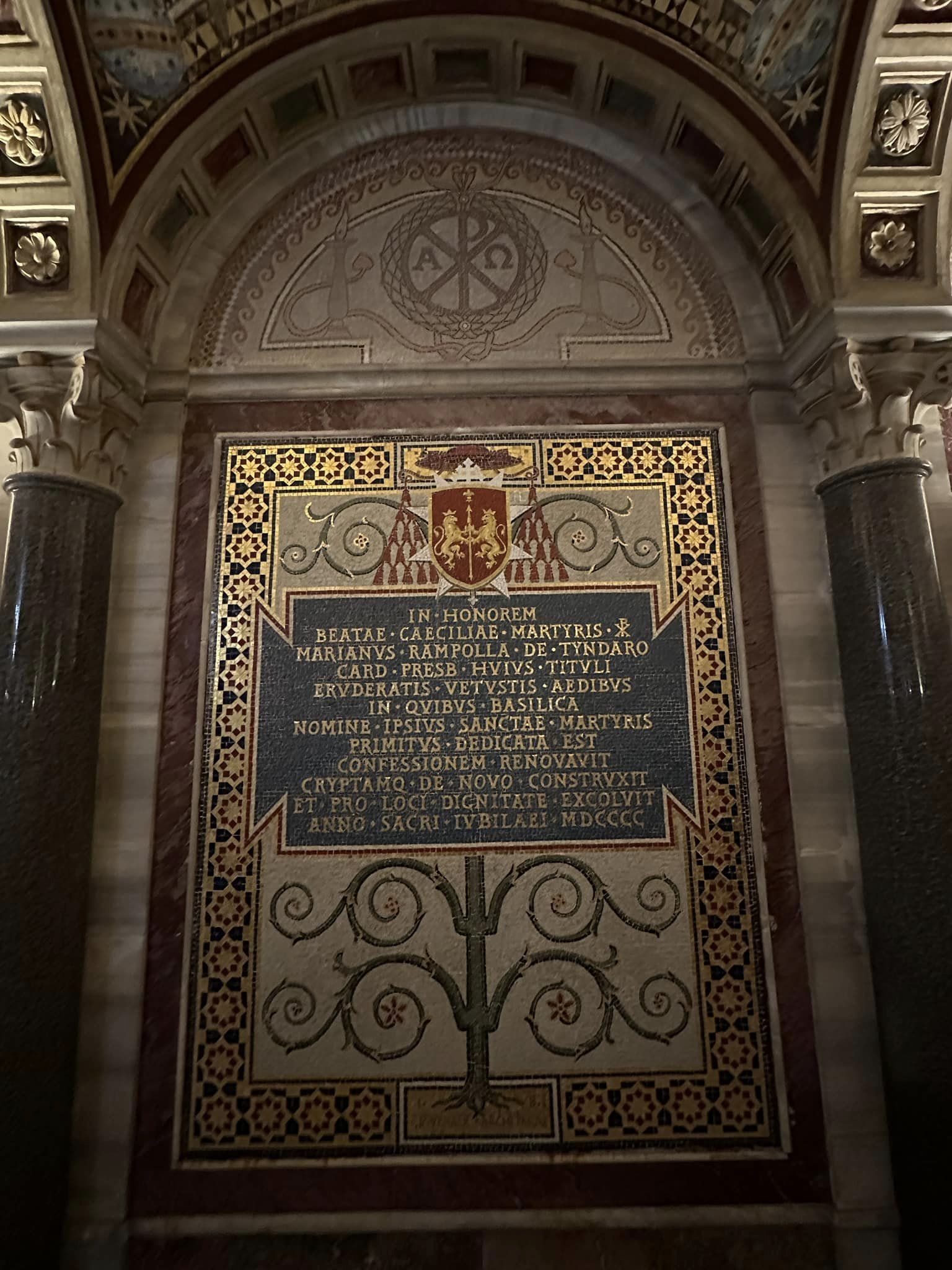
A Motet by Palestrina for the Feast of St Cecilia
Gregory DiPippoPalestrina was having a particularly good day when he composed this motet for the feast of St Cecilia, the words which form the antiphon of the Benedictus in her Office.
Aña Dum auróra finem daret, Caecilia exclamávit dicens: Eia, mílites Christi, abjícite ópera tenebrárum et induímini arma lucis. ~ Aña As dawn was fading into day, Cecilia cried out, saying: Arise, o soldiers of Christ, cast away the works of darkness, and put on the armour of light.![]() |
| The Martyrdom of St Cecilia, ca. 1610, by Carlo Saraceni (1579-1620). Public domain image from Wikimedia Commons. |

Wednesday, October 11, 2023
Announcing Palestrina500: A Year-Long Festival with Twelve Extraordinary Events in Grand Rapids, Michigan
Peter KwasniewskiFeatured choirs include:
- the Tallis Scholars
- The Gesualdo Six
- The London Oratory Schola
- The Theatre of Early Music
- Schola Antiqua and His Majesty’s Men
Sacred Heart Parish has launched an online fundraising campaign, which can be found at palestrina500.org. Please consider supporting this colossal festival, whose aim is not only to honor our rich Catholic musical patrimony, but more importantly, to give God His due worship and to evangelize through beauty.
Here is the promo video:
New Liturgical Movement is very excited about this amazing and ambitious project and will offer updates and announcements as the festival proceeds.
Congratulations to Sacred Heart, their music director and program, and all who are working behind the scenes and contributing to Palestrina500. It will surely be an inspiration for the whole Church, and, Deo volente, a model for other initiatives in honor of the undisputed prince of liturgical polyphony.
Tuesday, August 22, 2023
Palestrina’s Canticle of Canticles
Gregory DiPippoBefore the Tridentine reform, very few feasts had Scriptural readings in the first nocturn of the Divine Office. On the feasts of the Saints, it was typical for readings of their lives to supply all the Matins lessons, while on those of Our Lord and Our Lady, the first two nocturns were usually a sermon about the feast, and those of the third a homily on the Gospel read at Mass. There were, however, certain exceptions to this, such as Christmas and Epiphany, which always had the same readings from Isaiah that they do today. Among the feasts of the Virgin Mary, only that of her Nativity had Scriptural readings; these were taken from the Song of Songs, or Canticle of Canticles, as it was traditionally known in the Latin West, from its title in the Vulgate, “Canticum Canticorum.”
his great friend Paula and her daughter Eustochium (who are both also Saints), in which he expounds his belief in the Assumption of the Virgin, and exhorts them to imitate Her as a model of consecrated life. In reality, it was written by St Paschasius Radbertus, a monk of the ninth century, when “forgeries” of this sort were not looked upon as frauds or acts of deception. Patristic scholar Jaroslav Pelikan notes that Paschasius “under the name of Saint Jerome made a far more substantial contribution to the history of Marian spirituality and devotion than any of the genuine works of Jerome, or for that matter than (his own) other principal work … on the subject of the Blessed Virgin Mary.” (“The Odyssey of Dionysian Spirituality”, Pseudo-Dionysius: The Complete Works, Paulist Press, 1987.)In the early 16th century, however, Erasmus had shown that “Cogitis me” was certainly not by St Jerome, although he did not know who the true author was. It was therefore removed from St Pius V’s breviary and replaced by writings of other Church Fathers. (Ironically, the readings from St Athanasius assigned to the feast in the first edition were also later determined to be not actually his, and were removed from the second edition published by Clement VIII in 1602.)
![]() |
| The upper half of a polyptych of the Assumption, with Ss Paul and Jerome, Catherine of Alexandria and Clare of Assisi, 1529-30, by Alessandro Bonvicino (1492/5 - 1554), known as “Moretto da Brescia.” |
The readings are arranged as follows:
| August 15 | chapter 1 (1-16) |
August 16 |
chapter 2 (1-17) |
August 18 |
chapter 4, 1-4 and 7-15 |
August 19 |
chapter 5, 8-12 chapter 6, 1-5 and 8-12 |
August 21 |
chapter 7 (1-13) chapter 8, 1-4 |
August 22 |
chapter 8, 5-14 |
Two days within the octave have no such readings: August 17th, the octave of St Lawrence, and the 20th, the feast of St Bernard. (The readings of the 16th, 19th and 21st were later removed as other Saints were added to the calendar on those days.)
![]() |
| Palestrina presents his first book of Masses to Pope Julius III; part of the frontispiece of the book itself, which was published in 1554. Julius (whose scandal-ridden papacy was a profound embarrassment to the rising reform movement within the Church; his papal name has never been used again), had been bishop of the very ancient suburbicarian see of Palestrina, about 24 miles to the east of Rome. It was he who called the great musician from his position as organist in the cathedral of his native town to work in the choir of St Peter’s basilica. (Public domain image from Wikimedia Commons.) |
Of these 29 motets, the texts of all but one, the 18th, coincide with the readings for the Assumption and its octave, although they do not include all the verses that are in the breviary. (There are none from chapter 8, so the octave day is not included.) But more interestingly, the same verses that are omitted from the breviary are also not used by Palestrina. The motets taken from chapters 4 and 5 begin at the same verses as readings on August 18 and 19, and those from chapter 6 omit the same verses (8-9) which are omitted in the breviary. The two chapters which get the most thorough treatment, the first (motets 1-8) and second (motets 11-17), are also the ones used on other feast days of the Virgin, the former on Her Nativity, and the latter on the Visitation.
These motets are also quite short, averaging about 2 minutes and 45 seconds each. This would make them very appropriate for the sweltering Roman summer when these feasts are celebrated, a time of year in which we may reasonably guess that people would not want the liturgy to be excessively prolonged by lengthy musical pieces.
Palestrina came to Rome in 1551, and worked there for 43 years, at St Peter’s Basilica, St Mary Major and St John in the Lateran. Given the circles in which he moved, it seems quite possible that he knew the clerics who edited the Tridentine breviary. Taken all together, these things seem to make for at least the possibility that he deliberately selected his texts out of the breviary, and intended them to be used during the Masses of Our Lady’s major feasts in the summer.
Here is a very nice recording of the whole set by the Hilliard Ensemble.
Posted Tuesday, August 22, 2023
Labels: Assumption, Bible, Liturgical History, Liturgical Reform, Palestrina, Song of Songs
Sunday, October 10, 2021
Durandus on the Offertory Super Flumina Babylonis
Gregory DiPippoUpon the rivers of Babylon, there we sat and wept, when we remembered thee, o Zion. (The Offertory chant of the 20th Sunday after Pentecost.)
The bodily captivity (of which the Offertory speaks) signifies our spiritual captivity; the return from captivity is the forgiveness of sins. ... Therefore, lest we return to a similar captivity, and be shut out of the wedding feast (in last week’s Gospel, Matthew 22, 1-14), Paul warns us in the Epistle, “See to it that ye walk with care, not as the unwise, but as the wise.” The Introit Omnia quae fecisti is the voice of Daniel remembering that past captivity, and ascribing it to the judgment of God; likewise, in the Offertory, we weep over that captivity, but in the Gradual Oculi omnium, we give thanks (for deliverance from it). - William Durandus, Rationale Divinorum Officiorum 6.137 in fine.Posted Sunday, October 10, 2021
Labels: Offertory, Orlando de Lassus, Palestrina, polyphony, Victoria, William Durandus
Sunday, May 31, 2020
Pentecost 2020
Gregory DiPippo![]() |
| The Descent of the Holy Spirit, 1618-20, by St Anthony van Dyck (1599-1641); public domain image from Wikimedia Commons. |
Friday, April 03, 2020
The Stabat Mater and the Feast of the Seven Sorrows
Gregory DiPippo![]() |
| The Virgin of Sorrows; the central panel of the Van Belle triptych by Pieter Poubus (1523 ca. - 1580); in the church of St James in Bruges, Belgium. There were different traditions as to which events in Our Lady’s life counted as Her Seven Sorrows; here they are (clockwise from lower left) the Circumcision, the Flight into Egypt, losing the Child Jesus, meeting Christ on the road to Calvary, the Crucifixion, the deposition from the Cross, and the entombment. The Roman version of the Passiontide feast contains no specific list. (Public domain image from Wikimedia Commons.) |
Saturday, September 28, 2019
Music for Vespers of St Michael
Gregory DiPippo| Te, splendor et virtus Patris, Te vita, Jesu, cordium, Ab ore qui pendent tuo, Laudámus inter Angelos. |
O Jesus, life-spring of the soul! The Father's Power and Glory bright! Thee with Angels we extol; from Thee they draw their life and light. |
| Tibi mille densa millium Ducum coróna mílitat; Sed éxplicat victor Crucem Míchaël salútis sígnifer. |
Thy thousand, thousand hosts are spread, embattled o’er the azure sky; but Michael bears Thy standard dread, and lifts the mighty Cross on high. |
| Dracónis hic dirum caput In ima pellit tártara, Ducemque cum rebéllibus Caelesti ab arce fúlminat. |
He in that sign the rebel powers did with their dragon prince expel: and hurled them from heaven’s high towers, down like a thunderbolt to hell. |
| Contra ducem superbiae Sequámur hunc nos príncipem, Ut detur ex Agni throno Nobis coróna gloriae. |
Grant us, with Michael, still, O Lord, Against the prince of pride to fight; So may a crown be our reward, Before the Lamb’s pure throne of light. |
| Deo Patri sit gloria, Qui, quos redémit Filius, Et Sanctus unxit Spíritus, Per Angelos custodiat. Amen. |
To God the Father, with the Son And Holy Paraclete, with thee, As evermore hath been before, Be glory through eternity. Amen. |
Many churches, including St Peter’s basilica, as well as the various orders of monks, and the religious orders that retained their own liturgical (Dominicans, Premonstratensians and Old Observance Carmelites) did not accept the revised hymns of Pope Urban, and continued to use the original version. It has also been restored to the post-Conciliar Liturgy of the Hours, with only two small alterations, which are included in this recording; the words “omnes caeli milites” are changed to “inclytos archangelos”, to reflect the recasting of the feast as that of the three Archangels named in the Bible, and the word “zabulum”, an early medieval version of “diabolum”, is replaced, purely in function of Dom Lentini’s literary taste. (English translation by John Mason Neale, 1818-66).
| Tibi, Christe, splendor Patris, Vita, virtus cordium, In conspectu Angelórum Votis, voce psállimus: Alternantes concrepando Melos damus vócibus. |
Thee, O Christ, the Father’s splendor, Life and virtue of the heart, In the presence of the angels Sing we now with tuneful art, Meetly in alternate chorus, Bearing our responsive part. |
| Collaudámus venerantes Omnes caeli mílites, Sed praecípue Primátem Caelestis exércitus: Michaélem, in virtúte Conterentem zábulum. |
Thus we praise with veneration All the armies of the sky; Chiefly him, the warrior primate, Of celestial chivalry, Michael, who in princely virtue Cast Abaddon from on high. |
| Quo custóde procul pelle, Rex Christe piíssime, Omne nefas inimíci: Mundo corde et córpore, Paradíso redde tuo Nos sola clementia. |
By whose watchful care repelling, King of everlasting grace, Every ghostly adversary, All things evil, all things base, Grant us of Thine only goodness, In Thy paradise a place. |
| Gloriam Patri melódis Personémus vócibus, Gloriam Christo canámus, Gloriam Paráclito, Qui trinus et unus Deus Exstat ante sáecula. Amen. |
Laud and honor to the Father, Laud and honor to the Son, Laud and honor to the Spirit, Ever Three, and ever One, Consubstantial, co-eternal, While unending ages run. Amen. |
The earlier version was, of course, the one known to the great composers of the Counter-Reformation; here is a particularly beautiful setting in alternating chant and polyphony by Tomás Luís de Victória (1548-1611.)
The antiphon for the Magnificat at First Vespers – Aña Dum sacrum mysterium cérneret Joannes, Archángelus Míchaël tuba cécinit: Ignosce, Dómine, Deus noster, qui áperis librum, et solvis signácula ejus, allelúja. – While John beheld the sacred mystery, the Archangel Michael sounded his trumpet: Forgive, o Lord our God, Who openest the book, and loosest the seals thereof. Alleluia.
And for Second Vespers – Aña Princeps gloriosíssime, Míchaël Archángele, esto memor nostri: hic et ubíque semper precáre pro nobis Fílium Dei, allelúja, allelúja. – O Prince most glorious, Michael the Archangel, do thou remember us; here, and everywhere, always entreat the Son of God for us, alleluja, alleluja.
The text was set as a motet by Palestrina’s contemporary Luca Marenzio (1553-99), who was famous as a composer of madrigls, of which he wrote over 500, but also wrote a large number of sacred works.
Tuesday, June 18, 2019
A Resource for Polyphonic Sacred Music in the Vernacular
David ClaytonThis is a project created by Heath Morber, who has adapted music by de Victoria, di Lasso, and Palestrina to English translations of motets and liturgical texts including the Ordinary of the Mass. The complexity and difficulty of the arrangements vary, so there are some suitable for beginners and some for more experienced singers. There are arrangements are for two, three and four parts.
When he started this project, Heath had in mind Catholic musicians who wanted to expose their congregations to the beauty of Renaissance polyphony, and think that the vernacular may be a safe way to introduce this music to people in the pews who may balk at the use of Latin.
He already has already made over 200 pieces available, and is adding more month by month. At the moment he is asking for a one-time payment of just $30 in exchange for access to the full and expanding library of titles, as long the site and the internet exist.
Here are two samples from the site. First, Answer My Prayer, an STB three-part arrangement of Exaudi Me Domine by Orlando di Lasso:
Monday, March 04, 2019
Photos from the Second Annual Lepanto Conference in New York City
Peter KwasniewskiThis year’s conference began with a Pontifical Mass at the faldstool, a Votive Mass of Pope St Pius V, celebrated by Auxiliary Bishop James Massa of the Brooklyn Diocese, who preached at the Mass (video here), which was well attended by both young people and adults, numbering over seven hundred. The Mass setting was Palestrina’s Missa Tu Es Petrus à 6. From the records that have been searched, this seems to be the first Pontifical Mass celebrated in St Vincent Ferrer Church in recorded history. [Update: a reader has indicated in the comments that a Pontifical Mass was celebrated in 1918 for the dedication of the Church.]
The Mass was completely set up and carried out by local clergy and seminarians — a glowing example of bringing forth the treasure of the usus antiquior of the Roman Rite within a diocesan setting. The subdeacon was Fr Seán Connolly of the Archdiocese of New York, the deacon was Rev. Mr Roger Kwan, a transitional deacon for the Archdiocese of New York who will be ordained a priest this spring. The Assistant Priest was Fr Richard Cipolla of the Diocese of Bridgeport.
A catered conference followed, featuring Fr Gerald Murray, Fr Cipolla, and myself as speakers (links are to videos of the lectures).
The Lepanto Conference is a magnificent testimony to the beauty and power of Catholic Tradition for the renewal of the Church today. I was proud to be part of it and especially impressed with the young people who organized and ran it. If Vatican officials would like to find out someday how to get youth interested and involved again in the life of the Church, they should visit a conference like this, sit in choir, take notes, and go home with a new pastoral plan.
It was almost extremely gratifying to see members of the New York Police Department serving as an honor guard at Mass. They entered in procession, stood to the sides, remained in the front pews for the entire service, and recessed with the dignitaries. It was one of those rare moments when you see a little chink in the wall between Church and State.
A number of photos of the pontifical Mass were sent to me, which I now gladly share.
![]() |
| Vesting of bishop in side chapel |
![]() |
| The procession forms |
Thursday, November 22, 2018
The Feast of St Cecilia 2018
Gregory DiPippoR. As the organs played, the virgin Cecilia in her heart sang only to the Lord, saying: * Let my heart, o Lord, and my body be immaculate, that I may not be confounded. V. Praying in fasts of two and three days together, she entrusted the cause of her fear to the Lord. Let my heart...