Thursday, July 16, 2026

Conference on Faith and Beauty, October 2-3, Portland, Maine

Featuring Catholic artists, Dony McManus, Henry Wingate, and David Clayton

I am delighted to be speaking in Portland, Maine, this coming fall with my friends and Catholic artists, Henry and Dony, at a conference organized by the Diocese of Portland.

To find out more and register to attend, follow this link: https://portlandcatholic.org/beauty


You can see Henry’s work at henrywingate.com, and Dony’s at donymacmanus.com.

Tuesday, April 21, 2026

Art, Beauty, Creativity and Inspiration #4: What Use is Beauty?...Beauty and Utility

Is Beauty an Extravagance When There is Still Poverty In the World?

This is the fourth and final post in a series exploring a Christian philosophy of art and beauty. In the first post, I examined what art is and what makes it good and Christian. In the second, I looked at how art is made and what beauty does to the human soul. Last week, I asked how we can know what is beautiful, arguing that tradition is our surest collective guide. This week, I turn to two very practical objections that any advocate of beauty must be prepared to answer. The first is the claim that beauty and utility are in tension — that a truly functional building or object has no room for aesthetic considerations. I will argue, on the contrary, that beauty and utility are not rivals but are in fact inseparable: that when something is made well for a genuinely good purpose, beauty follows necessarily. The second objection is the most pointed of all: in a world of poverty and need, can we justify spending money on beautiful churches, art, and sacred objects? I will argue, drawing on the example of the Franciscans and the economic thinking of Benedict XVI, that this is not only justified but is, rightly understood, one of the most effective things we can do for the poor.

20th century utilitarian architecture: The convent of Sainte Marie de La Tourette, France, designed by Le Corbusier, completed in 1960. I’ve seen more pleasing prisons!
Above is a convent that looks like a prison, and here is a Victorian prison, Lincoln Castle Prison, now a listed building, which looks like a palace. The nuns’ cells seem less appealing than those of the prisoners!

Beauty and Utility

It is common for people with traditional tastes to criticize modern architecture as ugly. Its ugliness arises, they say very often, because it is designed on utilitarian principles in accord with the common slogan, ‘form follows function’. The architectural style that developed from this idea in the 20th century is known as functionalism, and it is the movement from which modern architecture emerged. Its most famous proponent was the Franco-Swiss architect Le Corbusier.

The problem with this approach, so the common criticism goes, is that the architect has not considered how to make his design beautiful, as he is only interested in creating a building that serves its function.

For example, imagine a newly built library in a contemporary utilitarian style. Many people with more traditional tastes will likely think it is ugly. The reason for that ugliness, they would say, is that the architect considered only how it could house and provide people with access to books - its ‘utility’ - and made no effort to incorporate a beautiful design. Such critics typically argue that the architect ought to have made it both beautiful and useful.

Vybord Library, Russian, 1927, an example of functionalism

I would very likely dislike the appearance of such a building too, but would argue the case slightly differently. I would say that when any human artefact with a good purpose is made well, it is necessarily beautiful. Beauty is not an add-on to usefulness. Rather, when the library is designed for optimal utility, it is inevitable that it will be beautiful. Beauty, as I see it, is intimately bound up with utility (properly understood), because when it has integrity, everything about it is in conformity to its purpose.

The problem with our imagined ugly library is not that the architect was a strict utilitarian who considered only how the building would be used. Rather, the problem is that he had a diminished understanding of the true utility of a library. Because he only considered the narrow material needs of those who might read its books, he did not understand the full purpose of a library. If people are to be at ease and able to read in peace and tranquility, the building must be a beautiful environment for reading.

These additional functions of a beautiful library relate to our spiritual needs, which, for the Christian, unlike our hypothetical atheist, materialist architect, are even more important than our material needs. Any information that we read and which is grasped by the intellect will impact our spiritual lives, too. It is important that the environment predisposes us to be open to both spiritual and intellectual formation through what we read.

The Radcliffe Camera library in Oxford, designed by James Gibbs in the Baroque style, and completed in 1739.

We can look to church architecture for inspiration here. Traditional church architecture fosters contemplation of God. The main focus of the design of churches is as a place of worship, and the activity of worship properly includes the engagement of the intellect through the reception of information that is imparted to us via both the written and spoken word. It is appropriate, therefore, that the design of a library should draw on that of a church so that we learn what we read in such a way that it raises our hearts to God even in the library, just as it does in the church. Traditionally, this is precisely what we observe. It is no accident that the libraries of the Oxford and Cambridge colleges are adaptations of church architecture, built, for example, in the Gothic style, which originated as a style for churches. The design of a college library is not identical to that of the college chapel, as it is appropriate to the function of a library, but it is closely related to it.

This does not suggest that every human activity has a spiritual component. Rather, it is saying that, since the human person is a unity of body and soul, even activities directed primarily towards the good of the body must also affect the soul.

Take, for example, the most mundane activities, say, cleaning our teeth. I brush my teeth daily because I want to be healthy, and I don’t want my breath to smell bad. I cannot, for the life of me, see how I can brush my teeth spiritually. I doubt that a Christian mystic and an atheist materialist Communist will brush their teeth any differently. However, physical health contributes to my well-being and, in an indirect way, to my spiritual health, thereby enhancing my capacity to undertake the work of the Lord. While it is possible to overcome ill health and remain of sound mind and spirit through grace, it is nevertheless an aid to my spiritual health to be physically sound as well. As something that is God-given, I should do all that I can to maintain bodily health. So even something as mundane as a toothbrush suited to its purpose will, therefore, have a beauty that speaks of this greater picture of the benefits of cleaning our teeth. Its beauty will work in harmony with its primary purpose and will incline us to use it for the good of our health. This is the utility of beauty in a toothbrush! Therefore, it would be reasonable to incorporate traditional proportions, rooted in the beauty of the cosmos, into toothbrush design.

When, unlike a toothbrush, the object we are considering does have a direct impact on the spiritual life, such as on how we pray, as is the case with a church building, then it is all the more obvious that its beauty, which directs us to God, has a direct impact on our ability to carry out that activity well. The beauty of sacred art that hangs inside the church also plays a direct role in raising our hearts to heaven. This means that while ugly toothbrushes are unlikely to lead us to hell, the environment’s impact on worshippers’ souls should be considered of paramount importance. Therefore, everything associated with the liturgy, for example, the art, music, architecture, and vestments, must be appropriately beautiful to serve its purpose well.

A toothbrush made in 1872!

Is Beauty Worth It? Doesn’t It Cost Too Much to Make Beautiful Objects?

First, as a general principle, it is not a given that it is more expensive to make something beautiful than it is to make something ugly. Overall, the beauty of artefacts is a function of design. Mass production and industrialization, which lead to lower production costs, are not, contrary to what is commonly asserted, necessarily processes that automatically produce aesthetically undesirable products. It is as easy to mass-produce something beautiful as it is something ugly. The ugliness of today’s culture is driven as much by poor design principles as it is by economic considerations.

A large basilica built in modern design is typically even more expensive than one built in, say, a traditional Romanesque design, as evidenced by the recent building of the neo-Romanesque church of St Mary in Kansas, which comes in at significantly less cost than the ugly modernist Los Angeles Catholic Cathedral despite being on a similar scale.

The Immaculata Church, St Mary’s Church, Kansas, completed in 2023

While this is not automatically the case, as stated, sometimes creating something beautiful can cost more than its ugly equivalent. Even when the cost is higher, it is an investment that yields economic returns. For example, houses built to traditional proportions typically command higher prices on the open market, which more than offsets any additional construction costs. These buildings cost more, incidentally, not because designing beautifully is intrinsically more costly, but because the current templates of mass production of house parts, for example, window dimensions, do not reflect traditional harmony and proportion. As a result, window frames have to be made individually. If they were mass-produced, the costs of building houses in traditional, harmonious proportions would come down.

I would argue that if we wish to consider the souls of those who use what we create, then we must endeavor to make beautiful objects and do so in a cost-effective manner. An ‘investment’ in the souls of men will pay off.

When faced with the dilemma of whether to spend money on beautiful churches and sacred art, a common objection is that it would be better to give it to the poor. This is an old but false argument (one that goes back to Judas!) that I would counter as follows:

Consider the gospel account of Martha, Mary, and Judas (Luke 10:38-42). Many will be aware of this story of the two women acting as hostesses, in which Mary washed Jesus’s feet with expensive nard while Martha attended to the other guests’ needs and complained to Jesus that she was doing all the work. Judas, the keeper of the apostles’ funds, also complained that the money spent on expensive nard would be better spent on the poor. It is common to interpret this story by focusing on the contrast between Martha and Mary’s attitudes. However, we can also contrast Mary’s attitude with that of Judas. Here is a lesson about the allocation of resources:

Mary made the right choice, we were told, in choosing Christ even before giving to the poor. There is an equivalent choice facing us today whenever we have to decide whether to have beautiful churches and art, intricate vestments, ornate, jewel-studded chalices, and so on. Is it right to direct money to these things when there is poverty? The answer is yes, when these things, through the liturgy, elevate the souls of the faithful to Christ. Directing wealth toward the creation of beautiful churches and church artefacts is a more noble use of resources than giving it directly to the poor, which, in fact, will result in greater benefits for them. Why would we say this?

Interior of St Cyprian’s Church, Clarence Gate, Marylebone, London. Designed by Ninian Compton and completed in 1903. The Anglican Church in England, under the inspiration of ‘slum priest’ Charles Gutch, built its most ornate churches deliberately to serve the poor.

First, all of us, rich or poor, can go to church, and we all need our souls saved. So, in church, the poor benefit spiritually as much as the rich do. Beauty is a common good equally available and equally beneficial to all who encounter it, rich and poor alike.

Second, the poor will benefit materially as well. Faith inspires charity and will directly inspire the rich to give to the poor. Furthermore, it will enable greater wealth creation for the benefit of the poor, thereby elevating their dignity. This is a result of the principle of superabundance at work. Superabundance is the creation of something out of nothing, or of more from less. The Christian life lived according to the principle of love is always fruitful in so many ways—and when it is, God works through us, and it invokes the principle of superabundance.

Benedict XVI addresses the principle of superabundance through charity in the economic sphere in his encyclical Caritas in Veritate (CV). He argues that love may be present even in the ordinary economic transaction. When it is, it not only creates wealth, as all voluntary economic transactions do, but also builds the dignity of all concerned, for even economic transactions suffused with love are raised to a level beyond the material. This interaction contributes to the creation of a community that, through every interaction, including economic ones, builds the dignity of those involved and, in turn, generates greater material wealth by encouraging more economic activity, because a culture of trust and love encourages people to trade with one another.

Benedict explains it as follows:

“Because it is a gift received by everyone, charity in truth is a force that builds community; it brings all people together without imposing barriers or limits. The human community that we build by ourselves can never, purely by its own strength, be a fully fraternal community, nor can it overcome every division and become a truly universal community. The unity of the human race, a fraternal communion transcending every barrier, is called into being by the word of God-who-is-Love. In addressing this key question, we must make it clear, on the one hand, that the logic of gift does not exclude justice, nor does it merely sit alongside it as a second element added from without; on the other hand, economic, social and political development, if it is to be authentically human, needs to make room for the principle of gratuitousness as an expression of fraternity.

“In a climate of mutual trust, the market is the economic institution that permits encounter between persons, inasmuch as they are economic subjects who make use of contracts to regulate their relations as they exchange goods and services of equivalent value between them, in order to satisfy their needs and desires. The market is subject to the principles of so-called commutative justice, which regulates the relations of giving and receiving between parties to a transaction. But the social doctrine of the Church has unceasingly highlighted the importance of distributive justice and social justice for the market economy, not only because it belongs within a broader social and political context, but also because of the wider network of relations within which it operates. In fact, if the market is governed solely by the principle of the equivalence in value of exchanged goods, it cannot produce the social cohesion that it requires in order to function well.” (CV, 34-35)

A Church whose liturgy inspires holiness will foster the atmosphere of mutual trust that Benedict speaks of, thereby generating increasingly productive economic activity.

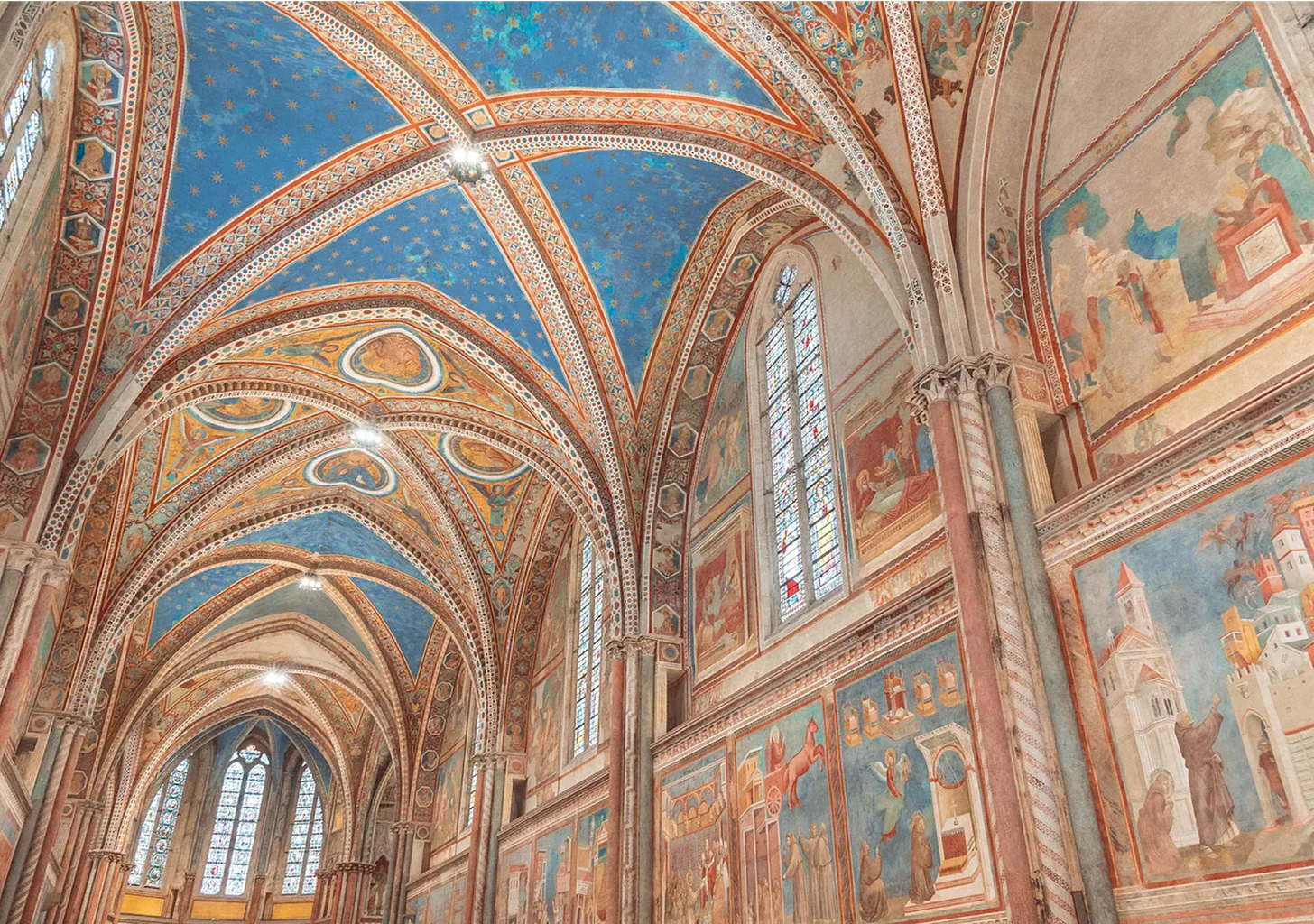
During his papacy, Pope Francis made headlines with regular calls for charity toward the poor, citing St. Francis of Assisi as a model. To this day, the Franciscan order is characterized by a mission of charity for the poor. But it should not be forgotten that God commissioned St Francis to rebuild Christ’s Church, and the Franciscan order responded by ministering to the poor and by building grand and beautiful churches. Consistent with the principle that Benedict later cites, the Franciscan order did not regard investment in beautiful churches as contrary to its mission to help the poor. They became the great patrons of the art of their age, and many of the great artists from the time of St Francis were third-order Franciscans or were commissioned by Franciscans to work on their churches - Giotto, Cimabue, Simone Martini, Raphael, and Michelangelo. There is no austerity in the Franciscan churches of the past—the Basilica at Assisi is richly decorated from floor to ceiling.

If we are to help the poor in America, we begin, as the Franciscans did in medieval Italy, by striving to transform the Church through beautiful liturgy, art, and architecture. This will, in turn, evangelize the culture and change all men’s hearts, making them more inclined to help the poor in their own community. It will also create a national culture that fosters mutual trust, by which, as a by-product, the economy will grow, so that many will have jobs and greater dignity to support their material needs and aid them in their pursuit of holiness.

The interior of the Basilica of St Francis of Assisi, Umbria, Italy.

Tuesday, April 14, 2026

Art, Beauty, Creativity and Inspiration #3: Is Beauty in The Eye of The Beholder?

Or are there standards by which we can measure it?
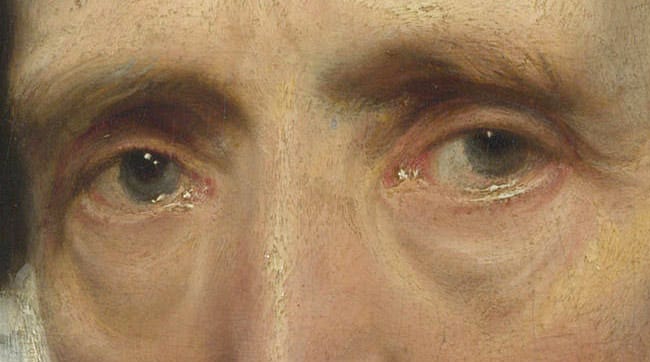
Detail of Portrait of Cornelius Van Der Geest, by Anthony Van Dyck, Flemish, 17th century.
This is the third in a four-part series exploring a Christian philosophy of art and beauty. In the first post, I examined what art is and what makes it good and Christian. Last week, I looked at the traditional process of artistic creation and the effect that beauty has on us when we apprehend it - how it wounds us with desire for something beyond itself, ultimately for God. This week, I take up what is perhaps the most contested question in all of aesthetics: how do we know whether something is beautiful? Is beauty subjective - merely in the eye of the beholder, or is it an objective quality that can, at least in principle, be discerned and judged? Or is it a bit of both? I argue that while individual judgments differ, tradition provides the most reliable collective measure of what is truly beautiful, far more reliable than the fashions of any single generation or person (…even me!) or the opinions of university elites. Next week, I will conclude with the practical questions of beauty and utility and consider whether or not the creation of beautiful things is simply too expensive to justify.

How Do We Know What is Beautiful?

This is not always easy to answer with certainty, so we must look to tradition for help here.

We follow the traditional assumption that when we apprehend beauty in the world around us, we are discerning a property that belongs to the objects regarded. Consistent with this, we call beauty an objective quality. The subject—the person who views the object—makes a personal judgment on its beauty. To categorize beauty as an objective quality is not to say that everyone makes the same judgments. Clearly, there is a varying subjective element to the apprehension of beauty, as we all know, because there are differences of opinion about what is beautiful.

There is no contradiction in recognizing that there may be a differing subjective response to the same objective quality. There are several reasons two people might look at the same object and differ in their sense of its beauty. It might relate to the proper functioning of the senses: someone who is colorblind will very likely have a different sense of the beauty of something than someone who differentiates colors well.

A second reason concerns legitimate differences in the perceived goodness of the object. Some things can be good for one person but bad for another. The sound of a babbling brook, for instance, has the beauty of the sweetest music to the man who is dying of thirst, but is horrifying to a man who is drowning and sees the water level in the pond rise due to that brook.

A third reason relates to the person’s attitude toward God. Given that beauty is a sign of the divine, someone who hates God will hate beauty also and so be disinclined to accept that it is beautiful. The power of beauty to delight any particular person depends on whether or not God delights or repels him. It is important to note, therefore, that when we stated earlier that it is intrinsic to beauty to delight us, the assumption is that the person is properly ordered in his desire for God, which, in practice, will not always be the case.

Nevertheless, these subjective responses do not undermine the principle that beauty is an objective quality too. The fact that we may have differing abilities to apprehend that quality does not change the fact that we are responding to a reality - the form and appearance of the object itself. It is just as with any physical property that might be investigated by natural science. For example, two different scientists determine an object’s mass differently depending on the quality of the equipment they use to measure it, but that doesn’t mean the object has two different masses. It simply means that it is difficult to determine the mass precisely. So it is with beauty. The fact that it is difficult to know for certain that something is beautiful doesn’t undermine the principle of objective beauty.

Until the modern era, very few people dissented from the idea of beauty’s objectivity. For example, the philosopher most often cited by Catholics on the nature of beauty is St. Thomas Aquinas, who consistently treats it as an objective quality.

According to St Thomas, to be able to apprehend the beauty of an object, we need to know certain things about it:

First, we must know what we are looking at (if we are discussing visual beauty) and its purpose—this is called clarity. If we look at something and have to ask, ‘What is it?’, then it lacks this property of clarity, and we will struggle to determine whether it is beautiful.

Once its purpose is clear to us, we intuitively judge how well suited it is to that purpose and how good or noble that purpose is. When we judge whether something is well-suited to its purpose, we are considering a property known as integrity.

Then, we judge how appropriately its various parts are arranged within it to have high integrity—this is called due proportion. When it has a due proportion, all the parts are arranged within the object so that it can be well suited to its purpose.

The assumption here is not that people systematically consider these elements, one after another, before deciding whether something is beautiful. On the contrary, people just react instinctively and instantaneously to what they see, and in a moment, they see beauty, or they don’t. What St Thomas is describing through his own observation is what properties are present in things that many people, in general, see as beautiful. Similarly, knowing that beauty consists of these sub-categories does not help us to ascertain by reason what is beautiful, for in judging each aspect - clarity, integrity, and due proportion - we are still making personal judgements in regard to each sub-category. We can be no more certain in our judgment of these sub-categories than we can in our judgment that the whole is beautiful.

So, where can we look in order to ascertain what is beautiful? Is there any authority that we can trust? The traditional approach to resolving this difficulty is to seek a broad consensus. So, we can begin to create a measure of beauty that might be accepted by all by considering the common reaction to beauty. When we fully apprehend something as beautiful, we delight in it because we can see its goodness in the context of God’s purpose. St Thomas Aquinas observed this phenomenon and then based his definition of beauty on it. He told us that pulchra dicuntur quae visa placent, which means ‘things that give pleasure when they are perceived are called beautiful’. Here, he is telling us the ‘common sense’ of beauty. There is no assumption here that all people individually form the same opinion when observing a single object or react in the same way when they see something beautiful. Rather, he is describing the ideal that emerges from the general pattern of observation of many people.

Portrait of Dora Maar, by Pablo Picasso, Spanish, 20th century... an ugly portrair of a beautiful woman? (Picture by myself, taken at the Musée Picasso.

This description of the essential elements of beauty assumes an interrelatedness between the observer and the observed object. Accordingly, for someone to be able to observe an object, that object must radiate information about itself to us so that we can perceive it with our senses. For this reason, beauty is often defined alternatively as the radiance of being.

When something is lacking in one or more of these things, we take less delight in its appearance, and we might call it ugly. Ugliness is considered to be a ‘privation’ of beauty. So when viewed in this way, ugliness is not actually a property that anything possesses; rather, something is ugly when it is not as beautiful as it ought to be. Ugliness is, therefore, a sign to us that the object is not fully what it ought to be.

There are various reasons something might be judged ugly.

The object might be distorted or damaged somehow, and so lacks due proportion and integrity because it cannot fulfill its intended purpose. Alternatively, it might be that it can fulfill its intended purpose, but that purpose is evil.

It might be that we are not fully apprehending the object, and it lacks clarity. Perhaps the object is not radiating sufficient information about itself to us, as might be the case in the dark. Alternatively, our senses may be impaired. A blind man cannot appreciate the beauty of a painting.

Even if the object is beautiful and our senses are good, we might misunderstand what we are seeing. This can be, for example, because our intellects are not fully equipped to process information from the senses, or because, even with our sinful natures, we misjudge or reject the good we see. (All these considerations become particularly complex in the judgment of the beauty of people, and we will discuss this later.)

In the properly ordered world, all things would be as they ought to be, and we would have the capacity to recognize this. In such a world, all would be beautiful, for all things exist and are made by God or man to contribute in some way to His glory.

However, we live in a fallen world in which many things are not perfect, and our capacity to judge such things is also impaired, so there appears to be much ugliness in the world. Nevertheless, an imperfect object is still good, even if not as good as it should be. It is still beautiful, even if not as beautiful as it should be. Notwithstanding these imperfections, all aspects of Creation can serve as signs that point us toward the good and our role in the world. We are called to participate in God’s creative work and direct our efforts to the perfection of all things through cooperation with grace. To the extent that we achieve this, we will be good stewards of the world, elevating the natural world by fashioning matter into beautiful art and architecture, and by creating beautiful gardens, farms, homes, and cities. To the degree that we achieve this, contemporary culture will also be beautiful, surpassing even the beauty of the wilderness - the natural world untouched by humans - for we are raising the wilderness up to something higher.
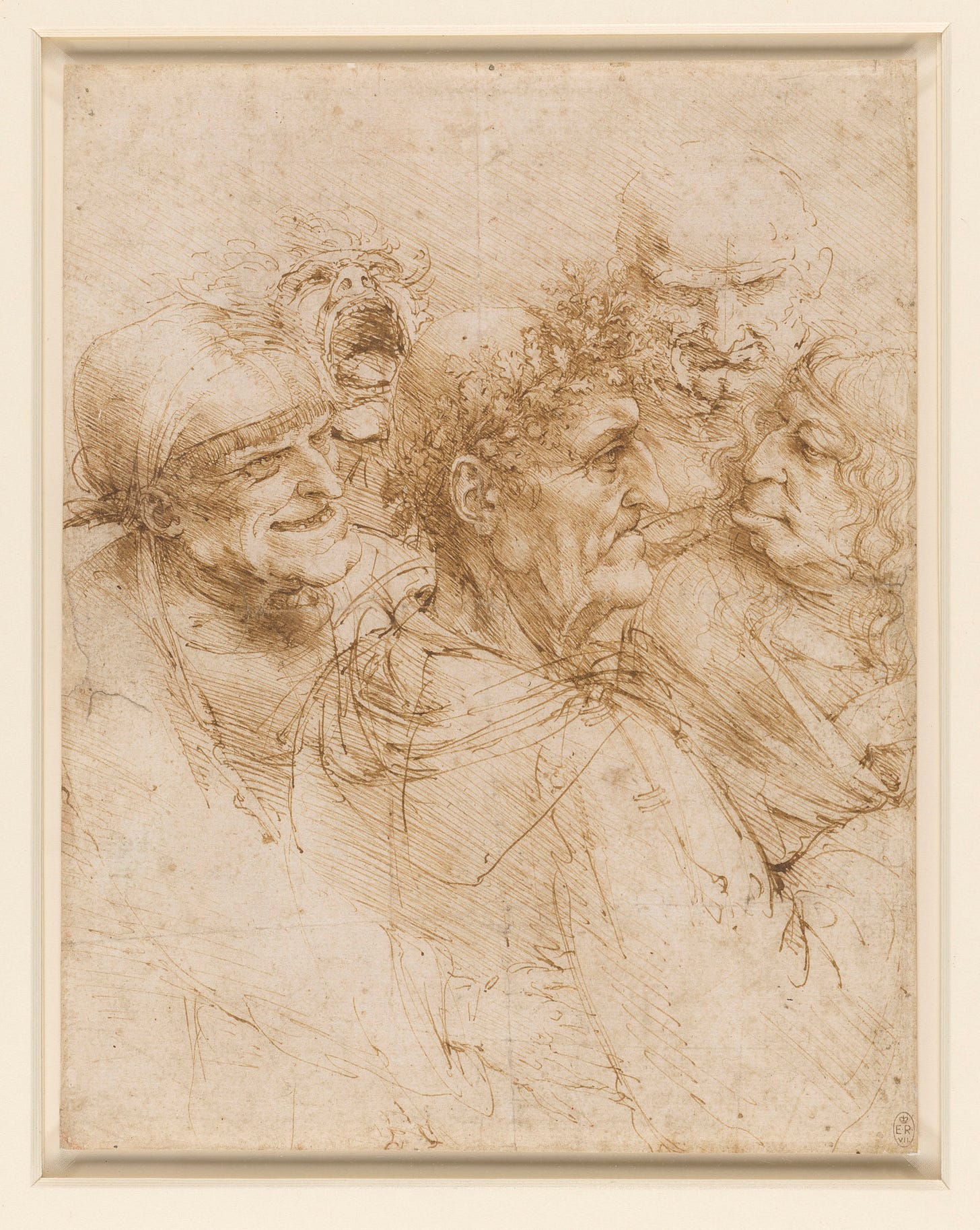
Five Grotesque Heads, drawing by Leonardo da Vinci, Italian 15th century... a beautiful portrait of five ugly men?

The Importance of Tradition to a Culture of Beauty

I have argued that beauty is an objective quality but that people can, for various reasons, differ in their ability to apprehend it. This, in turn, leads to different opinions about what counts as good art and what counts as bad art. When there is a difference of opinion, one might ask, “How do we know who is right? What standard is there to help us make such a judgment?”

This is not an easy question to answer. In another context, if we were considering the morality of someone’s action, for example, we might look to the Magisterium or to scripture directly for an authoritative judgment. Murder is wrong, for example, because Scripture tells us so.

However, God has not revealed an equivalent ‘Ten Commandments of Beauty’. As a consequence, rational arguments that one thing is more beautiful than another or that my judgment is more accurate than yours are usually fruitless because there is no accepted visible standard to back up such a claim.

Moses Receiving the 10 Commandments, Anonymous, 12th-century, from St Catherine’s Monastery, Mt Sinai, Egypt. God gave us moral clarity through revelation…why couldn’t he have revealed principles for beauty too?

Some might ask: what about the criteria already mentioned—integrity, clarity, and due proportion—can I apply them to obtain a definitive answer?

These can help to a degree, but the difficulty here is that we still have to make a personal judgment on the degree of integrity, clarity, and due proportion that the object possesses, and so are effectively left with the same difficulty, except multiplied by three!

The capacity of unaided human reason to judge beauty is so variable that we cannot be sure of the validity of any single judgment.

All is not lost, however. Just because it is difficult to be sure that any single human judgment is good, it doesn’t mean that we have no measure at all. We know that human nature is drawn to beauty just as it is to the common good; thus, we can examine the broad patterns of most people’s likes and dislikes over time in society to consider what is beautiful. We might term this the ‘common taste,’ analogous to concepts such as common sense, common law, and the highest of these, the common good.

The common good is not a physical good that is to be divided up so that a small part is given to everyone; rather, it is a metaphysical principle, the Good, which is ultimately God, to which we are all drawn naturally - although we can exercise free will in rejecting the call of God. It is termed the common good because when someone does what is good, it is good for the person and, simultaneously, good for society as a whole.

The ‘common taste’ or, put another way, the common sense of what is beautiful, is that standard that emerges over time and in consideration of most people in a society. It is a tradition that preserves and passes on this common taste over generations. As cultural phenomena, artistic traditions can vary across societies, even while retaining universal principles. For example, within the iconographic tradition of sacred art, each national church tends to develop its own style, so that Greek icons are distinct from Russian icons, which are distinct from English Romanesque icons. These are different traditions of iconography, each beautiful in its own way.

Therefore, the best way to determine whether a work of art is beautiful is to ask what tradition tells us about it. That is to say, if something has been considered beautiful by many people for a long period of time, then there is a greater chance that it is beautiful than for those objects that people appreciate for a short period of time. Tradition is not an infallible guide, but I suggest a more reliable guide than a panel of elite intellectuals in a university art department…or even, dare I say it, sacred art writers on Catholic blogs!

In consulting tradition, we consider the society for which a beautiful object was intended. So we would say that the cosmos was made for all men to behold. If we want to consider whether or not the cosmos is objectively beautiful, we ask ourselves if men have generally thought that it was.

Similarly, in sacred art, the best guide to the goodness of the style is its impact on the worshipers for whom it was intended. Does it, overall, draw people to God as intended? The pool of people to draw on in this latter category is much smaller than ‘all men’, and so the reliability of the judgment of the effect will be less certain, but it is still the best that we have.

Popular Culture vs Tradition

This appeal to general opinion will likely disturb some readers who, sensing that popular art and popular culture are low-brow and superficial, worry that it is an overreliance on democracy and popularity. Doesn’t this just tend to the lowest common denominator, rather than an elevated common taste, one might ask? In the short term, the answer is, very possibly yes. However, if we give at least as much weight to the past as to the present, we have a chance, at least, of overcoming the vagaries of fashion. The next generation will not know much of what is popular today. However, some popular items will remain known and appreciated in subsequent generations, and these are more likely to be truly beautiful. Chesterton called this approach of considering past and present opinions the ‘democracy of the dead’. The more we look at the art that transcends its own time and has been considered beautiful by many people in the society for whom it was intended, the greater chance we have of being able to choose the best.

I would argue that we should be so respectful of tradition that, in judging the best art, we should adopt a general principle referred to by Benedict XVI as a ‘hermeneutic of continuity’1. By this principle, the default position is always with tradition. We assume that tradition has the best answer, content, and style unless we have compelling evidence to the contrary. If current needs are identical to those of the past, we conform to tradition. Where needs differ, we may respond accordingly and adjust accordingly to the extent those needs are met. The artist’s whim is not considered here. This principle was articulated by Pius XII in the encyclical Mediator Dei when he said the following:

What we have said about music applies to the other fine arts, especially to architecture, sculpture and painting. Recent works of art which lend themselves to the materials of modern composition, should not be universally despised and rejected through prejudice. Modern art should be given free scope in the due and reverent service of the church and the sacred rites, provided that they preserve a correct balance between styles tending neither to extreme realism nor to excessive “symbolism,” and that the needs of the Christian community are taken into consideration rather than the particular taste or talent of the individual artist. (Mediator Dei, 195)

These principles guide our judgment. There is room for much variation, individual expression, and taste while remaining in conformity with the principles Pius articulates. This is true of all artistic traditions. A tradition is not defined by unbending rules that cannot be adapted to different situations. Rather, every identifiable tradition, such as the Baroque, Gothic or iconographic traditions in art, conforms to core principles that characterise it unwaveringly, but those principles can be applied differently according to different needs. Indeed, it is the mark of a living tradition that it can always adapt to contemporary needs without contravening the principles that define it.
undefined
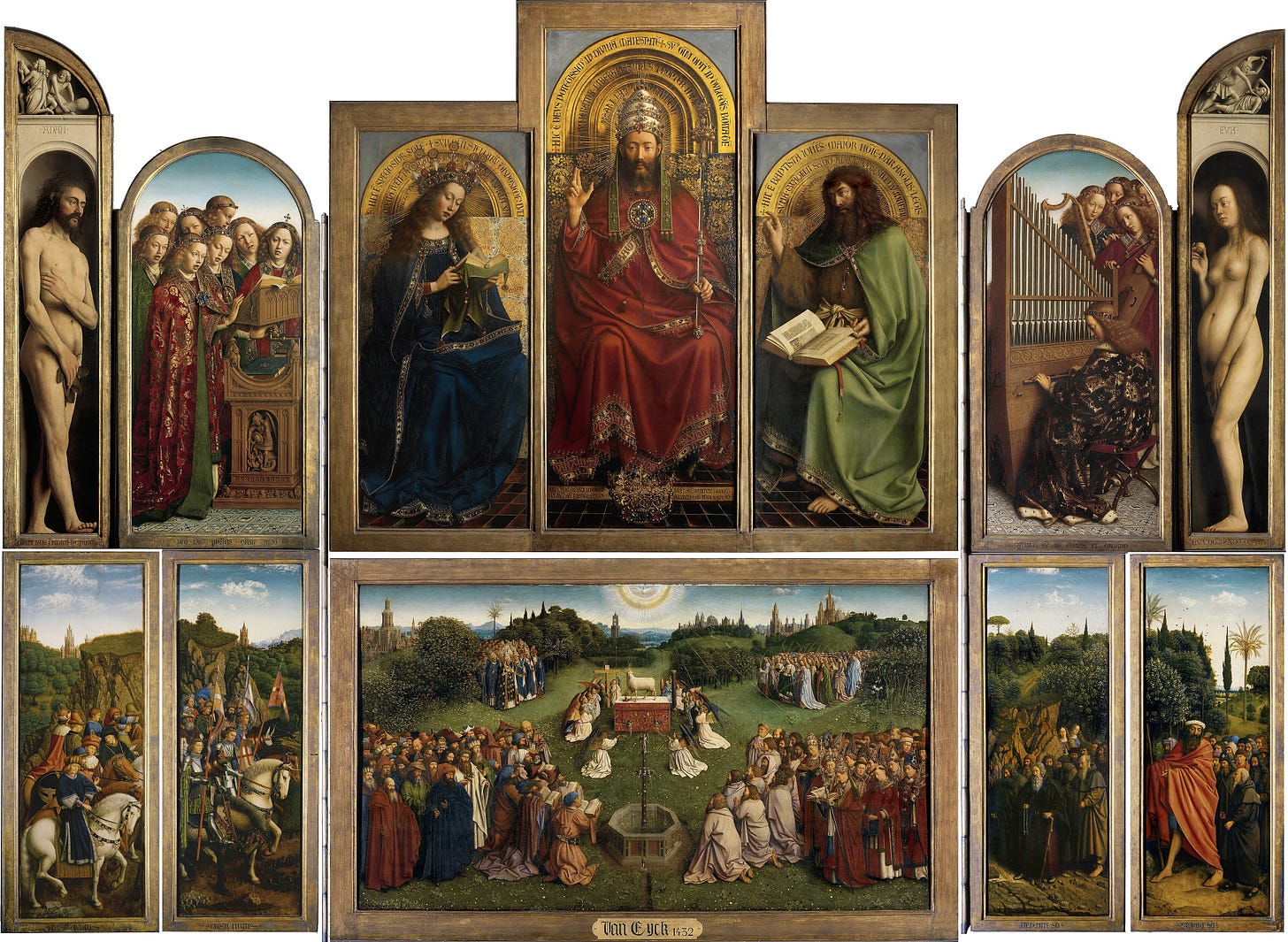
The Ghent Altarpiece (Adoration of the Mystic Lamb), completed in 1432 by Hubert and Jan van Eyck, Flemish, is one of the most visited and influential artworks in the world, housed in St. Bavo’s Cathedral in Ghent, Belgium

Tuesday, March 31, 2026

Art, Beauty, Creativity and Inspiration – Part 1: What is Art?

Towards A Christian Understanding

This is the first in a four-part series in which I explore what art is, what makes it beautiful, and why beauty matters – not merely aesthetically, but also theologically and even economically.

Over these four posts, I hope to lay out a coherent Christian philosophy of art and beauty, drawing on classical thought, the insights of St Thomas Aquinas, and the living tradition of the Church. This week, I begin at the beginning: with the question of what art actually is. It sounds almost too simple to ask, and yet we live in an age that has quietly abandoned any agreed answer – with consequences that surround us on every side. I will also consider what distinguishes good art from bad, and what makes art distinctively Christian, arguing that a work need not carry an explicitly religious subject matter to be genuinely Christian in spirit.

The Million Dollar Banana, conceptual art, by Maurizio Cattelan, Italian, 2024
We live in an age that has largely lost confidence in its own artistic tradition – an age that fills galleries with objects whose claim to be “art” rests not on beauty, skill, or purpose, but on the artist’s assertion alone. To recover a culture of beauty, we must begin at the beginning: with a clear understanding of what art actually is, what makes it good, and what makes it distinctively Christian. This long article sets out to do precisely that. Drawing on the ancient traditions of both Greece and Rome, on the philosophical insights of St. Thomas Aquinas, and on the living wisdom preserved in the Church’s artistic heritage, we will explore art not as an arbitrary exercise in self-expression, but as a purposeful act of making – one rooted in skill, ordered toward beauty, and capable, at its highest reaches, of drawing the human soul toward God. Along the way, we will consider how beauty is known and judged, why tradition is a more reliable guide to it than individual taste or critical fashion, and why the creation of beautiful things is not a luxury to be weighed against other needs, but a form of participation in God’s own creative work that pays for itself.

What is Art?

The word ‘art’ can have a variety of meanings today, and it might be impossible to come up with a definition that all will accept, but here we will focus on ideas of art that are likely to appeal to the traditionally minded Christian and for which we might find a consensus amongst non-Christians also.

Looking to traditional understandings in Western culture, we find that the ancient Greek techne and Latin ars both denoted “skill,” “craft,” or “technique” – a learned proficiency in creating or producing, encompassing all practical trades, such as carpentry, as well as what today we might call the fine arts, such as poetry or painting. An “artefact” is the product of techne in action, and the artisan is the one who creates an artifact. When we speak of an “artist” today, we typically have in mind someone who creates works of fine art.

But how precisely would we define fine art today? How does the mainstream art world define it? We want to answer this question, if only to be sure that when we discuss art with others, we at least know what they believe it to be.

One might think that the major art galleries would provide a definition, given that their whole raison d’être is the exhibition of art. However, a review of the websites of major art galleries such as MoMA, Tate, and the National Galleries of England and America doesn’t provide much help. In fact, I couldn’t find any definitions. Perhaps they assume we all know what art is and that a definition is unnecessary; or perhaps they hesitate to put anything in words because they struggle to find a definition that applies to all the artifacts they show in their galleries.

The British Museum, which is more traditional in its outlook, provides (albeit buried in a training program newsletter) a good working definition of what we would call fine art, closer to the ancient idea of art as the product of techne, as described above. This can be a good working definition for us. It says:

“The definition of art can vary depending on the context and the cultural, social, and historical background in which it is created. However, art in general can be defined as a creative expression of human skill and imagination that aims to communicate an idea, emotion, or message to an audience. This can include a wide range of media, including painting, sculpture, music, literature, film, and other forms of artistic expression.” 1

Good Art and Christian Art

For Christians, adopting this working definition from the British Museum and building on it, we might then ask: what constitutes good art? And, what constitutes Christian art?

In response, I would say that good art is art (as defined above – “a creative expression of human skill and imagination”) that fulfills a good purpose well. We define a good purpose as one consistent with a Christian worldview. This means that art can be Christian even if it does not explicitly express a religious theme or message. For example, a beautiful landscape that communicates the beauty of Creation is a work of Christian art, even if the artist had no explicitly religious intention in painting it and was not a Christian himself.

We would further say that all art is a manifestation of an idea (which might also be an emotion or a message) or an image that first exists in the artist’s imagination before being fashioned into material form. This picture in the artist’s imagination is, in traditional Christian anthropology, taken directly or assembled as a composite from information gained through sensual experience.

The creation of art, from the Christian perspective, is bound up with the creation of something beautiful. Art requires beauty to fulfill its purpose – if a work is not beautiful, it is not good; this might seem a strange proposition given that there is a place for the representation of ugliness, evil, and suffering in art. However, if the art is to portray a Christian understanding of these things, it must also communicate the purpose of these evils within the economy of grace. God must permit evil in the world for good reason, and it is the responsibility of the Christian artist to communicate that message, too. Otherwise, he is not communicating the full truth

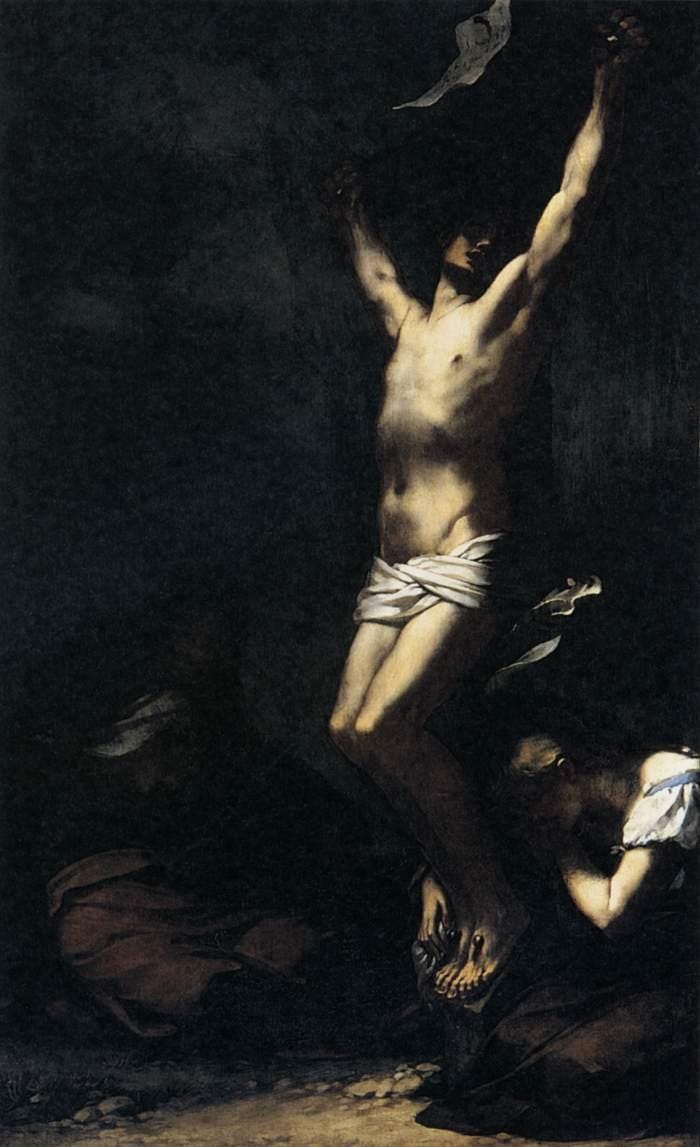
For the Christian, even in the face of evil, suffering, and ugliness, there is hope. When infused with hope, the portrayal of these otherwise ugly realities becomes beautiful. This is exemplified by depictions of the Crucifixion. A well-executed Crucifixion is a beautiful work of art. This beauty is created through the artist's treatment of the image – through skillful choices in line, tone, contrast, and composition, for example. In this way, a good artist presents the greatest crime ever committed without diminishing the profound evil it signifies, but rather by infusing the work with Christian hope – a hope that surpasses all the evil and suffering depicted.


Crucifixion, Pierre-Paul Prud’hon, French, 19th century. Using the baroque style, the artist intentionally contrasts the light on Christ with darkness to symbolize the Light overcoming evil and suffering. This stylistic choice is meant to communicate a sense of hope.
To depict suffering or evil without simultaneously offering hope is, for a Christian, not the full truth. It presents an incomplete picture that can lead to despair. It is through beauty that Christ’s hope is communicated to us, for beauty naturally speaks of God's love (more on beauty later).
Sacred art is the highest form of art, characterized by an explicitly sacred or religious purpose. Liturgical art—created to help us worship God – is the noblest form of sacred art, since worship of God is the highest expression of love for Him and the greatest human activity.
For Christians, the creation of art is intertwined with the pursuit of beauty and divine inspiration. When we recognize the goodness of a work of art, we call it beautiful. As such, good art serves as a sign of the divine – beauty in good art is a visible sign of the work of the unseen God, either as Creator, as seen in the beauty of the universe, or as the God who inspired its creation, through human effort. Therefore, beauty tends to awaken in us a desire for something greater than what we see – the source of that beauty, who is God Himself.

Wednesday, January 29, 2025

On Music and the Beautiful - Guest Article for the Feast of St. Francis de Sales

In honor of today’s feast, that of St. Francis de Sales, NLM is grateful to Alan Hicks for offering us this de Sales-infused reflection on the objectivity of the beautiful and the manner in which habituation in what is beautiful shapes the human character. This is a key lesson to bear in mind when considering the beauty of the liturgy in its ceremonies, music, vestments, furnishings, and architectural setting: not only is giving glory to God by the best we can offer at stake, but also the formation of Christians in right instincts, appetites, and responses. The moral and the aesthetic touch at every border. It is also clear that true beauty takes time to get used to, and that we do no service to anyone by making “instant relevance” or “easy accessibility” the sole or primary criterion. - PAK

On Music and the Beautiful

Alan Hicks 

It is often said that beauty is in the eye of the beholder, and on the surface, at least, this seems to be the case. A beautiful object is always a source of delight—what we call aesthetic pleasure—and for different people different things will please. Clearly pleasure has an obvious subjective element, in so far as it resides in a human subject with unique dispositions and inclinations.

Yet there are serious difficulties in denying any objectivity to beauty or to the pleasure it engenders; not least is the recognition that while people may sometimes differ in their judgments of what is beautiful, there is also remarkable agreement, which would not be so if beauty was purely subjective. That is why there are lines of tourists at the Grand Canyon, Niagara Falls, or St. Peter’s Basilica; for such objects, both natural and man-made, have always possessed a universal aptitude to please. It is only because of this objective element, even allowing room for subjective taste, that it is possible to educate and form in the young a sense of beauty and an aesthetic sensitivity.   

According to the ancient tradition, subsumed and elaborated upon throughout the Christian centuries, the objectivity of beauty rested upon its essential connection to what is true and good. Thus, the sense in saying that a moral person has a beautiful soul or even that a human act is beautiful. Accordingly, when the woman in the Gospel anointed Christ’s head with precious oil and was scolded for wasting wealth that could have been used for the poor, Christ replied that her act was kalos, literally translated as “beautiful.” [1] It would seem to follow, then, that one of the pathways to the good is through the beautiful, which in addition to its affective power to please, can contribute to the shaping of a virtuous and moral soul. Only with this understanding can we make any sense of the oft-cited line from Dostoevsky that “beauty will save the world.” [2] 

The connection between goodness, truth and beauty is grounded in their nature as “transcendentals,” a term signifying attributes or properties transcending any division or category of being—all of which is to say that they are coextensive with being itself, accompanying existence in all its forms. As coextensive with being, they are convertible with one another, such that we may say that a thing is both true and good to the extent that it exists, and to the extent that it exists, it is both true and good. Hence their identity.

Their differences, on the other hand, are understood in their relation to us. Goodness, for example, is a transcendental aspect of being understood as desirable. As for truth, while we might say that it exists primarily in the intellect, in the intellect’s conformity to what is, it can also be said to exist as a property of being itself insofar as what exists is capable of being known. [3] Though beauty is not identified by Aristotle as a transcendental property, Plato sees the good as always beautiful, and therefore always pleasing to the perceptive powers of intellect and sense. This is essentially the position of St. Thomas as well. [4] 

St. Francis de Sales, in the opening of his incomparable Treatise on the Love of God, describes this relationship of goodness and beauty:

As the Angelic Doctor, St. Thomas Aquinas, following the great St. Dionysius, well puts it, although beauty and goodness agree to a certain extent, they are not one and the same thing. The good is that which pleases appetite and will; the beautiful is that which pleases sense and understanding. To put it otherwise, the good is that whose possession delights us, while the beautiful is that whose apprehension pleases us. For this reason, we attribute corporal beauty in the strict sense only to the object of the two senses that have the greatest capacity for knowledge and best serve the intellect, namely, sight and hearing. We do not say, ‘These are beautiful odors or beautiful tastes,’ but we rightly say, ‘These are beautiful voices or beautiful colors.’ [5]
Of course we desire to possess beautiful objects, for those objects are also good, and there is a corresponding pleasure in the possession. But the beauty of the object itself cannot be possessed and enjoyed except through apprehension, and this apprehension and its resulting aesthetic pleasure can be, and often is, of those things we do not possess in any material sense. I can get as much pleasure looking at a beautiful picture that is owned by my friend as my friend, I just don’t get it as often. 

Now one of the most widespread of human pleasures is the delight found in music, and in regards to this beauty which pleases the understanding through the medium of sound, we may ask: what it is in music that gives it its beauty and appeal? St. Francis de Sales is again a rich source of insight:
Unity established within a variety of different things produces order. Order produces harmony and proportion, and in things that are whole and complete harmony produces beauty. We speak of a fine army if all the parts making it up are so arranged that their differences are reduced to the relative proportions needed to constitute a single army. For music to be beautiful it is necessary not only that the voices be pure, clear, and quite distinct from one another, but also that they be blended in such fashion that a right consonance and harmony result by means of both union in the midst of variety and variety within that union of voices. Not incorrectly, then, is music called a discordant harmony, or a harmonious discord.[6]
St. Francis continues in elaboration on the added elements of the beautiful object—splendor and clarity.
 
Painting of St. Francis de Sales by Valentin Metzinger

But as significant and profound as his brief discourse on beauty is, it does not help us to understand why one person might enjoy a specific piece or form of music but not another, or why two people may have contrary responses to the same piece, which variance contributes to the perception that beauty is subjective and merely “in the eye of the beholder.” To account for this variety of taste would require an exploration of individual habits and acquired dispositions, in a similar manner by which we might explain why what appears good and hence desirable to one person might not to another, even assuming the objective nature of the good.

Years ago, while living in Northeastern Pennsylvania, my wife and I began attending the opera in New York City. We would dress and then drive in early, sometimes to shop and then to dine. After coffee and dessert, we would walk the streets in the fading daylight, enjoying the variety of people and sights, arriving at the opera house shortly before the performance. These are treasured memories, which even yet provide some pleasure in the memory, mixed with a note of sadness for days that are no more. They were times of togetherness, away from the many cares which beset our lives, sharing a beautiful and uplifting form of human expression. The theater was grand, the staging and sets elaborate, and the performances were of the highest order. But it was the music itself that touched the soul with a poignant beauty expressive of the most elevated emotions and longings of the human heart.

Now it is true that most people enjoy music, and children of all nations respond cheerfully to simple songs and melodies; for music is consonant with human nature. Yet complex musical expressions are not universally appreciated and only come to be so after experience over time. Earlier in my life I didn’t enjoy opera and in fact was quite put off by my wife’s attempts to introduce me to its pleasures. In time, however, it became one of my greatest delights.  I won’t elaborate here the progression of experiences that led me to change in my perceptions of the operatic art, but only to say that while the art remained the same, there was, over time, a clear change in me, in my perception and appreciation. 

All of which goes to show that there is a difference between the objective good or the beauty of an object and the value that we may attach to it or our appreciation; for “good” and “beautiful” denote something objective, while “value” and “appreciation” allude to our subjective response. The pleasure that we receive is no doubt connected to the good and the beautiful, but only through the value; that is to say, a good or beautiful object will please only if we see it as such. And there are many personal factors which influence how we see a thing. While I didn’t like opera in my initial exposure, we have all had the experience of having something “grow on us” as we come to know it better and thereby come to see the good that is there. My wife liked opera and I enjoyed spending time with my wife, and it was for this reason that I first submitted myself to the experience. Over time I grew to appreciate the art in itself.
 
People enjoying an opera in Romania (source)
And so it is with many of the things that we eventually come to value. In our limited understanding and perception, we often don’t see the full reality of an object or its goodness at first sight. When a young man meets a young woman fair of form and appearance, he is naturally attracted and drawn to her. Such an attraction may be superficial, but there is nothing wrong with that—that is simply the way of nature. Another woman may not be so attractive on initial meeting; yet if given the opportunity to spend time with her the man begins to see her for what she truly is. He comes to appreciate the charm of her personality, her feminine ways of thinking and looking at the world, her tender feelings and responses to things around her. Her very look begins to alter as she becomes more familiar and he sees her in a different light. Given time, the man is able to recognize a deeper and more lasting beauty, a beauty from which a greater satisfaction and pleasure is drawn.

This human progress in appreciation is multiplied repeatedly in the course of a human life. Some likes are fairly universal and immediate, while others are only what we call “an acquired taste.” No one, for example, has to be taught to enjoy food or drink. That is instinctual and innate. We exit the womb hungry for our mother’s milk. Yet eating soon becomes a more complex activity as its object becomes more diverse and differentiated. The ability to appreciate certain kinds of food or drink is not innate, but is a cultivated taste that develops over time, with culinary tastes formed according to environmental factors of culture and family joined to one’s own personal habits and experience. That being said, there are unquestionably better and worse ways to eat from an objective point of view regarding human health.

Now if pleasure immediately followed the objective good, then the best foods would always engender the most pleasure. Yet for a child, what is perceived as “best” may differ markedly from the judgment of an adult. If a child is allowed to develop bad eating habits, he will have an inclination to what is unhealthy and will generally be repulsed by what is not. The trick is thus to form the habit, thereby matching the value to the objective good. If a child is raised in an environment where the kitchen is ruled by reason as opposed to mere desire, he will have no choice but to eat what is healthy. Accordingly, he will develop in time a taste for healthy foods, after which he will eat better because that is what he likes.

For whatever agrees with a thing according to its nature is pleasurable, and as habit exists as a sort of nature—what we call “second nature”—those acts consonant with a developed habit are naturally agreeable. [7] This is true not only in regards to culinary tastes or ones taste in music and art, but in the moral realm as well, for virtue is an acquired disposition no less than one’s aesthetic sense. Thus it is that Aristotle sees the pleasure or sorrow experienced by a man in his moral activity as an indication of his true character. In his words: “every virtuous person rejoices in virtuous acts, for no one will call a man just who does not enjoy doing just deeds; no one will call a man generous who does not enjoy giving generously.” [8] For this reason, moral education was understood by Aristotle to be necessarily concerned with pleasure and pain and consists in training one to feel joy and sorrow in the proper object and at the proper time. [9]

Alan Hicks was a student of the Integrated Humanities Program at the University of Kansas under John Senior and received his degrees in Philosophy at Kansas following his conversion to the Catholic Church. He was the founding Headmaster of St. Gregory’s Academy in Pennsylvania and was subsequently the principal of Catholic schools in both St. Louis and Southern California. He has since returned to his first love—teaching—and is currently a professor of Humanities at St. Gregory the Great Seminary in Lincoln, Nebraska.

NOTES

[1] Mark 14, 6.

[2] The Idiot.

[3] See St. Thomas Aquinas, The Disputed Questions on Truth (Henry Regnery, 1952), Q. 1, art. 2.

[4] St. Thomas, On Truth, I, 5, 4.

[5] St. Francis de Sales, Treatise on the Love of God (TAN Books and Publishers, 1975), 53.

[6] Ibid., 53.

[7] See St. Thomas Aquinas, Commentary on the Ethics (Henry Regnery, 1964), 124.

[8] Aristotle, Nicomachean Ethics, bk. 1, ch. 8, 1099a 15-20.

[9] Ibid., bk. 2, ch. 3, 1104b10.

Tuesday, October 29, 2024

Why Beauty Matters

And “Art for Art’s Sake” Is Anti-Human

The purpose of art and the role of beauty in the culture have been subjects of ongoing debate. While some view art as existing purely for its own sake - ‘art for art’s sake’ - divorced from any broader utility or message, others argue that art must serve a didactic or ideological function. The traditional Christian perspective, however, offers a distinct understanding that avoids these extremes, and the result is art for God’s sake, which, if done well, will always be art for our sake too.

The interior of St Mark’s Cathedral Venice: Is this art for art’s sake, or art for God’s sake? (Image from Wikimedia Commons by Rob Hurson)
Central to the Christian view is the recognition of the profound unity of the material and spiritual dimensions in the human person. As beings composed of both body and soul, humans possess material and spiritual needs. Consequently, the purpose of art cannot be reduced solely to aesthetic considerations or purely practical or ideological aims. Rather, true art must harmonise these aspects, reflecting and serving the totality of human nature, material and spiritual.
This understanding is rooted in Christian anthropology, which sees beauty not as a superfluous addition to an object’s utility, but as an integral part of its purpose. When an object is truly beautiful, its beauty is seen as a sign that its purpose is in accord with God’s governance of the world—a reflection of divine inspiration or the beauty of Creation itself.
Take, for example, something as mundane as a toothbrush. While its primary purpose is the practical one of cleaning teeth and promoting bodily health, a well-designed toothbrush incorporates elements of beauty that speak to a broader understanding of human well-being. Its harmonious design serves its practical function and invites the user to consider the more profound implications of oral hygiene for overall health and spiritual vitality. While few will consciously contemplate such things when brushing their teeth (least of all first thing in the morning or last thing at night!), most of us, even with something as simple as a toothbrush, would not choose an ugly one in preference to a beautiful one. This means that we are accepting the invitation of beauty at some level.
This principle is even more evident and more important in works of art with a direct spiritual or liturgical purpose, such as sacred art or architecture. In these cases, beauty plays a crucial role in elevating the human spirit and facilitating the contemplation of the divine. For instance, the beauty of a cathedral is not merely an aesthetic embellishment, but a vital component of its purpose as a house of worship, drawing the hearts and minds of the faithful towards heaven.
The Christian perspective recognises that individuals possess free will and can respond positively or negatively to the call of beauty. While beauty can inspire a deepening desire for virtue and a closer relationship with God, it can also be rejected or dismissed as mere sentimentality.
Ultimately, the traditional Christian view sees art and beauty not as ends in themselves, but as means of elevating the human person and facilitating a deeper engagement with the spiritual realm. Beauty is not a superficial adornment but a reflection of the divine order – a sign that an object or work of art fulfils its intended purpose in harmony with God’s design.
In this understanding, the apprehension of beauty is not merely an emotional response but a profound experience that can engage the intellect, will, and emotions in a multifaceted way. It is a call to contemplate the divine, to pursue virtue, and to recognise the unity of the material and spiritual dimensions of human existence.
By integrating these perspectives, the traditional Christian view offers a nuanced and holistic approach to the purpose of art and the role of beauty – one that recognises their intrinsic value while situating them within a broader framework of human flourishing and spiritual growth.
One presumes that even Our Lady cleaned her teeth, and even this humble activity would have been done gracefully and beautifully.

Tuesday, February 07, 2023

Doesn’t it Cost Too Much To Make Things Beautiful?

Why a culture of beauty pays off both economically and spiritually

On the whole, the beauty of artifacts is a function of design rather than materials. This means that, contrary to what many believe, mass production and industrialization are not processes that automatically create ugly products. It is as easy to mass produce something beautiful as it is something ugly. The ugliness of today’s culture is not driven by economics, but rather by poor design, because artists and designers are no longer aware of how traditional values are manifested in design, or else because they deliberately reject those values. A large basilica built in modern design is typically more expensive than one built in, say, a traditional Romanesque design, as evidenced by the recent building of the Neo-Romanesque church of St Mary in Kansas, which compares favorably with say, Los Angeles cathedral. 

The Immaculata church at St Mary’s Kansas. This is still under construction.

Sometimes the cost can be greater but not because designing beautifully is intrinsically more costly, but rather because, particularly for lower priced housing which might ordinarily rely on mass produced units, the current templates of mass productions, e.g., for window dimensions, are not reflective of traditional harmony and proportion.  But this could change in time if the demand for better proportioned units increases . Furthermore, even if greater cost is incurred before we reach that point, it is an investment that pays off economically. Houses that are now being built in traditional proportions typically have a higher price on the open market that more than offsets any additional costs in their building. This was the experience of building the experimental village in Dorset, Poundbury, which is an urban extension of the larger town of Dorchester.

I would argue that if we wish also to consider the souls of those who use what we create, then we must endeavor to make beautiful objects, and to do so in a cost effective manner. An ‘investment’ in the souls of men will always pay off. For example, when faced with the dilemma about whether or not money should be spent on beautiful churches and sacred art, some object and say that it would be better given to the poor.

This is an old but false argument that I would counter as follows: consider the Gospel account of Martha, Mary and Judas (John 12, 1-9). The two women acted as hostesses, Mary washed Jesus’s feet with expensive nard, while Martha attended to the other guests’ need. Judas, who was the keeper of the funds for the apostle, also complained that the money spent on expensive nard would be better given to the poor.

Tintoretto, Italian 16th century: Martha and Mary with Christ in Bethany, with Judas looking on,

Here is a lesson about allocation of resources: Mary made the right choice, we were told, in choosing Christ even before giving to the poor. There is an equivalent choice facing us today every time we have to decide about having beautiful churches and art, intricate vestments, ornate jewel-studded chalices and so on. Is it right to direct money to these things when there is poverty? The answer is yes, when these things, through the liturgy, elevate the souls of the faithful to Christ. This is greater than giving these resources to the poor directly. Why would we say this?

First, all of us, rich or poor, can go to church and we all need our souls saved. So in church the poor benefit from this spiritually as much as the rich do. Beauty is a common-good equally available, and equally beneficial, to all who encounter it, rich and poor alike.

But second, the poor will benefit materially as well. Faith inspires charity and so it will inspire the rich to give to the poor directly. Furthermore , it will allow for the creation of greater wealth for the benefit of the poor in such a way that their dignity is elevated. This is the principle of superabundance at work. Superabundance is the creation of something out of nothing, or of more from less. The Christian life, lived according to the principle of love is always fruitful in so many ways – and when it is it invokes the principle of superabundance.

Benedict XVI speaks of this principle of superabundance through charity in the economic sphere in his encyclical, Caritas in veritate (CV). He tells us how love might be present even in the ordinary economic transaction. When it is, it not only creates wealth, as all economic transactions do, but also builds up the dignity of all concerned, for even economic transactions suffused with love are raised to a level that goes beyond the material. A community is created which through every interaction, including the economic, builds up the dignity of those involved and in turn generates greater material wealth by encouraging more economic activity.   

Benedict writes:  
“Because it is a gift received by everyone, charity in truth is a force that builds community, it brings all people together without imposing barriers or limits. The human community that we build by ourselves can never, purely by its own strength, be a fully fraternal community, nor can it overcome every division and become a truly universal community. The unity of the human race, a fraternal communion transcending every barrier, is called into being by the word of God-who-is-Love. In addressing this key question, we must make it clear, on the one hand, that the logic of gift does not exclude justice, nor does it merely sit alongside it as a second element added from without; on the other hand, economic, social and political development, if it is to be authentically human, needs to make room for the principle of gratuitousness as an expression of fraternity.

“35. In a climate of mutual trust, the market is the economic institution that permits encounter between persons, inasmuch as they are economic subjects who make use of contracts to regulate their relations as they exchange goods and services of equivalent value between them, in order to satisfy their needs and desires. The market is subject to the principles of so-called commutative justice, which regulates the relations of giving and receiving between parties to a transaction. But the social doctrine of the Church has unceasingly highlighted the importance of distributive justice and social justice for the market economy, not only because it belongs within a broader social and political context, but also because of the wider network of relations within which it operates. In fact, if the market is governed solely by the principle of the equivalence in value of exchanged goods, it cannot produce the social cohesion that it requires in order to function well.” (CV, 34)
A Church whose liturgy inspires holiness will inspire an atmosphere of mutual trust that Benedict speaks of.

During his papacy, Pope Francis has made headlines with regular calls to charity towards the poor, citing St Francis of Assisi as a model. To this day, the Franciscan order is characterized by a mission of charity for the poor. But it should not be forgotten that St Francis was commissioned by God to rebuild Christ’s Church, and he did both lovingly and beautifully, for both missions, ministering to the poor and building up the Church, are connected. We must not forget that the regeneration of the Church that St Francis of Assisi inspired involved a powerful cultural renewal too. This was the Church that inspired Franciscans to help the poor. So many of the great artists from the time of Francis were third order Franciscans or were commissioned by Franciscans to work on their churches – Giotto, Cimabue, Simone Martini, Raphael, Michelangelo. There is no austerity in the Franciscan churches of the past - the basilica at Assisi is richly decorated from floor to ceiling.  

The interior of the Basilica of St Francis of Assisi. The Franciscan order felt that there is no contradiction between spending money on such decoration, and care for the poor.

If we are to help the poor of America, we must begin as the Franciscans did in medieval Italy, by transforming the Church into one that has beautiful liturgy and beautiful art and architecture. This will in turn evangelize the culture and change all men’s hearts so that they are more inclined to help the poor  as part of their own community. It will also create a national culture that will foster the rise in mutual trust by which the economy will grow in such a way that the poor will have jobs and greater dignity; in other words, they will cease to be poor.

More recent articles:

For more articles, see the NLM archives: