
Friday, May 30, 2025

The Holy Ghost Hole

A Holy Ghost hole in Saints Peter and Paul parish church in Söll, Austria

A curious architectural feature of some churches in France, southern Germany, and Austria is the Holy Ghost Hole, an opening in the ceiling into which different objects were once thrown during the celebration of the Mass. It is speculated that the art surrounding the hole indicates its original function. If the theme is the Holy Spirit, then the use of the Holy Ghost Hole was limited to Pentecost, but if the theme was more generic (such as the Eye of Providence featured below), it was used at other times of the year. The Holy Ghost Hole was an invention of the Middle Ages but it persisted into the Baroque era, at least as a façade, and in some churches, it could be disguised as a sound-hole for the organ.

Church of St. Michael, Ziegelbach, Germany
Annunciation
The Holy Ghost Hole was useful on at least three holy days. On the Annunciation (March 25), churches in western Germany that had one would lower a boy dressed as Saint Gabriel it to address another young actor playing Mary below. As the children in the congregation looked up in awe, their mothers would surreptitiously place cookies or candy on the pew benches, allowing them to believe that Gabriel’s heavenly companions put them there. [Francis X. Weiser, S.J., Handbook of Christian Feasts and Customs (Harcourt, Brace, and Company, 1958), 303.]
Ascension Thursday
Second, on the Ascension, some churches hoisted a statue of Jesus Christ up into the hole with a pulley after the Gospel was read. The first recorded instance of this custom is marked with tragedy: in 1433, the Provost of the Augustinian Canons’ Monastery in Bernried, Germany, was killed by a falling figure of Christ after the rope broke. Today the custom continues in two parishes in the Freising district of Germany.
One custom that did not survive is the sequel to the Ascension of the Christ statue. Inspired by the Book of Revelation’s description of the fall of the dragon from Heaven, some churches threw one or more straw effigies of the devil out of the Holy Ghost Hole. Apparently, this addition caused quite a stir, as spirited adolescents would drag the effigy through the streets before burning it. Tired of all the commotion, the clergy eventually suppressed the practice around the eighteenth century.
Kapelle Schanz in Ebbs, Austria
Pentecost
But the main use of the Holy Ghost Hole was on Pentecost. During the chanting of the sequence Veni Sancte Spiritus, communities came up with creative ways to mimic the descent of the gifts of the Holy Spirit upon the first disciples. The eminent scholar of feasts and customs Fr. Francis X. Weiser, SJ writes:
In some towns of central Europe people even went so far as to drop pieces of burning wick or straw from the Holy Ghost Hole, to represent the flaming tongues of Pentecost. This practice, however, was eventually stopped because it tended to put the people on fire externally, instead of internally as the Holy Spirit had done at Jerusalem. [ibid. 252]
France had a safer if not cleaner solution. In the thirteenth century, several cathedrals released real white pigeons that flew around inside while roses were dropped from the Holy Ghost Hole. The records do not show how the pigeons were collected afterwards, or who had to clean up the birds’ own contributions to the floor and pews.
Another option was lowering a blue disc the size of a wagon wheel with the figure of a white dove painted on it. The disc would swing in ever-widening circles as it descended. Some places even provided sound effects, imitating the noise made by the Holy Spirit’s appearance in the Upper Room with trumpets, windbags, hissing, humming, and rattling benches. It too was followed by a shower of rose petals.
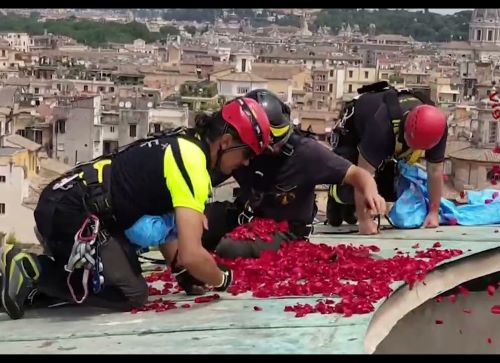
Rose petals, in fact appear to have been the most popular (and reasonable) practice. The most famous example of this custom today is at the Basilica of St. Mary and the Martyrs in Rome, better known as the Pantheon. Volunteers from the local fire department scale the roof of the ancient temple and throw thousands of petals through the oculus, the opening in the center of the dome. Although the oculus predates the Holy Ghost Hole by a millennium, it serves the same function.
Gaming Parish Church
We conclude with a more modest example, the Pfarrkirche Gaming or Gaming Parish Church, in the tiny town of Gaming, Austria, (not to be confused with the magnificent medieval Karthause (former Carthusian monastery) less than a mile away.)
Exterior of the Gaming parish church
The small Baroque church serves the town’s 3,200 residents. Its simple exterior belies its ornate interior, which includes statues completely plated in gold, and an elaborate pulpit made of marble and wood. The church also has an organ that legend says a young Mozart once played.
The church organ
Interior of the Gaming Parish Church
More to the point, the small church boasts of two Holy Ghost Holes. The first, in the nave, is covered with the eye-and-pyramid image betokening the Providence of God, similar to that found on the back of every U.S. dollar bill.
The first Holy Ghost Hole over the nave in the Gaming Parish Church
That same pyramid crowns the reredos of the high altar in the sanctuary. As the eyes ascends beyond it, one comes to the second Holy Ghost Hole, which is covered with an image of a dove.
The second Holy Ghost Hole over the sanctuary in the Gaming Parish Church
No petals, fireballs, devils, or angelically-clad children came out of these two holes in the old days, nor did statues of Our Lord pass up through them. They are Baroque organ-holes masquerading as the real thing. Nevertheless, like their more authentic counterparts, they are both a marvelous testimony to the dramatic flair of our ancestors and a permanent reminder to the worshipper that the Holy Spirit stands ready to descend into our hearts every day of the year and not just on special occasions.

Wednesday, January 15, 2025

“The Office of the Holy Spirit” Prayed by the Bridgettine Nuns

The Bridgettine nuns once prayed, every Sunday, a specialized Office in honor of the Holy Ghost. Its arrangement is more complete than that of most Little Offices, but less complete than that of the most famous and widely used, the Little Office of the Virgin Mary. All the Hours are present, with most their constitutive parts (antiphon, psalm, chapter, hymn, versicle, oration, etc.), but Matins has neither readings nor responsories.

Presumably both for ease of memorization and for intensity of devotion, the Veni Creator Spiritus is used as the hymn for every hour, and the same chapter, from Romans 5, is also repeated. The other parts vary, and all are in service of highlighting the mystery of the Holy Spirit’s presence, operation, and fecundity in the Church.

I will present images of the pages in groups of three. The entire PDF may be downloaded here.

Extracted from the Breviarium Birgittinum published in Rome in 1908.

Visit Dr. Kwasniewski’s Substack “Tradition & Sanity”; personal site; composer site; publishing house Os Justi Press and YouTube, SoundCloud, and Spotify pages.

Friday, December 06, 2024

The Conglorified Life-Maker

Lost in Translation #114

In the Niceno-Constantinople Creed, the Holy Spirit is identified in a somewhat curious manner:

Καὶ εἰς τὸ Πνεῦμα τὸ Ἅγιον, τὸ Κύριον, τὸ ζῳοποιόν,
Which in Latin is:
Et in Spíritum Sanctum, Dóminum et vivificantem
And which I translate as :
And in the Holy Spirit, the Lord and Life-maker.
I translate vivificans as “Life-Maker” rather than the more common “Giver of Life” for two reasons. First, the verb vivifico etymologically means to make life: vivus+facio. Second, as we have seen before, making and being made are important themes in the Creed. The Father is the Maker of Heaven and earth, the Son is He through whom all things are made, and now we learn that the Holy Spirit is the Maker of life. Calling the Holy Spirit a Life-Maker is a way of affirming His full and equal divinity.

But the word would not have entered the Creed were it not for the vicissitudes of history. The Pneumatomachians” or “Spirit-fighters” (also known as the Macedonians) denied the divinity of the Holy Spirit, and since He was not God, He was not a Life-Maker but a life-needer, that is, a creature who needed life from a higher source. It was Saint Basil the Great who refuted this error. Lifting a rare Greek term from the pages of philosophy [1], Basil called the Holy Spirit a ζῳοποιόs or Life-Maker. The Latin vivificans is rarer still, appearing only in ecclesiastical Latin. [2]

We can also attribute another line of the Creed, simul adoratur et conglorificatur, to Basil’s fight with the Spirit-fighters. The latter somehow got it into their heads that no glory should not be attributed to the Holy Spirit. Basil easily refuted their argument by noting all the places in the Scriptures that even creatures are given glory and then asking them:
While so many are being glorified, do you wish the Spirit alone to be without glory? “The dispensation of the Spirit,” Scripture says, “comes in glory.” How, then, is He unworthy of being glorified? According to the Psalmist, great is the glory of the just, but according to you, the glory of the Spirit is nothing. How, then, is there not an evident danger that from such words they bring inevitable sins from themselves? If the man who is saved by works of righteousness glorifies even those who fear the Lord, he would not defraud the Spirit of the glory that is owed to Him. [3]
The Creed is one of the ways that we do not defraud the Spirit of the glory that is owed Him.
Basil the Great
The Basilian fingerprints on the Creed are an instructive reminder about how doctrine develops. It is tempting to think of dogmatic development as a strictly logical process that deductively moves from first principles to conclusions, or from what is implicitly held to what is explicitly stated. But the truth is a little more complicated than that. Mostly, dogma is defined in reaction to a doctrinal crisis, and doctrinal crises are specific. Had the Spirit-fighters attacked some other aspect of the Holy Spirit, we would probably be saying something different in the Creed. If, for example, they denied that the Holy Spirit is Love, we might be saying every Sunday, Et in Spiritum Sanctum, Dominum et Caritatem. Fundamentalists are wrong to think that the Truth descends from Heaven in a hermetically-sealed container, and modernists are wrong to think that truth is at best in a Heraclitan flux. Doctrinal development reminds us that Catholic dogma is both historically conditioned and absolutely true, and that sometimes, it is easier to understand those truths when one knows the history behind them.

Notes
[1] See Theophrastus, On the Causes of Plants 2.9.6; Proclus, Institutio Physica 145; Porphyry, acc. to Eusebius, Preparation for the Gospel 3.11; Damascius, On First Principles 80.
[2] See Augustine, Against Two Letters of the Pelagians 2.10, 33; Prudentius, Apotheosis 234; Paulinus Nola, Hymn 26.207; Jerome, Epistle 108, 11.
[3] On the Holy Spirit, trans. Stephen Hildebrand (St. Vladimir’s Seminary Press, 2011), 24.55.

Thursday, May 23, 2024

A Hymn to the Holy Ghost by St. John of the Cross

The epic romance that was the life of John of the Cross began before he was born. His father, Gonzalo de Yepes, married for love, choosing a poor maiden named Catalina Álvarez over the good favor of his wealthy, merchant-class family. Their union was blessed with three children, among whom was Juan de Yepes, but Gonzalo’s ultimate reward for following his heart was poverty and death; his parents disowned him, leaving him burdened by hardships that brought his life to a premature end. Catalina, now both impoverished and widowed, did what she could to provide for her children’s needs, but John’s prospects were dim. Malnutrition had left him physically frail, stunted, and therefore barely qualified even to perform the manual labors that were the likely destiny of a boy with no money, no education, and no social connections.
John of the Cross (artist unknown). Oil on canvas.

It turns out that Juan de Yepes did not become a manual laborer. He died in 1591 as Fray Juan de la Cruz of the Discalced Carmelites, having reached the heights of sanctity and of literary achievement. Canonized in the eighteenth century and declared a Doctor of the Church in the twentieth, St. John of the Cross composed some of the most sublime poetry in the history of the Spanish language. His writings on the spiritual life have been immensely influential, and they are a compelling reminder of poetry’s exalted status in pre-modern Christianity: his famous prose treatises, noted for their systematic theology and rigorous philosophy, were originally conceived not as independent works but as commentaries on his poems.

 
This remarkable artifact, still on display in the museum of the Monastery of the Incarnation in Spain, is a sketch made by St. John of the Cross after he received a vision of Christ crucified.

Some of John’s poetic excellence was surely born of his extraordinarily poetic life, which is a tale of privations, wanderings, godsends, mystical yearnings, and heroic austerities interspersed with betrayal, torment, and exile. A turning point in his earthly journey was the cruel imprisonment imposed by his own Carmelite confreres, whose twisted logic marked him as a “rebel.” These misguided religious were, however, the unwitting instruments of the divine Author, for they offered John a personal rebirth worthy of well-crafted fiction: his narrow cell was perpetually dark, like the womb, and his captivity ended—after nine months—with an agonizing midnight escape. It was during this period of purgatorial silence and solitude that he composed some of his finest verse. Indeed, the overpowering darkness of that cell may have been the seed of John’s most enduring spiritual metaphor: the dark night of the soul.

 
A manuscript of John’s Spiritual Canticle, with marginal additions in the saint’s own hand. Courtesy of Biblioteca Virtual Miguel de Cervantes.

Llama de amor viva (“Living Flame of Love”), a lyrical poem written relatively late in the saint’s life, was an attempt to express the inexpressible fulfillment of contemplative union with God. It does not identify the “living flame” to whom it is addressed, but St. John’s commentary on the poem states clearly that it is the Holy Ghost:

This flame of love is the spirit of her [i.e., the soul’s] Spouse, who is the Holy Spirit, whom the soul feels within itself, not only as a fire that has consumed and transformed her in tender love, but also as a fire that burns within her and casts a flame ...; and that flame bathes the soul in glory and refreshes her in the aura of divine life.

A vivid masterpiece of strong emotion and ecstatic paradox, Llama de amor viva challenges us to truly believe that human love, even during its most romantic and passionate stages, is but a pale reflection of the mystical love that unites the soul to her Creator.

Wishing all of NLM’s readers a most blessed Pentecost, a feast whose solemnity is second only to that of Easter, I offer below my translation of Llama de amor viva. For those who, like me, must sometimes groan under the burden of prosaic liturgies, I hope that it helps your Whitsuntide celebrations to feel a bit more poetic.

O living flame of love alight,
you who tenderly wound my soul,
you who deeply wound my heart,
since you no longer look away,
if you should wish, perfect me now:
break the thread of this embrace.

O burning, healing, tender fire,
O wound delightful as a gift,
O hand so soft, O touch so fine,
which savors of immortality,
which pays all debts most generously:
by giving death you make death life.

O fiery lamp, O gleaming torch
that shines into the depths of sense:
sense that once was dark and blind,
and now is giving warmth and light
—with beauty, rare and wondrous bright—
so near the Beloved’s side.

How tenderly, how lovingly,
you are awaking in my heart
and dwelling there, alone and true;
your breathing is to me delight,
—is glory, goodness in my sight—
so gently I fall, in love with you.


For thrice-weekly discussions of art, history, language, literature, Christian spirituality, and traditional Western liturgy, all seen through the lens of medieval culture, you can subscribe (for free!) to my Substack publication: Via Mediaevalis.

Monday, November 28, 2022

Offspring of Arius in the Holy of Holies: Recent False Claims about the Roman Rite

Detail of French MS, ca. 1360–1370 (Master of Jean de Mandeville; full image here)

Imagine my surprise when I read, in the second installment of the (now finished) five-part series at Church Life Journal by Drs. Cavadini, Healy, and Weinandy [CHW], the following claim:

Significantly, while the faithful [before The Council] knew and believed that the one God is a Trinity of persons, their liturgical and personal prayer often primarily consisted of praying to the one (generic) God. Only after Vatican II, with the revision of the rite and the use of the vernacular, did the faithful become more cognizant of the trinitarian nature of the liturgy and of their own ability to pray in a trinitarian manner.

Apart from the authors’ remarkable ability to know intimately how millions of Catholics prayed and engaged with the liturgy prior to the 1960s — and in particular, their ability to know that widely-available and popular devotional materials, explicitly Trinitarian in content, in fact must not have been used by anyone who bought them — together with their crystal-ball glimpse into the Trinitarian literacy of modern Catholics (which I am sure a Pew Research survey could quickly establish, together with their literacy in Eucharistic doctrine) and their intimate Trinitarian prayer lives, we should, with discipline, zero in on the central claim: that it was specifically “the revision of the rite and the use of the vernacular” that brought about this renaissance in Trinitarian knowledge and prayer.

Archbishop Lefebvre in one of many flourishing preconciliar missions run by the Holy Ghost Fathers in Africa; sadly, their liturgy did not help them much in their conquest of the continent for Christ.

In my book Resurgent in the Midst of Crisis, published in 2014 — a book frequently reviewed, and easily available, for those with a taste for liturgical studies — I devote one of the chapters to documenting the systematic removal of Trinitarian and Christological confessions from the reformed liturgy, demonstrating that the vernacular rite Catholics were given after 1969 was far less centered on the mystery of the Trinity than the Tridentine liturgy to which the faithful were accustomed (especially from the unofficial vernacular versions they would have encountered in widely-used hand missals — unless CHW somehow know, once again, that the millions of copies of such missals that were sold over many decades were never actually used by anyone).

Given the magnitude of this claim — that, essentially, the Church had allowed her faithful for centuries to be deficient in their knowledge and devotion to the Trinity (!) — it seems opportune to share this chapter online, in the interests of making the truth better known.

Offspring of Arius in the Holy of Holies

(Chapter 6 of Resurgent in the Midst of Crisis, Angelico, 2014)

In the New Testament two basic “orientations” of prayer are displayed and inculcated: first and foremost, in keeping with Jewish tradition, prayer addressed to “God” or “Lord” (into this category may also be placed the altogether novel way in which our blessed Savior intimately addresses his “Father,” as we see, for example, in the farewell discourses in the Gospel of John), [1] and occupying a secondary but still important place, prayer addressed to Jesus Christ himself.

To the former and more familiar Jewish practice, Jesus adds a new and crucial element that concerns the very essence of the revelation he embodies: God is to be invoked in Jesus’ name, for the Son of God is now the Son of Man, the one and only Mediator between God and man, through whom all our prayers ascend to the Father and all his graces are given to us in the Mystical Body. Hence the Lord teaches his disciples: “You did not choose me, but I chose you and appointed you that you should go and bear fruit and that your fruit should abide; so that whatever you ask the Father in my name, he may give it to you” (Jn 15:16), and again: Truly, truly, I say to you, if you ask anything of the Father, he will give it to you in my name. Hitherto you have asked nothing in my name; ask, and you will receive, that your joy may be full” (Jn 16:23–24). Such teachings are the revealed foundation of the Church’s custom of concluding her prayers per Christum Dominum nostrum, a formula we already see frequently in St. Paul, whose letters are full of liturgical language: “I thank my God through Jesus Christ for all of you, because your faith is proclaimed in all the world.” [2]

Nevertheless, our Lord also taught his disciples to address him, the Son and Savior, in prayer: “Whatever you ask in my name, I will do it, that the Father may be glorified in the Son; if you ask me anything in my name, I will do it” (Jn 14:13–14). [3] When Jesus says: “You call me Teacher and Lord; and you are right, for so I am” (Jn 13:13), he affirms that his followers are right to turn to him as the ultimate authority, the Holy One of Israel. Events, especially miracles of healing, confirmed the truth of these words. “The centurion answered him, ‘Lord, I am not worthy to have you come under my roof; but only say the word, and my servant will be healed’” (Mt. 8:8). [4] “The crowd rebuked them, telling them to be silent; but they cried out the more, ‘Lord, have mercy on us, Son of David!’” (Mt. 20:31). There are the words of the thief: “Jesus, remember me when you come into your kingdom” (Lk 23:42), and the words of the doubter: “My Lord and my God!” (Jn 20:28).

Pietro da CORTONA, The Stoning of St Stephen (c. 1660)
Again, the spontaneous exclamations of the early Christians are a precious witness that Christ, as true God, was the addressee of many prayers, not only a mediator through whom one had access to the Father. “As they were stoning Stephen, he prayed, ‘Lord Jesus, receive my spirit’” (Acts 7:59). “To the church of God which is at Corinth, to those sanctified in Christ Jesus, called to be saints together with all those who in every place call on the name of our Lord Jesus Christ, both their Lord and ours: Grace to you and peace from God our Father and the Lord Jesus Christ” (1 Cor 1:2–3). More important than any one verse, however, is the general tenor of a number of texts, for example chapter 10 of the Epistle to the Romans, where St. Paul writes:
If you confess with your lips that Jesus is Lord and believe in your heart that God raised him from the dead, you will be saved. . . . The scripture says, “No one who believes in him will be put to shame.” For there is no distinction between Jew and Greek; the same Lord is Lord of all and bestows his riches upon all who call upon him. For, “every one who calls upon the name of the Lord will be saved.” (vv. 9, 11–13)

Here, in typical rabbinic fashion, the Apostle to the Gentiles weaves together citations from the Old Testament that are manifestly speaking about the one true God, the God of Israel, and applies them to Jesus Christ. In this way he is not only clearly asserting Christ’s divinity, but also urging the Christians who receive his letter to confess this mystery with their lips (a reference to liturgical worship) and to invoke Jesus as God in their prayers.

In the end, both ways of praying are given a succinct endorsement in the solemn words of Jesus that have echoed down the centuries: “I am the way, and the truth, and the life; no one comes to the Father, but by me . . . He who has seen me has seen the Father” (Jn 14:6, 9). By saying that he is the way, he self-effacingly presents himself as Mediator, the Word made flesh, the only way to reach the Father; by saying that he is truth and life, consubstantial with the Father, he presents himself as he truly is in the Father’s glory — namely, as the Son who, together with the Father and the Holy Spirit, lives and reigns, one God, forever and ever. Hence, there can never be any tension, much less contradiction, between praying to the Father and praying to Jesus. For Jesus is Emmanuel, God-with-us, and whoever sees or speaks to him has seen or spoken to the Father.

Icon of the angelic visitors to Abraham, representing the persons of the Trinity

In regard to ways of praying, it comes as no surprise that traditional liturgies of all rites, Eastern and Western, closely adhere to the witness of the New Testament and the practice of the ancient Church. The classical Roman liturgy — viewed in terms of ethos, ceremonial, spirituality, and the dogmatic theology expressed in the texts — shares much more in common with the Byzantine liturgy than it does with the Novus Ordo Missae. [5] Perhaps nowhere is this fact more obvious than in regard to the presence, in liturgical texts and ceremonies, of solemn Trinitarian affirmations and their counterpart, a thoroughgoing Christocentrism.

Indeed, there could hardly be a more insistently Christ-confessing liturgy than the Divine Liturgy of St. John Chrysostom. In this liturgy there is a constant hymning both of Christ as the one true God and of the indissoluble unity of the Trinity: “Let us commend ourselves and one another and our whole life to Christ our God”; “For You, O God, are gracious and You love mankind, and to You we render glory, Father, Son, and Holy Spirit, now and ever and forever.” Right before the Nicene Creed is recited, the priest sings: “Let us love one another, so that with one mind we may profess” — and the people finish his sentence: “The Father and the Son and the Holy Spirit, the Trinity, one in substance and undivided.” Immediately after the consecration the priest sings: “We offer to You Yours of Your own, on behalf of all and for all,” to which the people respond: “We praise You, we bless You, we thank You, O Lord, and we pray to You, our God.” One of the most beautiful texts in the Divine Liturgy is an ancient hymn that perfectly illustrates the point we are making:

O only-begotten Son and Word of God, Who, being immortal, deigned for our salvation to become incarnate of the holy Mother of God and ever-virgin Mary, and became man, without change. You were also crucified, O Christ our God, and by death have trampled death, being One of the Holy Trinity, glorified with the Father and the Holy Spirit, save us.

The Byzantine liturgy is overflowing with such texts, boldly confessing the divinity of Christ and the perfect unity of Father, Son, and Spirit.

Now, even if the classical Roman liturgy, with its comparative sobriety and simplicity, is not “overflowing” in the same way as Eastern liturgies tend to be, it too conveys the same theological message, and with many of the same expressions and gestures. It clearly belongs to and derives from the same ancient Christian heritage, where chanting the praises of the divine Word-made-flesh and falling in adoration before the Most Holy Trinity were the pith and purpose of liturgical life.

In marked contrast, the Novus Ordo Missae displays an insistent “Patricentrism” or generic Theocentrism that is characteristic of no historically well-established liturgical rite. In its official texts and ceremonial the Novus Ordo exhibits what can only be called a certain Arianizing appearance or tendency. [6] The presbyter Arius of Alexandria (ca. 256–336), after whom the heresy of Arianism is named, taught that Jesus Christ is not truly and properly divine, but rather, a highly exalted creature and specially favored servant of God — a “son” or “god” by grace, not by nature.

St Athanasius Triumphs over Arius, by Jacob de Wit (after Peter Paul Rubens); public domain image from the website of the Netherlands Institute for Art History (RKD).

Monday, May 24, 2021

The Pentecost Embertide Fast: Renewing in Faith and Fervor the Gift Once Given

Stained glass window by C. E. Kempe in the church of St Giles in Cambridge.
Photo by Lawrence Lew, O.P.
A reader asked me a question last year at Pentecost, and I wanted to bring it up again this year now that we are within the ancient solemn Octave of Pentecost (in the authentic Roman rite of the Catholic Church). He had asked “why, during the Pentecost Octave, would the traditional liturgical calendar insert three penitential Ember days. I truly want to be joyful and singularly reflect on the joy and incredible work of the Holy Spirit during this very high Octave. Why couldn’t the Ember Days be bumped to the week after? I feel like it’s liturgical schizophrenia.”

When I shared the question with my NLM colleague Michael Foley, he decided to write a response, which I highly recommend to readers: “Dubium: Is It Appropriate to Fast during the Pentecost Octave?” (This, I would note, is an example of a dubium that actually received a reply.)

Beyond all the excellent points made by Dr. Foley as well as by Gregory DiPippo whom he quotes in extenso, I would like to add that fasting is not just a sign of penance, but also a sign of solemnity, urgent preparation, and efficacious supplication. Remember what Jesus says to the apostles: “Some demons can only be cast out by prayer and fasting.” So if we are building up to ordinations, when the devil and his restive servants have more than a little interest in ruining things or at least marring them, it’s highly appropriate for us to fast, even in the midst of celebrating the outpouring of the Third Person. The Holy Spirit is the Spirit that drives out unclean and malicious spirits; conversely, the evil angels wage war throughout the whole of history against the gifts and fruits of the Spirit of God. The loss of fasting is, from that perspective, of a piece with the loss of effective belief in the devil and in the spiritual combat in general.

A priest friend of mine, who had been a monk in a Novus Ordo monastery and is now living in a traditional Benedictine community, shared with me his great disappointment during those earlier decades whenever Pentecost came: it lasted one day, then immediately gave way to “Ordinary Time.” As he immersed himself in the traditional Octave (including the pre-55 Vigil of Pentecost), he noted the crucial lesson it imparts: the prolongation of the feast with an octave shows that, even after the gift of the Holy Spirit has been bequeathed to the Church, we must pray constantly for His light and consolation. We must pray earnestly that the gift once given—to which the Church has, as it were, a permanent right—will reach ourselves and will renew the face of the earth in our times. One could compare the gift of Pentecost to a trust fund, where the beneficiaries receive payments if they request them, but not if they forget about it or ignore it.

By suppressing the octave and praying for the Spirit only in the lead-up to the feast, the subtle impression is given that after the day of Pentecost the Church cannot do anything wrong, since “the Church already has the Holy Spirit.” In other words, we recall the Apostles asking, but we do not recall liturgically the Apostles continuing to ask and deepening their relationship with the Font of Life and Fire of Love, and our need to emulate them in that regard. As Fr. Zuhlsdorf never tires of pointing out, the fact that the Church is indefectible in herself does not mean you or I or any bishop or any Christian land is incapable of defecting from the Faith or being destroyed by enemies. And frankly, since the liturgical changes, we have seen a skyrocketing increase in bad decisions and confusing (if not erroneous) teaching.

One is reminded, in this connection, of the flurry of Facebook posts that always go up when a Novus Ordo Solemnity coincides with a Friday: “No abstinence from meat necessary today!” According to the letter of the law, that is quite correct. But if we step back and consider the almost total loss of asceticism from the Roman Catholic liturgical calendar—our fasting and abstinence requirements are laughably minimalistic and constitute a never-ending scandal of counterwitness against the truth of what we claim to believe and the sources of our faith—then we will see that the preconciliar practice of abstaining on Fridays regardless of what feasts may arise is a far better practice, because it retains the symbolism of the connection between each Friday and Good Friday, maintains a stable habit from week to week, and offers us a recurring opportunity for self-denial. The same may be said of fasting during Lent, and, finally, of Ember Day and Rogation Day fasts. Most of our fasting is and is meant to be penitential, but some of it, as we have seen, is simply an expression of spiritual earnestness, a cleansing of the mind, and an additional weight of supplication for others in the Mystical Body.

Love makes burdens light. That is one of the signs that the Holy Spirit is truly in our midst: He moves us to do more, to suffer more, to abstain from material goods and to embrace spiritual ones with greater fervor. This is what the Pentecost Ember Days remind us of; this is the light burden, born of joy and expectation, to which they challenge us. The real liturgical schizophrenia, it seems, would consist in saying we believe these great mysteries but then acting in no way different from our unbelieving neighbors.

The Church in history is like this incomplete sketch by Van Dyck:
in one sense the picture is clear, in another it remains to be filled in.

Friday, September 11, 2020

The Sensational Postcommunion Prayer of the Fifteenth Sunday after Pentecost

Pierre Bouillon, Jesus Resurrecting the Son of the Widow of Naim (1817)
Lost in Translation #16
The Sunday that in former ages was called, on account of its Gospel, the Sunday of the Widow of Naim, contains the following Postcommunion Prayer:
Mentes nostras et córpora possídeat, quáesumus, Dómine, doni caelestis operatio: ut non noster sensus in nobis, sed júgiter ejus praeveniat effectus. Per Dóminum.
Which I translate as:
May the working of [Thy] heavenly gift, O Lord, take possession of our minds and bodies so that not our sensus but its effect may ever take precedence in us. Through our Lord.
I leave sensus temporarily untranslated to highlight its peculiarity. Most Missals translate noster sensus as either “inclinations” (St. Joseph's and Fr. Stedman) or “impulses” (Fr. Lasance and Baronius Press) or even “natural impulses” (St. Andrew's). But these choices are problematic from a grammatical point of view.  As a fourth declension noun, sensus can be either singular or plural. In the Collect for the Monday of the Third Week of Lent, we find it in the plural, when the Church prays that by abstaining from carnal meats we may be able to “steer our senses (sensus) away from harmful excesses.” In this context sensus can indeed mean “impulses” or “inclinations.” In the Postcommunion Prayer of the Fifteenth Sunday after Pentecost, however, the noun is singular, a fact we know from the adjective noster modifying it. Thus, sensus refers to a single faculty like “sensation” rather than a number of activities or conditions.
With the notion of sensation in mind, I argue that noster sensus means “our perception,” or better, “our sense of things,” which I take to include not only our initial perception but our entire judgment and opinion. If my hypothesis is correct, the prayer asks that a “Eucharistic worldview,” or at least a worldview nourished by the Eucharist, take precedence over our own perception of reality. One of the goals of the Christian believer is to see the world through the eyes of God. As one of the seven gifts of the Holy Spirit, knowledge is that which “makes us see created things in a supernatural way as only a child of God can see them.” [1] There is nothing wrong with human perception or judgment per se; indeed, it is a rather impressive faculty for an animal. Nevertheless, it cannot see all there is to see. A scientific understanding of the world, for example, is a splendid thing, but if a scientist knows nothing more, he misses out on the great sacramental mystery of creation As St. Augustine points out, it would be better for him to know nothing more than “only God can make a tree” than for him to know everything about trees except the fact that God made them (see Confessions 5.4.7).
And seeing through the eyes of God is far more than seeing that nature is a divine gift. It is seeing everything sub specie aeternitatis; it is seeing through the eyes of Love and service; it is seeing through the eyes of the Spirit. The Postcommunion, accordingly, ties in nicely with the Epistle reading for this Sunday. In Galatians 5, 25-26, 6, 1-10, St. Paul exhorts us to live and walk in the Spirit, to bear one another's burdens, and not to deceive ourselves with an inflated self-knowledge. How can we do any of these things if we do not see through the eyes of God?
The Postcommunion also indicates the means by which we can replace our eyes with God's, so to speak: the grace of the Eucharist. In powerful language, the prayer asks that the Holy Communion we have just received may take possession of our minds and our bodies and that its effect may forever take precedence over our own sense of things. Or rather, it asks that the working (operatio) of Holy Communion may take possession of us. It is a vigorous prayer, conjuring up the image of Eucharistic grace working its way through our minds and our bodies, kneading, loosening, strengthening, healing, transforming. It is also worth noting that the prayer asks for our bodies to be taken possession of as well as our minds in order to have our perception of things changed. There is a profound union between body and soul, and perhaps in order to see through the eyes of love we need to change certain bodily habits. The word sensus, after all, straddles the line between the mental and the physical.

[1] Blessed Columba Marmion, Christ the Life of the Soul (Angelico Press, 2012), 122.

Friday, July 24, 2020

What the? The Eighth Sunday after Pentecost and Its Collect

"Parable of the Unjust Steward" by Marinus van Reymerswaele

Lost in Translation #9
   Each year, the Gospel for the Eighth Sunday after Pentecost hits me like a slap in the face and makes want to say at the end of its proclamation "What the?" instead of Laus tibi Christe (Kudos to the ancient architects of the Roman liturgy for including one of the "hard sayings" of the Gospels.) The Gospel is perplexing because it appears to approve the injustice of a corrupt employee. The master in the Parable of the Unjust Steward (Luke 16:1-9) praises his assistant as one worldling admiring the clever maneuvering of another; our Lord, on the other hand, commends the man’s foresight in providing for his future. It is also possible that by reducing the amount which his master’s debtors owed, the unjust steward took out his own unjustly added commission and thereby became, in his actions if not his intentions, more just.
   Christ’s command in the Gospel to “make yourself friends with the mammon of iniquity” is not a call to worldly compromise but an admonition to use riches and so on in such a way that we are worthy of eternal life, fit to be received into our Father’s everlasting dwellings. For as St. Paul explains in this Sunday's Epistle (Rom. 8:12-17), we are to live not by the light of temporal goods but according to the Spirit, mortifying the deeds of the flesh.
It is in light of these readings that the Collect seems almost ironic:
Largíre nobis, quǽsumus, Dómine, semper spíritum cogitándi quæ recta sunt, propítius et agéndi: ut, qui sine te esse non póssumus, secúndum te vívere valeámus. Per Dóminum.
Which I translate as:
Graciously grant to us, O Lord, we beseech Thee, the spirit to think and do always the things that are right; that we who cannot be without Thee may be able to live according to Thee. Through our Lord.
I say "almost" because there is no contradiction between the Collect and the biblical readings. Indeed, the Collect functions as a hermeneutic or lens by which to interpret them. Of course God wants us always to think and do what is right, but that does not mean carrying on like babes in the woods or deer in the headlights. Rather, as Our Lord says elsewhere, "Be as prudent as serpents and as innocent as doves" (Matthew 10:16). In Theology for Beginners Frank Sheed observes that "prudence" is often misconstrued as timidity or playing it safe, but it simply means the virtue of  seeing "the world as it actually is and our relation to it as it should be" (136). There are therefore circumstances in which it is prudent to be subtle and clever, and there are circumstances in which it is prudent to be martyred, for as Sheed points out, "there is no gain in avoiding martyrdom at the loss of one's eternal soul" (136). Live, then, prudently, like St. Thomas More. It is a good lesson to keep in mind at all times but especially in an age such as ours.
But the Collect is even more specific than that: it does not ask for the ability to think and do what is right but for the spirit to think and do what is right. The petition ties into the Epistle's call to live according to the Holy Spirit, who makes us the adopted children of God, transposing us into a supernatural state of intimacy with, and participation in, our Maker; it also reminds us of a spirit world of good and evil. During Rogationtide and other litanies we pray for deliverance from the "spirit of fornication"; here we pray for the infusion of a better spirit. "Spirit" is breath, and we want to be filled with and breathe the good in order to think it and do it.
Finally, the petition for the spirit to think and do what is right is subordinate to the main request of the prayer: to be able to live according to God. What a wonderful life that would be. The verb used for "to be able" is valeo/valere, which also means to "have the strength to do" (Vale, for example, means "Wax strong" or "Fare well" in Latin and is used to say goodbye). We want God to infuse a spirit of right thinking and right action not for its own sake but to have the strength to live in total conformity with His will, which we cannot muster on our own. For if we can't exist without God, we certainly can't live consistently as a perfect reflection of His will without Him.


Friday, June 19, 2020

The Sequence Veni Sancte Spiritus (Part 4)

Lost in Translation, #4
“Thou… art glorified in the assembly of the Saints… By crowning their merits, Thou crownest Thy own gifts” (Gallican Preface, All Saints’ Day)
In the realm of study, the mind is in “focused mode” when it concentrates and learns new information; only afterwards, when it is at leisure, does the mind goes into “diffuse mode” to ruminate on the data and connect it to the larger framework of what it already knows.  Diffuse mode may sound like the less important, but it is not. As we see in the classical case of Archimedes and the baths, it is in diffuse mode that new breakthroughs occur, and it is in diffuse mode that a mystery is infused more deeply into the soul.
Unlike Ordinary Time in the new calendar (which, as I point out here and here, has a different rationale), the traditional Time after Pentecost functions as a diffuse mode for the focused mode that is Paschaltide, when we have the opportunity after the intensity of Easter and Pentecost to ruminate quietly on the mysteries we have just encountered. And so we unabashedly continue (and conclude) our reflection on the Pentecost sequence Veni Sancte Spiritus by examining its last two stanzas.

Da tuis fidélibus,
In te confidéntibus,
Sacrum septenárium.
Grant to Thy faithful,
Who confess to Thee,
The sacred sevenfold [gift].

The last line of this stanza is particularly intriguing. Septenarius in Latin is an adjective for sevenfold, and sacrum (sacer is the adjective for “sacred”) is used here as a noun. “Give us your sevenfold sacred thing,” the poet implores. The reference, of course, is to the seven gifts of the Holy Spirit, with a focus on their unity. As Augustine explains, “The Spirit is sevenfold (septenarius) and the Spirit is one, one by a sevenfold operation” (Sermon 8.11.13).
But why does the author say sacrum septenarium (“sevenfold sacred thing”) and not something clearer like septiformis munere (“by the sevenfold gift”), as does that other great hymn to the Holy Spirit, Veni Creator Spiritus? The answer may be that he has in mind a wry word play.
Septenarius in Latin can also refer to a line in poetry that consists of seven feet, and indeed this is the definition of the English word “septenarius, n.” Further, word order is not as important in Latin as it is in English. Putting these pieces together, sacrum septenarium can just as easily be translated “sacred septenarius.”
But what on earth is a sacred septenarius? Perhaps it is a sacred poem that only consists of seven-syllable verses, a poem like (you guessed it) Veni Sancte Spiritus. By asking the Holy Spirit for a poem that he has already written, the poet may be alluding to the paradoxical nature of prayer. Sometimes, our very petition to God contains the answer.
Da virtútis méritum
Da salútis éxitum,
Da perénne gáudium.
Amen. Allelúja.
Grant the reward of virtue,
Grant an exit with salvation,
Grant joy unending.
Amen. Alleluia.
The last stanza of this remarkable sequence marvelously encapsulates in just three lines 1) a good Christian life, 2) a good Christian death, and 3) a good Christian afterlife.
A good Christian life involves moral, intellectual, and religious excellence, that is, it is resplendent with moral, intellectual, and theological virtues. Our sacred poet is asking for the reward of virtue, but because he knows that such a reward is a consequence of virtue, he is essentially asking for a lifetime of virtue. And he needs to ask because man cannot become virtuous without God. It is a lovely if paradoxical arrangement: God helps us grow virtuous and then gives a reward for being virtuous! As the Gallican Preface for All Saints’ Day puts it, when God crowns the merits of His saints, He is crowning His own gifts. Unfortunately, many a Protestant brother does not understand this paradox and falsely accuses Catholicism of having a “works righteousness” doctrine of salvation, as if the Church had never condemned Pelagianism in all its forms early on.
A good Christian death is one that overcomes the final assaults of the Devil, who often makes a last-ditch effort at the dying by inducing fear or despair or even defiance. And how does one exit with salvation? By persevering with the Holy Spirit who, as we learned from the Collect on the Ember Friday after Pentecost (when the Veni Sancte Spiritus was still being used liturgically), keeps us from being disturbed by every assault of the Enemy. “He that shall persevere to the end, he shall be saved” (Mt. 24:13).
Finally, a good Christian afterlife is one that consists of union with God the Father, Son, and Holy Spirit in the Beatific Vision. St. Augustine defines happiness as “joy in truth” (Confessions 10.23.33-34), but the truth only brings joy when you are in love with it. Seeing the truth causes the damned in Hell pain, for they hated the truth in life, and they hate the truth when it exposes their wicked lives. But when the saints in Heaven see the Truth, they experience pure joy, for they have at last attained what they have loved. As we learned in the Gospel reading on Pentecost Monday (likewise when the Veni Sancte Spiritus was being used in the Mass): “For every one that doth evil hateth the light, and cometh not to the light, that his works may not be reproved; but he that doth truth cometh to the light, that his works may be made manifest, because they are done in God” (Jn. 3:20-21).

Friday, June 12, 2020

The Sequence Veni Sancte Spiritus (Part 3)

Lost in Translation, #3:

One of my favorite seasons of the liturgical year is the Time after Pentecost. Although none of the propers during this season are especially pneumatological, the very name invites us to interpret what we are celebrating in the wake of the first Christian Pentecost, when the Holy Spirit descended upon the Apostles and breathed life into the Church. It is therefore appropriate to continue our contemplation of the sequence Veni Sancte Spiritus (see here and here for earlier reflections) even though it is not being used liturgically at this time.
We turn to three (nonconsecutive) stanzas that I am tempted to label by stealing the title “Opposites, More Opposites, and a Few Differences” from one of Richard Wilbur’s delightful books of poetry.

4. In labore requies,
In aestu temperies,
In fletu solatium.
In labor, Thou art rest,
In sweltering heat, Thou art the cool,
In tears, Thou art comfort.
7. Lava quod est sordidum,
Riga quod est aridum,
Sana quod est saucium.
Cleanse what is dirty,
Water what is parched,
Heal what is wounded.
8. Flecte quod est rigidum,
Fove quod est frigidum,
Rege quod est devium,
Bend what is rigid,
Warm up what is frozen,
Guide what is astray.

Saint Augustine writes that Jesus Christ is a Divine Physician who cures our sins sometimes through contraries and sometimes through similarities. A doctor sometimes applies a cold pack to an inflamed part of the body and sometimes applies a round bandage to a round wound, and so too, in a manner of speaking, does Our Lord. Regarding contraries, Christ heals man’s pride through His humility and defeats the serpent’s wisdom through His folly. Regarding similarities, “He was born of a woman to deliver us who fell through a woman, came as a man to save us who are men, as a mortal to save us who are mortals, by death to save us who were dead” (On Christian Doctrine 1.14.13).

Contraries rather than similarities are on full display in the Veni Sancte Spiritus, which is appropriate for the Holy Spirit since He did not become Incarnate and hence similar to us in the way that Christ did. Indeed in sacred art, although it is permissible to portray the Father and Son in human form, it is generally forbidden to portray the Holy Spirit anthropomorphically (remember, Andrei Rublev’s famous icon The Trinity portrays three angels appearing as men who are types for the Trinity). [1]

In the stanza In labore requies, the poet addresses the Holy Spirit as the counterpoint to his various negative experiences: “In labor, you are rest,” “in the heat, you are [literally] just the right mixture or temperature,” and “in tears, you are comfort” (a nice allusion to the Holy Spirit as the Paraclete or Comforter). The verb “to be” is implied in all three verses (common in Latin), and the context makes clear that the action is happening in the present tense. In other words, the poet is not saying that the Holy Spirit is rest after labor, but that He is rest in the midst of labor. He is not a cold drink when the hot day is done; He is a cool breeze during hard, sweltering work. And He is not going to wait to console us after we have dried our tears; He is consoling us right now, entering into our sorrow and providing sweet relief. Happily, even amidst the entanglements of this world, we can enjoy a foretaste of the total bliss which is to come, thanks to the Holy Spirit.
The other two stanzas consist of six urgent pleas to the Paraclete, again in terms of opposites. In my original post a couple of weeks ago, I translated Rege quod est devium as “Straighten out what is crooked” to capture a sense of deviance. Now, however, I agree with Gihr's commentary that “Guide what is astray” is the better rendering. Rege means “keep straight” while de-vius literally means “off-road” (etymologically, a “deviant” is someone who lives in an out-of-the-way place). Going off-road is fine when you are playing the weekend warrior and roughing it on your ATV, but spiritually it means that you are the lost sheep who has gone rogue, like Dante in the opening lines of the Comedy:
Midway upon the journey of our life
I found myself within a forest dark,
For the straightforward pathway had been lost.
I like how the generality of these two stanzas invites self-examination. What is in my life that is dirty and requires cleaning? That is dehydrated and needs watering? That is wounded and cries out for healing? That is rigid when it should be flexible? That is numb, chilly, or cool and in need of warming up? That is wandering around and can’t find the way home? Fix us, O Holy Spirit: You are our Cleaner, Gardener, Healer, Chiropractor-Masseur, Warm Fire, and Park Ranger of our filthy, parched, bleeding, frozen stiff, and lost souls!

With its daily use of the Veni Sancte Spiritus, each of the seven days of the Pentecost Octave (not counting Trinity Sunday) invites us to answer these questions, but the vicissitudes of life being what they are, our answers will vary over time. What is too tight one year may be too loose the next or vice versa. (The traditional calendar gives us an annual barometer for measuring our progress as pilgrims, and this sequence is one example of how it does that.) The spiritual life is one of constant adjustment and re-calibration, and the Holy Spirit is the Master Mechanic with whom we collaborate in the fine tuning.

[1] One interesting exception is the fresco on the ceiling in the sanctuary of the Mission Santa Clara de Asis in northern California, completed by Mexican artist Agustin Davila in 1825 and portraying the Trinity as three young, bearded men sitting together. I have been told that the unusual depiction was an artistic attempt to explain the Trinity to the native converts. (Sorry, I can't find an image of it in the public domain.)

Monday, June 01, 2020

Correlations between the Sacraments and the Readings for the Octave of Pentecost

Photo by Fr. Lawrence Lew, O.P.
If I had a perfect memory, I would be able to remember where, in the vast forest of online postings, someone first pointed out this beautiful correlation. Whoever you are, thank you for sharing it to begin with, and giving me the opportunity to flesh it out here.

In the traditional Latin rite’s Octave of Pentecost — present since at least the late sixth century but tragically excised by a liturgical reform bent on hypersimplification, in spite of a professed love of ancient things — we find a sequence of readings that, by the sweet arrangement of the Holy Ghost, bring to mind each of the seven sacraments of the Church, through which, in this “Age of the Spirit” that stretches from Pentecost until the Parousia, the members of Christ are sanctified. Each year, the “Time after Pentecost” reminds us of the gifts and opportunities of our present condition, suspended, as it were, between creation ex nihilo, when only God’s righteousness reigned, and the creation of a new heavens and a new earth, where righteousness will be at home (cf. 2 Pet 3:13).

During the week of Whitsuntide, the Mass readings exalt the sacraments. In fact, multiple sacraments are exalted each day, in an intertwined manner that I will not here be able to expound fully (see Guéranger, Parsch, and Schuster).

In Monday’s Epistle (Acts 10:42–48), the Holy Spirit falls on all who heard Peter, and he commands that they receive baptism. The Gospel (John 3:16–21) is taken from the discourse where Jesus speaks to Nicodemus. the offertory antiphon continues the theme: “The Lord thundered from Heaven, and the Highest gave His voice; and the fountains of waters appeared, alleluia” (Ps 17:14,16).

Tuesday’s Lesson shows Peter and John laying hands on the baptized, strenghtening them in the Holy Ghost: confirmation. “In those days, when the apostles that were in Jerusalem had heard that Samaria had received the word of God, they sent unto them Peter and John; who, when they were come, prayed for them, that they might receive the Holy Ghost: for He was not as yet come upon any of them; but they were only baptized in the name of the Lord Jesus. Then they laid their hands upon them, and they received the Holy Ghost” (Acts 8:14–17).

Pentecost Ember Wednesday’s Gospel gives us part of the Bread of Life discourse (John 6:44–52), highlighting the Eucharist: “If any man eat of this bread, he shall live for ever; and the bread that I will give, is My flesh for the life of the world.”

Thursday’s Gospel (Luke 9:1–6) describes the authority of the priesthood to cast out devils, cure the sick, and to preach the Gospel: “At that time, Jesus calling together the twelve apostles gave them power and authority over all devils, and to cure diseases. And He sent them to preach the kingdom of God, and to heal the sick.”

In the Gospel of Pentecost Ember Friday, Christ forgives the sins of the man lowered down on a pallet (Luke 5:17–26), a power exercised in Confession. The verse of the Introit highlights the liberation won through the sacrament of penance: “In Thee, O Lord, have I hoped, let me never be put to confusion: deliver me in Thy justice, and rescue me” (Ps 70:23).

In the Gospel of Pentecost Ember Saturday, Christ is shown healing the sick (Luke 4:38–44), reminding us of the power of extreme unction. “At that time, Jesus rising up out of the synagogue, went into Simon's house: and Simon's wife's mother was taken with a great fever, and they besought Him for her. And standing over her He commanded the fever, and it left her: and, immediately rising, she ministered to them. And when the sun was down, all they that had any sick with divers diseases, brought them to Him: but He laying His hands on every one of them, healed them.” The offertory antiphon begins with the words: Domine, Deus salutis meae… O Lord, the God of my health/salvation.

But where is holy matrimony?

We might offer a practical and a speculative reason why marriage is not featured in this series. The practical reason is that there are only six days to work with: Monday through Saturday. The next Sunday is the feast of the Most Holy Trinity and, as it were, the octave day of Pentecost. (It is, however, interesting to note parallels between the Introit and Communion antiphons from Tobias on Trinity Sunday and the Introit from Tobias of the Nuptial Mass.)

The speculative reason is that marriage, uniquely among the sacraments, is already a natural institution existing from the time of creation, which Christ elevated to the dignity of a sacred sign that effects in the spouses what it signifies, namely, the union of Christ and His Church. Unlike matrimony, the other six sacraments, while they had prefigurations in the Old Law, had no proper existence before their institution by the Lord. They are altogether new — like the newness of the atonement that canceled out our debt, like the newness of the resurrection of Christ that abolished death in the new supernatural Head of the human race, the second Adam. The Pentecost octave stresses the newness of the gifts of Christ: His six “ex nihilo” sacraments, through which the grace and charity of the Holy Spirit is poured out into our hearts.

I had almost said: May we never take these sacraments for granted. But the strange Coronatide though which we have passed, and from which we are still suffering, has purged many Catholics of this fault: we do not take for granted what is taken away from us for a time. May that deprivation come to an end, and may our longing for these ineffable mysteries never end until we draw our last breath.

Visit Dr. Kwasniewski’s website, SoundCloud page, and YouTube channel.


A little humor, courtesy of Dom Hubert van Zeller

Monday, May 06, 2019

The Marvels of the Sacrament of Confirmation

As if responding to the surge of new life in nature and the resplendent outpouring of supernatural life in the celebration of the Easter mysteries, the season of Spring each year brings with it a rising tide of sacramental grace: first holy communions, confirmations, weddings, and priestly ordinations.

In the West, Confirmation is a sacrament about which many disputes have taken place in recent years, primarily about the proper order in which to give the “sacraments of initiation,” operating on the assumption (criticized by our Eastern brethren) that they are to be staggered over the course of childhood: baptism to begin the spiritual life, confirmation to strengthen it, and the Holy Eucharist to bring it to perfection; or baptism to start life, the Eucharist to nourish it, and confirmation to perfect it for public witness. The staggering of sacraments can be defended, as can both of the aforementioned orders.

However, entering into this debate is not the purpose of this article. Rather, I wish to suggest that our basic problem with “placing” Confirmation is a lack of understanding of the grandeur of the sacrament. We have many resources in the Fathers of the Church and the Schoolmen for reinvigorating our catechesis, preaching, and imagination. Here I shall simply present a number of points for meditation, drawing primarily on Sacred Scripture, to help us appreciate the depth of the mystery into which this great sacrament plunges us.

I. The Holy Spirit is at work from the very beginning of creation.

1. At the creation of the world, the Spirit hovered over the waters, the formless void (Gen. 1:2). This is our life before we know Christ, or before Christ comes into our lives: the human soul is in a state of chaos, a state of sin, until the Spirit brings grace to it and the orderliness of charity.

2. When God created Adam, He breathed into him the breath of life, and “he became a living being” (Gen. 2:7). Such is the Spirit to the Christian: the breath of our breath, the life of our life.

3. After the Flood, Noah sent out a dove. When it no longer returned, this was a sign that the world was now habitable (Gen. 8:8–12). The flood is a symbol of baptism and the dwelling of the dove on the newly washed land is like the indwelling of the Holy Spirit conferred in Confirmation on the baptized.

4. The Jewish feast of Pentecost memorialized the giving of the Law on Mt. Sinai. It also became a harvest festival, when the first fruits were offered to God. The gift of the Spirit is the gift of the New Law, the law internal to us rather than external, the inward motivation to love God and neighbor. If we tend this implanted love, we will yield a rich harvest.

5. A prefiguration of Confirmation was found in the anointing of priests, such as Aaron (Ex. 28:41). David and Solomon were anointed with oil for kingship (1 Sam. 16:12, 1 Chr. 29:22). Prophets were full of the Holy Spirit (Ez. 37:14, 39:29, Mic. 3:8). Confirmation truly “confirms” that we are priests in union with Christ the High Priest, prophets in union with the Word made flesh, and kings in union with the Man of Sorrows who, with perfect self-mastery, persevered in justice to the end.

6. Oil was a symbol of joy and strength, health and cleansing (Ps. 23:5, 104:15). It was used by athletes before competition and after bathing, as well as for healing. It was often infused with aromatic herbs and spices. This is still the case: how many countless types of oils, lotions, and scents are sold today to people who want to look, feel, and smell their best? But what of our spiritual good looks, our spiritual vigor and odor? It’s time to take seriously again the old-fashioned idea of “the odor of sanctity.” For indeed, sin stinks to high heaven; St Catherine of Siena could not abide the spiritual stench of sinners. We need the holy oil of gladness and strength if we are to be preserved from corruption.

7. Throughout the Old Testament there were prophecies that a Messiah or Anointed One would come (Isa. 42:1, 61:1, Matt. 3:1). He would be full of the Holy Spirit and preach the gospel to the poor. Psalm 45:7 says that the Messiah would be anointed “above your fellows.” It was also prophesied that the Lord’s Spirit would come on all the people of Israel, which is what Moses had wished for (Num. 11:29, Joel 2:28–29). Confirmation conforms us to the Anointed One of God, lifting us above ourselves. When we act according to this grace, we can conquer our limitations.

8. We can also see a prefiguration of Pentecost and Confirmation in Elijah’s offering on Mt. Carmel (cf. 1 Kgs 18:38). After three barrels of water were poured on the sacrifice (reminiscent of the triune immersion or pouring in baptism), fire from heaven came and consumed it (the outpouring of the grace of the Holy Spirit).

9. In all these cases, we see that God wishes to dwell in His people as in a temple, He wishes to be the life of their souls. Unfortunately the sinfulness of the children of Adam continually throws up obstacles to this plan of adoption. Instead, the anointing seems to arise more as an extraordinary phenomenon (e.g., in certain prophets and kings) than as a regular aspect of the life of Israelites. The natural Son of God, the Anointed One par excellence, must come to make available to Israel and all mankind the grace of the Holy Spirit.

II. All prophecies and types are fulfilled in Christ: He is the Temple where the Holy Spirit dwells.

1. Christ was conceived in the womb of the Virgin Mary through the power of the Holy Spirit (Luke 1:35). As “the Lord and Giver of Life” (Niceno-Constantinopolitan Creed), the Holy Spirit is at work in the creation of Christ’s humanity, just as He is in the creation of the world. Moving over the unformed matter of the Virgin’s womb and fashioning from it the body of a man, separated from the chaos of sin, is the beginning of the New Creation.

2. At the Baptism of Christ (Luke 3:22), the Holy Spirit is seen descending on Him in the form of a dove. Contrary to bad preaching, Jesus does not “receive the Spirit” at this point; He has been anointed in His humanity from the first moment of His existence in the flesh. This is rather the external manifestation to John the Baptist—and to us as well—that Jesus is the Messiah. Through this “resting” of Holy Spirit, He is anointed as priest, prophet, and king, above any other: “God anointed Jesus of Nazareth with the Holy Spirit” (Acts 10:38).

3. Teaching at the synagogue, Christ reads the prophecy about the Messiah from Isaiah: “The Lord has anointed me to preach the good news to the poor.” He then said: “Today this scripture is fulfilled in your hearing” (Luke 4:18–21).

4. On Easter Sunday, Christ appears to His apostles, and breathes on them, saying, “Receive the Holy Spirit” (John 20: 22). This reminds us of the breath of life put into Adam by God.

5. Fifty days after the Resurrection, on the feast of Pentecost, a mighty wind and tongues of flame signify the descent of the Spirit on the apostles (Acts 2:1–4). Once again, the breath of God takes weak material and puts order into it—the ordo caritatis, so that the disciples can love God above all and their neighbor’s salvation as their own. After this, they are no longer fearful, hidden indoors, but able and eager to preach the gospel to all, speaking in the tongues of every people. They are prepared to hand over their lives to death, for “love is strong as death” (cf. Song 8:6). This was the firstfruits of the Gospel preaching, for about 3,000 were added to their number (Acts 2:41). It also signifies that the Spirit is the New Law, and the Old Law is fulfilled and superseded (Rom. 8:2).

6. Later, the Apostles give the Holy Spirit through the “laying on of hands” (Acts 8:14–17). This is the Biblical “proof text” for Confirmation.

III. Through baptism, we are united with Christ; in Confirmation, the Spirit of Sonship, the Spirit of truth, comes to dwell in us in His fullness.

The sacrament of Confirmation completes baptismal graces and is a participation in Christ’s mission and anointing.

1. Just as the Apostles were called upon to “lay on hands,” so the bishop, successor to the Apostles, is the ordinary minister of Confirmation. Even when the bishop delegates authority to simple clergy to confer confirmation, they will be using oil consecrated by the bishop.

2. The graces conferred on us in the sacrament of Confirmation are the same graces that Christ has in His soul to the highest degree.
a. In Christ, divine filiation is natural. We are adopted “sons in the Son” and receive the fullness of the Spirit who cries out “Abba, Father” (Rom. 8:14-17) in us.
b. Confirmation strengthens our union with Christ. The Holy Spirit teaches us all that Christ would have us know (cf. John 14:26).
c. Confirmation prepares us to preach and defend the faith, just as Christ and the Apostles preached (Matt. 10:20, Luke 12:12).
d. Through Confirmation, we receive an increase in the seven gifts of the Holy Spirit that the Prophet Isaiah prophesied would be poured out upon the Messiah: the gifts of wisdom, understanding, counsel, fortitude, knowledge, fear of the Lord, and piety (Isa. 61:1–2).

3. Through Confirmation, God’s desire to make a permanent dwelling in His children is fulfilled (“the kingdom of heaven is within you,” Luke 17:21), and the prophecy of Joel is realized: “I will pour out my spirit on all flesh” (Joel 2:28).

Does this mean that Christians cannot be holy without Confirmation, or that Confirmation will automatically make Christians holy? The answer to both questions is no. We never deny God’s freedom to sanctify whom He will, as He will, outside of His usual ways; nor do we deny man’s freedom to resist the better way and squander the graces God gives him or would give him. Nevertheless, Confirmation is the regular path to spiritual maturity in Christ, the normal way He has established for achieving the full measure of Christian manhood. It is a great and guaranteed gift of access to the power and gifts of the Third Person of the Blessed Trinity, capable of reproducing in our souls all of the effects attributed to the Spirit of God in the Old and New Testaments. In this way Confirmation is not a “rite of passage” but a bestowal of permanent Christ-likeness in our souls, which equips us to receive all that it demands.

Visit www.peterkwasniewski.com for events, articles, sacred music, and classics reprinted by Os Justi Press (e.g., Benson, Scheeben, Parsch, Guardini, Chaignon, Leen).

More recent articles:

For more articles, see the NLM archives:



