This year’s Sacra Liturgia conference, sponsored by His Excellency Archbishop Salvatore Cordileone, will take place in his episcopal city of San Francisco from June 28 to July 1; registrations are now open via the conference website: https://www.sacraliturgiasf.com/
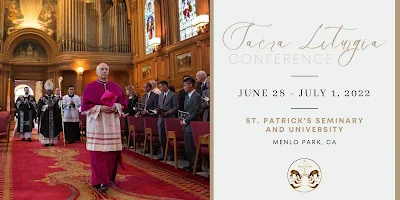
The Sacra Liturgia conference, founded by Dom Alcuin Reid, is an internationally recognized center of intellectual excellence in liturgical scholarship. Beautiful Masses are celebrated with excellent choirs so Catholics can experience the power of the Eucharist in a new way. The conference will take place from June 28 to July 1 at St Patrick’s Seminary in Menlo Park, close to Stanford University. Among this year’s roster of speakers features Cardinal Robert Sarah, Cardinal George Pell, Bishop Steven Lopes, Dom Alcuin Reid, Father Joseph Fessio, Jennifer Donelson-Nowicka, Msgr. Gerard O’Connor, Duncan Stroik and more. Renowned choral conductor Martin Baker, past president of the British Royal College of Organists and until recently Master of Music at Westminster Cathedral, will conduct singers from the Sacred Music Project in a Mass celebrated by Cardinal Pell. The final Mass will feature new music by Frank La Rocca, composed in honor of St Junipero Serra (Missa Sancti Juniperi Serra), and be celebrated by the conference host, Abp Cordileone, on St Junipero’s feast day, July 1, at the historic Mission Dolores which the Saint founded in 1776. Richard Sparks will conduct the Benedict Sixteen Choir and Orchestra.Friday, February 18, 2022
Sacra Liturgia San Francisco: June 28 - July 1
Gregory DiPippoThe conference schedule can be found here: https://www.sacraliturgiasf.com/schedule
Options before and after the conference include: an tour of beautiful churches of San Francisco, available on the afternoon of the 28th; a reception with Kansas City Chief kicker Harrison Butker after the final Mass; a sacred music concert conducted by Martin Baker featuring the works of living Catholic composers. Ticket holders will be emailed information about these before and after events. Accommodation should be booked separately.

Sunday, January 26, 2020
SCL 2020 at Notre Dame - That They May Be One: Liturgical Reconciliation
Jennifer Donelson-Nowicka
Readers of NLM may be interested in the call for papers for the upcoming 2020 annual conference of the Society for Catholic Liturgy, titled “That They May Be One: Liturgical Reconciliation”, which will be held at the University of Notre Dame from September 24–26. The Keynote Speakers will be Bishop Stephen J. Lopes, Bishop of the Ordinariate of the Chair of Saint Peter, and Dr. Stephen Bullivant, Director of the Benedict XVI Centre for Religion and Sociology, and Professor of the Theology and Sociology of Religion at St Mary’s University (Twickenham and London).
tomalley@nd.edu by Monday, February 3, 2020.
Presentations are expected to be 45 minutes in length, followed by 15 minutes of discussion. Papers presented will be considered for publication in the Society for Catholic Liturgy’s journal Antiphon: A Journal for Liturgical Renewal.
Registration, Housing, and Travel
Registration information will be available by February 1, 2020.
A block of rooms has been reserved at the Embassy Suites and Fairfield Inn at the University of Notre Dame. Information about reserving these rooms will be available by February 1, 2020.
The University of Notre Dame is accessible via air, rail, and car.
In his Catholicism: Christ and the Common Destiny of Man, Henri de Lubac, S.J. describes the unifying function of liturgical prayer. In offering the Eucharistic sacrifice, the Church participates in the sacrifice of Christ on the cross. It is through this sacrifice that men and women in the Church are restored to the original communion that was the destiny of the human family. The unity made possible by Christ’s sacrifice is ritually celebrated each Holy Thursday during the Mass of the Lord’s Supper as the Church sings, “Simul ergo cum in unum congregamur:/Ne nos mente dividamur, caveamus./Cessent iurgia maligna, cessent lites./Et in medio nostri sit Christus Deus” (So when we as one are gathered all together,/let us strive to keep our minds free of division;/may there be an end to malice, strife and quarrels,/and let Christ our God be dwelling here among us).
The irony is that much liturgical scholarship and practice in the last fifty years has led to disunity rather than unity within the Church. Catholics who worship according to the reformed rites of the Second Vatican Council may be viewed as participating in a liturgically deficient presentation of Christ’s sacrifice. Many liturgical scholars, pastoral liturgists, and even clergy of the post-conciliar era cast a suspicious eye toward Catholics who celebrate the Extraordinary Form or who desire a retrieval of liturgical and devotional practices from pre-conciliar Catholicism. The liturgical arts, especially sacred music and architecture, have become a space of contestation within Catholicism.
Liturgical renewal within both scholarship and pastoral practice must move beyond a mutual suspicion that does harm to Christ’s Body. The task of reconciliation within liturgical scholarship and practice cannot proceed as benign tolerance or a naïve relativism. Instead, it must include a deeper reflection on a liturgical theology of unity, grounded in what Pope Emeritus Benedict XVI called the sacramental mysticism central to Catholicism.
The 2020 conference of the Society for Catholic Liturgy invites submissions for papers and pastoral presentations that treat the theme of liturgy and unity in the Catholic Church. Proposals may address eastern Catholic liturgies, the reformed rites of the Second Vatican Council, the Extraordinary Form, and the Personal Ordinariate for former Anglicans. Potential topics and questions which arise from the conference theme are:
The irony is that much liturgical scholarship and practice in the last fifty years has led to disunity rather than unity within the Church. Catholics who worship according to the reformed rites of the Second Vatican Council may be viewed as participating in a liturgically deficient presentation of Christ’s sacrifice. Many liturgical scholars, pastoral liturgists, and even clergy of the post-conciliar era cast a suspicious eye toward Catholics who celebrate the Extraordinary Form or who desire a retrieval of liturgical and devotional practices from pre-conciliar Catholicism. The liturgical arts, especially sacred music and architecture, have become a space of contestation within Catholicism.
Liturgical renewal within both scholarship and pastoral practice must move beyond a mutual suspicion that does harm to Christ’s Body. The task of reconciliation within liturgical scholarship and practice cannot proceed as benign tolerance or a naïve relativism. Instead, it must include a deeper reflection on a liturgical theology of unity, grounded in what Pope Emeritus Benedict XVI called the sacramental mysticism central to Catholicism.
The 2020 conference of the Society for Catholic Liturgy invites submissions for papers and pastoral presentations that treat the theme of liturgy and unity in the Catholic Church. Proposals may address eastern Catholic liturgies, the reformed rites of the Second Vatican Council, the Extraordinary Form, and the Personal Ordinariate for former Anglicans. Potential topics and questions which arise from the conference theme are:
- The role of liturgical history in contributing to both unity and disunity in the Church. How might a liturgical historian narrate the history of the liturgy in a way that does not succumb to prejudices against a specific liturgical era or series of practices?
- A liturgical theology of unity grounded in the rites of the Church.
- Sociological and cultural examinations of liturgical practice in parishes and seminaries. Are parishes and seminaries marked by discord or harmony around liturgical practice? What is the source of this discord or harmony in parishes and seminaries?
- Constructive proposals attending to how the Novus Ordo, the Extraordinary Form, and eastern Catholic liturgies may contribute to a fuller understanding of actuosa participatio. What theological, ritual, aesthetic, pastoral, and principles should form the basis of this robust account of active participation?
- The role of the liturgical arts and sacred music in fostering the unity of the Church within the liturgy.
- The Personal Ordinariate of former Anglicans and its contributions to the Catholic Church.
- The function of liturgical language (the vernacular or a sacred language) as fostering ecclesial unity.
- The role of liturgical prayer as fostering unity within the human family in a global context.
tomalley@nd.edu by Monday, February 3, 2020.
Presentations are expected to be 45 minutes in length, followed by 15 minutes of discussion. Papers presented will be considered for publication in the Society for Catholic Liturgy’s journal Antiphon: A Journal for Liturgical Renewal.
Registration, Housing, and Travel
Registration information will be available by February 1, 2020.
A block of rooms has been reserved at the Embassy Suites and Fairfield Inn at the University of Notre Dame. Information about reserving these rooms will be available by February 1, 2020.
The University of Notre Dame is accessible via air, rail, and car.
Wednesday, March 01, 2017
18th Cologne International Liturgical Conference – March 29- April 1
Gregory DiPippo
The 18th Cologne International Liturgical Conference will take place from March 29 to April 1st this year in Herzogenrath bei Aachen, Germany. Among the participants are Archbishop Alexander Sample of Portland, Oregon, who will speak on “The Rediscovery of the Classical Roman Liturgy in North America,” celebrate one of the Masses, and preach at another. Bishop Steven Lopes of the Personal Ordinariate of the Chair of St Peter will speak on the development of the Ordinariate Missal, and celebrate a Pontifical Liturgy according to that Missal. Our own Dr Peter Kwasniewski will be giving a lecture (in German), and launching the German translation of his book Resurgent in the Midst of Crisis. Dr Martin Mosebach, author of “The Heresy of Formlessness”, will deliver a tribute to Pope Benedict XVI. The liturgies at the conference will be celebrated according to the Extraordinary Form; the full program in English may be see at the following link: http://www.liturgische-tagung.info/programme.html





