Saturday, February 14, 2026

Medieval Art and Liturgical Objects at the Musée de Cluny in Paris (Part 2)

This is the second post in our series of Nicola’s photographs of an exhibition recently held at the Musée de Cluny in Paris, titled “The Middle Ages of the 19th Century - Creations and Fakes in the Fine Arts”, a display of medieval works next to modern ones inspired by them, and some forgeries as well. Here we have an interesting mix of vestments, textiles, reliquaries, and vessels, but we begin with two paintings which include medieval liturgical objects in them. 

A still-life by the French painter Blaise Alexandre Desgoffe (1830 – 1901), ca. 1890, titled “Still Life with a Reliquary of St Henry and various medieval artworks.” Desgoffes was a highly regarded specialist in the still-life genre, and very interested in medieval art: the objects represented here are all in the medieval collection of the Louvre.

Ornaments from the Musée de Cluny, by Joseph Bail, 1886
A chalice originally made perhaps in Catalonia, sometime from roughly 1325-50, restored in the 19th century in Paris.
A reliquary with part of the arm bone of the Apostle St James the Less, made for the church dedicated to him in Liège, Belgium, in 1889. The firm that produced this, Joseph and Georges Wilmotte, working on a design by the architect Jean-Baptiste Bethune, won a silver medal for it at the Paris Exposition that same year.

Thursday, February 12, 2026

Medieval Art and Liturgical Objects at the Musée de Cluny in Paris (Part 1)

Our Ambrosian Rite expert Nicola de’ Grandi recently visited the Musée de Cluny in Paris, so called because it is housed in a building that was once the Parisian residence of the abbot of Cluny. This museum has an extremely important collection of medieval art, and probably is best known as the home of a famous set of six tapestries called The Lady and the Unicorn; there are, of course, a huge number of very beautiful liturgical objects in the collection as well. The museum recently hosted an exhibition titled “The Middle Ages of the 19th Century - Creations and Fakes in the Fine Arts”, a display of medieval works next to modern ones inspired by them, and some forgeries as well. I previously posted some pictures of this exhibition taken by another friend, but Nicola managed to photograph pretty much the entire thing, so this will extend over several posts.

We begin with a 19th-century reproduction of the one of the most famous objects in the Louvre’s medieval collection. The nucleus of the original is a vase made in the 2nd century of a kind of stone called porphyry, from the Greek word for “purple.” This material was high prized by the ancient Romans, partly because purple was the color of royalty, partly because it is very rare, found in only one place in Egypt; it is also extremely hard and heavy, making it difficult and expensive to work with and transport. The vessel had been at the abbey of St Denis outside Paris for many years, lying disused in a chest, when it was discovered by the abbot Suger (1080 ca. - 1151), better known to the world as the inventor of Gothic architecture. The abbot had the vessel mounted with metal pieces, made partly of silver and gold, in the form of an eagle, so it could be used as a vessel for the washing of hands during solemn Mass.

A clock made in 1835, modelled on the façade of Notre-Dame de Paris as it was before the restorations of Eugène Viollet le Duc began in 1844.
A pyx for the Blessed Sacrament made in 1887...
modelled on this original made in Limoges ca. 1200.
A jeweled chalice and paten set made between 1868 and 1890...
copied from this set made before the year 962 at the abbey of St Maximin in Trier, commissioned by a bishop of Toul named Gauzelin, for the abbey of Bouxières-aux-Dames.
  

Friday, January 23, 2026

Liturgical Items at the Abbey of St Martin in Disentis, Switzerland

At the beginning of this month, we shared Nicola’s pictures of the abbey of St Martin in Disentis, a town in the Swiss canton of Grisons, about 35 miles to the southeast of Lucerne. Today we follow up with his pictures from the abbey’s museum, which has a lot of very beautiful liturgical items.

A bronze processional cross from sometime after the middle of the 12th century. As is typical in Romanesque art, Our Lord is show standing upright to indicate that even in the midst of His sufferings, He is still the creator and sustainer of the world.

A silver monstrance made in Spain sometime in the 15th century. The cylindrical form is typical of the period, and still the norm to this day in the Ambrosian Rite.

A cross made of rock crystal and silver made in France in the same period, with a corpus of the Baroque period added to it.

A modern copy of a thurible made ca. 1200.
On the left, a Gothic pyx made of gilded brass, French, ca. 1460; on the right, a Gothic chalice, ca. 1300.

Two more Gothic chalices, on the left, ca. 1450, on the right, ca. 1500, and a 16th century German paten made of gilded copper.

Wednesday, March 19, 2025

Why Should We Build Beautiful Confessionals?

Confession is a sacrament in which we confess dark deeds, shameful sins, cowardly compromises, repeated rifts. It is something we often wish more to be done with than to do; we know we must go, that it is “good for us” as a visit to the dentist’s or the doctor’s is good for us. It might seem as if the place where we fess up, red-handed, and receive the cleansing bath of the Redeemer’s Blood should be a discreet, hidden, almost unnoticed spot, somewhere over in the corner, perhaps fused into the surrounding architecture like a broom closet (indeed, some confessionals were turned into broom closets after Vatican II, though the brooms had surely done nothing to deserve an environment reserved to rational animals).

Yet the designers and builders of Catholic churches and of their furnishings operated under a very different mentality. They made confessionals beautiful works of art (sometimes even extravagant), put them in prominent places where no one could miss them, and multiplied their number, so that you couldn’t avoid seeing them.

This, at least, was the Catholic (Counter-)Reformation’s way of reaffirming what the Protestants denied: that the Lord had, in His great mercy, provided the Catholic Church with an efficacious means for blotting out post-baptismal grave sin, a “second plank after shipwreck.” Contrary to some early heretics, grave sin after baptism, even including apostasy, could be forgiven; no sin permanently barred the penitent soul from grace. Contrary to the more recent heretics, faith alone was not enough, but faith must be faith in the Blood of Christ applied to souls by the ministry of the Church, at His bidding—ultimately, so that we could be rightly humbled and utterly certain of our having been forgiven.

These are some of the thoughts I had on my mind as I explored churches in Sicily in February and started taking pictures of the lovely Baroque confessionals that nearly every church contained. I will not try to label exactly which church each one belonged to, as that is somewhat beside the point; I doubt anyone will ever make a trip to a church just to see a confessional. Rather, one can marvel at the artistic creativity employed, and the strong, silent, steady love of this sacrament that such furnishings convey.

A curious detail of this confessional

Thursday, September 19, 2024

Beautiful Liturgical Objects from the Holy Land

Thanks once again to our friend Fr Joseph Koczera SJ, who has often shared his photos with us, this time for these pictures of an exhibition going on at the Marino Matini Museum in Florence of items from the collection of the Terra Sancta Museum in Jerusalem. On display are vestments, books, and other liturgical items, many of the very highest quality, donated to the Franciscan Custody of the Holy Land and the Latin Patriarchate of Jerusalem by the royal houses of Europe.

Father also pointed out to me one of the didactic panels from the exhibition, which offers a very wise rationale for the use of such beautiful and well-crafted objects. “… since the 1960s, certain currents within the Church have sought to condemn the existence and use of such riches, considered contrary to the spirit of the Gospel… However, striving to express the Truth as perfectly as possible through art and beauty, and aware that luxury offered to God brings nothing to the Creator, these extravagant gifts benefit their donors, bringing them closer to perfection, depending on the purity of the intention with which these offerings are placed at the foot of the altar. Thus, in Christian thought, Evil, the Prince of this world, can be defeated not only by Good, but also by Beauty.” Amen!

A fourteenth-century Office antiphonary, donated to the Franciscans of the Holy Land by King Henry IV of England. (It is here opened to a responsory for the feast of the Beheading of St John the Baptist.)

A portable altar given by King John VI of Portugal in the early 1820s; the Portuguese coat of arms are on the backboard and the missal cover.
A crucifix made of gold and lapis-lazuli, given by King Charles of Naples, the future King Charles III of Spain, in 1756.
Altar furnishings given by Kings Philip IV and Charles II of Spain in the 1660s and ‘70s.
A very nice set of vestments donated by the Serene Republic of Venice in the later part of the seventeenth century.

Thursday, February 08, 2024

More Liturgical Treasures from Milan Cathedral (Part 2)

Following up on recent posts in December and January, here are some more items of liturgical interest from the museum of the cathedral of Milan, photographed by Nicola de’ Grandi.

This two-sided painting, known as the Madonna dell’Idea, was made in the 2nd quarter of the 15th century by Michelino and Leonardo da Besozzo, and is still carried every year in the procession on Candlemas.

A gilded and silvered copper head of God the Father, by Beltramino da Rho, 1416-25, originally mounted on the crossing of the ribs in the apse, (now replaced by a copy in the church itself).

A painting of St Charles Borromeo carrying in procession the nail of the Crucifixion, which is one of the most precious of the cathedral’s many relics; by Fede Galizia, 1628-29. Originally commissioned for the Theatine church of St Anthony, and used a processional banner during the plague of 1630, since St Charles had done the same during a severe outbreak of the plague that hit Milan in 1576. 
An altar frontal made for the canonization of St Charles, which took place on All Saints’ Day of 1610. This and the two items that follow, a chalice veil and an orphrey for a cope, both made for the same occasion, are largely the word of a famous master-embroiderer of the early 17th century called Ludovica Antonia Pellegrini. 

Saturday, January 27, 2024

More Liturgical Treasures from Milan Cathedral

At the end of last month, we published some photos by Nicola de’ Grandi of an ivory diptych and a cover for a Gospel book, both preserved in the cathedral museum of Milan. Here are several more of items of liturgical interest from the museum: two more ivory diptychs, some very nice chalices and processional crosses, and a miter painstakingly decorated with hummingbird feathers. (Unfortunately, for several of these items, there is less information available than one would want.)

A pax brede donated by Pope Pius IV (1559-64), a member of the Milanese cadet branch of the Medici family, to his nephew St Charles Borromeo, whom he appointed the see of Milan in 1560; St Charles then donated it to the cathedral. The Cross is surmounted with thirteen set diamonds, and the scene of the Deposition from the Cross is figured in gold beneath it. In the lunette above, a group of angels, and the stem of the Medici.

The Ambrosian Church still to this day uses this form of cylindrical monstrance, which was very common in the late Middle Ages. The lower part, in the form of a tree-trunk, was made in the late 15th century, and is decorated with pearls and green enamel formed to look like leaves; it seems to have originally been a decorative cup created for a secular context, and later donated to the cathedral and reworked, with the upper section added in the 16th century. Two angels are delicately cut into the rock-crystal.

This object is known as “the chalice of the liberal arts”, since the seven liberal arts and the original Four Doctors of the Latin Church are depicted on the ivory cup, which was made in the 14th century. The piece to which the ivory is attached is contemporary, but the base was made about 50 years earlier. This was almost certainly not used as a chalice for the consecration of the Precious Blood, but as a kind of pyx.
This carved ivory bucket for holy water, or “situla”, was commissioned by another archbishop of Milan, Gotofredo (974-80), for the blessing of the Emperor Otto II (967-983), which was supposed to take place in the Basilica of Saint Ambrose. It was probably never used, since the archbishop died before the emperor’s arrival in Milan. An inscription on the upper edge reads “A gift of Gotofredo to thee, holy prophet Ambrose, a vessel to sprinkle blessed water on Caesar when he shall come.” The relief images along the outside are separated from each other by columns supporting arches. The silver handle is made in the form of two winged monsters with reptilian tails and front paws, large, open eyes and feline ears, who hold a small human head in their jaws.

Miter decorated with hummingbird feathers, ca. 1525-75.

Tuesday, December 19, 2023

Commissioning a Portable Altar Appropriate for the TLM

My friend Fr Andrew Marlborough, a priest of the diocese of Plymouth, in England, (whom our readers may remember from his writings about the recovery of liturgical artifacts from auction houses) recently contacted me about a portable altar he had made for personal use.

I asked him to describe the process and how consideration of the different requirements that went into the design of altar. The carpenter who built the altar is Dutch, his name is Daan Lockefeer: www.lockefeermeubelmaker.nl.

Fr Andrew wrote: When asked to help at a university chaplaincy, I was shocked to learn that there was no proper altar or liturgical space to use. This was especially sad because the university had once been a thriving convent school with a beautiful chapel, now converted into a lecture theatre.

The experience made me determined to find a fitting solution for offering Holy Mass in temporary spaces. This was amplified by a desire to help priests who celebrate the Traditional Latin Mass in places with no permanent altar. So, I set out to source a portable altar for such situations.

At first, I looked at second-hand small chapel altars but most of these were still too big to be easily moveable. Then I also considered buying an old military chaplain’s altar, or one of the beautifully-crafted St Joseph’s Workshop portable altars. But these seemed really for more occasional backcountry or field use and are just too small for normal circumstances.

I soon realised that what I really needed was a transportable altar that was still a traditional size but which could fold up to be transported in the back of a car. And this type of altar seemed not to be available. So, I decided to commission a prototype from a cabinet-maker. I consider this to be a first attempt which can be improved upon in later designs and I hope it might stimulate further discussion and similar commissions.
The first thing was to establish the size needed. This is really important for good ars celebrandi and sadly many modern altars are made without proper reference to the accumulated practical wisdom of tradition. Reflection on this, and discussion with a traditional priest-friend, made me realise that the ideal size was 100cm high x 150cm long x 60cm deep.

Another major step was the realisation of the essential difference in design of this altar from the ‘all-in-one’ military-inspired portable field altars. Sacred vessels, Crucifix, candlesticks, sacred art, and other elements can easily be transported separately. What was essential here was a basic structure of the correct size which could be dressed with altar linens and which could accommodate an altar stone.

There were several design challenges to address. The first was the configuration of the folding mensa. After initially considering a centrefold, we realised that the central section on which the corporal, and so the Sacred Body & Blood of Our Lord, would rest, should be of one piece. Given the ideal overall length of 150cm, it was decided that this central section should be 75cm, with folding end panels of 37.5cm each, secured by extra-strong hinges. The second design question was how to construct the legs. It was decided here that single-piece removable legs, strengthened by removable stretchers, would be better and stronger than folding legs. The third challenge was how to incorporate an altar stone into the design. The need for a thin mensa to keep weight down meant that recessing an altar stone permanently into the wood surface wasn’t possible. After considering several options, the best solution seemed to be a simple shallow pull-out drawer located directly under the mensa centre which can accommodate an altar stone that is removed in transit.

Finally, it was decided that the best material to use would be oak. The overall result is a strong, relatively light, basic altar structure of the correct dimensions, which can be easily transported in an average car. The cost before shipping was 1200 Euros.

Thursday, August 11, 2022

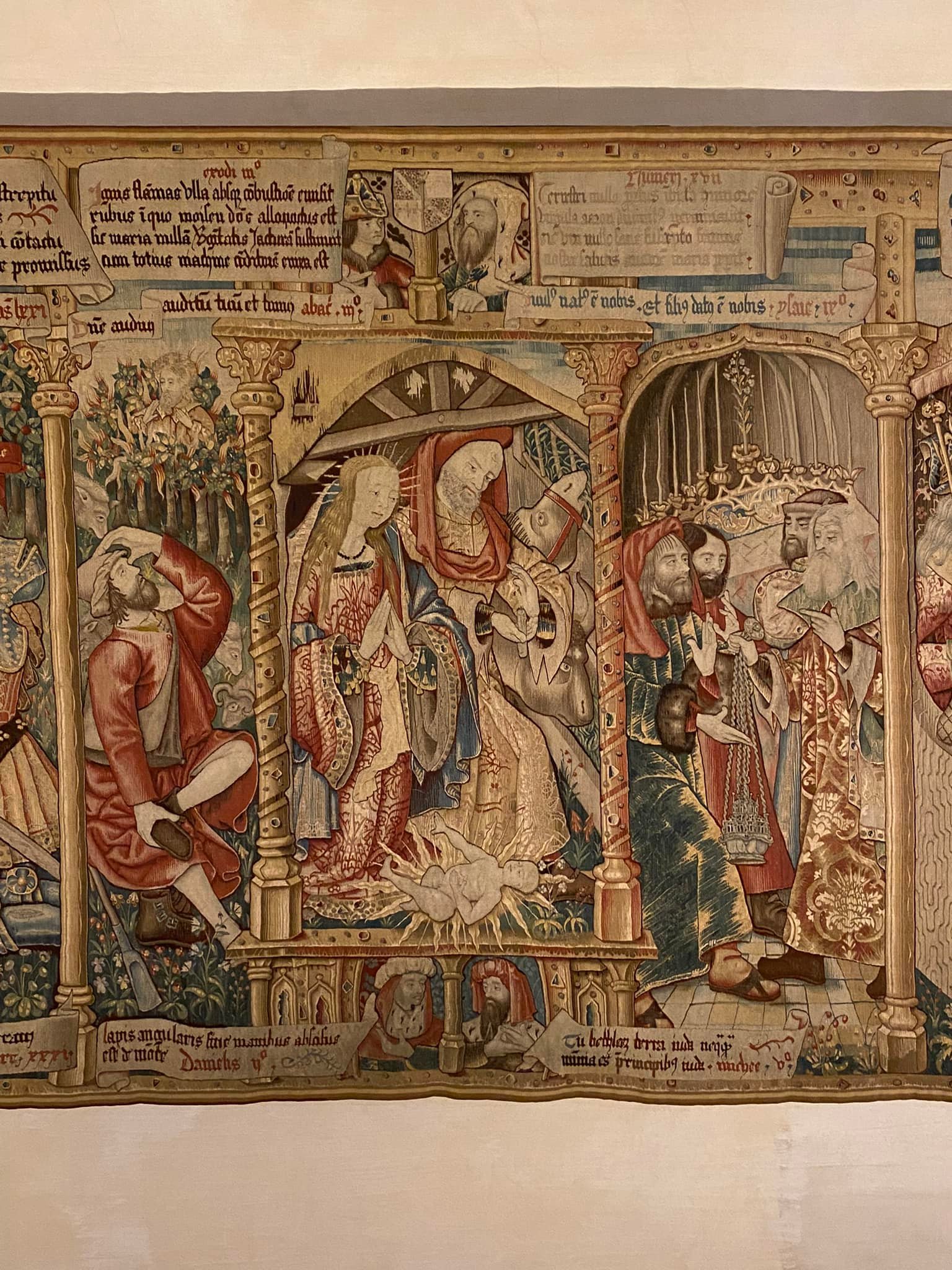
The Abbey of Chaise-Dieu (Part 2): The Tapestries

Last week, we shared some pictures recently taken by a friend of one of the most beautiful abbeys in France, the Chaise-Dieu. The former monastery buildings now also house a very remarkable set of early 16th century tapestries, which were designed to hang in the choir of the abbey church. These were commissioned by the abbot of Saint-Nectaire, one of La Chaise-Dieu’s many dependent houses, in 1501; each tapestry depicts a New Testament scene alongside related scenes from the Old Testament.
The Crucifixion, with the Binding of Isaac (Gen. 22) at the upper left, and the Bronze Serpent (Num. 21) at the upper right.

The Birth of Christ, with Moses and the Burning Bush (Ex. 3) to the left, and the Flourishing of the Rod of Aaron (Num. 17) to the right. At the top are the prophets Habakkuk and Isaiah, with banderoles on which are written their respective prophecies of the Incarnation: Habakkuk 3, “O Lord, I have heard Thy report, and grown afraid...”; Isaiah 9, “Unto us a Child is born, unto us a Son is given.”
The Adoration of the Magi" to the left, the episode recounted in 2 Samuel 23, 13-17, of the three soldiers who bring water from the fountain of Bethlehem to King David; to the right, and Solomon and the Queen of Sheba (3 Reg. 10). At the top are King David and Isaiah, with banderoles on which are written from Psalm 71 “Kings shall bring thee gifts”, and from Isaiah 60, “They shall adores the traces of Thy feet.”
The Massacre of the Holy Innocents: to the left, the murder of the priests of the house of Achimelech (1 Samuel 22); to the right, and Queen Athaliah killing the sons of Ochoziah (4 Reg. 11). At the top are the prophets Jeremiah and Hosea, with banderoles on which are written from Jeremiah 31 “A voice was heard in Rama, of mourning and wailing”, and from Hosea 8, “They reigned, and not from from me.”
The Raising of Lazarus: to the left, Elijah raising a dead child (3 Kings); to the right, Elisha doing the same (4 Reg. 5). At the top, King David has on his banderole the words of Psalm 118, “Thy word giveth me life”, and the prophet Samuel, “The Lord killeth and maketh alive”, although these words are actually spoken by his mother Anna in her canticle in 1 Samuel 2.

More recent articles:

For more articles, see the NLM archives: