Tuesday, March 31, 2026

Art, Beauty, Creativity and Inspiration – Part 1: What is Art?

Towards A Christian Understanding

This is the first in a four-part series in which I explore what art is, what makes it beautiful, and why beauty matters – not merely aesthetically, but also theologically and even economically.

Over these four posts, I hope to lay out a coherent Christian philosophy of art and beauty, drawing on classical thought, the insights of St Thomas Aquinas, and the living tradition of the Church. This week, I begin at the beginning: with the question of what art actually is. It sounds almost too simple to ask, and yet we live in an age that has quietly abandoned any agreed answer – with consequences that surround us on every side. I will also consider what distinguishes good art from bad, and what makes art distinctively Christian, arguing that a work need not carry an explicitly religious subject matter to be genuinely Christian in spirit.
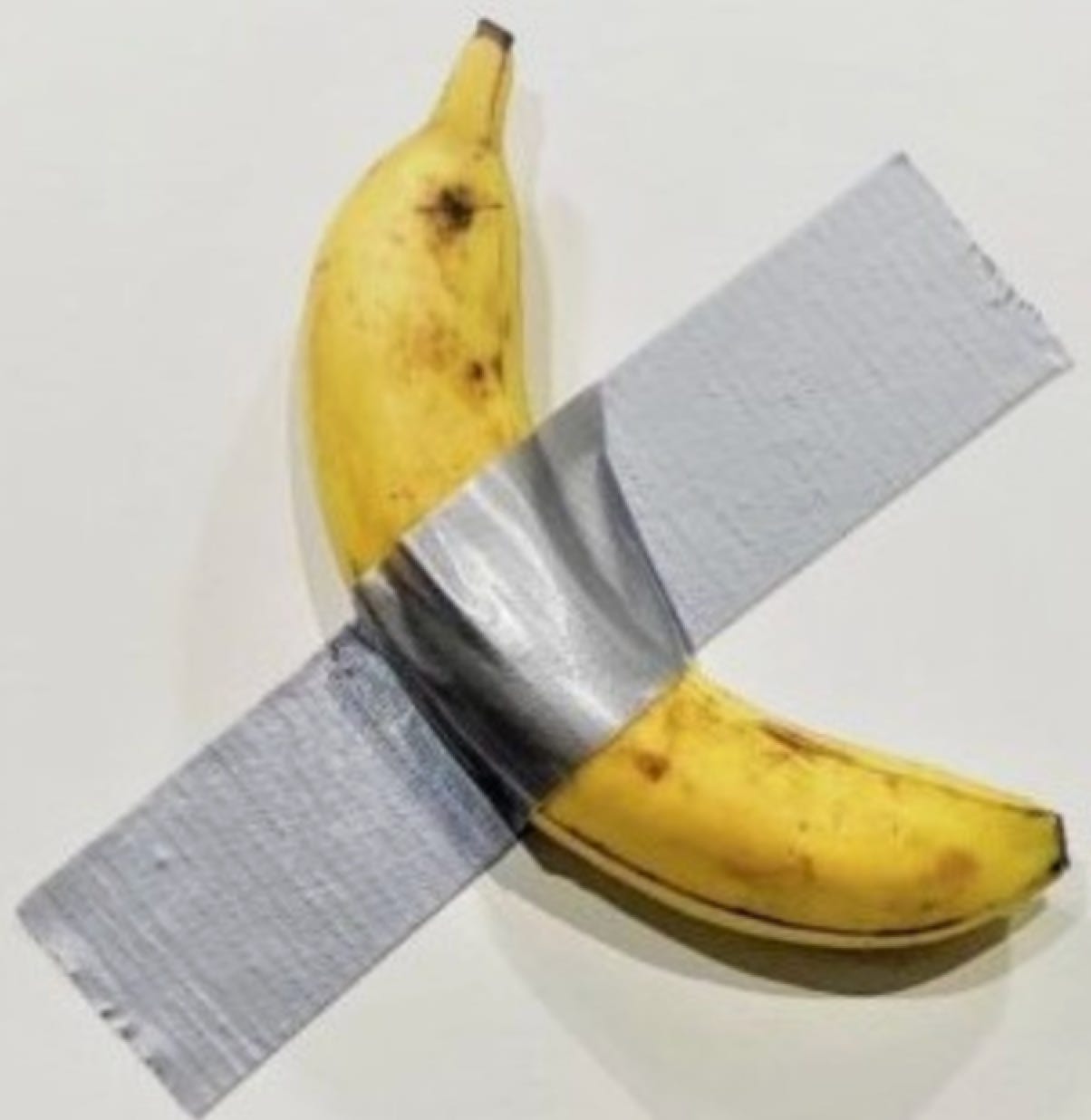
The Million Dollar Banana, conceptual art, by Maurizio Cattelan, Italian, 2024
We live in an age that has largely lost confidence in its own artistic tradition – an age that fills galleries with objects whose claim to be “art” rests not on beauty, skill, or purpose, but on the artist’s assertion alone. To recover a culture of beauty, we must begin at the beginning: with a clear understanding of what art actually is, what makes it good, and what makes it distinctively Christian. This long article sets out to do precisely that. Drawing on the ancient traditions of both Greece and Rome, on the philosophical insights of St. Thomas Aquinas, and on the living wisdom preserved in the Church’s artistic heritage, we will explore art not as an arbitrary exercise in self-expression, but as a purposeful act of making – one rooted in skill, ordered toward beauty, and capable, at its highest reaches, of drawing the human soul toward God. Along the way, we will consider how beauty is known and judged, why tradition is a more reliable guide to it than individual taste or critical fashion, and why the creation of beautiful things is not a luxury to be weighed against other needs, but a form of participation in God’s own creative work that pays for itself.

What is Art?

The word ‘art’ can have a variety of meanings today, and it might be impossible to come up with a definition that all will accept, but here we will focus on ideas of art that are likely to appeal to the traditionally minded Christian and for which we might find a consensus amongst non-Christians also.

Looking to traditional understandings in Western culture, we find that the ancient Greek techne and Latin ars both denoted “skill,” “craft,” or “technique” – a learned proficiency in creating or producing, encompassing all practical trades, such as carpentry, as well as what today we might call the fine arts, such as poetry or painting. An “artefact” is the product of techne in action, and the artisan is the one who creates an artifact. When we speak of an “artist” today, we typically have in mind someone who creates works of fine art.

But how precisely would we define fine art today? How does the mainstream art world define it? We want to answer this question, if only to be sure that when we discuss art with others, we at least know what they believe it to be.

One might think that the major art galleries would provide a definition, given that their whole raison d’être is the exhibition of art. However, a review of the websites of major art galleries such as MoMA, Tate, and the National Galleries of England and America doesn’t provide much help. In fact, I couldn’t find any definitions. Perhaps they assume we all know what art is and that a definition is unnecessary; or perhaps they hesitate to put anything in words because they struggle to find a definition that applies to all the artifacts they show in their galleries.

The British Museum, which is more traditional in its outlook, provides (albeit buried in a training program newsletter) a good working definition of what we would call fine art, closer to the ancient idea of art as the product of techne, as described above. This can be a good working definition for us. It says:

“The definition of art can vary depending on the context and the cultural, social, and historical background in which it is created. However, art in general can be defined as a creative expression of human skill and imagination that aims to communicate an idea, emotion, or message to an audience. This can include a wide range of media, including painting, sculpture, music, literature, film, and other forms of artistic expression.” 1

Good Art and Christian Art

For Christians, adopting this working definition from the British Museum and building on it, we might then ask: what constitutes good art? And, what constitutes Christian art?

In response, I would say that good art is art (as defined above – “a creative expression of human skill and imagination”) that fulfills a good purpose well. We define a good purpose as one consistent with a Christian worldview. This means that art can be Christian even if it does not explicitly express a religious theme or message. For example, a beautiful landscape that communicates the beauty of Creation is a work of Christian art, even if the artist had no explicitly religious intention in painting it and was not a Christian himself.

We would further say that all art is a manifestation of an idea (which might also be an emotion or a message) or an image that first exists in the artist’s imagination before being fashioned into material form. This picture in the artist’s imagination is, in traditional Christian anthropology, taken directly or assembled as a composite from information gained through sensual experience.

The creation of art, from the Christian perspective, is bound up with the creation of something beautiful. Art requires beauty to fulfill its purpose – if a work is not beautiful, it is not good; this might seem a strange proposition given that there is a place for the representation of ugliness, evil, and suffering in art. However, if the art is to portray a Christian understanding of these things, it must also communicate the purpose of these evils within the economy of grace. God must permit evil in the world for good reason, and it is the responsibility of the Christian artist to communicate that message, too. Otherwise, he is not communicating the full truth

For the Christian, even in the face of evil, suffering, and ugliness, there is hope. When infused with hope, the portrayal of these otherwise ugly realities becomes beautiful. This is exemplified by depictions of the Crucifixion. A well-executed Crucifixion is a beautiful work of art. This beauty is created through the artist's treatment of the image – through skillful choices in line, tone, contrast, and composition, for example. In this way, a good artist presents the greatest crime ever committed without diminishing the profound evil it signifies, but rather by infusing the work with Christian hope – a hope that surpasses all the evil and suffering depicted.
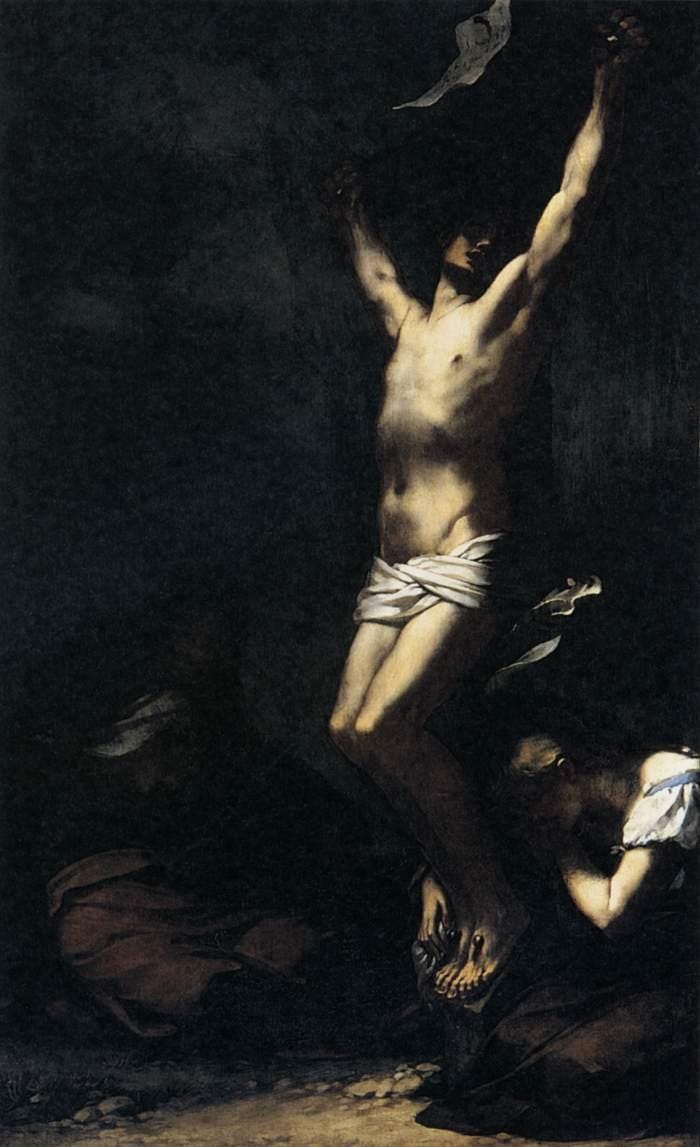

Crucifixion, Pierre-Paul Prud’hon, French, 19th century. Using the baroque style, the artist intentionally contrasts the light on Christ with darkness to symbolize the Light overcoming evil and suffering. This stylistic choice is meant to communicate a sense of hope.
To depict suffering or evil without simultaneously offering hope is, for a Christian, not the full truth. It presents an incomplete picture that can lead to despair. It is through beauty that Christ’s hope is communicated to us, for beauty naturally speaks of God's love (more on beauty later).
Sacred art is the highest form of art, characterized by an explicitly sacred or religious purpose. Liturgical art—created to help us worship God – is the noblest form of sacred art, since worship of God is the highest expression of love for Him and the greatest human activity.
For Christians, the creation of art is intertwined with the pursuit of beauty and divine inspiration. When we recognize the goodness of a work of art, we call it beautiful. As such, good art serves as a sign of the divine – beauty in good art is a visible sign of the work of the unseen God, either as Creator, as seen in the beauty of the universe, or as the God who inspired its creation, through human effort. Therefore, beauty tends to awaken in us a desire for something greater than what we see – the source of that beauty, who is God Himself.

Tuesday, March 03, 2026

Why Are Modern Church Buildings So Ugly

And Why Does it Matter?

The following first appeared as an interview in The Catholic Herald. Jan C. Bentz, who conducted the interview, teaches philosophy at Blackfriars College, Oxford.

Los Angeles Cathedral, completed 2002

Dr Bentz wrote:

For many Catholics, the experience is familiar and disquieting: newly built churches that feel more like conference centres than places of worship, stripped of ornament, symbolism, and the Holy. The question of ugliness in modern church architecture is often dismissed as a matter of taste or nostalgia. Yet for David Clayton, artist, educator and one of the most articulate contemporary defenders of traditional Catholic aesthetics, the issue runs far deeper. At stake is not merely style, but theology: how the Church understands worship, the human person and the relationship between beauty and truth.

In this conversation, Clayton argues that modern ecclesial ugliness reflects a loss of Catholic inculturation, a failure of formation, especially in seminaries, and a philosophical rupture that predates the Second Vatican Council by more than a century. Drawing on Benedict XVI, classical harmony and proportion and the liturgical traditions of East and West, he makes the case that beauty is not decoration but necessity: a formative power that shapes belief, prayer and even faith itself.

Jan C. Bentz (JCB): Many modern churches appear deliberately resistant to beauty, ornament and symbolic density. Do you think this widespread ugliness is primarily a failure of taste, or does it reflect a deeper theological, or even anthropological, confusion about what a church actually is?

David Clayton (DC): It is, I would say, a combination of all three. There is certainly a failure of taste, but that failure itself is rooted in something deeper: a loss of awareness of Catholic tradition and of how that tradition is inseparable from theology and anthropology, specifically, the Church’s understanding of what man is and what worship does to him.

We have become dislocated from our own inheritance. That rupture is largely the result of inadequate education and formation among Catholics today, and unfortunately this includes the formation of priests in seminaries, where these questions are often not given the attention they deserve. One of the most significant gaps is a lack of understanding of form, by which I mean not simply what is depicted, but how it is depicted. Style, proportion, harmony and architectural language all express a philosophical and theological world-view.

When this connection is lost, architecture and art are reduced to matters of personal taste. And taste, when it is not properly formed, becomes highly susceptible to contemporary trends and cultural fashion. People end up liking what they think they ought to like, rather than judging according to universal principles. At that point, beauty no longer refers to reality but to preference. That, I think, is at the heart of the problem.

JCB: You mentioned formation, especially in seminaries. Do you think there is an active lack of education in these areas? Should seminaries be more intentional about teaching beauty across architecture, art and music?

DC: Yes, very much so. Seminarians may encounter aesthetics in a philosophical sense, but what is really needed is a deeper Catholic inculturation. They need to be formed within a living tradition, not simply taught concepts in isolation. If you look at Orthodox or Byzantine Catholic priestly formation, the contrast is striking. Their clergy are required to understand what icons belong in a church, how iconographic schemas function and how art, architecture and liturgy work together as a unified whole. They are formed liturgically in a very concrete way. By comparison, Roman seminaries often teach what the liturgy is without sufficiently explaining how architecture, music and visual art are ordered towards it. There is, in short, a significant gap in formation. Without that integration, priests are left unequipped to make informed decisions about church buildings, and the results are all around us.

JCB: Do you see a connection between this loss of formation and a post-conciliar loss of confidence in symbolism, transcendence and tradition more broadly?

DC: Yes, but it is essential to be precise here. This is not the fault of the Second Vatican Council itself. Rather, the Council was used as a pretext by those who already wished to introduce changes, often in ways that directly contradicted what the Council actually taught.

Following Benedict XVI, especially in The Spirit of the Liturgy, I would trace the deeper roots of this problem back to the early nineteenth century. The real issue lies in a distorted understanding of worship itself and in the separation of liturgy from the artistic forms that properly belong to it.

Architecture is not merely a neutral container for worship. The church building actively forms those who worship within it. Its structure, orientation and beauty guide the faithful towards participation in the liturgy. When this formative role is forgotten, worship becomes increasingly internalised and cerebral, almost purely intellectual.

As long as liturgical structures were fixed and immovable, they exercised a kind of corrective force. But once change was permitted without sufficient theological grounding, the floodgates opened. What we saw after the Council was not a sudden rupture but the acceleration of a trajectory long in the making.

JCB: Turning to architecture more directly: are modern movements such as functionalism or Brutalism fundamentally incompatible with Catholic liturgical theology?

DC: Yes, because these movements are grounded in materialist philosophies. They fail to acknowledge the metaphysical and spiritual dimension of the human person. Ironically, they are not even functional in the fullest sense, because they do not fulfil the true function of a church, which includes nourishing the spiritual life of those who worship there.

Utility has been reduced to purely material concerns: keeping out the rain, ensuring audibility and accommodating bodies. Those things matter, of course, but they are not sufficient. Beauty is not optional. It is essential, because it raises hearts and minds to God.

And not just any beauty will do. A railway station can be beautiful, but beautiful as a railway station. A church must be beautiful as a church. Its form must be ordered towards worship, towards encounter with Christ in the Eucharist.

Brutalist architecture, in particular, quite literally brutalises man by reducing him to a creature with purely material needs. Designing a church according to such principles is therefore incoherent.

Traditional harmony and proportion presuppose that beauty is objective, that it is rooted in reality itself, even though it is perceived subjectively. This assumption was undermined by Enlightenment philosophy, especially by Kant’s separation of perception from reality. Once that happens, beauty becomes merely emotional response.

Those ideas eventually filtered into architecture schools. By the mid-twentieth century, traditional harmony and proportion were no longer taught. Interestingly, many architects understood they were rejecting Christianity long before Christians themselves recognised it.

JCB: Defenders of modernist simplicity often argue that it fosters humility and prayer. How would you respond?

DC: Accessibility is important. People should not need a university education to respond to beauty. Traditional forms achieve this remarkably well, but they are not simple. They are complex, in the same way that the cosmos is complex: immediately accessible, yet inexhaustible.

The claim that complexity distracts is ancient. It goes back at least to the iconoclastic controversies, and even figures such as St Bernard worried that beauty might draw attention to itself. But authentic beauty does not trap the gaze; it draws us beyond itself, towards its source, who is God.

Experience overwhelmingly confirms this. The forms that have endured in Christian worship are not simplistic designs but richly ordered ones, capable of forming the soul precisely because of their depth.

JCB: Finally, on a practical level: if a parish or diocese were to build or renovate a church today, what principles should guide the project?

DC: The first principle is to find the right architect, someone deeply immersed in tradition. Whether classical or Gothic matters less than whether the architect truly understands a living tradition. But it is equally important not to reproduce the past uncritically.

Here I follow the guidance of Pius XII and Benedict XVI’s hermeneutic of continuity. We do not change forms unless we must. Modern elements may be incorporated, but only if they genuinely serve the needs of the worshipping community.

The liturgy is the wellspring of Catholic culture. Architecture, art and music must flow from it. Only then can the Church engage modern culture discerningly, rejecting what is harmful and integrating what is good.

If we begin with worship, grace will do the rest. Beauty will attract. And from that beauty, a truly Catholic culture can once again emerge.

San Francisco Cathedral, completed in 1970

Tuesday, February 03, 2026

What Is Culture, And How Do We Transform It? Part 3

The Importance of the Liturgy to the Evangelization of American Culture.

This is the third and final article in my series on the Catholic understanding of culture. In the first, I defined culture as the organically emerging pattern of personal interactions that reveal and nurture a society’s core values, and I argued that Christians must fight to infuse it with beauty and love. In the second, I explored how freedom, when rooted in knowledge of the common good and just laws, enables authentic Christian cultures to emerge bottom-up in distinct national expressions, fostering a family of nations that imitate and adapt the best from one another. Here, I turn to the liturgy as the wellspring of faith and culture, describing how right worship, especially through beautiful sacred art, might drive the evangelisation of American society toward a transfigured Christ. As an example of how the liturgy drove cultural change in the past, I use the example of the baroque style that began as sacred art in Italy in the late 16th century with painters such as Caravaggio and Barroci, and then spread across Europe as the dominant style in subjects both sacred and profane, and eventually came to the US, where arguably the last great artist in this glorious Christian style, John Singer Sargent who died in 1925, lived and worked.

Rorate Mass at FSSP Baltimore, photo by Amy Proctor, taken from FSSP.com

As a Christian, I hope for and work towards a society in which the ordering principle of the country in which I live, America, is the transfigured Christ, albeit expressed in a characteristically American way. Even beginning such work requires more than knowledge of the principles of the American Constitution and a love for America, although both would be helpful. It also requires a deep appreciation of the cultural milieu from which the Constitution and the principles of the American republic emerged.

How do we form people capable of contributing to this change? Education is important; I have devoted much of my work to it for this reason. But once again, the greatest contribution that each of us can make is to play our own part in being a model citizen, that is, relating to others as good Americans and good Christians (or as one who imitates the way of good Christians, if you are not a Christian).

How can we do this?

It is the Church’s worship, the Sacred Liturgy, that is the most powerful influence on the transmission and retention of the Christian faith among its members. It is through right worship, therefore, that we will become the people who can transform society. For Catholics in particular, this means a liturgically centered spirituality with the Mass and the Liturgy of the Hours at its heart. The Church Fathers articulate this principle of the preeminence of worship in retaining and transmitting faith with the phrase lex orandi, lex credendi, which means ‘rule of prayer, rule of faith’. This phrase conveys the principle that our prayers, especially those in the liturgy (the highest form of prayer), most strongly shape our beliefs.

People today, who likely have never heard of the phrase lex orandi, lex credendi, nevertheless instinctively know how important worship is to the Christian faith. This is why fights over the content and style of the liturgy are so emotional and, at times, embittered. This is not a sideshow; it does matter. It is the primary battleground in the fight for Christian faith and Christian culture. Many of those who hate the Church know this, too, and will do all they can to undermine the freedom to worship God and to introduce ugliness and distortion into the culture of worship.

In summary, if we accept that the liturgy has the most significant influence on our faith, and that our faith has the most significant impact on culture, then we can see that it is the liturgy (rather than, for example, socio-economic factors) that has the most significant positive influence on the broader culture. Other factors can influence it too, but authentic worship, as the most powerful influence, is considered the wellspring of Christian culture, and its primary influencer is Christ Himself.

Visual art plays a vital role in our worship.

The fine arts - high culture - are not matters to be considered only by aesthetes; they play a vital role in the well-being of the Church and, therefore, of society as a whole. The Church understands this and teaches that good sacred art, where my personal interest lies, along with liturgical music and church architecture, is an essential part of our worship. Thus, beautiful and dignified liturgy, along with art forms in harmony with it, is a constant need for the well-being of the Church and all Christian nations.

The Purpose of Art

Once we accept the centrality of the liturgy in governing our lives, this informs our understanding of the purpose of art. The purpose of art is to inspire and inform our worship of God, liturgical art, first, and then the whole of our Christian lives, mundane or profane art.

It has been said that all the great art movements began on the altar. This saying suggests that when we get the liturgical arts right, their form and beauty will inform all other art. When we get it right, this will happen naturally and organically in the proper order of things. This is why the liturgy is the wellspring of all Catholic culture.

We can see examples of this. For example, Baroque art originated in Italy as a style of sacred art in the late 16th century, exemplified by painters such as Caravaggio and Federico Barocci.

Federico Barocci, The Circumcision of Christ, 1590

Once established, the baroque style of sacred art quickly became the template for non-religious art. In addition to liturgical and devotional art, Baroque artists also painted portraits, landscapes, and still-lifes. Such was the beauty of these works that artists across Europe started to imitate it. Catholics, such as the Flemish painter Rubens, the Frenchman De La Tour, and the Spaniard Velázquez, adopted it; Protestants also sought to paint in this style. Rembrandt and the Dutch masters were inspired by the new Italian style of Catholic sacred art, which influenced their approach to painting.

Rembrandt, Portrait of a Woman, 17th century 

The great beauty of baroque art, not forceful arguments made by elites in universities, persuaded patrons to commission works in this style. The same effect was observed in music and architecture, and through this organic spread, the culture of 17th-century Europe became universally baroque, and its style always spoke in some way of Christ, even when the subject depicted was something more mundane.

In England at this time, King Charles 1 recruited Rubens’s most outstanding student, Anthony (later Sir Anthony) Van Dyck, to be the court painter. The long-standing English school of portraiture, with great figures of the 18th century such as Sir Joshua Reynolds and Gainsborough, was descended from Van Dyck’s portraiture.

Portrait by Anthony Van Dyck, made in 1616, when the artist was only 17 years old. 

This, in turn, influenced American painters such as Gilbert Stuart, who adopted the English style, and is now known especially for his portraits of George Washington. 

The Skater, also known as the Portrait of William Grant, by Gilbert Stuart, 1782

The influence persisted until the 20th century. In my opinion, the last great painter in the Baroque style was an American who died in 1925, John Singer Sargent.

A portrait of the French composer Gabriel Fauré, by John Singer Sargent

The culture that created this great art form was Catholic, but both Catholic and Protestant Christian cultures sustained it. By the time Sargent died, contemporary culture was moving in a different direction, away from Christianity, and the style of modern art followed suit.

To transform American culture, therefore, we American Christians, and particularly Catholic Christians, must worship well, draw others to our faith by our conduct and our love for those with whom we interact personally, and strive for art forms that connect with good worship. The most beautiful art forms that emerge from this will eventually dominate because their beauty will persuade all Christians to adopt them. It will be a supply-side process! This will then become the driving force for a new, contemporary culture that is informed by and speaks to the faith and values of Christianity in a uniquely American way.

In the Office of Readings, one of the Hours of the Divine Office, on the Feast of the Epiphany, the second reading is from a sermon by Pope St Leo the Great. The passage closes with the following words:

‘Dear friends, you must have the same zeal to help one another; then, in the kingdom of God, to which faith and good works are the way, you will shine as children of the light: through our Lord Jesus Christ, who lives and reigns with God the Father and the Holy Spirit for ever and ever. Amen.’

Our lives and our whole life’s work—and art is part of this—must participate in this Light. If we can move even partially towards this ideal, the effect will be irresistible. In America, as in every nation, it is our Christian worship that drives us forward to the Light and transforms us into people of the Light.

Tuesday, January 27, 2026

What is Culture, And How Do We Transform It? Part 2

This is the second of three articles exploring the Catholic understanding of culture. Last week, in the first installment, I defined culture as the emergent pattern of activity in a society that manifests and sustains its core beliefs and values, showing how it both reflects and shapes worldviews – making it a vital battleground for Christians to transform toward beauty, love, and faith, especially in issues like the fight against abortion. This time, I will examine how freedom, as the capacity to act in accordance with the common good, underpins a truly beautiful Christian culture, allowing nations to express love in their unique ways while drawing from shared eternal principles.

Princeton University Graduate College, designed by Ralph Adams Cram (American), 1913; image from Wikimedia Commons by Zeete, CC BY-SA 4.0

Freedom, love, and the culture of nations

Love is by nature freely given (the moment we are compelled to love, it is no longer love!). Therefore, freedom - the freedom to love God and neighbor - is a necessary condition for a beautiful culture.

What is freedom? Many feel that freedom is simply the absence of constraint and compulsion. That is part of it, but the traditional approach has a deeper understanding. In the traditional understanding, freedom is best understood as the capacity to choose the practicable best. ‘Practicable’ here means what can be put into practice.

Therefore, three components must be present for us to be fully free and to choose the best course.

The first component is the absence of constraint or compulsion; the second is a full knowledge of what is best for us; and the third is the power to act in accordance with what is best.

The good that is best for each of us in the context of a society is known as the ‘common good’. When we act in accordance with the common good, we also do what is best for ourselves. In the proper order of things, the personal and common good are never in conflict. The most obvious guides to seeking the common good are the moral law and the principles of justice prescribed by Christ’s Church. All authentic and beautiful Christian cultures emerge from the freely taken actions of the members of society toward the common good.

It is in the interest of a Christian society, therefore, to promote freedom by a system of laws that are just, and so give security to the individual to act in accordance with the freedom to be moral and good. Such a system of laws would, in part, be designed to prevent interference with others' freedom. The state also encourages the formation of its citizens or subjects through an education that will help them to know the common good. The state fulfils its role by enabling effective teachers, especially parents, to teach well. If these conditions are satisfied, a culture of beauty will emerge naturally and organically from the bottom up.

Analogously, and regarding supporting the fine arts, I believe it is better to strive to create the conditions that promote the freedom to pursue art as a career than to impose the elitist vision of what art ought to look like onto people from the top down. In this context, the freedom afforded to an artist is understood as imparting knowledge of what forms of art might benefit society, as well as the skills, means, and inclination to create it. As a general rule, a top-down rigid imposition of artistic standards almost always restricts freedom and undermines the chance of creating an authentically beautiful culture. 

Willard Straight Hall, Cornell Univeristy, designed by William Adams Delano,1925

A society’s pattern of positive law (those laws created by human government) will inevitably be different from one nation to another, even for nations seeking to create laws for all the right reasons. The truths of the natural law, which inform positive law, are eternal and universal principles. Still, this universality of the principles does not mean that human society immediately and uniformly comes to know and apply them in exactly the same way everywhere. Human knowledge must progress slowly, in stages, step by step, and organically, or else it is not a true “human society” at all. It does so through trial and error, gradually seeing what works best. Therefore, until the end times, each society will take a different path towards this knowledge.

The good Christian society recognizes the difficulty of knowing fully and applying well the universal principles of the natural law, and thus, the good Christian society seeks the aid of revealed truth, which is Tradition (that is, Christian Revelation), and the experience of past laws to help guide reason. God revealed truths for two reasons, St Thomas Aquinas tells us, first because some truths are beyond the grasp of reason (for example, the Trinity, the Incarnation, the resurrection of the body); and second, God also revealed moral truths that, although part of the natural law and accessible to natural reason, would “only be discovered by a few, and that after a long time, and with the admixture of errors” (ST Ia Q1,1 co.). Arising from this, there are two important reasons why the pattern of exercising freedom will differ from one Christian nation to another. First, principles that are well understood can still be applied in different ways across societies without contravening them; second, knowledge or understanding of a principle is unlikely to be perfect or complete and will vary from nation to nation, each believing it knows best.

Accordingly, different Christian nations are free to observe the experience of other nations, imitate what is best in them, and adopt what is beautiful and good from them. This way, in the proper order of things, each nation is part of a family of distinct and autonomous nations, each helping the other to find what is best.

Keble College, Oxford, England, designed by William Butterfield, 1870. Image from Wikimedia Commons by Diliff, CC BY 2.5

As already stated, a culture is a sign of the society’s core values that produce it, and is beautiful to the degree that it is Christian. We should be aware that this is true even in societies or countries that would not think of themselves as Christian. An Islamic nation, for example, has a beautiful culture to the degree that its culture is consistent with an expression of Christian truths, even when those truths are communicated to them by the Koran or through the discernment of natural law.

Furthermore, the Christian characteristics of different cultures connect them to one another, and the national expressions of that Christian faith, manifested in characteristic patterns of loving interaction and free behavior, distinguish these cultures.

So, for example, the United States began as a nation that adopted and then adapted a system of law from the English constitutional tradition. The English constitutional tradition is a system of laws, rooted in Christian values yet expressed in a characteristically English way that is quite different from that of its neighbor, France. Over time, the American legal system developed its own national characteristics, while still owing much to its English origins, but now expressed in a characteristically American way. If American culture is to be transformed so that it may be once more one of beauty, it will assert the importance of America as a distinct nation with characteristic values that are simultaneously Christian and of a particular American-English expression. As such, one would expect similarities between English and American cultures, and a natural tendency for developments in one nation to inform those in the other. We see, for example, that in the latter part of the 19th and early 20th centuries, American churches and universities were modelled on the English Neo-Gothic style. They even hired English architects to build them, but an American character quickly emerged in their neo-Gothic architecture. While Princeton and Oxford share similarities, they also differ. One reflects America, while the other reflects England.

In citing the above example, I should clarify that I am referring to the Princeton and Oxford buildings constructed before the widespread rejection of Christian values in American and British culture, which took hold strongly after the Second World War. In both nations, many institutions, especially universities, lost a sense of the importance of the Christian faith and rejected traditional forms and Christian culture generally. Many of the newer buildings on the campuses, reflecting this anti-Christian worldview, are ugly in my opinion.

Mitchell Tower (1901-8), University of Chicago, Shepley, Rutan & Coolidge, architects. Modeled after the Magdalen Tower (1492–1508), Oxford University. Image from Wikimedia Commons, CC BY-SA 3.0.

Oh dear… here is the Princeton University Art Museum, which opened in November 2025.

Princeton University Art Museum, 2025, already known locally as ‘the concrete air conditioning unit’; Image from Wikimedia Commons by Kenneth C. Zirkel, CC BY 4.0

Tuesday, January 20, 2026

What is Culture and How Do We Transform It? Part 1

The Liturgy As the Wellspring of Catholic and the Wider Contemporary Culture

This is the first of three articles exploring a Catholic understanding of culture. This week, I’ll define culture, discuss how it manifests and sustains its core beliefs and values, and explain why it is important to evangelize the culture. In the next two installments, I’ll examine how freedom, properly understood, underpins authentic Christian cultures of different nations, and finally, in the third, how the liturgy of the Church serves as the wellspring for a Christian culture and therefore holds the key to evangelizing the American national culture into one of greater beauty that speaks of the love of God.

What is culture? 
Even if they can’t say exactly what it is, people care about culture. They will fight to protect it if they feel it is good and is threatened, and they battle to change it if they don’t like it. Culture matters because people often perceive it as a sign of what society values. When that culture resonates with the values they already hold, they perceive it as beautiful and feel, ‘at home in the world’, as Roger Scruton, the English philosopher, aptly puts it. When the converse is true, and it is a sign of values that don’t match their own, they are ill at ease.

The Western front of the US Capitol building

A Definition of Culture

Here is my definition of culture:

A culture is the emergent pattern of activity associated with a society. It manifests, sustains, and nurtures the core beliefs, values, and priorities of that society.

This is the definition that, to me, best fits most people’s idea of what culture is. We all recognize cultures that characterize a society or nation, subgroups within a society, or even ideas, ideologies, and faiths. Some are good, and some are bad. We talk of American or British culture, perhaps, or of café culture, drug culture, youth culture, Christian culture, Western culture, secular culture, Marxist culture, and so on. When we do so, we recognise a pattern of activity that reflects their shared values and connects members of that society to one another, thereby distinguishing it from other societies. In this context, “emergent” refers to something that arises organically and spontaneously from the complex interactions of individuals within a society, rather than being deliberately designed, imposed, or reducible to any single person’s intentions or actions. 1

Culture Both Reflects and Influences a Worldview

Culture not only reflects attitudes, but it also tends to influence people at a deep level. Put simply, the more we see it, the more we tend to like it, and the pattern of our personal pattern of activity and attitudes tends to harmonize with it.

So when the culture reflects my values, I like it, not only because it affirms my own beliefs by telling me that others believe it too, but also because it reassures me that the values it reveals will very likely be in this society in the future, as the culture influences the next generation to hold the values that are dear to me.

On the other hand, when a culture speaks to me of values that are contrary to my own, I feel uneasy, not only because I have to resist its influence, which tends to undermine my own faith and values, but also because I worry that it will influence others to believe and act in a way that is contrary to my own beliefs and actions.

This visceral response explains why culture can become a battleground and why, indeed, it is worth fighting for. Christians should engage with culture and work to transform it with the best weapons at their disposal: righteousness, love, and faith.

Culture Works with Politics to Change Society

One way to understand the importance of culture is to think of the current struggle for the abolition of abortion. We see protests and petitions, prayer vigils and novenas, all undertaken to influence politicians and legislators and to effect changes in the law. Since the overturning of Roe v. Wade in the United States, political battles have shifted from the national stage to the states, but the war continues.

There is a way to influence behaviour without resorting to the coercion of the law. And that is through the culture. Culture can be a powerful force that influences opinion. Its impact is slower than that of law, but nevertheless more powerful and longer-lasting. The power of culture to persuade was known by those who wanted to legalize abortion in the first place, and they focused their efforts on influencing the culture long before Roe v. Wade was instituted. They first created a culture of death, and then they sought to change the law. I believe that if we wish to replace the culture of death with one that supports the lives of the unborn, then we must also work to transform our culture into one of beauty, freedom, and love. Such a culture inclines people to seek what is good and true, and as a result, fewer people will wish to have abortions. This is not to argue that we should abandon the fight for just law. Rather, seeking cultural change should be undertaken in conjunction with efforts to influence the judiciary and legislative bodies.

A beautiful Christian culture can positively influence thinking in all aspects of life, not just the single issue of abortion. And it creates a positive feedback dynamic that reinforces people’s desire for the common good. The more people see it, the more they desire it, the more they wish to conform to the values it manifests, and, in turn, the more they contribute to the continued creation of a beautiful culture.

The Palace of Westminster, including the House of Parliament, London, England; Image from Wikimedia Commons, by Terry Ott, CC BY 2.0

We Need the Aerial View of Society to Recognize Culture

We see a pattern that characterizes a culture most clearly by looking at society as a whole rather than by a close analysis of its parts. Consider, for example, the culture of France. I can’t look at one Frenchman and tell what French culture is. I don’t know if the things I notice about him are unique to him or characteristics of all French people. When I observe the members of a French family, having more French people to observe, I can start to see what each has in common and how they interact. There is a discernible pattern of personal interaction as well as individual attributes. Even then, while what I see in the culture of a French family is a better indicator of French culture than the observation of a single Frenchman, I can’t be sure what aspects of the pattern for the family are unique to them rather than characterizing the whole French nation.

I can never be certain of what characterizes all French people until I have studied the whole pattern of all French people through time. This is an almost impossible standard, but the more time I spend in France observing people and the more I study its history and its art and artefacts and so on, the more I am going to get a sense of what that whole might be and start to have some confidence that I understand French culture. My understanding of French culture deepens as I become increasingly familiar with its various aspects. As I build up a picture of what it means to be French, I will form an opinion on the beauty of French culture and, hence, on the goodness of the French as a nation.

The Palais de Luxembourg, in Paris, France, which housed the French legislature in the early 19th century. Image from Wikimedia Commons by xiquinhosilva, CC BY 2.0 

Beauty and Culture

A culture of beauty speaks to us of love, just as a culture of ugliness speaks of a lack of love and of death. The more that love is the governing principle of the personal relationships and actions of society’s members, the more beautiful that culture will be. If it speaks of love, then it also speaks to us of freedom and faith, for there is no love without freedom, and freedom is greatest for those with faith.

It is said that French is the language of love. I would say that, along with France, all nations - even the English! 2 - can speak the language of love through their cultures, and the degree to which they do so is the degree to which they reflect the Christian faith. Each, in its own characteristic way, can have a culture that is beautiful and which speaks to us of loving action. The most beautiful culture is one that communicates God’s love for mankind. As a detached observer, I can appreciate the beauty of French Christian culture when it speaks of the love that the French people have for one another. However, as an Englishman, I will appreciate French culture even more if it reflects the love that the French people have for me. And I will love it even more when it also speaks of the love God has for me as every Christian culture should (albeit with a French accent!).

The source of all love is God. We can only love each other because God loves us first, and we accept His love. Only when we accept His love do we have the capacity to love others. This is true even for the person who thinks he hates God. God loves him, and to the degree that he loves his fellows, he is, at some level, accepting God’s loving guidance in his life. As all human love is a participation in God’s love, there are aspects of our loving action that are common to us all; they are universal, and the signs of this are apparent in the culture. Our attitude to God, therefore, is the foundational principle that shapes all cultures, and to the degree that we love God, it will be beautiful.

John Paul II put the general principle as follows in his encyclical Centesimus annus:

Man is understood in a more complete way when he is situated within the sphere of culture through his language, history, and the position he takes towards the fundamental events of life, such as birth, love, work and death. At the heart of every culture lies the attitude man takes to the greatest mystery: the mystery of God. Different cultures are basically different ways of facing the question of the meaning of personal existence. When this question is eliminated, the culture and moral life of nations are corrupted. For this reason the struggle to defend work was spontaneously linked to the struggle for culture and for national rights.

As the Christian faith offers us the deepest participation in the love of God, to the degree that a culture is authentically Christian, it will be the fullest cultural expression of what is good, true, beautiful and loving. As such, Christian cultures are higher and more noble than other cultures, which are good only to the degree that they participate in these universal ideas. Furthermore, as these principles are universal in their appeal, so is Christian culture, which should be offered to all peoples, just as the Faith should be offered to all peoples.

There is no generic Christian culture, for the principles that govern every culture (such as a love of the common good) are expressed in ways that are particular to a time, a place, and a people, while simultaneously participating in universal principles of what is good, beautiful and true for all. Therefore, not all Christian cultures will be identical, but to the extent that they are Christian, they will share common aspects and be good for all who encounter them.

The goal for us as Americans is to form an American culture that speaks of the love of God in a uniquely American way, that is, as one nation under God.

The Jefferson Memorial, Washington DC; Image from Wikimedia Commons by King of Hearts, CC BY-SA 4.0

Footnotes: 1 Nobel prize-winning economist, Frederick Hayek, described a similar phenomenon, which he called ‘spontaneous’ order. In this context, Hayek’s spontaneous order can be seen as the blueprint for an emergent economic culture, wherein complex market institutions, prices, and norms arise organically from the decentralized, self-interested actions of individuals, fostering a dynamic, adaptive system that no single planner could foresee or impose.

2 I write as a naturalized American who grew up and lived in England for 45 years!

Tuesday, December 02, 2025

The Icon of the Transfiguration as a Symbol of Cultural Transformation

In this essay, I explore how beauty and culture led me to Catholic faith well over thirty years ago, using an icon of the Transfiguration as a metaphor. I was drawn to the Church not primarily through theological arguments, but indirectly. I was drawn to Christ by the light of Catholic culture – its art, music, and the graceful lives of believers – which served as heralds pointing toward something greater. The icon’s mandorla, with its bands that darken toward Christ at the center, illustrates my journey: initially I could perceive only the outer rings of divine light reflected in the beauty of Creation and Christian culture. Only after taking my “leap into the blinding Light” by entering the Church’s sacramental life could I encounter Christ more directly. Now, as part of His mystical body, I too contribute to the cultural beauty that draws others toward God in some small way, along with all other Catholics – revealing how Christian cultural transformation is both an effect and a cause of faith.

Mosaic of the Transfiguration in the apse of the katholikon (main church) off St Catherine’s Monastery on Mt Sinai, 6th century.
I am a convert to Catholicism. Becoming Catholic was a decision as important as any I have ever made, and one I have never regretted. I became Catholic because I believed that if I did so, I would be happier in this life and have the possibility of perfect happiness in the next. Being Catholic has more than fulfilled my hopes and expectations for this life and so increased my conviction that it will deliver in the next!

People often ask me why I made the decision. How could I know what the future would hold for me as a Catholic? How did I come to the conviction that being a Catholic was a route to happiness? For all the good reasons one might present for being Catholic to persuade me of its truth and goodness, and there were many, I could never really know whether the proposition was true until I tried it. And I can’t fully experience the life of faith until I am received into the Church. At some point, I have to decide that I am ready to put aside my doubts, take the plunge, and give it a go.

One might liken that final decision to one that is, at least partially, a leap into the unknown, or into the dark. I prefer to think of it as a leap into the Light, albeit a Light so bright and dazzling that it temporarily blinds and appears dark.

Until I was Catholic and participating in the Church’s sacramental life, that Light – the Light of the World, Jesus Christ – was too bright for me to grasp directly. But once I was part of the Church, my eyes of faith could by degrees focus more clearly on and perceive its source, and be transformed by it supernaturally.

However, before I became Catholic, there were ways I could perceive the Light, but only indirectly and dimly. I interpreted these glimmers as promises of what I might receive. Some powerful signs of the Light were the grace, love, beauty and happiness in the lives of Catholics. Another sign was the beauty of Catholic culture. A third was the beauty of Creation, which spoke to me of the One who had created it, the Creator.

Within Catholic culture, it was the art and the music in particular that drew me in. Each person is unique and will likely respond to different aspects of that culture differently, but the wonderful thing is that Catholic culture is so rich; there is something there for just about everyone.

St John the Evangelist tells us in his gospel (chapter 1, 6-8) of the emergence of St John the Baptist, also known as John the Forerunner, acting as a herald of that Light:

“There was a man sent from God whose name was John. He came as a witness to testify concerning that Light so that through him all might believe. He himself was not the Light; he came only as a witness to the light.”

In many ways, the beauty of Catholic culture acted for me just as John the Baptist, the Forerunner of the light, did for the Jews of the 1st century AD. Like John the Forerunner, the beauty was not the Light, but it bore witness to it, powerfully and irresistibly. The beauty of Catholic works of art, music and architecture, for example, was a sign of what inspired their creation by the Christian artists, composers and architects of the past.

Those who contributed to that culture were participating in God’s governance, I now realize, by creating beautiful manifestations of the Light. Their beauty, the creation of which I now know was inspired by the Faith and by God, stimulated my desire for the source, Beauty itself. I was aware that beauty was creating in me a yearning for something more early on, but I didn’t immediately realize that it was God I was yearning for. I have heard this yearning described as a ‘wound’ of beauty because it creates in us an awareness that what we have is not enough, for, of its beauty, we are missing out on something even greater, and we yearn for whatever that might be.

Initially, I responded by seeking greater beauty, which began as a deep interest in Western culture. As I was to discover, traditional Western culture is, at root, a Christian culture, and all Christian culture is, at root, Catholic culture. All the beauty that I found was a reflection, a sign, of a whole new worldview —the Faith.

Consider now this painting of the Transfiguration, an icon of the 16th-century.

In the portrayal of this event, which took place just before His passion, we see Christ on the mountain flanked by the two prophets and with the three disciples stunned by the sight of the transfigured Christ. Their vision was a glimpse given to the disciples of His heavenly glory, which had hitherto been unseen. Jesus revealed to Peter, James, and John who He is—God and man—and what all Christians will become in Him. All of us are invited to embrace that joyful path that He has prepared for us.

This icon is also a good illustration of how a Christian culture is simultaneously the effect and a cause of Christian faith.

The nimbus that surrounds Christ in this picture is called a mandorla. It is called a mandorla because it is often depicted in an elliptical, almond shape, and mandorla is the Italian word for almond. The mandorla surrounding Christ usually shows concentric bands of shading, which get darker toward the center rather than lighter. It is painted in this way to communicate to us, pictorially, that we must pass through stages of what seems like increasing mystery to encounter the person of Jesus Christ. This encounter, which takes place most profoundly in the Mass with the Eucharist at its heart, transforms us supernaturally, so that we can now begin to grasp the glory of Christ both directly and indirectly.

This encounter with Christ present in the Eucharist in the liturgy is made possible by the sacraments of baptism and confirmation, by which we have ‘put on Christ’ as St Paul calls it in Galatians (Gal 3, 2;7). God’s actions are not in any way restricted by the sacraments, of course, but as a general rule, until we become Catholic, we are dazzled into blindness. We are blind to the transfigured Christ, so to speak, so that the mandorla prior to our being in the Church is perceived as a jet-black envelope with a heart of darkness. Only when we take that leap into the blinding Light and are received into the Church are we able to participate in the sacramental and supernatural life of the Church. As a result, we can, in a new way, see Christ directly with our eyes of faith. Only then does his person become visible to us as he was suddenly, to the three disciples.

To ‘see Christ’ in this context does not mean, for most people in this life, literally seeing with their eyes a human figure, but rather to be able to know Him deeply, as one does when one loves someone. To love Christ is to accept His love and return that love to Him. We return that love to Him most profoundly in our acts of worship in the Church, and we glorify Him by leading a life of virtue and beauty and loving Him through our interactions with our neighbors. In the next life, we will see God as the angels and saints in heaven see Him now and as the disciples saw him in glory on Mt Tabor.

Theophan the Greek, 15th century
Returning to consideration of the icon, before being fully part of the body of Christ and the Church, although we cannot see Christ we can perceive the outer rings of the mandorla. These represent the Light of Christ reflected in the cosmos, in Christian culture, and art, and in the loving and graceful lives of good Christians. This is what I was seeing in the beauty of the world and culture before I became Catholic. It is the beauty and grace of the effects of the Christian life in a beautiful Christian culture, and in the work of God in Creation, that tell us there is always more to know and love. If we allow this message to touch our hearts, we yearn for the source of all beauty, grace, and love, who is God and who is portrayed at the heart of this image.

Beauty is, in this sense, a perceptible sign of the source of all good things, Almighty God. It calls us to itself and then beyond to Him who inspired it, who is Beauty itself. Creation is beautiful because it bears the thumbprint of the Creator, and the culture or any aspect of it, whether mundane or sacred, high or simple art or even everyday Christian activity, any of this is beautiful – graceful – if God inspires it. The rings of the mandorla represent the Light reflected in the beauty of the world, of Christian culture, and in the lives of Christians.

The Christian life well lived is one in which potentially every action contributes to the increasing brightness of those outer rings of the mandorla, and which in turn draw people, just like me, into the Church. We contribute to the intensification of that brightness by creating beautiful things and living graceful lives as best we can.

As Christians, we are part of the Church, the mystical body of Christ. Each of us, therefore, is mystically a pixel of supernatural light in the person of Christ depicted in the heart of darkness in the mandorla! To the degree that we lead the life of a good Christian, we become part of the source of Light as much as the reflections in the cultural Light. This is the paradox of Christianity. Both the artefacts we create and the lives we lead that enable us to create them, participate deeply in the beauty of the Light. The Christian painter is called to create beautiful art and to lead a virtuous life. But it is also true that every Christian, through just about every human activity, can create beauty if he cares to, which gives glory to God and joy to our fellow man.

The icon of the Transfiguration speaks of the whole mission of the Christian life. It reminds us that if we want to transform the culture, our lives must begin and end with Christ himself. He is both the end and the means by which we attain that end. By keeping our sights firmly on Him, we become icons of Christ and draw people to Him through our lives of grace and virtue, participating in God’s governance. We are part of the mystical body of Christ, and we contribute to the creation of the concentric rings of the mandorla that draw others to Him also.

Aidan Hart, England, 21st century

Tuesday, June 17, 2025

Beauty Ever Ancient and Ever New

Contemporary Sacred Music by the Texas-based Composer Andrew Dittman

Today, there is a stark divide between high culture (often confined to a small, educated elite) and popular culture, which appeals broadly but lacks the depth of traditional artistic forms. We see this pattern of the separation of high and pop culture in art, music, architecture and literature, and are so used to the idea that it is easy to imagine this it has always been so.

On the one hand, you have what now passes for high culture, which is typically so ugly and inaccessible that to be able to appreciate it, you need years of education at a modern university to remove your good taste and common sense (which is the primary purpose of a modern education). On the other hand, you have a popular culture that is accessible and can sometimes be beautiful, but is limited by its scope and the ambition of what it aims to communicate. As a result, it is often also base and crude.

Historically, however, this was not always the case. Dickens and Shakespeare had mass appeal, for example, and the music of composers such as Mozart and Beethoven resonated as much with the aristocracy and the educated as with the ordinary people, drawing from a shared cultural font, which is the sacred. Even for music that had no obvious religious or sacred connections, the forms of the mundane were derived from, and hence point back to, the forms that dominated the sacred music of the time. If we believe that it is good for all to appreciate and participate in the highest expressions of human creativity and beauty (and I do), then it becomes desirable to eliminate the gap. Some seek to do this by artificially elevating the place of pop culture to that of the sacred, by, for example, using the forms of pop music in church. This is the movement that brings guitar-strumming folk bands and rap into the choir loft.

I prefer another approach, which is to encourage a fresh creativity in traditional forms of music, in order to restore a high culture that is noble, accessible, beautiful, and universally cherished. For this to be simultaneously popular and elevating, it must both be of its time so that it speaks to the people of the current age, and conform to tradition. If this is ever to happen, sacred music within the liturgy must reclaim its role as the pinnacle of artistic expression, so that it can be once again the natural driving force for all contemporary music.

It is encouraging to see composers in the present age responding to the challenge by choosing to base themselves in churches and compose for the choirs, much as Haydn or Bach did in their day. They craft music that serves worship while aspiring to artistic excellence. I think of figures such as Paul Jernberg, who composes for the Roman Rite, and Roman Hurko, who composes for the Byzantine Rite.

On a recent trip to Dallas, Texas, the music of composer Andrew Dittman was brought to my attention, and he is another who exemplifies this vision. As choirmaster at The Chapel of the Cross Reformed Episcopal Church since 2013, Dittman composes sacred music for weekly liturgical performances, rooted in traditional forms and sung in English and Latin. His work draws on a range of influences, including plainchant, Renaissance and Baroque counterpoint, creating compositions that are both timeless and approachable.

Below are examples of his sacred music from his YouTube channel, highlighting choral performances of his compositions set to both English and Latin, and including harmonised settings of the plainsong chants of the Ordinary of Mass, taken from the Latin and adapted to English:

First is a setting for the text of Psalm 131 (130), text in Latin:

The next two are adaptations of the plainchant Ordinaries to the English translation, which are then harmonised.

And a setting of the Collect of the Fourth Sunday after Trinity Sunday:

It was St Augustine who, in his Confessions, described the beauty of God as ‘ever ancient, ever new’ to describe the divine presence as encompassing all time in an eternal present moment (and which I quote above). He also famously said that those who sing their prayers pray twice! So with that in mind, and aided by the music of Andrew Dittman, let us pray… 

More recent articles:

For more articles, see the NLM archives: