Sunday, June 14, 2026

St Basil the Great on the Value of Tradition

St Basil the Great died on January 1st, 379, after serving the Church as bishop of Caesarea in Cappadocia for about 8½ years. The structure of the Byzantine Rite permits the joining of two feasts much more readily than the Roman Rite does, and so it keeps his feast on the day of his death together with that of the Circumcision. In the West, his feast was hardly kept at all before the later 15th century; once it began to spread, the date most commonly chosen for it was that of his episcopal consecration, June 14th, since his death day was already occupied. This choice was then consolidated by the Tridentine Reform, which raised him to what was then the highest of three grades of feast, together with three other Easterners, Ss Athanasius, Gregory of Nazianzus and John Chrysostom, and granted them all the title of Doctor of the Church.
An icon of St Basil the great, 1764, by the Greek painter Spyridon Romas (1730-86). Image from Wikimedia Commons by Sailko, CC BY-SA 3.0
Some years ago, I happened across this very interesting passage from his treatise on the Holy Spirit, which is well worth considering. (chapter 27)

“Of the beliefs and practices, whether generally accepted or publicly enjoined, which are preserved in the Church, some we possess derived from written teaching; others we have received delivered to us in a mystery by the tradition of the Apostles; and both of these in relation to true religion have the same force. And these no one will gainsay – no one, at all events, who is even moderately versed in the institutions of the Church. For were we to attempt to reject such customs as have no written authority, on the ground that the importance they possess is small, we should unintentionally injure the Gospel in its very vitals; or, rather, should make our public definition a mere phrase and nothing more.

For instance, to take the first and most general example, who is thence who has taught us in writing to sign with the sign of the cross those who have trusted in the name of our Lord Jesus Christ? (This means the ritual of signing the catechumens with the sign of the cross on their foreheads before baptism.) What writing has taught us to turn to the East at the prayer? Which of the saints has left us in writing the words of the invocation at the displaying of the bread of the Eucharist and the cup of blessing? For we are not, as is well known, content with what the Apostle or the Gospel has recorded, but both in preface and conclusion we add other words as being of great importance to the validity of the ministry, and these we derive from unwritten teaching. Moreover we bless the water of baptism and the oil of the chrism, and besides this the catechumen who is being baptized.

On what written authority do we do this? Is not our authority silent and mystical tradition? Nay, by what written word is the anointing of oil itself taught? And whence comes the custom of baptizing thrice? And as to the other customs of baptism, from what Scripture do we derive the renunciation of Satan and his angels? Does not this come from that unpublished and secret teaching which our fathers guarded in a silence out of the reach of curious meddling and inquisitive investigation? Well had they learned the lesson that the awful dignity of the mysteries is best preserved by silence. What the uninitiated are not even allowed to look at was hardly likely to be publicly paraded about in written documents.”

This translation is taken from the Nicene and Post-Nicene Fathers series, published between 1886 and 1900, as a companion to the earlier Ante-Nicene Fathers series (1867-73), both originally put out by T&T Clark, which still exists as an imprint of Bloomsbury Publishing. The founder, Thomas Clark, was a member of a break-away Presbyterian sect called the Free Church of Scotland, and the two series were conceived as a response to a similar series begun in 1836 by the founders of the Oxford Movement, The Library of the Fathers, which was seen as too sympathetic to Roman Catholicism. (Given that one of the founders and most active contributors to the latter, St John Henry Newman, ended his days as a Roman Catholic cardinal and religious, this view was, from a Presbyterian point of view, perfectly reasonable.) The anti-Catholic tenor of the notes in both of Clark’s series is very pronounced, but personally, I find it almost touching to read their fierce defense of points of doctrine which the majority of the churches born at the Reformation would not touch with a barge pole today.

The authors of the series recognized (how could they not?) how damning this passage is to the logical contradiction that is sola Scriptura, and certainly deserve credit for their honesty in noting that the slippery Erasmus tried to remove it as inauthentic, but that this cannot be justified. They therefore introduced certain other passages of St Basil in the same note, which purportedly show that he “is, however, strong on the supremacy of Holy Scripture.” But even if such passages did prove what they imagined they proved, and that St Basil therefore essentially contradicted himself, what this really proves is what the Roman Catholic Church has always taught, namely, that since the Fathers themselves do not agree on every point, it is necessary that there be an authority which can pronounce definitively on the meaning and value of what they say.

Wednesday, June 14, 2023

St Basil the Great on the Value of Tradition

St Basil the Great died on January 1st, 379, after serving the Church as bishop of Caesarea in Cappadocia for about 8½ years. The structure of the Byzantine Rite permits the joining of two feasts much more readily than the Roman Rite does, and so it keeps his feast on the day of his death together with that of the Circumcision. In the West, his feast was hardly kept at all before the later 15th century; once it began to spread, the date most commonly chosen for it was that of his episcopal consecration, June 14th, since his death day was already occupied. This choice was then consolidated by the Tridentine Reform, which raised him to what was then the highest of three grades of feast, together with three other Easterners, Ss Athanasius, Gregory of Nazianzus and John Chrysostom, and granted them all the title of Doctor of the Church.
An icon of St Basil the great, 1764, by the Greek painter Spyridon Romas (1730-86). Image from Wikimedia Commons by Sailko, CC BY-SA 3.0
Since his feast falls within the octave of Corpus Christi this year, I was planning on finding something to post which he might have said about the Mass and the Blessed Sacrament. Instead, I happened across this very interesting passage from his treatise on the Holy Spirit, which is well worth considering. (chapter 27)

“Of the beliefs and practices, whether generally accepted or publicly enjoined, which are preserved in the Church, some we possess derived from written teaching; others we have received delivered to us in a mystery by the tradition of the Apostles; and both of these in relation to true religion have the same force. And these no one will gainsay – no one, at all events, who is even moderately versed in the institutions of the Church. For were we to attempt to reject such customs as have no written authority, on the ground that the importance they possess is small, we should unintentionally injure the Gospel in its very vitals; or, rather, should make our public definition a mere phrase and nothing more.

For instance, to take the first and most general example, who is thence who has taught us in writing to sign with the sign of the cross those who have trusted in the name of our Lord Jesus Christ? (This means the ritual of signing the catechumens with the sign of the cross on their foreheads before baptism.) What writing has taught us to turn to the East at the prayer? Which of the saints has left us in writing the words of the invocation at the displaying of the bread of the Eucharist and the cup of blessing? For we are not, as is well known, content with what the Apostle or the Gospel has recorded, but both in preface and conclusion we add other words as being of great importance to the validity of the ministry, and these we derive from unwritten teaching. Moreover we bless the water of baptism and the oil of the chrism, and besides this the catechumen who is being baptized.

On what written authority do we do this? Is not our authority silent and mystical tradition? Nay, by what written word is the anointing of oil itself taught? And whence comes the custom of baptizing thrice? And as to the other customs of baptism, from what Scripture do we derive the renunciation of Satan and his angels? Does not this come from that unpublished and secret teaching which our fathers guarded in a silence out of the reach of curious meddling and inquisitive investigation? Well had they learned the lesson that the awful dignity of the mysteries is best preserved by silence. What the uninitiated are not even allowed to look at was hardly likely to be publicly paraded about in written documents.”

This translation is taken from the Nicene and Post-Nicene Fathers series, published between 1886 and 1900, as a companion to the earlier Ante-Nicene Fathers series (1867-73), both originally put out by T&T Clark, which still exists as an imprint of Bloomsbury Publishing. The founder, Thomas Clark, was a member of a break-away Presbyterian sect called the Free Church of Scotland, and the two series were conceived as a response to a similar series begun in 1836 by the founders of the Oxford Movement, The Library of the Fathers, which was seen as too sympathetic to Roman Catholicism. (Given that one of the founders and most active contributors to the latter, St John Henry Newman, ended his days as a Roman Catholic cardinal and religious, this view was, from a Presbyterian point of view, perfectly reasonable.) The anti-Catholic tenor of the notes in both of Clark’s series is very pronounced, but personally, I find it almost touching to read their fierce defense of points of doctrine which the majority of the churches born at the Reformation would not touch with a barge pole today.

The authors of the series recognized (how could they not?) how damning this passage is to the logical contradiction that is sola Scriptura, and certainly deserve credit for their honesty in noting that the slippery Erasmus tried to remove it as inauthentic, but that this cannot be justified. They therefore introduced certain other passages of St Basil in the same note, which purportedly show that he “is, however, strong on the supremacy of Holy Scripture.” But even if such passages did prove what they imagined they proved, and that St Basil therefore essentially contradicted himself, what this really proves is what the Roman Catholic Church has always taught, namely, that since the Fathers themselves do not agree on every point, it is necessary that there be an authority which can pronounce definitively on the meaning and value of what they say.

Tuesday, January 24, 2023

Respect for Tradition is Vital if We Want a Culture of Beauty

Without it we have nothing to guide us

The traditional assumption is that when we apprehend beauty in the world around us, we are discerning a property that belongs to the objects regarded. Consistent with this, we call beauty an objective quality. This is to distinguish it from the subject - the person who views the object and makes a judgement on its beauty.

The strongest argument in favor of this assertion, I would say, is that when the assumption of the objectivity of beauty was broadly accepted, the culture that emerged from that society was more beautiful that it is today. Each of you ask yourself: which art, architecture or music is the most beautiful? Most people pick something from the past when people believed this. Similarly, I might ask which part of Oxford do the 10 million visitors visit each year? Or which part of Florence do similar number of tourists go to look at? Is it the part of town with the old buildings with designs rooted in the assumption of objective beauty and incorporating traditional harmony and proportion, or the new buildings built sine WW2 by architects who abandoned the old principles. It is the former. If you do not agree with me on this, you are entitled to your opinion, and you are very unlikely to accept the rest of my argument.

Would you rather pay for a holiday in Florence to see the Duomo…?

….or this 21st century student accommodation?

To categorize beauty as an objective quality is not to say that everyone makes the same judgements. Clearly there is a subjective element too, because we see differences in opinion from person to person on what is beautiful.

When there is a difference of opinion, one might ask, how do we know who is right? What standard is there to help us make such a judgement?

This is not an easy question to answer. In another context, if we were considering the morality of someone’s action for example, we might look to the Magisterium or to Scripture directly for an authoritative judgement. We can know that murder is wrong because Scripture tells us so!

However, there are no equivalent ‘Ten Commandments of beauty’ that God has revealed to us. As a consequence, it is usually fruitless to attempt to make rational arguments that one thing is more beautiful than another, or that my judgment is more accurate than yours, because there is no accepted visible standard that we can use to back up such a claim.

What about those criteria already mentioned - integrity, clarity and due proportion - some might ask? Can’t I apply these criteria to get a definitive answer?

These can help to a degree, but the difficulty here is that we still have to make a personal judgment on the degree of integrity, clarity and due proportion that the object possesses, and so are effectively left with the same difficulty, except multiplied by three!

The capacity of unaided human reason to judge beauty is so variable that we cannot be sure of the validity of any single judgment.

All is not lost, however; just because it is difficult to be sure that any single human judgement is good, it doesn’t mean that we have no measure at all. We know that human nature is drawn to beauty just as it is drawn to the common good, and so we can look at the broad pattern of likes and dislikes of most people over time in a society to consider what is beautiful. We might term this the ‘common taste’ and it is analogous to concepts such as common sense, common law and the highest of these, the common good.

This ‘common taste’ or, put another way, the common sense of what is beautiful, is that standard that emerges over time, and in the consideration of most people in a society. Another word for this common taste over generations is tradition. As an aspect of the culture, the artistic traditions of a society can vary from society to society even while retaining universal principles. So, for example, within the iconographic tradition of sacred art, each national church will tend to develop it’s own style: Greek icons are distinct from Russian icons, which are in turn distinct from English Romanesque icons.

The best way to decide if a piece of art is beautiful, therefore, is to ask what tradition tells us about it. If something has been considered beautiful by many people for a long period of time, there is a greater chance that it is beautiful than for those objects which only a few people appreciate for a short period of time. Tradition is not an infallible guide, but more reliable than a panel of elite intellectuals in a university art department!

In consulting tradition, we consider the society for whom a beautiful object was intended. So we would say that the cosmos was made for all men to behold and so if we want to consider whether or not the cosmos is objectively beautiful we ask ourselves if generally, men have thought that it was.

Similarly, when we look at sacred art, the best guide to the goodness of the style is consideration of the impact that it has on the worshipers in the churches for whom it was intended. Does it on the whole draw people to God as hoped? The pool of people to draw on in this latter category is much smaller than ‘all men’ and so the reliability of the judgment of the effect will be less certain, but nevertheless it is still the best that we have.

Popular culture vs tradition
This appeal to general opinion is likely to disturb some readers who, sensing that popular art and culture is low-brow and superficial, worry about an overreliance on democracy and popularity. However, if we give at least as much weight to the past as to the present, we have a good chance of overcoming the vagaries of fashion. Much of what is popular today will not even be known by the next generation. Some popular items will remain known and appreciated in subsequent generations, however, and it is these are more likely to be truly beautiful. Chesterton called this approach of considering both past and present opinion, the ‘democracy of the dead’. The more we look at the art that transcends its own time and has been considered beautiful by many people in the society for whom it was intended, the greater chance we have of being able to choose the best.

I would argue that we should be so respectful of tradition that in judging the best art we should adopt a general principle referred to by Benedict XVI as a ‘hermeneutic of continuity.’ By this principle, the default position is always with tradition. We assume that tradition has the best answer, the best content, the best style, unless we have compelling evidence that it does not. If current needs are identical to those of the past, we conform to tradition. Where needs are different, it must respond in accordance with the needs of the community (not to the mere whim of the artist). This principle was articulated in a different way by Pius XII in the encyclical Mediator Dei when he said the following:
What we have said about music, applies to the other fine arts, especially to architecture, sculpture and painting. Recent works of art which lend themselves to the materials of modern composition, should not be universally despised and rejected through prejudice. Modern art should be given free scope in the due and reverent service of the church and the sacred rites, provided that they preserve a correct balance between styles tending neither to extreme realism nor to excessive “symbolism,” and that the needs of the Christian community are taken into consideration rather than the particular taste or talent of the individual artist. (195)
These principles guide our judgment. There is room for much variation, and individual expression and taste even while remaining in conformity to the principles that Pius articulates. This is true of all artistic traditions. They conform to principles which can be applied differently according to different needs. This is not the same thing as having unbending rules that cannot be adapted to different situations. Indeed it is the mark of a living tradition that it can always adapt to contemporary needs without contravening the principles that define it. It is clear that Pius XII understood this.

Would you be more excited about studying here, Magdalen College, Oxford?

...or here, at Oxford’s 20th century Mathematical Institute, on the right?

Thursday, January 13, 2022

Irish Musings on the Rebirth of the Traditional Mass

Several people have brought this to my attention in the last couple of days, a beautiful reminiscence posted on Reddit about the collapse of religious practice in Ireland, and the writer’s reversion at a very young age through the discovery of the traditional Mass. (The New Pentecost™ has been especially harsh in Ireland; I recently read that in this past year, more bishops were ordained there than priests.) In accordance with the standards of fair use, here are a few excerpts. If the author should chance to read this: I would be very glad to repost your lovely piece in full, with your permission. If you are amenable to this, please contact me at gdipippo@newliturgicalmovement.org.

“I can only describe the Ireland I was born into with the cliché that the past is a different country. As a baby of the nineties, I caught the last breaths of ‘Catholic Ireland’. I remember the dread and spite at being awakened each Sunday for Mass. You had to arrive half an hour before Mass to hope to get a seat and then endure the boredom of ‘Shine Jesus Shine’ and corny jokes from Father Trendy in the pulpit. ...

When I was nine, something strange happened. ... one Sunday I appeared in the kitchen dressed for Mass only to be told to change and go outside and play. I cannot express the joy I had at that moment. It was like a snow day off school and I quickly joined about half my friends whose families had also stopped going to church. I would have sang halleluias to God for getting out of that despised rite if I had believed in him.

On the Feast of the Immaculate Conception 2002, we went to Dublin, as we always did, to do our Christmas Shopping. ... I hated, and continue to hate, shopping with such zealotry that my Mother would allow me to wander the city’s museums and churches unattended knowing me to be wary and sensible, while she got to shopping in nearby shops. Whilst she browsed the stalls, I popped into an old, run-down, church. I always lit a candle on Immaculate Conception for my grandmother since it was her birthday and, as an 11 year old boy, playing with fire was really only acceptable if you were lighting candles for your granny.
I walked in and there I saw my first traditional Mass.
I had no idea what was going on, I had no inkling that it was even a Mass but I was in complete enchantment. Somehow, in the midst of the dust and the damp, and the spattering of grannies with headscarves and lace doilies, and the elderly man who croaked Latin chant alone in the loft above me, I knew God existed and was there in that spotless host that the old priest touched with such awe, such respect and love.”
From a post in December of 2016, an Irish priest of the Institute of Christ the King offering his first Mass at the church of St Kevin in Dublin.

Monday, July 26, 2021

A Parallel between Cassava Domestication and Liturgical Development

Cassava (manioc) root
A friend of mine was reading a book and sent me a passage from it, with the cryptic note: “Relevant to things you’re interested in.” The book is Joseph Henrich’s The Secret of Our Success: How Culture Is Driving Human Evolution, Domesticating Our Species, and Making Us Smarter, published by Princeton University Press in 2017. Another blog, The Scholar’s Stage, summarizes his approach as follows. (I assure you that this post will eventually arrive at a liturgical application!)

“Henrich advances the argument that brain-power alone is not enough to explain why humans are such a successful species. Humans, he argues, are not nearly as intelligent as we think they are. Remove them from the culture and environment they have learned to operate in and they fail quickly. His favorite example of this are European explorers who die in the middle of deserts, jungles, or arctic wastes even though thousands of generations of hunter-gatherers were able to survive and thrive in these same environments. If human success was due to our ability to problem solve, analyze, and rationally develop novel solutions to novel challenges, the explorers should have been fine. Their ghastly fates suggest that rationality may not be the key to human survival.

“If rational thought is not the key to our success, what is?

“To answer that, Henrich says, we should look at the cassava plant. Cassava, or manioc, is one of the most popular staple foods in the world. But there is a catch: if not prepared correctly, cassava will slowly poison you. Yet some populations eat it without a problem. How does this work?”

Now we turn to the words of Henrich himself:

“In the Americas, where manioc was first domesticated, societies who have relied on bitter varieties for thousands of years show no evidence of chronic cyanide poisoning. In the Colombian Amazon, for example, indigenous Tukanoans use a multistep, multiday processing technique that involves scraping, grating, and finally washing the roots in order to separate the fiber, starch, and liquid. Once separated, the liquid is boiled into a beverage, but the fiber and starch must then sit for two more days, when they can then be baked and eaten….

“Such processing techniques are crucial for living in many parts of Amazonia, where other crops are difficult to cultivate and often unproductive. However, despite their utility, one person would have a difficult time figuring out the detoxification technique. Consider the situation from the point of view of the children and adolescents who are learning the techniques. They would have rarely, if ever, seen anyone get cyanide poisoning, because the techniques work. And even if the processing was ineffective, such that cases of goiter (swollen necks) or neurological problems were common, it would still be hard to recognize the link between these chronic health issues and eating manioc. Most people would have eaten manioc for years with no apparent effects. Low cyanogenic varieties are typically boiled, but boiling alone is insufficient to prevent the chronic conditions for bitter varieties. Boiling does, however, remove or reduce the bitter taste and prevent the acute symptoms (e.g., diarrhea, stomach troubles, and vomiting).

“So, if one did the common-sense thing and just boiled the high-cyanogenic manioc, everything would seem fine. Since the multistep task of processing manioc is long, arduous, and boring, sticking with it is certainly non-intuitive. Tukanoan women spend about a quarter of their day detoxifying manioc, so this is a costly technique in the short term. Now consider what might result if a self-reliant Tukanoan mother decided to drop any seemingly unnecessary steps from the processing of her bitter manioc. She might critically examine the procedure handed down to her from earlier generations and conclude that the goal of the procedure is to remove the bitter taste. She might then experiment with alternative procedures by dropping some of the more labor-intensive or time-consuming steps. She’d find that with a shorter and much less labor-intensive process, she could remove the bitter taste. Adopting this easier protocol, she would have more time for other activities, like caring for her children. Of course, years or decades later her family would begin to develop the symptoms of chronic cyanide poisoning.

“Thus, the unwillingness of this mother to take on faith the practices handed down to her from earlier generations would result in sickness and early death for members of her family. Individual learning does not pay here, and intuitions are misleading. The problem is that the steps in this procedure are causally opaque—an individual cannot readily infer their functions, interrelationships, or importance. The causal opacity of many cultural adaptations had a big impact on our psychology.

Traditional cassava preparation
“Wait. Maybe I’m wrong about manioc processing. Perhaps it’s actually rather easy to individually figure out the detoxification steps for manioc? Fortunately, history has provided a test case. At the beginning of the seventeenth century, the Portuguese transported manioc from South America to West Africa for the first time. They did not, however, transport the age-old indigenous processing protocols or the underlying commitment to using those techniques. Because it is easy to plant and provides high yields in infertile or drought-prone areas, manioc spread rapidly across Africa and became a staple food for many populations. The processing techniques, however, were not readily or consistently regenerated. Even after hundreds of years, chronic cyanide poisoning remains a serious health problem in Africa. Detailed studies of local preparation techniques show that high levels of cyanide often remain and that many individuals carry low levels of cyanide in their blood or urine, which haven’t yet manifested in symptoms. In some places, there’s no processing at all, or sometimes the processing actually increases the cyanogenic content. On the positive side, some African groups have in fact culturally evolved effective processing techniques, but these techniques are spreading only slowly.

“The point here is that cultural evolution is often much smarter than we are. Operating over generations as individuals unconsciously attend to and learn from more successful, prestigious, and healthier members of their communities, this evolutionary process generates cultural adaptations. Though these complex repertoires appear well designed to meet local challenges, they are not primarily the products of individuals applying causal models, rational thinking, or cost-benefit analyses. Often, most or all of the people skilled in deploying such adaptive practices do not understand how or why they work, or even that they ‘do’ anything at all. Such complex adaptations can emerge precisely because natural selection has favored individuals who often place their faith in cultural inheritance—in the accumulated wisdom implicit in the practices and beliefs derived from their forbearers—over their own intuitions and personal experiences.”

Thus Henrich. It is difficult to read something like that and not think (mutatis mutandis) about the experience of the Catholic Church in the twentieth century. The application to the cultural inheritance of the traditional Latin liturgy is obvious, as well as the limitations of the application of pure reason to culture and ritual, which it cannot fully account for, and yet cannot do without. Consider a creative rewriting of Henrich:

“In the Catholic Church, where the Mass was first practiced, believers who have relied on the traditional inheritance for centuries show no evidence of heretical or irreligious poisoning. The Solemn High Mass, for example, is a complex, multistep process that takes many hours to complete. Despite their beauty and doctrinal content, however, one person would have a difficult time figuring out why everything is done this way, and certainly no person himself, or no committee of persons by themselves, could come up with it (or something better). The children who grow up with this inheritance simply learn it by attending, observing, praying, and, in many cases, serving, or singing, or joining in a procession, with reinforcing customs practiced at home. They would have rarely, if ever, seen anyone get heretical or irreligious poisoning, because the practices work. Although at times practices might be inferior, serious poisoning would have been rare, since the form of prayer removed or reduced the evils and prevented acute symptoms.

“So, if one did the common-sense thing and just followed the customs handed down, everything would seem fine. Since the multistep task of traditional Catholic liturgy is long, arduous, and at times repetitious, sticking with it might seem non-intuitive. Clergy spend about a quarter of their day praying the Mass and the breviary, so this is a costly technique in the short term. Now consider what might result if a self-reliant priest, or bishop, or pope, decided to drop any seemingly unnecessary steps from the daily round of prayer. He might critically examine the practices handed down to him from earlier generations and conclude that the goal of the procedure is to get everyone actively involved in a communal event. He might then experiment with alternative practices by dropping some of the more labor-intensive or time-consuming steps. He’d find that with a shorter and much less labor-intensive process, a similar appearance of religious activity could be maintained. Adopting this easier protocol, he would have more time for other activities, like counseling, social justice, cultural excursions, and golfing. Of course, years and decades later, his flock would develop the symptoms of chronic heretical and irreligious poisoning.

“Thus, the unwillingness of this father to take on faith the practices handed down to him from earlier generations would result in sickness and early death for members of his flock. Individual learning does not pay here, and personal intuitions are misleading. The problem is that the elements of traditional practices are causally opaque—an individual cannot readily infer their functions, interrelationships, or importance.

“Wait. Could I be wrong about the need to accept the practices handed down? Perhaps it’s actually easy to figure out the correct steps for liturgical prayer and any community can rediscover them on its own? Fortunately, history has provided a test case. After the complex form of liturgy was abandoned by the pope, the new form was spread around the world. What was not transported, however, were the age-old rubrics or the underlying commitment to following the Roman tradition. Because the new liturgy was easy to practice, it spread rapidly and became a staple for many communities. The spiritual yields, however, were not plentiful, and even after many decades, chronic heretical and irreligious poisoning remains a serious spiritual health problem in the Catholic Church on all continents. Detailed studies of particular churches (such as those in India) show that high levels of religious syncretism, eclecticism, and indifferentism remain and that many individuals carry them in their brains. On the positive side, some few groups have in fact developed effective prayer techniques (called “reform of the reform”), but they are spreading only slowly.

“The point here is that liturgical development is often much smarter than we are as isolated individuals or committees. Operating over generations as believers attend to and learn from more successful, prestigious, and healthier local churches, especially the Church of Rome, this process generates cultural adaptations and expectations (such as the connection between reverence and kneeling to receive the Eucharist on the tongue). Though these complex repertoires appear, upon close inspection, well designed to meet local challenges, they are not primarily the products of individuals applying causal models, rational thinking, or cost-benefit analyses. Often, the people who value and deploy such adaptive practices do not understand how or why they work. These complex adaptations emerge precisely because divine Providence guides individuals who place their faith in the cultural inheritance of the Church—in the accumulated wisdom implicit in the practices and beliefs derived from their forbears—over their own ideas and personal experiences.”

Wednesday, January 20, 2021

Guest Article: Bishop Athanasius Schneider on the Significance of Minor Ministries in the Sacred Liturgy

NLM is grateful to His Excellency Bishop Athanasius Schneider for offering us the first publication of his profound analysis of the ancient origins of the minor orders and their liturgical-theological rationale, together with a critique on that basis of the novel path taken in the post-conciliar period, from Ministeria Quaedam of 1972 to Spiritus Domini of 2021.

Ordination of lectors in the traditional Roman rite

The Significance of Minor Ministries in the Sacred Liturgy


1. The principle of Divine law in the liturgy

Regarding the nature of the sacred liturgy, that is, of Divine worship, God himself has spoken to us in His Holy Word, and the Church has explained it in her solemn Magisterium. The first basic aspect of the liturgy is this: God himself tells men how they must honor Him; in other words, it is God who gives concrete norms and laws for the development, even exterior, of the worship of His Divine Majesty.

In fact, man is wounded by original sin and for this reason he is profoundly characterized by pride and ignorance, and even more profoundly by the temptation and tendency to put himself in the place of God at the center of worship, that is, to practice self-worship in its various implicit and explicit forms. Liturgical law and norms are therefore necessary for authentic Divine worship. These laws and norms must be found in Divine Revelation, in the written word of God and in the word of God transmitted by tradition.

Divine Revelation transmits to us a rich and detailed liturgical legislation. An entire book of the Old Testament is dedicated to liturgical law, the Book of Leviticus; partially also the Book of Exodus. The individual liturgical norms of Divine worship of the Old Testament had only a transitory value, since their purpose was to be a figure, looking to the Divine worship that would reach its fullness in the New Testament. However, there are some elements of perennial validity: firstly, the very fact of the need for liturgical legislation; secondly, that there is a detailed and rich legislation of Divine worship; and finally, that Divine worship takes place according to a hierarchical order. This hierarchical order presents itself as concretely tripartite: high priest–priest–levite; in the New Testament, respectively: bishop–presbyter–deacon/minister.

Jesus came not to abolish the law, but to bring it to its fullness (cf. Mt 5:17). He said: “Until heaven and earth have passed away, not one iota or a sign of the law will pass, without all being completed” (Mt 5:18). This is particularly valid for Divine worship, since the adoration of God constitutes the first commandment of the Decalogue (cf. Ex 20, 3-5). The purpose of all creation is this: angels and men and even irrational creatures must praise and worship the Divine Majesty, as the revealed prayer of the Sanctus says: “The heavens and the earth are full of Thy glory” (cf. Is 6:3).

Old Covenant hierarchy
2. Jesus Christ, the supreme worshiper of the Father and the supreme liturgical minister

The first and most perfect worshiper of the Father is Jesus Christ, the incarnate Son of God. His work of salvation had as its main purpose to give honor and glory to the Father in place of sinful humanity, unable to give a worthy and acceptable worship to God. The re-establishment of true Divine worship and the atonement of Divine Majesty, outraged due to the innumerable forms of perversion of worship, constituted the primary purpose of the Incarnation and the work of Redemption.

By constituting His apostles true priests of the New Covenant, Jesus left His priesthood to His Church and with it the public worship of the New Testament, which has for its ritual culmination the offering of the Eucharistic sacrifice. He taught his apostles through the Holy Spirit that the worship of the New Covenant was to be the fulfillment of the worship of the Old Covenant. Thus the apostles transmitted their power and their liturgical service in three degrees, that is, in three hierarchical orders, in analogy with the three degrees of the ministers of the cult of the Old Covenant.

The supreme performer of the liturgy is Christ (in Greek: hó liturgós). He contains in himself and exercises all the Divine worship, even in the smallest functions. The following words of Christ can also be referred to this fact: “I am among you as one who serves” (Lk 22:27). Christ is the minister; he is also the “deacon” par excellence. So too is the bishop, as the supreme possessor of the liturgical service of Christ. The episcopate contains all the ministries and services of public worship: the ministry of the presbyterate, the ministry of the diaconate, the ministry of the minor orders, that is, also, the service of ministers (“altar boys”). In the pontifical Mass according to the most ancient form of the Roman rite, the bishop dresses in all the robes, even of the lower orders. In the absence of all the lower ministers, the bishop himself performs all the liturgical functions of the presbyter, of the deacon, and even of the minor orders, that is, of the altar servers. In the absence of the deacon, the presbyter himself performs all the liturgical functions of the deacon and of the minor orders, that is, of the altar servers. In the absence of the deacon, the sub-deacon, the holders of the minor orders, or the altar servers can perform some of the functions of the deacon.

The vesting of a pontiff
3. The tradition of the apostles

The apostolic tradition has seen in the triple hierarchical order of the Church the fulfillment of the typology of the triple hierarchical order of Divine worship in the Old Covenant. This is what Pope Saint Clement I, the disciple of the Apostles and third successor of the Apostle Peter, testifies to us.

In his letter to the Corinthians, Saint Clement presents the liturgical order divinely established in the Old Covenant as an exemplar for the right order of the hierarchy and worship of every Christian community. Speaking of Divine worship, he states:

We must do everything in order with regard to what the Lord has ordered to do according to the appointed times. He ordered the oblations and worship services to be performed not by chance or without order. By his sovereign decision, He Himself has determined where and by whom these services are to be performed, so that all things will be done in a holy manner according to His good pleasure and pleasing to His will. For the high priest has been assigned liturgical services (liturghíai) reserved for him, priests have been given their own proper place, on the levites devolve special ministrations (diakoníai), and the layman (ho laikòs ànthropos) is bound by the laws that pertain to laymen (laikóis prostágmasin). (1 Clem 40:1-3.5)
Pope Clement understands that the principles of this order divinely established in the Old Covenant must continue to operate in the life of the Church. The most evident reflection of this order should be found in the liturgical life, in the public worship of the Church. Thus the Holy Pontiff draws this conclusion, applied to the life and worship of Christians: “May each of you, brothers, in the position that is proper to him, be pleasing to God in good conscience and with reverence, without transgressing the established rule of liturgical services (kanón tes leiturghías)” (1 Clem 41:1).

Later (cf. 1 Clem 42:1ss.) Pope Clement describes the hierarchy of the New Covenant, contained in the Lord Jesus Christ himself and concretized in the mission of the apostles. This reality corresponds to the order (táxis) willed by God. Here Saint Clement uses the same terms with which he had previously described the liturgical and hierarchical order of the Old Covenant.

From the first centuries, the Church was aware that Divine worship had to take place according to an order established by God in keeping with the example of the Divine order established in the Ancient Covenant. Therefore, in order to carry out a task in public worship, it was necessary to belong to a hierarchical order. Consequently, Christian worship, that is, the Eucharistic liturgy, was carried out in a hierarchically ordered manner by persons officially appointed for this purpose. For this reason, these agents of worship constituted an order, a sacred order, divided into three degrees: episcopate, presbyterate and diaconate, paralleling the three degrees of ministers of Old Covenant worship: high priest, priests, and levites. Pope Saint Clement in the first century designated the service of the Old Testament levites with the word “diakonia” (1 Clem 40:5). We can therefore identify here the foundation of the ancient ecclesiastical tradition, since at least the fifth century, of designating the Christian deacon with the word “levite,” for example in the Constitutiones Apostolicae (2, 26:3) and in the writings of Pope Leo the Great (cf. Ep. 6:6; Ep. 14:4; Serm. 59:7; 85:2).
 
St. Peter ordains St. Stephen a deacon (Fra Angelico)

Saturday, January 09, 2021

“Why The Youth Want Tradition” : Another Excellent Commentary from Brian Holdsworth

Brian Holdsworth has just posted another superb video on why traditional forms of worship are so appealing to the young, and why attempts to “relate” to young people by aping the forms of popular culture in the liturgy inevitably fail. Any further commentary on this from me would be quite superfluous, apart from urging all of our readers to share this around as much as they can.

Tuesday, July 14, 2020

Dr Scott Hahn on the TLM: An Assessment by Mr Matthew Roth

I am sure that many of our readers have already seen this interview with Dr Scott Hahn, published a few days ago by Cameron O’Hearn as part of his Mass of the Ages documentary project. A long time reader and Steubenville alumnus, Matthew Roth, was inspired to share with us his thoughts about what Dr Hahn says here, for which we thank him. Mr Roth is experienced in assisting with the celebration of the traditional Roman liturgy, and is especially interested in the history of the traditionalist movement in France, where he currently lives.


What Dr. Scott Hahn’s Public Support for the Traditional Liturgy Means
By Matthew Roth
Virtually all students of the Franciscan University of Steubenville are asked by practicing Catholics among their friends and family if they have ever taken a class with Scott Hahn, or if we have at least read his books. Sometimes, the answer is in fact negative. When I was an undergraduate, Dr. Hahn and I were only on the same campus for three semesters in the three years on the Hill in the post-industrial gem which is Steubenville, Ohio, and as a history major, I did not take any biblical theology classes with him, preferring theology electives that fit neatly into my interests.

Surprisingly, I have never even read his books beyond the footnotes of A Father Who Keeps His Promises (written for an academic audience, whereas the book was more popular, I found). But Dr. Hahn was of course a prominent figure on campus, as a mentor in prayer and faith, and is one of the most prominent Catholic biblical scholars and apologists in the English-speaking world. Therefore, when he speaks, he has my attention.

Dr. Hahn’s attendance at the traditional Mass at St. Peter’s in downtown Steubenville was consistent, so his preference is unsurprising. That he gave an interview on the subject is a surprising but a welcome development. Without diving into internal Franciscan University politics, that Dr. Hahn is able to say this reflects that the traditional Mass is popularly entrenched among Catholics, thirteen years after Summorum Pontificum. Incoming freshmen are now young enough to have spent all of their formative years attending only the traditional Latin liturgy, between the haphazard indult chapels and Masses which began after the motu proprio.

Pontifical Mass celebrated by His Eminence Raymond Card. Burke at the church of St Peter in Steubenville.
Second, Dr. Hahn is generally correct in his dispositions. The Church’s worship is fundamentally prayer and sacrifice, giving God that which he is owed. We must never forget that religion is primarily about the virtue of justice, not a series of beliefs with which we agree, and faith is by grace anyways, not pure reason. It is necessary to argue for the traditional Latin liturgy–– how else can we convince our pastors to celebrate it and our friends to attend?–– but polemic ought to be as measured as possible, as only “being all things to all people” will attract souls to the traditional Mass, and more broadly, to Christ.

We have a duty to nourish our souls, and it is hard to argue against going to great lengths to attend the traditional liturgy, but if we have no choice when fulfilling our Sunday obligation, then the Mass is the Mass. This is all the more reason to attend the traditional Mass frequently in order to increase in divine life while reducing the obstacles that impede growing in charity.

A little game of pretend is helpful here. A priest of a traditional community, and very dear to me, explained to me and my family that he and his confrères generally do not talk about the “new Mass” from the pulpit. To do so is an easy temptation, because most of us seek out the traditional Mass on purpose; few discover it by accident and stay without also going to the Novus Ordo.

But that the church of Rome herself has two liturgies in common and in widespread official usage is an anomaly; they are not analogous to the variant usages of the various papal basilicas, because the Novus Ordo was expected to totally displace the traditional liturgy. When this didn’t happen, Pope Benedict XVI created a unique legal status, which allowed as many priests as possible to celebrate the traditional liturgy without the interference of the bishops.

A traditional Mass at the chapel of Christ the King on the Steubeville campus.
So what does this mean for the priest? It means that in preaching, he should treat the traditional Mass and Office as normative, with limited qualifiers. Then the flock will come to believe that this is the faith, and eventually, the traditional liturgy will return in its plenitude. We have already seen this at work with the traditional ceremonies of Holy Week and slowly but surely with the pre-Pius XII rite of the Mass; perhaps one day, the breviary will be prayed as it was prayed from time immemorial.

This said, American Catholics tend to throw out the baby with the bathwater. French Catholics attached to the traditional liturgy are second to none in their efforts to preserve the liturgy of our fathers, but still sing the Laudate Dominum omnes gentes of the Taizé community and the Je vous salue, Marie, comblée de grâces made popular by the Communauté de l’Emmanuel, a charismatic community to which Mgr Dominique Rey belongs. The bishop of Fréjus-Toulon is the most traditional bishop in France, celebrating traditional ordinations for his diocese and traditionally-oriented communities alike, and is a self-described “tradismatique,” a portmanteau of “traditional” and “charismatic” that works equally as well in English. There is something to be said for integrating such prayers and songs into our life of prayer, without falling into the trap of the four-hymn sandwich or the necessity of the vernacular, which Dr. Hahn nimbly argues against in discussing participation.

It might be true that France was rural for so long into the twentieth century that these songs are more organically connected to traditional music and ways of life, or that Americans and other English speakers are broadly cut off from our past in such a way that renders these melodies cheap or saccharine, but to embrace this possibility is to open up another way of being spiritually healthy, without constantly seeking to mark oneself as different from other Catholics. In short, pick your battles. By way of conclusion, I offer this periphrasis, again borrowed from the French. Catholic Scouting today shows us that we are not made for this world, as the Scouting movement revolves around the liturgy, to which all activities ––pilgrimages, spectacles and variety shows, camping–– are anchored. However, while we are in this world, we ought to strive for a society which reflects divine and natural law, one which promotes peace, supports families, and most importantly, provides for the right worship of God. To this end, the Roman liturgy is the means for most baptized Catholics, as well as being an end in itself, and it provides the nourishment that lifts the reason of the most intellectual and orders the senses of the most sentimental, so that we might be filled with the grace of the Spirit in every moment; something to consider in this sublime season after Pentecost when such themes predominate in the propers of the Mass.

If you take no other lesson away from Dr. Hahn’s conversation and my reflection, then take this one, in order to weather the storm and emerge in triumph behind the royal banner of Jesus Christ the King.

Saturday, July 04, 2020

Worship That Takes God Seriously: A Convert from Islam on the TLM

Our readers have probably already seen some of the videos now circulating on social media about “Mass of the Ages”, a documentary on the Traditional Latin Mass currently in the works, which aims to show how the beauty of our timeless traditional liturgy will begin to restore and heal the Church. As we all know, over the last century, people have lost their faith at an alarming rate; the film-makers and designers involved in this project are putting their talents to the creation of a compelling piece of work that will, God willing, increase the general awareness of the reverence and beauty of the Mass. The filmmakers interview Catholics from all walks of life to investigate the power of the old Mass and the profound effect it has on our spiritual lives.You can check out what they are doing on their Facebook page (https://www.facebook.com/liturgyfilm/) and via their Youtube channel.

Yesterday, I watched a video from the latter in which the leader of the project, Mr Cameron O’Hearn, talks about the TLM with Dr Derya Little, a convert from Islam to Catholicism via atheism, who has written about her conversion in a book titled “From Islam to Christ.” She also recently wrote a “A Beginner’s Guide to the Traditional Latin Mass”, to help those who come to the traditional rite with no previous experience of it whatsoever. In this video, she explains very nicely that it was her experience of beauty and reverence in the liturgy that really showed her that Catholicism “takes God seriously.” The channel also has interviews with writer Eric Sammons and our own Dr Peter Kwasniewski, which I am sure you will find interesting.

Sunday, June 14, 2020

St Basil the Great on the Value of Tradition

St Basil the Great died on January 1st, 379, after serving the Church as bishop of Caesarea in Cappadocia for about 8½ years. The structure of the Byzantine Rite permits the joining of two feasts much more readily than the Roman Rite does, and so it keeps his feast on the day of his death together with that of the Circumcision. In the West, his feast was hardly kept at all before the later 15th century; once it began to spread, the date most commonly chosen for it was that of his episcopal consecration, June 14th, since his death day was already occupied. This choice was then consolidated by the Tridentine Reform, which raised him to what was then the highest of three grades of feast, together with three other Easterners, Ss Athanasius, Gregory of Nazianzus and John Chrysostom, and granted them all the title of Doctor of the Church.

An 18th-century Russian icon of St Basil. (Public domain image from Wikimedia Commons.)
Since his feast falls within the octave of Corpus Christi this year, I was planning on finding something to post which he might have said about the Mass and the Blessed Sacrament. Instead, I happened across this very interesting passage from his treatise on the Holy Spirit, which is well worth considering. (chapter 27)

“Of the beliefs and practices, whether generally accepted or publicly enjoined, which are preserved in the Church, some we possess derived from written teaching; others we have received delivered to us in a mystery by the tradition of the Apostles; and both of these in relation to true religion have the same force. And these no one will gainsay – no one, at all events, who is even moderately versed in the institutions of the Church. For were we to attempt to reject such customs as have no written authority, on the ground that the importance they possess is small, we should unintentionally injure the Gospel in its very vitals; or, rather, should make our public definition a mere phrase and nothing more.

For instance, to take the first and most general example, who is thence who has taught us in writing to sign with the sign of the cross those who have trusted in the name of our Lord Jesus Christ? (This means the ritual of signing the catechumens with the sign of the cross on their foreheads before baptism.) What writing has taught us to turn to the East at the prayer? Which of the saints has left us in writing the words of the invocation at the displaying of the bread of the Eucharist and the cup of blessing? For we are not, as is well known, content with what the Apostle or the Gospel has recorded, but both in preface and conclusion we add other words as being of great importance to the validity of the ministry, and these we derive from unwritten teaching. Moreover we bless the water of baptism and the oil of the chrism, and besides this the catechumen who is being baptized.

On what written authority do we do this? Is not our authority silent and mystical tradition? Nay, by what written word is the anointing of oil itself taught? And whence comes the custom of baptizing thrice? And as to the other customs of baptism, from what Scripture do we derive the renunciation of Satan and his angels? Does not this come from that unpublished and secret teaching which our fathers guarded in a silence out of the reach of curious meddling and inquisitive investigation? Well had they learned the lesson that the awful dignity of the mysteries is best preserved by silence. What the uninitiated are not even allowed to look at was hardly likely to be publicly paraded about in written documents.”

This translation is taken from the Nicene and Post-Nicene Fathers series, published between 1886 and 1900, as a companion to the earlier Ante-Nicene Fathers series (1867-73), both originally put out by T&T Clark, which still exists as an imprint of Bloomsbury Publishing. The founder, Thomas Clark, was a member of a break-away Presbyterian sect called the Free Church of Scotland, and the two series were conceived as a response to a similar series begun in 1836 by the founders of the Oxford Movement, The Library of the Fathers, which was seen as too sympathetic to Roman Catholicism. (Given that one of the founders and most active contributors to the latter, St John Henry Newman, ended his days as a Roman Catholic cardinal and religious, this view was, from a Presbyterian point of view, perfectly reasonable.) The anti-Catholic tenor of the notes in both of Clark’s series is very pronounced, but personally, I find it almost touching to read their fierce defense of points of doctrine which the majority of the churches born at the Reformation would not touch with a barge pole today.

The authors of the series recognized (how could they not?) how damning this passage is to the logical contradiction that is sola Scriptura, and certainly deserve credit for their honesty in noting that the slippery Erasmus tried to remove it as inauthentic, but that this cannot be justified. They therefore introduced certain other passages of St Basil in the same note, which purportedly show that he “is, however, strong on the supremacy of Holy Scripture.” But even if such passages did prove what they imagined they proved, and that St Basil therefore essentially contradicted himself, what this really proves is what the Roman Catholic Church has always taught, namely, that since the Fathers themselves do not agree on every point, it is necessary that there be an authority which can pronounce definitively on the meaning and value of what they say.

Wednesday, June 03, 2020

“Reclaiming Our Roman Catholic Birthright” – A New Book by Dr Peter Kwasniewski

Angelico Press has just released a new book by our prolific and long-time contributor Dr Peter Kwasniewski, titled “Reclaiming Our Roman Catholic Birthright - The Genius and Timeliness of the Traditional Latin Mass.”

From their website: “At the crest of volatile years of experimentation, a new rite of Mass was introduced in 1969 — no mere cosmetic treatment but a radical reconstruction of the Church’s central act of worship. A minority of the faithful continued to hold fast to the traditional rite, which John Paul II and Benedict XVI gradually freed from restrictions. The steady growth of this  ‘traditionalist’ movement inevitably prompts questions in the minds of more and more people. What is it that Catholic laity, clergy, and religious are discovering and falling in love with? Could you — should you— be among them?

“In this engaging book, Peter Kwasniewski draws on decades of experience and, presuming no specialized knowledge, explains why the traditional Mass operates the way it does, what its distinctive features and benefits are, and how it still captures hearts with a beauty deeply rooted and perennially green. Every reader — whether already a lover of the Mass of Ages or a complete newbie, whether committed or curious, perplexed or skeptical, sitting on the fence or bouncing back and forth between old and new — will find life-changing insights in these pages.”

Here is the Table of Contents:


Blurbs from the back cover:

“Dr. Kwasniewski’s comprehensive new book has something for just about everyone seeking an answer to the question why it is so urgent that we take refuge in our tradition and reclaim our birthright as Catholics. Parents and grandparents with an interest in passing on the Faith to the next generation will also find much food for thought.” — ARCHBISHOP THOMAS E. GULLICKSON

“Peter Kwasniewski is the theological master and propagator of the usus antiquior. But never does he lose the common touch that appeals to the non-scholar or the mere onlooker coming to the classical Mass for the first time. Of books defending the usus antiquior, Kwasniewski’s Reclaiming Our Roman Catholic Birthright should hold pride of place on your bookshelf.” — REV. JOHN A. PERRICONE

“If you’re looking for carefully crafted, incisive, logical arguments as well as Pascal’s ‘reasons of the heart’ for why the Traditional Latin Mass is a lighthouse both for the Church and for your own soul’s voyage amid stormy seas, this is a book for you.” — REV. WILLIAM J. SLATTERY

“This eloquent work even fulfilled the function of spiritual reading for me, as so many passages rise into prayerful appreciation for the treasures of tradition. And if you love a good donnybrook, you’ll find plenty of deft argumentative pugilism.” — MICHAEL P. FOLEY

“Having recently rediscovered the Traditional Latin Mass, my spirit has been soaring ever since. I found Peter Kwasniewski’s writings to be a wonderful resource, erudite without being academically forbidding. This book could change your spiritual life forever.” — JANET E. SMITH

“Reclaiming Our Roman Catholic Birthright has that rare combination of readability and intellectual depth needed for responding to our ecclesial crisis. If you are already convinced of the pressing need to return to the beauty of tradition, it will provide you with sound rhetoric; if you are not convinced, it will draw you toward the truth.” — LEILA MARIE LAWLER

“Dr. Kwasniewski leads those who are curious about the traditional Mass into a thorough understanding of its superiority in language, music, prayers, postures, reverence, and piety. Although written by a scholar, this book is for everyone. Readers will come away with a new appreciation for our sacred birthright, meant to be passed on to all Catholic generations until the Lord comes again.” — JESSE ROMERO

Wednesday, September 18, 2019

Tradition is for the Young (18) - Card. Burke Celebrates Pontifical Mass in Scotland

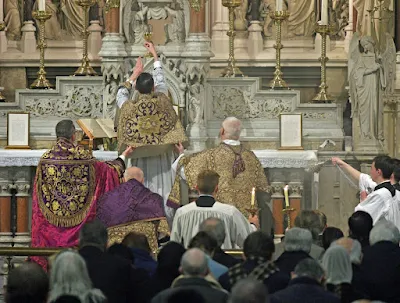
On the feast of the Exaltation of the Holy Cross, Una Voce Scotland hosted H.E. Raymond Cardinal Burke for the celebration of a Pontifical High Mass at the church of the Immaculate Heart in the Balornock district of Glasgow – how better to mark the 12th anniversary of the implementation of Summorum Pontificum! Once again, we should all find it very encouraging to see how young the people are who made the effort and committment to put together this kind of ceremony, which requires a good amount of work and rehearsal. This is plainly not based in nostalgia, but a real love for the richness and beauty of our Catholic liturgical tradition. (Our thanks to Una Voce Scotland for sharing with is these photos by Mr Matthew Lukowski.)

The genuflection at the words of the Epistle (Phil. 2, 5-11), “that in the name of Jesus every knee should bow, of those that are in heaven, on earth, and under the earth:”

Wednesday, September 04, 2019

Counterpoints to the Hieromonk’s Letter

My publication earlier this week of a letter written by a Greek Orthodox monk to a Benedictine monk concerning the plight of the Catholic Church was meant to stimulate thought and conversation. Dr. Pepino and I felt that this anonymous heir of the East made a number of valid points, eloquently and persuasively. We also saw that he indulged in some of the all-too-familiar Orthodox gibes and generalities that gloss over a much more complicated picture for the convenience of those who are settled in mind.

I posted the letter in the spirit of “if the shoe fits, wear it,” taking from the monk his good points — above all, that the West has a solemn obligation to reconnect with and restore its own tradition — and rolling eyes at his unfair points. But I see now that I should engage it in greater detail, indicating where I agree and where I disagree. Indeed, I must engage it, because at least one reader was prompted by the post to ask me: “Are you planning to convert to Orthodoxy?”

I will begin with two reactions that were sent to me privately, which I share here with permission, because I find them expressive of my own view:
There are three kinds of ecumenism.
       1. Stupid Ecumenism, which is what Roman Catholics do: all the worst of us compared to all the best of you.
       2. Mean Ecumenism, which is what Orthodox do: all the best of us compared to all the worst of you.
       3. Real Ecumenism, of which the sole known practitioner among Christian prelates was Pope Benedict XVI: the whole of us, the best, the worst, and everything in-between, compared to the whole of you, the best, the worst, and everything in-between.
       Our Orthodox monk friend from yesterday proved to be no exception to this assessment. “Your roots go no further back than the 12th century.” This is a gross and grotesque exaggeration, as if people like St Theresa of Jesus or St John of the Cross brought nothing to the table; as if the Orthodox had none of their own fashionable spiritual gurus; as if every word spoken by every Orthodox priest or monk were drawn straight and solely from the Holy Fathers; as if pure stasis in the 5th or 6th or 7th or 8th century would be a good thing, a guarantee of fidelity. It is painfully easy to point out that the West has its lunatics like Chardin and Rahner, as if there were none to be found in the East. It is painfully easy to point out that the West will tolerate any amount of heresy, but no schism, while ignoring the fact that the East will tolerate any amount of schism, but no heresy. The former is without question a very bad thing, but the latter is certainly not a sign of “a rather incredible period of spiritual renewal.” Both churches have beams in their eyes.
Another similar reaction, though more mildly stated:
Interesting letter from the Orthodox monk, but I am always a bit leery of their heavy-handed apologetics (which, to be fair, we can be guilty of, too). While a calm person can see that the grass isn’t greener on the other side, there is a certain kind of nervous Trad — beaten down for years by the establishment, reading too many sensationalist blogs, and sick of gay clergy — who wants to live in a holistically solid Church now rather than take the long, less rewarding task of building the blocks of reform. In other words, jump on board an apparently tidy trireme in the bright blue Aegean rather than bail water and repair sails on the barque of Peter. I’ve witnessed two defections in my time to Orthodoxy (though I have also sponsored two Orthodox to come into the Catholic Church), and in both cases they were highly discouraged Trads who weren’t interested in waiting things out past their own life times; of course there were other issues at hand (they lived in places where traditional Catholicism was more or less non-existent), but the highly distilled brand of Orthodoxy touted in the West — devoid of all their liturgical development, medieval and dogmatic theology, and history of caesaropapism by emperors and dictators — greatly appeals to these vulnerable people.
       Like you, I pray for the reunion of the Churches. I believe we are the answer to each other’s shortcomings and that we need to be honest with ourselves about what they are. I disabuse Catholics who speak ill of the Orthodox in public and happily rebuke Orthodox when they do the same to us. It’s an all-round sticky situation. We have until eternity to figure it out though.
Now for my own observations.

Like the West, the East has its “black boxes” into which people are not supposed to look too closely, lest they find tensions, contradictions, reversals, laxities, and other odds and ends. Above all, their systematic theology and moral theology are a mess, because they have no authoritative framework for interpreting the Fathers. Their own version of scholasticism, a bit like Islam’s, imploded and fell apart, unlike the West’s, which with figures like Bonaventure and Thomas attained a rare perfection and magnificence. Above all, there is no one in the East who is as biblical, patristic, ecumenical, synthetic, broad-minded, and comprehensive as the Angelic Doctor. Aquinas makes frequent, sympathetic, incisive use of dozens of Western and Eastern Fathers — indeed, more Eastern authors than Western — so it’s a bit silly to say our theology starts in the 12th century. It would be just as silly to say that the theology of the East stops after the Seventh Ecumenical Council.

Moreover, what the hieromonk doesn’t seem to grasp, or perhaps doesn’t wish to acknowledge, is the many great spiritual figures the West has always had, and still has. He does not mention figures like St. Thérèse of Lisieux, Bd. Charles de Foucauld, St. Elizabeth of the Trinity, St. Maximilian Kolbe, and Bd. Columba Marmion, let alone countless martyrs and saints of every state in life. He mentions St. Pio of Pietrelcina only to suggest that he was opposed by the Church, which is only partially true. The writings of Fr. Jacques Philippe are every bit the equal of many contemporary books published by the Orthodox. One might also take a look at the pre-Reformation volumes of the Classics of Western Spirituality series from Paulist Press to get a rough sense of the richness of our mystical tradition.

Perhaps it is felt on the Eastern side that elders or spiritual guides must be distinguished by the length of their beards. We have some impressive “graybeards” on our side, as well, as one can experience by visiting places in the West where the Catholic faith is still believed and lived in its integrity — places like Le Barroux, Fontgombault, Clear Creek, Silverstream, or Norcia. (I privilege Benedictine monasteries only because, as a Benedictine oblate, I know them well.) I have heard or spoken with monks at nearly all of these houses whose wisdom reminds me of the spirit I encounter when reading the lives of the desert fathers. Anyone from the East would fit right in, liturgically and spiritually.

Admittedly, the number of such islands of sanity, outposts of civilization, is not huge; but they do exist and are attracting vocations — they are not in danger of disappearing altogether. Yes, theoretically, popes can try to crush all of this under foot, but popes have limited lifespans, and so do their plans and projects. “Man proposes, God disposes.” The pope can stack the deck all he wants, but God will have the last laugh. There is no chance, for example, that the old Roman liturgy will ever disappear. There are still priests, more with each passing decade, who are willing to risk everything and suffer anything rather than give up the traditional rite. When you have a handful of people like this, you have permanence. Progressivism will die the first and the second death. It has no intrinsic principle of life; it lives as a parasite on the scraps of tradition it still retains.

Vetus Ordo
On the subject of liturgy: I have joyfully participated in many Byzantine Divine Liturgies celebrated by Greek Catholics — offered in Slavonic, Ukrainian, Romanian, German, and English. I learned to cantor and have done it frequently. I’ve prepared choirs to sing the congregational prayers in three-part harmony. I have studied and continue to study the Eastern Fathers, including Athanasius, the Cappadocians, Dionysius, and St. Maximus the Confessor. But . . . I am Roman to the core. There is nothing I love more than a solemn High Mass in the Roman Rite (obviously the Vetus Ordo — there is no other Roman rite worthy of the name, as the hieromonk recognizes). For sheer melodic beauty and variety, the Gregorian chant is a musical form unequaled by any chant in the East. On weekdays, I will take a quiet Low Mass at a side altar over any Divine Liturgy. Again, there is no doubt that the East has preserved its liturgical tradition well, whereas the West has squandered it like Esau selling his birthright for a mess of pottage. But the West has a liturgical tradition that is profound and beautiful, and those of us who have delved deeply into it are nourished by it, “fed with the fat of wheat, and filled with honey out of the rock” (cf. Ps 80:17).

The most important and seductive error of proponents of Orthodoxy is their claim, which we may assume is made more in ignorance than in malice, to be believing and doing only what is ancient. A little study of history handily dispenses with that myth. While there isn’t as much theological diversification and liturgical pluralism, there is still a process of development over the centuries that continues past the first half-millennium, past the first millennium, down to the present. In fact, the almost hyperventilating insistence on “fidelity to the early Church” is more a feature of Orthodoxy from the early 20th century onwards, especially as one finds it among the Russian émigrés in Paris who gave us such dreadful pseudo-scholarship as Lossky’s The Mystical Theology of the Eastern Church, which is a masterpiece of imaginary polemics or polemical imagination.

There is genuine growth in doctrine, liturgy, and devotion, for all Churches that remain alive. We see this across the entire Christian spectrum, East and West. There should be growth, amplification, variation, as long as it is not deviation or corruption. How do we know the difference? Not by a mathematical formula, that’s for sure, or a Geiger counter. It will often end up being a messy question of how something is received, perceived, accepted. Sometimes devotions come in and they are taken up right away with joy; other times, things sputter out and disappear. History is not tidy, but it’s not completely chaotic, either. There are patterns. One can see the difference between wheat and weeds if one has enough distance and perspective. On this point, the East will have to say the same thing as the West: much of what we do is not from the apostolic period, or even from the patristic golden age, but from the Middle Ages, or in the case of the Slavic tradition, even later.

Female acolytes: an example of corruption entering into the East
At the NLM post last week, there was an interesting exchange along these lines. One commenter objected that “the current Eastern iconostasis (or ‘holy wall’) . . . is not very traditional.” A hieromonk responded:
The point of tradition is that it develops and praxis changes over the centuries. We do not indulge in liturgical archeology, but are part of a continuum as the Holy Spirit guides the Church (though Catholic and Orthodox renovationists love doing this in a Protestant critical manner, believing they are scraping away centuries of accretion to find a somehow pristine and pure practice — of their own making!)
       In the early Church, communion was given in the hands and the Holy Gifts reserved in domestic settings. As Byzantines, we do not do this today, nor do we seek to do so, as tradition has developed so that things are now done differently.
       The services have grown in richness and solemnity as tradition unfolds. The development of Byzantine hymnography has brought new textual layers and features to the Liturgy and offices; the musical tradition has also seen great growth, with new genres of hymns over the millenia; the development of iconography has seen the portrayal of new themes and the development of the ikonstas; the arrangement of the temple has developed to what we see and know today.
       So... we need to be cautious about saying things are not traditional if they were not earlier practices.
He is right. We are not antiquarians, but at the same time, we will not assume that any and every possible change will be a good one. Growth is inevitable, as Newman says, but we still have to compare any new practice or idea against the background out of which it emerged to ensure that it is moving in a straight line rather than off at some bizarre angle. Plenty of examples come to mind, such as we discuss here regularly at NLM. To take only a most obvious one: communion on the tongue to people kneeling is a development that comes straight out of increasing awareness of the adorable mystery of Our Lord’s presence in the Eucharist and of the special consecration of His ministers at the altar. It is just not hard to see that this development is a deepening expression of what the Church already believed, but of which it had not yet found the fullest or most emphatic expression. Many more examples can be given in the realms of clerical vestments, church architecture, and liturgical hymns and orations. And then there will be simply issues of pluralism: some churches give the sacraments of initiation all at once to infants, while others spread them out in acknowledgment of the role of reason and free will. Is one necessarily right and the other wrong? Couldn’t they both be right, because they’re looking from different legitimate angles?

Thus, it stretches credulity for any Orthodox to claim “we’re doing things just like they were done in the ancient Church.” No, you’re not. All legitimate living churches show development; indeed, all must struggle with and against corruption — liturgical, theological, ethical, political, or what have you. All must welcome reform movements and distinguish them from revolutions. All must pray for conversion, personal and institutional. The moment we stop doing these things, on any side, in any community, we have truly give up the Holy Ghost.

The Holy Ghost has not abandoned any of the apostolic-sacramental churches, since all of them give abundant evidence of the operations of the Spirit: faith, hope, charity, the gifts and fruits, miracles. But I do think that (1) there has been a widespread deliberate rejection of charismatic graces on the part of the Church’s hierarchy; (2) God in His Providence has permitted this period of hard and soft apostasy to test, purify, and animate us, without reneging on His promise that the gates of hell will not prevail; (3) we will see either a dramatic restoration of Catholicism or the end of the world — one or the other.

Of all apocalyptic fiction I have read, the most convincing to me is the “Short Story of the Antichrist” by Vladimir Soloviev. At the end of time, in the face of mass defection of Christians, the last pope, the last patriarch, and the last pastor come together in the Catholic Church to face the enemy and to welcome the King.

Let us pray and pray often for the reunion of the churches in truth and in charity.

“Holy Father, I know you want to breathe with both lungs, but surely…”
Visit www.peterkwasniewski.com for articles, sacred music, and classics reprinted by Os Justi Press (e.g., Benson, Scheeben, Parsch, Guardini, Chaignon, Leen).

More recent articles:

For more articles, see the NLM archives: