St Peter Martyr was killed on April 6, 1252, but since that day so often occurs in Holy Week or Easter week, when he was canonized less than a year after his death, his feast was assigned to April 29. As we have noted several times in the past (see here and here), his relics are in the Portinari chapel within the basilica of St Eustorgius in Milan. Here is a picture the large reliquary containing his skull, taken in the basilica on Sunday by Nicola de’ Grandi.
In the background of this picture, we see the Saint’s monumental tomb of the type known as an ‘arca’ in Italian, which is deliberately designed so that the faithful can walk under it and touch the sarcophagus containing the relics. (The video below it was made a few years ago.)
An inscription which commemorates the dedication of a new altar for the chapel on the day before his feast in 1737.
Last month, we shared pictures of a solemn Ambrosian Mass celebrated in one of the most ancient and important churches in Milan, the basilica of St Ambrose, on December 14th, the fifth Sunday of Advent. As a follow up, here are some close-up pictures of the basilica’s high altar taken by Nicola de’ Grandi. This altar was made between 825 and 859 by a sculptor named Vuolvino; the front, which faces the people, is gold; the back, which faced the apse, is silver.
The central panel of the front shows Christ in glory, surrounded by the symbols of the Evangelists and the Twelve Apostles. Twelve episodes of His life are depicted in the panels to either side.
The stories of the life of Christ run from bottom to top, first on the left side, then the right. Here we see the Annunciation...
followed by the Nativity, with a shepherd in the middle, raising his arms in a gesture which conveys his emotion at finding the Messiah. This is a very good example of how artists of the Carolingian Renaissance rediscovered a more naturalistic approach to art from ancient Roman models, which they would have been able to study in very old illustrated manuscripts.
This past Sunday, a solemn Mass was celebrated in the traditional Ambrosian Rite in the basilica of St Ambrose, one of the most ancient and important churches in the city of Milan, as a special occasion for the Jubilee year, by kind permission of the mitred abbot of the basilica, Mons. Carlo Faccendini. The Mass was celebrated by Mons. Francesco Braschi, and our own Nicola de’ Grandi, who has worked tirelessly for many years to preserve the Ambrosian liturgical tradition, served as the MC. Our friend Don Elvir Tabaković, a former professional photographer from Croatia who is now in religious life, was also there, and we are grateful to him for sharing these beautiful pictures with us. Ad multos annos!
The entrance procession comes from the sacristy. The Ambrosian Advent begins two week before the Roman, so this past Sunday was the fifth, rather than the third of Advent; there is no Gaudete Sunday, so the vestments are violet.
The Mass was also attended by several members of the Confraternity of the Most Blessed Sacrament from the town of Vanzaghello, about 25 miles outside Milan.
The basilica’s 9th century apsidal mosaic was badly damaged by a bomb during World War II, but expertly reconstructed. Christ is shown with the Archangels Michael and Gabriel and the martyrs Gervasius and Protasius to either side of His throne; below are portraits of St Ambrose’s siblings, St Marcellina and Satyrus, and St Candida.
The prayers at the foot of the altar.
The first incensation of the altar. An Ambrosian thurible has no cover, so it is swung in wide arcs to keep the contents inside by centrifugal force.
This article is mostly the work of our Ambrosian writer Nicola de’ Grandi; I translated it from Italian, and added the parts about the Ambrosian arrangement of the Sundays after Pentecost.
In the Ambrosian Rite, there are only fifteen Sundays formally named “after Pentecost”, and if Pentecost is very late, as few as eleven may be actually celebrated. The series is interrupted by the Sundays “after the Beheading of John the Baptist,” of which there may be four or five, followed by the first and second Sundays of October. On the third Sunday, the church of Milan commemorates the dedication of its cathedral, followed by three Sundays “after the Dedication.” This division is found in one of the very oldest surviving Ambrosian liturgical books, the 8th century lectionary of Busto Arsizio. The largest possible number of Sundays after Pentecost is therefore 26, whereas it is 28 in the Roman Rite, since the Ambrosian Advent begins two weeks earlier, on the Sunday following St Martin’s day.
A tradition which is not recorded in particularly early sources states that the dedication commemorated on the third Sunday of October took place in the year 453 under St Eusebius, archbishop of Milan from 449-462, after the cathedral had been destroyed by the Huns, and that on the same day, the lesser of the city’s two cathedrals was dedicated in 836. However, there are two things which suggest that the choice of this day as one of the hinges of this part of the liturgical year depends on more than a simple recollection of these events, especially in light of the highly conservative tradition of the Ambrosian rite.
The cathedral of Milan as it stood for many years, before the façade was completed in 1812.
The first, as noted in an article in 2016, comes from St Ambrose himself, in his “Second Apology for David”, a stenographer’s record of sermons which he preached over two or three days in the year 388. This work attests that the Gospel of the Sunday “before the Dedication”, that of the woman caught in adultery, John 8, 1-11, and that of the Dedication itself, John 10, 22-30, were already in their places next to each other in his time. Both of these Gospels take place in the temple in Jerusalem. “At that time, Jesus went unto mount Olivet. And early in the morning he came again into the temple.” (John 8, 1-2) “At that time, it was the feast of the dedication at Jerusalem: and it was winter. And Jesus walked in the temple, in Solomon’s porch.” (John 10, 22-23) This does not seem likely to be a coincidence.
The second comes from a comparison with other liturgical traditions. The rite of Milan is the only Western rite which has a liturgical season marked by a dedication, but the Syrian Rite, in both its eastern and western form, also has a season “of the dedication”, which in turn may derive from the ancient rite of the city of Jerusalem. The Armenian lectionaries of the fifth century, which faithfully reproduce the order of readings used in the Holy City, contain a feast of “the Dedication of the Holy Places” on September 13th, and assign John 10, 22-42, to be read at the “Anastasis”, the great church of the Resurrection built by Constantine. The existence of a liturgical season centered on a dedication, attested in the very oldest Ambrosian sources, may therefore derive from the tradition of Jerusalem.
The Mass texts of the Solemnity of the Dedication refer repeatedly to the Church as the bride of Christ. The Preface, for example, one of the oldest in the Ambrosian repertoire, reads as follows.
“Per Christum Dominum nostrum, qui eminentiam potestatis acceptæ Ecclesiæ tradidit, quam pro honore percepto, et Reginam constituit et Sponsam. Cuius sublimitati universa subiecit: ad cuius iudicium consentire iussit e cælo. Hæc est mater omnium viventium, filiorum numero facta sublimior: quæ per Spiritum Sanctum quotidie Deo filios procreat: cuius palmitibus mundus omnis impletus est: quæ propagines suas ligno baiulante suspensas erigit ad regna cælorum. Hæc est Civitas illa sublimis iugo montis erecta, perspicua cunctis, et omnibus clara: cuius conditor, et inhabitator est idem Dominus Noster Jesus Christus Filius tuus. Quem una tecum...”
“…through Christ Our Lord. Who handed down to the Church the preeminence of the power which He had been given, and in accordance with the honor (She) received, made Her both Queen and Spouse, and subjected all things to Her majesty, and from heaven ordered that they obey Her judgment. She is the mother of all the living, all the more exalted for the number of Her children, who daily beareth sons unto God through the Holy Spirit. All the world is filled with Her branches; She lifts up Her shoots to the kingdom of heaven, supported by the wood of the Cross. She is that exalted city, built upon the height of the mountain, visible and bright to all; and He that founded and dwelleth in Her is the same Our Lord Jesus Christ, Thy Son; Whom together with Thee, Almighty Father, and the Holy Spirit, the Angels sing praise…”
The connection between this theme and the Sunday of the Dedication is confirmed at the very beginning of the Ambrosian Rite’s history, in the writings of St Ambrose himself, and indeed, in the same “Second Apology for David” in which he comments on the Gospel of the Adulteress. “Thus did Christ love the beauty of His Church, and prepared Her in order to take Her as His Bride.”
The Duomo of Milan as it stands today is the result of a project which began in 1386, to replace the two cathedrals which had hitherto served the see of St Ambrose. The “winter church”, as it is still called in Ambrosian liturgical books, was the smaller of the two, dedicated to the Virgin Mary, and used from the Third Sunday of October, the feast of its Dedication, until Holy Saturday; it stood where the modern cathedral stands, but was nowhere near as large. The Gospel from John 10, which is attested on this day in the oldest Ambrosian liturgical books, was read here; the “dedication” or “renewal” (“enkainia” in Greek) to which it refers at the beginning is the re-dedication of the Jerusalem Temple which took place under Judas Maccabee, as recorded in 1 Maccabees 4, 59.
On this occasion, in the portico of the Temple, the Lord rebukes those who insist that He tell them whether or not He is the Messiah. “I speak to you, and you believe not: the works that I do in the name of my Father, they give testimony of me. But you do not believe, because you are not of my sheep.” In contrast to those who do not believe, “My sheep hear my voice: and I know them, and they follow me. And I give them life everlasting; and they shall not perish for ever, and no man shall pluck them out of my hand. That which my Father hath given me, is greater than all: and no one can snatch them out of the hand of my Father. I and the Father are one.” In the treatise cited above, St Ambrose explains this same passage as a reference to the replacement of the old Temple, and the old covenant of which it is the symbol, with the New and Eternal Covenant.
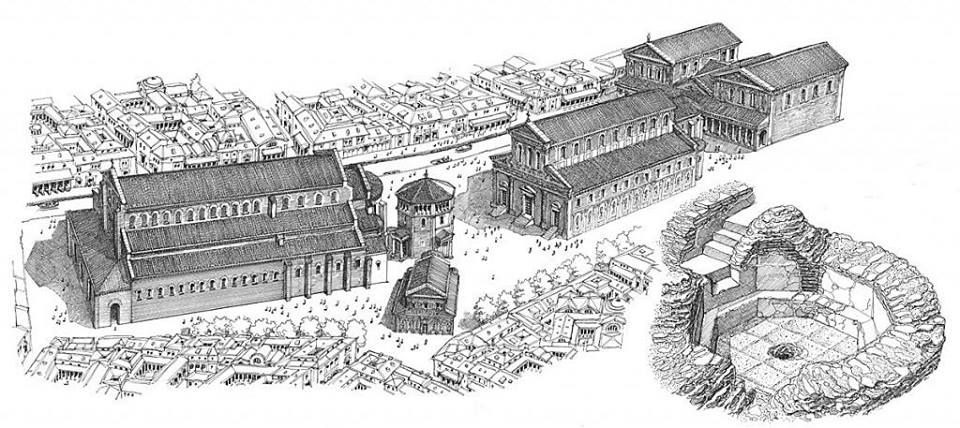
A reconstruction of the cathedral complex of Milan, with the summer church of St Thecla on the left, and the winter church of the Virgin Mary at the right. The octagonal structure in front of St Thecla is the baptistery of St John; the smaller structure beneath it is the baptistery of St Stephen. At the lower right is a partial reconstruction of the interior of the baptistery of St John.
The larger “summer church”, which was demolished in 1543, stood on the opposite end of the modern Piazza del Duomo, and was dedicated to St. Thecla, for which reason her name is included in the Canon of the Ambrosian Mass. In several important liturgical books of the Ambrosian Rite, another Gospel is assigned to the Mass on the same day in this “summer church”, Matthew 21, 10-17.
“Jesus went into the temple of God, and cast out all them that sold and bought in the temple, and overthrew the tables of the money changers, and the chairs of them that sold doves: And he saith to them: It is written, My house shall be called the house of prayer; but you have made it a den of thieves.” The purification of the Temple which follows looks forward to the establishment of the Church as the new house of God. In like manner, the basilica of the Anastasis in Jerusalem, built by the Emperor Constantine, is seen in the liturgical tradition of Jerusalem as the replacement of the temple destroyed by Titus in 70 AD.
The Expulsion of the Money-changers from the Temple, 1610-20, by the painter known as Cecco del Caravaggio, from the obvious indebtedness of his style to the works of Caravaggio.
For the many centuries during which the two cathedrals were still in use, the cathedral chapter of Milan, led by the archbishop, would celebrate a particularly interesting rite on both this day and Holy Saturday. All of the liturgical objects used in the cathedral were loaded into an “ark” (arca), and transported from the winter to the summer church on Holy Saturday, vice versa on the feast of the Dedication. The Latin word “arca” was also used for the place where the Scroll of the Law was kept in a synagogue; its use in the Milanese rite perhaps refers to the substitution of the synagogue’s worship by that of the Church, the one replacing the other, as the church building itself replaces the old temple.
A text from Vespers of the Dedication may also be read as a corroboration of this explanation. As on many of the most ancient and important feasts in the Ambrosian Rite, the first Vespers of the Dedication has only one Psalm, to which Psalms 133 and 116 are added at the end, and the three sung as a single Psalm. The Psalm in this case is 85, from which is also taken the antiphon, “All the nations thou hast made shall come and adore before thee, O Lord.” This text is therefore an assertion that Christ came as redeemer and savior not of the Jewish people alone, but for all nations who are called into His Church.
Finally, we may note the epistle of the Sunday preceding the Dedication, Romans 7, 1-6: “Know you not, brethren, (for I speak to them that know the law,) that the law hath dominion over a man, as long as he liveth? For the woman that hath an husband, whilst her husband liveth is bound to the law. But if her husband be dead, she is loosed from the law of her husband. Therefore, whilst her husband liveth, she shall be called an adulteress, if she be with another man: but if her husband be dead, she is delivered from the law of her husband; so that she is not an adulteress, if she be with another man.” In this context, this passage is taken to mean that the Law of Moses no longer has dominion over the people of God, which now lives under the grace of Christ, the “new” spouse of the Mystical Body.
We never let August 30th pass without remembering the Blessed Cardinal Alfredo Ildefonso Schuster, who went to his eternal reward on this day in 1954, after serving as Archbishop of Milan for just over a quarter of a century. We have written about him many times on NLM, partly in connection with our interest in the Ambrosian liturgy, of which he was a great promoter, but also as one of the most important scholars of the original Liturgical Movement.
In 2018, we published a brief meditation of his on the value of praying the Office, which, to judge from viewing numbers and several requests for permission to reprint, was very much appreciated. This was taken from the account of Schuster’s final days included in the book Novissima Verba by Abp Giovanni Colombo, the cardinal’s successor-but-one in the see of St Ambrose. At the time of Schuster’s death, the latter was a simple priest, serving as both rector and professor of Italian literature at Venegono, the archdiocesan seminary which the cardinal had founded; it was he who who administered the last rites to Schuster. My translation of this incredibly moving piece certainly does not do justice to Abp Colombo’s magnificent Italian. Thanks to Nicola de’ Grandi for some of the pictures.
Had it been possible to foresee that these were his last words, that each one was almost like a will, they would certainly have been noted down one by one with diligence, to be kept in a notebook with the veneration due to a father. But there was no way any one could have seen ahead of time how close and how swift his final departure would be, not even the doctors who hoped to get him back his strength with a few weeks’ rest and care. So now, after five years, the heart alone remains, with no written aid, to remember his final holy words, and record them faithfully as it finds them in memory.
The call by which his secretary, Mons. Ecclesio Terraneo, informed us that His Eminence would come to Venegono for a period of rest was received in the seminary with a sense of joy, and also amazement. Joy, because it hardly seemed real that we could have time to enjoy the presence of the archbishop, whose visits were frequent, to be sure, but always accompanied by his eagerness to run off to other places and persons; amazement, and almost dismay, because the suspicion had arisen in us all that only a serious illness could have brought such a tireless shepherd to yield at last to the idea of taking a vacation, the first in 25 years of his episcopacy, and as it would prove, the last. …
… although nature and vocation had made him for the peace of prayer and study, more than for the turmoil of action, he never deceived himself (as to his duty), not even when old age and poor health would have urged greater moderation (in his activities). He had no wish to spare his energies, even when he was close to the end. He used to say “To be archbishop of Milan is a difficult job, and the archbishop of Milan absolutely cannot allow himself the luxury of being ill. If he becomes ill, it is better that he go at once to Paradise, or renounce his see.”
Cardinal Schuster’s episcopal consecration, celebrated in the Sistine Chapel by Pope Pius XI, himself previously archbishop of Milan, on July 21, 1929.
The archbishop’s car stopped outside the entrance to the seminary around 6 p.m. on August 14, 1954. It was no longer raining, but a low cloud cover filled the sky, … Exhausted, wan, in pain, walking towards the elevator with difficulty, he said, “I would like to read some of the recent publications on archeology, liturgy, church history while I am here.” He had always taught that studies are an essential component of the priest’s spiritual life; all his life had borne witness to this teaching, and he remained faithful to it even in the face of a deadly illness.
On the feast of the Assumption, the radio broadcast the noon Angelus recited by Pope Pius XII. Standing in the room where he took his meals privately, because he did not have the strength to reach the common dining room, while awaiting the Pope’s prayer, the archbishop heard along with us the joyful tolling of the bells of St Peter’s. At the sound, he looked at us with eyes full of emotion, and repeated twice, “The bells of my town, the bells of my town!” His voice was trembling; was it the sweet nostalgia of other occasions that called back to him to the long-ago solemnities of his childhood, or was it rather the sad understanding that he would never hear them again?
On the afternoon of August 18th, the high school seminarians and those of the theologate, who had come back to the seminary the day before… gathered on the tree-lined slope under the window of his apartment to see and greet the archbishop. Called by their youthful song, he appeared smiling on the balcony, and spoke to them with these words. “Here I am among you, on a forced rest; because I did not wish to pay the interest year by year, now I am forced to pay both interest and capital at once. You have asked for a memento from me. I have no memento (to give you), other than an invitation to holiness. It seems that people do not any longer let themselves be convinced by our preaching, but in the presence of holiness, they still believe, they still kneel and pray. It seems that people live in ignorance of supernatural realities, indifferent to the problems of salvation, but if a true Saint, living or dead, passes by, everyone runs to see him. Do you remember the crowds around the caskets of Don Orione or of Don Calabria? Do not forget that the devil has no fear of our playing fields and our movie theatres [1], but he does fear our holiness.” …
His days, which should have been passed in complete rest, were full of prayer, reading, decisions on the affairs of the diocese, and discussions. Someone said to him, “Your Eminence allows himself no rest. Do you want to die on your feet like St Benedict?” Smiling, he answered, “Yes.” This was truly his wish, but this was a matter of Grace, and thus it was God’s to grant.
It was only a few days before the 25th anniversary of his entry into the diocese. In the quiet sunsets of Venegono, he was beset by memories. How many labors and events, some of them tragic, did he have to confront after that serene morning of September 7th (1929), when, on the journey from Vigevano to Rho, he stopped the car half-way over the bridge on the Ticino river, got out, and kissed the land of St Ambrose on its threshold? That land had become his portion of the Church, the sacred vineyard of his prayerful vigils, of his austere penances, of his labor and his love, of his griefs both hidden and known, of all his life, and now of his death. From the end of the road he had traveled, looking back, he saw that he had passed through dangers of every sort, but felt that the hand of God had drawn him safely through fire and storm; above all, he was comforted by the thought that he had always had the affection and loyalty of his people. …
(Unedited footage of Cardinal Schuster’s installation as archbishop in Milan cathedral, unfortunately without soundtrack. Particularly noteworthy is the Latin plaque shown at the beginning, which set over the door of the cathedral, and starts with the words “Enter (‘Ingredere’, in the imperative,) Alfred Ildephonse Schuster.” Starting at 1:20, one sees the extraordinarily large crowd in the famous Piazza del Duomo, far too large for them all to enter the cathedral for the ceremony itself, many of whom have climbed up onto the large equestrian statue of King Victor Emmanuel II. From the YouTube archive of the Italian film company Istituto Luce.)
The archbishop spoke of the recent canonization of St Pius X, saying among other things, “Not every act of his governance proved to be completely opportune and fruitful. The outcome of one’s rule in the Church, as a fact of history, is one thing, whether for good or ill; the holiness that drives it is another. And it is certain that every act of St Pius X’s pontificate was driven solely by a great and pure love of God. In the end, what counts for the true greatness of the Church and Her sons is love.”
He spoke of St Pius X, but he was certainly thinking also of himself, in answer to his own private questions. Looking back upon his long episcopacy, the results could perhaps have made him doubt the correctness of some of his decisions, or the justice of some of his measures; he might perhaps have thought that he had put his trust in both institutions and men that later revealed themselves unworthy of it. But on one point, his conscience had no doubts: in every thought and deed, he had always sought the Lord alone, had always taken His rights with the utmost seriousness, and preferred them above everything and every man, and even above himself. As his spiritual father, Bl. Placido Riccardi, had taught him when he was a young monk, the Saint is set apart from other men because he takes seriously the duties which fall to him in regard to God. …
One morning, the door of his room was left half-opened; from without, one could see the cardinal sitting at the table in the middle of the room in the full light of the window. His joined hands rested on the edge of the desk, with the breviary open before them; his face, lit by the sun, was turned towards heaven, his eyes closed, and his lips trembled as he murmured in prayer. A Saint was seen, speaking with the invisible presence of God; one could not look at him without a shiver of awe. I remembered then what he had confided to me some time before concerning his personal recitation of the Breviary, in the days when he found himself so worn out that he had no strength to follow the sense of the individual prayers.
“I close my eyes, and while my lips murmur the words of the Breviary which I know by heart, I leave behind their literal meaning, and feel that I am in that endless land where the Church, militant and pilgrim, passes, walking towards the promised fatherland. I breathe with the Church in the same light by day, the same darkness by night; I see on every side of me the forces of evil that beset and assail Her; I find myself in the midst of Her battles and victories, Her prayers of anguish and Her songs of triumph, in the midst of the oppression of prisoners, the groans of the dying, the rejoicing of the armies and captains victorious. I find myself in their midst, but not as a passive spectator; nay rather, as one whose vigilance and skill, whose strength and courage can bear a decisive weight on the outcome of the struggle between good and evil, and upon the eternal destinies of individual men and of the multitude.” …
He had decided to end his stay and continue on his way. In vain did the doctors and all his close friends ask him to stay longer – he was set to depart from Venegono on August 30. “Neither rest nor the treatments have helped me: I might as well return to Milan. If death comes, it will find me on my feet, at my place and working.” And he would indeed depart that Monday, but on a different voyage.
Giovanni Cardinal Colombo, 1902-92; archbishop of Milan 1963-79.
In the middle of the night, shortly after 1 o’clock in the morning of the 30th, the brother in charge of the infirmary called me to his sickbed. I found him alone, sitting on the bed, with his hands joined, in deep recollection. Just a moment before he had received the Holy Eucharist from his secretary, Mons. Terraneo.
“I wish for Extreme Unction. At once, at once.”
“Yes, Your Eminence; the doctor will be here in a few moments, and if necessary, I will give you Extreme Unction.”
With a voice full of anguish, he replied, “To die, I do not need the doctor, I need Extreme Unction. … be quick, death does not wait.”
Meanwhile, Agostino Castiglioni, the seminary doctor, had arrived, and after seeing his illustrious patient, told us that his condition was very serious, but did not seem to be such that we should fear his imminent death.
Assisted by Mons. Luigi Oldani, by Fr Giuseppe Mauri, and Mons. Ecclesio Terraneo, I began the sad, holy rite. He spoke first, with a clear and strong voice: “In nomine Patris et Filii et Spiritus Sancti. Amen. Confiteor Deo omnipotenti...”
He followed every word with great devotion, answering every prayer clearly; at the right moment, he closed his eyes, and without being asked, offered the back of his hands for the holy oils.
When the sacrament has been given, sitting on the bed, he said with great simplicity, “I bless the whole diocese. I ask pardon for what I have done and what I have not done. In the name of the Father, and of the Son, and of the Holy Spirit.” He traced a wide Sign of the Cross before himself; then he lay down on the bed. The doctor at the moment realized that his heart was giving out.
“I am dying. Help me to die well.”
The signs of his impending death became more evident.
He groaned: “I cannot go on. I am dying.” …
He was told that in every chapel of the seminary, the various groups, the students of the theologate, the high school, the adult vocations, the oblate brothers, the sisters, were gathered in prayer and celebrating Masses for him. “Thank you! Thank you!”
He looked steadily upon each person who entered the room, as if he were trying to recognize someone for whom he was waiting. With his innate gentility, which did not fail even in his final agony, he invited those present to sit. “Please, have a seat!”
Again and again he repeated the prayers suggested to him, but at a certain point he said, “Now I can’t any more. Pray for me.” …
At 4:35, he let his head fall on the pillow, and groaned. His face became very red, then slowly lost its color. From the other side of the bed, the expression of the doctor, who was holding his wrist, told us that he no longer lived upon the earth. The heart of a Saint had ceased to beat. …
None of those present felt that they had attended three hours of agony, but rather, at a liturgy of three hours’ length. Three hours of darkness, but a darkness filled with the hope of the dawn that would rise in the eternal East. Three hours of suffering, but a suffering permeated by waves of infinite joy coming rapidly on. He spoke no uncontrolled words; his suffering, which was great, (he said “I cannot go on! I cannot go on!” several times), was indicated by quiet laments, as if in dying he were not living through the sufferings of his own flesh and spirit, but rather reading those of the Servant of the Lord in the rites of Holy Week. [2] He made no uncontrolled movements; his translucent hands, his arms, his head, all his slender body, held to the hieratic gestures of a pontifical service.
The archbishop’s death was in no way different from those of the ancient giants of holiness on whose writings he had long meditated, with such fervor as to become familiar with their very thoughts, their feelings and their deeds. A year before he died, describing their death in the Carmen Nuptiale [3], without knowing it, he prefigured his own death. “The death of the ancient Fathers was so dignified and serene! Many holy bishops of the Middle Ages wished to breathe their last in their cathedral, after the celebration of the Eucharist, and after exchanging the kiss of peace with the Christian community. Thus does St Gregory the Great describe the death of Cassius, bishop of Narni, of St Benedict, of St Equitius, etc. In the Ambrosian Missal, the death of St Martin is commemorated as follows: Whom the Lord and Master so loved, that he knew the hour in which he would leave the world. He gave the peace to all those present, and passed without fear to heavenly glory. [4] But what was it that made the death of these Saints so precious in the sight of God (Psalm 115, 6) and of the Church? In the fervor of their Faith, they rested solidly on the divine promise, and so set their feet on the threshold of eternity. ‘Rejoicing in the sure of the hope of divine reward….’ These are the words of St Benedict.” [5]
The Carmen Nuptiale was a truly prophetic swan song. Speaking of St Benedict, Schuster had written, “After the Holy Patriarch’s death, some of his disciples saw him ascend to the heavenly City by a way decorated with tapestries, and illuminated with candlesticks. This was the triumphal way by which the author of the Rule for Monks and the Ladder of Humility passed.”
The street which descends from the hill of the seminary, passing through Tradate, Lonate Ceppino, Fagnano Olona, Busto Arsizio, Saronno, and comes to Milan, was the triumphal way decorated with tapestries, illuminated by the blazing sun, on which not just a few disciples, but crowds without number, watched him pass, one who out of humility had refused all celebration of his 25th year of his episcopacy.
Who drove all those people, on that August 31st, to line the streets? Who drew the workers to come out of their factories, along the city walls? Who brought those men and women together, waiting for hours for the fleeting passage of his casket? Who drove the mothers to push their little ones towards that lifeless body? Why did they all make the Sign of the Cross, if his motionless hand could not lift itself to bless them? What did those countless lips murmur, what was it that they wished to confide to a dead man, or ask of him?
He himself gave the answer fifteen days before to the seminarians, speaking from the balcony of his rooms. “When a Saint passes by, everyone runs to see him.”
* * *
[1] “our playing fields and our movie theatres.” In the post-war period, Italian parishes built countless playing fields for various sports and movie theaters, to provide healthy activities for young people, while keeping them away from similar facilities run by the communists. This was especially common in the urban centers of the north, Milan most prominent among them, which were taking in large numbers of new residents from the poorer regions of the South.
[2] Isaiah 53, known as the Song of the Suffering Servant, is read at the Ambrosian Good Friday service ‘post Tertiam’, before the day’s principal account of the Lord’s Passion.
[3] “Carmen Nuptiale – Wedding Song” is the title of a poem on the monastic life written by the Bl. Schuster in the year before he died.
[4] The Transitorium (the equivalent of the Roman Communio) of the Ambrosian Mass of St Martin. “Quem sic amavit Magister et Dominus, ut horam sciret qua mundum relinqueret. Pacem dedit omnibus adstantibus: et securus pergit ad caelestem gloriam.”
[5] The Rule of St Benedict, chapter 7. “Securi de spe retributionis divinae... gaudentes.”
Today is the feast of a group of four Saints, the martyrs Nazarius and Celsus, who are traditionally said to have died at Milan in the middle of the first century, and Popes Victor I (ca. 189-99) and Innocent I (401-17). On the Ambrosian Calendar, the two martyrs have the day to themselves, and their feast is kept with a vigil; there is also a feast of the translation of Nazarius’ relics on May 10th.
The high altar of the church of the Holy Apostles and St Nazarius, commonly known as “San Nazaro in Brolo”, with the relics of St Nazarius.
In 395 AD, their bodies were discovered by St Ambrose in a garden outside the city; when the tomb of Nazarius was opened, his blood was seen to be as fresh as if he had just been wounded. His relics were then taken to a basilica which Ambrose had constructed about 15 years earlier, and dedicated to the Twelve Apostles; a large apse was added to the church, and the relics laid to rest in a crypt in the middle of it. In 1578, in the course of building a new altar for the church, a silver reliquary contemporary to the original construction of the basilica was discovered under the high altar, with relics of the Apostles Ss Peter and Paul inside it. St Ambrose himself attests that these relics had been given to him by Pope St Damasus I, for the first dedication of the church to the Twelve Apostles; St Charles was rather disappointed to find that they were not relics of their bodies, but relics “by contact”, pieces of cloth that had touched the Apostles’ bones. Nevertheless, he donated one of his own copes to wrap up the relics of St Nazarius, the Apostles, and four of his Sainted predecessors among the archbishops of Milan, who were buried in the church. The reliquary is now displayed in the museum of the Archdiocese of Milan; thanks to Nicola for all of these pictures.
On the lid of the reliquary are shown Christ and the Twelve Apostles. On the lower left are seen the baskets of fragments collected by the Apostles after the multiplication of the loaves and fishes; on the lower right, the six vessels of water turned into wine during the Wedding at Cana. The custom of representing Christ beardless to distinguish Him from the Father was still common in this era, although soon to fade away. The classical style of all five of the panels is very typical of the highest quality artworks of the era, as one would expect from a work commissioned by a man of aristocratic background and high political rank like St Ambrose; this is particularly evident in the pose of the standing figures, which are very reminiscent of the better Roman statues.
Joseph sitting in judgment on his brothers; the young prisoner on the left is Benjamin, the older one on the right is Judah. The hat worn by Joseph and the other brothers, known as a Phrygian cap, was generically associated by the Romans with peoples of the Eastern Mediterranean and beyond, and often adopted by the Christians to represent the characters in the Old Testament.
The Three Children in the Furnace, also wearing the Phrygian cap, and the angel that comes to make the inside of the furnace cool.
The church of Milan today celebrates the feast of the martyr St Victor, a Christian soldier from the Roman province of Africa, who was killed in the first year of the persecution of Diocletian, 303 AD, while serving at Milan under the Emperor Maximian. He is usually called “Maurus - the Moor” to distinguish him from the innumerable other Saints called Victor, which was a very common name in the Roman world. St Mirocles, bishop of the city at the time of the Edict of Milan, originally buried the martyr in a small basilica just outside the city walls; in the later part of the 4th century, St Ambrose translated the relics to a chapel built for that purpose, within the basilica where he himself was later buried, and which is now named for him. (This chapel, San Vittore in Ciel d’Oro, contains the famous mosaic portrait of St Ambrose.) In the 9th century, the relics were returned to the original basilica, known as St Victor ‘ad corpus’, and have remained there ever since; they were officially recognized as authentic by the Bl. Schuster in 1941. In the mid-16th century, the church was completely rebuilt by the Olivetan monks who then had charge of it. Once again, our thanks to Nicola for sharing his pictures of one of the many beautiful churches of his city.
The architect Galeazzo Alessi, who had charge of the rebuilding project, intended to build a portico in front, but this was never realized, leaving the upper and lower parts of the façade with this rather disjointed appearance.
The main altar, which contains the relics of St Victor, was consecrated by St Charles Borromeo in 1576, when the rebuilding of the church was almost completed.
The main altar seen from behind, in the monastic choir. (The Olivetans were expelled from the church in 1805, during the Napoleonic suppression of religious houses; it is now a parish.)
The cupola is decorated with figures of the four Evangelists by Daniele Crespi (1598-1630) in the pendentives; eight Sybils by Gugliemo Caccia, known as “Il Monclavo” (1568-1625), in the drum, and eighty Angels in the dome itself, also by Caccia.
In the ceiling of the choir, The Coronation of the Virgin, by Ercole Procaccini the Younger (1605-75.)
Here are some great photos from
our Ambrosian correspondent Nicola de’ Grandi of the Portinari Chapel at the Basilica of St Eustorgio in Milan. They were taken during a special night-time opening made possible by a new lighting system; as one might well imagine, the Italians are extraordinarily good at this sort of thing, and more and more museums throughout the country are now offering occasional visits in the evening or night. The chapel is famous as the place where the relics of St Peter Martyr are housed in a large medieval “ark”, which, as noted several years ago in a guest article by our friend Dr Donald Prudlo, was designed so that the faithful could pass under it to touch and kiss it.
The ark of St Peter Martyr was carved by Giovanni di Balduccio in 1339, but has only been in the Portinari Chapel since the 18th century. The major panels on the front show St Peter’s funeral, his canonization, and a posthumous miracle by which he saves a ship in danger.
On the back, St Peter heals a mute, causes a cloud to cover the sun while he preaches outdoors, and heals a sick man and an epileptic.
This inscription records the praises of St Peter by his confrere St Thomas Aquinas. “When St Thomas Aquinas had visited the grave of St Peter as he was traveling to France in the year 1265, wondering at so great a martyr, he said ‘A herald, lantern, fighter for Christ, for the people and for the faith, here rests, here is covered, here lies, wickedly murdered. A sweet voice to the sheep, a most pleasing light of spirits, and sword of the Word, fell by the sword of the Cathars. Christ makes him marvelous, the devout people adore him, and the Faith which he kept by martyrdom adorns him as a Saint. But Christ makes new signs speak, and new light is given to the crowd, and the Faith spread (thereby) shines in this city.”
The dome and vaults of the chapel, painted by Vincenzo Foppa from 1464-68.
On the left, the miracle of the cloud; on the right, a very famous apparition in which the devil appeared to St Peter in the guise of Virgin, but was driven off when St Peter showed him a Eucharistic Host and told the apparition, “If you are truly the Mother of God, then adore your Son!”
In some liturgical books of the Use of Cologne, Germany, today is noted in the calendar as “Obitus tertii regis – the death of the third king”, but it appears that this feast was never in general use within the archdiocese. (It is missing from many books altogether, especially the post-Tridentine editions, and in others is relegated to an appendix.) The kings to which this title refers are the three Magi, whose relics were taken from the basilica of St Eustorgio in Milan in 1162 by the German emperor Frederick Barbarossa, after his conquest of the city. The relics were given to the imperial chancellor for Italy, Rainald von Dassel, who was also archbishop of Cologne, and installed in his see’s cathedral; to this day, Cologne still celebrates the feast of the translation of the relics on July 23rd. The impetus to build the city’s gigantic “new” cathedral (begun in 1248, but not completed until 1880, with a hiatus of over 280 years, from 1560-1842) came in no small part from the desire to build a space that could accommodate the large crowds of pilgrims who came to venerate these relics. (Images of and related to the Cologne reliquary from Wikimedia Commons, CC BY-SA 4.0 unless otherwise noted.)
In 1190, von Dassel’s successor as archbishop, Philip von Heinsberg, commissioned a goldsmith from Verdun named Nicolas to make a new reliquary for the Magi. It was finished after 35 years of work, and is one of the largest medieval reliquaries that survives: more than 3’ 7” by 7’ 2” at the base, just over 5 feet tall, and weighing over 1100 pounds. The core is made of oak, covered over with gold, gilded copper and silver, and decorated with small golden statues, precious stones, gems, cameos and enamels. Over the centuries, it has been kept in various parts of the cathedral; since 1948, it has stood in a display case right behind the high altar.
The front has a plate which can be removed to expose a grill, behind which can be seen the skulls of the three kings. This is done every year on the Epiphany, and on special occasions.
The lower part of the front is divided by highly decorated columns which form an arcade. In the middle sit the Virgin and Child, as the Magi approach from the left. Behind the Magi stands the Holy Roman Emperor Otto IV (1209-18), who donated three golden crowns for the three skulls in 1200. (These were stolen and melted down in 1803.) To the right is shown the Baptism of Christ, and above, Christ in majesty flanked by two angels. Above Him are the archangels Gabriel and Raphael in round medallions; St Michael was replaced by a jewel. (Obviously, the glass case in which the reliquary is kept for security purposes makes for less than optimal photography. The next four images are all by Velopilger, CC0 1.0.)
On the back are shown on the left the Flagellation of Christ, and on the right, the Crucifixion, with the Virgin Mary and the Apostle John. The prophet between them is labelled as Jeremiah, but the text on his scroll is from Isaiah. Above the prophet is a portrait of Rainald von Dassel, and in the upper section, the personification of the virtue of Patience, flanked by the Milanese martyrs Felix and Nabor, whose putative relics were also brought to Cologne, and formerly kept in this reliquary.
Today being the third Sunday of October, in the Ambrosian Rite it is the feast of the dedication of the cathedral of Milan. On this same day and feast in 1963, His Excellency Giovanni Colombo, who had been appointed to the see of St Ambrose earlier that year (on August 10), formally took possession of and solemnly entered his cathedral. (He was raised to the cardinalate in 1965, and retired at the very end of 1979, passing away in May of 1992.) The first picture here shows how the sanctuary of the cathedral was set up for the ceremony; this is followed by pictures of his procession from the archiepiscopal seminary, the solemn entrance, a color photo of the Mass, and finally, the archbishop imparting his blessing to the enormous crowd gathered in the piazza in front of the Duomo. Many thanks to Nicola de’ Grandi for sharing these with us.
In the photograph below, we can see a metal grill in the floor of the Duomo in front of the sanctuary. This is part of the “scurolo”, the chapel which contains the relics of St Charles, which had an open ceiling looking up into the Duomo. Unfortunately, Cardinal Colombo himself decided to effect the post-Conciliar rearrangement of the sanctuary by closing this aperture with a large piece of concrete, and planting the versus populum altar on top of it. The recent renovation of the scurolo was necessitated in part by the atmospheric problems created by the lack of air circulation between the crypt and the nave. As seen in the photo above, the Mass in 1963 was celebrated on a forward facing altar temporarily erected on a raised platform over the scurolo.



.jpg)
.jpg)
.jpg)


.jpg)
.jpg)
.jpg)
.jpg)
.jpg)
.jpg)