Friday, December 15, 2023

An Historic Painting by Guido Reni Enshrined in Covington Cathedral

Thanks to our good friend Fr Jordan Hainsey of the diocese of Covington, Kentucky, for sharing with us this item about a painting recently put on display in Covington Cathedral.

A painting of St. Philip Neri was enshrined at St. Mary’s Cathedral Basilica of the Assumption in Covington, Kentucky, in late July. Visually framed by the vaults and pillars of a side aisle, it hangs above the west portal door at the cathedral’s narthex. While it is new to the Cathedral, its history stretches back to one of Rome’s greatest painters and the earliest days of the German presence in Covington.

The Covington copy of Guido Reni’s St Philip Neri
The painting was brought from Rome to the United States in 1839 by Fr. Ferdinand Kühr, the first pastor of Mother of God Church in Covington. Fr. Kühr was born in Eslohe, Prussia on August 25, 1806. An early history by Mother of God Church relates: Having lost his parents at an early age, the boy was forced to work in the fields for a living. A priest uncle, noticing his inclination toward the ecclesiastical state, sent him to the Gymnasium of Paderborn. After two years, the benefactor died, and the boy was again left destitute. Ferdinand was determined to become a priest – money or no money. Hearing that poor boys might be educated for the missions gratuitously at the college of Propaganda Fide, he set out on foot for Rome with one companion. By the time they had reached the Alps, their little money was gone, and they accepted charity at Saint Gotthard, where they were advised to turn back to Germany. The two youths, however, proceeded to Rome; and according to Fr. Kühr’s own description, arrived, footsore, hungry, and in tatters. On the outskirts of the Eternal City, they knelt to beg God’s blessing on their future and trudged on to the first church in sight. Here they fell asleep, only to be awakened by a confused lay brother, who, not being able to understand them, conducted the two “urchins” to a German priest. They were presented to the Propaganda by their newly-found friend and were enrolled at the College.

Fr Ferdinand Kühr
The college Kühr found himself in was the Pontifical Urban College for the Propagation of the Faith. Founded in 1627, this institution prepared young men for holy orders and missionary work in their homelands. Italians were not admitted; instead, it welcomed students—like Kühr—from the Balkans, Northern Europe, and the Middle East. At the time of Kühr’s arrival, Karl-August Graf von Reisach, one of the most influential churchmen of the 19th century, was rector. A native Bavarian, Reisach enjoyed a close friendship with several popes and was a well-respective churchman known for his cultured diplomacy. Reisach would eventually be named Bishop of Eichstätt, later Archbishop of Munich-Freising, and, eventually, a Cardinal. Decades later, when Pius IX began preparations for Vatican Council I, he called on Reisach to begin preparations and went on to name him council president.
The Painting Travels From Rome to America
Divine providence not only carried the poor boy from Prussia across the Alps and brought him to ordination day, but it gave him an education and formation by Reisach, who ordained him on the feast of St Lawrence, August 10, 1836, in Rome by Reisach. The Holy Spirit and the imposition of Reisach’s hands not only conferred Holy Orders upon him, but seemingly passed on a missionary zeal that would carry Kühr to the shores of America.
Cardinal Reisach
Following ordination, Kühr became professor of Theology at the Propagation of the Faith from 1836-39. According to The Centenary of Catholicity in Kentucky, he was said to be an “energetic and faithful priest highly esteemed to the clergy to whom he was known. He was a holy man unpretending in his ways, and deeply pious.” Gaining the affection of many, sometime during these three years the Cardinal Archbishop of Cologne (likely Clemens August Droste zu Vischering) gifted Kühr a painting of St. Philip Neri purported to be one of six created by the Baroque Master, Guido Reni. Where he got it and how it was chosen to give to Kühr is unknown.
Almost immediately though, Kühr felt an interior voice say, “Go to the new world and build a church in honor of the Mother of God!” As the story goes, when he told the cardinal friend that he would take his treasured painting with him to America, his eminence replied: “You dare not; the Pecci Law is written forbidding masterpieces to be taken from Rome.” What exactly the cardinal meant by the Pecci law is unclear, as no historical record of such law exists as we know it. However, beginning during the reign of Pius VI in the 18th century, strict regulations about exporting artworks from the Pontifical States were enforced. Such regulations would have later been incorporated bodily into the legal code of the Kingdom of Italy, particularly after the so-called Unification. Whatever the case, Kühr found a loophole. As tradition relates, “Knowing that the law is not in force until duly promulgated, Fr. Kühr left Rome quietly at night, and took his Saint Philip Neri with him.”
The Painting Arrives in Covington and Mother of God Parish is Established
Covington’s “St. Mary’s Mission,” served a congregation of both English-speaking and German-speaking Catholics, most of them immigrants, in the early 1830s. For the first three years of its existence, it had no resident priest. “One of the Reverend clergy of the Cathedral of Cincinnati,” noted the Catholic Telegraph, “celebrated ‘Holy Mass’ on two Sundays (second and fourth) of every month.” The “Reverend clergy” mentioned in the article was Fr Stephen Montgomery.
Soon though, Fr. Kühr was drawn to this growing congregation. In the spring of 1839, he arrived with the painting in the United States and began ministry. Beginning in Cincinnati, he eventually traveled to Pennsylvania, before offering his service to Bishop Flaget for ministry to the growing German faithful who had settled in the city of Covington. By the time he arrived, the number of German-speaking families at St. Mary’s had increased to nearly 40, which warranted the creation of a new parish church. With the Bishop’s permission, a new congregation was organized under Kühr, who at first rented a hall in the Old National Hotel Building on Scott Street in which to have Mass. Then in the spring of 1841, he bought a piece of property a block from St. Mary’s on Sixth Street upon which the new German church was erected. Contractors, builders, and labors were generous, donating both their time and materials. The church was under roof by August, and dedicated shortly thereafter, on October 10, 1842 as Mutter Gottes Gemeinde (Mother of God Parish).
While it seems likely the Kühr’s painting of St. Philip Neri would have been enshrined in the church, no photographs exist to prove this; where it hung in these early years is a mystery. What is clear though is that Kühr had kept his promise to “go to the new world and build a church in honor of the Mother of God!”
What makes the story of the painting’s arrival in America even more intriguing though is its purported artist. Oral and written provenance by the Sisters of Charity in Cincinnati, relate that the painting is one of six painted by the very hand of the Baroque master, Guido Reni.
Guido Reni, The Painting’s Artist
Reni was the most celebrated painter of seventeenth-century Italy. He was famous for the elegance of his compositions and the beauty and grace of his upturned heads and entrancing eyes; these were his religious zeitgeist. In 1608, Pope Paul V made him his court painter. Already popular, Reni could now barely keep up with commissions; the powerful Borghese dynasty, centered around Pope Paul V, and several other patrons, demanded a stream of new works from the star painter.
Self-portrait of Guido Reni, ca. 1602
To keep up, the artist ran a huge studio in Bologna, employing at one time up to 80 assistants; this studio even became an attraction for visitors to the city. A constant stream of art dealers, cardinals, and ambassadors dropped by. Whether altarpieces or devotional pictures, mythological scenes or portraits, Reni’s art remained highly sought after, and his studio assistants produced countless copies of his most popular paintings. For example, more than 50 workshop copies of the “Penitent Magdalene” are known today. But Reni himself is said to have held the firm opinion that it didn’t matter who executed the paintings or, indeed, how many times they were repeated. What counted was the brainchild behind them. In that vein, every workshop copy was an original Reni.
St Mary Magdalene, by Guido Reni, 1633
After Reni’s appointment in 1608 to the Papal Court, the Oratorians of Santa Maria in Vallicella (Chiesa Nuova) commissioned the famed artist to create a new painting of St. Philip Neri to hang in the chapel which housed the saint’s moral remains beneath the altar. The painting was slated to be the centerpiece of the 1615 beatification ceremonies.
Known as the third Apostle of Rome, St. Philip Neri was born on July 22, 1515. He lived during the Renaissance—a period of resurgence in learning, affecting philosophical thought, science, and art. At a time when the Catholic Church was embattled in the Reformation, Neri achieved a spiritual renewal in the Church’s capital city of Rome. He was gentle, kind, and had a warm personality, as well as a wonderful sense of humor. His two favorite books were the Bible and a joke book. He used charm and humor to teach others about Jesus and he shared joy and kindness with the poor. By the time he died in 1595, Neri’s popularity had skyrocketed; now part of Heaven’s cloud of witnesses, he was on par with Rome’s greatest patrons, Sts. Peter and Paul. The new painting then would become the focal point of devotion for Rome’s newest saint.
The chapel of St Philip Neri in the Roman Oratory church.
In 1614, Reni completed the commissioned painting of St. Philip Neri to the delight of the Oratorians and the lay faithful. Executed in his typical style, it depicts Neri’s ecstatic encounter with the Madonna and Christ Child. Employing those hallmark eyes, Reni has depicted Neri kneeling, with his hands outstretched in prayer, alluding to the mystical experience which St Philip had in the Catacombs of St. Sebastian. In that vision, a fire from the Holy Spirit settled in his chest and expanded his heart to the point that ribs were broken—a physical reality corroborated by doctors upon examination after his death. He is dressed in a rich red brocade “Neri Chasuble”— a vestment whose distinct, ample cut was popularized and codified at the Council of Trent and is now synonymous with Neri himself. The pairing of an ecstatic moment and the use of Mass vestments (which allude to Eucharist itself) create a picture of anamnesis—a Jewish and Christian concept that says what we are doing and experiencing is not simply a passive process, but one by which one can actually enter into now. Reni wanted to create a work that would draw the viewer into a transcendent encounter with the Divine who is ever-present. His success is undeniable.
Attribution and Provenance of Covington’s Painting
The fact that Reni’s studio was known to have created as many as 50 copies of a work lends credibility to the provenance of Covington’s St. Philip Neri painting as originating from it. It is also likely that the 19th century clergy and connoisseurs took to heart Reni’s own view that since he was the brainchild, every copy from his workshop was a true original. With that in mind, it is absolutely plausible that Covington’s painting is one of six executed in Reni’s workshop. The canvas was relined at some point with the surface showing considerable areas of inpainting and infilling. Varnish over time has yellowed, darkening the surface. While the coloration may differ from the original in Rome, and the hand of the painter or painters appears to be less accomplished than that of the master, it still lives and breathes, encompassing the same forms, style, execution, and emotion one can expect from a work by Reni’s very hand.
A chalk sketch of the St Philip painting, used by Reni’s workshop in the production of copies.
The church that Kühr built lasted through the late 1860s until overcrowding became a problem. The original structure was demolished, and ground was immediately broken for a newly planned Italian Renaissance Revival structure. The cornerstone was set on July 3, 1870 and the building dedicated on September 10, 1871. Unfortunately, Fr Kühr did not live to see its completion, having died on November 29, 1870 after an injury suffered from a shying horse. Following his death, at his month’s mind Mass (30 days after) his personal effects were sold at auction, the Neri painting among them. It was bought by a Fr. Hundt of Aurora, Indiana, and later sold in 1883 to Fr. Thomas S. Byrne (then Chaplain to the Sisters of Charity, and later Bishop of Nashville), who in turn gifted it to Mother Regina Mattingly for the sisters’ art gallery.
The Cathedral Basilica — A New Home for St. Philip Neri
The painting became the centerpiece of the Bishop Byrne Art Collection at the Sisters of Charity Motherhouse from 1883 until May 5, 2022, when much of their collection was de-accessed and sent to auction. It was at that time that Bishop Roger Foys of Covington was apprised of its existence. Considering the painting’s historical significance for the diocese, Bishop Foys obtained the painting at auction and donated it to his cathedral as a votive offering to Our Lady and gift to the people of Covington. Hung near the confessional, the life size 65.5 x 43 inch oil on canvas work has become a focal point of devotion for faithful and visitors to the Cathedral Basilica.
It is unclear if Bishop Maes or the cathedral architects ever planned artwork for the space where the painting now lives, but it now feels like it has always been there, gives testimony to the ancient and sacred idea that a cathedral is never finished, and that each generation is called to leave it better and more beautiful than they found it.
Art history and criticism will always fall short in grasping or dissecting the true meaning of this painting without the lens of faith. It is only with faith that the painting receives a pulse and becomes what the iconographers call “a window into Heaven”—meaning, what we are viewing is also viewing us. Perhaps that’s why Kühr ushered it so quickly and secretly out of Rome. For him, it was not a masterpiece for a gallery wall or palace adornment, but a sacred work that would console the German faithful in the new and unfamiliar land of America, for all good art heals and consoles.
When the painting left Covington in 1870 at Kühr’s death, its story was eclipsed. Now, 153 years later, the painting, its story, and the memory of the faithful missionary who carried it here come back to life. It remains for us to consider what it says to us, and what we will carry away from it.

Thursday, June 15, 2023

Monthly Veneration of True Cross Relic at Covington Cathedral

The cathedral basilica of St Mary of the Assumption in Covington, Kentucky, is offering the veneration of a relic of the True Cross on the first Friday of every month, from noon to 1pm; Confession is made available concurrently. The dates for the rest of this year are July 7, August 4, September 1, October 6, November 3, and December 1. The monthly veneration is sponsored by the Knights and Dames of the Covington-Lexington section of the Equestrian Order of the Holy Sepulchre of Jerusalem.

It concludes with a blessing and the opportunity for the faithful to come forward and personally venerate the True Cross; they may also visit the cathedral’s relic shrine in the apse, which contains over 350 relics. For more information, visit: https://covcathedral.com/. (Thanks to our friend Fr Jordan Hainsey for letting us know about this excellent initiative.)

Saturday, March 04, 2023

New “Speaking” Reliquaries for Covington Cathedral

Thanks to our good friend Fr Jordan Hainsey of the diocese of Covington, Kentucky, for sharing with us this item about two beautiful new reliquaries recently made for the relics collection of Covington Cathedral.

Thanks to the generosity of several benefactors, the Cathedral Basilica of the Assumption in Covington, Kentucky, recently commissioned two new reliquaries to house significant relics from the church’s collection: a piece of the carpal bones of St Paul the Apostle, and the ulna and radius bones of St. Arnold of Arnoldsweiler. These relics were obtained by Covington’s third bishop, Camillus Paul Maes, who held the see from 1884 until his death in 1915.
The new reliquaries were commissioned from the renowned sacred art atelier Byzantine Art (Βυζαντινή Tεχνη), located in Athens, Greece, which has furnished sacred artworks for nearly every continent since 1926. Each reliquary is fashioned from bronze repoussé and features both sterling silver and gold plating. They are further accentuated with freshwater pearls and colorful zircon stones. They are of the type known as “speaking” reliquaries, because their form is “speaking,” communicating what relic is contained inside. Speaking reliquaries became popular throughout the Medieval period as churches on major pilgrimage routes vied for the pilgrims’ attention. For master artisans, these reliquaries became a new medium for expression in their skill and craft.
Speaking reliquaries took various forms, from heads to arms and feet. Egbert, the bishop of Trier (977-93), commissioned the first known surviving body-part reliquary: a portable altar of St. Andrew made to house the Saint’s sandal. Some of the most prolific head reliquaries come from the tradition of St. Ursula Martyr and her 11,000 Companions. At Cologne’s Golden Chamber, dozens of medieval reliquaries contain the skulls of these 4th century martyrs. Reliquaries in the form of arms were much more common however, with hundreds of examples surviving in museums and church treasuries today.
Speaking reliquaries in Cologne, Germany
Arm reliquaries were popular because of they could easily be set standing upright on or near an altar, but perhaps more so because of their sacred gesture. By showing a saint’s hand in the form of blessing, clergy could carry or display the reliquary, thereby animating a Saint’s body during liturgical celebrations or processions. In this way, the saint could literally bless, touch, and heal the faithful with his or her own hand.
The first new reliquary houses a carpal bone of St. Paul the Apostle. The hand forms the traditional gesture of blessing visible in many traditional icons, and shapes the letters IC XC, an abbreviation for the Greek words Jesus (IHCOYC) Christ (XPICTOC) made of the first and last letter of each word. The hand, then, communicates the Name of Jesus, the “Name above every name” (Philippians 2,9). Bishop Maes received this relic of St. Paul on March 20, 1900, along with 24 other large relics from Bishop Gustave Joseph Waffelaert of the Diocese of Bruges, Belgium.
Bishop Waffelaert
The second reliquary houses the left arm bones (ulna and radius) of St. Arnold of Arnoldsweiler, a harpist and singer from the court of Charlemagne. St. Arnold is hailed as a patron saint of musicians, organists, and makers of musical instruments. Shown reaching upward, the reliquary’s hand takes on the gesture of strumming, communicating that the saint was a musician in this life and that, through the relic’s compelling display, he now sings God’s praise forever as a saint.
St. Arnold would have been widely known to German Catholic immigrants of the 19th century, particularly at Covington’s church of the Mother of God. In 1879, Fr. William Tappert became the pastor of this parish, with his brother, Fr. Henry, as parochial vicar. Coming from the town of Düren in Germany’s Rhineland, the two brothers transplanted European classicism to Northern Kentucky. Fr. Henry brought with him a classical music education and set to work right away as choir director, and the musical programs at Mother of God Church became famous on both sides of the Ohio and Licking Rivers for their Cecilian reform music, which promoted and emphasized chant and polyphonic works. Other notable German composers of the day would call Mother of God home, adding to the growing choir. It is clear by historical accounts that Mother of God had become synonymous with truly fine sacred music. And, with such a program, it is evident that the Tappert brothers, and indeed the faithful, looked for a patron from their homeland to aid them in their noble endeavors: St. Arnold.
Mother of God Church in Covington
In 1886, Pope Leo XIII formally recognized the Saint’s cultus for the Archdiocese of Cologne and canonized him, prompting the Tappert brothers to request that Bishop Maes write to obtain relics of St. Arnold for not only Mother of God Church, but other churches in the diocese. On November 23, 1886, Bishop Maes wrote Philipp Cardinal Krementz, Archbishop of Cologne, requesting relics of St. Arnold. Providence appeared to be at work as revived interest in St. Arnold initiated renovations at the shrine and the apparent opening of the Saint’s tomb for authentication, restoration, and the procurement of relics.
The tomb of St Arnold
The shrine where the tomb is located.
On December 15, 1886, Cardinal Krementz wrote to Bishop Maes that it gave him “great joy to grant the wish.” The Archbishop forwarded Bishop Maes’ request to a Fr. Schulte at the shrine in Arnoldsweiler so that relics could be procured, and on January 5, 1887, the relics of St. Arnold arrived in Covington. In the accompanying letter, Fr. Schulte noted the “considerable” size of the relic and that, after examination by a Dr. Rollen of Düren, it was found to be “part of the shank of the left arm.” Fr. Schulte closed his letter wishing that “Your Excellency foster the veneration of St. Arnold and... that St. Arnold may, through his intercession, assist you and all who honor him fervently.”
Cardinal Philip Kremenz, archbishop of Cologne,1885-1899
The new “speaking” reliquaries can be seen in the St. Paul Relics Chapel located, beneath the baldachin of St Mary’s Cathedral Basilica of the Assumption. The altar contains over 350 relics, including some of the Church’s newest Saints and Blesseds: among the Saints, José Sánchez del Río, Oscar Romero, Maximilian Kolbe, Pope John Paul II, Damien of Molokai, Conrad of Parzham, and Teresa of Calcutta; among the Blesseds, Miguel Pro, Franz Jägerstätter, Stanley Rother, Karl of Austria, Solanus Casey, and Carlo Acutis.
For more information, visit covcathedral.com

Friday, June 17, 2022

A New Chrism Ampulla for the Diocese of Birmingham

Thanks to our good friend Fr Jordan Hainsey of the diocese of Covington, Kentucky, for sharing this item with us about an interesting new piece of liturgical art.

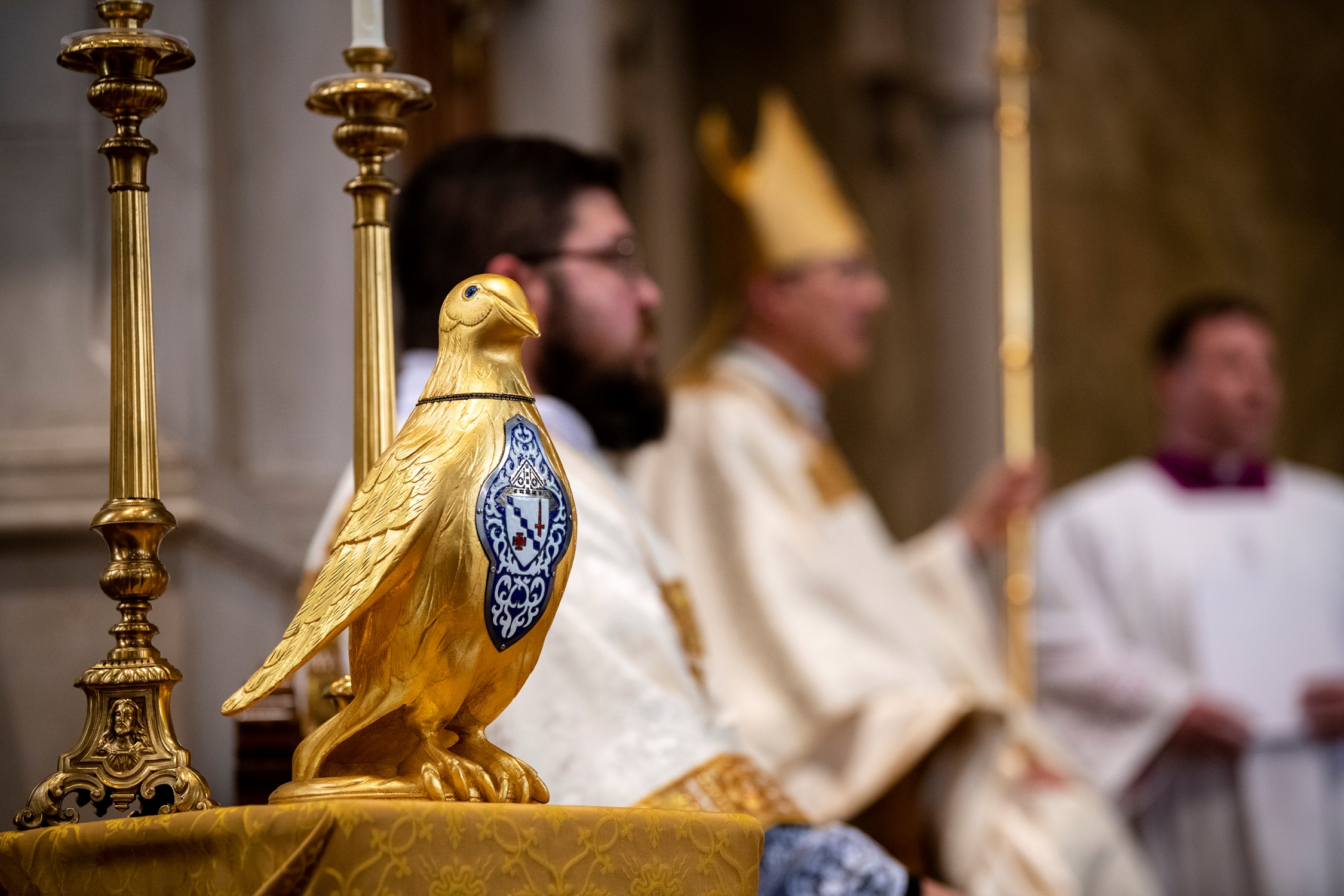
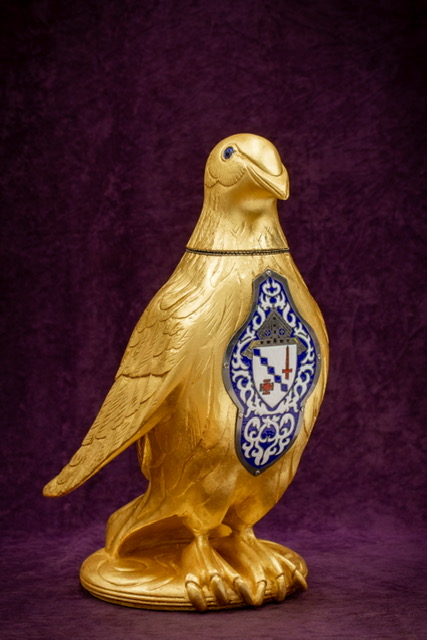
Bishop Steven Raica of the diocese of Birmingham, Alabama, recently commissioned a Holy Chrism Ampulla for use in diocesan sacred liturgies.
Ampullae were popular in ancient times for the transportation of oil, and in the early Church, holy oil was gathered from lamps in the shrines of martyrs and the sites of pilgrimage. In addition, small ampulla vessels were among the many objects part of catacomb burials. Whether they contained Holy Water, holy oil, or the blood of martyrs, the purpose of ampullae were to hold something sacred.
Ampullae were made of a variety of materials like terracotta, metal, and glass, and were decorated with Christian symbols and inscriptions. Numerous ampullae, both historically documented and extant, reveal their importance in the Church’s liturgical life.
The “Sainte Ampoulle,” sadly lost during the French Revolution, was used at the consecration of the kings of France in the cathedral of Reims. It was popularly believed to have been brought from Heaven by a dove at the baptism of Clovis (496). In the cathedral of Monza, several ampullae are preserved that were sent to Queen Theodolinda by Pope Gregory the Great; they contained oil from the tombs of Roman martyrs. In England, a golden eagle ampulla from the 17th century is used in the monarch’s consecration rite. Its design is based on a 14th century legend in which the Blessed Virgin Mary appeared to St. Thomas Becket and presented him with a golden eagle oil vial for anointing future kings of England.
Among the most important extant ampullae is one commissioned by the great medieval visionary Abbot Suger of Saint-Denis in the 12th century. Held in the Louvre Museum, the ampulla known as Suger’s Eagle, combines an ancient 2nd century porphyry vase to a 12th century silver-gilt eagle. It most likely held the Sacred Chrism. ~ In discussing the many wondrous things he provided for the church at Saint-Denis, Abbot Suger (1081-1151) succinctly wrote the following about sacred vessels and their fashioning for use in the sacred liturgy:
“To me, I confess, one thing has always seemed preeminently fitting: that every costlier or costliest thing should serve, first and foremost, for the administration of the Holy Eucharist. If golden pouring vessels, golden vials, golden little mortars used to serve, by the word of God or the command of the Prophet, to collect the blood of goats or calves or the red heifer: how much more must golden vessels, precious stones, and whatever is most valued among all created things, be laid out, with continual reverence and full devotion, for the reception of the blood of Christ! Surely neither we nor our possessions suffice for this service. If, by a new creation, our substance were reformed from that of the holy Cherubim and Seraphim, it would still offer an insufficient and unworthy service for so great and so ineffable a victim; and yet we have so great a propitiation for our sins. The detractors also object that a saintly mind, a pure heart, a faithful intention ought to suffice for this sacred function; and we, too, explicitly and especially affirm that it is these that principally matter. [But] we profess that we must do homage also through the outward ornaments of sacred vessels, and to nothing in the world in an equal degree as to the service of the Holy Sacrifice, with all inner purity and with all outward splendor. For it behooves us most becomingly to serve Our Saviour in all things in a universal way — Him Who has not refused to provide for us in all things in a universal way and without any exception; Who has fused our nature with His into one admirable individuality; Who, setting us on His right hand, has promised us in truth to possess His kingdom; our Lord Who liveth and reigneth for ever and ever.”
The Birmingham ampulla was made by New Guild Studio Inc. of Pittsburgh, Pennsylvania, and was inspired by an ampulla from the treasury of Notre Dame Cathedral, Paris, made by Viollet-le-Duc in 1866.
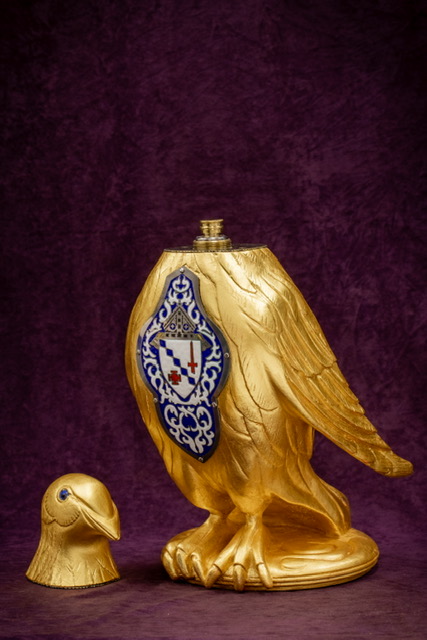
Fr. Jordan Hainsey of the diocese of Covington, and Fr Justin Ward, episcopal Master of Ceremonies and Vicar for Sacred Liturgy for the diocese of Birmingham, offered artistic direction on the project. The Birmingham ampulla is in the shape of a dove, recalling the Holy Spirit. It is hand-carved from linden wood and measures 16 inches tall. Set with hand-blown lapis glass eyes, the ampulla is gilded in 24kt gold leaf and features a hand chased, fired enamel breast plate on the front featuring the coat of arms of the diocese of Birmingham. Ingeniously engineered, an embedded magnetic plate at the head allows practical access to the Holy Chrism vial inside.
The Birmingham ampulla will be used and carried in procession for episcopal ceremonies such as the Chrism Mass, Ordinations, Confirmations, and other liturgies in which Holy Chrism is used.

Friday, September 10, 2021

A New Relic Shrine in Covington Cathedral

Thanks to our good friend Fr Jordan Hainsey of the diocese of Covington, Kentucky, for sharing with us these pictures of the beautiful new relic shrine in Covington cathedral. Bishop Foys has appointed Fr Hainsey as the diocesan custodian of the relics, with the duty to care for and expand the collection, and promote devotion to the relics throughout the diocese.

On August 23, the feast of Rose of Lima, a relic shrine to St Paul was dedicated and consecrated in St Mary’s Cathedral Basilica of the Assumption in the diocese of Covington, Kentucky, by Bishop Roger J. Foys. The shrine is located beneath the cathedral’s baldacchino, and displays a collection of over 300 relics.
The heart of the collection is two skulls taken from among the 11,000 companion martyrs of St Ursula; these were donated by the shine of these martyrs in Cologne, Germany, to Covington’s third bishop, Camillus Paul Maes, in the 1890s. Over the course of his 30 year episcopate, Bishop Maes expanded the collection with dozens of 1st and 2nd class for the growing Church in northern Kentucky.
Bishop Foys has expanded the collection with several relics of newer Saints and Blesseds, including Saints John Paul II, Maximilian Kolbe, Teresa of Calcutta, Damien of Molokai, Katharine Drexel, Oscar Romero, Elizabeth of the Trinity, Louis and Zélie Martin, Edith Stein, José Sánchez del Río, Faustina Kowalska, and Conrad of Parzham, and Blesseds Karl of Austria, Solanus Casey, Stanley Rother, Miguel Pro, Carlo Acutis, Franz Jägerstätter, Anna Maria Taigi, Clelia Merloni, Francis Xavier Seelos, and Mariam Teresa Demjanovich.

Wednesday, June 23, 2021

New Statues for the Cathedral of Covington, Kentucky

Our friend Fr Jordan Hainsey has sent us some pictures of the sculptures recently added to the façade of the cathedral of his diocese, Covington, Kentucky. He writes, “On Sunday, June 6, Bishop Roger Foys and the faithful of Covington, Kentucky, blessed and dedicated 24 new statues and two tympana on the façade of the cathedral of the Assumption during Solemn Vespers of Corpus Christi. Modeled after some of France’s great Gothic churches like St Denis and Notre-Dame de Paris, the cathedral was begun in 1894 by Covington’s third bishop, Camillus Paul Maes; while much of the construction and decoration were completed by 1915, a good deal of the work envisioned by Bishop Maes remained unfinished.

World-renowned ecclesiastical artist Neilson Carlin was commissioned to design 24 statues honoring the Diocese of Covington’s parishes and institutions, and 2 tympana bas-reliefs to complete the tripart Marian schema of the portals. They are made of Bedford limestone taken from the same quarry which provided material for the original façade in 1908.

Twenty, full-round statues fill the portal jamb niches (L-R): Saints John the Baptist, Barbara, James the Greater
Agnes, William of York, Timothy

Saturday, June 12, 2021

An Exhibit of Episcopal Dress in Covington, Kentucky

Our friend Fr Jordan Hainsey has just sent us the following. “The Diocese of Covington, Kentucky, blessed and dedicated 24 new statues and two tympana for the façade of the Cathedral Basilica of the Assumption on Sunday, June 6. To honor Bishop Camillus Paul Maes (1846-1915), who built the cathedral and façade, a temporary display of his clothing and personal effects is on view through the end of June the crypt chapel where his remains are entombed, visitors can see items ranging from episcopal clothing to the trowel used at the ’athedral’s cornerstone laying ceremony in 1910.” (Below, there are two historical photographs of Bishop Maes, one in the standrard cassock and rochet, and the other in the winter cappa magna. There is also a portrait Mark A Thiessen, who served as the bishop’s train bearer from 1906-09, wearing the formal costume seen in the 4th photo.) Fr Hainsey will soon be sharing photos of the new statues with us.

The formal costume of Bishop Maes’ trainbearer, very typical for its time.

Sunday, November 01, 2020

The Feast of All Saints 2020

From the Breviary according to the use of the Roman Curia, 1529, the beginning of the sermon for the fourth day in the Octave of All Saints.

Most beloved brethren, it is well known that this day’s most solemn festivity of All the Saints was established for this reason, namely, that Pope Boniface, wisely changing unto the worship of God and the reverence of the Saints those things which were formerly instituted in impiety for the rite of idols and the worship of demons, on this day dedicated a church for the common veneration of the Mother of God, and all of Christ’s martyrs. We truly believe this was done by God’s dispensation, that Christ, the wisdom of God, who had cast out the prince of the world, should vindicate unto Himself even those place and temples given over to his (i.e. the devil’s) worship. And so he that in his arrogance had presumed to seize hold of the likeness of the Most High, might grieve that the places set up for his wicked worship are converted to the glory and honor of the Saints. Let us worthily venerate them upon the earth, that we may be defended by their protection in heaven.

The Pantheon, also known as the church of Saint Mary of the Martyrs. When this engraving was made in 1877, the building still had the famous (or infamous) bell towers added by Gian Lorenzo Bernini, nicknamed the “Donkey’s Ears”, as well as the gates in the porch, all of which have subsequently been removed.
The pre-Tridentine Roman Breviary has a different sermon for Matins of each day of the Octave of All Saints, but each of these sermons is structured the same way. The first lesson refers to the feast’s institution as part of the dedication of the Pantheon in Rome as a church, the second is about God, the third about the Virgin Mary and the other holy virgins, and so on through the hierarchy of the Saints: Angels, Patriarchs and Prophets, Apostles, Martyrs and Confessors. The final lesson is part of Saint Augustine’s homily on the Gospel of the feast, the Sermon on the Mount. This year, we will follow the lessons for the fourth day in the octave.
Relics of the Saints set out for today’s solemnity at the Cathedral Basilica of the Assumption in Covington, Kentucky. (Courtesy of Fr Jordan Hainsey)

Wednesday, September 02, 2020

Triduum of Prayer and St Rocco Procession in Covington, Kentucky

From August 20-22, the diocese of Covington, Kentucky, held a triduum of prayer, fasting, and sacrifice for an end to the COVID-19 pandemic and all its effects, culminating with Mass on the feast of the Queenship of Mary, celebrated by Bishop Roger Foys at the Cathedral-Basilica of the Assumption. Following the Mass, Bishop Foys traveled throughout the city of Covington, its urban parishes, and to St Elizabeth Hospital where he gave a blessing with a 1st class relic of St Rocco (Roch), the protector against pandemics. A votive altar to St. Rocco currently graces the sanctuary of the Cathedral-Basilica where the faithful may pray and venerate the relic. Thanks to our friend Fr Jordan Hainsey of the diocese of Covington for sharing these pictures with us.

More recent articles:

For more articles, see the NLM archives: