Thursday, April 17, 2025

The Chrism Mass: Tradition, Reform and Change (Part 2) - Guest Article by Abbé Jean-Pierre Herman

This is the second part of an article by Fr Jean-Pierre Herman on the blessing of oils, which is traditionally celebrated at the Mass of the Lord’s Supper, and the recent reforms thereof; the first part was published on TuesdayThe French original was published on Sunday on the website of the Schola Sainte-Cécile as a single article. Fr Herman is professor of liturgy at the Good Shepherd Institute’s Séminaire Saint-Vincent de Paul in Courtalain, France, and we repeat our gratitude to him for sharing this English translation with NLM. The images are reproduced with the kind permission of the Schola Sainte-Cécile.

A ritual overload foreign to tradition

Over and above these strictly liturgical changes, the Chrism Mass has become a condensed version of conciliar ecclesiology: a celebration of the People of God, an expression of communion between the bishop and his priests, a renewal of ministries and, in some dioceses, even a renewal of diaconal promises.

Mons. Leon Gromier
Among the most enlightened critics of this change is Mgr Léon Gromier. A pontifical ceremonial officer and great connoisseur of the Roman rites, Mgr Gromier firmly denounced the reform of Holy Week in 1955, which he described as a “subversion of Roman tradition under the pretext of restoration.”
With regard to the Chrism Mass, he pointed out a double contradiction: on the one hand, the dislocation of the link between the Eucharistic sacrifice and the consecration of the oils, and on the other, the introduction of new structures with no traditional foundation. In particular, he criticised the idea of a separate Mass for the blessing of the oils, stating that “never in the Roman tradition has chrismation been separated from the very heart of the Sacrifice of the Mass” . For him, any attempt to make this Mass an autonomous ecclesial event risked transforming an act of sacramental sanctification into an institutional event, thereby losing the profound meaning of the rite.
Annibale Bugnini justifies this transformation:
The idea of making the Chrism Mass a ‘priestly feast’ was an intuition of the Pope... A new and attractive element was added in 1965: the concelebration of the Eucharist...
With this in mind, the Chrism Mass was rethought as a collective celebration of the ordained ministry. According to Bugnini, the liturgy had to become the living image of the mystery of the Church and make visible the communion of the presbyterate around the bishop. Thus, the strictly sacramental elements were gradually surrounded by new symbols, mainly aimed at highlighting ecclesial unity and the identity of the diocesan clergy.
Annibale Bugnini, architect of the post-Conciliar reform.
This change was accompanied by a ritual and symbolic overload. The blessings of the oils are inserted into a complex liturgical development, which now includes: the renewal of priestly promises, any commitments of deacons, processions with the oils, acclamations sung by the congregation, narrative presentations of the ministries in the diocese, and gestures of collective homage to the bishop. Far from constituting a homogeneous enrichment, this accumulation of signs creates symbolic competition, in which the sacramental mystery is often overshadowed by the celebration of conciliar ecclesiology.
Bugnini himself describes its contrasting reception:
The most severe liturgists were reluctant to accept the fact. They resigned themselves reluctantly to saying goodbye to the centuries-old liturgy that wove the Missa chrismatis around the consecration of the oils.
The introduction of the renewal of priestly promises, a rite that was completely new to the Roman tradition, reinforced this communal and affective orientation. Bugnini states:
The renewal of priestly vows on this special day is a strong, long-awaited, almost necessary gesture to publicly reaffirm the bond between the priest and his bishop, and their fidelity to their mission.
In several dioceses, this practice has been extended to deacons, who also renew their liturgical commitments. This development, not foreseen by the rubrics, blurs the hierarchy of orders and tends to transform a priestly rite into a simple celebration of the local Christian community. The sacramental meaning is thus buried under an avalanche of pastoral gestures and speeches.
Added to this is the content of episcopal homilies, which are often far removed from any doctrinal explanation of the sacraments and their efficacy. Many bishops choose to focus their preaching on pastoral assessments, calls for diocesan unity or community exhortations, thereby relegating the sacramental dimension to the background. The Chrism Mass then becomes an exercise in ecclesial communication, sometimes political, to the detriment of mystagogy and liturgical catechesis.
This overload seriously undermines the sacramental clarity of the rite. What was intended by Pius XII to be a sacramental catechesis becomes a celebration of institutional identity. Instead of demonstrating the sacraments’ dependence on Christ’s sacrifice, the rite tends to express, above all, the self-celebration of the local Church and its ministers. The liturgical word is fragmented into multiple discourses, often anecdotal or circumstantial, losing sight of the profound unity of the sacred action centred on Christ and his Cross.
Bugnini himself insists on this turning point:
It was worth sacrificing a traditional preference [...] in order to highlight the visible communion of the presbyterate around its bishop, in a liturgy fully adapted to the new times.
This statement sums up the logic of the reform: to abandon the sacramental symbolism inherited from centuries of tradition to make way for a new liturgical rhetoric, based no longer on mystery but on ecclesial visibility. of the rite: instead of a pedagogy of grace, there is an emphasis on affective communion, sometimes to the detriment of doctrine. The liturgical word is fragmented into multiple discourses, often anecdotal or circumstantial, losing sight of the profound unity of the sacred action centred on Christ and his Cross.
The urgent need to find the source
Pope St Alexander I consecrating the holy oils, in an image from a manuscript dated 1300-10. According to a medieval tradition, it was Alexander, the 5th successor of St Peter (reigned ca. 105-15) who instituted the rite of consecrating the oils on Holy Thursday.  
The shift of the Chrism Mass from a sacramental epiphany centered on Christ’s sacrifice to a community celebration with an identity function reflects a profound evolution in contemporary liturgical theology. This shift is not purely formal, but goes to the very heart of the liturgy: its purpose, its language and its theological structure.
While Pius XII, with a clear desire for pedagogical reform, wanted to offer the faithful a liturgy that was profoundly Eucharistic and catechetical, the post-conciliar reforms gradually replaced this logic with a horizontal conception of the liturgy. The liturgy is now presented as a manifestation of ecclesial communion, centred on the bishop and his presbyterate, to the detriment of the catechesis of the sacraments. Josef Ratzinger - the future Benedict XVI - rightly noted:
What was once turned towards God has gradually turned in on the community. Community self-celebration has replaced the act of worship.
This withdrawal is particularly evident in the modern Chrism Mass, where the episcopal preaching no longer focuses on the nature and power of the sacraments, but on pastoral concerns, diocesan assessments or calls for synodality. The bishop becomes less the sacramental minister of Christ than the visible animator of a community on the move.
The liturgist Mgr Klaus Gamber, in his prophetic writings, was already denouncing this development:
Instead of looking at the organic development of the liturgy, new office-born rites have been introduced, cut off from any living tradition and oriented more towards ideology than faith.
Thus, what Pius XII had conceived as a catechetical liturgy, centred on the sacramental grace deriving from the one sacrifice of Christ, was gradually transformed into a symbolic manifestation of an ecclesial communion conceived above all as visible, participative and ministerial. The gradual erasure of the link between the Eucharist and the sacraments, the dilution of theological language in orations, and the inflation of symbolic gestures based on a horizontal ecclesiology have emptied the rite of its mystagogical density.
The time has come to restore the original significance of the Chrism Mass as a sacramental act within the sacrifice of Christ, the source of all anointing and sanctification. The traditional rite offers a sober, majestic expression of this, doctrinally rigorous and spiritually fruitful. Restoring it does not mean going backwards: it means re-establishing a vital link between the sacraments and their Eucharistic source, between liturgical action and the redemption of the world.
To serve liturgical truth is to honour the Paschal Mystery of Christ, celebrated in his Church with fidelity, sobriety and faith.
Bibliography
1. Liturgical and historical sources
G DURAND, Rationale divinorum officiorum, ed. A. Davril & T. Thibodeau, Turnhout, Brepols, 1995.
Pontificale Romanum (ed. 1595-1596), republished by Libreria Editrice Vaticana.
Gelasian Sacramentary, ed. H. Wilson, The Gelasian Sacramentary, Oxford, 1894.
Gregorian Sacramentary, ed. Dag Norberg, Paris, CNRS, 1985.
Ordo Romanus I, ed. M. Andrieu, Les ordines romani du haut Moyen Âge, vol. III, Louvain, 1951.
2. Historical and critical studies
H. SCHMIDT, Die Formularien der Chrisammesse in den alten römischen Sacramentarien , Ephemerides Liturgicae, vol. 71, 1957, pp. 733-736.
L. GROMIER, Commentaires sur la réforme de la Semaine Sainte, in: Ephemerides Liturgicae (various articles, years 1951-1962).Ephemerides Liturgicae (various articles, years 1951-1962).
A. BUGNINI, La réforme de la liturgie 1948-1975, trans. fr. P.-M. Gy, Cerf, 1998.
K. GAMBER, La Réforme liturgique en question, DMM, 1992.
J.-F. Thomas, La liturgie: art sacré, théologie et vie mystique, Via Romana, 2017.
3. Liturgical theology and mystagogy
J. LECLERCQ, La Semaine Sainte dans la liturgie romaine, Solesmes, 1951.
L. BOUYER, Le Mystère pascal, Cerf, 1945.
P. GUÉRANGER, L’Année liturgique. Le Temps de la Passion et la Semaine Sainte, Solesmes.
J. RATZINGER (Benedict XVI), The Spirit of the Liturgy, Ad Solem, 2001.
J. HANI, Le symbolisme du culte chrétien, L’Âge d’Homme, 1995.

Tuesday, April 15, 2025

The Chrism Mass: Tradition, Reform and Change (Part 1) - Guest Article by Abbé Jean-Pierre Herman

We are very grateful to Fr Jean-Pierre Herman for sharing with us this important article about the Chrism Mass and its recent reforms. The French original was published two days ago on the website of the Schola Sainte-Cécile as a single article; it will be published here in two parts. Fr Herman is professor of liturgy at the Good Shepherd Institute’s Séminaire Saint-Vincent de Paul in Courtalain, France. The images from liturgical books are reproduced with the kind permission of the Schola Sainte-Cécile.

The Chrism Mass, from sacramental catechesis to ecclesiological celebration:
tradition, reform and change.
by Abbé Jean-Pierre Herman

Among the major liturgical rituals of the year, the Chrism Mass today occupies a major place in the liturgical life of dioceses. It is presented as one of the most significant manifestations of the fullness of the bishop's priesthood and the intimate bond that unites him to his priests. [1] It is the moment when the Church sanctifies the oils intended for the sacraments and, in its post-conciliar version, when the link between the ministerial priesthood, the people of God and the Paschal Mystery is publicly manifested. Priests solemnly renew their ordination promises, and the bishop visibly embodies the unity of the presbyterate.

However, it should be remembered that the term “Chrism Mass” did not appear until the reform of 1955. Until then, the Roman liturgy included only one celebration on Holy Thursday: the Mass in Coena Domini, during which the bishop proceeded to bless the oils. Ancient sources, such as the Gelasian Sacramentary, present several liturgical formularies linked to this day, but, as Hermann Schmidt has shown [2], these were not separate Masses, but a single ritual whole. The Gregorian Sacramentary, a century later, proposes only one form for the blessing of the oils. The Ordo Romanus I confirms this tradition of a single rite, [3] which was maintained with notable symbolic enrichments, admirably described by William Durandes, bishop of Mende, in his Rationale (or Manual of the Divine Offices), and taken up again in the Roman Pontifical of 1595, until the reform of the twentieth century.

Frontispiece of a 1511 edition of the Pontificale Romanum.
Pius XII’s intention in the 1955 reform (Maxima Redemptionis nostrae mysteria) was to make this Mass a sacramental catechesis. By isolating the blessing of the oils from the evening Mass, the Pope wanted to emphasize that all sacramental grace flows from the Sacrifice of Christ. However, this reform, while respectful of the traditional canonical structure, paved the way for more radical developments. With the post-conciliar reform, the Chrism Mass became an ecclesiological celebration, centered no longer on sacramental grace, but on communion between the bishop, his priests and the people.
The traditional rite: a strong Eucharistic structure.
In the traditional rite, as codified in the Pontifical Romanum of 1595, the blessing of the Holy Oils is not an independent celebration, but is solemnly inscribed at the heart of the Mass in Coena Domini. Far from being a marginal addition, it is deeply integrated into the Eucharistic offering. This insertion manifests a fundamental liturgical and theological truth: all sanctification in the Church, including that of the sacramental instruments, flows directly from the sacrifice of Christ made present at the altar.
The three blessings - of the oil for catechumens, the oil for the infirm and the holy chrism - are structured around the Roman Canon. This structuring is not arbitrary: it expresses the fact that the mystery of the Cross and the Eucharist is the unique source of all grace. By blessing the oils as part of the Eucharistic sacrifice, the Church confesses that Christ, priest and victim, communicates his divine life through the sacraments that these oils are used to confer.
The beginning of the consecratory preface of the Holy Oils in an edition of the Roman Pontifical printed in 1497.
The rite itself is remarkably rich in symbolism. It includes:
  • the minister's breath on the oils, evoking the life-giving action of the Holy Spirit in creation and resurrection;
  • the anointing in the chrism vessel, marking the intimate link between the oil and the sanctifying grace; 
  • the incensing of the sacred vessels, which signifies the ascension of prayer and the consecration of what is destined for God;
  • the solemn chant of O Redemptor, a theological and contemplative hymn that magnifies the redemptive work of Christ in the sacraments;
  • and the triple acclamation Fiat, taken up by the clergy, a liturgical sign of community assent to the invocation of the Paraclete.
The epiclesis that precedes the consecration of the chrism - Emitte, quaesumus, Domine, Spiritum Sanctum Paraclitum - establishes an explicit link with Pentecost: the chrismal oil is sanctified by the Spirit, just as the Apostles were in the Upper Room. This link shows that the sacramental ministry of the Church continues the work of Christ in the power of the Holy Spirit, through the Eucharistic sacrifice. The ancient liturgy thus retains a profound mystagogical coherence, rooted in the theology of the Paschal Mystery.
The 1955 reform: a catechetical turning point
The liturgical reform promulgated by Pius XII in 1955 introduced a significant change in tradition: it detached the blessing of the oils from the Mass in Coena Domini and instituted a separate Mass, known as the Chrism Mass, celebrated on the morning of Holy Thursday. This innovation broke with the ancient Roman custom, in which the unity of the Eucharistic sacrifice and the consecration of the oils bore symbolic witness to the fact that the sacraments derive their efficacy from the mystery of the Cross.
However, despite this new autonomy for the Chrism Mass, the internal structure of the celebration remains close to the Tridentine model: the blessings of the oils continue to be inserted at the end of the Roman Canon and after communion. This partial maintenance of the structure aims to preserve the sacramental significance of the gestures, while making them more intelligible to the assembly of the faithful, who are now more involved in the liturgical life.
The aim of this reform is no longer primarily to demonstrate the dependence of the sacraments on the Eucharist, but to highlight the diversity and beauty of the sacramental life of the Church, with a view that is more pedagogical than mystagogical. From a pastoral point of view, the link between the oils and the various sacraments they are used to confer should be made clear: baptism, confirmation, ordination and the anointing of the sick.
The beginning of the blessing of the Holy Oils in an edition of the Pontificale printed in Paris in 1683.
Nevertheless, this reform has led to a significant simplification of the rites:
rich and symbolic gestures are largely reduced or modified;
Traditional orations, long, typically theological and often dense, are giving way to briefer texts, with a more accessible vocabulary, but sometimes less evocative;
The liturgy as a whole gains in clarity, but loses the mystical density that characterised the Tridentine Pontifical.
Post-conciliar reform: an ecclesiological celebration refocused on ministry
The liturgical reform promulgated in 1969, in the wake of the Second Vatican Council, brought about a profound transformation of the Chrism Mass, both in its structure and in its theology. The underlying pastoral intention was clear: to make this celebration a visible manifestation of the unity of the presbyterate around the bishop, with greater emphasis on the communitarian and ministerial dimension of the priesthood. But this refocusing entails a significant theological shift: the Chrism Mass ceases to be a Eucharistic theophany of sacramental grace, becoming above all an ecclesiological presentation of the ministry.
The Chrism Mass was henceforth conceived as an autonomous celebration, which could be brought forward to another day in Holy Week, thus breaking with the ancient liturgical integration of Holy Thursday, the day of the priestly mystery par excellence. Most of the time, the blessings of the oils are no longer inserted into the Canon of the Mass, nor are they placed after communion, a possibility still offered by the rubrics, but moved to a separate moment, after the homily, in the form of a "rite of the oils" detached from the Eucharistic prayer. This change is not merely functional; it runs the risk of dissociating the sacraments from the altar, which is their ontological source.
A major innovation was added to this restructuring: the solemn renewal of the priestly promises by the priests. This element, totally absent from the previous liturgical tradition, constitutes a radical innovation introduced without historical precedent or ritual roots. Its inclusion in the liturgy is in keeping with a post-conciliar perspective of valuing the presbyteral ministry as a collegial participation in the mission of the bishop. Although this gesture is not at the heart of the celebration, it has become a high point, often highlighted in contemporary pastoral practice. It marks a turning point: the liturgy no longer celebrates only the action of Christ in his sacraments, but also the subjective commitment of the ministers themselves.
This refocusing has visible consequences in the way the rite is conducted. The Liturgy of the Word is enriched with texts of a catechetical nature, emphasising the prophetic, priestly and royal mission of the People of God, while the blessings of the oils, while retaining their ancient structures, are simplified in their implementation. The breathing, the anointing in the vessels, the acclamations such as the Fiat, the singing of O Redemptor: all these gestures are either abbreviated, made optional, or simply omitted. The symbolic and theological density of the rite is impoverished.
In short, the post-conciliar reform shifts the centre of gravity of the Chrism Mass from the sacramental union of the oils with the Eucharistic sacrifice to a celebration of the ministerial Church and of presbyteral communion. The focus is no longer primarily on the origin of the sacrament - Christ the priest offering his sacrifice - but on the human structure of the Church and the pastoral life of its ministers. The Chrism Mass thus becomes the mirror of a Church that contemplates itself, rather than a Church that receives everything from its Lord at the altar.
NOTES:
[1] Institutio Generalis Missalis Romani, quoted by G. TORNAMBE, «Évolution des rites de la Missa chrismatis», Revue des sciences religieuses, 90/1 (2016), pp. 81-103.
[2] H. Sschmidt, «Formularia liturgica Feria V in Cena Domini: Considerationes criticae», Ephemerides Liturgicae, 71 (1957), pp. 733-736.
[3] M. Andrieu, Les Ordines Romani du Moyen-Age, I-V, Spicilegium Sacrum Lovaniense 11, 23, 24, 28, 29 ), Louvain, 1931-1961.

Thursday, April 14, 2022

The Oldest Text of the Chrism Mass

It is one of the Church’s most ancient customs to bless the oils which are used in the celebration of the Sacraments on Holy Thursday. This is attested all of the pertinent liturgical books of the Roman Rite as far back as we have them, and indeed, the Wurzburg lectionary, the very oldest of the Roman Rite, has as its title for Holy Thursday the words “Quando chrisma conficitur – when the chrism is made”, but not the words “Coena Domini”, which are added about a century later in the lectionary of Murbach.

The earliest Roman sacramentaries attest to the custom by which the blessing of oil was done at a separate Mass from that of the Lord’s Supper, while a third Mass was celebrated for the reconciliation of the public penitents. The earliest form of this Mass given in the Old Gelasian Sacramentary makes it very clear why this was so.
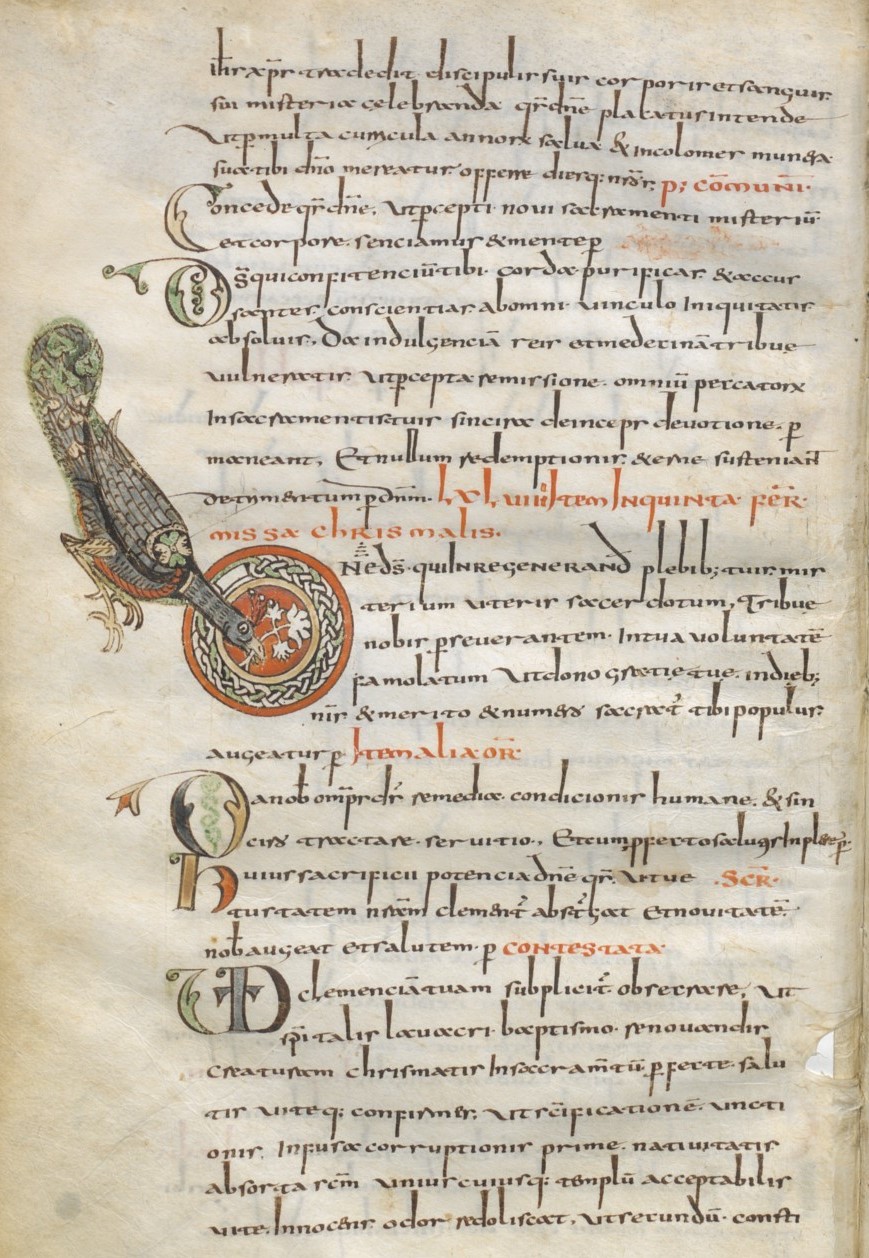
The Chrism Mass in the Gellone Sacramentary, ca. 780 AD.
The Roman Holy Week is a conceptual unity, the various parts of which frequently refer to the other parts. For example, it is the only rite in which the celebration of the Lord’s triumphal entry into Jerusalem is shown to be part of His Passion by actually reading the Passion at the Mass of Palm Sunday. Speaking only of the Roman Rite, this custom is, as far as we know, much older than the blessing of palms and procession. In a similar vein, the Epistle added to the blessing of the palms in the 10th century, Exodus 15, 27 – 16, 1, was clearly chosen in reference to the Lord’s Supper, His Passion and death, and His Resurrection; and furthermore, in reference to specific ritual details of Holy Week, such as the Mass of the Presanctified on Good Friday, and the incomplete character of the Mass of the Easter vigil.
This intertwining of references unites all the ceremonies of Holy Week as parts of the same Paschal mystery. Here, however, the word “mystery” should not be taken in its modern sense of “something incomprehensible”, but rather, referred back to its Greek root “mueō – to initiate.” Holy Week is the season of Christian initiation par excellence, not only for those who are to be baptized at the Easter vigil, but also for those who are already baptized, or, to put it another way, already initiated into the Christian Faith. The crucial events of our salvation, as Pope St Leo the Great says, “are not so much remembered as a thing past, but rather honored as a thing present.” (non tam praeteritum recoli quam praesens debeat honorari. Sermon 64, 13th on the Lord’s Passion). This is also why the Church continued to read in the liturgy of Lent and Easter Biblical passages which were clearly chosen as lessons for the catechumens and neophytes, even long after the adult catechumenate had largely disappeared.
The blessing of oils, therefore, is historically presented by the Church in light of this, and the oldest form of the Chrism Mass refers repeatedly to the use of the oils in the baptismal rituals of Easter night. I here present my own translation of it with some explanatory notes, following the text of Dom Leo Mohlberg’s critical edition of the Old Gelasian Sacramentary, printed in 1960. This manuscript represents the state of the Roman Mass as it was in about the year 700, but the manuscript itself is from about 50 years later.
Chrism Mass celebrated in the Roman Rite in Vaduz, Lichtenstein, in 2013. 
Collect Lord God, who in the regenerating of Thy peoples makest use of the ministry of priests, grant us to serve with perseverance in Thy will, that by the gift of Thy grace, the people made holy unto Thee may be increased in our days both in merit and in number. Through (our) Lord (etc.)
Many Masses in the Gelasian Sacramentary, but not all, have two or even three collects, a phenomenon which admits of no simple and consistent explanation. The second collect for this Mass is:
Grant us, almighty God, both to exercise the remedies of the human condition with true service, and to fulfill them with the perfection of salvation. Through.
Secret May the power of this sacrifice, we ask, Lord, both mercifully wipe away our oldness, and increase for us both renewal and salvation. Through.
(Preface) Truly is is worthy… to humbly beseech Thy clemency, that for those who are to be regenerated by the baptism of spiritual washing, Thou may strengthen this creature of chrism for the mystery of perfect salvation and life; so that, being infused with the sanctification of anointing, and the corruption of its first birth being destroyed, the holy temple of each one may be redolent with the innocent fragrance of an acceptable life; so that in accord with the mystery established by Thee, being imbued with the royal, and priestly and prophetic honor, they may be clothed in the garment of an incorruptible gift. Through (our Lord, Jesus Christ, through) whom the angels praise Thy majesty…
Infra actionem (the standard rubric for introducing a variable Communicantes, also in the Missal of St Pius V) the Communicantes as above. (i.e., in the previous Mass, that for the reconciliation of penitents; “Communicating, and celebrating the most holy day, on which our Lord Jesus Christ was betrayed; but also (venerating) the memory…”)
Note that all three of these Masses use the same variable Communicantes, which does not refer to either the reconciliation of the penitents or to the blessing of the oils. These events are rather placed solidly within the context of the Lord’s Supper as one of the days of the Paschal mystery. The same is true of the following, the variable Hanc igitur, which is not marked by a rubric. Variations of both these texts are still used on Holy Thursday to this day.
We therefore beseech Thee, O Lord, that Thou may peaceably accept this offering of Thy servants and handmaids, which they offer to Thee for the sake of the day on which our Lord Jesus Christ gave to His disciples the Mysteries of His Body and Blood to be celebrated; and in Thy holiness may Thou grant that though the course of many years, in safety and good health, they may merit to offer their gifts to Thee, the Lord; and (to dispose) our days…
Like many early medieval rubrics, those that follow here would be barely intelligible in a literal translation, and here I will paraphrase them. After a header, “The blessing of oil”, a rubric indicates that the celebrant speaks “to the people”, followed by a citation of the opening words of a fixed speech, “This oil for anointing the sick.” Before Per quem haec omnia, the blessing is said as follows; this is still the custom of the Roman Rite to this day.
Send forth from heaven, we beseech you, o Lord, the Holy Spirit, the Paraclete, upon this richness of oil which Thou hast deigned to produce for the refreshment of mind and body. And may your holy blessing be for everyone who anoints, tastes and touches it protection of body soul in spirit, to take away all pains, all infirmity, all sickness of mind and body, from which Thou didst anoint priests, kings and prophets and martyrs, Thy perfect chrism, blessed by thee o Lord, abiding within us, in the name of our Lord Jesus Christ. The canon is then resumed at Per quem haec omnia.
After the Lord’s Prayer and the fraction, the corporal, which was much larger in those days, is pulled over “the gifts of the altar”; the celebrant goes to the seat. “And there, the other oil is offered by the deacon to be blessed,” and he begins with, “The Lord be with you”, and “Let us pray”. This prayer is still used for the blessing of the oil of the catechumens to this day.
O God, the rewarder of all spiritual increase and growth, who strengthenest the beginnings of weak souls by the power of Thy Holy Spirit: we pray thee, o Lord, that Thou may grant to those who come to the laver of blessed regeneration, by the anointing (they receive from) this creature, the cleansing of soul and body; that so, if there remain any stains fixed upon them by their spiritual enemies, they may depart by the touch of this holy oil. May wicked spirits find no place there; may the powers that have been put to flight have no sway; may there be no lurking place left to insidious evil ones, but rather, may Thy servants that come to the Faith, and are to be cleansed by the operation of the Holy Spirit, find the preparation of this anointing profitable to salvation, which also they are to receive in the Sacrament of Baptism, by the birth of a heavenly regeneration. Through our Lord Jesus Christ, who shall come to judge the world by fire. Amen.
Here there follows the standard preface dialogue, and a long preface, which is also still used in the blessing of oils. However, in the pontifical of Clement VIII, most of the preface of the Chrism Mass given above has been added to the end of it. Note the references to the first and second prophecies of the Easter vigil, the Creation of the world in Genesis 1, and the story of Noah in Genesis 5-8.
It is truly meet and just, right and available to salvation, that we should always, and in all places, give thanks to thee, O Holy Lord, Almighty Father, Eternal God: who, in the beginning, among the rest of thy gifts of Thy bounty and goodness, didst command the earth to bring forth fruit-bearing trees, among which should be born the olives, which provide this most rich fluid, whose fruit was to serve for the holy chrism. For David, knowing aforehand by the prophetic spirit of the sacraments of Thy grace, sang that our faces were to be made glad with oil: and when the sins of the world were of old being expiated by the flood, a dove announced that peace was restored to the earth, showing this through an olive-branch, unto the likeness of the gift to come, which in these last ages has been declared with manifest effects, since after all the sins of men have been washed away by the waters of Baptism, this anointing of oil makes our countenances joyful and calm. Thence also didst Thou give the commands to Thy servant Moses to establish his brother Aaron priest by pouring this oil upon him, after he had first been cleansed with water. A greater honor came to it when Thy Son, our Lord Jesus Christ, had made John baptize him in the waters of the Jordan, and the Holy Ghost being sent upon him in the likeness of a dove thou didst show Him to be thine Only Begotten Son, in whom thou wast well pleased, by the witness of the voice that followed, and proved most clearly that this was what the prophet David had sung, that he would be be anointed with the oil of gladness above his fellows. We therefore beseech thee, O Lord, Holy Father, Almighty everlasting God, through (the same) Jesus Christ, thy Son, our Lord, that thou deign to sanctify the richness of this creature, by thy blessing, this thy creature oil, and infuse into it the virtue of the Holy Ghost, through the power of Thy Christ, from whose holy name it received the name of Chrism, from which thou didst anoint Thy priests, Kings, Prophets, and Martyrs, that it may be for those who shall be reborn of water and the Holy Spirit, the Chrism of salvation, and Thou make them sharers in eternal life and co-heirs of heavenly glory. Through the same our Lord etc.
This is followed by the “making of the exorcized oil”, in which balsam is mixed with oil, and the mixture blessed as follows.
I exercise thee, creature of oil, in the name of God, the Father almighty, and in the name of His Son Jesus Christ, and of the Holy Spirit, that in this invocation of the threefold power and strength of the godhead, thou every most most wicked power of the adversary, every ancient malice of the devil, every approach of violence, every confused and blind spirit be routed out and put to flight, and depart from the creature of this oil appointed for the use of men, so that this anointing for the divine sacraments may be purified for the adoption of flesh and spirit for those who shall be anointed from it unto the forgiveness of all sins that it may become in them a body sanctified for every spiritual grace, through the same our Lord Jesus Christ who shall come in the Holy Spirit to judge the living and the dead and the world through fire through the Lord.
Then another preface.
Truly it is worthy ... almighty everlasting God, who revealing the secrets of Thy mysteries, didst show a grove of trees to the eyes of Noah, witnessed the mouth of a dove, so that they who dwelled in the ark might learn through the Holy Spirit and the oil of an olive that the glory of liberation would return to the world. Through our Lord Jesus Christ, who shall come to judge the world by fire. Amen.
The last rubric instructs the celebrant to resume the Mass from the comingling, to omit the peace, to receive Communion, and reserve it for the Mass of the Presanctified the next day.

Wednesday, August 11, 2021

“Eucharistic Concelebration: Theological, Historical, and Liturgical Aspects” — Guest Article by Bishop Athanasius Schneider

New Liturgical Movement is pleased to be able to publish online the following incisive text by Bishop Athanasius Schneider, which also appears in print in the latest issue of Latin Mass magazine. In the first part, His Excellency looks at the historical roots and theological implications of Eucharistic concelebration, while in the second part he makes a concrete proposal for how concelebration might be rarely but appropriately used and how its ceremonial ought to unfold. This rich presentation comes at a critically important time, as concelebration has once again been much in the news.—PAK

Jean Auguste Dominique Ingres, Papal Mass (1832)

Eucharistic Concelebration:
Theological, Historical, and Liturgical Aspects


Bishop Athanasius Schneider

I. The Theological and Historical Aspect

1. The first Holy Mass was celebrated by Our Lord in the cenacle. This Mass did not have the form of a sacramental concelebration because the apostles did not pronounce the words of consecration; only the Lord pronounced them. The apostles participated in the Eucharist, celebrated by the Lord, by sacramentally receiving His Body and His Blood. We could say they “concelebrated” in the first Mass in the form of a non-sacramental concelebration.

2. From the earliest times, the universal Church (both in the East and in the West) conserved faithfully this original form of Eucharistic concelebration with these two characteristics:
  1. The main celebrant alone pronounces the words of consecration;
  2. The main celebrant is always and exclusively the “high priest,” i.e. the bishop (and in Rome the Pope).
3. In the beginning of the Middles Ages, in the Papal Liturgy in Rome there was a development of the original form by the fact that the concelebrants pronounced the words of consecration together with the Pope (cf. Ordo Romanus III, 8th century).

4. However, down to the present, the most ancient Oriental churches—the non-Catholic Greek Byzantines, the non-Catholic Copts, and non-Catholic Nestorians—have conserved the norm that only the main celebrant pronounces the words of consecration.

5. Until recent times in the universal Church, a priest never presided as the main celebrant of a Eucharistic sacramental concelebration.

6. From the seventeenth century on, the Byzantine Catholic churches introduced an innovation, that is, the form of concelebration among priests without a bishop as the main celebrant. Thereby the concelebration among priests became usual (cf. the article “Le rituel de la concélébration eucharistique” of Aimé Georges Martimort in Ephemerides Liturgicae 77 [1963] 147–168).

7. Such a form of Eucharistic concelebration only among priests was alien to the universal and constant tradition of the Church. Therefore the Roman Church forbade such concelebration among priests (cf. can. 803 of the Code of Canon Law 1917).

8. Only the Catholic Oriental churches adopted the custom that all concelebrants pronounce the words of consecration.

9. Until the Second Vatican Council, in the Latin Church a Eucharistic sacramental concelebration, where all concelebrants pronounce the words of consecration, was practiced only on three occasions:
  1. Episcopal consecration: only the main consecrator and the newly consecrated bishops concelebrated.
  2. Priestly ordination: only the bishop and the newly ordained priests concelebrated.
  3. Chrism Mass on Holy Thursday in the Cathedral of Lyons (France): the bishop concelebrated with six priests.
10. For the Chrism Mass, the Roman Church conserved until the Second Vatican Council however the most ancient form, i.e. the words of consecration pronounced only by the bishop, although twelve priests assisted him clothed with all the vestments required for Mass. With this form, the Roman Church perhaps wished to recount the first Holy Mass on Holy Thursday, where the main celebrant, Jesus the High Priest, alone pronounced the words of consecration while the twelve apostles concelebrated non-sacramentally, since they did not pronounce together with the Lord the words of the sacramental consecration.

11. In the millennial tradition of the Roman Church, sacramental Eucharistic concelebration constituted always an extraordinary solemn act, which occurred on:
  1. Ecclesiastically important circumstances, which reflected the hierarchically ordered constitution of the Church, such as in the aforementioned episcopal consecrations and in priestly ordinations;
  2. When the bishop celebrated Mass in a most solemn and hierarchically structured form, such as was the case in the Chrism Mass of Lyons, or when the Pope (in the first millenium) celebrated solemnly on the four highest feasts in the year: Christmas, Easter, Pentecost, Ss. Peter and Paul (a custom that ceased in Rome in the high Middles Ages).
P. Villanueva, Blessing of the Chrism on Holy Thursday in the Lateran Basilica (ca. 1900)

Saturday, February 24, 2018

New ICEL Translations in England and Wales for the Chrism Mass

Readers of NLM may be interested to know that the Liturgy Office of England and Wales has just announced that the English and Welsh Bishops' Conference has received the recognitio for use of the 2016 ICEL translation of the Ordo benedicendi oleum catechumenorum et infirmorum et conficiendi chrisma (1971)

This use of this translation, entitled The Order of Blessing the Oil of Catechumens and of the Sick and of Consecrating the Chrism, will be obligatory in England and Wales from 2018 onwards, so will be in use in this year's Chrism Masses. The text is provided on the Liturgy Office website, along with some other related resources.

These are not texts that are used very often, so a good number of people may be unfamiliar with them. For those who are interested, I have drawn up a table where the 1971 Latin editio typica, the 1972 ICEL translation, and the new ICEL translation can be compared:

Comparison of the Order of Blessing the Oil of Catechumens and of the Sick and of Consecrating the Chrism (1971 Latin, 1972 ICEL, 2016 ICEL) [PDF]

(Note: the 2009 translation of the Ordo benedicendi published in the interim Roman Pontifical in 2012 is not part of the comparison here, as to the best of my knowledge it was never in use in England and Wales.)

Pope Benedict XVI breathing on the Chrism before the Prayer of Consecration (2010)
I am sure that NLM readers will enjoy discussing the merits and faults of the new translation in the comments below!

Wednesday, March 01, 2017

Information Request: When is Your Local Chrism Mass?

I am preparing an article which I hope to publish shortly before Holy Week on the subject of the Chrism Mass. As I am sure everyone knows, the blessing of the oils is traditionally held on Holy Thursday; however, in the post-Conciliar Missal, a provision is made to anticipate (not, ad litteram, to postpone,) the Chrism Mass to another day “close to Easter.” I would ask our readers to leave a comment in the Disqus combox, as to when the Chrism Mass is held in their dioceses, and what is the reason given for moving it off Holy Thursday, if stated or known. Thanks for your help!

The Chrism Mass at Westminster Cathedral, from an article which we published in 2011.

Thursday, March 03, 2016

Ordinariate Use Chrism Mass in Washington, D.C., March 17

On March 17 at 7 pm, Bishop Steven J. Lopes, the recently ordained first bishop of the Personal Ordinariate of the Chair of St. Peter, will come to Washington, D.C. to celebrate a Chrism Mass, at St. Luke’s at Immaculate Conception Church, an Ordinariate parish in downtown Washington. This will be the very first Chrism Mass for the Ordinariate.

The Most Reverend Carlo Maria Viganò, Apostolic Nuncio to the United States, will be in attendance. As the Holy Father’s personal representative to the U.S., Archbishop Viganò’s presence at the Ordinariate’s Chrism Mass is a powerful sign of the Holy See’s support and encouragement for the Personal Ordinariate of the Chair of St. Peter.

Since only a bishop can bless the holy oils, Ordinariate priests have until now obtained the oils used for anointing from the geographical dioceses in which they reside. During the Mass, the priests of the Ordinariate will renew their priestly promises, as well.

The Chrism Mass at St. Luke’s at Immaculate Conception will be additionally interesting because it will be the first such Mass in the Catholic Church celebrated with Divine Worship: The Missal, the newly propagated Missal which blends language from the Anglican tradition with a fully Catholic Mass.

If you are in the D.C. area March 17th, you owe it to yourself to be present for this unique and beautiful ceremony. There will be a wine and cheese reception immediately after the Mass. Mark your calendar!

For more information about the Personal Ordinariate of the Chair of Saint Peter, visit ordinariate.net.
(reproduced from the website of St Luke’s at Immaculate Conception parish.)

More recent articles:

For more articles, see the NLM archives: