Monday, September 04, 2023

A Rare Example of Modern Venetian Gothic Architecture with a Moorish Flair

Today I will share the final batch of photos from my trip to Louisiana this past July. I have saved these pictures for last because it seemed fitting to talk about a church dedicated to the Immaculate Conception in the week in which we will celebrate the feast of Our Lady’s Nativity.

Immaculate Conception Church, completed and dedicated in 1930, is located in the downtown of New Orleans, at 130 Baronne Street, and run by the Society of Jesus. Immediately from the façade, one can tell that its style is different from those one usually encounters; its Wikipedia article describes it as the Neo-Venetian style of Gothic Revival architecture, with Moorish Revival and Byzantine Revival elements.

Yet the façade, as unusual as it is, does not prepare the visitor for the impact made by the height of the nave, which is all the more unexpected in a church sandwiched between (and somewhat dwarfed by) high-rises.

Note the small decorated columns of the middle level.

Monday, August 28, 2023

A Visit to St. Patrick’s Church in New Orleans, Home to the Latin Mass Since 1965

In terms of the history of the traditionalist movement, one of the most interesting places I had the opportunity to visit in Louisiana was St. Patrick’s in downtown New Orleans.

This church is a glorious artistic monument, built in 1833, and boasting an inspiring history. It is one of the few places anywhere on earth that kept the chanted Latin liturgy going from 1965 all the way to the present. There was a period (from ca. 1970 to 1984) when the Mass was the Novus Ordo in Latin, but before that period, and after it, the Roman Rite has held sway. All of the pastors from 1965 onward have been committed to keeping this tradition going; the archbishops have supported it, and the congregation is strong and healthy.

The parish is “bi-formal”; each day there is both the TLM and the NOM, and on Sunday the Novus Ordo is also celebrated ad orientem. The very sign announcing the Mass times is like a silent testament to Benedict XVI’s vision of paix liturgique, now shattered by his successor:

The Sunday 9:15am Solemn High Mass I attended filled the pews, with a high proportion of young adults and big families. The congregation sang the Ordinary and responses with gusto.


Monday, August 21, 2023

The Cathedral of St Louis IX in New Orleans

A highlight of my time in New Orleans last month was a chance to visit the city’s cathedral -- the oldest continuously operating cathedral in the United States of America -- dedicated to St. Louis IX, whose feast we will celebrate later this week. In what follows, I shall make use of descriptions taken from the cathedral’s website. All photographs are mine.

“The St. Louis Cathedral is one of New Orleans’ most notable landmarks. This venerable building, its triple steeples towering above its historic neighbors, the Cabildo and the Presbytere, looks down benignly on the green of the Square and General Andrew Jackson on his bronze horse and on the block-long Pontalba Buildings with their lacy ironwork galleries. Truly, this is the heart of old New Orleans."

“Since 1727, New Orleanians have worshipped in churches on this site. Half a dozen years earlier, the French engineer, Adrien De Pauger, who arrived in the newly founded city on March 29, 1721, designated this site for a church in conformity with the plan of the Engineer-in-Chief of Louisiana, LeBlond de la Tour, who was at the capital, Biloxi.”

The current church, whose foundation stone was laid in the auspicious year of 1789 (!), has a quite distinctive aesthetic style, with the second-floor galleries, the quasi-pendentives, and the ornate painted ceiling featuring French texts, as do the Stations of the Cross. 
“The new parish church, dedicated to Louis IX, sainted King of France, was thus perhaps the first building in New Orleans of ‘brick between posts’ (briques entre poteaux) construction, an effective method of building that continued to be used in Louisiana until at least the middle of the nineteenth century.” This church was elevated to the status of cathedral in 1794 and completed in 1795. It had further additions in 1819 (clock and bell tower) and 1849-51 (remodeling and enlargement of structure).

Monday, August 07, 2023

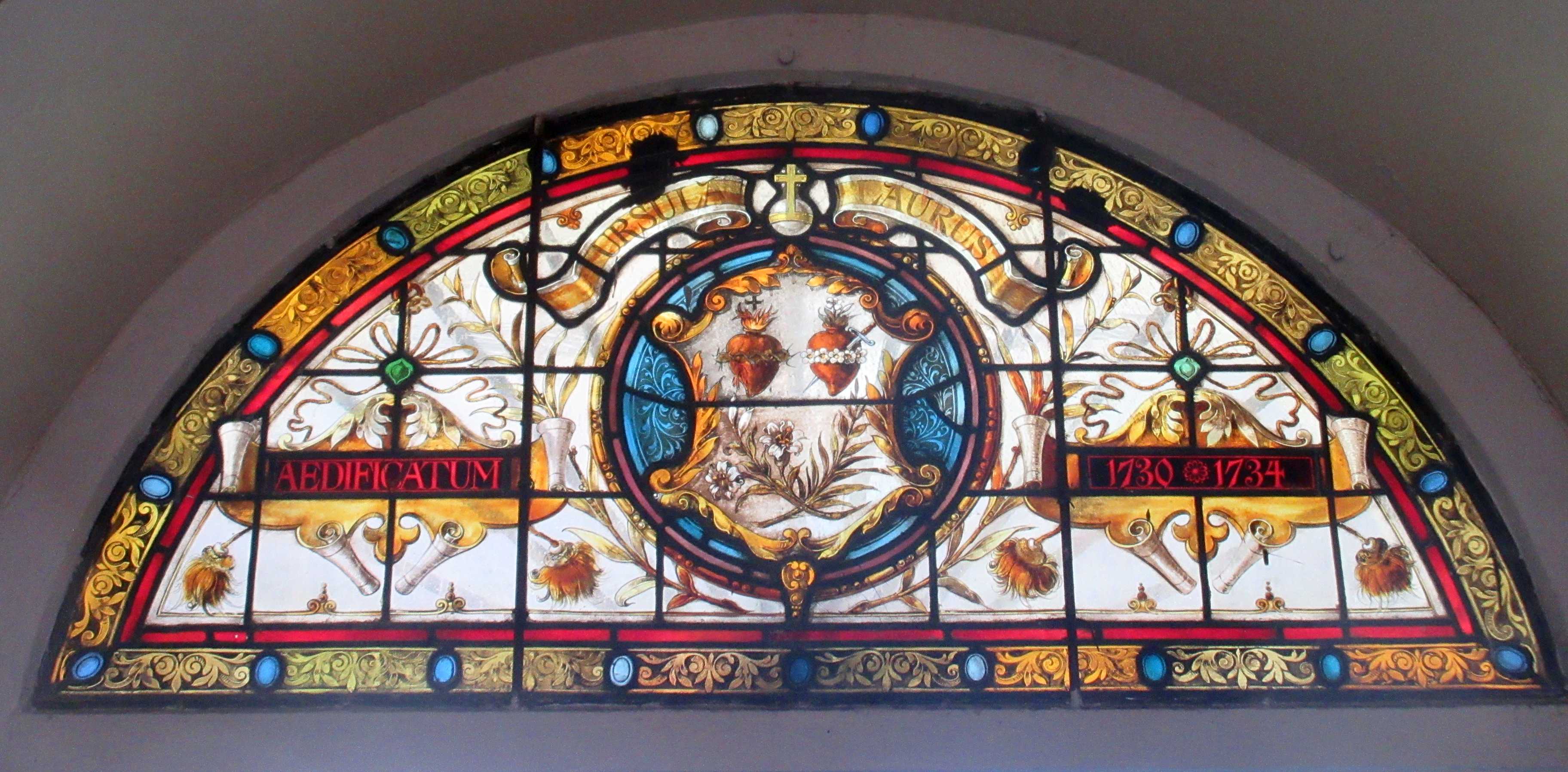
The Old Ursuline Convent in the French Quarter of New Orleans

The stained glass window above the entrance
During my trip last month to Louisiana, I had the pleasure of spending a good part of a day walking around the French Quarter of New Orleans in the company of David Liberto, a long-time Thomist professor at Notre Dame Seminary, and a man who knows the city like the back of his hand.
One of our stops was the Old Ursuline Convent, the oldest building in the Mississippi Valley. (In what follows, I will be freely drawing upon descriptions offered here, at the official website. All photos are my own except where noted.) As an American, accustomed to a national history that sometimes seems thimble-deep compared to Europe’s, it does one good to visit a building from the mid-eighteenth century, built by Frenchmen on what would later be our country’s soil. The connection to the old world is palpable.

“Constructed by French Colonial Engineers under the auspices of the crown, the convent was designed in 1745 and completed in 1752-1753. Over the centuries, this building has been a convent for the Ursuline nuns, a school, an archbishop’s residence, the archdiocesan central office, a meeting place for the Louisiana Legislature. Later, it served as a residence for priests serving mainly the Italian community and then housed the Archdiocesan Archives. Today, together with the St. Louis Cathedral and St. Mary’s Church, it forms the Catholic Cultural Heritage Center of the Archdiocese of New Orleans.”

Here are two overhead photos from the museum’s website.

More recent articles:

For more articles, see the NLM archives: