Wednesday, September 02, 2026

TLM Pilgrimages in France and the Holy Land with Dr. Kwasniewski

Over the years, I’ve noticed a happy development, and it seems to me to confirm the general trend pointed out by countless observers, namely, that where Catholicism still remains, it is becoming more traditional, or at least more tradition-friendly. Thus, it used to be the case that it was nearly impossible to find a group pilgrimage to the famous religious sites, be it Lourdes or Fatima, Jerusalem, Santiago de Compostela, or what have you, that also featured the daily celebration of the traditional Roman Rite. But today, if you look at companies like St. Charles Catholic Pilgrimages or Syversen Touring, you will quickly find several options with chaplains who will offer only the old rite.
Without prejudice to any of the other wonderful trips taking place, I wanted to alert NLM readers to a couple of unique opportunities coming up in 2027, because of their unusual combination of traditional liturgy, theology, and sacred music.
O Beauty Ever Ancient, Ever New: French Gothic Cathedrals with Sacred Music From September 29 to October 9, 2027, I will be co-leading a pilgrimage to sacred sites in France that offers a rare immersion in the Church’s tradition. We will contemplate the theological vision embodied in Gothic architecture (including the cathedrals of Paris, Chartres, Beauvais, Amiens, and Rouen), and venerate relics and holy sites (Mont St. Michel, St. Denis, Sainte Chapelle, Miraculous Medal chapel, the Carmel of Lisieux and Les Buissonnets, the site of St. Joan of Arc’s martyrdom). I will be offering commentary as the trip proceeds, in addition to casual conversations with each of the participants. Daily High Mass will be offered by our chaplain, Canon Jean-Baptiste Commins, ICKSP, with a choir singing Gregorian chant and Renaissance polyphony that I will direct for every Mass. The kind of music we’ll be singing:
Formed by the Church’s liturgy and the legacy of French Catholic culture, we will seek to draw closer to Christ in His mysteries. Ends with a Seine River cruise.
***N.B.: there’s a $300 per person Early Booking Discount for deposits received before 9/29/2026 and a $200 per person Check Discount for those paying the remaining balance by check after the initial deposit. For more information, visit the pilgrimage page.
The Holy Land: An 11-Day REGINA Insider’s Pilgrimage
Those who are looking for a traditional Catholic pilgrimage to the Holy Land, look no further. On this Regina/St. Charles trip, taking place November 29 to December 9, 2027, we will have daily Latin Mass with a wonderful priest, Fr. Pablo Santa Maria—and we will sing whenever we can, whether inside or outside of churches, utilizing special Masses and chants for the Holy Land. Our tour manager will be the incomparable John Paul Sonnen of Liturgical Arts Journal, one of the most widely-traveled and culturally knowledgeable Catholics you will ever meet in your life. Our local guide will be Amer Shehadeh, revered for his experience, lore, and connections. And I will be offering theological and liturgical commentary, as well as being available for conversations over meals or on walks. A rare opportunity and still a few spots open. For details, see this page.
Fr. Santa Maria and I on an earlier pilgrimage

Giving a short talk on the bus

Fr. Santa Maria offering Holy Mass

Tuesday, September 01, 2026

The Legend of St Giles

On the Roman calendar, today is the feast of the abbot Aegidius, known as Giles in English, one of the most popular Saints of the Middle Ages. All hagiographical scholars recognize that the traditional account of his life is full of incongruities, and cannot be treated as historically reliable. For example, it begins by saying that he was an Athenian of royal descent; Athens had had no king for over a millennium by the time Our Lord was born. Having been raised as a Christian, he performed several miracles in his youth, curing a sick beggar by giving him his cloak, and healing one man of snakebite and another of demonic possession. Fearing the consequences of his growing fame, he fled westward, settling in southern France, and after spending two years with St Caesarius, the bishop of Arles (470 ca. – 542), went to live as a hermit in a remote spot near the mouth of the Rhône.

St Giles and the Hind, by an anonymous Franco-Flemish painter active around the turn of the 16th century, known as the Master of St Giles. Image from Wikimedia Commons by Sailko, CC BY 3.0.
He is usually depicted in the company of a hind, which often came to him in his solitude to feed him with her milk. His legend tells that a king of the Goths named Flavius (otherwise unknown to history) fell upon the hind during a hunt, but when she fled into Giles’ cave, the king’s hunting dogs simply gave up the chase. This happened three days in a row, but on the third day, one of the huntsman shot an arrow into the cave, which wounded the hermit. The king and his retinue then entered the cave and found him with the hind sitting at his feet, and after learning who he was and what he was doing, withdrew from any further pursuit. The king offered the services of a physician and a very large monetary donation; Giles refused the former, and told the king to use the latter to found a monastery. This he did, and eventually prevailed upon the Saint to become the abbot.
The Mass of St Giles, by the same painter. Image from Wikimedia Commons by Sailko, CC BY 3.0
At this point, another king enters the story, named Charles. (The first king of the Franks to bear this name was Charlemagne, who was born a bit more than 200 years after the death of Caesarius of Arles.) Moved by tales of Giles’ sanctity and miracles, he summoned him to court, and told him that he had committed some great sin, unspecified, but so terrible that he dared not confess it. On the following Sunday, as Giles celebrated Mass in the royal presence, an angel appeared and laid on the altar a scroll on which the king’s sin was written down, along with an assurance that by Giles’ prayers and intercession he was forgiven, IF he sincerely repented and made a firm purpose of amendment of his life. After the Mass, the abbot gave the scroll to the king to read, and the latter did indeed confess and repent.
Not long before his death, Giles paid a visit to Rome, and received as a present from the Pope two doors made of cypress wood, carved with images of the twelve Apostles. These he threw into the Tiber, trusting in divine providence to get them back to Provence, and on returning home, found them at the local port, and was thus able to bring them back to his monastery. When he died not long thereafter, his soul was seen carried into heaven by the choirs of angels.
St Giles is one of the Fourteen Holy Helpers, the only one of them who was not a martyr. The legends of these Saints all have in common that they received a promise from God that their intercession would be particularly effective on behalf of those who honor them. This promise was made to the other thirteen at the hour of their martyrdom, but in Giles’ case, it was added to the scroll mentioned above, that “whoever should call upon St Giles, for whatever he had committed, provided that he desist from that sin, he should not doubt that it was forgiven him by the Saint’s merits.”
A statue of St Giles on the high altar of the basilica of the Fourteen Holy Helpers in Bad Staffelstein, Bavaria, and beneath it, a view of the whole altar. Both images from Wikimedia Commons by Holger Uwe Schmitt, CC BY-SA 4.0. 
The two panels shown above by the Master of St Giles were originally part of the same altarpiece, which has long since been dismantled, and the pieces scattered. They are both in the National Gallery in London; two others are in the National Gallery of Art in Washington, D.C. One of the Washington panels show the Baptism of Clovis, the first Christian king of the Franks.
The other shows an unidentified bishop on the steps of his cathedral, blessing a crowd of the poor as an exorcism takes place in the background.
The place where the altarpiece was originally displayed is also unknown, but the presence of kings in three of the surviving scenes suggests that the commission was made for a church connected with the French royal family. The Mass of St Giles is set in the royal abbey of Saint-Denis, and The Baptism of Clovis in the Sainte-Chapelle. The unidentified bishop is standing outside Saint-Jean-le-Rond, a small church attached to the north side of the façade of Notre-Dame de Paris which was used as a baptistry. In the background is the old Hôtel-Dieu, a large pilgrim hospice which formerly stood right next to Notre-Dame. These images are precious records of these buildings as they looked before the devastation of the Revolution.

On Sacred Art, part 2: What Governs the Style of the Traditions

How the anthropology of the Theology of the Body accounts for the iconographic, Gothic, and Baroque styles, and why the art of Leonardo and Michelangelo is not among them.

This is the second of two related articles on the three authentic liturgical traditions of the Church, as described by Benedict XVI. In the first, I asked what sacred art is for and introduced the three traditions Benedict XVI identifies: the iconographic, the Gothic, and the Baroque. Here I turn to what accounts for the differences between them – the understanding of the human person that each embodies – and explain why the High Renaissance, so often considered the summit of Catholic art, is not among them.

What governs the style of these traditions?

The most important factor governing the style of figurative art is its understanding of the human person, that is, anthropology. Those familiar with John Paul II’s Theology of the Body will know that he distinguishes different states of human existence; it is helpful to draw on his categories here.

First, there is Original Man: Adam and Eve before the Fall, ‘naked without shame’, marked by innocence and complete reliance on God.

Second, there is Historical Man: mankind after the Fall, bearing the consequences of a broken relationship with God, with others, and with himself. Though corrupted by sin, Historical Man is not utterly depraved; he retains the capacity for sanctity through cooperation with grace. This is the condition we all share in this life.

Third, there is Eschatological Man: man as he will be in heaven – immortal, partaking of the divine nature, adopted as a son or daughter of God, and united to Christ in a perfect exchange of love.

These second two of these states, as I see it, correspond broadly to the three liturgical traditions in different ways. (There is no tradition directly relating to Original Man, to my knowledge).

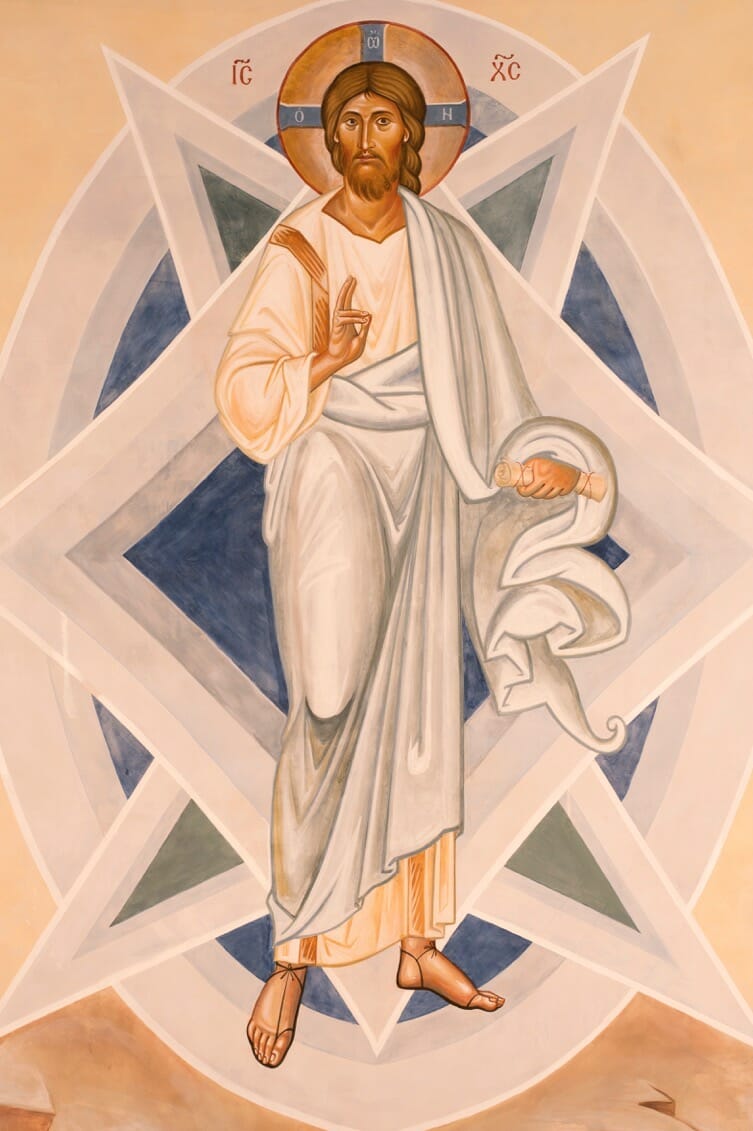
The iconographic tradition reveals Eschatological Man. One important inspiration for this style is the account of the glorified Christ in the Transfiguration; all the saints share in that glory through baptism, as members of the Church, the mystical body of Christ. The stylistic features of icons are shaped by the desire to communicate the reality of man in heaven. The gold disc – the halo – represents the uncreated light radiating from the glorified body. There are no cast shadows, since each figure is its own light source rather than being illuminated from outside. And because heaven lies outside space and time, the icon deliberately reduces the illusion of depth through devices such as reverse perspective, ensuring that the figures inhabit the plane of the painting as much as possible. This is also why oil paint is generally avoided in iconography: it creates too strong an illusion of depth and a quality of sensory richness that works against the image’s purpose. Egg tempera, mosaic, and fresco are better suited to the iconographic style.

Christ Enthroned, in the iconographic style
The Baroque tradition reveals Historical Man, and its distinctive style follows from that different subject. Where iconographic art flattens space and eliminates shadow, Baroque painting deliberately creates an illusion of depth through perspective and portrays deep cast shadows from external light sources. Shadow has been a symbol of evil and suffering throughout Christian tradition – the ancient Office of Tenebrae (named for the Latin word for darkness or shadows) uses precisely this symbolism within the Triduum, in the final days of Holy Week. In Baroque painting, those shadowy depths are deliberately exaggerated, but the Christian message is not one of despair. Just as Easter follows Good Friday, the darkness in a Baroque painting is always contrasted with light, representing the Light that is Christ, that overcomes darkness.

The Baroque style is far more naturalistic than the iconographic, but it is not a simple reproduction of appearances. The artist varies color, edge sharpness, and tonal contrast to direct the viewer’s eye toward what matters and to ensure that the figure is depicted with dignity worthy of a creature made in God’s image. While Baroque art is always the art of fallen, Historical Man, it insists on man’s capacity for sanctity and his need for God’s grace. It is the art of suffering and hope, a Christian hope that transcends suffering.
Saint Jerome and the Angel, 1626, 262 x 164 cm., Museo di Capodimonte
Image: St Jerome and the Angel of Judgment, by Jose Ribera, 
Spanish/Italian, 1626, in the Baroque style
Baroque art should be clearly distinguished from the academic painting of the 19th century, with figures such as Ingres or Bouguereau in France, and from the Pre-Raphaelites in England in the same period. While there were some good examples within each grouping, in my opinion, we can detect that, as a whole, there is a subtle drift away from the Christian balance of idealization and naturalism toward one extreme or the other, becoming either cold and sterile or sentimental to the point of being saccharine. Much of what became 20th-century modernism was an overreaction to this 19th-century academic art. Although the modernists believed they were reacting against Christian tradition, they were, aesthetically at least, reacting against an inferior distortion of it.

The Gothic tradition occupies the ground between the other two, which is fitting given its historical position as a transitional form derived from the Romanesque and anticipating the Baroque. In stylistic terms, it oscillates between the visual language of Eschatological Man, characterized by a highly abstracted iconographic style, and that of Historical Man, characterized by a highly naturalistic Baroque style. It might be called the art of pilgrimage: its imagery points simultaneously toward heaven and the fallen world, reflecting that although we cannot complete the transformation into Eschatological Man in this life, we can begin it. The sacramental life of the Church is precisely the means by which that transformation starts. Like the spires of Gothic churches, Gothic art reaches upward to the heavens while remaining rooted in the earth.
Stone statues of men surrounding a dying woman under an arch
Image: The tympanum of the South portal of Notre-Dame de Strasbourg , ca 1230, The Dormition of the Virgin Mary, sandstone; in the Gothic style. CC BY-SA 2.0 Frédéric Châteaux
The late-Gothic painter Fra Angelico illustrates the point well. He uses elements of the increasing naturalism developing around him, such as single-point perspective and cast shadows, alongside the iconographic visual vocabulary of uncreated light and pictorial flatness. His depictions of the Annunciation (there are several) are examples of paintings that employ perspective and cast shadow; his heavenly scenes, such as the Coronation of the Virgin, revert to the iconographic prototype of flattened space and radiant light. His works are not inconsistent with each other: they reflect a coherent theological understanding of the difference between scenes set in this world and those set in the next.

Image: The Coronation of the Virgin by Fra Angelico, painted around 1434.

A reasonable question arises here. If each tradition rests on a different understanding of man — fallen, glorified, or on pilgrimage between the two — how is it that within a single tradition we find figures in all three states? Baroque art reveals Historical Man, yet it gives us scenes set in heaven, such as the Coronation of the Virgin. The answer, I would argue, is that while a tradition may occasionally admit some slight variation – Fra Angelico is a rare and notable case – in general, once a style of representing the human figure is established within a tradition, it is applied across all situations. To ask an artist to be fluent in several styles and traditions at once, switching between them according to the subject, would be asking too much of him and would likely confuse those who see it; working consistently within one style is what gives a body of work its coherence. And in any case, there are other means of indicating heaven while remaining within the Baroque idiom – the presence of angels, the absence of any earthly setting, and so on.

Why not the High Renaissance?

Many Catholics will be surprised to find that Benedict XVI’s list of authentic liturgical artistic traditions does not include the High Renaissance – the period of Leonardo, Raphael, and Michelangelo, c. 1480–1530, which is often considered the summit of Catholic artistic achievement. I follow Pope Benedict’s lead here, and it is worth explaining why.

All traditional art training involves, in varying degrees, copying the works of great masters and the direct observation of nature. The style in which an artist ultimately paints is shaped above all by the art with which he is most familiar, which in turn shapes his response to the nature he observes. Gothic artists looked to Romanesque models and to one another; for this reason, there was no sharp break between the Romanesque and the Gothic, and Gothic art can be understood as a progressively “naturalized” version of the iconographic style, the level of naturalism increasing gradually and without any clear dislocation from its roots.

The High Renaissance represents a different kind of transition: a clear break from that inherited tradition. Artists of this period no longer looked primarily to Romanesque or Gothic masters for inspiration, but to the ancient Greek and Roman sculptures that surrounded them in Italy and were being excavated at the time. The sharp change in style between the Gothic and the Italian High Renaissance is not a reflection of increased naturalism – as we have explained, that process had already been going on for centuries. Rather, it is due to the incorporation into artists’ training of copying ancient Greek and Roman statues and plaster casts of them, which radically altered the form of the art. The main impetus for this was not theological or philosophical; rather, it was simply that the period was enamored of the magnificence of this ancient form and wished to emulate it.

The implications of this shift were far-reaching. Benedict XVI described what followed:

The Renaissance did something quite new...its art speaks of the grandeur of man almost as if it were surprised by it; it needs no other beauty to seek...The tragic burden of antiquity is forgotten; only its divine beauty is seen. A nostalgia for the gods emerges, for myth, for a world without the fear of sin...True, Christian subjects are still being depicted, but ‘religious art’ is no longer sacred in the proper sense. It does not enter into the humility of the other sacraments and their time-transcending dynamism.
The Spirit of the Liturgy, p129

The phrase “without fear of sin” is worth dwelling on. It was the art theorist Alberti who first proposed, in his influential treatise On Painting (1435), that the observation of the nude should also form part of every artist’s training, along with the copying of ancient statues. In doing so, he was knowingly departing from the practice of Christian tradition up to that point – attaching excessive importance to direct observation of the unclothed figure without sufficient regard, in my opinion, for human dignity or for concupiscence, the natural inclination of fallen man toward sin.

The 16th century, shaped by Alberti’s ideas, is characterized less by a coherent tradition than by a series of dominant, individualistic, and brilliantly gifted figures: Leonardo, Michelangelo, Raphael, and Titian. While there were undoubted individual high points, the period as a whole represented a departure from the sacred character of what preceded it, for the reasons Benedict identifies. The Baroque style was a deliberate response to this, inspired by the Council of Trent (which closed in 1563) and the spiritual energy of the Counter-Reformation. Gradually, the contributions of these and other artists were assessed and integrated, and by the end of the 16th century a coherent Christian tradition, properly grounded in theology, had developed from their work.

This, then, is why the High Renaissance, for all its brilliance, does not appear among the three authentic traditions. It is not a judgment on the gifts of its artists, but a recognition that the sacred character of an artistic tradition depends on the end it serves and the understanding of the human person it embodies. The iconographic, the Gothic, and the Baroque each, in their different ways, keep that end in view; and it is to a fuller account of each that I hope to turn in the articles that follow.
Michelangelo, the Creation of Adam, fresco in the Sistine Chapel.
Roman Discus Thrower, from the 1st century AD, Villa Arianna, Italy

More recent articles:

For more articles, see the NLM archives: