Tuesday, August 25, 2026

Arranging the Breviary for the Rest of the Liturgical Year

This is our annual posting on one of the discrepancies between the traditional arrangement of the Roman Breviary and the new rubrics of 1960; this year, the first such discrepancy appears at Vespers on Saturday evening of this week. In some years, including this one, it also moves the September Ember Days one week forward from their traditional place.

One of the changes made to the Breviary in the revision of 1960 regards the arrangement of the months from August to November.

The first Sunday of each of these months is the day on which the Church begins to read a new set of Scriptural books at Matins, with their accompanying responsories, and Magnificat antiphons at Saturday Vespers. These readings are part of a system which goes back to the sixth century: in August, the books of Wisdom are read; in September, Job, Tobias, Judith and Esther; in October the books of the Maccabees; in November, Ezekiel, Daniel, and the twelve minor Prophets. (September is actually divided into two sets of readings, Job having a different set of responsories from the other three books.)
Folio 98v of the antiphonary of Compiègne, 860-77 AD. At the top of the page are three antiphons taken from the book of Job for Saturday Vespers, the first and second of which (Cum audisset Job and In omnibus his) are found in the Breviary of St Pius V and subsequent revisions thereof. These are followed by responsories and antiphons from the book of Tobias, and responsories from the book of Judith. (Bibliothèque nationale de France. Département des Manuscrits. Latin 17436)
The “first Sunday” of each of these months is traditionally that which occurs closest to the first calendar day of the month, even if that day occurs within the end of the previous month. This year, for example, the first Sunday “of September” is actually August 30th, the Sunday closest to the first day of September.

In the 1960 revision, however, the first Sunday of the months from August to November is always that which occurs first within the calendar month. According to this system, the first Sunday of September is the 6th this year.

The Ember days of September, (which are older than this system), are celebrated within the third week of that month. In the traditional arrangement, this means that they always begin with the Wednesday after the Exaltation of the Cross. However, in the 1960 rubrics, the third week of September is determined differently, and they can be therefore be pushed forward a week, as they are this year. So in the traditional arrangement, they are on Sept. 16, 18 and 19; according to the 1960 rubrics, on Sept. 23, 25 and 26.

This change also accounts for one of the many peculiarities of the 1960 Breviary, the fact that November has four weeks, which are called the First, Third, Fourth and Fifth. According to the older calculation, November has five weeks when the 5th of the month is a Sunday. (This is also the arrangement that has the shortest possible Advent of three weeks and one day.) According to the newer calculation, November may have three or four weeks, but never five. In order to accommodate the new system, one of the weeks had to be removed; the second week of November was chosen, to maintain the tradition that at least a bit of each of the Prophets would continue to be read in the Breviary. However, in some years, November only has three weeks, and the first one is also omitted, but this is not the case this year.
The Sundays of the rest of the liturgical year, according to the traditional system:
August 30 – the 1st Sunday of September (XIV Sunday after Pentecost)
September 6 – the 2nd Sunday of September (XV after Pentecost)
September 13 – the 3rd Sunday of September (XVI after Pentecost); Ember week
September 20 – the 4th Sunday of September (XVII after Pentecost)
September 27 – the 5th Sunday of September (XVIII after Pentecost)

October 4 – the 1st Sunday of October (XIX after Pentecost)
October 11 – the 2nd Sunday of October (XX after Pentecost; commemorated on the feast of the Maternity of the Virgin Mary)
October 18 – the 3rd Sunday of October (XXI after Pentecost; commemorated on the feast of St Luke the Evangelist)
October 25 – the 4th Sunday of October (XXII after Pentecost, commemorated on the feast of Christ the King)
November 1 – the 1st Sunday of November (XXIII after Pentecost; commemorated on the feast of All Saints)
November 8 – the 3rd Sunday of November (V after Epiphany resumed)
November 15 – the 4th Sunday of November (VI after Epiphany resumed)
November 22 – the 5th Sunday of November (XXIV and last after Pentecost)

T
he Sundays of the rest of the liturgical year, according to the 1960 system:
August 30 – the 5th Sunday of August (XIV Sunday after Pentecost)
September 6 – the 1st Sunday of September (XV after Pentecost)
September 13 – the 2nd Sunday of September (XVI after Pentecost)
September 20 – the 3rd Sunday of September (XVII after Pentecost); Ember week
September 27 – the 4th Sunday of September (XVIII after Pentecost)
October 4 – the 1st Sunday of October (XIX after Pentecost)
October 11 – the 2nd Sunday of October (XX after Pentecost)
October 18 – the 3rd Sunday of October (XXI after Pentecost)
October 25 – the 4th Sunday of October (XXII after Pentecost, omitted on the feast of Christ the King)

November 1 – the 1st Sunday of November (XXIII after Pentecost, commemorated on the feast of All Saints)
November 8 – the 3rd Sunday of November (V after Epiphany resumed)
November 15 – the 4th Sunday of November (VI after Epiphany resumed)
November 22 – the 5th Sunday of November (XXIV and last after Pentecost)
The calculation of the Sundays after Pentecost also calls for a note here. (The discrepancies between the Missals of St Pius V and St John XXIII are very slight in this regard.)
The number of Sundays “after Pentecost” assigned to the Missal is 24, but the actual number varies between 23 and 28. The “24th” is always celebrated on the last Sunday before Advent. If there are more than 24, the gap between the 23rd and 24th is filled with the Sundays after Epiphany that had no place at the beginning of the year. The prayers and readings of those Sundays are inserted into the Mass of the 23rd Sunday (i.e., the set of Gregorian propers.) The Breviary homily on the Sunday Gospel and the concomitant antiphons of the Benedictus and Magnificat also carry over in the Office. This year, the Fifth and Sixth Sundays after Epiphany are celebrated between the 23rd and 24th after Pentecost.

If this all seems a little complicated, bear in mind that the oldest arrangement of the Mass lectionary that we know of was even more so. The oldest lectionary of the Roman Rite, a manuscript now in Wurzburg, Germany, dates to ca. 700, and represents the system used at Rome about 50 years earlier. It has a very disorganized and incomplete set of readings for the period after Pentecost; the Sundays are counted as 2 after Pentecost, 7 after Ss Peter and Paul, 5 after St Lawrence, and 6 after St Cyprian, a total of only 20. There are also ten Sundays after Epiphany, even though Septuagesima is also noted in the manuscript, and the largest number of Sundays that can occur between Epiphany and Septuagesima is only six.

Monday, August 03, 2026

The Finding of St Stephen the First Martyr

Today is the feast of the Finding of St Stephen the First Martyr. This took place in the year 415, when the teacher of St Paul, Gamaliel, who is named twice in the Acts of the Apostles (5, 34-40 and 22, 3) appeared in a vision to a priest of Jerusalem named Lucian, on three successive Fridays, and named the location of the burial. Gamaliel further revealed that he himself had taken charge of Stephen’s body after his martyrdom, and buried him on his property near a village that bore his own name, Caphargamala; and that he himself was later buried in the same place, along with his son Abibas, and Nicodemus, who is mentioned in three places in the Gospel of John. (“Abibas” is the Hellenized form of the name “Habib”, which means “beloved” and is very common in Semitic languages.)

St Stephen Mourned by Gamaliel and Nicodemus. Attributed to the anonymous painter known as Pensionante del Saraceni (active 1610–1625), a follower of the Venetian painter Carlo Saraceni (1579–1620); ca. 1615. Public domain image from the website of the Boston Museum of Fine Arts.
Gamaliel ordered Lucian to tell what he had seen in these visions to John, the bishop of Jerusalem, who then sent Lucian to investigate the site. In due course, the graves were discovered, with inscriptions to confirm the identity of the persons buried therein. John was then attending a synod at Lydda (the place of St George’s martyrdom); on receiving word of the discovery from Lucian, he hastened to the site, attended by two other bishops and a large multitude of people. When the coffin of St Stephen was opened, the ground shook, and “an odor of such sweetness and fragrance came forth therefrom, … that (those present) thought they were in the delight of Paradise”; seventy-three persons were healed of possession and a great variety of physical ailments. The relics were then translated to a church on Mt Sion, which Lucian’s letter, the first source for this story, anachronistically describes as the place “where Stephen was ordained as archdeacon.”

From there, portions of the relics were subsequently sent out to many other places, as attested inter alia by a sermon of St Augustine. “His body lay hidden from (the time of his martyrdom) until these days; but recently appeared, as the bodies of the holy martyrs are wont to appear, by the revelation of God, when it pleased the Creator. And indeed, it was revealed to him who showed these very things when they had been found; for the place was shown beforehand by signs, and the discovery made just as had been told by revelation. Many have received relics from there, because God willed it so, and these have come here.” (Sermon 318, 8) At the end of the 5th century, Gennadius, a priest of Marseille, wrote a continuation of St Jerome’s book On Illustrious Men, in which he states that “Lucian the priest, a holy man, to whom God revealed the place of the burial and the relics of St Stephen the First Martyr, in the time of the Emperors Honorius and Theodosius, wrote down (the story of) the revelation to all the churches, in Greek”, which a Spanish priest named Avitus then translated into Latin. (capp. 46-47; PL 58 1084B).

A reliquary for the hand of St Stephen from the cathedral of Genoa, Italy.
Prior to the Tridentine reform of the Breviary, it was far more common for the lessons of a Saint’s life to occupy all the lesson of Matins, and readings from Scripture on feast days were very rare. Therefore, in the Roman Breviary of 1529, the lessons of August 3rd tell the story as above, with a number of other less important details, in six lessons which occupy the first two nocturns of Matins. In the third nocturn, a homily of St Jerome on the Gospel of the day, Matthew 23, 34-39, is repeated from St Stephen’s main feast day.

In 1568, however, the lessons are reordered according to a pattern which was made universal by the Breviary of St Pius V, in which those of the first nocturn are always Biblical, those of the second are either a Patristic sermon or the life of a Saint, and those of the third a homily on the day’s Gospel. In the case of today’s feast, the lessons of the third nocturn remain the same, while those of the first are repeated from St Stephen’s octave day, Acts 7, 51 – 8, 2, the end of his speech and the account of his death and burial.

The story of the discovery of the relics by Lucian would normally then be compressed into the three lessons of the second nocturn, as was done for countless other Saints. However, they are actually reduced to two lessons, while the sixth is taken from the last book of St Augustine’s City of God.

“When the bishop Projectus was bringing the relics of the most glorious martyr Stephen to the waters of Tibilis, a great concourse of people came to meet him at the shrine. There a blind woman entreated that she might be led to the bishop who was carrying the relics. He gave her the flowers he was carrying. She took them, applied them to her eyes, and immediately saw. Those who were present were astounded, while she, with every expression of joy, preceded them, pursuing her way without further need of a guide. Lucillus (bishop of Sinita), in the neighborhood of the colony Hippo, was carrying in procession some relics of the same martyr, which had been deposited in the castle of Sinita. A fistula under which he had long suffered … was suddenly cured by the mere carrying of that sacred burden.” (De Civ. Dei 22, 8)

These are only two of the many miracles which St Augustine attributes to the relics of St Stephen in this chapter; he goes on to list several others, and more still which took place in the towns of Calama and Uzali, which also had relics of the Saint, miracles of which he had personal knowledge. “I cannot record all the miracles I know; and doubtless several of our adherents, when they read what I have narrated, will regret that I have omitted so many which they, as well as I, certainly know. … I beg these persons to excuse me, and to consider how long it would take me to relate all those miracles … For were I to be silent of all others, and to record exclusively the miracles of healing which were wrought in the district of Calama and of Hippo by … the most glorious Stephen, they would fill many volumes.”

St Augustine, by Giuseppe Antonio Pianca, ca. 1745
As is so often the case (see here, here, and here) the inclusion of this passage in the Breviary is part of the Church’s response to the Protestant reformation. The early reformers frequently claimed to find in the writings of the Church Fathers proof that their novelties were in fact the original teachings of Christ and the Apostles, long obscured by medieval corruptions, and happily restored by themselves. On this score, St Augustine was frequently appealed to especially in matters pertaining to the doctrine of grace; John Calvin famously stated about him “totus noster est – he belongs entirely to us” (a typically gross exaggeration), while Luther himself had been an Augustinian.

It hardly needs to be said that apologists on the Catholic side had an easy rejoinder to this, namely, that the same Church Fathers frequently and enthusiastically taught and practiced things which the reformers themselves rejected. St Jerome, for example, was the only authority to whom they could appeal in support of their rejection of the Deuterocanonical books of the Bible, but he was also a fierce defender of the Papacy, of asceticism, monasticism, celibacy and virginity, all of which made him particularly distasteful to Luther. Likewise, here we see St Augustine, the supposed Protestant doctor of grace, unreservedly promoting not just devotion to the Saints (which many Protestants could accept in some form), but also the importance of relics.

There were, of course, many dubious or manifestly false relics in circulation at the time of the Reformation; it also true that in some places, clerical avarice benefitted greatly from the laity’s devotion by charging them to see or touch the relics kept in churches, a frequent matter of Protestant complaints. True reformers rightly wished to see such abuses put to an end, and the problem was raised and effectively dealt with at the final session of the Council of Trent. But passages such as the one from St Augustine added to the Breviary show the complete rejection of relics on the part of the reformers for what it truly was, a radical break with a universally held tradition, one with roots in the Bible itself, and faithfully passed on by the Fathers.

Folio 113r of the Saint-Sever Apocalypse, a mid-11th century manuscript which contains inter alia the Commentary on the Apocalypse of St Beatus of Liébana (ca. 730-800). This page represents the words of Apocalypse 6, 9-11, “I saw under the altar the souls of them that were slain for the word of God, and for the testimony which they held. And they cried with a loud voice, saying, ‘How long, O Lord (holy and true) dost thou not judge and revenge our blood on them that dwell on the earth?’ And white robes were given to every one of them one; and it was said to them, that they should rest for a little time, till their fellow servants, and their brethren, who are to be slain, even as they, should be filled up.” The golden T in the upper right corner of the picture is the altar (labelled ‘ara aurea - the golden altar’) and the birds beneath it are labelled ‘the souls of the slain.’ In the lower part, the caption reads ‘to these were given white stoles.’ (Bibliothèque nationale de France. Département des manuscrits. Latin 8878)
In another example of its classic liturgical conservatism, the Roman church kept the feast of the Finding of St Stephen with almost the same liturgical texts as his principal feast on December 26th. The lessons of Matins described above are the only proper feature of the Office; the Mass is exactly the same, apart from the change of a single word in the Collect: “Grant us, we beseech thee, O Lord, so to imitate what we revere, that we may learn to love even our enemies; for we celebrate the birth/finding of him who knew how to pray for his very persecutors to our Lord.”

There was however, a completely proper Office for the feast, based on the text of Lucian’s letter, which was used in many other parts of Europe. Here are the three antiphons for the Gospel canticles.

Folio 312v of an antiphonary produced for the abbey of St Maur in France in the last quarter of the 11th century, with the first part of the proper Office of the Finding of St Stephen. (Bibliothèque nationale de France. Département des manuscrits. Latin 12584)
Ad Magn. Aña in I Vesp. Ostendit * sanctus Gamaliel per visum Luciano sacerdoti tres calathos aureos rosis refertos, et quartum argenteum croco plenum, et dixit: Hi sunt nostri loculi, et nostræ reliquiæ: hic autem sanguineas habens rosas, loculus est sancti Stephani, qui solus ex nobis martyrio meruit coronari. – The holy Gamaliel showed the priest Lucian in a vision three golden baskets filled with roses, and a fourth of silver, filled with saffron, and said, ‘These are our coffins, and our relics; and this one that hath roses the color of blood is the coffin of Saint Stephen, who alone among us merited to be crowned with martyrdom.” (In the letter, Gamaliel explains that the saffron represents the purity of his son Abibas, who died very young, and that they were buried together, hence there are only three coffins.)

Ad Bened. Ex odoris * mira fragrantia sanitas ægrotis emanavit maxima: septuaginta namque et tres tunc a variis languoribus curati sunt homines in Inventione corporis Stephani dilectissimi Martyris, Deum benedicentes. – From the wondrous fragrance of the smell, very great healing came forth unto the ill; for seventy-three persons were then healed of various ailments at the finding of the body of Stephen, the most beloved martyr, as they blessed God.

Ad Magn. in II Vesp. Hodie * Joannes Pontifex cum maximo cleri plebisque tripudio, pretiosas Protomartyris Stephani reliquias in sanctam transtulit ecclesiam Sion, ubi quondam Archidiaconi functus est officio: cujus pia apud Deum sit pro nobis, quæsumus, intercessio. – Today, bishop John, with very great rejoicing of the clergy and people, translated the precious relics of the First Martyr Stephen to the holy church of Zion, where once he fulfilled the office of archdeacon; and we ask that his holy intercession may stand for before God.

Monday, July 06, 2026

The Legend of Simon Magus

Until the year 1881 [note], the Roman Breviary included among the lessons during the octave of Ss Peter and Paul part of a sermon of St Maximus of Turin, a Church Father of the late 4th and early 5th, of whom very little is known. This sermon recounts a famous legend concerning the death of the Apostles as follows.

The Fall of Simon Magus, by Benozzo Gozzoli, 1461-62
“On this day, then, the blessed Apostles shed their blood; but let us look to the cause for which they suffered, namely, that among other miracles, they also by their prayers brought down the famous magician Simon in a headlong fall from the empty air. For when this Simon said that he was Christ, and claimed that as the Son he could ascend to the Father by flying, and, having been lifted up by his magical arts, had at once begun to fly; then Peter knelt down and prayed the Lord, and by his holy prayer, overcome the magician’s flight. For his prayer ascended to the Lord before the flight did, and his just petition came there before (Simon’s) wicked presumption did; Peter, being set upon the earth, obtained what he asked for before Simon could come to the heavens whither he was headed. Then did Peter set him down like a prisoner from the lofty heights, and dashing him down with a steep fall onto a stone, broke his legs; and this, as a reproach of what he had done, so that he who had just tried to fly could suddenly no longer walk, and he that had taken on wings lost the use of his feet.” (Sermo 72 de natali Ss Apostolorum Petri et Pauli)

Church Fathers even earlier than St Maximus, such as St Justin Martyr and Arnobius, knew of the tradition that Simon Magus, who sought to buy the power of the Holy Spirit from St Peter (Acts 8), was in Rome at the same time as the Eternal City’s founding Apostles. The apocryphal Acts of St Peter tell the story that Simon sought to win the Emperor Nero to his teachings, which he would prove to be true by flying off a tower built in the Forum specifically for this purpose. As he was lifted up into the air by the agency of demons, Peter and Paul knelt on the street and prayed to God, whereon Simon was dropped, and soon after died of his injuries.

In the unintentionally hilarious 1954 historical epic The Silver Chalice, Simon Magus is played by the great Jack Palance, wearing what is perhaps the very worst super-hero costume ever made. (Palance, by the way, was born Volodymyr Palahniuk, to a Ukrainian Greek-Catholic father and Polish mother, in Pennsylvania mining country. This movie saw the debut of another world-famous actor, Paul Newman, whose performance earned him a Golden Globe nomination; despite this, Newman himself once called it “the worst motion picture produced during the 1950s.”)

The legend goes on to say that the enraged Nero arrested Peter and Paul and threw them into the Mamertine prison before their execution. There they converted the two wardens, Processus and Martinian, in whose acts it is told that St Peter caused a well to spring up from the ground so that he could baptize them. The site has been venerated as the place of the Apostles’ imprisonment for many centuries, and pilgrims can still visit it to this day; a plaque near the door lists the famous Roman prisoners, such as King Jugurtha of Numidia, who were killed there, the Saints who suffered and died within its walls, and the later Saints who have come to venerate the site.

On the opposite end of the Via Sacra, the principal street of the Roman Forum, Pope St Paul I (757-67) built an oratory dedicated to Peter and Paul, nicknamed ‘ubi cecidit magus – where the magician fell.’ This oratory contained as its principal relic the stone upon which St Peter knelt to pray for the defeat of Simon Magus and the vindication of the Christian faith. It was later demolished, but the stone itself is preserved in the nearby church of Santa Maria Nuova.

Photo by JP Sonnen. The Italian inscription above says “On these rocks St Peter set his knees when the demons carried Simon Magus through the air.”
[note] In October of 1880, Pope Leo XIII added the feast of Ss Cyril and Methodius to the general calendar, and assigned their feast to July 5th. The day within the octave of the Apostles was chosen to express the hope for the reunion of the Orthodox Slavs, originally evangelized by Cyril and Methodius, with the See of Peter; this is also stated in the proper hymns of their Office, which were composed by the Pope himself. Their feast was celebrated on this day from 1881 to 1899. At the end of 1899, the feast of St Anthony Maria Zaccaria, founder of the Clerks Regular of St Paul (also known as the Barnabites, from the titular Saint of their mother church in Milan) was extended to the universal calendar, and placed on July 5th, the day of his death in 1539; Ss Cyril and Methodius were then moved to the 7th. In the post-Conciliar calendar, they were moved again, to the day of Cyril’s death, February 14th.

Tuesday, May 12, 2026

A Homily of St Gregory the Great Carved in Stone

Today is the feast of two Roman Saints named Nereus and Achilleus. An inscription placed over their burial place by Pope St Damasus I (366-84) tells us that they were soldiers who were forced to participate in the persecution of Christians, but threw away their weapons and armor, and were in turn martyred for the Faith. There can be no doubt of the authenticity of their martyrdom, or that their feast is very ancient, but the date of their death is uncertain, and the various details later added to their story are considered legendary. In the pre-Tridentine Roman Divine Office, their Matins lessons amount to barely over a hundred words, which are restated with similar brevity in the reformed version of St Pius V. Their feast was kept at the lowest rank, and shared with another Roman martyr who died on the same day, St Pancratius.

Pope St Gregory the Great venerating a miraculous image of the Virgin and Child, surrounded by Ss Papias and Maurus (left), and Nereus, Achilleus and Domitilla (right); 1606-7, by Peter Paul Rubens. This painting was commissioned for the Chiesa Nuova, the church of the Roman Oratory, which dedicated to both the Virgin Mary and St Gregory; parts of the relics of the five Saints depicted in it are in the high altar.
They were buried in part of the Christian cemetery complex now known as the Catacomb of Domitilla, about 1½ miles from the Aurelian Walls down the via Ardeatina; Pope Damasus then built a small basilica on the grounds over this cemetery. More than two hundred years later, Pope St Gregory the Great preached in this church on the martyrs’ feast day. However, in later centuries, when the empire had fallen apart, and the countryside around Rome was no longer safe for pilgrims to traverse, the relics of nearly all the Saints who had originally been buried in the various catacombs were brought into the city, and placed in churches. The basilicas over the cemeteries were then abandoned and mostly fell into ruin, in some cases, so completely that their exact location is no longer identifiable.
The interior of the modern reconstructed basilica of Ss Nereus and Achilleus, at the catacomb of Domitilla. (Image from Wikimedia Commons by Dennis G. Jarvis, CC BY 2.0)
It is not certain when Nereus and Achilleus were brought into Rome. Around 800 AD, Pope St Leo III built or rebuilt a church in their honor next to the baths of Caracalla, and it is possible that this was done specifically to accommodate the translation of their relics. But one way or another, four centuries later, they were brought to the church of St Hadrian in the Roman Forum.
When Pope Clement VIII elevated the great Church historian Cesare Baronio, a priest of the Roman Oratory and close friend of its founder, St Philip Neri, to the rank of cardinal in 1596, he gave him the church of Ss Nereus and Achilleus as his title. Baronio immediately set about giving the building a much-needed top-to-bottom restoration. The following year, the Saints’ relics were discovered at St Hadrian, and solemnly translated to their own church on the day before their feast.
Image from Wikimedia Commons by RealRome, CC BY 4.0 
Image from Wikimedia Commons by LivioAndronico2013, CC BY-SA 4.0
At the time, it was mistakenly believed that this was the church in which St Gregory had preached the aforementioned homily, and the cardinal therefore had the full text of it carved onto the episcopal throne in the apse, where it can still be seen today. The feast itself was raised to the rank of semidouble, and excerpts of the same homily, on the Gospel of the healing of the prince’s son (John 4, 46-53) were added to the breviary. (Another part of the same homily is read on the 20th Sunday after Pentecost.)
Image from Wikimedia Commons by Lalupa, CC BY-SA 3.0 
Here is the conclusion, starting from where St Gregory mentions the Saints for the first time. If he seems very pessimistic about the state of the world, one must remember that Rome was in a terrible condition after the Gothic wars of the sixth century, and he would have walked through roughly two miles of ruins to get to the place where he preached it. Assuming he took the shortest route from the Lateran, where the popes lived at the time, he would have passed by at least one broken aqueduct, an abandoned bath complex, and a good many large but long-empty houses.
“Behold, this world which is loved flees away. These saints at whose grave we stand trampled the flourishing world with contempt. They had long life, continual health, material riches, many children, tranquility in long-lasting peace, and yet, though it flourishing in itself, this world had already withered in their hearts. Behold, now this world is withered in itself, and still, it flourishes in our hearts. Everywhere is death, everywhere mourning, everywhere desolation; on all sides we are struck, on all sides we are filled with bitterness. And yet, in the blindness of our mind, we love the very bitterness of the tasted fleshly desire; we pursue what flees, we cling to what falls, and since we cannot hold onto that which falls, we fall with what we hold onto. Once, the world captivated us for itself with its delight; now it is now full of such misfortunes that already it sends us back to God.
Consider, therefore, that what happens in time does not count, for the end of all temporal things shows how meaningless is that which can pass away. The collapse of things shows us that something which passes away was almost nothing, even when it seemed to stand firm. Dearest brothers, think of these things with careful consideration; fix your hearts in the love of eternity, so that, while you disdain to reach the heights of earth, you may come to that glory which you hold by faith, through Jesus Christ our Lord, who is God, and lives and reigns with the Father in unity of the Holy Spirit, through all the ages of ages. Amen.”
The ruins of the baths of Caracalla in Rome, depicted in an engraving by the Swiss artist Louis Duclos (1748-1810), ca. 1780. In St Gregory’s time, the complex was already abandoned, but of course nowhere near so badly ruined.  

Thursday, April 23, 2026

A Resource for Those Learning the Pre-55 Breviary

Thanks once again to our friend Mr Sean Pilcher, this time for sharing with us this a review of a resource newly reprinted by Church Latin Publications for those who want to learn to say the pre-55 Breviary, a book will be especially useful for those who have been used to the edition of 1960. Mr Pilcher is the director of Sacra: Relics of the Saints (sacrarelics.org), an apostolate that promotes education about relics, and works to repair, research, and document relics for religious houses and dioceses.

The transition from the breviary in force in 1962 to the more traditional breviary before 1955 can be disorienting, even for priests, religious, and interested layfolk who are familiar with the traditional Roman rite. The 1962 breviary is vastly simplified and pared down, so that is, in some ways easier to use. Setting aside the question of whether this outweighs the drastic reduction in patristic readings and hagiographies, as well as a neutered calendar, we can feel puzzled by the additional commemorations, lessons, and ranking of feasts when beginning to pray the older Office.

A very useful resource, especially for those looking for an intuitive transition from the reduced ’62 breviary, but really anyone interested in the Office, is Learning the Breviary by Fr Bernard A. Hausmann, S.J. The book, which was written in 1932, has been recently reprinted by Church Latin Publishing. The book begins with a touching exhortation to fidelity to the breviary written by His Excellency William Hayden, bishop of Wilcannia-Forbes, Australia, which he originally penned to his priests: “The priest who says his Office every day, digne, attente ac devote, is traveling on very safe lines. I do not mean to say that the reciting of the Office alone is all that is required of him. What I mean is, that the priest who is faithful to this duty will also be faithful to the many other obligations which are inseparably linked with the sacerdotal state.” The author also frankly acknowledges that the complex structure and the language can be real obstacles to appreciating the rich treasure of the Roman Breviary.

The text is directed toward those approaching Orders (and therefore obligation to the Divine Office) and those who have already spent much time reciting the breviary but with less profit than they wish. The introduction is especially stirring for clerics, but can be helpful for anyone who wishes to pray with the liturgy of the Church. He addresses the difficulty of the psalter: ‘Who could say when asked on the spot the meaning of words such as absistat et vecordia; or Virginis proles opifexque matris?’, and the value of the cursus of Scripture, saints’ lives, and patristic commentaries in the lessons of matins. The introduction also stresses the hidden beauty of the hymns, however altered, and ends by giving real paternal advice to priests in prioritizing the hours and staying faithful to them: “My dear Fathers, I know that many of you have to live in lonely places, without many home comforts and without the companionship of your fellow-priests. Hence I would advise you to make the Breviary your special friend and companion.” The bishop stresses that for him, not even a busy schedule, travel, or primitive accommodations should be real obstacles to faithful prayer of the breviary.
The Dictionary of Terms, or glossary, that follows is invaluable. The author defines all of the unique terms associated with the canonical hours (antiphon, versicle, ferial office) in clear, unambiguous language to assist beginners. Beyond this, however, he explains many terms which those coming from the ‘62 breviary may find puzzling, and which are in many texts taken for granted. Anyone who has ever had a second thought about ‘double,’ ‘semidouble’ or ‘duplex majus’ feasts will benefit. Finally, certain shorthands and rubrical notes (‘m.t.v.,’ ‘vesperae de sequenti’) used as technical terms are explained. ~ Besides its spiritual words of encouragement at the outset, the book is deeply practical. What follows is an individual treatment of each hour, an explanation of each of its parts and how they can vary, and an anticipation of many of the most common misunderstandings and errors in recitation of the office in question. The explanation even prints out many abbreviated texts in full, so that beginners can understand the sometimes confusing way the breviary prints the prayers for our ease and to economize space.
After the individual treatment of matins, lauds, prime, terce, sext, none, vespers, and compline individually on their own terms, the author dedicates a section to summarizing the structure of the Divine Office as a whole. Once the reader has a grasp of each of the hours, this helpful summary can solidify the general pattern of the Office as a unity throughout the year as seasons, feasts, and fasts come by. Two short sections follow explaining the Office of Our Lady on Saturdays, and the Office of the Dead, with special direction on how to pray the latter on particular days of commemoration (the day of death or burial, and on anniversaries), and how to pray them in conjunction with the regular offices for the day. The next section presents general changes throughout the seasons, such as on Sundays, during Lent and Holy Week, and for Paschaltide. There is also a small set of notes to aid beginners in reading an ordo.
Finally, the author presents sample offices and a series of charts to compare the various possible forms each one can take. The book ends with a very useful index of the explanations given.
Church Latin Publishing also reprints a similar resource for the 1962 Office, which could be of use to those learning the traditional breviary coming from no prior experience or from the Liturgy of the Hours.

Thursday, September 18, 2025

A New Edition of the Monastic Breviary from the Monastère Saint-Benoît

We are very glad to share to the news that the printing house of the Monastère Saint-Benoît in Brignole, France, Éditions Pax inter Spinas, has now made available a republication of the two volumes of the last edition (1963) of the traditional Latin Monastic Breviary, as was announced back in March. Dom Alcuin Reid, OSB, prior of the monastery, recently gave an interview to the Liturgical Arts Journal about the Divine Office and its place in our liturgical tradition, which is, of course, well worth your time to read. He also explains some of the editorial decision which were made, regarding the inclusion of some useful material from earlier editions of the Monastic Breviary. 

The Breviary contains all that is necessary to pray the complete Monastic Divine Office of Matins, Lauds, Prime, Terce, Sext, None, Vespers and Compline for each day of the liturgical year. In addition to the complete contents of the 1963 edition, an appendix provides texts found in previous editions of the Breviary for those who wish to use them. Printed on bible paper in black and red throughout with gilt edges, 6 silk marker ribbons and a black flexible cover, these volumes are both worthy and durable.

In addition to the whole of the Monastic Office, both volumes of the Breviarium Monasticum include the Little Office of Our Lady, the manner of praying the Gradual psalms in choir, as well as the seven penitential psalms and the litany of the saints. There is also an appendix with excepts from the Roman Missal (the prayers for the preparation for Mass and thanksgiving afterwards), prayers to St Benedict, prayers for the pope, prayers for the renewal of religious profession, a filial commendation to St Benedict, excerpts from the Roman Ritual (the litanies of the Holy Name, of the Sacred Heart, of the Precious Blood, of Our Lady, of St Joseph, rites for visiting and blessing the Sick, rites and prayers for the dying, rites for the blessing of Holy Water, images, children, medals of St Benedict, rosaries, houses, etc.), monastic rites including the blessings of lectors and refectory servers, grace before and after meals, the Itinerarium, the General Absolution from faults against the Rule given at certain times of the year, as well as the brief formulae used in the administration of the Sacraments in emergencies.

The Breviaries are not available as separate volumes. Discounts are available for orders from monasteries or other religious communities for orders of 5+ copies, and trade discounts are available for bookshops. Please contact us.

BREVIARIUM MONASTICUM vol. I 10.5 x 16.5cm, sewn flexible cover, 1680pp ISBN 9782956905523

BREVIARIUM MONASTICUM vol. II 10.5 x 16.5cm, sewn flexible cover, 1400pp ISBN 9782956905530

To order: www.monasterebrignoles.org/editionspaxinterspinas.html

Saturday, August 30, 2025

Arranging the Breviary for the Rest of the Liturgical Year

This is our annual posting on one of the discrepancies between the traditional arrangement of the Roman Breviary and the new rubrics of 1960; this year, the first such discrepancy appears at Vespers this evening. In some years, including this one, it also moves the September Ember Days one week forward from their traditional place.

One of the changes made to the Breviary in the revision of 1960 regards the arrangement of the months from August to November.

The first Sunday of each of these months is the day on which the Church begins to read a new set of Scriptural books at Matins, with their accompanying responsories, and Magnificat antiphons at Saturday Vespers. These readings are part of a system which goes back to the sixth century: in August, the books of Wisdom are read; in September, Job, Tobias, Judith and Esther; in October the books of the Maccabees; in November, Ezekiel, Daniel, and the twelve minor Prophets. (September is actually divided into two sets of readings, Job having a different set of responsories from the other three books.)
Folio 98v of the antiphonary of Compiègne, 860-77 AD. At the top of the page are three antiphons taken from the book of Job for Saturday Vespers, the first and second of which (Cum audisset Job and In omnibus his) are found in the Breviary of St Pius V and subsequent revisions thereof. These are followed by responsories and antiphons from the book of Tobias, and responsories from the book of Judith. (Bibliothèque nationale de France. Département des Manuscrits. Latin 17436)
The “first Sunday” of each of these months is traditionally that which occurs closest to the first calendar day of the month, even if that day occurs within the end of the previous month. This year, for example, the first Sunday “of September” is actually tomorrow, August 31st, the Sunday closest to the first day of September.

In the 1960 revision, however, the first Sunday of the months from August to November is always that which occurs first within the calendar month. According to this system, the first Sunday of September is the 7th this year.

The Ember days of September, (which are older than this system), are celebrated within the third week of that month. In the traditional arrangement, this means that they always begin with the Wednesday after the Exaltation of the Cross. However, in the 1960 rubrics, the third week of September is determined differently, and they can be therefore be pushed forward a week, as they are this year. So in the traditional arrangement, they are on Sept. 17, 19 and 20; according to the 1960 rubrics, on Sept. 24, 26 and 27.

This change also accounts for one of the many peculiarities of the 1960 Breviary, the fact that November has four weeks, which are called the First, Third, Fourth and Fifth. According to the older calculation, November has five weeks when the 5th of the month is a Sunday. (This is also the arrangement that has the shortest possible Advent of three weeks and one day.) According to the newer calculation, November may have three or four weeks, but never five. In order to accommodate the new system, one of the weeks had to be removed; the second week of November was chosen, to maintain the tradition that at least a bit of each of the Prophets would continue to be read in the Breviary. However, in some years, November only has three weeks, and the first one is also omitted, but this is not the case this year.
One further note regarding a major discrepancy which occurs this year between the Roman Rite and the post-Conciliar Rite. In the Roman Rite, the Commemoration of All the Faithful Departed, commonly known as All Souls’ Day, cannot be celebrated on a Sunday, since it is regarded as inappropriate to dedicate the day of the Resurrection primarily to praying for the dead. Therefore, if November 2nd occurs on a Sunday, as it does this year, All Souls is moved to Monday.
As a principle, this is still very much part of the post-Conciliar Rite, which heavily restricts which Masses for the Dead can be celebrated on Sundays. (They are permitted only on Sundays per annum, not on those of Advent, Lent or Eastertide, and only for proper funeral Masses, i.e., with the body of the deceased present.) However, it would obviously be far too much to ask Modern Man™ to attend Mass two days in a row; therefore, when November 2 falls on a Sunday, the Mass of All Souls is celebrated in place of that of the Sunday. (It may be noted in passing that the post-Conciliar Rite’s opening prayer for the first Mass of All Souls’ Day is easily one of its very worst innovations, wholly divorced from the entire Church’s tradition, not just that of the Roman Rite, since it does not actually pray for the dead.)  
 
The Sundays of the rest of the liturgical year, according to the traditional system:
August 31 – the 1st Sunday of September (XII Sunday after Pentecost)
September 7 – the 2nd Sunday of September (XIII after Pentecost)
September 14 – the 3rd Sunday of September (XIV after Pentecost, commemorated on the Exaltation of the Cross); Ember week
September 21 – the 4th Sunday of September (XV after Pentecost, commemorated on the feast of St Matthew the Evangelist)
September 28 – the 1st Sunday of October (XVI after Pentecost)
October 5 – the 2nd Sunday of October (XVII after Pentecost)
October 12 – the 3rd Sunday of October (XVIII after Pentecost)
October 19 – the 4th Sunday of October (XIX after Pentecost)
October 26 – the 5th Sunday of October (XX after Pentecost, commemorated on the feast of Christ the King)
November 2 – the 1st Sunday of November (XXI after Pentecost)
November 9 – the 3rd Sunday of November (XXII after Pentecost, commemorated on the feast of the Dedication of St John in the Lateran)
November 16 – the 4th Sunday of November (XXIII after Pentecost)
November 23 – the 5th Sunday of November (XXIV and last after Pentecost)

T
he Sundays of the rest of the liturgical year, according to the 1960 system:
August 31 – the 5th Sunday of August (XII Sunday after Pentecost)
September 7 – the 1st Sunday of September (XIII after Pentecost)
September 14 – the 2nd Sunday of September (XIV after Pentecost, omitted on the Exaltation of the Cross)
September 21 – the 3rd Sunday of September (XV after Pentecost); Ember week
September 28 – the 4th Sunday of September (XVI after Pentecost)
October 5 – the 1st Sunday of October (XVII after Pentecost)
October 12 – the 2nd Sunday of October (XVIII after Pentecost)
October 19 – the 3rd Sunday of October (XIX after Pentecost)
October 26 – the 4th Sunday of October (XX after Pentecost, omitted on the feast of Christ the King)

November 2 – the 1st Sunday of November (XXI after Pentecost)
November 9 – the 3rd Sunday of November (XXII after Pentecost, omitted on the feast of the Dedication of St John in the Lateran)
November 16 – the 4th Sunday of November (XXIII after Pentecost)
November 23 – the 5th Sunday of November (XXIV and last after Pentecost)
The calculation of the Sundays after Pentecost also calls for a note here. (The discrepancies between the Missals of St Pius V and St John XXIII are very slight in this regard.)
The number of Sundays “after Pentecost” assigned to the Missal is 24, but the actual number varies between 23 and 28. The “24th” is always celebrated on the last Sunday before Advent. If there are more than 24, the gap between the 23rd and 24th is filled with the Sundays after Epiphany that had no place at the beginning of the year. The prayers and readings of those Sundays are inserted into the Mass of the 23rd Sunday (i.e., the set of Gregorian propers.) The Breviary homily on the Sunday Gospel and the concomitant antiphons of the Benedictus and Magnificat also carry over in the Office. This year, however, there are exactly 24 Sundays after Pentecost, and therefore, none of the Sundays after Epiphany are resumed at the end of the year.

If this all seems a little complicated, bear in mind that the oldest arrangement of the Mass lectionary that we know of was even more so. The oldest lectionary of the Roman Rite, a manuscript now in Wurzburg, Germany, dates to ca. 700, and represents the system used at Rome about 50 years earlier. It has a very disorganized and incomplete set of readings for the period after Pentecost; the Sundays are counted as 2 after Pentecost, 7 after Ss Peter and Paul, 5 after St Lawrence, and 6 after St Cyprian, a total of only 20. There are also ten Sundays after Epiphany, even though Septuagesima is also noted in the manuscript, and the largest number of Sundays that can occur between Epiphany and Septuagesima is only six.

Sunday, August 24, 2025

The Legend of St Bartholomew

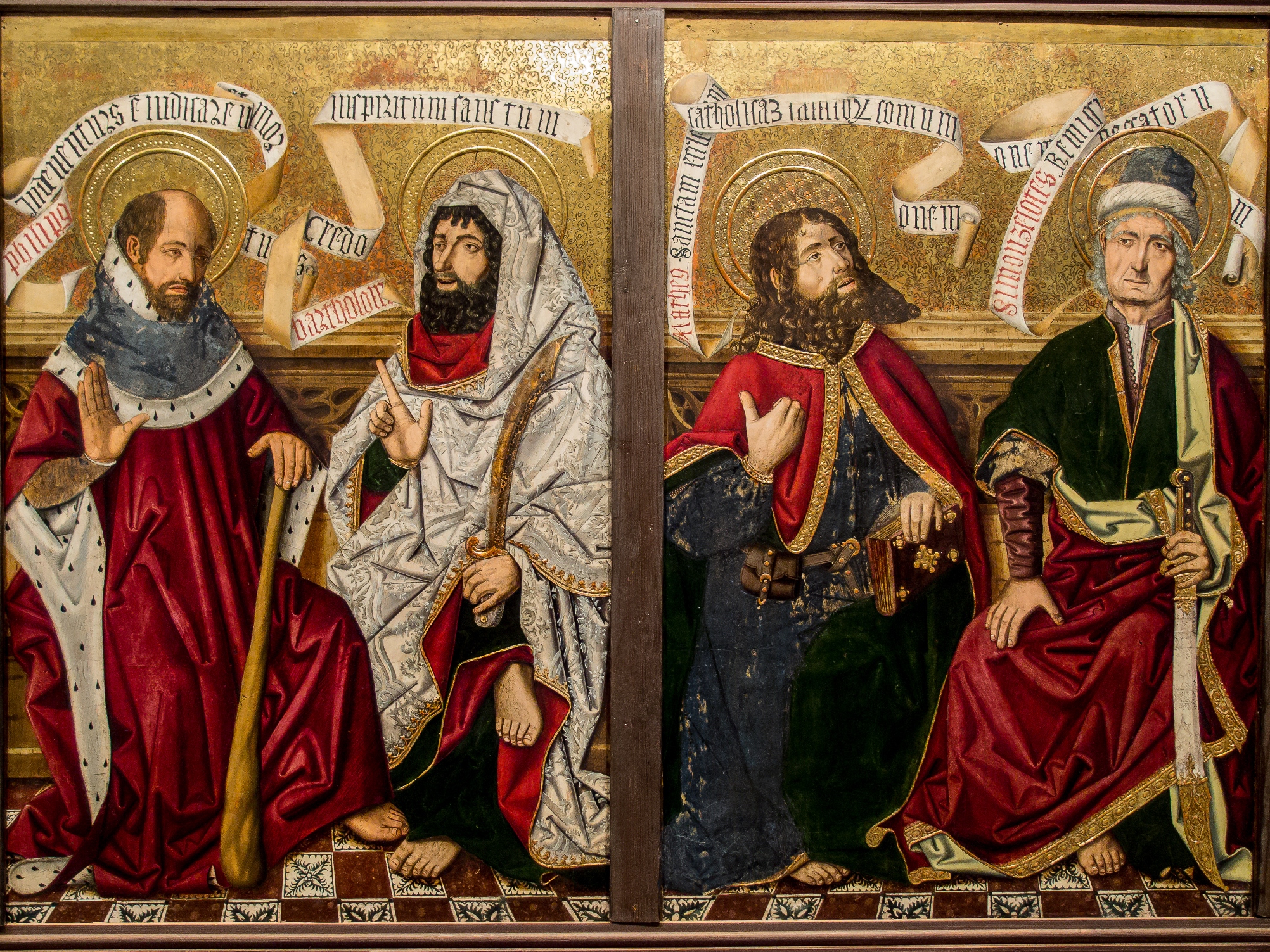
In all three Synoptic Gospels, Saints Philip and Bartholomew are named fifth and sixth in the company of the Twelve Apostles, and then nothing else is said about them. The latter is traditionally identified with Nathanael, who figures prominently at the end of the first chapter of St John’s Gospel, and is mentioned at the beginning of the last chapter among those who saw the Risen Lord at the sea of Tiberias. This identification is made partly because in John 1, it is Philip, with whom he is always paired in the Synoptics, who brings him to Christ, and partly because Bartholomew is a patronymic, “son of Tolmai”, which would make “Nathanael” his personal name. The custom of the Church accepts this identification, but always uses the name Bartholomew in the liturgy.
The Apostles Philip, Bartholomew, Matthew and Simon, each of whom contributes one article to the Apostles’ Creed, following a popular medieval legend. 1483-7, by the workshop of the Spanish painter Miguel Ximenez. Public domain image from Wikimedia Commons.
However, the Roman Gospel of his feast day is not his exchange with Christ recorded in St John (1, 44-51), but rather, St Luke’s list of the Twelve Apostles, and the beginning of the Sermon on the Plain, 6, 12-19.
“At that time: Jesus went out into a mountain to pray, and he passed the whole night in the prayer of God. And when day was come, he called unto him his disciples; and he chose twelve of them (whom also he named apostles): Simon, whom he surnamed Peter, and Andrew his brother, James and John, Philip and Bartholomew, Matthew and Thomas, James the son of Alpheus, and Simon who is called Zelotes, and Jude, the brother of James, and Judas Iscariot, who was the traitor. And coming down with them, he stood in a plain place, and the company of his disciples, and a very great multitude of people from all Judea and Jerusalem, and the seacoast both of Tyre and Sidon, who were come to hear him, and to be healed of their diseases. And they that were troubled with unclean spirits, were cured. And all the multitude sought to touch him, for virtue went out from him, and healed all.”
This choice depends on the final words, referring to the healings of the sick and the possessed, since in his various apocryphal acts Bartholomew effects many cures of both kinds. Many pre-Tridentine breviaries give a fairly full account of these stories, which in their broad outline are similar to the apocryphal acts of some of the other Apostles, most particularly those of St Matthew. Bartholomew goes to India and silences a demon in a temple where people had been wont to come for healing. He then heals the possessed daughter of a king, who embraces Christianity, and helps the Apostle to convert many people, including a good number of the pagan priests. Many impressive miracles and healings attend this preaching, but also excite the jealousy of some of the pagan priests, who remain unconverted, and convince the king’s brother to rise up against him. The latter kills the Apostle, but comes to a bad end, slain by a demon, as are the pagan priests who egged him on, and the faith flourishes in the region.
(Two panels of an altarpiece depicting the legend of St Bartholomew, by the Sienese painter Pietro di Giovanni d’Ambrogio, ca. 1435. (Public domain images from Wikimedia Commons.) In the first, the Apostle is tried before the King Astyages...
and in the second, beaten with clubs.)
Already by the beginning of the 13th century, the Ordinal of Pope Innocent III, the ancestor of the breviary of St Pius V, had reduced this story to a single lesson, a very basic outline of barely more than 100 words. This is a sure sign that even in an age which has, and in many ways deserves, a reputation for uncritical acceptance of all kinds of legends, there was an awareness that the tale is not historically reliable. This lesson does, however, accept the common tradition, going back to Eusebius of Caesarea and St Jerome (both in the 4th century), that Bartholomew preached in Lycaonia, a central region of Asia Minor, before going to India, and then ended his days in Armenia. The oldest version of his acts says that he was beaten with rods and then beheaded; by the high Middle Ages, the tradition was commonly accepted that he was skinned alive before his beheading.
Just as many other Saints are depicted holding the instruments of their passion, St Bartholomew is therefore often shown holding the knife by which he was flayed.
St Bartholomew, by Cecco di Pietro, 1370-1400 ca. (Image from Wikimedia Commons by Sailko, CC BY 3.0)
Artists could also take the opportunity to display their knowledge of anatomy by showing him actually flayed. A particularly good example of this is found in the cathedral of Milan, a sculpture by Marco d’Agrate completed in 1562. In the inscription on the base, the artist cleverly pretends to fear being mistaken for Praxiteles, the most famous sculptor of ancient Greece. “Non me Praxiteles, sed Marcus finxit Agrates. – It was not Praxiteles who made me, but Marco from Agrate.”
Image from Wikimedia Commons by Darafsh, CC BY-SA 3.0
The best known image of St Bartholomew, however, is certainly that in Michelangelo’s Last Judgment in the Sistine Chapel, not least because of the popular but mistaken idea that the artist put his own face on the skin.
There is also a very complicated tradition about the frequent translation of his relics, which are venerated in many different places. In his Books of Miracles (chapter 33), St Gregory of Tours writes the following:
“When many years had passed after his passion, and persecution had once again come upon the Christians, and the pagans saw that all the people were coming together at the tomb (of Bartholomew), and frequently offered prayers and incense, led on by jealousy, they stole the body, and putting it into a lead sarcophagus, they threw it into the sea, saying, ‘No longer shalt thou lead our people astray.’ But by the secret working of God’s providence, the lead sarcophagus was picked up and carried from that place by the waters, and brought to an island called Lipari. And it was revealed to the Christians that they should collect the sarcophagus; and when they had done so, they buried it and built a large church over it. When now he is invoked therein, (the Apostle) makes it clear that he helps the peoples by many miracles and blessings.” (PL LXXI, 734A-B.)
A reliquary of St Bartholomew, covered with ex votos, in the cathedral of Lipari. Image from Wikimedia Commons by Effems, CC BY-SA 4.0)
This tradition is also known to the Byzantine Rite, which celebrates a feast of this translation on August 25, and sings these two hymns at Vespers:
“Thy journeys were seen in the sea, o Apostle, and made manifest beyond the understanding of men; for being cast into the sea in a casket, thou didst turn thy course to the West, as renowned martyrs followed thee from the East on either side, and rendering homage to thee at the behest of the Master of all, o Bartholomew the Apostle.
With thy wondrous ascents thou didst sanctify the water, and arrive at the island of Lipari, pouring forth myrrh, o glorious one, and healing incurable diseases, having become for the faithful in that place a savior and a refuge, an intercessor and deliverer before the King and Savior of all, a Bartholomew the Apostle.”
Part of these relics were then moved from Lipari to Benevento, and from there to a church on the Tiber Island in Rome, where they remain to this day.
The altar of the church of St Bartholomew on the Tiber Island in Rome, with a plaque on the front that says “The body of the Apostle Bartholomew.” Photo courtesy of Liturgical Arts Journal, via their Facebook page.

Friday, August 08, 2025

The Doctors of the Church in the Liturgy

Last week, it was announced that Pope Leo will soon declare St John Henry Newman to be a Doctor of the Church, raising the total number of Doctors to thirty-eight. St John Henry is the first Oratorian to be granted the title, the second Englishman, after the Venerable Bede, and the third cardinal, after Ss Bonaventure and Robert Bellarmine. (St Anselm, the eleventh Doctor, is often called “of Canterbury” because of the episcopal see he held, but he was Italian by birth, from the northern region of the Val d’Aosta.) He is also the first Doctor of the Church who converted from Protestantism.

A banner with an image of St Hildegard of Bingen, here called a prophetess, suspended from the façade of St Peter’s for the ceremony in which she was proclaimed a Doctor of the Church by Pope Benedict XVI in 2012.
It is often stated that the first four Doctors of the Church, Saints Ambrose, Jerome, Augustine, and Gregory the Great, were proclaimed as such by Pope Boniface VIII in 1298. It would be more accurate to say that the Pope formalized a long-established custom by ordering that their feasts be celebrated throughout the Latin Church with the same liturgical rank as those of the Apostles and Evangelists. Already in the 8th century, the Venerable Bede cites the four of them as “most outstanding” among the Fathers of the Church, and the “most worthy” sources for his commentary on the Gospel of St Luke, an assessment shared by many other writers in the following centuries. In art they are often associated with the four Evangelists; the medieval fondness for numerical symbolism in theology also tended to designate each one of them as the principal expounder of one of the four senses of the Sacred Scriptures. (See the introduction to the first volume of Henri Card. De Lubac’s Medieval Exegesis, pp. 4-7.)

In the liturgical tradition of the Roman Rite, the four Doctors are also associated with the four Evangelists in the collections of homilies read at Matins, in which each appears as the principal (but by no means sole) commentator on one of the four Gospels. Broadly speaking, St Jerome’s Commentary on Matthew, St Ambrose’s Exposition of the Gospel according to Luke, and St Augustine’s Treatises on the Gospel of John are commonly read in all Uses of the Divine Office. St Mark rarely appears in the traditional Mass lectionary of the Roman Rite, but does provide the Gospel on the greatest feast of the year, Easter, and on the Ascension; on both of these days, the homily at Matins in most Uses is taken from St Gregory. Therefore, the first sense in which a Father might be called a Doctor was the frequent use of his writings in the Church’s public worship.
St Mark the Evangelist, with his traditional symbol, a winged lion, on the left, and on the right, St Gregory the Great and a book of his sermons. From the ceiling of the church of Sant’Agostino in Cremona, Italy, by Bonfazio Bembo, 1452.
Of course, many other Fathers are frequently read in the Office; outside the Use of Rome, St Bede is foremost among them in the medieval breviaries. As he himself notes in the prologue to the commentary mentioned above, he often borrows from the earlier Doctors; his gathering of the best passages from earlier writers makes his commentaries ideal for use in prayer services. So much of Bede’s writing is taken almost word for word from other works that the medieval copyists of liturgical manuscripts often confused his writings with his sources, and accidentally added passages from the latter back into his texts.

Also prominent in the public prayer of the Church are the writings of Saints Leo the Great, Hilary of Poitier (especially in France), and Maximus of Turin. Bede, Leo and Hilary have all subsequently been made Doctors themselves; St Maximus, on the other hand, has been the object of almost no liturgical devotion, although he is noted in the Martyrology as a man “most celebrated for his learning and sanctity.” Indeed, his writings often appear in breviaries under the name of some other saint, usually Augustine. In the 13th century, many of the writings of St John Chrysostom were translated into Latin, and began to find their way into the Office; in the Roman Breviary of 1529, sermons by him are read on three of the four Sundays of Lent.
The Four Doctors of the Church, by Pier Francesco Sacchi, ca. 1516. Note that each is accompanied by a symbol of one of the four Evangelists.
The terms of Pope Boniface’s decree were carried over into the liturgical books of the Tridentine reform, which also added five other Doctors. Four of these were early Fathers of the Eastern church: Ss Athanasius, John Chrysostom, Basil the Great, and Gregory of Nazianzus. (The third Cappadocian Father, Basil’s brother Gregory of Nyssa, has never been venerated liturgically by the Latin Church.) All of them appear in various pre-Tridentine liturgical books, but the feasts of Basil and Gregory are extremely rare. In the Counter-Reformation, the Catholic Church was greatly concerned to assert that its teachings were those held “always, everywhere and by all”, and not medieval corruptions introduced by the “Romish Church”; the pairing of four Eastern Doctors with the traditional four Western Doctors therefore asserts the universality of the teachings held by Rome and defended by the Council of Trent. Three of them also have special connections to Rome and the Papacy. During the second of his five exiles, St Athanasius was a guest of Pope St Julius I, who defended him against the Arian heretics; relics of Ss John Chrysostom and Gregory of Nazianzus were saved from the iconoclasts in the 8th century and brought to Rome, later to be placed in St Peter’s Basilica.
The Chair of St Peter in the Vatican Basilica, by Gian Lorenzo Bernini, 1655-61. The Doctors standing further from the chair and wearing mitres are Saints Ambrose and Augustine, those closer but without mitres are Saints Athanasius and John Chrysostom.
To this group, the Dominican Pope St Pius V added a new Doctor, his confrere St Thomas Aquinas. Like many great theologians of the medieval period, Thomas was frequently referred to as a Doctor both in liturgical contexts and elsewhere; thus we find the calendar of a 1477 Dominican Missal noting his feast day, “Thomas, Confessor and Doctor, of the Order of Preachers.” A famous story is told that during the process of his canonization, the devil’s advocate objected that he had worked no miracles, to which a cardinal replied “Tot miracula quot articula – there are as many miracles as there are articles (in the two Summas).” During the Council of Trent, his Summa Theologica was placed on the altar of the church alongside the Bible and the Decretals (the medieval canon law code, a copy of which was also burnt by Luther, along with his bull of excommunication.) Thus did the Council assert that its teachings, and those of the medieval tradition of both law and theology, were indeed in harmony with the teachings of Christ in the Gospel.

In 1588, Pope Sixtus V, a Franciscan and former vicar apostolic of his order, declared his confrere St Bonaventure, the contemporary of St Thomas, the tenth Doctor of the Church. Although another Franciscan, Duns Scotus, generally known as the “Subtle Doctor”, was far more influential at Trent, he had not been canonized; this emphasizes the fact that a Doctor of the Church in the formal sense must be recognized not only for his learning, but also for the sanctity of his life. Bonaventure had been canonized in 1472 by an earlier Franciscan Pope, Sixtus IV (more famously the builder of the Sistine Chapel), in whose honor Sixtus V had chosen his papal name. (Scotus was declared a Blessed in 1993.)

St Bonaventure shows the Saints to Dante, from Canto 12 of the Paradise of the Divine Comedy. The majority of figures pointed out in this passage are famous theologians: St Augustine, Hugh of St Victor, Peter Comestor, Chrysostom, Anselm, and Rabanus Maurus. (Manuscript illumination by Giovanni di Paolo, 1450)
In 1720, Pope Clement XI added a new Doctor of the Church, St Anselm of Canterbury. This may seem a strange choice, given the many more prominent Fathers of the Church such as Leo and Bede who had not yet received the title. The Catholic Encyclopedia points out that Anselm’s contribution to Scholastic theology is like the foundation of a building: hidden but necessary, and present to every part. It seems, however, that at the time, the creation of the first new Doctor in 140 years was not seen as a matter of any particular importance; it is not even mentioned in the official collection of Pope Clement’s acts, spanning a reign of over 20 years.

St Anselm was quickly followed by two other new Doctors; St Isidore of Seville, the great encyclopedist of the Middle Ages, was given the title in 1722 by Innocent XIII, and St Peter Chrysologus by Benedict XIII in 1729. After a break of 25 years, Benedict XIV, one of the Church’s greatest scholars of hagiography, bestowed the title on St Leo the Great, to whom more than any other of the Latin Fathers the honor was long overdue.

There then followed a pause of more than 70 years, until St Peter Damian was given the title in 1828 by Pope Leo XII; subsequently, almost every Pope has declared at least one Doctor. (The exceptions are Gregory XVI, St Pius X and the short-lived John Paul I.) Blessed Pius IX actually made three, including the first “modern”, St Alphonse Liguori (1696-1787), but the record is four each by Leo XIII and Pius XI. The former’s Doctors are all of the Patristic era (including another long overdue honor, to St Bede), while the latter recognized the fruits of the Counter-Reformation in two Jesuits, Ss Robert Bellarmine and Peter Canisius, balanced with a Dominican, St Albert the Great, the teacher of St Thomas.

Dante meets Ss Thomas Aquinas and Albert the Great in Canto 10 of the Paradise, among the lovers of divine wisdom. Beneath them are Boethius, St Denis the Areopagite, Gratian, Peter Lombard, Paul Orosius, Solomon, St Isidore of Seville, the Venerable Bede, Richard of St Victor and Siger of Brabant. (Giovanni di Paolo, 1450. Note that Siger, the last figure on the right, who was regarded by many as a heretic, has been partly scratched out.)
The traditional Office of a Doctor is that of a Confessor Bishop or a simple Confessor, with a few proper features; namely, the readings of Matins, the responsory In medio Ecclesiae (borrowed from the Office of St John the Evangelist), and the antiphon of the Magnificat at both Vespers, O Doctor optime. The Missal of St Pius V contains a single Mass for Doctors, also called In medio Ecclesiae from its introit; but several of their feasts have their own propers or borrow them from other Masses. Many Saints have been informally recognized as Doctors within a particular place or religious order by the use of these texts on their feast days; In medio was sung by the Cistercians as the introit of St Bernard long before he was formally declared a Doctor in 1830, and several parts of the same Mass are used by the Dominicans on the feasts of St Dominic and the great canon lawyer St Raymond of Penyafort.
Over the last century, the title of Doctor has been devalued by overuse, as it has been extended to several Saints whose writings have little or no relevance to the theological or liturgical tradition of the Roman church which has granted them the title, and do not acquire such relevance from the granting of it. A perfect recent example of this is St Gregory of Narek, a figure of the highest importance to the church of his native Armenia, but almost totally unknown in the West. Obviously, this is not the case with St John Henry, and I strongly commend to our readers’ attention some recent articles on Dr Kwasniewski’s Substack, in which he explains that the newest Doctor’s writings are in many ways a guide out of the terrible theological crisis that has beset the Church since the beginning of the New Pentecost™. Sancte Joannes Henrice, ora pro nobis, et doce nos!
The famous portrait of Cardinal Newman made in 1881 by Sir John Everett Millais. (Public domain image from Wikimedia Commons)

More recent articles:

For more articles, see the NLM archives: