Monday, July 29, 2024

Lyonese Propers and Chants for the Feast of SS. Mary, Martha, and Lazarus

The purpose of this post is not to argue for or against the traditional Western view that St. Mary Magdalene, St. Mary of Bethany (sister of SS. Martha and Lazarus), and the sinful woman who anoints Christ's feet are one and the same person. For a long time it has been fashionable to assume that this identification is false. A strong case in favor of it was made just last year by Clement Harrold (here); further details about the interesting history of the Magdalene's liturgical feast may be found in this piece by Gregory.

Here, rather, I should like to share several rare liturgical offices from the rite of Lyons, which, instead of the Roman feast of St. Martha by herself, celebrated a combined triple feast of SS. Mary, Martha, and Lazarus, the siblings of Bethany. I will share the Hours of the Divine Office with their antiphons and hymns, the five proper antiphons of the Mass, and the readings from a breviary sans music; I will also share the first page of a Mass handout of which, unfortunately, I cannot find the remainder. These prayers, antiphons, and chants are extremely beautiful, and one wonders how different the liturgical reform might have been, had such resources been taken advantage of for the desired "enrichment," instead of buried with the rest of the Western patrimony.

As usual, click on any image to enlarge or download.

Lyonese Gradual:

Alas, I have no more of the pages of this handout!

Monday, June 24, 2024

The Prominence of St John the Baptist in the Old Roman Rite

Unknown Master, 15th cent. Birth of John the Baptist (photo by Fr Lawrence Lew)
Each year in the Western rites of the Catholic Church, the birthday or nativity of St John the Baptist, Precursor of the Lord, is celebrated on June 24, exactly six months away from the nativity of Jesus Christ Our Lord. The simplest explanation for the date is that, as the St. Andrew’s Daily Missal says, “in the Gospel of March 25th we read that the angel Gabriel announced to Mary that three months later [i.e., end of June], Elizabeth, in virtue of a divine miracle, would have a son.”

But there is also an allegorical explanation given by all the liturgical commentators across the ages. As John himself said, concerning the Messiah: “He must increase, I must decrease” (John 3, 30). Right around Christmas in the northern hemisphere falls the shortest day of the year, when the darkness is at its peak; after this, the light will slowly increase. Similarly, right around St John’s nativity falls the longest day of the year, after which the light—John’s light—will decrease. The cycle of nature itself proclaims the right relationship between the Son and Word of God and all of His disciples, no matter how great.

Those who study liturgical, architectural, and artistic history in our times, in which St. John the Baptist is, to be quite frank, an almost marginal figure in Catholic life, may be astonished as they discover the magnitude of the traditional devotion to the Baptist, greatest of the prophets, over all the centuries of the Church, in lands Eastern and Western. In Europe there were thousands of churches dedicated to him, statues and innumerable windows, paintings of every description. He was one of the most popular patrons of places. After the Virgin Mary, there is practically no saint more often invoked.

We can see the evidence of this devotion in the classical Roman rite. Not only does he have two feasts, one of which (the Nativity’s) has a proper Vigil Mass as well, and one of which (again today’s) enjoyed an octave; but in each and every celebration of the Tridentine Mass he is invoked six times in the thrice-repeated Confiteor; again in the great “Suscipe, Sancta Trinitas” prayer at the end of the Offertory; yet again in the Roman Canon; and finally in the Last Gospel. That means nine times each Mass.

By comparison, before 1962, St. Joseph wasn’t mentioned even once in the Order of Mass!

The text of the traditional Confiteor readers:
Confíteor Deo omnipoténti, beátæ Maríæ semper Vírgini, beáto Michaéli Archángelo, beáto Ioánni Baptístæ, sanctis Apóstolis Petro et Paulo, ómnibus Sanctis, et tibi, Pater: quia peccá­vi nimis cogitatióne, verbo et opere: mea culpa, mea culpa, mea máxima culpa. Ideo precor beátam Maríam semper Vírginem, beátum Michaélem Archángelum, beátum Ioánnem Baptístam, sanctos Apóstolos Petrum et Paulum, omnes Sanctos, et te, Pater, orare pro me ad Dóminum, Deum nostrum.
       (I confess to almighty God, to the blessed Mary ever Virgin, blessed Michael the Archangel, blessed John the Baptist, the holy Apostles Peter and Paul, to all the Saints, and to thee, Father, that I have sinned exceedingly in thought, word, and deed, through my fault, through my fault, through my most grievous fault. Therefore I beseech the blessed Mary, ever Virgin, blessed Michael the Archangel, blessed John the Baptist, the holy Apostles Peter and Paul, all the Saints, and thee, Father, to pray to the Lord our God for me.)
The Suscipe, sancta Trinitas, the last prayer of the Offertory, reads:
Súscipe, sancta Trínitas, hanc oblatiónem, quam tibi offérimus ob memóriam passionis, resurrectiónis et ascensiónis Iesu Christi Dómini nostri: et in honórem beátæ Maríæ semper Vírginis, et beáti Ioánnis Baptístæ, et sanctórum Apostolórum Petri et Pauli, et istórum, et ómnium Sanctórum: ut illis proficiat ad honórem, nobis autem ad salútem: et illi pro nobis intercédere dignéntur in cælis, quorum memóriam ágimus in terris. Per eúndem Christum Dóminum nostrum. Amen.
       (Receive, O holy Trinity, this oblation which we make to Thee, in memory of the Passion, Resurrection and Ascension of our Lord Jesus Christ, and in honor of Blessed Mary, ever Virgin, blessed John the Baptist, the holy Apostles Peter and Paul, and of all the Saints, that it may avail unto their honor and our salvation, and may they vouchsafe to intercede for us in heaven, whose memory we celebrate on earth. Through the same Christ our Lord. Amen.)

How powerful it is to remember—and yet so often forgotten!—that the Holy Sacrifice of the Mass is offered not only “in remembrance of the Passion, Resurrection, and Ascension of Our Lord Jesus Christ,” but also “in honor of blessed Mary ever Virgin, of blessed John the Baptist, of the holy Apostles Peter and Paul, of these, and of all the Saints.”

The mention once again of the two patrons of the Church of Rome reminds us that only five days after the Nativity of John, on June 29, comes the solemnity of Saints Peter and Paul, who are also, like John, mentioned nine times each in the Tridentine Order of Mass: six times in the thrice-repeated Confiteor; once here, in the Suscipe; once in the Roman Canon; and once in the Embolism after the Lord’s Prayer. For those who know their numerology, nine is a special number because it honors the Blessed Trinity (3+3+3 or 3x3), as in the ninefold Kyrie of the authentic rite of Mass.

The Roman Canon mentions the Baptist in the second list of saints, after the Consecration:

Nobis quoque peccatóribus fámulis tuis, de multitúdine miseratiónum tuárum sperántibus, partem áliquam et societátem donáre dignéris, cum tuis sanctis Apóstolis et Martýribus: cum Ioánne, Stéphano, Matthía, Bárnaba, Ignátio, Alexándro, Marcellíno, Petro, Felicitáte, Perpétua, Agatha, Lúcia, Agnéte, Cæcília, Anastásia, et ómnibus Sanctis tuis: intra quorum nos consórtium, non æstimátor mériti, sed véniæ, quaesumus, largítor admítte. Per Christum, Dóminum nostrum. Amen.
       (To us also, Thy sinful servants, confiding in the multitude of Thy mercies, vouchsafe to grant some part and fellowship with Thy holy Apostles and Martyrs, with John, Stephen, Matthias, Barnabas, Ignatius, Alexander, Marcellinus, Peter, Felicitas, Perpetua, Agatha, Lucy, Agnes, Cecilia, Anastasia, and with all Thy Saints, into whose company we beseech Thee to admit us, not weighing our merits, but pardoning our offenses. Through Christ our Lord. Amen.)

That ”John” here is none other than the Baptist is acknowledged by all liturgical commentators (see, e.g., Archbishop Amleto Cicognani, The Saints Who Pray with Us in the Mass, Romanitas Press, 2017, p. 26).

The Last Gospel, taken from the Prologue of the Gospel of John, includes these words (John 1, 6-8):

Fuit homo missus a Deo, cui nomen erat Ioánnes. Hic venit in testimónium, ut testimónium perhi­béret de lúmine, ut omnes créderent per illum. Non erat ille lux, sed ut testimó­nium perhibéret de lúmine.
       (There was a man sent from God, whose name was John. This man came for a witness, to testify concerning the Light, that all might believe through Him. He was not the Light, but he was to testify concerning the Light.)

How sad it is to reflect on the fact that nowadays, at nearly all celebrations of the Novus Ordo, the name of St John the Baptist, the greatest man born of woman, will not be mentioned even once. (The only time he’d be mentioned at all is if the Roman Canon were chosen ad libitum.)

This is the kind of thing traditionalists have in mind when they speak of the different spiritualities of the old and new “forms” of the Mass. The devotional worldview of those brought up on the novel production of Paul VI is not the same as that of our predecessors in the Faith and of those who retain the traditional form of worship. Thank God, more and more Catholics are coming to see the immense value in reconnecting with their birthright: the lex orandi and lex credendi of the Roman Church of the ages.

Visit Dr. Kwasniewski’s Substack “Tradition & Sanity”; personal site; composer site; publishing house Os Justi Press and YouTube, SoundCloud, and Spotify pages.

Wednesday, November 23, 2022

“For a General Liturgical Reform” by Annibale Bugnini (Part 5: Conclusion)

With this final installment we complete our publication of the first-ever English translation of Bugnini’s programmatic 1949 article in Ephemerides Liturgicae outlining the plan for a total overhaul of the Church’s liturgical worship. (See Part 1; Part 2; Part 3; Part 4. The entire document may be downloaded as a single PDF.)


12. OBSERVATIONS ON CERTAIN PARTS OF THE OFFICE

We have made a few remarks on the different parts of the Divine Office, discussing the matter systematically. Let us now complete this with a few specific annotations.

Some would like to give each Hour an explanatory title: a “theme,” an “idea” as a guide, and also assign for each day and for the individual Hours an official “prayer intention” of the Church. Furthermore, according to the same proponents, each feria could have its own, more explicit particular meaning. For example: Sunday: the Trinity; Monday: thanksgiving; Tuesday: high praise to God; Wednesday: universal prayer; Thursday: glorification of the God-Man; Friday: general Satisfaction to Christ who is sacrificed for us; Saturday: Mary and the saints.

Some would ask for the faculty to say ad libitum, in Lent, the Office de tempore, instead of that of the day’s saint, as is already done for the Mass.

Let us just mention the proposal that “parish priests be authorised to anticipate at noon, at least on Sundays and Feasts, the Matins of the following day.” The proposal denotes the good spirit and the piety of those who advanced it, but betrays an erroneous conception of the Divine Office, which by its very nature is an “hourly” prayer, to be distributed in the various proper times to sanctify all the hours of the day.

To compensate for the loss of the hagiographic lessons, it is asked for the introduction at Prime of the reading of the Martyrology (either in full, or reduced to some eulogies more important to the universal and local Church). This would also resolve, according to the contributors, the issue of commemorations, which would be abolished per se, as the memory done at Prime with the Martyrology should suffice.

As for the Minor Hours, a pastoral suggestion is that at least on Sundays and feast days, parish priests and others with care of souls should be dispensed from them.

Some would like greater protection of the standing of First and Second Vespers on Sunday, particularly during Lent and Advent, even when First and Second Class feasts clash against it.

For Compline there are those who would want every day, except Sunday, Psalm 50 (“Miserere”). Others would prefer to return to the old invariable arrangement, that is, the current Sunday scheme, as it was before Pius X. Some think that for Compline too, parish priests and clergy who sing Vespers with the people could be exempted.

For a fair solution it is necessary to bear in mind the proper character of each Hour and particularly of Compline, to which Psalms 90 and 133 are really well suited, and therefore a return to the status quo ante would please anyone. All the more so since the ever more frequent use, among certain groups of faithful, of Prime and Compline as morning and evening prayers, compels the clergy to say these Hours with them, and a simplification of the arrangements for practical use would be desirable.

13. THE OCTAVES

These have taken on enormous development, “exaggerated,” says one of the contributors. And for the octaves too, the “unanimous consensus” is that they should be simplified. Some would like them all to be abolished, with the exception of Christmas, Epiphany, Easter, Pentecost, Ascension and Corpus Christi, raising the office infra octavam to the rank of duplex. Others argue as follows: “The octaves of Easter and Pentecost should undoubtedly be retained because of their antiquity, and also that of Christmas because of its entirely special character: it is in fact an integral part of Christmastide, and endows the week from 25th to 31st December with singularly attractive features.

The octave of the Ascension, of recent institution, could certainly disappear, and the same goes for that of the Sacred Heart and all the non-privileged octaves. Besides, they could all be reduced to the rank of simple octaves, with a proper office only on the eighth day and with a special privilege enabling this to be preferred to feasts of double or inferior rite. One could also give the Sundays “infra octavam” an office inspired by the feast: this would seem almost indispensable for the majority of countries where these feasts are no longer celebrated by the people on the assigned day, but postponed to the following Sunday.

For Epiphany and Corpus Christi, the octave might be retained, but reducing all the days infra octavam to the simple rite, with ferial psalter. Wouldn’t it be a good idea to go a step further and rearrange all the festive offices, if not by reducing them to the simple rite, at least by referring them to the principle of a three-lesson office? In that case, the responsories that were suppressed could be used at Vespers, Lauds, and the Minor Hours after the chapter, so as not to deplete the liturgical prayer of these items, which are often magnificent.”

To recap, the octave system, in the opinion of a contributor, could be modified as follows:

1. Easter, Pentecost, Christmas: no change.

2. Octaves of the Temporal:
  • Epiphany: on the days infra octavam, 3-lessons office with ferial psalter, commemoration only on the feasts of St Joseph and the Holy Family; on the eighth day, double office as on the feast day, but with proper texts, referring to the Baptism of Jesus.
  • Ascension: octave suppressed, but maintaining the “Ascensiontide.”
  • Corpus Christi: on the days infra octavam, 3-lessons office, yielding only before a double with simple commemoration; on the eighth day, feast of Christ the High Priest.
  • Sacred Heart: simple octave, to be merged with the feast of the Precious Blood of Our Lord.
3. Octaves of the Sanctoral:
  • Immaculate Conception, simple octave.
  • Joseph (to be celebrated at Christmastide), simple octave.
  • John the Baptist, simple octave.
  • Ss. Peter and Paul, simple octave (on 4th July, feast of all the Holy Popes).
  • Lawrence, simple octave.
  • Assumption, simple octave, to be merged with the feast of the Immaculate Heart of Mary.
  • Nativity of the Blessed Virgin, simple octave, to be merged with the feast of the Name of Mary, which would take the office of the Nativity with proper parts from the current office.
  • All Saints’ Day, simple octave, to be merged with the feast of the Holy Relics.
  • Patron and Titular Saint, Dedication of a church, simple octave.
4. Office of the Sundays infra octavam:

Preserve intact the current offices for the Sundays within the octaves of Christmas, Ascension, Corpus Christi and Sacred Heart. Restore the Sunday within the Octave of the Epiphany and set the Feast of the Holy Family on another day infra octavam.

For Sundays infra octavam of the feasts of the Assumption and the Nativity of the Blessed Virgin, Saints Peter and Paul, All Saints, the Dedication, the Feast of the Patron and of the Titular, the office could be composed as follows: Psalms and antiphons, chapter and hymn, short responsories and verses, from the Feast; Matins lessons and oration, from the occurring Sunday. At Mass, commemoration (the first one) and preface of the octave.

14. COMMEMORATIONS

It is said that by inserting the Martyrology at Prime, all the commemorations may as well be suppressed. This is, frankly, a somewhat simplistic way of solving the problem. Others call for its suppression at Matins, Lauds and Vespers, but not at Mass. All the commemorations should be reduced to two and all the rest be omitted, some propose. And again: the saints of the simple or double rite, when occurring on a Sunday, should only be commemorated at Lauds. We will not linger over other proposals as the simplified system for the octaves would also bring about this simplification, which ultimately is a logical consequence of the foregoing.

15. THE RUBRICS

Among the various proposals, here are the main ones:

1. Brief notes, both historical and exegetical, should be provided before the various rites and their parts, or else be merged with the general rubrics of both the Breviary and the Missal. Naturally the current “Rubricae generales” should be combined with the “Additiones et Variationes.” These should be numbered progressively, emulating in brevity and clarity the canons of the C.I.C. The new prolegomena of the liturgical books should also serve as the school text (or as a substantial part of the text) of practical liturgy in seminaries.

2. The rubric or rubrics referring to the canonical Hours in relation to the Conventual Mass should be revised or deleted. Thus the rule prescribing the recitation of Vespers before midday (i.e. before lunch) in Lent is a patent error of interpretation, which should be corrected.

3. A few specific notes: in order to dispel any doubt as to whether one should genuflect with one or both knees, the rubric at the Invitatory: “In sequenti Psalmi versu, ad verba: venite, adoremus, et procidamus, genuflectitur,” should be changed to: “In sequenti Psalmi versu verba: venite, adoremus, et procidamus dicuntur flexis genibus.”

On the feast of the Holy Angels, at each Hour and at the end of First Vespers on 24 March, 8 May, 29 September, 2 October, 24 October, the following rubric should be added: “Conclusio hymnorum ad omnes Horas”:

         Deo Patri sit gloria, - Qui, quos redemit Filius
         Et Sanctus unxit Spiritus, - Per Angelos custodiat. Amen.

The first stanza of the Iste Confessor should always say: “Hac die laetus meruit supremos - Laudis honores.” Thus many particular rubrics on the feasts of the saints would drop by themselves.

4. “There is urgent need,” says a collaborator, “for a methodical compilation, for the use of the whole Church, not of a detailed guide to the slightest gestures of choir or officiants, but of a collection of the general principles, a true Codex iuris liturgici, enunciating in clear and systematic terms what individuals and the different categories are to do, according to the times, places and circumstances of the celebration of liturgical feasts and ceremonies.

The order should be parallel to that of the Code of Canon Law, and the subject matter should be provided by the methodical sifting of the rubrics -- those that have not fallen into disuse or become obsolete -- of the Missal, the Breviary, the Pontificale and the Ceremoniale, together with the appendix for minor churches, and the Rituale. The selection should be made not on the basis of the uses that are legally in force, but on that of the abundant and serious studies that have shed light on the origin, meaning and historical evolution of each rite or ceremony.

Such work should later serve as a starting point for synodal and diocesan commissions for liturgy to adjust, according to the spiritual needs of the different places, the celebrations required of each priest in his parish and to put an end to the arbitrary practices that are occurring more and more every day.”

CONCLUSION

We have sifted here and there through an abundant harvest. Proposals and projects, in their manifold variety, reflect one identical light: the intimate desire for renewal and adaptation of the “laus perennis” to the current spiritual needs of the clergy and the “plebs Dei.” We have wanted to report with absolute fidelity, often in their own words, the thoughts of our collaborators, so that their voice may reach our readers without distortion or misrepresentation, but in its genuine integrity. While we warmly thank all those who have joined us in this common endeavour, which we hope will bear fruit “tempore opportuno,” we also confirm that the pages of the Review will remain open to any other collaboration that, both in intention and in formulation, adheres to a wise balance between “nova et vetera.”

Rome, March 1949.
A. BUGNINI, C. M.

Msgr. Bugnini 18 years later, celebrating the Missa Normativa at the 1967 Synod of Bishops

Thursday, November 17, 2022

“For a General Liturgical Reform” by Annibale Bugnini (Part 2)

We continue our publication of the first-ever English translation of Bugnini’s programmatic 1949 article in Ephemerides Liturgicae outlining the plan for a total overhaul of the Church’s liturgical worship. Part 1 was published yesterday.

An Ordo from 1842
II. RANKING OF FEASTS

The general complaint is that the ranking of feasts, as it currently stands, is too complicated and painstaking. But when it comes to providing a solution, either no solution at all is offered, or one which is clearly inadequate to the purpose. Most are content to say that the “doubles” are too many and must be reduced; that the “semi-doubles,” in practice, have no other effect than to burden the office with the addition of the “preces” at Prime and of the common commemorations to the normal nine-lesson office, and that it must therefore be abolished, reducing these feasts to the simple rite, while raising the Sundays to the double rite, or to the major double, or to second-class feasts.

Furthermore, we have the semi-festive office (St. Agatha, St. Cecilia, etc.), which would also need a transformation as it forces an illogical division and, in some cases, a capricious interweaving of parts that are inseparable by nature. Overall, the proposed remedies only solve the problem to a minimal extent. How to reach a real and definitive simplification?

Not far from the truth, perhaps, are those who describe as “excessive and arbitrary the current nomenclature of the rites of the Office,” and even suggest the development of a new ideal scale for the ranking of feasts, one that is not merely intentional and fictitious, but has a real and concrete basis in the intrinsic value of the feasts themselves, and that can meet the reasonable demands of the liturgy. Such a scale should take into account first of all the fundamental feasts of the mysteries of the Lord (Christmas, Epiphany, Easter, Ascension, Pentecost), which regulate the entire annual cycle of the Redemption and should therefore be given special treatment, then the other more recent but particularly important feasts of the Lord, namely Corpus Christi, Sacred Heart and Christ the King, and then, proportionally, the other feasts of the year, distributed, of course, in very limited gradations.

III. CALENDAR

A. Temporal [Cycle]

We have already mentioned that with the two cycles of Christmas and Easter the proprium de tempore should regain, in the reformed liturgy, an absolute pre-eminence over the proprium sanctorum. This desire is universal. Here too, however, no one has addressed the problem on the whole, but rather limited themselves to particular remarks, which can be summarised as follows:

a) A proper Preface for Advent;

b) Suppression of commemorations in Advent;

c) In the Christmas cycle, concordance between the historical succession of events and the liturgical calendar. Currently, it is noted, there is a very capricious intertwining of the two things, as can be seen from the following chart:

Historical succession

1. Nativitas

2. Circumcisio

3. Praesentatio

4. Magorum adventus

5. Fuga in Ægyptum

6. Innocentium Passio

7. Reditus de Ægypto

8. Vita in Nazareth

9. Jesus in Tempo

10. Baptismus in Jordane

11. Nuptiae in Cana

[Feast Date]

25 Dec.

28 Dec.

Dom. Infra Oct.

[Idem]

1 Jan.

5 Jan.

6 Jan.

Dom. i. Oct.

13 Jan.

Dom. II

2 Febr.

Liturgical Calendar

1. Nativitas

2. Innocentium Passio

3. Praesentatio (1ª pars)

4. Reditus in Nazareth

5. Circumcisio (die 8)

6. De Ægypto in Nazareth

7. Magorum adventus

8. Jesus in Tempo

9. Baptismus in Jordane

10. Nuptiae in Cana

11. Praesentatio (2ª pars)

If one were to trace the lines connecting historical facts with the corresponding liturgical feast, the result would be a veritable labyrinth.

The proposal would aim to bring the two ideal successions together.

d) The octave of Christmas should deal entirely with the Christmas mystery and therefore the feasts of the saints should be eliminated or reduced to a simple commemoration. St John the Evangelist and St Stephen are already celebrated at other times and can disappear here; the Holy Innocents, on the other hand, can remain, as they are related to Christmas. Lessons for other days can be taken from the feast of the Holy Family, the Maternity, etc. (Editor’s note: when he says that Ss John and Stephen “are already celebrated at other times”, he is referring to the feasts of St John at the Latin Gate on May 6th, and of the Finding of St Stephen on August 3rd, both of which were suppressed in 1960. That such a mutilation of the ancient arrangement of the Christmas octave was even deemed worthy of mention, and not just in any scholarly journal, but the Vatican’s official publication on the liturgy, shows how appallingly the field of liturgical study had already deteriorated well before any serious changes were made.)

e) On the Feast of the Epiphany, a second Mass should be celebrated to commemorate the Baptism of Jesus (the Mass of the Magi in the morning, and of the Baptism after Terce).

Greater prominence should be given to the Feast of the Epiphany with its octave. Somewhat curious in this regard is a project that would pile up around this solemnity several others, currently celebrated throughout the year. Namely, with this arrangement:

Sabbato post kalendas Januarii

Dominica prima post Circumc.

Feria secunda post Epiphaniam

Feria tertia post Epiphaniam

Feria quarta post Epiphaniam

Feria quinta post Epiphaniam

Feria sexta post Epiphaniam

Sabbato post Epiphaniam

Dominica prima post Epiphaniam

Dominica secunda post Epiphaniam

Dominica tertia, quarta, quinta p. E.

Dominica ultima post Epiphaniam

Vigilia Epiphaniae

Epiphania (Bapt. J. C. in Jordane)

Magorum adventus

Jesus in Templo

Nuptiae in Cana

Transfiguratio Christi

Cor Jesu (sine octava)

Assumptio B. M. V.

Festum Christi Regis

Festum Sanctae Familiae

ut nunc

Festum Praesentationis (Purificatio)

The proponent adds to the scheme ample explanations justifying the individual allocations and transpositions, but the proposal seems on the whole rather peculiar and not easy to implement, assuming, of course, that it really deserves, as it stands, to be taken into consideration. (Editor’s note: here also, we have a proposal for mutilating the liturgical calendar in which even something so ancient and universal as the date of the Assumption is not safe. The mere fact that Bugnini himself describes this horrendous and absurd idea so mildly (‘somewhat curious’, ‘rather peculiar’), demonstrates how perfectly unfit he was to have any hand in any project of liturgical reform.) 

f) Easter. Some want it fixed, others mobile (either leaving it as it is, or setting it on the first Sunday in April or in the first half of the same month). The supporters of a fixed Easter claim that it “would bring in all fields of activity and of prayer a considerable advantage, which would far outweigh the various standpoints of the traditionalists.” These, in turn, note that “the mobility of Easter is one of the most precious elements in the poetry of an already too monotonous life.” On the other hand, they add that in order to achieve it artificially, the desired fixedness could not be ensured without sacrificing,  the traditional lunar computation and the regular succession of the seven weekdays.”

The issue, as is well known, has been dealt with in all sorts of ways even outside, indeed especially outside, the purely ecclesiastical field. Yet for the purposes of a possible liturgical reform, this is of secondary importance. The attitude of the Holy See in this regard is also well known, an attitude which remains to this day the guiding principle.

g) Pentecost. Return to the most ancient practice of closing the Easter season with the fiftieth day, i.e. with Pentecost Sunday, without an octave. [1]

B. Sanctoral [Cycle]

A lightening of the Sanctoral was a desideratum of many respondents, wishing for a greater development of latreutic worship and ferial offices. It is a matter of elimination and limitation. Thus, what is called for is not just a reduction of the current calendar, but also some fixed and peremptory norms to prevent the indiscriminate clustering of new feasts of saints, later on. Here is how one contributor puts it:

The devotional prevalence must be brought to an end by reducing to the one type of simple feast and ferial psalter all the feasts of saints for which there exists no local reason for greater solemnity. Purely devotional reasons are inadmissible. All that should be taken into account are: the birth of the saint, his dwelling place, his tomb or the actual presence of prominent relics in a specific place, not for the whole diocese.
        The simplified feasts should include, out of their proper or from the common, nothing but the Collect, the antiphon to the Magnificat and the verse at Vespers, the antiphon of the Benedictus with the verse at Lauds. Everything else should be taken from the psalter and the ordinary. Only the most solemn feasts should have the nine-lesson office and double rite, as in current use. The actual patrons, local apostles and major saints of the universal Church should have their proper office or the common one with double major or 2nd class rite. The 1st class, especially with an octave, should be very rare.
        An excellent way to cut down on the irritating multiplication of commemorations would be to incorporate into the Breviary the reading of the Martyrology at Prime...
        The public celebration must be freed of all the elements that have crept in by fortuitous circumstances (findings of relics, translations of relics, etc.). History tells us that the cult of saints was only celebrated around their burial site, the tomb or ‘cathedra’. The unsafe position of “extra muros” cemeteries at the time of the invasions led to the bringing of the saints’ bodies into the city, giving rise to the development of their cult to the detriment of the celebration of the mysteries of Redemption. A return to the ancient state of affairs could have the beneficial effect of revitalising pilgrimages, something that no one thinks about any more since the saints’ feasts are celebrated everywhere.
To these general observations another scholar gives a more traditionalist and detailed emphasis, while still upholding the principle of simplification:

1. It is by now common consensus (he says), and admitted by all that the office ‘de tempore’ must resume a preponderant place without sacrificing the cult of saints. This can be achieved by keeping only these feasts in the calendar of the universal Church:

a
) the two feasts of St John the Baptist, and that of St Michael the Archangel on 29 September;

b) a single feast of St Joseph to be celebrated at Christmastide (others suggest the 3rd Sunday after Easter or in the month of May);

c
) the feasts of the Apostles;

d) the main feasts of the martyrs, retaining just the ancient Roman martyrs, but also a few martyrs of the universal Church, e.g. St. Pothinus and St. Dionysius, St. Boniface, St. Josaphat, St. Wenceslas, the Dominican and Franciscan Martyrs of Morocco, the Japanese Martyrs, a few missionary martyrs of the last centuries;

e) the feasts of the Doctors of the Church (if necessary, by grouping them together);

f) the feasts of some major Popes: St. Gregory VII, St. Pius V, etc.;

g) the feasts of the founders of great Orders or Congregations of truly universal importance and scattered throughout the world, such as St. Benedict, St. Bernard, St. Brunel, St. Francis of Assisi, St. Dominic, St. Vincent de Paul, St. Jeanne de Chantal, St. Theresa of Avila, etc.;

h) a few other feasts of saints that are truly universal and chosen somewhat from all countries. Obviously, this choice would require a great deal of tact!

2. Within the same vein, several saints who have had the same or related activities should be grouped together (something that is already the case in the Benedictine Order). Why not bring together Saints Barnabas, Titus, Timothy and Silas, with the office of the Apostles? Likewise St. Joachim and St. Anne (with their own office, taking into account that they are Old Testament saints); groups of holy Popes, etc.; of holy Patriarchs and Prophets, instituting a collective feast.

3. As a mere suggestion, the following feasts could be eliminated from the universal calendar: St Martina, St Andrew Corsini, St Romuald, the Seven Holy Founders of the Servants of Mary, St Symeon of Jerusalem, St Casimir, St Frances of Rome, the Forty Martyrs [of Sebaste], St Francis of Paola, Sts Soter and Caius, St George, St Paul of the Cross, St Peter of Verona. On the contrary, one could combine St. Thomas Becket and St. Stanislaus, St. Athanasius of Alexandria and St. Hilary of Poitiers, St. Cyril of Jerusalem and St. John Damascene, St. Albert the Great and St. Bonaventure, St. Peter Canisius and St. Robert Bellarmine, St. Felix of Valois and St. John of Matha, St. John of God and St. Camillus de Lellis. In this case the common “pro aliquibus locis” of multiple confessors and holy women could brought into general use. On the other hand, suppressed saints’ feasts could be integrated into the diocesan, national or congregational propers.

4. As for the feasts of Our Lord and Our Lady, some are certainly duplicates and should be simplified. For instance: the Circumcision and the Holy Name of Jesus, the Precious Blood to be merged with the Octave of the Sacred Heart, the Transfiguration and the 2nd Sunday of Lent, the two feasts of the Holy Cross, the two feasts of Our Lady of Sorrows, the Holy Name of Mary, to be merged with the Octave of the Birth of the Virgin, the two feasts of the Cathedra Petri.

Other proposals of lesser importance concerning the Sanctoral are: that the feast of Christ the King be transferred to the Sunday within the octave of the Ascension, and the Maternity of the Blessed Virgin Mary to 3rd January; or that the name of St. Joseph enter into the Canon [2] and the Confiteor; that a “festum Annuntiationis S. Ioannis Baptistae” be set on September 23rd, as this day would constitute “primordia Evangelii” [the primordial events of the gospel]; that the “Commune Sanctorum” be completely reordered; (the so-called “Confessorum” is practically a refuge for all the most disparate saints: priests, monks, laymen, young, old, of all classes and ranks, so that even the formulary has become schematic, without life and proper charateristic). At least the “Commune Confessoris non Pontificis” should be split in two: a “Comm. Confessoris Presbyteri” and a “Comm. Conf. non Presbyteri,” assigning to the former some texts drawn even from the Roman Pontifical, so that they may “rememorent pristinos dies” and “resuscitent gratiam quae data est per impositionem manuum” [“remember the ancient days” and “reawaken the grace once given through the imposition of the hands”].

What to say about all these proposals? There is undoubtedly much good in them, and they appear to be driven by a fairly concrete vision of the problem. However, it seems to us that they must be set within an even broader framework, and flow from distinct and clear principles, providing the backbone for the reformed calendar and serving as a norm for the future. For the days in a year are limited (365), while the saints are many and ever increasing. On what principles could an agreement be reached? We think these should be the same as those that inspired the Commission of St. Pius V when it carried out the reform named after him, as it was exactly then that the Roman calendar took on a truly “catholic” character with its extension to the universal Church. If one looks closely, the Pian calendar has an embryonic twofold orientation: a sense of Roman-ness and a beginning of Catholic universality. These two concepts could provide the founding principles of the new calendar.

Romanitas, thus giving a place of privilege to authentic Roman martyrs, ancient saints that are not Roman but with ancient cult in Rome, saints associated with the titular churches of Rome, popes, the dedication of Roman churches.

Catholic universality: the Doctors, the holy Fathers and later ecclesiastical authors, the saints representative of monasticism and ancient asceticism, of the Eastern Churches, the national saints (the evangelizers of the different nations, saints and princes, other “national” saints), the founders (depending on the importance of the saint and of his Order in the universal Church), patron saints, the feasts of the most famous world shrines. There is then a heap of questions about the minor feasts of Our Lord and Our Lady, the feasts of ideas, the Offices of the Passion, etc., which must be carefully examined, so that the liturgy can truly meet all the demands (as far as humanly possible) of today’s liturgical piety. But how can the introduction or retention of all these feasts be reconciled with the desired lightening of the calendar from the feasts of the saints? Everything depends on the rank they will possess, and thereby the manner of celebrating them.

This series will continue with Part 3, on the Breviary, the Psalmody, and Antiphons.

[NOTES]

[1] [It is with some astonishment that one reads “return to” Pentecost without an octave, since the octave in this case is extremely ancient, going back at least to the sixth century (and probably more ancient given its universal practice in East and West), putting it squarely within the age of antiquity recognized by the Liturgical Movement as “uncorrupted” by medieval influence. Even the Jews celebrate Pentecost (Shavuot) for two days instead of just one.—PAK]

[2] [Which occurred in John XXIII’s revision of the Missal.—CS]

Monday, July 11, 2022

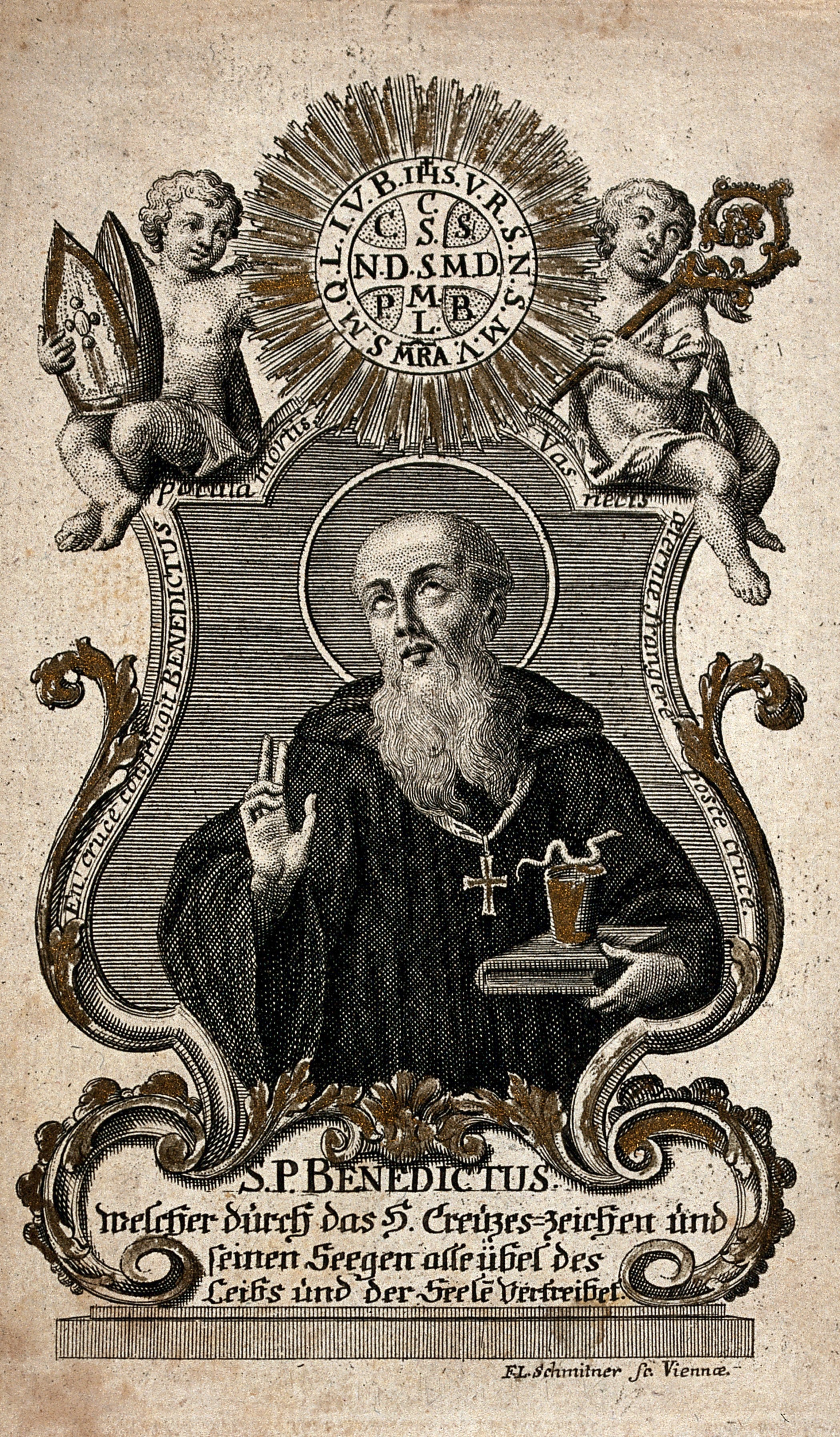
The Feasts of St. Benedict and Their Proper Texts in Benedictine Churches

Catholics attentive to the sanctoral cycle will have noticed two feasts of St. Benedict that appear in the calendar (depending on your location and the form of the Mass): the dies natalis of March 21, which almost always falls during Lent, and the summer feast on July 11, which historically originated as a feast of the translation of relics but has been simply accepted by most Benedictines as an opportune time to celebrate their holy father. Traditionally March 21 has no octave due to Lenten austerity but July 11 has a jubilant octave. In the Tridentine calendar, March 21 is the only feast of the saint, and sadly since John XXIII the day is rarely given over to the great patriarch of Western monasticism. Even if the feast is observed, it would be observed with the “Os Justi” Common.

However, Benedictines who keep their own traditions rejoice in three proper Masses for their holy founder: one on March 21; another on July 11; and a third on July 18 for the octave. I thought it would interest NLM readers to see the proper texts for all three, which are conveniently found in an appendix to the St. Andrew Daily Missal (reprint of the 1945 edition). I do not know if any other founder of a religious “order” (taking that term in the broadest possible sense) enjoys such a profusion of proper Masses! The texts are extraordinarily rich and well-suited to the saint, a luminous exemplar of how the usus antiquior coalesces its changing texts around the figure of a saint as an icon of Christ, as a figure that fulfills in his life the message of Sacred Scripture.

I would draw the reader's attention particularly to the Sequence and the proper Preface.

We should bear in mind thatt the July 11th feast as the translation of St Benedict’s relics, while very old, was not universally celebrated by the OSB before the 19th century, and the recasting of it as the “solemnity of St Benedict” with an octave is rather recent. E.g., it is not in this edition of the breviary from 1831.

UPDATE (7/12/22): I have been informed by several people that there is yet another feast of St. Benedict observed in some monasteries, namely, a December 11th "In Veneratione et Repositione Sacrae Reliquiae Capitis SS. Patriarchae Nostri Benedicti." I have not been able to get hold of the Propers but here's a screenshot that was shared with me:
 

March 21


The March 21st propers are conveniently available as a PDF online, from which the following images have been extracted.

Friday, July 01, 2022

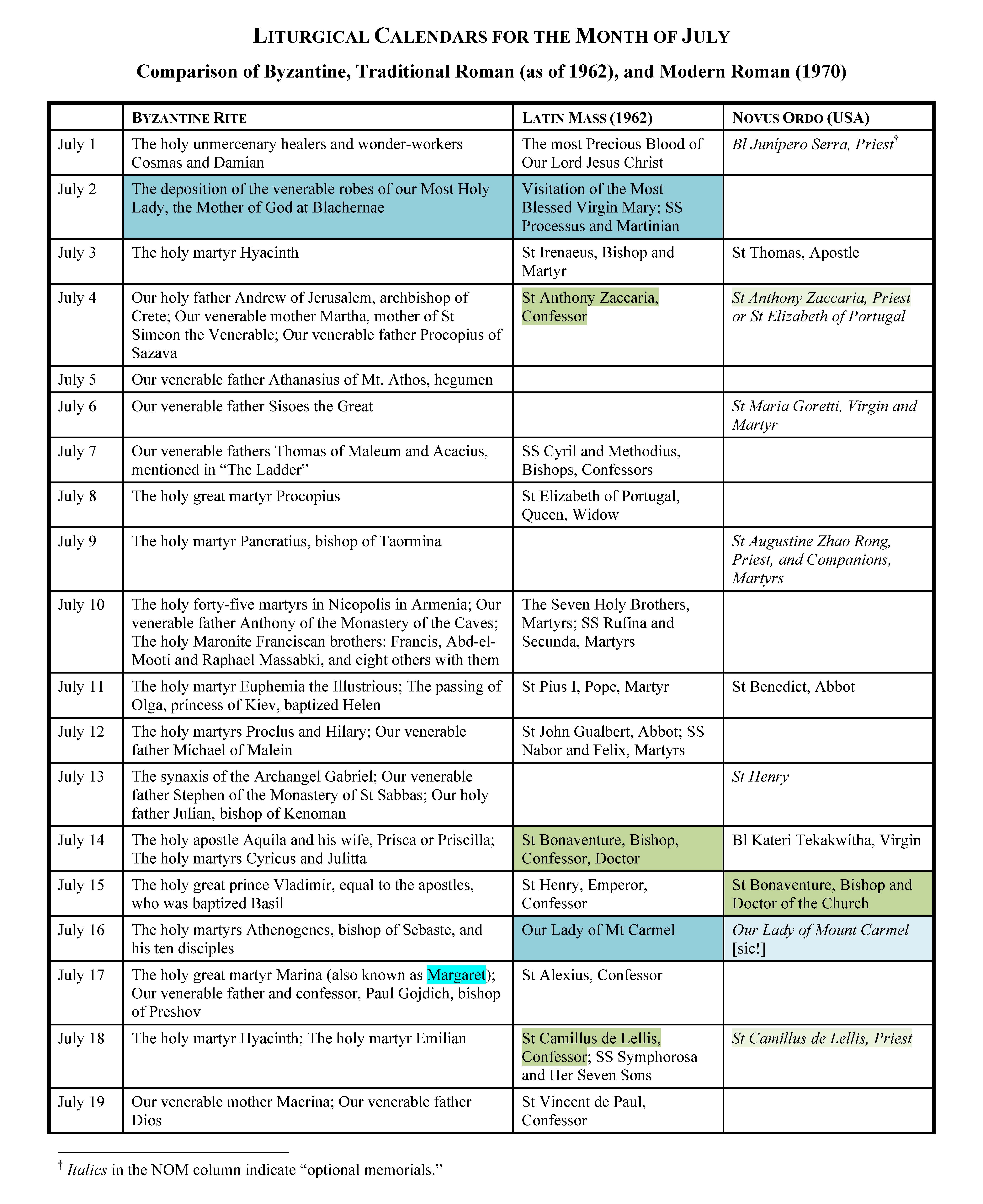
A Calendar Comparison for the Month of July: Byzantine, Tridentine, Montinian

On November 16, 2020, I published a piece at NLM entitled “The Sanctoral Killing Fields: On the Removal of Saints from the General Roman Calendar.” I noted, inter alia, the tremendous and often ruthless purging of saints from the calendar in the 1960s, including many saints who have been on it for as long as we have any records and saints universally beloved.

Toward the end of last July, I happened to notice a few parallels between the Roman Martyrology and the Byzantine liturgical calendar, and this prompted me to look more closely at the month of July as a whole. I then brought in the Novus Ordo calender, to see how it compared to both of these. The findings were interesting, confirming what most of us already know from experience.

The Byzantine calendar features 135 named saints or dominical feasts, and all are mandatory. The traditional Latin Mass calendar features 60 named saints or dominical feasts, and all are mandatory (unless a saint happens to fall on a Sunday; a sad legacy that should be undone, at least by way of a simple commemoration after the Sunday orations). The Novus Ordo calendar features 22 named saints, of which only 10 are mandatory.

I am certainly aware of the important differences between how the presence of a saint affects the Byzantine liturgy and how it affects the Western rites; in the former case it has little enough effect, in the latter a dramatic effect. For more on this topic, see my article "In Defense of Cluttered Calendars."

The details may be found in the two images below.

Monday, August 16, 2021

In Defense of Cluttered Calendars

A few weeks ago, on July 12th to be precise, I mentioned on Facebook that it was the feast, on the traditional Roman calendar, of St. John Gualbert, Abbot, with a commemoration of Saints Felix and Nabor, martyrs who were praised by St Ambrose and enshrined by him in Milan. I noted that the Collect for the commemoration of the latter is very interesting:

Praesta, quæsumus, Domine: ut, sicut nos sanctorum Martyrum tuorum Naboris et Felicis natalitia celebranda non deserunt; ita jugiter suffragiis comitentur. Per Dominum... [Grant, we beseech Thee, O Lord, that just as the celebration of the birth of Thy holy Martyrs Nabor and Felix never abandons us, so may they always accompany us by their prayers. Through our Lord…]
Nearly every time I post a comment in praise of a “lesser” saint’s feast on the traditional Roman calendar for the Mass, or publish a blog article along those lines, inevitably several comments arise: “We should get rid of a lot of these obscure or territorial saints and leave more room for more local or modern saints.” The ones who make these comments love the traditional liturgy, but they seem to agree with the rationale that led to the removal of over 300 saints from the general calendar in 1969.

I would like to suggest, in all kindness, that this gigantic overhaul was excessive, disproportionate, harmful, and uncharacteristic of liturgical history, which tends to prune rather than to purge, and which prefers to add more than to cut away. Yes, I’m quite aware that St. Pius V removed quite a few saints from the Roman calendar, but even his cuts could not compare with Paul VI’s — and besides, his successors pretty quickly began adding back ones that Pius had removed.

A university student once wrote the following note to me:
In my liturgy class, we discussed the calendar. What you wrote at Rorate about St. Felix of Valois — “Who is this obscure saint, and why is he cluttering our calendar?” — was the exact mindset the professor strove to pound into students’ minds that day. He described how over the centuries, “certain elements crept into the calendar” (his words), and these elements had clouded over the meaning of Sunday, plus many saints and feasts days held no meaning for us anymore and sometimes were mythological. But, he said, as if to clinch his point, “other popes have cleaned out the calendar before.”
         Thank you for being willing to defend the old calendar and its rich sanctoral cycle and prayers. Any time I’ve tried to defend the beauty of the traditional rites in class, the things I’ve pointed to have been declared “unnecessary for modern man.” Well, to that I respond, the Mass should not have changed for modern man; modern man should have changed for the Mass.

That’s what all the modern liturgists said and still say: “The calendar was too cluttered, it needed a lot of pruning.” I used to think so, too — until I got to know the traditional missal well, over years of daily Massgoing, and came to love the richly-encrusted cycle of saints, famous and obscure, ancient and modern, and how they crowd into certain clusters, sometimes even forming “octaves” of a sort.

My appreciation of the density of the old calendar grew still more when I began attending Mass with the Institute of Christ the King, whose clergy follow (somewhat inconsistently, but with growing conviction) a sanctoral calendar of circa 1948. In this calendar there are even more saints, and frequently double commemorations. I have to say: so far from seeming cluttered, it’s like a big Catholic family with kids all over the place, and everyone happy. The multiple orations enrich the liturgy’s prayerfulness and power, rather than detracting from a “simplicity” or “focus” conceived in rationalist terms. Anyone who knows great works of art knows that they achieve their cumulative effect through multiple simultaneous means, and that unity and coherence are not foreign to but actually reliant upon a carefully balanced harmony of many parts, including tiny and seemingly insignificant details. Multiplicity and complexity are not the problem; pointless multiplication and a random or confused complexity are the problem.


I am reminded of the insight of Martin Mosebach:

It was the new Western way of perceiving the “real” sacred act as narrowed down to the consecration that handed over the Mass to the planners’ clutches. But liturgy has this in common with art: within its sphere there is no distinction between the important and the unimportant. All parts of a painting by a master are of equal significance, none can be dispensed with. Just imagine, in regard to Raphael’s painting of St. Cecilia, wanting only to recognize the value of the face and hands, because they are “important,” while cutting off the musical instruments at her feet because they are “unimportant.” (Heresy of Formlessness, rev. ed., p. 185)

Doubtless, we cannot say of the details of the sanctoral cycle that all are of equal importance; this claim would be easier to sustain of the fixed Order of Mass. Nevertheless, we love our saints — especially that somewhat “arbitrary” group that our tradition, in its slow meandering, has put right in front of us in the missal. The combination of famous and obscure saints, and the concentration of martyrs and confessors of antiquity, is itself a resounding lesson: we do not pick and choose our saints at Mass to reflect our preoccupations or favoritisms; the saints pick us, as it were, by coming to us down through centuries of devotion. It is another expression of the “scandal of the particular” in which the very essence of Christianity consists. No matter how wonderful a more recent or more local saint may be, this quality, in and of itself, does not justify the suppression of another saint who has been liturgically venerated by countless Christians for many centuries.

The solution we should favor is to let saints pile up on a given day, but decide which one gets the Mass (so to speak) and which one gets the Commemoration. The main cause of the purge in 1969 was a positive dread of having more than one set of orations per Mass, since evidently Modern Man™ is too stupid to follow more than one thread at a time. How differently we think in the era of emails, texting, and social media.

And even if, as the liturgists say, calendric simplification has happened before in the history of the Roman Rite, was it necessary to do so between the mid-1950s and the early 1970s? Who was clamoring for it? The People of God? The parochial clergy? Truth be told, it was no one but the professional liturgists, lovers of “clear and distinct” Cartesian modernity, with its glassy, steely mien, as of hygienic instruments, silver aeroplanes, and whirring time-saving appliances. The resulting empty-headedness of Catholics regarding their own heroes is, needless to say, not caused exclusively or even primarily by the loss of a rich sanctoral cycle, but surely we cannot avoid seeing a connection.

Consider the following exchange between two art historians, Martin Gayford and Philippe de Montebello, in a book called Rendez-vous with Art (London: Thames & Hudson, 2014):

MG: Some would say that putting a religious work in a museum removes its most crucial meaning. It wasn’t intended — or at least only intended — to be appreciated as a painting; it was made to be prayed before, to stand on an altar while a priest performed Mass.
         PdM: Well, the meanings are in danger of disappearing anyway. The modern public by and large no longer reads the Bible, no longer knows the stories represented in the pictures. The role of museums in re-educating people in sacred stories and doctrines is very large. One could almost make the case that museums fill a gap that the churches are increasingly leaving in teaching the lives of the saints, Christ, and the Virgin, plus the stories of the Old Testament. All of the pictures and sculptures in most museums carry a label briefly telling the story, something that you do not find in church. 

“The pictures and sculptures . . . carry a label briefly telling the story, something that you do not find in church.” Yet this is exactly what my St. Andrew’s Daily Missal (reprint of the 1948 edition) and countless other hand missals did and still do for the laity: they tell us something about every saint, and make them beloved companions of the journey.


Note that this banishment of the cultus of saints goes hand in hand with the ecumenical downplaying of all that is distinctive, the pseudo-purity of “focusing on Christ” when even He is pushed away from the closed circle, and the utter ineffectiveness of the verbal didacticism of reading so much Scripture. The people in the old days knew more about the saints and the stories of the Bible than modern believers, who are so much more “literate” and “educated.” However many causes there are of the stygian vacuity of the modern Catholic mind, we can say without hesitation that the traditional Roman liturgy emphasizes the saints vastly more than the modern liturgy does, and was capable, accordingly, of serving as a crucial pillar in a culture that saturated with the cultus of the Virgin and the saints. As Dom Guéranger writes in the general preface to The Liturgical Year:

In order that the divine type may the more easily be stamped upon us, we need examples; we want to see how our fellow-men have realized that type in themselves: and the liturgy fulfils this need for us, by offering us the practical teaching and the encouragement of our dear saints, who shine like stars in the firmament of the ecclesiastical year. By looking upon them we come to learn the way which leads to Jesus, just as Jesus is our Way which leads to the Father. But above all the saints, and brighter than them all, we have Mary, showing us, in her single person, the Mirror of Justice, in which is reflected all the sanctity possible in a pure creature.

I have to say, in passing, that the older Roman calendar reminds me much more of the Byzantine calendar, which expressly names saints in the liturgy practically  every day. Of course, it works differently because their daily liturgy is not nearly as shaped and “governed” by the saint as the Roman one is — there is no concept of a “Mass of a Virgin” or a “Mass of a Confessor” in the Divine Liturgy: it has a few special antiphons sprinkled throughout for the saint, and then the rest is generic. Still, the Eastern and Western traditions bear witness to the norm throughout Christian history until the Protestant revolt: “the more saints, the merrier.” The presence of saints on the calendar augmented the glory of Christ rather than detracting from Him, as indeed the original placement of the feast of Christ the King, right before the feast of All Saints, emphasized.

Twenty-five years of working under both Roman calendars, old and new, gave me a vivid experience of the truth of Louis Bouyer’s acerbic estimation of the reform:

I prefer to say nothing, or little, about the new calendar, the handiwork of a trio of maniacs who suppressed, with no good reason, Septuagesima and the Octave of Pentecost, and who scattered three-quarters of the Saints higgledy-piggledy, all based on notions of their own devising! Because these three hotheads obstinately refused to change anything in their work and because the pope wanted to finish up quickly to avoid letting the chaos get out of hand, their project, however insane, was accepted! (The Memoirs of Louis Bouyer, trans. John Pepino [Kettering, OH: Angelico Press, 2015], 222–23) 

To return, then, to our starting point, Saints Nabor and Felix. For many centuries the Church at prayer told her Lord that the birthday of these martyrs “never abandons us” and saw this recurring date as a promise that their intercession, too, would always be ours. Every time I encounter these “obscure” saints, I thank God for making them part of my life, for connecting me to the memory of their triumph and the power of their living intercession. Nor will this grand old calendar of saints ever cease to be followed within the Catholic Church, notwithstanding the feeble fulminations of faded flower-children.

A page from my 1838 Ordo from Baltimore

Monday, August 02, 2021

Married Couples Recorded in the Roman Martyrology, with a Litany for Private Use

Saints Aquila and Priscilla

As I was reviewing page proofs for the book Are Canonizations Infallible? Revisiting a Disputed Question, I was struck once again by the account that was given during John Paul II’s pontificate of why so very many people “had” to be beatified and canonized starting in 1983. The rationale was this: the Church taught at Vatican II that holiness is everyone’s calling. And since the Church always remains faithful to Christ, there must therefore be a whole lot of saints in every category, especially from recent times, that need to be accelerated through the process in order to provide lots of examples and encouragement.

Now, this is a curious mixture of truths and falsehoods. It is of course true that the Church will always produce sanctity; no age is without saints. But it is not true that we can, as it were, crank up the factory and simply make more saints while maintaining the most rigorous standards of what constitutes publicly venerable holiness, or Christian perfection in charity. Nor is it by any means guaranteed that any particular age will be more fruitful than, or even equally fruitful as, any other age in verifiable saints. It could well be that modernity erects more barriers to the achievement of beatifiable and canonizable holiness. Indeed, this seems to be implied in Leo XIII’s letter Testem Benevolentiae.

One claim I have frequently seen in the literature surrounding John Paul II’s pontificate is that he wanted to present lots of examples of married sanctity to the laity. In and of itself, and taking into account the caveats of the preceding paragraph, we can say this is a laudable intention. For instance, we can rejoice in Louis and Zélie Martin, the parents of St. Thérèse of Lisieux, who, living relatively near to us in history, make spousal and parental holiness more vivid to our eyes. One also occasionally meets with cynical interpretations of hagiography that accuse the Church of denigrating marriage and promoting only a celibate model of sanctity. While some writers over the centuries doubtless had an axe to grind with marriage, this is by no means an operative assumption, nor is the dogmatic teaching that virginity consecrated to Christ is a more perfect state of life incompatible with a generous estimation of the good of sacramental marriage.

A way to see that the Church has not, in fact, been slow to recognize the sanctity of married couples and parents is to become more familiar with the traditional Roman Martyrology, which, as I have grown familiar with it over the years, has placed before me daily after Prime a remarkable procession of spouses, parents, and widows who have been part of our collective memory and liturgical worship for untold centuries. I continue to believe that it is highly valuable to read the Martyrology daily, for it furnishes a fuller picture of the models of sanctity venerated by the Catholic Church than the vastly smaller number of saints who are venerated in the Mass itself can give us by itself.

When we look more closely, we find in fact quite a good number of married saintly couples listed in the traditional Martyrology. By this, I mean something very specific: an entry that lists both the husband and the wife as saints. There are, as one would imagine, many more that list a saintly man or woman, husband or wife, without making mention of the other spouse or parent; and there are times when the whole family is martyred but only the husband is named. These have also been listed, because they too bear witness to the sanctity achievable in the married state and in the responsibilities of parenthood. (I have also included a few entries that speak of continent marriages, but these are few in number compared to the other categories.) It should also go without saying that plenty of other saints in the Martyrology would, in fact, have been married and/or parents, but here I am listing only those where the text itself includes such a description.

This article concludes with a litany in the usual style, for devotional use.

Saints Daria and Chrysanthus 

1. Saints who were married to each other

At Rome, blessed Dafrosa, wife of St. Flavian, Martyr, and mother of SS. Bibiana and Demetria, Virgin-Martyrs, who after the slaying of her husband was first sent into exile, and afterwards beheaded under the same prince. (Jan. 4)

At Sebaste, in Armenia, St Peter, Bishop, the son of SS. Basil and Emmelia, and brother also of SS. Basil the Great, Gregory of Nyssa, Bishops, and of Macrina, Virgin. (Jan. 9; cf. Mar. 9 and Jul. 19)

At Rome, on the Via Cornelia, the holy martyrs Marius and Martha his wife, and their sons Audifax and Abachum, Persians of noble birth, who came to Rome to pray in the time of the Emperor Claudius. After they had borne scourging, the rack, fire, iron hooks and the amputation of their hands, Martha was slain in the Nympha, and the others beheaded, and their bodies burnt. (Jan. 19)

At Caesarea in Mauritania, the holy martyrs Severian and Aquila his wife, who were burnt to death. (Jan. 23)

At Ostia, the holy martyrs Maximus and Claudius, brothers, and Praepedigna, the wife of Claudius, with their two sons, Alexander and Cutias; who, though they were of very noble birth, were at Diocletian's command all put to the test, and sent into exile. Later they were burned to death, offering themselves to God as a sweet sacrifice of martyrdom. Their relics were cast into the river, but discovered by the Christians, and buried near the same city. (Feb. 18)

At Nicomedia, the birthday of the holy martyrs Victor and Victorinus, who for three years were tormented by many tortures, together with Claudian and his wife Bassa; and, being cast into prison, they fulfilled there their life's course. (Mar. 6)

At Nicomedia, the birthday of the holy martyrs Macedonius, Patricia his wife, and his daughter, Modesta. (Mar. 13)

In Illyria, SS. Philetus, a senator, Lydia his wife, and his sons Macedo and Theoprepes; and also Amphilochius, a captain, and Chronides, a notary, who endured many torments for their confession of Christ and obtained the crown of glory. (Mar. 27)

At Milan, St Valeria, Martyr, wife of St Vitalis, and mother of SS. Gervase and Protase. (Apr. 28)

At Attalia in Pamphylia, the holy martyrs Exuperius, his wife Zoe, and Cyriac and Theodulus their sons; they were the slaves of a certain Paganus, and in the reign of the Emperor Hadrian, by order of their master, on account of their outspoken profession of the Christian faith, were scourged and severely tortured. Finally they were cast into an oven and so gave up their souls to God. (May 2)

In the Thebaid, the holy martyrs Timothy and Maura, his wife, whom, after many torments, the prefect Arian ordered to be fixed to a cross, whereon they hung alive for nine days, confirming each other in the faith, and achieved their martyrdom. (May 3)

At Rome, blessed Calepodius, Priest and Martyr, whom the Emperor Alexander had slain with the sword, and his body dragged through the city and cast into the Tiber. Pope Callistus buried it after it had been recovered. Palmatius the consul was also beheaded, with his wife and children, and forty-two others of his household, of both sexes; likewise Simplicius the Senator with his wife and sixty-eight of his household; and also Felix with Blanda his wife, whose heads were suspended at different gates of the City as a warning to the Christians. (May 10)

At Rome, St. Artemius, with his wife Candida, and his daughter Paulina. Artemius, at the preaching and miracles of St. Peter the Exorcist, believed in Christ, and was baptized with all his household by St. Marcellinus, Priest. He was scourged and slain with the sword by command of the judge Serenus: while his wife and daughter were driven into a crypt and buried beneath stones and debris. (Jun. 6)

At Rome, on the Via Salaria, the passion of blessed Getulius, a most famous and learned man (the father of the seven holy brethren, whom his wife Symphorosa bore him), and his companions Cerealis, Amancius and Primitivus. At the command of the Emperor Hadrian they were arrested by the governor Licinius and first of all scourged, then cast into prison, and lastly delivered to the flames: but since they were in no wise hurt thereby, they fulfilled their martyrdom by their heads being broken sticks. Symphorosa, the wife of blessed Getulius, gathered up their bodies and buried them with honour in a sand pit in her villa. (Jun. 10; cf. Jul. 18)

At Rome, St. Zoa, Martyr, wife of the blessed martyr Nicostratus, who, while praying at the Confession of blessed Peter the Aposde, was taken by the persecutors under the Emperor Diocletian, and cast into a dark prison. Then she was tied to a tree by the throat and hair, and a horrible smoke produced beneath her, and so she gave up the ghost, confessing the Lord. (5 July) [To which is related an entry two days later:] At Rome, the holy martyrs Claudius, a notary, Nicostratus (chief secretary, and the husband of blessed Zoa the Martyr), Castorius, Victorinus and Symphorian. St. Sebastian brought them all to the faith of Christ and the Priest blessed Polycarp baptized them. While they were busied in recovering the bodies of the holy martyrs, the judge Fabian ordered them to be apprehended, and after he had tempted them for ten days with threats and flatteries, and could not move them in the least, he ordered them to be thrice tortured and then cast headlong into the sea. (Jul. 7)

In Asia Minor, SS. Aquila and Priscilla, his wife, of whom mention is made in the Acts of the Apostles. (Jul. 8)

At Cordova in Spain, the holy martyrs George, a Deacon, Aurelius and his wife, Natalia, Felix and his wife, Liliosa, in the Arab persecution. (Jul. 27)

At Tomi in Pontus, the holy martyrs Marcellinus, a tribune, his wife Mannea, and their sons John, Serapion and Peter. (Aug. 27)

At Adrumetum in Africa, SS. Boniface and Thecla, who were the parents of twelve sons, blessed Martyrs. (Aug. 30)

At Caesarea in Cappadocia, SS. Theodotus, Rufina and Ammia; the first two of these were the parents of St. Mamas the Martyr, to whom Rufina gave birth in prison and whom Ammia educated. (Aug. 31)

At Rome, on the Via Appia, blessed Cornelius, Pope and Martyr; in the persecution of Decius, after being exiled, he was commanded to be beaten with leaden scourges, and was beheaded with twenty-one others of both sexes. And Cerealis also, a soldier, with his wife Sallustia, whom the same Cornelius had instructed in the faith, were beheaded on the same day. (Sep. 14)

At Rome, the passion of the holy martyrs Eustace and Theopistis, his wife, and their two sons Agapitus and Theopist, who were condemned to the beasts, under the Emperor Hadrian but by the help of God were uninjured by them. They were then enclosed in a heated brazen bull and consummated martyrdom. (Sep. 20)

At Damascus, the holy martyrs Paul and Tatta his wife, and their sons Sabinian, Maximus, Rufus and Eugene, who, accused of professing the Christian religion, were tortured by stripes and other punishments, and in torment gave up their souls to God. (Sep. 25)

In Persia, the holy martyrs Dadas, a kinsman of King Sapor, Casdoa his wife, and Gabdelas his son, who were deprived of their honours, wounded by various tortures and, after long imprisonment, slain by the sword. (Sep. 29)

At Jerusalem, SS. Andronicus and Athanasia his wife. (Oct. 9)

At Rome, the holy martyrs Chrysanthus and his wife Daria, who, after many sufferings which they endured for Christ, under the prefect Celerinus, were commanded by the Emperor Numerian to be set in a sand-pit on the Via Salaria, and there, while still living, to be covered with earth and stones. (Oct. 25)

St. Zachary, Priest and Prophet, the father of blessed John the Baptist, the Precursor of the Lord. Also St. Elisabeth, the mother of the same most holy Precursor. (Nov. 5)

At Emesa in Phoenicia, the holy martyrs Galatio and Epistemis his wife, who in the persecution of Decius were beaten with scourges, their hands, feet and tongues mutilated, and finally achieved martyrdom by beheading. (Nov. 5)

On the same day, St. Natalia, the wife of blessed Adrian, Martyr, who for a long time ministered to the holy martyrs held in prison at Nicomedia under the Emperor Diocletian; and when their battle was over she went to Constantinople, and there rested in peace. (Dec. 1)

At Rome, the holy martyrs Claudius, a tribune, and his wife Hilaria, and their sons Jason and Marus, with seventy soldiers. Of these the Emperor Numerian commanded Claudius to be bound to a huge stone and cast headlong into a river, while the soldiers and sons of Claudius were condemned to death. Blessed Hilaria, after burying the bodies of her sons, was arrested by the heathen a little while after while praying at their tombs, cast into prison and passed to the Lord. (Dec. 3)

At Rome, the finding of the holy martyrs Nemesius, a Deacon, Lucilla, a Virgin, his daughter, Symphronius, Olympius a tribune, Exuperia his wife, and Theodulus his son, whose commemoration is made on August 25. (Dec. 8; cf. Aug. 25.)

In the same city, St. Flavian, an ex-prefect, who was the husband of blessed Dafrosa, a martyr, and the father of the holy virgin martyrs Bibiana and Demetria. He was condemned under Julian the Apostate to be branded for Christ's sake and sent into exile at Bagni-di-Ferrata in Tuscany, where he gave up his spirit to God in prayer. (Dec. 22)

On the same day, St Melania the Younger, who left Rome with her husband Pinian and went to Jerusalem; she led a religious life among the holy women, and her husband among the monks, and both died a holy death. (Dec. 31)

St. Henry and St. Cunegund

2. Married saints who lived a life of continence

At Antioch, under Diocletian and Maximian, the birthday of St. Julian, Martyr, and of Basilissa, Virgin, his wife, who kept her virginity while with her husband, and ended her life in peace. But Julian (after a crowd of priests and ministers of Christ's Church, who fled to them because of the cruel persecution, had been burnt with fire) was tortured with many torments at the command of the governor Marcian and condemned to death. With him suffered also Antony, a priest, and Anastasius. The latter, after he had been raised from the dead, Julian himself had made a sharer of Christ's grace. Celsus, a boy, with his mother Marcionia, and his seven brothers, and many others, suffered martyrdom. (Jan. 8)

At Bamberg, St. Cunegunda, Empress, who was married to the Emperor Henry I, but preserved her virginity with his consent. Enriched with the merit of good works, she rested in a holy death and thereafter was famous for her miracles. (Mar. 3)

Solemnity of St. Joseph, Workman, Husband of the Blessed Virgin Mary, Confessor, Patron of Artisans. (May 1)

At Bamberg, St. Henry I, Emperor of the Romans and Confessor. He led a life of perpetual virginity with his wife St. Cunegund, and brought St. Stephen, King of Hungary, and almost all his people, to embrace the faith of Christ. (Jul. 15)

3. Wives and widows, mentioned as such

Wives: St. Joanna (May 24), St. Clotilde (Jun. 3), St. Perpetua (Aug. 4), St. Serena (Aug. 16), St. Tryphonia (Oct. 18).

Widows: St. Paula (Jan. 26), St. Marcella (Jan. 31), St. Louisa Albertoni (Jan. 31), St. Joan de Lestonnac (Feb. 2), St. Juliana (Feb. 7), St. Frances of Rome (Mar. 9), St. Louisa de Marillac (Mar. 15), St. Lea (Mar. 22), St. Grata (May 1), St. Corona (May 14), St. Rita of Cascia (May 22), St. Margaret of Scotland (Jun. 10), St. Elisabeth of Portugal (Jul. 8), St. Athanasia (Aug. 14), St. Jane Frances Fremiot de Chantal (Aug. 21), St. Cyriaca (Aug. 21), St. Margaret (Aug. 27), St. Eutropia (Sep. 15), St. Catherine of Genoa (Sep. 15), St. Galla (Oct. 5), St. Bridget (Oct. 8), St. Hedwig (Oct. 16), St. Elisabeth of Hungary (Nov. 19), St. Olympias (Dec. 17), St. Begga (Dec. 17).

4. Husbands, mentioned as such

St. Craton (Feb. 15), St. Palmatius (May 10), St. Simplicius (May 10), St. Euthymius (Aug. 29), St. James Intercisus (Nov. 27), St. Venustian (Dec. 30).

5. Mothers or fathers, mentioned as such

Fathers: St. Richard, King of the English (Feb. 7), Theusetas (Mar. 13), St. Quirinus (Mar. 30), St. Pudens (May 19), St. Philip the Deacon (Jun. 6), St. Tranquillinus (Jul. 6), St. Thomas More (Jul. 6), St. Joachim (Aug. 16), St. Simplicius (Aug. 26), St. Marcellus (Oct. 30).

Mothers: St. Macrina (January 14), Queen Matilda (Mar. 14), St. Monica (Apr. 9), St. Plautilla (May 20), St. Marcella (Jun. 28), St. Mary (Jun. 29), St. Anne (Jul. 26), St. Theodota (Aug. 2), St. Nonna (Aug. 5), St. Helen (Aug. 18), St. Bassa (Aug. 21), St. Philippa (Sep. 20), St. Sophia (Sep. 30), St. Tryphonia (Oct. 18), St. Mary Salome (Oct. 22), St. Denise (Dec. 6), St. Fausta (Dec. 19).

Saints Joachim and Anne

A Litany of Married Saints
(For private use)
Lord, have mercy on us. Lord, have mercy on us.
Christ, have mercy on us. Christ, have mercy on us.
Lord, have mercy on us. Lord, have mercy on us.
Christ, hear us. Christ, hear us.
Christ, graciously hear us. Christ, graciously hear us.
God the Father of heaven, have mercy on us.
God the Son, Redeemer of the world, have mercy on us.
God the Holy Ghost, have mercy on us.
Holy Trinity, one God, have mercy on us.
Holy Mary, pray for us.
Holy Mother of God, pray for us.
Holy Virgin of virgins, pray for us.

Saints Joachim and Anne, pray for us.
Saints Zachary and Elisabeth, pray for us.
Saints Aquila and Priscilla,
Saints Flavian and Dafrosa,
Saints Basil and Emmelia,
Saints Marius and Martha,
Saints Severian and Aquila,
Saints Claudius and Praepedigna,
Saints Claudian and Bassa,
Saints Macedonius and Patricia,
Saints Philetus and Lydia,
Saints Vitalis and Valeria,
Saints Exuperius and Zoe,
Saints Timothy and Maura,
Saints Felix and Blanda,
Saints Artemius and Candida,
Saints Getulius and Symphorosa,
Saints Nicostratus and Zoa,
Saints Aurelius and Natalia,
Saints Felix and Liliosa,
Saints Marcellinus and Mannea,
Saints Boniface and Thecla,
Saints Theodotus and Rufina,
Saints Cerealis and Sallustia,
Saints Eustace and Theopistis,
Saints Paul and Tatta,
Saints Dadas and Casdoa,
Saints Andronicus and Athanasia,
Saints Chrysanthus and Daria,
Saints Galatio and Epistemis,
Saints Adrian and Natalia,
Saints Claudius and Hilaria,
Saints Olympius and Exuperia,
Saints Melania and Pinian, pray for us.

Lamb of God, who takest away the sins of the world, spare us, O Lord.
Lamb of God, who takest away the sins of the world, graciously hear us, O Lord.
Lamb of God, who takest away the sins of the world, have mercy on us.

Let us pray. Grant, we beseech Thee, O almighty God, that the intercession of Holy Mary, Mother of God, St. Joseph, her most chaste Spouse, and all holy husbands and wives, fathers and mothers now reigning in Thy Kingdom, may everywhere gladden us, so that, while we commemorate their merits, we may experience their protection. Through our Lord Jesus Christ Thy Son, who livest and reignest with Thee in the unity of the Holy Ghost, God for ever and ever. Amen.

More recent articles:

For more articles, see the NLM archives: