Monday, June 19, 2023

Taking Music Seriously — Inside and Outside of Church

Our Western art-music is the loftiest of God’s gifts to us in the natural order, the greatest artistic treasure the world has ever known, and, in its specifically liturgical manifestations, a vital, indispensable bearer of the theology, spirituality, meaning, and identity of the Catholic religion. We cannot live well without it; we will not pray well without it either.

Music is the language of the soul, its most intimate and exalted expression. Music goes deeply into the soul, into its passions and emotions; it affects us at the intersection of spirit and flesh, it gets “under the skin,” it goes into the very sense-appetites and shapes them by motion, by repetition. Just as habits of virtue or vice are formed in the sense-appetites by repeated action, so too are certain habits formed in the same appetites by repeated sensual stimulation. What we listen to does not remain “outside” of us but enters into us and changes our way of feeling, reacting, perceiving. We cannot help being affected morally by long-term exposure to any kind of music.

The sound that is language comes from our unique mode of being in this world—as being in the world, due to our physicality, but not of it, due to our being rational creatures made in the image of God. The sound that is music, for its part, is the finest flowering of language. No wonder it is the province of worship, loss and lamentation, exultation and joy! For it is a wonder past all other wonders that proceed from the heart of man. Christians, inasmuch as we are “priests, prophets, and kings” by our baptism into Christ the High Priest, Word of God, and King of Kings, deserve and require a diet of the most artistically beautiful, most emotionally satisfying, most intellectually stimulating, and most spiritually beneficial music. In short: we need, for our human and Christian perfection, music that is both good and great. Surrounding it, sustaining it, we need prayer-saturated silence.

Such is the fundamental thesis of my new book Good Music, Sacred Music, and Silence: Three Gifts of God for Liturgy and for Life, which has just been released by TAN Books of Gastonia, North Carolina. Born of decades of experience, study, and reflection as a singer, choir director, composer, and teacher, and seasoned by countless conversations with college students in particular, this work urges readers to take the art of music as seriously as it ought to be taken.
 
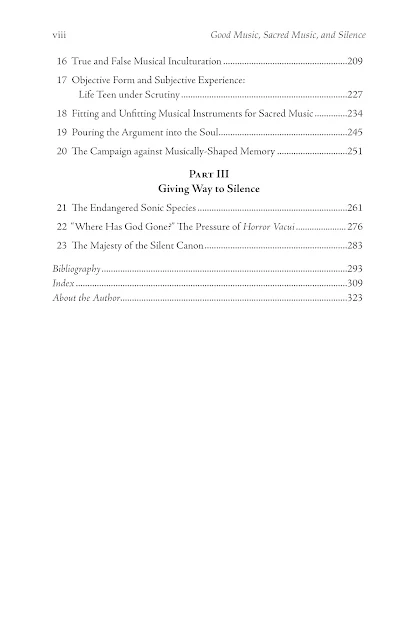
The first part, “Music Fit for Kings: The Role of Good Music in the Christian’s Life,” deals with the corrosive cultural and psychological effects of a lot of modern popular music, contrasted with the numerous benefits of a lifelong apprenticeship to the great music of the Western tradition (including the many excellent composers working today). Here, I draw upon thinkers such as Plato, Aristotle, Aquinas, Pieper, and Ratzinger, and offer concrete strategies for acquiring or deepening a love of beautiful music.

The second part, “Music Fit for the King of Kings: The Role of Sacred Music in the Church’s Life,” provides a thorough philosophical and theological account of what is right about Gregorian chant, polyphony, and pipe organ, and what is wrong with, say, folksy guitar-and-piano or peppy Praise & Worship genres at Mass. I do not hesitate to name names and to pursue my argument to the nitty-gritty level.

In the last and (appropriately) shortest part, I speak of the ways in which silence is both the origin and the fulfillment of music. The book ends with a thorough defense of the more-than-thousand-year-old custom of the silent Canon in the Mass, the fittingness of which Cardinal Ratzinger praised, more recently joined by Cardinal Sarah.

Here’s the Table of Contents:
 
Good Music, Sacred Music, and Silence was written for the benefit of pastors, seminarians, church musicians, homeschooling families, classical curriculum advocates, and everyone who is already in love with music or is seeking to develop a better knowledge of it. To musicians particularly, I would add: in my meandering journey from

  • a childhood liberal parish and contemporary youth group (all the while listening to prog rock, heavy rock, rap, and other, dare I call them, genres), to
  • a charismatic prayer group (when my listening incorporated some “Christian pop” artists), to
  • a Latin Novus Ordo with a chant schola (by which time I had switched over entirely to “classical” music), to
  • immersion in the Byzantine liturgy in Austria, to
  • a mixed old-and-new-Mass chaplaincy in Wyoming, to
  • life in parishes run by the Institute of Christ the King Sovereign Priest and the Priestly Fraternity of Saint Peter,
it is highly likely that I have been, for some portion of my life, in a situation similar to that in which any Catholic musician, music director, or music lover may ever find himself; so I believe my book will carry the force of conviction born of experience, and will be able to say something relevant and beneficial to readers from a wide range of backgrounds.

Nowadays I am singing in a fine men’s schola every Sunday and most holy days, and look forward — if anything, ever more as time goes on — to the joy of singing these incomparably wonderful ancient plainchant melodies, so perfectly suited for the rites to which they give musical utterance and shape. Their beauty elevates my mind to God; their tranquility comforts my heart. This is a joy in the beautiful that we should eagerly share with everyone, until they too can know it and benefit from it.

Nothing could be better than the flourishing, everywhere, and to the fullest extent, of great secular music and of the finest sacred music in the liturgy. That is why I have written my latest book, and I hope you’ll check it out.

Good Music, Sacred Music, and Silence: Three Gifts of God for Liturgy and for Life (hardcover, 344 pp., $29.95, ISBN 978-1505122282) is available from the publisher, from Amazon, and from the author if you would like a signed copy.

*   *   *
Mary Harrell of TAN Books conducted a 26-minute interview with me about the book, for those who might be interested:
 

Thursday, September 22, 2022

The Sacred Liturgy as a Secret Garden, by Fr Armand de Malleray, FSSP

The well-known children’s story The Secret Garden lends itself to a religious and modern interpretation. Like orphaned children in desperate need of spiritual comfort, many Catholics discovered the traditional Latin Mass thanks to the Covid pandemic. Thirsting for Confession, for Eucharistic adoration, or for Holy Communion administered with reverence, they rejoiced when finding all this and more in traditional worship. This book offers an analogy between Frances Hodgson Burnett’s pre-WWI tale for children, and the revelation experienced in the 2020s by a growing number of adults stepping into the grace-filled haven of the traditional Roman liturgy.
Praise for The Sacred Liturgy as a Secret Garden:
“A very clever treatment of the novel The Secret Garden. That well-known children’s story should be read twice—firstly, as any reader would read it just for enjoyment, and then again after reading Fr de Malleray’s fascinating hermeneutic of tradition, because the enjoyment and appreciation would be much greater.” – Leo Darroch, former President of the International Federation Una Voce
“An imaginative essay, whose poetic nature is a timely invitation to rediscover the forgotten riches of the Church’s traditional liturgy.” – Fr Simon Henry, BA MA, Director of St Peter’s International College
“This essay is intriguing, creative and sufficiently provocative to maintain the reader’s interest. The variety of expression is refreshing. Readers of all ages will enjoy discovering the liturgical treasures that lie hidden in the Secret Garden.” – Fr Neil Brett, former head teacher
Available for purchase from the publisher: https://aroucapress.com/sacred-liturgy-garden
About the author: Fr Armand de Malleray, FSSP holds a Master’s Degree in Modern Literature from the University of The Sorbonne in Paris. Ordained a priest and first assigned in England in 2001, he has been the editor of the quarterly magazine Dowry since 2008 and is the author of theological essays, of fiction and of art commentaries. He regularly preaches retreats to the clergy and the laity, and to young members of the Juventutem youth movement of which he has been the general chaplain since 2004. Since 2015, he is rector of St Mary’s Shrine Church in the Archdiocese of Liverpool, England.

Monday, July 12, 2021

First Issue of Sophia Press’ Benedictus (August 2021) Now Available

A surprise greeted me in my mailbox last week on July 7 (an auspicious date, to be sure): the first-ever full issue of Benedictus, the new daily Latin Mass companion published by Sophia Institute Press. This issue covers the whole month of August. Readers may recall that this initiative was announced at NLM on February 10.

My hopes were already high, given the short sample that was mailed out during Lent and the detailed advertising, but I have to say that the first issue exceeds all my expectations. It is an absolutely gorgeous publication. I will share now some photos along with brief comments. (If any of the images are blurry, that’s the fault of my bucket-o’-bolts camera; make due allowances.)

For the sake of scale (it’s a compact book that would fit in a purse or a jacket pocket, but not a pants pocket; a bit larger than Magnificat):

The two-tone artwork (black and gold) with gray shading is more elegant by far than anything I’ve seen in a missallette like this; the layout is handsome, the font easy on the eye; the meditations and features are exquisitely chosen from traditional sources, which will be one of the great benefits Benedictus bestows on its users.

First, for the layout of the Order of Mass, which is repeated with full Propers and Ordinary for each Sunday and Holy Day (so, no page turns in those cases):


Wednesday, February 10, 2021

Sophia Press Announces Benedictus, a New Monthly Guide to the Traditional Latin Mass

Sophia Institute Press has announced a major new initiative that should be of exceptional interest to Catholics in the USA: Benedictus: The Traditional Catholic Companion. Think Magnificat, except keyed to the Tridentine Mass, making use of the Roman Breviary, and quoting from classic authors.

The dedicated website (www.praybenedictus.com) tells us what subscribers will find in each monthly booklet:
DAILY MASS COMPANION
Pray the Traditional Latin Mass, with the 1962 Missale Romanum presented in a clear and simple format. Continuous Latin and English text with reduced rubrics are included for Sundays (no page-jumping required), and complete Mass propers are offered in English for weekdays and feasts of each month.

MORNING AND EVENING DEVOTIONS
Enter the broader stream of Catholic liturgy with daily excerpts included from both Lauds and Vespers of the 1960 Breviarum Romanum, the official morning and evening hours of prayer used by traditional clergy and religious throughout the world. Excellent for family devotions, which, as a result, will synchronize better with the prayers and atmosphere of the traditional Latin Mass.

DAILY MEDITATIONS
Learn at the feet of Catholic spiritual masters each day, with devout meditations curated exclusively from saints and scholars who prayed and loved the traditional Mass, from the early Church to the early 1900s. Guaranteed to be free of soft modernism or fluffy pablum.

INFORMATIVE COMMENTARY
Dive deeper into our heritage of Faith through insightful mini-essays on the feasts and saints of the traditional calendar, as well as brief catecheses and ideas for extending a liturgical life into the home. Unlock the riches of Tradition like never before.

Thursday, October 29, 2020

Call for PhD Applicants in Liturgical Studies at Notre Dame

The Graduate School at the University of Notre Dame accepts up to two fully-funded PhD students per year in Liturgical Studies. The program integrates three sub-disciplines, Liturgical History, Liturgical Theology, and Ritual Studies, and offers a wide range of research opportunities, with particular strengths in early and late antique Christian ritual and material culture, medieval liturgy, Byzantine Christianity, manuscript studies, contemporary liturgical theology, and ritual studies. All applications must be submitted to the Graduate School by January 2, 2021. More information and a link to the online application may be found here: https://theology.nd.edu/graduate-programs/ph-d/. For those without a Master degree, the Theology Department also offers a two-year Master of Theological Studies (MTS) with a concentration in Liturgical Studies: https://theology.nd.edu/graduate-programs/mts/.

The Liturgical Studies program was founded in 1947 as the first graduate program in the Department of Theology, and quickly grew to become an international center for the study of liturgy. Pioneers in the discipline who have taught at Notre Dame include Josef Jungmann, Louis Bouyer, Robert Taft, Paul Bradshaw, and many others. The program is currently comprised of seven faculty members and represents one of the largest concentrations of liturgical scholars at one place in the world.

In addition to its core strengths, Liturgical Studies offers a variety of opportunities for research collaboration with other institutions at Notre Dame, including the Medieval Institute, the Program in Sacred Music, other departments at the university (esp. History, Anthropology and Sociology), and other programs within the Theology Department, including Christianity and Judaism in Antiquity (CJA), the History of Christianity (HC), and Systematic Theology (ST). The Hesburgh Libraries system has extensive holdings in theology and one of the nation’s largest collections in medieval and Byzantine studies, including the Milton Anastos Collection. The Theology Department also offers a broad range of ancient languages, including courses in Greek, Latin, Syriac, Hebrew, Coptic, Armenian and Ge’ez, with additional opportunities for studying Georgian, Slavonic, and Jewish Aramaic.

Wednesday, August 05, 2020

Cardinal Schuster’s Masterpiece Back in Print for the First Time in Nearly a Century

I am pleased to share with readers of NLM the excellent news that Arouca Press, a Catholic publisher based in Ontario, has just released an affordable reprint of Cardinal Ildephonse Schuster’s classic commentary on the Roman rite, The Sacramentary, in both paperback and hardcover editions, with discount rates for buying the entire 5-volume set directly from Arouca (US $100 for the complete paperback set, $140 for the hardcover set). As far I have been able to ascertain, Schuster’s work has been out of print since the late 1920s and the early 1930s when it was first published in English translation, and used copies fetch outrageous sums on the used book market. The Arouca edition is a high-quality and crisply legible reproduction of the original, with a new Foreword by NLM’s own Gregory DiPippo, discussing Schuster’s life, career, and publications.

It would be hard to exaggerate the importance and continuing relevance of Schuster’s work. He brings a formidable scholarship, an insightful mind, and a Thomistic clarity to bear on the history and meaning of the elaborate network of signs and symbols that make up the classical Roman rite in its millennial development. One would be hard-pressed to find a work comparable to The Sacramentary in richness of detail. Like all the members of the Liturgical Movement to one degree or another, Schuster sometimes let his theories get the better of him (see herehere, and here for examples), and later wrecking-ball reformers invoked such theories as their warrant. It is all the more important then to bring both the positive contributions and the occasional lapses of this giant figure back into the conversation as we continue to sift through the legacy of the original Liturgical Movement. It deserves to be emphasized that Schuster is, above all, a man of deep prayer and immense love for the liturgy; this radiates from every page, and places him in the company of Dom Guéranger as one from whom tradition-loving Catholics have much to learn today.

A brief synopsis of the contents:

The Sacramentary [Liber Sacramentorum]: Historical and Liturgical Notes on the Roman Missal

Volume I
Part I. Songs of Zion Beside the Waters of Redemption: General Conceptions of Sacred Liturgy
Part II. The Inauguration of the Kingdom of the Messiah
- Introduction
- The Sacred Liturgy from Advent to Septuagesima

Volume II
Part III. The New Testament in the Blood of the Redeemer
- Introduction
- The Sacred Liturgy from Septuagesima to Easter
Part IV. Baptism by the Spirit and by Fire
- Introduction
- The Sacred Liturgy During the Easter Cycle
- Euchological Appendix

Volume III
Part V. The Eternal Nuptials of the Lamb
- Introduction
- The Sacred Liturgy from Trinity Sunday to Advent
- Euchological Appendix
Part VI. The Church Triumphant
- Introduction
- The Feasts of the Saints during the Christmas Cycle

Volume IV
Part VII. The Saints in the Mystery of the Redemption
- Introduction
- The Feasts of the Saints in the Paschal Cycle (March to August)
- Euchological Appendix

Volume V
Part VIII. The Saints in the Mystery of the Redemption
- Introduction
- The Feasts of the Saints from August 14 to November 28
- Euchological Appendix

The paperback and hardcover sets may be ordered here; see here for a listing of individual volumes. The books may also be purchased at Amazon and affiliates.

Friday, July 10, 2020

Reflections on Liturgical Language

Lost in Translation #7

Cicero Denounces Catiline, by Caesare Maccari, 1889

The other day I stumbled upon an old article by a priest critiquing the 2011 English edition of the Roman Missal. He used three criteria: exclusion, catechesis, and poor theology. (In case you were wondering, the orations of the Roman Rite “border on the heretical” because with their talk of merit they regularly contradict “our fully signed up [1999] agreement with the World Lutheran Federation on justification by faith and grace”!)

But it was the author’s argument about “exclusion” that caught my eye:
Only people of a certain background and a relatively high level of education can make any sense of [the new translation]. In your ordinary congregation, many are excluded: the young, people whose first language is not English, people whose education stopped after primary school or early in secondary school. Also excluded, as far as the responses go, are people who attend church only for baptisms, weddings and funerals. It has pushed some people finally to stop attending Mass at all.
I would love to see the good father’s empirical evidence of his final claim, and I hardly think that the entire worship of the Catholic Church should be specifically tailored to those who “attend church only for baptisms, weddings and funerals.” But what struck me most of all by the argument is the implicit assumption that elevated language is exclusive. Is it so?

In her 1938 study Rhetoric in the Sunday Collects of the Roman Missal, Mary Haessley writes that the three purposes of classical rhetoric--teaching, delighting, and persuading--are on full display in the Church’s liturgical prayer:
…all these devices of the art of language are necessary for us, for they enable us: (1) to grasp clearly the lessons embodied in the Prayers (docere); (2) to make these lessons more acceptable to us through the charm of diction and structure, in a word, through their appeal to our aesthetic sense (delectare); (3) to persuade us (movere) to mold our conduct in accordance with the principles of faith set forth in the Prayers. This explains why rhetoric is, and must be, found in the liturgy: it is to dispose us to pray “ut oportet,” as we ought to pray. (5)
And it is often through making diction and structure somewhat complex that that “charm” is produced. The complexity may, of course, engender some initial frustration, but that is intentional, for a little frustration goads the reader or listener to push on and figure it out. And when it is figured out, there is an “Aha!” moment that brings a delight greater than that which comes from understanding something easy. If adults only used baby talk, it might be effective, but it would not be delightful. “What is sought with some difficulty,” St. Augustine writes in On Christian Doctrine, “is attained with more pleasure.” And what is attained with more pleasure, we might add, has a deeper impact on our souls. The rhetorical goal of delighting is intimately bound up with the goal of persuading, of “molding our conduct.” And since one of the purposes of sacred liturgy is the formation of souls, liturgical composers are wise not to neglect this connection.

Used properly, then, elevated language does not exclude but extends to all an invitation to understanding, just as the dense imagery of poetry is not meant to rebuff but to awaken in the reader a deeper meaning. And just as poetry is not for the few (even if few today, alas, pay it any attention), neither is liturgical prayer, which by its very nature is solemn, public, rhetorical. There is something condescending about thinking of either poetry or sonorous public discourse as the purview of the elite.

Of course, if the entire liturgy were nothing but fancy rhetoric, it could become overwhelming. But the beauty of the Roman Rite (and the other apostolic liturgies) is its linguistic diversity. The Scriptural passages that comprise the Propers tend to be simple in diction and structure--with the possible exception of the Epistles of the rhetorically-gift Saint Paul. The Offertory Prayers, composed in the Middle Ages, betray a medieval love of elegant precision. And the Canon and Orations (Collect, Secret, and Postcommunion) are examples of courtly rhetoric at its finest. The Church employs an array of linguistic tools in an effort to catch and form souls.

But to follow a “lowest common denominator” approach and flatten all language during the most important and solemn act that man can make is both mystagogical suicide and a sin against the great gift of the tongue with which God has endowed us. It is also to deny the so-called uneducated an experience of beauty on the grounds that they are “too dumb” to appreciate it. That, to me, is the ultimate exclusion.

Friday, May 01, 2020

Best One-Volume Scholarly Introduction to the Traditional Mass, Now in English

I am delighted to announce the publication by Angelico Press of Michael Fiedrowicz’s masterful work The Traditional Mass: History, Form, and Theology of the Classical Roman Rite (first published in 2011, and now in its third German edition).

Having been blessed with the opportunity to read this book twice and really absorb its content, I can confidently say that there is nothing comparable to it in the English language, in its comprehensive scope, depth of research, and insight into every aspect of the liturgy. It is a compelling apologia for the old rite at every level and on every head. The author’s judgments are judicious, polished, sober, and clear; there is not a touch of exaggeration or unfairness. The result is both triumphant and devastating.

In these strange times, when we see the number of traditional Masses at an all-time high (thanks to a proliferation of private Masses), the CDF issuing decrees that precisely imply the permanence of the usus antiquior in the future of the Church, and an ominously-worded questionnaire sent out to bishops about the implementation of Summorum Pontificum, we may have many questions and a few anxieties, but we also enjoy a towering certainty: interest in and adherence to the traditional Mass will not subside. On the contrary, it will continue to grow, seminarian by seminarian, priest by priest, and even quite possibly bishop by bishop as the champions of rupture retire and churchmen with less rigid ideas about the “success” of the liturgical reform and the “outdatedness” of our heritage take their place.

Fiedrowicz’s work arrives, therefore, at exactly the right moment. If you are going to read just one serious book on the TLM, this is the one. In addition, I recommend purchasing copies for every priest you know who already offers the usus antiquior — indeed, for every priest who is, or may be, interested in learning more about the very Roman rite for which he was ordained.

Table of Contents


In the following excerpt from the book (pp. 58-61, minus the footnotes), Fiedrowicz applies Newman’s theory of development to the classical Roman rite:
The organic, homogenous unfolding of the traditional rite of the Mass can similarly be illustrated on the basis of the seven criteria identified by John Henry Newman in his work Essay on the Development of Christian Doctrine (1845) in order to show how the changes witnessed in the form of the Roman Catholic Church over the course of centuries are the expression of a continuous and seamless development.
       The first criterion is the “Preservation of Type,” which deals with the protection of the original form and proportions. With all of the changes to the outward form, the Eucharist’s sacrificial character in the traditional rite of the Mass remained decisive, while the meal aspect of the action of the sacrifice is subordinate and secondary.
       The second criterion is “Continuity of Principles.” Theocentrism and never anthropocentrism has been part of the inner basic policy of the classical rite, which manifests itself in the outward form. The traditional form of the liturgy does not consider itself as a parish assembly, but rather as the performance of worship with two dimensions, the glory of God (latreutic goal) and the sanctification of the people (sacramental-soteriological goal).
       “Power of Assimilation” constitutes the third criterion of organic development, which derives its vitality from the adoption of outside and foreign elements, without losing its own identity. A concrete example of this is the so-called Roman-Frankish mixed liturgy, in which the original form of the Pontifical High Mass incorporated elements of monastic piety—such as private prayers of the priest—and was embellished through rich ceremonial forms and gestures.
       The fourth criterion, “Logical Sequence,” consists in recognizing, in retrospect, an inner coherence between the earlier and later stages of development. In this sense, the later silent prayers of the priest come up as the spiritual interpretation of the liturgical action that was already previously done without accompanying prayers (e.g., oblation, incensing, and washing of the hands). In the same way, the prayers at the foot of the altar are only the later organic development of the earlier acts of preparation (silent pauses or prostrations before the altar, apologia, and the praying of psalms belonging to the entrance ritual).
       The fifth criterion, “Anticipation of Its Future,” demands that later occurrences are not completely new; rather, future developments must already be suggestively present in some form. Thus, for instance, Communion in the mouth, accepted during the Middle Ages, was already anticipated in earliest times in those original gestures of Communion that manifested veneration (e.g., obeisance, veiled hands, and genuflection).
       “Conservative Action on Its Past” demands, as the sixth criterion, that previous achievements may not be overturned and abandoned by further developments. An indication of organic development is continuity, not breaking with the past. The classical rite of Mass perfectly satisfies this criterion, when, for example, elements of the original pontifical liturgy, such as processions, have been preserved in principle, even in the simple private Mass, although in a reduced form, such as a turning of the celebrant’s body or a change from one side of the altar to the other.
       The seventh and last criterion is “Chronic Vigor.” In contrast to many ideas and innovations that, after a sensational beginning, quickly grew old or completely vanished, genuine development can be identified by permanence and unspent vitality. The classical Roman rite organically and continually evolved from its core components over the course of 1,500 years. Its chronic vigor is apparent not least in the fact that on the eve of Vatican II, neither the laity, nor the parish clergy, nor the bishops were demanding profound changes to the liturgy. Its chronic vigor is also further demonstrated by the fact that it is just those monasteries, communities, and seminaries that have preserved the traditional rite, or at least maintained it alongside the newer form of the liturgy, that have found growing attention and increasing numbers of entrants in recent decades and years.
       Succisa virescit—having been cut down, it flourishes [again]: this motto of the Benedictine Abbey of Monte Cassino, which after afflictions and destructions was invariably rebuilt, can also be applied to the classical rite of the Mass, which despite exterior adversity over the course of history has proven and will continue to prove its chronic vigor.
*       *       *
Publisher’s Description

In view of ever deepening interest in the traditional form of the Roman rite of Mass — which, according to Benedict XVI’s Summorum Pontificum, demands “due honor for its venerable and ancient usage”—a comprehensive but concise introduction to its history, form, and theology is more than ever desirable. In contrast to conventional explanations of the Mass that offer practical or allegorical explanations of particular moments in the rite, the present work attends to the organic process by which the Roman rite was built up from its foundations into a magnificent structure, marked by the accumulated riches of each age through which it passed, and characterized by order, beauty, and piety in its texts, gestures, rubrics, chants, and calendar — ranging from the major elements to the most minute details. Treated as well are the reality of the sacred and how it is encountered, the irreducible role of ritual action, the eastward direction of prayer, the formation and value of a specialized sacred language, and liturgical participation correctly understood.

Product Details

History/Politics, Liturgy, Theology
350 pages
6 × 9 in
978-1-62138-523-3 (paper)
978-1-62138-524-0 (cloth)
Available at all Amazon outlets

Praise for The Traditional Mass

“Readers will find here much with which to grow in their appreciation of Pope Benedict XVI’s insistence that, in respect of the older liturgy: ‘What earlier generations held as sacred, remains sacred and great for us too, and it cannot be all of a sudden entirely forbidden or even considered harmful. It behooves all of us to preserve the riches which have developed in the Church’s faith and prayer, and to give them their proper place.’ The publication of this English translation marks another important step towards achieving that goal.” — DOM ALCUIN REID

“This historically rigorous and theologically informed book is indispensable for anyone who cares about Pope Benedict XVI’s liturgical vision. I am delighted that this outstanding introduction to the traditional form of the Roman Mass is now available to Anglophone readers.” — FR. UWE MICHAEL LANG

“Michael Fiedrowicz here accomplishes something well-nigh miraculous: a comprehensive introduction to the elaborate history, complex structure, and sublime theology of the traditional Latin Mass — supported by abundant scholarship — all within the scope of a single highly readable volume. Quite simply, this is the best one-volume work on the classical Roman Mass published since the Second Vatican Council.” — PETER A. KWASNIEWSKI

“I am pleased that Angelico Press has made available in English translation Prof. Fiedrowicz’s substantive achievement — the fruit of careful research, orthodox faith, and reverence for the riches handed on in tradition.” — FR. THOMAS KOCIK

“The Roman Church has been rendered a great service with the publication of The Traditional Mass. Whereas previous tomes on the Roman Liturgy have often been too technical to appeal to the average Catholic, Fiedrowicz’s style — simple, informative, yet profound — grips and guides the reader from the outset. I heartily recommend this masterpiece to all Catholics who desire to better understand and appreciate the traditional Roman Mass.” — LOUIS J. TOFARI

About the Author

Michael Fiedrowicz, born in Berlin in 1957, is a Roman-Catholic priest of the archdiocese of Berlin. He studied Theology, Philosophy, Latin Philology, and Patristics at Berlin, Paderborn, and Rome universities. Since 2001 he has been Professor of History of the Early Church, Patrology, and Christian Archeology at the Theological Faculty of Trier. His many works include Apology in Early Christianity, Theology of the Church Fathers, Handbook of Patristics, and Ecclesia militans.

Friday, December 06, 2019

New SoundCloud Page for Audio of Dr Kwasniewski’s Lectures and Interviews

For a number of years, readers have been asking me to make available video and audio files of my lectures and interviews. This is indeed something I have wanted to do, but there are two limitations: one is my technological ineptitude, and the other is the need for planning in advance to have recordings made at events, which doesn’t always happen.

Nevertheless, over the past couple of years, a good many such recordings have in fact been made, so I finally created a dedicated SoundCloud page on to which most of them have now been uploaded (and more will be added). Below, I have listed the content currently available. I encourage you to explore and to recommend the site to others who appreciate audio content. All of the files are freely downloadable.


In no particular chronological or topical order:

“Beyond Smells and Bells: Why We Need the Objective Content of the Usus Antiquior” (Minneapolis lecture, November 13, 2019)

“What Happened in the Liturgical Reform? And Why Does It Matter?” (OnePeterFive Podcast, June 2017)

“The Growing Popularity of the Latin Mass — and Troubles People Have With It” (Interview on Laymentality, November 23, 2019)

“Gregorian Chant: Exemplary Music for the Catholic Liturgy” (Sacred Liturgy Conference, Spokane, WA, May 29, 2019)

“Against Memoricide: The Importance of Preserving Liturgical Tradition” (given under the title “Dew, Tears, and Torrents: The Living Waters of Tradition,” Sacred Liturgy Conference, Spokane, WA, May 30, 2019)

“Why Catholics Must Take Culture and the Fine Arts Seriously” (Campion College, Toongabbie, Australia, April 5, 2019)

“A Short Interview on Beauty and the Art of Music” (The After Dinner Scholar, 2017)

“‘From the East to the West’: A Defense of Ad Orientem Worship” (Maternal Heart of Mary, Sydney, Australia, April 6, 2019)

“The Sacred Liturgy and the Ecstatic Orientation of Man” (Silverstream lecture, July 28, 2016)

“The Roman Canon: Touchstone of Divine Faith, Foundation of Immovable Rock” (Maternal Heart of Mary, Sydney, Australia, April 7, 2019)

“Problems and Prospects for Recovering Traditional Catholicism” (Q&A Session, Oxford, UK, October 26, 2018)

“Liturgical Obedience, the Imitation of Christ, and the Seductions of Autonomy” (Silverstream lecture, July 18, 2017)

“From the Liturgical Movement to Vatican II to the Novus Ordo” (Interview with Steve Koob, One More Soul radio program, August 2017)

“Replying to the Arguments of Modern Liturgists” (Interview with Hrvoje Juko in Norcia, Italy, July 2017)

“What’s Wrong with the New Lectionary? Why Is the Old One Better?” (Interview with Br. Andre Marie, Reconquest Episode 196, September 18, 2019)

“A Theological Review of the Amazon Synod” (Lecture at Regina Caeli, Houston, November 24, 2019)

“Question & Answer Session in Vancouver” (November 12, 2016)

“Have We Gone Liturgically Insane?” (Interview with Fr. Robert McTeigue, S.J., September 4, 2019, for The Catholic Current on The Station of the Cross Catholic Radio Network)

“The Words of Our Lady and the Spirit of The Liturgy” (Lecture for the Vancouver Latin Mass Society Annual General Meeting, November 12, 2016)

“Does Today’s Communion in the Hand Really Revive an Ancient Custom?” (Fr. Z podcast, November 27, 2019)

“‘Death by Verbosity’: How the Novus Ordo Drowns Us in Words” (Fr. Z podcast)

“Explaining and Defending Worship Ad Orientem” (Interview with Br. Andre Marie, Reconquest Episode 156, December 5, 2018)

*       *       *
For those who prefer video, a number of items can be found on YouTube, posted by various people and organizations; my personal YouTube channel is more heavily tilted towards sacred music, but it does have both the recent lecture on the Amazon Synod and the Minneapolis lecture listed above.

Wednesday, October 16, 2019

Call for PhD Applicants in Liturgical Studies at Notre Dame Univ.

The Graduate School at the University of Notre Dame accepts up to two fully-funded PhD students per year in Liturgical Studies. The program integrates three sub-disciplines, Liturgical History, Liturgical Theology, and Ritual Studies, and offers a wide range of research opportunities, with particular strengths in early and late antique Christian ritual and material culture, medieval liturgy, Byzantine Christianity, manuscript studies, contemporary liturgical theology, and ritual studies. All applications must be submitted to the Graduate School by January 2, 2020. More information and a link to the online application may be found here: https://theology.nd.edu/graduate-programs/ph-d/


The Liturgical Studies program was founded in 1947 as the first graduate program in the Department of Theology, and quickly grew to become an international center for the study of liturgy. Pioneers in the discipline who have taught at Notre Dame include Josef Jungmann, Louis Bouyer, Robert Taft, Paul Bradshaw, and many others. The program is currently comprised of seven faculty members and represents one of the largest concentrations of liturgical scholars at one place in the world.

In addition to its core strengths, Liturgical Studies offers a variety of opportunities for research collaboration with other institutions at Notre Dame, including the Medieval Institute, the Program in Sacred Music, other departments at the university (esp. History, Anthropology and Sociology), and other programs within the Theology Department, including Christianity and Judaism in Antiquity (CJA), the History of Christianity (HC), and Systematic Theology (ST). The Hesburgh Libraries system has extensive holdings in theology and one of the nation’s largest collections in medieval and Byzantine studies, including the Milton Anastos Collection. The Theology Department also offers a broad range of ancient languages, including courses in Greek, Latin, Syriac, Hebrew, Coptic, Armenian and Ge’ez, with additional opportunities for studying Georgian, Slavonic, and Jewish Aramaic.

Monday, February 18, 2019

Is Passivity Mistaken for Piety? On the Perils and Pitfalls of Participation

This essay will have two contrasting parts. In the first part, I will defend being a “silent spectator” at Mass, one who looks and listens, or perhaps prays the Rosary. In the second part, I will suggest that there is, in postconciliar times, a danger of bending the stick so far in this direction that one risks cultivating a habit of liturgical passivity rather than true devotion. I am confident that each part will offend a different cohort of my beloved fellow traditionalists, and I only ask in return their prayers.


Part I: Pope Pius XII subtly corrects Pope Pius XI
A recent NLM article commemorated the 90th anniversary of Pope Pius XI’s Apostolic Constitution on Sacred Music Divini Cultus, promulgated on December 20, 1928. This document has many fine passages (as the quotations in the commemorative article demonstrate.) Nevertheless, there is one phrase in section 9 that should give us pause:
In order that the faithful may more actively participate in divine worship, let them be made once more to sing the Gregorian Chant, so far as it belongs to them to take part in it. It is most important that when the faithful assist at the sacred ceremonies, or when pious sodalities take part with the clergy in a procession, they should not be merely detached and silent spectators [non tamquam extranei vel muti spectatores], but, filled with a deep sense of the beauty of the Liturgy, they should sing alternately with the clergy or the choir, as it is prescribed.
The notion that laity who sit or kneel quietly at Mass and do not vocally participate are “disengaged and mute onlookers” is something of a caricature, and the mantra-like use made of this phrase in subsequent decades of the increasingly audacious Liturgical Movement culminated in a fascist enforcement of “active participation” that numbered among its casualities the interior participation that often thrives on silence and sacred music. The majority of the faithful, even those who may be utilizing paraliturgical devotions, are still participating in the mystery of the Holy Sacrifice; following a missal word-for-word, which seemed to be the ideal of the Liturgical Movement, is not only not required, but can even be an impediment to offering up the holy oblation in peace. [1]

Pope Pius XII’s encyclical Mediator Dei contains the best treatment of participation — and of the related topics of the priesthood of the faithful and how they offer the sacrifice of the Mass in union with the priest — to be found in any magisterial document. [2] In paragraph 80 he writes:
It is, therefore, desirable, Venerable Brethren, that all the faithful should be aware that to participate in the Eucharistic Sacrifice is their chief duty and supreme dignity, and that not in an inert and negligent fashion, giving way to distractions and day-dreaming, but with such earnestness and concentration that they may be united as closely as possible with the High Priest, according to the Apostle, “Let this mind be in you which was also in Christ Jesus” (Phil. 2, 5). And together with Him and through Him let them make their oblation, and in union with Him let them offer up themselves.
Pius XII explains in paragraph 106 the purpose of any actions by which the faithful join in more directly with the liturgy taking place, such as following a daily missal or chanting the responses and the Ordinary — “their chief aim is to foster and promote the people’s piety and intimate union with Christ and His visible minister and to arouse those internal sentiments and dispositions which should make our hearts become like to that of the High Priest of the New Testament” — but then cautions against those who, “led away by false opinions, make so much of these accidentals as to presume to assert that without them the Mass cannot fulfill its appointed end”:
Many of the faithful are unable to use the Roman Missal even when it is written in the vernacular; nor are all capable of understanding correctly the liturgical rites and formulas. So varied and diverse are men’s talents and characters that it is impossible for all to be moved and attracted to the same extent by community prayers, hymns, and liturgical services. Moreover, the needs and inclinations of all are not the same, nor are they always constant in the same individual. Who, then, would say, on account of such a prejudice, that all these Christians cannot participate in the Mass nor share its fruits? On the contrary, they can adopt some other method which proves easier for certain people; for instance, they can lovingly meditate on the mysteries of Jesus Christ or perform other exercises of piety or recite prayers which, though they differ from the sacred rites, are still essentially in harmony with them.
This was Pius XII’s typically nuanced response to a complex situation. On the one hand, he applauded efforts made to inform and involve the laity in the actual liturgical rites — in this regard no different at all from Dom Guéranger’s purpose in writing The Liturgical Year and Explanation of the Prayers and Ceremonies of Holy Mass. [3] On the other hand, he rebuked the haughty proponents of “objective piety” who considered it wrong for Catholics to “tell their beads” during the Mass. It is as if the Pope is saying to each Catholic who assists at Mass: Pursue whatever it is that will most unite you in mind and heart to the mysteries of Christ and especially to His Sacrifice. For different people, this will take different forms; and even for the same person it will take different forms at different times.

Medieval manuscript showing layfolk at Mass.
When my son Julian interviewed Bishop Athanasius Schneider in June 2018 at the Sacred Liturgy Conference in Oregon, he asked him how the Rosary and the Mass complement one another, how they might “work together.” I was delighted to read the good bishop’s profound answer:
The Rosary is a beautiful synthesis of the entire mystery of the Incarnation, redemption, and work of salvation. And the Holy Mass is the recapitulation of the work of salvation. Christ became incarnate for what reason? To offer Himself as the Lamb of God and to offer Himself on the Cross for the salvation of humankind, and to glorify the Father. This is what it means. When we pray the Rosary, which we can pray even during Mass, we do participate very actively in the Joyful Mysteries, centered around the Incarnation — and the holy Mass is a continuation of the coming of Christ in the Incarnation, under the veils of the sacred species of bread and wine. And then the Sorrowful Mysteries, of course, they are the specific meditation of the holy Mass: they help us to contemplate the real presence of Golgotha under the sacramental veil. And then the Glorious: Christ present in the holy Host is the Risen One, the Glorified One, with His luminous wounds.
          So we have in the prayer of the Rosary a really beautiful synthesis of the entire Mass. And therefore in ancient times, those who could not read, I mean the peasants and farmers, did participate in the Mass with the Rosary. Often times after the Council, priests ridiculed these people, and humiliated them for praying the Rosary. But this is bad; it is unjust. They participated more deeply with praying the Rosary because they are meditating on what is now going on at the altar with the Rosary, the prayer of the Gospel, because the words of this prayer are of the holy Gospel.
          And so, of course, I do not want to say that we should only pray the Rosary during holy Mass, but it is a possible way of participating — not the only one, maybe not the main one, but it is legitimate. This I would say for people who have a special affinity for this.
As Pius XII said, and as Bishop Schneider beautifully explained, we should have no objection to people praying the Rosary during the traditional Latin Mass. I remember when I used to parrot the fashionable objections against such “private devotions” and “subjective piety.” But sooner or later, I learned a different lesson, thanks to my encounters with priests who say the old Mass especially slowly. This was a new phenomenon: I had so much time on my hands that I could read the propers of the Mass five times and still be left wondering what to do with myself. So I tried praying the Rosary and was surprised as how well it worked. (These “peasants and farmers” knew a thing or two! — a tough lesson for a kid who grew up in suburban New Jersey.) Or I will pray the preparatory Psalms printed in my St Andrew’s Daily Missal of 1945 — Psalms 83, 84, 85, 115, and 129 — or a Litany during the Offertory and the Canon, and often the prayer of St Ambrose or St Thomas while the priest is reciting his prayers immediately before communion. So far from detaching me as a silent spectator, all of these practices have enriched my offering of the prayer of the Mass, the prayer of Christ.


Part II: Liturgical Quietism and the Deactivation of the Laity
All this being said, however, I have noticed in some pockets of the Catholic traditionalist world a pendulum swing to an extreme opposite to outward participation and intelligent assimilation of the liturgy. I will call it a refusal to engage the liturgy at a bodily level, be this in the manner of gestures, reading, or singing; almost a taking pride in saying or singing nothing, and making as few motions as possible. There are many examples of the phenomenon; I will offer a few for consideration.

If you are literate and can follow the orations (collect, secret, postcommunion), or ponder the Epistle and Gospel, why would you not do it — at least sometimes? Why sit there and let the foreign words float over your head while you think about something else than what the liturgy is presenting to God on your behalf and with you (at least partly) in mind? Yes, it’s efficacious ex opere operato, but you can also make it your own prayer and your own meditation. It seems a perfect occasion for having the Church’s words in your soul, illuminating your mind and warming your heart. [4]

If the priest makes the sign of the cross at the start of his homily, and doesn’t himself say “Amen,” as if expecting the people to say it, why should they not say “Amen”? Yet I have seen congregations sit there, silent as stone, and never say “Amen.” Are we worried that it would be Protestant to hear the sound of our voices?

If you know the melody of Credo III and can sing it, why would you not sing it? The profession of faith is yours, too, and there’s no reason to consider it exclusively the property of the choir or schola. Congregational singing of the Ordinary is something the 20th century popes spoke consistently in favor of, and for good reason.

If you know that it’s a custom to strike your breast three times with the servers at the Confiteor, or during the Agnus Dei and the “Domine, non sum dignus,” why wouldn’t you do it? And if the faithful don’t know it, why couldn’t the priest tell them about it in a sermon? The same could be said of the many times when the priest makes the sign of the cross (“Adjutorium nostrum in nomine Domini…”; “Indulgentiam, absolutionem, et remissionem peccatorum nostrorum…”; “in gloria Dei Patri”; “vitam venturi saeculi”; etc.). Admittedly, many of the faithful do cross themselves at these moments, which is a beautiful custom; why should it not be universal? What about the slight bowing of the priest’s head at certain points in the Gloria and in the Creed? Such actions, for me at any rate, remind me all the more forcibly of what is being prayed and why. When bowing the head at “simul adoratur et conglorificatur,” one is aware in one’s very muscles as well as in one’s intellect that the Holy Spirit is God, deserving of latria.

When the priest turns towards us with the Blessed Sacrament, why shouldn’t we say together: “Domine, non sum dignus ut intres sub tectum meum, sed tantum dic verbo, et sanabitur anima mea”? Of all the moments in the Mass, this one seems the most appropriate for a corporate exclamation before the corporate action of processing forward for Communion.

Now, I am not suggesting (quod absit!) that rubrics be imposed on the faithful to that effect, for we have seen how harmful such regimentation has been in the sphere of the Novus Ordo. I am merely pointing out a kind of passivity among the faithful that inhibits a fuller response to the texts and motions of the liturgy. [5] For, as Hilary White insightfully put it, liturgy is “theology in motion,” and this means our motion, to the extent that it pertains to us. [6]

A friend of mine once quipped that traditional Catholics too often “dress like Amish and pray like Quakers.”

At this point many readers may be itching to accuse me in the comments of being in cahoots with the tumid Liturgical Movement, of trying to sacerdotalize the laity, of importing Novus Ordo expectations into a classical context where they do not belong, of confusing participatio actuosa with activism, etc. But all of this I have argued against elsewhere repeatedly and at great length, and nothing I am saying need be construed as implying or promoting those errors.

What I object to is a situation where there is nothing in common between the two parts of the church — the nave and the sanctuary — except that the people in each part happen to be in the same building at the same time with the same generic intention. This strikes me as a low-water mark in the practice of liturgy, and a fruitful cause of the evils of liturgical reform. The solution isn’t to change the liturgy, or to force laity to do something; the solution is that clergy and laity alike learn to know and love the liturgy as it stands, and to insert ourselves into it with our powers of soul and body. Unlike the “pastoral priests” who are bent on repeating the errors of the past, we must be intelligent supporters and sustainers of the liturgical tradition as it comes down to us.

This does require some preaching specifically on the liturgy; it requires catechesis and ongoing education. The family of St Thérèse of Lisieux read aloud Dom Guéranger’s The Liturgical Year, which formed the souls of the Martins. Lest it be thought that no one today could read such a book within the family, I happen to know of a family that did it — with about a dozen children, ranging from infants at the breast to young adults. More is possible than we tend to think possible.

I am convinced that it is too trite and simplistic to say “well, all that the priest says at the altar belongs to him, it’s his business; all the stuff the schola sings is their business; and the laity should just do their own thing.” No. The liturgy belongs to everyone in the church, because it belongs to Christ our Head. It is our common inheritance and activity. We have different offices and roles within it, but the liturgy is not like a pie divided up into different pieces that are served up to different people. It is a common good, like a philosophical truth or a theological mystery that can be equally and fully possessed by everyone at the same time. What the priest is doing and saying is also mine, albeit in a different mode. [7] When the schola sings the propers, they are my prayer, too, sung on my behalf — words that the Church places before me and within me.

It is also trite and simplistic to say “participation is interior.” Yes, it is principally interior and spiritual; as we all know, without this inner component, any amount of physical activity is useless or worse. But “principal” implies a comparison with something else that is secondary. The soul of man is primary and his body is secondary, yet you cannot have a man without both. The liturgy is a physical action and the man who participates in it is a physical being who engages with it through his bodily senses. Thus the body should be engaged as much as is consistent with the role a given person has in the liturgy. To my mind, that means not only kneeling, but also beating the breast, making the sign of the cross, bowing the head, singing the responses, and singing the Ordinary.

Ultimately the right disposition is not passivity, where we sit or kneel and otherwise keep still as if we were schoolchildren in the 1950s, afraid to call down on our heads the displeasure of the sister in charge. The right disposition is receptivity — and this means receiving not simply invisible graces but the particular goods the liturgy itself, in all its human richness, offers us.

The inscription reads: "Joseph, rising from sleep..."
NOTES

[1] In Yves Chiron’s biography of Annibale Bugnini, we learn about the latter’s radical liturgical experiments in the 1940s, where he began manipulating the liturgy for the sake of “participation.” In Bugnini’s own words: “I suddenly wondered: how could I have this people, with their elementary religious instruction, participate in the Mass? Above all, how could I make the children participate? I started out by painting big signboards with the easier responses for the people to say in Latin… Then I did the same with signposts in Italian… I knew that I had found the formula: the people willingly followed the Mass. The ‘inert and mute’ assembly had been transformed into a living and prayerful assembly” (p. 25). Note how Bugnini himself reverts to the formula of Pius XI.

[2] See sections 76 to 111. As to the common priesthood, there is no question that the traditional liturgy accentuates the one who is sacramentally configured to Christ in Holy Orders and who represents the Head of the Church within the assembly, the ekklesia. However, this would seem to cancel out the priesthood of the faithful only if one had an activistic notion of what it means to exercise this universal baptismal priesthood, which, in reality, is one of consent and self-offering.

[3] For the latter, I recommend this new edition from Angelico.

[4] I do not take into account the relatively rare situation of a layman who is so capable in Latin that he can perfectly understand what the priest is saying or singing. But a missal is still useful because often, perhaps even more often than not, issues of church architecture, acoustics, idiosyncratic pronunciation, or the speed of delivery make it difficult to follow the Latin of the priest even when it is spoken aloud.

[5] For the record: I am not a proponent of the so-called “dialogue Mass.” The kind of responses I have in mind are those that are sung during a High Mass (“Et cum spiritu tuo,” “Gloria tibi, Domine,” “Amen,” etc.) and the Ordinary of the Mass (from the “Asperges” through the final “Deo gratias”).

[6] For many examples of bodily participation in the usus antiquior, see my article “How the Traditional Latin Mass Fosters More Active Participation than the Ordinary Form,” which became the center of chapter 8 in my book Noble Beauty, Transcendent Holiness (Angelico, 2017).

[7] As mentioned above, Pius XII’s explication of this point in Mediator Dei remains unsurpassed, whatever the flaws of that encyclical may be in regard to the axiom of Prosper of Aquitaine.

Visit www.peterkwasniewski.com for information, articles, sacred music, and Os Justi Press.

Monday, February 11, 2019

“The Way is the Goal”: Against Reducing the Mass to a Sacramental Delivery System

In the years when I lived in Austria, I used to see a popular bumpersticker that read: “Der Weg ist das Ziel” — “the way is the goal.” This statement has been attributed to Confucius, although it might sound like the motto of a postmodern German relativist who does Yoga on the weekends and, having spurned the Cardinal Marxes of the world, directs her church tax to the upkeep of the EU. If, moreover, one is fortunate enough to have an Audi, a Mercedes, or a BMW, as many Germans and Austrians do, one might be tempted to drive with no particular goal in mind. But here I should like, perhaps unexpectedly, to suggest that this motto admits of a special application to Catholic liturgy.

Unlike a business trip where the whole point is to get to a meeting or conference and the journey stands somewhere between a necessary evil and an inconvenience, liturgy is not just about getting a certain result or outcome.

“Results” there may and should be, of course: Holy Communion may be consumed, a newly-wed couple may walk out of the church, a new priest may step forth into the sunshine, a body may be carried off to the cemetery. But such results do not exhaust, much less cancel out, the intrinsic reasons why we worship, and the inherent needs and demands of that worship.

Liturgy — the formal, solemn, public cultus of God, wherein the Church, on behalf of mankind and all of creation, adores, blesses, glorifies, and gives thanks to the Most Holy Trinity — is the reason we do liturgy. The way is the goal. If liturgy truly is our participation in the heavenly worship of the angels and saints gathered around their High Priest in the sanctuary not made by human hands, then we are participating in this heavenly worship now, and, depending on how we worship, will be participating well or poorly.

Put it this way: what Our Lord expects of us in worship is not that we get something or get somewhere, but that we be a certain way in His presence, that we know and love Him in a certain way. This is the precondition for being fitted to receive any gift He wishes to give, most especially His Body in the Eucharist. In that sense, if we do not take seriously the way, we are not taking seriously the goal, either. We do not reach the goal except by the way thither, and, in the spiritual realm, our behavior or attitude on the way determines our worthiness or fitness to come to the goal.

Liturgy mirrors our earthly pilgrimage. If we expect to come to heaven, the only determining factor is how we live our lives en route. It’s not as if we can live a slipshod life and die a godless death, and then expect to be rewarded for it with beatitude. It’s not as if we’re given another chance after death. The way we live is the way we die. If we live for God now, even the now that verges on death, we are already at the goal: union with God in love.

As Pope Leo XIII says in his encyclical Divinum Illud Munus, the difference between a soul in the state of grace and a soul in the state of glory is the hiddenness of the presence of God: in this life His indwelling is invisible to us, while in the next we see Him face-to-face in the beatific vision. But in both states He is truly present in us, and we in Him. In a sense, then, one may say of the Christian life as a whole what one may say of the liturgy: the way is the goal.

Vespers at Blackfriars in Oxford
Where we see this truth most splendidly is the Divine Office, which is pure verbal incense, burned up in the presence of the Lord, and for His sake. This is not to say that we do not benefit from it; quite the contrary. St. Thomas Aquinas says plainly enough that since we cannot improve God by our worship, any benefits must accrue to us. But the benefit consists in the very doing of it, not in something other than the doing of it. Perhaps this is why the Office has fallen on such hard times: for pragmatic, utilitarian, materialistic people such as we modern Westerners are — even, at times, in spite of our best intentions — the Office fails to “deliver the goods.” Where’s the thing we get at the end of it? The ashes, palm branch, bulletin, anointing, host? We tend to look at the Office through the lens of the Mass and find it wanting, because it seems to be unable to compete with the sacramental results of the latter.

What is needed, rather, is to see the Mass through the lens of the Office. We need to see the Mass as a sweet-smelling sacrifice of praise offered up in psalms, hymns, and spiritual canticles, thanking God for His great glory, adoring, placating, supplicating Him. Only after that does it make sense to see it as a banquet to which we are invited. We are invited to a sacrifice of which we may then partake if we are properly disposed; we reap spiritual fruit in proportion to how well we have been prepared by the very liturgical action in which we have participated.[1]
* * *
Some weeks ago I published an article here entitled “The Continual Spectre of False Antiquarianism,” in which I expressed my amazement that there are Catholics who, having been exposed to the traditional liturgy or having some awareness that it exists and is richer than its streamlined modern counterpart, still seem to shrug their shoulders and say, in effect, “it’s not such a big deal.” Arguably, a precondition for arriving at this stance is the implicit or explicit acceptance of a reductionistic conception of the Mass that equates it with the consecration: as long as we have Jesus in the Eucharist, that’s all that matters.[2]

It sounds plausible, and yet it is not, for several reasons.

The Mass is not a utilitarian process designed to maximize the efficient delivery of goods. The Mass is not, as such, a communion service. It is a complex ceremony of repentance, adoration, petition, and thanksgiving, with a sacramental sacrifice at its core. It was given to us by our Lord and His Church as the highest form of prayer, which prepares for, culminates in, and gives thanks for the gift of His Most Holy Body and Blood. It does not begin and end with that gift.

So, the first problem with the Novus Ordo Missae is that, given its very content and ceremonial, it tends not to cultivate and prompt acts of repentance, adoration, petition, and thanksgiving nearly as well as the old Mass does. The next problem, intimately linked with the foregoing, is that it does not prepare us for the reception of the Most Holy Eucharist as well as the old rite does. Hence, it falters even if we view the Mass under the more restricted aspect of being an opportunity for sacramental communion.[3]

Think of it this way: If you were Mary of Bethany, sitting at the feet of Jesus and soaking in His words, would you want to sit there quietly, for quite some time, preparing yourself deeply for the spiritual marriage with Him — “the marriage of the Lamb is come, and his wife hath prepared herself” (Rev 19:7) — or would you want to listen for a few minutes, jump up, give Him a hug and a kiss, and be off to the next thing? Or worse, what if Mary greeted Him with a smile, said “Gotta do some stuff — be with you in a moment,” busied herself with a few chores, and then came back with hors d’oeuvres, in order to be “actively participating” in this colloquy? Meanwhile, Jesus patiently and humbly sits there, waiting until Mary will stop goofing around and sit down. In the contemporary Church, it’s mostly Martha, very little Mary; mostly busyness, little contemplation; efficiency, in place of wasteful love.

James Tissot, Martha and Mary
Beyond this devotional angle, we must consider the Mass in its diachronic continuity. The Mass is handed down to us from apostolic tradition, developed over the centuries of faith by the real devotional life of the People of God. It is therefore like a living, breathing, growing organism, reflecting and, in a mysterious way, sharing in the divine and human life of the Son of God and of His Mystical Body. The Mass is something we gratefully and humbly receive, just as we do our human nature and our supernatural life in baptism. Thus, even if per impossibile the Mass were no more than a glorified communion service, we would STILL have no right, no business, deconstructing and reconstructing the Mass of the Roman Rite, an inheritance the Church always considered it her duty to guard and protect.

It was and is a crime for Church leaders to treat the Church’s tradition in such a contemptuous way; it was and is an incalculable loss for the spiritual vitality and sanctification of her members; it was and still is the principal cause of the crisis of faith through which we have been passing in the decades since the Council. The only way we will restore an integrally Catholic way of life is with an integral liturgy, the liturgy that the Holy Spirit built up over twenty centuries with the living stones of clergy, religious, and laity, with the breath of their orations, lections, and chants, with the fire of the Spirit poured forth upon the Church at Pentecost. No matter how valid a new sacramental rite may be, no one can create for it a history ex nihilo, no one can make it to be a treasure handed down when it is not. No matter how valid it may be, if it is defective in regard to the way of worship, it will be defective also in leading people to the end of worship. The way and the goal cannot be divorced: “what God has joined together, let no man (and no committee) put asunder.”

In short: the Mass is not just about communion. It is a many-sided service of prayer, part of which is a careful preparation for communion and thanksgiving for it[4] — and it is a prayer handed down to us along the line of the apostolic tradition to which we belong. For both of these reasons, a stripped-down, heavily redacted, modified, and innovated rite of Mass is a bad thing for the life of the Church and the life of individual Catholics, regardless of whether or not the consecration is valid.

Let us consider this fact. It would have been a lot “simpler” if Jesus had remained among us under His natural appearances until the end of time. He surely could have done that; the Ascension was not necessary, in the strict logical sense of necessity. He chose nevertheless to depart and to communicate His grace and truth to us in other ways — in specifically sacramental, liturgical, ecclesial ways, which therefore deserve our trust, our homage, our best efforts, and our gratitude.

The liturgy is not a mere shell for the Real Presence, like a monstrance holding a host, nor is it a mere container for a product, like a tube full of toothpaste; it is the privileged way He becomes present to us and we to Him. And that way is not a modern highway along which we speed as quickly as we can to reach our exit, not paying much attention to the road; it is a path along which we are sanctified, prepared to reach our goal worthily.[5]

Allow me to draw out a corollary from the foregoing discussion. A liturgical rite is constituted by its particular texture and content of chants, texts, ceremonies, the language it has made its own, the stance of the priests, the motions of the ministers, and so forth. These things are not supplementary to or decorative of the liturgy; they simply are the liturgical rite. Thus, it can be said with precision that the Novus Ordo is not a form of the Roman Rite; it is not the same liturgy as the Roman Rite. For it is possible to have a Novus Ordo celebration in which almost nothing said and done is held in common with what is said and done in the Roman Rite as it historically existed: one can have different proper antiphons (or none at all), different orations, different readings, a different anaphora, the contrary stance of the priest, etc.; and even if all of the “right” options were chosen, they remain essentially “at option” and thus not inherent and constitutive of the rite.

So the next time someone says: “It doesn’t matter which Mass you go to, the OF or the EF — Jesus is present in both!” (which is usually said with a triumphant assurance that this is the end of the discussion, when in fact the real discussion hasn’t even begun), you might want to slow them down and ask what their conception of the Mass is. Are they reducing it to consecration and communion? We may be dealing here with a sort of Catholic parallel to the popular Protestant notion of “salvation by faith alone,” namely: “liturgy by Eucharist alone.” To the oft-posed Fundamentalist question “Have you accepted Jesus Christ as your personal Lord and Savior?” would correspond the sacramentally reductionist question: “Has your Mass transubstantiated bread and wine?”

If such a position were true, the ultimate Novus Ordo — the Novissimus Ordo, as it were — would start off with a priest standing over bread and wine, who, right after a greeting, immediately says the words of consecration, distributes communion, and closes with a blessing. Over and done with in less than three minutes (particularly if armies of EMHCs are called upon), and, don’t you know, “we’ve got Jesus.” What more could we ask for?[6]

Our Lord Himself gives us the kernel of a response: “I came, that they may have life — and have it in abundance.” This abundance is the mysteries of His human and divine life, unfolded and elaborated, made real and present for us, in the sacred liturgy developed and delivered over twenty centuries. The children of the Church should settle for nothing less, as they continue to resist the reductionism of the liturgical reform.

NOTES

[1] See “The Priority of Religion and Adoration over Communion,” NLM, October 9, 2017.
[2] For more on this point, see “The Long Shadow of Neoscholastic Reductionism,” NLM, July 3, 2017; cf. “Is the Mass ‘Just’ the Mass?,” OnePeterFive, February 3, 2016. Readers may charge me with being unfair by suggesting that Catholics who frequent the Novus Ordo have this mentality. But I have heard this countless times in discussions: If the Eucharist is present, what more do you want? What more do we need? The fact that this is such a common reaction suggests a systemic problem in the way of our thinking, since the Church has never held to such reductionism.
[3] For a detailed exposition of the claims of this paragraph, see the five-part series at NLM: “Time for the Soul to Absorb the Mysteries” (all links available here), and “Bad Liturgical Parenting,” OnePeterFive, November 8, 2018.
[4] See “Priestly Preparation Before Mass and Thanksgiving After Mass,” NLM, September 28, 2015.
[5] See, for an application to the usus antiquior,Two Modest Proposals for Improving the Prayerfulness of Low Mass,” NLM, November 12, 2018.
[6] Indeed, it would be even “better,” from this reductionist vantage, for a priest to consecrate a bushel or two of hosts at a given location, and then to allow lay ministers to distribute communion daily for the next several months. This would at once solve the problem of the priest shortage and empower laity with new forms of active participation! Absurdity aside, what we see is that the Catholic Faith demands the figure and function of the priest to remain what it is and to carry on the worship to which we are deputed in our baptism. Therefore, we are obliged to seek the liturgical form that most fully reflects the sacramental identity and unique activity of the priest, and to resist anything that dilutes it or farms it out to those to whom it is foreign.

Visit www.peterkwasniewski.com for information, articles, sacred music, and Os Justi Press.

More recent articles:

For more articles, see the NLM archives: