Tuesday, August 27, 2019

New Decorations for Covington Cathedral

The Cathedral Basilica of the Assumption in Covington, Kentucky, has recently completed the installation of three new carpets for the main sanctuary and Blessed Sacrament Chapel, designed by Gardiner Hall Associates, Inc., of Rockville, Maryland. The “Ave” pattern woven into the red background was designed by Indiana-based artist Daniel Mitsui, whose work we have featured on several occasions here on NLM. The new carpets complement the jewel-box interior of the cathedral, which was modeled after some of the great Gothic churches of France such as St Denis and Notre-Dame de Paris. Begun in 1894 and completed in 1915 under Covington’s third bishop, Camillus Maes, the cathedral houses numerous artistic treasures, including a triptych mural by the renowned American portrait painter Frank Duveneck, as well as one of the world’s largest church stained glass windows. It was raised to the rank of minor basilica in 1953 and greets close to one million visitors each year for tours, liturgies, and private prayer. Our thanks to Jordan Hainsey for sharing this information and these photographs with us.

The main altar
The Blessed Sacrament Chapel
The predella of sanctuary

Monday, December 11, 2017

Hand-drawn Altar Cards by Daniel Mitsui

Daniel Mitsui is an artist quite well known to readers of NLM for his exquisite work in calligraphy and iconography. He was recently commissioned to produce a set of altar cards and went at it with his customary thoroughness, ingenuity, love of detail, and delight in the Gothic aesthetic. I received a set of these cards to examine, and I must say that they are simply stunning. The overall design is harmonious and pleasing to the eye; the font comes across as strong, slightly ornate, and yet highly legible; the illuminated initials add considerable interest; and the iconographic program followed in the ample margins is a microcosm of the entire liturgical year and indeed the history of salvation. As a teacher, I found myself thinking, “I could teach a catechism course just using these altar cards.” More to the point, they embody the entire Catholic theology of the sacred liturgy.

Here are some photos; afterwards I shall quote the artist’s explanation of the iconographic program.

The central altar card (16" x 20"), with my hand for the sake of scale:

(A straight-up JPG of this card may be accessed here.)

The Gospel card and Lavabo card (each 9" × 12").


(Again, JPGs of the above two cards may be found here and here.)

The Lavabo card with my hand, for scale:

Some details of the central card:


Two details from the Gospel card:


The artist’s website offers a full explanation of the choice and arrangement of scenes, which evince a deep grasp of liturgical symbolism and patristic commentary.
The Gospel side card contains the beginning of the Gospel of St. John (In principio erat Verbum), and the pictures on it reflect the themes of Creation and Incarnation. Running down the left border and across the bottom, a series of eight small scenes illustrate the six days of Creation, with the Creation of Adam and the Creation of Eve depicted individually. Following the older iconographic tradition, and the words of the Gospel itself (Omnia per ipsum facta sunt: et sine ipse factum est nihil, quod factum est), the Creator depicted in these miniatures is God the Son. The preaching of John the Baptist appears in the historiated initial.
          In the bottom corners I drew the Annunciation and the Nativity of Jesus Christ, which begin a sequence of events in the life of Christ that runs across the bottoms of all three cards.
          It continues on the Epistle side card, with the Adoration of the Magi and the Baptism of Christ. The historiated initial and the eight small scenes depict nine of the prophecies read at the ancient ceremonies of the Easter Vigil: the Deluge and Noah’s Ark, Pharaoh’s army drowned in the Red Sea, a prophecy of Isaiah, a prophecy of Baruch, Ezekiel’s vision of the valley of dry bones, another prophecy of Isaiah, the repentance of Nineveh, the Canticle of Moses and Shadrach, Mesach and Abednego in the furnace. These prophecies are associated with Baptism, and thus fitting to the psalm on the card (Lavabo inter innocentes).
          On the central card, in each of the four corners is the scene of an Old Testament prefigurement of the Eucharistic sacrifice: the Sacrifice of Abel, Abraham’s sacrifice of Isaac, the Sacrifice of the Paschal Lamb and the Sacrifice of Melchizedek. Three of these are mentioned in the Canon of the Mass; two of them, together with the Creation depicted on the Gospel cards and the nine prophecies depicted on the Epistle card, complete the twelve prophecies of the Easter Vigil.
          Running along the bas-de-page are six scenes from the life of Christ: the Temptation in the desert, the Transfiguration, the Last Supper, His washing St. Peter’s feet, the Resurrection and the Ascension. The historiated initials that begin the Gloria and Credo contain, respectively, pictures of the Annunciation to the Shepherds and the Descent of the Holy Ghost at Pentecost. I drew a large picture of the Crucifixion at the top of the central column of text.
          The arrangement of scenes summarizes the liturgical year: the Gospel card represents Advent, as the Preaching of John the Baptist is the subject of the Gospel reading for the 3rd and 4th Sundays, and the Annunciation Gospel is read on the Ember Wednesday. Advent of course concludes with the Nativity, which begins the Christmas season.
          Continuing in chronological order to the Epistle side card, the Adoration of the Magi and the Baptism of Christ represent Epiphany; both are manifestations of Jesus Christ’s divinity. The two scenes below the left column on the central card have a longstanding iconographic association, being recounted in the Gospel readings for the first two Sundays of Lent. In the central column of the central card, the Last Supper, the washing of feet, an the large Crucifixion together represent the Holy Triduum, the center of the liturgical year. The images in the next column (Resurrection, Ascension and Pentecost) represent the Easter and Pentecost seasons.
          On the left and right borders of the central card I drew standing figures of six saints. On the left are the first three mentioned in the Confiteor: the Blessed Virgin Mary, Michael the Archangel and John the Baptist. On the right are three more mentioned in the Libera nos: the Apostles Peter, Paul and Andrew. 
You have to see these cards to believe them. I am looking forward to framing this set for local liturgical use. I would certainly recommend these altar cards to priests, deacons, and any laity who are looking for a special Christmas gift for your TLM-celebrating clergy.

The commissioned set was drawn in ink on calfskin vellum with gold and palladium leaf details, and hand lettering. What I have photographed here is an open-edition giclée print on Lexjet archival matte paper, with a custom typeface, Benedict, utilized instead of handwritten letters, to improve readability.

The cards may be ordered directly from the artist.

Wednesday, May 11, 2016

A New Artwork Based on the Medieval “Creeping to the Cross”

Those intrigued by liturgical practices of late medieval England, as well as those who are interested in contemporary illustration and calligraphy, should make a point of checking out this new work by Daniel Mitsui.

The drawing depicts the “Creeping to the Cross” that occurred not on Good Friday, but on Easter morning, after the Crucifix is disinterred from the Easter Sepulcher, as described in Eamon Duffy’s book The Stripping of the Altars, and alluded to in The Vision of Piers Plowman.

I encourage you to go and have a look at the literary and liturgical description at Daniel’s website. The details in this drawing are absolutely fascinating, particularly the intertwined monsters in the background, which seem to draw upon Bosch and Escher, and the Amen-Alleluia pattern behind the figures.

Go here for the full description and image.

Monday, November 30, 2015

Recent Typeface Design and Calligraphy from Daniel Mitsui

We have much work to do in the rebuilding of Catholic culture, and in this “slow evangelization” (as Stratford Caldecott called it), liturgy can be compared to the right hand, the fine arts to the left hand. I found myself thinking about this when looking at some magnificent calligraphic work by well-known Catholic artist Daniel Mitsui, and reading his superb lecture at the Franciscan University of Steubenville, “Invention and Exaltation.” (The text may be read here; a video of the lecture is available here. Highly recommended.) Daniel visited the university to open an exhibit of his artwork in the Gentile Gallery on September 14th.

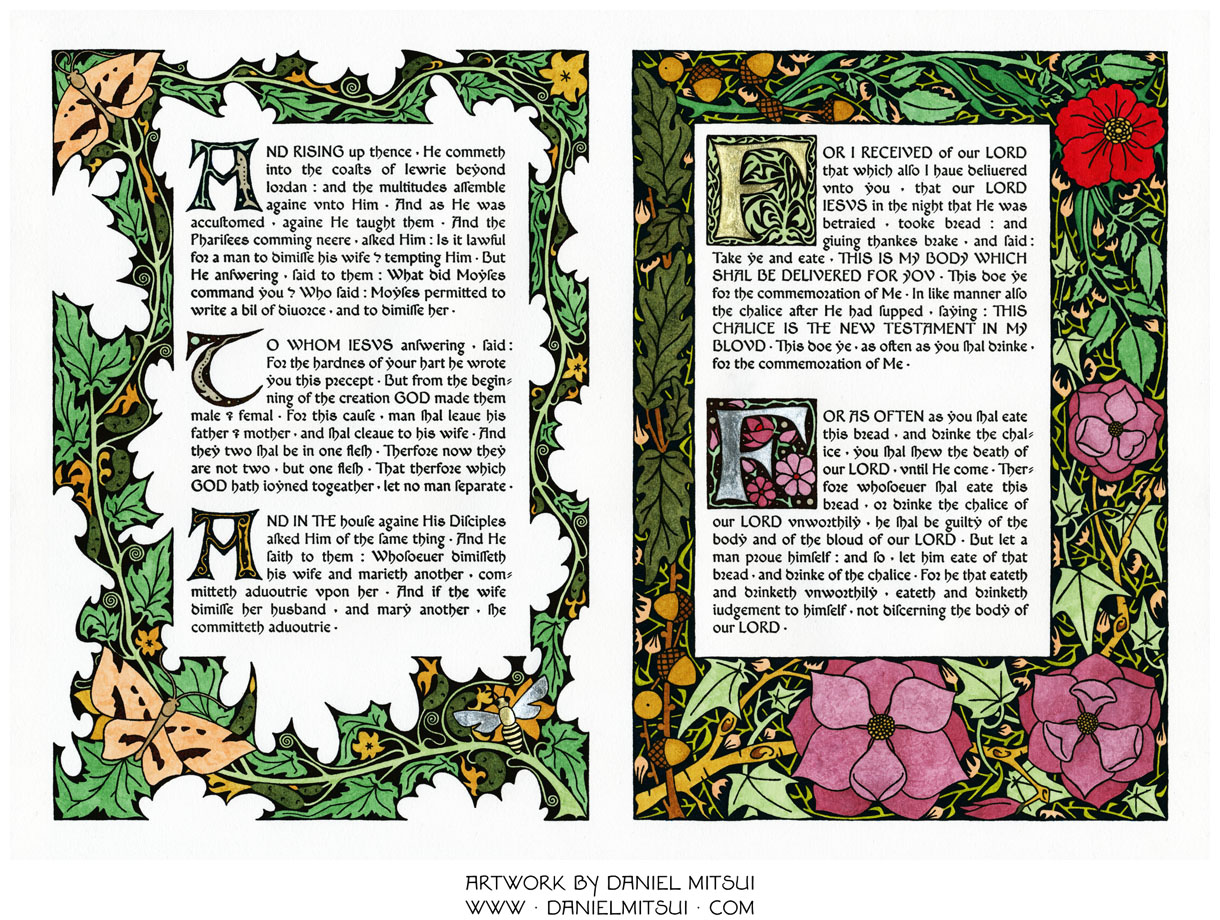
Following up on my earlier post about the layouts and typography of Dom Benedict Andersen, I wanted to share with NLM readers some of Daniel Mitsui’s recent experiments with designing his own typefaces, a painstaking art form he is pursuing in order to work towards the publication of new illustrated fine press editions of late medieval books. Two of the pieces now on display in Steubenville are typographic broadsides, one of them prepared in anticipation of the Synod on the Family:

(To see these at the artist's website, go here and here.)

In toto, Daniel has designed four typefaces: Benedict, Victor, Adam, and Michaëla. The marriage and family texts above are written in Benedict; the Lord's Prayer in Victor. Here are samples of Adam and Michaëla:


Some time ago Daniel did this "Ecce quam bonum," which is a masterly example of the art of illuminating a text (we see again the Benedict font):

These are truly exquisite pieces of work, and we are all looking forward to many more from this extraordinary artist. Check out his website for a complete portfolio and items for sale.


More recent articles:

For more articles, see the NLM archives: