Tuesday, May 30, 2023

A Bill To Prescribe Traditional Architectural Styles for Federal Buildings

Beautiful architecture by the people, for the people, and of the people?

Last Wednesday, Rep. Jim Banks, a Republican from Indiana, introduced legislation to codify an executive order by former President Trump that made classical architecture the model for new government buildings, an order which was axed by President Biden. He was recently interviewed on the subject by on Fox News.

The “Beautifying Federal Civic Architecture Act” declares “traditional and classical” architectural styles to be preferred for new Federal government buildings. This offers hope, at least, that we might again see a national culture that is beautiful and is in harmony with Christian values.

Alexander Solzhenitsyn, the Russian dissident, famously said on coming to the US (quoting Dostoevsky) that, ‘Beauty will save the world.’ I would assert that in order to save the world, we must first save America, and that in order to do that, beauty must save America. I write as one, incidentally, who recently became an American citizen, because I want to help save the West through beauty.

Those who wish to see a strong American society rooted in traditional values focus, quite rightly, on the political battles, but can forget at times that this ought to be an urgent cultural battle as well. This is a shame, because a noble and accessible culture of beauty is the greatest ally that those politicians who strive for what is good in America can have. As the British conservative philosopher, the late Roger Scruton, put it, when the world around us is beautiful, ‘it tells us that we are at home in the world.’

When we are at home in the world, our desire is to conserve and develop further what is good, rather than to destroy the institutions of society. Furthermore, beauty inspires in us love for our fellow men, generates a culture of faith and virtue that supports the generation of wealth, and our desire to care for the poor. I have previously written about this principle here.

The neo-Marxist theorists who have steadily gained control of the institutions that influence culture in the West understand this well. They have nothing but disdain for the common taste, and for decades, they have deliberately sought to further their political goals by promoting a contemporary culture of ugliness, despair and death, in order to spark revolutionary and destructive anger directed against the America of the Founding Fathers. Beauty raises our hearts and minds to God, and in so doing, reinforces our desire to live by American values, which are rooted in Scripture and Judeo-Christian values. The Marxists know this, even if many Christians seem not to. Accordingly, the Marxists push ugliness, because they know it undermines traditional values. Their architecture of despair distracts our gaze from ‘heavenly things’, as St Paul puts it, and hence from an adherence to objective truth, leaving us vulnerable to manipulation by false propaganda.
The brutalist US Dept of Health and Human Services, the Hubert H Humphrey building. This speaks directly of the disdain that the elites who push this style have for those whom they serve. It says, ‘You may not like it, but we know better than you, as with everything else we do.’
I was delighted therefore to see in December 2020, right at the end of his term, that President Donald Trump (not a man popularly associated with high culture) issue a barely noticed Executive Order mandating that federal buildings should adopt the traditional American style of classical architecture. I wrote about it at the time as a move that would set a standard for American buildings that could be a visible symbol of the traditional American values of faith, freedom and justice. At last, I thought, at the highest level, we have a move that recognizes the importance of culture in preserving and promoting American values, which are rooted in Judeo-Christian values. “If the EO survives the next administration, it will, contrary to what it’s critics on the left claim, likely encourage creativity, authentic originality, and a new richness in architectural style that can be the driving force for a beautiful American culture that speaks authentically of its past and directs us hopefully to its future.”

It turns out that was an important ‘if’. Within a month of Joe Biden becoming President, the EO was scrapped.

Now, thanks to Rep Jim Banks, there is a proposed bill that seeks to do the same, and which adds more detail and direction to the original mandate. For example, as his press release tells us, it specifies that: 
“The term ‘traditional architecture’ includes classical architecture; and the historic humanistic architecture, including Gothic, Romanesque, Pueblo Revival, Spanish Colonial, and other Mediterranean styles of architecture historically rooted in various regions of America, the bill states. 

The bill denounces modern, ‘brutalist’ styles of buildings made popular in the 20th century, defined as a ‘massive and block-like appearance with a rigid geometric style and large-scale use of exposed poured concrete.’ Buildings should instead be modeled after ‘Greek and Roman antiquity’ like the U.S. Capitol and the Supreme Court. 

Banks said his bill aims to restore respect for the beauty of traditional American culture. 

A 2020 poll from the National Civic Art Society found that 72% of American respondents prefer classical and traditional design for federal buildings. Justin Shubow, president of the National Civic Art Society, said he is fully behind Banks' bill. 

"It is crucial that the design of federal buildings reflects the preferences of ordinary Americans — namely, that such buildings be beautiful, uplifting, and designed in a classical or traditional style.”
I am hoping that this bill might make progress, and even if not made law, might set the standard for how legislation can have an impact on the culture. 
Setting an example that will drive a wider American culture of beauty. 
On the whole, I believe that the culture is not created from the top-down, but from the bottom up. It is a pattern of how ordinary people interact and behave. So it is appropriate that a federal bill limits its attentions to the aspect of American architecture that it should properly be concerned with, that is federal architecture. This way, its influence beyond that is by example only. If people like what they see, they will be inspired to follow suit in the building design that they have an influence over. 
The Supreme Court building
Architecture for the people, not the elites 
This bill reflects a proper government concern for serving the people. If the views of ordinary people were taken into account, then I am pretty sure there would be no modernist architecture ever. (I am using modern in a broad sense to mean those styles that arise from a conscious rejection of Western tradition). A poll referred to by the drafters of the bill indicated that classical was the preferred style of the public and of federal workers - those who will actually have to look at and work in the buildings. This does not surprise me. In my experience of decades of talking to people about art and culture, it is the many - ordinary people (who don’t consider themselves members of the cognoscenti) who prefer traditional designs. On the other hand, it is the few - elites who are inclined to tell us what we ought to like - who advocate modernist designs, and who dominate the teaching institutions that form the architects who go on to design such buildings. 

A move that will encourage originality and creativity 
One argument that I am sure will be used against the bill is that it will stifle creativity. In fact, in my opinion, the opposite will happen. It will encourage a richer and more authentically American diversity of beautiful architecture than that produce by modernist architects.

As a rule, in art, if you define limits to creativity in one direction, creativity finds room for maneuver in other directions. Rather than being a prescription for sameness and sterility, it is exactly the opposite: a mandate for beautiful creativity and variety. 

History confirms this. Some of the most admired architectural styles began as attempts to copy the past. Without deliberate intent from the architects, their work was a product of the time and place in which it was created as well. So, for example, the High Renaissance classical style began as an attempt to recreate the classical style of the ancient Romans and Greeks. It quickly became its own distinct form of classicism known as Palladian architecture and in turn morphed into English Georgian and the American colonial style.

Tuesday, November 08, 2022

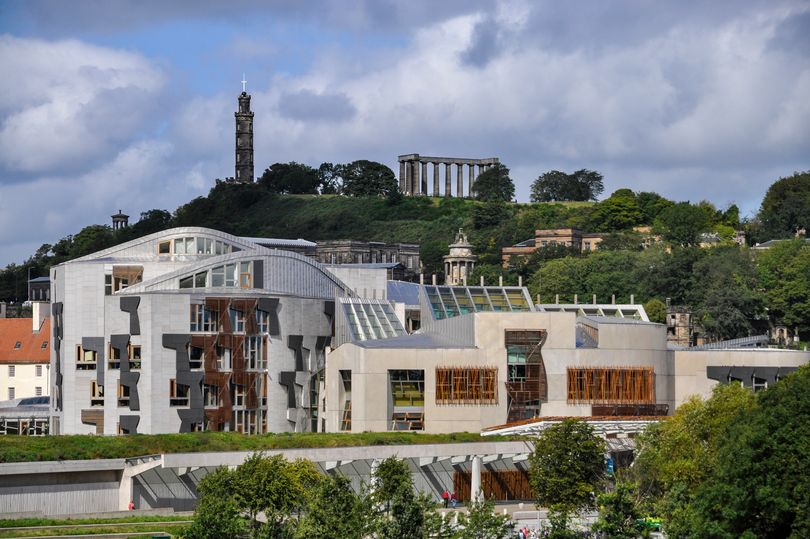
Out-Law, Dis-Order, and In-Justice Captured in Concrete: the Design of the Scottish Parliament Building

This post is the latest in an occasional series that contrasts traditional and modern architecture. The principles that underlie the two modes of design are explained in an earlier article: Cacophony and Monotony are the Twin Principles of Modern Design. Whatever Happened to Harmony?

Here is the current Scottish Parliament building, designed by a Spanish architect and completed in 2004.

Wikipedia tells us on the page devoted to the building:
A major public inquiry into the handling of the construction, chaired by the former Lord Advocate, Lord Fraser of Carmyllie, was established in 2003. The inquiry concluded in September 2004 and criticised the management of the whole project from the realisation of cost increases down to the way in which major design changes were implemented. Despite these criticisms and a mixed public reaction, the building was welcomed by architectural academics and critics. The building aimed to achieve a poetic union between the Scottish landscape, its people, its culture, and the city of Edinburgh. The Parliament Building won numerous awards including the 2005 Stirling Prize and has been described by landscape architect Charles Jencks as “a tour de force of arts and crafts and quality without parallel in the last 100 years of British architecture.”
As usual, you have architectural experts asserting that it is good, while most of the people who have to look at it on a day to day basis struggle with the ugliness of it. This is the pattern of modern culture. The people who appreciate such things are the elites who flatter themselves that they are cultured, and hence set apart from the great unwashed masses. Typically they had to go to university to have good taste educated out of them.

In regard to the stated aims: I am curious as to how this speaks visually of Edinburgh, the Scottish landscape, the Scottish people, or Scottish culture. Could anyone looking at this building without knowing what or where it was discern anything Scottish about it? I am struggling to see any of these things myself. It reminds more of a hurriedly erected seaside hotel that might be seen in the home country of the architect, Spain. 

Contrast the above with a building previously associate with the Scottish parliament, in Parliament Square, Edinburgh, built in the early 19th century.

The design visibly speaks of the function of the building – the formulation of law in accordance with the principles of justice and directed to the common good and the maintenance of order in society. Law and order – the two go together. The design incorporates the universal principles of harmony and proportion. The principles of harmony and order are derived from an analysis of the pattern of the cosmos and what in common perception makes it beautiful. “Cosmos” is a Greek word that also means both “beauty” and “order”: the ancient Greeks assumed that these things went together and were universal, which is to say, that they were apprehended by all people.

As universal Christian principles, developed from those of the ancient Greeks, the principles of harmonious proportion are appropriate to Scotland too. The Scottish landscape is in my opinion as beautiful a part of the cosmos as one can find. Therefore, the mathematical principles of cosmic harmony and order that become the design basis for this building are deeply connected to the Highlands of Scotland or the Western Isles.

The Isle of Skye in the Hebrides
The design of the building is also characteristic of the traditional architecture of Edinburgh, a city that attracts many visitors because of the beauty of the Georgian and neo-classical architecture of its center. Most of it was built out of a locally quarried sandstone, and thus incorporates into itself the very fabric of Scotland’s geography, and hence also its people and culture.

The principles of harmony and proportion - which I describe in my book The Way of Beauty, and teach in my course The Mathematics of Beauty at Pontifex University - are apparent in the Parliament Square buildings and the others in New Town. See how the three stories of different dimensions work together harmoniously in accordance with the mathematical principles of musical harmony.

These buildings will continue to be an attraction long after the modern version has been razed to the ground and forgotten.

Edinburgh’s Georgian ‘New Town’, the architecture that characterises the city.

Tuesday, December 28, 2021

A Description of the Theory of Harmony and Proportion in Renaissance Architecture

Architectural Principles in the Age of Humanism by Rudolph Wittkower

Here is a book that is, in my opinion, an excellent source for people who are interested in understanding the basis of harmony and proportion. In the past, I have posted numerous examples of buildings that use traditional harmony and proportion, and contrasted them with the ugliness of modern architectural design (e.g. Monotony and Cacophony are the Twin Principles of Modern Design - Whatever Happened to Harmony?) As well as focusing in detail on the mathematical proportions used and described by men like Alberti and Palladio in architectural textbooks, there is a lot of context provided, and the author describes well the philosophical ideas behind the movement. 

Rudolph Wittkower (1901-71) was a German art historian who went to London when the Nazis came to power, and subsequently taught at the University of London. In this book, first published in 1949 with multiple subsequent editions, he contrasts the approach of architects from the High Renaissance period, who relied largely on musical theory for their mathematics, with those of the ancient Greek and the medieval period, the latter relying on geometric constructions based upon the triangle, the square, and the pentagon. As such, it is a good resource for someone who wishes to get a broad introduction to the subject. He also describes how the developing thought of the Enlightenment and its new understanding of what beauty is contributed to the gradual abandonment of the use of mathematically derived harmony and proportion, starting at the end of the 18th-century, and culminating in its almost total rejection in architectural schools by the mid-20th century.
As well as the main text, there are four appendices with talks given by the author, the last of which is particularly is recommended reading for a concise overview of the subject.
Those who are interested in going more deeply into the subject might be interested in taking my course, The Mathematics of Beauty which can be taken online, for audit or for credit, from www.Pontifex.University

Nostell Priory in England, built in the Palladian style, in Nostell near Wakefield in Yorkshire in 1733.

Tuesday, October 19, 2021

The Philadelphia Art Museum - Site of the Iconic Rocky Steps and a House for Beautiful Art

I recently made a very enjoyable trip to Philadelphia, which included an afternoon at the Philadelphia Art Museum. This is the building featured in the film Rocky, in which the title character played by Sylvester Stallone runs up the steps as part of his grueling training routine. In this clip, he runs through the city neighborhoods and, as a metaphor for the inspiring narrative of an against-the-odds rise from poverty to success (mirrored in the life of Stallone himself), he finishes on the top of the steps of the beautiful building, the Art Museum, that overlooks the whole city. Stories such as this can play two ways. On the one hand, it can be viewed as the triumph of human effort against the odds. When, however, this rise is identified with a narrative of good triumphing over evil, as is the case with Rocky, a simple narrative well told transcends one of material gain, and becomes a type for the attainment of the ultimate good that we yearn for. This is part of what gives such stories the power to connect with us; the imagery would not have worked in the film if the site of the summit had not been grand, beautiful, and in many ways a symbol of the idealized city.

The building was completed in 1928 in a neo-classical (I would have said Palladian) style. It has classical columns and portico, and windows in harmonious proportion. Each story is a different size in accordance with principles of visual harmony. The two architects generally credited with its design are from the two local firms that collaborated on the work, Howell Lewis Shay for the building’s plan and massing, and Julian Abele for the detail work and perspective drawings. Abele, incidentally was the first African American to graduate from the University of Pennsylvania’s School of Architecture, in 1902. 

The stone is a beautiful honey-colored dolomite, quarried in Minnesota. It is common nowadays, for those who wish to retrieve traditional values in building to insist that only local stone will work. I have never understood this argument. As far as I am aware, builders of grand buildings have always used the most beautiful and appropriate materials they could afford, as suited to the purpose of the building. If this meant importing marble from a distance, so be it. Certainly, it is not the case that the art museum used local stone.

I can’t let the moment pass without some reference to the art collection inside the building. Here are two examples that caught my eye. The first is a diptych by the 15th century Flemish artist Rogier van der Weyden, a Crucifixion in the high Gothic style.
And then a landscape painting of the 19th-century by a Norwegian artist whom I had never heard of before, Fritz Thaulow.

Tuesday, December 29, 2020

A Presidential Order on Civic Architecture Will Engender Creativity and Variety

...and the Cultural Elites Who Deride It Are Wrong

I read recently of an Executive Order issued by President Donald Trump declaring the classical style of architecture tobe the preferred style for new government buildings, and that regardless of the style chosen, the building must be beautiful.

Predictably, the architectural institutes and leftists have objected, both parties faithfully reflecting the neo-Marxist theory that rejects all tradition. The problem with such an edict, so the argument runs, is that, among other things, it undermines the principle of cultural diversity and as such is “undemocratic.” And, as we know, in modern critical theory, “diversity” per se is an incontestable good!

I believe, in contrast, that what the President has done is a good thing, and if the EO survives the next administration (whoever that may be), it will likely encourage creativity, authentic originality, and a new richness in architectural style.
The Capitol, Washington DC
I am assuming sufficient goodwill from enough people to make it work for this to be the case, and this is, I admit, a big assumption. For example, to define what is meant by “classical” is probably not so easy. Anyone who has ever seen a photo of the Acropolis or the Capitol building knows classical style when they see it. But to define it so precisely that loopholes can’t be found by people who are determined to find them will be a difficult task. However, assuming that a genuine attempt is made to follow this in spirit for the beauty of our cities, and the good of those who work in the buildings, rather than the self-aggrandizement of the architect, then I believe that the result will be good.

So, to counter the objections: Firstly, if democracy really was the concern of the critics, then I am pretty sure there would be no modernist architecture ever. (I am using modern in a broad sense to mean those styles that arise from a conscious rejection of Western tradition.) The Trump administration said that polls indicated that classical was the preferred style of public and federal workers - those who will actually have to look at and work in the buildings. This does not surprise me. In my experience of decades of talking to people about art, it is “the many”, ordinary people (who don’t consider themselves members of the cognoscenti) who prefer traditional designs. On the other hand, it is the few - elites who are inclined to tell us what we ought to like - who advocate modernist designs and who dominate the teaching institutions that form the architects who go on to design such buildings.
This is the telling statement in the Reuters article cited above:
The White House official said that polling showed a vast majority of Americans prefer traditional designs and said some modern structures weren’t easily identifiable as public buildings. New construction should command respect by the general public and not just architectural elites, the official said.
One argument that I am sure will be used against the EO is that it will stifle creativity. In fact, in my opinion, the opposite will happen. It will encourage a rich and authentic diversity of beautiful architecture than that produced by architects who subscribe to the views of the modernist critics. 
As a rule, in art, if you narrow the width of the constraints, creativity finds room for maneuver by reaching for greater heights and depths. Rather than being a prescription for sameness and sterility, it is exactly the opposite: a mandate for beautiful creativity and variety. Take the iconographic style of sacred art as an example: this is perhaps the most narrowly defined artistic style that I know, yet the range of styles, reflecting time and place, is huge. My icon-painting teacher always used to say that someone who knows iconographic styles can look at an icon and from the style alone, identify when it was painted, to around 50 years, and from which geographical region it originates.
Accordingly, the likely result of this EO is the emergence of a new, American neo-classical style that is simultaneously a full participation in the essence of classicism as established 2,500 years ago, and a unique 21st-century American style. These two principles are not mutually exclusive. 
If we look at history, some of the most admired architectural styles began as attempts to copy the past. Without deliberate intent from the architects, their work was a product of the time and place in which it was created as well. So, for example, the High Renaissance classical style began as an attempt to recreate the classical style of the Roman worldt. It became its own distinct form of classicism known as Palladian architecture and in turn morphed into English Georgian and the American colonial style.

Georgian houses, Bath, England.
Similarly, AW Pugin, who was, ironically, reacting against the neo-classical architecture of the early 19th century (which Trump admires) set out to re-establish the Gothic (or as he called it ‘pointed’) style of architecture. Again, the result was a distinct form of Gothic architecture that was adopted widely because of the power of its beauty. Examples are across the globe in local variations - in India and Russia, across Europe, and in the US, for example. It created some of the most iconic buildings in the world, for example, Big Ben and Tower Bridge.
All of the varieties of architecture mentioned, Gothic or classical, arise from the traditional desire to participate in the beauty of Creation, which in turn bears the mark of the Creator.
In contrast, consider the architecture that is produced, when the mandate is that anything goes as long as it isn’t traditional (which is what dominates today). Look at inner cities around the world that have been developed since WW2. You can barely tell one from another, or what any individual building is for. All these cities in continents across the globe look pretty much the same, and for all the effort that has gone into creating the giant structures, the overall impression is of bland uniformity of ugliness. It is only the elites who push the theories that underlie their design who dare to admit that they like them (and one wonders if even then it is really true that they do in every case.)
This is a reflection, I would say, of the fact that there is no order outside God’s order, only disorder. There is no beauty that is not a participation in divine beauty, only a dull and bland uniformity of ugliness. And there is no originality if the origins of all beauty are no longer the source of inspiration. To shut out the traditional wellspring of inspiration, as modernity has done, is to rely on the despair and isolation of fallen man, and this runs dry very quickly. Looking to the cosmos and to God, on the other hand, is to tap into infinite possibilities of beautiful design.

The National Gallery of Art, Washington DC
Trump will no doubt continue to be derided by the cultural elites who think they know better and are anxious to preserve their own reputations and jobs, for his supposedly simplistic approach. The irony of this is that he has probably done more to establish a rich and inspiring culture of beauty than his puffed-up critics and their like have done for over a hundred years. If the Executive Order can remain in place, I envisage a cultural renewal that will make American cities the envy of the world.
The Parthenon, in the Acropolis, Athens

More recent articles:

For more articles, see the NLM archives: