Thursday, August 27, 2026

Complete Coetus XI Documentation on the New Lectionary Now Published in English

The Lectionary for Mass – drawn up by Group XI of the Consilium, the “super-committee” charged with carrying out Sacrosanctum Concilium – is often held up as one of the greatest achievements of the post-Vatican II liturgical reform. Yet until recently, the full details of the committee’s discussions and labors have remained unpublished, accessible only to archival researchers and specialist scholars.

Newly published, The Post-Vatican II Reform of the Lectionary: The Schemata of Group XI offers an English translation, by NLM contributor Matthew Hazell, of the Latin and French schemata of Group XI in their entirety – the first time, in fact, that the complete documentation for any of the Consilium study groups has been made available in translation. The process of the reform of the lectionary can thus be traced through the various draft orders of readings as well as the debates among the members and consultors.

As readers would expect from his writing at NLM and his posting online, Hazell equips the book with a robust, detailed, masterly introduction to the views on the lectionary entertained in the 20th-century Liturgical Movement, how these views animated (or not) the Council Fathers, the formulation accepted at the Second Vatican Council, and the complex mechanisms by which a few lines from the Council were extrapolated into a multi-year lectionary designed more or less ab ovoThis introduction alone is a major addition to the scholarly literature (it could have been published as a small book of its own), followed by a comprehensive bibliography of secondary sources ranging over many languages.

By making the primary source documentation more accessible to all, this volume of 512 pages contributes to further critical study and exploration of the Novus Ordo lectionary and the post-Vatican II liturgical reforms more generally, as well as to ongoing discussion of how closely the Consilium’s work reflects the will of the Council Fathers.

It is surprising how much information is only now emerging about the enormous undertaking of liturgical reform at the Vatican in the 1960s and 1970s. Until recently we did not have ready access to eyewitness accounts of how things went “behind closed doors”; then the valuable memoirs of such participants as Louis Bouyer, Boniface Luykx, and Ferdinando Antonelli were published, shedding new light on the proceedings.

This new volume from Os Justi Press continues the work of historical investigation and analysis.
 

The reader will find a treasure trove of information and insight into the mind and workings of Coetus XI. Hazell’s introduction is a refreshing summary, reporting different points of view without being limited to the common narrative. A comprehensive bibliography allows those interested to further their studies and the appendices provide additional pertinent historical documents. Hazell is to be commended for making the sources available. In this way, the reader has the necessary tools with which to make informed judgments about this important aspect of the life of the Church.” 
          —Dom Cassian Folsom, OSB, Professor of Liturgical Books, Pontifical Institute of Liturgy, Sant’ Anselmo, Rome

With this volume, Matthew Hazell fills a conspicuous and long-standing gap in liturgical scholarship. The revision of the Mass lectionary, despite its enormous consequences for Catholic worship, has remained strangely obscure—its committee debates, drafts, and decisions known only in fragments. Hazell reconstructs that history in exhaustive detail and, crucially, supplies English translations of the schemas and official notes in their entirety. It is difficult to imagine future research on the three-year lectionary that does not begin here.
          —Rev. Matthew S. C. Olver, Senior Lecturer in Liturgics, Nashotah House Theological Seminary

“A growing number of scholars have turned their attention to exactly what took place within the body charged to implement the Council’s constitution on the liturgy. Matthew Hazell is to be congratulated for this important contribution to that scholarship and to the ability to distinguish between the reform desired by the Council and that which was in fact promulgated in its name.”
          —Dom Alcuin Reid, Prior, Monastère Saint-Benoît, Brignoles, France

Available from Os Justi Press or any Amazon site. (At the Os Justi site you can “look inside” at the Table of Contents, part of the Introduction, and sample pages from the translations and charts.)

Some further thoughts on this book by our contributor Dr. Kwasniewski, who is also the director of Os Justi Press:
Some sample pages.

Saturday, July 25, 2026

The Incarnation, the Passion, and the Eucharist as Keys to Rightly Interpreting the Song of Songs

If you’ve ever read the Song of Songs (also called the Canticle of Canticles) in the Old Testament, you probably had more than a few questions about it! What is this very sensuous book about a lover and a beloved doing in the canon of Scripture? Are the modern biblical exegetes right when they say it’s just a loose collection of ancient Near Eastern erotic poetry that accidentally found its way into the Hebrew scriptures? Were the Jewish rabbis closer to the truth when they said it depicts the tender and tempestuous relationship between YHWH and Israel?

In his new book Wounded I Sing: The Song of Songs and the Incarnation of the Son of God, Dr. Timothy Kelly, a professor of theology at the International Theological Institute in Trumau, Austria, argues that Christians are uniquely positioned to unlock the mysteries of this book, which opens its secrets more and more as we read it in and through the Heart of Christ.

When the Word became flesh, the transcendent God of love reached down into our mortal, passible nature to join it as a man joins his betrothed, and upon the Cross He accomplished a bodily-spiritual nuptial covenant with the Church and every baptized soul that He renews, day after day, in fleshly-and-spiritual Eucharistic communion.

What the Hebrews longed for as yet-to-be-attained in the Messianic age, the Christian receives as now accomplished in the sacrifice and sacrament of the Lord's Passion—yet this, in turn, is the foretaste and pledge of something far greater: the eternal wedding feast of the Lamb. The dynamism of eros that characterizes the Song reveals both the fiery love of the Divine Lover and the yearning of His beloved to be inseparably one, but in a manner that is incarnate, ecstatic, total, irrevocable, blissful beyond what mind can conceive or imagine.

This is the essence of the Christian life and no book in the entire Bible conveys it better. No wonder the Fathers and Doctors wrote more commentaries on the Song of Songs than on any other book. No wonder it entices and baffles us: it speaks to our deepest desire, and yet does so with all the enigmas of salvation history and of our pilgrimage under the invisible hand of Providence.

And we can be thankful to Dr. Kelly for synthesizing all of this—drawing especially on St. Bernard of Clairvaux, St. Thomas Aquinas, and Matthas Scheeben—into a readable guide that opens one magnificent vista after another. An exemplary work of Thomistic synthesis, with the clarity of Garrigou-Lagrange and the eloquence of Pieper.

Readers of NLM will be particularly interested in Kelly's extensive discussion of the Passion narratives (pp. 63-96), which play so pivotal a part in the ancient Roman Rite's celebration of Holy Week (with all four being read between Palm Sunday and Good Friday); how Christ's spousal office is necessarily priestly, sacrificial, and nutritive of His bride, the Church and the Christian soul; and how baptism and the Holy Eucharist, in particular, are nuptial sacraments with analogous aspects of unity and fecundity (pp. 97-149).

Without necessarily intending to be an apologetics work for the Catholic Faith, in fact Kelly's argument shows that both the Old Testament as a whole and the Passion of Christ make no salvific sense if there is not an immediate physical-spiritual communion possible with the Son of God, and in that sense proves that the Protestant account of personal salvation (through faith, by Scripture, by grace alone, etc.) is in tension with the entire trend of salvation history and of the life of Christ.


The early readers of this manuscript—including some of the greatest living Catholic biblical scholars—loved it.

Scott Hahn, editor of the Ignatius Bible’s commentary on the Song of Songs, wrote: “Rarely will you see a book that brings biblical, dogmatic, and mystical theology together so artfully and lucidly as this remarkable and readable synthesis does. Timothy Kelly refreshingly resets the entire question of the Song’s literal and spiritual meanings.”

John S. Bergsma, who co-authored A Catholic Introduction to the Bible with Brant Pitre, and wrote a book called The Bible and Marriage, had this to say: “An exquisite contemporary reading of the book, which I hope will contribute to returning the Song to its rightful and central place within Catholic biblical theology.”

Stephen K. Ray, author of commentaries on Genesis and the Gospel of John, summed it up as “an illuminating guide to a sublime and mysterious book.”

Fr. John Saward, author of some of the finest theological works of recent decades, declared: “Writing with a poet’s sensitivity to language, Dr. Kelly shows us how the Nuptial Mystery of Christ and His Church, of which the Song of Songs speaks with the authority of divine and prophetic inspiration, stands at the very centre of the Catholic faith.”

To find out more or “look inside,” visit the publisher’s site or any Amazon site.

Here’s a short video introduction, including a reading of part of the text:

Wednesday, July 08, 2026

Historian Breaks New Ground in Vatican II Research, with Special Attention to Liturgical Reform

People today often ask questions like: “What in the world happened at the time of Vatican II, that the Church seemed in such an unholy hurry to change? Why were the changes so drastic and so sudden? What were the causes, the motives, the expectations, the assumptions about reform and its expected fruits? Who were the main actors? Was it planned out or random? Who benefited (cui bono)? How responsible were the bishops for it, versus the middle managers, versus the laity?” and so forth. It can be very hard to disentangle so many threads.

This is why professional historians exist. Professor Hanael Bianchi has spent 10 years researching, at the nitty-gritty level, how Vatican II was received and implemented in a particular (and very important) diocese, using archival materials, period documents, and firsthand accounts. The resulting book, A Liberal Revolution: The Implementation of Vatican II in the Archdiocese of Baltimore, will leave a permanent mark henceforth on all studies of the period.

Bianchi answers the above questions, one after the next – and brings the receipts. In an era of endless podcasting and spitballing, the disciplined work of research is more necessary than ever if we wish to gain a well-documented and well-organized account of complex events, while overturning faulty theories and clumsy generalizations from (…yes…) every part of the ecclesiastical spectrum.

While the Second Vatican Council has generated a large scholarly corpus, A Liberal Revolution is the first close-up history to be written of a single diocese in the years immediately following it. Using the see of Baltimore as a case study and drawing exclusively on primary sources, Bianchi reconstructs how the decrees of the Council in faraway Rome – and, more tellingly, the new ideas and attitudes prompted by it – were implemented and experienced on the local level, in parishes, seminaries, religious communities, retreat centers, and chancery offices.

The claim that the Church “embraced the modern world” after Vatican II is well known; this book sharpens it by focusing specifically on liberalism as the framework through which implementation took place. The study begins by tracing the dismantling of inherited traditions, then turns to the rise of individualism within Catholic life and governance, before arriving at its most original contribution: an analysis of the emergence of a dense church bureaucracy that embodied and enforced a liberal worldview.

Although the story told in these pages is a tragedy, A Liberal Revolution is no polemic; rather, it is a work of careful historical analysis grounded in years of research. It will not only contribute to the scholarly understanding of Vatican II and its aftermath but also offer guidance to Catholics seeking a path toward genuine renewal, grounded in a thorough and accurate assessment of what actually happened. Understanding the whats, hows, and whys of postconciliar disruption – a topic that, so far from fading into the past, has grown to be a most urgent task for the present – finds in Bianchi a uniquely capable guide.

NLM readers will find especially valuable Part 1, “Attack on Tradition and the Rise of the New,” divided into “The Priesthood Revolts,” “Novelty in Music and Architecture,” and “Liturgical Confusion.” Among other topics, Bianchi's presentation of the data concerning how the different age groups reacted to new policies shows that radical change was in fact extremely popular with the younger set of seminarians and priests (at least, until they left the seminary or the priesthood, as many of them did), and, at the same time, that diocesan policies repeatedly found ways to empower these reformatory forces while marginalizing older priests who were skeptical of the changes or even wished to continue with the traditional Mass in Latin. There is also liturgically relevant material in Parts 2 and 3.

Famed sociologist Dr. Stephen Bullivant, Professor of Theology and the Sociology of Religion and Director of the Benedict XVI Centre for Religion and Society at St. Mary’s University in London, calls A Liberal Revolution “a richly detailed account... an impressive piece of scholarship, beautifully written, very compelling, and highly recommended.”

Dr. Anne Hendershott, Professor of Sociology at the Franciscan University of Steubenville, concurs: “With historical precision and narrative force, this book shows how reforms reshaped Catholic life in unexpectedly negative ways, with consequences that still reverberate through the Church today.”

Veteran journalist and founder of the Catholic Culture site, Philip Lawler, finds in the book a crucial tool for understanding the bureaucratic mentality that has morphed into synodality: “[Bianchi documents how] the post-conciliar era saw a spectacular proliferation of offices, boards, and commissions at the diocesan level. This new bureaucracy developed its own interests in spurring change, regardless of either the formal directives of the Council or the wishes and needs of the faithful.”

Finally, poet and liturgist Barry Spurr sums up the effusive reactions of the book’s initial readers: “The importance and necessity of this book cannot be overstated. Bianchi reveals the destructive effects of the late 1960s mindset at the parochial level.”

A Liberal Revolution is available in paperback, hardcover with dust jacket (both pictured here), or ebook, either directly from the publisher Os Justi Press or from any Amazon site around the world. At both places, you can “look inside” to read the Introduction.

Monday, June 08, 2026

A Memoir on the Battle to Bring the Latin Mass to the Military

David Sonnier, a 1981 West Point graduate, loved the Army and worked to be a model soldier. A bend in his career path brought him into contact for the first time with the traditional Mass. His life, with that of his family, was changed forever—something quite a few Catholics can relate to!

Naturally, he wanted to share this great good with fellow soldiers, many of whom, as he discovered, were already longing for something more reverent and traditional than they were getting in their chapels.

Sonnier began respectfully petitioning for a traditional Latin Mass to be offered on the bases where he served, in accordance with the policy of John Paul II's letter Ecclesia Dei. He watched in disbelief as chaplains at every level and several bishops, over the course of six years, made every effort to thwart his efforts, stopping at nothing and stooping to any ruse.

In his gripping memoir Rites and Wrongs: One Man's Struggle for the Latin Mass in the U.S. Army, just released by Os Justi Press, Lt. Col. Sonnier relates—documentary evidence in hand—the tangled web of lies, backstabbing, slander, double-crossing, bureaucratic manipulation, letters intercepted and undelivered, veiled threats, and secret meetings, all to ensure that no Latin Mass would ever be celebrated on a military installation, even when willing priests were available. 

The 97-percent-Christian chaplaincy at the time allowed chapels to be used for Protestant praise & worship services and even Wiccan pagan ceremonies (!), but the TLM was subjected to a perpetual ban. When an exasperated Sonnier finally took his story to the press, it was taken up in major newspapers and eventually reached the floor of Congress in Washington, DC.

A true story from a dark period (those who do not know how bad things were before Summorum Pontificum can use this as a crash course), Sonnier's first-person account ranges through the world of the Colombian Army, Special Operations, Fort Bragg, NATO, and the Vatican. A cast of colorful characters enters the drama: Michael Davies, Bishop Timlin, Msgr. Calkins, Msgr. Perl, Cardinal Castrillon Hoyos, and clergy from the Institute of Christ the King and the Society of St. Pius X, together with a whole roomful of multi-star generals and their entourages—plus authoritarian chaplains who launch into spittle-flecked nutties at the slightest mention of Latin, chant, or anything reminiscent of Catholicism before the 1960s. also play a role.

Though active or retired servicemembers and lovers of military history will especially appreciate this memoir, Rites and Wrongs is a captivating read for any Catholic who relishes a story full of life-changing realizations, backroom intrigues, surprising reversals, and hard-earned wisdom. Lt. Col. Sonnier's candor and courage shine through these pages, full of valuable lessons for life, faith, and freedom.

For a brief video introduction to the book:

To look inside, see the endorsements, or order a copy in paperback, hardcover, or ebook, visit this page.

Rites and Wrongs
is also available from any Amazon site around the world (e.g., in the USA here).

Wednesday, March 11, 2026

St. Thomas Aquinas on St. Paul’s Letter to the Hebrews and the Theology of Salvation

Os Justi Press has released two major Thomistic publications that will no doubt be of interest to many readers of NLM, given their extensive engagement with liturgical matters.

In Lent and Paschaltide, we reflect on Jesus as the lion who has conquered (Rev. 5, 5). But what has Jesus conquered? And how has he done so? The Bible also repeatedly refers to Jesus as our “savior.” But what does Jesus save us from, and how does he do so?

Daniel Robert Waldow’s The Lion Has Conquered
is an unsurpassed introduction to soteriology – the branch of theology that seeks to answer these questions – as expressed in Scripture and Tradition. It guides the reader through the fundamental principles, issues, and questions, such as:

• the nature of and relationship between sin, death, hell, the devil, and punishment
• the purpose of ritual and moral sacrifices in the Old Testament
• the salvific function of the Incarnation, public ministry, and Paschal Mystery of Christ
• the objective work of Christ and our subjective participation in that work
• cooperation between grace and good works
• the salvific function of Baptism, Penance, and the Eucharist
• the relation between the sacrifice of the Cross and the sacrifice of the Mass.

Dr. Matthew Levering:
“Aquinas scholar Daniel Waldow offers a theology of Christ and salvation that readers will treasure for its insight and clarity. The first part is a biblical tour-de-force, while the second part systematizes these insights with the aid of magisterial documents. A marvelous final chapter leads us through Catholic soteriology as inscribed in Western and Eastern Eucharistic rites, calling us to live liturgically the salvific path revealed by God.”
 

Complementing Waldow is The Transcendent Christ: St. Paul’s Letter to the Hebrews. This fine collection of essays includes, among others:

• Dr. Nathan Schmiedicke’s brilliant defense of the Pauline authorship of Hebrews (as testified by the unanimous liturgical tradition, East and West – but discarded in the Novus Ordo)
• Rev. Cassian Folsom OSB on the letter’s biblical and liturgical typology
• Rev. Thomas Crean OP on how the Mass is a true and proper sacrifice
• Dr. John P. Joy on the theology of atonement
• Dr. Daniel Lendman on the headship of Christ

I contribute a chapter on liturgy as “the sacrifice of praise” (sacrificium laudis, in the words of the Roman Canon). The transcript of a live scholastic debate with Fr. Thomas Crean as magister is included, focusing on the relationship between the Old Law and the New Law. The book concludes with the divisio textus of Hebrews provided by St. Thomas.

Scott Hahn
: “This series of essays offers rich theological reflections prompted by the Book of Hebrews. Each essayist shows how the argument of Hebrews is illumined by St. Thomas’ commentary and the light that living Tradition sheds, especially on the Sacrifice of the Mass and our celestial High Priest.”

Karl Keating
: “The contributors offer unexpected insights, with ramifications well beyond the Mass. Despite my familiarity with the Epistle, I found myself repeatedly surprised—and delighted. That will be the reaction of any reader.”

Steve Ray
: “The book of Hebrews is rich with complex imagery, liturgy, and theology from the Old Covenant. It can be daunting. The Transcendent Christ delves into these treasures, illuminating Christ’s fulfillment of every expectation.”

Shane Kapler
: “Reading these essays is akin to eavesdropping on the great universities of the past.”
 

Both are available in paperback, hardcover, or ebook. To “look inside” either one and to see more endorsements, visit their product pages at the Os Justi Press shop (The Lion Has Conquered, The Transcendent Christ).

The books are also available from Amazon sites around the world.

May Christ, our Eternal High Priest, interceding for us at the right hand of the Father, have mercy on us and save us, for He is gracious and loves mankind. And may St. Thomas Aquinas, the Angelic Doctor, intercede for us at the throne of God.

Tuesday, August 12, 2025

Book Announcement: “Prayers in Honor of Saint Thomas Aquinas”

If you’ve been paying attention to the Dominican world, you’ll know we’ve hit some huge Thomistic anniversaries recently:
  • in 2023, the 700th of Aquinas’s canonization;
  • in 2024, the 750th of his death;
  • and in 2025, the 800th of his birth.
To me, as a writer and publisher, it seemed that a special celebratory publication was in order!

Now, books that contain Aquinas’s own prayers and poems are fairly plentiful. That may not have been the case decades ago, but thanks to the efforts of Fr. Paul Murray and others who have rescued Aquinas from the false accusations of proto-rationalism, we are in a good spot today when it comes to familiarity with and use of a broader range of the saint’s writings, including scripture commentaries, sermons, expert opinions, and the like. But when it comes to collecting traditional prayers and devotions in honor of St. Thomas into a single book, the story’s rather different. As far as I can tell, such a thing has never been done. I am therefore delighted to announce the latest release from Os Justi Press, a beautiful prayerbook that brings together the finest of this literature, researched and edited by Thomas O'Sullivan:
  • The Little Office of St. Thomas Aquinas
  • Antiphons & Responsories from the Office of St. Thomas Aquinas
  • Prayer of the Angelic Warfare Confraternity
  • Prayers to St. Thomas, Patron of Catholic Schools
  • Prayer Before Studying St. Thomas
  • Litany in Honor of St. Thomas Aquinas, Doctor of the Church & Patron of Chastity
  • The Six Sundays in Honor of St. Thomas Aquinas
These devotions help us to relate to the Angelic Doctor as first and foremost the Lord’s beloved friend, a miracle-worker, an intercessor before the throne of God, a powerful member of the Mystical Body in its heavenly glory—one who merited to be hailed as “the holy teacher, citizen of the heavenly courts, splendor of the world, guide and light of the faithful, pattern, path, and law of all morality, vessel of virtues.”


Prayers are given in both Latin and English, on facing pages. The meditations for the Six Sundays are in English.
 

Monday, April 28, 2025

Launching “Theological Classics”: Newman on the Virgin Mary, St Vincent on Novelty & Heresy, Guardini on Sacred Signs

At a time of turmoil, nothing could be better or more important than rooting ourselves more deeply in the Catholic tradition. One of my favorite quotations is by St. Prosper of Aquitaine (390-455), writing in his own age of chaos: “Even if the wounds of this shattered world enmesh you, and the sea in turmoil bears you along in but one surviving ship, it would still befit you to maintain your enthusiasm for studies unimpaired. Why should lasting values tremble if transient things fall?”

Enter Os Justi’s new Theological Classics series. Noticing that many indispensable works of ancient, medieval, and more recent centuries are no longer (or were never) available in worthy print editions, we decided to do something about it. Our series, which could be compared to St. Vladimir Press’ Popular Patristics, will feature handsome, convenient, and affordable books, equipped with superb historical and doctrinal introductions.

The series commences with three masterpieces.

Placing Our Lady at the head of all (as is only fitting) the first in the series is St. John Henry Newman’s incomparable apologia for Marian doctrine, The Virgin Mary as New Eve: A Letter Addressed to the Rev. E. B. Pusey, which some consider the single best response to Protestant objections ever penned. This volume features an in-depth historical and doctrinal introduction by Fr. Thomas Crean, OP, and, for the first time, full translations of all the Latin passages quoted by Newman.
 
The second in the series is St. Vincent of Lérins’ Commonitory for the Antiquity and Universality of the Catholic Faith Against the Profane Novelties of All Heretics, a work that enunciates and illustrates the famous “Vincentian canon”: “In the Catholic Church, every care should be taken to hold fast to what has been believed everywhere, always, and by all”—which has resounded as a battle cry for defenders of dogmatic tradition; indeed, it served as an inspiration and catalyst for Newman’s Essay on the Development of Christian Doctrine. Os Justi’s new edition features the original Latin text side-by-side with a flowing translation into modern English, accompanied by ample notes and interpretive essays by Alan Fimister, Peter Kwasniewski, and Phillip Cambpell. Astonishingly, there has been no acceptable English edition of this very famous Patristic work in print for decades—until now.
 
The third in the series is Romano Guardini’s Sacred Signs, in which the author sets himself the task of “seeing and feeling” the basic language of signs out of which worship is composed: the human person and the objects, movements, and awarenesses of time and space that pervade everyday life. Its piercing insight, radiant piety, and almost fairy-tale-like style make it unique in the annals of liturgical writing. Os Justi’s edition is graced with the original line drawings as well as a pedagogically rich introduction by Benedictine Fr. Samuel F. Weber.

These books deserve to reach the hands of serious readers everywhere; they would serve well not only for private study but also as texts for university, seminary, homeschool, or adult enrichment courses.

Here’s a short video that gives a substantial peak inside the pages:


Os Justi Theological Classics are available directly from the publisher or from any Amazon site across the world.

Wednesday, April 09, 2025

A Comprehensive Guide to the Theology and Practice of Veiling

The latest release from Os Justi Press is a revised and expanded new edition of Anna Elissa’s Mantilla: The Veil of the Bride of Christ, this time in full color. (It first came out 9 years ago in Indonesia and quickly become a favorite of many readers until it sold out; it was time for a superior presentation, with better distribution channels. You can find NLM’s original review of the black-and-white first edition here, posted on August 31, 2016.)

Mantilla: The Veil of the Bride of Christ is the most thorough, insightful, and serene guide to veiling ever written—one that will equip you with answers to your own questions as well as the never-lacking questions of friends, relatives, and strangers.

Resting her account on Scripture and Tradition as interpreted by the Church Fathers, St. Thomas Aquinas, and papal, liturgical, and canon law texts, Anna Elissa—a wife, mother, psychiatrist, and lay Dominican—offers arguments of fittingness on behalf of veiling, responds to common objections against it, offers practical advice for choosing, wearing, and even designing mantillas, and shows how the veil contributes to a Eucharistic way of life that treats femininity as a gift, a treasure, and a mystery.

To illustrate and verify her points, Elissa presents a substantial collection of testimonials from women of all ages about their experience adopting and wearing the veil—and from men, too, including clergy, about why they value the practice and its return.

Appropriately for a work about the language of signs and beauty, “Mantilla” is also graced with exquisite artworks in color.

In his foreword, Apostolic Nuncio Archbishop Antonio Guido Filipazzi describes the book as a “beautiful surprise.” Whether you are a long-time veiler, a skeptic of veiling, or simply curious to learn more, this is the book for you!

Paperback, 5” x 8”, 152 pp. $16.95. (Hardcover and ebook also available.) Available from Os Justi Press or any Amazon outlet.


Thursday, February 27, 2025

“Close the Workshop: Why the Old Mass Isn’t Broken and the New Mass Can’t Be Fixed” — New Book by Peter Kwasniewski

hardcover on the left, paperback on the right
I am delighted to announce to NLM readers that my new book from Angelico Press, Close the Workshop: Why the Old Mass Isn’t Broken and the New Mass Can’t Be Fixed, has just been released.

As the title and subtitle suggest, the book replies to the cancer-phase Liturgical Movement arguments in favor of massively overhauling the old rite, explaining why it did not need the Consilium’s extreme makeover; and then refutes the idea that the new rite can be “reformed” or “done well” so that it might someday be the right thing. Instead, the old rite is fine the way it is, as long as it is well celebrated; and the new rite, regardless of good intentions, is irreparable.

The argument of this book is particularly important at a time when a lot of clergy and laity, feeling discouraged by various and sundry restrictions, are tempted to take the line that “As long as we do the new rite well, that will suffice.” The dangers of this approach are enormous, though seldom highlighted. I shine a giant floodlight on them.

What is more, it’s very possible we’ll see an attempt made in the coming years to impose “reforms” on the old rite: if you can’t beat ’em, beat ’em up in some other way. The enemies of tradition see that the TLM is not going to disappear entirely, so they will launch a campaign of “death by a thousand cuts”: “You can keep the TLM as long as you adopt the new lectionary, the new calendar, the new prefaces,” etc. etc.—basically, an attempt to force Sacrosanctum Concilium on recalcitrant trads 60+ years later. (And we mustn’t be naive: a “conservative” pope might throw his weight behind this campaign just as much as a progressive one would do, under the mistaken impression that it would offer “the best of both worlds.”)

My book explains why all of this is a non-starter, a dead end, a ruse, and a means of destroying the perfections of the old rite, which I describe and defend. What we love, we fight for; and to love it better, we must understand it deeply. That is the purpose of this book: to equip the reader with the deepest understand of why the old Mass isn’t broken and doesn’t need fixing, and why the new Mass is a mess that cannot be fixed but must be set aside for good.

A Foreword by Fr. Thomas M. Kocik, world expert on the reform of the reform, graces the volume.


Publishers Description

The Mass of Paul VI is so deeply flawed that it cannot be repaired from within, whether by copious helpings of smells and bells, by arbitrary attempts at traditionalizing, or by an official “reform of the reform”; and the Roman Mass inherited from the Age of Faith did not (and does not) need to be “reformed” along antiquarian or pastoral-utilitarian lines, as it fulfills the highest act of religion in a fitting manner perfected over many centuries of prayerful practice. The liturgical revolution, driven by ideology, culminated in balkanization, banality, and boredom; its fabrications must be retired from use, and the traditional rite must be restored to its rightful place of honor in the Church of the Latin rite.

Such are the bold claims defended in Close the Workshop: Why the Old Mass Isn’t Broken and the New Mass Can’t Be Fixed, in which Peter Kwasniewski refutes the reformers’ own case for reforming the old rite and illustrates the subtle dangers to which clergy and laity are exposed by attempts at “doing the new rite reverently.” Simultaneously he reminds traditionalists that they should aspire to the noblest possible celebration of the Mass, always faithfully observing the rubrics and resisting bad habits that interfere with the rite’s full splendor and efficacy: unseemly haste, minimalism, ineptitude, and the itch for pastoral experimentation.

If the Catholic Church in the West is ever to recover her internal soundness and external cultural influence, her shepherds and her flocks must let the ill-advised Council of the 1960s and the Bauhaus liturgy fabricated in its name lapse into obsolescence, so that the perennially fresh theology of the Council of Trent and the immortally beautiful liturgy of the Roman Church may once again flourish unfettered.

What Readers Are Saying

“We are grateful to Dr. Kwasniewski for showing to the readers of our day the inestimable treasure of the Catholic liturgical tradition, which, in its prayers and rites, most perfectly reflects the integrity and the ineffable mystery of the Faith, and at the same time for exposing patiently and no less thoroughly the severe flaws of its attempted replacement.” —Most Rev. Athanasius Schneider

“David slaying Goliath is the only apt metaphor for Dr. Kwasniewski. At the Goliath of systematic lies perpetuated about the traditional Mass, he has aimed the five shiny stones of his prodigious scholarship. He has mortally wounded the giant of liturgical mendacity; it is hard to see how any thinking Catholic could ever grant it credibility again.” —Fr. John A. Perricone

“Dr. Kwasniewski has produced a volume that demands a verdict. Agree or disagree with this work as you see fit—but it cannot with integrity be dismissed or ignored.” —Fr. Robert McTeigue, S.J.

“Most of Kwasniewski’s conclusions in this volume are diametrically opposed to those of the Vatican, which is all the more reason they should be read—not as a proud act of dissent but in order to gain a different perspective, one that raises serious questions about a matter vital to the Church.” —Michael P. Foley

“An impassioned, uncompromising defense of the traditional Latin Mass…. An encyclopedic review of the current issues in the Catholic traditionalist movement, both clarifying fundamental theological principles and offering practical advice on celebrating the TLM today.” —Stuart Chessman

“The author makes an important contribution to a question that has become only more urgent over time: Did we certainly and genuinely need a substantial reconfiguration of liturgical rites that exchanged a venerable patrimony for a manufactured product that was (or was at least intended to be) adapted to ourselves and to the zeitgeist—or do we actually need to reform ourselves and our culture, adopting as our own a tradition passed down from time immemorial?” —Shawn Tribe

Table of Contents

Close the Workshop is available in paperback or hardcover:
• from the publisher;
• from any Amazon site;
• or via the Os Justi Press website.

Monday, December 09, 2024

Announcing The Our Lady of Mount Carmel Hymnal: 900 Pages of Gregorian Chant and Classic Hymns

Os Justi Press is proud to announce the publication of
The Our Lady of Mount Carmel Hymnal. Produced by Music Manuscript Service of Denver with the help of a team of expert consultants, the OLMCH provides, at long last, the ultimate Catholic hymnal for a fully traditional Catholic sacred music program, in parishes, schools, or religious houses. Designed primarily with TLM communities in mind, here are some highlights: • Full Gregorian Kyriale in chant notation, including all 18 Solesmes Ordinaries plus several more (Du Mont, Hildegard, Pothier), 11 settings of the Creed, and all common tones of the Mass • Complete text & chants of the traditional Requiem & Nuptial Masses • More than 600 Catholic hymns, ancient and new, for every season and occasion, with original (non-modernized) lyrics and classic SATB harmonizations • All your favorite hymns plus an astonishing repertoire specifically for saints' feasts: Our Lady (70 separate pieces for her!) and St. Joseph (7), but also St. Anne, the Holy Archangels, the Guardian Angels, St. John the Baptist, St. Peter, St. Paul, St. John, St. Stephen, the Holy Innocents, St. Cecilia, St. Martin, St. Teresa of Avila, St. Thérèse of Lisieux, St. Benedict, St. Scholastica, St. Dominic, St. Francis, and more • Many hymns feature organ introductions
• Concludes with several beloved Litanies, in English and in Latin chant: Holy Name; Sacred Heart; Our Lady (Loreto); St. Joseph; Saints • Beautifully bound hardcover of nearly 900 pages, but still thin and light enough to make the book sit comfortably in the hand For more information (including bulk discount rates), visit this link. Here's a 3-minute promo video:
More photos:

Again, visit the publisher’s site for more information.

Deo optimo maximo, To God the greatest and best!

Monday, November 13, 2023

The Incomparable Latinity of the Church’s Prayer: Two Newly-Released Books

It is characteristic of our strange in-between times that, while officialdom in the Church frowns severely upon all manifestations of tradition, be it in the wearing of cassocks and lace or the use of a bimillennial liturgy or the defense of the decalogue, “on the ground” there is a never-ending stream of indications that tradition is seeping in everywhere and saturating the rising generations who still believe in Christ. Nowhere is this more apparent than in the world of publishing, where nine out of ten books appearing on liturgy, sacraments, spirituality, and the like are either markedly conservative or defiantly traditional in approach.

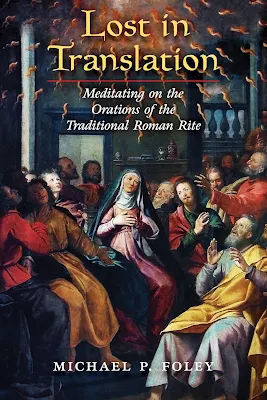
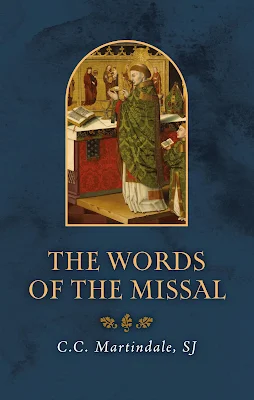
Today I am pleased to announce the nearly simultaneous release of two books—the one by a living writer familiar to all NLM readers, namely, Dr. Michael Foley; the other a reprint, after many decades, of a valuable preconciliar work by Fr. C.C. Martindale—that have, in their distinctive ways, very similar concerns. Both are written to expound and exult in the enormous riches, the world of subtlety, the colorful details, of the Church’s specifically Latin orations, which no vernacular language can convey or capture.

The New Book


Michael P. Foley. Lost in Translation: Meditating on the Orations of the Traditional Roman Rite. Brooklyn: Angelico Press, 2023. 302 pages. Paper $21.95; Cloth $32.
Publisher’s Description: At every celebration of the traditional Latin Mass, one of the greatest achievements of Christian culture passes by virtually unnoticed. The orations of the Roman Rite—the Collect, Secret, and Postcommunion—are literary masterpieces: a unique species of rhetoric, they ingeniously combine tight structure, poetic rhythm, literary order, succinct imagery, and a panoply of human experience. These brilliant gems are underappreciated because much of their splendor comes from their deft exploitation of Latin, which, like any other language, has its own ecosystem and way of doing things. As a result, even the best translations will leave something out.

Lost in Translation was written to introduce readers to these gems even if they do not know Latin. In its pages Michael Foley explains one or more orations for every Sunday of the Church year and for a number of Saints’ feast days, unearthing the subtle nuances and vivid images that make these prayers such a delight. The result is a new portal into the beauty of sacred liturgy and the mystery of our redemption.
Praise for “Lost in Translation
“The orations of the classical Roman Rite are rich and illuminating, especially when placed in their proper context: the days and seasons of the liturgical year. Acting as missal mystagogue, Michael Foley takes us on a delightful tour from Advent to Apocalypse, unpacking the prayers’ dense content, reveling in their linguistic finesse, and applying their lessons to our spiritual life hic et nunc. Food for prayer and kindling for homilies, Lost in Translation is guaranteed to intensify the reader’s astonishment at the treasure-chest of tradition, with the orations as its diamonds, emeralds, and rubies.” —PETER A. KWASNIEWSKI

“In this excellent book, Michael Foley skillfully guides us through the liturgical year using the Collects, Secrets and Postcommunions of the traditional Roman Rite. These liturgical prayers of the Church are crammed full of theological, biblical, and patristic insights as well as poetry, imagery, and wordplay, all of which can often be overlooked in vernacular translations. Dr. Foley’s valuable insights are sure to prove spiritually fruitful for laity and clergy alike, and will no doubt be a source of fresh inspiration for those entering into the Church’s traditional liturgy.” —MATTHEW P. HAZELL

“In clear, conversational prose, Michael Foley attentively studies the orations of select Masses of the 1962 Roman Missal in their context. His meditations foster personal inner appropriation of the Church’s common prayer and teach us how the prayers school our desires. Foley’s work is pleasantly enriched by the pertinent inclusion of words from Fathers and Doctors of the Church and of historical facts and customs that tell us about a feast’s celebration or highlight theological and spiritual truths presented in its Mass texts.” —LAUREN PRISTAS

Available directly from the publisher here or from Amazon (here, or at any other country’s site).

The Reprint


C.C. Martindale, SJ. The Words of the Missal. Lincoln, NE: Os Justi Press, 2023 (originally published by the Macmillan Company in 1932). 226 pages. Paperback $17.95.
For those unfamiliar with him, Cyril Charlie Martindale (1879–1963) was a Catholic priest, scholar, and writer, who, with fellow Jesuit Martin D’Arcy, was among England’s foremost Catholics of the first half of the twentieth century. He kept up a correspondence with such figures as Ronald Knox, Evelyn Waugh, and Graham Greene. In 1931, Fr Martindale wrote a fine and accessible study of key Latin words in the Missale Romanum, with this admirable goal: “All I want is that this book may help people to pray still better, and to love the Missal still better, so that what is old and familiar shall reveal new beauty and lovableness.”

The resulting book, accurately (if not excitingly) entitled The Words of the Missal, long out of print, has now been reprinted by Os Justi. Here are some words from the Introduction:
If you read St. John or St. Paul, you are almost sure to love their works, or at least some parts of them. But if you take real trouble to find out what exactly their words mean—Faith, for example; Justice; Fulness; Spirit; Light—their value begins to glow forth from within, and the page becomes transfigured and quite different from what it was before you took the pains to pause, compare, ponder, and to catch all manner of elusive shades and depths of meaning in such words. When you re-read those writers you will not any more have to spend time over such details, nor find yourself pulled up or committed to any complicated work, but the flow and the glory of the inspired pages will be a new thing for you.
          Something similar can be done with the Roman Missal. The Latin words in the Missal at times float and waver, and require care before they perfectly yield up their sense. Others have so definitely "Latin" a flavour that it is very difficult to translate them exactly into English; still, the attempt should be made, along with a little explanation. Others may seem so ordinary that we might take them for granted and not notice some of the richer meaning that is theirs.
          The method of this book, then, is quite simply to take a few of the words which come often in the Missal so as to be in a certain sense “favourite” words in the Liturgy, or else, other words that we might not notice; to collect several instances of their use (for isolated instances prove little; many exercise a cumulative effect); and then, to “worry” them until a kind of valuable juice of meaning is crushed out of them. Certainly no reader would be expected to attend to such details during Mass itself; but, having done it outside of Mass, he will find that Mass becomes full of added delight.
The Table of Contents:

Introduction
1 “Rejoice in the Lord”
2 Human Fragility
3 The Divine Initiative
4 God’s Hand of Power
5 God’s Largesse
6 Man’s Transformation
7 Drastic Discipline
8 How the Church Speaks to God and How We Should Think of Him
9 The Wording of Our Payers
10 The Mysticism of the Missal
11 The Light of Life
12 Newness of Life
13 Charity, Unity, Peace
14 Lights and Shades of Meaning
15 Delicacies of Meaning
Appendix: Latin and English
Postscript

Available directly from the publisher here or from Amazon (here, or at any other country's site).

Although Fr. Martindale speaks generally of “the missal,” in fact nearly all of his examples are drawn from the orations. That makes the Foley book and the Martindale book wonderfully complementary to each other, as each covers different parts of this vast territory and by different methods: Foley looking one by one at particular days or feasts in the Church calendar, Martindale exploring themes across the entire missal.

May books like these restore among eager Catholics the knowledge, appreciation, and savor of the wisdom of our inherited tradition—and may they help to bury, once and for all, the folly of those who claim that all of the Latin Church’s tradition of prayer can be effectively conveyed in vernacular. It cannot be, and these books demonstrate it with atomic force.

More recent articles:

For more articles, see the NLM archives: