
Saturday, May 09, 2026

St Pachomius of Egypt

On May 9th, the Coptic Church commemorates one of the great early monastic patriarchs, a native Egyptian called Pachom, whose name is Latinized as Pachomius. He was one of the most influential figures on the organization of monastic life in the 4th century; this is true even in the West, (where his feast has only been kept very rarely), since St Benedict adopted many of his ideas into his Rule.

Pachomius was born in 292 to a pagan family in the Thebaid, the Roman province which had formerly been the kingdom of Upper Egypt, with its capital at Thebes, the modern city of Luxor. At the age of twenty, he was conscripted into the Roman army, and sent up the Nile with other conscripts under miserable conditions. When the boat stopped at Latopolis (the modern Esnah), the local Christians came out to take care of them, and Pachomius was so impressed by their kindness that he determined to embrace their faith as soon as he was able. When his unit was disbanded, he returned to his native place, a village called Khenoboskion where there was a Christian church, was accepted as a catechumen, and baptized soon thereafter.

A fresco on the wall of the Trinity Chapel in Lublin, Poland, showing several of the early monastic Saints: Pachomius furthest to the left, with his Rule in hand, then Anthony, Macarius, Spyridon of Trimythous, and Daniel the Stylite. (Image from Wikimedia Commons by Hans A Rosbach, CC BY-SA 3.0.)
He then chanced to hear of a man named Palaemon, a very holy and austere hermit living nearby in the desert, much like his contemporaries and fellow-countrymen, Ss Paul the First Hermit and Anthony the Great. Pachomius became his disciple, observing with him a life of strict fasting and abstinence, keeping long vigils, frequently reciting the entire Psalter at one go, and performing a good deal of manual labor. After several years, he visited a place called Tabennisi, about nine miles up the river, and heard a voice telling him to establish a monastery in that place. He is also said to have been visited by an angel, who confirmed this order, and gave him certain instructions as to how the monastic life was to be lived there. With his master’s encouragement, he built a cell at Tabennisi, and having settled there, soon began to attract many disciples, the first among them being his own elder brother. (Palaemon himself, however, withdrew back to his solitude.)

As with many of the early ascetics, Pachomius’ personal austerity was very astonishing, especially to our modern sensibilities. He is said to have gone fifteen years taking only brief rests, always sitting, never lying down, and never to have eaten a full meal. But he had a finely-honed sense of what others could bear, and turned no one away from joining his community, adjusting the discipline according to what was appropriate for each, as determined by his condition and temperament, both spiritual and physical. In due course, he established other monasteries, one of which, at a place called Pabau, grew to be even greater than its mother house, much as in the days of St Bernard, Clairvaux eclipsed Citeaux as the most important house of the Cistercian Order. When Pachomius died in 348, there were a total of three thousand monks in the nine houses he had founded. In the monastic tradition, both eastern and western, the Thebaid has long had a mythical role as a kind of early monastic Paradise. On the last Saturday before the beginning of Great Lent, the Byzantine Rite commemorates “All of the God-bearing Fathers and Mothers Who Shone Forth in the Ascetic Life,” singing the following hymn at Vespers.

“Rejoice, faithful Egypt; rejoice, holy Libya; rejoice, o chosen Thebaid; rejoice, every place, and city, and land that nourished the citizens of the kingdom of heaven, and raised them in self-discipline and toil, and showed them forth to God as men perfect in their desires. They were revealed as those who give light to our souls; these very same, by the glory of their miracles, and the wonders of their deeds, shone forth to our minds, unto every corner of the world. Let us cry out to them, ‘All-blessed fathers, pray that we may be saved!’ ”

Scenes from the Lives of the Desert Fathers, or “Thebaid”, by Blessed Fra Angelico, 1420; now in the Museum of Fine Arts in Budapest.
The lives of the first monks sometimes degenerated into a competition of asceticism, with men vying with each other to think up ever more bizarrely unpleasant ways of living; one Egyptian document even speaks of a “hermit” who lived like an animal in the midst of a herd of wild buffalo. St Pachomius had the wisdom to see that this made for strong temptations to pride, which were best checked by the living of a communal life under a rule and an authority. He is therefore credited as the founder of “cenobitic” monasticism, monasticism “of the common life.” (κοινὸς βίος)

St Jerome was a very small child when Pachomius died, but when he visited Egypt in the later decades of the fourth century, the communities which the latter had founded were still thriving. Jerome, who had a great deal of interest in and admiration for the monks, visited several of these communities, and, working through a Coptic-speaking translator, produced a Latin version of Pachomius’ rule. This Latin translation is considered to be the first and most faithful to the Coptic original, which is now lost, and it was through it that St Benedict came to know of Pachomius’ ideas about the monastic life. Scholars have rightly noted a great many references and even direct quotes of the Pachomian Rule in that of Benedict, who, not by coincidence, calls cenobites the best kind of monk. (cap. 1 in fine)

In his own prologue to this translation, St Jerome writes, “… while I was grieving over the death of the holy and venerable Paula… I received books sent to me by a man of God, the priest Silvanus, which he had gotten from Alexandria, so that he might send them on to be translated. For he told me that in the cenobia of the Thebaid, … there live very many Latins who do not know the Egyptian or Greek languages, in which the Rule of Pachomius, Theodore and Orosius were written. These men are the ones who first laid the foundation of the cenobia throughout the Thebaid and Egypt, according to the command of God, and of an angel who was sent to them for this very purpose. … and we have translated these letters as they are read among the Egyptians and Greeks, setting down the same elements that we found, and imitating the simplicity of the Egyptian language … lest learnèd speech should change (the readers’ impression of) those apostolic men, who were completely full of spiritual grace.”
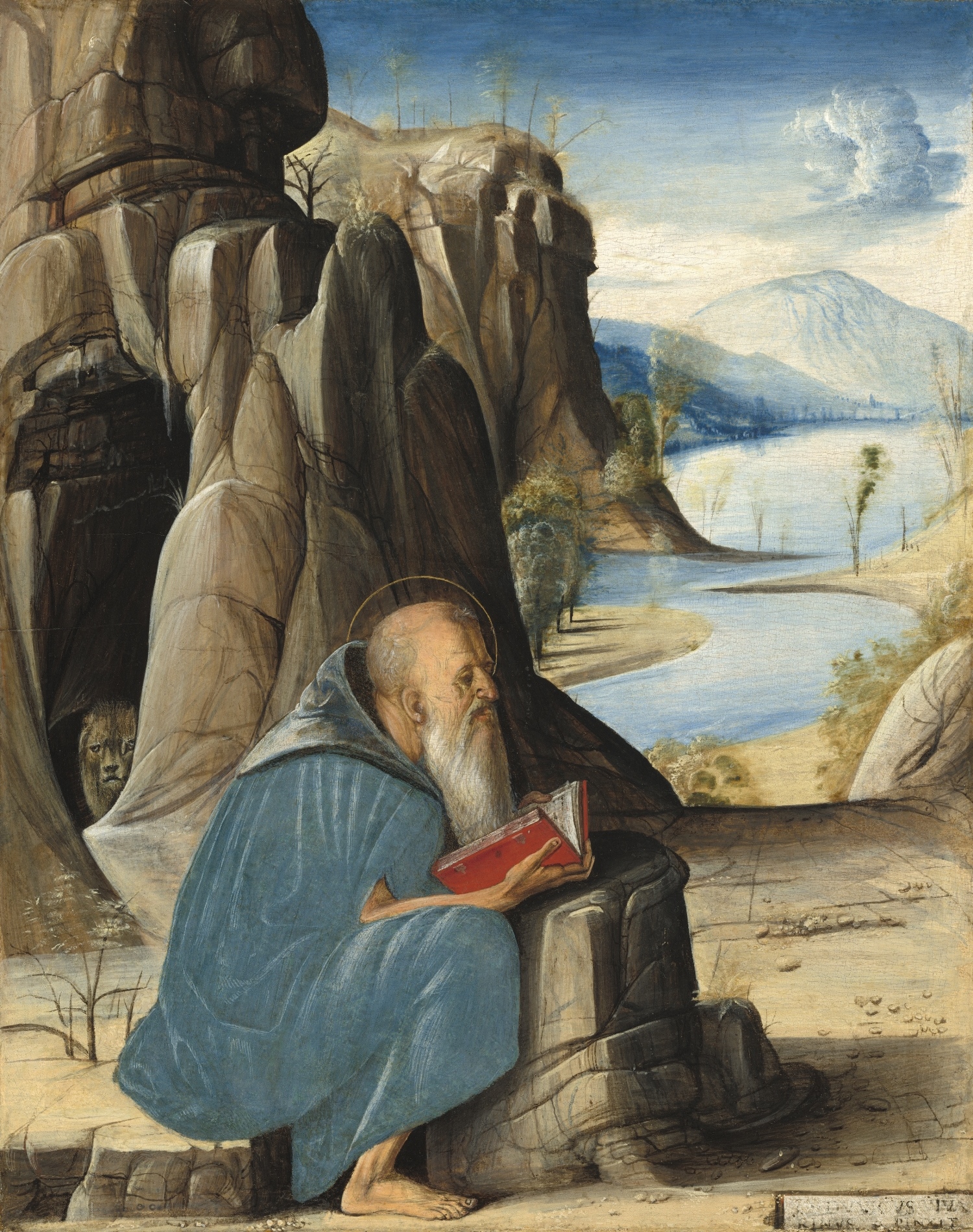
St Jerome in the Desert, ca. 1476, by the Venetian painter Alvise Vivarini (1447 ca. – 1503/5)

Saturday, March 21, 2026

The Feast of St Benedict 2026

Listen carefully, my child, to the master’s precepts, and incline the ear of your heart; willingly receive and effectively fulfill the admonition of your loving father, that by the labor of obedience you may return to Him from whom you had departed by the sloth of disobedience. To you, therefore, my discourse is now addressed, whoever you may be that renounce your own will to do serve under the Lord, Christ the true King, and take up the most mighty bright weapons of obedience. And first of all, as you begin to do any good work, beg of Him with most earnest prayer that it may be perfected, so that He who has now deigned to count us among His children may not at any time be grieved by our evil deeds. For we must always so serve Him with the good things He has given us, that He will never as an angry Father disinherit His children, nor ever as a dread Lord, provoked by our evil actions, deliver us to everlasting punishment as wicked servants who would not follow Him to glory. (The Prologue of the Rule of St Benedict.)

Saints Benedict and Bernard, by Diogo de Contreiras, 1542; painted for the Cistercian convent of Santa Maria de Almoster in Portugal. (Public domain image from Wikimedia.)
The second half of the Hour of Prime is sometimes called the Chapter Office, from the Benedictine custom of reading a part of the Rule of St Benedict at the end of it every day. The text of the Rule was divided into roughly 120 sections, and read in order over the course of four months, making for three full readings a year. At Citeaux, however, this reading began not on January 1st, as in most other houses, but on March 21st, which is both the feast day of St Benedict, and the day the abbey was founded in 1098. Beginning the reading of the Rule on this day became an annual reminder not only of the Order’s founding, but more specifically of the Cistercians’ role as the “strict constructionalists” of Benedictine monasticism, almost as if to say that the observance of the Rule itself began again with the coming of the new Order.

The first two pages of the Rule of St Benedict, with the Prologue to be read on March 21st, from a Cistercian Martyrology printed at Paris in 1689.

Wednesday, February 05, 2025

The Rhythms of Day and Night in the Rule of St. Benedict - Guest Article by a Monk

The following article was given to NLM by a monk of the Order of St. Benedict who writes under the pen name Placidus. Any reader who would like to get in touch with him may write to placidus12986@gmail.com.

I have often wondered how a monk would have spent his day in the time of St. Benedict. An overview of his Rule for Monasteries shows that he would typically divide his time between five things: praying, studying, working, eating, and sleeping. The way that these activities where distributed throughout the day, however, depended upon the amount of daylight available for artisanal or outdoor agrarian work, and the amount of darkness from which one could profit a full night’s sleep.

In St Benedict’s day, an hour was not counted by a division into 24 equal parts of the period from one solar noon to the next. Rather, one solar hour of the day was counted as one twelfth part of the period from sunrise to sunset, and a nocturnal hour was likewise one twelfth of the period between sunset and sunrise. At Montecassino, the total duration of the twelve daylight hours varies from about 15 conventional hours at the summer solstice to a bit more than 9 conventional hours at the winter solstice.

How one calculates an hour is somewhat arbitrary in the end, but the main principle is that it be based on some fixed law of motion, if, indeed, time is the numbering of motion according to an order of before and after. Whether one calculates time according to the daily motions of the sun, or the vibrations of a caesium atom, is a matter of taste and practicality. In a technocratic culture dependent upon world-wide commerce, communication, and travel, a system of time-keeping that admits of no variation anywhere in the world makes sense. But in an agrarian culture that is without such dependencies, as was that of rural Italy in the time of St. Benedict, the daily motion of the sun was the natural choice for tracking the day.

A Roman solar day near the summer solstice

A Roman solar day near the winter solstice

One of the reasons why St. Benedict calculates the hours according to the amount of daylight is because the liturgical day ends at sunset, and so the daily requirement of praying to God seven times a day (cf. Ps. 118, 164) was to be completed before then. Hence, for St. Benedict, a monk’s prayer was to be distributed according to evenly spaced solar hours between sunrise and sunset. Lauds, therefore, is generally prayed at first-light, such that it concludes near the moment of sunrise, Prime is one solar-hour after sunrise, Terce is around three later, Sext is at solar-noon, None is around nine solar-hours later, and Vespers occurs about an hour or so before sunset, whereas Compline is sung at sunset, during the twilight period, so as to close off the day. [1] All of these, St. Benedict says, must be sung while there is still some light in the sky.

However, Scripture also tells us to pray at night (Ps. 118, 62), and so St. Benedict prescribes that the office of Matins (or Vigils) be prayed after a full night’s sleep in winter (eight hours after sunset), and just before Lauds in Summer, since the time between sunset and sunrise for most of this season is not enough for a full night’s sleep. [2] To make up for these short nights, a siesta is added before None so that the monk still gets his total of eight hours of sleep each day.

In winter (October 1st to Easter), St. Benedict has his monks spend any available time between Matins and Terce and between None and Vespers doing lectio divina, the prayerful study and meditation on Sacred Scripture and the Church Fathers, or else the monks are to memorize those Psalms that have not yet been learned by heart. But the warmer and brighter hours between Terce and None during this season are spent outside doing manual labor. However, in summer (Easter to October 1st), the inverse occurs. The monk spends the hottest hours in the middle of the day between Terce and None inside the monastery doing his lectio divina, whereas he spends the cooler hours in the morning between Prime and Terce or in the evening between None and Vespers doing manual labor outside, or he spends it doing artisanal labor in one of the monastery’s workshops.

Yearly solar horarium according to the Rule of St. Benedict, chs. 8, 41, 48

In any medieval monastery, study was easily done in summertime within the cool, stone interior of the monastery’s scriptorium or cloister-walk, but in wintertime, it was done by candlelight at the fireside of the calefactory. However, indoor artisanal work requires at least daylight coming through the workshop windows, and agrarian labor also requires bearable outdoor temperatures, determined by the passing of the sun. The day is arranged, then, to make the most efficient use of light and temperature.

The taking of meals also reflects this harmony with and dependence upon the sun and seasonal changes. In fall and winter (beginning on September 14t), when there is less manual work to do outside, the monk eats less, taking his one main meal after None, or after Vespers during Lent, but in summer (beginning at Easter), when the manual work is more intense, the monk eats his main meal after Sext and also takes supper after Vespers. However, in accord with his Italian heritage, St. Benedict makes no mention of breakfast in the early morning.

Now, if we compare the total amount of time given to each activity, mentioned above, we can see that the monk spends an average of 5½ hours a day in manual labor and 4 hours in study. These vary inversely so that there is more work in the summer, but more study in the winter. The monk also has the option of replacing his siesta in summer with more study, if he wishes.

Likewise, the monk spends from around 4 to 5 hours a day in liturgical prayer and about ¾ to 1¼ hours at meals. These are similarly related inversely so that the extra time during the monastic fast between September 14th and Easter, when only one meal is taken rather than two, is replaced by more time in liturgical prayer, i.e. at Matins. The monk also has the option here of adding more time for personal prayer in the chapel on his own, perhaps during the long period between Matins and Lauds in Winter. Hence, as the night hours increase, study and prayer increase, but when the daylight hours increase, work and bodily nourishment increase.


There are many things that we can learn from this contemplative rhythm of life that is built around this daily ebb and flow of light and warmth. The monk sees the rising of the sun each day as he comes out from Lauds, having just admonished all creation to divine praises: “Praise him sun and moon, praise him every star and light” (Ps. 148, 3; cf. Dan. 3, 56-88), and thus he is reminded by the dawn of God’s loving Providence over all things. In the hymn at Lauds the monk praises God for having created night and day:
Maker of all, eternal King / Who day and night about dost bring / Who weary mortals to relieve / Dost in their times the seasons give.

Now the shrill cock proclaims the day / And calls the sun’s awakening ray / The wandering pilgrim’s guiding light / That marks the watches night by night. . . .

O let us then like men arise / The cock rebukes the slumbering eye / Bestirs who still in sleep would lie / And shames who would their Lord deny. [3]
The Creator of the day speaks to us through nature, both by the rising light of dawn as by the rooster’s crow, which both attest to the ordered celestial laws that govern the days, months, and years, as well as to the necessary submission of nature to those same laws. If the rooster is obedient to the rising light and announces on time its maker’s glory, all the more are we encouraged to do so. Hence, St. Benedict rouses his monks to wakefulness in the Rule, saying,
Let us then rise at length, since the Scripture arouseth us, saying: “It is now the hour for us to rise from sleep” (Rom. 13, 11); and having opened our eyes to the deifying light, let us hear with awestruck ears what the divine voice, crying out daily, doth admonish us, saying: “Today, if you shall hear his voice, harden not your hearts” (Ps. 94, 8) . . . “Run whilst you have the light of life, that the darkness of death overtake you not” (John 12, 35). [4]
The urgency of his admonition is all the more apparent when the time one has for daily work is clearly marked by the unchanging laws of the sun. “Are there not twelve hours in the day? If any one walks in the day, he does not stumble, because he sees the light of this world” (John 11, 9). All that we have is today for our conversion; no man knows if the sun will rise for him again. “Night is coming when no man can work” (John 9, 4). The Scripture that is read each day at Lauds also warns us to cast off the night of our sins and to put on Christ.
The night is far gone, the day is at hand. Let us then cast off the works of darkness and put on the armor of light; let us conduct ourselves becomingly as in the day (Rom. 13, 12-13).
Singing Lauds just before sunrise reminds us that Christ himself is coming: “Awake, O sleeper, and arise from the dead, and Christ shall give you light” (Eph. 5, 14). Nearly every day the monk is reminded in song of this rising light, which he sees with his own eyes and knows in his own soul: the physical light that casts off the shadow of night, and the spiritual light that breaks through the darkness of sin. The rising light of day recalls to mind that we are given yet another chance to return to Christ: “Therefore, our days are lengthened to a truce for the amendment of the misdeeds of our present life.” [5]

Dusk on the mountain in November

At Vespers, the monks recalls again the ordered harmony of the celestial motions:
O God, whose hand hath spread the sky / And all its shining hosts on high / And painting it with fiery light / Made it so beauteous and so bright.

Thou, when the fourth day was begun / Didst frame the circle of the sun / And set the moon for ordered change / And planets for their wider range. [6]
These ordered laws that govern the heavenly motions are continually proposed to the monk for contemplation: the circuit of the sun, the phases of the moon, the wheeling stars and wandering planets. All of these point in their constant change to something changeless and eternal: the Divine Will and Providence, unchanging in its firmness, but which governs all things with love and sweetness, bringing them to their preordained consummation. Meditating on this divine rule in the ordered changes of the seasons, the great St. Boethius declared shortly before his execution,
Thou short the days dost make / When Winter from the trees the leaves doth take,
Thou, when the fiery sun / Doth Summer cause, makest the nights swiftly run.
Thy might doth rule the year / As northern winds the leaves away do bear . . .
None from Thy laws are free, / Nor can forsake their place ordained by Thee.
Thou to that certain end / Governest all things. [7]
Living by the rhythms of the sun, the monks of old were compelled to assent to its benign governance, and through submitting to its care, they were made to acknowledge the One who created it, and who is ever over all things, supreme.

NOTES 

[1] St. Benedict has Terce and None vary slightly according to the season, depending on the exigencies for outdoor manual labor and the time given to study or lectio divina.

[2] Lauds follows shortly after Matins from Easter to November. However, since Matins is longer from November until Easter by as much as ½ an hour due to lengthier readings, Lauds moves back to just before sunrise.

[3] From the hymn Ætérne rerum Cónditor, from Lauds on Sunday.

[4] Rule of St. Benedict, Prologue.

[5] Rule of St. Benedict, Prologue.

[6] From the hymn Cæli Deus sanctíssime, from Vespers on Wednesday. Cf. Gen. 1:14-19.

[7] St. Severinus Boethius, The Consolation of Philosophy, 1.5.

Tuesday, May 09, 2023

St Pachomius of Egypt

On May 9th, the Coptic Church commemorates one of the great early monastic patriarchs, a native Egyptian called Pachom, whose name is Latinized as Pachomius. He was one of the most influential figures on the organization of monastic life in the 4th century; this is true even in the West, (where his feast has only been kept very rarely), since St Benedict adopted many of his ideas into his Rule.

Pachomius was born in 292 to a pagan family in the Thebaid, the Roman province which had formerly been the kingdom of Upper Egypt, with its capital at Thebes, the modern city of Luxor. At the age of twenty, he was conscripted into the Roman army, and sent up the Nile with other conscripts under miserable conditions. When the boat stopped at Latopolis (the modern Esnah), the local Christians came out to take care of them, and Pachomius was so impressed by their kindness that he determined to embrace their faith as soon as he was able. When his unit was disbanded, he returned to his native place, a village called Khenoboskion where there was a Christian church, was accepted as a catechumen, and baptized soon thereafter.

A fresco on the wall of the Trinity Chapel in Lublin, Poland, showing several of the early monastic Saints: Pachomius furthest to the left, with his Rule in hand, then Anthony, Macarius, Spyridon of Trimythous, and Daniel the Stylite. (Image from Wikimedia Commons by Hans A Rosbach, CC BY-SA 3.0.)
He then chanced to hear of a man named Palaemon, a very holy and austere hermit living nearby in the desert, much like his contemporaries and fellow-countrymen, Ss Paul the First Hermit and Anthony the Great. Pachomius became his disciple, observing with him a life of strict fasting and abstinence, keeping long vigils, frequently reciting the entire Psalter at one go, and performing a good deal of manual labor. After several years, he visited a place called Tabennisi, about nine miles up the river, and heard a voice telling him to establish a monastery in that place. He is also said to have been visited by an angel, who confirmed this order, and gave him certain instructions as to how the monastic life was to be lived there. With his master’s encouragement, he built a cell at Tabennisi, and having settled there, soon began to attract many disciples, the first among them being his own elder brother. (Palaemon himself, however, withdrew back to his solitude.)

As with many of the early ascetics, Pachomius’ personal austerity was very astonishing, especially to our modern sensibilities. He is said to have gone fifteen years taking only brief rests, always sitting, never lying down, and never to have eaten a full meal. But he had a finely-honed sense of what others could bear, and turned no one away from joining his community, adjusting the discipline according to what was appropriate for each, as determined by his condition and temperament, both spiritual and physical. In due course, he established other monasteries, one of which, at a place called Pabau, grew to be even greater than its mother house, much as in the days of St Bernard, Clairvaux eclipsed Citeaux as the most important house of the Cistercian Order. When Pachomius died in 348, there were a total of three thousand monks in the nine houses he had founded. In the monastic tradition, both eastern and western, the Thebaid has long had a mythical role as a kind of early monastic Paradise. On the last Saturday before the beginning of Great Lent, the Byzantine Rite commemorates “All of the God-bearing Fathers and Mothers Who Shone Forth in the Ascetic Life,” singing the following hymn at Vespers.

“Rejoice, faithful Egypt; rejoice, holy Libya; rejoice, o chosen Thebaid; rejoice, every place, and city, and land that nourished the citizens of the kingdom of heaven, and raised them in self-discipline and toil, and showed them forth to God as men perfect in their desires. They were revealed as those who give light to our souls; these very same, by the glory of their miracles, and the wonders of their deeds, shone forth to our minds, unto every corner of the world. Let us cry out to them, ‘All-blessed fathers, pray that we may be saved!’ ”

Scenes from the Lives of the Desert Fathers, or “Thebaid”, by Blessed Fra Angelico, 1420; now in the Museum of Fine Arts in Budapest.
The lives of the first monks sometimes degenerated into a competition of asceticism, with men vying with each other to think up ever more bizarrely unpleasant ways of living; one Egyptian document even speaks of a “hermit” who lived like an animal in the midst of a herd of wild buffalo. St Pachomius had the wisdom to see that this made for strong temptations to pride, which were best checked by the living of a communal life under a rule and an authority. He is therefore credited as the founder of “cenobitic” monasticism, monasticism “of the common life.” (κοινὸς βίος)

St Jerome was a very small child when Pachomius died, but when he visited Egypt in the later decades of the fourth century, the communities which the latter had founded were still thriving. Jerome, who had a great deal of interest in and admiration for the monks, visited several of these communities, and, working through a Coptic-speaking translator, produced a Latin version of Pachomius’ rule. This Latin translation is considered to be the first and most faithful to the Coptic original, which is now lost, and it was through it that St Benedict came to know of Pachomius’ ideas about the monastic life. Scholars have rightly noted a great many references and even direct quotes of the Pachomian Rule in that of Benedict, who, not by coincidence, calls cenobites the best kind of monk. (cap. 1 in fine)

In his own prologue to this translation, St Jerome writes, “… while I was grieving over the death of the holy and venerable Paula… I received books sent to me by a man of God, the priest Silvanus, which he had gotten from Alexandria, so that he might send them on to be translated. For he told me that in the cenobia of the Thebaid, … there live very many Latins who do not know the Egyptian or Greek languages, in which the Rule of Pachomius, Theodore and Orosius were written. These men are the ones who first laid the foundation of the cenobia throughout the Thebaid and Egypt, according to the command of God, and of an angel who was sent to them for this very purpose. … and we have translated these letters as they are read among the Egyptians and Greeks, setting down the same elements that we found, and imitating the simplicity of the Egyptian language … lest learnèd speech should change (the readers’ impression of) those apostolic men, who were completely full of spiritual grace.”
St Jerome in the Desert, ca. 1476, by the Venetian painter Alvise Vivarini (1447 ca. – 1503/5)

Monday, March 22, 2021

The Feast of St Benedict 2021

In places where St Benedict is kept as a patron, including all Benedictine houses of whatever order, his feast is transferred to today, since yesterday was Passion Sunday, which can never be impeded.

Listen carefully, my child, to the master’s precepts, and incline the ear of your heart; willingly receive and effectively fulfill the admonition of your loving father, that by the labor of obedience you may return to Him from whom you had departed by the sloth of disobedience. To you, therefore, my discourse is now addressed, whoever you may be that renounce your own will to do serve under the Lord, Christ the true King, and take up the most mighty bright weapons of obedience. And first of all, as you begin to do any good work, beg of Him with most earnest prayer that it may be perfected, so that He who has now deigned to count us among His children may not at any time be grieved by our evil deeds. For we must always so serve Him with the good things He has given us, that He will never as an angry Father disinherit His children, nor ever as a dread Lord, provoked by our evil actions, deliver us to everlasting punishment as wicked servants who would not follow Him to glory. (The Prologue of the Rule of St Benedict.)

Saints Benedict and Bernard, by Diogo de Contreiras, 1542; painted for the Cistercian convent of Santa Maria de Almoster in Portugal. (Public domain image from Wikimedia.)
The second half of the Hour of Prime is sometimes called the Chapter Office, from the Benedictine custom of reading a part of the Rule of St Benedict at the end of it every day. The text of the Rule was divided into roughly 120 sections, and read in order over the course of four months, making for three full readings a year. At Citeaux, however, this reading began not on January 1st, as in most other houses, but on March 21st, which is both the feast day of St Benedict, and the day the abbey was founded in 1098. Beginning the reading of the Rule on this day became an annual reminder not only of the Order’s founding, but more specifically of the Cistercians’ role as the “strict constructionalists” of Benedictine monasticism, almost as if to say that the observance of the Rule itself began again with the coming of the new Order.

The first two pages of the Rule of St Benedict, with the Prologue to be read on March 21st, from a Cistercian Martyrology printed at Paris in 1689.

Monday, February 22, 2021

Advice to Singers: Drink Some Water After Receiving Holy Communion

In talking to Catholics over the years, I’ve sometimes encountered odd ideas about what’s reverent or not. To be fair, the biggest problem is the lack of any conception of reverence whatsoever, but that’s not my focus in the present article. Here, I am thinking of devout Catholics who may think that a certain practice is irreverent when it’s simply not. A classic example is when Catholic schoolchildren of yore were taught that it would be wrong to masticate the host; it had to be allowed to dissolve. One can appreciate that religious sisters were in the business of teaching much-needed manners to children (especially boys) and did not want to see them “munching” on their way back from communion, but the way I’ve heard it told, it sounds like they might have gone overboard in the emphasis given on this or similar points of decorum.

So, too, it seems that some choir members are uncomfortable with drinking water from a water bottle immediately after communion, as if somehow this were not appropriate. But I would make the case that not only is there nothing wrong with it, but on the contrary, it can be a very good idea. I think what might be happening psychologically is a kind of assumption that because it is fitting to fast before communion, we should also fast (as it were) after communion.

It is indeed a big deal to fast before Holy Communion, and the reduction of the fast from all night to three hours to one hour is a poster child example of the colossal prudential error frequently made by churchmen in modern times, namely, that if we relax our disciplines we will somehow retain or attract more believers. This is demonstrably false; the ancient discipline was eminently wise. In his commentary on the Sentences, St. Thomas writes as follows:

This sacrament should only be received by those who are fasting, unless out of necessity because of imminent death, lest it happen that someone should have to exit this life without viaticum. Fasting must be established in reverence for such a sacrament, for three reasons in particular. First, because of the very sanctity of the sacrament; so that the mouth of a Christian, by which it is to be consumed, would not be first drenched with other food, but would be reserved for its reception as something new and pure. Second, because of the devotion that is required on the part of the one receiving, and the attention that could be distracted by having taken food, with gases rising from the stomach to the head. Third, because of the danger of vomiting, and other things like that. (In IV Sent. d. 8, q. 1, a. 4, qa. 1)

On the other hand, even if it is highly fitting for worshipers to remain after Mass for a time of thanksgiving rather than immediately leaving the church building and tucking into regular food and drink, doing so would not carry the same gravity, since a time of thanksgiving is (at least theoretically) built into the Mass itself. Again St. Thomas:

According to the custom of the Church, out of reverence for so great a sacrament, after having received it, a man should remain in thanksgiving; and the prayer of thanksgiving after Communion in the Mass is also said, and the priests after celebrating Mass have special prayers for thanksgiving. And so it is fitting that there should be a certain interval between consuming the Eucharist and other foods. But since a great interval is not required, and what lacks something small seems to lack nothing, as it says in Physics 2, for this reason we might concede that in this sense a person can take other food immediately after receiving the Eucharist.

After all, the priest himself, in receiving the unconsecrated wine and water during the ablutions, is already consuming non-consecrated elements, at times only moments after having received Holy Communion. Obviously the vessels have to be cleansed, and there is no more efficient way to do it; but we should also not overlook the practical benefit to the priest in being able to clear his mouth of any fragments of the host that might have remained there. A sign that this concern is real may be gleaned from the Holy Rule of St. Benedict. In chapter 38, the legislator prescribes concerning the weekly reader during the meals: “Let the brother who is reader for the week take a little bread and wine before he begin to read, on account of the Holy Communion, and lest it be hard for him to fast so long. Afterwards let him take his meal with the weekly cooks and other servers.” On this passage, a commentator writes:

Saint Benedict prescribes “a little bread and wine before he begin to read, on account of the Holy Communion.” This is not only because the reader, if he waits until after the meal, risks a headache and weakness from too prolonged a fast; it is also out of reverence for the Most Holy Sacrament. The “little bread and wine” serve as an ablution of the mouth, lest in reading or chanting, the reader inadvertently expectorate particles of the Sacred Host in his saliva. The custom of an ablution of the mouth after receiving Holy Communion is very ancient; traces of the custom have perdured, not only among certain Orthodox faithful, but even in some places in the West. I remember very well that my paternal grandmother, who received her First Holy Communion in County Leitrim in about 1909, was taught to cleanse her mouth with water immediately upon returning home from Holy Mass and before eating or drinking anything. I can still see her coming in from the early morning Mass. She would, without removing her hat and coat, light the burner under the kettle for tea and, then, go straight to her pantry for the traditional post-Holy Communion glass of water. It is interesting that such a custom was still practiced in early 20th century rural Ireland.

Like readers, singers are aware of the “inadvertent expectoration” mentioned above, however rare it might be that it would contain a crumb of the divine manna. It only took one such experience to convince me of the benefit of taking a drink of water in the choir loft upon returning from communion and before beginning to sing the communion antiphon or motets. Later on, when I read the passage in the Holy Rule, and connected it with the ablutions, I realized that this awareness has long been present in the mind of the Church, if in an understated way.

Visit Dr. Kwasniewski’s websiteSoundCloud page, and YouTube channel.

The monastic reader in the refectory

Monday, October 12, 2020

Is Modern Man “Incapable of the Liturgical Act”?

In 1964, “forty-six years after the publication of his seminal work, The Spirit of the Liturgy, and just after the promulgation of Sacrosanctum Concilium, Romano Guardini reflected on the challenges of the Liturgical Movement in a letter to a Congress on the Liturgy in 1964.” [1] He famously claimed that Modern Man is “no longer capable of a liturgical act”:
Is not the liturgical act and, with it, all that goes under the name of “liturgy” so bound up with the historical background – antique or medieval or baroque – that it would be more honest to give it up altogether? Would it not be better to admit that man in this industrial and scientific age, with its new sociological structure, is no longer capable of a liturgical act? And instead of talking of renewal ought we not to consider how best to celebrate the sacred mysteries so that modern man can grasp their meaning through his own approach to truth? [2]
In the same letter, Guardini states:
The question will arise whether our present liturgy contains parts which cannot mean much to modern man. I remember a conversation with the late Abbot Ildefons Herwegen of Maria Laach, the great champion of liturgical renewal. We had been considering various aspects and I said a sign that the work for liturgy was really coming to life would be a liturgical crisis, and Abbot Herwegen thoughtfully agreed.[3]
While Guardini himself only a few years later would dismiss the Consilium’s drafts as “plumber’s work,” it would be impossible to exaggerate the harm he himself caused by the remarks he made in the 1964 letter, which seemed to suggest, as many other semi-modernists had done, that the entirety of Christian liturgy from as early as Constantine, and certainly no later than the Middle Ages onward, was irrelevant, useless, inaccessible, ready for the scrap heap. What is surprising is that a theologian of Guardini’s stature, who was so attuned to the sacred liturgy's “irrelevance” and “uselessness” (properly understood) [4], was able to embrace this kind of chronological relativism.

On the one hand, we might sympathize with Guardini to this extent: the liturgical reform seemed to be premised on the idea that if the liturgy as it stands “isn’t working,” then all we need to do is redesign it — find a “working” model — pack it up, ship it out, and roll it off the skids to the expectant populace. In this vision, the problems are all on the side of the liturgical rites; it is not men who need to be reformed, but only the rites.

Yet what if the problem is in man? If he were judged to be incapable of the liturgical act, then he would be incapable of any liturgy, whether it comes from the scriptorium of Gregory the Great or the desk of Annibale Bugnini. He might be capable of something else, like a Bible study, a soup kitchen, prison ministry, or volunteering for scouts, but the leitourgia, the sacrificial action of one on behalf of the many [5], will not have any purchase in his individualistic world. In that sense, perhaps the avant-garde liturgists underestimated the challenge they were up against. It’s not about “tweaking” something to get it to “work” better, much less of piling on more and more Scripture so that one can check off a box that says “Bible is being read—done.” For it is not the reading or the text, the chant or the ritual, that is a problem, but the modernity of modern man, which prevents him from engaging, cosmically, symbolically, ascetically, and mystically, with the very realities Scripture is about, and short of which it fails of its aim.

“More than words: Signs, symbols, metaphors”

On the other hand, in defense of the common man, it might be asked: Why should we buy this typically pessimistic German view to begin with, reminiscent of Wotan lamenting the ineluctable collapse of Valhalla, the Götterdämmerung? To say that moderns are not able to be liturgical in the same way that all men prior to them have been is a path leading to despair: as if man were now a different species that requires a different religion, that is, a different system of signs ordered to divine worship. This subterranean despair was part of the motivation for the Novus Ordo. It led to the belief that a simplified, abbreviated, intelligible, vernacular, communal celebration will obviously appeal to modern man, who is incapable of vertical, theocentric, densely symbolic, archaically uttered ritual. But this seems to be basically false, and has led to a massive falling-away, as well as to the surprising resilience of the old rites that were supposed to be outdated and unapproachable.

The truth that is really inevitable is not Guardini’s fatalism, but an acknowledgement of the requirements of human formation.
Just as we cannot give ourselves permission to stop teaching each new generation how to speak, how to read, how to write, and how to think, so we must not fail to immerse ourselves in ritual that is uncompromisingly ritualistic, for this is the logic, grammar, and rhetoric of revealed religion, in both Testaments and in the history of the Church. It enjoys a universal anthropological basis that makes it always learnable, but since it is rather strange within rationalistic modernity, it is now more capable, not less capable, of confronting us with the transcendence of God, which calls us out of our comfort zone, as Abraham was called from Ur of the Chaldeans. When people have the sense that in the liturgy they are entering the domain of the sacred, somehow stepping into the realm of the divine, then their ears will begin to open to listening to the words of God in Scripture. The focus, the starting point, has to be elsewhere than Scripture. That is exactly contrary to where the reformers, in their homotextuality (so to speak), wanted to place the emphasis.

Another way of seeing this is to look at the repetitiousness of the old rite, much maligned of course by the reformers. In “Repetition Is the Mother of a Great Many Things,” I discuss the value of the frequent use of the same pericopes and verses of Scripture (and non-Scriptural texts) in the traditional liturgy precisely as a method for making us deeply familiar with the words. Eventually these words, or many of them at any rate, will be memorized; they come to live within us, forming our consciousness as the floor, walls, and ceiling of our inner architecture. The way to get modern Christians to take Scripture more seriously would be to take memory more seriously, and to preach and teach about ways in which our modern way of life is sapping or emptying our memories of what is divine and filling them with what is secular, profane, and, at times, diabolic. Once again, what modern man needed and still needs is what traditional liturgy rites and practices give him, not something newly fashioned à la Guardini.

Learning the old liturgy in the midst of ruins

It is also true, and I will be the first to admit it, that without some catechesis, whether outside of liturgy or in the homily, most modern people will not be able to grasp enough of the message of liturgy to get a good grip, a good foothold, for making further progress. In that sense, education simply cannot be bypassed. Dignified and beautiful liturgy can accomplish immense good, even conversions from atheism or paganism; but for most people, entering deeply into all that the liturgy has to offer is going to require at least some investment of work, slowly, over a long period. And it has always been so; there’s a reason St. Benedict speaks of the opus Dei, the work of God. It is work that, as the Holy Rule stresses, requires repetition, study, and expertise, though — as Guardini rightly says — it is also the highest-level play, since it does not have an ulterior motive, an end for which it is merely a means.

Let us return to our starting point. Guardini said that modern man could no longer perform the liturgical act. This was taken by many in the later phase of the Liturgical Movement as an indisputable truth and a warrant for unlimited experimentation, with the goal of equipping the liturgy to elicit or solicit the “correct” participation from the faithful. Ironically, what happened instead is that the liturgical act was transformed into its opposite: the celebration of the community itself by itself. In a strange twist, Guardini’s dour assessment was not disproved by the Novus Ordo but inculcated by it: what had been a risk of missing the properly liturgical became a habit of missing it with confident ease. In short, it is above all the reformed liturgy that has made modern men, to the extent humanly possible and divinely permitted, incapable of performing the liturgical act.

NOTES

[1] Editorial introduction at Corpus Christi Watershed.
[2] “1964 Letter from Romano Guardini.”
[3] See Christopher Carstens, “Romano Guardini Was Careful What He Asked For: A Liturgical Crisis.”
[4] See Fr. Daniel Cardo, “At Prayer in the Fields of the Lord: The Playfulness of the Liturgy.”
[5] See William Daniel, Christ the Liturgy (Brooklyn: Angelico Press, 2020), 1-39, on the correct meaning of the term leitourgia.

Visit Dr. Kwasniewski’s website, SoundCloud page, and YouTube channel.

Friday, April 05, 2019

“Watchmen of the Night” : A Documentary about Le Barroux

Here is a really wonderful documentary, narrated in French with English subtitles, about the abbey of Le Barroux, called “Watchmen of the Night” (“Veilleurs dans la nuit”; this was brought to my attention by our founding editor Shawn Tribe.) It contains several scenes of the community’s liturgical life, including both the Office and Mass, and a good deal of interesting stuff about monastic life in general. There are also some scenes in which monks are interviewed about their vocation, and talk about what they did before entering the monastery; one of them was a member of a biker-gang, another describes himself as a former “hippy”, which is apparently the French word for hippy.


Monday, December 10, 2018

Consecrated Buildings and Their Officially Sponsored Profanation

The back of the monastery chapel in Norcia
The Rule of St. Benedict has as one of its many virtues the ability to capture an entire vision of things in one lapidary phrase. There is not a single wasted word; what Benedict means to say, he says with vigor, brevity, and clarity. A splendid example is chapter 52, “Of the Oratory of the Monastery,” where the Patriarch writes:
Let the oratory be what its name implies, and let nothing else be done or kept there. When the Work of God is finished, let all go out in deep silence, and let reverence for God be observed, so that any brother who may wish to pray privately be not hindered by another’s misbehavior. And at other times also, if anyone wish to pray secretly, let him just go in and pray: not in a loud voice, but with tears and fervor of heart. He, therefore, who does not behave so, shall not be permitted to remain in the oratory when the Work of God is ended, lest he should, as we have said, be a hindrance to another. [1]
I have often wished that this text would be carved into wood or stone and mounted at the door of every Catholic church throughout the world, printed in every bulletin, and preached from every pulpit, with such unfailing regularity that the pervasive anteliturgical and postliturgical chitchat by which the reverent silence of the temple of God is globally snatched away Sunday after Sunday might begin to be suppressed and reduced to naught. I don’t know if it would work, but I’ve often wondered why so few pastors ever make the attempt to restore “deep silence” to our churches. It may have to do with a sinking feeling that the good habits of preconciliar days are gone forever and will not return among the cellphone barbarians in the pews; it may have to do with a simple loss of belief in the church as a sacred place. Considering that many suburban churches fall somewhere along the spectrum between a Jet Propulson Laboratory and a beige-carpeted athletics facility, it may not be surprising that the sense of sacrality is absent, even eradicated.

Earlier in the Rule, in chapter 19, “On the Discipline of Psalmody,” St. Benedict bears witness to the dignity of the church and of the opus Dei that takes place in it, deducing thence what our inner and outer attitudes should be:
We believe that God is present everywhere and that the eyes of the Lord in every place behold the good and the evil (Prov. 15, 3); but let us especially believe this without any doubting when we are performing the Divine Office. Therefore, let us ever remember the words of the prophet: Serve ye the Lord in fear (Ps. 2, 11); and again, Sing ye wisely (Ps. 46, 8); and, In the sight of the angels will I sing to thee (Ps. 137, 2). Let us then consider how we ought to behave ourselves in the presence of God and his angels, and so sing the psalms that mind and voice may be in harmony. [2] 
This text helps us to grasp two lessons: the sacred liturgy is the time when, by God’s own design and good pleasure, we are most of all held to be standing in His divine Presence, yielding up our minds and hearts to Him; and the oratory or church in which we are doing this “Work of God” is a place like no other, a place consecrated for the sole purpose of worshiping God. In a well-known passage, Augustus Welby Pugin conveys this point with Victorian lavishness:
[The church] is, indeed, a sacred place; the modulated light, the gleaming tapers, the tombs of the faithful, the various altars, the venerable images of the just, — all conspire to fill the mind with veneration, and to impress it with the sublimity of Christian worship. And when the deep intonations of the bells from the lofty campaniles, which summon the people to the house of prayer, have ceased, and the solemn chant of the choir swells through the vast edifice — cold, indeed, must be the heart of that man who does not cry out with the Psalmist, Domine, dilexi decorem domus tuae, et locum habitationis gloriae tuae. [3]
Drawing on the insights of Benedict and Pugin, we might state this principle: The church building is the most sacred space we have; as a result, it is there that we will learn — or not learn — the meaning of the very distinction between sacred and profane. If there is not a strong sense, upon entering a church, of passing from one domain to another, of leaving the world (to some extent) and entering a different realm, of going from an earth-bound atmosphere in which we are at ease to a celestial temple that calls forth reverential fear, I am afraid there will usually be nothing else that offers an equally powerful communication of the distinction. There are, to be sure, other ways to evoke the distinction, such as the sound of Gregorian chant even in a Mass celebrated outdoors or in a humble tent; but the sacred space, the “oratory,” is normally the most obvious, impressive, durable, stable, all-encompassing sign of the sacred that we have. It either says to you: “This is God’s house, where you will meet Him in a special way — tread quietly, watch and pray”; or it says “This is just a building, where you can amble around, talk, text, take selfies, joke, sleep, or eat a snack.”

Selfie in a church
Eminent liturgical theologian Msgr. Nicola Bux writes in his book No Trifling Matter: Taking the Sacraments Seriously Again (a book I highly recommend):
Jacob understood, once awakened from sleep: “Indeed, the Lord is in this place.” He became conscious of the fact, he was afraid, and said: “How awe-inspiring is this place! This is none other than the house of God, this is the gate of heaven.” [4] The divine presence pushes the patriarch to fashion the stone, on which he had slept and received the dream, into a stele, the primitive altar, and to anoint it on top. We would say: to consecrate it. God, in fact, had established his abode, his house; for this reason he changed the name and called that place Bethel, in Hebrew, house of God. That stone founded the house of God.
          Consecration renders the Lord always present in a place made by human hands, and increases reverent fear and devotion for the abode and house of God. Consecration changes the designated use of the place: it cannot be used for profane purposes.
          But unfortunately today things are not always like that! And so God leaves us, is not with us, does not protect and accompany us in the journey of life, does not feed us, does not make us return safe and sound to our home. [5]
Later on, Bux speaks at greater length of the grave significance of the consecration of a church — something that changes it objectively and permanently. His words are worth quoting in full:
Though much emphasized as regards the effects and the changes it calls forth in the place that has been chosen for the purpose, the dedication of a building to Christian worship is very quickly forgotten these days: in fact, one is frequently present at the profanation of everything that was offered to the Lord with such a rite.
          In the Ordinary Form of 1977, the Mass of dedication underlines the will of the ecclesial community to dedicate the new building to divine worship, in an exclusive and perpetual way. In particular, the presence of the sacrament and the altar do not permit any other use; in fact they are there to recall to us that the church is the sign of the heavenly sanctuary where Jesus Christ has penetrated, in order to appear before the sight of God on our behalf (Heb. 9, 24).
          Liturgists would say that for the sake of the truth of the sign, a church cannot be employed for purposes other than worship, on pain of gravely offending the Lord to whom it has been offered. Besides, its dedication is rightly commemorated every year on the anniversary day, especially within the church that was consecrated. It is therefore a grave error that, in practice, the consecration we have just described is emptied of meaning in our day by the actions of priests themselves, with the holding of events incompatible with the sacred place: concerts, performances, ballets, meetings of every type, which at one time were done outside or “in front of the temple,” as the Latin word pro-fanum recalls; the phenomenon of using churches for concerts of not only sacred but also profane music seems unstoppable. Acts that are not sacred, and normally done elsewhere, bring with them a profanation of the church.
          Welcome cannot be given to profane actions of this type, or to any others, in the place where the divine mysteries are celebrated. How is it possible that bishops and priests have forgotten that such a place as that, so often built with sacrifice by the faithful, has been “dedicated” — a word that recalls the act with which something very personal is offered to someone who is loved. To dedicate something means that it is no longer mine, but his. If I were to take it back, that would be a betrayal. It is a grave matter, because we take from God that which is his, what we ourselves had sworn we would give him. The rite itself of dedication shows that it is a kind of oath or vow, that is, a sacred act. What need is there for such solemnity, if afterwards the sacred place is employed for profane uses?
          Liturgists exalt the rite of dedication, but in contradiction with that, they go silent and speak not a word in the face of the transformation of churches into multi-purpose halls. This is worse than what was done by totalitarian atheist regimes, which had transformed these places into theaters, gymnasiums, and stores. It is a very serious phenomenon, because it means, first, that the sense of the church as a place offered to God, for the worship owed him, has been lost; we have consecrated something, and then we take it back in order to do purely human things there. In the second place, we favor in this way the eclipse of the divine presence, because in the church we practice activities proper to a theater or an auditorium, such as speaking, eating, applauding, and other attitudes typical of places of entertainment. When a church becomes a theater where people laugh, applaud, and shout, it then becomes difficult to demand, for the same place, the proper attitudes for worship: listening, recollection, silence, adoration, because the conviction that one is standing in a versatile locale has taken root. That conviction leads to obscuring the principal and characteristic function of a church, which is adoration, and to prohibiting kneeling for prayer, either when the liturgy is being celebrated in the church, or outside the liturgy. But in reality, the church remains a place of presence and prayer, and of silence, even when there is no liturgy being celebrated. [6]

Wednesday, March 21, 2018

The Feast of St Benedict 2018

Listen carefully, my child, to the master’s precepts, and incline the ear of your heart; willingly receive and effectively fulfill the admonition of your loving father, that by the labor of obedience you may return to Him from whom you had departed by the sloth of disobedience. To you, therefore, my discourse is now addressed, whoever you may be that renounce your own will to do serve under the Lord, Christ the true King, and take up the most mighty bright weapons of obedience. And first of all, as you begin to do any good work, beg of Him with most earnest prayer that it may be perfected, so that He who has now deigned to count us among His children may not at any time be grieved by our evil deeds. For we must always so serve Him with the good things He has given us, that He will never as an angry Father disinherit His children, nor ever as a dread Lord, provoked by our evil actions, deliver us to everlasting punishment as wicked servants who would not follow Him to glory. (The Prologue of the Rule of St Benedict.)

Saints Benedict and Bernard, by Diogo de Contreiras, 1542; painted for the Cistercian convent of Santa Maria de Almoster in Portugal. (Public domain image from Wikimedia.)
The second half of the Hour of Prime is sometimes called the Chapter Office, from the Benedictine custom of reading a part of the Rule of St Benedict at the end of it every day. The text of the Rule was divided into roughly 120 sections, and read in order over the course of four months, making for three full readings a year. At Citeaux, however, this reading began not on January 1st, as in most other houses, but on March 21st, which is both the feast day of St Benedict, and the day the abbey was founded in 1098. Beginning the reading of the Rule on this day became an annual reminder not only of the Order’s founding, but more specifically of the Cistercians’ role as the “strict constructionalists” of Benedictine monasticism, almost as if to say that the observance of the Rule itself began again with the coming of the new Order.

The first two pages of the Rule of St Benedict, with the Prologue to be read on March 21st, from a Cistercian Martyrology printed at Paris in 1689.

Monday, March 20, 2017

“Samuel and Daniel, Though Young, Judged the Elders”: Traditionalism as a Youth Movement

The progress of centuries has often returned to the Rule of St. Benedict as a repository of timeless wisdom, capable of guiding any community of God-seekers to peace and holiness. One cannot help but be struck by the way Benedict emphasizes that the young monks’ voices ought to be given a fair hearing. Benedict was not exactly egalitarian (he frequently counsels the beating of the refractory, for example), but he recognized, with St. John Cassian, that age does not automatically equal wisdom and that young people can have the perspective needed by the community at a given moment. 
“And on no occasion whatsoever should age distinguish the brethren and decide their order [in the monastery]; for Samuel and Daniel, though young, judged the elders” (ch. 63).[1] 
“As often as any important business has to be done in the monastery, let the abbot call together the whole community and himself set forth the matter. And, having heard the advice of the brethren, let him take counsel with himself and then do what he shall judge to be most expedient. Now the reason why we have said that all should be called to council is that God often reveals what is better to the younger” (ch. 3).[2]
The saint’s advice seems all the more relevant in today’s Church, when it is clearly the young who are rediscovering Catholic Tradition in all its fullness, and who, at the same time, are bearing the full brunt of the resistance of their elders, who have been “sticks in the mud” when it comes to welcoming this stirring of the Holy Spirit. In this curious way, today’s older generations often seem like the Jews in the Gospels, who cannot receive the newness of Christ and his apostles (cf. Acts 7:51).

Of course, it need hardly be said that St. Benedict’s advice also applies perfectly to monasteries, convents, and other religious houses, where, let us be frank about it, revival or even bare survival is bound up with a recovery of traditional liturgy, in both the Divine Office and the Mass, and in the chant.[3] It is no longer a secret that the most flourishing communities are the ones that have unashamedly restored the way of life that a foolish generation threw away in the name of aggiornamento. A certain Benedictine monk told me that in the late 1960s, when his monastery switched over to a liturgy entirely in the vernacular, a member of the community actually put all of the copies of the Antiphonale Monasticum into a wheelbarrow, carted them outside, built a bonfire, and burned them. Another monk, horrified, gathered as many copies of the Graduale Romanum as possible and hid them so that they would be spared a similar fate. How many precious volumes, repositories of the wisdom and beauty of ages, were destroyed in this barbaric manner? “Vengeance is mine,” says the Lord (Deut 32:35; Rom 12:19); one can be certain that those who sinned against Catholic tradition have paid the last penny for it.

When I was being given a tour this past October of a famous Benedictine monastery near Krakow, the young monk who was my guide stated outright that the younger monks wish to have the tabernacle back in the center, wish to have Mass ad orientem, and wish to receive communion kneeling and on the tongue, while their elders are opposed to all of these things. It is not merely “generational dynamics,” as if we ought to expect the next generation to clamor for the opposite again. No. It is an awakening at last from the Rip van Winkle sleep of progressive liturgism — that weird coma between the ill-informed but thriving conservatism of the preconciliar age and the better-informed though struggling traditionalism of the postconciliar age.

We have heard and still hear a lot about the “charismatic movement,” but no one can explain how in the world it is supposed to fit in with the Catholic Faith as it has matured and blossomed in the miracle-rich lives of the saints, full of ascetical sobriety and mystical transcendence, which are perfectly mirrored in the liturgical and sacramental rites they knew and loved. Traditionalism is the real charismatic movement in the Church today, and it is high time that we stop thwarting the Spirit. Would that today’s shepherds and sheep would heed Gamaliel’s hard-nosed advice:
Ye men of Israel, take heed to yourselves what you intend to do, as touching these men. For before these days rose up Theodas, affirming himself to be somebody, to whom a number of men, about four hundred, joined themselves: who was slain; and all that believed him were scattered, and brought to nothing. After this man, rose up Judas of Galilee, in the days of the enrolling, and drew away the people after him: he also perished; and all, even as many as consented to him, were dispersed. And now, therefore, I say to you, refrain from these men, and let them alone; for if this council or this work be of men, it will come to nought; but if it be of God, you cannot overthrow it, lest perhaps you be found even to fight against God. (Act 5:35-39)
“If it be of God, you cannot overthrow it.” No member of the body of Christ, high or low, can fight against God and win. The traditionalist movement is here to stay and is growing. Its adherents truly believe that the Eucharistic liturgy is the font and apex of life, and act accordingly. Those who oppose this movement are not just setting themselves up for failure, but setting themselves up against the God who has inspired such a deep attachment to the means of sanctification He Himself bestowed on the Church. The sacred liturgy as well as the desire of the people to worship God through it are both of the Holy Spirit. As we know, the sin against the Holy Ghost is the only sin that can never be forgiven, in this world or in the world to come.

The stakes are high. Choose well. Choose with discretion and courage, as did Samuel and Daniel, who, “though young, judged the elders.”

St. Benedict, Father of Western Monasticism, Co-Patron of Europe, whose feast we begin to celebrate at First Vespers this evening, pray for us.

NOTES

[1] Rule, ch. 63 (McCann ed.), p. 143
[2] Rule, ch. 3, p. 25.
[3] See Paul VI’s Sacrificium Laudis.

Monday, February 13, 2017

True Poverty of Spirit in the Splendor of Worship: Why We Pay Deference to the Celebrant

The reactions to my article of two weeks ago (“A Defense of Liturgy as ‘Carolingian Court Ritual’”) displayed a wide range of opinions on the “baroque” or “rococo” aspects of the Tridentine Roman liturgy. Some even suggested that the difference between medieval rites and the Tridentine rite is that in the former, the focus remains on God throughout, with the ministers merely having various jobs to perform in carrying out the work, while in the latter, the focus shifts to everyone paying homage to the celebrant. I think this is a crucial issue that deserves further thought, as it exposes foundational questions about the iconicity or representationalism of the liturgy.

Last January, I published a defense of the cappa magna (“The Cappa Magna in the Light of Nature, Rationality, and Mystery”), in the course of which I claimed that this garment is “fully consistent with the logic of creation, the Incarnation, and the grammar of worship as the most special of all special occasions,” and that
As Catholics, we rejoice in the natural beauty of colors and forms; we rejoice in the rational capacity to highlight personal dignity, elevated office, and earnest ritual; we rejoice in the supernatural symbolism that draws our minds beyond this earthly realm to the heavenly kingdom and its majestic Sovereign. It is a perfect example of the harmony of nature and grace — the hidden depths of visible nature and the sensible signs of invisible grace.
What I argued about the cappa magna may be extended to all the aspects of the greatest of historic Latin liturgies after the Papal Mass, namely, the Pontifical Mass. This liturgy features elaborate pre- and post-ceremonies of divesting and vesting, in addition to special touches throughout the Mass bound up with the episcopal standing of the celebrant. How we should understand these things may be gathered from a luminous statement in the Holy Rule of St. Benedict: “Let the abbot, since he is believed to hold the place of Christ, be called Lord and Abbot, not for any pretensions of his own, but for the honour and love of Christ.”[1] As with the abbot, so with the sacerdos magnus: all attentions are being given to Christ, who is present in a special way in His ordained ministers. For our Lord could have said of His animate instruments just what He said of the poor, with no less truth: “Whatsoever you do to the least of my pontiffs, that you do unto Me.” And we know that “he who honoureth not the Son, honoureth not the Father, who hath sent him” (Jn 5:23).

With the widespread loss of faith in the Real Presence of Christ in the Holy Eucharist, we lose our faith in His real presence in the priests; religious exercises come to be about us, about the community. Naturally, in this false perspective, it is absurd to wear beautiful vestments, much less a cappa magna — who are we to dress up like this? But it is not about us; it is all about Jesus, directed to His honor and reflective of His glory. How would we treat Our Lord if He were the one offering the High Mass? Yet He is the one offering it; the Eternal High Priest is present in and working through His earthly high priest, whom we confess to be alter Christus.

No one has been granted the privilege of seeing this truth more fully than St. Gertrude the Great, who beheld in many of her visions the Lord Jesus Himself celebrating the liturgy of the Mass and of the Divine Office, with hosts of angels as his acolytes.
As He [Christ] sat on His royal throne, St. Gertrude cast herself at His feet and embraced them. Then He chanted the Kyrie eleison, in a clear and loud voice …
       The Son of God then rose from His royal throne and turning towards God the Father, intoned the Gloria in excelsis in a clear and sonorous voice. At the word Gloria, He extolled the immense and incomprehensible omnipotence of God the Father. At the words in excelsis, He praised His profound wisdom. At Deo, He honored the inestimable and indescribable sweetness of the Holy Spirit. The whole celestial court then continued in a most harmonious voice, Et in terra pax bonae voluntatis. …
       At the conclusion of the Gloria in excelsis, the Lord Jesus, who is our true High Priest and Pontiff, turned to Gertrude, saying Dominus vobiscum, dilecta — “The Lord be with you, beloved,” and she replied Et spiritus meus tecum, praedilecte — “And may my spirit be with Thee, O most Beloved.” After this she inclined towards the Lord, to return Him thanks for His live in uniting her spirit to His Divinity, whose delights are with the children of men. The Lord then read the Collect …
       Gertrude saw our Lord rise from His royal throne and present His blessed Heart to His Father, elevating it with His own Hands and immolating it in an ineffable manner for the whole Church, At this moment the bell rang for the Elevation of the Host in the Church [where St. Gertrude was on earth], so that it appeared as if our Lord did in heaven what the priest did on earth. …
       And our Lord communicated Himself to her with a love and tenderness which no human tongue could describe, so that she received the perfect fruit of His most precious Body and Blood. After this He sang a canticle of love for her and declared to her that had this union of Himself with her been the sole fruit of His labors, sorrows, and Passion, He would have been fully satisfied.[2]
Admittedly, Gertrude was caught up in rapture and saw visions that are seldom granted to mortals. Nevertheless, a Pontifical Mass truly does convey something of the burning intensity, the royal majesty, the celestial beauty, the overwhelming holiness of the Mass of Our Lord that she beheld. If our Mass on earth does not hint at this, if it is not capable of being a springboard to mystical communion with the High Priest, if it is antithetical to the truth Gertrude saw momentarily unveiled, it is being false to its essence.

I remember with great inner warmth how it felt to be at the Mass celebrated by His Eminence Raymond Leo Cardinal Burke at Strahov Abbey on the Feast of St. Teresa of Jesus in October 2016. Between the sanctuary full of ministers going about their many and varied tasks of service and the choir loft whence flowed the milk of chant and the honey of polyphony, I was suspended in an enormous net of prayer, the Church in heaven and the Church on earth, into which I, though unworthy, was invited to participate, along with the hundreds of souls packed into the narrow wooden benches of the nave.[3] Prayer was not a mental construct but a pulsing, palpable thing going on above me, before me, and yet within me, something much greater and more real than myself in that it came from God and carried me to God, infusing a sense of wonder and humility. “Who am I, that the mother of my Lord should come to me?” — this mother that the liturgy is for our spiritual life.

The two hours of the Pontifical Mass passed as quickly as if time had stepped aside in deference to its master, waiting to be summoned again when he should wish it. The liturgy ended with a monumental improvisation on the pipe organ, so that my last impressions were an anarchic blend of banners carried in procession, music seizing hold of all space, and the bustle of men, women, and children streaming forth to the courtyard. I had been present at the tearing of the veil in the temple, the veil of His flesh, and for a moment the heavens were opened. I had worshiped with the angels, knelt with sinners, felt the balm of beauty, tasted the sacrament of love. Never have I been more proud to be a Catholic — or more aware of my smallness and dependency, my unworthiness as a member of the Mystical Body.

From those heights, let us return once more to pontifical regalia and look at the question from the opposite angle. While it is sometimes possible that a saintly priest or bishop would choose to rid himself of anything valuable in order to give the money to the poor, in our own times it is much more common to encounter what might be called “ostentatious bad taste” or “hypocritical poverty,” when a priest or bishop who claims to be renouncing pomp and circumstance for the sake of the Gospel is really drawing attention to himself as a paragon of social justice, whose ugly garments or clumsy chalices in fact still cost a great deal of money — money that could have been spent on something truly beautiful, which spiritually enriches all who behold it, including the poor. We could put it this way: a priest or bishop who does not see himself as essentially a symbol of another and therefore as able to accept and promote liturgical beauty for the sake of that other will, perforce, see himself as —himself, in front of the people, on display. At this point, two roads are open to him: to be ostentatiously wealthy for the sake of worldly glory, or to be ostentatiously poor and virtuous. In either case, it’s all about him, and the result is thoroughly disedifying. In contrast, when a man of God really acts and speaks as a man of God, one who totally belongs to Christ the Eternal High Priest, it is extremely edifying to see him robed in splendor, uplifted in honor. When Our Lord said: “Whatsoever you do to the least, you do unto Me” (cf. Mt 25:40), He was certainly not excluding the truth that whatsoever you do to the greatest, you do to Him as well.

We can see in the simplicity of St. Benedict’s faith the reason why so many in the Church today object to “pomp and splendor” — namely, their lack of the same faith. “Let the abbot, since he is believed to hold the place of Christ, be called Lord and Abbot…” If one does not believe firmly and unshakably with one’s mind and heart that the ministerial priest is alter Christus, a priest forever according to the order of Melchizedek; if one does not believe that the bishop is Christ as ruling, teaching, and sanctifying; if one does not believe that the hierarchs of the Church are the authoritative voice and healing hands of the Word made flesh, the King of Kings and Lord of Lords who suffered and is now exalted gloriously in heaven above the cherubim and seraphim, then it is perfectly reasonable to be repelled by signs of pomp and splendor.

Charles Coulombe makes this insightful observation about the difference in “style” between Benedict XVI and Francis: 
The generation of westerners of which he [Francis] is a part was marked — in Church, State, and indeed, in every field — by what can only be called a sort of “personalization” of authority. That is to say, that the traditional division in perception between an office and the current holder of that office — which allowed people of wildly differing, sometimes even opposed, views to collaborate out of shared respect for the office under whose direction they functioned — has been blurred or even obliterated. Such folk, when in authority, tend to downgrade or do away with traditional symbols of their office while emphasizing their own personalities in pursuit of some nebulous “authenticity.” So it is that morning dress and uniforms disappear from presidential inaugurations and legislative openings, and royals love to appear in casual wear. The difficulty with such an approach is that it tends to weaken respect for the office in the eyes of its subjects, who in turn begin to believe that their loyalty to it is dependent purely on their personal feelings for the occupant of the moment. Seeing the problems this had created, Benedict XVI began to restore the symbolic side of the Papacy, for all that formalism and display ran extremely counter to his nature. But it is not an issue that one of Francis’s generation could be expected to understand — quite the contrary.[4]
Pope Benedict, says Coulombe, attempted to show the “hermeneutic of reform in continuity” by his very apparel; it was not a mental construct or an eccentric opinion, but a lived reality, displayed on the outside:
What is certain is that he did try to use the hermeneutic of reform himself. Despite the lack of tiara noted earlier, piece by piece he restored bits of the papal wardrobe that his immediate predecessors had discarded: the fur-lined mozzetta, the camauro, the fanon, and — most annoying to some — the traditional red shoes, symbolizing the fact that as Pope he walked in the footsteps of the martyrs.
This humble Bavarian who shied away from the limelight saw that paradoxically it was necessary to elevate and accentuate the sacramental iconicity of the pontiff in order to move beyond the cult of personality inadvertently started by John XXIII and vastly augmented in the charismatic athlete, actor, poet, and playwright John Paul II. With Pope Francis, we see a return both of the cult of personality and of the false conception of poverty, this time applied not only to liturgy but also to doctrine itself.[5]

When we look back over the criticisms made of episcopal vestments by certain fathers of the Second Vatican Council and by our minimalists of today, we must ask ourselves: Why would a bishop who protests about wearing gauntlets or buskins not likewise protest about the mitre and crook? Why is a bishop or a priest still wearing clerical attire of any sort? Did not the chasuble begin as a typical Roman garment, of which jeans and a T-shirt would be our equivalent? Why is a cleric still using prescribed rituals and ceremonies at all?

Joseph Ratzinger saw that the post-modern critique of structures and institutions extends to everything — there is no logical reason to stop at the cappa magna or the gold chalice or the medieval chant, as opposed to carrying the deconstruction of religion all the way to its entire visible material system of power.[6] For this reason, therefore, the post-modern critique has to be rejected at its root. In its place we must put the Pseudo-Dionysian principle of excess, even super-excess. While we may not prefer the results of the Baroque aesthetic to those of the Byzantine, the Romanesque, or the Gothic, we can recognize in it the Christ-loving, creation-loving exultation of the Catholic soul, which serves as an antidote to the poisonous reductionism of our time and an exemplar of the disciplined abandon to holy things, rejoicing in every pound of spikenard it can spill out to anoint the feet of the Lord.

NOTES

[1] Holy Rule, ch. 63 (McCann trans.). Perhaps the most astonishing example of Benedict's analogical thinking is found in ch. 7, under the fifth degree of humility. The chapter begins: "The fifth degree of humility is that he [the monk] humbly confess and conceal not from his abbot any evil thoughts that enter his heart, and any secret sins that he has committed." Straightforward. But then Benedict backs up this advice with three authorities: "To this does Scripture exhort us, saying: Make known thy way unto the Lord and hope in him. And again: Confess to the Lord, for he is good, and his mercy endureth for ever. And further: I have made known my sin to thee, and my faults I have not concealed. I said: I will be my own accuser and confess my faults to the Lord, and with that thou didst remit the guilt of my sin." The patriarch has virtually equated "confessing to the Lord" with "confessing to the abbot." This can make sense only because the abbot is a true and authoritative 'icon' of the Lord, an alter Christus, along the lines of Jesus' statement: "He who hears you, hears me."

[2] William J. Doheny, C.S.C., The Revelations of  Saint Gertrude, Part III, ch. LXI.

[3] It was thought that hardly anyone would come to this Mass. When it began, the church was so full that no seats were left and latercomers had to stand or sit wherever they could. It is doubtful that this abbey has seen so many worshipers for a very long time. It is almost always this way with Pontifical Masses: the People of God are famished and they come to the feast whenever and wherever it is set forth.

[4] Vicars of Christ: A History of the Popes (Arcadia: Tumblar House, 2014), 389–90.

[5] By “poverty of doctrine” I refer to the superficiality, messiness, ambiguities, contradictions, and unclarity of this pope’s teaching, in contrast to the rich truthfulness of those of his predecessors who took seriously the Lord’s command to “let what you say be simply ‘yes’ or ‘no’” (Mt 5:37); cf. 2 Cor 1:17–19, Jas 5:12.

[6] For more thoughts about the deconstruction of symbolism, see the superb recent article on Alfred Lorenzer's 1981 study The Council of the Bookkeepers.

More recent articles:

For more articles, see the NLM archives:



