Wednesday, March 18, 2026

Another Chant for the Byzantine Liturgy of the Presanctified

Now the powers of heaven invisibly worship with us, for behold, the King of Glory entereth! Behold, the mystical sacrifice, being perfected, is carried forth in triumph. With faith and love, let us come forth, that we may become partakers of eternal life, Alleluia, Alleluia, Alleluia!

Нынѣ Силы Небесныѧ съ нами невидимо служать, се бо входитъ Царь Славы: се Жертва тайнаѧ совершена дориноситсѧ. Вѣрою и любовию приступимъ, да причастницы жизни вѣчныѧ будемъ. Аллилуїа, аллилуїа, аллилуїа.

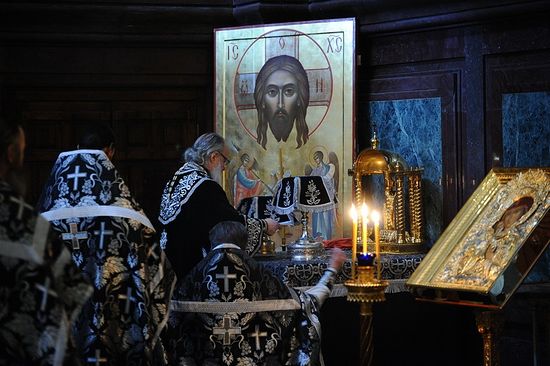
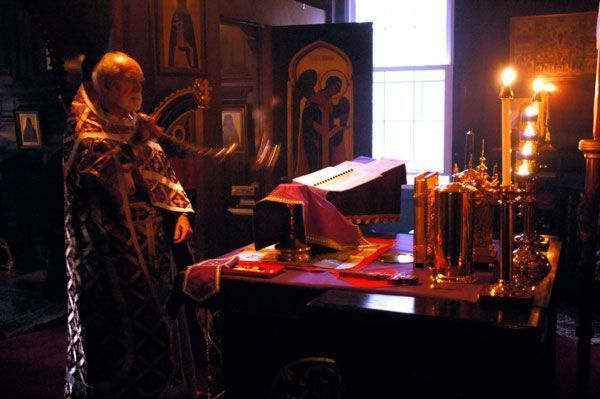
Earlier this month, I posted a setting of Psalm 140, “Let my prayer rise as incense etc.”, composed for the Byzantine Liturgy of the Presanctified gifts, along with a brief description of the first part of the ceremony. For the second part, the Litany of Fervent Supplication and special litanies for the catechumens are said, after which the royal doors are opened. The first part of the chant above is sung, then the Presanctified gifts are carried out the side-door, and back through the royal doors, followed by the second part (“With faith and love...”). This chant, therefore, replaces the hymn “We who mystically represent the Cherubim,” which is sung at the Divine Liturgy as the bread and wine are brought to the altar. The rest of the service is basically identical to the regular order of the Divine Liturgy.

Here is the Greek version:

Νῦν αἱ δυνάμεις τῶν οὐρανῶν σὺν ἡμῖν ἀοράτως λατρεύουσιν· ἰδοὺ γὰρ εἰσπορεύεται ὁ Βασιλεὺς τῆς δόξης. Ἰδοὺ θυσία μυστικὴ τετελειωμένη δορυφορεῖται· πίστει καὶ πόθῳ προσέλθωμεν, ἵνα μέτοχοι ζωῆς ἀιωνίου γενώμεθα. Ἀλληλούϊα, Ἀλληλούϊα, Ἀλληλούϊα.

I also make note here of two particularly beautiful prayers which are said in this second part of the service. The first of these is read silently by the celebrating priest while the deacon chants the litany that leads into the Lord’s Prayer.
“O God of ineffable and unseen mysteries, with whom are the hidden treasures of wisdom and knowledge, who did reveal the service of this liturgy to us, and appointed us hast appointed us sinners through Thy great love for mankind, to offer unto Thee gifts and sacrifices for our sins and for the deeds of ignorance of the people: do Thou Thyself, unseen King, who dost great and inscrutable things, glorious and extraordinary, of which there is no number, look upon us, Thy unworthy servants, who stand at this Thy holy altar as if at Thy cherubic throne, upon which rests Thy only-begotten Son and our God in the dread mysteries set forth thereon; and having delivered us and Thy faithful people from every impurity, sanctify all our souls and bodies with the sanctification which cannot be taken away, so that, partaking of these divine, hallowed things with a pure conscience, with an unashamed face, and with an illuminated heart, and being enlivened by them, we may be united to Christ Himself, our true God, who said, ‘He that eateth My flesh and drinketh My blood, abideth in me, and I in him,’ so that as Thy Word, O Lord, dwelleth in us and sojourneth among us, we may become a temple of Thy all-holy and adorable Spirit, redeemed from every wile of the devil, done either by deed or word or thought, and may obtain the good things promised to us with all Thy saints who from the beginning have been well-pleasing to Thee.”
The second prayer, said just before dismissal at the end of the rite, is known as “the prayer behind the ambo” (ὀπισθάμβωνος εὐχή in Greek, молитва заамвоннаѧ in Church Slavonic), because in Hagia Sophia, it was said by a priest who exited the main sanctuary and recited it while standing behind the great ambo in the nave. (It is seen in this digital reconstruction of the Great Church at about 3:55.)
This prayer originally could vary according to the liturgical occasion, and often included references to the day’s Gospel; many texts of it are preserved in ancient manuscripts. It is now reduced to only two forms, one which is said at the Eucharistic liturgy, and the other at the liturgy of the Presanctified, as follows.
“O Master almighty, who made all creation in wisdom, who through Thy ineffable providence and great goodness hast brought us to these all-revered days for the purification of souls and bodies, for the restraint of passions, for hope of resurrection, who during the forty days didst hand over to Thy servant Moses the tablets (of the Law), letters divinely carved: grant also to us, o good one, to fight the good fight, to complete the course of the fast, to preserve the faith unchanged, to crush the heads of the invisible serpents, to shine forth as victors over sin, and without condemnation to attain unto and worship the Holy Resurrection. For blessed and glorified is Thy all-honorable and magnificent name, of the Father, and of the Son, and of the Holy Spirit; now and ever, and unto ages of ages. Amen.”

Friday, March 06, 2026

“Let My Prayer Rise as Incense” by Dmitry Bortniansky - Byzantine Music for Lent

In the Byzantine Rite, the Divine Liturgy is not celebrated on the weekdays of Lent, but only on Saturdays and Sundays; an exception is made for the feast of the Annunciation. Therefore, at the Divine Liturgy on Sundays, extra loaves of bread are consecrated, and reserved for the rest of the week. On Wednesdays and Fridays, a service known as the Liturgy of the Presanctified Gifts is held, in which Vespers is mixed with a Communion Rite. (It is also held on the first three days of Holy Week, and may be done on other occasions, but twice a week is the standard practice.)

The first part of this ceremony follows the regular order of Vespers fairly closely, and the second part imitates the Great Entrance and the Communion rite of the Divine Liturgy. After the opening Psalm (103) and the Litany of Peace, the Gradual Psalms are chanted by a reader in three blocks, while a portion of the Presanctified Gifts is removed from the tabernacle, incensed, and carried from the altar to the table of the preparation. This is followed by a general incensation of the church, as the hymns of the day are sung with the daily Psalms of Vespers (140, 141, 129 and 116), the entrance procession with the thurible, and the hymn Phos Hilaron. Two readings are given from the Old Testament (Genesis and Proverbs in Lent, Exodus and Job in Holy Week), after which, the priest stands in front of the altar and incenses it continually, while the choir sings verses of Psalm 140, with the refrain “Let my prayer rise before Thee like incense, the lifting up of my hands as an evening sacrifice.” (The first part of this refrain is also NLM’s motto.)


This particular setting is by one of the greatest Slav composers of music for the Byzantine Liturgy, Dmitry Bortniansky, who was born in 1751 in the city of Hlukhiv in modern Ukraine. At the age of seven, he went to St Petersburg to sing with the Imperial Court Chapel, whose Italian master, Baldassare Galuppi, was so impressed with his talents that he brought him back to Italy in 1769. After ten years of training and work as a composer, Bortniansky returned to St Petersburg, and eventually became himself master of the same choir. His enormous oeuvre includes operas, instrumental compositions, songs in a variety of languages, 45 sacred concertos, and of course a very large number of liturgical compositions in Church Slavonic, like the one given above.

Friday, March 21, 2025

Another Chant for the Byzantine Liturgy of the Presanctified

Now the powers of heaven invisibly worship with us, for behold, the King of Glory entereth! Behold, the mystical sacrifice, being perfected, is carried forth in triumph. With faith and love, let us come forth, that we may become partakers of eternal life, Alleluia, Alleluia, Alleluia! (Recording by the Lviv Archeparchial Clergy Choir.)

Нині сили небесні з нами невидимо служать: ось бо входить Цар слави, ось жертва тайна совершенна супроводиться у славі. * З вірою і любовʼю приступім, щоб нам причасниками життя вічного бути. Алилуя, алилуя, алилуя.

Last week I posted a setting of the Psalm 140 “Let my prayer rise as incense etc.”, composed for the Byzantine Liturgy of the Presanctified gifts, along with a brief description of the first part of the ceremony. For the second part, the Litany of Fervent Supplication and special litanies for the catechumens are said, after which the royal doors are opened. The first part of the chant above is sung, then the Presanctified gifts are carried out the side-door, and back through the royal doors, followed by the second part (“With faith and love...”). This chant, therefore, replaces the hymn “We who mystically represent the Cherubim,” which is sung at the Divine Liturgy as the bread and wine are brought to the altar. The rest of the service is basically identical to the regular order of the Divine Liturgy.

Here is the Greek version:

Νῦν αἱ δυνάμεις τῶν οὐρανῶν σὺν ἡμῖν ἀοράτως λατρεύουσιν· ἰδοὺ γὰρ εἰσπορεύεται ὁ Βασιλεὺς τῆς δόξης. Ἰδοὺ θυσία μυστικὴ τετελειωμένη δορυφορεῖται· πίστει καὶ πόθῳ προσέλθωμεν, ἵνα μέτοχοι ζωῆς ἀιωνίου γενώμεθα. Ἀλληλούϊα, Ἀλληλούϊα, Ἀλληλούϊα.

I also make note here of two particularly beautiful prayers which are said in this second part of the service. The first of these is read silently by the celebrating priest while the deacon chants the litany that leads into the Lord’s Prayer.
“O God of ineffable and unseen mysteries, with whom are the hidden treasures of wisdom and knowledge, who did reveal the service of this liturgy to us, and appointed us hast appointed us sinners through Thy great love for mankind, to offer unto Thee gifts and sacrifices for our sins and for the deeds of ignorance of the people: do Thou Thyself, unseen King, who dost great and inscrutable things, glorious and extraordinary, of which there is no number, look upon us, Thy unworthy servants, who stand at this Thy holy altar as if at Thy cherubic throne, upon which rests Thy only-begotten Son and our God in the dread mysteries set forth thereon; and having delivered us and Thy faithful people from every impurity, sanctify all our souls and bodies with the sanctification which cannot be taken away, so that, partaking of these divine, hallowed things with a pure conscience, with an unashamed face, and with an illuminated heart, and being enlivened by them, we may be united to Christ Himself, our true God, who said, ‘He that eateth My flesh and drinketh My blood, abideth in me, and I in him,’ so that as Thy Word, O Lord, dwelleth in us and sojourneth among us, we may become a temple of Thy all-holy and adorable Spirit, redeemed from every wile of the devil, done either by deed or word or thought, and may obtain the good things promised to us with all Thy saints who from the beginning have been well-pleasing to Thee.”
The second prayer, said just before dismissal at the end of the rite, is known as “the prayer behind the ambo” (ὀπισθάμβωνος εὐχή in Greek, молитва заамвоннаѧ in Church Slavonic), because in Hagia Sophia, it was said by a priest who exited the main sanctuary and recited it while standing behind the great ambo in the nave. (It is seen in this digital reconstruction of the Great Church at about 3:55.)
This prayer originally could vary according to the liturgical occasion, and often included references to the day’s Gospel; many texts of it are preserved in ancient manuscripts. It is now reduced to only two forms, one which is said at the Eucharistic liturgy, and the other at the liturgy of the Presanctified, as follows.
“O Master almighty, who made all creation in wisdom, who through Thy ineffable providence and great goodness hast brought us to these all-revered days for the purification of souls and bodies, for the restraint of passions, for hope of resurrection, who during the forty days didst hand over to Thy servant Moses the tablets (of the Law), letters divinely carved: grant also to us, o good one, to fight the good fight, to complete the course of the fast, to preserve the faith unchanged, to crush the heads of the invisible serpents, to shine forth as victors over sin, and without condemnation to attain unto and worship the Holy Resurrection. For blessed and glorified is Thy all-honorable and magnificent name, of the Father, and of the Son, and of the Holy Spirit; now and ever, and unto ages of ages. Amen.”

Friday, March 14, 2025

“Let My Prayer Rise as Incense” - Byzantine Music for Lent

In the Byzantine Rite, the Divine Liturgy is not celebrated on the weekdays of Lent, but only on Saturdays and Sundays; an exception is made for the feast of the Annunciation. Therefore, at the Divine Liturgy on Sundays, extra loaves of bread are consecrated, and reserved for the rest of the week. On Wednesdays and Fridays, a service known as the Liturgy of the Presanctified Gifts is held, in which Vespers is mixed with a Communion Rite. (It is also held on the first three days of Holy Week, and may be done on other occasions, but twice a week is the standard practice.)

The first part of this ceremony follows the regular order of Vespers fairly closely, and the second part imitates the Great Entrance and the Communion rite of the Divine Liturgy. After the opening Psalm (103) and the Litany of Peace, the Gradual Psalms are chanted by a reader in three blocks, while a portion of the Presanctified Gifts is removed from the tabernacle, incensed, and carried from the altar to the table of the preparation. This is followed by a general incensation of the church, as the hymns of the day are sung with the daily Psalms of Vespers (140, 141, 129 and 116), the entrance procession with the thurible, and the hymn Phos Hilaron. Two readings are given from the Old Testament (Genesis and Proverbs in Lent, Exodus and Job in Holy Week), after which, the priest stands in front of the altar and incenses it continually, while the choir sings verses of Psalm 140, with the refrain “Let my prayer rise before Thee like incense, the lifting up of my hands as an evening sacrifice.” (The first part of this refrain is also NLM’s motto.)

Here is a very nice version in Church Slavonic, a modern composition by Fr Ruslan Hrekh, a priest of the Ukrainian Greek-Catholic Church, sung by clergy of the eparchy of Lviv.

And a Greek version sung by monks of the Simonos Petra monastery on Mt Athos.

Wednesday, March 20, 2024

Another Chant for the Byzantine Liturgy of the Presanctified

Now the powers of heaven invisibly worship with us, for behold, the King of Glory entereth! Behold, the mystical sacrifice, being perfected, is carried forth in triumph. With faith and love, let us come forth, that we may become partakers of eternal life, Alleluia, Alleluia, Alleluia! (Recording made last year at the Greek-Catholic cathedral of St George in Lviv, Ukraine.)

Нынѣ Силы Небесныѧ съ нами невидимо служать, се бо входитъ Царь Славы: се Жертва тайнаѧ совершена дориноситсѧ. Вѣрою и любовию приступимъ, да причастницы жизни вѣчныѧ будемъ. Аллилуїа, аллилуїа, аллилуїа.

Last week I posted a setting of the Psalm 140 “Let my prayer rise as incense etc.”, composed for the Byzantine Liturgy of the Presanctified gifts, along with a brief description of the first part of the ceremony. For the second part, the Litany of Fervent Supplication and special litanies for the catechumens are said, after which the royal doors are opened. The first part of the chant above is sung, then the Presanctified gifts are carried out the side-door, and back through the royal doors, followed by the second part (“With faith and love...”). This chant, therefore, replaces the hymn “We who mystically represent the Cherubim,” which is sung at the Divine Liturgy as the bread and wine are brought to the altar. The rest of the service is basically identical to the regular order of the Divine Liturgy.

Here is the Greek version:

Νῦν αἱ δυνάμεις τῶν οὐρανῶν σὺν ἡμῖν ἀοράτως λατρεύουσιν· ἰδοὺ γὰρ εἰσπορεύεται ὁ Βασιλεὺς τῆς δόξης. Ἰδοὺ θυσία μυστικὴ τετελειωμένη δορυφορεῖται· πίστει καὶ πόθῳ προσέλθωμεν, ἵνα μέτοχοι ζωῆς ἀιωνίου γενώμεθα. Ἀλληλούϊα, Ἀλληλούϊα, Ἀλληλούϊα.

I also make note here of two particularly beautiful prayers which are said in this second part of the service. The first of these is read silently by the celebrating priest while the deacon chants the litany that leads into the Lord’s Prayer.
“O God of ineffable and unseen mysteries, with whom are the hidden treasures of wisdom and knowledge, who did reveal the service of this liturgy to us, and appointed us hast appointed us sinners through Thy great love for mankind, to offer unto Thee gifts and sacrifices for our sins and for the deeds of ignorance of the people: do Thou Thyself, unseen King, who dost great and inscrutable things, glorious and extraordinary, of which there is no number, look upon us, Thy unworthy servants, who stand at this Thy holy altar as if at Thy cherubic throne, upon which rests Thy only-begotten Son and our God in the dread mysteries set forth thereon; and having delivered us and Thy faithful people from every impurity, sanctify all our souls and bodies with the sanctification which cannot be taken away, so that, partaking of these divine, hallowed things with a pure conscience, with an unashamed face, and with an illuminated heart, and being enlivened by them, we may be united to Christ Himself, our true God, who said, ‘He that eateth My flesh and drinketh My blood, abideth in me, and I in him,’ so that as Thy Word, O Lord, dwelleth in us and sojourneth among us, we may become a temple of Thy all-holy and adorable Spirit, redeemed from every wile of the devil, done either by deed or word or thought, and may obtain the good things promised to us with all Thy saints who from the beginning have been well-pleasing to Thee.”
The second prayer, said just before dismissal at the end of the rite, is known as “the prayer behind the ambo” (ὀπισθάμβωνος εὐχή in Greek, молитва заамвоннаѧ in Church Slavonic), because in Hagia Sophia, it was said by a priest who exited the main sanctuary and recited it while standing behind the great ambo in the nave. (It is seen in this digital reconstruction of the Great Church at about 3:55.)
This prayer originally could vary according to the liturgical occasion, and often included references to the day’s Gospel; many texts of it are preserved in ancient manuscripts. It is now reduced to only two forms, one which is said at the Eucharistic liturgy, and the other at the liturgy of the Presanctified, as follows.
“O Master almighty, who made all creation in wisdom, who through Thy ineffable providence and great goodness hast brought us to these all-revered days for the purification of souls and bodies, for the restraint of passions, for hope of resurrection, who during the forty days didst hand over to Thy servant Moses the tablets (of the Law), letters divinely carved: grant also to us, o good one, to fight the good fight, to complete the course of the fast, to preserve the faith unchanged, to crush the heads of the invisible serpents, to shine forth as victors over sin, and without condemnation to attain unto and worship the Holy Resurrection. For blessed and glorified is Thy all-honorable and magnificent name, of the Father, and of the Son, and of the Holy Spirit; now and ever, and unto ages of ages. Amen.”

Thursday, March 14, 2024

“Let My Prayer Rise as Incense” by Dmitry Bortniansky - Byzantine Music for Lent

In the Byzantine Rite, the Divine Liturgy is not celebrated on the weekdays of Lent, but only on Saturdays and Sundays; an exception is made for the feast of the Annunciation. Therefore, at the Divine Liturgy on Sundays, extra loaves of bread are consecrated, and reserved for the rest of the week. On Wednesdays and Fridays, a service known as the Liturgy of the Presanctified Gifts is held, in which Vespers is mixed with a Communion Rite. (It is also held on the first three days of Holy Week, and may be done on other occasions, but twice a week is the standard practice.)

The first part of this ceremony follows the regular order of Vespers fairly closely, and the second part imitates the Great Entrance and the Communion rite of the Divine Liturgy. After the opening Psalm (103) and the Litany of Peace, the Gradual Psalms are chanted by a reader in three blocks, while a portion of the Presanctified Gifts is removed from the tabernacle, incensed, and carried from the altar to the table of the preparation. This is followed by a general incensation of the church, as the hymns of the day are sung with the daily Psalms of Vespers (140, 141, 129 and 116), the entrance procession with the thurible, and the hymn Phos Hilaron. Two readings are given from the Old Testament (Genesis and Proverbs in Lent, Exodus and Job in Holy Week), after which, the priest stands in front of the altar and incenses it continually, while the choir sings verses of Psalm 140, with the refrain “Let my prayer rise before Thee like incense, the lifting up of my hands as an evening sacrifice.” (The first part of this refrain is also NLM’s motto.)


This particular setting is by one of the greatest Slav composers of music for the Byzantine Liturgy, Dmitry Bortniansky, who was born in 1751 in the city of Hlukhiv in modern Ukraine. At the age of seven, he went to St Petersburg to sing with the Imperial Court Chapel, whose Italian master, Baldassare Galuppi, was so impressed with his talents that he brought him back to Italy in 1769. After ten years of training and work as a composer, Bortniansky returned to St Petersburg, and eventually became himself master of the same choir. His enormous oeuvre includes operas, instrumental compositions, songs in a variety of languages, 45 sacred concertos, and of course a very large number of liturgical compositions in Church Slavonic, like the one given above.

Wednesday, March 10, 2021

Byzantine Hymns for Mid-Lent

The Fast that bringeth good things hath now reached its middle point, having pleased God well in the days gone past, and bringing help in the days to come; for the increase of good things maketh greater the good work. Wherefore let us cry to Christ, the Giver of all good things, pleasing Him well, “O Thou who for our sake did fast and endure the Cross, deem us worthy to partake also of Thy divine Pasch uncondemned, living our lives in peace, and rightly glorifying Thee with the Father and the Spirit.

Much more by coincidence than design, this is the fourth week in a row, and the third Wednesday in a row, that I have posted something about the Byzantine Divine Office in Lent, and today I had a really good idea for writing something about Wednesday, March 24th, the Forefeast of the Annunciation. The earlier parts of what has now accidentally become a series covered the use of the Psalter in Lent, the first part of the very beautiful ritual known as the Liturgy of the Presanctified Gifts, and then the second part of it.
Since the Byzantine liturgical week runs from Monday to Sunday [note], Lent starts two days before the Roman Ash Wednesday; therefore, today is Wednesday of the Fourth Week of Lent in the Byzantine Rite, but “Wednesday of the Third Week” in the Roman. This day is sometimes referred to informally as Mid-Lent, although this is an approximation, where the analogous half-way point of the Paschal season, a special feast called “Mid-Pentecost”, is exactly half-way (25 days) between Easter and Pentecost. The sticheron given above is one of several placed between the verses of a group of four Psalms which are sung at Vespers every day (140, 141, 129 and 116), while the deacon incenses the altar and sanctuary, the iconostasis, the church, the clergy and the faithful. The first of these Psalms is chosen for the words “Let my prayer raise before Thee like incense, the lifting up of my hands as an evening sacrifice,” which are prominent in most historical Christian rites. (A sticheron is technically referred to as kind of “hymn”, but in construction is really more analogous to the antiphons of the Roman Rite; the number of them varies from day to day.)

The last of a group of stichera is always a Theotokion, a hymn to the Virgin Mary, and that of Mid-Lent is particularly beautiful. The references to the Crucifixion look back to the preceding Sunday, that of the Veneration of the Holy and Life-Giving Cross, and forward to Good Friday and the end of Lent.

“Today, He that is by nature unapproachable becometh approachable to me, and undergoeth His sufferings to deliver me from sufferings; He that giveth light to the blind is spit upon by impious lips, and giveth His cheek unto blows, for the sake of those held captive. The holy Virgin and Mother, seeing Him upon the Cross, cried out, ‘Alas, my Child! What is this Thou hast done? Beautiful beyond the sons of men, dost Thou appear without life or spirit, having no beauty or comeliness? Alas, my Light! I cannot look upon Thee sleeping, I am wounded to the core, and a terrible sword passeth through my heart. I sing of Thy sufferings, I adore Thy compassion; long-suffering Lord, glory to Thee!’ ” (In the video below, the Church Slavonic version.)

A 16th-century Russian icon of the Holy Mandylion, the cloth with Christ’s face impressed upon it, and below, the Lamentation over the Dead Christ.
Note: as with most things Byzantine, this is a case where a little bit of inaccuracy saves a ton of explanation. In the liturgical book called the Triodion, which contains the Office propers of Fore-Lent, Lent and Holy Week, the liturgical week begins on Monday, so the First Monday of Lent is followed by the First Tuesday, Wednesday etc., then the First Sunday. The next day after that is “the Second Monday of Lent”, then Tuesday, Wednesday etc., and then the Second Sunday, the Third Monday, and so on. The same system is used in the lectionary for the period after Pentecost. However, in the Pentecostarion, which covers the Easter season, the weeks are arranged from Sunday to Saturday; there are also features of the Divine Office which run on a weekly cycle that begins with Vespers on Saturday evening.

Wednesday, March 03, 2021

Another Chant for the Byzantine Liturgy of the Presanctified

Now the powers of heaven invisibly worship with us, for behold, the King of Glory entereth! Behold, the mystical sacrifice, being perfected, is carried forth in triumph. With faith and love, let us come forth, that we may become partakers of eternal life, Alleluia, Alleluia, Alleluia! (Recording by the always impressive choir of the Sretensky Monastery in Moscow.

Нынѣ Силы Небесныѧ съ нами невидимо служать, се бо входитъ Царь Славы: се Жертва тайнаѧ совершена дориноситсѧ. Вѣрою и любовию приступимъ, да причастницы жизни вѣчныѧ будемъ. Аллилуїа, аллилуїа, аллилуїа.

We recently shared a setting of the Psalm 140 “Let my prayer rise as incense etc.” by Pavel Chesnokov, composed for the Byzantine Liturgy of the Presanctified gifts, along with a brief description of the first part of the ceremony. For the second part, the Litany of Fervent Supplication and special litanies for the catechumens are said, after which the royal doors are opened. The first part of the chant above is sung, then the Presanctified gifts are carried out the side-door, and back through the royal doors, followed by the second part (“With faith and love...”). This chant, therefore, replaces the hymn “We who mystically represent the Cherubim,” which is sung at the Divine Liturgy as the bread and wine are brought to the altar. The rest of the service is basically identical to the regular order of the Divine Liturgy.

Here is the Greek version:

Νῦν αἱ δυνάμεις τῶν οὐρανῶν σὺν ἡμῖν ἀοράτως λατρεύουσιν· ἰδοὺ γὰρ εἰσπορεύεται ὁ Βασιλεὺς τῆς δόξης. Ἰδοὺ θυσία μυστικὴ τετελειωμένη δορυφορεῖται· πίστει καὶ πόθῳ προσέλθωμεν, ἵνα μέτοχοι ζωῆς ἀιωνίου γενώμεθα. Ἀλληλούϊα, Ἀλληλούϊα, Ἀλληλούϊα.

I also make note here of two particularly beautiful prayers which are said in this second part of the service. The first of these is read silently by the celebrating priest while the deacon chants the litany that leads into the Lord’s Prayer.
“O God of ineffable and unseen mysteries, with whom are the hidden treasures of wisdom and knowledge, who did reveal the service of this liturgy to us, and appointed us hast appointed us sinners through Thy great love for mankind, to offer unto Thee gifts and sacrifices for our sins and for the deeds of ignorance of the people: do Thou Thyself, unseen King, who dost great and inscrutable things, glorious and extraordinary, of which there is no number, look upon us, Thy unworthy servants, who stand at this Thy holy altar as if at Thy cherubic throne, upon which rests Thy only-begotten Son and our God in the dread mysteries set forth thereon; and having delivered us and Thy faithful people from every impurity, sanctify all our souls and bodies with the sanctification which cannot be taken away, so that, partaking of these divine, hallowed things with a pure conscience, with an unashamed face, and with an illuminated heart, and being enlivened by them, we may be united to Christ Himself, our true God, who said, ‘He that eateth My flesh and drinketh My blood, abideth in me, and I in him,’ so that as Thy Word, O Lord, dwelleth in us and sojourneth among us, we may become a temple of Thy all-holy and adorable Spirit, redeemed from every wile of the devil, done either by deed or word or thought, and may obtain the good things promised to us with all Thy saints who from the beginning have been well-pleasing to Thee.”
The second prayer, said just before dismissal at the end of the rite, is known as “the prayer behind the ambo” (ὀπισθάμβωνος εὐχή in Greek, молитва заамвоннаѧ in Church Slavonic), because in Hagia Sophia, it was said by a priest who exited the main sanctuary and recited it while standing behind the great ambo in the nave. (It is seen in this digital reconstruction of the Great Church at about 3:55.)
This prayer originally could vary according to the liturgical occasion, and often included references to the day’s Gospel; many texts of it are preserved in ancient manuscripts. It is now reduced to only two forms, one which is said at the Eucharistic liturgy, and the other at the liturgy of the Presanctified, as follows.
“O Master almighty, who made all creation in wisdom, who through Thy ineffable providence and great goodness hast brought us to these all-revered days for the purification of souls and bodies, for the restraint of passions, for hope of resurrection, who during the forty days didst hand over to Thy servant Moses the tablets (of the Law), letters divinely carved: grant also to us, o good one, to fight the good fight, to complete the course of the fast, to preserve the faith unchanged, to crush the heads of the invisible serpents, to shine forth as victors over sin, and without condemnation to attain unto and worship the Holy Resurrection. For blessed and glorified is Thy all-honorable and magnificent name, of the Father, and of the Son, and of the Holy Spirit; now and ever, and unto ages of ages. Amen.”

Wednesday, February 24, 2021

“Let My Prayer Rise as Incense” by Pavel Chesnokov - Byzantine Music for Lent

As we have noted a number of times (examples here and here), in the Byzantine Rite, the Divine Liturgy is not celebrated on the weekdays of Lent, but only on Saturdays and Sundays. (An exception is made for the feast of the Annunciation.) Therefore, at the Divine Liturgy on Sundays, extra loaves of bread are consecrated, and reserved for the rest of the week. On Wednesdays and Fridays, a service known as the Liturgy of the Presanctified Gifts is held, in which Vespers is mixed with a Communion Rite. (It is also held on the first three days of Holy Week, and may be done on other occasions, but twice a week is the most common practice.)

The first part of this ceremony follows the regular order of Vespers, and the second part imitates the Great Entrance and the Communion rite of the Divine Liturgy. After the opening Psalm 103 and the Litany of Peace, as the Gradual Psalms are chanted in 3 separate blocks, a portion of the Presanctified Gifts is moved from the altar to the table of the preparation. There follow the general incensation of the church to the singing of 4 psalms (140, 141, 129 and 116) with the hymns known as “stichera” between the verses, then the entrance procession with the thurible and the hymn Phos Hilaron. Two readings are done from the Old Testament (Genesis and Proverbs in Lent, Exodus and Job in Holy Week), after which, the priest stands in front of the altar and incenses it continually, while the choir sings verses of Psalm 140, with the refrain “Let my prayer rise before Thee like incense, the lifting up of my hands as an evening sacrifice.” (See note below.)

This setting, sung here by the choir of the Sretensky Monastery in Moscow, is by one of the great modern Russian composers, Pavel Chesnokov (1887-1944), a remarkably prolific author of sacred music, with over 400 pieces to his name. Very sadly, when the Cathedral of Christ the Savior in Moscow, where he had served as choirmaster, was destroyed in 1933, he became so distraught that he stopped composing altogether. (The church was demolished to make way for a gigantic public building that was never realized, and reconstructed on the same site from 1995 to 2000.)

Note: in some traditions, the verses of Psalm 140 are sung by the celebrant, and the choir sings the refrain. The priest may also move around the table, standing first in front of it, then to one side, than at the back etc., changing places as the choir sings the refrain. He will also incense the Presanctified Gifts at the table of preparation during this part of the rite.

Wednesday, March 04, 2020

Byzantine Music for Lent by Tchaikovsky

In the Byzantine Rite, the Divine Liturgy is not celebrated on the weekdays of Lent, but only on Saturdays and Sundays; an exception is made for the feast of the Annunciation. Therefore, at the Divine Liturgy on Sundays, extra loaves of bread are consecrated, and reserved for the rest of the week. On Wednesdays and Fridays, a service known as the Liturgy of the Presanctified Gifts is held, in which Vespers is mixed with a Communion Rite. (It is also held on the first three days of Holy Week, and may be done on other occasions, but twice a week is the most common practice.)

The first part of this ceremony follows the regular order of Vespers fairly closely, and the second part imitates the Great Entrance and the Communion rite of the Divine Liturgy. After the opening Psalm (103) and the Litany of Peace, the Gradual Psalms are chanted by a reader in three blocks, while a portion of the Presanctified Gifts is removed from the tabernacle, incensed, and carried from the altar to the table of the preparation. This is followed by a general incensation of the church, as the hymns of the day are sung with the daily Psalms of Vespers (140, 141, 129 and 116), the entrance procession with the thurible, and the hymn Phos Hilaron. Two readings are given from the Old Testament (Genesis and Proverbs in Lent, Exodus and Job in Holy Week), after which, the priest stands in front of the altar and incenses it continually, while the choir sings verses of Psalm 140, with the refrain “Let my prayer rise before Thee like incense, the lifting up of my hands as an evening sacrifice.” (The first part of this refrain is also NLM’s motto.)

For the second part, the Litany of Fervent Supplication and special litanies for the catechumens are said, after which the royal doors are opened. The first part of the following chant is sung, then the Presanctified gifts are carried out the side-door, and back through the royal doors, followed by the second part (“With faith and love...”). This chant, therefore, replaces the hymn “We who mystically represent the Cherubim,” which is sung at the Divine Liturgy as the bread and wine are brought to the altar. The rest of the service is basically identical to the regular order of the Divine Liturgy.


Нынѣ Силы Небесныѧ съ нами невидимо служать, се бо входитъ Царь Славы: се Жертва тайнаѧ совершена дориноситсѧ. Вѣрою и любовию приступимъ, да причастницы жизни вѣчныя будемъ. Аллилуя, аллилуя, аллилуя. (Now the powers of heaven invisibly worship with us, for behold, the King of Glory entereth! Behold, the mystical sacrifice, being perfected, is carried forth in triumph. With faith and love, let us come forth, that we may become partakers of eternal life, Alleluia, Alleluia, Alleluia!)

These settings are by Piotr Ilych Tchaikovsky (1840-93), who is of course best known to the English-speaking world for his Nutcracker Suite and 1812 Overture. He was a very prolific composer, and among his many choral works are complete settings of the Divine Liturgy of St John Chrysostom, and the All-Night Vigil (Vespers, Matins and Prime joined together as a single service, and celebrated in most Russian churches on Saturday evenings and the day before major feasts.) These two pieces are included in a group known as Nine Sacred Pieces (or Nine Church Pieces), composed in 1884-85, whch also includes three settings of the Cherubic hymn for the regular Divine Liturgy, Truly it is fitting (from the Byzantine Preface dialog), We hymn Thee (sung after the Consecration), and the Lord’s Prayer.

Wednesday, March 20, 2019

“Let My Prayer Rise as Incense” by Dmitry Bortniansky - Byzantine Music for Lent

In the Byzantine Rite, the Divine Liturgy is not celebrated on the weekdays of Lent, but only on Saturdays and Sundays; an exception is made for the feast of the Annunciation. Therefore, at the Divine Liturgy on Sundays, extra loaves of bread are consecrated, and reserved for the rest of the week. On Wednesdays and Fridays, a service known as the Liturgy of the Presanctified Gifts is held, in which Vespers is mixed with a Communion Rite. (It is also held on the first three days of Holy Week, and may be done on other occasions, but twice a week is the standard practice.)

The first part of this ceremony follows the regular order of Vespers fairly closely, and the second part imitates the Great Entrance and the Communion rite of the Divine Liturgy. After the opening Psalm (103) and the Litany of Peace, the Gradual Psalms are chanted by a reader in three blocks, while a portion of the Presanctified Gifts is removed from the tabernacle, incensed, and carried from the altar to the table of the preparation. This is followed by a general incensation of the church, as the hymns of the day are sung with the daily Psalms of Vespers (140, 141, 129 and 116), the entrance procession with the thurible, and the hymn Phos Hilaron. Two readings are given from the Old Testament (Genesis and Proverbs in Lent, Exodus and Job in Holy Week), after which, the priest stands in front of the altar and incenses it continually, while the choir sings verses of Psalm 140, with the refrain “Let my prayer rise before Thee like incense, the lifting up of my hands as an evening sacrifice.” (The first part of this refrain is also NLM’s motto.)

This particular setting is by one of the greatest Slav composers of music for the Byzantine Liturgy, Dmitry Bortniansky, who was born in 1751 in the city of Hlukhiv in modern Ukraine. At the age of seven, he went to St Petersburg to sing with the Imperial Court Chapel, whose Italian master, Baldassare Galuppi, was so impressed with his talents that he brought him back to Italy in 1769. After ten years of training and work as a composer, Bortniansky returned to St Petersburg, and eventually became himself master of the same choir. His enormous oeuvre includes operas, instrumental compositions, songs in a variety of languages, 45 sacred concertos, and of course a very large number of liturgical compositions in Church Slavonic, like the one given above.

Friday, April 06, 2018

Good Friday 2018 Photopost (Part 1)

Once again, our photopost series continues to demonstrate the richness of our Catholic liturgical heritage; here we have the ceremonies of Good Friday in both pre- and post-Pian form of the EF, as well as the OF, and Vespers of Good Friday in the Melkite liturgy. I would call our readers’ attention especially to the first set of pictures from Munich, where we have an interesting example from Germany of popular devotion in a liturgical context. There will be at least one more of these before we move on to Tenebrae, the Easter vigil and Easter Sunday; as always, with our thanks to everyone who sent these in!

Damenstiftkirche - Munich, Germany (FSSP)

Friday, March 09, 2018

Another Chant for the Liturgy of the Presanctified

Now the powers of heaven invisibly worship with us, for behold, the King of Glory entereth! Behold, the mystical sacrifice, being perfected, is carried forth in triumph. With faith and love, let us come forth, that we may become partakers of eternal life, Alleluia, Alleluia, Alleluia!


Нынѣ Силы Небесныѧ съ нами невидимо служать, се, бо входитъ Царь Славы: се Жертва тайнаѧ совершена дориноситсѧ. Вѣрою и любовию приступимъ, да причастницы жизни вѣчныя будемъ. Аллилуя, аллилуя, аллилуя. (Sung by the choir of the Sretensky Monastery in Moscow.)

We recently shared a setting of the Psalm 140 “Let my prayer rise as incense etc.” by Pavel Chesnokov, composed for the Byzantine Liturgy of the Presanctified gifts, along with a brief description of the first part of the ceremony. For the second part, the Litany of Fervent Supplication and special litanies for the catechumens are said, after which the royal doors are opened. The first part of the chant above is sung, then the Presanctified gifts are carried out the side-door, and back through the royal doors, followed by the second part (“With faith and love...”). This chant, therefore, replaces the hymn “We who mystically represent the Cherubim,” which is sung at the Divine Liturgy as the bread and wine are brought to the altar. The rest of the service is basically identical to the regular order of the Divine Liturgy.

Here is the Greek version:

Νῦν αἱ δυνάμεις τῶν οὐρανῶν σὺν ἡμῖν ἀοράτως λατρεύουσιν· ἰδοὺ γὰρ εἰσπορεύεται ὁ Βασιλεὺς τῆς δόξης. Ἰδοὺ θυσία μυστικὴ τετελειωμένη δορυφορεῖται· πίστει καὶ πόθῳ προσέλθωμεν, ἵνα μέτοχοι ζωῆς ἀιωνίου γενώμεθα. Ἀλληλούϊα, Ἀλληλούϊα, Ἀλληλούϊα.

Wednesday, February 28, 2018

“Let My Prayer Rise as Incense” by Pavel Chesnokov - Byzantine Music for Lent

As we have noted a number of times (examples here and here), in the Byzantine Rite, the Divine Liturgy is not celebrated on the weekdays of Lent, but only on Saturdays and Sundays. (An exception is made for the feast of the Annunciation.) Therefore, at the Divine Liturgy on Sundays, extra loaves of bread are consecrated, and reserved for the rest of the week. On Wednesdays and Fridays, a service known as the Liturgy of the Presanctified Gifts is held, in which Vespers is mixed with a Communion Rite. (It is also held on the first three days of Holy Week, and may be done on other occasions, but twice a week is the most common practice.)

The first part of this ceremony follows the regular order of Vespers, and the second part imitates the Great Entrance and the Communion rite of the Divine Liturgy. After the opening Psalm 103 and the Litany of Peace, as the Gradual Psalms are chanted in 3 separate blocks, a portion of the Presanctified Gifts is moved from the altar to the table of the preparation. There follow the general incensation of the church to the singing of 4 psalms (140, 141, 129 and 116) with the hymns known as “stichera” between the verses, then the entrance procession with the thurible and the hymn Phos Hilaron. Two readings are done from the Old Testament (Genesis and Proverbs in Lent, Exodus and Job in Holy Week), after which, the priest stands in front of the altar and incenses it continually, while the choir sings verses of Psalm 140, with the refrain “Let my prayer rise before Thee like incense, the lifting up of my hands as an evening sacrifice.” (See note below.)
This setting, sung here by the choir of the Sretensky Monastery in Moscow, is by one of the great modern Russian composers, Pavel Chesnokov (1887-1944), a remarkably prolific author of sacred music, with over 400 pieces to his name. Very sadly, when the Cathedral of Christ the Savior in Moscow, where he had served as choirmaster, was destroyed in 1933, he became so distraught that he stopped composing altogether. (The church was demolished to make way for a gigantic public building that was never realized, and reconstructed on the same site from 1995 to 2000.)

Note: in some traditions, the verses of Psalm 140 are sung by the celebrant, and the choir sings the refrain. The priest may also move around the table, standing first in front of it, then to one side, than at the back etc., changing places as the choir sings the refrain. He will also incense the Presanctified Gifts at the table of preparation during this part of the rite.

Thursday, March 23, 2017

Byzantine Hymns for Mid-Lent

The Fast that bringeth good things hath now reached its middle point, having pleased God well in the days gone past, and bringing help in the days to come; for the increase of good things maketh greater the good work. Wherefore let us cry to Christ, the Giver of all good things, pleasing Him well, “O Thou who for our sake did fast and endure the Cross, deem us worthy to partake also of Thy divine Pasch uncondemned, living our lives in peace, and rightly glorifying Thee with the Father and the Spirit.

Since the Byzantine liturgical week runs from Monday to Sunday, Lent starts two days before the Roman Ash Wednesday; therefore, yesterday was Wednesday of the Fourth Week of Lent in the Byzantine Rite, but “Wednesday of the Third Week” in the Roman. This day is sometimes referred to informally as Mid-Lent, although this is an approximation, where the analogous half-way point of the Paschal season, the feast of Mid-Pentecost, is exactly half-way (25 days) between Easter and Pentecost. The sticheron given above is one of several placed between the verses of a group of four Psalms which are sung at Vespers every day, (140, 141, 129 and 116), while the deacon incenses the altar and sanctuary, the iconostasis, the church, the clergy and the faithful. The first of these Psalms is chosen for the words “Let my prayer raise before Thee like incense, the lifting up of my hands as an evening sacrifice,” which are prominent in most historical Christian rites. (A sticheron is technically referred to as kind of “hymn”, but in construction is really more analogous to the antiphons of the Roman Rite; the number of them varies from day to day.)

The last of a group of stichera is always a Theotokion, a hymn to the Virgin Mary, and that of Mid-Lent is particularly beautiful. The references to the Crucifixion look back to the preceding Sunday, that of the Veneration of the Holy and Life-Giving Cross, and forward to Good Friday and the end of Lent.

“Today, He that is by nature unapproachable becometh approachable to me, and undergoeth His sufferings to deliver me from sufferings; He that giveth light to the blind is spit upon by impious lips, and giveth His cheek unto blows, for the sake of those held captive. The holy Virgin and Mother, seeing Him upon the Cross, cried out, ‘Alas, my Child! What is this Thou hast done? Beautiful beyond the sons of men, dost Thou appear without life or spirit, having no beauty or comeliness? Alas, my Light! I cannot look upon Thee sleeping, I am wounded to the core, and a terrible sword passeth through my heart. I sing of Thy sufferings, I adore Thy compassion; long-suffering Lord, glory to Thee!’ ” (In the video below, the Church Slavonic version.)

A 16th-century Russian icon of the Holy Mandylion, the cloth with Christ’s face impressed upon it, and below, the Lamentation over the Dead Christ. 

Wednesday, March 15, 2017

The Byzantine Feast of St Benedict in Rome

In the Byzantine Rite, the feast of St Benedict is kept on March 14th, one week before the day of his death, which is his traditional Roman day. The Greek College in Rome honors him as its Patron Saint, but because his feast always falls in Lent, when the Divine Liturgy is only celebrated on Sundays and Saturdays, it is commemorated when it falls during the week at a Liturgy of the Presanctified Gifts, Vespers combined with a Communion service. Here are a few pictures from yesterday evening’s ceremony.


An icon of St Athanasius. titular Saint of the College’s main church.
As Elijah once did, Father, you brought down the rain from heaven by your divine entreaty; you made a vessel run over with oil, and raised a dead man, and accomplished numberless other wonders, in all ways unto the glory of God and the Savior, o holy one; wherefore, Benedict, we celebrate your holy memory with love. (3rd Sticheron for Vespers)

The little entrance with the Gospel book. Normally, this is done with only the thurible, but on major feasts, an Epistle and Gospel may be added to the Vespers of the Presanctified Gifts, in which case the Gospel book is carried as is normally done at the Divine Liturgy.

Friday, February 12, 2016

A Beautiful Byzantine Chant for Lent

Now the powers of heaven invisibly worship with us, for behold, the King of Glory entereth! Behold, the mystical sacrifice, being perfected, is carried forth in triumph. With faith and love, let us come forth, that we may become partakers of eternal life, Alleluia, Alleluia, Alleluia!


Нынѣ Силы Небесныѧ съ нами невидимо служать, се, бо входитъ Царь Славы: се Жертва тайнаѧ совершена дориноситсѧ. Вѣрою и любовию приступимъ, да причастницы жизни вѣчныя будемъ. Аллилуя, аллилуя, аллилуя. (Sung by the choir of the Sretensky Monastery in Moscow.)

As I am sure many of our readers know, it is the custom of the Byzantine Rite that the Eucharistic liturgy is not celebrated on the weekdays of Lent, except on the feast of the Annunciation. Therefore, at the Divine Liturgy on Sunday, extra loaves of bread are consecrated, and reserved for the rest of the week. On Wednesdays and Fridays, a service known as the Liturgy of the Presanctified Gifts is held, in which Vespers is mixed with a Communion Rite. (It is also held on the first three days of Holy Week, and may be done on other occasions, but twice a week is the most common practice.) The first part follows the regular order of Vespers fairly closely, and the second part imitates the Great Entrance and the Communion rite of the Divine Liturgy. This chant, therefore, replaces the hymn “We who mystically represent the Cherubim,” which is sung at the Divine Liturgy as the bread and wine are brought to the altar.

Here is the Greek version:

Νῦν αἱ δυνάμεις τῶν οὐρανῶν σὺν ἡμῖν ἀοράτως λατρεύουσιν· ἰδοὺ γὰρ εἰσπορεύεται ὁ Βασιλεὺς τῆς δόξης. Ἰδοὺ θυσία μυστικὴ τετελειωμένη δορυφορεῖται· πίστει καὶ πόθῳ προσέλθωμεν, ἵνα μέτοχοι ζωῆς ἀιωνίου γενώμεθα. Ἀλληλούϊα, Ἀλληλούϊα, Ἀλληλούϊα.

Tuesday, March 04, 2014

The Liturgy of the Presanctified Gifts: Guest Article by Dr. Kyle Washut

We are grateful once again to Dr. Kyle Washut of Wyoming Catholic College for a new series of articles on one of the most beautiful aspects of the Byzantine Rite, the Lenten Liturgy of the Presanctified Gifts.
This year, the date of Easter is the same for both the Julian calendar and the Gregorian calendar, so the Church is taking air into both lungs as she prepares to dive into Great Lent. Last week, those who observe the Byzantine tradition have already stopped eating meat, and we stopped eating dairy products this Monday; hence, this week is called Cheesefare. (For more on the history of the Fast, and the Sundays that prepare for it, and the varying rules of fasting for throughout the period see here my lecture from last year.)

The Wednesday of Cheesefare week is the first day that Christians of the Byzantine tradition celebrate the Liturgy of the Presanctified Gifts, that is, a service wherein the faithful partake of Holy Communion consecrated at a prior Divine Liturgy. The Latin tradition also utilizes a Presanctified Liturgy as part of its liturgical year, but only on Good Friday. There is a manuscript tradition of the presanctified liturgies for the Syrian, Hagiopite and Georgian traditions, as well; the Coptic, Ethiopian and Armenian tradition do not seem to have ever had a full ritual for the presanctified gifts. Within the Byzantine tradition, however, such an observance takes place twice this week, on Wednesday and Friday, and then remains an integral feature of weekday Lenten worship up through the Week of the Bridegroom, Holy Week.
Liturgy of the Presanctified Gifts celebrated according to the Russian Tradition.

Our consideration of the Presanctified Liturgy in this context will be divided into three parts. First, I will lay out its structure, with some notes on the developments that have taken place within the rite, and the days that it is observed. Part two of our study will consider the historical and theological justifications for an aliturgical observance of Lenten weekdays, (“liturgical” here meaning strictly a service in which there is an anaphora with an epiclesis). Part three will consider some of the key moments of the liturgical observance: Phos Christou, the chanting of Ps. 140, and the Prayer of St. Ephraim the Syrian, which although not strictly part of the rite is inextricably linked with the faithful’s experience of it.

For readers interested in a far more in-depth treatment of the historical development of the Presanctified Liturgy, I heartily recommend the book referenced a few years ago here at NLM, The Presanctified Liturgy in the Byzantine Rite by Greek Orthodox priest, Fr. Stefanos Alexopoulos. His admirable history of the rite’s development is an exemplary work in the school of the historical liturgist, Rev. R. Taft. Much of what I say about the history and development of the rite only serves as a summary or introduction to the much more detailed work of Fr. Alexopoulos, although at times I will note certain distinctive features of the Slavic tradition which are generally neglected in the study. At present there is no comparable study in English on the Slavic traditions of the Presanctified.

The structure of the Presanctified Liturgy is basically that of a Byzantine Vespers service, with a service for the distribution of communion attached to it. As Fr. Alexopoulos shows, the rite as it now stands is a testimony to the multi-staged development of the Byzantine liturgical tradition, having 1) key pre-Constantinian features at its root, 2) key imperial developments appropriate to the Cathedral rites of the Byzantine tradition, 3) features that characterize the monastic practice at the end of Late Antiquity (called by Taft the Dark Ages), 4) developments proper to the Studite synthesis of monastic and cathedral usages, and 5) characteristics of the neo-Sabaitic liturgical synthesis after the Latin conquest of Constantinople. As such it is a rich repository of liturgical history, and it especially tells the Byzantine story of balancing cathedral and monastic usage, a tension that hangs over the tradition to this day.

While the Liturgy is today attributed to St. Gregory the Dialogist (called “the Great” in the West), such an attribution is relatively late, gaining in popularity as Latin and Greek dialogue picks up after the fall of Constantinople. There does not seem to be any historical basis for an attribution to any particular author. The first documented evidence of the Presanctified Liturgy, which by its own description presupposes a much older tradition, is in the anonymous Chronikon Paschale of the early seventh century:
In the fourth indiction [of Emperor Heraclius, 615 or 616 A.D.], under Patriarch Sergius of Constantinople (610-638), commencing with the first week of Lent, a chant was introduced after the “Let my prayer ascend to You [Ps. 140]” at the moment when the celebrant brings the gifts to the altar from the sacristy (skeuophylakion) after the priest has said, “Through the gift of your Christ.” Immediately, the congregation begins to sing “Now the Powers of heaven are invisibly worshipping with us: for behold, the King of Glory enters in. Behold, the mystic and perfect sacrifice is being escorted. In faith and fear let us approach, so that we may become partakers in eternal life. Alleluia!” This hymn is sung not only during Lent as pre-sanctified offerings are brought in, but also on other days, whenever there are Presanctified offerings (P.G. 92,989). 
This first citation does not reference the prayers preceding the specific communion rights of the Presanctified Liturgy, but neither do many of the later manuscripts, in which the reader’s knowledge of the typical Vespers service is presumed. In the case of the Chronikon, we don’t know the structure of the whole liturgy into which this new hymn was inserted. By the end of the 8th century, however, we have a Byzantine Eucologion which includes the whole outline of the Presanctified Liturgy, including the Vespers service and the distinctive features thereof. Therefore, either the account above was already a part of the Lenten vesperal service, or it quickly became so over the next hundred some years.

The structure of the rite described above is as follows:
1. The reposition of the Presanctified gifts in the same place as the unconsecrated offerings for Divine Liturgy.
2. The chanting of Ps. 140
3. A procession, similar to the Great Entrance of the Divine Liturgy, but with the consecrated gifts, and with the singing of a new hymn.

All of these elements characterize the Liturgy of the Presanctified Gifts to this day. (For our Latin readers, it should be known that Alleluia is not prohibited during the Lenten season for the Byzantine tradition; indeed, it sung more often, but in a more mournful tone.)
Incensing of the Pre-Sanctified Lamb (source)

Without going into the whole history of how the Cathedral rite described above blended with the monastic usage of the time, and ultimately was almost entirely absorbed into first, the Studite monks’ attempted synthesis between the cathedral and monastic liturgical traditions, and then the neo-Sabaitic synthesis of the same, I will briefly outline the current form of the Presanctified Liturgy, with some notes on particular elements. The current form of the Presanctified Liturgy utilized by the Carpathian tradition was printed in Uzhorod at the beginning of the 20th century, and the form currently in use among American Ruthenians is an adaption of it. I will focus on the full usage, without taking note of the particular pastoral adaptations utilized by Orthodox and Catholic parishes in North America.

A. Vespers


    Ps. 103 (This psalm is from the usage of Lavra of St. Sabas, replacing the cathedral usage of Ps. 85)
    Kathisma 18 (Kathismas are “seats”, or sections of the Psalter. There are 20 kathisma are divided between the hours of the office so that monks can pray the Psalter in a week. During Lent, they pray it twice each week. Kathisma 18 is broken into three stations: 119-123, 124-128, 129-133. This arises from the Sabaitic use.)
    Prothesis (During the recitation of Kathisma 18, the Lamb [the square seal removed from the prosphora and offered at a previous liturgy] is ritually transferred from the Tabernacle to the Prothesis table to the left of the altar, which has long since replaced the skeuophylakion of the Hagia Sophia mentioned above.)
   Vespers Psalms: 140, 141, 129, 116, and assigned strophe (Typical of all Byzantine vespers; introduced by Studites and replacing the Antiochene usage which previously characterized the cathedral rite.)
   Entrance of Priest and chanting of “O Joyful Light.”

B. Readings and Accompanying Rituals

   Prokeimenon and First Reading (During Cheesefare Week there is only one reading, and that is taken from the Book of Joel, but during the remainder of Lent the first readings, following the Antiochene tradition that gave us Chrysostom’s homilies on Genesis, progresse through Genesis, with a second reading from Proverbs.)
   Second Prokeimenon
   Phos Christou (Here the priest brings forth a candle, and blesses the congregation with it while proclaiming: “The Light of Christ enlightens all!” The congregation responds by making 3 prostrations to the candle.)
   Second Reading (During Holy Week the readings change from Genesis and Proverbs to Exodus and Job. From the first prokeimenon to this point, the entire ritual seems to have derived from the Lenten catecheses/vesperal system in Antioch.)
   Chanting of Ps. 140
   Epistle and/or Gospel (This takes place on certain key feast days if they fall on a weekday of Lent: St. Charalampas (Feb. 10), the First and Second Findings of the Head of John the Baptist (Feb. 24), and the 40 Martyrs of Sebaste (March 9). There is also a Gospel for each of the first three days of Holy Week. In older times, when the Presanctified was celebrated on Wednesdays and Fridays through the year, there seems to have been a set progression of epistle and Gospel readings.)

C. Litanies: There follows a series of litanies for the faithful, the catechumens, and those in the catechumenate who will be baptized this Easter.

D. Great Entrance: The rite of the Great Entrance involved a procession from the prothesis to the altar, accompanied by incense and the chanting of the hymn described in the Chronikon.

E. Precommunion, Communion, Post-Communion Rites, and Dismissal: These rites have been deliberately modeled on the corresponding rituals of the Divine Liturgy, with only subtle variations in words or actions.

Some Notes on Frequency of the Liturgy
As noted, the Presanctified Liturgy is celebrated on the Wednesday and Friday of Cheesefare Week, every Wednesday and Friday through Lent, and the first three days of Holy Week. In principle, there is nothing preventing the Presanctified Liturgy from being offered every weekday of Lent, and even, as implied by the Chronikon quote, fast days outside of Lent. Under the influence of the neo-Sabaitac reforms, however, the more restricted use has been adopted. Reasons for this, the relation between the Presanctified Liturgy and fasting, and also the question about the theological justifications for fasting from the Divine Liturgy, will be dealt with in the next article.

More recent articles:

For more articles, see the NLM archives: