One of the most widely used sequences for the feast of the Annunciation in the Middle Ages is known from its opening words as Mittit ad Virginem. It is often attributed to the famous (or infamous) scholar Peter Abelard (1079-1142), but it should be noted that the Analecta hymnica, the massive collection of medieval hymns and scholarly notes about them, makes no mention of him in its entry on this particular text. (vol. 54, pp. 296-98) In some uses, such as that of Sarum, it was not sung on the feast, since the Annunciation usually occurs in Lent (three years out of four), and it was a common custom to omit sequences altogether in Lent; at Sarum, it was used at the Advent votive Mass of the Virgin instead, which shares many of its texts, including the Gospel, with today’s feast. The Latin text with English translation is taken from Sequences from the Sarum Missal, with English Translations, by Charles Buchanan Pearson (Bell and Daldy; London, 1871. Click images to enlarge.) This recording was made by the monks of Clear Creek Abbey.
Wednesday, March 25, 2026
A Sequence for the Annunciation
Gregory DiPippoWednesday, October 22, 2025
The Dominican Sequence for the Dedication of a Church
Gregory DiPippoIn May of 2022, I addressed the persistent misunderstanding that the liturgical reform of St Pius V removed the great majority of sequences from the Mass. The reality is that the Roman Missal had always had very few sequences, and as various churches and orders adopted it, they adopted its sparse repertoire of them along with it. However, some churches and orders that did not adopt the Roman Missal nevertheless reformed their own missals in one way or another in imitation of it. One of the most common such reforms was to take out of most of the sequences, and in 1687, this was done to the Dominican Missal when the master general Antonin Cloche had a new edition published. (The Premonstratensians had done something similar in the 1620s.)
![]() |
| The Sequence Rex Salomon in the Codex of Humbert of Romans, the prototype manuscript of the medieval Dominican liturgy. (Rome: Santa Sabina MS XIV L1). This manuscript was compiled by the Master of the Order Humbert of Romans, in accord with the commission of the Dominican General Chapter held at Buda in 1254, and approved by the General Chapter of Paris in 1256. The sequence begins with the large blue R in the left column. |
Thursday, June 12, 2025
An Old Parisian Sequence for Thursday in the Octave of Pentecost
Gregory DiPippoThis article by Henri de Villiers was originally posted in 2014.
Here is how Paris used to arrange the sequences during the octave of Pentecost:
- Pentecost Sunday: Fulgens præclara Paraclyti Sancti
a subdivision of an old French prose for Easter, prior to the year 1000. - Pentecost Monday: Sancti Spiritus adsit nobis gratia
by Notker the Stammerer (c. 840 † 912). - Pentecost Tuesday: Lux jucunda, Lux insignis
by Adam of St. Victor († 1146). - Pentecost Wednesday: Simplex in essentia
by Adam of St. Victor. - Pentecost Thursday: Qui procedis ab utroque
by Adam of St. Victor. - Pentecost Friday: Alma chorus Domini
an anonymous French composition, prior to 1000. - Pentecost Saturday Pentecost: Veni, Sancte Spiritus
by Stephen Langton (c. 1150 † 1228).
Many other proses were subsequently built on the rhythms and songs of Adam; especially well know is the Lauda Sion for Corpus Christi, modeled by St. Thomas Aquinas on the Laudes Crucis by Adam of St. Victor.
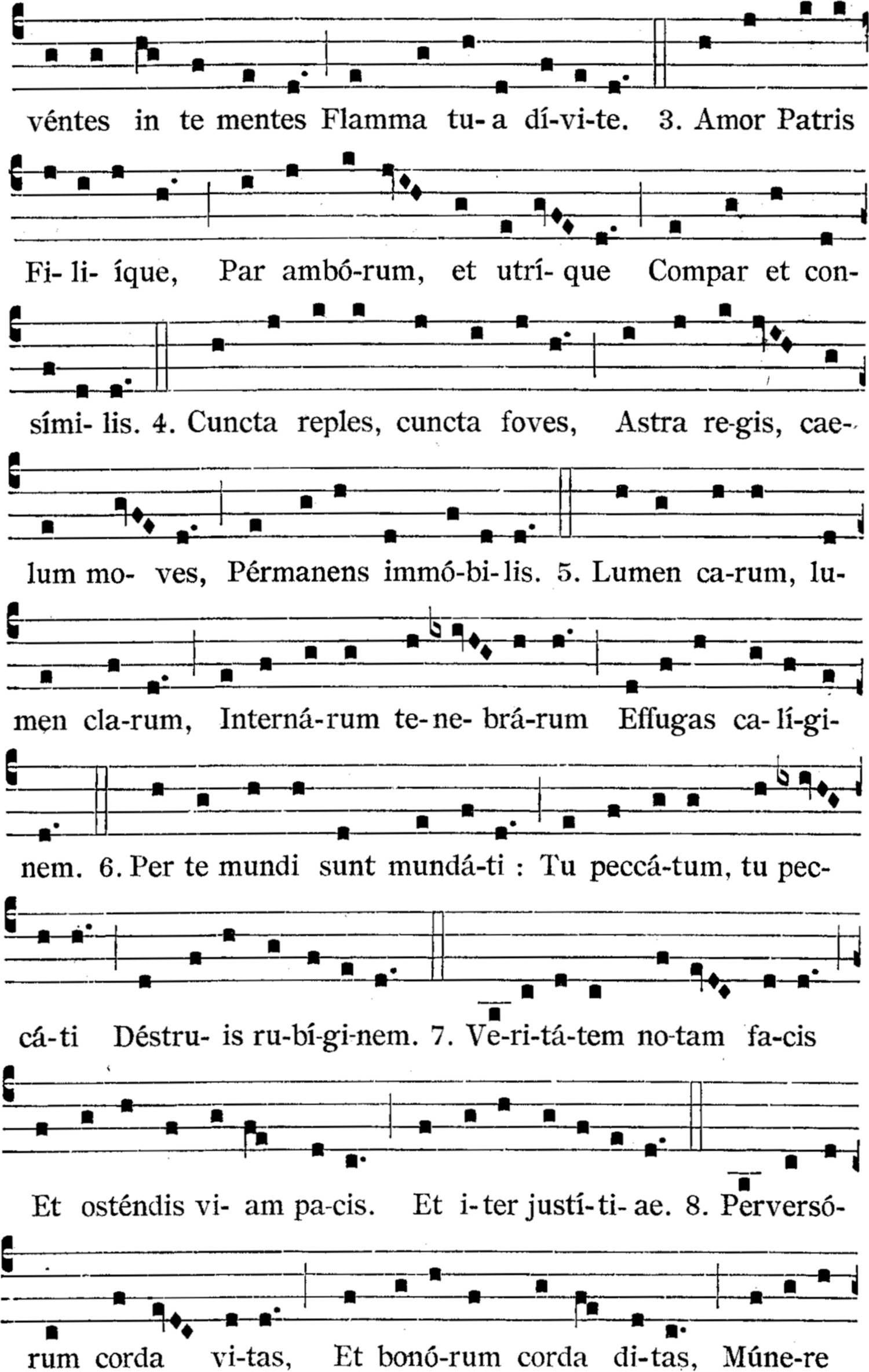
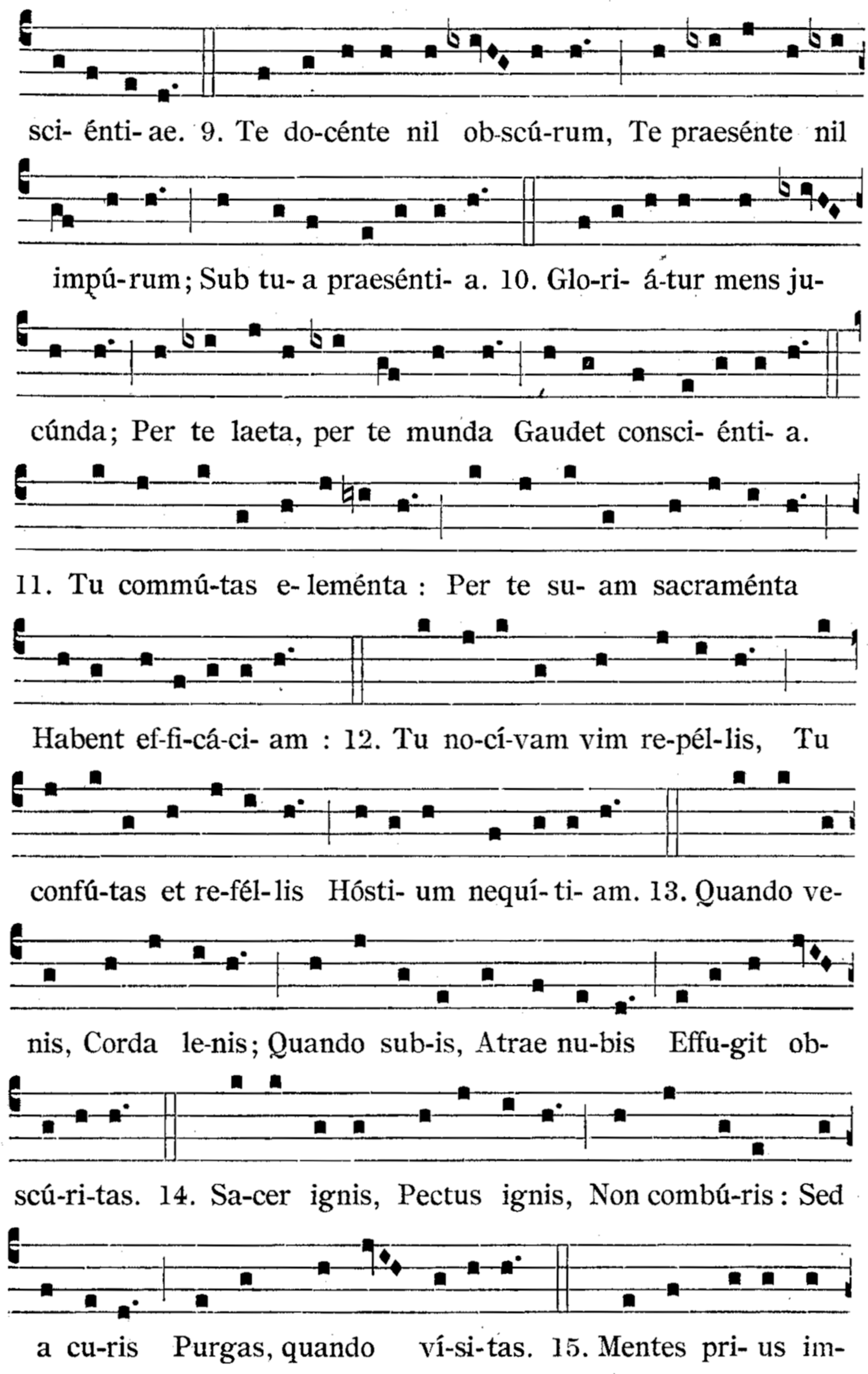
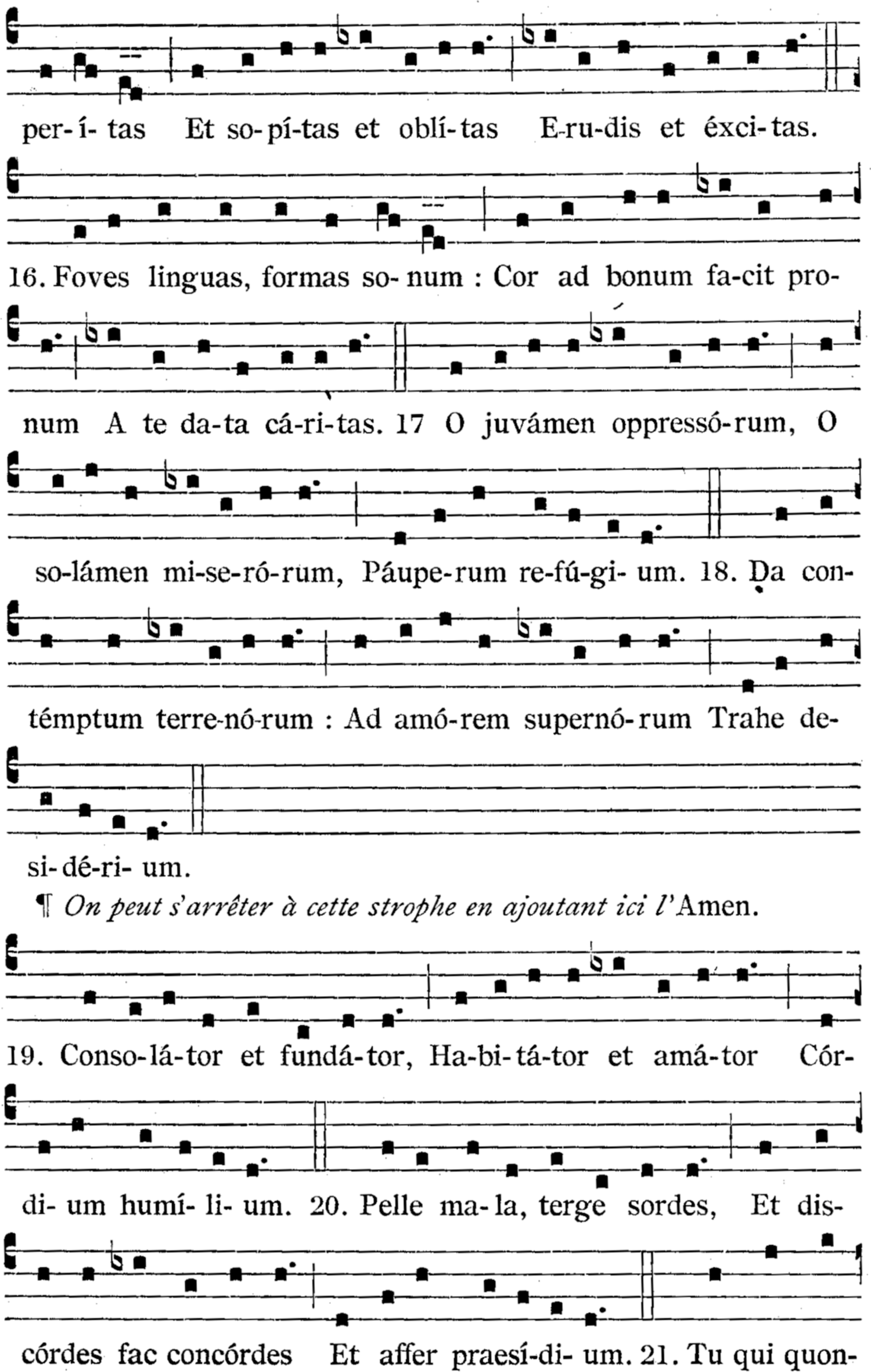
Today I would like to present the text and the chant of the Parisian sequence for Thursday in the Octave of Pentecost: Qui procedis ab utroque, by Adam of St. Victor.
The liturgical texts dedicated to the Holy Spirit have become relatively rare in the Latin Church. It may be interesting to renew our acquaintance with this medieval hymnographic corpus of such high quality, as this magnificent repertoire is so rich, both spiritually and musically. Here is how dom Gueranger introduces this prose in his Liturgical Year:
Here is the chant of this prose, Qui procedis ab utroque, from the excellent Proper of Paris published in 1923-1925:This great liturgical poet of the western Church has surpassed himself in what he has written on the Holy Ghost; and more than once, during the octave, we will select from his rich store. But the hymn we give to-day is not merely a composition of poetic worth; it is a sublime and fervent prayer to the Paraclete, whom Jesus has promised to send us, and whom we are now expecting. Let us make these sentiments of the devout poet of the twelfth century our own; let us imitate him in his longings for the holy Spirit, who is coming that He may renew the face of the earth, and dwell within us.
Here is a metrical translation by Digby S. Wrangham:
From the Son and from the Father,
Who proceedest equally!
Eloquent our utterance render;
With Thy splendour
Bright engender
In our hearts true warmth for Thee.
Love of Father, Son, together;
Equal of them both; with either
One: the same in every part!
All Thou fillest, all Thou lovest,
Stars Thou rulest, heaven Thou movest,
Though immovable Thou art.
Light the dearest!
Light the clearest!
Off Thou scarest,
As Thou nearest,
From the heart its gloomy night:
All the pure Thou purifiest,
Thou it is that sin destroyest,
And its mildew's baleful blight.
Knowledge of the truth Thou spreadest;
On the way of peace Thou leadest,
And the path of righteousness.
From Thee thrusting
Hearts unruly,
Thou all trusting
Hearts and holy
Dost with gifts of wisdom bless.
When Thou teachest,
Nought obscure is!
Where Thou reachest,
Nought impure is;
And, if present Thou wilt be,
Hearts in Thee then blithely glory,
And the conscience joys before Thee,
Gladdened, purified by Thee.
Elements their mystic dower,
Sacraments their saving power,
But through Thee alone possess:
What can harm us Thou repellest,
Thou exposest and Thou quellest,
Adversaries' wickedness.
Where Thou lightest,
Hearts are brightest;
Gloom-enshrouded
Clouds that brooded
There, before Thee disappear;
Fire all-holy!
Hearts Thou truly
Never burnest,
But thence yearnest,
When Thou comest, cares to clear.
Thou the heart, experience needing,
Languor pleading,
Little heeding,
Dost instruct and rouse to right;
Speeches framing, tongues endowing,
And bestowing
Love all-glowing,
Hearts Thou mak'st in good delight.
Sustentation
In dejection!
Consolation
In affliction!
Only refuge of the poor!
Give us scorn for things terrestrial,
And to care for things celestial
Lead our longings more and more!
Comfort wholly,
Founder solely,
Inmate truly,
Lover throughly,
Of those hearts that bow to Thee!
Concord, where is discord, raising,
Ills thence chasing,
Guilt effacing,
Bring us true security!
Thou, Who once by visitation
Didst inform, and consolation
To Thy scared disciples give!
Deign Thou now to come unto us:
If it please Thee, comfort show us,
And all nations that believe!
One excelling
Greatness sharing,
One as well in
Power appearing,
But one God three Persons are.
Coming forth from two together,
Thou co-equal art with either,
No disparity is there.
Such as is the Father Thou art;
Since so great and such Thou now art,
By Thy servants unto Thee,
With the Sire, and Son, in heaven
Our Redeemer, praise be given,
As is due, most reverently! Amen.
Tuesday, June 03, 2025
A Sequence for the Ascension
Gregory DiPippoFor the ongoing feast of the Ascension, here is a sequence for it which was sung in the Uses of Sarum, York, and Hereford in England, and in those of Paris and Sens in France. (Despite its great antiquity, and its status as the capital of France, Paris was a suffragan diocese to Sens until 1622.) It is attributed, though far from certainly, to the Blessed Hermanus Contractus (Herman the Cripple), better known as the author of the great Marian antiphons Alma Redemptoris Mater and Salve, Regina. This recording is interesting for the way it alternates between a single voice and the full choir; in fact, sequences were most typically designed to be sung in some form of alternation like this. The Latin text with English translation, taken from Sequences from the Sarum Missal, with English Translations, by Charles Buchanan Pearson (Bell and Daldy; London, 1871. Click images to enlarge.)
Saturday, April 26, 2025
The Easter Sequence Laudes Salvatori
Gregory DiPippoThe traditional sequence for Easter, Victimae Paschali laudes, is rightly regarded as one of the greatest gems of medieval liturgical poetry, such that it was even accepted by the Missal of the Roman Curia, which had only four sequences, a tradition which passed into the Missal of St Pius V. But of course, sequences as a liturgical genre were extremely popular elsewhere, and many, many more were composed for the most important feast of the year. And thus, for example, we find that in the Sarum Missal, there is a different sequence for each day of the Easter octave, and Victimae Paschali was sung only on Friday.
One of the most common Easter sequences, Laudes Salvatori voce modulemur, was written at the beginning of the tenth century by a monk of the abbey of St Gallen in Switzerland, known as Notker Balbus (or ‘Balbulus’, i.e., the Stammerer), to whom the Victimae Paschali has also been attributed. At Sarum it was sung on Low Sunday, but in other places on Easter itself.Saturday, April 06, 2024
Blessed Notker the Stammerer
Gregory DiPippoToday is the last day on which the sequence Victimae Paschali Laudes is sung at Mass this year, and also the feast day of its long-reputed author, Blessed Notker, known as “Balbulus – the Stammerer” in Latin, who died on this day at the age of about 72, in the year 912.
He was born to a wealthy family around the year 840, near the abbey of Saint Gall in Switzerland, where he was educated from early childhood. This was one of the greatest centers of learning and culture in Europe, and to this day, houses an important collection of manuscripts which includes some of the oldest witnesses to the tradition of Gregorian chant. Notker became a great scholar and musician, while also serving the abbey as librarian and guest master, and was offered the abbacy of several other houses, but refused all such preferments. He is generally believed to be the author of a collection of anecdotes known as the Gesta Caroli Magni, one of the earliest sources of information on the life of Charlemagne, a poetic biography of his abbey’s founder, and a martyrology, inter alia.![]() |
| A portrait of Notker in a manuscript of the 10th century; public domain image from Wikimedia Commons. |
Thursday, March 21, 2024
A Sequence for the Feast of St Benedict
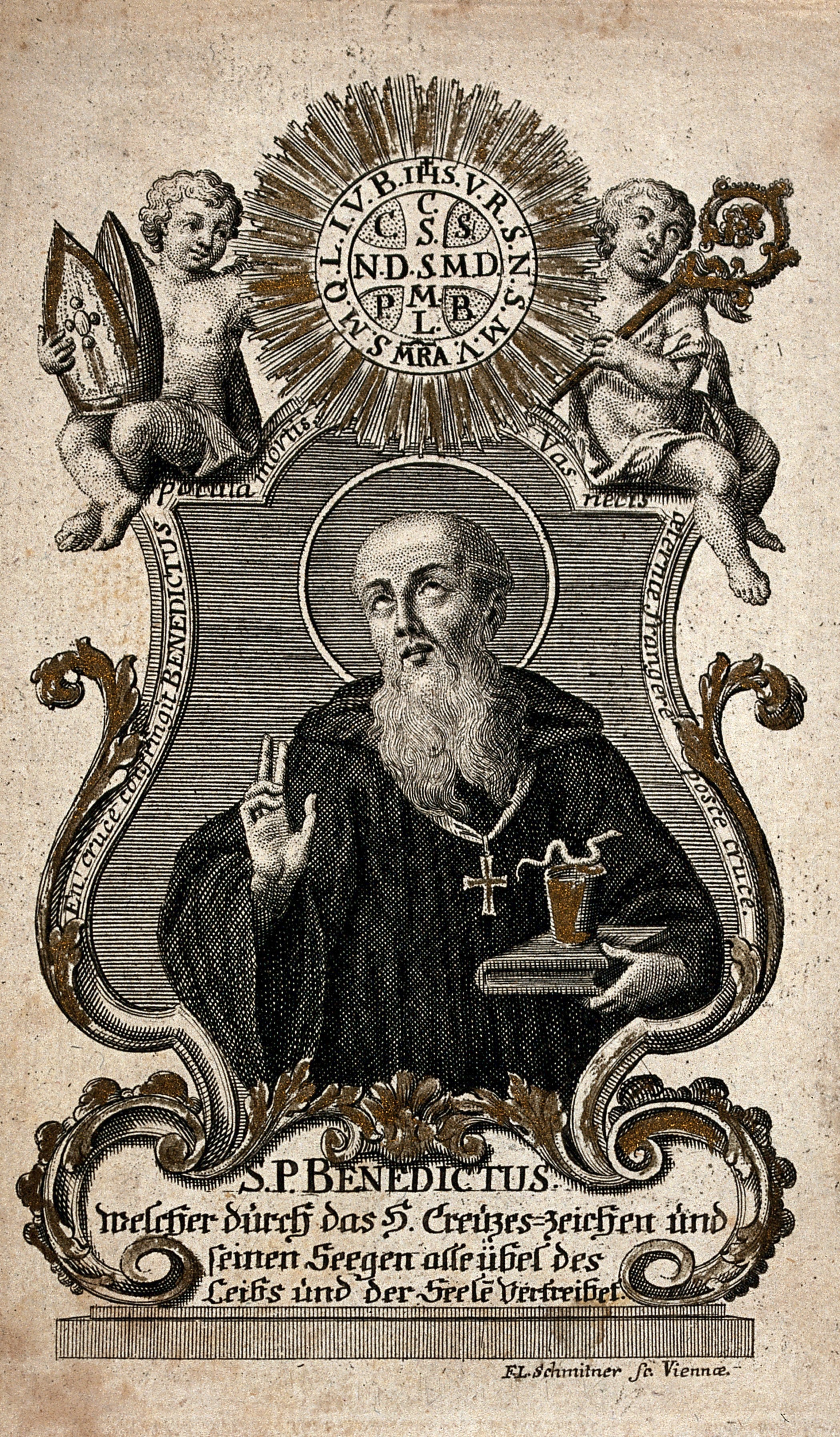
Gregory DiPippoFor the feast of St Benedict, here is the Sequence which is sung at his Mass by those Benedictines who use Missale Romano-Monasticum. It is first documented in a missal printed for the use of the Monte Cassino Benedictine congregation in 1506, and was later adopted by some other congregations, including the Cluniacs. The opening words were originally “Laeta quies – the happy rest”, since March 21 is the day of Benedict’s death; for the use of those who keep the feast on July 11th, this is changed to “Laeta dies – the happy day.” (This variant is attested very close to the time of its composition.)
(My dull prose translation)
![]() |
| St Benedict at Prayer in the Cave, by the anonymous Master of Messkirch, ca. 1520-40. Early on in his career as a monk, St Benedict withdrew to a cave at Subiaco, and was fed by another monk called Romanus, who was the only who knew he was there. In the upper part, a devil is breaking the bell which Romanus would ring to let Benedict know that he had arrived. (Public domain image from Wikimedia Commons.) |
Friday, August 04, 2023
The Sequence of St Dominic
Gregory DiPippoFor the feast of St Dominic, here is a very nice recording of In caelesti hierarchia, the Sequence for his Mass in the Dominican Missal. Dominic was, of course, the very first Saint of his order to be canonized; this was done in 1234 by Pope Gregory IX (1227-41), who had known him personally, and declared that he no more doubted his sanctity than he did that of Saints Peter and Paul. The author of the Sequence is unknown; it is attested in Dominican liturgical sources that predate the codification of their Use which took place in the mid-1250s, and still forms the basis of it to this day.
| In caelesti hierarchia, nova sonet harmonia, novo ducta cantico: Cui concordet in hac via, nostri chori melodia, congaudens Dominico. Ex Aegypto vastitatis, virum suae voluntatis vocat Auctor saeculi, In fiscella paupertatis, flumen transit vanitatis, pro salute populi. In figura catuli, praedicator saeculi matri praemonstratur; Portans ore faculam, ad amoris regulam populos hortatur. Hic est novus legislator, hic Elias aemulator, et detestans crimina. Vulpes dissipat Samsonis, et in tuba Gedeonis, hostis fugat agmina. A defunctis revocatum, matri vivum reddit natum, vivens adhuc corpore: Signo crucis imber cedit; turba fratrum panem edit, missum Dei munere. Felix, per quem gaudia tota jam ecclesia sumens exaltatur. Orbem replet semine, in caelorum agmine tandem collocatur. Jacet granum occultatum, sidus latet obumbratum: sed Plasmator omnium, Ossa Joseph pullulare, sidus jubet radiare, in salutem gentium. O quam probat carnis florem, omnem superans odorem, tumuli fragrantia! Aegri currunt, et curantur, caeci, claudi reparantur, virtutum frequentia. Laudes ergo Dominico personemus mirifico, voce plena: Clama petens suffragia, ejus sequens vestigia plebs egena. Sed tu pater pie, bone, pastor gregis, et patrone, prece semper sedula, Apud curiam summi Regis, derelicti vices gregis commenda per saeculi. Amen. Alleluia. |
Now new canticles ascending, And new strains harmonious blending, ’Mid the hierarchies of heaven: With our earthly choirs according, Join this festival in lauding, To our holy father given. For the welfare of the nations, Called from Egypt’s desolations By their God and Maker, he Was the chosen one and glorious, Passing o’er the wave victorious, In the ark of poverty. Ere his birth, the preacher brother Is prefigured to his mother By a hound with torch of fire; So her son, his torch-light bearing, Midst the nations dark appearing, Leads them on with full desire. He, another Moses, teacheth, And Elias-like he preacheth, Sin denouncing with his might Samson-like his foxes sending, And the foe his trumpet rending, Gedeon-like he put to flight. From death’s sleep a child he waketh Whom alive his mother taketh: When the holy sign he makes, Cease the floods; and bread from heaven For his fainting sons is given Which into their hands he breaks. Happy he, whose elevation, Is our mother’s exa1tation, Is her joy and weal indeed. To his home by saints attended, Hath his soul for aye ascended, Having filled the earth with seed. Like the hidden grain he bideth Like the clouded star he hideth: But the Maker of the spheres, Joseph’s dry bones readorning, Will reveal the star of morning, Till earth’s darkness disappears. O surpassing fragrance, telling Of the virtues of that dwelling, Which within the tomb doth lie! Thither flock the sick for healing, Blind and lame the grace revealing That his body lives for aye. Wherefore now with jubilation Bless and praise him, every nation, Cry aloud, and crave his care: Sing Dominic the glorious, Sing Dominic victorious, Claim his help and promised prayer. And thou, father, kind and loving, Shepherd, patron, unreproving, Kneeling heaven’s high throne before, Lift for us thy voice prevailing, To our King with prayers availing Evermore and evermore. Amen. Alleluia. |
Monday, November 21, 2022
The “Barbarous” Sequence of the Presentation
Gregory DiPippoThe fact that this could find its way into print in a serious publication demonstrates what an atrocious state liturgical scholarship was when Thurston wrote these notes in the 1930s, and still was when Attwater put his hand to revising them in the 1950s. And indeed, the entire entry on the feast is grossly lacking. It states that it is “not very ancient”, while simultaneously asserting that it probably originated with the dedication of a church to the Virgin Mary in Jerusalem in 543, making it older than a great many other feasts on the calendar in both East and West. [1] But it fails to mention that it is counted among the Twelve Great Feasts of the Byzantine Rite, which celebrates it with a fore-feast and an after-feast, the equivalent of the Roman Rite’s vigil and octave.
![]() |
| An icon of the Entrance of the Mother of God into the Temple, as the feast is called in the Byzantine Rite. Note that the Virgin is represented as a small adult, rather than as a child; the reason for this is give below. (Cretan, 15th century; public domain image from Wikimedia Commons.) |
![]() |
| A page of a Roman Missal printed at Venice in 1521, in which the Mass of the Presentation consists solely of the aforementioned rubric in the upper part of the right column. |
Here then is the text of the sequence; the first letters of each stanza form an acrostic: “Ave Maria; benedico te. Amen.” As told in the Protoevangelium, when she entered the temple at the age of three, the Virgin already walked as if she were fully mature; this is the reason why in icons of the Presentation, she is represented not as a toddler, but as a small adult. The sequence also refers to the tradition that when it came time for the maidens who served in the temple to marry, St Joseph was chosen as her spouse because a flower bloomed on his walking staff, as did the rod of Aaron in Numbers 17. The translation is taken from the English edition of the apposite volume of Dom Gueranger’s Liturgical Year, with several modifications. Unfortunately, but not surprisingly, there is no recording available on YouTube.
![]() |
| The Marriage of the Virgin, ca. 1475-95, by an anonymous Netherlandish painter known as the Master of the Tiburtine Sybil. In the background are various other episodes from the Protoevangelium of James: in the upper middle, Joachim walks away from the temple, as his offering is rejected, since he is believed to be disfavored by God because of his failure to beget a child; he then goes out into the desert, and in the far background, an angel comes and tells him to return to his wife, and that they will conceive a child; Joachim and Anne are reunited at the gate of Jerusalem. At the left, the birth of the Virgin, and opposite, Her entry into the temple, with Joachim and Anne looking on behind her. (Public domain image from Wikimedia Commons.) |
| Altissima providente, Cuncta recte disponente, Dei sapientia: |
As the Wisdom of God, foreseeing the greatest mysteries, disposeth all things rightly: |
| Uno nexu coniugatis Ioachim et Anna gratis Iuga sunt sterilia. |
Joachim and Anne are united in wedlock, but their union is sterile. |
|
Ex cordis affectu toto Domino fideli voto Se strinxerunt pariter: |
With all the heart’s affection they together bind themselves by faithful vow to the Lord: |
|
Mox si prolem illis dare Dignetur, hanc dedicare In templo perenniter. |
that if He deign to give them a child, they soon will consecrate it for ever in the temple. |
| Angelus apparuit Lucidus, qui docuit Exaudita vota, |
A bright Angel appears, and tells them their prayers are heard |
| Regis summi gratia Ut detur his filia Gratiosa tota. | By the most high King’s grace, a daughter shall be given them, full of grace. |
| In utero consecrata, Miro modo generata, Gignet mirabilius |
Consecrated in the womb born in a wondrous manner, more wondrously will she give birth |
|
Altissimi Patris natum, Virgo manens, qui reatum Mundi tollet gratius. |
to the Son of the Father most high, remaining a virgin; and He shall freely take away the world’s guilt. |
| Benedicta virgo nata, Templo trina præsentata, Ter quinis gradibus |
Blessed is the Virgin born, at three years presented in the temple; by the fifteen steps |
| Erecta velox ascendit, Et uterque parens tendit, Ornando se vestibus. |
Swift and erect, she ascends adorned with her beautiful robe, as her parents’ watch. |
| Nova fulsit gloria Templo, dum eximia Virgo præsentatur. |
The temple shines with a new glory, when the august Virgin is presented; |
| Edocta divinitus, Visitata cælitus Angelis lætatur. |
Taught by God, Visited from heaven, she rejoices with the Angels. |
|
Dum ut nubant iubet multis Princeps puellis adultis, Primo virgo renuit. |
When the chief (priest) bids the maidens of adult age to marry, the Virgin at first refuses; |
|
Ipsam namque devovere Parentes, ipsaque manere Virgo voto statuit. |
for her parents have devoted her to God, and she herself has vowed to remain a virgin. |
| Consultus Deus responsum Dat ut virgo sumat sponsum, Quem pandet flos editus. |
God, being consulted, answers that the Virgin shall take that spouse whom the blooming flower shows; |
| Ostensus Ioseph puellam Ad parentum duxit cellam, Nuptiis sollicitus. | Joseph thus chosen weds the maiden, and leads her to his parents’ home, careful of the marriage. |
| Tunc Gabriel ad virginem Ferens conceptus ordinem, Delegatur. |
Then Gabriel is sent to the Virgin, bearing (God’s) command of her conception; |
|
Erudita stat tacita, Verba quam sint insolita Meditatur. |
the prudent Virgin stands silent, pondering over the strangeness of the message. |
| At cum ille tradidit Modum, virgo credidit, Sicque sacro Flamine |
But when he explains how this shall be, she believes him; and thus by the Holy Spirit |
| Mox Verbum concipitur, Et quod nusquam clauditur, Conditur in virgine. |
Soon the Word is conceived, and He whom no space can contain is concealed within the Virgin. |
| Ecce virgo singularis, Quanta laude sublimaris, Quanta fulges gloria. |
Behold, peerless maiden, with what great praise thou are exalted, with what great glory thou shinest. |
| Nos ergo sic tuearis, Ut fructu quo gloriaris Fruamur in patria. Amen. |
Therefore, do so protect us, that in our fatherland we may enjoy the fruit, whereby thou art so honored. Amen. |
[1] This church, known as the “nea ekklesia – the new church”, or simply the Nea, was a project of the emperor Justinian, and was located very close to the site of the temple of Solomon into which the Virgin entered, the event celebrated by today’s feast. Its dedication was celebrated on November 20, 543; it seems likely, therefore, that the Presentation came into existence as a concomitant feast for the anniversary of this dedication, as the Exaltation of the Cross did for the dedication of the Holy Sepulcher. Thurston and Attwater inexplicably given no indication of any of this. (The Nea no longer exists; another church of the same name was built in Constantinople in the later 9th century, and has also disappeared.)
![]() |
| Jerusalem in a mosaic map in the floor of the church of St George in Madaba, Jordan, ca. 570 A.D., discovered in 1884. The main street is clearly visible running through the middle of it; the Nea Ekklesia is the building which fronts on it at the end of the street on the right. (Public domain image from Wikimedia Commons.) |
Saturday, October 22, 2022
The Dominican Sequence for the Dedication of a Church
Gregory DiPippoEarlier this year, I addressed the persistent misunderstanding that the liturgical reform of St Pius V removed the great majority of sequences from the Mass. The reality is that the Roman Missal had always had very few sequences, and as various churches and orders adopted it, they adopted its sparse repertoire of them along with it. However, some churches and orders that did not adopt the Roman Missal nevertheless reformed their own missals in one way or another in imitation of it. One of the most common such reforms was to take out of most of the sequences, and in 1687, this was done to the Dominican Missal when the master general Antonin Cloche had a new edition published. (The Premonstratensians had done something similar in the 1620s.)
![]() |
| The Sequence Rex Salomon in the Codex of Humbert of Romans, the prototype manuscript of the medieval Dominican liturgy. (Rome: Santa Sabina MS XIV L1). This manuscript was compiled by the Master of the Order Humbert of Romans, in accord with the commission of the Dominican General Chapter held at Buda in 1254, and approved by the General Chapter of Paris in 1256. The sequence begins with the large blue R in the left column. |
Monday, July 11, 2022
The Feasts of St. Benedict and Their Proper Texts in Benedictine Churches
Peter KwasniewskiHowever, Benedictines who keep their own traditions rejoice in three proper Masses for their holy founder: one on March 21; another on July 11; and a third on July 18 for the octave. I thought it would interest NLM readers to see the proper texts for all three, which are conveniently found in an appendix to the St. Andrew Daily Missal (reprint of the 1945 edition). I do not know if any other founder of a religious “order” (taking that term in the broadest possible sense) enjoys such a profusion of proper Masses! The texts are extraordinarily rich and well-suited to the saint, a luminous exemplar of how the usus antiquior coalesces its changing texts around the figure of a saint as an icon of Christ, as a figure that fulfills in his life the message of Sacred Scripture.
I would draw the reader's attention particularly to the Sequence and the proper Preface.
We should bear in mind thatt the July 11th feast as the translation of St Benedict’s relics, while very old, was not universally celebrated by the OSB before the 19th century, and the recasting of it as the “solemnity of St Benedict” with an octave is rather recent. E.g., it is not in this edition of the breviary from 1831.
UPDATE (7/12/22): I have been informed by several people that there is yet another feast of St. Benedict observed in some monasteries, namely, a December 11th "In Veneratione et Repositione Sacrae Reliquiae Capitis SS. Patriarchae Nostri Benedicti." I have not been able to get hold of the Propers but here's a screenshot that was shared with me:
March 21
The March 21st propers are conveniently available as a PDF online, from which the following images have been extracted.
Posted Monday, July 11, 2022
Labels: Benedictine, Proper of the Mass, religious life, sanctoral cycle, Sequences, St. Benedict
Thursday, June 09, 2022
An Old Parisian Sequence for Thursday in the Octave of Pentecost
Gregory DiPippoThis article by Henri de Villiers was originally posted in 2014.
Here is how Paris used to arrange the sequences during the octave of Pentecost:
- Pentecost Sunday: Fulgens præclara Paraclyti Sancti
a subdivision of an old French prose for Easter, prior to the year 1000. - Pentecost Monday: Sancti Spiritus adsit nobis gratia
by Notker the Stammerer (c. 840 † 912). - Pentecost Tuesday: Lux jucunda, Lux insignis
by Adam of St. Victor († 1146). - Pentecost Wednesday: Simplex in essentia
by Adam of St. Victor. - Pentecost Thursday: Qui procedis ab utroque
by Adam of St. Victor. - Pentecost Friday: Alma chorus Domini
an anonymous French composition, prior to 1000. - Pentecost Saturday Pentecost: Veni, Sancte Spiritus
by Stephen Langton (c. 1150 † 1228).
Many other proses were subsequently built on the rhythms and songs of Adam; especially well know is the Lauda Sion for Corpus Christi, modeled by St. Thomas Aquinas on the Laudes Crucis by Adam of St. Victor.
Today I would like to present the text and the chant of the Parisian sequence for Thursday in the Octave of Pentecost: Qui procedis ab utroque, by Adam of St. Victor.
The liturgical texts dedicated to the Holy Spirit have become relatively rare in the Latin Church. It may be interesting to renew our acquaintance with this medieval hymnographic corpus of such high quality, as this magnificent repertoire is so rich, both spiritually and musically. Here is how dom Gueranger introduces this prose in his Liturgical Year:
Here is the chant of this prose, Qui procedis ab utroque, from the excellent Proper of Paris published in 1923-1925:This great liturgical poet of the western Church has surpassed himself in what he has written on the Holy Ghost; and more than once, during the octave, we will select from his rich store. But the hymn we give to-day is not merely a composition of poetic worth; it is a sublime and fervent prayer to the Paraclete, whom Jesus has promised to send us, and whom we are now expecting. Let us make these sentiments of the devout poet of the twelfth century our own; let us imitate him in his longings for the holy Spirit, who is coming that He may renew the face of the earth, and dwell within us.
Here is a metrical translation by Digby S. Wrangham:
From the Son and from the Father,
Who proceedest equally!
Eloquent our utterance render;
With Thy splendour
Bright engender
In our hearts true warmth for Thee.
Love of Father, Son, together;
Equal of them both; with either
One: the same in every part!
All Thou fillest, all Thou lovest,
Stars Thou rulest, heaven Thou movest,
Though immovable Thou art.
Light the dearest!
Light the clearest!
Off Thou scarest,
As Thou nearest,
From the heart its gloomy night:
All the pure Thou purifiest,
Thou it is that sin destroyest,
And its mildew's baleful blight.
Knowledge of the truth Thou spreadest;
On the way of peace Thou leadest,
And the path of righteousness.
From Thee thrusting
Hearts unruly,
Thou all trusting
Hearts and holy
Dost with gifts of wisdom bless.
When Thou teachest,
Nought obscure is!
Where Thou reachest,
Nought impure is;
And, if present Thou wilt be,
Hearts in Thee then blithely glory,
And the conscience joys before Thee,
Gladdened, purified by Thee.
Elements their mystic dower,
Sacraments their saving power,
But through Thee alone possess:
What can harm us Thou repellest,
Thou exposest and Thou quellest,
Adversaries' wickedness.
Where Thou lightest,
Hearts are brightest;
Gloom-enshrouded
Clouds that brooded
There, before Thee disappear;
Fire all-holy!
Hearts Thou truly
Never burnest,
But thence yearnest,
When Thou comest, cares to clear.
Thou the heart, experience needing,
Languor pleading,
Little heeding,
Dost instruct and rouse to right;
Speeches framing, tongues endowing,
And bestowing
Love all-glowing,
Hearts Thou mak'st in good delight.
Sustentation
In dejection!
Consolation
In affliction!
Only refuge of the poor!
Give us scorn for things terrestrial,
And to care for things celestial
Lead our longings more and more!
Comfort wholly,
Founder solely,
Inmate truly,
Lover throughly,
Of those hearts that bow to Thee!
Concord, where is discord, raising,
Ills thence chasing,
Guilt effacing,
Bring us true security!
Thou, Who once by visitation
Didst inform, and consolation
To Thy scared disciples give!
Deign Thou now to come unto us:
If it please Thee, comfort show us,
And all nations that believe!
One excelling
Greatness sharing,
One as well in
Power appearing,
But one God three Persons are.
Coming forth from two together,
Thou co-equal art with either,
No disparity is there.
Such as is the Father Thou art;
Since so great and such Thou now art,
By Thy servants unto Thee,
With the Sire, and Son, in heaven
Our Redeemer, praise be given,
As is due, most reverently! Amen.
Thursday, May 05, 2022
What Really Happened to the Sequences?
Gregory DiPippo![]() |
| A page of a Premonstratensian Missal printed in 1578, with a sequence for the feast of the Epiphany; in the next edition, this sequence is missing. |
![]() |
| The Mass of Easter Sunday in a Cistercian Missal printed in 1486, without the Victimae Paschali. |
![]() |
| The tomb and monument of Pope St Pius V in the basilica of St Mary Major in Rome. |


.jpg)