Thursday, October 02, 2025

The Feast of the Guardian Angels 2025

The Angel of the Lord came down into the furnace together with Azariah and his fellows, and smote the flame of the fire out of the furnace, * and the fire touched them not at all, nor did it hurt them. ℣. Blessed be their God, Who sent His Angel, and delivered His servants that trusted in Him! And the fire... (The fifth responsory of Matins)

An illustration in a manuscript of The Mirror of Human Salvation (Speculum Humanae Salvationis), a popular theological and devotional work of the early 14th century; 1360, author unknown. In the upper part, the Church Triumphant, Suffering and Militant, and the damned in hell; in the lower, the three children in the furnace with the angel, from Daniel 3. (Public domain image from Wikimedia Commons.) 
℟. Angelus Dómini descendit cum Azaría et sociis ejus in fornácem, et excussit flammam ignis de fornáce, * et non tétigit eos omníno ignis, neque contristávit. ℣. Benedictus Deus eórum, qui misit Angelum suum, et eruit servos suos qui credidérunt in eum. Et non tétigit eos...

Wednesday, October 02, 2024

St Robert Bellarmine’s Hymn for the Guardian Angels

St Robert Bellarmine was born in 1542, and in his youth, received a classical education typical of his era, showing himself to be a particular bright pupil at a very early age. It was an essential part of education in those days that people were trained not only to read and comment intelligently upon the Latin classics, but also to write their own Latin in both prose and verse, and Robert was already skilled at this as a boy. In his early years in the Society of Jesus, which he entered at age 18, he taught the classics in the order’s school in Florence. When he was transferred to Mondovi in Piedmont, he discovered that he was supposed to teach Cicero and Demosthenes, although he knew hardly any Greek at all; he therefore taught himself in one night the grammar lesson he was supposed to deliver the next day. In the midst of his vast output of theological writings, for which he was named a Doctor of the Church in 1931, and his many other scholarly achievements, he also continued to write poetry in both Latin and Italian throughout his life.

St Robert Bellarmine (Public domain image from Wikipedia.)
Formal liturgical devotion to the Guardian Angels is found sporadically in the Middle Ages and Renaissance, but really began to establish itself in the Counter-Reformation period, of which St Robert was such an important protagonist. Pope Paul V (1605-21), who kept him as one of his most valued counselors, was also the first post-Tridentine Pope to formally approve a feast of the Guardian Angels, which he granted to the Holy Roman Empire at the request of Ferdinand II of Austria. When the feast was extended to the universal church by Pope Clement X in 1670, it was given a proper Office, which includes two hymns composed by St Robert: Custodes hominum, which is sung at Matins and both Vespers, and Aeterne rector siderum for Lauds.

Ancient Greek and Latin poetry was not based on rhyme, which was considered a blemish on verse in antiquity, but on alternations of long and short syllables, according to various established patterns. The oldest Christian hymns, such as those of St Ambrose or Venantius Fortunatus, were similarly constructed, although often rather more loosely than in the classical period. In the Middle Ages, when Latin vowel quantities were mostly not heard or pronounced, rhyme established itself as the norm for new liturgical composition, and even extended itself beyond the various types of hymns into non-metrical forms like responsories. The Renaissance, however, which sought to imitate the classical world in all the arts, rejected rhyme and returned to metrical composition based on vowel quantity; this classicizing spirit in the use of Latin lasted much longer than the Renaissance itself did, and is found in new liturgical compositions of every period, up to and including the most recent texts of the post-Conciliar rite. In the same spirit, Pope Urban VIII (1623-44) had the whole corpus of hymns in the Roman Breviary revised and classicized, giving rise to the famous remark “Accessit Latinitas, recessit pietas - Latinity came in, piety went out.”

To judge by St Robert’s compositions for the Guardian Angels, it is a pity that he did not live to contribute to Pope Urban’s project, which might have been more successful with his input. His vocabulary is almost entirely within the established usage of Christian Latinity. The metrical form is one used by Horace in his odes, called the Third Asclepiadean, but he mostly avoids the contorted word order which the classical poets and their later imitators often employed. Here is a splendid recording by the Ensemble Venance Fortunat, in alternating chant and polyphony; a pure Gregorian version sung by the Gloriae Dei Cantores, alternating women’s and men’s voices, is given below. The English translation is that of Alan Gordon McDougall (1896-1965).

Custodes hominum, psallimus
Angelos,
Naturae fragili quos Pater addi-
dit,
Caelestis comites, insidianti-
bus,
Ne succumberet hostibus.
Angel guardians of men,
spirits and powers we sing,
Whom our Father hath sent,
aids to our weakly frame,
Heavenly friends and guides,
help from on high to bring,
Lest we fail through
the foeman’s wile.
Nam, quod corruerit proditor
angelus,
Concessis merito pulsus hono-
ribus
Ardens invidia pellere nititur
Quos caelo Deus advocat.
He, the spoiler of souls,
angel-traitor of old,
Cast in merited wrath out
of his honoured place,
Burns with envy and hate,
seeking their souls to gain
Whom God’s mercy
invites to heaven.
Huc, custos, igitur pervigil ad-
vola,
Avertens patria de tibi credita
Tam morbis animi quam requi-
scere
Quidquid non sinit incolas.
Therefore come to our help,
watchful ward of our lives:
Turn aside from the land,
God to thy care confides
Sickness and woe of soul,
yea, and what else of ill
Peace of heart
to its folk denies.
Sanctae sit Triadi laus pia jugi-
ter
Cujus perpetuo numine machi-
na
Triplex haec regitur, cujus in
omnia
Regnat gloria saecula. Amen.
Now to the Holy Three
praise evermore resound:
Under whose hand divine
resteth the triple world
Governed in wondrous wise:
glory be theirs and might
While the ages unending run.

A different and somewhat looser English version, by Fr Edward Caswall. (Fr Caswall, born in 1814, was an Anglican clergyman who converted to Catholicism in 1847. After the sudden death of his wife in 1849, he entered the Birmingham Oratory in 1850; he was ordained priest two years later, and died in 1878. He was a talented poet, and many of his English translations of the traditional Latin hymns were incorporated by John Crighton-Stuart, the Third Marquess of Bute, into his monumental English version of the Roman Breviary, including this one.)

Praise we those ministers celestial
Whom the dread Father chose
To be defenders of our nature frail,
Against our scheming foes.

For, since that from his glory in the skies
Th’ Apostate Angel fell,
Burning with envy, evermore he tries
To drown our souls in Hell.

Then hither, watchful Spirit, bend thy wing,
Our country’s Guardian blest!
Avert her threatening ills; expel each thing
That hindereth her rest.

Praise to the trinal Majesty, whose strength
This mighty fabric sways;
Whose glory reigns beyond the utmost length
Of everlasting days. Amen.

Monday, October 03, 2022

Bulgakov on the Holy Guardian Angels

In this type of icon the guardian angel is shown holding and protecting the soul in his care

October 2 is the feast of the Holy Guardian Angels, although this year (in 2022) it was supplanted by the Seventeenth Sunday after Pentecost (or, in some places, the external solemnity of Our Lady of the Rosary). Each year I feel, more strongly than before, that we must turn our minds and hearts to our angel guardians and rekindle a warm devotion to these resplendent companions on our journey, persons to whom the Lord entrusts us from our conception onward, into, we hope, a joyous eternity of friendship. Indeed, we should consider consecrating ourselves to our guardian angels, as I explain here.

Readers of my recent work at NLM will be aware that I have a bit of a fascination with Sergius Bulgakov’s Spiritual Diary, recently translated into English for the first time and published by Angelico Press. Apart from a few stray anti-Roman comments, I found it a nourishing book to read, with many profound spiritual insights and (at times harrowing) accounts of the author’s spiritual struggles, which he seems to have “worked out” for himself through immersion in liturgical prayer—something I find entirely relatable and believable, as it has been my experience too over time.

I was particularly struck, reading it, at how often and how movingly Bulgakov’s mind turns to his guardian angel or to the angels in general. I have gathered the finest of these passages here for the reader’s edification.

The icons reflect a few of the different types that exist in the Byzantine tradition. It is rather difficult to find good images of guardian angels in Western art.

21.X.1924

Lord, here I begin a new day of your grace, a new page of life. Help me so that the day may not remain barren on account of my laziness, as has been true of most days of my life, and that it may not be covered over by my vile sins, both voluntary and involuntary, committed in knowledge and in ignorance,55 but grant that this day may be marked by even the smallest bit of service to You. Guard me and my dear friends through your holy angels on this day, shield them from every evil, grant it to all of them this day to fulfill Your will so that You may not repent, all-blessed Lord, that You gave us, unworthy as we are, this day of our life [cf. Gen. 6:6]. In the name of the Father, and of the Son, and of the Holy Spirit. (82)
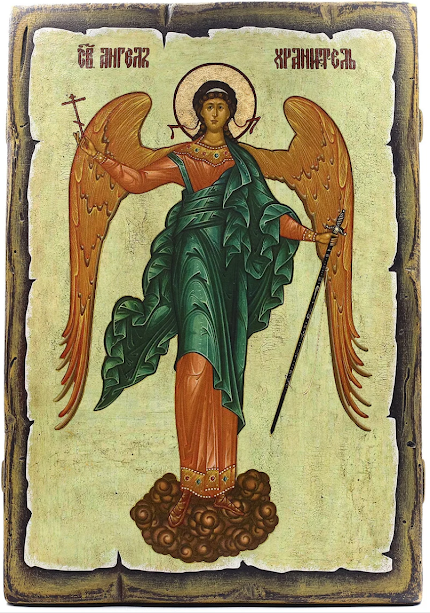
In this type of icon the guardian angel is shown with a cross in one hand and a sword in the other

11.XI.1924

We pray and appeal to our guardian angel. He is our friend, given to us by God, yet how faintly and weakly does our heart sense this friend, how little it gives thanks and how little it loves! If only our eyes could be opened, then we would constantly see him, the “guardian of our souls and bodies.” We would comprehend that, in those situations when—by some sort of confluence of circumstances—we were unexpectedly saved from deadly troubles or misfortunes, it was he who saved us, our luminous guardian. And when some good word or thought came into our hearts, it was he, our friend, who implanted this thought in us. Our entire life would appear to us not so lonely and gloomy as we see it, but as a life of two, a life with a loving, solicitous friend. Yes, our guardian angel has been appointed to us by God, but he is no superintendent; rather, he is a friend, he loves us, we are loved by him. And this is why, according to the Church’s pious belief, our angel “weeps” when we sin or perish, and he fights for us and with us (but only in the spiritual world) against the spirits who tempt us.

[…]

How can we open our hearts to our guardian angel, how can we come closer to him? By praying to him, thinking about him, reaching for him, by attending inwardly to that barely audible whisper that resounds in our hearts at the time of prayer and after it, in those blessed hours when prayer envelops us. For he is our “kind guide,” he guides us with open eyes while we walk blindly, for we do not know the world of spiritual beings that surrounds us, we do not know the beginning and the end of the path. Be attentive then and hearken to the secret whisper of your soul, for that is the voice of your guardian angel. (91)

Ask of God faith and patience. Ask of God a guardian angel for our souls and bodies. Know that without his help and protection we would be torn to pieces in body and soul by demons: the insanity of demoniacs and of Soviet rule is only a partial example of what demons wish to do to us due to their hatred of God, their hatred of God’s creation, their hatred of man. Before us would be revealed a world of dark powers (which we in our frivolity at times recklessly try to catch a glimpse of), all possible ailments would assault us, we would not last even one hour if we did not have an angel of peace, a faithful guide, a guardian of our souls and bodies. For the Apostle says that the devil, like a roaring beast, seeks whom he may devour [1 Pet. 5:8]. And can we really stand before him on our own strength without the constant protection of our guardian angel? (97)
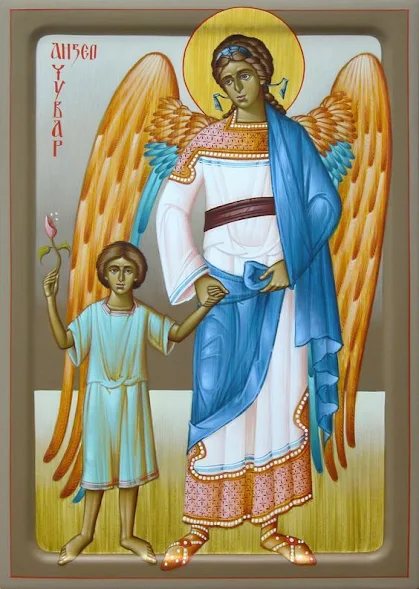
In this type of icon the angel is shown holding the hand of and guiding his charge

31.I.1925

Holy guardian angel, pray to God for us! What joy, what cheer, what comfort it is to know that we have a guardian angel, a true and buoyant and good friend, and that we may call upon him in prayer. Immediately after praying the canon to one’s guardian angel, there is such a freshness and clarity in the soul, as if he—a true guide and friend—had brushed me with his wing, as if my soul had drunk from the cup of celestial beings. And somehow, my soul joyfully knows and believes that it is he, yes, he, that is with me and with all of us. What immeasurable joy there will be when our eyes are opened and we see the entirety of our life, and, through it all, our faithful companion, preserving us and our sweet loved ones from plunder, from being torn apart, from evil demons and from those who serve them; what immeasurable joy there will be when we discover this love for us (which we have done absolutely nothing—besides being neglectful—to merit) and discover this prayer that is uttered for us, together with the angelic doxology, before the throne of the Most High. (116)

10.II.1925

Holy guardian angel, pray to God for us. What comfort and strength we find in prayer to our guardian angel, to our friend who is always close and who belongs to us. We must at least once in our life see our guardian-friend, we must find him in prayer so that we may carry in our hearts the joy and hope he brings. What fear, but also what great joy, await us when we will come to know him face to face, to see him after we cross the threshold of this earthly life, when we depart from the flesh. How great a teacher and guide in this life we have in him, who knows our life, who has lived all of it with us, who has wept over our falling and rejoiced in our rising again. He knows how to teach us the first lessons we need for the new life that awaits us after the grave. Oh, we shall not be alone there, we shall not be abandoned. For no human friendship—not even the loftiest and most tender—can compare with this spiritual friendship: disinterested, not disdainful of our foulness and stubbornness, but conquering all things through love. Even here he is with us, he stands behind us, covering us with his wings. Holy angel, our guardian appointed by the Lord, pray to God for us! (119)

Western depictions, where they exist, tend to be of the last sort

Sunday, October 02, 2022

The Feast of the Guardian Angels 2022

In all their affliction he was not troubled, * and the Angel of his presence saved them. V. In his love, and in his mercy he redeemed them, and he carried them and lifted them up all the days of old. And the Angel of his presence saved them. Glory be to the Father, and to the Son, and to the Holy Spirit. And the Angel of his presence saved them. (the 6th responsory of Matins)

The Guardian Angels, from the Almugávar Hours, ca. 1510-20, now in the Walters Art Museum in Baltimore.
R. In omni tribulatione eorum non est tribulatus, * et Angelus faciei ejus salvavit eos: V. In dilectione sua et in indulgentia sua ipse redemit eos, et portavit eos, et elevavit eos cunctis diebus sæculi. Et Angelus. Gloria Patri. Et Angelus.

Saturday, October 02, 2021

St Robert Bellarmine’s Hymn for the Guardian Angels

St Robert Bellarmine was born in 1542, and in his youth, received a classical education typical of his era, showing himself to be a particular bright pupil at a very early age. It was an essential part of education in those days that people were trained not only to read and comment intelligently upon the Latin classics, but also to write their own Latin in both prose and verse, and Robert was already skilled at this as a boy. In his early years in the Society of Jesus, which he entered at age 18, he taught the classics in the order’s school in Florence. When he was transferred to Mondovi in Piedmont, he discovered that he was supposed to teach Cicero and Demosthenes, although he knew hardly any Greek at all; he therefore taught himself in one night the grammar lesson he was supposed to deliver the next day. In the midst of his vast output of theological writings, for which he was named a Doctor of the Church in 1931, and his many other scholarly achievements, he also continued to write poetry in both Latin and Italian throughout his life.

St Robert Bellarmine (Public domain image from Wikipedia.) 
Formal liturgical devotion to the Guardian Angels is found sporadically in the Middle Ages and Renaissance, but really began to establish itself in the Counter-Reformation period, of which St Robert was such an important protagonist. Pope Paul V (1605-21), who kept him as one of his most valued counselors, was also the first post-Tridentine Pope to formally approve a feast of the Guardian Angels, which he granted to the Holy Roman Empire at the request of Ferdinand II of Austria. When the feast was extended to the universal church by Pope Clement X in 1670, it was given a proper Office, which includes two hymns composed by St Robert: Custodes hominum, which is sung at Matins and both Vespers, and Aeterne rector siderum for Lauds.

Ancient Greek and Latin poetry was not based on rhyme, which was considered a blemish on verse in antiquity, but on alternations of long and short syllables, according to various established patterns. The oldest Christian hymns, such as those of St Ambrose or Venantius Fortunatus, were similarly constructed, although often rather more loosely than in the classical period. In the Middle Ages, when Latin vowel quantities were mostly not heard or pronounced, rhyme established itself as the norm for new liturgical composition, and even extended itself beyond the various types of hymns into non-metrical forms like responsories. The Renaissance, however, which sought to imitate the classical world in all the arts, rejected rhyme and returned to metrical composition based on vowel quantity; this classicizing spirit in the use of Latin lasted much longer than the Renaissance itself did, and is found in new liturgical compositions of every period, up to and including the most recent texts of the post-Conciliar rite. In the same spirit, Pope Urban VIII (1623-44) had the whole corpus of hymns in the Roman Breviary revised and classicized, giving rise to the famous remark “Accessit Latinitas, recessit pietas - Latinity came in, piety went out.”

To judge by St Robert’s compositions for the Guardian Angels, it is a pity that he did not live to contribute to Pope Urban’s project, which might have been more successful with his input. His vocabulary is almost entirely within the established usage of Christian Latinity. The metrical form is one used by Horace in his odes, called the Third Asclepiadean, but he mostly avoids the contorted word order which the classical poets and their later imitators often employed. Here is a splendid recording by the Ensemble Venance Fortunat, in alternating chant and polyphony; a pure Gregorian version sung by the Gloriae Dei Cantores, alternating women’s and men’s voices, is given below. The English translation is that of Alan Gordon McDougall (1896-1965).


Custodes hominum, psallimus
Angelos,
Naturae fragili quos Pater addi-
dit,
Caelestis comites, insidianti-
bus,
Ne succumberet hostibus.
Angel guardians of men,
spirits and powers we sing,
Whom our Father hath sent,
aids to our weakly frame,
Heavenly friends and guides,
help from on high to bring,
Lest we fail through
the foeman’s wile.
Nam, quod corruerit proditor
angelus,
Concessis merito pulsus hono-
ribus
Ardens invidia pellere nititur
Quos caelo Deus advocat.
He, the spoiler of souls,
angel-traitor of old,
Cast in merited wrath out
of his honoured place,
Burns with envy and hate,
seeking their souls to gain
Whom God’s mercy
invites to heaven.
Huc, custos, igitur pervigil ad-
vola,
Avertens patria de tibi credita
Tam morbis animi quam requi-
scere
Quidquid non sinit incolas.
Therefore come to our help,
watchful ward of our lives:
Turn aside from the land,
God to thy care confides
Sickness and woe of soul,
yea, and what else of ill
Peace of heart
to its folk denies.
Sanctae sit Triadi laus pia jugi-
ter
Cujus perpetuo numine machi-
na
Triplex haec regitur, cujus in
omnia
Regnat gloria saecula. Amen.
Now to the Holy Three
praise evermore resound:
Under whose hand divine
resteth the triple world
Governed in wondrous wise:
glory be theirs and might
While the ages unending run.


A different and somewhat looser English version, by Fr Edward Caswall. (Fr Caswall, born in 1814, was an Anglican clergyman who converted to Catholicism in 1847. After the sudden death of his wife in 1849, he entered the Birmingham Oratory in 1850; he was ordained priest two years later, and died in 1878. He was a talented poet, and many of his English translations of the traditional Latin hymns were incorporated by John Crighton-Stuart, the Third Marquess of Bute, into his monumental English version of the Roman Breviary, including this one.)

Praise we those ministers celestial
Whom the dread Father chose
To be defenders of our nature frail,
Against our scheming foes.

For, since that from his glory in the skies
Th’ Apostate Angel fell,
Burning with envy, evermore he tries
To drown our souls in Hell.

Then hither, watchful Spirit, bend thy wing,
Our country’s Guardian blest!
Avert her threatening ills; expel each thing
That hindereth her rest.

Praise to the trinal Majesty, whose strength
This mighty fabric sways;
Whose glory reigns beyond the utmost length
Of everlasting days. Amen.

Wednesday, November 04, 2020

The Feast of All Saints 2020: The Angels

From the Breviary according to the use of the Roman Curia, 1529, the continuation of the sermon for the fourth day in the Octave of All Saints.

The most blessed spirits of the heavenly fatherland, our fellow citizens, the first-fruits of God’s creation, are fully, perfectly, and completely distinct in their orders, ever ready to serve Him; except that the destructive Lucifer, falling from heaven with his accomplices, destroyed the integrity of the Angels. But although the goodness of the Almighty created us in accord with the dignity of that army on high, and Wisdom recovered us from the complete ruin of so harmful a fall, nevertheless, we are subject to the motions of changeable nature, by which we can be dragged down to worse things. And since we are set between the higher powers and the lower, a difficult struggle still bears down upon us against the lower spirits of wickedness, such that we must fall beneath them, unless through the grace of Christ, the relief of the higher spirits comes to help us. For this reason, therefore, we keep their memory so diligently in our solemnity, that we may be helped here by their prayers and merits.
St Frances of Rome and her Guardian Angel; detail of a painting of the Crucifixion by Guercino, 1630 (Public domain image from Wikimedia Commons.) St Frances, who founded a congregation of Benedictine Oblates in Rome in the 15th century, was for much of her later life given the grace to both see and converse with her guardian angel.

Friday, October 02, 2020

Vesper Hymn for the Feast of the Guardian Angels

A very nice alternation of chant and polyphony, by the Ensemble Venance Fortunat. 

1. Custodes hominum psallimus angelos,
Naturae fragili quos Pater addidit
Coelestis comites, insidiantibus
Ne succumberet hostibus.

Angel-guardians of men, spirits and powers we sing,
Whom our Father hath sent, aids to our weakly frame,
Heavenly friends and guides, help from on high to bring,
Lest we fail through the foeman's wile.

2. Nam quod corruerit proditor angelus,
Concessis merito pulsus honoribus,
Ardens invidia pellere nititur
Quos coelo Deus advocat.

He, the spoiler of souls, angel-traitor of old,
Cast in merited wrath out of his honoured place,
Burns with envy and hate, seeking their souls to gain
Whom God's mercy invites to heaven.

3. Huc custos igitur pervigil advola,
Avertens patria de tibi credita
Tam morbos animi, quam requiescere
Quidquid non sinit incolas.

Therefore come to our help, watchful ward of our lives:
Turn aside from the land God to thy care confides
Sickness and woe of soul, yea, and what else of ill
Peace of heart to its folk denies.

4. Sanctae sit Triadi laus pia jugiter,
Cujus perpetuo numine machina
Triplex haec regitur, cujus in omnia
Regnat gloria saecula. Amen.

Now to the Holy Three praise evermore resound:
Under whose hand divine resteth the triple world
Governed in wondrous wise: glory be theirs and might
While the ages unending run. Amen.

Wednesday, October 02, 2019

The Feast of the Guardian Angels 2019


Oraison a son bon ange Angele, qui meus es custos, pietate superna me tibi commissam serva, defende, guberna. (A prayer to her good angel Angel, who art my guardian, preserve, defend and guide me, who am entrusted to thee by God’s love.)
Versus Gloriosus apparuisti in conspectu Dei. (Glorious did thou appear in God’s sight.)
Responsorum Propterea decorem induit te Dominus (Therefore the Lord hath clothed thee in beauty.)
Oremus Oratio Deus, qui michi indigne famule tue Angelum tuum custodem dare voluisti: concede propitius eius suffragio omnes adversarios meos superare, ut ad te tramite recto valeam pervenire. Per Christum, Dóminum nostrum. Amen. (God, who willed to give me, Thy unworthy handmaid, Thy angel as my guardian; mercifully grant that by his prayer I may overcome all my adversaries, that I may be able to come to Thee by the straight path. Through Christ, our Lord. Amen.

The two images above are taken from the Grandes Heures d’Anne de Bretagne (The Great Hours of Anne of Brittany), made by Jean Bourdichon, 1503-8, for Anne, Duchess of Brittany and Queen of France (1477-1514), and considered to be one of the finest illuminated Books of Hours ever made. These two leaves (165v and 166r) come from section known as the Suffrages, a series of commemorations of the Saints, each consisting of an antiphon from that Saint’s Office, a versicle and respond, and the prayer. The antiphon in this case is an earlier form of the well-known prayer to one’s Guardian Angel, which was later filled out to rhyme in both Latin and English.“Angele Dei, qui custos es mei, me tibi commissum pietate superna, hodie illumina, custodi, rege, et guberna. Amen. – Angel of God, my guardian dear, to whom God’s love commits me here, ever this day be at my side, to guard, enlighten, rule and guide.”

The Great Hours of Anne of Brittany can be seen in full on the website of the Bibliothèque National de France. In addition to the liturgical texts and the very large number of sacred illustrations of the highest quality, they are also remarkable for the decorative borders; these show a great variety of plants and flowers, and small animals of every kind, all labelled in Latin, and painted with a truly impressive degree of realism.

Sunday, September 29, 2019

Card. Burke to Celebrate Pontifical Mass in Rome on Wednesday

On Wednesday, October 2, the feast of the Guardian Angels, His Eminence Raymond Cardinal Burke will celebrate a Pontifical High Mass at the Fraternity of St Peter’s Roman church, Santissima Trinità dei Pellegrini. The Mass will begin at 6:30 pm; afterwards, the Blessed Sacrament will be exposed, and the church will remain open until midnight for Adoration. The church is located in the Piazza Santissima Trinità dei Pellegrini, close to the Ponte Sisto.


Tuesday, October 02, 2018

St Robert Bellarmine’s Hymn for the Guardian Angels

St Robert Bellarmine was born in 1542, and in his youth, received a classical education typical of his era, showing himself to be a particular bright pupil at a very early age. It was an essential part of education in those days that people were trained not only to read and comment intelligently upon the Latin classics, but also to write their own Latin in both prose and verse, and Robert was already skilled at this as a boy. In his early years in the Society of Jesus, which he entered at age 18, he taught the classics in the order’s school in Florence. When he was transferred to Mondovi in Piedmont, he discovered that he was supposed to teach Cicero and Demosthenes, although he knew hardly any Greek at all; he therefore taught himself in one night the grammar lesson he was supposed to deliver the next day. In the midst of his vast output of theological writings, for which he was named a Doctor of the Church in 1931, and his many other scholarly achievements, he also continued to write poetry in both Latin and Italian throughout his life.

St Robert Bellarmine (Public domain image from Wikipedia.) 
Formal liturgical devotion to the Guardian Angels is found sporadically in the Middle Ages and Renaissance, but really began to establish itself in the Counter-Reformation period, of which St Robert was such an important protagonist. Pope Paul V (1605-21), who kept him as one of his most valued counselors, was also the first post-Tridentine Pope to formally approve a feast of the Guardian Angels, which he granted to the Holy Roman Empire at the request of Ferdinand II of Austria. When the feast was extended to the universal church by Pope Clement X in 1670, it was given a proper Office, which includes two hymns composed by St Robert: Custodes hominum, which is sung at Matins and both Vespers, and Aeterne rector siderum for Lauds.

Ancient Greek and Latin poetry was not based on rhyme, which was considered a blemish on verse in antiquity, but on alternations of long and short syllables, according to various established patterns. The oldest Christian hymns, such as those of St Ambrose or Venantius Fortunatus, were similarly constructed, although often rather more loosely than in the classical period. In the Middle Ages, when Latin vowel quantities were mostly not heard or pronounced, rhyme established itself as the norm for new liturgical composition, and even extended itself beyond the various types of hymns into non-metrical forms like responsories. The Renaissance, however, which sought to imitate the classical world in all the arts, rejected rhyme and returned to metrical composition based on vowel quantity; this classicizing spirit in the use of Latin lasted much longer than the Renaissance itself did, and is found in new liturgical compositions of every period, up to and including the most recent texts of the post-Conciliar rite. In the same spirit, Pope Urban VIII (1623-44) had the whole corpus of hymns in the Roman Breviary revised and classicized, giving rise to the famous remark “Accessit Latinitas, recessit pietas - Latinity came in, piety went out.”

To judge by St Robert’s compositions for the Guardian Angels, it is a pity that he did not live to contribute to Pope Urban’s project, which might have been more successful with his input. His vocabulary is almost entirely within the established usage of Christian Latinity. The metrical form is one used by Horace in his odes, called the Third Asclepiadean, but he mostly avoids the contorted word order which the classical poets and their later imitators often employed. Here is a splendid recording by the Ensemble Venance Fortunat, in alternating chant and polyphony; a pure Gregorian version sung by the Gloriae Dei Cantores, alternating women’s and men’s voices, is given below. The English translation is that of Alan Gordon McDougall (1896-1965).


Custodes hominum, psallimus
Angelos,
Naturae fragili quos Pater addi-
dit,
Caelestis comites, insidianti-
bus,
Ne succumberet hostibus.
Angel guardians of men,
spirits and powers we sing,
Whom our Father hath sent,
aids to our weakly frame,
Heavenly friends and guides,
help from on high to bring,
Lest we fail through
the foeman’s wile.
Nam, quod corruerit proditor
angelus,
Concessis merito pulsus hono-
ribus
Ardens invidia pellere nititur
Quos caelo Deus advocat.
He, the spoiler of souls,
angel-traitor of old,
Cast in merited wrath out
of his honoured place,
Burns with envy and hate,
seeking their souls to gain
Whom God’s mercy
invites to heaven.
Huc, custos, igitur pervigil ad-
vola,
Avertens patria de tibi credita
Tam morbis animi quam requi-
scere
Quidquid non sinit incolas.
Therefore come to our help,
watchful ward of our lives:
Turn aside from the land,
God to thy care confides
Sickness and woe of soul,
yea, and what else of ill
Peace of heart
to its folk denies.
Sanctae sit Triadi laus pia jugi-
ter
Cujus perpetuo numine machi-
na
Triplex haec regitur, cujus in
omnia
Regnat gloria saecula. Amen.
Now to the Holy Three
praise evermore resound:
Under whose hand divine
resteth the triple world
Governed in wondrous wise:
glory be theirs and might
While the ages unending run.


A different and somewhat looser English version, by Fr Edward Caswall. (Fr Caswall, born in 1814, was an Anglican clergyman who converted to Catholicism in 1847. After the sudden death of his wife in 1849, he entered the Birmingham Oratory in 1850; he was ordained priest two years later, and died in 1878. He was a talented poet, and many of his English translations of the traditional Latin hymns were incorporated by John Crighton-Stuart, the Third Marquess of Bute, into his monumental English version of the Roman Breviary, including this one.)

Praise we those ministers celestial
Whom the dread Father chose
To be defenders of our nature frail,
Against our scheming foes.

For, since that from his glory in the skies
Th’ Apostate Angel fell,
Burning with envy, evermore he tries
To drown our souls in Hell.

Then hither, watchful Spirit, bend thy wing,
Our country’s Guardian blest!
Avert her threatening ills; expel each thing
That hindereth her rest.

Praise to the trinal Majesty, whose strength
This mighty fabric sways;
Whose glory reigns beyond the utmost length
Of everlasting days. Amen.

Friday, October 02, 2015

Vesper Hymn for the Feast of the Guardian Angels

A very nice alternation of chant and polyphony, by the Ensemble Venance Fortunat. 

1. Custodes hominum psallimus angelos,
Naturae fragili quos Pater addidit
Coelestis comites, insidiantibus
Ne succumberet hostibus.

Angel-guardians of men, spirits and powers we sing,
Whom our Father hath sent, aids to our weakly frame,
Heavenly friends and guides, help from on high to bring,
Lest we fail through the foeman's wile.

2. Nam quod corruerit proditor angelus,
Concessis merito pulsus honoribus,
Ardens invidia pellere nititur
Quos coelo Deus advocat.

He, the spoiler of souls, angel-traitor of old,
Cast in merited wrath out of his honoured place,
Burns with envy and hate, seeking their souls to gain
Whom God's mercy invites to heaven.

3. Huc custos igitur pervigil advola,
Avertens patria de tibi credita
Tam morbos animi, quam requiescere
Quidquid non sinit incolas.

Therefore come to our help, watchful ward of our lives:
Turn aside from the land God to thy care confides
Sickness and woe of soul, yea, and what else of ill
Peace of heart to its folk denies.

4. Sanctae sit Triadi laus pia jugiter,
Cujus perpetuo numine machina
Triplex haec regitur, cujus in omnia
Regnat gloria saecula. Amen.

Now to the Holy Three praise evermore resound:
Under whose hand divine resteth the triple world
Governed in wondrous wise: glory be theirs and might
While the ages unending run. Amen.

Monday, November 04, 2013

The Feast of All Saints 2013: The Angels

From the Breviary according to the use of the Roman Curia, 1529, the continuation of the sermon for the fourth day in the Octave of All Saints:
The most blessed spirits of the heavenly fatherland, our fellow citizens, the first-fruits of God’s creation, are fully, perfectly, and completely distinct in their orders, ever ready to serve Him; except that the destructive Lucifer, falling from heaven with his accomplices, destroyed the integrity of the Angels. But although the goodness of the Almighty created us in accord with the dignity of that army on high, and Wisdom recovered us from the complete ruin of so harmful a fall, nevertheless, we are subject to the motions of changeable nature, by which we can be dragged down to worse things. And since we are set between the higher powers and the lower, a difficult struggle still bears down upon us against the lower spirits of wickedness, such that we must fall beneath them, unless through the grace of Christ, the relief of the higher spirits comes to help us. For this reason, therefore, we keep their memory so diligently in our solemnity, that we may be helped here by their prayers and merits.
A guardian angel protecting a child, and stepping on a devil. In the Cathedral of Milan, at the altar of San Giovanni Bono in the right transept. (1763) Photograph by Giovanni dell'Orto, from Wikimedia Commons.

Wednesday, October 02, 2013

Saint Thomas on the Guardian Angels

In honor of today’s feastday of the Guardian Angels, it seems highly fitting to share some excerpts from the Angelic Doctor’s treatment of “The Guardianship of the Good Angels” (Summa theologiae, Prima Pars, Question 113). The the whole question, which consists of eight articles, may be found here.
* * *

It is written (Ps. 90:11): “He hath given His angels charge over thee, to keep thee in all thy ways.” According to the plan of Divine Providence, we find that in all things the movable and variable are moved and regulated by the immovable and invariable; as all bodily things by immovable spiritual substances . . . It is manifest, moreover, that as regards things to be done, human knowledge and affection can vary and fail from good in many ways; and so it was necessary that angels should be deputed for the guardianship of men, in order to regulate them and move them to good.

By free-will man can avoid evil to a certain degree, but not in any sufficient degree; forasmuch as he is weak in affection towards good on account of the manifold passions of the soul. Likewise universal natural knowledge of the law, which by nature belongs to man, to a certain degree directs man to good, but not in a sufficient degree; because in the application of the universal principles of law to particular actions man happens to be deficient in many ways. Hence it is written (Wis. 9:14): “The thoughts of mortal men are fearful, and our counsels uncertain.” Thus man needs to be guarded by the angels.

* * *

On the text, “Their angels in heaven,” etc. (Mt. 8:10), Jerome says: “Great is the dignity of souls, for each one to have an angel deputed to guard it from its birth.”

Man is guarded in two ways; in one way by particular guardianship, according as to each man an angel is appointed to guard him; and such guardianship belongs to the lowest order of the angels, whose place it is, according to Gregory, to announce the “lesser things”; for it seems to be the least of the angelic offices to procure what concerns the salvation of only one man. The other kind of guardianship is universal, multiplied according to the different orders. For the more universal an agent is, the higher it is. Thus the guardianship of the human race belongs to the order of Principalities, or perhaps to the Archangels, whom we call the angel princes. Hence, Michael, whom we call an archangel, is also styled “one of the princes” (Dan. 10:13). Moreover all corporeal creatures are guarded by the Virtues; and likewise the demons by the Powers, and the good spirits by the Principalities, according to Gregory’s opinion (Hom. xxxiv in Ev.).

* * *

Man while in this state of life, is, as it were, on a road by which he should journey towards heaven. On this road man is threatened by many dangers both from within and from without, according to Ps. 159:4: “In this way wherein I walked, they have hidden a snare for me.” And therefore as guardians are appointed for men who have to pass by an unsafe road, so an angel guardian is assigned to each man as long as he is a wayfarer. When, however, he arrives at the end of life he no longer has a guardian angel; but in the kingdom he will have an angel to reign with him, in hell a demon to punish him.

Christ as man was guided immediately by the Word of God: wherefore He needed not be guarded by an angel. Again as regards His soul, He was a comprehensor, although in regard to His passible body, He was a wayfarer. In this latter respect it was right that He should have not a guardian angel as superior to Him, but a ministering angel as inferior to Him. Whence it is written (Mt. 4:11) that “angels came and ministered to Him.”

* * *

As Origen observes, there are two opinions on this matter [of when a man receives his guardian angel]. For some have held that the angel guardian is appointed at the time of baptism, others, that he is appointed at the time of birth. The latter opinion Jerome approves, and with reason. For those benefits which are conferred by God on man as a Christian, begin with his baptism; such as receiving the Eucharist, and the like. But those which are conferred by God on man as a rational being, are bestowed on him at his birth, for then it is that he receives that nature. Among the latter benefits we must count the guardianship of angels. Wherefore from the very moment of his birth man has an angel guardian appointed to him.

As long as the child is in the mother’s womb it is not entirely separate, but by reason of a certain intimate tie, is still part of her: just as the fruit while hanging on the tree is part of the tree. And therefore it can be said with some degree of probability, that the angel who guards the mother guards the child while in the womb. But at its birth, when it becomes separate from the mother, an angel guardian is appointed to it; as Jerome, above quoted, says.

* * *

The demons are ever assailing us, according to 1 Pt. 5:8: “Your adversary the devil, as a roaring lion, goeth about, seeking whom he may devour.” Much more therefore do the good angels ever guard us. 

The guardianship of the angels is an effect of Divine Providence in regard to man. Now it is evident that neither man, nor anything at all, is entirely withdrawn from the providence of God: for in as far as a thing participates in being, so far is it subject to the providence that extends over all being. God indeed is said to forsake man, according to the ordering of His providence, but only in so far as He allows man to suffer some defect of punishment or of fault. In like manner it must be said that the angel guardian never forsakes a man entirely, but sometimes he leaves him in some particular, for instance by not preventing him from being subject to some trouble, or even from falling into sin, according to the ordering of divine judgments. In this sense Babylon and the House of Israel are said to have been forsaken by the angels, because their angel guardians did not prevent them from being subject to tribulation.

More recent articles:

For more articles, see the NLM archives:



