Friday, October 22, 2021

An Ordinariate Pilgrimage in Scotland

On Saturday, October 16th, the Personal Ordinariate of Our Lady of Walsingham held a highly successful day pilgrimage to St Ninian’s, Tynet and St Gregory’s, Preshome in Morayshire, northern Scotland. The theme of the day was to look at the ways the Catholic community had survived the penal periods of the 17th and 18th centuries, and to acknowledge that many of the same strictures faced Episcopalians in Scotland at that time. Indeed, many who attended the day had been received into full communion with the Catholic Church from the Scottish Episcopal Church.

The day began at St Ninian’s with a glorious Sung Mass according to the Ordinariate Rite. This church, sometimes referred to as ‘the Bethlehem of Banffshire’, is a place where the Catholic Faith was ‘cradled’ during the harsh and difficult days following the Reformation in Scotland. It was built in 1755, at a time when Catholic worship was still not legally permitted in Scotland, the oldest surviving Catholic church in the country to have been built after the Reformation. On the outside, it looks like a row of cottages…
however when one enters there is a simple but beautiful 18th century church.
The liturgy was enriched by a small schola of talented singers from Aberdeen, brought together for the day by Dr Shelagh Noden. Matthew McVey played the organ superbly, which his grandfather actually built, and which had its first public performance at the Mass. The principal celebrant of the Mass was Fr Len Black, Group Pastor of the Scottish Mission of the Ordinariate with fellow Ordinariate priests, Fr Cameron Macdonald and Fr Stanley Bennie concelebrating. It was a great joy to be able to welcome 3 novices from Pluscarden Abbey, who with Fr Abbot’s permission, joined us for the day pilgrimage and served at the Mass.

Thursday, March 04, 2021

A Look at the English Standard Version (Catholic Edition) Lectionary for the Ordinary Form

Readers of NLM may be aware that last year, the Catholic Bishops’ Conference of India (CBCI) promulgated a new translation of the lectionary for the Ordinary Form, using the English Standard Version: Catholic Edition (ESV-CE) except for the Psalms, which are from the Abbey Psalms and Canticles (APC).
The ESV was first published in 2001, and is fundamentally a revision of the Revised Standard Version (1971). It describes itself as an “essentially literal” translation, and “seeks to be transparent to the original text, letting the reader see as directly as possible the structure and exact force of the original”. [1] The translation was carried out by a group of more than one hundred Evangelical Protestant scholars and advisors, and has undergone a number of small revisions over the last two decades (2007, 2011, 2016).
In 2017, after a small group of Catholic scholars in India had been commissioned by the CBCI to examine the ESV and make any necessary changes to the text to ensure fidelity to the teaching of the Church, the ESV-CE was approved by the Indian Bishops as the first step towards the new OF lectionary translation. The ESV-CE Bible was published in India in 2018, and in the United States in late 2019 by The Augustine Institute; in the United Kingdom, it is scheduled for publication later this year. The Indian ESV-CE lectionary text was confirmed by the CDWDS in December 2019, and came into force in India on 5th April 2020 (Palm Sunday).
Following the hard work of the CBCI, the Bishops’ Conference of Scotland (BCS) voted last July to also adopt the ESV-CE (with APC) for a new translation of the OF lectionary, replacing the Jerusalem Bible (with the Grail Psalter). And just last month, the Catholic Bishops’ Conference of England and Wales (CBCEW) announced that they had decided to do the same. At the time of writing, the Irish, Australian, and New Zealand Bishops’ Conferences have yet to announce any replacement, but it looks as though that the ESV-CE is likely to be the de facto English-language Catholic Bible version outside of North America. [2]
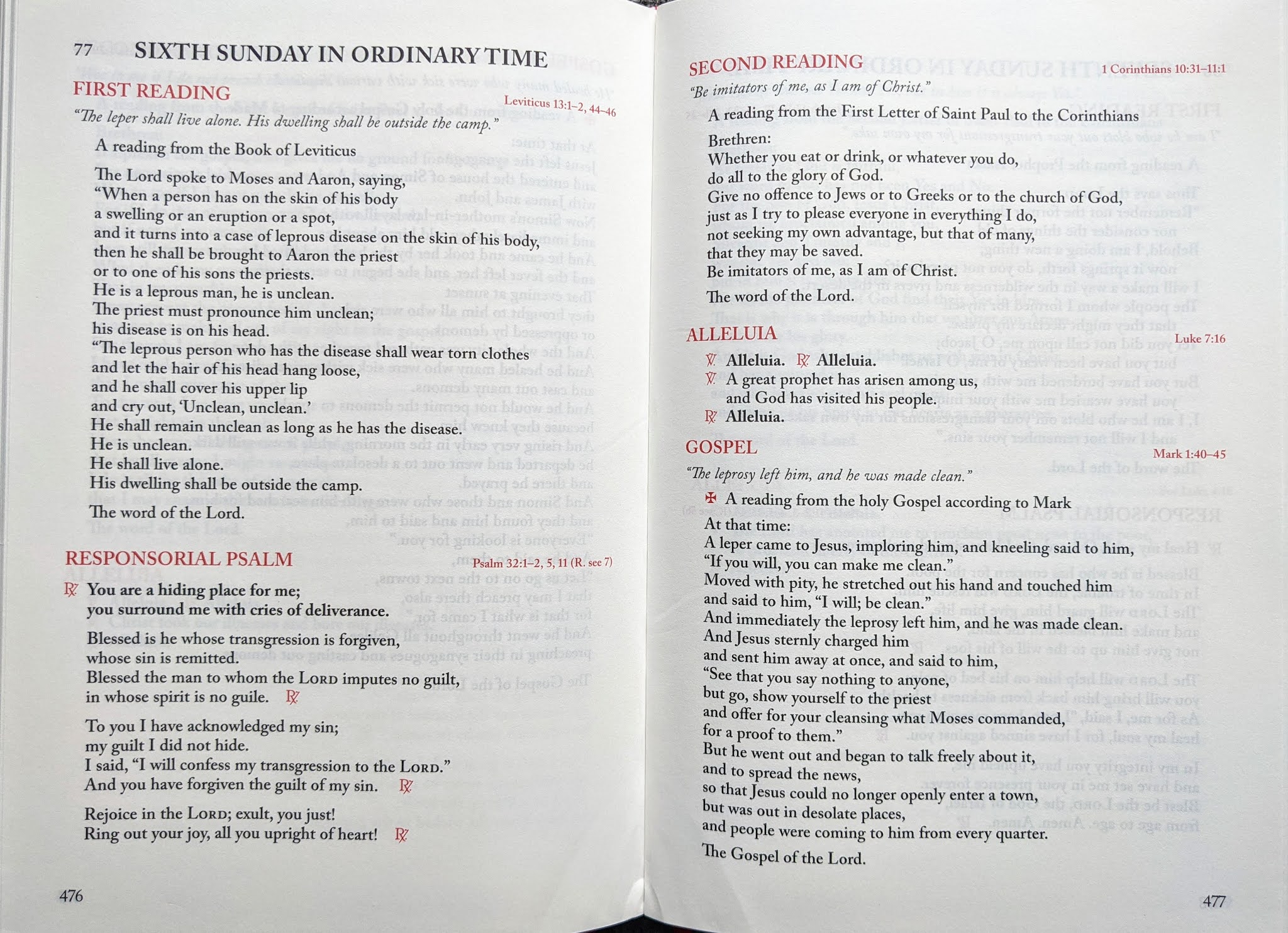
So, as a result, I thought that NLM readers would appreciate a quick look at the Indian ESV-CE lectionary itself - especially as there seems very little in the way of information online about these volumes at the moment other than that they exist! I have been fortunate enough to acquire a copy, so here are some pictures, along with my observations, both positive and negative.
The CBCI decided on a three-volume layout:
  1. Sundays and Solemnities (xxxiv + 966 pp) - this contains Years A, B and C of the Sunday cycle of readings, plus Solemnities.
  2. Weekdays (xxviii + 1106 pp) - this contains Years I and II of the weekday cycle of readings.
  3. Proper of Saints, Commons, Ritual Masses, Masses for Various Needs and Occasions, Votive Masses, Masses for the Dead (xxx + 1152 pp) - basically, everything else!
This layout, like any other, has a number of things to recommend it, but also contains compromises. First, it means that the cost for parishes, currently ₹7,500 for all three volumes (about $103/£73), is lower than it would be for other possible publishing arrangements. There is a certain logic to having the Sunday readings in one volume and the weekday readings in another. However, in the medium-term this may come at the cost of longevity: for example, the Sundays and Solemnities volume is going to get three times as much use compared to if each year of the Sunday cycle were its own individual volume. Similarly, the fact that the Funeral Mass readings are at the back of Volume 3 is perhaps not ideal for longevity, though the quality of the binding is fair. (Please bear in mind that my copies have travelled halfway across the world!)
The BCS and CBCEW, in consultation with publishers, [3] may decide on other layouts, such as having three volumes for each year of the Sunday cycle, or separate volumes for Nuptial Masses, Funeral Masses, etc.
Volumes 1 and 2 have two ribbons, with Volume 3 having three ribbons. This is appreciated, but the third volume really could have done with just one more ribbon; I will explain why below.
Use is made of the reference numbers of the 1981 Ordo lectionum Missae, editio typica altera (OLM), with the 2015 additiones, which is good. The celebrations proper to India have also been added in without disturbing these reference numbers. However, the lack of small headings at the top of each page does make sections more difficult to find than they could have been otherwise - this is not really a problem in Volumes 1 or 2, but is much more so in Volume 3 due to the variety of material contained in that volume.

Tuesday, March 10, 2020

Good News Photopost

I’m pretty sure that all of our readers could do with some good news these days, so here are some photos of recent events on three different continents, which show the ever-growing movement to recover the fullness of our liturgical tradition. We have a Dominican Mass for the feast of St Thomas Aquinas in Australia (where apparelled albs continue their triumphal progress through the country), a baptism in the traditional rite in Delaware, and a church in Scotland which celebrated its first EF Mass in 50 years on the feast of St Peter’s Chair. This Lent will be a period of great difficulty, and indeed, of great sorrow, for many people thoughout the world; as we remember them in our prayers, let us not forget also to thank the Lord for His many mercies and good gifts, and to keep up the good work of evangelizing through beauty!

From the Dominican Rite Community at Monash Univeristy in Melbourne, Australia, solemn Mass for the feast of St Thomas Aquinas. Photos by Justin Beirouti.
The missal and lectionary are carried in by the deacon and subdeacon, who then lay them down on the first altar step for the prayers at the foot of the altar.
The reading of the Gradual and Tract is done at the sedilia.
The preparation of the chalice, done while the choir sings the Gradual and Tract.

Thursday, May 23, 2019

A Pilgrimage to Elgin Cathedral in Scotland

Thanks to our friends of the Confraternity of St Ninian, which organizes celebrations of the traditional Mass in Scotland, for this account of their recent pilgrimage to Elgin Cathedral, and the celebration of the traditional Mass within its ruins. (Photos by Maciej Zurawski.)

Last weekend, the Holy Sacrifice of the Mass returned to one of Scotland’s most impressive ruined cathedrals for the first time in over four centuries. The Mass, celebrated in the Extraordinary Form of the Roman Rite by Fr Ross Crichton on Saturday, May 18, was sung in the cathedral’s Huntly Aisle and heard by around thirty people, many of whom were participating in the Confraternity of St Ninian’s weekend retreat to nearby Pluscarden Abbey. It is locally understood that no previous celebration of Mass had taken place within the ruin since it was abandoned by the Church during the Reformation c.1560. The cathedral, which was founded in 1224, was one of the most prominent centres of the mediaeval Church in Scotland and its impressive structure was widely famed as the “Lantern of the North.”

Friday, August 10, 2018

Traditional Rite Pilgrimage in Scotland

Our thanks to Mr Mark Hamid of the Confraternity of St Ninian for sharing with us this account of the annual Two Shrines Pilgrimage which recently took place in Scotland.

From Saturday, August 4th, to Monday the 6th, The Confraternity of St Ninian made its third annual Two Shrines Pilgrimage, a three-day walk inspired by the Chartres pilgrimage in France, in honour of Scotland’s patron saint, the Apostle Andrew. Pilgrims walked from his national shrine in Edinburgh to his former medieval shrine in the ruins of the cathedral in St Andrews, a distance in excess of sixty miles. The pilgrimage was made for the particular intention of the reconversion of Scotland to the Faith, and in the spirit of countless medieval pilgrims from across Christendom who had made St Andrews one of the foremost sites of ancient pilgrimage. Over the course of the journey, the pilgrims received spiritual support from a group of eight members of the Sons of the Most Holy Redeemer, led by Fr Anthony Mary FSSR, with the programme incorporating daily sung Mass, sung rosary, and other traditional devotions and hymns. Brothers from the community gave a variety of talks on theology and the sacramental life, and the pilgrims also enjoyed fellowship, both on the way and each evening with the opportunity to share dinner and socialise with one another.

The pilgrimage began on Saturday morning at St Mary’s Metropolitan Cathedral in Edinburgh before setting out on the short walk to Holy Cross Church, Trinity, where Fr Anthony Mary offered Holy Mass for the pilgrims’ intentions, a Votive Mass for Pilgrims and Travellers. The pilgrims drew much attention (both positive and negative) from passers-by, on account of their many sacred banners and the distinctive riband worn by Confraternity members, which is made from the St Ninian tartan devised for the visit of His Holiness Pope Benedict to Scotland on their patron’s feast day in 2010.

Pilgrims process through Edinburgh’s New Town
Opening Holy Mass for Pilgrims and Travellers
Leaving Edinburgh by the ancient Cramond Brig, the pilgrims proceeded towards the Firth of Forth where they crossed into Fife at the site of the (now three) iconic bridges which replace a ferry endowed in the eleventh century by St Margaret, Queen of Scots, to assist pilgrims in former times. Arriving in Dunfermline, St Margaret’s royal capital, they visited the abbey there and the site of her pre-Reformation shrine, before arriving at the magnificent late nineteenth-century church built in the town to house those of her relics which have survived to the present day.

At St Margaret’s Church, South Queensferry
Crossing the Firth of Forth
Outside the ancient abbey of Dunfermline
On the second day pilgrims heard Holy Mass, offered for the intentions of benefactors and supporters, at St Margaret’s Church before setting out across southern Fife. In the morning they took in the almost apocalyptic post-industrial landscape of the defunct Fife coalfields (including the site of an opencast mine named after St Ninian) before taking in the natural beauty found in the heights of the Lomond Hills Regional Park. Descending to the former royal hunting lodge at Falkland, Bishop Steven Robson of neighbouring Dunkeld Diocese once again lent his support to the pilgrims’ efforts by presiding at a Holy Hour at the Chapel Royal, Falkland Palace, which concluded with Pontifical Benediction of the Blessed Sacrament.

Sung Mass for the XI Sunday after Pentecost

Friday, August 26, 2016

More Good News from Scotland

In addition to the pilgrimage which we reported on yesterday, here is some more good news from the church in Scotland. A regular reader writes to let us know of an ordination which took place on the feast of the Assumption at St Andrew’s Cathedral in the diocese of Dunkeld, followed by the First Mass of the newly ordained priest, Fr Ninian Doohan, at the church of the Immaculate Conception in Dundee. “One of the most beautiful ordinations in the Ordinary Form I have witnessed.” Our heartiest congratulations to Fr Doohan! And likewise, thanks to His Excellency Bishop Stephen Robson, the Ordinary of Dunkeld, for his support of the traditional liturgy in Scotland, as will be seen from the photos below.

I have not yet received permission to download and reproduce the photos from the website of the diocese, but you can see pictures of the ordination here, and those of the First Mass here.

The following Saturday, Fr Doohan celebrated a Solemn EF High Mass at the church of the Immaculate Heart of Mary in Glasgow.


On Sunday the 21st, Bishop Robson confirmed three children in the traditional rite, after which Fr Doohan celebrated a Solemn High Mass in the presence of a greater prelate. The assistant priest was Fr Anthony Mary and the deacon Fr Magdala Mary, both of the Sons of the Most Holy Redeemer, and the sub-deacon Fr Mark Morris. The High Mass vestments were donated by Una Voce Scotland to Father Ninian upon his ordination. (The following photographs courtesy of Mr Martin Gardner; click here to see the whole set.)


The famous Confirmation slap!

Friday, November 29, 2013

Dominican Rite Requiem Mass in Edinburgh

The Dominican community of the Priory of Saint Albert the Great in Edinburgh, Scotland commemorated its founding benefactors, Canon John Gray, Marc-André Sebastien Raffalovich, and Mrs Charlotte Jefferson-Tytus with a sung Requiem in the Dominican rite on 23 October 2013.

After an absence of almost 400 years due to the Protestant Reformation, the Dominican friars had returned to Edinburgh in 1931, and at the invitation of Archbishop Andrew Thomas McDonald, O.S.B., they established a Catholic Chaplaincy for the students and staff of Edinburgh University. The establishment of the Chaplaincy and Priory at 24 George Square was made possible thanks to gifts and support from the above named benefactors.

From the beginning, the Georgian town house at 24 George Square was thought to be ideal for a new chaplaincy centre because it boasted what was reputedly "the largest drawing room in Edinburgh", and this first-floor room, with an apse-like bay window, served as the chapel of the priory and chaplaincy until 2012. Over the decades, plans for a purpose-built chapel never quite materialised, but finally in 2012 this hope was realised. On 15 August 2012, precisely 781 years after the first Dominican priory opened in Edinburgh, the new chapel of St Albert the Great, built in the garden behind the priory was dedicated by the Archbishop.

Last Saturday's Missa Cantata was celebrated in this modern chapel, which has received seven major architectural awards so far. This was the first time the ancient rite of the Order has been said in it, and it was probably also the first public Dominican rite Mass in the city for almost five decades. Mass was sung by fr. Lawrence Lew, O.P., who is assistant Catholic chaplain at St Albert's, and two students of Edinburgh University served as acolytes; the students had ably mastered in just two days the intricacies of this role in the Dominican rite. The sermon was preached by the Prior, fr. Dermot Morrin, O.P., in which he reflected on Canon Gray's conversion to Catholicism having glimpsed the simple reverent beauty of the Mass, and Raffalovich's love of beauty and the Dominican charism.

A Schola Gregoriana comprised of singers from Stirling-based 'Cantors of the Holy Rude' sang the Mass propers and ordinary from the Dominican Gradual. They were led by an alumnus of St Albert's Catholic Chaplaincy, James MacMillan CBE.

The chapel was full to capacity for this Mass, with a good number of current students present as well as alumni and friends from all over Scotland and the north of England. A booklet with the text and rubrics of the Mass, annotated with thoughts concerning the Mass by St Thomas Aquinas, St Albert the Great, and fr. Gerald Vann, O.P., was provided for all present. For many this was the first time they'd attended Mass in a pre-concilar form, and students commented positively on the beauty, reverence, and contemplative stillness of the ancient Liturgy.


The photos below were taken by, and republished here courtesy of Martin Gardner


More recent articles:

For more articles, see the NLM archives: