As expressed in Byzantine hymns and three paintings: English Pre-Raphaelite, Hieronymus Bosch, and an English medieval wall painting
The symbolism of the crown of thorns is rich. What was meant as a sign of degradation becomes, for Christians, a sign of Christ’s triumph over suffering and death as the King of Kings. Jesus transforms the symbol of the curse into one of redemption. This also designates Christ as the new Adam, who saved us from the effects of the Fall, which originally ushered in the thorns and thistles of evil and suffering due to the curse, the consequence of the first Adam’s sin. Jesus bore our sins in our place. The crown of suffering contrasts with (and leads to) his crown of victory.
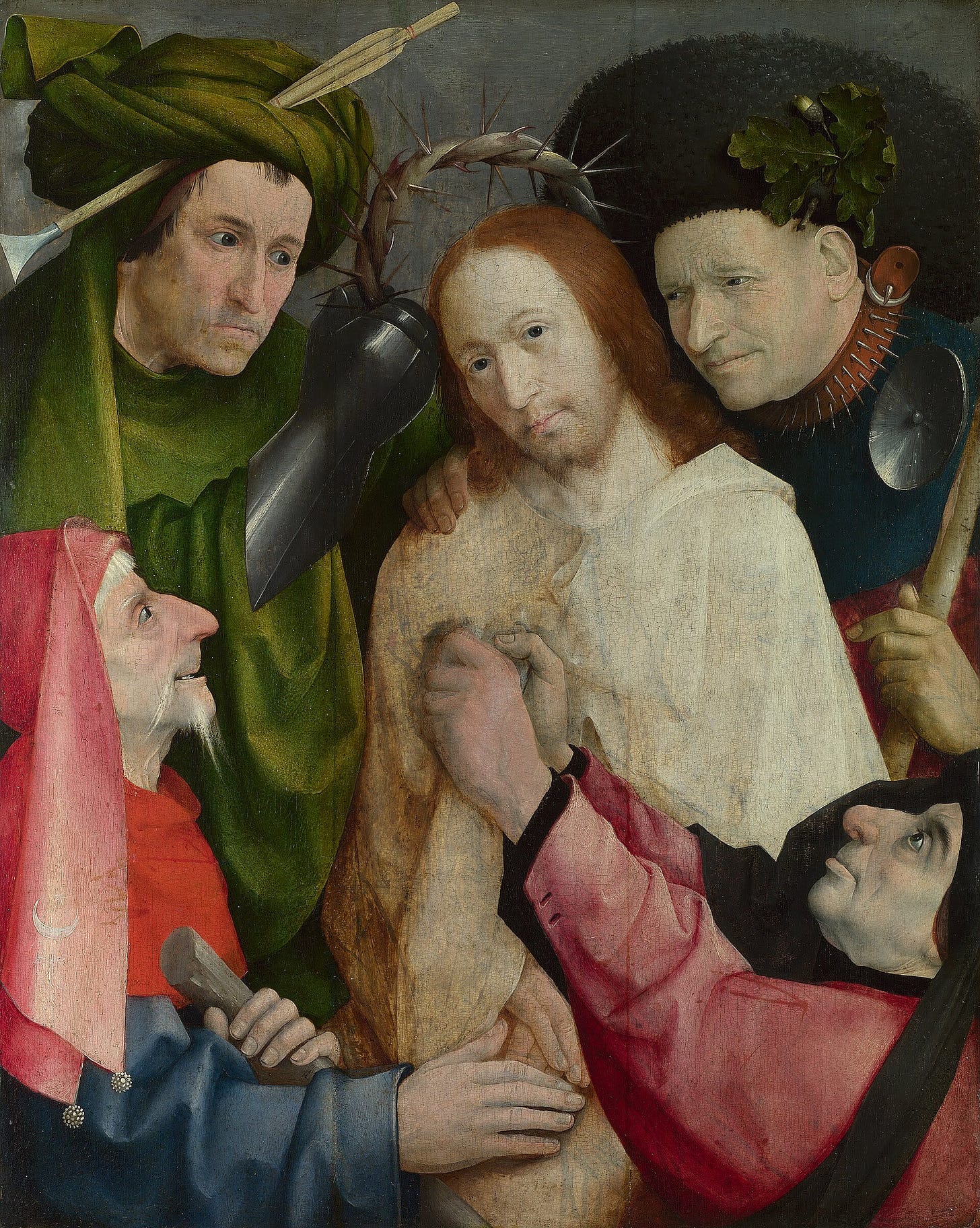 |
| The Mockery of Christ, by Hieronymous Bosch, Dutch, 1500 |
This is beautifully summed up in one of the hymns of the Byzantine liturgy:
If Christ is the new Adam, Our Lady is the new Eve, who leads us to Him and who cooperated with grace fully, giving Christ His humanity. The Byzantine liturgy here portrays her as a lily of purity:
Sunday Orthros, Ode 9, in Tone IV: “We behold thee as a lily arrayed in a robe dyed by the divine Spirit, O all-pure one, resplendent amid thorns and filling with sweet fragrance those who sincerely magnify thee. The incorrupt One, receiving corrupt human nature from thy womb, O most immaculate one, showed it to be incorrupt within Himself, in His loving kindness; wherefore we magnify thee as the Theotokos.”
The imagery is evocative of the Song of Songs 2:2: “Like a lily among thorns is my darling among the young women.” (“Thorns” is sometimes translated ‘thistles’.)
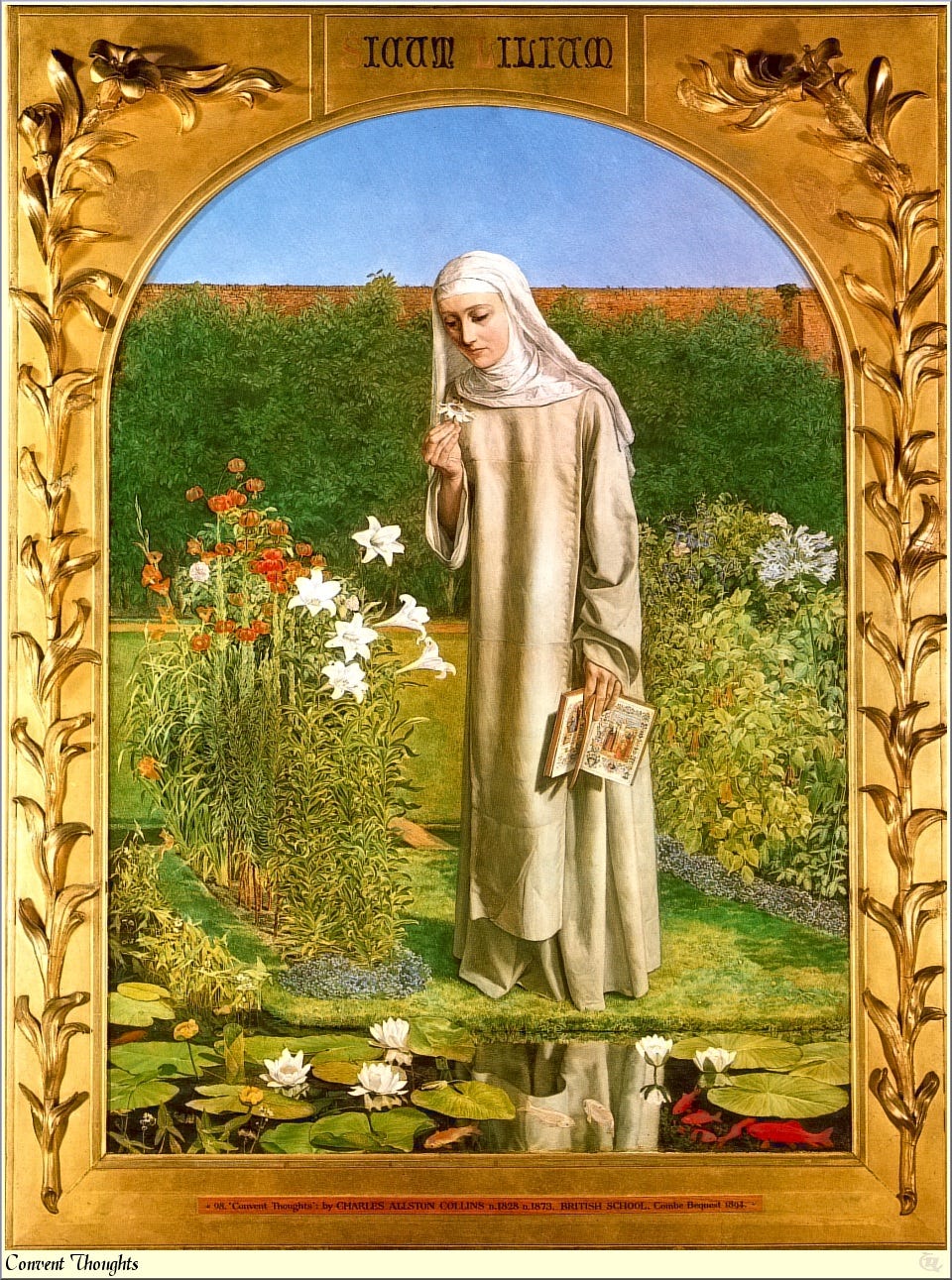
The painting above is Convent Thoughts by the English pre-Raphaelite painter Charles Alston Collins (1851), now in the Ashmolean Museum in Oxford. The museum website tells us:
“A nun looks at a Passion flower, symbolizing the crucifixion of Christ. In her left hand, she holds a religious book open at an image of the Virgin Mary. The frame, designed by Millais, reads: SICUT LILIUM (’As the lily among the thorns’) from the Song of Solomon. This was traditionally associated with the Virgin Mary, as was the enclosed garden. The flowers in the painting symbolize various traits of a nun, including remembrance (Forget-me-nots), purity (Madonna lilies), constancy (Evergreen trumpet honeysuckle), and most of all passion for Christ (the Passion flower she holds in her hand).”
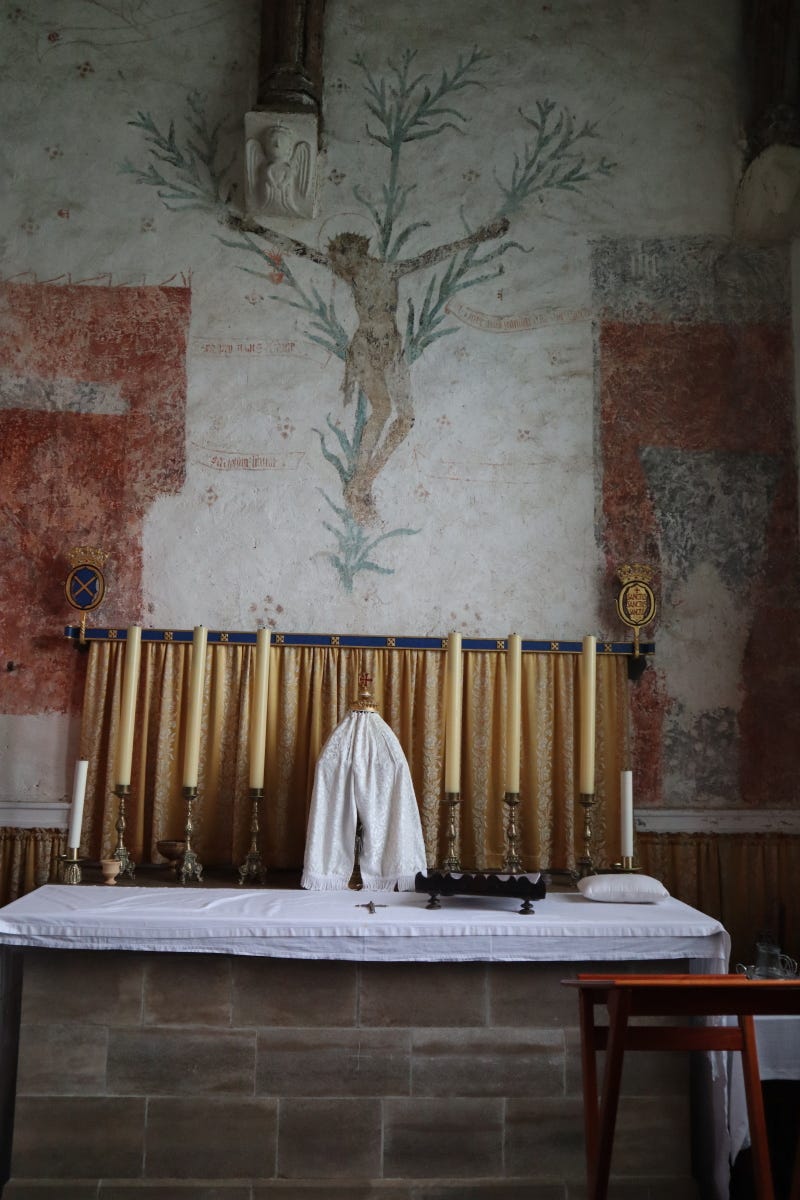
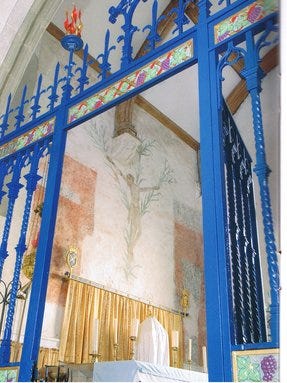
Another rather unusual painting that juxtaposes the lily as Mary with the suffering Christ appears in a 15th-century English wall painting, executed around 1450, at All Saints, Godshill, on the Isle of Wight, which depicts Christ on a cross of lilies. The website of the church, now an Anglican parish, tells us that the lily-cross likely refers to the coincidence that occurs usually a handful of times in any given century, when Good Friday falls on March 25, the feast of the Annunciation. Ancient tradition holds that the creation of Adam, the Annunciation, and Good Friday all took place on this date, and until 1752, the Annunciation, Lady Day, was the beginning of the New Year in England.