Thursday, February 05, 2026

On New Revisions to the Carthusian Liturgy: Guest Article by Mr Calder Claydon

Our thanks to Mr Calder Claydon for sharing with us this account of some research he has been doing on the modern revisions of the Carthusian liturgical books. The pictures are all his, taken during a recent visit to the Charterhouse of St Hugh in Parkminster, England.

The Carthusian Rite has existed, in one form or another, since the very beginning of the order, as a liturgical Use of the Roman Rite separate from that which was codified later by Pope St Pius V. It was heavily influenced by the Use of the see of Grenoble, within whose territory order was founded. The first discussion of it as a separate Use was in the year 1142, when the 7th prior of the order, St Anthelme, instituted a General Chapter. This was the occasion on which the communities following the life and charism of Saint Bruno were united under the authority of the prior of the Grande Chartreuse, and uniformity was brought to the liturgies celebrated in the various charterhouses. It continued in use after the Tridentine reform of the Roman liturgy was promulgated; the last notable revision took place in 1687 at the request of the Sacred Congregation of Rites, but this merely concerned conformity with the text of the Vulgate.

After the Second Vatican Council, a new project of revisions began in 1981, significantly later than the rest of the Church, with the promulgation of a revised Missale Cartusiense, published by the Order itself. Further changes have been made including a revised English edition of the diurnale. In 2008, the Pleterje Charterhouse in Slovenia published an ad experimentum edition of this book, which had not yet received the Imprimatur of the (then) Congregation for Divine Worship.
In 2018, the Congregation for Divine Worship approved a new Calendarium ad usum Ordinis Cartusiensis, which was followed by a further revised edition of the missal in 2021, but without the imprimatur of the Dicastery for Divine Worship, in both Latin and English. In May 2026, a General Chapter will meet at the Grande Chartreuse in France where it is hoped that the final revisions will be approved by the Order, before being presented to the DDW for approval.
The rubrics of the 1981 and 2021 revised editions of the missal inevitably differ, given the forty years between them, but the language seen in the 2021 revising concerning the Roman Rite differs greatly to from that of the 1981 edition.
In the 1981 rubrics, the Roman Liturgy is mentioned three times.
“Patrum nostrorum erga sanctam Missam veneratio et reverentia iam ex eo apparent, quod Guigo noster in Consuetudinibus Cartusiæ apprime de Liturgia conventuali tractet: ubi plurimos usus, ad Missam celebrandam spectantes, nobis tradit. Cartusiensis celebrandi modus in decursu temporis paulatim evolutus est, dum Patres nostri haud pauca e vicinis ecclesiis vel monasteriis, et ulterius e Missali Romano, mutuarentur, ita tamen ut propria suæ vitæ generis indoles omnia quasi pervaderet.
The veneration and reverence of our Fathers towards the Holy Mass is already apparent from the fact that our Guigo, in his Consuetudines Carthusiae, deals particularly with the conventual Liturgy: where he gives us many uses pertaining to the celebration of the Mass. The Carthusian way of celebrating gradually developed over time, as our Fathers borrowed not a few things from neighboring churches or monasteries, and further from the Roman Missal; yet in such a way that the distinctive character of their own manner of life permeated almost everything.”
“Pro celebratione Sanctorum, calendarium nostrum, ad exemplar calendarii romani recognitum, universalitatem sanctitatis christiánæ, per regiones orbis et per tempora, in lucem ponit.
For the celebration of the Saints, our calendar, revised according to the model of the Roman calendar, brings to light the universality of Christian holiness, throughout the regions of the world and throughout time.”
“Novi textus praesertim e Missali Romano, simplicitatis ratione semper habita, desumpti sunt, vel aliquando e veteribus sacramentariis, vel e Sacra Scriptura.
The new texts have been taken primarily from the Roman Missal, always with due regard for simplicity, and at times from the old sacramentaries, or from Sacred Scripture.”
The language of the rubrics explicitly mentions the “Carthusian way of celebrating” as a separate form, with the Carthusian Missal borrowing from neighbouring monasteries and rites, and “further from the Roman Missal”. Furthermore, the rubrics speaks of how the revised Missal has also revised their conventual calendar according to the “model of the Roman Calendar”. Despite this, no mention, or implication, of the Carthusian Liturgy being a use or a form of the Roman Rite is made.
However, in the further revision in 2021, this language changes substantially.
“Ordo quoque Cartusiensis, ut Ecclesiæ voluntatem plenius adimpleret, sana traditio retineretur et tamen via legitimæ progressioni aperiretur, accurata investigatione peracta, proprii Missalis instaurationem perfecit secundum Concilii generales rationes prout in instaurato Missali Romano recipiuntur. Cum autem Cartusiensi Ordini proprii quidam usus sint, in hoc Missali nonnullæ particularitates inveniuntur.
The Carthusian Order, in order to fulfill the will of the Church more fully, to retain sound tradition and yet to open the way for legitimate progress, after careful investigation, completed the restoration of its own missal according to the general principles of the Council as they are received in the restored Roman Missal. However, since there are certain practices specific to the Carthusian Order, some particularities are found in this Missal.”
“Missale Cartusiense antiquam peculiarem formam celebrandi in gremio Ritus romani iugiter servat præbetque. Quapropter et hæc editio fundamenta in Institutione Generali Missalis Romani.
The Carthusian Missal constantly preserves and presents the ancient and special form of celebration within the fold of the Roman Rite. For this reason, this edition also has its foundations in the General Institution of the Roman Missal.”
“Quædam notæ distinctivæ huius instaurationis hæc sunt: a) Prex eucharistica aucta est copia præfationum necnon formulariis a Missali Romano receptis, ut peculiares partes mysterii salutis clarius patefierent, et uberior gratias agendi materia præberetur.
Some of the distinctive features of this restoration are: a) The Eucharistic Prayer has been increased in the number of prefaces and formularies taken from the Roman Missal, so that special parts of the mystery of salvation are more clearly revealed and richer material for giving thanks is provided.”

Monday, November 17, 2025

The Feast of St Hugh of Lincoln

In England and in the Carthusian Order, today is the feast of a Saint called Hugh (1140 ca. – 1200), a French Carthusian who in 1186 became bishop of Lincoln, which was at the time the largest diocese in that country. (Image below: part of an altarpiece from the Carthusian monastery of Saint-Honoré in Thuison-les-Abbeville, France, ca. 1490/1500. Like his contemporary St Francis, Hugh was known for his love of animals; he is often depicted with a wild swan which would follow him around like a pet and eat from his hand, not at all typical behavior for those ill-tempered creatures.)

St Hugh was born to a noble family in a village called Avalon in the kingdom of Burgundy, roughly 80 miles to the south-southeast of Lyon. When he was eight, at the death of his mother, his father sent him to be educated by a local community of Augustinian Canons Regular, which he decided to enter in his mid-teens. He was ordained a deacon, and sent to assist an aged parish priest whose church was a dependency of the canonry; he soon had a reputation for being a very good preacher. But he had already begun to long for a more contemplative life when he paid a visit to the Grande Chartreuse, which is roughly a long day’s walk (around a mountain) from Avalon. The monastery was then relatively new, founded by St Bruno in 1084 on property donated by another St Hugh, bishop of nearby Grenoble (1053 – 1132). He entered the community in 1163, and was ordained a priest; after about ten years, he was chosen for the office of procurator, the administrator of all the monastery’s temporal possessions. He would hold this position until he left the monastery seven years later.
Normally, the life of a Carthusian would pass unnoticed by the wider world, but Hugh was a man of noble birth who held an office of high importance in a much-admired monastery, a leading institution of reform in an age of reformers, and was destined not to remain in the obscurity of his cell.
As part of his penance for his role in the murder of St Thomas Becket, King Henry II of England had agreed to establish the first Carthusian house in his country, at a place called Witham in Somerset in the west country, but the project was going forward at a snail’s pace. Henry had heard about Hugh from a French nobleman who had lands near the Grande Chartreuse, and therefore sent a deputation to formally request that he be sent to take over as prior. Against his great reluctance, Hugh was constrained to accept the position by the Carthusian chapter, and thus departed for England, where he would spend nearly all the rest of his life.
The Grande Chartreuse. St Hugh’s native place is on the other side of the mountains seen here behind it.
On arriving at Witham, he found the monastery barely begun, and the local peasants, many of whom had been displaced from the king’s land to make room for it, understandably quite hostile. Hugh was able with great tact to persuade the king not only to fulfill his promise to provide all that was necessary to complete the building project, but also to properly and fully compensate the peasants. The monastery began to flourish, and was often visited by the king, whose favorite hunting grounds were nearby.
King Henry held Hugh in very high regard, as illustrated by the story that once when he and his army were caught in a terrible storm at sea, he called upon God to save them “though the merits and intercession” not of St Nicholas or St Elmo, but by those “of the prior of Witham”, and the storm died down immediately. However, although he had been chastened in the aftermath of St Thomas’ murder, Henry had not really renounced any of the importunities which had for too long characterized relations between the monarchy and the Church. Among other things, it had become a common custom to leave episcopal sees vacant, so that the revenues attached to the bishop’s office would default to the royal coffers. The see of Lincoln had thus been left vacant for all but 18 months of the previous 18 years. St Hugh prevailed upon the king to redress the matter, at which Henry pressured the chapter of Lincoln to elect Hugh himself as their bishop. Once again, this was done very much against his will, and once again, he was obliged to accept the office by the authority of his order.
The Martyrdom of St Thomas Beckett, depicted ca. 1220, the year of St Hugh’s canonization, in an illuminated psalter.
Not at all surprisingly, his tenure as bishop demonstrated the truth of the axiom that power is best given to those who do not want it. After so long without a shepherd, the diocese of Lincoln was very much in need of reform, and Hugh proved to be an exemplary reformer, assiduous in his administration of the sacraments, in his preaching, and in his visitation of his very large diocese, diligent in his leadership of his clergy, and in his care of the poor and the sick. Each year he would make a retreat to Witham Priory, and live for a time as an ordinary monk within the community.
He was known for his good cheer and sense of humor, which is illustrated by an anecdote regarding yet another of King Henry’s intrusions into the life of the Church. It was a common abuse in that era for the nobility to reward their courtiers with lucrative ecclesiastical jobs under their patronage. (Very often, the salary would go to a man with no interest in actually doing the job, who would then use part of it to pay a man of much lower social class to act as his vicar, and do all the work in his stead.) St Hugh refused to seat a proposed nominee to one of the prebends of his cathedral, saying that “the king does not lack (other) means to reward his servants.” Henry summoned him to court, but ordered everyone in the castle to simply ignore him when he arrived. Hugh came upon the king sewing a bandage on his cut finger, and after a few minutes of icy silence from his majesty, remarked, “Now you look like your kinsman at Falaise,” a reference to Henry’s great-grandmother, Herleva of Falaise, who had been the daughter of a glove-maker. The king is said to have laughed out loud at this, and once again, been reconciled with the holy bishop.
In 1189, Henry died, and was succeeded by his son Richard I, known as the Lionhearted; that same year saw the beginning of the Third Crusade, and several outbreaks of mob violence against the Jews in England. On three different occasions, one of them at his own cathedral, St Hugh single-handedly faced down the mobs, and solely by the force of his own authority and personality, cowed them into leaving their would-be victims alone. In 1197, Richard attempted to force the bishops of England to help finance a war with the king of France; Hugh successfully resisted this importunity as well.
A year before his election to Lincoln, the city’s original cathedral had been badly damaged by an earthquake, an extremely rare event in England. St Hugh began an ambitious rebuilding project, and lived to see the completion of the choir, which is traditionally named after him. (From the time of its completion in 1311 until 1549, Lincoln Cathedral was the tallest man-made structure in the world. It lost its rank as such not because it was outbuilt, but because its central spire collapsed.)
Lincoln Cathedral. Image from Wikimedia Commons by Julian P Guffogg, CC BY-SA 2.0
St Hugh’s Choir within the cathedral, as it appears today.
When King Richard died in 1199, his brother and successor, John, sent Hugh as an ambassador to France. On this trip, he visited the three great mother-houses of the major monastic congregations, his old home, the Grand Chartreuse, Cluny and Citeaux, and was received with great honor. But his health was now failing; he was taken badly ill while attending a council in London, and died after lingering for two months. His body was taken back to Lincoln and buried in the cathedral, and he was canonized by Pope Honorius III only 20 years after his death. His shrine became an important pilgrimage site, and his feast was kept on this day throughout England until the reformation, when the shrine was destroyed.
In the 16th century, the importunity of the English monarchs against the Church finally reached its zenith, the greed and impiety of another eighth Henry was brought down on all the monasteries of England, and the charterhouse at Witham was suppressed, along with the nine other Carthusian houses that had subsequently been founded. When the order was reestablished in England in 1873, in the southern town of Parkminster, the new house was named for St Hugh.
The Charterhouse of St Hugh at Parkminster. (Image from Wikimedia Commons by Antiquary, CC BY-SA 4.0.)

Monday, October 06, 2025

The Charterhouse of St Martin in Naples

For the feast of St Bruno, the founder of the Carthusian Order, here are some pictures of one of the most beautiful of the order’s monasteries, that of St Martin on the Vomero hill above Naples. Founded in 1325 by Charles, Duke of Calabria, the monastery remained under royal patronage through most of its history as an active monastery. (It was suppressed in 1866, and is now a goverment-run museum.) As a result, it is full of some extraordinarily elaborate decorations, especially from the early 17th century, when the Neapolitan Baroque style was first flourishing. An enormous complex grew up around the church in various phases, and any set of photographs will give only a very small idea of the place.

The main altar and nave of the church.
The Chapel of the Immaculate Conception
 
One of the sections of the large sacristy.
Detailing of the pavement - the Neapolitan Baroque style is especially famous for its highly elaborate floral patterns.

The main choir of the church.

Sunday, October 06, 2024

A Carthusian Treatise for the Novice at Mass

For the feast of St Bruno, here is a wonderful treatise from the Directory for Novices of the Carthusian Order, a guide to forming their interior dispositions during the conventual Mass. This is taken from an edition printed near Grenoble in 1688, in the neighborhood of the Grande Chartreuse; it is included in a four-part collection of Carthusian statutes known as the Nova Collectio, a rare example of the word “new” being used by the venerable order. (The two pictures of the Mass below are from this wildly popular post from 2016.)

St Bruno, 1617, by Juan Sánchez Cotán (1560-1627). In 1603, Sánchez Cotán, then a very successful painter in Toledo, Spain, left the world to enter the Charterhouse of Santa María de El Paular near Madrid. He was later sent to the house at Granada, where he ended his days; he continued to work as a painter, doing a series for the Granada cloister on the foundation of the Order and the martyrdom of the English Carthusians. Laudabiliter pinxit.
“When the priest begins the Mass with the humble confession of his sins, imitating him, also say the Confiteor, pronouncing it an act of contrition for your sins, and recognizing that you are unworthy to be present for this divine sacrifice.

The Mass is divided into three parts.

The first part, from the Introit to the Offertory, was formerly called the Mass of the Catechumens.

While the Introit and the Kyrie are sung, remember how ardently the ancient patriarchs longed for the coming of the Messiah.

At the Gloria, join yourself to the angelic choirs, praising God with them, and giving thanks for the mystery of the Incarnation.

In the prayers, intend and ask for the same things which the Church intends and asks for.

While the Epistle is read, be attentive, as if you were hearing one of the Apostles preaching; but at the Gospel, consider it to be Christ Himself that is speaking.

Then put the Faith into practice by singing the Creed with everyone else.


The second part is from the Offertory to the Canon.

During the Offertory, join and conform your intention to the intention of the priest, and offer to God that holy sacrifice according to these four ends …

1. As an act of worship, that is, of the supreme adoration, by offering acts of the adoration to the Eternal Father of the Incarnate Son, and joining your own (such acts) to them.

2. As an act of thanksgiving, that is of the rendering of thanks to the Eternal Father by offering that sacrifice as a thanksgiving for the glory and merits of His Most Beloved Son, and of the Blessed Virgin Mary and of all the Saints, and for all the benefits which you have received through the merits of Christ, and receive even now.

3. As an act of petition, offering it to the Eternal Father as the pledge of His love for us, handed down to us for our firmest hope that we will receive from Him the spiritual goods which we need; and ask for those things which you need, and especially for the emendation of this or that defect.

4. As an act of propitiation, that is, offering it for satisfaction of all your sins, and for the expiation of so many crimes which are committed throughout the world. Humbly and confidently set forth to the Eternal Father, that all things may be forgiven us by Him, since He has already given us His only-begotten Son, and that very Son still offers Himself to Him in this sacrifice as a victim, that He may be the propitiation for our sins. …

Having adored the most sacred Host, we lie prostrate, and remain thus until the sign is given to rise. In this first prostration, you may join your intention to those of Christ as He hung on the Cross, which you shall offer again to the Eternal Father with these words of the Psalm, “Behold, O God our protector, and look on the face of thy Christ.” (Ps. 83, 10)

Or, you can call to mind the prostration of Christ as He prayed in the garden, and lay in that sad state, and wonder at His love in this mystery, by which in a certain way He seems to suffer once again for the wicked, for whose sake He was then in an agony, and sweated water and blood. …

During the time we remain in silence, from the Preface to the Communion, think sweetly upon one of the things that were done in the death of Christ Who suffered for you, which death is represented in this mystery, and brought forth again, and take therefrom occasion for some holy aspiration, as devotion may suggest; now wondering at His love and suffering, now detesting your sins as the cause of his pain, now proclaiming thanksgiving, contemplating sometime the Holy Virgin as She stood present at the sad sight of Her Only-begotten dying; or ask God to meet your spiritual needs …

At the Our Father, join your petitions to those of the priest.


The third part of the Mass is from the Communion to the end.

When the first Agnus Dei is sung, at the prostration, communicate spiritually in this or like manner.

1. With ardent desire, long to be united to Christ, and recognize that you are pressed by urgent necessity to live though His life.

2. Bring forth an act of contrition for all your sins, present and past.

3. Just as Zacchaeus received the Lord Jesus in his house, so also, receive Him in spirit, invite Him into the deepest recesses of your soul, and ask of Him insistently the grace by which you may live to Him alone, since you can live in a holy manner only through Him. Then imitate Zacchaeus in your good proposals, and exercise yourself in devout imitation of that man…”

Thursday, October 26, 2023

The Origin of the Carthusian Rosary

After seeing our post earlier this month about the Carthusian Rosary, reader Benjamin Whitworth very kindly sent us this translation of part of a treatise about it. This is an excerpt from the Liber Experientiae, the 15th-century autobiography of a Carthusian monk named Dominic of Prussia, who is credited with inventing the particular manner of saying the Rosary observed by the Order.

The Carthusian Rosary
From the Book of Experience by Dominic of Prussia (1384-1460), Carthusian monk of Trier. ~ From the 38th narration: Concerning the experience of true devotion.
Old man: […] This brother Rupert [this is how Dominic refers to himself], of whom I have spoken, generally used to have a devotion to the humanity of Christ and his cross, except when the Lord drew him towards some deeper theme of meditation. This was because one day, when he was singing the Gloria in excelsis in choir with the others, he lifted up his thoughts to our Lord’s sitting upon the right hand of the Father in heaven, and only with the greatest difficulty was he able to bring his mind back down to earth. For he had arrived at such a dizzy height, that he felt as if his heart were closed up, and as if his access to the cross were shut off, so that only by long effort did he succeed in returning to the state of devotion that he was formerly accustomed to. Unless the Lord draws someone’s mind upwards to himself and in himself, it is risky for that person to raise his attention to the purely divine and heavenly mysteries. Therefore he no longer ventured forward without, as it were, leaning on the staff of the holy Cross. Every day he thought and meditated on the Incarnation and Passion of Christ, and on the things that the Lord Jesus Christ did so humbly in this life for our salvation. He preached and said many good things about these matters. He was the first who added those meditations and clausulæ (little clauses) on the life of Jesus to the Rosary of blessed Mary, which we have used in saying this devotion, and still do.
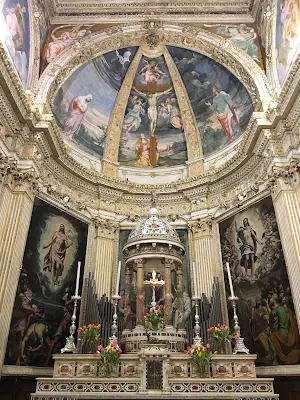
The apse and altar of the Charterhouse of Garegnano outside Milan, with the Crucifixion, Resurrection and Ascension of Christ, all by Simone Peterzano, 1578. Photo by Nicola de’ Grandi.   
Just how many good things come from this, in heaven and on earth, was revealed on his deathbed to a Vicar of this House (Adolf of Essen, who had previously been Prior of this House, and who had received the same brother Rupert into the Order). He was a devout man and an intimate friend of God, and was often rapt into the heavens, as we discovered after his death from his writings. And among other things that he was shown by God, he once saw in the heavens how the glorious Mother of God, Saint Mary, with all her Virgins, and with all the holy Angels and Saints, sang the Rosary very devoutly, with its clausulæ, before the most high God enthroned, adding Alleluia to every clausula, that is, to all fifty. And each time the name of blessed Mary was named, they all bowed their heads very deeply. When, further, the name of Jesus was named, they all bent their knees very devoutly, according to the exhortation of the Apostle, who said: In the name of the Lord every knee should bow, of those that are in heaven, on earth, etc. (Phil. 2, 10) He both saw and heard that they all gave boundless thanks to almighty God for the universal benefits that flow from this same Rosary, since God and our Lord Jesus Christ are praised and blessed in it, along with his most holy Mother, in all that he did or suffered in this world for the whole human race, as it is always said at the end of the angelical salutation, “Blessed art thou among women and blessed is the fruit of thy womb Jesus Christ,” and there is added: “who did this or that, who suffered this or that,” according as his life is recounted in order from beginning to end.
The Virgin Mary and Saints within a Rosary; German woodcut, ca. 1500. Public domain image from the website of the National Gallery of Art.
Wherefore, not unduly do the Saints themselves dance in the heavens with inexpressible joy, and on earth many, busy with the same exercise, are filled with admirable grace and devotion, for it has been spread now to various parts of the world, and disseminated by our own writings for about thirty years. Indeed the Saints, as that father heard, prayed to the Lord with feelings of great devotion for those who occupy themselves with this Rosary, asking that the Almighty would deign to enlighten and strengthen such devotees with his special grace, so that they might always profit from this or from other good exercises and persevere to a happy end, and especially that they might be happy in heaven after this life. He also saw in the heavens countless, very beautiful, imperishable, flowering, shining and sweet-smelling crowns, resting on those who perform this Rosary to the praise of God and his Mother, Saint Mary. And as often as one of them completed such a thing, so often one of these Crowns was added to the ones already resting on their head, to be kept with them. And that father was told that, of a certainty, any person saying the Rosary in this way, and conforming himself to the power of the Saints in the observances spoken of above, will be given full remission of all his sins, as often as he shall do it. That father had prayed for and obtained bodily strength and courage, and peace of heart, that he might serve God his Maker faithfully. And it was not without great wonderment that we saw him, an old man and full of years, who had borne the burden of the Order for more than 40 years, yet able to work harder than anyone, despite eating and sleeping less than we young ones. Many of us saw in him this extraordinary gift of grace, but we did not understand where he got it from, until after his death we found out from his writings, etc.
So what could we more usefully do in this fleeting time, than to say this Rosary, which might take no longer than it would to celebrate or hear a Mass? For as we read in other revelations, the Lord has told certain devout souls that nothing pleases him as much, as someone devoutly reflecting on the benefits done to himself and to others, and thanking God for each one of them. This is what we are doing succinctly in the present very devout little work, in which, as I have said above, we bless and praise the Lord Jesus Christ in all his deeds, and salute and honour his holy Virgin Mother with blessings.
Young man: I can well believe that we can hardly do anything in this passing hour that is more pleasing to God and useful to ourselves, or that anything can give us more joy and consolation in the doing of it, since the angelical salutation itself is such a sweet utterance, and reflecting on the life of Jesus is fruitful and delightful above all other things. Blessed be God, then, who in these latter days, to stir up our hearts from their numbness, has deigned to pour out so much grace upon us, that if we are not moved to devotion by his present gifts, we might at least be drawn onwards by the greatness of his future promises. Therefore may his name be blessed for ever. Old man: Amen.
Here follows the Rosary of blessed Mary, of which mention was made in the 38th narration, above.
HAIL Mary, full of grace, the Lord is with thee. Blessed art thou among women, and blessed is the fruit of thy womb, Jesus Christ,
  1. Whom thou didst conceive by the Holy Spirit, as the Angel announced. Amen.
  2. Whom having conceived, thou didst go into the hill country to Elizabeth. Amen.
  3. Whom thou didst bear joyfully, ever remaining a holy virgin in mind and body. Amen.
  4. Whom thou didst worship as thy Creator, and didst feed at thy virginal breasts. Amen.
  5. Whom thou didst swaddle in cloths, and didst place in the manger. Amen (this is always added at the end).
  6. Whom the angels praised, singing Glory in the highest, and the shepherds found in Bethlehem.
  7. Who was circumcised on the eighth day and called Jesus.
  8. Who was worshipped by the three wise men reverently offering their threefold gifts.
  9. Whom thou didst carry to the temple in thy motherly arms, and didst present to God his Father.
  10. Whom Simeon the old man took into his arms and blessed, and the widow Anna recognised.
  11. With whom thou didst flee from before the face of Herod into Egypt.
  12. With whom, after seven years, thou didst return to thy homeland, summoned back by an angel.
  13. Whom, in his twelfth year, thou didst lose in Jerusalem, and after seeking him sorrowfully for three days thou didst find him again in the temple.
  14. Who progressed day by day in age, grace and wisdom in the sight of God and of men.
  15. Whom John baptized in the Jordan, pointing him out as the Lamb of God.
  16. Who fasted for forty days in the desert, and whom Satan thrice tempted there.
  17. Who, having gathered disciples from here and there, preached the kingdom of heaven to the world.
  18. Who gave light to the blind, cleansed lepers, cured paralytics and delivered all those who were oppressed by the devil.
  19. Whose feet Mary Magdalene washed with her tears, dried with her hair, kissed and anointed with ointment.
  20. Who resuscitated Lazarus after four days, and other dead people.
  21. Who, on the day of palms, was received by the people with great honour, sitting on a donkey.
  22. Who instituted the worshipful Sacrament of his Body and Blood at his last supper.
  23. Who went into the garden with his disciples, and, praying there at length, sweated a bloody sweat.
  24. Who spontaneously went to meet his enemies, and willingly gave himself up into their hands.
  25. Whom the servants of the Jews roughly tied up, and the chief priests led away bound.
  26. Whom they accused with false testimonies, hooded, spat at, and rained blows and slaps upon.
  27. Whom they proclaimed a criminal malefactor, deserving of crucifixion, before Pilate and Herod.
  28. Whom, having been stripped of his clothes, Pilate had scourged harshly and for a long time.
  29. Whom the servants crowned with thorns, and, his having been dressed in some discarded purple cloth, worshipped in mockery.
  30. Whom they condemned unjustly to a most shameful death, and led out with two unrighteous men.
  31. Whom they nailed to the cross by his hands and feet, and offered wine mixed with myrrh or gall.
  32. Who prayed for those who crucified him, saying: Father, forgive them, for they know not what they do.
  33. Who said to the thief on his right hand: Amen I tell thee: today thou shalt be with me in Paradise.
  34. Who said to thee, his most holy Mother: Woman, behold thy son. And to John: Behold thy mother.
  35. Who cried out: Eli, Eli, lema sabacthani? That is, [My God, my God, why hast thou forsaken me?].
  36. Who said: It is finished.
  37. Who said at last: Father, into thy hands I commit my spirit.
  38. Who died a most bitter and most sacred death for us miserable sinners. Thanks be to God.
  39. Whose side the soldier opened with a lance, and blood and water flowed therefrom for the remission of sins.
  40. Whose most sacred body was taken from the cross, and returned lifeless to thy bosom (as is called the pietà).
  41. Whom righteous and holy men buried, his having been embalmed with spices and wound in a shroud.
  42. Whose grave the Jews sealed up and defended with guards.
  43. Whose most holy soul descended into hell, and comforting the holy fathers led them out with him into Paradise.
  44. Who rose again on the third day, and gladdened thee with inestimable joy. Alleluia.
  45. Who appeared many times to his disciples and faithful believers after his resurrection, and confirmed their hearts in the holy faith.
  46. Who ascended to the heavens in their sight, with thee present and looking on, and sitteth at the right hand of the Father.
  47. Who sent the Holy Spirit to his faithful from the heavens on the day of Pentecost, as he had promised them.
  48. Who at last assumed to himself, called to his right hand, and gloriously crowned thee his most sweet Mother.
  49. Who will deign, at thy intercession, likewise to assume us, his servants and thine, after the course of this wretched life, and settle us in the kingdom of his Father.
  50. Who with the Father and Holy Spirit, and thee, his most glorious Mother, liveth and reigneth an invincible and glorious King, world without end. Amen.
The Coronation of the Virgin, by Jacopo di Mino del Pelliciaio, active in Siena and Umbria in the mid-14th century. Public domain image from Wikimedia Commons.
How the aforesaid Rosary first had its origin, the following exemplum shows.
A CERTAIN man in secular life had the habit of making a chaplet of roses or other flowers, which he would place on an image of blessed Mary with great devotion. Having entered religious life, where he was prevented, by the duty of obedience, from doing this, he was so saddened that he even wished to return to the world. Having thought this over, a certain good man gave him some wholesome advice, namely to remain in the religious life, and to say fifty Ave Marias in place of the previous chaplet, promising him that this would please our Lady more than any material chaplet. When he had been doing this for some time, it happened that the same laybrother was riding through a wood where there were robbers hiding. When he had tied up his horse, and was saying the Rosary of Blessed Mary on his knees, the robbers hastened from afar and would have preyed upon him. But behold! they saw a beautiful virgin standing by him, and after a little while they saw that she was frequently picking up lovely Roses that fell from his mouth, and weaving them into a chaplet. When it was finished, she placed it on her head and ascended into the heavens. They drew near full of wonder, and asked him what he was doing, and who might be the virgin that they had seen. He said that there was no virgin with him, but they forced out of him that he had been making a spiritual chaplet for the Queen of Heaven, as was his wont. Then they related to him what they had seen, and strongly confirmed him in this kind of holy service to the Mother of God. They themselves, as might well be believed, changed their way of life for the better. This miracle being published, as one can read, this Rosary first began to be practised by pious and devout servants of Mary. Later a certain brother of the Carthusian Order, for the sake of greater devotion and attention, added the life of our Lord Jesus Christ, according as it has been set out above. Hence this Rosary is much honoured, and received with great effect by our glorious Lady, her Son, and all the knights of the heavenly court, as is described above in the little book of experience, in the thirty-eighth narration.
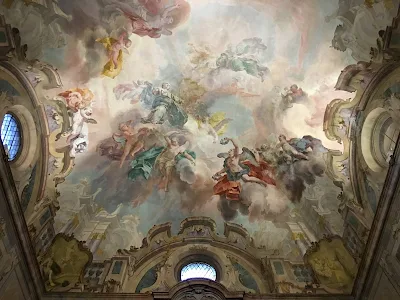
The Assumption of the Virgin Mary, by Biagio Bellotti (1714-89), also in the Charterhouse of Garegnano. Photo by Nicola de’ Grandi. 
How is this Rosary to be performed?
Whoever, then, wishes to take up this little exercise so pleasing to God and the Saints, and to carry out this Rosary to the praise and glory of God and the Virgin Mary, his Mother, should say the Angelical salutation fifty times, and after each, add any one of the clausulæ on the life of Christ set out above. It is not necessary to observe the form of words laid out for this Rosary either here or elsewhere, but each person can prolong the theme, shorten it, or change it for the better, according to the grace and devotion that the Lord has given him or her; many people have done so, uttering in words the life of the Saviour or silently meditating upon it in thought, now this way, now another way, according to the grace, ability and time that they have. One could hardly find a better way of spending the present moment than by saying this Rosary, for, as has been said, it is pleasing to God and his Saints in heaven, and for those saying it, it is very useful and fruitful, and finds great favour with God, to the increase of their devotion and the improvement of their life, as experience has shown in many examples both of the living and of those now dead.
It is mentioned in the revelations of some devout souls, that nothing pleases God more than a person’s recollecting frequently the good things the Lord has done for the world, and giving thanks for each one. And we do this in the present brief exercise, when at the end of each angelical salutation we say, “… and blessed is the fruit of thy womb Jesus Christ, who did this or that, or suffered this or that,” as above. Constantly praising and blessing the Lord and his most holy Mother in this way, we are beneficiaries of the promise once pledged to the prophets, for it was about our Lord Jesus Christ, and for us, that the Patriarch Isaac prophesied, saying: let him that blesseth thee be filled with blessings, etc. [Gen 27.29]. And he who soweth in blessings, as the Apostle says, shall also reap eternal life in blessings [2 Cor 9.6]. And whoever will crown Christ the King and the Queen of Heaven with this rosy crown, will deserve to be crowned by them in turn with the unfading crown of life in eternity. Amen.
Blessed be the name of our Lord Jesus Christ, world without end. And may the name of his Mother, the most glorious Virgin Mary, be blessed and remain so in eternity. Amen.

Friday, October 06, 2023

The Carthusian Rosary

Since today is the feast of St Bruno, and tomorrow is that of the Holy Rosary, it seems like a good day to share an article I stumbled across some time ago on the Carthusian Rosary. Many religious orders have traditionally used a form of rosary different from that of the Dominicans, which is of course the most widely known and practiced; the Franciscans have a Crown of the Seven Joys, the Servites that of the Seven Sorrows. The day after tomorrow is the feast of St Bridget of Sweden, and Tuesday was St Thérèse of Lisieux, both of whose orders have a rosary that is like the Dominican one, but with six mysteries per set; the Immaculate Conception is added as the first Joyful Mystery, the removal of Christ’s body from the Cross as the last Sorrowful, and the Virgin’s Patronage of the Order as the last Glorious.

The Carthusian Rosary, with the austerity which characterizes everything about the Order’s way of life, has 50 Aves, and a different “mystery” for each one. In some places, it is the custom to interpolate into the Hail Mary a few words which refer to the particular mystery, as e.g. “Ave Maria, gratia plena... Jesus, qui resurrexit a mortuis. Sancta Maria etc.” for the Resurrection, or “Jesus, quem Virgo concepisti” for the Annunciation. In the article, you can find a list of fifty such interpolations, along with a bit more history of the Carthusian rosary; here are just the first three.

1. … Jesus, conceived of the Holy Spirit during the Annunciation of the Angel.
2. … Jesus, who together with you who has conceived him, visits Saint Elizabeth.
3. … Jesus, to whom you, virgin in body and soul, have given birth with joy.

From a post in July of 2016, here are a couple of historical images from the Charterhouse of Barcelona, these photos show Carthusians with their rosaries, in choir in the first image, and in the cell in the second.

Thursday, May 04, 2023

A Brief Documentary about the Only American Charterhouse

On the general calendar, today is the feast of St Monica, but in England, it is the feast of the Carthusian Martyrs of London, the first three of whom were put to death on this day in the year 1535, the earliest victims of King Henry VIII’s greed and impiety. By whatever strange intuition, the YouTube algorithm (which normally has so many bizarrely unhelpful suggestions to offer) managed to dig up this brief video about the only Carthusian monastery in the United States, the Charterhouse of the Transfiguration on Mt Equinox in Sandgate, Vermont. As you can see, the building is made out of the material which was most readily available in the area at the time of its construction, granite, which perfectly suits the deep austerity characteristic of Carthusian life.

Thursday, October 06, 2022

Sunday Matins at the Great Chartreuse

To celebrate the feast of St Bruno, here is a recording of part of the Office of Sunday Matins sung by the Carthusian monks at the Grande Chartreuse. The bells sound at midnight (1:35); the Office then begins with the introduction and Psalm 3, sung without an antiphon, followed by the Invitatory Adoremus Dominum * qui fecit nos, with the verses of Psalm 94, and the hymn Aeterne rerum conditor, one of the indisputably authentic hymns of St Ambrose. The first nocturn begins at 15:50, you can see that a piece of paper with the full text of the first antiphon has been pasted into the antiphonary, since traditionally, the antiphons would have been semidoubled. Psalms 20-25 are sung with one antiphon for each two Psalms, followed by the versicle, after which the Lord’s Prayer is said in silence. The readings are taken from 2 (4) Kings 19, which in the traditional order would put this on the 11th Sunday after Pentecost. The four responsories are taken from the traditional series read with the books of Kings according to the Carthusian Use; the fourth one, Domini est terra, is used by the Roman Rite in the season after Epiphany.

At the doxology, it is customary to stand and then bow, which accounts for the shuffling of feet and seats that one hears; the Carthusians also sing it very slowly. Of course, this video only includes the first of three nocturns; the twelfth and final responsory in the third nocturn is followed by the Te Deum, the Sunday Gospel, the brief hymn Te decet hymnus, and the prayer. According to the website of the Grande Chartreuse, Lauds is still done right after Matins. Laudabiliter vivunt!

Wednesday, October 06, 2021

A Carthusian Treatise for the Novice at Mass

For the feast of St Bruno, here is a wonderful treatise from the Directory for Novices of the Carthusian Order, a guide to forming their interior dispositions during the conventual Mass. This is taken from an edition printed near Grenoble in 1688, in the neighborhood of the Grande Chartreuse; it is included in a four-part collection of Carthusian statutes known as the Nova Collectio, a rare example of the word “new” being used by the venerable order. (The two pictures of the Mass below are from this wildly popular post from 2016.)

St Bruno, 1617, by Juan Sánchez Cotán (1560-1627). In 1603, Sánchez Cotán, then a very successful painter in Toledo, Spain, left the world to enter the Charterhouse of Santa María de El Paular near Madrid. He was later sent to the house at Granada, where he ended his days; he continued to work as a painter, doing a series for the Granada cloister on the foundation of the Order and the martyrdom of the English Carthusians. Laudabiliter pinxit.
“When the priest begins the Mass with the humble confession of his sins, imitating him, also say the Confiteor, pronouncing it an act of contrition for your sins, and recognizing that you are unworthy to be present for this divine sacrifice.

The Mass is divided into three parts.

The first part, from the Introit to the Offertory, was formerly called the Mass of the Catechumens.

While the Introit and the Kyrie are sung, remember how ardently the ancient patriarchs longed for the coming of the Messiah.

At the Gloria, join yourself to the angelic choirs, praising God with them, and giving thanks for the mystery of the Incarnation.

In the prayers, intend and ask for the same things which the Church intends and asks for.

While the Epistle is read, be attentive, as if you were hearing one of the Apostles preaching; but at the Gospel, consider it to be Christ Himself that is speaking.

Then put the Faith into practice by singing the Creed with everyone else.


The second part is from the Offertory to the Canon.

During the Offertory, join and conform your intention to the intention of the priest, and offer to God that holy sacrifice according to these four ends …

1. As an act of worship, that is, of the supreme adoration, by offering acts of the adoration to the Eternal Father of the Incarnate Son, and joining your own (such acts) to them.

2. As an act of thanksgiving, that is of the rendering of thanks to the Eternal Father by offering that sacrifice as a thanksgiving for the glory and merits of His Most Beloved Son, and of the Blessed Virgin Mary and of all the Saints, and for all the benefits which you have received through the merits of Christ, and receive even now.

3. As an act of petition, offering it to the Eternal Father as the pledge of His love for us, handed down to us for our firmest hope that we will receive from Him the spiritual goods which we need; and ask for those things which you need, and especially for the emendation of this or that defect.

4. As an act of propitiation, that is, offering it for satisfaction of all your sins, and for the expiation of so many crimes which are committed throughout the world. Humbly and confidently set forth to the Eternal Father, that all things may be forgiven us by Him, since He has already given us His only-begotten Son, and that very Son still offers Himself to Him in this sacrifice as a victim, that He may be the propitiation for our sins. …

Having adored the most sacred Host, we lie prostrate, and remain thus until the sign is given to rise. In this first prostration, you may join your intention to those of Christ as He hung on the Cross, which you shall offer again to the Eternal Father with these words of the Psalm, “Behold, O God our protector, and look on the face of thy Christ.” (Ps. 83, 10)

Or, you can call to mind the prostration of Christ as He prayed in the garden, and lay in that sad state, and wonder at His love in this mystery, by which in a certain way He seems to suffer once again for the wicked, for whose sake He was then in an agony, and sweated water and blood. …

During the time we remain in silence, from the Preface to the Communion, think sweetly upon one of the things that were done in the death of Christ Who suffered for you, which death is represented in this mystery, and brought forth again, and take therefrom occasion for some holy aspiration, as devotion may suggest; now wondering at His love and suffering, now detesting your sins as the cause of his pain, now proclaiming thanksgiving, contemplating sometime the Holy Virgin as She stood present at the sad sight of Her Only-begotten dying; or ask God to meet your spiritual needs …

At the Our Father, join your petitions to those of the priest.


The third part of the Mass is from the Communion to the end.

When the first Agnus Dei is sung, at the prostration, communicate spiritually in this or like manner.

1. With ardent desire, long to be united to Christ, and recognize that you are pressed by urgent necessity to live though His life.

2. Bring forth an act of contrition for all your sins, present and past.

3. Just as Zacchaeus received the Lord Jesus in his house, so also, receive Him in spirit, invite Him into the deepest recesses of your soul, and ask of Him insistently the grace by which you may live to Him alone, since you can live in a holy manner only through Him. Then imitate Zacchaeus in your good proposals, and exercise yourself in devout imitation of that man…”

Tuesday, October 06, 2020

The Carthusian Rosary

Since today is the feast of St Bruno, and tomorrow is that of the Holy Rosary, it seems like a good day to share an article I stumbled across some time ago on the Carthusian Rosary. Many religious orders have traditionally used a form of rosary different from that of the Dominicans, which is of course the most widely known and practiced; the Franciscans have a Crown of the Seven Joys, the Servites that of the Seven Sorrows. The day after tomorrow is the EF feast of St Bridget of Sweden, and Saturday was St Thérèse of Lisieux, both of whose orders have a rosary that is like the Dominican one, but with six mysteries per set; the Immaculate Conception is added as the first Joyful Mystery, the removal of Christ’s body from the Cross as the last Sorrowful, and the Virgin’s Patronage of the Order as the last Glorious.

The Carthusian Rosary, with the austerity which characterizes everything about the Order’s way of life, has 50 Aves, and a different “mystery” for each one. In some places, it is the custom to interpolate into the Hail Mary a few words which refer to the particular mystery, as e.g. “Ave Maria, gratia plena... Jesus, qui resurrexit a mortuis. Sancta Maria etc.” for the Resurrection, or “Jesus, quem Virgo concepisti” for the Annunciation. In the article, you can find a list of fifty such interpolations, along with a bit more history of the Carthusian rosary; here are just the first three.

1. … Jesus, conceived of the Holy Spirit during the Annunciation of the Angel.
2. … Jesus, who together with you who has conceived him, visits Saint Elizabeth.
3. … Jesus, to whom you, virgin in body and soul, have given birth with joy.

From a post in July of 2016, here are a couple of historical images from the Charterhouse of Barcelona, these photos show Carthusians with their rosaries, in choir in the first image, and in the cell in the second.

Friday, April 17, 2020

Modern Photos of the Pleterje Charterhouse in Slovenia

After seeing the historical images which we posted on Wednesday of the Pleterje Charterhouse in Slovenia, a reader very kindly shared with us some photos of his own from a more recent visit. As one would expect of the Carthusians, if you compare the photos of the church from 1938 and those from last year, you can see that very little has changed, which is always reassuring. Our reader also informs us that the monks make and sell a superb pear brandy.

These are the modern buildings which the monks constructed after recovering the property in 1899 and reestablishing it as a Charterhouse. Below, there are photos of a church which was built as part of the original foundation at the beginning of the 15th century; it is also part of the property, and still used by the monks.
The choir of the main church.

Wednesday, April 15, 2020

Historical Photos of a Charterhouse in Slovenia

A reader in Slovenia very kindly sent us some pictures which he scanned out of an old book about the Carthusian Monastery of Pleterje, located in a village called Drča about 50 miles to the west-south-west of the capital, Ljubljana. Originally founded as a Charterhouse by a local count at the beginning of the 15th century, it was turned over to the Jesuits at the end of the 16th. With the suppression of the latter in the 1770s, it became first state property, then private, until the Carthusians were able to repurchase in 1899 it and reestablish it as a monastery; it is now the only functioning Charterhouse in Slovenia. These photos date to the date to the year 1938.

The chapel of the brothers
A chapel dedicated to St Joan of Arc
The chapter house
The prior’s throne in the main church.
Prayer in the cell

Sunday, October 06, 2019

The Charterhouse of St Martin in Naples

For the feast of St Bruno, the founder of the Carthusian Order, here are some pictures of one of the most beautiful of the order’s monasteries, that of St Martin on the Vomero hill above Naples. Founded in 1325 by Charles, Duke of Calabria, the monastery remained under royal patronage through most of its history as an active monastery. (It was suppressed in 1866, and is now a goverment-run museum.) As a result, it is full of some extraordinarily elaborate decorations, especially from the early 17th century, when the Neapolitan Baroque style was first flourishing. An enormous complex grew up around the church in various phases, and any set of photographs will give only a very small idea of the place.

The main altar and nave of the church.
The Chapel of the Immaculate Conception
 
One of the sections of the large sacristy.
Detailing of the pavement - the Neapolitan Baroque style is especially famous for its highly elaborate floral patterns.
The main choir of the church.

Saturday, October 06, 2018

Sunday Matins at the Great Chartreuse

For the feast of St Bruno, here is a recording of part of the Office of Sunday Matins sung by the Carthusian monks at the Grande Chartreuse. The bells sound at midnight (1:35); the Office then begins with the introduction and Psalm 3, sung without an antiphon, followed by the Invitatory Adoremus Dominum * qui fecit nos, with the verses of Psalm 94, and the hymn Aeterne rerum conditor, one of the indisputably authentic hymns of St Ambrose. The first nocturn begins at 15:50, you can see that a piece of paper with the full text of the first antiphon has been pasted into the antiphonary, since traditionally, the antiphons would have been semidoubled. Psalms 20-25 are sung with one antiphon for each two Psalms, followed by the versicle, after which the Lord’s Prayer is said in silence. The readings are taken from 2 (4) Kings 19, which in the traditional order would put this on the 11th Sunday after Pentecost. The four responsories are taken from the traditional series read with the books of Kings according to the Carthusian Use; the fourth one, Domini est terra, is used by the Roman Rite in the season after Epiphany.
At the doxology, it is customary to stand and then bow, which accounts for the shuffling of feet and seats that one hears; the Carthusians also sing it very slowly. Of course, this video only includes the first of three nocturns; the twelfth and final responsory in the third nocturn is followed by the Te Deum, the Sunday Gospel, the brief hymn Te decet hymnus, and the prayer. According to the website of the Grande Chartreuse, Lauds is still done right after Matins. Laudabiliter vivunt!

Thursday, November 23, 2017

An Italian Documentary on the Carthusians, 1972

Another great discovery on Youtube, a documentary filmed in the Charterhouse of Vedana in northern Italy (close to Belluno, in the province of the Veneto) by Italian television in 1972. The narration is too long to give a translation, but even if you don’t speak any Italian, it gives a lot of very nice images of the Carthusian life, including a chapter, (ca 10:30) with the general confession of faults (12:00), and a part of the Office towards the end (ca. 22:00).

The soundtrack music is very typical of the era, and perhaps more than a little distracting; it makes me appreciate even more how appropriate it was to have no soundtrack for so much of The Great Silence. At 5:30, it is stated that there were 12 priests (only 1 of whom was Italian) and 10 conversi, of whom 9 were Italian, in this house in 1972. Unfortunately, there are no monks there today, although plans have been discussed to install another community in the complex.


Friday, October 06, 2017

A Carthusian Treatise for the Novice at Mass

For the feast of St Bruno, here is a wonderful treatise from the Directory for Novices of the Carthusian Order, a guide to forming their interior dispositions during the conventual Mass. This is taken from an edition printed near Grenoble in 1688, in the neighborhood of the Grande Chartreuse; it is included in a four-part collection of Carthusian statutes known as the Nova Collectio, a rare example of the word “new” being used by the venerable order. (The two pictures of the Mass below are from this wildly popular post from last year.)
St Bruno, by Juan Sánchez Cotán (1560-1627), 1617. In 1603, Sánchez Cotán, then a very successful painter in Toledo, Spain, left the world to enter the Charterhouse of Santa María de El Paular near Madrid. He was later sent to the house at Granada, where he ended his days; he continued to work as a painter, doing a series for the Granada cloister on the foundation of the Order and the martyrdom of the English Carthusians. Laudabiliter pinxit.
“When the priest begins the Mass with the humble confession of his sins, imitating him, also say the Confiteor, pronouncing it an act of contrition for your sins, and recognizing that you are unworthy to be present for this divine sacrifice.

The Mass is divided into three parts.

The first part, from the Introit to the Offertory, was formerly called the Mass of the Catechumens.

While the Introit and the Kyrie are sung, remember how ardently the ancient patriarchs longed for the coming of the Messiah.

At the Gloria, join yourself to the angelic choirs, praising God with them, and giving thanks for the mystery of the Incarnation.

In the prayers, intend and ask for the same things which the Church intends and asks for.

While the Epistle is read, be attentive, as if you were hearing one of the Apostles preaching; but at the Gospel, consider it to be Christ Himself that is speaking.

Then put the Faith into practice by singing the Creed with everyone else.


The second part is from the Offertory to the Canon.

During the Offertory, join and conform your intention to the intention of the priest, and offer to God that holy sacrifice according to these four ends …

1. As an act of worship, that is, of the supreme adoration, by offering acts of the adoration to the Eternal Father of the Incarnate Son, and joining your own (such acts) to them.

2. As an act of thanksgiving, that is of the rendering of thanks to the Eternal Father by offering that sacrifice as a thanksgiving for the glory and merits of His Most Beloved Son, and of the Blessed Virgin Mary and of all the Saints, and for all the benefits which you have received through the merits of Christ, and receive even now.

3. As an act of petition, offering it to the Eternal Father as the pledge of His love for us, handed down to us for our firmest hope that we will receive from Him the spiritual goods which we need; and ask for those things which you need, and especially for the emendation of this or that defect.

4. As an act of propitiation, that is, offering it for satisfaction of all your sins, and for the expiation of so many crimes which are committed throughout the world. Humbly and confidently set forth to the Eternal Father, that all things may be forgiven us by Him, since He has already given us His only-begotten Son, and that very Son still offers Himself to Him in this sacrifice as a victim, that He may be the propitiation for our sins. …

Having adored the most sacred Host, we lie prostrate, and remain thus until the sign is given to rise. In this first prostration, you may join your intention to those of Christ as He hung on the Cross, which you shall offer again to the Eternal Father with these words of the Psalm, “Behold, O God our protector, and look on the face of thy Christ.” (Ps. 83, 10)

Or, you can call to mind the prostration of Christ as He prayed in the garden, and lay in that sad state, and wonder at His love in this mystery, by which in a certain way He seems to suffer once again for the wicked, for whose sake He was then in an agony, and sweated water and blood. …

During the time we remain in silence, from the Preface to the Communion, think sweetly upon one of the things that were done in the death of Christ Who suffered for you, which death is represented in this mystery, and brought forth again, and take therefrom occasion for some holy aspiration, as devotion may suggest; now wondering at His love and suffering, now detesting your sins as the cause of his pain, now proclaiming thanksgiving, contemplating sometime the Holy Virgin as She stood present at the sad sight of Her Only-begotten dying; or ask God to meet your spiritual needs …

At the Our Father, join your petitions to those of the priest.


The third part of the Mass is from the Communion to the end.

When the first Agnus Dei is sung, at the prostration, communicate spiritually in this or like manner.

1. With ardent desire, long to be united to Christ, and recognize that you are pressed by urgent necessity to live though His life.

2. Bring forth an act of contrition for all your sins, present and past.

3. Just as Zacchaeus received the Lord Jesus in his house, so also, receive Him in spirit, invite Him into the deepest recesses of your soul, and ask of Him insistently the grace by which you may live to Him alone, since you can live in a holy manner only through Him. Then imitate Zacchaeus in your good proposals, and exercise yourself in devout imitation of that man…”

More recent articles:

For more articles, see the NLM archives:



