
Thursday, November 17, 2022

The William P. Mahrt Sacred Music Chair (Part 1): Guest Article by Roseanne T. Sullivan

We are very grateful to guest contributor Roseanne T Sullivan for this article about a new chair in Sacred Music, named for our publisher, and long-time president of the Church Music Association of America, Dr William P. Mahrt. The chair has been established by His Excellency Salvatore Cordileone, Archbishop of San Francisco, at the archdiocesan seminary and university of St Patrick in Menlo Park, and its first holder is our contributor Dr Jennifer Donelson-Novicka. This post will be followed by a second part with an interview with Archbishop Cordileone.

His Excellency Salvatore Cordileone, Archbishop of San Francisco has created an endowed chair in Sacred Music at St. Patrick’s Seminary and University, which forms clergy for the San Francisco archdiocese and for other dioceses throughout the West and the Pacific Rim. With the establishment of this new William P. Mahrt Chair in Sacred Music, many courses in the history and practice of the Church’s sacred music will be available to seminarians and to others who are interested.
St Patrick’s Seminary
The overall quality of music at the seminary liturgies will be enhanced by the musical direction and example of the new holder of the chair, Professor Jennifer Donelson-Nowicka. In her new role as Associate Professor of Music and Director of Sacred Music at the seminary, she will also serve as the director of sacred music, overseeing all the musical activities in the seminary chapel, and accompanying liturgies at the organ, while both developing and directing a schola cantorum, which will sing Gregorian chant (in Latin), chant in English and Spanish, and sacred polyphony.
Here are some quotations from her paper “Emotion, Intellect, and Will: The Fruits of Sacred Music in the Spiritual Life”, which was given on June 29 at the Sacra Liturgia 2022 Conference in San Francisco.
“The Church has long been the greatest patron of beauty, feeding Christ’s sheep. Beauty is food for the soul. The world needs the material charity of the Church, but also Her spiritual charity.”
“It is possible to get to heaven without understanding much of anything about music, thanks be to God. But to willfully cling to ignorance or even an anti-knowledge which prizes ugliness or mediocrity is to choose to be deaf to one mode through which God makes known His glory.”
“Mediocre music, banal music is not spiritually neutral. It has a numbing effect on the soul, feeding the senses with the mere shadow of the glory of God’s love, but never really piquing our interest or helping us see God clearly. ... Bad music is a sort of spiritual junk food—food that looks like food, but makes us fat and lethargic. Musical junk food has no place in the sacred liturgy.”
Prof. Donelson-Novicka speaking at the Sacra Liturgia conference this past June; to her right are His Eminence Robert Card. Sarah, Archbishop Cordileone, and Fr Mark Doherty, the rector of St Patrick’s Seminary.
Professor Donelson-Nowicka wrote this to me in an email: “The chair is named after Dr. Mahrt in honor of his decades of devoted service to the cause of sacred music, not only in the Bay Area through his work at Stanford University and with the St. Ann Choir, but also nationally and internationally through his leadership as president of the Church Music Association of America (CMAA), and editorship of the CMAA’s journal Sacred Music.
“His scholarly work highlights, for example, how the Church’s Gregorian chant not only fittingly conveys the texts it adorns, but serves an integral role in the Church’s worship by expressing the nature of the liturgy itself. An Introit is an integral component of the liturgical action, moving the hearts of worshippers to the altar, and the procession to the sanctuary, sounding in a music that likewise moves. The Alleluia, in its profusion of notes on a short text, affords the opportunity for contemplation and meditation which, as the Church points out for example in the General Instruction of the Roman Missal, is a dominant characteristic of the Liturgy of the Word. The Church’s polyphony, too, expresses a particular splendor, reminiscent of the glory of God in His creation.
“All these are insights that Dr. Mahrt has patiently developed in his own work and in the hearts of his listeners and readers. They are the thoughts of a man who takes seriously the worship of God as the center of his life, and who devotes his intellectual energies towards the probing of the gifts the Church gives her children to ‘worship the Father in Spirit and in truth.’
“Inspired by Dr. Mahrt’s work, the mission of the chair is likewise to bring together prayer, worship, theology, beauty, and academic and technical excellence in sacred music.”
Professor Donelson-Nowicka is also organizing an international sacred music conference to be held at St. Patrick’s seminary in November of 2023 celebrating the work of Dr. Mahrt.
The choice of Professor Mahrt is particularly exciting to me because I have been writing for years about his achievement of keeping chant and polyphony alive while it was out of favor. [1] I sang with the St. Ann Choir that he directs at St. Thomas Aquinas Church in Palo Alto for a few years beginning in 2005, and was very impressed when I learned that he had persisted in directing that choir in the singing of Gregorian chant and motets at Sunday Masses, and polyphonic Masses on feast days, in liturgies where that kind of music belongs, even during the long decades when that kind of music was virtually banned in the Church after Vatican II.
Dr. Mahrt directing the St Ann Choir... 
and here, showing a large decorated folio with the introit of the choir’s patronal feast. 
Music at the Heart of the Archbishop’s B16 Institute
This exciting innovation is tightly aligned with the goals of the Benedict XVI Institute for Sacred Music and Divine Liturgy, which Archbishop Cordileone founded in 2013.
I’ve also written several articles on Archbishop Cordileone’s initiatives to promote more-reverent liturgies through the Benedict XVI Institute. On January 5, 2014, I was present when Archbishop Cordileone along with Father Samuel Weber, O.S.B., the original director, announced the founding of the new institute. During its “opening night,” the archbishop announced, “The heart of the institute is music.” Among other related goals, he said that he wanted “to reclaim the sacred music that is so much at the heart of our celebration of the Mass.”
To do this, he continued, the institute would promote “what the Church has been asking us to do for a really long time, beginning at the Second Vatican Council” and continuing with “so many documents since, including the current General Instruction on the Roman Missal: Gregorian chant is to have first place in music at Mass.”
Archbishop Cordileone speaking at the Sacred Liturgia conference.
After the archbishop’s introduction, Fr. Weber demonstrated that it is easier than generally imagined to train people to sing chant well without much instruction on how to read the chant notation. Rehearsing with a program he had prepared with English chants of his own composition, Fr. Weber prepared the 200 or so people who attended to sing hymns and psalms at Benediction and Vespers of the Epiphany. As one commenter on Fr. Zuhlsdorf’s blog noted, “Vespers was fantastic, presided over by Abp Cordileone, and cantored by Fr. Weber, chanted in its entirety. Before we went into the Church for vespers, Fr. Weber did a quick tutorial/run-through of the chants for vespers, and unsurprisingly, everyone picked them up quite easily.”
The scope of the activities of the Benedict XVI Institute has widened in the ensuing years. On July 26, 2017, Catholic San Francisco announced that the institute’s name had changed a little, replacing “Liturgy” with “Worship” and that it was expanding its focus from sacred music to include also Catholic art, architecture, and literature under the new executive director, Maggie Gallagher.
Part of the expanded focus is to promote the creation of new works of art and literature and to build community and recognition between Catholic creatives, potential patrons, and other lovers of Catholic sacred arts.
The importance of music to the institute is evidenced by Archbishop Cordileone having named Frank La Rocca to be the institute’s composer in residence. The institute has commissioned several Mass settings so far from La Rocca: the Mass of the Americas, the Requiem for the Homeless, and Missa Sancti Juniperi Serra (in honor of St. Junipero Serra). La Rocca's new Messe Des Malades: Honoring Our Lady Of Lourdes, will premiere in February 2023.
The first Mass setting La Rocca composed for the institute, Mass of the Americas, continues to be performed in more and more cathedrals and churches long after it first premiered December 8, 2018.
Another great indicator that the results of the institute’s initiatives are also spreading into mainstream culture is a new album with a studio recording of the Mass of the Americas by Grammy-winning producer Blanton Alspaugh. After the album was recently released, it quickly rose to the top of the Billboard charts.
The institute also frequently sponsors events where other music, also art, and poetry from talented living creative Catholics is performed. “Our artists need to know we value their work, including a creative genius like Frank La Rocca, but also young artists,” Archbishop Cordileone has said.
The creation of the new Sacred Music chair that is the main topic of this article emphasizes the vital importance of priestly formation in survival of the Church’s heritage of sacred music. It seems to me to be an exciting step forward in achieving the goals of the institute, perfectly in line with the archbishop’s plan from the beginning to foster reverent liturgies.
The ripple effects of this new program may continue to be seen in many places in years to come. The Vatican Council II document Sacrosanctum concilium states, “The treasury of sacred music is to be preserved and cultivated with great care.” Those who benefit from training and the example of music skillfully performed at St. Patrick’s by an expert in expounding and performing the treasury of the Church’s sacred music will in their turn go out to spread the good news to many more places.
[1] See my articles “Gregorian Champ,” (National Catholic Register, 18 November 2007) and “Palo Alto’s secret gift to the Church,” (California Catholic Daily, 20 December 2017.)

Tuesday, September 20, 2022

The Debut Recording of Frank La Rocca’s Mass of the Americas

The début recording of Frank La Rocca’s Mass of the Americas (Misa de las Américas) will be released shortly and can be preordered here. It is performed by the Benedict XVI Institute’s Choir and Orchestra and directed by renowned international conductor Richard Sparks. William P. Mahrt wrote about the Mass here following its liturgical performance at a Pontifical Mass in Washington DC:

“This stunning composition set the tone for the whole liturgy, where music ranged from traditional Gregorian chants sung by a schola of either men or women, to elaboration upon the chants, to settings incorporating the traditional Mexican melodies in music of transcendent liturgical expression. La Rocca uses his skill as a composer to create music that is harmonic but innovative. This music is modern but comprehensible, classical but not archaic.”

The work extends the genre of the Missa solemnis: a sublime setting of a Traditional Latin Mass for choir and orchestra, weaving together a rich modern tapestry with serene Gregorian chants, folk melodies from 18th-century regions of México, and florid praises in Nahuatl, the language spoken by Our Lady of Guadalupe to San Juan Diego in 1531. Benedict XVI Choir’s début recording sung in Latin, Spanish, and Nahuatl, will be released on Capella Records on September 23, 2022.
(The Mass of the Americas was sung as part of this Mass celebrated by Abp Cordileone at the National Shrine of the Immaculate Conception on Nov. 16, 2019.)

Friday, February 18, 2022

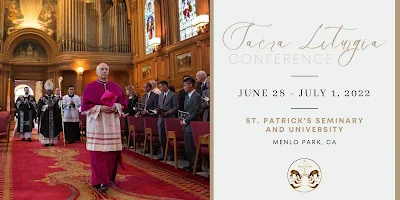
Sacra Liturgia San Francisco: June 28 - July 1

This year’s Sacra Liturgia conference, sponsored by His Excellency Archbishop Salvatore Cordileone, will take place in his episcopal city of San Francisco from June 28 to July 1; registrations are now open via the conference website: https://www.sacraliturgiasf.com/

The Sacra Liturgia conference, founded by Dom Alcuin Reid, is an internationally recognized center of intellectual excellence in liturgical scholarship. Beautiful Masses are celebrated with excellent choirs so Catholics can experience the power of the Eucharist in a new way. The conference will take place from June 28 to July 1 at St Patrick’s Seminary in Menlo Park, close to Stanford University. Among this year’s roster of speakers features Cardinal Robert Sarah, Cardinal George Pell, Bishop Steven Lopes, Dom Alcuin Reid, Father Joseph Fessio, Jennifer Donelson-Nowicka, Msgr. Gerard O’Connor, Duncan Stroik and more. Renowned choral conductor Martin Baker, past president of the British Royal College of Organists and until recently Master of Music at Westminster Cathedral, will conduct singers from the Sacred Music Project in a Mass celebrated by Cardinal Pell. The final Mass will feature new music by Frank La Rocca, composed in honor of St Junipero Serra (Missa Sancti Juniperi Serra), and be celebrated by the conference host, Abp Cordileone, on St Junipero’s feast day, July 1, at the historic Mission Dolores which the Saint founded in 1776. Richard Sparks will conduct the Benedict Sixteen Choir and Orchestra.

The conference schedule can be found here: https://www.sacraliturgiasf.com/schedule
Options before and after the conference include: an tour of beautiful churches of San Francisco, available on the afternoon of the 28th; a reception with Kansas City Chief kicker Harrison Butker after the final Mass; a sacred music concert conducted by Martin Baker featuring the works of living Catholic composers. Ticket holders will be emailed information about these before and after events. Accommodation should be booked separately.

Thursday, November 21, 2019

Dr William Mahrt on The Mass of the Americas

Our publisher Dr William Mahrt attended the recent celebration of the Pontifical Mass in Washington DC, the first time Frank LaRocca's Mass of the Americas was performed with the celebration of the Extraordinary Form, and was kind enough to share this review with us. A complete video of the ceremony is included below, and several pictures of the Mass, courtesy of photographers Matthew Barrick and Jeffrey Bruno, and the Benedict XVI Institute.

On November 16, a Solemn Pontifical Mass in the Extraordinary Form was celebrated at the Basilica of the Immaculate Conception in Washington, D.C., by His Excellency Salvatore Cordileone, Archbishop of San Francisco. Sponsored by the Benedict XVI Institute for Sacred Music and Divine Worship, it was designated the “Mass of the Americas”; the idea for it came from the close occurrence of the feast of the Immaculate Conception and the San Francisco celebration of the Guadalupana, the festive observance of Our Lady of Guadalupe. The archbishop wanted a liturgical observance uniting the two traditions, and so he commissioned composer Frank La Rocca to produce music incorporating traditional Mexican tunes, especially “La Guadalupana,” into the music for the Mass in the manner of a Renaissance parody Mass. This was celebrated in the Ordinary Form on December 8 of last year in San Francisco, and will be celebrated again on other occasions across the country; its celebration in Washington in the Extraordinary Form was part of this project. While the Mass in San Francisco included some texts in the vernacular, the Extraordinary Form admits only of Latin, and so La Rocca revised some of the music to create one of the most beautiful and impressive celebrations of that Mass in a long time.

The ceremonies of the old Mass were extensive and highly significant. Assisting the archbishop was the assistant priest, four deacons—two of the throne, two of the altar—a subdeacon, a master of ceremonies, two miter bearers, and numerous acolytes; each minister was in a distinctive vestment which showed forth the distinct function of his ministry. Two familiares, who aided the archbishop in washing his hands, were vested in ferraiolae, black floor-length capes that showed them as the lowest, yet valuable participants in the ceremonies. A significant and rarely seen part of the ceremonies was the vesting of the archbishop. At least twelve distinctive vestments were brought to him in turn, each of which is donned as he says a prayer. Particularly interesting were the tunicle and dalmatic, the vestment of the subdeacon and deacon, and the chasuble, proper to a priest; that a bishop wears all of these symbolizes his possession of the fullness of the priesthood. The hierarchy of vestments of the ministers corresponded to the hierarchy of the elements of the ceremonies, which involved a complex of formal actions and gestures; even the congregation was included when they were honored with incense, when they sang the responses to the archbishop, and, of course, when they received Communion.

The vestments were created specifically for the Mass of the Americas. They incorporate the turquoise color of Mary’s cloak in the famous Guadalupe image, as well as the sun behind her; twelve stars on three of the principal vestments derive from Mary’s crown in the Book of Revelation. A Scriptural verse visible on the vestments refers to the consequence of the revelation to St Juan Diego at Guadalupe—the conversion of Mexico to Christianity: “Non fecit taliter omni nationi” (Ps. 147:20, He hath not done thus for every other nation.)

Omni nationi!
It was the music that brought the whole liturgy together. All the music for the Extraordinary Form had to be in the ancient liturgical languages, and so some pieces were newly composed, for example the Kyrie, an alternation between Gregorian chant and polyphonic elaboration using the Kyrie cum jubilo for Masses of the Blessed Virgin. This stunning composition set the tone for the whole liturgy, where music ranged from traditional Gregorian chants sung by a schola of either men or women, to elaboration upon the chants, to settings incorporating the traditional Mexican melodies in music of transcendent liturgical expression. Some movements began with chant-like melodies, only to go far beyond them in extraordinary musical textures. Before and after the Mass, during the vesting and de-vesting of the archbishop, music in Latin, Spanish, and Nahuatl, the Aztec language spoken by St. Juan Diego, was sung.

All the music had a discernable focus in a harmonic language that could be understood by an intelligent listener; it could be called tonal, but it departed from traditional tonal techniques. There were familiar kinds of dissonance, but it took them far beyond conventional contrapuntal practice. It used some traditional harmonic language, but with new and exciting progressions and sonorities. At its most complex, it achieved a use of harmonic language that emerged from creative use of conventional contrapuntal and harmonic practices. This is the hallmark of La Rocca’s composition: he began as an academic composer of skilled but abstract music; then he realized that there was more to music than the esoteric language of academic composition. He now uses his skill as a composer to create music that is harmonic but innovative. This music is modern but comprehensible, classical but not archaic. He avoids, on the one hand, the slightly remote style of Arvo Pärt, and, on the other hand, the luscious, indulgent style of Morton Lauritsen.

The pieces of the Ordinary of the Mass are of remarkably different purposes: the Kyrie, drawn-out and hieratic, the Gloria, exultant and joyful with moments of lyrical introspection. The Sanctus is a most evocative anticipation of the mystery about to be enacted, while the Benedictus, which speaks of Him who has just come, is a warm but hieratic welcome to the presence of the Savior. The Agnus Dei reflects both the pathos of the sacrifice of Christ and the love by which that sacrifice was offered. Some of the Propers of the Mass were sung by a schola in pure Gregorian chant, but others were given eloquent polyphonic settings, either based upon chants or upon free melodies.

Eternal Word Television Network broadcast the entire liturgy, and deserves credit for many aspects of a very skillful presentation, not the least of which was the absence of any superimposed commentary: the liturgy and its music could be observed directly and speak for themselves. The entire church (the largest Catholic Church in North America) was filled with worshipers, including many young people.


Archbishop Cordileone’s sermon focused upon the intercession of the Blessed Virgin Mary as a means of uniting—“that all may be one”—East and West, Old World and New, Aztecs and Spaniards, rich and poor. He approached the question of how one can mount such an elaborate liturgy as this in so beautiful a church, while the poor are in need. He quoted Dorothy Day: we must feed the bodies of the poor but also their souls—satisfy hunger for bread, but also hunger for beauty. Of the transcendentals truth, goodness, and beauty, beauty is most lacking today, and this leads to the purpose of the Mass of the Americas: to bring beauty to the life of the church.

Thursday, November 07, 2019

EF Pontifical Mass in DC, November 16th, with Frank La Rocca’s Mass of the Americas

Next Saturday, November 16th, His Eminence Salvatore Cordilone, Archbishop of San Francisco, will celebrate a Solemn Pontifical Mass in the Extraordinary Form at the basilica of the Immaculate Conception in Washington D.C. This will be the first Mass in the traditional rite at which Frank La Rocca’s Mass of the Americas will be performed; we recently published an interview with Mr La Rocca by Roseanne Sullivan, which includes several videos of its various parts during an OF Pontifical Mass. The Mass will begin at 10 am; the church is located at 400 Michigan Ave NE.

For more information, see the following page at the website of the Benedict XVI Institute: https://www.benedictinstitute.org/mass-of-the-americas/. The organizers of the Mass have asked people to help them plan for numbers by RSVPing at this Eventbrite page http://massoftheamericas.com/


Following the Mass, there will be an afternoon conference cosponsored by the Benedict XVI Institute for Sacred Music and Divine Worship and The Catholic University of America’s Rome School of Music, Drama and Art, starting at 2pm. The first address on “The Making of the Mass of the Americas” will be given by Abp. Cordileone, Mr La Rocca, and conductor Richard Sparks. The conference is free, and will take place at CUA, 620 Michigan Avenue NE. For more information, see the following EventBrite page: https://www.eventbrite.com/e/mass-of-the-americas-the-after-conference-tickets-73447019011. Registration for the conference automatically includes registration for the Mass as well.

Wednesday, September 25, 2019

“Mass of the Americas” and the Flourishing of Religious Culture: Guest Article By Roseanne T. Sullivan

In our era, new musical Mass settings are rarely commissioned. So, it’s notable that a new musical Mass was commissioned and celebrated by Archbishop Salvatore Cordileone in San Francisco last December. For this article, Roseanne T. Sullivan interviewed by email the respected Bay Area traditional sacred music composer, Frank La Rocca, who composed the Mass. They discussed when it is legitimate to call a musical composition a “Mass,” and how he was able to incorporate multiple languages and non-traditional musical instruments and elevate them into a composition suitable for the sacred liturgy of the Catholic Church. This article was previously published on the blog Dappled Things.

On December 8, 2018, the Feast of the Immaculate Conception, the “Mass of the Americas” premiered at San Francisco’s Cathedral of St. Mary of the Assumption. The Mass was celebrated by Archbishop Cordileone at the end of the 25th annual “Cruzada Guadalupana,” a 12-mile pilgrimage in honor of our Lady of Guadalupe—which is held every year on the closest Saturday to her feast day December 12. This popular annual event draws thousands, many of them Mexican-American, from around the Bay Area.

Mark Nowakowski—who is also a composer and who attended the “Mass of the Americas”—wrote in his review “Return to Liturgical Glory?” that even though many mass goers were exhausted from the pilgrimage, the music elicited their rapt attention.

This reaction was confirmed for me personally by Lety (Letitia) Hernandez, who cleans house for me once in a while. She lives in San José, which is an hour’s drive from San Francisco. She told me the next Monday—with great enthusiasm, in a mixture of Spanish and a little English—that she took part in the walk, attended the Mass, and (¡Me gusto mucho!) she liked the music very much.

The Mass was sung by a 16-voice choir and by soloists singing different parts, in Spanish, Latin, English. One hymn was sung in Nahuatl, the language in which Our Lady of Guadalupe spoke when she appeared to Saint Juan Diego. The singing was accompanied at various points by an equally unusual ensemble of organ, string quartet, bells and marimba.

Frank La Rocca, who composed “Mass of the Americas,” is a classically trained musician and composer, and he is the composer in residence for the Benedict XVI Institute for Sacred Music and Divine Worship—which was founded by Archbishop Cordileone.

When I first read the announcements at the Benedict XVI Institute website about the planned inclusion of multiple languages and non-traditional instruments in “Mass of the Americas,” I feared the result might be a hodgepodge that departed from the accepted traditional norms of musical Mass settings. But in the process of researching the Mass and interviewing its composer, I became convinced that composer La Rocca deftly incorporated the non-traditional elements with the best possible understanding and reverence for what a Mass is supposed to be.

How It Came About

Mass of the Americas was envisioned by Archbishop Cordileone as an intertwined tribute to our Lady of the Immaculate Conception as Patroness of the United States and our Lady of Guadalupe as Patroness of all the Americas, with sacralized folk music. “I’m trying to model how the Church has always appropriately enculturated the Gospel by adapting aspects of the local culture, but within the sacred tradition” — Archbishop Cordileone

The quotes in this section are from “The Making of the Mass of the Americas” by Maggie Gallagher, the director of the Benedict XVI Institute, from an interview with La Rocca. More specifics about why and how La Rocca used various languages in the parts of his “Mass of the Americas” are in the Gallagher interview and in my own interview at the end of this article.

La Rocca at first resisted Archbishop Cordileone’s request. “I am a dyed-in-the-wool Western European classical composer. All of these things take me well outside the orbit of what I know.” However: “It is the job of a composer-in-residence to respond to commissions.”

In response to the commission, La Rocca researched the Mission period, the music, and the various versions of Mexican Marian folk hymns that the archbishop suggested, including Las Mananitas and La Guadalupana. “La Mananitas is the Mexican equivalent of Happy Birthday, although originally the tune was created for a text about the Virgin Mary and King David, so it has a devotional history even though it’s not used that way now. . . . La Guadalupana has always been, and it sounds like, a typical Mexican Mariachi tune: the oompah, oompah guitar, the crooning violins, and the two robust male singers. The challenge before me was to make the tune recognizable enough so anyone paying attention would sit up and say, ‘I know that,’ but with the words changed and the sounds of the guitars, the violins, and the voices lifted up and transformed.”

“That occupied a great deal of my time trying to figure out how close to the surface to bring the tune – how close to what listeners would be literally familiar with — in order for it to be recognized, and yet still get absorbed into the fabric of reverent music for the liturgy.” His challenge was to do it “in a musical style appropriate to the tune while taking it to sacred places that, for all I know, no other arranger ever has.” In some ways, it’s not that different than what many classical music composers have done over the centuries in incorporating folk tunes into the classical tradition.

Frank La Rocca, “Mass of the Americas” Composer

Sixty-eight year old La Rocca has a B.A. in Music from Yale, and an M.A. and Ph.D. in Music from University of California at Berkeley. He was a cradle Catholic who left the Church as a young man and returned after forty-two years of being away. The first piece of sacred choral music he ever composed as a Catholic was his Ave Maria, which is included the Mass of the Americas.

He dedicated his Ave Maria to a friend, an old Cistercian Nun, Sister Columba Guare, O.C.S.O. When he sent it to her and told her he had come back to the Church, Sister Columba told him that her whole community at Our Lady of the Mississippi Abbey in Iowa had been praying for his return! (You can listen to La Rocca’s Ave Maria here).

La Rocca has said he approaches his work in sacred choral music as “a kind of missionary work” and regards himself in that role “as an apologist for a distinctively Christian faith—not through doctrinal argument, but through the beauty of music.”

MOTA’s Use of the Ordinary

La Rocca stayed true to the traditional practice of using the words of the Catholic Mass for his settings of the Ordinary. For example, La Rocca set the text of the Kyrie with each Greek verse preceded by a Spanish invocation (trope) from the Spanish translation of the Missal. For example, “Tú que vienes a visitar a tu pueblo con la paz. Kyrie Eleison.”


MOTA’s Use of Historic Hymns

La Rocca’s Mass included the music for three hymns that have deep roots in California history. The Processional (Entrance Hymn) “El Cantico del Alba,” the “Canticle of the Dawn,” is a morning hymn in Spanish to Our Lady. Historians have recorded that hymn was sung upon rising and on the way to Mass, by almost everyone, every day, and everywhere Catholics lived throughout Alta and Baja California, in the missions and the pueblos, during the years of Spanish and Mexican rule.

A unique musical setting by La Rocca was used for the Communion meditation. He set the text of a translation of “Aue Maria,” “Hail Mary” in the Nahuatl language, which he discovered in a collection used for teaching Nahuatl-speakers that was written in 1634 by a mixed-race missionary in Mexico who was fluent both in Spanish and in Nahuatl.

La Rocca’s Mass ended with a Recessional setting of the Latin Marian Antiphon for the season, “Alma Redemptoris Mater,” which melded gradually into counterpoint between “Alma” and the melody of “La Guadalupana,” a musical symbol of the unity Archbishop Cordileone asked La Rocca to embody in the work. As La Rocca explained, the tune of La Guadalupana was “elevated into a high classical sacred musical language” to suit the reverence due the liturgy. The tune was also subtly woven into a number of other movements, most notably the Gloria.

The words themselves are charming; they tell about how Our Lady of Guadalupe appeared to Juan Diego, in the form of a young native woman, how she asked for an altar in her honor to be built on the hill where she appeared, and how from the time she appeared she has been the mother of all peoples in Mexico. Pope John Paul II canonized Juan Diego in 2002 and declared Our Lady of Guadalupe the patroness of the all the Americas.

Wednesday, November 21, 2018

New Mass by Frank LaRocca to Premiere in San Francisco on Dec. 8th

On December 8, St Mary’s Cathedral in San Francisco will celebrate something new and historic, the Mass of the Americas, a unique tribute to Our Lady of the Immaculate Conception, the patroness of the United States, and Our Lady of Guadalupe, the patroness of both Mexico and all the Americas. The Mass of the Americas was written by Frank La Rocca, the Benedict XVI Institute’s composer-in-residence, (FrankLaRocca.com); it is the first new Mass commissioned for the Cathedral since the installation Mass in 1971. Written for a 16-voice mixed chorus, accompanied by organ, string quartet, bells and marimba, in Spanish, Latin, English and Nahuatl (the Aztec language which Our Lady spoke to St Juan Diego), this polyphonic work in the Catholic tradition also incorporates traditional Mexican hymns to Mary, especially La Guadalupana. The Mass of the Americas was originally conceived by Archbishop Cordileone as the musical equivalent of mission architecture, something rooted in the tradition AND incorporating local elements to create something new. Sponsored by The Benedict XVI Institute for Sacred Music and Divine Worship, whose mission is to open the door of Beauty to bring people closer to God, the Mass of the Americas will be televised and livestreamed by EWTN. The liturgy will begin at 2 p.m. (PT); St Mary’s Cathedral 1111 Gough Street.

The Mass was partly inspired by the fact that this year the feast of the Immaculate Conception falls on the Saturday before the feast of Our Lady of Guadalupe, which is the day the Archdiocesan Guadalupan celebrations take place, offering a unifying moment for the Anglo and Latino Church. “The Mass of the Americas thus embodies the way Mary, our Mother, unites all of us as God's children,” says Archbishop Salvatore Cordileone.


A local television channel program on recently interviewed composer Frank La Rocca about his work.

Thursday, April 26, 2018

A New Mass Composed for a New Religious Community

Catholic Arts Today, the website of the Benedict XVI Institute for Sacred Music and Divine Worship published an interview yesterday with composer Frank La Rocca, concerning a new Mass which he has composed for the Contemplatives of St Joseph. This is a new religious community which has been founded in the Archdiocese of San Francisco, and will be formally established by Archbishop Salvatore Cordileone on May 1st, the feast of St Joseph the Worker. The Missa Sancti Joseph will be sung for the first time at the Mater Dolorosa Church in South San Francisco, starting at 11 a.m., right after the ceremony of consecrating the order’s first prior. The church is located at 307 Willow Avenue. As an example of Mr La Rocca's work, here is his setting of O magnum mysterium from his Youtube channel.


Here are some excerpts from the interview. As you can read, he is a composer who really thinks about the sacred character of the music to be used in the liturgy. (If only we had a few dozen more like him!)

CAT Editors: What composers, if any, influence you and how? Did any composer specifically influence your composition for the Missa Sancti Ioseph?
Frank La Rocca: At this stage of my career, my influences are largely subliminal. That is, I am not consciously aware of any influences per se as I am working. What others have sometimes told me is that they hear the vocal texture of Renaissance polyphony with a harmonic language a bit like Bruckner. This is a sound, therefore, very much in continuity with the Church’s great treasury of sacred music, but in a harmonic language informed by more recent developments in harmony. Since this is music for Liturgy, it would not be appropriate to try to project any kind of highly individualistic voice in the music, such as one might do in a concert work. Seeking to assert a quality of ‘originality’ for its own sake could very well lead to music that would distract from the interior participation in the Liturgy that sacred music is supposed to facilitate.

This restraint, if you will, is not something all composers are willing to exert, but as Popes from Pius X to Benedict XVI have taught, such an approach conforms to the true “Spirit of the Liturgy” (the title of Benedict XVI’s excellent book, which I recommend to anyone interested in the questions surrounding music in the Liturgy). ...

CAT Editors: Is there a specific reason why you have the soprano starting the Kyrie and Agnus Dei, which is not very common in chant-based polyphony? What inspired you to start with the soprano and not the tenor?
Frank La Rocca: The reason is twofold: First, this is not a chant-based Mass. Second, and more importantly, these are the penitential movements of the Mass. The soprano voice, traditionally associated with a child’s voice in an all-male Schola, was (in the Bach Passions for example) often assigned the role of the ‘believer’ or the ‘catechumen’. When we come before God to seek forgiveness, we should approach Him with a childlike receptivity (Matt 19:14). I seek to express that childlike disposition through the use of the soprano voice.

CAT Editors: Were there any special spiritual influences that went into the composition of this music?
Frank La Rocca: There are always spiritual influences in my music, as there are in many composers’ music, even when the subject is not explicitly religious. But more specifically, I sought in this Mass to capture a tone of humility, obedience, and reverence, since these are qualities embodied especially by St. Joseph in his role as the foster father of our Lord. Indeed, among the Saints, only the Virgin Mary can be said to have more deeply and perfectly embodied these traits. So this is for me a particularly “conservative” work, an approach I found entirely in keeping with the spirituality of St. Joseph.

Wednesday, April 26, 2017

Concerts of Newly Composed Work by Frank La Rocca in Galway, London and San Francisco

As mentioned in passing in yesterday’s article, a new composition by American composer Frank La Rocca will be premiered later this week. For the benefit of those who might wish to attend, but didn’t make it to last paragraph... Ne irascaris Domine will be performed in Galway, Ireland, and Oakland, California on April 29th. This means that because of the difference in time zones, Ireland has the privilege of offering us the world premiere! It will then be performed in different locations in London and California on May 7th, 13th and 14th. For details go to his website: www.franklarocca.com/concerts.

You can hear examples of his music on his website here: www.franklarocca.com/cd-recordings.


Tuesday, April 25, 2017

Bridging the Gap - Music for Entertainment That Speaks of the Liturgy

If we are to evangelize the culture, we need creative artists in all disciplines who connect with people today. This is the primary and achievable aim, in my opinion, of the study of the arts as an academic discipline. It is not so much to develop the consumer’s taste and create a market for the traditional approach, as it is to form the creators of new works that participate in the traditional principles in new ways. The goal of these newly-formed creators is then to connect with “the many” - to use the phrase of Benedict XVI in this context - through the power of beauty expressed in such a way that even the untutored may respond to it.

This is, as far as I am aware, the way it was always done. The number of people who formally study Christian culture in school or college is not great today, but it is still probably far greater in number than ever before. How many of those who converted to Christianity in the days of the early Church within the Roman empire had a liberal arts education, I wonder? I do not know, but I’ll bet it wasn’t many. Yet once it was given freedom to flourish, a Christian culture emerged from a pagan cultural foundation, just as it can emerge again from the neo-pagan cultural background that predominates in the West today.

If those who animate, design, direct, paint, sculpt, write and compose get it right, then their work will engage people today and stimulate their receptivity to God. Ultimately that most likely happen in connection with the artistic forms that are used in the liturgy, and in an encounter with God in the Eucharist, but it might also happen via intermediary aspects of the culture that derive from and point to the liturgy. This is like the layers of an onion, or the spheres in an Aristotelian universe, in which the outer ring directs us to the next inner ring, and so that by degrees we arrive at the center.

To illustrate with the example of music, we still need composers of three-minute popular ditties as much as we need composers of highly elevated music or liturgical music. In today’s fragmented culture, we need a whole variety of different forms that will appeal to different types of people at a superficial level, and which in turn stimulate in them the beginnings of a desire for something greater. At the heart of the diagram below, at the end of the Christian’s Journey to the Centre of the Earth, is the Eucharist. Christ is the node through which we pass and which connects us to the outer Prime Mover from which all of this originates. (Incidentally, I would say that looking from where we sit right now, the earth is the center of the universe, as it is quite reasonable to consider the place of the other heavenly bodies relative to where we view them from...but that’s another debate!)


The measure of such modern creativity’s quality is the power and nature of the effect it has on those who hear it. The best music will be accessible to its intended audience, which not be all people, but most likely a particular section of the population, and stimulate in them a desire for something higher. The highest forms are those which are connected to the liturgy, and the function of these is to lead people to God Himself in the Blessed Sacrament. This is why, however popular Christian “popular” music might be, and however many people might attend Masses with such music in the context of the liturgy, there is no place for such musical forms. (In fact it usually isn’t really all that popular, despite what people may say; see my article here on the subject.) Just because people are listening to something and enjoying it, doesn’t mean that it is doing the work of directing people to the Eucharist as powerfully as it should.

We need exclusively liturgical forms, with chant having preeminence, which have the highest potential to open hearts to God in the context of the worship of Him. Even here we must have new compositions too. I would not want to displace the canon of chants for the Mass, but there must be, I believe, newer compositions that participate in this tradition, for the overall impact to have real power with the greatest number of people.

As mentioned, while there is no place for superficiality in the liturgy, superficiality does have its place outside the church! There is a place for superficiality, and that is to engage people on a superficial level and prime them to engage with something deeper. Therefore we need inspired composition and creativity across the whole spectrum of entertainment in wider culture too.

The argument applies to all art forms, not just music, even to those art forms that have no direct place in the liturgy, such as film and video. Creativity in these areas ought to stimulate the potential for receptivity of the forms that are in the liturgy. The drama of movies, for example, will prime the viewer to be receptive to the presentation of the human story of redemption which is realised in the Mass, as explained here. Movie-makers who do this will not only do the greatest service to mankind, but will also make the most popular and lucrative films!

Recently, I was sent this video of a performance of Schubert’s Ave Maria for the Italian senate by the Italian trio, Il Volo (h/t Gareth Genner, President of Pontifex University).


Here is evidence that beautiful music can be very popular if performed well. By all accounts, these three young men (whose pop-star good looks no doubt draw in a few additional admirers) speak without inhibition of the importance they place on family values. It is a good thing that such music is still popular, but we can not rely solely on the good music of the past to do this..

While Schubert can be heard occasionally in the context of the liturgy, it is not, I suggest, genuinely liturgical music. Rather, it is highly elevated profane music that bridges the gap between the sacred and the mundane; its true place is the concert rather than the liturgy. This particular piece of music was not originally written for the Latin prayer at all, as it happens; it was a setting for the German translation of a poem by Sir Walter Scott, beginning with the same words, “Ave Maria.” For all the power which it still has, it will have been most powerful in fulfilling its function with the original text and for the ears of its original intended audience, the Austrians of 1825.

We need Schuberts for today too, who will compose this “bridging music” for us today in the concert hall. To my mind, such a person is the American composer Frank La Rocca, whose music has its place in that first concentric ring outside the strictly liturgical. Unlike Shubert’s Ave Maria, much of his music is inspired directly by sacred texts and themes, and so is certainly not out of place as meditative or devotional music in the context of the liturgy; but it is as likely to be as effective, and therefore popular, in the concert hall. May there be more like him!

Frank has a newly composed piece, Ne irascaris Domine (“Be not angry, O Lord”), that premiers in a variety of locations in Europe and the US in April and May. There are concerts in Galway, Ireland, and Oakland, California on April 29th, and in London on May 7th. Judging from the regularity of concerts of his music taking place, as indicated on his website, Frank is steadily gaining ground in connecting with people today.

Tuesday, July 26, 2016

A Model Review - Br Brad Elliot OP on the Music of Frank La Rocca

Here is a review of a selection of Frank La Rocca’s compositions called In This Place, written by Br Brad T. Elliot OP; it appeared first, in slightly altered form, on page 49 of the Fall 2015 edition of Sacred Music, the journal of the CMAA.


I have only just seen this, but I thought to bring it to your attention for a couple of reasons, the first being that I think that Frank La Rocca’s work deserves to get more attention.

The second reason is that the principles by which the reviewer judges the merit of La Rocca’s works are themselves worthy of study. Br Brad Elliot, who is a Dominican of the Western Province of the United States, has a good grasp of music theory (way beyond my own) and of the principles of sacred music. He brings his knowledge of both into the discussion. As such, in this short piece, I feel he outlines succinctly a guide for patrons, composers, and for the judgment of such compositions, in accord with general principles are applicable in all the creative arts.

Br Brad explains very well why it is imperative that we always have new compositions to breathe life into any artistic tradition. No tradition can rely on a canon of past works alone; without continuing creativity, it will cease to engage new people and become dead. As he puts it:
Simply put, the giving over or tradere of the past into the future must pass through the present as a necessary middle term; the present is where the real tradition takes place.
He stresses also the importance of exploring modern forms of music, as he says:
...modern harmony should not be feared as a threat to sacred beauty.  
But he is quick to point out that such exploration can never be used as a reason for compromising the essential principles of sacred music.

Is Frank La Rocca’s music doing this? Perhaps. I think so, and Br Brad thinks so. But we must be clear that fulfillment of the criteria that Br Brad lays down is not the only requirement. In the end, it has to appeal at a natural level to many people as well. This is the great challenge to the artist in any field, and the mark of true creativity. Neither Br Brad nor myself are the final arbiters of taste and so the final test of its goodness is not if he or I like it, but its popularity. If it is good, it will be performed, and congregations will be drawn to it. And only time can tell us this in regard to Frank La Rocca’s or any other composer’s music. You can decide for your self by listening to his work. Here is his O Magnum Mysterium.


We ought to encourage the continued creativity of people who understand the principles of sacred music and modern music, and are prepared to take that great risk in looking for ways of combining the two. Frank La Rocca looks to the incorporation of modern classical forms. This is not the only area of modern music in which people can look for inspiration, but whatever approach is taken, it has to be done with the dedication and respect for tradition with which we see from Frank and a few others. (Another example is my colleague on this blog, Peter Kwasniewski). The more people who are doing so, the more likely it is that the sacred musical form of today will break out of the esoteric circle of those who are deeply interested in such things and emerge as a new, popular and noble form. The music that does this will characterize our age when future generations look back at the early 21st century.

Someone once tried to persuade me that I should appreciate the highly dissonant classical music of the 20th century with the absurd opening argument that “modern music isn’t as bad as it sounds.” While there is always a place for guiding people into an appreciation of what is good, if we have to persuade people that they ought to like something, we have failed.

Thoughtful criticism that highlights what is good is as necessary to the process of cultural transformation as the work of the creative artist. I think both Br Brad Elliot and Frank La Rocca are showing us the path by which we can succeed (not forgetting Sacred Music which prints the review of course!)

The Fall edition of Sacred Music has just appeared online, so you can read the review in the journal, here. Alternatively, I reproduce it here with permission:

Composers of sacred music are in a precarious position in today’s world; in many ways, they are a dying breed. On the one hand, they find themselves competing with an aesthetic of the past, as so many in their audience are driven by a nostalgia for a form and harmony indicative of music centuries-old. On the other hand, they are immersed in a post-modern world that has all but forgotten the very natural laws of beauty, the very symmetry, proportion, and order imbued in creation that any authentic imitation of that creation – the ancient notion of art – should reflect. The contemporary composer of sacred music seems to be straddling two incommensurable worlds. How is he to be faithful to the tradition by assimilating its rich vocabulary, and yet express this vocabulary and pass it on to a post-modern world that has all but revolted against that language?

The tension between purist and progressive is deeply felt by the sacred music composer. The Christian audience in today’s world inevitably defaults to equating a sacred aesthetic with an ancient or an old aesthetic, and this antiquity tends to become more and more idealized as it fades into a past known only through the frozen images of paintings or the archaic prose of worn books. Yet if the tradition of sacred music is to be handed on at all, if it is to be a true tradition –tradere – or giving over of something, it cannot remain in the idealized past. After all, sacred music is not a mere platonic universal floating in a world of ideas; it must be instantiated in a present particular work, that is, a piece of music that contains all the individuality and unrepeatable character of any other. If the tradition of sacred music is to be known, it must be incarnated in the here-and-now, given flesh and matter through some distinct composition. Simply put, the giving over or tradere of the past into the future must pass through the present as a necessary middle term; the present is where the real tradition takes place.

But here is precisely the dilemma; if any particular composition is to be a true giving over of something and not a mere replica of the past, than this work will naturally embody the character of the present time. The harmony, feel, texture, and aesthetic of the contemporary world will serve as the matter out of which the tradition again takes flesh. But can contemporary music actually provide a sufficient matter for a true expression of the sacred? Has the twentieth century, and now the twenty-first, provided a musical language with which the tradition can again be spoken? Or would not modern harmony, with its dissonance and atonality, compromise the sacred to an unrecognizable degree? Unfortunately, many answer this last question with a simple “yes.” This is the nature of the tension that composers know all too well.

For the past twenty years I have been a lover of sacred music, both its history and contemporary trends, and I have grown accustomed to this tension. I confess that, for much of my life I would have, like the many mentioned above, simply denied that the modern aesthetic could ever express the transcendence which is the hallmark of sacred music. As easy as it may be to succumb to this doubt given the pervasive banality of so much contemporary music, every so often a composer emerges who provides the needed exception to this presumed distrust, a composer who fully embraces contemporary forms of structure and harmony and yet still remains rooted in the sacred tradition. The composer Frank La Rocca has again provided this welcomed exception and the album In This Place is proof that an artist fully immersed in twentieth-century music can again speak the language of the sacred musical tradition to contemporary ears in a way that is understandable and attractive.

The album In This Place is unquestionably a work born from Catholic Christian spirituality with six of the eight compositions as settings of biblical or liturgical texts. From the opening, O Magnum Mysterium, a setting of the responsorial chant of Matins of Christmas, to the closing Credo, a setting of the Latin text of the Nicene Creed, the album is an explicit expression, in music, of the faith of the historic Christian Church. There is Expectavi Dominum with text from Psalm 40, Miserere with text of King David’s great prayer of repentance in Psalm 51, the Pentecost Sequence Veni Sancte Spiritus, and the famous prayer of St. Thomas Aquinas, O Sacrum Convivium. In addition to these vocal works, there is a piano work entitled Meditation, and an instrumental chamber work, In This Place, from which the album gets its name.

The entire album is a kaleidoscope of colors, textures, and moods where, like the psalms and liturgical prayers themselves, the full spectrum of human emotion is embraced and felt. La Rocca is undoubtedly adept at composing with the dissonance and set-harmony of twentieth-century music fully playing with all its qualities, and yet the album touches tonal harmony at every turn. As one listens from start to finish, the composer takes the listener on a journey through both the traditional narrative-like tension/release of tonal harmony and the persistent chromatics of the modern era. In a sense, La Rocca pulls the best from both worlds and weaves them together into his own distinctive voice. While the influence of Renaissance composers like Orlande de Lassus and William Byrd may be heard, particularly in the choral works, the influence of twentieth-century composers is evident. One can hear the harmonic sharpness and rhythmic agility of Stravinsky as well as the mystical naturalism of Mahler. Far from being a patch-like jumble of the old and the new, it is an authentic blending in the truest sense of the word. Any lover of twentieth-century music will find in La Rocca a composer who fully understands his taste. Nonetheless, through these works, the lover of traditional sacred music will also hear, echoing as from the past into the present, a true icon of holy transcendence once again instantiated in the present.

The blending of old and new elements is best seen in La Rocca’s use of old church modes. Traditional modal harmony is present in much of the album yet the composer never compromises its contemporary feel. For example, Veni Sancte Spiritus, for soprano voice and chamber ensemble, is composed in the Aeolian mode. The piece remains rooted in the church mode from beginning to end and yet, by exploring the range of intervals imbedded therein, La Rocca is able to extract gradations of dissonance and consonance that one would not expect. In modern fashion, the composition is held together by an angular motif, a succession of open ascending intervals that is heard from both voice and instrument. While a calm melancholic feel pervades, there is also expressed a subtle note of hope and expectancy so appropriate for the text of the Veni Sancte Spiritus which begins, “Come, Holy Spirit, and from your celestial home radiate divine light.”

Similarly, the title track of the album, In This Place is also composed in the Aeolian mode. The composition, a solely instrumental work, is passionately mournful with an interplay between reed and string that is eerily prayer-like. La Rocca creates this mood, not only through harmonic dissonance, but also through taking advantage of the biting tambour of string and reed. There is a deep introspective element to the work reminiscent of the art songs of Mahler.

The Credo is, as one might expect, most reflective of traditional forms. The influence of Gregorian chant can be heard in the opening phrase yet the music quickly expands to the use of counterpoint indicative of Renaissance polyphony. It is an experiment in the balance and contrast that may be achieved when music suitable for liturgy is combined with more modern concert forms. The settings of the psalms, Expectavi Dominum and Miserere, likewise harken back to an earlier polyphonic style but utilize modern harmonic colors to punctuate the biblical text. For example, Expectavi Dominum, the text of Psalm 40 which begins “I waited patiently for the Lord,” highlights the ache of this waiting by opening with the unconventional dissonance of a minor second. Miserere is, like the text of Psalm 51 itself, a musical journey from the bitterness of contrition, through the pain of repentance, and finally to the tranquility that accompanies faith in the Lord’s mercy. The music first expresses, through minor modes and dissonance, the sadness and gravity of King David’s confrontation with the horror of his own sin. But then as the text “cor mundum crea in me, Deus” is sung (create in me a clean heart O God), the music transforms into a joyful, restful praise of God. Following the biblical text, the music begins with mourning and anguish but ends in a musical Sabbath-rest.

A particularly noteworthy piece is the sixth track on the album, O Sacrum Convivium. This is a setting of the prayer composed by St. Thomas Aquinas in praise of the Holy Eucharist and, like the rest of the album, it is a hauntingly beautiful blend of classic and contemporary elements. The work most reveals the influence that English Renaissance polyphony, particularly that of William Byrd, has had on La Rocca’s choral style. Of all the compositions, it contains the most triadic harmony and best represents traditional polyphonic structure. A classical yet unexpected opening occurs when the bass, tenor, alto, and soprano each respectively state the opening melody in ascending sequence. However, these ascending statements are not removed by a perfect fifth as one would traditionally expect, rather, they are each removed by a perfect fourth giving the opening a suspended and otherworldly feel most fitting for the text of the prayer. The polyphonic chant is interrupted by a recurring motif, arresting of the attention with its dense chromatic clusters, that emphasizes the theologically rich texts “in quo Christus sumitur” (in which Christ is received) and “mens impletur gratia” (the mind is filled with grace).

The album as a whole is a courageous blend of styles and genres that is atypical for the fractioned world of modern music. Thus, it bears a confidence that is only born of years of artistic maturity. The sheer variety of the album pays testament to the diversity of influences that have shaped the composer’s ear and, what is more, pays greater testament to a composer who has himself wrestled with the interplay between these influences and has emerged from the battle. All lovers of sacred music wearied by the divide between the traditional and modern aesthetic will find happy repose in the album In This Place. Its varied collection hints that La Rocca has gone before us through this divide and is now giving to others the fruits of his own musical and spiritual journey.

Indeed, modern harmony should not be feared as a threat to sacred beauty. In This Place is proof of this. For sacred beauty, like God Himself, is timeless; no age can claim Him as its own. Beauty, wherever it is found, may be used as an icon of God’s holy presence, and the composer Frank La Rocca has again given the world a fresh example of this truth. The album In This Place, far from being a mere restatement of the old, is a new instantiation of the tradition of sacred music in our own time. Far from re-creating the past, La Rocca speaks the tradition with his own musical voice. I encourage all lovers of music to invest time in listening to his work. It is time well spent.

Saturday, August 24, 2013

A Stunning Setting of ‘O magnum mysterium’

Around this time of year choir directors tend to start thinking about December, choosing carols and planning Christmas music lists. For those of us in the northern hemisphere, the height of the summer is always a strange time to be looking ahead to Christmas, and as I write, appositely enough from Bethlehem in the middle of a choir tour to Palestine, the dusty heat makes snow seem unimaginable. However, the idea of a cold and icy landscape still serves in a figurative sense, representing the world before Christ.

One of the most well-known Christmas texts, 'O magnum mysterium', has inspired many composers for centuries and there are several beautiful settings in the repertoire, notably by Victoria, Gabrieli and Poulenc. Another one which I recently came across is by Frank La Rocca, the Emeritus Professor of Music at California State University and a leading Catholic composer. His is a very powerful contemporary setting, immensely beautiful and of great integrity. There is a very strong sense in his music that his primary focus is to serve the text and illuminate its meaning, rather than use choral effects for their own sake, a route sometimes taken by other modern composers.

His paper The Apologetics of Beauty, which focuses on his 'O magnum mysterium', attempts to answer the question of what defines the concept of beauty in sacred music. He writes:

1. That which arouses in the beholder a longing for the transcendent; that which serves as a bridge from the material to the spiritual world to unite us to the transcendent.

2. That work of art which possesses attributes of harmony, integrity, proportion and clarity appropriate to its subject.

Ave Maria by Robert Parsons (excerpt)
In the same paper he goes on to talk of the kreuz motif which was used by J.S.Bach as a melodic representation of the Cross. This is a musical shape generally built around four consecutive notes, the second of which is lower than the first, the third rising above both, and the fourth returning to the original pitch of the first note. There are many variations of this musical shape, and a possible precursor to Bach's kreuz motif can be found in the extended Amen of the beautiful Ave Maria by the Tudor composer Robert Parsons. This contains a series of melodies which bear a cruciform resemblance, perhaps intended as a sign of the cross at the end of the prayer. La Rocca's use of this device in his setting is a very powerful way of turning our mind to Christ's ultimate purpose on earth. Below is the first page of his piece with the cruciform melodies marked:


You can listen to the piece beautifully rendered by the Artists Vocal Ensemble directed by Jonathan Dimmock in the YouTube clip below. This comes from a CD of works by Frank La Rocca entitled 'In This Place' which was described by American Record Guide as containing 'luminous sacred introspection, transcendental effect, and breathtaking beauty'. You can buy the CD from Amazon, and Frank La Rocca's website is here.

More recent articles:

For more articles, see the NLM archives:



