Monday, April 21, 2025

Pope Francis RIP

Deus, qui inter summos sacerdótes fámulum tuum Franciscum ineffábili tua dispositióne connumerári voluisti: praesta, quáesumus; ut, qui Unigéniti Filii tui vices in terris gerébat, sanctórum tuórum Pontíficum consortio perpétuo aggregétur. Per eundem Christum, Dóminum nostrum. Amen.

Courtesy of Shawn Tribe and Liturgical Arts Journal
God, Who in Thy ineffable providence, did will that Thy servant Francis should be numbered among the high priests, grant, we beseech Thee, that he, who on earth held the place of Thine Only-begotten Son, may be joined forevermore to the fellowship of Thy holy pontiffs. Through the same Christ, Our Lord. Amen.

Saturday, February 25, 2023

New Liturgical Anathemas for the Post-Conciliar Rite

Yesterday, we looked at the Byzantine Rite’s liturgical reading on the first Sunday of Lent (tomorrow on the Gregorian calendar, next Sunday on the Julian) of the Synodikon of Orthodoxy, a decree of the Seventh Ecumenical Council that anathematizes the iconoclasts and various other heretics. Since the post-Conciliar Rite adopted into itself so many oriental customs wholly extraneous to the Roman Rite, well might one wonder why this custom was not among them.
The frontispiece of a Byzantine Catholic Rite archieratikon, the liturgy book containing the bishop’s parts of the major liturgies, printed at Supraśl, Poland in 1716.
Wonder no longer. With a decree issued on Tuesday, the Sacred Congregation for Rites has finally closed this gap, promulgating a set of liturgical anathemas that admirably reflect the most exciting new developments in ecclesiology and liturgical theology. NLM is very honored to be the medium by which the Sacred Congregation has chosen to divulge these, while we wait for the official Latin text of the decree, which will be titled Ludens feci, to be officially published in the Acta Sanctae Sedis.
The very first encyclical letter of the current pontificate warned the Church against the temptation to self-referentiality, and as more recent events have shown us, the best possible way to combat this temptation is for the Church to spend four years talking to itself about itself. This will explain the fact that these anathemas are all, as it were, inward-looking, a part of the necessary process of self-reflection by which the Church will shake itself free of that temptation. In the finest tradition of the post-Conciliar liturgy, these anathemas may be adapted to local realities, but never, of course, to local ideas, and indeed, the careful reader will immediately note that it is only ideas that are anathematized, and not realities. Of course, we cannot but admit that we were very surprised to see where some of these ideas that are now being anathematized come from, but such is the way of the god of surprises.
The beginning of the Synodikon of Orthodoxy in that same edition.
It is foreseen that the text will be re-written continually, year by year, as the process of liturgical inculturation initiated by the Council continues to bear ever more mature fruits which even the Council itself never envisioned.
Rubrics for the proclamation of the new anathemas.
1. Following the Byzantine tradition, these anathemas may be proclaimed on the first Sunday of Lent, but also on any other Sunday of Lent, or a Sunday of another season, or on any other day. The authority to determine another appropriate day for their proclamation rests with the local bishops’ conferences, which, however, are strictly forbidden from making any such determination without the approval of the Sacred Congregation for Rites, to be requested in writing.
2. As in the Byzantine tradition, the ordinary minister of the anathemas is the deacon, but if there is no deacon, they may be proclaimed by a lay person, who, for this occasion only, may also wear a dalmatic if one is available. Whether worn by a deacon or a lay person, the color of the dalmatic may be violet, since the traditional day for their proclamation is the first Sunday of Lent, in which the liturgical color is violet, in order to symbolize in a more profound and meaningful way that the season is Lent. However, it may also be white, to symbolize the purity of intention with which the Church proclaims them; red, to symbolize the fervor with which She proclaims them; or green, to symbolize the flourishing of the Faith that comes from proclaiming them. The authority to determine the liturgical color for the proclamation of the anathemas rests with the local bishops’ conferences, which, however, are strictly forbidden from making any such determination without the approval of the Sacred Congregation for Rites, to be requested in writing.
Copes for the proclamation of the anathemas at the cathedral of Namur in Belgium. The authority to determine the use of a cope rather than a dalmatic for their proclamation rests with the local bishops’ conferences, which, however, are strictly forbidden from making any such determination without the approval of the Sacred Congregation for Rites, to be requested in writing. (Photo courtesy of Liturgical Arts Journal.)
3. The anathemas are to be proclaimed from the same pulpit from which the Scriptural readings, general intercessions, sermons, and announcements are proclaimed. But they may also be proclaimed during a procession, after the Mass, before the Mass, or in a separate “service of the Word” to be held apart from the Eucharistic celebration, if local pastoral realities determine this to be useful. The authority to determine another appropriate occasion for their proclamation rests with the local bishops’ conferences, which, however, are strictly forbidden from making any such determination without the approval of the Sacred Congregation for Rites, to be requested in writing.
4. In keeping with the Byzantine tradition, the response of the people to the anathemas may be “Anathema, anathema, anathema.” However, other responses more appropriate to local pastoral realities may be used instead, such as a verse from Scripture. A brief period of meditation may also follow the proclamation of each anathema, in place of a vocal response. The authority to determine another appropriate response rests with the local bishops’ conferences, which, however, are strictly forbidden from making any such determination without the approval of the Sacred Congregation for Rites, to be requested in writing.
The anathemas.
1. If anyone shall say that the bishops of the Catholic Church “have the sacred right and the duty before the Lord to make laws for their subjects, to pass judgment on them and to moderate everything pertaining to the ordering of worship and the apostolate”, let him be anathema.
2. If anyone shall say that the bishops of the Catholic Church are “(not) to be regarded as vicars of the Roman Pontiffs, for they exercise an authority that is proper to them, and are quite correctly called ‘prelates,’ heads of the people whom they govern”, let him be anathema.
3. If anyone shall say that it is “up to the bishop, as moderator, promoter, and guardian of the liturgical life of the Church of which he is the principle of unity, to regulate the liturgical celebrations, to authorize in his churches, as local Ordinaries, the use of the Missale Romanum of 1962, applying the norms of the motu proprio ‘Traditionis custodes’, and to determine case by case the reality of the groups which celebrate with this Missale Romanum”, let him be anathema.
4. If anyone shall say that authority over the liturgy in a diocese resides with the local bishops rather than with the Roman Curia, let him be anathema.
5. If anyone shall say that “there must be no innovations (made to the liturgy) unless the good of the Church genuinely and certainly requires them; and care must be taken that any new forms adopted should in some way grow organically from forms already existing”, let him be anathema.
6. If anyone shall say that “the use of the Latin language is to be preserved in the Latin rites” or that “Gregorian chant, being especially suited to the Roman liturgy, should have the chief place in liturgical services”, let him be anathema.
7. If anyone shall say that “that holy Mother Church holds all lawfully acknowledged rites to be of equal right and dignity”, or “that she wishes to preserve them in the future and to foster them in every way”, let him be anathema.
8. If anyone shall say that “What earlier generations held as sacred, remains sacred and great for us too, and it cannot be all of a sudden entirely forbidden or even considered harmful”, let him be anathema.
9. If anyone shall say that the Holy See should “guarantee respect for the rightful aspirations of all those Catholic faithful who feel attached to some previous liturgical and disciplinary forms of the Latin tradition”, let him be anathema.
10. If anyone shall broaden his tent to include those who love the traditional Roman Rite, show them mercy, accompany them, dialogue with them, or listen to them, let him be anathema.
(NLM editor’s note: this is the place where, in keeping with the spirit of the Byzantine Synodikon of Orthodoxy, there should be a commendation of the inventors of the post-Conciliar Rite, as the Synodikon commemorates the defenders of the orthodox faith. But of course, despite the magnificence of their achievements, the Holy See has traditionally drawn a veil of humility over them. If thou seekest their monument, look around...)

Tuesday, February 07, 2023

Doesn’t it Cost Too Much To Make Things Beautiful?

Why a culture of beauty pays off both economically and spiritually

On the whole, the beauty of artifacts is a function of design rather than materials. This means that, contrary to what many believe, mass production and industrialization are not processes that automatically create ugly products. It is as easy to mass produce something beautiful as it is something ugly. The ugliness of today’s culture is not driven by economics, but rather by poor design, because artists and designers are no longer aware of how traditional values are manifested in design, or else because they deliberately reject those values. A large basilica built in modern design is typically more expensive than one built in, say, a traditional Romanesque design, as evidenced by the recent building of the Neo-Romanesque church of St Mary in Kansas, which compares favorably with say, Los Angeles cathedral. 

The Immaculata church at St Mary’s Kansas. This is still under construction.

Sometimes the cost can be greater but not because designing beautifully is intrinsically more costly, but rather because, particularly for lower priced housing which might ordinarily rely on mass produced units, the current templates of mass productions, e.g., for window dimensions, are not reflective of traditional harmony and proportion.  But this could change in time if the demand for better proportioned units increases . Furthermore, even if greater cost is incurred before we reach that point, it is an investment that pays off economically. Houses that are now being built in traditional proportions typically have a higher price on the open market that more than offsets any additional costs in their building. This was the experience of building the experimental village in Dorset, Poundbury, which is an urban extension of the larger town of Dorchester.

I would argue that if we wish also to consider the souls of those who use what we create, then we must endeavor to make beautiful objects, and to do so in a cost effective manner. An ‘investment’ in the souls of men will always pay off. For example, when faced with the dilemma about whether or not money should be spent on beautiful churches and sacred art, some object and say that it would be better given to the poor.

This is an old but false argument that I would counter as follows: consider the Gospel account of Martha, Mary and Judas (John 12, 1-9). The two women acted as hostesses, Mary washed Jesus’s feet with expensive nard, while Martha attended to the other guests’ need. Judas, who was the keeper of the funds for the apostle, also complained that the money spent on expensive nard would be better given to the poor.

Tintoretto, Italian 16th century: Martha and Mary with Christ in Bethany, with Judas looking on,

Here is a lesson about allocation of resources: Mary made the right choice, we were told, in choosing Christ even before giving to the poor. There is an equivalent choice facing us today every time we have to decide about having beautiful churches and art, intricate vestments, ornate jewel-studded chalices and so on. Is it right to direct money to these things when there is poverty? The answer is yes, when these things, through the liturgy, elevate the souls of the faithful to Christ. This is greater than giving these resources to the poor directly. Why would we say this?

First, all of us, rich or poor, can go to church and we all need our souls saved. So in church the poor benefit from this spiritually as much as the rich do. Beauty is a common-good equally available, and equally beneficial, to all who encounter it, rich and poor alike.

But second, the poor will benefit materially as well. Faith inspires charity and so it will inspire the rich to give to the poor directly. Furthermore , it will allow for the creation of greater wealth for the benefit of the poor in such a way that their dignity is elevated. This is the principle of superabundance at work. Superabundance is the creation of something out of nothing, or of more from less. The Christian life, lived according to the principle of love is always fruitful in so many ways – and when it is it invokes the principle of superabundance.

Benedict XVI speaks of this principle of superabundance through charity in the economic sphere in his encyclical, Caritas in veritate (CV). He tells us how love might be present even in the ordinary economic transaction. When it is, it not only creates wealth, as all economic transactions do, but also builds up the dignity of all concerned, for even economic transactions suffused with love are raised to a level that goes beyond the material. A community is created which through every interaction, including the economic, builds up the dignity of those involved and in turn generates greater material wealth by encouraging more economic activity.   

Benedict writes:  
“Because it is a gift received by everyone, charity in truth is a force that builds community, it brings all people together without imposing barriers or limits. The human community that we build by ourselves can never, purely by its own strength, be a fully fraternal community, nor can it overcome every division and become a truly universal community. The unity of the human race, a fraternal communion transcending every barrier, is called into being by the word of God-who-is-Love. In addressing this key question, we must make it clear, on the one hand, that the logic of gift does not exclude justice, nor does it merely sit alongside it as a second element added from without; on the other hand, economic, social and political development, if it is to be authentically human, needs to make room for the principle of gratuitousness as an expression of fraternity.

“35. In a climate of mutual trust, the market is the economic institution that permits encounter between persons, inasmuch as they are economic subjects who make use of contracts to regulate their relations as they exchange goods and services of equivalent value between them, in order to satisfy their needs and desires. The market is subject to the principles of so-called commutative justice, which regulates the relations of giving and receiving between parties to a transaction. But the social doctrine of the Church has unceasingly highlighted the importance of distributive justice and social justice for the market economy, not only because it belongs within a broader social and political context, but also because of the wider network of relations within which it operates. In fact, if the market is governed solely by the principle of the equivalence in value of exchanged goods, it cannot produce the social cohesion that it requires in order to function well.” (CV, 34)
A Church whose liturgy inspires holiness will inspire an atmosphere of mutual trust that Benedict speaks of.

During his papacy, Pope Francis has made headlines with regular calls to charity towards the poor, citing St Francis of Assisi as a model. To this day, the Franciscan order is characterized by a mission of charity for the poor. But it should not be forgotten that St Francis was commissioned by God to rebuild Christ’s Church, and he did both lovingly and beautifully, for both missions, ministering to the poor and building up the Church, are connected. We must not forget that the regeneration of the Church that St Francis of Assisi inspired involved a powerful cultural renewal too. This was the Church that inspired Franciscans to help the poor. So many of the great artists from the time of Francis were third order Franciscans or were commissioned by Franciscans to work on their churches – Giotto, Cimabue, Simone Martini, Raphael, Michelangelo. There is no austerity in the Franciscan churches of the past - the basilica at Assisi is richly decorated from floor to ceiling.  

The interior of the Basilica of St Francis of Assisi. The Franciscan order felt that there is no contradiction between spending money on such decoration, and care for the poor.

If we are to help the poor of America, we must begin as the Franciscans did in medieval Italy, by transforming the Church into one that has beautiful liturgy and beautiful art and architecture. This will in turn evangelize the culture and change all men’s hearts so that they are more inclined to help the poor  as part of their own community. It will also create a national culture that will foster the rise in mutual trust by which the economy will grow in such a way that the poor will have jobs and greater dignity; in other words, they will cease to be poor.

Thursday, July 07, 2022

Roundup of Articles on Desiderio Desideravi

Today is the fifteenth anniversary of the promulgation of Summorum Pontificum. Perhaps there are some for whom the memory of Pope Benedict XVI’s pastoral goodness and love for the Church’s liturgical tradition has become rather bittersweet, given the developments of the past year. And indeed, another anniversary, a most baleful one, looms very close. I urge all our readers who feel this way to read our colleague Matthew Hazell’s piece published on Rorate Caeli on the same day as the recent Apostolic letter on the liturgy, subtitled, “An Admission of Failure.” I have placed it first on this roundup not just as an act of in-house nepotism, but as a useful reminder that Traditionis Custodes, the supposed dubia, and certain assertions in that letter are above all an admission that the post-Conciliar reform (and of course, this means far more than just the liturgical reform) has failed, and borne none of the fruits that Sacrosanctum Concilium looked for in its first paragraph. This is why its partisans now do by force what they cannot do by persuasion, and their failure to persuade is made painfully evident by the letter itself. I doubt there will be any need for a second such round-up, but if we have missed anything of significance here, please let us know in the combox. (My thanks to Peter who did almost all the work of collecting these.)

Matthew Hazell, “Apostolic Letter Desiderio desideravi: An Admission of Failure”, Rorate Caeli, June 29
https://rorate-caeli.blogspot.com/2022/06/apostolic-letter-desiderio-desideravi.html

Fr Hugh Somerville-Knapman, OSB, “The unintended consequences of Desiderio desideravi”, Catholic Herald, June 30
https://catholicherald.co.uk/the-unintended-consequences-of-desiderio-desideravi/

Gregory DiPippo, “We Don’t Need No Re-Education”, NLM, June 30
https://www.newliturgicalmovement.org/2022/06/we-dont-need-no-re-education.html

Fr. John Zuhlsdorf, “Francis’ NEW ‘Desiderio desideravi’ an Apostolic Letter ‘on the liturgical formation of the people of God’ – an attempt to explain Traditionis custodes, to calm the storm” Fr. Z’s Blog, June 29
https://wdtprs.com/2022/06/francis-new-desiderium-desideravi-an-apostolic-letter-on-the-liturgical-formation-of-the-people-of-god-an-attempt-to-explain-traditionis-custodes-to-calm-the-storm/
“Look at more of ‘Desiderio desideravi’ ”, June 30
https://wdtprs.com/2022/06/look-at-more-of-desiderio-desideravi/
“Look at even more of ‘Desiderio desideravi’ ”, July 5
https://wdtprs.com/2022/07/look-at-even-more-of-desiderio-desideravi/

Luisella Scrosati, “The Motu Proprio cut off the head of Benedict’s line, and Desiderio buries its corpse”, Rorate Caeli, June 30
https://rorate-caeli.blogspot.com/2022/06/the-motu-proprio-cut-off-head-of.html

Christopher R. Altieri, “Pelosi’s reception of Holy Communion upstages the Holy Father’s liturgical reflections”, Catholic World Report, June 29
https://www.catholicworldreport.com/2022/06/29/pelosis-reception-of-holy-communion-upstages-the-holy-fathers-liturgical-reflections/

Peter Kwasniewski, “Daringly Balanced on One Point: The New Papal Letter on Liturgy” ~ OnePeterFive, June 29, 2022
https://onepeterfive.com/new-papal-letter-liturgy/

Phil Lawler, “The Pope’s liturgical non sequitur”, Catholic Culture, June 29, 2022
https://www.catholicculture.org/commentary/popes-liturgical-non-sequitur/

Joseph Shaw, “Pope Francis’ Liturgical Longing”, OnePeterFive, July 5
https://onepeterfive.com/pope-francis-liturgical-longing/

Anonymous, “The Old Liturgy and the New Despisers of the Council” Rorate Caeli, July 5
https://rorate-caeli.blogspot.com/2022/07/guest-article-old-liturgy-and-new.html

Peter Kwasniewski, “Further thoughts on ‘inculturation’: Why ignore the liturgy that sustained the evangelization of the entire globe?”, Rorate Caeli, July 5
https://rorate-caeli.blogspot.com/2022/07/further-thoughts-on-inculturation-why.html

Peter Kwasniewski, “Pope presides over Zairean rite ‘marked by drum music, dancing, shouts of jubilation’ — and the Traditional Latin Mass is to be abolished?”, Rorate Caeli, July 4
https://rorate-caeli.blogspot.com/2022/07/pope-presides-over-zairean-rite-marked.html

Fr. Raymond J. de Souza, “‘Desiderio Desideravi’: Initial Impressions of Pope Francis’ New Document on the Mass”, National Catholic Register, June 29
https://www.ncregister.com/news/desiderio-desideravi-initial-impressions-of-pope-francis-new-document-on-the-mass

Clare Johnson, “Why the whole Church should embrace Desiderio Desideravi”, The Catholic Weekly, July 1
https://www.catholicweekly.com.au/why-the-whole-church-should-embrace-desiderio-desideravi/

Anthony Esolen, “The Lost Symbolism of the Liturgy”, Crisis Magazine
https://www.crisismagazine.com/2022/the-lost-symbolism-of-the-liturgy

Michael Charlier, “The amorphous ‘Roman rite’ and the authentic Roman Rite”, Rorate Caeli, July 6
https://rorate-caeli.blogspot.com/2022/07/the-amorphous-roman-rite-and-authentic.html

Friday, May 20, 2022

Pope Francis Mandates Ad Orientem Worship

Our readers will perhaps remember that in 2016, His Eminence Cardinal Robert Sarah, then Prefect of the Congregation for Divine Worship, called upon the Church to return to its authentic custom of offering the Mass ad orientem, as a way of “putting God back at the center” of Christian worship. (Original interview in French here: https://www.famillechretienne.fr/vie-chretienne/liturgie/cardinal-sarah-comment-remettre-dieu-au-caeur-de-la-liturgie-194987.) They will also likely remember that was met with a swift Papal intervention on behalf of retaining the inauthentic custom of worshipping versus populum, which cannot perish soon or thoroughly enough.

This controversy does not impinge solely on the Roman Rite. The Syro-Malabar Church suffered a number of very unfortunate Latinizations in the 20th century, which the Congregation for the Eastern Churches has spent a good deal of time undoing, in obedience to the one decree of Vatican II that the Vatican itself seems to take seriously these days, Orientalium Ecclesiarum. In recent months, this has become such a very sharp controversy that (lamentabile sane dictu!), some members of the faithful even went so far as to publicly burn in effigy the prefect of the Oriental Congregation, H.E. Leonardo Sandri, and the Major Archbishop of the Syr-Malabar Church. H.E. Mar George Alencherry. In January, over 100 Syro-Malabar priests staged a protest and hunger-strike in front of Cardinal Alencherry’s residence in favor of the continuation of the inauthentic custom.

Given the events of 2016 in regard to the Roman Rite, we are very pleased to be able to report via the German website katholisches.info (brought to my attention by Peter) that the Pope has now changed his mind, and ordered the Syro-Malabar in toto to accept the proposed return to the authentic custom of the Church. Like the recent denunciation of the Novus Ordo by Abp Roche, we can only say that this bodes well for the future!

“Pope Francis settled a dispute by ordering that all (Syro-Malabar) diocesesthroughout the Church celebrate the Holy Sacrifice of the Mass ad orientem, versus Deum. Together, Francis said, priests and people have to look to the East, from where, according to apostolic tradition, the Second Coming of the Lord is expected. No satire. You read correctly. But how can this be?” Read the full article here: (German is a language which the automatic translator of Google Chrome handles very well.)
His Excellency Mar Joseph Pallikaparampil, bishop emeritus of the Eparchy of Palai in India, celebrates the Holy Qurbana ad orientem in the grotto of St Peter’s basilica in 2015. (Image from Wikimedia Commons by Emmanuel Parekkattu, CC BY-SA 4.0)

Wednesday, May 18, 2022

Of Liturgical Interest: Three New Books on the Papacy, Tradition, Authority, and Obedience

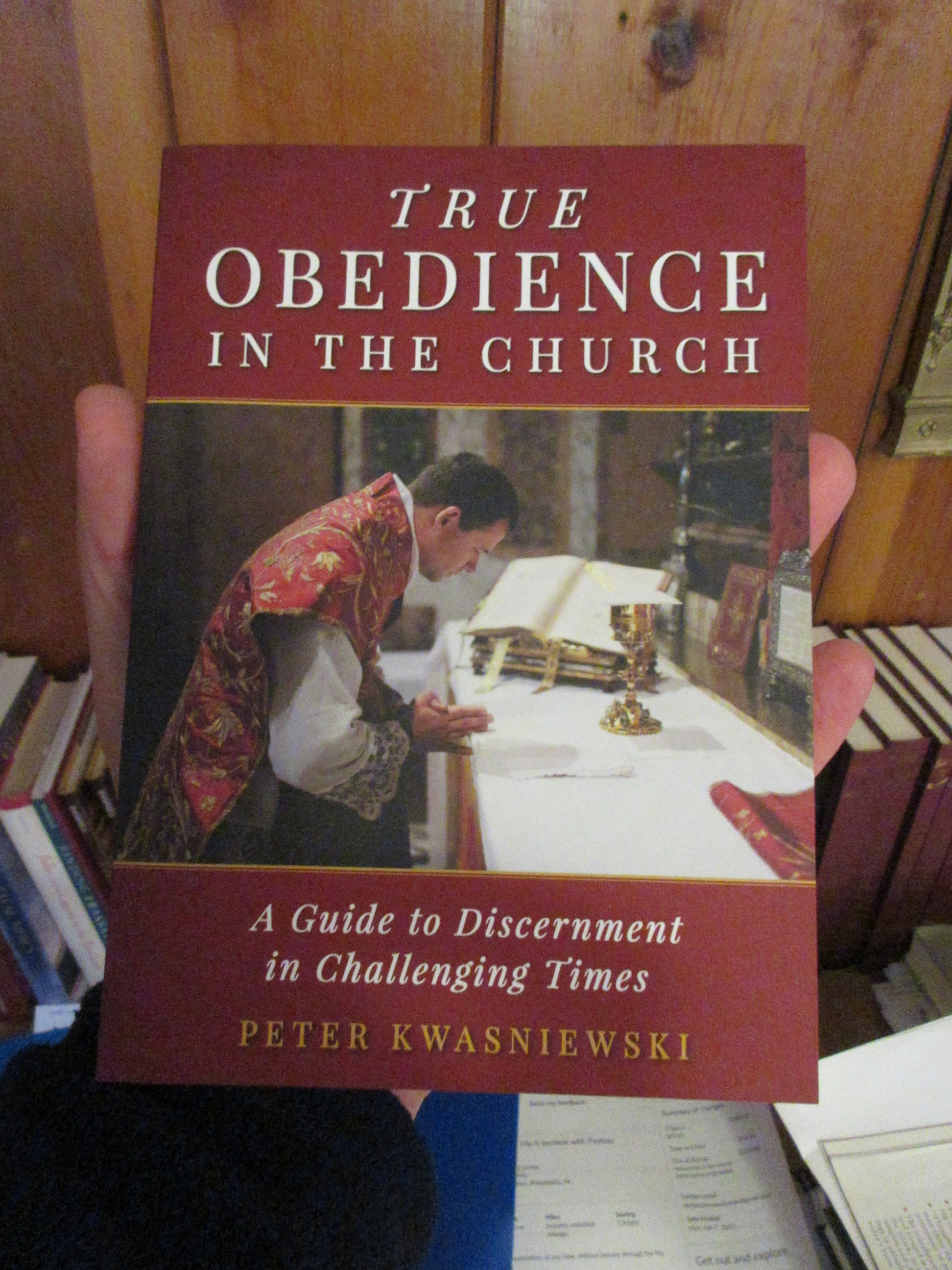
A few months ago, a “tract for the times” (so to speak) appeared from Sophia Institute Press, called True Obedience in the Church: A Guide for Discernment in Challenging Times. This small book has been the topic of many online interviews, a list of which can be found at the link above. The most recent took place with Timothy Flanders, editor of OnePeterFive, on May 16 (here). True Obedience has also been translated into Spanish and German, with Italian, French, Portuguese, and Polish on the way.

The reason it has struck a nerve is not hard to see. Traditionis Custodes presented us with a fundamentally untenable situation. As many authors have explained, it canceled out the pax Benedictina which insisted on some kind of continuity between old and new such that there was room for both in the Church (and, more importantly, such that the old should be seen as in some sense normative for the new, and as positively beneficial in the life of the Church), and replaced it with a rather blunt assertion of the cancellation of the traditional lex orandi by a modern lex orandi because the lex credendi had changed. We were faced with a more outrageous contradiction between popes than has been witnessed in a long time, or perhaps ever, because (to repeat for the hundredth time) it does not concern merely disciplinary matters.

As a result, a crisis of theology, of conscience, and of priesthood immediately follow. How are we to think about this situation, and navigate it practically? What are the principles by which we can distinguish between the obedience that must be given to legitimate authorities, and an “indiscreet obedience” (as St. Thomas Aquinas calls it) that is excessive, based on falsehood, harmful to the good of the Church or to one’s own soul? When canon law is wielded as a cudgel to dissuade or dismay tradition-loving Catholics, what recourse do we have? Do canonical penalties always take effect? What if they are based on falsehoods, both theoretical and practical? Can a falsehood generate a just law or an efficacious application of law?

These are the sorts of questions into which True Obedience delves. Thanks to a generous donor, free copies may be requested by priests, deacons, and seminarians using this link. A dedicated website has been set up, TrueObedience.com, where relevant articles, reviews, and videos may be found.

Naturally, raising such questions prompts still others that go straight back to the foundations of the Catholic religion, especially in the realm of ecclesiology:

• On what basis can we ever question the teachings, commands, or prohibitions of Church authorities?
• Does the papal office have any limits to its power? If so, what are they and how do we know what they are and when they have been overstepped?
• How is a pope’s freedom of action and teaching limited by tradition and by the actions and teachings of his predecessors?
• Did the First Vatican Council officially turn the pope into a supreme monarch whose will is law?
• Why are appeals to “living tradition” and “living magisterium” equivocal and misleading?
• What are we supposed to learn from alternating dark and bright periods of papal history?
• If a pope goes astray in teaching, have the “gates of hell” prevailed?
• Are traditional Catholics guilty of “Protestant private judgment”?
• Why are Sedevacantism and Orthodoxy dead ends rather than ways out of the crisis?
• Is there a common thread connecting the many deviations of the Bergoglio papacy?
• How can we maintain spiritual tranquility in the midst of an ecclesiastical meltdown?
 
The need to engage questions like these, plentiful in the reign of Pope Francis and its renewal of the 1970s attack against liturgical tradition, has led me to think and write frequently about the papacy and about this pontificate. I believed the time had come, in the “end of reign” mood that has taken hold, to gather the best fruit of that work and make it available in a more convenient and definitive format. Arouca Press has just released the resulting two-volume set, entitled The Road from Hyperpapalism to Catholicism: Rethinking the Papacy in a Time of Ecclesial Disintegration.

Volume 1, Theological Reflections on the Rock of the Church, takes up broader theological and spiritual themes, presenting a realistic ecclesiology in which the papacy is indeed a capital part of the Mystical Body of Christ on earth, but still only a part, with definite duties and responsibilities toward the whole; moreover, a pope’s fidelity in meeting these can be assessed by objective, knowable standards.

Volume 2, Chronological Responses to an Unfolding Pontificate, analyzes the major moments of Francis’ pontificate, illustrating and corroborating the points laid out in volume 1. Includes extensive discussions of Amoris Laetitia, the change to the Catechism ono the death penalty, the Abu Dhabi declaration, the Pachamama debacle, and various synods, especially the ones on marriage and family, on youth, and on the Amazon, concluding with analyses of the dismissal of Bishop Daniel Fernández Torres, the reconfiguration of the Roman Curia under Praedicate Evangelium, and an overview of Modernism from Pius X to Francis.

Although it’s a matching set, and obviously the topics interrelate, the volumes are designed to be self-contained and to stand alone; either one can be taken up first. In both, readers will find a searching investigation into some of the major issues facing Catholics at this time in the history of the Church and of the West.

It is only fitting for a post at NLM to draw attention to the liturgical aspects of these books.

Volume 1 argues for the inseparable triad of doctrine, morals, and liturgy: this is what the orthodox Faith necessarily involves. It is not just a matter of “true doctrine” or even “true doctrine and sound morals,” next to which liturgy is a sort of nice leisure activity to keep the faithful busy, to create opportunities for taking up collections, and to share announcements and homespun wisdom from the pulpit. Liturgy is the first and most basic work of the Church, the home of doctrine and the school of morals. More specifically, the 9th chapter of vol. 1 speaks about Pius VI’s Auctorem Fidei and similar documents, and explains why they do not furnish security to the Novus Ordo but, on the contrary, rule out the liturgical reform ahead of time.

Volume 2 contains a number of chapters directly on liturgical matters: ch. 1, an early and still optimistic piece on Pope Francis’ positive remarks about the Byzantine Divine Liturgy; ch. 2 on environmentalist ethics applied to liturgy; ch. 9 on Francis’ sociological reading of 1 Cor. 11, 27-29 in order to sidestep restrictions on Eucharistic communion; ch. 12 on the modernization of liturgy as a key psychological moment in the dismantling of the Ten Commandments; ch. 30 on the routine profanation of church buildings by secular events; ch. 35 on the traditional Martyrology’s witness to martyrs under Islam; ch. 44 on the bizarre invention of the “Sunday of the Word of God” and the refusal of the post-reform Church to acknowledge how the modern liturgy itself withholds the reverence traditionally given to Scripture; ch. 45 on the irony of replacing the feast of the Divine Maternity with the feast of John XXIII; ch. 48 on idolatry, inculturation, celibacy, and deaconesses; ch. 58 on the shattering of liturgical unity by excessive vernacularization; ch. 59 on the unbelievability of papal protestations over liturgical abuses, which “must stop” even if nothing is ever going to be done to stop them. There are, needless to say, many other references to liturgy in these pages, but the foregoing are the extended discussions.

Arouca Press is offering a 15% discount on the set at this link. Otherwise, it may be found at all Amazon outlets.

Monday, February 21, 2022

The Pope Confirms FSSP’s Use of Traditional Liturgy

The following communiqué has been published on the website of the Fraternity of St Peter. We urge all of our readers to continue their prayers for the preservation of the Ecclesia Dei institutes in their charisms as agreed upon with them by the Holy See.

On Friday, February 4, 2022, two members of the Priestly Fraternity of St. Peter, Fr. Benoît Paul-Joseph, Superior of the District of France, and Fr. Vincent Ribeton, Rector of St. Peter’s Seminary in Wigratzbad, were received in private audience by the Holy Father, Pope Francis, for nearly an hour.

During the very cordial meeting, they recalled the origins of the Fraternity in 1988; the Pope expressed that he was very impressed by the approach taken by its founders, their desire to remain faithful to the Roman Pontiff and their trust in the Church. He said that this gesture should be “preserved, protected and encouraged”.
In the course of the audience, the Pope made it clear that institutes such as the Fraternity of St. Peter are not affected by the general provisions of the Motu Proprio Traditionis Custodes, since the use of the ancient liturgical books was at the origin of their existence and is provided for in their constitutions.
The Holy Father subsequently sent a decree signed by him and dated February 11, the day the Fraternity was solemnly consecrated to the Immaculate Heart of Mary, confirming for the members of the Fraternity the right to use the liturgical books in force in 1962, namely: the Missal, the Ritual, the Pontifical and the Roman Breviary.
Grateful to the Holy Father, the members of the Fraternity of St. Peter are in thanksgiving for this confirmation of their mission. They invite all the faithful who feel close to them as a spiritual family to attend or join them in prayer at the Mass tomorrow, on the feast of the Chair of St. Peter, and to pray for the Supreme Pontiff.
Frs Paul-Joseph and Ribeton with the Holy Father

Saturday, January 29, 2022

A Reform-of-the-Reform Paladin Throws in the Towel

Denis Crouan, the French founder and president (since 1988 or so) of the organization Pro liturgia, which promotes “the Mass as Vatican II truly intended it”, with Latin, chant, ad orientem, etc., has declared such efforts to be a “waste of time”, and thrown in the towel. The following article is his Final Message on the site, although he states that its activities will continue in a different form on another site. NLM is very grateful to an old and dear friend, Mr Jerome Stridon, for providing this translation. Caveat lector: the reproduction of this text does not imply agreement on the part of anyone associated with NLM with everything that is stated herein. Below is a video in French in which Mr Crouan explains in greater detail his decision to end the activities of Pro liturgia.

Asking present-day clergy to respect the liturgy of the Church is a waste of time: with an obstinacy often coupled with a profound lack of culture, those who occupy the places from which they are supposed to teach, go before, and lead the faithful - at all levels in the Church, from the pope to the simple parish priest - seem to want to systematically sabotage divine worship in a way that remains completely incomprehensible.

We must separate ourselves from a clergy that for years has been trying to dream up, with inexplicable perseverance, liturgical celebrations that only bring together the naive, unthinking conformists who place their need for conviviality and sentimentality above any preoccupation with the truths of faith and liturgical sense, to the point of forgetting them, or even denying them, and depriving those who need them.

We must leave behind a clergy and churchgoers who find their attitudes encouraged and shared by bishops who stray into biased readings of magisterial texts (as evidenced by their ways of reading and applying both the Second Vatican Council and Pope Francis’ Motu proprio “Traditionis custodes”).
Let those who wish to go on making friendship bracelets, filling in coloring books, and singing inanities at Masses that alternate between kitschiness and faddishness do so with complete freedom: they will not transmit anything to the future generations.
Let those who wish to cling to stiff chasubles or to lace albs, the hallmarks of falsely “traditional” celebrations, do so if they find it to their liking: these days, every way of celebrating the liturgy is to be considered acceptable.
Let our bishops who want to be the heralds of a rootless pastoral ministry that has never produced anything do so, if it gives them the feeling of being up to their mission: the extravagances of which they are capable and which no longer surprise are not yet exhausted.
That Pope Bergoglio is more interested in Luther and Pachamama than in the doctrine and morals of the Church is his choice: a choice that everyone is entitled to consider regrettable and more than risky. (editor’s note: I cannot help but wonder if this statement from a promotor of the post-Conciliar liturgy will lead to calls for yet another motu proprio ordering that said liturgy be suppressed.)
In any case, all of this, this way in which the Church and its liturgy present themselves, is no longer of any interest to the simple faithful who want to escape the betrayals of a clergy that wallows in the management of empty parishes where only “committed laymen” swarm and claim to “animate” liturgies that are, at best, lukewarm soups swallowed out of a spirit of sacrifice, and, at worst, poisons for inner peace and psychological balance.
Granted, there do remain harbors of peace, such as the monasteries that have resisted the winds of modernism and have received and applied Vatican II with faith and intelligence. But a monastery, though it may be an occasional place of refreshment, is not the parish sanctuary that the lay faithful should normally frequent, and where they ought to be sure that they can live out and feed their faith in silence and contemplation.
In order to get away from this ecclesial situation, which has become delirious and toxic to the point of harming inner peace and the Catholic faith, it has been decided to put an end to the “adventure” of Pro Liturgia. The current situation has no future and is kept up by a partly unstable clergy and laity that have accepted to be so disoriented that they no longer question what they are made to do during the Mass. As such, this situation demands such a decision of us.
The watchword of our bishops is that Masses should be entrusted neither to “traditionalists” nor to the faithful who respect the decisions of Vatican II on liturgy, but only to those who abuse divine worship. Therefore, to try to have a conversation with these mitred pastors, with their impenetrable way of thinking, is a waste of time (and sometimes even of faith).

Saturday, December 18, 2021

The Last Stand of the Brezhnev Papacy

Merry Christmas, traddyland! Your present, which you knew was coming in one form or another, came early this year. The Congregation for Divine Worship has issued a series of clarifications to Traditionis Custodes, and they are, sadly, but not surprisingly, no less thoroughly, relentlessly and unapologetically specious and disingenuous as the original. Far be it from me to suggest that the timing of this document could not be better calculated to let the faithful who love the traditional worship of the Roman Church know that mercy and accompaniment are not for them. The document does that all by itself, not least when, in the process of ruthlessly marginalizing them, it declares that “There is no intention in these provisions to marginalise the faithful who are rooted in the previous form (sic) of celebration.”

To add insult to injury, it is presented in the form of responses to “dubia” submitted by various bishops, so it turns out that the highest authorities of the Church have not forgotten how to answer a simple direct question after all. Far be it from me to suggest that these “dubia” happen to correspond fairly well (but not, thank God, completely) to the unnecessarily harsh interpretations of Traditionis Custodes which certain liturgists have been pushing for since July. In the end, it hardly matters where they come from, any more than the survey of bishops about the effects of Summorum Pontificum in the life of the Church mattered. The intent to erase the Roman Rite is stated clearly and unmistakably, and the question of whether they intend to do it by hook or by crook is something of an academic one.

The specific details of what this new decree means will be hashed out over time by canonists and others much more competent to do so than myself. For the time being, there are two things which I think particularly noteworthy.
Before Summorum Pontificum, when many followers of the traditional rite had to beg and plead for permission to do anything, and were often denied even the crumbs that fall from the table of their masters, their communities were often described as ghettos. The new instruction is nowhere near so generous as to leave us in the relative peace of a ghetto; it explicitly states that it wants to send us to a gulag for re-education. “This provision is intended to underline the need to clearly affirm the direction indicated by (TC)… In implementing these provisions, care should be taken to accompany all those rooted in the previous form (sic) of celebration towards a full understanding of the value of the celebration in the ritual form given to us (sic) by the reform of the Second Vatican Council. This should take place through an appropriate formation that makes it possible to discover how the reformed liturgy is the witness to an unchanged faith, the expression of a renewed ecclesiology, and the primary source of spirituality for Christian life.” (This is especially hilarious, given that it effectively admits that the post-Conciliar rite does not do any of these things on its own, and given that almost no such effort has been made to help that majority of the faithful who follow the post-Conciliar rite in a similar process of discovery.)
Like many Latin words, “traditio” (of which “traditionis” is the possessive singular form), and “custos” (of which “custodes” is the plural subject form), have several meanings. The verb “tradere” means “to hand down”, but also “to hand over”, hence “to betray”, the sense in which it is used more than once in the Gospels in reference to Judas. “Traditio” can therefore mean both “tradition” and “treachery.” And likewise, “custos” can mean “a guardian”, the sense in which it is used to refer to St Joseph in the Divine Office (“custos Domini sui – guardian of his own Lord”), but also “prison-guard”, the meaning it has several times in the Acts of the Apostles. “Traditionis Custodes” can therefore mean either “guardians of the tradition”, or “prison-guards of treachery.”
Traditionis Custodes itself already falsely imputed unsavory and counter-revolutionary motives to those of the Christian flock who love the traditional rite, and gave the bishops fairly broad permission to acquire their smell by wading into their midst and giving them a solid thrashing. The new instruction clearly seeks to drive an even greater wedge between the bishops and their flocks by making them their “prison-guards” and not their “guardians.”
The freedom of the “guardians of the tradition” to guard the tradition is severely hampered. They are not free to authorize their own priests and deacons ordained after July 16 to celebrate the Roman Rite; they must obtain further authorization from Rome, which will, of course, be denied as a matter of course, in accord with the intention to slowly strangle the rite. They are also not free to use a liturgical book proper to their station, the Pontifical, not even to bless a bell, much less to confirm or ordain. (This is particularly noteworthy, given that they can, within limitations, authorize the use of the old Rituale, and are thus less free than the priests they will authorize to use it.) Their freedom to administer churches for the benefit of tradition-minded faithful is also hampered, and they are made responsible for the unenviable task of re-educating them about the riches of the post-Conciliar Rite.
The instruction even pretends to dictate to the bishops of the synodal, listening, decentralized Church what they may allow their priests to publish in parish bulletins regarding the Roman Rite, and a sycophant has already publicly doxxed a parish for not updating their bulletin accordingly, exhorting the parishioners to denounce the bishop to the Central Committee if he will not comply. (I am sure the Pope himself has denounced this kind of petty malice and hypocrisy on more than one occasion.)
In short, every effort is made to reduce the bishops’ dealings with faithful who love the traditional rite to the purely administrative, until such time as the gulag is closed, and the liturgists’ paradise established upon the earth. So much for the smell of the sheep...
Fortunately, there are many bishops who have been generous and kind to the faithful who love the traditional rite. If any such bishop happens to read this, I make bold to plead with you that you continue to exercise the same pastoral charity to the faithful that you have in the past, and encourage your brother bishops to do the same. The Church is burning down around our heads, and there is nothing to be gained from acts which can have no effect other than to engender discouragement and sadness among the faithful, and destroy vocations in your diocese. The Pope has denounced “rigidity” constantly for over eight years now, so do not be rigid. Just last month, he stated at a Sunday Angelus, “Today we see clericalism in many places; this being above the humble, exploiting and beating them, feeling perfect. This is the evil of clericalism. It’s a warning for all times, Church and society: never take advantage of your position to crush others.” Do not take advantage of your position to crush others. Take these exhortations to heart, and turn a blind eye to these unjust provisions, or if you feel that you cannot, be as generous as you can to the faithful, remembering that Canon 87 is still a thing, and you don’t actually have to do any of these things. Be a guardian, and not a jailer.
And likewise, take to heart these words rightly said by a young priest on Twitter: “The people harmed by Traditiones Custodes are not sede-vacantists and ‘rad trads’, but the great numbers of Catholic faithful who, desiring the salvation of their souls and that of their family, lovingly adore Our Lord in the same manner that Christians have for nearly 2K years. The attempt to reduce this document to a mere move to quell radical fringe groups is a blatant denial of the truth of the situation, and an offense to God Himself.”
Secondly, with permission, I share a reflection written by an Italian friend, followed by an elaboration of my own.
“The pontificate of John Paul II produced a generation of Wojtylian priests, that of Benedict XVI a generation of Ratzingerian priests. The current pontificate has inspired no such school or movement. Gentlemen of a certain age, who had already taken hold of positions of power, have consolidated their power, but there is no ‘Bergoglio generation.’ This pontificate, with all its hangers-on, must recur to the use of force as its solution to the traditionalist ‘problem’, a force which conquers, but does not convince (vince ma non convince): repression and censure. Does the new rite as understood by Pope Francis, Abp Roche or Andrea Grillo inspire art, the spiritual life, or vocations? No? Fine, then we shall forbid the old one, and Ratzinger’s whole understanding of the problem. A senile, Brezhnevian Church, paralyzed and sterile, which continues to repeat the slogans of the 1970s ever more tiredly, will end like the power of the Soviet Union ended.”
Does this seem overly harsh? Within a bit more than 3300 words, Abp Roche (who is, after all, the prefect of the Congregation for Divine Worship, and is supposed to know this stuff) refers more than ten times to the post-Conciliar rite in one way or another as the fulfillment of the will of the Second Vatican Council. It is as if even the most cursory reading of Sacrosanctum Concilium did not reveal the post-Conciliar rite to be the complete overthrow of that document. It is as if no further research had been done on the liturgy in fifty years, revealing the scholarly premises of the reform to be erroneous at best, and its methods fraudulent. It is as if the reform had borne any of the fruits looked for in the first paragraph of Sacrosanctum Concilium.
Far be it from me to suggest that it is also as if he were trying to convince himself of something which he knows in his heart of hearts not to be true.

It is easy to be discouraged in circumstances such as these. Do not be discouraged. Before many of you were even born, “aggiornamento”, the “updating” of the Church, had degenerated into a desperate, exhausted attachment to the childish novelties of the 1970s, and “collegiality” into heavy-handed papal crushing of an ecumenical council. The appointment of the bishops as “guardians of the tradition” has met the same pathetic fate in less than six months. The post-Conciliar revolution is dying and afraid, and so it has struck out and done harm. It will continue to strike out and do harm, but every time it does so, it confesses its own failure, weakness, and fear. When it is gone, by the grace of God, you will still be here, and so will the most authentic expression of the Roman Church’s lex orandi.
Do, then, as my Italian friend suggests: “Have patience and trust in God, and put a good bottle of champagne in storage, to be opened on the day of liberation.” It will come, later than we hope for, but sooner than we expect.

Monday, November 01, 2021

Announcing From Benedict’s Peace to Francis’s War — A Book of Articles & Essays on Traditionis Custodes

I am very pleased to announce the publication by Angelico Press of a major collection of essays and articles by prelates and pastors, theologians and canonists, philosophers and cultural figures, in response to the pope’s July 16th motu proprio: From Benedict’s Peace to Francis’s War. And  a potent anthology it is: 70 responses to Traditionis Custodes from 45 authors in 12 countries—5 cardinals, 5 bishops, 8 priests, 2 religious, and 27 laymen.

The contributors, by category:

Cardinals
Cardinal Walter Brandmüller, Cardinal Raymond Leo Burke, Cardinal Gerhard Müller, Cardinal Robert Sarah, Cardinal Joseph Zen

Bishops
Archbishop Héctor Aguer, Archbishop Thomas E. Gullickson, Archbishop Carlo Maria Viganò, Bishop Rob Mutsaerts, Bishop Athanasius Schneider

Priests
A Catholic Priest, Abbé Claude Barthe, Abbé Christian Gouyaud, Dr. Michael Fiedrowicz, Dr. Martin Grichting, Fr. John Hunwicke, Msgr. Charles Pope, Dr. Gero P. Weishaupt

Religious
Dom Alcuin Reid, Cristiana de Magistris (pen name)

Laymen
Christopher Altieri, Phillip Campbell, David Deavel, Tomasz Dekert, Pietro de Marco, Juan Manuel de Prada, Michael Brendan Dougherty, Ross Douthat, Douglas Farrow, Edward Feser, Christophe Geffroy, Peter Kwasniewski, Phil Lawler, Jean-Pierre Maugendre, Daniel McGlone, Leila Miller, John A. Monaco, Sebastian Morello, Martin Mosebach, George Neumayr, Michel Onfray, Rubén Peretó Rivas, Matthew Schmitz, Joseph Shaw, Tim Stanley, José Antonio Ureta, Massimo Viglione

Most of these pieces were published already in dozens of places online between July 16 and September 20. The primary purpose of the book is to gather them all conveniently into one volume, with errata corrected, some editorial notes added, and the whole beautifully typeset. (N.B. The book does, however, contain several pieces that have not appeared anywhere else yet, either simply, or in English translation: Jean-Pierre Maugendre’s “Francis: The Pope of Exclusion” and “Divide and Conquer?”; Juan Manuel de Prada’s “Substance and Form”; two substantial lectures by Joseph Shaw, “Is the Missal of Paul VI the Unum Necessarium?” and “We Will Persevere, and with God’s Help We Will Prevail”; Christophe Geffroy and Abbé Christian Gouyaud’s “After the Shock, the Analysis.” It also has fresh and better translations of Michel Onfray’s “Ite Missa Est” and Abbé Claude Barthe’s “The Council's Last Stand?”)

The table of contents may be viewed in this composite and cropped image (click to enlarge):
 
Some interior photos to give a sense of the layout:


Publisher’s Description:

Already on July 16, 2021, the reactions to Pope Francis’s severe restrictions on the traditional Latin Mass in Traditionis Custodes were like a river in full flood: articles, essays, interviews, podcasts—everywhere and from every point of view. An emotional, spiritual, intellectual dam had broken and the waters of discourse poured forth across the world. The sheer volume of writing occasioned by Traditionis Custodes is unlike anything seen in the history of papal documents—testimony to a neuralgic subject on which arguments proliferate and passions run high.

The two-month period following the release of the motu proprio gave proof that the traditionalist movement was no fringe phenomenon, but something that had gained significant strength and sympathy during the relatively peaceful years from 2007 to 2021 (the “Pax Benedictina” to which the book’s title refers). The purpose of this volume is to gather in one convenient place some of the finest and most appreciated essays and articles published in the period from mid-July through September of this fateful year, 2021—not only from America and England (although these predominate), but also from other nations: France, Germany, Switzerland, the Netherlands, Italy, Spain, Argentina, Poland, Kazakhstan, and China.

This book is not, and makes no pretense of being, a presentation of “both sides of the argument.” It offers a variety of critiques of this profoundly unwise and unpastoral decree, which suffers from incoherent doctrinal foundations, grave moral and juridical defects, and impossible ecclesiological implications.

Angelico Press is profoundly grateful for the many prominent authors the world over who have permitted us to publish their contributions. We wish to underline that the inclusion of any contribution does not imply the author’s approval of the opinions of others published in the book, or of the editorial decisions made by Angelico Press, including the title, which remain the responsibility of Angelico Press alone.

To Order:

From Benedict’s Peace to Francis’s War: Catholics Respond to the Motu Proprio Traditionis Custodes on the Latin Mass. Edited by Peter A. Kwasniewski. Brooklyn, NY: Angelico Press, 2021. 406 pp.  |  Paperback: $22.95  |  Hardcover: $32  |  (Kindle forthcoming)

Available at Amazon and Barnes & Noble—or request it from your local bookseller.

Friday, October 29, 2021

An Open Letter to Pope Francis, by Roseanne T Sullivan

After a career in technical writing in the computer industry while doing other writing on the side, Roseanne T. Sullivan now writes full-time about sacred music, liturgy, art, and whatever strikes her Catholic imagination. She has published many essays, interviews, reviews, and memoir pieces at Latin Mass Magazine, Sacred Music Journal, Dappled Things, National Catholic Register, and other publications, and she writes for the Benedict XVI Institute of the Archdiocese of San Francisco. We are glad to welcome her for yet another fine guest contribution to NLM.

Dear Holy Father,

When I read your Motu Proprio Traditionis Custodes on July 16 and realized the effects it will have on the free celebration and future growth of the traditional Latin Mass, I cried. It seems like an excessively harsh measure uncharacteristic of an otherwise kindly seeming pope, after the comparative freedom we enjoyed after your predecessor, Pope Benedict XVI released Summorum Pontificum in 2007.
To explain my reaction, I think it would help for you to know some things about my background. I am a 76 year old Catholic lay woman, with a B.A. in art and English and an M.A. in writing. I was for many years a technical writer in the computer industry in Silicon Valley, and I now write full time as a passionate amateur about Catholic sacred music and divine liturgy, architecture, art, and literature.
I was a cradle Catholic who left the Church in 1963 in adolescent pride, a university freshman who thought that intelligent people don’t believe in God, and I returned in the late 1970s, a “sadder and wiser” divorced mother of two. In the meantime, from lots of hard experiences, I had realized that the Church is not a big meanie trying to steal our joys and that God’s commandments are for our protection.
At first I accepted the new Mass without any question. After all, I had come back because I had learned to believe in and trust the Church as the Body of Christ, so why would I not trust the changes made to the liturgy?
At the first parish where I went to Mass after I returned to the Church, I saw many examples of the kinds of jarring things I continued to see in the years since then. Long-haired hippies in blue-jeans played rousing spirituals and folk songs on guitars, banjoes and tambourines at the parish Masses —not that I was averse to hippies or to spirituals, but to the lack of reverence and to the way in which performance was emphasized over worship. I still hear the same types of distracting music that brings the rhythms of the world into the Mass even now when, for example, I’ve attended Masses at my diocesan cathedral, with its current large ensemble of cantors and musicians located to the right of the altar with a jazz piano, electric guitars, and drums.
During Mass at that first parish I attended in 1978, we stood in a half circle facing each other. After the novelty wore off, over time I realized that everyone was showing off, everyone was looking at everyone else, and the focus was no longer on the sacrifice that was taking place at the altar.
The priest was now at the center of attention and, since then, as I’ve seen again and again, many priests have trouble resisting the temptation of playing to the audience, spouting their own opinions instead of the Church’s teachings, sometimes telling jokes, even off-color ones, from the pulpit. The constant rather lame improvisations and the folksy or jazzy songs remind me of the old TV show The Ted Mack Amateur Hour.
I also grew more and more appalled at the experimentations that led to what Pope Benedict XVI and you have termed objectionable improvisations of liturgy. But not only that, deformations of doctrine and practice were and are rampant.
What is especially shocking is that over the ensuing years in various parts of the country where I’ve lived almost every Catholic lay person, priest, religious sister or brother or Catholic university professor I talked with believed that not only had the Mass changed but morality had changed also. Statistics show that non-traditional Catholic couples are unashamedly casually engaging in the intimacy that belongs in marriage, living together outside of marriage, contracepting, aborting their babies, and divorcing at the same rate as the rest of the society.
I think it’s due perhaps to an unexpected after-effect of Vatican II. Many Catholics believed during the 1960s, when the council was going on, everything formerly taught and practiced by the Church for two millennia was up for grabs. Some simple-mindedly seem to reason, for example, that if the Church taught before Vatican II that we would go to hell for eating meat on a Friday, and the Church removed that penalty that the Church could and was probably going to remove the penalty for all sorts of other things. As the song goes, a new Church was being sung into being, and in many respects it was nothing like the old Church.
Another false assumption came to light for me in the late 1990s when I went to a Franciscan retreat center. At Sunday Mass, the Franciscan priest who managed the center walked away from the pulpit into the middle aisle and acted out the Gospel of the day, in which Jesus says that God hates divorce. He then proceeded to claim in his homily that Jesus was really not against divorce.
After Mass, I asked the priest how he could have contradicted the words of Christ. By the way he answered me, I learned that he believes the Gospels were written by committees, each of which had its own agenda—which is a theory, as I learned later, I taught at most Catholic universities and seminaries. Many, like that priest, go on to infer logically from that premise that no passage of the Gospels needs to be taken literally, and so there’s no such thing any more as Gospel truth. And for those type of Catholics, it seems, the Church’s perennial teachings are no longer to be consulted. The priest told me that a moral theologian had written Jesus was not against divorce, and the opinion of a theologian trumped the Church’s teachings in that priest’s mind.
After I started studying at my bishop’ institute for leadership in ministry in 2002, I found there the speculations of theologians were taught as if they were settled doctrine, even thought in many cases, the theologians’ claims had been rejected by popes or by decisions from the Congregation for the Doctrine of the Faith.
My own bishop taught the class on Penance. He told us that Jesus had not instituted the seven sacraments, and that that the Eucharist forgives mortal sins. Professors from nearby Catholic universities and priests from the Bay Area taught that morality had changed, that the Church was no longer a hierarchy but a circle, that the church’s teachings against contraception and homosexual acts did not have to be followed. (I still have my notes.) No classes taught about personal holiness. No classes used the Catechism of the Catholic Church, which I heard referred to disparagingly as a “pre-Vatican II document,” even though it was published in 1992; CCC came out during the reign of Pope Saint John Paul II, who many apparently regard as objectionably conservative.
Back to the music. In 2006, I joined a choir that had managed to keep singing Gregorian chant and polyphony during ordinary form Masses, even after that kind of music had practically been banned since 1969. After I was re-exposed to the Gregorian chants of the Ordinary I had learned as a Catholic school girl in fourth grade, and I learned the many more chant Mass settings, I then learned about the wonderful chants for the Propers of the Mass that varied every day throughout the liturgical year.
I read Sacrosanctum Concilium, the Vatican II document on the liturgy, for myself. I learned that it actually says “Gregorian chant should be given pride of place,” and “the pipe organ is to be held in high esteem.” And that it didn’t say that chant should be replaced with folksy or jazzy tunes or that the organ should be replaced with guitars, drums, pianos, banjoes, or tambourines. SC does say that the vernacular could be “allowed,” not that Latin should be banished. So, what happened there?
I also learned that SC doesn’t say anything about Communion in the hand distributed from one pair of unconsecrated hands to another, about Extraordinary Eucharistic Ministers, about the priest celebrating facing the people, or about “girl altar boys.”
For these and several other reasons, I started to wonder what is behind the claim that the new Roman Missal expresses the mind of the Second Vatican Council. Maybe someone will explain that to me some day. But I digress.
Over time, I found myself unwilling to go to Mass at other churches where a “four-hymn sandwich” had replaced the chants. As a result of abandoning the Church’s sacred music, Catholics were singing at Mass instead of singing the words of the Mass.
And the hymns they were singing were seemingly chosen at random and had no relation to the feast of the day or the day’s place in the liturgical year. Besides, the words of the hymns were often doctrinally unsound. For example, one Christmas Eve midnight Mass, when I joined my parish church’s combined choirs, I was shocked when one of the members of the Spanish choir played his electric guitar and sang Imagine, John Lennon’s atheistic hymn against religion.
In 2007, after Pope Benedict XVI’s Summorum Pontificum freed up the celebration of the traditional Latin Mass, the San José diocese erected an oratory as the diocesan center for the TLM. I joined their newly formed choir, and since then I have mostly attended Masses at the oratory.
I can’t help but grieve that you, my pope, my papa in the original meaning of the word, have made this decision to prevent the further growth of the traditional Latin Mass. Already many bishops around the world have used your motu proprio to justify the suppression of these Masses. These measure seems cruel and heavy handed.
Dear Papa Francis, I and the vast majority of us who love the traditional Latin Mass prefer it not because we are divisive, but because we love and are loyal to the Church.
We prefer the traditional Latin Mass because we prefer the reverence, the beauty, and the emphasis on the Holy Sacrifice of the altar that we find at the old Mass and have seldom found at the new. We know that the priests are not going to be doing comedy routines from the pulpit and they will not be contradicting the words of Our Saviour either.
Generalized accusations against traditional Catholics unfairly disparage the deep and authentic devotion that I and thousands, perhaps millions, of Catholic men, women, and children express when we worship God and remember the sacrifice of His Son Jesus Christ at the traditional Mass. Besides, how can we deny what Pope Benedict XVI wrote in Summorum Pontificum? “What earlier generations held as sacred, remains sacred and great for us too, and it cannot be all of a sudden entirely forbidden or even considered harmful.”
You call for more reverent Masses that are true to the rubrics of the current Roman Missal. Pope Saint Paul VI did too, as did Pope Benedict XVI. But sixty years have passed since the experimentation began, and many more may pass before misinterpretations of Vatican II are done away with and the Church that celebrates the Mass of 1969 stops being the electric Church —as Mother Angelica once said, “because every time you go, you get a shock.”
Please reconsider. Please don’t take the Mass of the Ages away from us. Don’t divide us. Let us live side by side together with those who find their comfort with the new Mass, all of us tolerant of our differences, in peace, and united in true obedience to God.
Sincerely and respectfully yours in Christ,
Roseanne T. Sullivan
Tuesday, August 03, 2021

Peace-Builder or Pacifier? Some Considerations of Traditionis Custodes and Pope Francis

The following essay by Prof. Ruben Peretó Rivas was published on his blog Caminante Wanderer on July 31st, and is here given in a translation from the original Spanish which he has reviewed. Dr. Peretó Rivas is a member of the Faculty of Philosophy and Literature at the National University of Cuyo in Mendoza, Argentina. We are very grateful to him for his kind permission to share this with our readers.

Political theory in the Anglo-Saxon world makes an interesting distinction between the concepts of “peace-building” and “pacification”. The first, “the building of peace”, refers to a process by which peace is sought through dialog between the parties in a conflict. In the second, on the other hand, peace is achieved by coercive military action which forces the parties to keep silent about their complaints under pain of violent reprisals.
This schema can also be applied to the reading of what has happened in the Church in the last several years in regard to the traditional Mass. The conflict which dragged on from the very moment of the promulgation of the new Missal by Paul VI was previously almost resolved with Benedict XVI’s motu proprio Summorum Pontificum, who in this way became a “builder of peace.” With the sudden appearance a few weeks ago of Traditionis Custodes, Pope Francis has not only dynamited the dialog and peace reached in liturgical matters, but has also established himself as a “pacifier” in the Anglo-Saxon sense of the term: one who imposes peace by force, while threatening the punishment of those who do not accept his designs.
The trial-by-fire of the liturgical books of the Mozarabic Rite. “Both books were thrown into the fire.The Roman one leapt out of the fire. The Gothic one was unharmed in the flames.” (From an NLM quiz in 2011.)
This is the reading which the majority of analysts of the ecclesiastical and liturgy situation have made, such as Cardinal Mueller, Cardinal Burke, Mons. Rob Mutsaerts and Fr Guillaume de Tanoüarn, reaching the conclusion that Traditionis Custodes (TC) is, fundamentally, a profoundly anti-pastoral document, one which generates division and reopens a painful conflict, causing enormous damage to many of the faithful. Undoubtedly, this is the most important characteristic of the most recent motu proprio, but it may not be the most grave, since from the theological point of view, it dismantles the construction which Benedict XVI had achieved, and creates a thorny problem which becomes unresolvable.
Pope Francis bases part of what little argumentation he provides to justify his draconian measures in regard to the traditional Mass on the assertion that it was permitted by Pope John Paul II, and afterwards regulated by Pope Benedict XVI, with the “desire to favor the healing of the schism with the movement of Mons. Lefebvre.” Although it is certainly true that both Popes wished to resolve the problem posed by the SSPX, as all good Catholics should want to do, they also wanted to maintain continuity with the traditional liturgy. In the book The Last Testament. In his own words, Pope Benedict responded to the claim that the reauthorization of the Tridentine Mass was a concession to the Society of St Pius X, with these clear and conclusive words. “That is absolutely false! For me, what is important is the unity of the Church with itself, in its interior, with its past; that that which was holy for Her before should not be in any way an evil now.” (Pope Benedict XVI with Peter Seewald, London: Bloomsbury, 216, pp. 201-202).
And there are many other witnesses who can be cited in support of this. Card. Antonio Cañizares, as prefect of the Congregation for Divine Worship, one with privileged knowledge of the thought and intention of Pope Benedict in Summorum Pontificum, wrote: “The will of the Pope was not only to satisfy the followers of Mons. Lefebvre, nor to limit himself to answering the just wishes of the faithful who feel attached, for various reasons, to the liturgical inheritance represented by the Roman Rite, but also and especially to open the Church’s liturgical riches to all the faithful, making possible in this way the discovery of the treasures of the Church’s liturgical patrimony to those who still do not know them.” (Prologue to the book The Reform of Benedict XVI, by Nicola Bux.)
His Eminence Antonio Card. Cañizares celebrates a Pontifical Mass in the traditional Rite at the high altar of the Pope’s cathedral, St John in the Lateran, in 2009.
The website of the now defunct Pontifical Commission Ecclesia Dei, which can still be visited, and which, according to the introduction by Cardinal Dario Castrillon Hoyos, then president of the Commission, is not an opinion site, but a site that includes “information and material in absolute fidelity to the thought of the Holy Father”, affirms that “the legitimacy of the Church’s liturgy resides in continuity with tradition.” Therefore, the usus antiquior certainly has legitimacy; it has hundreds of years of history behind it, and the other rites both eastern and western recognized by the Church alongside it. It has the Tradition to defend it. The idea that brought Pope Benedict to hold this position is that a rite which was a sure path to sanctity over the ages cannot suddenly become a threat, “if the Faith which is expressed in it is still considered valid”, says one of the documents on the aforementioned site. To present an opposition of missals – one good and one bad, and therefore prohibited – as Pope Francis does in TC, although it may on the practical level go to the detriment of the old one, on the level of principles, reveals the weak foundation of the new one.
In this theological perspective, what is left weakened is the Missal of Paul VI, since it is clearly a construction hastily put together in a laboratory by a group of specialists, as the protagonists of its creation bear witness in their memoires. (E.g., those of Louis Bouyer, Bernard Botte, or Annibale Bugnini).
Joseph Ratzinger, while he was still a priest, wrote in 1976 to Prof. Wolfgang Waldstein, “The problem of the new Missal lies in its abandonment of a historical process that was always continual, before and after St Pius V, and in the creation of a completely new book, although it was compiled of old material, the publication of which was accompanied by a prohibition of all that came before it, which, besides, is unheard of in the history of both law and liturgy. And I can say with certainty, based on my knowledge of the conciliar debates and my repeated reading of the speeches made by the Council Fathers, that this does not correspond to the intentions of the Second Vatican Council. (Wolfgang Waldstein, “Zum motuproprio Summorum Pontificum”, in Una Voce Korrespondenz 38/3 (2008), 201-214).
This worry has accompanied Pope Benedict all his life – how to theologically save the Missal of Paul VI, which lacks the continuity with tradition that always existed in the Church’s liturgy. Since it was impossible to demonstrate this continuity as a matter of history, the only way to do so was, and is, through an act of the will, without further proof that this continuity existed. And this is precisely what he did in Summorum Pontificum. Pope Francis has just dynamited this theological assemblage, which saved the two missals and re-established the pax liturgica, thereby not only rekindling the conflicts of the ’70s and ’80s, but also, and more importantly, aborting the solution which was found in the theological field to justify the liturgical reform of the late ’60s.
Certainly, the theology which is hidden behind TC is not an original creation of Pope Francis. It is in fact no more than a by-product of the rupturist position developed by the School of Bologna, and curiously, coincides with the theories which of one of the lesser representatives of that school, Andrea Grillo, has published in recent years.
TC also shows the concepts of authority and obedience to which Pope Francis holds, nearer to perinde ac cadaver [note] than to the tradition and theology of the Church. His authoritarian and absolutist reflections bring to my mind a passage of Lewis Carroll’s Through the Looking-Glass.
‘When I use a word,’ Humpty Dumpty said in rather a scornful tone, ‘it means just what I choose it to mean — neither more nor less.’
‘The question is,’ said Alice, ‘whether you can make words mean so many different things.’
‘The question is,’ said Humpty Dumpty, ‘which is to be master — that’s all.”
Public domain image from Wikimedia Commons
With TC, Pope Francis seeks to impose on the Church the mentality of Humpty Dumpty, and govern it as a despot: the question is, which is to be master?
We must recognize one success of TC: its title, Traditionis custodes, the opening words which gives the document its name, is perfectly true, since the bishops are the “guardians of the tradition”, which is to say, they are obliged to know it, contemplate it, and protect it. And for this reason, it is the tradition as something objective which ought to determine their actions as bishops. However, we must here note a certain nuance: the motu proprio seems to understand the expression in the sense that the tradition is what the bishops – and especially the bishop of Rome – decide it is: La tradition, c’est moi.
editor’s note: The Latin words “perinde ac cadaver – just like a corpse” are often used to describe a notion of religious obedience introduced by the Jesuits. A trenchant essay by Dr John RT Lamont, published on Rorate Caeli in 2018, describes it very well as one open to “tyrannical understanding of authority in general as based on the arbitrary will of the possessor of power, rather than on law.” Law here may also be replaced by “tradition” or “custom.”

More recent articles:

For more articles, see the NLM archives: