Some interesting unused footage of Pope St John XXIII blessing the Agnus Deis in 1959, from the YouTube channel of British Pathé. (The video has no sound.)
Agnus Deis are discs of wax impressed with an image of the Lamb of God, and often with the arms of the Pope or the image of a Saint on the reverse. They were traditionally blessed by the Popes as described by the old Catholic Encyclopedia: “The great consecration of Agnus Deis took place only in the first year of each pontificate and every seventh year afterwards, which rule is still (in 1907) followed. The discs of wax are now prepared beforehand by certain monks ... On the Wednesday of Easter week these discs are brought to the Pope, who dips them into a vessel of water mixed with chrism and balsam, adding various consecratory prayers. The distribution takes place with solemnity on the Saturday following, when the Pope, after the Agnus Dei of the Mass, puts a packet of Agnus Deis into the inverted mitre of each cardinal and bishop who comes up to receive them.” The custom was a very ancient one, dating back to the early ninth-century; this photo shows some very old ones formerly kept in the Papal chapel of the Sancta Sanctorum at the Lateran, but now in the Vatican Museums.
As they were shaped like medallions, they were also used like medallions. Again from the Catholic Encyclopedia: “The(ir) symbolism ... is best gathered from the prayers used at various epochs in blessing them. As in the paschal candle, the wax typifies the virgin flesh of Christ, the cross associated with the lamb suggests the idea of a victim offered in sacrifice, and as the blood of the paschal lamb of old protected each household from the destroying angel, so the purpose of these consecrated medallions is to protect those who wear or possess them from all malign influences. In the prayers of blessing, special mention is made of the perils from storm and pestilence, from fire and flood, and also of the dangers to which women are exposed in childbirth. It was formerly the custom in Rome to accompany the gift of an Agnus Dei with a printed leaflet describing its many virtues. Miraculous effects have been believed to follow the use of these objects of piety. Fires are said to have been extinguished, and floods stayed. The manufacture of counterfeits, and even the painting and ornamentation of genuine Agnus Deis, has been strictly prohibited by various papal bulls.”
As I described in an article last year, Vespers of Easter Sunday and the days within the octave was celebrated in the Middle Ages according to a special form used only in that period. There were many variations to the ceremony; my article was based on the Use of Sarum, simply because the rubrics of Sarum liturgical books are more thorough than those of most other medieval Uses. When the See of Paris passed over from its Neo-Gallican Use to the Roman books in 1871, a special indult was granted to continue the celebration of Vespers in this form, and this is still done at the church of St Eugène. Here is the video of the full ceremony celebrated four days ago, from the YouTube channel of our dear friends of the Schola Sainte-Cécile; you can follow along in this pdf booklet in Latin and French: https://schola-sainte-cecile.com/programmes/Vepres-stationnales.pdf.
The first part of this series, covering the Sunday and Monday of Easter, was published two days ago.
The Introit of Tuesday’s Mass also clearly refers to the Saint at whose church the station is kept. As the Pope comes to the tomb of St. Paul, the “vessel of election, to carry (Jesus’) name before the gentiles, and kings, and the children of Israel”, the Church sings “He gave them the water of wisdom to drink, alleluia; he shall be made strong in them, and he shall not be moved, alleluia: he shall exalt them forever, alleluia, alleluia.”
In the Epistle from Acts 13, St. Paul preaches the Resurrection in the synagogue at Antioch of Pisidia.
And when they had fulfilled all things that were written of Him, taking Him down from the tree, they laid Him in a sepulcher. But God raised Him up from the dead the third day: Who was seen for many days, by them who came up with Him from Galilee to Jerusalem, who to this present (day) are His witnesses to the people. And we declare unto you, that the promise which was made to our fathers, this same God hath fulfilled to our children, raising up Jesus Christ, our Lord.
Each day of the Easter octave, the first part of the Gradual is the same verse of Psalm 117, “This is the day which the Lord hath made: let us be glad and rejoice therein.” The verse, however, changes daily, and on this day is taken from Psalm 106: “Let them say so that have been redeemed by the Lord, whom He hath redeemed from the hand of the enemy, and gathered out of the countries.” St. Paul himself was such a one, redeemed from the hand of the enemy whose purposes he served when he persecuted the Church; and by his work, many were gathered from the nations of the world.
The Alleluia verse that follows looks back to the first words of the Epistle cited above, “The Lord hath risen from the sepulcher, even He who for us hung upon the tree.”
The Communion antiphon then cites the Epistle of St. Paul which is sung at the Mass of the Easter vigil: “If you be risen with Christ, seek the things that are above; where Christ is sitting at the right hand of God, alleluia: mind the things that are above, alleluia.” (Colossians 3, 1-2)
Detail of Michelangelo’s Conversion of Saul in the Capella Farnese, Vatican City (1542-5)
In the Mass of Wednesday at the tomb of St. Lawrence, the Introit is taken from the Old Latin version of the Gospel of the first Monday of Lent, “Come, ye blessed of my Father, receive ye the kingdom, alleluia, which was prepared for you from the beginning of the world, alleluia, alleluia, alleluia.”
These words are spoken by Christ in Matthew 25 to those who practice the corporal works of mercy, doing to Him whatever they do to even the least of His brethren. This was indeed the work of St. Lawrence, who was placed in charge of the Roman church’s charitable funds by Pope St. Sixtus II in the mid-3rd century. When ordered to hand over to the Romans the riches of the Church, Lawrence distributed everything at his disposal to the poor, whom he then brought to the house of the city prefect, saying, “These are the riches of the Church.”
Detail of Fra Angelico’s St. Lawrence Distributing Alms in the Capella Niccolina, Vatican City (1447-9)
In this same Mass, St. Peter also figures prominently once again. The Epistle is taken from the speech which he makes to the crowds after healing the paralytic at the Beautiful Gate, (Acts 3, 13-15 and 17-19), the Alleluia repeats the words of the Communion antiphon of Monday, cited above, and the Gospel, John 21, 1-14, tells of the appearance of the Lord to Peter and several of the other Apostles at the sea of Tiberias. The liturgy appropriately celebrates the witness of the first Pope to the Resurrection at the tomb of a martyr who served so nobly under a successor of Peter in the see of Rome.
On Thursday, the church commemorates the whole of the “glorious choir of the Apostles” at the basilica dedicated to them, also the station church of the four Ember Fridays. It was originally dedicated only to Ss. Philip and James, whose relics are kept in the large crypt beneath the main altar. The Apostle Philip was often confused with the deacon Philip (Acts 6, 5) who evangelized Samaria and converted the eunuch of the Queen of Ethiopia, (Acts 8, 5-14 and 26-40); as we find, for example, in book 3, 31 of Eusebius’ Ecclesiastical History. This is certainly part of the reason why the story of Philip and the Ethiopian eunuch is read at this Mass. It is also a reminder that the Apostles instituted the diaconate under the guidance of the Holy Spirit, to help their evangelizing mission, and that the true preachers of the Gospel are those sent by them and their successors, the bishops of the Catholic Church.
Philip the Deacon Catechizes the Ethiopian Eunuch, from a illustrated Bible by Jean de Tournes père, Lyons, 1558. Image courtesy of the Pitts Theological Library, Candler School of Theology at Emory University.
The Introit of this Mass is taken from the tenth chapter of the book of Wisdom, commenting on the Exodus: “They praised with one accord thy victorious hand, o Lord, alleluia; for wisdom opened the mouth of the dumb, and made the tongues of infants eloquent, alleluia, alleluia.”
On Monday, the Church has sung of Baptism as the new Exodus, and Peter as the new Moses; today, she celebrates the unified witness to the Resurrection of all the Apostles together, whose “sound hath gone forth into all the earth, and their words unto the ends of the world.” (Psalm 18) The “tongues of the dumb” here are those of the Apostles, which at the time of His Passion kept silent and betrayed Him, though they swore they would die with Him; in the Resurrection and the coming of the Holy Spirit, they are made eloquent before all nations in their fearless preaching, for the sake of which they were all eventually martyred. The Offertory of this Mass also looks back to the Mass of Monday, partly repeating the words of its Introit, “On the day of your solemnity, sayeth the Lord, I will being you into the land that floweth with milk and honey, alleluia.”
In a number of early Christian sarcophagi, the Apostles are shown standing together around the Chi-Rho monogram, the symbol of Christ’s victory, and offering crowns in homage; the two soldiers kneeling before it are the symbol of His triumph over death and the devil. (Arles, later 4th century)
For the newly baptized Christians of the church of Rome, the octave of Easter was the culmination of both their baptismal preparation, and of the seven-week long series of stational visits that brought them and the Pope to most of the important churches of the city.
The station of the Easter vigil is of course at the cathedral of Rome, the Archbasilica of the Most Holy Savior, where the Popes also resided from the time of the Emperor Constantine until the beginning of the 14th century. The city’s main baptistery, dedicated to St. John the Baptist, still stands behind the church where Constantine first built it, one of the few surviving parts of the once very large complex of structures that surrounded the Lateran Basilica. (Like the cathedral itself, it has been rebuilt and renovated several times.) After hearing their final set lessons from the Old Testament, the twelve prophecies sung after the Exsultet, the catechumens would process with the Pope and clergy to the baptistery; there the waters of the font were blessed, and the catechumens finally received the sacrament by which they were “buried together with (Christ) into death; that as Christ is risen from the dead by the glory of the Father, so we also may walk in newness of life”. (Romans 6, 4) As a symbol of the new life into which they had just entered, they were then clothed in white garments; they would wear these at Mass each day of the Easter octave, and at Vespers, which they attended daily at the Lateran.
A view of the Lateran Baptistery from within the colonnade that surrounds the font in the center, showing the various phases of its building and restoration. The colonnade itself was made in the fifth century of ancient materials despoiled from various structures; the window shows the crest of Pope Urban VIII Barberini, (1623-44), who also restored the lantern; next to it on the left is a portrait of Carlo Card. Rezzonico, Archpriest of the Lateran Basilica from 1780-81, and nephew of Pope Clement XIII; the paintings above are modern copies of originals by Andrea Sacchi (1599-1661). Photograph courtesy of Fr. Lawrence Lew, O.P.
Having begun the celebration of Easter at a church dedicated to the Savior, the six stations that follow form a hierarchical itinerary of visits to the Roman churches of the most important Saints. In other seasons, the stations are often determined by the liturgical texts, particularly the scriptural lessons, which in many cases were part of the lectionary well before the legalization of Christianity and the building of public churches. In the case of Easter and its octave, the hierarchical nature of this itinerary established the order of the stations, and many of the liturgical texts were then chosen in reference to them.
On Easter Sunday, the Mass is held at St. Mary Major, the Virgin’s most ancient Roman church, a short distance from the Lateran; the Mass is wholly occupied with the Resurrection, and contains no reference to the Queen of all the Saints. This silence is fitting, for the Gospels themselves do not tell us when the risen Christ first appeared to Her. Over the next three days, the newly-baptized were brought to the tombs of Rome’s three principal patron Saints, the Apostles Peter and Paul, and the martyr St. Lawrence; the three churches that keep their sacred relics are also grouped together in the stational observances of Septuagesima, the very beginning of that part of the temporal cycle which is formed around Easter.
The Mass of Easter Monday contains several references to St. Peter, the first being the Introit, from Exodus 13: “The Lord has brought you into a land that floweth with milk and honey, alleluia, that also the law of the Lord may be always in your mouth, alleluia, alleluia.”
In their original context, these words are spoken by Moses to the children of Israel, who have been delivered from the land of slavery and bondage. The Exodus from Egypt and the crossing of the Red Sea have been understood by the Church from the earliest times as symbols of the soul’s delivery from sin and death in the sacrament of Baptism. In the New Testament, St. Peter is the first to preach and exhort the people to receive Baptism, at the very first Pentecost (Acts 2, 37-41); in early Christian art, therefore, he is often depicted as the new Moses, and shown making water run from a rock as Moses did in the desert. The “law of the Lord… always in your mouth” refers to the new Law given to the Church by Christ to replace the Mosaic Law; this is the basis of another common scene in early Christian art in which St. Peter also figures prominently, the “traditio Legis – handing down of the Law.”
The “traditio Legis” scene depicted on a sarcophagus in the Vatican Museums’ Pio-Christian collection; note the streams of water flowing from the rock between Peter and Paul.
This oblique reference to the “traditio Legis”, in which the Church receives its new Law from Christ through St. Peter, also determines the choice of the Epistle, Acts 10, 37-43. Here Peter testifies to the Resurrection before the Roman Cornelius, no ordinary gentile, but a centurion, and as such, a representative of the might of the empire which then ruled over the Holy Land. Peter speaks in the house of a Jew, Simon the tanner, but to a mixed crowd of Jews and Roman pagans, right after the vision of the clean and unclean animals in the linen sheet; by this vision, it is revealed to him not only that the Mosaic dietary laws are now laid aside, but also that no man shall be called common or unclean. Those among the newly-baptized who still felt themselves close to their Jewish roots were thus reminded by this reading that they were no longer obliged to observe the Law of Moses, while those of pagan origin were reminded that they were not second-class citizens within the Church. “There is neither Jew nor Greek … for you are all one in Christ Jesus. And if you be Christ’s, then are you the seed of Abraham, heirs according to the promise.” (Galatians 3, 28-29) The Communion antiphon of the Mass then also refers to Peter, in the words of the day’s Gospel, St. Luke 24, 13-35, “The Lord has risen, and hath appeared to Simon, alleluia.”
The Resurrection, by Titian (Tiziano Vecellio), 1542-44
When the Lord had clothed Himself with humanity, and had suffered for the sake of the sufferer, and had been bound for the sake of the imprisoned, and had been judged for the sake of the condemned, and buried for the sake of the one who was buried, He rose up from the dead, and cried aloud with this voice: “Who is he that contends with me? Let him stand in opposition to me. I set the condemned man free; I gave the dead man life; I raised up the one who had been entombed. Who is my opponent? I, He says, am the Christ. I am the one who destroyed death, and triumphed over the enemy, and trampled Hades under foot, and bound the strong one, and carried off man to the heights of heaven; I, He says, am the Christ.
Therefore, come, all families of men, you who have been befouled with sins, and receive forgiveness for your sins. I am your forgiveness, I am the passover of your salvation, I am the lamb which was sacrificed for you, I am your ransom, I am your light, I am your Savior, I am your resurrection, I am your king. I am leading you up to the heights of heaven, I will show you the eternal Father, I will raise you up by My right hand.”
This is the One who made the heavens and the earth, and who in the beginning created man, who was proclaimed through the law and prophets, who became a man through the Virgin, who was hanged upon a tree, who was buried in the earth, who was resurrected from the dead, and who ascended to the heights of heaven, who sits at the right hand of the Father, who has authority to judge and to save everything, through whom the Father created everything from the beginning of the world to the end of the age.
This is the alpha and the omega. This is the beginning and the end – an indescribable beginning and an incomprehensible end. This is the Christ. This is the king. This is Jesus. This is the leader. This is the Lord. This is the one who rose up from the dead. This is the one who sits at the right hand of the Father. He bears the Father and is borne by the Father, to whom be the glory and the power forever. Amen. (The conclusion of the Paschal Homily of St Melito of Sardis, the oldest surviving homily on Easter, ca. 165 A.D.)
TO all our readers, to your friends and families, we wish you an Easter filled with every joy and blessing in the Risen Lord - He is truly risen!
At the Divine Liturgy of Easter Sunday, the Byzantine Rite does not read one of the various Gospel accounts of the Resurrection, but rather, the Prologue of the Gospel of St John, 1, 1-17. (This is three verses longer than the Roman version read at the day Mass of Christmas, and at the conclusion of almost every Mass.) There are several reasons for this choice, which may seem at first rather counter-intuitive.
Greek Evangeliary, date unspecified; Bibliothèque nationale de France, Supplément grec 27, folio 1r. - St John the Evangelist is shown dictating his Gospel to his amanuensis St Prochoros, who was one of the first seven deacons. As can be seen from the folio number, this is at the very beginning of the manuscript; Byzantine Gospel books are traditionally arranged according to the order of their liturgical use, starting with Easter.
The most ancient Christian heresies, such as Docetism and Gnosticism, denied that the flesh of man could be saved, raised from corruption and glorified. The major Christological controversies which followed them, and which were very much more present to the East, all center on one fundamental point, namely, that it is God Himself who accomplishes the salvation of man, not a lesser being created by Him for that purpose, as heretics like Arius taught. A commonly used text in the cycle of hymns for Sunday Orthros expresses this very beautifully: “You came forth from a Virgin, not as an ambassador, nor as an Angel, but as the Lord Himself, incarnate, and saved the whole of me, a man.”
The Resurrection is the culmination of the salvation of the whole of our nature, body and soul together, which are both raised from the dead with Christ. In verse 16, St John says “we have all received of His fullness, and grace for grace”; this fullness is the totality of salvation accomplished in the Resurrection, including the flesh which the Word became, as stated earlier in the Prologue. The last verse, “For the law was given by Moses; grace and truth came by Jesus Christ,” echoes St Paul’s teaching that “Christ hath redeemed us from the curse of the law,” (Galatians 3, 13), a theme which becomes prominent later on in the Easter season in the Byzantine Rite.
On a practical level, so to speak, the Resurrection is also proclaimed at the Easter vigil, and at Vespers on Easter Sunday. The Gospel of the former is the whole of Matthew 28, where the Roman Rite reads only the first 7 verses. This Gospel begins with the words “But on the evening of the Sabbath”, as the vigil itself was originally celebrated on the evening of Holy Saturday. (In practice, it is often anticipated to the morning.) The first part tells of the women at the tomb meeting first the angel, then the risen Christ Himself (1-10), followed by the bribing of the soldiers who guarded the tomb (11-15). The final part, the meeting of Christ with the eleven disciples in Galilee, contains His commission to “teach all nations, baptizing them in the name of the Father, and of the Son, and of the Holy Spirit”, a perfect choice for the baptismal ceremony par excellence.
At Vespers of Easter Sunday, St John 20, 19-25 is read; this is the first part of the Gospel which is read in full (verses 19-31) on the following Sunday, known in the East as the Sunday of St Thomas. There are several occasions on which the Eucharistic liturgy and Vespers are celebrated together in a single ceremony, the Easter vigil among them, and therefore a Gospel is read; Easter is the only feast on which a Gospel is read at Vespers apart from the Divine Liturgy. (We may also note here that the Byzantine Rite has a series of eleven Gospels of the Resurrection; these are read in rotation at Orthros of Sunday, and this rotation is hardly ever interrupted.)
The Gospel on Easter Sunday begins a semi-continuous reading of St John which goes on until Pentecost. I say “semi-continuous” because it is occasionally interrupted; the readings follow the order of the Gospel itself closely, but not exactly, and a few passages which figure prominently elsewhere are omitted. St Thomas Sunday is followed by that of the Myrrh-bearers, on which the Gospel is taken from St Mark, 15, 43 – 16, 8. (Mark 16, 1-7 is the traditional Roman Gospel of Easter Sunday itself; in the post-conciliar lectionary, it is assigned to year B.)
A 16th century icon of the Myrrh-bearers at the Tomb. A well-known hymn from Orthros of Holy Saturday says “The angel stood by the tomb and cried to the myrrh-bearing women, ‘Myrrh is fitting for the dead, but Christ has been shown free from corruption.’ ” On the Sunday dedicated to them, this is expanded with the addition of the words, ‘But cry out, the Lord is risen, offering great mercy to the world.’
The period from the Ascension to Pentecost is not counted as part of the Easter season, as it is in the Roman Rite; there are therefore six Sundays of Easter, not seven. The first three being dedicated explicitly to the Resurrection, the three which follow are named for their Gospels, those of the Paralytic (John 5, 1-15), the Samaritan Woman (John 4, 5-42), and the Blind Man (John 9, 1-38). These three form an interesting trait d’union between the two great baptismal feasts, Easter and Pentecost. All three make prominent references to water: the paralytic is waiting to be healed in the pool of Bethsaida, while Christ speaks to the Samaritan woman of the “living water... springing up into life everlasting”, and sends the blind man to wash in the pool of Siloam.
All three also refer prominently to the Law of Moses, and the transition from it to the Law of Christ. The paralytic is told that he is violating the law of the Sabbath by carrying his bed, to which he replies, “He that made me whole said to me, ‘Take up thy bed, and walk.’ ” From ancient times, the Fathers understood this passage as proof that Christians are not required to observe the Law as the Jews did. The Samaritan woman belongs to a sect with which the Jews would not associate, because of their different interpretation of the Law; nevertheless, they receive the revelation of the prophet foretold by Moses. (In John’s Gospel, the Samaritan woman is the first person to whom Jesus says He is the Messiah, in verses 25-26.) The Pharisees claim that Jesus is “not of God” because He healed the blind man on the Sabbath, again, in violation of the Law of Moses; at the end of the Gospel, when Christ asks the blind man, “Do you believe in the son of God”, he confesses “ ‘I believe, Lord,’ and falling down adored him.” (In the Roman rite, a genuflexion is traditionally made at these words, just as it is made on Epiphany when the gentile Magi “falling down adored him.”)
A Christian sarcophagus of the 3rd century, in the Pio-Christian collection of the Vatican Museums. The healed paralytic is shown in the middle, carrying his bed.
This transition is underscored by the order in which these Gospels are read, with the story of the paralytic in chapter 5 before that of the Samaritan woman from chapter 4.
The pool of Bethsaida is in Jerusalem, the city made holy by the presence of the temple, the center of the Jewish people’s worship under the Law of Moses. The story of the paralytic begins with Jesus going there for “a festival of the Jews”, which Ss John Chrysostom and Cyril of Alexandria both believed was Pentecost, the feast that commemorates the giving of the Law. In the Synoptic Gospels, Christ foretells the destruction of both the Temple and the city; in St John, after the cleansing of the Temple, He proclaims “ ‘Destroy this temple, and in three days I will raise it up.’ … But He spoke of the temple of His body.” (chapter 2, 12-22. In Easter week, this passage is read out of order, on Bright Friday, between parts of chapter 3 on Thursday and Saturday. This is of course one week after Good Friday, the day on which the temple of His body was “destroyed.”)
In John’s Gospel, Christ’s prediction of the destruction of the temple is made to the Samaritan woman. “The woman saith to him, … ‘Our fathers adored on this mountain, and you (i.e. the Jews) say, that at Jerusalem is the place where men must adore.’ Jesus saith to her, … ‘the hour cometh, when you shall adore the Father neither on this mountain, nor in Jerusalem.’ ” The passage ends by saying that many Samaritans believed in Him, a declaration that, with the destruction of the temple, faith in the Jewish Messiah, and hence the worship of God, will pass to the gentile nations that enter the Church.
The blind man is told to wash in the pool of Siloam, which St John himself explains “is interpreted ‘sent’. ” The Greek word used here for “sent – apestalmenos,” is a participle of the verb whose root also makes the word “apostolos – one who is sent.” Although the blind man himself was a Jew, the Fathers understood his blindness to prefigure the blindness of the gentiles, who are illuminated when the Apostles come to them, fulfilling Christ’s commandment to “…teach all nations; baptizing them in the name of the Father, and of the Son, and of the Holy Spirit.” In both East and West, but more prominently in the East, “illuminate” and its cognates are very often used to refer to the Sacrament of Baptism.
Therefore, the three Gospels arranged in this particular sequence demonstrate the passage from the old worship in the Temple under the Law, through the Messiah to the Apostles, and hence to the Church.
By “the Gospel of Nicodemus”, I mean not the apocryphal gospel of that title, but the passage of St John’s Gospel in which Christ speaks to Nicodemus, chapter 3, verses 1-21. This passage has an interesting and complex history among the readings of the Easter season. For liturgical use, the Roman Rite divides it into two parts, the second of which begins at one of the most famous verses in all the Gospels, John 3, 16, “For God so loved the world that He sent His only Son …”; the first part anciently included verse 16, but was later cut back to end at 15.
Christ and Nicodemus, by Fritz van Uhde, ca. 1886
The oldest surviving Roman lectionary, the “Comes Romanus” of Wurzburg, was written around 700 A.D, and represents the liturgy of approximately 50-100 years earlier, the period just after St Gregory the Great; in it, John 3, 1-16 is assigned to be read twice in Eastertide. The first occasion is on the Pascha annotinum, the anniversary of the previous year’s Easter and baptism of the catechumens. The second is the Octave Day of Pentecost, the observance of which is, of course, much older than the feast of the Holy Trinity which we now keep on that Sunday.
In his Treatises on the Gospel of St John (11.3), St Augustine say that “this Nicodemus was from among those who had believed in (Christ’s) name, seeing the signs and wonders which He did” at the end of the previous chapter. (2, 23) “Now in this Nicodemus, let us consider why Jesus did not yet entrust Himself to them. ‘Jesus answered, and said to him: Amen, amen I say to thee, unless a man be born again, he cannot see the kingdom of God.’ (John 3, 3) Therefore, Jesus entrusts Himself to those who have been born again. … Such are all the catechumens: they already believe in the name of Christ, but Jesus does not entrust himself to them. If we shall say to the catechumen, ‘Do you believe in Christ?’ he answers, ‘I believe’, and signs himself; he already bears the Cross of Christ on his forehead.”
These words refer to the very ancient custom, still a part of the rites of Baptism to this very day, by which the catechumens were signed on their foreheads with the Cross. Augustine here follows his teacher St Ambrose, who says in his book On the mysteries, “The catechumen also believes in the Cross of the Lord Jesus, by which he is also signed: but unless he shall be baptized in the name of the Father and of the Son and of the Holy Spirit, he cannot receive forgiveness of sins, nor take in the gift of spiritual grace.” (chapter 4)
Augustine then says (11.4), “Let us ask (the catechumen), ‘Do you eat the flesh of the Son of man, and drink (His) blood?’ He does not know what we are saying, because Jesus has not entrusted Himself to him.” The fact that Nicodemus first came to Christ at night (John 3, 2) also refers to his status as a catechumen. “Those who are born from water and the Spirit (John 3, 5), what do they hear from the Apostle? ‘For you were heretofore darkness, but now light in the Lord. Walk then as children of the light.’ (Eph. 5, 8) and again, ‘Let us who are of the day be sober.’ (1 Thess. 5, 8) Those then who have been reborn, were of the night, and are of the day; they were darkness, and are light. Jesus already entrusts Himself to them, and they do not come to Jesus at night as Nicodemus did…”.
Following this interpretation, the Gospel is perfectly suited for the celebration of the Pascha annotinum, in which the catechumens commemorated the day when Christ first entrusted Himself to them in both Baptism and the Eucharist.
Two leaves of a 1491 Missal according to the Use of Passau (Germany). The Mass for the Octave Day of Pentecost begins towards the bottom of the first column on the left, with the rubric “everything as on the feast, except the Epistle and Gospel.”
On the Octave Day of Pentecost, this Gospel is repeated, although the Wurzburg manuscript here attests to a custom of the Roman Rite observed in northern Europe, but not in Rome itself. Already in very ancient times, baptisms were done on Pentecost as on Easter; this is attested in a letter of Pope St Siricius (384-399) to Himerius, bishop of Tarragon in Spain (cap. 2), and one of Pope St Leo the Great (440-461), in which he exhorts the bishops of Sicily to follow the Church’s custom and the example of the Apostle Peter, who baptized three thousand persons on Pentecost day. (Epist. 16) The Gospel of the vigil of Pentecost, John 14, 15-21, is continued on the feast itself with verses 23-31, both passages referring to the sending of the Holy Spirit. Since Baptism was traditionally administered on Pentecost, the reading of the Nicodemus Gospel on the Octave, a foundational text for the Church’s understanding of that Sacrament, expresses what an important aspect of the feast this really was.
This point is made even more clearly by the Ambrosian rite. The Church of Milan assigns two Masses to the Easter vigil and each day of Easter week, one “of the solemnity”, and a second “for the (newly) baptized”; the latter form a final set of lessons for the catechumens who have just been received into the Church. At the Easter vigil Mass “for the baptized”, the Nicodemus Gospel is read, ending at verse 13. The first prayer of this Mass begins with a citation of it: “O God, who lay open the entrance of the heavenly kingdom to those reborn from water and the Holy Spirit, increase upon Thy servants the grace which Thou hast given; so that those who have been cleaned from all sins, may not be deprived of the promises.” The Epistle, Acts 2, 29-38, is taken from St Peter’s speech on the first Pentecost, ending with the words, “and you will receive the Holy Spirit.”
On Easter itself, the Gospel of the Mass “for the baptized” is John 7, 37-39.
On the great day of the festivity, the Lord Jesus stood and cried out, saying: If any man thirst, let him come to me, and drink. He that believeth in me, as the scripture saith, Out of his belly shall flow rivers of living water. Now this he said of the Spirit which they should receive, who believed in him: [for as yet the Spirit was not given, because Jesus was not yet glorified.]
However, the words noted here in brackets are omitted at this Mass. Pentecost also has two Masses, and at its Mass “for the baptized”, this Gospel is repeated, but including the final words, further emphasizing the connection between the two great baptismal feasts.
The remains of the Baptistery of Saint John at the Fonts (San Giovanni alle Fonti), the paleo-Christian baptistery of Milan, discovered under the modern Duomo in 1889.
In the second-oldest Roman lectionary, the Comes of Murbach, roughly a century later than the Wurzburg manuscript, the Nicodemus Gospel was added to a third Mass, that of the Finding of the Cross on May 3rd. The origin and gradual diffusion of this feast are not the subject of this article; suffice it to note two points here. The Wurzburg lectionary has neither the Finding of the Cross nor the Exaltation, but both are in Murbach, and are well-established by the end of the Carolingian period. The latest possible date for Easter, (occurring only once per century since the Gregorian Calendar was promulgated in 1582), is April 25, making May 2nd the latest date for Low Sunday. It is probably not a coincidence that the Finding of the Cross was fixed to May 3rd, the first date at which it must occur in Eastertide, but cannot fall within the Easter Octave itself.
The choice of Gospel was certainly determined by the final words, “And as Moses lifted up the serpent in the desert, so must the Son of man be lifted up: That whosoever believeth in him, may not perish; but may have life everlasting.” St Augustine explains, “As those who looked upon the serpent did not perish from the bites of the serpents; so those who with faith look upon the death of Christ are healed from the bites of sins. But they were healed from death to temporal life: here, however, He says “that they may have eternal life.” (Tract. in Joannem, 12, 11)
The Deposition of Christ, by Michelangelo, 1547-53, also known as the “Nicodemus Pietà” from the generally accepted tradition that the hooded figure at the top of the group is Nicodemus, and a self-portrait of the artist. From the Museo dell’Opera del Duomo di Firenze.
It may also have been motivated by the fact that the Pascha annotinum was by this time falling into disuse; Bl. Ildephonse Schuster notes in The Sacramentary (vol. 2, p. 260) that it is only rarely mentioned in Rome after the 8th century. (The Murbach lectionary omits its Epistle.) This is probably due both to the disappearance of the adult catechumenate, and to the fact that it was supposed to be celebrated with the same rites as Easter itself, but will often occur in Lent; it would then have to be transferred, rather obviating the point of it. Assigning John 3, 1-16 to May 3rd may therefore have been intended to maintain its importance by finding it a more prominent position in the liturgy. And indeed, it is as the Gospel of the Finding of the Cross that it will serve as part of the liturgy of Eastertide past the Middle Ages and through the Tridentine period.
Although the Octave of Pentecost is very ancient, Rome and the Papal court never kept the first Sunday after Pentecost as part of it. (This forms another parallel with Easter, since the liturgy of Low Sunday differs in many respects from that of Easter itself.) In northern Europe, as noted above, the Octave Day was a proper octave, repeating the Mass of the feast, but with different readings: Apocalypse 4, 1-10 as the Epistle, and John 3, 1-16 as the Gospel. Both of these traditions were slowly but steadily displaced by the feast of the Trinity, first kept at Liège in the early 10th century; but there was a divergence of customs here as well. When Pope John XXII (1316-34) ordered that Holy Trinity be celebrated throughout the Western Church, he placed it on the Sunday after Pentecost, a custom which became universal after Trent. But even as late as the beginning of the sixteenth century, the Low Countries and several major dioceses in Germany still kept the older Octave Day of Pentecost, and put the feast of the Trinity on the Monday after.
Others compromised between the older custom and the new by keeping the readings from the Octave of Pentecost, but inserting them into the Mass of the Trinity; this was observed at Sarum, and by the medieval Dominicans and Premonstratensians. After the Tridentine reform, however, as part of the general tendency to Romanize liturgical books, this compromise was retained only by the Old Observance Carmelites, leaving the first part of the Nicodemus Gospel only on the Finding of the Cross for all the rest of the Roman Rite.
In 1960, the feast was suppressed from the general Calendar, and relegated to the Missal’s appendix “for some places”, causing the effective disappearance of the crucial Gospel passage from the liturgy of Eastertide. This defect been partially remedied in the Novus Ordo; the reading is broken into two pieces, assigned to the Monday and Tuesday after Low Sunday, but not to any major feast of the season.
A second (and shorter) part of this article will consider the second part of the Gospel of Nicodemus, John 3, 16-21, on Pentecost Monday, June 9th.
The traditional sequence for Easter, Victimae Paschali laudes, is rightly regarded as one of the greatest gems of medieval liturgical poetry, such that it was even accepted by the Missal of the Roman Curia, which had only four sequences, a tradition which passed into the Missal of St Pius V. But of course, sequences as a liturgical genre were extremely popular elsewhere, and many, many more were composed for the most important feast of the year. And thus, for example, we find that in the Sarum Missal, there is a different sequence for each day of the Easter octave, and Victimae Paschali was sung only on Friday.
One of the most common Easter sequences, Laudes Salvatori voce modulemur, was written at the beginning of the tenth century by a monk of the abbey of St Gallen in Switzerland, known as Notker Balbus (or ‘Balbulus’, i.e., the Stammerer), to whom the Victimae Paschali has also been attributed. At Sarum it was sung on Low Sunday, but in other places on Easter itself.
The sequence is a genre that lends itself to prolixity and repetition, and to be honest, I didn’t find the recording above all that interesting. Like many hymns used in the modern Mass in Germany, it wanders around rather aimlessly, and in my opinion, is nowhere near as stirring as the Victimae Paschali. However, I decided to make an article of it because of this splendid setting in alternating Gregorian chant and polyphony by the Netherlandish composer Heinrich Isaac (ca. 1450 – 1517). It was written as part of his magnum opus, the Choralis Constantinus, a collection of nearly 400 polyphonic settings of the Mass propers for the entire year. The alternation of chant and polyphony extends the performance time to over 13 minutes. offering a nice break at the sedilia to the celebrant after the taxing ceremonies of the Triduum, but not so much to the choir. His yoke is easy, and His burden is light.
The Mass of Easter in a Missal according to the Use of Constance, Germany, printed in 1505, the use according to which Isaac composed the pieces in the Choralis. The sequence begins in the lower part of the left column.
One of the most magnificent features of the Byzantine Rite is a group of hymns known as the Paschal stichera. These are sung at Orthros and Vespers each day of Bright Week, as the Easter octave is called, and thenceforth on the Sundays of the Easter season, and on the Leave-taking of Easter, the day before the Ascension. As with all things Byzantine, there are variants in local usage; and they are also often sung during the Divine Liturgy in Eastertide while Communion is distributed. The church at which this video was taken, St Simeon Orthodox Church in Birmingham, Alabama, uses an English translation which keeps the traditional music of the Slavonic version, a wonderful example of how it is perfectly possible to employ the vernacular in sacred worship without destroying the musical patrimony of a rite. They also follow the custom of swinging the chandeliers on feast days; I have asked friends of mine who are quite knowledgeable about the Byzantine Rite what the significance of this is, and the answer is always pretty much, “It’s festive!” (I have tried to conform the translation below to what is actually being sung, but for obvious reasons, it is not always easy to make out exactly what they are saying.)
Let God arise and let His enemies be scattered! (Ps. 67, 2)
Today, a sacred Pascha is revealed to us, a new and holy Pascha, a mystical Pascha, a Pascha worthy of veneration, a Pascha that is Christ the Redeemer; a blameless (i.e. immaculate) Pascha, a great Pascha; a Pascha of the faithful; a Pascha that hath opened to us the gates of Paradise; a Pascha that sanctifies the faithful!
As smoke vanishes, so let them vanish! (Ps. 67, 3)
Come from the scene, O ye women, bearers of good tidings, and say to Sion: receive from us the good tidings of joy, of Christ’s Resurrection; exult and be glad, and adorn thyself, O Jerusalem, for thou hast seen Christ the King come forth from the tomb like a bridegroom in procession.
So let sinners perish at the presence of God and let the righteous be glad!(Ps. 67, 3-4)
The myrrh-bearing women at the break of dawn stood before the tomb of the Life-giver; they found an angel sitting upon the stone; he greeted them with these words: Why do you seek the living among the dead? Why do you mourn the incorrupt amid corruption? Go, proclaim the glad tidings to His disciples.
This is the day which the Lord has made; let us rejoice and be glad therein!(Ps. 117, 24)
Pascha of beauty, Pascha, the Lord’s Pascha, the Pascha all-venerable hath dawned upon us. Pascha! let us embrace each other joyously. O Pascha! Ransom from affliction, for today, as from a bridal chamber Christ has shone forth from the tomb, and hath filled the women with joy, saying: proclaim the glad tidings to the Apostles.
Glory to the Father and to the Son and to the Holy Spirit. Both now and ever and unto the ages of ages. Amen.
This is the day of Resurrection, let us be radiant for the feast, and let us embrace each other. Let us say: Brethren, even to them that hate us, let us forgive all things on the Resurrection, and so let us cry: Christ is risen from the dead, trampling down death by death, and upon those in the tombs bestowing life! (3x)
To all those who celebrate the Feast of Feasts this week, we wish you every blessing in the Risen Lord - He is truly Risen!
In the Breviary of St Pius V, Vespers of Easter Sunday and the days within the octave present only one peculiarity, namely, that the Chapter and Hymn are replaced by the words of Psalm 117, “Haec dies quam fecit Dominus; exsultemus et laetemur in ea. – This is the day that the Lord has made; let us be glad and rejoice therein.” In the Office, this is labelled an “antiphon”, but it is really the first part of the Gradual of the Mass, and is also sung at Lauds and the minor Hours.
The vast majority of medieval liturgical Uses, however, apart from those of the monastic orders, had a special form of Vespers which was used only in this week. I will summarize it broadly here (without giving every detail) from the critical edition of the Sarum Breviary published by Francis Procter and Christopher Wordsworth in 1882, since the rubrics of the Sarum liturgical books are generally more complete than those of others Uses. There were a great many variants to this ceremony, far too many to note here, but the basic outline is the same from one Use to another.
A page of a Dominican Breviary printed at Venice in 1477; Vespers of Easter Sunday begins in the 10th line of the left column. Although the Kyrie in place of ‘Deus in adjutorium’ at the beginning is one of the most consistent features of these Vespers, it was later removed from the Dominican Use, as were the verse of the gradual, the alleluia, and the sequence.
Essentially, the first part of these Vespers corresponds in form to the Mass of the Catechumens, with the psalmody representing the Epistle, and the Magnificat representing the Gospel. The chants which are sung between the Epistle and Gospel in the Mass are repeated between the Psalms and the Magnificat, with certain variations. The second part consists of a series of processions: first to the baptismal font, which is the most important part of the ceremony, and its raison d’être, then “ad crucem”, which is to say, to a chapel with a Crucifix as its main feature, where Masses for the Dead were traditionally said, and then to a chapel of the Virgin Mary. (At Sarum, where the cathedral itself was dedicated to the Virgin, this last part was done as the procession returned to the main choir.)
At the beginning, the customary “Deus in adjutorium” is replaced by the Kyrie of the Mass Lux et origo, which is given as Mass I in the modern Liber Usualis. The first three psalms of Sunday Vespers, 109, 110 and 111, are sung with a single antiphon consisting of four Alleluias, followed by the gradual and alleluia of the Mass. The second part of the gradual varies from day to day, just as it does at the Mass; the alleluia is often different from that of the day’s Mass, or made longer by the addition of a second verse. In many Uses, but not that of Sarum, the sequence Victimae Paschali was said as well. There follow the Magnificat with its antiphon, and a prayer, in the customary manner.
At this point, the procession to the baptismal font is formed in the following order: the cross-bearer, two acolytes carrying candles, the thurifer, two deacons who carry the holy oil and the chrism, a server to carry the book, and the celebrant, followed by the leaders of the choir (called “rectors” at Sarum), and the rest of the clergy. A rubric of the Sarum Breviary notes that it was not their custom to carry the Paschal candle at the head of this procession, indicating that this was certainly done elsewhere.
Before the procession starts, the rectors intone an antiphon, “Alleluia, alleluia, alleluia,” which is completed by the choir. They then begin the fourth psalm of Sunday Vespers, 112; one “Alleluia” is sung after each verse, and the procession begins moving after the first verse is completed. It makes it way to the baptismal font, where the first verse of the psalm and then the antiphon are repeated, and the font is incensed, after which the celebrant sings a versicle, the choir sings the response, and the celebrant sings a prayer. Many Uses added the Vidi aquam to this part of the ceremony.
The Baptistery of St John in the Lateran in Rome, photographed by William Henry Goodyear (1846-1923); from the Brooklyn Museum archives via Wikimedia Commons. (The current baptismal font of Salisbury Cathedral is comically hideous.)
The procession then goes to the chapel of the Cross, while singing the fifth psalm of Sunday Vespers, 113, repeating an antiphon of just one “Alleluia” after each verse. (In many places, Psalm 113 was sung while processing to the font together with Psalm 112, and a responsory was sung here instead.) The Cross is likewise incensed, followed by another versicle, response and prayer.
The procession then returned to the main choir, while singing a Marian antiphon, also followed by another versicle and prayer; at Sarum, this antiphon varied each day of the octave, while in other Uses, such as that of the Dominicans, the Regina caeli was sung every day. At the end, Benedicamus Domino and Deo gratias are sung with two Alleluias as in the Roman Rite.
It should be obvious that this ritual had its origins in the very ancient days of the Church, when the newly baptized would return each day of the Easter octave to the font where they had been reborn in Christ on the eve of Holy Saturday. The eminently baptismal character of the ceremony also explains why it is not in the Roman Breviary, a form of the Office originally used in the chapel of the Papal court, which was not a parish, and hence had neither catechumens nor a font. In fact, the Ordinal of Pope Innocent III, which lays out this form of the Office in the early 13th century, contains a rubric noting that Vespers of Easter was done in a completely different manner in the Lateran Basilica from that done in the Papal chapel. This is also why we find that in the Dominican Use, the entire portion which was sung while processing to the font (Psalms 112 and 113) is simply dropped, since the earliest Dominican churches would not have been parishes, and hence not had baptismal fonts.
The most common variant of this rite, as noted above, was the singing of a responsory while processing to chapel of the Cross, instead of Psalm 113 as at Sarum. This beautiful text is attributed to King Robert II of France (972-1031), also known as Robert the Pious.
R. Christus resurgens a mortuis jam non moritur, mors illi ultra non dominabitur: * Quod enim vivit, vivit Deo, alleluia, alleluia. V. Dicant nunc Judaei, quomodo milites custodientes sepulchrum perdiderunt Regem ad lapidis positionem: quare non servabant petram justitiae? Aut sepultum reddant, aut resurgentem adorent nobiscum, dicentes: Quod enim vivit.
R. Christ rising again from the dead, dieth now no longer, death shall no longer have dominion over Him: * For in that He liveth, He liveth unto God, alleluia, alleluia. V. Let the Jews now say how the soldiers that guarded the tomb lost the King where the stone was laid: why did they not keep the stone of justice? Let them either give back Him that was buried, or with us adore Him as he riseth, saying: For in that He liveth…
To catalog of all the variants of this ceremony found in medieval liturgical Uses would be a truly Herculean task, since there do not seem to be two cathedrals in all of Europe that did it in quite the same way. One more text, this remarkable antiphon from the Use of Paris, calls for particular notice; the very simple rubrics of the Parisian Breviary of 1492 simply say that it was sung “ad crucem”, i.e., the cross on top of the rood screen.
Aña Ego sum Alpha et Ω, (omega) primus et novissimus, initium et finis, qui ante mundi principium et in saeculum saeculi vivo in aeternum. Manus meae, quae vos fecerunt, clavis confixae sunt; propter vos flagellis caesus sum, spinis coronatus sum; aquam petii pendens, et acetum porrexerunt; in escam meam fel dederunt et in latus lanceam; mortuus et sepultus, resurrexi, vobiscum sum. Videte, quia ego ipse sum et non est Deus praeter me, alleluia.
Aña I am the Alpha and Omega, the first and last, the beginning and the end, who before the beginning of the world, and unto all ages live forever. My hands, which made ye, were fixed with nails; for ye I was scourged, I was crowned with thorns; as I hung, I asked for water, and they offered vinegar. They gave Me gal for food, and a spear in My side. Being dead and buried, I rose, I am with ye. See that it is I, and there is no God beside me, alleluia.
In the Roman Rite, the minor Hours of Easter and its octave are celebrated according to a very simple and archaic form, which consists solely of the psalmody, the antiphon Haec dies, and the prayer, with the usual introduction and conclusion. (Haec dies is labeled as an “antiphon” in the Breviary, but it is identical to the first part of the gradual sung at Mass each day of Easter week, and is called a gradual in the liturgical books of some other Uses.) This is said from Prime of Easter Sunday to None of the following Saturday. An analogous form is used at Compline, which consists of just the psalmody, an antiphon of four Allelujas, the Nunc dimittis, the Haec dies and the prayer, again, with the usual introduction and conclusion.
The Byzantine Rite observes a very similar practice; from Prime of Easter Sunday to None of Bright Saturday, the minor Hours, including Compline and the Midnight Office, are all sung according to the same brief and highly simplified form, without varying any part of the text from one Hour to another. This form is meant to be sung by the choir, whereas normally, the minor Hours are done by a single reader, with the priest saying the opening and closing formulas, and the doxologies (e.g. “For thine is the kingdom…” after the Lord’s Prayer.)
After the brief introduction “Blessed is Our God …”, the Paschal troparion is sung three times. “Christ is risen from the dead, having trampled down death by death, and bestowed life upon those in the tombs.” Another hymn is also sung three times. “Having beheld the Resurrection of Christ, let us worship the holy Lord Jesus, the only sinless one. We worship Thy Cross, O Christ, and we sing of and glorify Thy holy Resurrection; for Thou art our God, beside Thee we know none other, we call upon Thy name. Come, all ye faithful, let us worship Christ’s holy Resurrection, for behold, through the Cross joy hath come to all the world. In all things blessing the Lord, we sing of His Resurrection; for, having endured the Cross for our sake, by death He hath destroyed death.”
There follows another hymn called a hypakoë, which is sung once. “Coming with Mary before the dawn, and finding the stone rolled away from the tomb, the women heard from the Angel, “Why do you seek among the dead Him That liveth in everlasting light, as though He were (merely) a man? See the grave-clothes, run and proclaim to the world that the Lord is risen and hath slain death; for He is the Son of God Who saveth the race of men.”
In the Byzantine Rite, the second Sunday after Easter is dedicated to the Myrrh-bearing Women; the Gospel is St Mark’s account of the burial of Christ, followed by their discovery of the empty tomb (15, 43 – 16, 8.)
Then the kontakion of Easter is sung. “Though Thou didst descend into the grave, o Immortal One, yet Thou didst destroy the power of Hades, and arise as victor, Christ God, calling out to the myrrh-bearing women, ‘Rejoice!’ and giving peace to Thy Apostles, Thou Who grantest resurrection to the fallen.”
This is followed by a series of three troparia, sung with the doxology; the concluding hymn of such a series is always about the Mother of God.
“In the grave bodily, but in Hades with Thy soul as God; in Paradise with the thief, and on the throne with the Father and the Spirit wast Thou, o Christ, who fillest all things, uncircumscribed. – Glory to the Father… How life-giving, how much more beautiful than Paradise, and truly more resplendent than any royal palace was Thy tomb shown to be, O Christ, the source of our resurrection. – Both now and ever, and unto the ages of ages. Amen. O sanctified and divine tabernacle of the Most High, rejoice! For through thee, o Mother of God, joy is given to them that cry out, ‘Blessed art thou among women, o Lady immaculate.’ ”
The Paschal Hour concludes with a slightly shorter form of the regular conclusion, which includes the text of the Paschal troparion. “Lord, have mercy (forty times). Glory to the Father… More honorable than the Cherubim, and incomparably more glorious than the Seraphim, who without corruption gavest birth to God the Word, the very Mother of God; we magnify Thee. Through the prayers of our holy fathers, O Lord Jesus Christ our God, have mercy on us. Amen. Christ is risen from the dead, having trampled down death by death, and bestowed life upon those in the tombs (three times).
Glory to the Father… Lord, have mercy (three times). O Lord, give the blessing. Thou that didst rise from the dead, O Lord Jesus Christ, Son of God, for the sake of the prayers of Thy most pure Mother, of our holy and God-bearing fathers, and all the saints, have mercy on us and save us, for Thou art good and the Lover of mankind. Amen.”
In the following video, recorded yesterday at the monastery of St Michael in Kyiv, Ukraine, the Paschal Hours begins at 3:50, followed by the Divine Liturgy. (This complex is traditionally known as the Golden-Domed Monastery; see picture below. There doesn’t appear to be a Greek version available on YouTube.)
Image from Wikimedia Commons by Rbrechko, CC BY-SA 4.0
An icon of the Harrowing of Hell made in Constantinople in the late 14th century.
Let all partake of the feast of faith. Let all receive the riches of goodness. Let no one lament their poverty, for the universal kingdom has been revealed. Let no one mourn their transgressions, for pardon has dawned from the grave. Let no one fear death, for the Saviour’s death has set us free. He that was taken by death has annihilated it! He descended into Hades and took Hades captive! He embittered it when it tasted His flesh! And anticipating this, Isaiah exclaimed: “Hades was embittered when it encountered Thee in the lower regions.” It was embittered, for it was abolished! It was embittered, for it was mocked! It was embittered, for it was purged! It was embittered, for it was despoiled! It was embittered, for it was bound in chains! It took a body and came upon God! It took earth and encountered Ηeaven! It took what it saw, but crumbled before what it had not seen! O death, where is thy sting? O Hades, where is thy victory? Christ is risen, and you are overthrown! Christ is risen, and the demons are fallen! Christ is risen, and the Angels rejoice! Christ is risen, and life reigns! Christ is risen, and not one dead man remains in a tomb! For Christ, being raised from the dead, has become the first-fruits of them that have slept. To Him be glory and might unto the ages of ages. Amen. (From a Paschal Homily of St John Chrysostom, read at Matins of Easter in the Byzantine Rite.)
TO all our readers, to your families and friends, we wish you an Easter filled with every joy and blessing in the Risen Lord - He is truly risen!
This article is an expanded version of one originally published in 2018. The first part, up to the *, is mostly a translation of notes written by Nicola de’ Grandi.
The oldest lectionary of the Roman Rite, a manuscript now in Wurzburg, Germany, dates to ca. 700, and represents the reading system used at Rome about 50 years earlier. It has a very disorganized and incomplete set of readings for the period after Pentecost, which is divided into four parts; the Sundays are counted as two after Pentecost, seven after Ss Peter and Paul, five after St Lawrence, and six after St Cyprian, a total of only 20.
The second oldest lectionary, from Murbach in eastern France, dates to about 100 years later, and represents the Roman Rite as used in France after Charlemagne had introduced it to replace the older Gallican Rite. It is much better organized and more complete than the Wurzburg manuscript, with 25 Sundays “after Pentecost.” This system has remained in use in the Roman Rite ever since, adjusted for the variable date of Easter, which can leave as few as 23 and as many as 28 such Sundays. The later medieval custom of counting Sundays after Trinity is no more than a variation on this theme.
A page of Ambrosian Missal printed in 1522; the Ingressa (Introit) of the First Sunday after the Beheading of St John the Baptist is at the bottom of the lower right hand column.
In the Ambrosian Rite the same period is divided into four different parts, as it anciently was in the Roman Rite. There are fifteen Sundays “after Pentecost”, followed by five “after the Beheading of St John the Baptist”; depending on the date of Easter, up to four of the former series will be omitted so the latter can begin. There are then three Sundays “of October”, on the last of which is celebrated the dedication of the cathedral of Milan, followed by three Sundays “after the Dedication”, which close the year before the beginning of the six-week Ambrosian Advent.
This arrangement is attested in one of the oldest sources of the Ambrosian Rite, a codex kept in the Capitular Library of the basilica of St John the Baptist in Busto Arsizio, which contains a very ancient order of readings, one that certainly predates the Carolingian period, when the Ambrosian lectionary underwent a significant reform.
The question therefore arises as to why Ambrosian liturgy raises the Beheading of St John the Baptist, (a very ancient feast, to be sure), to the level of feasts such as Easter, Epiphany, Pentecost, and the dedication of the rite’s mother church. The answer to this was given by Prof. Cesare Alzati in a paper which he delivered at the Sacra Liturgia conference in Milan in 2017.
On the Egyptian calendar, the New Year begins on the first day of the month of Tout, which corresponds to the Roman date of August 29th. (Since the Copts have not reformed their calendar according to the principles of the Gregorian calendar, Tout 1/August 29 currently falls on the Gregorian date September 11th.)
The Roman emperor Diocletian began his reign on November 20th, 284, but the Egyptians backdated his first regnal year to the start of their New Year, and the “Era of Diocletian” was thus counted from August 29th, 284. Since it was he who initiated the last, greatest and most systematic ancient persecution of the Church, the “Era of Diocletian” soon came to be known as the “Era of the Martyrs”; this term is still used to this very day by the Coptic Church, whose calendar begins in 284, making their current ecclesiastical year 1740.
A famous icon showing Christ with St Menas, one of the most revered of the early Egyptian Martyrs; his feast was even adopted at Rome, and he is still kept as a commemoration on the feast of St Martin in the Roman Rite. (Public domainimage from Wikipedia.) This icon, which is now in the Louvre, is one of the oldest in existence, dated to the 6th or 7th century.
After the Council of Nicea adopted the method of dating Easter followed by the churches of Rome and Alexandria, it became the latter’s responsibility to calculate the date of Easter, and communicate it to the other churches. As Prof. Alzati noted, St Ambrose speaks about this in one of his epistles. “In the eighty-ninth year from the reign of Diocletian, when the 14th day of the moon was on March 24th, we celebrated Easter on March 31st. The Alexandrians and Egyptians likewise, as they themselves wrote, when the 14th day of the moon fell on the 28th day of the month of Phamenoth, celebrated Easter on the fifth day of the month of Pharmuth, which is March 31st, and so they agreed with us.” (Ep. 13, alias 23, 14, PL XVI 1031A)
The church of Constantinople, or New Rome, as it was officially called, has perhaps preserved a memory of the same tradition, since the ecclesiastical New Year of the Byzantine Rite begins with the first day of the first Roman month after August 29th. The years, however, are counted from the creation of the world, dated to 5509 BC, and the year which begins today is therefore reckoned as Annus Mundi 7533. (Ἔτος τοῦ Κόσμου in Greek, Лѣто Мира in Church Slavonic.) *
This, then, explains why the feast of the Beheading of St John the Baptist, forerunner and prototype of the martyrs, is raised to such prominence in the Ambrosian Rite as one of the reference points for the arrangement of the liturgical year. After the three major cycles of the life of Christ marked by the seasons after Epiphany, Easter and Pentecost, we see His life as it continues in His Mystical Body, the Church, first in the Era of the Martyrs, and then in the era of peace, marked by the building of the great churches.
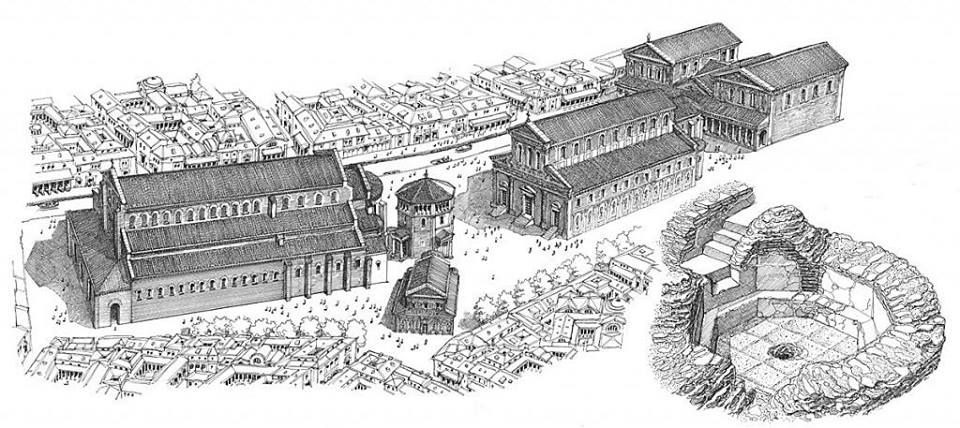
A reconstruction of the ancient cathedral complex of Milan, with the “summer church”, dedicated to St Thecla, on the left, and the “winter church”, dedicated to the Virgin Mary, at the right. The octagonal structure in front of St Thecla is the baptistery of St John; the smaller structural beneath it is the baptistery of St Stephen. At the lower right is a partial reconstruction of the interior of the baptistery of St John.
In the Ambrosian Missal, each Sunday between Pentecost and Advent has its own Scriptural readings, but the feast of the Dedication is the only one that has its own Mass chants, prayers and preface. For the chants, there is a limited repertoire of material (e.g. nine psalmelli, the equivalent of the Roman gradual, but only three allelujas), which are repeated in a mostly regular cyclical order. For the prayers and prefaces, there are only six of each, which are also repeated in a regular cycle. This arrangement places the following as the first prayer as the first Sunday after the Beheading, surely not by coincidence, as it refers to the end of the persecutions and the establishment of the peace of the Church. (It is also said on the Fourth and Tenth Sundays after Pentecost, and the second of October.)
“Deus, qui Ecclesiam tuam nova semper prole foecundas; auge eam quotidie credentium puritate, et divinæ gratiæ infusione multiplica: ut, repulsa impugnatione malorum omnium, in tranquillitate pacis et fidei, tuo semper ditata munere glorietur.
The church of St George ‘al palazzo - at the palazzo’, built on the site of the imperial palace at Milan, from which Constantine issued the Edict of Toleration in 313 AD. (Image from Wikimedia Commons by Parsifall, CC BY-SA 4.0)
O God, who dost ever enrich Thy Church with new offspring, increase it daily in the purity of those who believe, and multiply it by the infusion of divine grace, so that, the assaults of all evils being repelled, in tranquility of peace and faith, it may always glory that it has been enriched by Thy gift.”
The words “omnium malorum – all evils” may also be translated “all evil men”, speaking of the Church’s victory over the persecutors, and this is perhaps more consonant with the prophetic reading which comes immediately after it, Isaiah 65, 13-19.
“Thus saith the Lord God: Behold my servants shall eat, and you shall be hungry: behold my servants shall drink, and you shall be thirsty. Behold my servants shall rejoice, and you shall be confounded: behold my servants shall praise for joyfulness of heart, and you shall cry for sorrow of heart, and shall howl for grief of spirit. And you shall leave your name for an execration to my elect: and the Lord God shall slay thee, and call his servants by another name, in which he that is blessed upon the earth, shall be blessed in God, amen: and he that sweareth in the earth, shall swear by God, amen: because the former distresses are forgotten, and because they are hid from my eyes. For behold, I create new heavens, and a new earth: and the former things shall not be in remembrance, and they shall not come upon the heart. But you shall be glad and rejoice for ever in these things, which I create: for behold I create Jerusalem a rejoicing, and the people thereof joy. And I will rejoice in Jerusalem, and have joy in my people: saith the Lord almighty.”
The Gospel, Luke 9, 7-11, also speaks of the martyrdom of John the Baptist as a sign of the beginning of a new era in the life of the Church, which continues in the ministry of the Apostles and their successors, those through whom it is spread throughout the earth.
“At that time, Herod the tetrarch heard of all things that were done by the Lord Jesus, and he was in a doubt, because it was said by some, that John was risen from the dead, but by others that Elijah had appeared, and by others, that one of the old prophets was risen again. And Herod said, ‘John I have beheaded, but who is this of whom I hear such things?’ … And the apostles, when they had returned, told (Jesus) all they had done; and taking them, He went aside into a desert place apart, … And when the people learned of this, they followed Him; and He received them, and spoke to them of the kingdom of God, and healed them who had need of healing.”
The antiphon “after the Gospel” which is sung on this Sunday also refers to the end of the persecutions. (There are eight of these for the period; this is one is also sung on the eighth Sunday after Pentecost and the first of October.)
“Manus tua, Domine, pugnavit pro patribus nostris; tu enim ipse es Dominus Deus noster. Dextera tua confringat inimicos; ut cantemus nomini tuo, Domine, laudem tuam.
Thy hand, o Lord, did fight for our father; for Thou Thyself are the Lord, our God. Let Thy right hand shatter the enemies, that we may sing Thy praise, o Lord, to Thy name.”



.jpg)


.jpg)