A friend of mine, Mr Matthew Roth, has made some very nice new booklets for Tenebrae which include all the Gregorian chants, and a full translation in English. The text follows the Divino Afflatu reform (1911), with the music found in the Solesmes editions. They are on letter paper, and Matthew informs me that they don’t look good saddle-stitched (which tends to be too small anyway), so if the are printed out, they need to be need to be scaled for A4 if you are using A4 paper. Printer software should be able to do this easily. The files for each day may be found at these links: Thursday, Friday, Saturday.
Typographical or other errors may be reported via the comments here on NLM, or this thread on the Musica Sacra forum; the PDFs will be promptly replaced, and this does not break the relevant Dropbox links.
If one is so blessed as to have Sunday Vespers, then those should be sung in the usual way on Palm Sunday. It is a long day, but it is not worth subordinating the liturgy to our frailty in this case. There are no changes to be made to this office that pertain just to Palm Sunday, other than one might celebrate without ceremonies (due to a lack of personnel sometimes out of our control), although Benediction may follow in the usual way regardless. It helps to have sung the Vexilla Regis twice already before Good Friday, even with the organ taken away for the Triduum.
The lecterns do not have falls in violet or black at Tenebrae. The funerary candles of Good Friday may come out already on Wednesday, even if they are replaced again on Thursday morning with brass candlesticks and bleached candles.
I find it best to omit choir ceremonies (including a bow to the celebrant) on Wednesday, lest they be repeated on Thursday night out of habit. Further, one genuflects to the cross and even to the empty altar, when entering and exiting and during the office, but not otherwise before or after on Thursday (canons bow in that case, but we have hardly any who might qualify…).
I would not expect much if any congregational singing at Tenebrae, particularly if one does not chant psalmody regularly, but a parish which does faithfully follow the conciliar directive to sing Vespers on Sundays and the chief feasts may find itself in for a surprise (a treat, even). It goes without saying that one should probably not attempt the responsories without practice, especially since we find rare instances of tritones (going from F to B, that is, in more Gregorian terms, Fa to Si/Ti) avoided in most of the repertoire for its harsh sound, that is also hard to anticipate when coming back to the incipit from the verse sung by a soloist or by cantors. But this is fine. The faithful need not sing everything, and Holy Week may well be overwhelming as it is. Let Christ enter their hearts via the chant sung on their behalf in a more profound way than usual, but please, give them booklets or books throughout Holy Week.
But for Vespers sung recto tono (I include the Stripping of the Altars here, since it follows Vespers immediately on Thursday), it may be a different story. Some people have a booklet with some instructions on how to sing the last syllable of an antiphon, at the mediant, and at the end of a verse, i.e. to lengthen it slightly, pausing at the mediant and singing the subsequent verse immediately. You could put these syllables in boldface type too. There is always some disagreement about colons in the antiphons, which is manageable in the end, but I personally ignore the flex when singing recto tono. There is an excellent example from Fontgombault, albeit from the funeral rites instead.
Vespers is also a better way to move from one thing to the next than “silence as the mere absence of sound” as the faithful, whether workers or families with tired small children, exit after the main service ends. With Tenebrae, this is not a problem. The faithful leave quietly in the dark, the strepitus having shocked them, the content and the length of the office having overwhelmed them.
As to the ceremonies of Vespers of the Triduum, since there is no incense, I prefer to stand after the last antiphon of the psalmody and before the antiphon of the Magnificat, then kneel after the repetition of the Magnificat antiphon, whereas one sits when incense is used or at least when the office is sung in chant (and Compline never has incense!); if one takes advantage of the permission to sing the antiphons in the full Gregorian chant, do that. I should note that for dicitur, one must understand it as cantatur, either recto tono where no chant is given (the collect, the repeated Miserere, or, at the other hours, the Christus factus est) or where it is clearly only ad libitum, such as at Vespers. It is not legitur or recitatur, as in a speaking voice.
I leave the timing to another part of this essay, but I should mention the ceremonies of Tenebrae which must be done in darkness: if the sacristy is inaccessible from the sanctuary, or if the altar structure does not allow for the acolyte to hide with the candle behind it, then he should simply turn around facing the apse wall or walk to the back— with a lighter in hand in case of an accident.
On Thursday, if the parochial church is too small to place the altar of repose at a temporary altar towards the vestibule or at least on the side of the nave away from the main altar, then the candles must be extinguished during the Benedictus, lest the ceremony’s effect be diminished, even if adoration will continue until midnight; the candles must be lit again in this case.
The candle from the hearse should be extinguished in a timely manner after the psalm, preferably at the end of the antiphon. The cantor should look up to see that the candle is extinguished, which also keeps him grounded in prayer and not lost in his head.
Customarily, the dominant is the same pitch for each psalm tone, in each mode.
Keeping Do as the same pitch, or changing the pitch of the dominant, is too confusing and leads to problems with the range of the chant. In the traditionalist sphere, and in places that retained the chanted Latin office in its postconciliar arrangement, A flat to B flat is the usual choice of notes for the psalmody (in other words, the dominant is chosen from A flat, A natural, or B flat); for anything penitential sung recto tono, a whole step down (the repeated Miserere when not sung polyphonically, the final collect…) is usually sufficient. The responsories should be sung conveniently for the voices in question, just as with the Mass propers.
A pitch pipe is the best way to sound the pitches, as most of us do not have perfect pitch and require some sort of audio cue. Smartphone piano apps are OK in the choir loft, if one must give intervals, but they are not conducive to singing the office in cassock and surplice in the front of the church.
In the longer psalms such as Friday’s Lauds canticle, one should not be afraid to restore the pitch. At Vespers, give the pitch before each antiphon to keep it centered even if the pitch dropped in the preceding psalm.
The Timing and Other Considerations
What time should you celebrate, and how should you accommodate the lengthy (lengthier) rites? This is perhaps the most contentious question. First, obviously the rite of Palm Sunday occurs at the usual hour in the morning (preferably…). With the long reading or hopefully chant of the Passion according to Matthew, in addition to the palm blessing and procession, I would expect up to an additional two hours to be added to the Mass, depending on the number of people receiving palms and the length of the procession, even if the tract is shortened by singing it with a psalm tone. The Passion lasts around forty-five minutes when sung in full. So if at all possible, I would anticipate the start and reduce the number of Masses, or at least bless palms at only the sung (solemn) Mass. This also insists on the importance of the sung (solemn) Mass as the main Mass, what the French call, even in the most reduced, banal celebrations of the Novus Ordo, the grand’messe.
It is superfluous to preach following the Gospel on this day. The same is true of Holy Saturday, even without baptisms. But on Thursday and Friday, the liturgy is not so long as to make a short sermon overly burdensome on the faithful. Nevertheless, one could revive the custom of an evening sermon on these days as was often the case at Westminster Cathedral and in other major churches before the reforms of the last century.
We must briefly go over again the historical development of the timing of the celebrations that occur during the Triduum in order to address the pastoral questions raised by celebrating the classical Holy Week.
The major rites of each day are to occur after the hour of None, which is ordinarily celebrated in the mid-to-late afternoon. Holy Thursday was already anticipated to the morning in Rome itself no later than the middle of the eighth century, and the celebration of Holy Saturday was anticipated such that it was moved fully to the morning in the missal of Saint Pius V. Indeed, such anticipation remains normative in the Byzantine rite, barring a reduction to the most essential aspects, all celebrated in the evening in Western countries to accommodate workers (mirroring in part the modern practice of the Roman rite), and in the Roman rite, the link between the hour of None is not the time of day, as those few references are suppressed for the Triduum at the minor hours, but the custom of celebrating penitential Masses after this hour.
But in no case were the major liturgies, particularly on Thursday and Saturday, evening or nighttime rites, while the approximate timing of the major liturgy of Good Friday is the same in the classical Holy Week and in that of Pius XII, this rite stands out as being inconsistent with the historical literalism applied to Thursday and Saturday.
It is true that the PCED asked those who had the formal indult to observe the modern evening or at least afternoon times. The problem with this request is that Good Friday is rarely a public holiday in our time, much less so Holy Thursday, and then the longest rite of the liturgical year is celebrated late in the day. It is not seemly to sing Vespers exhausted in the dark. Much has been said about the apparent incongruity of the paschal vigil celebrated in the morning, but the 1955 reform transfers the problem to the other end of the day, such that Vespers is omitted – and since Vespers is not a nighttime office, it does some violence when moving the vigil so late in the day that one finishes towards nine or ten at night. (Adopting the 1955 Lauds with the rest of the pre-1955 vigil does yet more violence to; do not do that.) It also leaves the day completely empty of any liturgical celebration, and even private recitation of the shortened Matins (which must follow Compline) becomes a challenge for the clergy, in particular those who must celebrate Mass on the most important Sunday of the year. A late afternoon or evening celebration of the vigil realistically excludes the celebration of Matins (together with Lauds) even for choirs otherwise capable of the additional singing.
These three most holy days have not been holy days of obligation for centuries. They perhaps ought to be, and it made sense that they were before early modernity. But they are not obligatory in our own time. Pastors should therefore exhort the faithful to take time from work anyway, regardless of the missal ultimately placed on the altar. The benefit for those using the traditional Roman rite of Holy Week is that the ceremonies can be advanced including to the morning so that they may be done as solemnly as possible, in the most dignified way. It is not dignified to lose one’s voice having gone from one liturgy to Tenebrae without sufficient rest, and given the character of this office, which requires the passage to darkness amplified by the extinguishing of candles, transferring it to the morning as is the case of the 1955 reforms (with one exception, that of the cathedral in which the chrism Mass is celebrated), destroys the ceremony just as much as using another form of the breviary would.
Those who cannot take a day off from work should come to Tenebrae and, on Thursday, the Mandatum, if it is celebrated in the late afternoon around five or just after, in order to finish before Tenebrae.
Starting the major Mass (“Mass”) around nine or ten o’clock each day brings you to Vespers sometime by noon or just after. Clergy bound to the office have sufficient time to say Prime to None before and then Compline after, before returning for Tenebrae. For some of us, starting around six in the evening ensures that most of the ceremony is in darkness, or at least as darkness noticeably falls in the church, even if Easter falls relatively early and during Daylight Saving Time. (It does not always fall in DST in countries where this still begins in April or never does where DST is not observed at all.) But by Saturday, I can dispense with a light well into the second nocturn, even with the artificial, electric lights off since the fading natural light from outside suffices with the shorter liturgy of Holy Saturday’s office.
And you will need a light, preferably a book light to clip to your book (or binder or folder containing a printed booklet) that has settings to increase warmth. You want the warmest settings, not white light. These can be found easily and cheaply on the internet. The light is needed by all singing until the last verse of the Miserere sung by your side (either gospel or epistle side, or extinguishing it at the last odd or even verse depending on how you alternate the psalmody), by the officiant who sings the final collect recto tono, on his knees, per the rubrics. (Of course, he may have it memorized and the others the Miserere; more power to these men if that is the case!)
Prepare copies of the readings, the whole office of Tenebrae, etc. in advance. Ideally everyone sings from the same source, or everything is then copied from one source. Having different sources for Tenebrae in particular can cause issues in the psalmody (the flex is not always in the same place). You can print books with a spiral bound (letter, A4, etc.) at a decent price so that it looks a little less thrown together; otherwise, a black binder at Tenebrae will be fine (it may be a bit more noticeable during the daylight at the other services, but we must do our best with what we have). It goes without saying that one should practice the Lamentations, the Passion, and the first and/or twelfth prophecy (for which special tones exist) in particular. Keep things from year to year, if you have space. It makes your life much, much easier.
I have this to say as a sort of conclusion:
This series is long. One might consider that it’s missing the forest for the trees, and I do not take for granted that you can just do this with anyone; there is also a pastoral sensitivity: the decision to celebrate the classical Holy Week comes from the priest in charge (the pastor, chaplain, and so on), and it should not be up for argument, but he must do his best (his maximum effort, even) to prepare the faithful. Nevertheless, I suggest that this series is for those who intend to celebrate the classical Holy Week in due course and that there is something to take away from it, whatever stage of the process you are at.
The Catholic Institute of Sacred Music cordially invites you to the final event of its 2024–2025 Public Lecture and Concert Series.
Tenebrae: The Church’s “Office of the Dead” for Christ Crucified
Lecture by James Monti (Dunwoodie, New York)
Saturday, April 12, 10:00 a.m. PDT (1 p.m. EDT)
From at least as far back as the sixth century, the Church has begun her daily worship on the three days of the Easter Triduum with a unique solemnization of the Divine Office known as Tenebrae, a sung liturgy hewn from the Scriptural prophecies of the Passion, to form a veritable “Office of the Dead” in which She mourns the death of Christ. The sacred texts of this office inspired a priceless treasury of plainchant, and later, a vast corpus of polyphonic settings, particularly for the Scriptural centerpiece of Tenebrae, the Lamentations of Jeremiah. The purpose of this lecture will be to explore the history, the meaning, the music and the striking ritual actions of this profoundly moving office, which in recent years has undergone an amazing resurgence, fostered by the magnetic appeal of its compelling sights and soundscape.
The lecture is available live via Zoom. An RSVP is required, and space is limited. The lecture is available for free, but if your means allow we are grateful for a donation to support the work of the Catholic Institute of Sacred Music.
This post concludes the Tenebrae part of our Holy Week photopost series; we will move on to the other ceremonies of the Triduum next week. Many thanks to all the contributors - feliciter!
Oratory of Ss Gregory and Augustine – St Louis, Missouri
Marching on into the Triduum, here is the first set of photos of Tenebrae services. As always, there is always room and time for more, so please feel free to send yours in to photopost@newliturgicalmovement.org, and don’t forget to include the name and location of the church; and of course, our thanks to all the contributors - feliciter!
The momentum behind rediscovering and restoring tradition has not abated; on the contrary, I would say it is intensifying. Those who care, care more; and those who know and love will not be deterred by those who are indifferent to or full of hatred for tradition. They have increasingly shown their cards, as it were, and they are not altar cards.
With that as a prefatory remark, here are three new publications for the pre-55 Holy Week, which continues its quiet conquest.
The Masses of Holy Week & Tenebrae
I am pleased to announce the release of TheMasses of Holy Week & Tenebrae, published by Os Justi Press in time for Lent. This book contains the complete pre-55 Latin texts, with English translation, for Palm Sunday, the Triduum Masses, and the Office of Tenebrae, including complete Gregorian chants. Simple rubrics are indicated. No page turning is required. The book features many medieval illustrations as well. In the PDF they are in color; in the printed book, in grayscale.
Ideal for scholas, for personal study, or as a congregational worship aid, the book is handsomely printed with readable type and weighs in at nearly 500 pages. The cost is $20. Bulk discounts are available (and for multiple countries, not just the USA) by contacting the publisher. The book is also available through Amazon, including all of its international sites.
The cover is shown above. Below are some sample pages; more may be found here.
On Wednesday, April 5th, beginning at 8:00 pm, St Martin of Tours Catholic Church and Our Lady and St John Catholic Church will host a Tenebrae service at the parish of St Martin, located in downtown Louisville, Kentucky, at 639 South Shelby Street. The music, sung by the choir of St Martin of Tours, will include Thomas Tallis’ setting of the Lamentations of Jeremiah and the motet Christus Factus Est by Anton Bruckner.
Those who have assisted at the traditional Roman liturgy for some time can usually name many things about it that they noticed over the years — things that impressed, provoked, consoled, puzzled, that made them wake up, question more, dig deeper. There is a moment of transition, I find, from being one who appreciates the old liturgy, perhaps now and again, or as a field trip, or as a pastoral duty, to being one who has fallen in love with it, who makes it his spiritual home, and who, accordingly, may justly be called a traditionalist. (As much as some people protest against the use of that word, it remains immensely handy for naming a phenomenon, which is what language is supposed to do.)
My books mention many such experiences, but here are two that are especially appropriate to share in Easter week.
The first was the contrast I noticed, several years in a row, between the modern (Paul VI) Easter Vigil and the Easter Sunday Missa Cantata of the Roman Rite. The reason for comparing these two is that I was involved at the time in providing music for both — the “Ordinary Form” on Saturday night and the “Extraordinary Form” (how quaint are those terms now!) on Sunday morning.
The Paul VI vigil had no “spaces,” no obvious opening to mystery through which one could enter. It was a flood of didactic text, spoken aloud, with musical interludes. Modern people are already awash in words. Do we really need more? In the N.O. Easter Vigil, one felt that one had been thoroughly drenched in the Bible readings conducted in Nabbish, a lengthy homily, the unsatisfying glamor of receiving some people into the church in a ritual that culminated in applause, and a celebration of the Eucharist wholly lacking in supernatural resonance or fearful majesty. It made an impression for sheer length, number of lilies, and candles, but otherwise it was like cookie dough — the same consistency throughout.
The Easter Missa cantata, on the other hand, was full of the sound of Alleluias sung in Gregorian chant — sixteen of them (not counting the repetitions of the Communion antiphon). The chants for Easter are strong, sometimes strange, always unearthly, already half-dwelling in the realm of eternity. The church, ablaze with white and gold… the ritual nailed to the altar, from which salvation pours out like blood and water… the clouds of incense billowing… all point to the mysterious reality of the Crucified and Risen One — and this is something that can be perceived by anyone seeking God or even seeking some meaning in life. Marshall McLuhan said, decades ago, that modern culture is obsessed with images and that the Church must therefore provide images of great power: visual and audible images that are startlingly different from what secular culture offers. At the Easter morning sung Mass, I had an almost unnerving sense of stepping back through time across all the centuries that separated me from the resurrection of Christ and coming once again into His powerful presence. This was a ritual that somehow poured from His glorified wounds to bathe me in their light. There was a holy awe about the place, a restrained joy coiled like a spring ready to leap to heaven, a hushed adoration like that of Mary Magdalene when she discovered Christ in the garden and He would not let her touch Him.
Let me not be misunderstood: I am not calling into question the good will of anyone who contributed to the Easter Vigil. On the contrary, there was abundant good will, which I remember fondly. The problem is deeper than the individuals: it is in the rites they are using and the customs that have grown up around them to the point of having nearly the force of law. The face liturgy presents to us depends much more on the rites and customs than it does on the personnel who happen to be using them; the former determine and delimit the possible range of influence for the latter.
The second experience was singing, and then reflecting on, Lesson III of Holy Saturday’s Tenebrae: “Incipit Oratio Jeremiae Prophetae.”
Remember, O Lord, what is come upon us: consider and behold our reproach. Our inheritance is turned unto aliens: our houses to strangers. We are become orphans without a father, our mothers are as widows. Our water we have drunk for money: we have bought our wood for a price. We were dragged by our necks, we were weary and rest was not given unto us. Unto Egypt, and unto the Assyrians have we given our hand, that we might be satisfied with bread. Our fathers have sinned, and are no more: and we have borne their iniquities. Servants have ruled over us: there was none to redeem us out of their hand. Our bread we fetched at the peril of our lives, because of the sword in the desert. Our skin was burnt as an oven, by reason of the violence of the famine. They have oppressed the women in Sion, and the virgins in the cities of Juda. Jerusalem, Jerusalem, be converted unto the Lord thy God.
Pondering these prophetic words led me to see their application to our current liturgical situation, and the parallels have only grown clearer with time. We are alienated from our inheritance; our houses of worship are sold off to Masonic lodges or Hindu ashrams; we are become like orphans without a father in Rome or, in some cases, a father in our diocese; we bought our reforms for a steep price, and were dragged along without our consent; we grew weary of hyperactive participation and longed for a contemplative rest that was denied us; we exchanged our birthright for a seat at the United Nations and the European Union; those who fomented our disasters are mostly long-gone and we suffer from their sins; slaves of fashion rule over the sons of God; we fetched our traditional bread wherever we could find it, afraid of the sword of church authority in the desert of the post-Council; the spiritual famine has been violent, and it has extended even to threatening the religious life of consecrated virgins. Jerusalem, O Church on earth: be converted unto the Lord thy God!
Someone once said of the liturgical reformers: “They took the faith out of our hands and knees.” The reform stripped away, or allowed to be stripped away, bodily spiritual formation. Catholics can get a visceral sense of the contrast when they attend their first Tridentine Mass and find that there’s a lot more kneeling than they are accustomed to (even at High Mass) and more demands placed on their attention in general. It is a liturgy that pre-dates the invention of television, so it expects a long attention span, and the ability to be quiet and sit still. The faith has to penetrate into our bones and muscles or it remains cerebral and ineffectual.
Nowhere is this more clear than in the contrasting practices of Holy Communion. In too many churches, the faithful walk up in multiple lines and receive the Body of Christ in their hands, like people queueing for bus tickets, after which they take a cup to wash it down, like teammates sharing Gatorade. In traditional communities, the faithful kneel along the communion rail and wait until the priest comes to them to bless them with the Host — “Corpus Domini nostri + Jesu Christi custodiat animam tuam in vitam aeternam, Amen” — and places it gently on their tongues. These two contrasting scenes are, in reality, expressive of two different ideas of religion, if we take religion in the sense of the virtue by which we offer God our worship through concrete words and actions.
This is why I am not surprised that the former Benedictine monk Gabriel Bunge, a world expert on the Trinity icon of Rublev, left the Catholic Church to become Eastern Orthodox. No one ever introduced him to the real Western tradition that corresponded to what he was studying from the East. He came to the conclusion that the only authentic tradition left was the East. His conclusion should rather have been that the modern West had abandoned its own authentic tradition, and that we have an urgent calling to recover it.
After experiences like the two I recounted, one’s soul is seared with the truth, at once liberating and daunting: I cannot go back to the 60s and 70s, to those pathetic works of human hands. Let the dead bury the dead. It is the perennially youthful Roman Rite that gives joy to me, that shines forth light and truth.
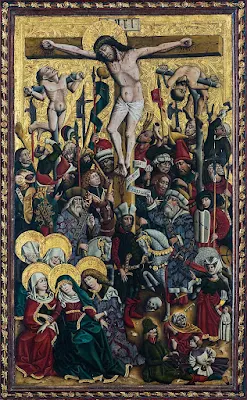
Anonymous, Central Panel of the Knappenaltar, Hallstatt, Austria, 1450
Without doubt the most dolorous day of the Church’s annually recurring sanctification of time is Good Friday, the day on which she commemorates in a special manner the Passion and Death of Our Lord, the day that is the culmination of forty days of fasting and penance, and the only day of the year in the Latin rites of the Church on which her altars are deprived of the Holy Sacrifice.
But as Christian disciples who are sorrowful but always rejoicing (see 2 Cor. 6, 10), Good Friday is not an occasion of defeat but of love's triumph. Today, let us look at five good effects of this solemn, somber day.
1. Music
The liturgical observance of Good Friday has inspired not only a number of beautiful musical compositions but also a number of musical genres. The celebration of Tenebrae, the combination of Matins and Lauds during the pre-dawn mornings of Holy Thursday, Good Friday, and Holy Saturday, led to a body of music called Lamentations. The Matins of Tenebrae include several passages from the Book of Lamentations in the Old Testament. Jeremiah’s wrenching dirge over the destruction of Jerusalem was traditionally chanted, but beginning in the fifteenth century it became the inspiration for non-liturgical polyphonic settings by several famous composers. These Lamentations are recognized today as among the finest examples of Renaissance and Elizabethan music.
The Three Hours’ Devotion, or “Seven Last Words of Christ,” is a Good Friday service begun by Father Alphonso Messia, S.J., in 1732. From its place of origin in Lima, Peru, it quickly spread to all other countries in Central and South America and from there to Italy, England, and America, where both Catholics and Protestants enthusiastically embraced the devotion. The service, which alternates between homilies on the seven last statements of the crucified Christ and various hymns and prayers, has also inspired the composition of memorable music, including “The Seven Last Words of Christ” by Franz Josef Haydn (1787), “Les Sept Paroles de Notre Seigneur Jesus-Christ sur la Croix” by Charles Gounod (1855), and “Les sept paroles du Christ” by Theodore Dubois (1867).
Lastly, the Gospel readings of the traditional Roman rite backhandedly led to the creation of Passion Music. In the Roman calendar, all four Gospel narratives of the Lord’s Passion are read at a time during Holy Week: the Passion according to St. Matthew on Palm Sunday, the Passion according to St. Mark on the following Tuesday, the Passion according to St. Luke on Spy Wednesday, and the Passion according to St. John on Good Friday. During a High Mass, these narratives would be chanted by three clerics: a tenor taking the role of the narrator, a high tenor taking the role of the mob and various individuals, and a bass voice taking the role of Christ.
The music for these parts is an outstanding example of the power and beauty of Gregorian chant; understandably, then, it left a deep impression on the Western imagination even after the Protestant Reformation in large part did away with the liturgical setting of Holy Week. Nature abhorring a vacuum, Protestant composers soon began writing passion oratorios to replace the music of solemn liturgy, the most famous of which are J. S. Bach’s “Saint John Passion” and “Saint Matthew Passion.”[1]
2. Food
Good Friday is principally known as a day of fasting. In contemporary Church discipline, it is only one of the two mandatory days of fasting left on the calendar (Ash Wednesday being the other). In former times, it was the occasion of far more rigorous fasting. The Irish and other Catholics kept what was known as the Black Fast, in which nothing was consumed, except perhaps for a little water or plain tea, until sundown. And in the second century the early Church is said to have kept a forty-hour fast that began at the hour when Christ died on the Cross (3 p.m. Friday) and ended on the hour that He rose from the dead (7 a.m. Sunday).[2]
But despite its link to fasting, Good Friday is also associated with several foods. In Greece it is customary to have a dish with vinegar added to it, in honor of the gall our Lord drank on the Cross.[3] In some parts of Germany, one would only eat dumplings and stewed fruit.[4] In other areas of central Europe, vegetable soup and bread would be eaten at noon, and cheese with bread in the evening. At both meals people would eat standing and in silence.[5]
The widespread custom in Catholic countries of marking every new loaf of bread with the sign of the cross took on a special meaning on Good Friday. In Austria, for instance, Karfreitaglaib, bread with a cross imprinted on it, was eaten on this day.
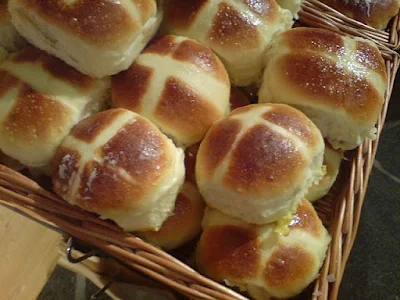
But the most famous Good Friday bread is the hot cross bun. According to legend Father Rocliff, the priest in charge of distributing bread to the poor at St. Alban’s Abbey in Hertfordshire, decided on Good Friday in 1361 to decorate buns with a cross in honor of Our Lord’s Passion. The custom spread throughout the country and endured well into the nineteenth century, where it was sold on the streets of England, as the nursery rhyme tells us, for “one a penny, two a penny.” Today, hot cross buns are available during all of Lent.
Several pious superstations also grew around the hot cross bun, such as the belief that it would never grow moldy and that two antagonists would be reconciled if they shared one. Good Friday hot cross buns were kept throughout the year for its curative properties; if someone “fell ill, a little of the bun was grated into water and given to the sick person to aid his recovery.” Some folks believed that eating them on Good Friday would protect your home from fire, while others wore them “as charms against disease, lightning, and shipwreck”![7]
3. Customs
Besides the lore surrounding hot cross buns, Good Friday became a magnet for an assortment of non-liturgical customs and folk beliefs. In Mexico and other lands, piñatas in the likeness of Judas Iscariot would be beaten to a pulp.[8] In Europe, people refrained from all forms of merriment: no joking and laughing, no noisy tasks, no theatrical performances (except for Passion plays), no dancing and, as we shall see, no hunting. Even children “abstain[ed] from their usual games.”[9]
In the Middle Ages it was common for the population to wear black during all of Holy Week as a sign of mourning and especially on Good Friday, and it was Church law until 1642 to refrain from all servile labor during the Triduum. Schools, businesses, law courts, and government offices would all close during Holy Thursday, Good Friday, and Holy Saturday. In Catholic countries it was common for pardons to be granted to prisoners during Holy Week, and often charges would be dismissed in court in honor of our Lord’s Sacrifice.[10]
The list of what could and could not be done was often inspired by the events of the Passion. It was auspicious to plant and to garden on Good Friday because “Christ blessed and sanctified the soil by His burial,”[11] but woe to the man who swung a hammer or drove a nail on the day that these objects became instruments of Our Lord’s torture. Doing laundry was also verboten, as Christ’s clothes were stained with blood during His Passion. According to one superstition, any woman who did the washing on Good Friday would find the clothes spotted with blood and bad luck would follow her all the year. It was, however, good luck to die on Good Friday, since one’s soul would, like the Good Thief’s, be given speedy access to Heaven.
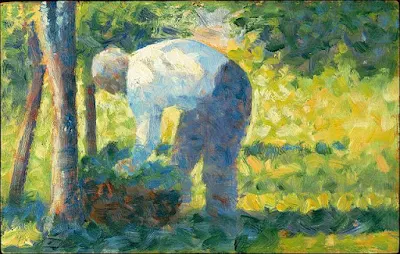
Georges Seurat, "The Gardener," 1882-1883
Among the non-superstitious customs, one of the most impressive can be found in the Eastern rites of the Christian Syrians and Chaldeans. Their customary greeting, Schlama or “Peace be with you,” is not used on Good Friday and Holy Saturday because it is the signature salutation of Christ after His resurrection (see Lk. 24,36; Jn. 20,21; 20,26) and is redolent of Judas’ perfidious greeting. Instead, they say “the Light of God be with your departed ones.”[12]
And, of course, the Western and Eastern rites of the Church developed beautiful liturgical and para-liturgical traditions for this unique anniversary. In the traditional Roman rite, the liturgical ministers vest in black as they would for a Requiem Mass. The service consists of the Mass of the Catechumens, where several readings, including the Passion according to St. John, are proclaimed; the Oratio Fidelium or “Prayer of the Faithful,” in which the Church solemnly prays for the world in a series of moving petitions; the Adoration of the Cross, when the priest unveils a crucifix in three stages and the people venerate the Cross with a kiss; and finally, the Mass of the Presanctified, a communion rite involving Hosts consecrated from a previous day.
Before the nineteenth century, the Good Friday service was supplemented throughout Europe by great processions through the streets that featured images of the suffering Christ and dolorous Blessed Virgin Mary borne on decorated platforms. This custom is still maintained today in the Latin countries of both the New and Old Worlds. Other popular or once-popular devotions include the Forty Hours’ Devotion, the Three Hours’ Devotion (see above), and the Stations of the Cross, the latter often dramatized (in Hispanic communities) outdoors.
Good Friday procession of the epitaphios in Greece
The most striking feature of the Good Friday service in the Byzantine Rite, on the other hand, is the “burial service” of Our Lord, where the faithful mourn the death of their Savior in a kind of funeral procession. A large and usually ornate shroud called an epitaphios bears Christ’s image and is carried around the perimeter of the church before it is placed in a Sepulchre. In addition to the Procession of the Holy Shroud, twelve Gospels are chanted, and a number of litanies are prayed, and a watch is kept at the Sepulchre.
4. Holy Deaths
The Catholic hagiographical tradition also cherishes the memory of several saints whose birthday into eternal bliss occurred on the anniversary of Our Lord’s death. Often, their feast days are transferred to another date; still, the day on which they died is a significant part of their life’s story.
Saints Azades, Tharba, and thousands of other Persian martyrs were cut down in a brutal persecution that began at twelve noon on Good Friday in A.D. 341 and ended on Low Sunday of the same year. Azades was a eunuch favored by the king; when he was martyred, the aggrieved tyrant limited the persecution to bishops, priests, monks, and nuns. Tharba, on the other hand, was a beautiful consecrated virgin who preferred being sawn in half to the lascivious advances of her judges. Their feast day is April 22.[13]
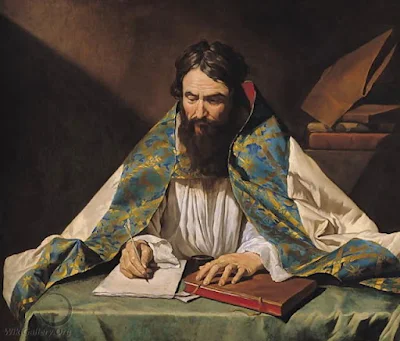
Matthias Stom, "Saint Ambrose," 1633-1639
Saint Ambrose of Milan (d. 397) is one of the great Latin doctors of the Church and the bishop who facilitated the conversion of Saint Augustine of Hippo.
Ambrose prayed during his final hours on Good Friday with his arms outstretched in imitation of his crucified Master and passed away shortly after receiving the Viaticum. His feast day is kept on December 7, the anniversary of his episcopal ordination.
Saint Proterius was a Patriarch of Alexandria who was stabbed to death in 557 by Eutychian schismatics in a baptistery where he had taken sanctuary. After killing him, the schismatics “dragged his dead body through the whole city, cut it in pieces, burnt it and scattered the ashes in the air.” His feast day is February 28.[14]
Saint Walter of Pontoise was an Abbot of St. Martin’s near Pontoise, France. He so feared becoming vainglorious from ruling a monastery that he frequently ran away from it. Eventually the Pope had to order him to remain in his abbey. Saint Walter was beaten and imprisoned by his fellow Benedictines for his opposition to simony within the order, but he bore his persecution with patience and even joy. He passed away on April 8, 1099, and his feast day remains on that day.[15]
Saint Francis of Paola, founder of the Minim Friars, sensed at the age of ninety-one that his death was approaching. Gathering his disciples and giving them his final instructions, he died on Good Friday in 1507 while listening to the reading of the Passion according to St. John. His feast is kept on April 2, the day that he passed away. Fifty-five years later, when his tomb was desecrated by the Huguenots, the saint’s body was discovered to be incorrupt. Nevertheless, the Huguenots dragged it out and burned it.[16]
Saint Margaret Clitherow, also known as the “Pearl of York,” is one of the forty great English recusant martyrs canonized by Pope Paul VI in 1970. Arrested for giving Catholic priests safe harbor, she refused to plead on the grounds that her young children could then be tortured and forced to testify. Consequently, Margaret received the standard punishment for those who refused to plead: she was stripped and crushed to death by an immense weight. The two sergeants who were put in charge of her execution could not bring themselves to do it and hired four beggars instead. After her execution, even the ruthless Queen Elizabeth I wrote to the citizens of York to express her horror at St. Margaret’s death, who as a woman should not have received capital punishment. Her feast day is August 30.
Saint John Baptist de la Salle is the founder of the Christian Brothers and the patron saint of teachers; because of the vast educational reforms he instituted, he is also considered the father of modern pedagogy. To meet the dire educational and social needs of his day, this holy priest proposed the radical idea of popular free schools. Among his reforms was a focus on reading and the teaching of elementary-school children in the vernacular rather than Latin. During Holy Week of 1719, Saint Jean Baptiste sensed that his life was coming to an end. On Holy Thursday he blessed the brothers who had gathered at his bedside, and on Good Friday “he breathed his soul into the hand of his Creator.”[17] His feast is celebrated on May 15.
After decades of teaching small children and caring for the sick and elderly, the Servant of God Maria Luisa Godeau Leal founded the Augustinians of Our Lady of Help and took the religious name Maria of the Eucharist and of the Holy Spirit. Maria, who hailed from Mexico City, died on Good Friday, March 31, 1956. Her cause is currently being put forth for canonization.
Lastly, mention should be made of St. Veronica Giuliani who, although she did not pass away on Good Friday, led a life that was punctuated by this holy day. Veronica was a Poor Clare Abbess, mystic, and stigmatist. When only eighteen months old, she uttered her first words in response to a shopkeeper who was doling out a false measure of oil: “Do justice, God sees you.”[18] She had the privilege of receiving divine communications from the age of three, and loved the poor so much that she often gave them the clothes off her back. When she was four, “her dying mother entrusted each of her five children to a sacred wound of Christ”: Veronica was assigned the wound in Christ’s side.[19]
After becoming a nun of the Poor Clares, she desired to become united with Christ in His sufferings. Eventually, she was favored with the stigmata in the form of the Crown of Thorns, which left wounds that were painful and permanent. And on Good Friday in 1697, she received the impression of the wounds on Christ’s hands, feet, and side. After her death an autopsy was performed and it was discovered that on her heart were recognizable symbols of Christ’s Passion. Her body, which was laid to rest in her monastery at Citta del Castello, remained incorrupt until it was destroyed by a flood from the Tiber River.
5. Conversions
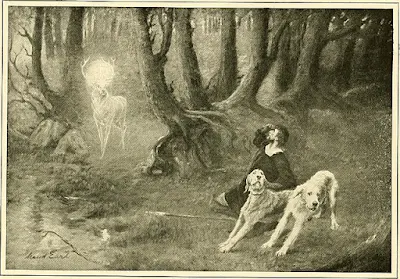
Good Friday is also auspicious for the living as well as for the dying. A number of sinners became saints, or at least embarked on the path to sanctification, because of this liturgical anniversary. Two of these saints had a conversion experience while hunting. Both Saint Eustace (a Roman martyr) and Saint Hubert (a medieval confessor Bishop of Germany) are said to have been irreverently using the day on which Our Lord’s blood was shed for us in an attempt to shed an animal’s blood for sport when they came upon a stag with a glowing cross between its large antlers. In Hubert’s case, the stunned hunter fell to his knees and heard a voice say to him, “Hubert, unless thou turnest to the Lord and leadest a holy life, thou shalt quickly go down to hell.” Hubert heeded the warning, eventually becoming the wise and holy bishop of Maastricht. And the image of a stag with a cross between its antlers eventually appeared on the label of the strong German liqueur named Jägermeister, or “master of the hunt.”
Robert Leighton, "Saint Hubert," 1911
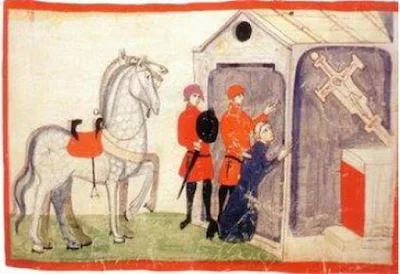
But perhaps the most powerful conversion story involving Good Friday is the life of Saint John Gualbert (d. 1073). Saint John was an Italian nobleman whose only brother was murdered by a man that was supposed to have been his brother’s friend. Swearing revenge, John chanced to come upon him face to face in a narrow passageway on Good Friday. When he drew his sword to slay the murderer, the man dismounted his horse, knelt down, and “besought him by the passion of Jesus Christ, who suffered on that day, to spare his life.” The memory of Christ, who prayed for his murderers on the cross, greatly affected Saint John, and lifting his brother’s killer from the ground, said to him: “I can refuse nothing that is asked of me for the sake of Jesus Christ. I not only give you your life, but also my friendship for ever. Pray for me that God may pardon me my sin.”[21]
Anonymous, "St. John Gualbert," 14th century
John then went to a nearby monastery to pray, and as he knelt before the crucifix begging forgiveness for his sins, Christ on the cross bowed his head three times, signaling (as Saint John interpreted it) that He was pleased with his repentance. John immediately asked the Abbot to be admitted as a monk. Although the Abbot was apprehensive of John’s father, who was shocked by his son’s decision, John eventually became an exemplary monk and the founder of his own religious community at Vallis Umbrosa in Italy.
Conclusion
Scholars remain uncertain about the precise origins of the English name “Good Friday.” Is it like the Dutch term Goede Vrijdag that means the same thing, or is it, as others have speculated, a corruption of “God’s Friday”? Either way, we can see how God’s Friday of merciful self-giving, and the Church’s annual remembrance of it, have created an abundance of good things both little and great.
This article, which first appeared in the Winter/Spring 2013 issue of The Latin Mass magazine, has been since updated. Many thanks to the editors of TLM for allowing its publication here.
Notes
[1] Francis X. Weiser, S.J., Handbook of Christian Feasts and Customs (Harcourt, Brace & World, 1958), 191, 203–204.
[2] Weiser, Handbook, 201.
[3] Evelyn Vitz, A Continual Feast (Ignatius Press, 1985),190.
[4] Katherine Burton and Helmut Ripperger, Feast Day Cookbook (Catholic Authors Press, 2005), 53.
[5] Weiser, Handbook, 205.
[6] Burton, Feast Day Cookbook, 52.
[7] Weiser, Handbook, 206.
[8] See Wendy Devlin, “History of the Piñata,” Mexico Connect, http://www.mexconnect.com/mex_/travel/wdevlin/wdpinatahistory.html; Olga Rosino, Belinda Mendoza, and Christine Castro, “Piñatas!” http://www.epcc.edu/ftp/Homes/monicaw/borderlands/10_pi%C3%B1atas.htm.
[9] Weiser, Handbook, 205.
[10] Weiser, Handbook, 187.
[11] Weiser, Handbook, 205.
[12] Weiser, Handbook, 205.
[13] Alban Butler, The Lives of the Fathers, Martyrs, and Principal Saints, 1866 edition, accessible at bartleby.com.
[14] Butler, Lives.
[15] Butler, Lives.
[16] Lawrence Hess, “St. Francis of Paula,” Catholic Encyclopedia, 1909, http://www.newadvent.org/cathen/06231a.htm.
[17] Matthias Graham, “St. John Baptist de La Salle,” Catholic Encyclopedia, 1910, http://www.newadvent.org/cathen/08444a.htm.
[18] Lawrence Hess, “St. Veronica Giuliani,” Catholic Encyclopedia, 1912, http://www.newadvent.org/cathen/15363a.htm.
[19] Joan Carroll Cruz, The Incorruptibles (TAN Books 1977), 252.
We continue our Holy Week photopost series with part 2 of Tenebrae, before we move on to Good Friday, Holy Saturday and Easter Sunday. I am also including two videos from the Oxford Oratory, and three from our friends of the mighty Schola Sainte-Cécile. We have received a slow but steady stream of new contributions, and there is always room for more; if you have photos you would like to share, send them in to photopost@newliturgicalmovement.org, remembering to include the name and location of the church. Evangelize through beauty!
St Patrick’s Church – Albury, New South Wales, Australia
One of the many enouraging signs of the slow-but-steady growth of interest in the recovery of our Catholic liturgical tradition is the increasing number of churches that do Tenebrae services during the Sacred Triduum. In 2015, the year I took over as managing editor of NLM, and in the three years after that, we had only one photopost for Tenebrae; in 2019, we got up to two, and after last year's interruption, we will have two again this year. There is always room for more, so feel free to send in photos of any part of the Triduum or Easter to photopost@newliturgicalmovement.org, remembering to include the name and location of the church.
Notre Dame de Lourdes – Libreville, Gabon (ICRSP)
Nossa Senhora do Pilar – São João Del Rei, Minas Gerais, Brazil
Our thanks to Mr Jehan-Sosthènes Boutte for sharing with us this artice about a particularly interesting medieval variant found in the Tenebrae Offices of various Uses.
Most readers of this site are familiar with the Tenebrae services traditionally held on Maundy Thursday, Good Friday and Holy Saturday, and with the particular ceremonial which accompanies them according to the Breviary of Saint Pius V, and its subsequent revisions until the 1950s. What they may not know is how different Tenebrae could be in other uses of the Roman rite. While the structure and most of the content was the same everywhere, many Uses had some variations to the service, and kept them for a long time; indeed, some have kept them to this very day.
One such variation regarded the end of the service. As it is widely known, in the Tridentine Breviary, Tenebrae ends with the singing of the “Christus factus est”, the Lord’s Prayer, Psalm 50 (Miserere mei Deus), the prayer “Respice quaesumus Domine” and the “Strepitus”, which was described thus by an article written here some years ago:
Then the strepitus begins--the noise that symbolizes the earthquake that took place at Christ's death, which is made by banging books on the choir stalls. While this symbolism maintains, it is also as if, with the strepitus, we’re begging Christ to come out of the tomb, especially on Holy Saturday. While the strepitus is still going on, the Christ candle--the Light which the darkness cannot overcome--is brought back out and replaced in the hearse, and all depart in silence.
On this point, however, the Tridentine Office was more an exception than a rule, since most Uses of the Roman Rite concluded Tenebrae with a short and unusual litany, sometimes called the “Kyrie puerorum” (Kyrie of the children), which differed only in some slight details from one Use to another.
When the Roman Office was simplified due to the exile of the Papacy in Avignon, the singing of the Gradual Christus factus est replaced a very curious and old litany – present in the Antiphonary of Compiègne – in which that same text, Christus factus est, was sung, in between several verses, on another melody. This ancient litany was kept by most French diocesan rites, particularly that of Paris.
The Antiphonary of Compiègne being one of the most ancient Roman antiphonaries we have today, it’s presence in the ancient basilical Roman Office is plausible, even though one can wonder how such a strange text could have found a place in the austere Office of the Roman Church.
In any case, this litany was sung in most French uses, with the notable exception of the Use of Lyon; it was also present in the Sarum and Dominican Uses. Here is the text of this litany as it appears in this latter rite (the text is virtually identical to that of the Sarum liturgy):
Kyrie, eleison. Kyrie, eleison. Kyrie, eleison. Dómine, miserére. Christus Dóminus factus est oboediens usque ad mortem.
Kyrie, eleison. Kyrie, eleison. Kyrie, eleison. Lord, have mercy. Christ the Lord became obedient unto death.
On Maundy Thursday and Holy Saturday, the following is then sung:
℣. Qui passúrus advenisti propter nos. ℟. Christe eleison. ℣. Qui expansis in cruce mánibus, traxisti omnia ad te sáecula. ℟. Christe eleison. ℣. Qui prophétice prompsisti: Ero mors tua, o mors. ℟. Christe eleison.
℣. Thou who camest to suffer for our sake. ℟. Christe eleison. ℣. Thou who with hands outstretched upon the cross didst draw all ages unto Thyself. ℟. Christe eleison. ℣. Thou who prophetically foretold: I shall be thy death, o death. ℟. Christe eleison.
On Good Friday, this part is replaced with the following:
℣. Agno miti basia cui lupus dedit venenósa. ℟. Christe eleison. ℣. Vita in ligno móritur: infernus et mors lugens spoliátur. ℟. Christe eleison. ℣. Te qui vincíri voluisti, nosque a mortis vínculis eripuisti. ℟. Christe eleison.
℣. Let us greet with a kiss the gentle Lamb to whom the wolf gave poisoned kisses. ℟. Christe eleison. ℣. Life upon the Tree did die: hell and death in anguish are despoiled. ℟. Christe eleison. ℣. Thyself wert willing to be bound, and so didst redeem us from the bonds of death. ℟. Christe eleison.
In both cases, it is concluded as follows:
Dómine, miserére. Christus Dóminus factus est oboediens usque ad mortem, mortem autem crucis. Kyrie eleison. Kyrie eleison. Kyrie eleison. Dómine, miserére. Christus Dóminus factus est oboediens usque ad mortem. Mortem autem crucis.
Lord, have mercy. Christ the Lord became obedient unto death, even the death of the Cross. Kyrie eleison. Kyrie eleison. Kyrie eleison. Lord, have mercy. Christ the Lord became obedient unto death. Even the death of the Cross.
When those words are sung, the friars prostrate themselves or kneel, and recite a silent Pater noster, after which, Psalm 50 is recited recto-tono. The celebrant says the prayer “Respice quaesumus”, without “Dominus vobiscum” or “Oremus”, then strikes his hand on a book or on his choir-stall and all leave in silence.
Of course, as I said earlier, this rite has some variations depending on the local use. For instance, in the Parisian rite, after the Kyrie came the verse “Domine miserere, parce famulis tuis” (Lord have mercy, spare Thy servants). And in the Hungarian rite of the diocese of Esztergom, the litany ended with the singing of the Christus factus est as it is known in the Tridentine Breviary:
Being no theologian, I will not risk a comment on all verses of this litany; it is perhaps enough to look at the last verse of Maundy Thursday and Holy Saturday, which always struck me: “Thou who prophetically foretold: I shall be thy death, o death”. This is a perfect example of a Christian liturgical interpretation of the Old Testament; this verse is taken from Hosea 13, 14: “O death, I will be thy death; O hell, I will be thy bite”, and is also used as the first antiphon of Lauds on Holy Saturday. It reminds us that the victory of Christ over death is not a metaphor: He did not “merely” give us life after death (although that would have already been most merciful from Him), nor did He conquered death in an allegorical way. He did really and permanently conquer physical death for all those who shall be saved; such is the meaning of the resurrection of the dead, of whom Christ was the first. This is also what separates Christianity from all other religions; while the latter often speak of a life after death, in which death is seen as a necessary (or even a good and desirable thing) step to eternal happiness, Christ and His Church promise us not only to live after death, but also to rise from our graves; for as the Byzantine Easter troparion says, “upon those in the tomb, He hath bestowed life”.
After the reforms which followed Vatican II, Tenebrae fell out of use in most places; and consequently, the few churches which kept a distinct Use for Tenebrae largely abandoned them. But just as Tenebrae has in recent years won a good deal of popularity back among Catholics, we can hope the same will happen for the “Kyrie puerorum”, especially considering the fact that it never was completely absent. The Order of Preachers has kept it intact in its proper version of the Liturgy of the Hours; indeed, I discovered this litany when attending Tenebrae in a Dominican convent. While the service itself was mostly an adaptation of the Dominican office in French, along with bits and pieces from various places, it ended nevertheless as it always had in the Order of Saint Dominic, with the Kyrie puerorum.
Here is the service of Holy Saturday as it is performed in the Dominican province of Toulouse, in Southern France. The litany starts at 1:34:30.
Moreover, the revived interest in Sarum Rite in the English-speaking world might also leave room for a rediscovery of its version of the “Kyrie” – especially considering there are now numerous resources for the rite of Salisbury in both Latin and in English.
Last but not least, the late professor Laszlo Dobszay of happy memory suggested that this litany be included ad libitum in a hypothetical revision of the Roman Breviary (pre-Divino Afflatu). Therefore, while rejecting archeologism, we ought to recover those ancient particular traditions where and when they were observed, inasmuch as they may be profitable for the faithful.