Wednesday, July 15, 2026

Interesting Liturgical Sights on a Recent Trip to Europe (1): Vienna and Environs

In May, my daughter and I visited a few places in Austria and Italy, and while I wasn’t much of a shutterbug (I’m trying these days to leave my camera mostly unused), I’ll admit that I pulled it out whenever I saw something that I thought NLM readers might enjoy seeing. As usual, click on the images to enlarge.

The ceiling of the sacristy at Heiligenkreuz Abbey. Note how the tormentors of the three children in the fiery furnace are sporting turbans, a reminder that the Turks once ransacked this abbey.

For a place that’s supposed to help priests become recollected for Mass, the interplay between this priest and his server is rather funny!

The Pummerin of Stephansdom in Vienna, the third largest bell in Europe at 44,380 lbs or the weight of 15-20 cars; its metal is from 208 Turkish cannons melted down after the Siege of Vienna.

Our guide took us up to the perimeter of the Stephansdom roof to give us a close look at the tiles.

Here’s the huge room under the Stephansdom roof, above the vaulted nave of the church - it's almost the size of a church in itself.

Friday, January 31, 2025

Gothic and Baroque Sculptures in a Swiss Abbey

Following up on three recent posts from earlier this month, this is the final set of Nicola’s photos of the abbey of St John in Müstair, Switzerland. The first part showed frescos from the Carolingian era, the second those of the Romanesque period, and the third, various Romanesque sculptures. I have titled this post Gothic and Baroque Sculptures for the sake of simplicity, but they are mixed in with some other things, including the abbess’ crook and pectoral cross, and some pictures of the nuns’ living quarters.

A wooden altar of Our Lady of the Rosary, with small panels of the fifteen mysteries arranged around the central image of the Virgin and Child, as Mary hands a rosary and a scapular to the faithful beneath Her.

Two late Gothic (1520s) sculptural panels, originally part of a triptych, of the Annunciation and Visitation.
The pectoral cross, ring and crook of the last abbess, Rev. Mother Augustina Wolf, who held the title from 1806-10. (When the area was invaded by the kingdom of Bavaria in 1810, the abbey was not suppressed, but degraded to a priory.)
Rings with the letters IHS or some other symbol on them, which signify that the nuns’ are brides of Christ.
The refectory was built in a large within the complex by the abbess Angelina Planta ca. 1500; these decoration were added to it by another abbess in the 1760s.

Saturday, September 21, 2024

The St Matthew Triptych by Orcagna

In 1367, the Florentine money-changers’ guild commissioned the painter Andrea di Cione, generally known by the nickname Orcagna, to make a triptych of their patron Saint, the Apostle and Evangelist Matthew. Orcagna, who was then running one of the busiest artistic workshops in the city, fell ill in the course of the work, and left it to be finished by his brother Jacopo when he died the following year. The emblem of the guild is seen at the top of the two side panels above the pinnacles.

Public domain images from Wikipedia; click to see in high resolution.
Its peculiar shape is owed to the fact that it was originally hung on one of the octagonal pillars of the famous church and guildhall known as the Orsanmichele. The central panel, which is mostly Orcagna’s own work, shows St Matthew with a pen and the Gospel book in his hands, the latter identified as his by the opening words “The Book of the Generation of Jesus Christ…” In accordance with the convention of the times, the beautiful decorative carpet on which he is standing is vertical, so that it can be seen; this was probably done by Jacopo. In the pinnacles above him, angels hold the crown and palms of martyrdom.

The side panels show four stories from the Saint’s life, running clockwise from the lower left. In the first one, Christ calls him away from the tollhouse, as described by Matthew himself in chapter 9 of his own Gospel. The Lord is accompanied by the four Apostles, Peter, Andrew, James and John, whose calling has already been described before this point, but the rest, who are named in chapter 10, are not yet with him.

The remaining panels show stories from the life of St Matthew as recounted in the Golden Legend. In the second one, when he had gone to Ethiopia to preach the Gospel, he came to a place where two magicians had gained control of the populace, and were worshipped as gods. At Matthew’s preaching, the people were converted to the faith; the magicians therefore planned to punish them by turning two dragons loose on them. Signing himself with the cross, the Apostle went out to confront them, at which the dragons lay down asleep at his feet.

In the third panel, he raises the son of a king named Hegippus from the dead, which the magicians were unable to do. This leads to the conversion of the king; furthermore, at St Matthew’s exhortation, his daughter embraces the state of consecrated virginity, a proposal in which she is followed by many other young women.

Hegippus is then succeeded by his brother Hirtacus, who turns against Christianity, and has St Matthew killed at the altar when he had just finished celebrating Mass, as seen in the fourth panel. Iphigenia, who is seen at the lower right, is still named to this day in the Roman Martyrology.

The story goes on that the people wished to avenge the Apostle’s murder by burning down the royal palace, but were restrained from doing so by the clergy, who rather celebrated his martyrdom. Since Iphigenia and the other virgins would not abandon their consecration, Hirtacus set her house on fire, but the Apostle turned the fire back on his house, which was destroyed. Hirtacus, afflicted with incurable leprosy, then kills himself, and is succeeded by Hegippus’ son, who effects the complete conversion of Ethiopia to Christianity, filling it with churches.
Just over half a century later, in 1419, the same guild commissioned the sculptor Lorenzo Ghiberti to make this bronze statue of the Apostle for one of the building’s external niches. It is now kept inside for preservation...

(Image from Wikimedia Commons by Sailko, CC BY-SA 3.0)
while a copy is displayed in the niche itself.
(Image from Wikimedia Commons by Sailko, CC BY-SA 3.0)

Wednesday, October 11, 2023

St Augustine and the Translation of His Relics

Many Augustinian congregations, both canons and friars, have traditionally celebrated October 11th as the feast of the Translation of the Relics of St Augustine. For centuries, the Premonstratensians even kept this feast with an octave, although this was suppressed after Pope St Pius X’s breviary reform.

The calendar for October from a Premonstratensian Breviary printed in 1490. The Translation of St Augustine is marked on the 11th; note that because the octave day, the 18th, is permanently impeded by the feast of St Luke the Evangelist, it is permanently anticipated to the 17th. (This may seem like an odd thing to do, but it was a common enough practice once upon a time, and the same is done with St Ursula and Companions on the 21st, since their octave is impeded by Ss Simon and Jude.)
St Augustine died on August 28, 430 A.D., as the barbarian Vandals were besieging the city of Hippo, where he had ruled as bishop for thirty-five years. The Vandals were Arians who often persecuted the Catholics of north Africa, and about 50 years later, their king Huneric expelled many of the Catholic bishops from his territory. Several of them fled to Sardinia, bringing Augustine’s relics with them to Cagliari on the south of the island, its major port and largest city. By the early 8th century, the Saracens had seized control of several coastal cities of the western Mediterranean, including Cagliari, while subjecting many others to continual raids and plunder. The king of the Lombards in northern Italy, one Liutprand, was able to ransom the relics from them in 724, and bring them to his capital city of Pavia, about 21 miles south of Milan. Since that time, they have been kept in the romantically-named church of San Pietro in Ciel d’Oro, “St Peter in the Golden Heaven,” where Liutprand himself is also buried.

From about 1360 to 1400, a monumental reliquary tomb for the Saint was made, of the type which is called an “arc.” (‘Arca’ in Italian; in the past we have shown similar arcs made for Ss Dominic and Peter Martyr.) It is attributed to a group of sculptors working under the brothers Matteo and Bonino da Campione, and Balduccio da Pisa. Originally kept in the sacristy, it was dismantled during the Napoleonic wars, and reassembled as the church’s altarpiece only in 1900. At four meters high, and covered with 90 statues, it is one of the most impressive monuments of late Gothic sculpture in Italy, with a remarkable richness of iconography. These photos were all taken by Nicola de’ Grandi.

Inside the altar is a silver box made by Liutprand for the relics of St Augustine, which were moved to a reliquary in 1833. They are exposed for the veneration of the faithful twice a year, on his principal feast day, August 28th, and the feast of his Conversion, April 24.

Inside the central register of the arc is depicted the death of St Augustine, who is shown in pontifical robes, with a Bible in his hand, surrounded by six deacons who hold his funeral veil. Above him, on the “ceiling”, as it were, of the open space, Christ appears to him, surrounded by Angels and Saints who are about to receive him into heaven. (Details can be seen by clicking the photo to enlarge it.)

The lower register shows the virtues of Faith (with the upside-down cross of the church’s titular Saint, the Apostle Peter, and a chalice), Hope (looking up to heaven), Charity (with a baby) and Religion, (founded on a rock, another reference to Peter.) On the panels between them are paired Ss Peter and John, James the Lesser and Andrew, Thomas and Bartholomew, each holding a scroll with a few words of the Apostles’ Creed. On the upper register are the episodes of St Augustine’s conversion: listening to the preaching of St Ambrose; the famous “Tolle, lege” episode; and the reading of St Paul’s words “Put ye on the Lord Jesus Christ, and make not provision for the flesh in its concupiscences.” (Romans 13, 14) In the triangles at top are shown various miracles of St Augustine.
On the lower register of the left side are Chastity, Ss Stephen, Paul the Hermit and Lawrence, and Obedience (holding a copy of a religious rule.) In the center, St Ambrose and St Possidius, bishop of Calama, are seen from behind; the latter was an eyewitness to St Augustine’s death, and later wrote a biography of him. The upper register depicts Augustine when he was a teacher of rhetoric at Milan.
St Ambrose died 33 years before Augustine; he is represented as present, along with Ss Jerome and Gregory the Great on the opposite side, to make up the company of the four Saints first recognized as Doctors of the Church. (St Jerome died about 10 years before Augustine, while Gregory was born about a century after his death.)
On the right side, the lower register depicts Meekness with a lamb, and the Evangelists Mark and Luke, with St Paul between them, and Poverty on the right. Above them, Ss Jerome and Gregory the Great (with a dove on his shoulder) are seen from behind. In the upper register, the panel on the right shows Liutprand bringing the relics from Sardinia, and then on the left, into Pavia.

Thursday, August 31, 2023

A Modern History of Gothic Vestments, 1838-1957 (Part 3): Guest Article by Nico Fassino

This is the third part of Mr Nico Fassino’s article on the history of the revival of Gothic vestments; the first part covered the period from 1841-1863, and the second part from 1863-1925. Mr Fassino is the founder of the Hand Missal History Project, an independent research initiative dedicated to exploring Catholic history through the untold and forgotten experiences of the laity across the centuries. Learn more at HandMissalHistory.com or @HandMissals. Once again, we are very grateful to him for sharing his interesting and thoroughly well-researched work with us.

A chasuble made for Cardinal Odoardo Farnese, ca. 1590-1610, designed by the painter Annibale Carracci. Image from Wikimedia Commons by Sailko, CC BY 3.0.
The Vatican “Ban” of 1925
The use of Gothic vestments continued to spread in England and elsewhere. For example: by 1925, it was reported that every single Catholic church and chapel except one (the Oratory of St. Philip Neri) in the Diocese of Birmingham used Gothic vestments. [38]
That year was a momentous one for the story of Gothic vestments. Pope Pius XI had proclaimed 1925 as a Holy Year, and Rome was chosen as the host city for an International Exhibition of Modern Christian Art. During the exhibition, “newly-made vestments, according to the Borromeon proportions, were shown in a special audience with Pius XI, who approved their use and blessed them.” [39]
Afterwards, there seems to have been a desire by some in Rome to walk back any idea of increased Gothic permissions. On December 9, 1925, the Sacred Congregation of Rites responded to a question regarding vestments. The rescript was exceedingly brief, did not formulate any new regulations or details, and simply referred the question back to the well-known letter of 1863, which was appended to the response:
[Question]: In the making and use of vestments for the sacrifice of the Mass and sacred functions, is it permissible to depart from the accepted usage of the Church and introduce another style and shape, even an old one?
[Response]: It is not permitted, without consulting the Holy See, in accordance with the Decree or circular letter of the S.R.C., given to Ordinaries on August 21, 1863. [40]
This was the very first time that the text of the 1863 letter had been published in any official collection of decrees of the Sacred Congregation of Rites. It is likely for this reason that the 1925 reply was commonly viewed as a ‘new’ or ‘updated’ Roman intervention on Gothic vestments, despite the fact that the reply merely pointed back to the original letter.
The Ecclesiastical Review, Dec, 1925, p. 626
The 1925 reply quickly raised questions around the world. It was reported in some quarters as an attempt to stop the widespread adoption of Gothic vestments. The editors of the Ecclesiastical Review answered several questions about it, discussed the original 1863 letter, and again did not interpret the decision to mean that ongoing use of Gothic vestments (or even the manufacture of new ones) was forbidden:
“Hence, while the use of the so-called Roman chasuble, in which the shoulder parts slightly overlap, is recognized as the prevailing approved custom, many churches in England, Germany, America, and even in Rome, adopt what is designated as the Gothic style to distinguish it from the purely Roman. It is certainly the more graceful of the two, and hence is commonly adopted in ecclesiastical art.” [41]
“The use of the Gothic chasuble in the modified form adopted by St. Charles and proposed by Bishop Gavanti, the Roman master of Pontifical ceremonies, is not forbidden. [...] The traditional right, which is not merely a privilege, of using Gothic vestments as described, was not abrogated by Pius IX or the S. Congregation, but continues wherever it has been regularly or accidentally adopted before that time.” [42]
As news of this reply from Rome spread in English-speaking lands, it produced a decent amount of confusion, and in some cases seems to have been met with barely a shrug. [43] Tongue-in-cheek commentary was offered in diocesan newspapers about the “battle of vestments” and the absurdity of attempting to define how ‘amply cut’ a vestment could be before it became forbidden.
The Catholic Transcript, April 15, 1926. p. 4
Gothic Vestments after the ‘ban’ of 1925
Given this reception and interpretation of the 1925 rescript, it will not be surprising that Gothic vestments continued to be used and continued to spread in the years which followed. In the decade following the 1925 document, they were discussed as normal and licit things by diocesan newspapers and the US Bishops’ news service; they were manufactured and advertised by church goods retailers, they were used in the presence of bishops and by bishops themselves; they were even used by papal legates and by the pope himself!
Gothic Chasuble commissioned in 1929 by Cardinal Francis Bourne. From Dom E.A. Roulin, Vestments and Vesture: A Manual of Liturgical Art (London: Sands & Co, 1933), page 94.
  • In 1926, Gothic vestments were used at the Solemn Midnight Mass at the Franciscan Monastery of the Holy Land in Washington, DC. [44]
  • In 1927, the US Bishops’ news service praised Sacred Heart church in Pittsburgh, Pennsylvania, for fostering a liturgical revival and specifically commented upon the exclusive use of Gothic vestments. [45]
  • In 1929, a special set of Gothic vestments was worn on the feast of St. Ignatius and Golden Jubilee of Rev. William Cunningham, SJ at the Church of the Gesù in Philadelphia, Pennsylvania. [46]
  • In 1929, Cardinal Francis Bourne commissioned Gothic vestments for Westminster Cathedral during the celebration of the centenary of Catholic Emancipation. [47]
On March 19, 1930, Pope Pius XI used Gothic vestments during mass at St. Peter’s, and allowed himself to be photographed while doing so. [48] Gothic vestments were widely used throughout Rome during these years, including by cardinals in the catacombs, at the Basilica of St. Sebastian, and in celebrations organized by the Pontifical Academy of Martyrs and presided over by the papal master of ceremonies. [49]
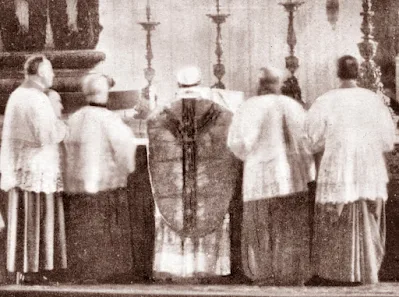
Pope Pius XI celebrating Mass in a Gothic chasuble made for him by the Poor Clares of Mazamet, France. Source: Raymund James, “The Origin and Development of Roman Liturgical Vestments” (Exeter: Catholic Records Press, 1934), page 2.
In 1934 the Catholic Church in Australia held a National Eucharistic Congress in Melbourne, celebrating the centenary of the church in that country and featuring “unprecedented” spectacular ceremonies and vast numbers of clergy and laity. On November 30, following the opening ceremonies for the congress, pontifical high mass was celebrated at St. Patrick’s Cathedral by papal legate Cardinal Joseph MacRory in the presence of 60 bishops and 450 priests from around Australia. The cardinal and celebrating ministers wore Gothic vestments. [50]
The Telegraph (Brisbane), Nov. 30, 1934, p. 7 
The following day Archbishop Filippo Bernardini, papal nuncio to Australia, celebrated another pontifical high mass in St. Patrick’s Cathedral for a crowd of more than 7,500 people, wearing Gothic vestments, which were frequently used throughout the Eucharistic Congress. [51]
Full approval of Gothic Vestments
In the years which followed, various members of the hierarchy of Australia continued to use Gothic vestments in high-profile settings, as in 1937, when Archbishop of Adelaide Andrew Killian used them during the consecration of Francis Henschke as Bishop of Wagga Wagga. [52]
They continued to receive official approval and use around the world during these years, for example, being authorized for the Archdiocese of Malines by Cardinal Jozef-Ernest van Roey in 1938, and by the Second Diocesan Synod of Quebec in 1940. [53]
Gothic vestments even reached the literal ends of the Earth during this period. During the US Navy’s Antarctic Expedition, on January 26, 1947, the first ever Catholic Mass offered in Antarctica was celebrated in extremely rustic conditions in the mess hall of camp ‘Little America IV’ on the Ross Ice Shelf. Rev. William Menster, chaplain of the flagship USS Mount Olympus, used green Gothic vestments. [54]
At left, Rev. William Menster; at right, the USS Mount Olympus (AGC-8) in Antartica, 1947. (Sources: left and right.)
Finally, on August 20, 1957, the Sacred Congregation of Rites issued a decree which gave bishops the right to permit the use of Gothic vestments in their own dioceses. From this point onward their use, which had been regular throughout the world by priests and bishops alike since 1925, only further increased.
NCWC News Service, Aug. 31, 1957, wire copy p. 8
Conclusions
This concludes our survey of the use of Gothic vestments between 1841 and 1957. It is a story far more complex and fascinating than that depicted by conventional narratives. What can we make of all this? I think there are several key points which are worthy of summary and further discussion.
First, it is abundantly clear that the ‘revival’ of Gothic vestments in the modern period was much more widespread throughout Europe–particularly in England, France, and German-speaking lands–much earlier than commonly thought. By 1849 it was authorized by multiple bishops (in some cases on a diocesan-wide basis) across the continent.
Second, it is also clear that from the very early days of the Gothic revival, there were some officials in Rome who were skeptical and disapproving of the use of these vestments. The number of those who disliked the Gothic, as well as their roles and the intensity of their opposition, varied over the years. On multiple occasions, the popes themselves directly gave approval for and/or approving remarks about Gothic vestments. But in general, there was consistently more opposition than support from various members of the curia.
Despite this, it is also evident that Rome did not ever unequivocally condemn or actually attempt to stamp out the practice, and that there was widespread toleration of Gothic vestments, which evolved into permission to the local bishops. [55] There were no formal restrictions against Gothic vestments until the circular letter of 1863, and even then it was not viewed by chanceries and clerical journals around the world as a strict ‘ban’. The text of the letter was not published for more than 60 years afterwards and not a single different or clarifying statement was ever issued by Vatican officials.
It’s obvious that there was a persistent lack of clarity on what Rome permitted, tolerated, or forbade, as is evident from the number of times the question was raised in clerical journals and Catholic periodicals). There was also a widespread interpretation that Gothic vestments could continue to be used with the permission of the bishop. Because of this, the situation varied from diocese to diocese and region to region. In some cities or dioceses, the use of Gothic vestments was fully approved; in others, it was forbidden or limited.
All of this demonstrates how difficult it would be to claim that there was a clear message from Rome or to assign the label of disobedience to those many priests, bishops, and laity who produced, purchased, and used Gothic vestments for decades even after the 1863 letter. They were discussed approvingly in diocesan newspapers, permitted and used by the bishops and cardinals of the region, and routinely sanctioned by canonical and clerical journals. If the use of these vestments was in fact disobedient or forbidden during these decades, could the common priest or member of the laity have been expected to discover that fact with any certainty? [56]
Even after the Vatican rescript of 1925–which merely pointed back to the 1863 letter, and again, was not interpreted as a ban–the use of Gothic vestments did not slow or diminish. Just 5 years after the rescript, the pope himself was photographed in Gothic vestments. Within less than a decade, multiple papal nuncios and legates were regularly using them in the most high-profile and public ceremonies possible.
Photograph of the Gothic vestments blessed by Pope Pius XI in 1925. Source: Dom E.A. Roulin, Vestments and Vesture: A Manual of Liturgical Art (London: Sands & Co, 1933), page 82.
Because the use of Gothic vestments was so widespread before 1900 (and was desired and encouraged by so many different priests and bishops in so many different countries for so many years) it seems clear that it would have been essentially impossible to avoid the trend even without the advent of the modern Liturgical Movement in the 1920s.
If Rome truly viewed the ongoing use of Gothic vestments as a clear abuse or explicitly forbidden, it must be said that they handled it in one of the worst and most ineffective ways possible. Furthermore, once papal representatives and the pope himself began to even occasionally use them for public masses, any remaining doubt about their permissibility was eliminated in the mind of Catholics around the world.
Following the decree of 1957, Gothic vestments came to dominate the ecclesiastical landscape and their use for the last several decades has been essentially universal. Contrary to the expectations of the writer in America in 1910, it seems that the vast majority of priests in the mid-20th century did not adopt the Gothic with “heavy hearts” after all. It is also interesting that the lighthearted commentary from 1926 now appears to be extraordinarily prescient:
“The question of amplitude or non-amplitude in vestments will never, let it be hoped, rise, or descend, to schismatical proportions. There was a long dispute over the date of Easter. The war of the Vestments ought to be settled within a generation or two at the utmost.” [57]
And indeed it was.
NOTES (numeration continued from previous article):

[38] The Advocate (Melbourne), June 4, 1925, page 15.

Saturday, August 26, 2023

A Modern History of Gothic Vestments, 1838-1957 (Part 2): Guest Article by Nico Fassino

This is the second part of Mr Nico Fassino’s article on the history of the revival of Gothic vestments; the first part was published on Wednesday. Mr Fassino is the founder of the Hand Missal History Project, an independent research initiative dedicated to exploring Catholic history through the untold and forgotten experiences of the laity across the centuries. Learn more at HandMissalHistory.com or @HandMissals. Once again, we are very grateful to him for sharing his interesting and thoroughly well-researched work with us.

Reception of the 1863 letter

Despite the 1863 letter from the Sacred Congregation of Rites, the use of Gothic vestments did not seem to be much changed in the years which followed. Records demonstrate the widespread and uncontroversial use of Gothic vestments around the globe during these years, including:

  • In 1870, a magnificent set of Gothic vestments worth approximately $50,000 in modern valuation was given to Bishop Richard Roskell of Nottingham for use in the cathedral. [15]
  • In 1873, Archbishop of Sydney John Polding wore “rich” Gothic vestments as he ordained Christopher Reynolds as Bishop of Adelaide in a large ceremony attended by at least four other Australian bishops. [16]
  • The 1867, 1879, 1883, and 1885 retail catalogs of Benziger Brothers, the premier Catholic publishing house and church goods retail in the United States, offered Gothic-style vestments. [17]
  • At his ordination by 1887, newly-consecrated Bishop of Wilcannia John Dunne wore “a superb and costly” set of white and gold Gothic vestments. [18]
  • By 1895, one account observed: “… there is a great diversity in this respect [of vestments] in the Roman Catholic Church. In England, the Gothic, French, and the Italian chasubles are all freely used by the Roman Catholic Clergy. [...] The Swiss Roman Catholic clergy and those in many parts of Germany use Gothic vestments, not those of Renaissance form”. [19]
Archbishop of Sydney John Bede Polding in Gothic vestments, 1866
Another summarized the situation thus: “[a]s in England, so also on the Continent, the advance of the ample chasuble was notable. By 1900 many dioceses in Western Europe could show churches where it was in use. Some of them had secured indults, some had simply accepted a growing custom, and all could cite the example of Rome itself, where several cardinals and at least two popes (Pius IX and X) encouraged the ample chasuble and used it themselves.” [20]
Helene Stummel, ca. 1890
Helene Stummel, wife of the famous artist Frederick Stummel, was a vestment maker, and a passionate advocate for the revival of Gothic vestments during these years. She was sought after by many bishops, taught regularly across Europe, and published books on recommendations for the design of vestments:

“Madam Stummel has lectured before cardinals, bishops, and the clergy in Rome, before the Congresses of Cologne and Dusseldorf. Recently a number of the Bishops of England have invited her to speak before the conferences of the clergy and in their seminaries to the students of theology. She possesses a singular mastery of the subject, and has the means to illustrate her clear and erudite expositions from a rare collection of paramentics gathered and disposed with artistic skill and a thorough realization of the dignity of the subject.” [21]

One may wonder how such a situation could exist following the circular letter of 1863. It seems exceedingly implausible that significant numbers of bishops and priests of multiple countries throughout the world were deliberately disobeying Roman directives. What then is the explanation?

Interpretation of the 1863 letter
First, it is interesting to note that the 1863 letter was not published or included in the official collection of decrees and decisions of the Sacred Congregation of Rites for more than sixty years after it was written. It is possible that, because of this, in some isolated cases the letter went unheeded due to lack of awareness, or because it was viewed as less authoritative than a formal decree. [22]

The letter was widely known in general, however, and regularly cited in clerical journals or similar interpretive authorities. These discussions demonstrate how the 1863 letter was understood and applied over decades and suggest an explanation for why the use of Gothic vestments continued: in short, the letter was not considered to be an unequivocal or totally restrictive ban.

Writing in 1884, the editors of the Irish Ecclesiastical Record explained that this letter permitted Gothic vestments to continue to be used but prevented any new vestments from being produced: “[i]n the face of this decree, it is not lawful to manufacture new vestments of this pattern. The bishop may allow the use of those already made, till they are worn out.” [23]
Painting of Rev. William Lockhart, from the cover of “William Lockhart: First Fruits of the Oxford Movement” (Herefordshire: Gracewing, 2011).
Rev. William Lockhart, a convert and friend of John Henry Newman, offered extensive commentary on the 1863 letter in the pages of the Irish Ecclesiastical Record in 1890, stating that, among other things, the manufacture of ‘Borromean’ chasubles (in the size and shape prescribed by St. Charles Borromeo) remained fully permitted without requiring any special permission, as did the ‘Galway’ chasuble in Ireland. [24]

Despite the continuing use of Gothic vestments and the prevailing interpretation that the 1863 letter permitted this (but not the manufacture of new ones), Rome did not issue any further instructions, clarifications, or restrictions. [25]
The hated modern ‘French’ style
It is also worth noting that there were a number of prominent clerical and lay figures during these years who regularly wrote about their preference for the Gothic style in clerical journals and Catholic periodicals. Ernest Gilliat-Smith, for example, wrote in 1890, “... to my mind, Gothic vestments are preferable to Roman, both from an artistic and symbolic point of view, and I hope and trust that one day their use may be universal.” [26]

There was also widespread and long running disdain for the cheap, mass-produced French (modern fiddleback-style) vestments. These had undergone rather significant changes in style – described by some as “cutting and clipping” and others as “mutilation” – both before and after the French Revolution. These new forms were not forbidden by Rome and had quickly spread throughout Italy and elsewhere. [27]
Example of French-style clerical dress, 1776
The trend was described by the editors of the American Ecclesiastical Review as “[t]he growing abuse of the viol- (fiddle-) shaped chasuble, forced on the ecclesiastical market by the French makers of paramentics and silk merchants.” [28] Commentary in the Irish Ecclesiastical Record in 1890 is at turns both comical and illustrative, and seems worth quoting at length:

“Who can describe the abortion of the chasuble that pervades France at the present day? Fiddle-shaped in front, not coming down to the knees, stiff with buckram, or paper pasted on the poverty-stricken half-cotton-half-silk material of Lyons manufacture. They are as stiff as tea-boards, and crack if they are bent.

“I was told a story lately in Belgium, of a priest who objected to the stiff paper pasted between the flimsy silk and cheap cotton lining. The manufacturer [...] misunderstanding the objection of the priest, replied: ‘Yes, M. l‘Abbe, we always use paper, in order that they may wear better, and to add to the substantial appearance of our vestments; but I assure you, on this point I have a delicate conscience, and I never put into vestments anything but des bons journaux Catholiques [good Catholic newspapers].”

“These Lyons vestments are going every day all over the world. They are cheap, and Les Dames pieuses can thus make their collections go a good way in providing vestments for Les Missions Etrangeres. [...] We need not wonder that Pius IX intimated in the letter of Cardinal Patrizi that there might be good reasons (rationes alicujus ponderis), in favour of a return to the more ancient form of the vestment.” [29]

Even the noted authority Bishop Josephus van der Stappen commented dismissively on the French corruption of the chasuble:

“Hence, when the ancient chasuble had, in the course of time, been cut down from its generous proportions of old, to the skimp reduction of modern times, and the evil had found its way from France into the neighboring countries, there arose in England, France itself, Germany, and Belgium men who, animated by a zeal for Christian art, sought on their own account to restore the ancient practice by adopting the more beautiful style of Gothic vestments...” [30]

American Gothic (Vestments)
In America, by the turn of the century, there was some regular use of Gothic vestments and clear clerical support for more. Even the editors of the Ecclesiastical Review, nobody’s idea of progressive innovators, routinely featured pieces and editorials supporting their adoption.
Excerpt from the Ecclesiastical Review, April 1910
Beyond mere support, the Review was considered to be a driving force behind a movement pushing for the change in vestments. A letter from 1910 begins: “To the Editor, The Ecclesiastical Review. My hearty congratulations upon the movement you have started for the very desirable reform in our church vestments. Enclosed is a typical letter showing that you have many well-wishers with you in this matter…” [31]  Multiple examples of proposed Gothic designs were published in the Review, along with example measurements of what was permissible.
Model of proposed Gothic chasuble in the Ecclesiastical Review, December 1909, page 687.
The use and permissibility of Gothic vestments were widely discussed in various Catholic publications of the time. Some discussions even considered the potential future of a Roman decree to abandon fiddlebacks and exclusively adopt the Gothic! A 1910 editorial in the Jesuit journal America commented on the matter in a rather cheeky fashion:

The proper form and colors of vestments is being discussed in the Ecclesiastical Review[…] they represent a school long in existence in Germany and England, and are strong in art and aesthetics. We fear the faithful are largely Philistines [regarding which style of vestments they prefer]. Moreover, the Latin races are not likely to submit gladly even in this matter to the Teuton. [...]

If the Holy See so ordains, priests will all exchange our aniline-dyed, fiddle-shaped vestments for modified Gothic of subdued, esthetic hue. But many will do so with heavy hearts and there will be heavy hearts, too, among their people. It is hard to part with old friends, and the modern form and the bright colors have many to love them. For, after all, as Andrew Lang, singing in ‘The Galleries’ the charms of the two schools of art, confesses: ‘You still must win the public vote, Philistia!’ ” [32]

Examples of a proposed three-tiered system of vestments, in the Ecclesiastical Review, March 1910, page 351. This system was devised by Bishop Wilhelm von Keppler of Rottenburg, Germany. [33]
Through the first decade of the twentieth century we find records of the use of Gothic vestments across America. In 1910, Gothic vestments were in use in St. Mary’s church in Portland, Oregon. The Tabernacle Societies of the cathedrals in Baltimore and Cincinnati, which funded supplies and furnishings for parishes too poor to afford them, regularly produced Gothic vestments during these years. [34]

In 1914, the general American situation was summarized as follows: “[d]uring the last few years there has been a steady advance, especially in our larger city churches, towards a more exact observance of the rubrics and the carrying out of the solemn services of the Church. One of the notable features has been a closer approach, in the matter of vestments, to the old Roman usage, and many churches have adopted altogether the use of the so-called Gothic (old Roman) chasuble in place of the violin-shaped garments introduced by Gallican enterprise.” [35]

Example of Gothic vestments being given to bishops as gifts. Source: NCWC News Service, May 28, 1923, wire copy page 15.
Parishes were proud to own fine Gothic vestments and hefty sums were paid out for the best sets from American and European retailers. They were also frequently given as gifts by various parish or diocesan groups to their priests and bishops. For example, in 1922 the St. Anne Married Ladies’ Sodality at St. Mary's parish in Dayton, Ohio paid $900 for an imported set as a Christmas gift to their pastor (equal to $16,345 in 2023 when adjusted for inflation). [36]

By 1924 they seem to be in widespread and regular use, at least in certain parts of the country. In Cincinnati alone there are multiple examples of Gothic vestments mentioned in less than 12 months: at the Student’s Crusade Castle chapel, at the parishes of St. Margaret of Cortona and St. Agnes, and even at the Cathedral. [37]

This concludes the second article in this series. The third and final article will explore the use of Gothic vestments between 1925 and 1957 and offer conclusions concerning the whole series.
NOTES (numeration continued from previous article):
[15] The Nottinghamshire Guardian, April 22, 1870, page 2. The set was donated by nuns of Cologne, Germany and was valued at between £400-500 in 1870, or £39,180 adjusted for inflation as of June 2023.

Wednesday, August 23, 2023

A Modern History of Gothic Vestments, 1838-1957 (Part 1): Guest Article by Nico Fassino

Last November, we published a research project by Mr Nico Fassino on the 1954 English Rituale. He has now graciously shared with us a new project, this time on the history of the revival of Gothic vestments, which will be published here in three parts. Mr Fassino is the founder of the Hand Missal History Project, an independent research initiative dedicated to exploring Catholic history through the untold and forgotten experiences of the laity across the centuries. Learn more at HandMissalHistory.com or @HandMissals. Once again, we are very grateful to him for sharing his interesting and thoroughly well-researched work with us. 

I recently saw a question about the modern history of ‘Gothic’ style vestments in the Roman Catholic Church. How and when were they re-introduced? At what point were they fully authorized for widespread use?

I am not an expert on vestments and have never studied their history. I was only casually familiar with what I would call the “common” narrative: that Gothic style vestments were illicitly adopted by some members of the Liturgical Movement in the early 1900s, forbidden as an abuse by Roman authorities, and only authorized in 1957 after which they became increasingly popular.

I was curious. Was this an accurate account or was there more to the story? I decided to explore historic Catholic newspapers and other contemporary material to see what I could find.

English Revival: Origins & Debate
The modern history of Gothic vestments largely begins with Augustus Welby Pugin (1812-52), at least for English-speaking lands. Pugin was a convert to Catholicism and an extraordinarily prolific ecclesiastical designer and architect. It is impossible to overstate his role or influence in launching the Gothic Revival movement.

Augustus Welby Pugin, by John Rogers Herbert, 1845 (source)
Bishop Thomas Walsh, Vicar Apostolic of England’s Midland District (one of the administrative regions of the English Catholic Church before the restoration of the hierarchy in 1850 - editor’s note), was a strong supporter of Pugin and “gave him almost a free hand in attempting to revive the old Gothic vestments of pre-Reformation days, besides encouraging him to build and restore churches in the Gothic style.” [1] This revival was not limited to England, however. On the Continent at this time, other figures were likewise involved in efforts to revive the use of Gothic vestments, including Dom Prosper Gueranger, abbot of monastery of Solesmes, and Canon Fanz Bock of the cathedral of Aix-la-Chapelle. [2]

Pugin’s efforts were quite successful and Gothic vestments were widely adopted by English clergy in these years. One notable public use of these vestments was at the opening of St. Mary’s College, Oscott in 1838 which was attended by several bishops and over 100 priests.

H.E. Bishop Antonio Mennini (then nuncio to Great Britain) wearing a Pugin vestment at St Mary’s College, Oscott, during a vocations conference held there in 2011.
But not all members of the English clergy were enthusiastic about these trends. Some, like Bishop Augustine Baines of the Westland District, opposed Pugin’s vision for vestments, church ornamentation, the restoration of Gregorian Chant, and other parts of the ‘English Catholic Revival’. Baines forbade his clergy to wear Pugin’s vestments and complained to Rome about them. [3]

In 1839, Bishop Thomas Walsh of the London District received a letter from the Congregation for the Propagation of the Faith which expressed displeasure with what he was permitting in his diocese. The letter also referred directly and dismissively to Pugin as “an architect converted from heresy” who was behind these innovations. Pugin corresponded about this with his friend and fellow convert Ambrose Phillipps De Lisle. De Lisle later wrote to another shared acquaintance and patron–John Talbot, Earl of Shrewsbury:
… that the College of Propaganda is to regulate even the minutest details of our ecclesiastical dress, is to assume for a foreign congregation a degree of power that has never yet been claimed by any Pope, no nor even by any General Council of the Church.

An uniformity of vestments or even of rites and Liturgies has never yet been enforced in any period of the Church [...] Italy has her Chasubles very different in many respects fm. those of France, of Germany, and of modern England [...] ; it is therefore idle to say that the restoration of the old English Chasuble hurts the uniformity of the Church, seeing that no such uniformity exists: it is equally idle to say that it infringes upon the rubricks ; when the rubricks were composed most assuredly the modern form of vestments existed not, and therefore if either offended against them, it wd. be the latter, not our glorious old English form. [...]

No, deeply do I deplore this lamentable business: its consequences if persisted in, will be most disastrous, the very idea of them fills me with horror and alarm. [4]
Despite the 1839 letter from Cardinal Franzoni to Bishop Walsh, and the initial despair of Pugin and De Lisle, no formal restrictions to the use of Gothic vestments were issued from Rome, and their use continued to spread throughout England, and in France, Belgium, and Germany.

English Revival: Continued Use
In June 1841, the new Cathedral of St. Chad in Birmingham–commissioned by Walsh and designed by Pugin–was opened in an extraordinarily grand ceremony attended by thirteen bishops from around the world (two from Scotland, one from the United States, and one from Australia) including Bishop Baines. [5] For this Mass, Bishop Nicholas Wiseman and the celebrating ministers wore a set of gold Gothic vestments which had been designed by Pugin. [6]

Illustration of the original interior of the Cathedral of St. Chad in Birmingham. From Robert Kirkup Dent, “Old and New Birmingham: A History of the Town and Its People” (Birmingham: Houghton and Hammond, 1880), page 458.
In the decades which followed, Wiseman would be appointed as the first Cardinal Archbishop of Westminster and become the driving force for trends within the newly re-established Catholic Church in England. He would continue to use Gothic vestments regularly. [7]

After the re-establishment of the Catholic Hierarchy and the First Provincial Synod of Westminster in 1852, now-Cardinal Wiseman traveled to Rome to submit the synodal decrees for Vatican approval. So widespread was the use of Gothic vestments at this time, it was rumored in the secular press that Rome intervened to edit the decrees in an attempt to regulate or ban them.

4. Dumfries and Galloway Standard and Advertiser, November 2, 1853, page 2.

Tuesday, August 08, 2023

St Francis of Assisi: Illuminations by Matthew Paris

I recently visited an exhibition at the National Gallery in London that focused on art relating to St Francis of Assisi. In the course of the next few weeks, some of my posts will show what was featured there. There were some excellent examples of traditional art, ranging from Italo-Byzantine to Gothic to Baroque, and just for comparison, as the dissonant chord that makes harmony all the more sweet, some truly awful modern images. The contemporary artists seemed more intent on undermining the Faith and trying to push it into a contemporary box of leftist or relativist dogma, rather than revealing Truth (more on those later in the series).

This week, however, something good!

There was a manuscript of a world history, the Chronica maiora of Matthew Paris, with illustrations of St Francis and a six-winged seraph, exquisite tainted pen drawings in the style of the 13th-century English school of St Albans, of which he was the pre-eminent exponent.

The above are in fact reproductions of illustrations drawn in the margin of the book, the originals of which are tiny!


There are two volumes of this history, which focuses, as one might expect, on Church history as a crucial aspect of world history (in contrast to the approach to history of many contemporary historians, who tend to write the prism of woke, neo-Marxist ideology).

The chronicle normally resides in the Parker Library and Corpus Christi College Cambridge. The library website contains the following description:
Matthew Paris OSB (c. 1200-59), a Benedictine monk of St Albans Abbey, was their official chronicler who wrote chronicles covering both world history and British history. These two volumes are of his most important work, the Chronica maiora, covering world history, but with a particular emphasis on that of Britain - vol I is CCCC MS 26 and vol II is CCCC MS 16, their production dating to the period c. 1240-55. Matthew was also a talented artist who was both scribe and illustrator of his own chronicles. These volumes have coloured marginal drawings, and also signs and heraldic shields in the borders signifying the persons and incidents in their lives, and also signifying their deaths, set beside the text passages mentioning these events. Recently, in 2003, the prefatory section to MS 16 (ff. i recto - v verso), containing lists and genealogies of kings, a diagram of the winds, itineraries, maps, and the picture of the elephant given by Louis IX to Henry III, has been bound separately as MS 16I. The part containing the chronicle text itself, ff. 1v-282r, has been rebound as MS 16II.

I wonder at the control that the 13th-century artist had when working on such a small scale. He must have had exceptional eyesight to work without the aid of optical devices and modern lighting systems. I speak as one who at 61 years old, would struggle to match it with something twice the size, even with the best reading spectacles, magnifying glasses and electric spot lamps!

More recent articles:

For more articles, see the NLM archives:



